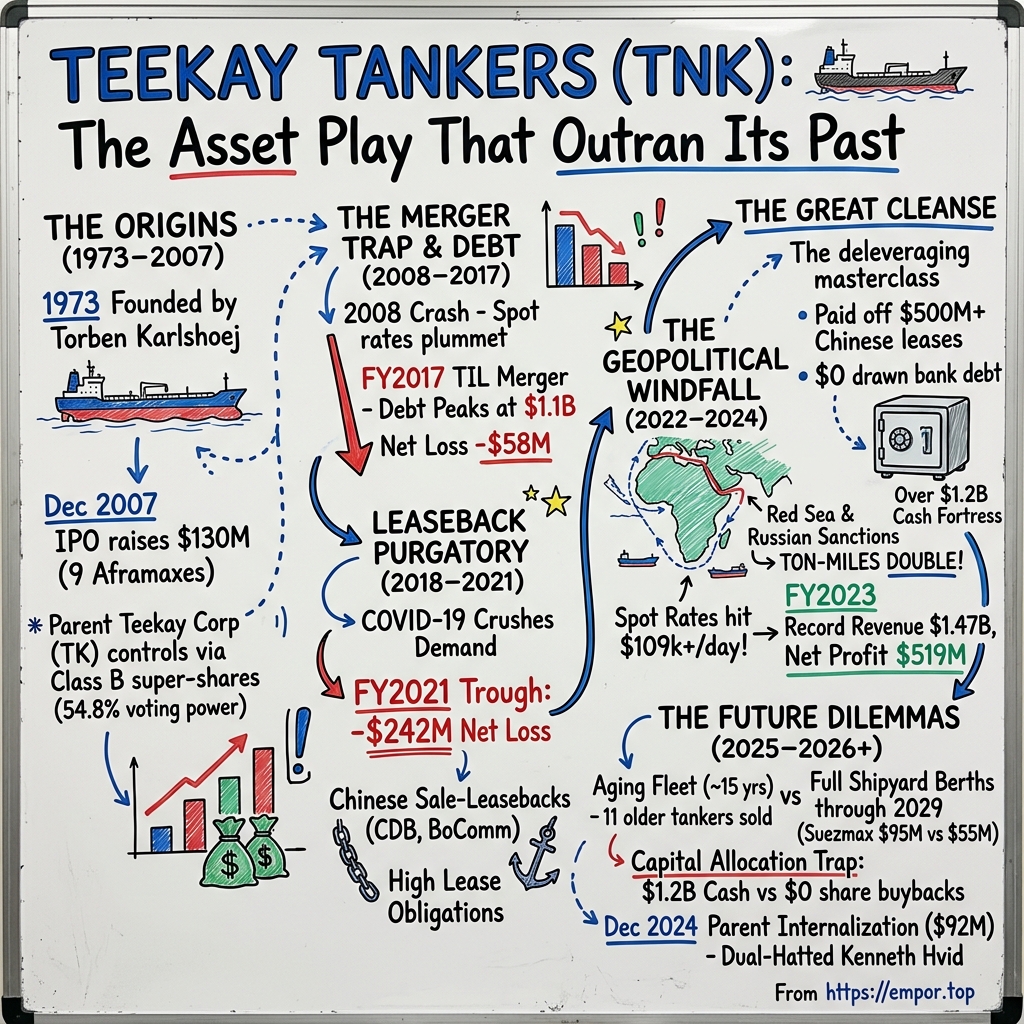
Teekay Tankers: The Asset Play That Outran Its Past
I. The War Chest on the Water
Somewhere off the coast of West Africa in the spring of 2026, a Suezmax tanker owned by Teekay Tankers was going the long way round. It was carrying about a million barrels of crude, too big for most small ports and too small to count as a supertanker. It was the kind of ship that has spent fifty years doing the unglamorous middle-distance work of the oil trade. For most of that time it earned a living that barely covered the crew, the steel and the interest. In the second quarter of 2026 it earned something closer to a lottery payout. Teekay's Suezmaxes on spot voyages averaged about $109,200 a day in that quarter, and its Aframax and LR2 tankers averaged about $74,100.1 For scale, a ship like that costs somewhere in the high four figures a day to crew and maintain.
When the company closed its books on June 30, 2026, the scene in the treasury was stranger still for a shipowner. Teekay Tankers held about $1.21 billion in cash and short-term investments, and it had drawn nothing at all on its bank credit line.2 Its only remaining obligations of any size were leases on chartered-in ships, worth less than $30 million.2 Net of those, the company held roughly $35 of cash for every share outstanding. Shipping companies are supposed to own ships and owe banks. This one owned ships and lent money to the commercial paper market.
That is a remarkable place for this particular company to be standing, because for most of its two decades in public life Teekay Tankers was the cautionary tale. It issued shares to buy ships at the top of the market. It bolted on a sister company full of debt in 2017. It survived the freight winter of 2021 by handing its hulls to lease financiers. At the end of that year it owed about $654 million, and its cash had shrunk to about $50 million.3 The ratio of debt to shareholders' equity, which stood above one for most of the 2010s, has fallen to about 0.03.3
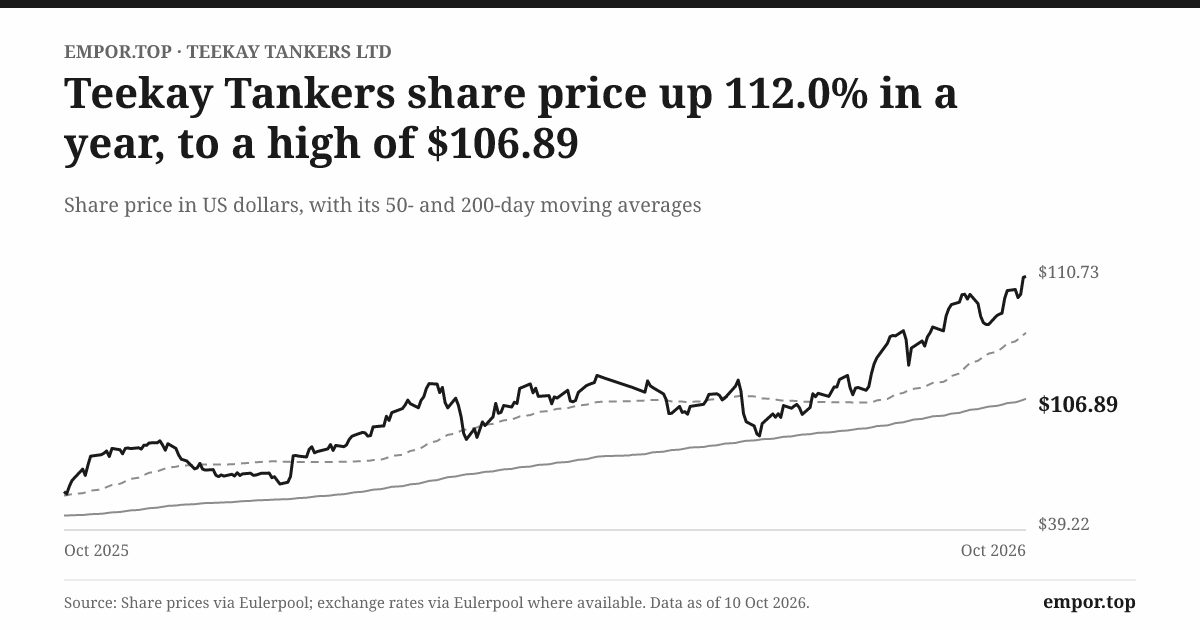
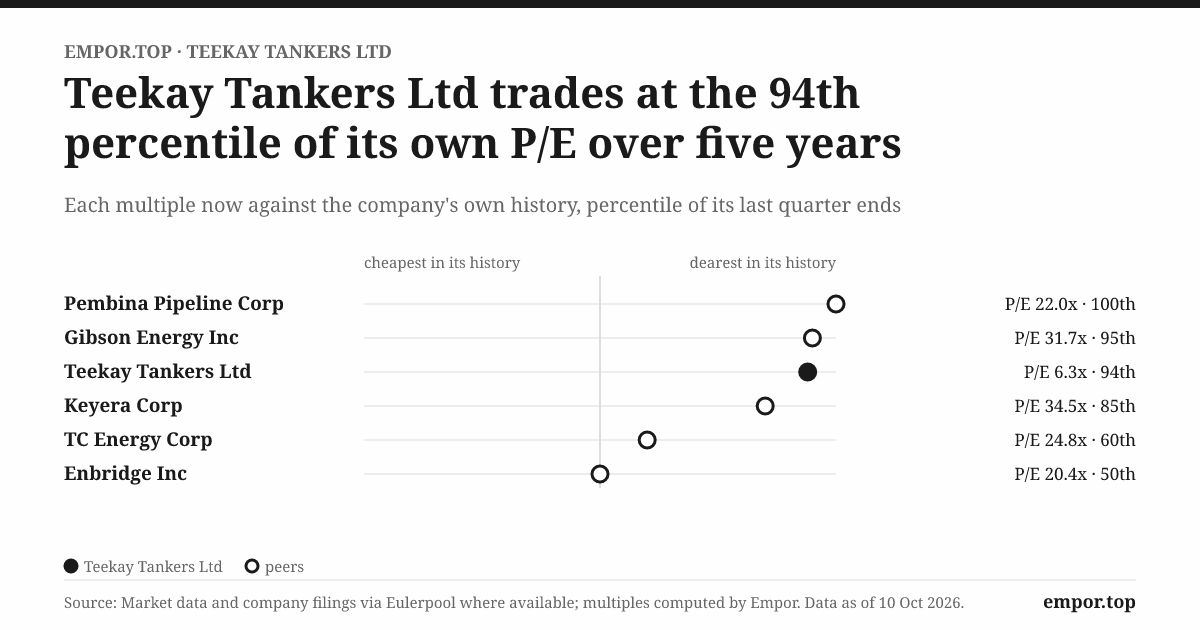
The market has noticed, but only partly. On October 10, 2026, the shares closed at $106.89, a 52-week high, giving the company a market value of about $3.7 billion.4 Strip out the cash, and the enterprise value, which is roughly what a buyer would pay for the operating fleet itself, was about $2.5 billion. That is around 3.7 times trailing EBITDA and 6.3 times trailing earnings.4 Those are the multiples of a business the market expects to earn far less in the future than it does today.
So this is a story with three questions running through it. The first is about the money. Kenneth Hvid, the chief executive, sits on more than $1.2 billion, an aging fleet and a $100 million buyback authorization that, as of mid-2026, had not been used to buy a single share.5 Will that cash go back to shareholders, or will it go to shipyards charging peak prices? The second is about who the money really belongs to. Teekay Corporation, the parent that created this company, owns about 31% of the economics but controls about 55% of the votes through a class of super-voting shares.6 Do public shareholders share equally in this windfall, or do they ride along? The third is about the tide. Is the $100,000-a-day freight market a structural shift caused by sanctions on Russia and missiles in the Red Sea, or the top of a cycle that has ended in a crash every time before?
The honest verdict, laid down at the start and tested for the rest of the episode, is this. Teekay Tankers has carried out one of the cleanest deleveragings in modern tanker shipping. But its record profits are mostly a geopolitical windfall earned by an older fleet, not proof that the business itself has changed. To see why that distinction matters, the story has to go back to a Danish shipbroker in Vancouver and the reason this company was created in the first place.
 Subscribe on LinkedIn
II. The Viking Legacy and the Daughter Spinoff (1973–2007)
Torben Karlshoej founded Teekay in 1973. He was a Danish-born shipping man who built his company not around the glamour trade of the era, the giant VLCCs carrying two million barrels from the Persian Gulf, but around smaller, more versatile ships.7 His instinct was that the middle of the market was where the steady work was. Big tankers serve big terminals. Mid-sized tankers go everywhere else.
That idea defines Teekay Tankers to this day, so it is worth understanding the ships. An Aframax carries roughly 80,000 to 120,000 deadweight tonnes, about 700,000 barrels of crude. A Suezmax carries about 120,000 to 160,000 tonnes, roughly a million barrels, and is named for being the largest ship that could pass loaded through the Suez Canal. An LR2 is essentially an Aframax with coated tanks that can carry refined products as well as crude. The reason these ships matter is flexibility. A supertanker is like a freight train that only runs between two stations. An Aframax is more like a truck. It can enter shallower regional ports, run short trades across the North Sea or the Caribbean, and do lightering, the delicate business of transferring cargo at sea from a giant tanker to smaller ships that can reach the dock.
Karlshoej died in 1992, but the company he built kept growing, and control passed into a trust he had set up, now known as the Kattegat Trust.6 By the mid-2000s Teekay Corporation had become one of the largest owners of mid-sized tankers in the world, and it had also learned a new trick that was sweeping shipping finance. Sponsors were carving their fleets into listed "daughter" companies. The parent dropped ships into the daughter, the daughter raised cheap public equity to pay for them, and the parent kept control and kept collecting fees for running the ships. Teekay did it with its LNG business and its offshore business, and in December 2007 it did it with tankers.
Teekay Tankers completed its initial public offering on the New York Stock Exchange on December 18, 2007, under the ticker TNK.8 The prospectus described a company that would start life with a fleet of Aframax tankers acquired from its parent and be run entirely by Teekay's own management companies.9 Its strategy was to pay out most of its cash as dividends, which was the selling point to investors who wanted shipping exposure with an income stream.
The timing looks unlucky in hindsight. Lehman Brothers collapsed nine months later. But for the parent, the timing was excellent. Teekay Corporation had converted ship ownership, the risky part of the business, into public equity just before asset values fell, while keeping the parts it liked best: control, and the fees for managing the fleet.
The structure was built to make that arrangement durable. Teekay Corporation took Class B shares carrying five votes each, which is why, even today with only about 31% of the economics, it holds about 55% of the votes.6 The daughter paid the parent's service companies for commercial, technical and strategic management. By the early 2020s those fees ran to about $35 million to $37 million a year, roughly 3% of revenue and about 40% of the company's general and administrative costs.10 Teekay's executives ran the daughter. And from the beginning, the company's bye-laws renounced corporate opportunities in favor of Teekay Corporation, which meant that if a promising deal arrived, the parent had first claim and the daughter had no grounds to complain.10
That last clause is the one to remember. It tells you what Teekay Tankers was designed to be: not an independent capital allocator chasing the best returns for its own shareholders, but an operating satellite. The company held the ships and the risk. The parent held the steering wheel and the fee meter. Whether that design still describes the company in 2026 is one of the central questions of this story. The first test of it came quickly, because the market Teekay Tankers was born into was about to go very wrong.
III. The Super-Cycle Hangover and the Merger Trap (2008–2017)
To understand the lost decade of tanker shipping, picture the shipyards of South Korea and China in 2007 and 2008. The previous five years had been a golden age. Chinese demand was pulling oil around the world, freight rates were fat, and owners ordered ships as fast as yards could build them. Ships take two to three years to deliver. So when the financial crisis cut oil demand in 2008 and 2009, the ships ordered at the peak kept arriving for years afterwards, into a market that no longer needed them.
This is the core mechanism of the tanker business, and it repeats in every cycle. Demand for ships moves fast. Supply of ships moves slowly. When rates are high, owners order. When the orders arrive, rates collapse. Through the early 2010s, mid-sized tanker rates spent long stretches at levels that did not cover the full cost of owning a ship, once interest and depreciation were counted. A daughter company built to pay out its cash had little cash to pay.
Then came what looked like rescue. In late 2014 the oil price crashed, and two things happened at once. Refiners bought cheap crude aggressively, and traders stored oil at sea because the futures price was higher than today's price. Both soaked up tankers. Teekay Tankers' revenue more than doubled in 2015, to about $514 million, and operating profit reached about $187 million.11 Net profit hit $179 million, or more than $9 a share.11
Management read the rally as the start of something lasting. In 2015 the company spent heavily on ships, and its investing cash outflow that year was about $880 million, funded by new debt and new equity.11 Borrowings climbed to about $1.2 billion, and shareholders' equity nearly doubled, partly because new shares were issued.3 It was a classic upcycle bet: buy capacity while rates are strong, on the assumption they stay strong.
They did not. By 2017 operating profit had shrunk to about $1.4 million on revenue of roughly $431 million, and the company lost about $58 million, or $2.19 a share.11 That was the context for the deal that defines this era. In November 2017, Teekay Tankers merged with Tanker Investments Ltd., a vehicle Teekay had co-sponsored a few years earlier to buy mid-sized tankers.12 It was an all-stock deal that brought TIL's fleet of mid-sized tankers into TNK, and with them TIL's debt. Borrowings at the end of 2017 stood at about $1.1 billion against equity of about $1.0 billion.3
The case for the merger was scale and simplicity. The case against it was everything that happened next. Public shareholders were diluted by new shares issued at a weak point in the cycle. The parent sat on both sides of the table. And the deal had a long tail. Years later, in 2025, when Teekay Tankers sold six tankers that had come from TIL, it paid Teekay Corporation a 1% transaction fee on the sales, about $2.1 million.10 The fee is small. The principle is telling: an arrangement struck in 2017 still routed a slice of the proceeds upstairs eight years later.
The record from this period disconfirms any claim that the old Teekay Tankers allocated capital well. Operating cash flow turned negative, about minus $7 million, in 2018 as the downturn bit.11 The dividend, which had paid out about three-quarters of profits in 2016, was cut sharply and then paid nothing at all from 2019 through 2022.11 For a company sold to investors as an income vehicle, that was a broken promise. And the company's debtor days, the time it took to collect what customers owed, had run as high as 132 days back in 2014, a sign of how loose the old business could be.13
The lesson of the decade was not that Teekay Tankers bought bad ships. It was that it bought ships with borrowed money and new shares at the wrong time, and that its parent's interests did not always line up with the shareholders who supplied that money. The bill for those decisions came due in the worst freight market of the century.
IV. The Chinese Leaseback Purgatory (2018–2021)
The spring of 2020 was one of the wildest moments in the history of oil shipping. Saudi Arabia and Russia started a price war just as COVID-19 lockdowns erased a large share of global oil demand. Oil had nowhere to go, so traders stored it in tankers, and for a few weeks owners were paid huge sums simply to let their ships sit full at anchor. Teekay Tankers rode that spike to its best year in half a decade: net profit of about $87 million in 2020 and operating cash flow of about $347 million.11
Then the storage unwound. The oil came off the ships, refineries ran slowly, and OPEC cut production. The tanker market fell into its deepest recession in roughly two decades. For Teekay Tankers, 2021 was catastrophic. Revenue fell almost 40% to about $542 million. The company posted an operating loss of about $194 million and a net loss of about $242 million, or more than $7 a share.11 Operating cash flow swung to about minus $107 million, meaning the ships were consuming cash rather than producing it.11 Return on equity was about minus 29%.13
Picture what that looks like from the CFO's desk. At the end of 2021 Teekay Tankers held about $50.6 million in cash against borrowings of about $654 million.3 Much of that debt was not ordinary bank lending. During the lean years before, the company had financed many of its ships through sale-and-leaseback deals, which is a way of borrowing that looks like renting. The owner sells a ship to a leasing company, often a Chinese bank-owned lessor, and immediately charters it back for years, paying a fixed daily hire and keeping an option to buy the ship back later. The owner gets cash today. The price is a rigid payment schedule, an interest cost usually higher than a conventional bank loan, and the loss of clean title to the ship.
Sale-leasebacks were how many mid-sized tanker owners stayed afloat when banks pulled back from shipping after 2008, and they did their job. The ships kept sailing and the company never missed a payment. But the arrangement left Teekay Tankers with almost no room for error. Every vessel came with a fixed daily obligation that had to be paid whether the market was paying $10,000 a day or $50,000.
The disconfirming lesson of 2021 is uncomfortable for anyone who later wants to describe Teekay Tankers as a strong business. In the downturn it showed no pricing power and no counter-cyclical buffer. It could not raise freight rates, because no tanker owner can. It could not cut costs fast enough, because a ship costs what a ship costs. Its survival depended on the patience of lessors and lenders and on the market turning before the cash ran out. That is not a moat. It is a bet that the cycle will come back.
The cycle did come back, faster and harder than almost anyone predicted. But before telling how, it is worth slowing down to look at the machine itself, because the size of the windfall only makes sense once you understand how a single voyage makes money.
V. The Unit Economics of the Mid-Sized Tanker
Picture a chartering broker in London on a weekday afternoon. A trader needs to move a million barrels of crude from the US Gulf to Rotterdam. The broker canvasses owners with a suitable Suezmax in the right place at the right time, and Teekay's chartering team offers one. They haggle not over a daily rate but over a price per tonne of cargo, quoted on an industry scale. When the deal is struck, the ship is "fixed" for a single voyage.
This is called a voyage charter, and it is how Teekay Tankers earns most of its money. In 2025, voyage charters produced about $785 million of the company's roughly $952 million of revenue, about 82.5%.14 Under a voyage charter, the customer pays freight for the trip, and Teekay pays the costs of getting there: bunker fuel, port charges, canal tolls and broker commissions. To compare voyages of different lengths and routes, the industry subtracts those voyage costs from the freight and divides by the number of days. The result is the time-charter equivalent, or TCE: what the ship earned per day after the costs of the trip. That single number, TCE per day, is the pricing unit of the whole business.
From the TCE, the ship then has to pay its daily running costs: crew wages, insurance, lubricants, spare parts and repairs. On top of that comes a share of the company's overhead and, for most owners, interest and loan repayments. What makes Teekay Tankers unusual today is that the last line is almost gone. With no bank debt and no finance leases, the main fixed costs are running the ship and running the office. Once those are covered, nearly every extra dollar of daily freight drops straight into operating cash flow. When Suezmax rates jump from $40,000 a day to $100,000 a day, almost all of the $60,000 difference becomes profit.
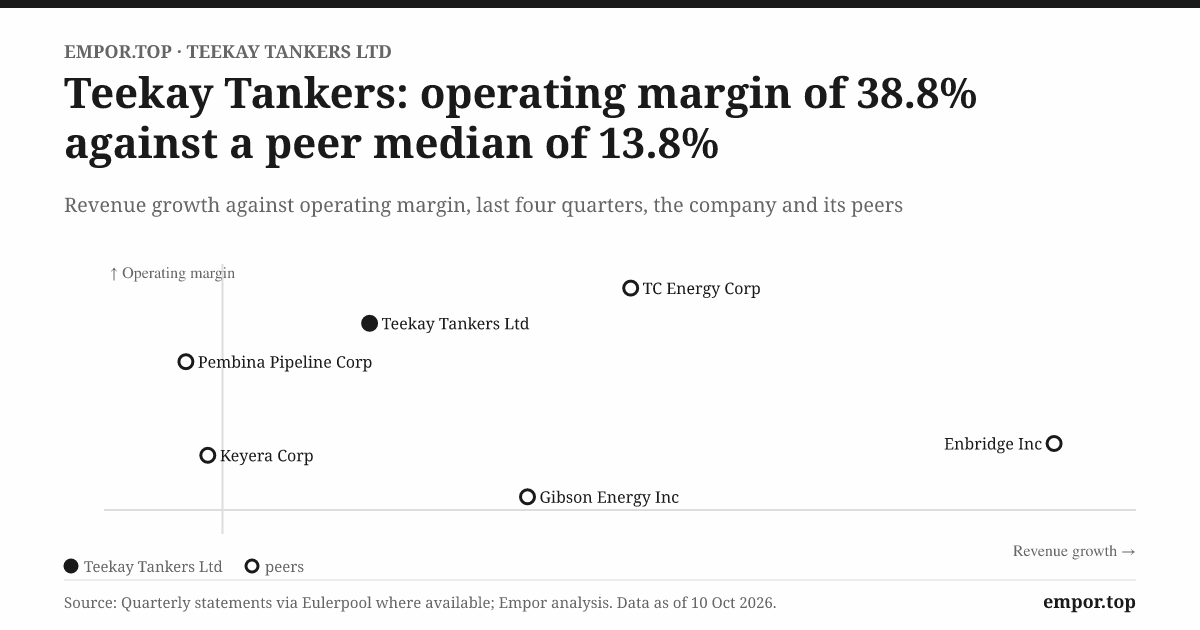
That is why the company keeps most of its fleet in the spot market. At June 30, 2026, 28 of its 38 operating tankers were trading on voyage charters, which left close to 80% of revenue days exposed to whatever the market paid that week.14 Fixed time charters, where a customer hires a ship for months or years at a set daily rate, contributed only about $23 million in 2025, a sliver of revenue.14 Management is choosing upside over certainty. In a boom, that choice is spectacular, and the second quarter of 2026 showed it, with an operating margin of about 50%.15 In a bust, the same choice is what produced 2021.
The customers on the other side of these voyages are the oil majors, national oil companies and big commodity traders. No single customer accounted for more than 10% of revenue in 2023, 2024 or 2025.16 That was not always true. In 2021, Shell alone was about 11% of revenue and Vitol about 10%.16 The spread of customers now reflects a busier market with more shippers looking for ships. These are some of the strongest credits in global commerce, and they pay quickly. Voyage freight is generally settled when the cargo is discharged. At the end of 2025 trade receivables were about $87 million, with a credit-loss allowance of only about $4 million, and debtor days stood at 59, less than half the 132 days of 2014.1317 Bad debts are not where this business loses money.
There is one other piece of the machine, and it is the least cyclical. When Teekay Tankers absorbed its parent's management companies at the end of 2024, it also took on Teekay's Australian operations. That business operates and maintains vessels for the Commonwealth of Australia's defence force and for offshore energy companies. In 2025 it brought in about $118 million, and ship-to-ship transfer support and management fees added roughly another $25 million, for marine services revenue of about $143 million.14 That is about 15% of 2025 revenue, earned on contracts rather than spot rates. It will not make anyone rich, but it pays the bills in a bad year.
Two final features of the economics matter for investors. The first is that depreciation, the accounting charge for the ships wearing out, runs at about $85 million to $100 million a year and costs no cash.18 So over the twelve years from 2014 through 2025, the company generated about $2.5 billion in operating cash flow against about $1.6 billion in net profit.18 Accounting profits understate cash generation over a cycle. The second is that the business is almost untouched by technology disruption. No software can move a million barrels of oil across the Atlantic. What can disrupt it is geography: where oil comes from, where it goes and which routes are open. Between 2022 and 2024 that geography changed in ways that rewrote the company's fortunes.
VI. The Geopolitical Windfall: Sanctions, Chokepoints, and Ton-Miles (2022–2024)
On February 24, 2022, Russian forces invaded Ukraine. Within months Europe had banned most seaborne imports of Russian crude, and the oil trade began to rearrange itself in a way that would be very good for mid-sized tankers.
The key concept is ton-miles. Tanker demand is not just about how much oil is shipped. It is how much oil is shipped multiplied by how far it travels. Before the war, a great deal of Russian crude went a short distance, from Baltic and Black Sea ports to refineries in northern Europe and the Mediterranean, often in Aframaxes and Suezmaxes on voyages of a few days. After the sanctions, Europe had to replace those barrels from much farther away: the US Gulf, West Africa, Brazil, Guyana and the Middle East. And the Russian barrels did not disappear. They went to India, China and Turkey, on voyages several times as long. The same amount of oil was now traveling far greater distances. A fleet that had been just about big enough was suddenly too small.
Mid-sized tankers sat right in the middle of this rearrangement. The Atlantic export trades that replaced Russian crude in Europe are their home market, and the Russian ports themselves are often too shallow or too constrained for supertankers. At the same time, the sanctions split the global fleet in two. Hundreds of older tankers were pulled into the so-called shadow fleet carrying sanctioned Russian, Iranian and Venezuelan oil under opaque ownership and insurance.19 Those ships stopped competing for cargoes from Western oil majors, who will only hire vessels that pass strict vetting. The pool of ships available to Shell, BP or ExxonMobil shrank, and an established, compliant owner like Teekay found itself with fewer competitors.
Then, from late 2023, Houthi forces in Yemen began attacking commercial ships in the Red Sea. Tankers avoided the Suez Canal and the Bab el-Mandeb strait, and sailed around the Cape of Good Hope instead.20 A voyage from the Middle East to Europe got longer by roughly two weeks. Once again, the same oil needed more ships.
The result shows up in the company's numbers like a seismic reading. Revenue more than doubled in 2022, rising about 117% to roughly $1.2 billion, and peaked at about $1.47 billion in 2023.11 Net profit swung from the $242 million loss of 2021 to about $235 million in 2022 and about $519 million in 2023.11 Operating profit reached about $547 million in 2023 and was still about $380 million in 2024.11 Return on invested capital hit about 39% in 2023, a figure that would flatter a software company.13
The consensus story is that Teekay Tankers turned itself around. The record supports a narrower version. Management did not change the ships, the routes or the customers in any way that explains the surge. Rates rose because the world's oil trade got longer, and every compliant mid-sized tanker owner earned similar windfalls. That is not to say management did nothing. What it did with the money is the real achievement of this era, and it is the subject of the next chapter. But the profits themselves were an exogenous gift.
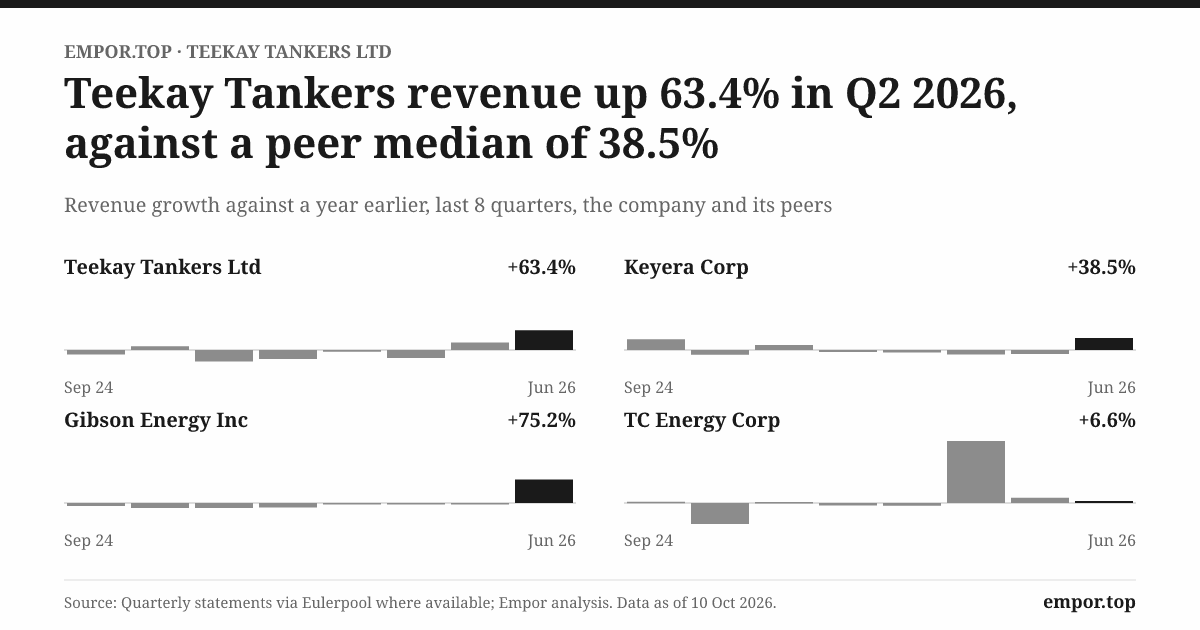
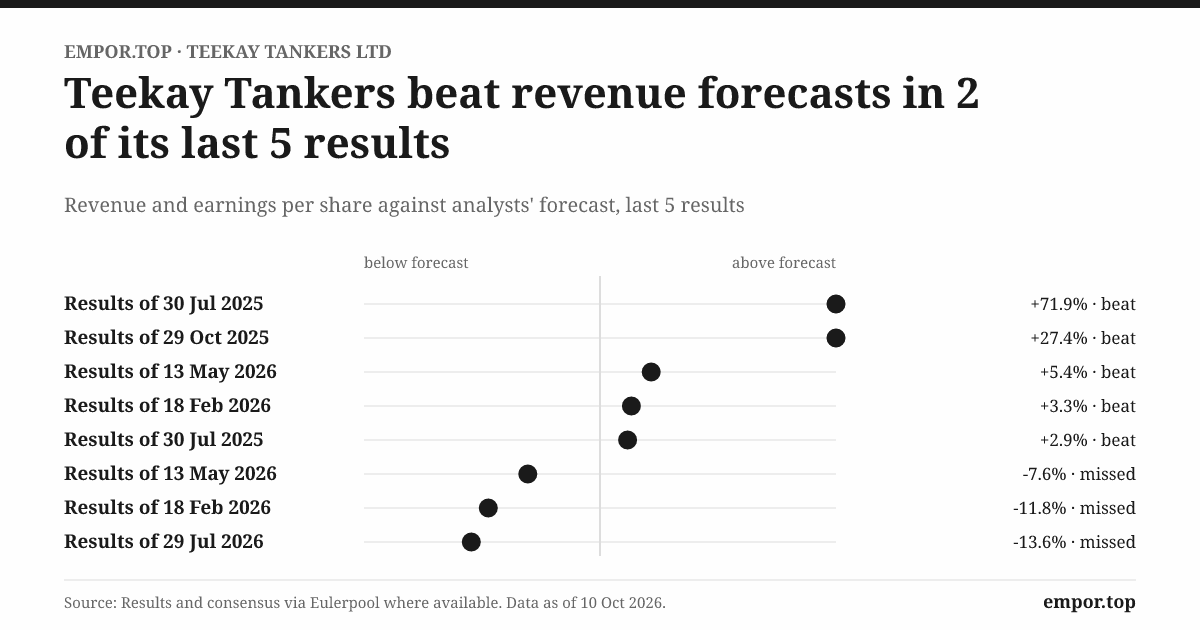
The proof is in what happened when the gift shrank. In 2025 revenue fell about 23% to roughly $952 million, and operating profit fell to about $215 million, less than 40% of the 2023 peak.11 Nothing went wrong at the company. Rates simply cooled. And then, in the first half of 2026, renewed tension in the Middle East and tighter enforcement against sanctioned shipping sent rates back up, and second-quarter net profit hit about $225 million on revenue of about $379 million.15 The earnings of this company rise and fall with the map. The question was never whether the windfall would come. It was what management would do with it while it lasted.
VII. The Great Balance Sheet Cleanse (2022–2025)
In March 2023, Teekay Tankers announced it would exercise purchase options on a group of sale-and-leaseback vessels, buying back its own ships from the lessors who had financed them in leaner years.21 It was the opening move in a campaign that would transform the company over the next two years.
The leadership running that campaign came from inside the Teekay system. Kenneth Hvid is a Danish shipping executive who spent much of his career at Teekay, including years running its oil tanker and offshore businesses, before leaving and later returning to lead both Teekay Tankers and Teekay Corporation.22 Brody Speers, a Canadian accountant who rose through Teekay's finance department, became chief financial officer of both companies.22 Neither is a flamboyant deal-maker. Their record in this upcycle has the feel of men who had watched the 2015 expansion and the 2021 crisis from close quarters and drawn the obvious lesson.
The playbook was simple to describe and hard to stick to. Use the windfall to remove every expensive form of financing, then accumulate cash. In 2023 the company spent about $364 million prepaying lease obligations, and in early 2024 about $137 million more, retiring all of its remaining sale-leaseback financing.23 By December 31, 2024, drawn bank debt was zero, and it stayed at zero through December 2025 and June 2026.23 The $350 million revolving credit facility the company had signed in May 2023 was allowed to shrink as ships were released from its collateral, to about $172 million at the end of 2025 and about $98 million by mid-2026, all undrawn.24
The scale of the change is easiest to see in a single comparison. At the end of 2021, the company had about $650 million of debt and lease claims against about $50 million of cash. At the end of 2025 it had about $55 million of borrowings, almost all of it leases on chartered-in ships, against about $853 million of cash and short-term investments.3 Six months later the cash had passed $1.2 billion.2
The cash flow numbers show where the money came from. Operating cash flow was about $631 million in 2023, about $471 million in 2024 and about $306 million in 2025.11 Ship sales added hundreds of millions more. Dividends, by contrast, took a modest share: about $231 million across 2023 to 2025.25 Over the twelve years from 2014 to 2025, dividends absorbed only about a quarter of the company's free cash flow.11
Is this capital discipline? The evidence says yes, in a specific and limited sense. Management did not repeat 2015. It did not order a wave of newbuildings at the top of the market, and it did not issue shares to buy a rival. Every dollar of high-cost debt was removed. The interest bill that used to eat into every voyage is gone, and the cash now earns interest instead: other income, mostly interest on cash, rose from about $3 million in 2023 to about $32 million in 2025.26 That is a genuine, durable change in the company's ability to survive a downturn.
But debt repayment is the easiest capital decision in shipping. It has a guaranteed return equal to the interest saved, it requires no forecast of freight rates, and nobody gets fired for it. The harder decisions, what to do with the cash once the debt is gone and how to replace an aging fleet, were still ahead. And before them came a decision that tested the relationship between the company and its parent more directly than any since 2017.
VIII. Internalizing the Parent: The $92 Million Governance Reckoning
On December 31, 2024, the last day of the year, Teekay Tankers bought the companies that had been running it. It acquired Teekay Corporation's commercial and technical management businesses, along with the Australian marine operations, for a gross price of about $98 million, or about $92 million net of cash acquired.27 The shoreside staff who chartered the ships, the technical managers who maintained them and the Australian team serving the defence force all moved inside the listed company.
The case for the deal is real. For seventeen years, Teekay Tankers had paid its parent for management whether the market was booming or busting. In 2023 and 2024, those strategic and administrative fees came to about $35 million and $37 million.10 That was about 3% of revenue and roughly 40% of general and administrative costs, a drag that went straight to the parent regardless of performance. From 2025 those fees disappeared on consolidation. By 2025, the remaining related-party flows were tiny: about $2 million of vessel sale fees going to Teekay Corporation, and about $2 million of management fees coming back the other way for work TNK staff did for the parent.10
The accounting tells a more complicated story. Because both companies were controlled by the same parent, the deal was treated as a transaction under common control. Prior years' results were restated as if Teekay Tankers had always owned the businesses, which is why the company's historical figures now include the Australian operations.28 And because the price exceeded the book value of what was acquired, about $37 million, the difference of roughly $61 million was not recorded as goodwill but as a reduction of equity, a return of capital to Teekay Corporation.10 In plain terms, Teekay Tankers paid its controlling shareholder about $61 million more than the accounting value of what it bought, and the books recorded that as a distribution upstairs.
Was the price fair? A business earning $35 million a year in fees, bought for about $92 million, looks cheap on the surface. But those fees were a cost to Teekay Tankers that the parent controlled, so the value of removing them depended partly on terms the parent had set. The independent directors approved the deal, but public shareholders had no separate vote that could override the controlling holder.6 That is the problem with common-control transactions: they may be fair, but the structure makes it impossible for outsiders to be sure.
What the internalization did not change is who runs the company. Kenneth Hvid remains president and chief executive of both Teekay Tankers and Teekay Corporation. Brody Speers remains CFO of both. Heidi Locke Simon chairs both boards, and four directors sit on both.22 Teekay Corporation reimbursed Teekay Tankers about $0.3 million of 2025 executive pay for time spent on the parent's affairs.22 Teekay Corporation, in turn, is controlled by the Kattegat Trust through Resolute Investments, and holds 54.8% of TNK's votes.6
The parent now owns little more than its stake in Teekay Tankers. So the conflict of interest has narrowed, because the parent's economic fortune and the daughter's are more closely tied than ever. But it has not disappeared. The bye-laws still renounce corporate opportunities in favor of the parent.10 And the obvious future event, some recombination of Teekay Corporation and Teekay Tankers, would be negotiated by executives who sit on both sides of the table. The 2026 annual meeting passed without a fight, and all seven directors were elected.22 That says more about the voting structure than about the satisfaction of minority holders.
The internalization removed a toll. It did not hand over the keys. And the person holding the keys now faces the most consequential decision in the company's recent history: what to do about the ships.
IX. The Aging Fleet and the Shipyard Berth Dilemma
There is a moment in every tanker's life when its value to the world's oil majors starts to fall faster than its steel. It usually comes around age fifteen. Major charterers inspect ships before hiring them, and older ships face harder questions. At regular intervals, every two and a half to five years, a tanker must go into drydock for a special survey, and the older the ship, the costlier the survey. By twenty, a tanker is often sold to buyers who trade in less fussy markets. By twenty-five it is usually headed for the scrapyard.
Teekay Tankers came into this upcycle with many ships built in the mid-2000s, and its management made a clear decision about them: sell into strength. In 2025 alone the company sold eleven tankers for about $343 million, booking about $100 million of gains over their book value.29 It sold more in the first half of 2026, raising about $138 million.29 Many of the buyers were serving trades where older tonnage still earned high rates, including, inevitably, parts of the market that Western majors avoid. For the company, those sales turned old hulls carried at depreciated values into cash at peak-cycle prices. That is good asset harvesting, plainly.
It also has a cost. Each ship sold is a ship that no longer earns spot rates. In March 2024, the company's fleet was 43 vessels; by mid-2026 it owned 35.30 The seafaring workforce fell from about 2,000 to about 1,800 in 2025 as ships left.29 When rates surged again in 2026, there were fewer ships to capture them. Harvesting and growing pull in opposite directions.
So management began to buy. In 2025 it acquired a secondhand Aframax and a Suezmax for about $190 million in total, and in December 2025 it agreed to buy three 2016-built Aframaxes for about $142 million, delivered in early 2026.29 In April 2026 it committed about $190 million for two South Korean Suezmax newbuilding contracts, bought as resales from another party and due for delivery in 2027.29 By June 30, 2026, about $157 million of that was still to be paid.29
Look closely at those prices and you see the dilemma. Two Suezmaxes for about $190 million is roughly $95 million a ship. Shipyards in South Korea and China are crowded with orders for LNG carriers and container ships, and tanker berths are scarce and expensive. Buying a resale contract rather than ordering from scratch is itself a sign of that scarcity: you pay a premium to someone who already holds a delivery slot. The company has been selling old ships at peak prices and buying younger ones at peak prices. The trade makes sense if the replacement ships earn their keep over twenty years. It looks worse if freight falls back while the new ships are still being paid for.
The arithmetic of renewal is the problem the company has not yet solved. Count the ships it sold in 2025 and the first half of 2026, around thirteen, and set them against the ships it has bought or committed to over the same stretch, about seven including the two newbuildings. Fleet shrinkage is outrunning fleet renewal. Management has not published a fleet renewal target, and the independent auditor flagged the impairment assessment of the vessels, worth about $1.0 billion on the books, as the critical judgment in the 2025 audit, because it depends on assumptions about future charter rates and useful lives.31
The conclusion is a narrowed version of the bullish story. Teekay Tankers sold old ships well. It has not yet shown that it can rebuild a fleet at sensible prices, and the cash pile that looks like a surplus may partly be the replacement fund for an aging fleet. Whether that fleet gives the company any lasting edge over its competitors is the next question, and the frameworks of competitive strategy give a blunt answer.
X. Frameworks: Porter's Five Forces and Hamilton Helmer's Seven Powers
Imagine lining up Teekay Tankers beside its listed peers: Frontline, DHT Holdings, International Seaways, Scorpio Tankers and Nordic American Tankers.32 Each owns similar steel. Each hires crews from the same global labor pool, buys fuel at the same ports and bids for cargoes from the same oil companies through the same London and Singapore brokers. In an upcycle all of them print money, and in a downturn all of them bleed. The war game here is not about who has the better product. It is about who survives.
Michael Porter's five forces explain why. Start with buyers. The customers are oil majors, national oil companies and trading houses such as Vitol and Trafigura, with deep market intelligence and dozens of owners to choose from on every voyage. Their bargaining power is high, softened only when ships are scarce. Suppliers are powerful too: a handful of shipyards in Korea, China and Japan set newbuilding prices, and bunker fuel passes through oil price swings directly. The threat of new entrants is moderate to high. Anyone with capital can order a tanker when returns look attractive, and private equity and Greek family owners do so in every upcycle. The only barrier today is temporary: crowded shipyards mean new ships cannot arrive quickly. Substitutes are weak. Pipelines and rail cannot replace seaborne crude across oceans, and software cannot move oil. Rivalry is intense, because the global tanker fleet is fragmented, and even the biggest owners control a small share of capacity. Each voyage is priced in what amounts to a daily auction.
Hamilton Helmer's seven powers ask a sharper question: what lets a company earn returns above its cost of capital for a long time? Scale economies are minimal. Owning 35 tankers gives a modest edge in purchasing and overhead over an owner with 15, but nothing like the scale benefits of a software platform. Network effects do not exist; a shipper gains nothing from other shippers using Teekay. Counter-positioning is absent, because Teekay's model is the industry model. Switching costs are close to zero: a charterer can hire Teekay this week and a rival next week. Branding is a modest safety and vetting reputation that helps win the trust of oil majors but does not command a higher rate than an equally well-vetted rival. Cornered resources are absent; steel hulls are interchangeable. Process power, the accumulated skill of running ships safely and efficiently, is real but replicable, and third-party managers sell exactly that service to anyone.
So the verdict is that Teekay Tankers has no structural moat in Helmer's sense. It is a price-taker in a near-perfectly competitive market. What it has instead is the one advantage that matters in a commodity cycle: a balance sheet that will not force it to sell ships or issue shares at the bottom. In 2021 the company had none of that; today it has more than almost anyone. That advantage is real, but it is a survival advantage rather than an earnings advantage. It does not make Teekay's ships earn more than Frontline's in a good year.
The market seems to price it that way. At 6.3 times trailing earnings, Teekay trades above its own five-year median of about 4.4 times, but at only 3.7 times EV to EBITDA once the cash is stripped out.4 Investors are paying a modest premium for safety, and a steep discount on the assumption that today's earnings will not last. Price-to-book is about 1.6 times, meaning the market values the company at about 60% more than the accounting value of its assets, which is largely a bet that the ships are worth more than their depreciated book value.4 With no moat, the only lever left for management to create value beyond the cycle is capital allocation, and that is where analysts have been pressing hardest.
XI. The Skeptical Investor's Cross-Examination
Earnings calls at Teekay Tankers in 2026 have developed a recurring rhythm. Management reports another quarter of huge spot earnings, a bigger cash pile and the regular dividend. Then an analyst asks some version of the same question: why not give more of it back?
The numbers behind that question are hard to dismiss. In the first half of 2026, the company generated about $364 million of operating cash flow and paid about $35 million in dividends, less than a tenth of it.25 The fixed dividend has been $0.25 a share each quarter since 2023, topped up once a year by a special dividend: $1.00 in 2023, $2.00 in 2024 and $1.00 in 2025.25 At the current share price the regular dividend yields about 1.9%.4 The $100 million share buyback the board authorized in March 2023 had been used for exactly zero shares by June 30, 2026.25 The share count has hovered around 34.6 million for years.25
An activist would put it bluntly. The company holds roughly $35 a share in cash. The stock trades around $107. Cash sitting in commercial paper earns perhaps 4% to 5%, while the ships earn far more in this market, and shareholders could earn whatever they like if the cash were returned. Keeping more than a billion dollars on deposit inside a controlled company, where minority holders have no say in its eventual use, is not obviously in their interest.
Management has not laid out a single public defence of the policy, but its behavior implies three. First, buying back shares at 1.6 times book value in a cyclical business is a bet that the ships are worth more than their book value for a long time. If rates fall and ship values follow, a buyback at today's price destroys value per share. Second, the company's float is modest, and buybacks would mechanically increase Teekay Corporation's share of the votes and economics without any decision by public holders. Third, there is the fleet bill. If the company needs to replace ten or more aging tankers, and Suezmax newbuildings cost around $95 million each, the cash pile is not surplus at all. It is a sinking fund.
There is a credibility test buried in this. Management announced the buyback with some fanfare in 2023. In the three years since, cumulative operating cash flow has exceeded $1.4 billion, and the authorization has sat untouched.1125 Either the buyback was never seriously meant, or management judged the stock too expensive to buy at every point in that period, including in late 2025 when it traded near half today's price.4 Neither explanation reflects badly on the decision to keep cash in a cyclical business. But both suggest that announcements from this company should be read as options management keeps for itself, not as promises.
The weighed conclusion is that management's caution is defensible on the economics and costly on the governance. Shipping history punishes owners who buy back stock at the top. It also punishes minority holders whose cash is controlled by someone else. The question of whether the cash belongs to the cycle, the fleet or the shareholders is exactly what an investment committee has to answer next.
XII. Bull vs. Bear: The Mid-Cycle Verdict
Picture an investment committee meeting this autumn. On the screen, Teekay Tankers trades at $106.89, the top of its 52-week range, valuing the operating business at about $2.5 billion after deducting the cash.4 Two analysts have been asked to argue the case.
The bull starts with supply. Shipyards are full of other ship types, the mid-sized tanker orderbook is small relative to the aging fleet, and new tankers ordered today will not arrive until 2028 or 2029. That puts a ceiling on fleet growth for the next few years. Next, the bull argues that the oil trade's longer routes are sticky. Sanctions on Russia have lasted more than four years, sanctioned shadow-fleet tankers remain outside the mainstream market, and the trade flows of 2026 look nothing like those of 2021. Third, there is solvency: with more than $1.2 billion in cash and no bank debt, Teekay cannot be forced into a distress sale, and in a downturn it could buy ships cheaply from weaker owners. Fourth, the price: an enterprise value of about $2.5 billion spread across about 35 owned tankers works out to roughly $70 million a ship, well below the $95 million cost of a new Suezmax, even before counting the Australian services business.429 On this view, the market is pricing the fleet as if the cycle has already turned.
The bear starts with history. Every peak in the tanker market has ended in sharp mean reversion, and this company's own record is the proof. Earnings fell from 2015's high to losses within two years, and from 2020's spike to a $242 million loss the following year.11 If the Red Sea reopens, or a settlement in Ukraine brings Russian oil back to shorter routes, ton-mile demand could fall quickly, and spot rates with it. Second, the fleet is old, and if management does not spend heavily on new ships, the company's earnings base will shrink each year as more hulls reach the age where majors stop hiring them. Third, the governance discount is real. A controlling shareholder with 54.8% of the votes and shared executives can shape any future recombination, and minority holders cannot block it.6 Fourth, volatility: the shares fell about 53% from peak to trough at one point in the past five years, and one-year volatility is about 40%.4 Even at the bottom of the 2025 slowdown, they traded below $49.4
Weighing these, the bull's strongest claims are about supply and solvency, and both have evidence behind them. The weakest is the claim that longer trade routes are permanent. The company's own record shows how fast windfall earnings can vanish when a single shock reverses; 2025's slowdown, before the 2026 spike, showed it again in miniature. The bear's strongest claim is the aging fleet, because it is a slow certainty rather than a forecast. The fairest summary is that the bull case rests on genuine supply constraints and real geopolitical friction, while the bear case rests on the base rate of the tanker business, in which every peak so far has mean-reverted.
Three numbers will tell the committee which side is winning. The first is the realized spot TCE for Suezmaxes and Aframaxes in each quarterly release, measured against the second-quarter 2026 readings of about $109,200 and $74,100 a day.1 The second is the change in cash and short-term investments, about $1.21 billion at mid-2026 and rising, measured against newbuilding commitments of about $157 million.229 The third is the size and age of the owned fleet, which has shrunk from 43 vessels in early 2024 to 35 by mid-2026.30
XIII. Playbook: Business & Investing Lessons
The first lesson belongs to the CFO's desk at the end of 2021, with about $50 million in the bank and roughly $650 million in debt and lease claims, and to the same desk in mid-2026 with more than $1.2 billion and no bank debt at all. Same ships, same industry, same management family. The difference between near-insolvency and a fortress was not the fleet. It was what sat underneath it. In a hyper-cyclical commodity business, the balance sheet is not part of the strategy; it is the strategy. Operating leverage can make you rich, but financial leverage decides whether you survive to collect.
The second lesson is about the windfall. Revenue went from about $542 million in 2021 to about $1.47 billion in 2023, and none of that came from new customers, new products or new pricing power. It came from Europe buying oil from farther away and from ships sailing around Africa to avoid missiles. Investors who called that a turnaround were naming the wrong cause. When a company's profits double because ships are forced to take the long way home, you are collecting an insurance premium on world chaos, not owning a franchise.
The third lesson is about the order of capital decisions. Teekay Tankers paid off every expensive lease before it bought back a single share, and it still has not bought back one. For a cyclical company buying at peak prices, debt repayment is the one investment with a guaranteed return. Buying back stock at peak asset values is the fastest way to incinerate cyclical earnings; buying back your own debt buys permanent survival. The caveat is that once the debt is gone, the same logic no longer justifies hoarding indefinitely.
The fourth lesson is about who sits where. When Teekay Tankers paid its parent about $61 million above book value to bring its own managers in-house, the executives approving the deal also ran the seller. The deal removed a real cost, and it may well have been fair, but the structure ensured that minority holders would never know for sure. When the same executive wears two hats, watch which balance sheet ends up holding the cash and which ends up holding the aging assets.
IV. Epilogue: The Next Moments That Decide the Cycle
Tonight Teekay Tankers stands at its highest share price in the past year, $106.89, with more than $1.2 billion in cash and freight markets still paying generously.42 Few moments in its history have looked better. That is precisely what makes the next twelve months interesting, because each of the three questions this story opened with now has a clear test on the calendar.
The cash question will come to a head with the full-year 2026 results, likely in early 2027. In each of the past three years the company has paid a special dividend alongside its annual results. If the board declares a special payout of several dollars a share, the cash pile will have proven to belong to shareholders. If instead it announces a large newbuilding program, ordering a group of Suezmaxes or Aframaxes from Asian yards for delivery in 2029, the pile will have proven to be the fleet's replacement fund, priced at the top of the market. The company could also do both, but its record suggests it will be cautious about either.
The parent question has no date, which is part of the problem. Teekay Corporation now owns little besides its stake in Teekay Tankers. At some point, a simplification of the two companies is a natural move, whether through a merger, a sale of the parent's shares or a buy-in of the public float. Done at today's valuation, it would test whether the controlling shareholder is willing to give public holders full value. Until it happens, the 54.8% voting block hangs over every capital decision.
The cycle question will be settled by the map. If shipping through the Red Sea returns to normal, or Russian crude finds its way back to shorter routes, the ton-miles that have soaked up the fleet will be released, and spot rates will fall. Teekay Tankers can survive that more comfortably than at any time in its history; with no debt service, its cash breakeven is far below the rates of recent years. But surviving is not the same as earning. The real test will be how far earnings fall, and whether management uses the downturn to buy cheap ships or holds back. The company that emerges from the next cycle will reveal whether its new discipline is a habit or an accident of good timing.
XV. Outro
Picture again that Teekay Aframax, riding low in the water near the mouth of the Strait of Hormuz with around 700,000 barrels in its tanks. It does not care about artificial intelligence or software disruption. It cares about the weather, the price of fuel, the route it has been told to take and the number of other ships competing for the same cargo. Fifty years after Torben Karlshoej bet that moving the world's oil would always be a brutal game of survival, his company's daughter has finally won that game. It has no debt to fear and more cash than it knows what to do with.
Now it has to prove it can play the next round. The tanker market gave Teekay Tankers a fortune for taking the long way around the world. The real test begins the day the world finds the short way back.
References
-
Form 6-K Earnings Release for the Second Quarter Ended June 30, 2026 — Teekay Tankers Ltd., U.S. SEC, 2026-07-29 ↩↩
-
Form 6-K Report for the Quarterly Period Ended June 30, 2026 — Teekay Tankers Ltd., U.S. SEC, 2026-07-31 ↩↩↩↩↩
-
Form 20-F Annual Report for the Year Ended December 31, 2025 — Teekay Tankers Ltd., U.S. SEC, 2026-03-13 ↩↩↩↩↩↩
-
Teekay Tankers Ltd. EDGAR Filing Directory — U.S. Securities and Exchange Commission ↩↩↩↩↩↩↩↩↩↩↩
-
Form 6-K Report for the Quarterly Period Ended June 30, 2026 — Teekay Tankers Ltd., U.S. SEC, 2026-07-31 ↩
-
Form 6-K Notice of 2026 Annual General Meeting and Proxy Statement — Teekay Tankers Ltd., U.S. SEC, 2026-05-06 ↩↩↩↩↩↩
-
Teekay Tankers Ltd. Investor Relations Landing Page — Teekay Corporation ↩
-
Form 20-F Annual Report for the Year Ended December 31, 2023 — Teekay Tankers Ltd., U.S. SEC, 2024-03-15 ↩
-
Form F-1/A Registration Statement — Teekay Tankers Ltd., U.S. SEC, 2007-12-03 ↩
-
Form 20-F Annual Report for the Year Ended December 31, 2025, Item 7 and related-party notes — Teekay Tankers Ltd., U.S. SEC, 2026-03-13 ↩↩↩↩↩↩↩
-
Form 20-F Annual Report for the Year Ended December 31, 2024 — Teekay Tankers Ltd., U.S. SEC, 2025-03-14 ↩↩↩↩↩↩↩↩↩↩↩↩↩↩↩↩↩
-
Teekay Tankers Investor Presentation August 2026 — Teekay Corporation ↩
-
Form 20-F Annual Report for the Year Ended December 31, 2025, consolidated balance sheets — Teekay Tankers Ltd., U.S. SEC, 2026-03-13 ↩↩↩↩
-
Form 20-F Annual Report for the Year Ended December 31, 2025, Note 4 revenue — Teekay Tankers Ltd., U.S. SEC, 2026-03-13 ↩↩↩↩
-
Teekay Tankers Q2 2026 Earnings Call Transcript — Seeking Alpha, 2026-07-30 ↩↩
-
Form 20-F Annual Report for the Year Ended December 31, 2023, Note 3 — Teekay Tankers Ltd., U.S. SEC, 2024-03-15 ↩↩
-
Form 20-F Annual Report for the Year Ended December 31, 2025, Note 1 — Teekay Tankers Ltd., U.S. SEC, 2026-03-13 ↩
-
Form 20-F Annual Report for the Year Ended December 31, 2025, consolidated statements of cash flows — Teekay Tankers Ltd., U.S. SEC, 2026-03-13 ↩↩
-
Shadow Fleet Growth and Sanctions Redraw Global Crude Shipping Map — Reuters, 2024-05-22 ↩
-
Oil Tanker Rates Surge as Red Sea Diversions Squeeze Fleet Supply — Bloomberg, 2024-02-15 ↩
-
Teekay Tankers exercises purchase options on eight sale-and-leaseback vessels — TradeWinds, 2023-03-16 ↩
-
Form 20-F Annual Report for the Year Ended December 31, 2025, Item 6 directors and management — Teekay Tankers Ltd., U.S. SEC, 2026-03-13 ↩↩↩↩↩
-
Form 20-F Annual Report for the Year Ended December 31, 2025, Notes 9 and 10 — Teekay Tankers Ltd., U.S. SEC, 2026-03-13 ↩↩
-
Form 6-K Report for the Quarterly Period Ended June 30, 2026, Note 7 — Teekay Tankers Ltd., U.S. SEC, 2026-07-31 ↩
-
Form 6-K Report for the Quarterly Period Ended June 30, 2026, Note 10 — Teekay Tankers Ltd., U.S. SEC, 2026-07-31 ↩↩↩↩↩↩
-
Form 20-F Annual Report for the Year Ended December 31, 2025, Note 17 — Teekay Tankers Ltd., U.S. SEC, 2026-03-13 ↩
-
Form 6-K Management Internalization Agreement and Acquisition of Teekay Services — Teekay Tankers Ltd., U.S. SEC, 2025-01-03 ↩
-
Form 6-K Earnings Release for the Fourth Quarter and Fiscal Year 2024 — Teekay Tankers Ltd., U.S. SEC, 2025-02-20 ↩
-
Form 6-K Report for the Quarterly Period Ended June 30, 2026, Note 19 — Teekay Tankers Ltd., U.S. SEC, 2026-07-31 ↩↩↩↩↩↩↩↩
-
Teekay Tankers Q4 2025 Earnings Call Transcript — Seeking Alpha, 2026-02-26 ↩↩
-
Form 20-F Annual Report for the Year Ended December 31, 2025, Report of Independent Registered Public Accounting Firm — Teekay Tankers Ltd., U.S. SEC, 2026-03-13 ↩
-
Form 20-F Annual Report for the Year Ended December 31, 2025, Item 4 business overview — Teekay Tankers Ltd., U.S. SEC, 2026-03-13 ↩
 LinkedIn
 WhatsApp
 Reddit
 Hacker News
 Email
Email Kindle
 RSS Feed
 Spotify
 Apple Podcasts
 Amazon Music
 Audible
 YouTube