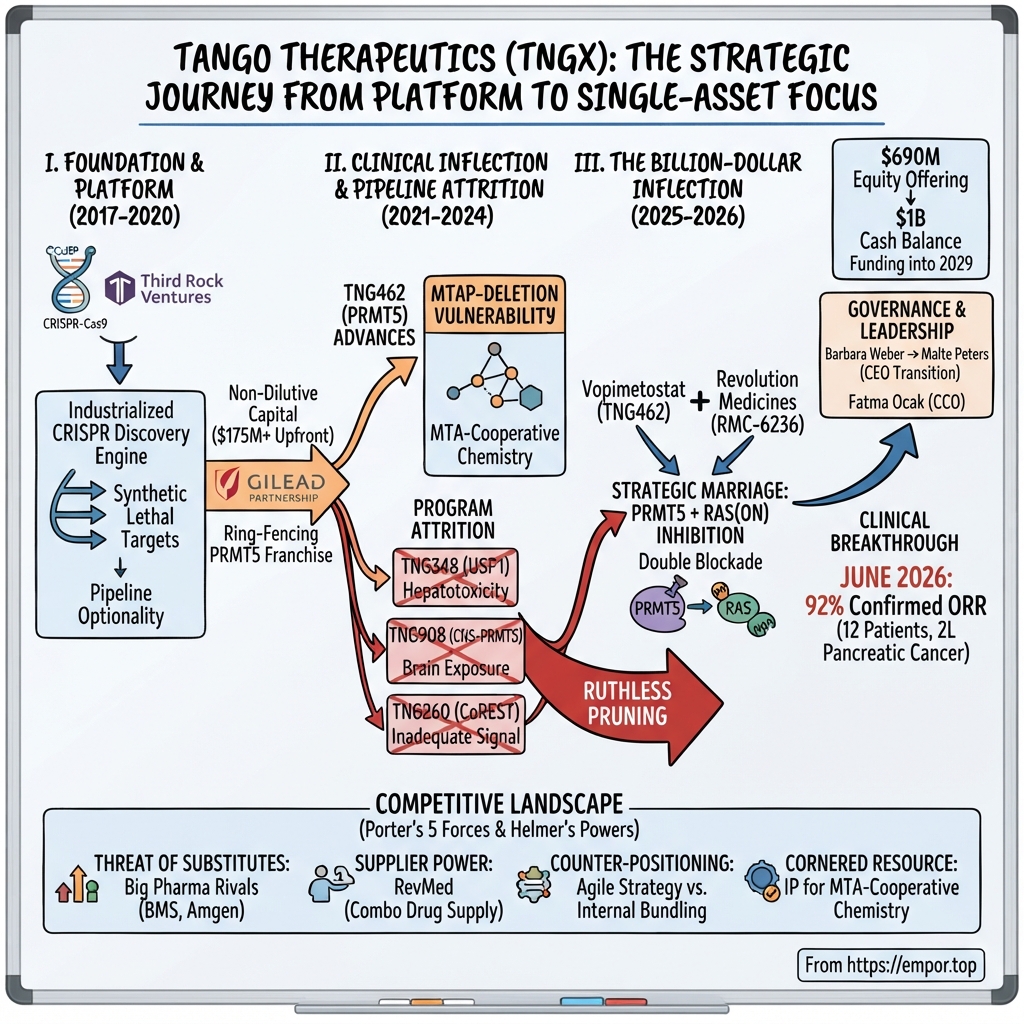
Tango Therapeutics: The Synthetic Lethality Machine, The PRMT5 Duel, and The Billion-Dollar Pivot
I. Introduction & The Synthetic Lethality Crucible
On the morning of June 8, 2026, a Boston-based oncology biotech whose market capitalization had spent much of the prior three years hovering uncomfortably close to the cash balance on its books issued a press release reporting clinical data from twelve patients.
Twelve patients in an industry where registrational oncology trials routinely enroll hundreds across dozens of countries is a statistical rounding error. Yet these twelve individuals had metastatic pancreatic cancer—among the most consistently lethal solid tumors in medicine—and had already progressed through at least one prior line of therapy. Eleven of the twelve achieved confirmed tumor shrinkage meeting RECIST criteria for an objective response, while the twelfth demonstrated stable disease. That yielded a 100% disease control rate, and at the six-month landmark, 90% of patients remained progression-free.[^1]
The regimen was an all-oral combination: vopimetostat (TNG462), Tango Therapeutics' MTA-cooperative PRMT5 inhibitor, administered alongside daraxonrasib (RMC-6236), Revolution Medicines' pan-RAS(ON) inhibitor. Neither compound had received regulatory approval, and neither company had commercialized a medicine. In the decade preceding the readout, second-line metastatic pancreatic cancer yielded objective response rates in the single digits, with median overall survival measured in months rather than years.
Within forty-eight hours, Tango priced an upsized public equity offering of 18.17 million shares at $30.00 per share, alongside pre-funded warrants, securing $690 million in gross proceeds once underwriters exercised their overallotment option in full.[^2] For an enterprise that went public at $10.00 per share through a special purpose acquisition company at the peak of the 2021 market boom—and subsequently watched its shares fall below $3.50 that winter—the financing expanded its balance sheet to approximately $1.0 billion in cash and marketable securities.[^3]
That market response was swift, but the underlying data warrants institutional scrutiny: a 92% objective response rate across twelve patients is an observation about a small cohort, not a definitive conclusion regarding pancreatic cancer. The primary investment question for Tango Therapeutics in September 2026 is whether that efficacy signal will prove durable in a randomized Phase 3 population, and whether an organization that has never executed a registrational trial, guided by a chief executive who took office eight months ago, can manage one to completion.
What synthetic lethality actually is
Understanding the underlying science is essential, because every commercial and clinical valuation downstream depends on it.
For three decades, cancer genomics presented an intractable pharmacological problem. High-throughput sequencing revealed primary oncogenic drivers with striking clarity: KRAS mutations, MYC amplification, TP53 inactivation, and deletions of tumor suppressors such as CDKN2A. Yet medicinal chemists found many of these alterations undruggable. A deleted gene cannot be directly inhibited because the target protein no longer exists, leaving no binding pocket for a small molecule. Consequently, tumor suppressor loss, which underpins a substantial portion of human cancers, remained largely inaccessible to conventional drug discovery.
Synthetic lethality reframes that constraint. The model exploits conditional genetic dependencies: if a cancer cell loses Gene A, and that loss creates an obligate dependency on Gene B—a target non-malignant cells can survive without—pharmacologically inhibiting Gene B selectively eliminates the tumor while sparing healthy tissue. Rather than attempting to repair the primary genetic lesion, the therapy exploits the biochemical vulnerability caused by its loss.
A useful analogy is a building designed with two staircases. Healthy cells retain access to both. Cancer cells, in their rapid proliferation, have permanently blocked one. Blocking the remaining staircase traps only the cancer cell, while non-malignant cells continue to use the parallel route.
The roadmap
This analysis examines how an incubation by Third Rock Ventures, established around that foundational premise, evolved over nine years into a clinical-stage biotechnology company whose valuation now depends almost entirely on a single asset. Specifically:
How Dr. Barbara Weber, an academic oncologist from the University of Pennsylvania turned Novartis and GlaxoSmithKline drug developer, partnered with Dr. Alan Ashworth—the investigator who demonstrated synthetic lethality in human clinical studies—to industrialize target discovery via CRISPR screening.
How Tango secured more than $175 million in upfront, non-dilutive capital from Gilead Sciences across two multi-year collaborations, with nominal milestone potential exceeding $6 billion, while ring-fencing its internal PRMT5 franchise and retaining 100% of worldwide commercial rights.[^4]
How the company completed its public listing through Boxer Capital's special purpose acquisition vehicle, BCTG Acquisition Corp., in August 2021 at the top of the equity cycle, before navigating a prolonged industry-wide biotech drawdown.1
And critically, the gap between early promise and clinical reality: contrasting the narrative of an automated CRISPR discovery engine with the attrition of three clinical programs, highlighted by the May 2024 discontinuation of the USP1 inhibitor TNG348 following observations of liver toxicity.[^6]
While public commentary often characterizes those pipeline cuts as disciplined capital allocation, they also served as a tacit acknowledgment that the early platform thesis did not generate durable drug candidates at the scale initially projected.
The enterprise that remains is no longer a diversified discovery platform. It is a single-asset oncology developer supported by a substantial cash cushion, racing pharmaceutical competitors including Bristol Myers Squibb and Amgen toward Phase 3 registrational data under a chief executive who took leadership in January 2026.[^7] Whether that profile represents a sustainable oncology franchise or a high-stakes call option on a single targeted combination remains the central dilemma confronting institutional investors.
 Subscribe on LinkedIn
II. Scientific Origins: Alan Ashworth, Third Rock, and the "Undruggable" Tumor Genome
In 2005, a research team at the Institute of Cancer Research in London published a paper that established the modern clinical foundation for synthetic lethality. Dr. Alan Ashworth and colleagues demonstrated that cells lacking functional BRCA1 or BRCA2—well-characterized tumor suppressor genes in breast and ovarian cancers—were not merely impaired at DNA repair. They were selectively, catastrophically hypersensitive to the inhibition of a second enzyme, poly(ADP-ribose) polymerase, or PARP.
The underlying mechanism relied on biochemical redundancy. Malignant cells with BRCA mutations lose homologous recombination, a high-fidelity DNA repair pathway, leaving them dependent on alternative mechanisms. PARP facilitates one of these backup pathways. Inhibiting PARP in healthy tissue causes minimal disruption because normal cells compensate via intact BRCA-mediated repair. In BRCA-deficient tumor cells, however, blocking PARP deprives the cell of both pathways, causing unrepaired DNA damage to accumulate rapidly until the cell undergoes apoptosis.
That finding established an entire therapeutic class: PARP inhibitors, including olaparib (Lynparza), niraparib (Zejula), rucaparib (Rubraca), and talazoparib (Talzenna). Beyond generating billions of dollars in annual product sales, these regulatory approvals provided clinical proof that synthetic lethality could translate from cell culture models into commercial human medicines.
The problem with one example
Yet for the subsequent decade, oncology drug development confronted a fundamental limitation: the BRCA-PARP interaction was an isolated clinical success. BRCA mutations account for a modest minority of breast and ovarian malignancies—a clinically meaningful patient cohort, but only a fraction of the broader landscape of tumor-suppressor-driven cancers that lacked targeted options.
If synthetic lethality represented a broad biological principle rather than a fortunate outlier, dozens of analogous gene pairs should exist across the cancer genome. Identifying them hypothesis by hypothesis was impractical. Systematic discovery required functional genomic tools that emerged at scale only a decade later: multiplexed, pooled CRISPR/Cas9 screening.
The methodology was conceptually straightforward yet technically demanding. Researchers take a cancer cell line harboring a specific genetic defect—such as an MTAP deletion—and introduce a lentiviral library of guide RNAs designed to systematically knock out every gene across the genome, one gene per cell. After the cell pool expands, genomic sequencing identifies which guide RNAs depleted from the surviving population, pinpointing genes essential for tumor viability. Repeating the screen in isogenic cell lines lacking the mutation highlights the differential: genes dispensable in normal cells but vital in mutant cells represent synthetic lethal vulnerabilities.
Replicating this process across hundreds of patient-derived cancer cell lines representing the genetic heterogeneity of human tumors offered, in theory, an industrialized discovery engine.
Assembling the syndicate
That premise formed the basis of Third Rock Ventures' incubation strategy in 2017. Rather than providing early-stage capital to external founders, the venture firm's model centered on conceiving biotechs internally around a biological thesis, funding them through syndicates, and recruiting veteran operators to lead them.
The scientific founding group assembled a prominent coalition of translational oncology researchers: Ashworth, then director of the UCSF Helen Diller Family Comprehensive Cancer Center; Dr. Keith Flaherty of Massachusetts General Hospital Cancer Center, an architect of targeted melanoma regimens; Dr. Levi Garraway of the Broad Institute and Dana-Farber Cancer Institute, who later directed oncology development at Eli Lilly before becoming chief medical officer at Roche and Genentech; Dr. Timothy Yap of MD Anderson Cancer Center, a specialist in early-phase clinical trial design; and medicinal chemist Dr. Daniella Zheleva.
Third Rock installed Dr. Barbara Weber as founding chief executive. Weber brought a background bridging academic genetics, large pharmaceutical drug development, and venture creation. Prior to joining Third Rock as a venture partner, she served as a professor of medicine at the University of Pennsylvania leading a breast cancer genetics program, followed by industry leadership roles as vice president of oncology at GlaxoSmithKline and global head of oncology translational medicine at Novartis—the division responsible for evaluating biomarker hypotheses for human clinical trials.
Weber's executive communication across nearly a decade at Tango remained clinically grounded. She emphasized pharmacokinetic exposure, target engagement, and molecular pharmacology over the speculative narrative framing common at biotechnology investor conferences. That discipline in interpreting early clinical signals would heavily influence how the organization navigated subsequent pipeline setbacks.
The founding thesis and its three buckets
Tango's initial operational roadmap divided synthetic lethal discovery into three biological categories:
First, tumor suppressor gene loss—specifically targeting MTAP deletions and STK11 deficiencies that characterize substantial subsets of non-small cell lung, pancreatic, and bladder cancers, which had historically lacked targeted therapies.
Second, oncogene-driven synthetic dependencies: identifying secondary vulnerabilities in KRAS-mutant or MYC-amplified malignancies, based on the premise that if direct inhibition of an oncoprotein proved elusive, the tumor could be disrupted through its collateral dependencies.
Third, immune evasion mechanisms: screening for tumor-intrinsic epigenetic targets that cancers exploit to evade T-cell surveillance. This category formed the primary rationale for the company's early business development strategy.
Third Rock anchored a $55 million Series A financing round in March 2017, enabling Tango to establish its discovery laboratories in Cambridge, Massachusetts.
Viewed from 2026, the primary analytical tension lies in the contrast between the breadth promised by the 2017 platform thesis and its eventual clinical output. The original investment premise envisioned an automated discovery engine continuously generating novel clinical targets across multiple cancer indications. Nine years later, the company's enterprise value rests almost entirely on a single biological axis: MTAP deletion and PRMT5 inhibition. While that interaction was validated through the discovery engine, Tango has not successfully translated secondary platform targets into durable clinical assets. Drug discovery platforms typically command valuation premiums based on their capacity to generate a pipeline of successive products; by 2026, Tango's commercial profile had narrowed to an individual program.
That divergence between platform narrative and pipeline attrition formed the core rationale for the company's multi-year collaboration with Gilead Sciences—and ultimately defined where that partnership faced its limits.
III. The Non-Dilutive Bankroll: The Gilead Mega-Deals & Keeping the Crown Jewels
Every discovery-stage biotechnology company eventually confronts an unforgiving financial dilemma: how to fund basic biological discovery before it generates clinical proof of concept. The standard industry options carry substantial trade-offs. Continual venture rounds dilute early equity; crossover financings demand near-term clinical catalysts; and conventional pharmaceutical partnerships often require licensing lead intellectual property before management can determine which programs will succeed. Tango navigated this dilemma through a corporate strategy that proved central to its corporate survival.
Gilead comes looking
In 2017, Gilead Sciences faced a strategic deficit that an $11 billion transaction had not resolved. The acquisition of Kite Pharma and its CAR-T platform signaled Gilead's ambition to become a major oncology player after a decade dominated by antivirals for hepatitis C and HIV. Yet cell therapy alone could not establish a comprehensive oncology franchise, and Gilead's internal discovery pipeline in targeted small molecules remained thin.
Gilead sought innovative immuno-oncology targets without the overhead of discovering them from scratch. Tango possessed a functional genomics screening operation configured to identify epigenetic mechanisms that tumors use to evade immune attack—the third pillar of its founding thesis. The initial collaboration, signed in 2018, provided Tango with $50 million in upfront cash alongside an equity investment, focusing research exclusively on immune evasion targets.
The August 2020 expansion
The partnership expanded significantly on August 18, 2020. Gilead committed $125 million in cash upfront and completed a $20 million direct equity investment.[^4]
The contract's structure carried far greater significance than its headline valuation. Gilead acquired options to license up to fifteen targets emerging from Tango's platform, with up to $410 million in opt-in, development, and commercial milestones per program—yielding a theoretical aggregate value exceeding $6 billion—alongside tiered royalties. In exchange, Tango retained United States co-development and co-detailing rights—securing profit participation rather than traditional royalties—on up to five lead programs.[^4]
Headline milestone figures in early-stage biotechnology warrant skepticism. Realizing a $6 billion figure assumed that all fifteen targets would be optioned, advance through clinical trials, and achieve commercial approval. In financial reality, the present value of the agreement rested almost entirely on the upfront cash, which provided the operational capital required to run discovery laboratories without public dilution.
The carve-out
The most consequential operational decision of the collaboration lay in what leadership refused to license: Weber preserved the PRMT5 franchise.
Both TNG908 and TNG462—the MTA-cooperative PRMT5 programs that would ultimately represent the core value of the company—were explicitly excluded from Gilead's option pool, leaving Tango with 100% of worldwide commercial rights.
That decision carried a distinct trade-off. Including an advanced, biomarker-stratified PRMT5 program would likely have increased the upfront cash payment in 2020. By accepting less capital upfront, management retained complete control of its premier asset. When the combination clinical data emerged in June 2026, Tango owned the compound's commercial upside entirely, unencumbered by partner consent rights, geographic divisions, or stacked royalty obligations.
In practical terms, Gilead underwrote Tango's wet laboratories, screening robotics, and corporate overhead from 2018 through 2023 without forcing management to issue common stock at depressed early-stage valuations. When the broader biotechnology sector entered a prolonged market downturn, that non-dilutive foundation allowed the company to survive rather than face liquidation or a dilutive restructuring.
Falsification: did the platform thesis hold?
This history provides an empirical test of a central premise in functional genomics: that a proprietary CRISPR screening engine creates a self-sustaining business model through continuous partner opt-ins, perpetual royalties, and a compounding target pipeline.
In practice, platform business models across biotechnology encounter well-documented obstacles. Target discovery suffers high attrition between screening hits and lead optimization, pharmaceutical partners frequently shift priorities when internal leadership changes, and milestone payments remain inherently erratic.
The collaboration encountered those realities in the third quarter of 2025, when the research alliance under the Gilead agreement concluded and discovery operations ceased.[^3] While Gilead retained licensing rights to programs already selected and Tango continued to record occasional milestone income—such as $12 million in license revenue recognized in the second quarter of 2024—the prospect of an indefinitely renewing platform annuity ended.2
This outcome did not invalidate synthetic lethality screening; the discovery platform successfully identified the MTAP-PRMT5 dependency that now underpins the company's valuation. However, the corporate history challenges the platform-as-a-business-model premise, replacing it with the reality of a single-discovery developer. Tango's enterprise value was not determined by the volume of targets its screening engine produced, but by whether one molecule achieved the requisite pharmacological profile in human patients.
For institutional investors, this transition requires assigning minimal baseline valuation to future platform alliances absent executed contracts with fresh upfront capital, while treating residual Gilead milestones as contingent windfalls rather than recurring operating cash flow.
That strategic evolution—from a diversified discovery platform to a focused single-product developer—unfolded internally years before the broader market acknowledged it. And in the summer of 2021, the public equity markets were pricing early-stage genomics with peak enthusiasm.
IV. Going Public in the Froth: The Boxer Capital / BCTG SPAC & The Biotech Reckoning
The summer of 2021 was an extraordinary period in the modern history of biotechnology capital markets.
With benchmark interest rates near zero following pandemic-era monetary stimulus, capital flooded into long-duration assets—most notably clinical-stage biotechnology, where projected commercial cash flows sat a decade into the future and remained acutely sensitive to discount rates. The SPDR S&P Biotech ETF (XBI) had roughly doubled from its March 2020 low, and generalist investment funds that had rarely owned pre-revenue drug developers began building substantial oncology books.
Traditional initial public offering channels struggled to absorb the demand. Investment bank syndicates faced finite underwriting bandwidth, pushing listing queues out by months. Into that bottleneck stepped a transaction structure popularized in financial technology and electric vehicles: the special purpose acquisition company, or SPAC.
Why BCTG was not a typical SPAC
Many blank-check vehicles launched during that cycle justified their subsequent negative reputation. Sponsors lacking sector expertise raised blind-pool capital, confronted a two-year liquidation deadline, and often merged with whatever targets were available—frequently pre-revenue companies with operating models that would have struggled to survive due diligence from specialist institutional investors.
BCTG Acquisition Corp. differed meaningfully from that template, a distinction critical to interpreting the equity's subsequent performance.
The vehicle's sponsor was Boxer Capital, the healthcare investment firm associated with Joe Lewis's Tavistock Group and led by Aaron Davis. Rather than a generalist fund opportunistically entering healthcare, Boxer was an established life sciences investment manager with an extensive record in public and private oncology assets. It had structured BCTG specifically to accelerate the public listing of a company it already intended to back long-term.
The transaction closed on August 10, 2021, and the combined company began trading on the Nasdaq Global Market under the ticker TNGX.1 Gross proceeds totaled approximately $353 million, comprising roughly $167 million held in the BCTG trust alongside a $186 million private investment in public equity, or PIPE, priced at $10.00 per share.1
The syndicate backing that financing reflected notable institutional depth: Boxer Capital, Avoro Capital, Bain Capital Life Sciences, Casdin Capital, EcoR1, Farallon, Fidelity, Foresite Capital, Perceptive Advisors, RA Capital Management, Samsara BioCapital, and Woodline Partners.1 This was not a retail momentum base, but a roster encompassing much of the specialist biotechnology buy side. Several of these managers ran concentrated portfolios where capital allocation typically signaled scientific validation rather than passive index tracking.
Tango debuted with an implied enterprise value of roughly $400 million against a pro-forma cash balance approaching $500 million. In economic reality, the transaction functioned as a vetted crossover financing executed through a blank-check structure, rather than a distressed reverse merger by an issuer unable to complete a standard registration.
The hangover
Yet institutional pedigree did not shield the equity from the ensuing macroeconomic downturn.
Beginning in late 2021 and accelerating throughout 2022, the Federal Reserve's aggressive rate-hiking campaign weighed heavily on long-duration biotechnology valuations. The XBI entered a drawdown exceeding 60% from its peak—among the deepest in the sector's history. Amid that retreat, companies that had completed public listings through SPACs faced indiscriminate selling regardless of underlying pipeline quality, as the vehicle structure itself fell out of favor.
TNGX fell from its $10.00 reference price to lows below $3.50 per share. At those levels, the company traded at a negative enterprise value. Public markets effectively assigned zero or negative value to Tango's clinical pipeline, proprietary intellectual property, Gilead partnership, and scientific infrastructure, pricing in an assumption that corporate cash burn would exhaust capital reserves before generating clinical value.
That repricing reflected a distinct probabilistic assessment: that a discovery-stage developer with no approved commercial products would consume its balance sheet on clinical programs that failed to advance. In retrospect, the market proved directionally accurate regarding three of Tango's four early clinical programs, even as it discounted the potential of the fourth.
Behavior in the trough
Management's operational conduct during that contraction provides tangible evidence regarding its capital allocation strategy, occurring during a cycle when external equity financing was largely inaccessible to early-stage biotechnology.
Tango avoided the structured PIPEs, heavy warrant coverage, and repricing reset provisions that severely diluted and impaired numerous peer biotechs from the 2021 vintage. Leadership did not execute a reverse stock split to maintain listing compliance, nor did it publicize incremental preclinical findings to manufacture temporary trading momentum.
Instead, the company controlled headcount expansion, set measured expectations on clinical milestones, and focused expenditure on prioritized clinical trials. Having entered the market downturn with nearly half a billion dollars, Tango maintained sufficient cash runway to advance its core candidates toward proof-of-concept readouts.
That operational discipline carries an important qualification: navigating a prolonged industry bear market is considerably more manageable with substantial cash reserves. Tango operated from a position of liquidity established through upfront collaboration proceeds from Gilead and the net proceeds of its SPAC listing. While leadership demonstrated fiscal restraint, that performance reflected balance-sheet insulation rather than navigation through an acute liquidity crisis.
How the organization deployed that runway ultimately hinged on a single biological bet—a vulnerability created by a chromosomal deletion that occurs in roughly one in eight human tumors.
V. The Biology Deep Dive: MTAP Deletion, PRMT5, & Why First-Gen Drugs Failed
Understanding Tango's commercial trajectory requires examining a structural genomic anomaly that occurs frequently in human oncology, yet resisted pharmacological exploitation for more than two decades.
The 9p21 accident
Chromosome 9p21 contains CDKN2A, which encodes p16/INK4a—a fundamental tumor suppressor that acts as a primary brake on cell division. When a malignant cell circumvents normal growth controls, deleting CDKN2A is among the most direct and frequent genomic alterations in cancer biology.
Located immediately adjacent on the chromosome is MTAP, a gene entirely unrelated to cell cycle regulation. MTAP encodes methylthioadenosine phosphorylase, a metabolic housekeeping enzyme responsible for the methionine salvage pathway.
Chromosomal deletions are coarse genomic events rather than surgical excisions. When a tumor deletes the 9p21 region encompassing CDKN2A, it routinely removes MTAP as well, resulting in co-deletion in approximately 80% to 90% of CDKN2A-deficient cases. The loss of MTAP confers no direct proliferative advantage on the tumor; it is collateral genomic damage.
For two decades, oncology research treated that co-deletion as an inert biological footnote. Eventually, translational researchers recognized it as a latent pharmacological vulnerability.
The scale
MTAP deletion occurs across an estimated 10% to 15% of all human solid tumors. Analyzed by histology, the alteration is heavily concentrated in several high-mortality malignancies: roughly 25–30% of pancreatic ductal adenocarcinoma, 15–20% of non-small cell lung cancer, about 15% of bladder cancer, roughly 25% of bile duct cancers, and approximately 50% of glioblastoma multiforme.3
In the United States alone, this genomic profile represents more than 100,000 newly diagnosed patients each year—an addressable population exceeding several established targeted oncology markets combined, yet historically lacking any approved targeted therapy directed at the lesion.
The mechanism, in plain terms
MTAP's primary biochemical function is breaking down methylthioadenosine, or MTA. When a tumor deletes MTAP, MTA cannot be metabolized and accumulates inside the cancer cell to concentrations far exceeding levels observed in healthy tissue.
That accumulated metabolite causes a distinct structural consequence: it binds directly into the catalytic pocket of protein arginine methyltransferase 5 (PRMT5), an essential epigenetic enzyme that attaches symmetric dimethyl marks to histones and proteins governing RNA splicing. PRMT5 is indispensable for cellular viability across normal tissues.
In an MTAP-deleted cancer cell, however, PRMT5 operates in an altered state, partially occupied by endogenous MTA. In a healthy cell with intact MTAP, intracellular MTA concentrations remain negligible, leaving PRMT5 uncomplexed.
That disparity—an intracellular metabolite accumulating selectively within tumor cells and lodging inside an essential enzyme—creates a workable therapeutic window. It establishes an enzyme-metabolite target unique to the cancer cell that can be identified through clinical biomarker testing.
The first-generation catastrophe
Major pharmaceutical companies identified PRMT5 as a compelling oncology target years before Tango's founding. GlaxoSmithKline advanced pemrametostat (GSK3326595), Johnson & Johnson developed JNJ-64619178, and Pfizer initiated early-phase programs.
Those efforts stalled due to an unaddressed pharmacological liability: first-generation PRMT5 inhibitors were non-cooperative and unselective for MTAP status. They bound PRMT5 indiscriminately whether MTA was present or absent, suppressing the enzyme across both tumor tissue and healthy organs. Crucially, hematopoietic stem cells in the bone marrow rely on PRMT5 for normal proliferation.
The clinical consequence was severe, dose-limiting hematologic toxicity, characterized by grade 3 and 4 thrombocytopenia, profound neutropenia, and anemia. Investigators had to reduce dosing regimens so substantially that drug concentrations in plasma never reached the thresholds required to inhibit tumors. With an unviable therapeutic index, the first-generation class was effectively abandoned.
That historical attrition is central to evaluating Tango's competitive positioning. PRMT5 was not an unvalidated biological target; it was an established target where earlier clinical programs had collapsed due to on-target systemic toxicity. Any investment thesis regarding second-generation chemistry depends on whether new compounds can circumvent that hematologic barrier.
MTA-cooperative chemistry
The second generation of PRMT5 inhibitors—developed by Tango, Mirati Therapeutics (later acquired by Bristol Myers Squibb), and Amgen—addressed this selectivity challenge through cooperative binding chemistry.
Rather than binding uncomplexed PRMT5, these molecules are engineered to bind preferentially to the PRMT5-MTA complex. The drug exhibits low affinity for free PRMT5, targeting instead the distinct structural conformation formed when MTA occupies the catalytic pocket.
Because healthy cells retain functional MTAP and maintain minimal intracellular MTA, normal PRMT5 remains unoccupied by the metabolite and largely uninhibited by the drug, sparing bone marrow progenitors. In MTAP-deleted tumor cells where MTA accumulates, the inhibitor binds the PRMT5-MTA complex and shuts the enzyme down.
The clinical benchmark for this mechanism is the selectivity ratio: the relative potency with which a compound inhibits MTAP-deleted cells compared to MTAP-intact cells. Tango's initial clinical candidate, TNG908, exhibited roughly 15-fold selectivity. Its successor, TNG462, was approximately 45-fold selective and substantially more potent.4 In oncology development, that threefold expansion in the therapeutic window represents the practical difference between a tolerable clinical regimen and one limited by off-target toxicity.
Whether that biochemical selectivity would hold up in human patients during extended combination dosing remained an empirical question that laboratory models could not settle. Resolving it required clinical trial execution—and Tango was about to experience the high rates of attrition common to early-phase oncology pipelines.
VI. The Crucible & Pipeline Carnage: The TNG348 Hepatotoxicity Shock & Ruthless Pruning
Entering 2023, Tango presented the profile its early investors had envisioned: a discovery platform supporting a mechanistically diverse clinical pipeline.
TNG908 was the central-nervous-system-penetrant, MTA-cooperative PRMT5 inhibitor designed for glioblastoma—where MTAP deletion rates approach 50%—as well as systemic solid tumors.
TNG462 was the next-generation, non-CNS-optimized PRMT5 inhibitor engineered with a wider selectivity window.
TNG348 was an allosteric inhibitor of the deubiquitinase USP1, aimed at BRCA-mutant and homologous-recombination-deficient tumors. Its strategic rationale targeted acquired resistance: because PARP inhibitors routinely lose efficacy over time, USP1 inhibition was hypothesized to resensitize resistant malignancies within an established commercial market.
TNG260 was a CoREST complex inhibitor designed to reverse immune evasion in STK11-mutant non-small cell lung cancer—a patient population historically unresponsive to immune checkpoint blockade. It represented the clinical translation of the third pillar of Tango's founding thesis.
Four programs across four distinct mechanisms and patient populations: the platform model appeared fully translated into a pipeline.
Within eighteen months, three of those four programs were discontinued.
May 23, 2024
On that date Tango announced it was discontinuing development of TNG348 entirely.[^6]
The trigger was hepatotoxicity. In the Phase 1/2 dose-escalation study, multiple patients developed Grade 3 and Grade 4 acute hepatocellular injury, characterized by alanine aminotransferase and aspartate aminotransferase elevations of a magnitude that required immediate trial cessation. Dose escalation was halted.[^6]
The timing proved fatal to the asset's development thesis. The clinical rationale for TNG348 depended on administering it in combination with a PARP inhibitor such as olaparib. No patient had yet received that doublet. If monotherapy at escalation doses induced acute liver injury, combining it with another agent with known systemic toxicities was clinically unviable. With no viable path through dose reduction, altered schedules, or biomarker enrichment, Tango closed the investigational new drug application.
Falsification: does the engine find safe targets?
The central premise undergoing clinical evaluation was straightforward: synthetic lethality screening reliably discovers safe, druggable targets beyond MTAP/PRMT5.
The flaw in that assumption lies in the gap between genetic target validation and small-molecule medicinal chemistry. A CRISPR screen demonstrates that ablating Gene B kills cells lacking Gene A. It does not establish whether Gene B possesses a druggable binding pocket, whether a small molecule can achieve oral bioavailability, or whether its metabolic breakdown products trigger idiosyncratic organ toxicity. Genetic knockout and pharmacological inhibition remain fundamentally distinct experiments.
The clinical record illustrates that divergence across the pipeline:
TNG348 demonstrated that sound biological rationale cannot overcome chemical toxicity. While the USP1 target hypothesis may have been biologically valid, the molecule was not viable.[^6]
TNG908 failed due to pharmacokinetic exposure rather than safety. Its measured unbound brain-to-plasma partitioning in human patients fell far short of preclinical animal projections, preventing the molecule from achieving therapeutic concentrations in glioblastoma tissue. Inadequate CNS penetration remains a common failure mode in neuro-oncology, and one that remains largely unpredictable until human pharmacokinetic data is collected.
TNG260 failed to establish a viable therapeutic window as a monotherapy or generate an unambiguous clinical signal in STK11-mutant non-small cell lung cancer, leading to its termination.
Three programs succumbed to three distinct failure modes: chemistry, pharmacokinetics, and clinical efficacy. Rather than an isolated setback, this attrition reflected the baseline attrition rates of oncology drug development asserting themselves over platform expectations.
The calibrated conclusion: the history rejects the claim outright. The discovery engine did not yield a broad clinical portfolio; it produced a single viable target interaction. Any valuation framework in late 2026 that attributes value to ongoing "platform optionality" pays for a capability unsupported by the company's nine-year operational record—a dynamic directly relevant to early-stage pipeline assets such as TNG456.
The countervailing evidence: how management behaved
While the attrition dismantled the multi-program platform thesis, management's operational response demonstrated notable capital discipline.
In clinical-stage biotechnology, management teams frequently prolong underperforming programs through extended strategic reviews, retrospective subgroup analyses to isolate partial responders, or repeated protocol amendments. That reluctance to accept negative data routinely consumes $50 million to $100 million in capital per program.
Tango moved rapidly and decisively. Following the May 2024 disclosure, Weber stated that the hepatic signal was disqualifying, the program was terminated, and the company would not attempt to salvage it.[^6] Leadership enacted similar closures elsewhere: TNG260 was ended rather than redirected into exploratory cohorts, and clinical spending on TNG908 was terminated rather than repurposed for non-CNS indications.
Executive leadership redirected capital, medicinal chemistry resources, and clinical operations entirely toward TNG462, the sole candidate demonstrating clear biological activity.
The financial impact of that retrenchment was material. The restructuring extended Tango's cash runway from late 2025 into 2027 without requiring equity financing during a severe sector downturn. Had management continued funding all four programs, the company would have been forced to raise capital in 2025 at depressed share prices. The shareholder dilution avoided by discontinuing three unviable assets ultimately proved more valuable than the terminated programs themselves.
Evaluating that performance requires distinguishing between discovery prowess and capital stewardship. The empirical record does not indicate that Tango built a superior discovery engine; rather, it shows that leadership acknowledged developmental failures promptly and insulated the balance sheet. In developmental biotechnology, that defensive discipline is uncommon and protective of capital, even if it cannot substitute for product discovery.
The asset preserved by that consolidation was TNG462—and across 2025 and 2026, the drug generated clinical efficacy data that fundamentally transformed the company's valuation.
VII. The Turning Point: Vopimetostat (TNG462), The RevMed RAS(ON) Marriage, & The 92% ORR Data Drop
TNG462 Strategic Inflection: The Convergence of Synthetic Lethality and Oncogene Addiction

[ MTAP Deletion (~30% of PDAC) ]           [ KRAS Mutation (>90% of PDAC) ]
               │                                           │
               ▼                                           ▼
      MTA Accumulation                             Hyperactive RAS Signaling
               │                                           │
               ▼                                           ▼
   PRMT5•MTA Complex Exposed                       Cell Proliferation & Survival
               │                                           │
   ┌───────────┴───────────┐                   ┌───────────┴───────────┐
   │  Tango Therapeutics   │                   │ Revolution Medicines  │
   │ Vopimetostat (TNG462) │                   │ Daraxonrasib(RMC-6236)│
   └───────────┬───────────┘                   └───────────┬───────────┘
               │                                           │
               └─────────────────────┬─────────────────────┘
                                     ▼
                      [ Co-Inhibition Synergy ]
                 Double Blockade of Epigenetic Splicing
                        & MAPK Signaling Cascade
                                     ▼
               92% Confirmed ORR / 100% Disease Control
                   (2L/3L Metastatic Pancreatic Cancer)
October 2025: the signal nobody was watching for
The earliest clinical validation arrived in October 2025, drawing limited public attention because broader investor focus had largely drifted away from Tango following its pipeline retrenchment.
Tango reported interim Phase 1/2 results evaluating vopimetostat as a single agent across MTAP-deleted solid tumors.[^11] Two clinical findings stood out.
In second-line MTAP-deleted metastatic pancreatic cancer, monotherapy generated a 25% objective response rate, with median progression-free survival reaching 7.2 months.[^11]
In isolation, a 25% response rate appears modest. Evaluated against established historical benchmarks, however, the outcome is notable. Second-line metastatic pancreatic cancer has long presented one of the most intractable challenges in clinical oncology. Patients who progress following first-line therapy and transition to alternative cytotoxic regimens—such as FOLFOX or crossing over between gemcitabine/nab-paclitaxel and fluoropyrimidine combinations—historically record objective response rates between 5% and 10%, alongside median progression-free survival of roughly 2.5 to 3.5 months. Furthermore, a substantial portion of these patients present with diminished performance status that precludes tolerating intensive second-line chemotherapy.
Administered as an oral single agent in a biomarker-selected cohort, vopimetostat roughly tripled the historical response rate and more than doubled median progression-free survival.
The second finding emerged from the histology-agnostic cohort: among heavily pretreated patients across multiple late-line solid tumors selected solely by MTAP deletion, vopimetostat demonstrated a 49% objective response rate with 9.1 months median progression-free survival.[^11] An objective response in nearly half of patients with treatment-refractory disease across varied tumor types indicates pharmacological activity governed by an underlying biomarker rather than primary tumor site—the central premise of precision oncology, yet an outcome infrequently demonstrated in late-stage solid tumors.
Two methodological qualifications remain critical. These were non-randomized, single-arm cohorts evaluated against historical controls, a format that often flatters novel investigational agents because early trial participants tend to maintain better baseline health than real-world patient cohorts. In addition, patients enrolled in early-phase studies at academic medical centers are rarely representative of routine community oncology practice.
Why combine with a RAS inhibitor?
The strategic deduction that followed fundamentally altered Tango's development path.
Pancreatic cancer exhibits exceptional genomic homogeneity: more than 90% of cases harbor an oncogenic KRAS mutation, while an estimated 25% to 30% carry MTAP deletions. These two alterations overlap substantially, meaning a distinct subpopulation of pancreatic cancer patients exhibits both an active oncogenic driver and a synthetic-lethal vulnerability simultaneously.
Crucially, preclinical evidence indicates that targeting both lesions yields more than simple additive efficacy. Research conducted by Tango and academic collaborators demonstrated that pharmacologically inhibiting PRMT5 impairs the alternative mRNA splicing of key regulatory proteins within the MAPK/ERK cascade—the precise signaling highway driven by oncogenic RAS.
In operational terms, direct RAS inhibition shuts down primary growth signaling, while PRMT5 inhibition compromises the tumor cell's capacity to properly assemble and deploy alternative signaling circuitry. The tumor cannot easily circumvent the blockade because its adaptive machinery is disabled in parallel. This mechanism established an empirical foundation for biological synergy rather than incidental co-administration.
The Revolution Medicines collaboration
The practical obstacle was straightforward: Tango did not possess a proprietary RAS inhibitor and lacked the capital and timeline required to build one internally. The RAS family had resisted medicinal chemistry for four decades, and Revolution Medicines had committed substantial time and capital to engineer the tri-complex chemistry required to inhibit active RAS(ON) proteins.
Rather than committing internal discovery resources to a protracted chemistry effort, Tango established a clinical trial collaboration with Revolution Medicines. Under the agreement, Revolution Medicines provided daraxonrasib (RMC-6236), its pan-RAS(ON) inhibitor, alongside zoldonrasib (RMC-9805), a KRAS G12D-selective candidate.
The transactional structure differed markedly from traditional biotechnology alliances. Tango acts as clinical trial sponsor and retains 100% of the worldwide commercial and economic rights to vopimetostat, while Revolution Medicines preserves unencumbered ownership of its compounds. The agreement required no equity consideration, created no cross-licensing of underlying intellectual property, and established no downstream royalty obligations. Each enterprise provided clinical-grade drug supply, aligned on trial design, and preserved the full long-term value of its asset.
The partnership entered clinical evaluation under trial protocol NCT06922591, assessing the combination in patients with MTAP-deleted, RAS-mutant solid tumors.5
June 2026
When preliminary clinical data were presented in June 2026, the efficacy metrics stood out even within the context of an enriched early-phase cohort.
In second- and third-line metastatic pancreatic cancer, the combination demonstrated a 92% objective response rate—achieving confirmed partial responses in eleven of twelve evaluable patients—alongside a 100% disease control rate and a 90% progression-free survival rate at the six-month evaluation.[^1]
In the non-small cell lung cancer cohort, three of three evaluable patients achieved confirmed responses.[^1]
Equally important, the regimen's safety profile remained stable. Adverse events were described as manageable, without overlapping toxicities between the two molecules and without dose-limiting bone-marrow suppression.[^1] This clinical tolerability provided essential validation for the MTA-cooperative selectivity thesis. First-generation PRMT5 inhibitors collapsed because non-selective target inhibition induced severe hematologic toxicity. If chemical selectivity were vulnerable to degradation, that liability would most likely emerge under the biological strain of combination dosing with another targeted agent. The trial demonstrated no such breakdown.
What the number actually means
An objective response rate of 92% in refractory pancreatic cancer represents a remarkable initial clinical signal; it is also a finding observed across a sample of twelve patients. A rigorous institutional assessment requires balancing both realities.
What the evidence substantiates: the combination exerts potent biological activity in this patient population; the MTA-cooperative selectivity mechanism functions in human patients under combination pressure; and both compounds can be co-administered at therapeutic doses without prohibitive overlapping toxicities. These clinical milestones directly supported the $690 million public offering priced two days later.
What the data do not yet demonstrate: the durability of these responses, the ultimate effect size across a broader and more diverse patient population, or statistical superiority over standard-of-care chemotherapy in a randomized setting. Early-phase expansion cohorts managed at specialized academic medical centers routinely enroll individuals with superior baseline functional scores and organ reserve compared to broader patient pools in registrational Phase 3 trials. In oncology development, preliminary response rates frequently moderate as sample sizes expand. The governing historical pattern is not that early efficacy signals are fabricated, but that observed response magnitudes compress over time.
The June 2026 clinical readout fundamentally altered Tango's risk profile without definitively proving the commercial case. The central analytical question facing the company shifted from whether vopimetostat possessed authentic biological activity to how deep and durable that activity will prove across randomized patient cohorts. That transition marked a substantial operational upgrade, but left the ultimate clinical outcome unresolved.
The immediate capital and operational decisions that followed that inflection point illustrate how the company's executive leadership intended to navigate that remaining uncertainty.
VIII. Capital Allocation, Governance, & The Management Transition: From Barbara Weber to Malte Peters
A familiar hazard in clinical-stage biotechnology is the founder-chief executive who struggles to step aside.
Scientist-executives who conceive a company around a biological thesis, navigate capital market contractions, and ultimately witness clinical proof of concept have every incentive to preside over late-stage development. Boards of directors are often hesitant to replace the executive whose scientific instincts were vindicated. Consequently, biotechnology developers routinely enter Phase 3—a phase demanding global clinical operations, multi-agency regulatory strategy, commercial-scale manufacturing, payer negotiations, and commercial infrastructure—under leadership whose demonstrated expertise centers on early-stage discovery biology.
Tango avoided that trap, and the timing of the transition was particularly notable.
The handover
In January 2026—five months before the combination data that transformed the company's valuation—Barbara Weber announced her transition to Executive Chair, with the board appointing Dr. Malte Peters as President and Chief Executive Officer.[^7]
The sequencing carried strategic weight. Weber initiated the handover while Tango was still valued as a speculative small-cap developer. Rather than stepping aside after the stock surged, she transferred executive leadership when the core clinical thesis remained unproven in humans. That succession decision occurred without the benefit of knowing the combination outcome, providing a genuine test of governance rather than post-hoc optimization.
Weber subsequently completed the transition, stepping down from executive leadership and the board of directors in August 2026. While founder-executives who transition to Executive Chair often cast an informal shadow that can compromise their successors, Weber's full departure gave Peters undivided operational authority. That separation created a cleaner corporate hierarchy, even as it removed the institutional memory behind earlier pipeline rationalizations.
Vetting Malte Peters
Peters is not a discovery scientist; his background is that of a clinical development executive.
At MorphoSys AG, he served as Chief Development Officer from 2017 to 2020 and then as Chief Research and Development Officer through 2022. During that tenure, he directed the global clinical development strategy that guided Monjuvi (tafasitamab) through both FDA and European Medicines Agency approvals for diffuse large B-cell lymphoma. That track record provided specific experience shepherding an oncology asset through registrational trials and multi-agency regulatory review.
Prior to MorphoSys, Peters served as Global Head of Clinical Development for Biopharmaceuticals at Sandoz and Novartis, alongside earlier oncology clinical development roles at Novartis and Merck KGaA. The biosimilar tenure at Sandoz holds particular relevance: biosimilar development requires rigorous regulatory compliance and manufacturing comparability under tight cost constraints—disciplines directly applicable to commercial-scale chemistry, manufacturing, and controls execution.
Equally significant is Peters' internal tenure. Rather than arriving as an external executive recruited after positive clinical data, he had served on Tango's board of directors since 2018. Over eight years of boardroom oversight, he participated directly in the strategic reviews that terminated TNG348, TNG908, and TNG260.
That continuity presents institutional trade-offs. It minimizes the risk of sudden strategic reversals or an incoming executive executing a broad portfolio review that revives terminated programs. Conversely, it means the new chief executive does not provide an outside perspective on prior strategic choices. If concentrated reliance on the MTAP-PRMT5 axis carries unmodeled risks, Peters is unlikely to challenge the foundational assumptions he helped establish.
A broader governance question concerns execution scale: while Peters possesses established regulatory and developmental credentials, managing global Phase 3 trials at an organization that has never executed a registrational study represents an operational hurdle. Furthermore, that experience offers limited insight into constructing a commercial sales organization from scratch—a discipline where Tango possesses no internal history.
Constructing a commercial-stage company
The executive appointments completed across 2026 illustrate the commercial infrastructure management intends to establish.
Matthew Gall was appointed Chief Financial Officer on April 15, 2026, succeeding Daniella Beckman and adding experience across capital markets, corporate treasury, and commercial financial planning.
Fatma Ocak joined as Chief Commercialization Officer on August 17, 2026.[^3] Her mandate encompasses building field sales teams, formulating market access and reimbursement strategies, and establishing testing infrastructure for MTAP companion diagnostics.
The diagnostic mandate highlights an underappreciated commercial dependency. Vopimetostat functions selectively in MTAP-deleted malignancies. If community oncologists do not routinely screen for MTAP loss, eligible patients will not receive the therapy. While MTAP deletions can be identified via immunohistochemistry and targeted next-generation sequencing panels, comprehensive routine screening remains unevenly distributed across community oncology practices. Establishing MTAP testing within standard diagnostic protocols for pancreatic and non-small cell lung cancer requires a sustained educational and diagnostic effort that must run parallel to registrational trials.
Dr. Adam Crystal continues as President of R&D, maintaining translational and scientific continuity through the corporate transition.
Appointing a Chief Commercialization Officer in August 2026, well before Phase 3 readouts, signals clear commercial intent. It also introduces substantial pre-commercial operating expenditure that risks becoming stranded capital if pivotal trials fail to confirm early response rates.
The financing
That organizational build-out was underpinned by rapid balance-sheet expansion following the June 2026 readout.
Management acted immediately upon the clinical disclosure: preliminary combination data were released on June 8, 2026, and the follow-on equity offering was priced the following day, June 9.[^1][^2] Tango issued 18.17 million common shares at $30.00 per share alongside pre-funded warrants, generating $690 million in gross proceeds following the full exercise of the underwriters' overallotment option.[^2]
In biotechnology capital markets, financing windows open abruptly on clinical catalysts and can close just as quickly on subsequent clinical setbacks. By pricing immediately into market momentum rather than holding out for higher valuations, leadership eliminated financing risk for the capital-intensive Phase 3 program ahead.
Management established a further liquidity mechanism in August 2026 through a $400 million at-the-market equity offering facility.[^3] While intended for opportunistic share issuance rather than immediate dilution, an authorized facility of that scale provides leadership with standing authority to raise additional capital.
Regarding equity ownership and institutional alignment: early specialist backers—including Boxer Capital, Third Rock Ventures, Casdin Capital, Avoro Capital, and RA Capital Management—have retained substantial shareholdings, while executive compensation structures emphasize equity awards tied to Phase 3 trial execution and regulatory milestones. Nonetheless, completing a $690 million offering at $30.00 per share based on a twelve-patient dataset shifted substantial operational risk to new shareholders at a valuation premised on unconfirmed early efficacy. That offering represented effective balance-sheet management; whether it proves a rewarding investment depends entirely on whether those response rates hold up in randomized pivotal trials.
IX. Business Economics, Financials, & The $1 Billion Balance Sheet
Biotechnology balance sheets are routinely evaluated through the metrics of survival: cash burn rates, operational runway, and estimated cash-out horizons. For most of its public existence, Tango Therapeutics operated under precisely those constraints. By mid-2026, however, its financial profile shifted into a fundamentally different posture.
The transformation
As of June 30, 2026, Tango reported approximately $1.0 billion in cash, cash equivalents, and marketable securities.[^3] By comparison, at year-end 2024, that figure stood at $257.9 million.6
That nearly fourfold expansion across eighteen months—driven almost entirely by the public offering executed within forty-eight hours of the June combination readout—illustrates how rapidly biotechnology valuations can recalibrate. Neither Tango's underlying cost structure, headcount, nor intellectual property portfolio altered materially during that forty-eight-hour window. Rather, equity markets sharply revised the implied probability of success for a single compound, and executive leadership capitalized on that momentum immediately.
Runway and burn
Management has guided that the current balance funds operations into 2029, encompassing the planned Phase 3 development of vopimetostat in pancreatic cancer and NSCLC.[^3]
Historical expenditure provides context for that timeline. Tango reported a net loss of $130.3 million in fiscal 2024, with quarterly operational cash burn running roughly $28 million to $35 million.6 That spending rate reflected the operational streamlining implemented after discontinuing TNG348, TNG260, and TNG908.
Pivotal Phase 3 development, however, fundamentally alters corporate expenditure. Registrational oncology trials require expansive multinational investigator networks, central imaging review, independent data monitoring committees, and commercial-grade drug supply produced under rigorous chemistry, manufacturing, and controls standards. Under those requirements, quarterly operating burn is projected to expand into the $50 million to $65 million range.
At the upper end of that range, annual cash consumption would reach approximately $260 million. Against a $1.0 billion balance sheet, that trajectory provides substantial operational runway, but it does not represent an inexhaustible surplus. Crucially, that runway estimate excludes the capital required to build a domestic commercial sales and marketing organization—an initiative that typically demands hundreds of millions of dollars, and one foreshadowed by the appointment of a Chief Commercialization Officer.
The core financial takeaway is that Tango has secured the liquidity necessary to reach Phase 3 readouts without facing the threat of dilutive, distressed financings during trial execution. While this insulation largely mitigates near-term insolvency risk, it does not eliminate dilution risk: the established $400 million at-the-market facility provides a mechanism for opportunistic equity issuance, and eventual commercialization would require capital beyond existing reserves.
Where the value sits
Tango Therapeutics Enterprise Value & Pipeline Allocation

┌────────────────────────────────────────────────────────────────────────┐
│ CORE ENGINE (~85% of Enterprise Value)                                 │
│ Vopimetostat (TNG462) — MTA-Cooperative PRMT5 Inhibitor                │
│ • 2L Pancreatic Cancer Monotherapy (Pivotal Phase 3)                   │
│ • 1L/2L Pancreatic Cancer Combo w/ Daraxonrasib (Registrational Path) │
│ • MTAP-Deleted NSCLC & Solid Tumor Basket Cohorts                     │
└────────────────────────────────────┬───────────────────────────────────┘
                                     │
    ┌────────────────────────────────┴───────────────────────────────────┐
    │ FUTURE OPTIONALITY (~10% of EV)    │ RESIDUAL CASH FLOW (~5% of EV)│
    │ TNG456 — Brain-Penetrant PRMT5     │ Gilead Collaboration Rights   │
    │ • Glioblastoma Multiforme (GBM)    │ • Milestones on licensed I/O  │
    │ • Brain metastases (NSCLC/melanoma)│ • US co-promote/profit share  │
    └────────────────────────────────────┴───────────────────────────────┘
Stripped of narrative framing, Tango Therapeutics operates essentially as a single-asset biotechnology company supported by a sizable cash reserve. Approximately 85% of its implied enterprise value rests on vopimetostat across its monotherapy and combination settings. The enterprise generates no commercial product revenue, possesses no therapeutic diversification, and maintains no secondary clinical asset in late-stage development.
That asset concentration reflects the deliberate pipeline pruning completed across 2024 and 2025. While terminating unviable programs protected the corporate balance sheet, it created an acutely binary risk profile tied almost entirely to the Phase 3 performance of a single molecule.
The dark horse, sized honestly
TNG456 represents Tango's second-generation, brain-penetrant MTA-cooperative PRMT5 inhibitor, engineered around the lessons learned from TNG908's pharmacokinetic shortfall. While TNG908 failed to achieve therapeutic unbound drug concentrations across the blood-brain barrier in human patients, medicinal chemists designed TNG456 specifically to optimize central nervous system exposure.
The commercial and clinical opportunity in neuro-oncology is considerable. Glioblastoma exhibits MTAP deletion rates approaching 50%—the highest prevalence among major human malignancies—and clinical outcomes have seen negligible therapeutic advancement in more than two decades. Brain metastases arising from MTAP-deleted non-small cell lung cancer and melanoma further expand the addressable population.
Rigorous institutional valuation, however, requires sizing that program conservatively at roughly 10% of enterprise value, tempered by the company's clinical history. Central nervous system oncology drug development exhibits historical attrition rates exceeding 95%. Tango has already encountered one clinical failure in this indication with this precise biological mechanism, driven by human brain-to-plasma partitioning that diverged from preclinical animal models—a variable that cannot be validated until pharmacokinetic data is gathered in human trials. Engineering a compound to circumvent a prior molecule's liabilities represents sound preclinical optimization, but it does not constitute clinical proof.
The residual value from the Gilead collaboration—comprising potential milestones on previously licensed immuno-oncology targets alongside U.S. co-promotion rights—accounts for the remaining estimated 5% of enterprise value. As demonstrated by the conclusion of active research under the alliance, these cash flows represent contingent, non-recurring optionality rather than dependable operating capital.
This structural concentration carries profound competitive implications: when an entire corporate valuation hinges on a single biological mechanism, the competitors racing to drug that same target determine whether that asset captures commercial leadership or enters an overcrowded market.
X. Strategy & Playbook: Porter's Five Forces & Hamilton Helmer's 7 Powers
Competitive Dynamics & Moat Assessment (Helmer's 7 Powers & Porter's 5 Forces)

      [ CORNERED RESOURCE ]                    [ HIGH SUPPLIER POWER ]
  Proprietary MTA-Cooperative PRMT5         Revolution Medicines controls
  Chemistry & 9p21 Companion Dx IP          Daraxonrasib combo drug supply
                │                                         │
                ▼                                         ▼
      ┌─────────────────────────────────────────────────────────┐
      │               TANGO THERAPEUTICS (TNGX)                 │
      │   Vopimetostat (TNG462) in MTAP-Deleted Solid Tumors    │
      └─────────────────────────────────────────────────────────┘
                ▲                                         ▲
                │                                         │
      [ HIGH THREAT OF SUBSTITUTES ]             [ COUNTER-POSITIONING ]
   Big Pharma PRMT5 Rivals:                  Willingness to optimize non-owned
   • BMS-986504 (Mirati / BMS)               combinations vs Pharma forced
   • AMG 193 (Amgen)                         internal asset bundling
Helmer's 7 Powers
Cornered Resource — High, with a defined expiry. Tango holds composition-of-matter and method-of-use patents protecting its specific MTA-cooperative scaffolds into the late 2030s and early 2040s. In biotechnology, composition-of-matter protection represents a classic cornered resource: a legally enforced, time-limited monopoly over a defined molecular structure. Complementing that legal moat is an accumulated translational database mapping MTAP deletion frequency and co-occurring alterations across rare solid tumor histologies—an asset valuable for clinical indication selection, though far less defensible than structural chemistry.
A cornered resource, however, protects only the specific molecule, not the overarching biological target. Tango holds exclusivity over vopimetostat, not PRMT5 inhibition itself. Competing pharmaceutical developers control their own distinct chemical scaffolds and independent patent estates.
Counter-Positioning — Moderate to High. Established pharmaceutical organizations operate under institutional incentive structures that routinely discourage external pairing: an internal PRMT5 candidate is typically bundled with an in-house RAS or MEK inhibitor. Partnering with a competitor's asset requires sharing commercial economics, negotiating complicated cross-company governance, and generating clinical evidence demonstrating that an outside compound is indispensable to the lead drug's efficacy.
Because Tango owned no proprietary RAS program, it faced no internal assets to protect. Management bypassed internal chemistry initiatives to partner directly with Revolution Medicines, the developer of the most advanced clinical pan-RAS(ON) candidate. The resulting clinical combination generated a dataset that larger pharmaceutical rivals such as Bristol Myers Squibb and Amgen cannot readily match without entering complex cross-company collaborations.
This dynamic reflects authentic counter-positioning: the incumbent's organizational incentives deter immediate imitation. That advantage, however, is not permanent. If dual blockade of PRMT5 and RAS emerges as the definitive standard of care, large competitors can execute external clinical alliances, in-license complementary candidates, or acquire pipeline assets outright. In oncology drug development, counter-positioning buys operational runway, and that advantage is measured strictly in the time gap between pivotal trial initiations.
Process Power — Moderate, and narrowing. Nearly a decade of focused execution in MTAP and PRMT5 biology yielded vopimetostat's approximately 45-fold selectivity window compared to the roughly 15-fold selectivity of its predecessor, TNG908.4 That accumulated medicinal chemistry know-how represents legitimate process execution within a complex epigenetic target class.
The corporate record, however, sets clear boundaries on that capability. The conclusion of discovery operations under the Gilead collaboration demonstrated that generalized functional genomics screening does not guarantee a sustained development pipeline once research moves from target identification to small-molecule medicinal chemistry—where the clinical hepatotoxicity of TNG348 revealed acute vulnerabilities. Across nine years, Tango's process power established a specialized edge in MTA-cooperative chemistry, but failed to sustain a generalized, multi-indication discovery engine.
Switching Costs — Nonexistent today; substantial post-approval. During clinical trials, switching costs are absent: oncologists direct eligible patients to whichever investigational protocol offers the most compelling therapeutic promise. Following regulatory approval, however, that dynamic inverts. Inclusion in National Comprehensive Cancer Network guidelines, institutional pathway integration, dosing familiarity among clinical staff, and preferred payer formulary placement establish significant operational inertia. In biomarker-selected solid tumors, the first entrant to establish clinical superiority is historically difficult to displace. As of September 2026, that switching-cost moat remains entirely prospective.
Scale Economies, Network Effects, Brand — Negligible. As a pre-commercial biotechnology developer with no marketed products, Tango possesses none of these traditional corporate moats.
Porter's Five Forces
Bargaining Power of Suppliers — Structurally high. Revolution Medicines maintains complete operational authority over daraxonrasib, including its clinical drug supply, manufacturing scale, regulatory submission strategy, label expansion, and eventual commercial price. To the extent that vopimetostat's most lucrative commercial indication relies on combination therapy with daraxonrasib, Tango's long-term commercial realization remains linked to an independent enterprise with which it shares no formal economic integration beyond a clinical trial supply protocol.
While the absence of equity dilution, milestone commitments, or product royalties protected Tango's corporate independence during early clinical testing, it provides minimal commercial leverage downstream. Revolution Medicines' strategic priorities could easily diverge: its pan-RAS franchise commands substantial standalone market opportunities and multiple potential combination partners across oncology.
Bargaining Power of Buyers — Moderate to High. Payer environments in the United States and Europe face systemic cost pressures, driven by Medicare price negotiations under the Inflation Reduction Act, consolidated pharmacy benefit managers, and growing resistance to oncology regimens that combine two premium-priced branded therapies. Exceptional efficacy in a lethal solid tumor provides substantial reimbursement support—payers rarely impede access to regimens that produce unprecedented response rates in refractory pancreatic cancer. Nonetheless, strict biomarker stratification caps total patient volume, and dual-branded combinations routinely face prior authorization friction, step therapy protocols, and substantial patient copay requirements.
Threat of Substitutes — High. Direct product substitution represents the primary commercial threat to Tango's market valuation.
BMS-986504 (formerly MRTX1719) was acquired by Bristol Myers Squibb through its $4.8 billion purchase of Mirati Therapeutics, completed January 23, 2024.[^14] As a clinical-stage MTA-cooperative PRMT5 inhibitor, the compound is backed by global trial infrastructure, established regulatory divisions, and multinational commercial distribution capabilities that an emerging biotechnology developer cannot match.
AMG 193 is Amgen's clinical-stage MTA-cooperative inhibitor, benefiting from similar balance-sheet scale and Amgen's commercial footprint in biomarker-selected lung cancer established through its KRAS G12C franchise.
A third substitution risk exists upstream in the biological pathway: if next-generation pan-RAS(ON) inhibitors demonstrate sufficient single-agent durability, or if emerging KRAS G12D-selective molecules deliver extended disease control as monotherapies, the incremental therapeutic benefit of adding a PRMT5 inhibitor narrows. Any compression in that incremental efficacy directly weakens the clinical and economic rationale for an expensive two-drug combination.
Threat of New Entrants — Low. Industry barriers to entry are exceptionally steep. The early history of non-selective PRMT5 chemistry serves as an industry-wide cautionary tale of dose-limiting hematologic toxicity. Engineering an MTA-cooperative small molecule that successfully balances target selectivity, oral bioavailability, metabolic stability, and clinical tolerability requires years of specialized structural chemistry. The three clinical contenders—Tango, Bristol Myers Squibb, and Amgen—initiated development years ahead of potential rivals, leaving prospective new entrants a decade behind in translational optimization.
Industry Rivalry — Intense. Three well-capitalized developers are racing toward pivotal clinical datasets across overlapping MTAP-deleted patient populations. In precision oncology, the first therapeutic to secure regulatory approval and national guideline recommendation routinely captures dominant market share and physician mindshare. Competitive rivalry in this segment is determined not by commercial pricing concessions, but by development velocity and regulatory execution.
Strategic synthesis: Tango's corporate position is anchored by specialized chemical selectivity and an agile combination strategy, but remains structurally exposed across the core capabilities of global pharmaceutical organizations: multinational registrational trial management, commercial-scale chemistry and manufacturing controls, global regulatory navigation, and field sales infrastructure. Its central strategic imperative is to translate its current early clinical efficacy signal into pivotal trial velocity before incumbent competitors leverage their scale to close the gap.
XI. The Crucible: Bull vs. Bear Case & What to Watch
Every clinical-stage biotechnology investment case eventually reduces to a single core disagreement. For Tango Therapeutics in September 2026, that question is whether twelve patients represent a reproducible therapeutic breakthrough or a flattering statistical outlier.
Why this company wins from here
The efficacy signal, if it holds, is category-defining. A 92% objective response rate with 100% disease control in second- and third-line metastatic pancreatic cancer has no clinical precedent.[^1] Pancreatic adenocarcinoma has long resisted targeted intervention due to dense stroma, profound immune exclusion, and driver mutations that historically defied small-molecule chemistry. If a randomized trial confirms even a substantially attenuated version of this efficacy, the combination of vopimetostat and daraxonrasib would not merely become an approved option in MTAP-deleted, RAS-mutant disease; it would establish a new standard of care against which subsequent regimens are measured.
The addressable population is larger than typical precision oncology niches. MTAP deletion is not an orphan biomarker confined to a fraction of a rare tumor. At 10% to 15% of all solid tumors, it spans pancreatic, non-small cell lung, bladder, biliary, gastric, and brain cancers.3 While sell-side analysts have projected multi-billion-dollar peak sales across these indications, such early estimates for pre-Phase 3 assets function primarily as scenario modeling rather than dependable commercial forecasts.
Financing risk is genuinely removed. With approximately $1.0 billion in liquidity and management guidance projecting operational runway into 2029, Tango has the capital required to advance two registrational programs concurrently, initiate commercial planning, and negotiate strategic partnerships from a position of balance-sheet strength.[^3] Relatively few single-asset biotechnology developers enter pivotal clinical trials insulated from near-term dilutive financings.
Strategic scarcity. Tango controls the most advanced unpartnered MTA-cooperative PRMT5 inhibitor in clinical development. Large pharmaceutical companies lacking a proprietary PRMT5 program face a narrowing window to establish a competitive presence in what could emerge as the most significant synthetic lethality class since PARP inhibition. While that scarcity does not guarantee an acquisition or corporate partnership, it provides meaningful strategic optionality.
Why it may fail
The N=12 problem is the dominant risk and it is not theoretical. The history of oncology drug development is filled with striking small-cohort response rates that compressed sharply upon trial expansion, where 90% response rates fell toward 30% or 40% as enrollment broadened to diverse clinical sites and real-world patient profiles. The underlying dynamic is well documented: early cohorts routinely enroll younger patients with better baseline performance status, preserved organ function, and favorable prognostic factors. Tango's own monotherapy data provide an internal benchmark: vopimetostat achieved a 25% objective response rate in second-line pancreatic cancer as a single agent.[^11] Stepping from 25% to 92% by adding a second targeted agent implies profound pharmacological synergy, and early clinical signals of that magnitude historically regress toward more modest averages.
Durability is unaddressed. A 90% six-month progression-free survival rate provides little insight into outcomes at twelve or eighteen months. Solid tumors inevitably evolve mechanisms of acquired resistance. Potential escape pathways include clonal selection for cells with reduced intracellular MTA accumulation, secondary mutations at the PRMT5 binding interface that disrupt cooperative drug binding, compensatory upregulation of alternative methyltransferases, or bypass reactivation of downstream MAPK signaling. While none of these mechanisms have been reported in this early cohort, the absence of documented resistance in twelve patients followed for half a year does not demonstrate durability. Median duration of response remains the critical unreported metric.
Two-company combination economics are genuinely unsolved. If regulatory approval requires co-administration with daraxonrasib, two independent commercial organizations must each price an innovative, branded oncology agent into a single regimen. Neither company possesses an incentive to discount its product for the other's economic benefit. Combined wholesale acquisition costs exceeding tens of thousands of dollars per month invite aggressive payer resistance, extensive prior authorization hurdles, and significant patient cost-sharing that can constrain real-world adoption even when formulary coverage is granted. Tango and Revolution Medicines maintain no formal commercial pricing or profit-sharing agreement to resolve that friction. While vopimetostat's single-agent activity offers a potential independent regulatory path, it delivers a considerably smaller clinical effect size.
Execution risk under a new regime is real. Chief Executive Officer Malte Peters must transition an organization historically structured around early discovery biology into a global Phase 3 development operation. The failure modes of registrational oncology trials are operational and unforgiving: investigator site activation delays, sluggish enrollment within a biomarker-stratified population requiring prospective MTAP screening, commercial-scale chemistry, manufacturing, and controls bottlenecks, and low-frequency adverse events that emerge only in large, diverse patient populations. While Tango executed its early-phase trials effectively, the operational leap from Phase 1 exploration to multicenter registrational trials represents one of the steepest transitions in biotechnology.
The activist stress test. An institutional stress test highlights four unresolved vulnerabilities: First, management raised $690 million and authorized a $400 million at-the-market equity facility based on a twelve-patient dataset, establishing aggressive capital-raising capacity against an early signal. Second, hiring a Chief Commercialization Officer years ahead of prospective regulatory approval introduces pre-commercial operating costs that risk becoming stranded capital if pivotal trials disappoint. Third, the company's premier commercial opportunity relies entirely on a clinical drug supply agreement without an underlying commercial or economic contract. Fourth, and most fundamentally, Tango was capitalized and taken public on the promise of an industrialized CRISPR discovery engine; that platform did not yield a diversified portfolio, leaving current enterprise value dependent entirely on an asset identified during the company's founding years, with no empirical evidence that the discovery engine can produce another.
Where the evidence leaves the thesis
Assessed against the operational record, the evidence narrows the investment thesis rather than validating or rejecting it in full. The claim of a self-sustaining discovery platform is contradicted by the clinical record. Conversely, the thesis of management discipline is substantiated—demonstrated by the decisive termination of unviable programs in 2024 and timely capital raising in 2026—though that discipline reflects defensive capital preservation rather than value creation through discovery. Finally, the efficacy hypothesis remains unverified at its reported magnitude; institutional models must treat that signal as a broad distribution centered well below 92%, focusing on whether an attenuated effect size still clears a commercially viable benchmark. In second-line pancreatic cancer, where historical standard-of-care chemotherapy yields response rates of 5% to 10%, that efficacy threshold is low enough that even a substantially moderated response rate would represent a major therapeutic advance. That clinical asymmetry constitutes the authentic core of the investment thesis—a narrower, more defensible proposition than the headline metrics suggest.
The three KPIs that matter
1. Confirmed ORR and median duration of response in expanded combination cohorts of meaningful size. The central question is not whether the 92% response rate persists, but where it stabilizes as the evaluable cohort expands beyond fifty patients, and whether median progression-free survival in second-line pancreatic cancer extends past the ten-to-twelve-month threshold. Median duration of response remains the single most informative missing metric.
2. Phase 3 initiation and the shape of the FDA alignment. Critical milestones include whether Tango secures Breakthrough Therapy Designation, negotiates a Special Protocol Assessment, and obtains regulatory agreement on an accelerated approval pathway based on objective response rate and progression-free survival rather than a mandated overall survival primary endpoint. The difference between those two clinical trial designs represents roughly two years of development timeline and could determine the competitive outcome against pharmaceutical rivals.
3. Quarterly operational cash burn against the guided envelope, and ATM usage. Institutional scrutiny will center on whether cash consumption remains within the projected $50 million to $65 million quarterly range as global trials expand, and whether management utilizes the $400 million at-the-market facility prior to reporting pivotal data. Premature ATM utilization would indicate unexpected clinical cost inflation or opportunistic equity dilution, offering tangible insight into management's internal conviction.
XII. Epilogue & Playbook Lessons for Biotech Founders and Public Investors
Nine years separate a Series A financing in Cambridge from a billion-dollar balance sheet. The operational lessons embedded in that span diverge sharply from conventional biotechnology narratives.
Lesson 1: The sunk-cost razor remains the most critical discipline in drug development.
When TNG348 induced Grade 4 liver injury, Tango closed the investigational new drug application rather than attempting a protracted dose-reduction rescue.[^6] When TNG908's human brain exposure fell short of preclinical projections, clinical development was halted rather than redirected into exploratory cohorts on the speculative premise that another tumor type might respond. When TNG260 failed to demonstrate an adequate monotherapy window, it was terminated immediately.
In development-stage biotechnology, capital destruction rarely stems from scientific failure itself—high attrition is the recognized industry baseline. Rather, value erodes when leadership fails to acknowledge failure on a timeline that preserves capital. Prolonging an unviable program consumes cash reserves and, more critically, diverts operational bandwidth and scientific personnel away from promising assets.
Yet an institutional investor must balance that execution against the broader record: while Tango's pruning demonstrated fiscal restraint, it also reflected a discovery engine that yielded a single viable asset from four initial clinical attempts. Disciplined program termination is a defensive necessity born of pipeline attrition. It protects shareholder capital, but it does not constitute a proprietary moat.
Lesson 2: Distinguish a commoditized platform from a core asset.
Dr. Barbara Weber granted Gilead broad access to Tango's functional genomics platform in exchange for more than $175 million in non-dilutive capital across two agreements, while ring-fencing the PRMT5 franchise and retaining 100% of worldwide commercial rights.[^4]
The strategic rationale underpinning that structure offers a generalizable operational lesson: separate rented discovery infrastructure from proprietary molecular assets. Screening capabilities are increasingly commoditized across the industry, with numerous organizations capable of executing pooled CRISPR libraries. By contrast, an engineered molecule possessing a wide selectivity window against a tumor-restricted vulnerability represents defensible, scarce intellectual property.
The structural caveat is that the carve-out appears prescient largely because TNG462 demonstrated clinical activity. Had the compound failed in early trials while an optioned immune evasion target advanced toward commercialization, that allocation of rights would have been viewed as a miscalculation. In early-stage biotechnology, strategic process and clinical outcomes remain loosely correlated. The defensible takeaway centers on governance discipline: leadership identified, well before clinical validation, which asset it refused to dilute, executing that judgment under substantial biological uncertainty.
Lesson 3: Pragmatic partnering can outperform internal empire-building.
Lacking an internal RAS program, Tango made no attempt to construct one from scratch. Instead, management partnered with the developer of an advanced pan-RAS(ON) candidate, structuring a clinical trial supply collaboration that required no equity dilution, milestone obligations, or cross-licensing of intellectual property. That agility yielded a clinical combination dataset that larger integrated pharmaceutical competitors cannot easily replicate without complex cross-company agreements.
For an emerging biotechnology company, lacking a broad pipeline is typically an operational vulnerability. In this instance, it served as an operational advantage. Because Tango had no secondary internal assets to prioritize, management was free to optimize for the most potent pharmacological pairing.
The unresolved limitation remains commercial dependency. That agile framework leaves Tango's premier commercial opportunity linked to a partner that holds no economic obligations beyond clinical trial drug supply. Programmatic agnosticism proved an effective clinical development strategy; establishing a viable commercial framework remains an uncompleted task.
Where this leaves the story
For fifteen years, precision oncology relied on a consistent playbook: identify an oncogenic driver mutation, synthesize an inhibitor, and stratify patients by biomarker. Alterations in EGFR, ALK, BRAF, and KRAS G12C all followed that trajectory, establishing modern targeted therapy.
The clinical approach pursued by Tango, alongside Bristol Myers Squibb, Amgen, and Revolution Medicines, explores an alternative mechanism: targeting a collateral genetic vulnerability created by a passenger deletion, and pairing that blockade with an oncogene inhibitor to prevent the tumor from engaging alternative signaling pathways. Rather than an incremental refinement of direct driver inhibition, this dual-blockade strategy represents a distinct pharmacological concept, and the June 2026 data provide preliminary evidence of human efficacy in an intractable solid tumor.
Yet the enterprise delivering that clinical signal differs fundamentally from the one founded in 2017. The automated multi-target platform thesis did not survive translation into small-molecule medicinal chemistry. A four-program pipeline narrowed to a single clinical bet. The founding chief executive completed her planned departure. What remains is an individual molecule, a billion-dollar liquidity cushion, an executive team untested in pivotal execution, and well-capitalized pharmaceutical rivals advancing through the same biological target.
Whether that profile translates into an enduring oncology franchise or an expensively capitalized disappointment will depend not on the underlying biology, but on clinical and regulatory execution over the next thirty-six months—and on whether an unprecedented early response rate survives replication across a larger, randomized patient population.
References
-
Tango Therapeutics and BCTG Acquisition Corp. Complete Business Combination — GlobeNewswire, 2021-08-10 ↩↩↩↩
-
SEC EDGAR Filing Archive: Tango Therapeutics, Inc. (CIK 0001819790) — U.S. Securities and Exchange Commission ↩
-
MTA-Cooperative PRMT5 Inhibitors Exploit Synthetic Lethality in MTAP-Deleted Cancers — PubMed, 2024 ↩↩
-
Tango Therapeutics Pipeline & Clinical Programs Overview — Tango Therapeutics ↩↩
-
Phase 1/2 Study of Vopimetostat in Combination with Daraxonrasib in MTAP-Deleted, RAS-Mutant Solid Tumors (NCT06922591) — ClinicalTrials.gov ↩
-
Tango Therapeutics, Inc. Form 10-K for the Fiscal Year Ended December 31, 2024 — U.S. Securities and Exchange Commission, 2025-02-27 ↩↩
 LinkedIn
 WhatsApp
 Reddit
 Hacker News
 Email
Email Kindle
 RSS Feed
 Spotify
 Apple Podcasts
 Amazon Music
 Audible
 YouTube