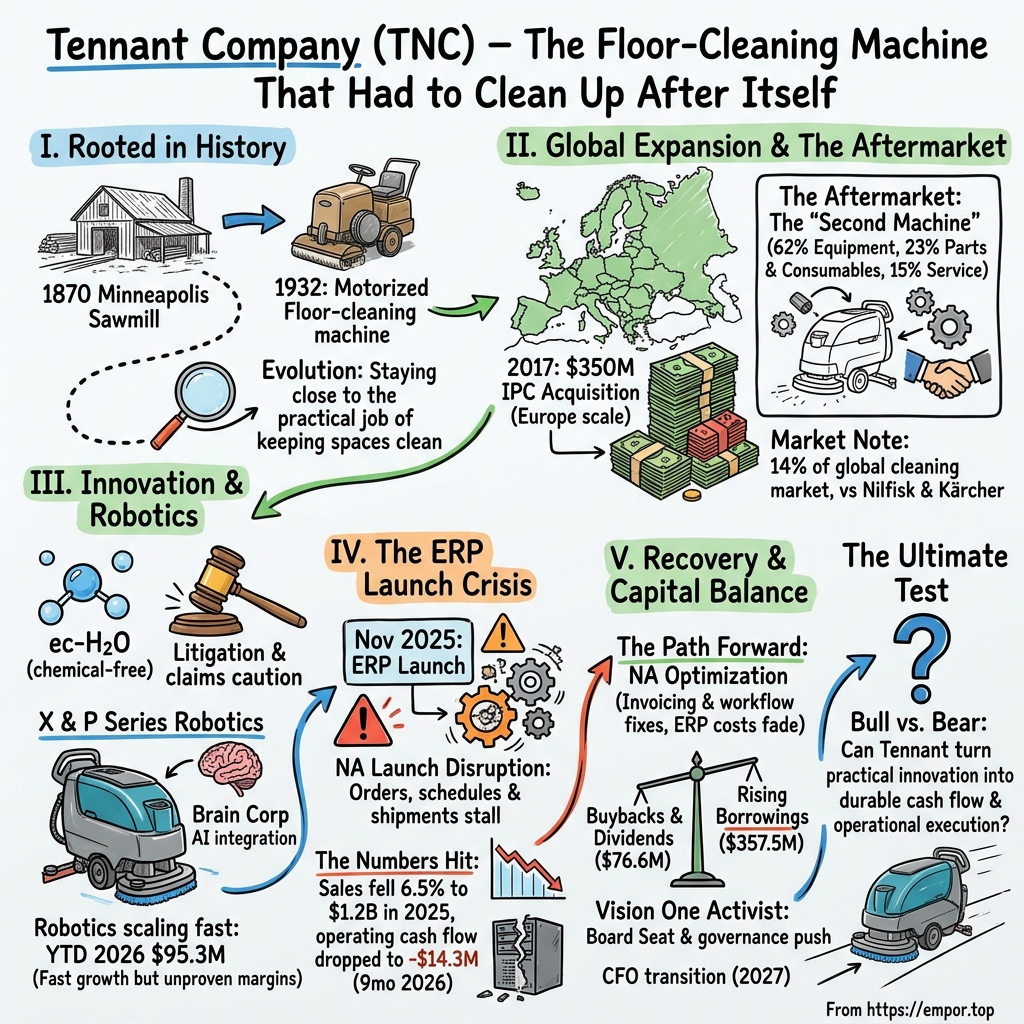
Tennant Company: The Floor-Cleaning Machine That Had to Clean Up After Itself
I. The Machine That Stalled
In the first week of November 2025, Tennant Company switched on the system that was supposed to carry it into its next century.1 The company had spent years preparing a new enterprise resource planning platform for North America, its largest region. An ERP system is the plumbing a customer never sees and the company cannot live without. It takes the order, checks whether a machine is in stock, tells the factory what to build next, sends the right brush or squeegee to the right service van, and issues the invoice at the end.
When the plumbing works, nobody talks about it. In the weeks after Tennant's go-live, people talked about little else. Orders that should have flowed straight through got stuck. Factory schedules fell out of step with demand. Parts that were sitting on a shelf somewhere became hard to see in the system, so technicians and customers waited.1 The company's own later description of the trouble reads like a tour of every room in the house: order management, fulfillment, manufacturing schedules, parts visibility and invoicing.2
The irony is almost too neat. Tennant makes the big scrubbers and sweepers that move through warehouses, airports, factories, hospitals and supermarkets after hours, keeping vast buildings ready for the morning. Its entire pitch to customers is reliability: buy this machine and the floor will be clean when the doors open. For a stretch of late 2025, the company could not reliably get its own orders out of its own doors.
The financial damage arrived quickly. Tennant's 2025 sales fell 6.5% to about $1.20 billion, and net income dropped to $43.8 million.1 The company spent $59.1 million on its ERP investment during the year, which means the modernization program cost more than the company earned in profit.1 In the fourth quarter alone, management estimated that the rollout took about $0.91 out of adjusted earnings per share.1 For a company whose adjusted earnings had been measured in a few dollars per share in good years, losing nearly a dollar in a single quarter to a software transition was not a rounding error. It was the quarter.
So this is not, at first glance, a story about a hot technology stock or a heroic founder. It is a story about a 156-year-old industrial company that had to clean up after itself. That framing is useful because it makes the stakes measurable. A disrupted system can be fixed. The harder question is whether the fix reaches the places investors actually get paid: the margin on each machine, the cash collected from each invoice, and the willingness of a facilities manager in Ohio or Ontario to keep buying from a supplier that left them waiting.
Three questions run through the rest of this episode. The first is whether Tennant has a defensible business at all in a fragmented equipment market, where a customer can, in principle, buy a scrubber from several makers. The second is whether robotics, the autonomous scrubbers that have become the most exciting part of Tennant's pitch, can become a genuinely profitable second engine rather than a promising product line. The third is whether management can restore cash generation while it keeps buying back shares, a combination that looks bold or careless depending on how the next year unfolds.
Here is the company as it stands in late 2026. Tennant reports a single business segment and organizes itself around three geographic areas: the Americas; Europe, the Middle East and Africa; and Asia Pacific.1 It employed about 4,484 people at the end of 2025.1 Management reaffirmed guidance for 2026 sales of $1.27 billion to $1.31 billion when it reported third-quarter results, which would put the top line back above where it stood before the stumble.3 But in the first nine months of 2026, net income was still down 43.4% from the year before, and the business consumed cash rather than producing it.34
That gap, between sales that are coming back and profits and cash that are not yet back, is the whole story in miniature. The system's disruption was real. Whether the recovery is durable depends on cash conversion and operating performance, not on the reassuring fact that the platform has stabilized. To understand why investors should care about the outcome at all, it helps to go back to the first time Tennant had to reinvent what it made, long before anyone used the word software.
 Subscribe on LinkedIn
II. From a Minneapolis Sawmill to the Factory Floor
In 1870, an Irish immigrant named George Henry Tennant set up a small woodworking operation in Minneapolis, a city that was then booming on the twin engines of lumber and flour.56 The business was a sawmill and woodshop, and it made the things a growing Midwestern city needed: hardwood floors, wooden downspouts and gutters.5 By the turn of the century it had become one of the leading hardwood-flooring makers in the Upper Midwest, surviving the fires that regularly visited wood businesses of the era, and in 1909 it incorporated.5
For a while, the formula was simple. Tennant sold the floor. Then it started selling the care of the floor too, developing an oil-and-sealer finishing system that was applied with a buffer.5 That small extension matters to the whole history that followed, because it moved the company's attention from the object to the job. A floor is bought once. A floor has to be maintained every day.
That instinct ran deeper than finishes and buffers. By the 1940s, Tennant was developing treatment products for concrete floors, the hard grey surfaces of factories and warehouses that were spreading across industrial America.5 Decades later the company still counted floor coatings among its businesses, a reminder that its real customer was never the person who bought a floor but the person responsible for keeping one usable.5
The pivotal moment came from a janitor. In the early 1930s, a junior high school custodian named Ben Casper built a floor-scouring contraption out of a coffee can wrapped in steel wool and hooked it to an old washing-machine motor so he could dry-clean his floors.5 A neighbor who worked as a shop foreman at Tennant saw it. Tennant acquired the rights to manufacture the device, and within a few years a version of the janitor's homemade machine had become the backbone of the company's business.5 By 1932, Tennant was producing motorized floor-cleaning equipment.6
It is worth pausing on what that pivot required. A lumber and flooring business is about raw material, milling and installation. A machine business is about motors, engineering, distribution and repair. Tennant did not keep making the same product better; it found a different product that served the same customer need. In 1947, a Tennant engineer named Ralph Peabody invented the first vacuum-equipped power sweeper, which pushed the company further from wood and deeper into industrial equipment.5
The family stayed close to the helm for more than a century. Roger Hale, a great-grandson of the founder, ran the company from 1976 until 1999, a 23-year tenure that ended when Janet Dolan, who had served as general counsel and then led the floor-coatings business and North American operations, became the first chief executive from outside the founding line.5 Her successor, Chris Killingstad, would lead the company into its largest acquisition, and his own successor would inherit the ERP project that opened this story.
Dolan's era also showed that buying reach was not a new idea for Tennant. In 1994 the company acquired Castex, and in 1999 it bought Paul Andra KG, a German business, as it tried to deepen its presence outside the United States; the same year brought a restructuring as Tennant worked to lower its costs.5 The habit of using acquisitions to build a footprint, especially in Europe, would return on a much larger scale two decades later.
The pattern that emerges is not a straight line of growth. It is a series of uncomfortable transitions: from lumber to flooring, from flooring to floor care, from manual care to motorized machines, and later from machines that need an operator to machines that can drive themselves. Each time, the legacy product was either fading or turning into a commodity, and each time the company bet that its closeness to the practical job of keeping large spaces clean would let it own the next way of doing that job.
That history explains Tennant's identity. It does not guarantee the next bet pays off. Longevity tells investors that the company has survived several product cycles; it does not tell them which of its current products will earn a premium. When a cleaning machine gains a new technology, the commercial question is always the same: does that technology change the customer's economics enough to justify paying more? Tennant's most famous attempt to answer yes, a few years after the financial crisis, offers a cautionary tale.
III. When "Chemical-Free" Met a Courtroom
Imagine a supermarket floor at 2 a.m. A scrubber rolls down the aisle laying down a film of cleaning solution, brushes working it into the grime, a squeegee pulling it back up. For decades that solution came from jugs of detergent, which had to be bought, stored, measured and disposed of. Tennant's ec-H₂O technology promised to take most of the jug out of the picture.
The idea was clever and easy to sell. Ordinary tap water passed through a module on the machine, where an electrical charge converted it into a cleaning solution capable of lifting dirt; once its work was done, the solution reverted toward ordinary water. For a facility manager, the pitch combined three attractive things: less chemical purchasing, less exposure for workers, and a greener story for the building owner. Tennant positioned ec-H₂O as a growth platform rather than a feature, and in the recovery after the 2008-09 recession, the company credited products equipped with the technology for helping to drive strong demand.7
The success was real enough to draw fire from the biggest name in the industry. Kärcher, the German family-controlled cleaning-equipment giant, challenged Tennant's advertising claims for ec-H₂O in a German court. The dispute was not about whether the machine cleaned floors. It was about what Tennant was allowed to say about how and how well it did so. In 2013, after a German court ruled against it, Tennant withdrew its appeal, saying the advertising claims in dispute were no longer being used.8
That ending is more instructive than dramatic. Tennant did not lose the right to sell its product, and the technology did not vanish. But a competitor had tested the marketing language in front of a judge, and Tennant chose to stop using the contested words rather than defend them further. For a business that sells on promises of performance, that is a meaningful distinction: technical capability and substantiated claims are two different assets, and only the second one survives a hostile reading.
It also says something about the competitive temperature of the industry. Cleaning equipment can look like a sleepy market from the outside, all brushes and squeegees and dealer catalogues. Inside, the largest players watch each other's claims closely, because a buyer comparing two scrubbers of similar size and price will often decide on the strength of a performance promise. When one maker claims to have removed most of the chemical cost from the equation, the others have every reason to test that claim, in the market and, if necessary, in court.
The legal tail of the technology proved surprisingly long. Oxygenator Water Technologies sued Tennant over patents covering ec-H₂O and a related scrubber option called nanoclean. In 2024, a jury awarded the plaintiff $9.8 million plus interest; after post-trial rulings added enhanced damages, Tennant's accrued liability reached about $20.5 million by the end of 2025.1 Tennant added a further $0.5 million in the first nine months of 2026, appealed the judgment, and posted a $20.3 million supersedeas bond, a kind of guarantee that lets a defendant pause collection during an appeal, without putting up cash collateral.4 Management has said the judgment does not restrict product sales.2 The sum is modest against a billion-dollar revenue base, but it is a reminder that a signature technology can generate legal costs long after it stops generating headlines.
There was also a smaller, quieter coda. Tennant had built a business around water-treatment ideas adjacent to ec-H₂O, branded Waterstar. In 2018, it sold the Waterstar assets for $4 million.9 That is a minor sum and should not be read as a verdict on everything Tennant attempts in technology. It does, however, belong in the record: a technology-adjacent effort that the company once thought worth building did not become a major growth engine and was sold for a figure that would barely register on today's balance sheet.
Put together, the ec-H₂O episode tells investors something specific about how to read Tennant's innovation stories. The company is genuinely capable of engineering distinctive products and taking them to market through a large sales force. It is less clear that those products have reliably turned into durable premium economics. The filings from that era describe ec-H₂O as a driver of demand; they do not show a sustained, separately reported profit stream that outlived the launch excitement.
The standard that follows is simple. A product milestone is the start of the case, not the end of it. Repeat orders, margins and service revenue are what show whether an innovation has become a business. That standard will matter enormously when this story reaches the autonomous scrubbers. But first, Tennant made a bet of a different kind, one that had nothing to do with clever engineering and everything to do with buying scale.
IV. The $350 Million Bet on Europe
In February 2017, Tennant announced that it had agreed to buy IPC Group from the Italian private-equity firm Ambienta.10 Chris Killingstad, then chief executive, was making the boldest move of his tenure. IPC was an Italian maker of professional cleaning equipment with a portfolio of brands and a strong position in European markets where Tennant had long been a smaller player. It was, by a wide margin, the largest acquisition in Tennant's history.
The price was about $350 million.10 IPC had reported roughly $203 million of sales in 2016, which meant Tennant was paying about 1.7 times revenue.10 Management told investors the deal would be accretive to 2018 earnings, and it planned to fund the purchase and related costs with about $420 million of new borrowing.10 Set against Tennant's own pre-deal revenue of a little over $800 million, IPC added roughly a quarter to the company's size in a single step, and it did so with debt rather than stock.1110
Why buy rather than build? The strategic logic was straightforward. Europe's cleaning-equipment market is crowded and fragmented, with strong local brands, dealer networks built over decades, and customers who often prefer products designed for smaller, denser buildings than the sprawling American warehouses where Tennant's heaviest machines shine. Building that presence one dealer at a time would have taken years. IPC offered an instant footprint: factories, brands, distribution relationships and a broader product range, especially at the more compact and price-sensitive end of the market.
So what Tennant bought was not a bolt-on product line. It was a much larger EMEA business and a second center of gravity for the company. That made the promise bigger, and so were the risks. The acquisition loaded the balance sheet just as Tennant had to integrate a company with different products, a different culture and a different cost base on another continent.
The early record was rough. Tennant reported a net loss for 2017, the year the deal closed.9 Acquisition accounting played a part: when a buyer revalues a target's inventory to fair value, the higher cost flows through as that inventory is sold, depressing margins for a few quarters. Management also pointed to weaker field-service productivity as a drag on profitability.9 Those facts complicate the triumphant version of the story, but they do not establish that IPC itself destroyed value. Integration costs are, to some degree, the expected price of a large deal.
The deal also changed Tennant's exposure to currencies. A bigger European business meant more revenue and costs in euros, and the company now names the euro alongside the Australian and Canadian dollars, sterling, the yen, the renminbi, the Brazilian real and the Mexican peso among its main exposures.1 It hedges with forwards and options, uses cross-currency swaps for its euro exposure, and says these instruments are not for speculation.1 The transaction effects that pass through the income statement are small, a loss of $1.7 million in 2025.1 The translation effects are not: when foreign assets are restated in dollars, the swing through comprehensive income moved from a loss of about $30 million in 2024 to a gain of about $41 million in 2025.1 Those are paper movements rather than cash, but swings of that size, against annual profit of $43.8 million, show how much of Tennant's balance sheet now lives outside the United States.
The more telling evidence arrived years later and from an unexpected direction: the auditor. In its opinion on Tennant's 2025 financial statements, Deloitte singled out the valuation of EMEA goodwill as its critical audit matter, the area of the audit requiring the most challenging judgment.1 Goodwill is the premium a buyer pays above the value of a target's identifiable assets, and much of Tennant's European goodwill traces to deals like IPC. The estimated fair value of the EMEA reporting unit exceeded its carrying value by only 7.9%.1 In plain terms, nearly a decade after the purchase, the European business was worth only slightly more than the books said it should be. A modest disappointment in European profits could push that cushion below zero and force a write-down.
That is the most honest verdict available. IPC materially expanded Tennant's European presence. But the headroom is thin, the filings do not supply a standalone EBITDA figure for IPC at the time of purchase, and there is no directly comparable set of deals to benchmark the price against. A confident claim that Tennant overpaid is not supported. Neither is a confident claim that the bet has clearly paid off. The narrow goodwill cushion is the market's sceptical question, written into an audit report.
Tennant kept buying, but at smaller scale. In 2024 it acquired TCS, a channel-expansion deal with a total purchase price of $34.9 million that contributed about $22 million of reported revenue that year.12 The company did not disclose a standalone operating profit for TCS, so investors cannot judge the purchase multiple on earnings. The deal fits a familiar pattern of tuck-ins aimed at owning more of the route to the customer.
Step back and look at the whole decade. Tennant's sales rose from $811.8 million in 2015 to about $1.20 billion in 2025, roughly 4% a year, with both acquisitions and organic growth in the mix.111 Net income told a far choppier story: it rose from $32.1 million in 2015 to a peak of $109.5 million in 2023, then fell back to $43.8 million in 2025.111 A company that adds sales at mid-single digits while profits swing by more than half within two years is not a steady compounder. It is a business whose earnings depend heavily on execution, mix and cost control. That makes the question of what Tennant sells after the machine leaves the dock the most important one in the whole story.
V. The Aftermarket Is the Second Machine
The shift ends at 6 a.m. The scrubber rolls back to its charging station in the corner of a distribution center, its brushes worn a little thinner, its squeegee blade a little more nicked, its batteries a little closer to replacement. Nobody at the facility is thinking about Tennant at that moment. But Tennant is, in a sense, still in the building.
Every machine that leaves a Tennant factory starts a second relationship that can outlast the first. It needs pads, brushes, squeegees, filters and batteries. It needs a technician when a motor fails or a sensor drifts. Many customers buy maintenance agreements, and buyers of autonomous machines often pay for autonomy subscriptions; Tennant describes prepaid autonomy and maintenance agreements running from 12 to 60 months.1 When the machine finally wears out, the customer faces a replacement decision, and the incumbent supplier usually gets the first conversation.
The revenue mix makes the second machine visible. In its 2025 investor materials, Tennant split its sales into about 62% equipment, 23% parts and consumables, and 15% service.13 Equipment remains the dominant source of sales, which matters because the company itself warns that product sales are sensitive to customers' capital spending.14 When a warehouse operator delays an upgrade or a retailer freezes its capital budget, new machine orders slow first. Parts and service tend to hold up better, because machines that are already working still need care.
That gives Tennant a partial buffer, not an annuity. More than a third of revenue comes from the installed base, which is valuable ballast in a downturn. But Tennant does not disclose what share of revenue is contractually recurring, how long customers typically stay, or how often they renew service agreements.1 The comfort is plausible; the proof is not published.
The customer base is broad. No single customer accounted for more than 10% of Tennant's 2025 sales.1 That is good news for bargaining power: no one buyer can dictate prices across the business. The company does not, however, publish the share of its top five or top ten customers, and it does not offer evidence that customers cannot or do not split their purchases among several suppliers. A national retailer could, for instance, buy Tennant ride-on scrubbers for its biggest stores and a rival's compact machines for its smaller ones.
So who are the rivals? Tennant estimates that the global market for mechanized cleaning equipment is worth roughly $8.6 billion to $9 billion, and that its own share is about 14%, with higher share in the Americas than in EMEA or Asia Pacific.131 That is management's estimate, not an independently verified figure, but it paints a believable picture: Tennant is a leader in a field that no one dominates.
Its two most visible competitors are European. Nilfisk, the Danish cleaning-equipment maker, generates roughly €1 billion of annual revenue across professional cleaning machines.15 Kärcher, the privately held German company that once took Tennant to court over ec-H₂O, reported €3.48 billion of revenue in 2025 across a much broader portfolio that includes consumer pressure washers and home appliances as well as professional machines.16 Those totals are context, not market shares. Kärcher is far larger overall, but much of its revenue comes from products Tennant does not make. In the heavy industrial scrubber and sweeper niche where Tennant earns its reputation, the comparison is closer than the headline numbers suggest.
Michael Porter's competitive-forces lens helps clarify where the power sits. Buyers are dispersed, which tempers their individual bargaining power, but they have choices at every replacement cycle and the option of simply running an old machine a little longer. Rivalry is real in a fragmented field where several global players and many regional ones compete on price, features and dealer relationships. Substitutes include manual cleaning, contract cleaning services that bring their own equipment, and a growing crop of autonomous-robot makers. Supplier power is mostly ordinary, with one important exception, Tennant's dependence on Brain Corp for autonomy software, which matters most once the machines start driving themselves. New entrants face the barrier of building service networks and brand trust, but robotics lowers that barrier for software-first companies.
Against that field, Tennant's best structural assets are its size in North America, its direct sales and service footprint, and the installed base of machines it maintains. A large network of technicians who already visit customer sites creates a cost advantage in service density and a natural point of contact for the next sale. Those are real mechanisms. What the filings lack is the evidence that would prove they translate into pricing power: retention rates, renewal rates, service attach rates, or price realization relative to competitors.
The ERP failure is, uncomfortably, the best natural experiment available. If customers were truly locked in, a stretch of late deliveries and invoice confusion would cause annoyance but little lasting damage. If they were not, rivals would have had an opening. The fact that Tennant's 2026 sales returned to growth, with organic sales up 5.7% in the third quarter, suggests customers did not abandon the company en masse.3 That is a meaningful data point in favor of the relationship. It is not proof of a moat, because some of that growth reflects recovery from the disruption itself.
The moat question, asked plainly, is whether Tennant can convert service reach and customer relationships into better retention, margins or price realization than its competitors. The company has the network that would make that possible. It has not yet published the numbers that would make it certain. And the part of the business most likely to change the answer is the newest one: machines that clean without anyone holding the handle.
VI. The Robot That Has to Earn Its Place
Picture a big-box store an hour before opening. An autonomous scrubber glides down aisle 14, slows for a pallet jack, turns at the end cap and starts back up aisle 15. The worker who used to spend that hour driving the machine is stocking shelves instead. For a retailer struggling to hire and keep staff, that hour is the product.
That is why the economics of a cleaning robot are really the economics of labor. A buyer is not paying for a cleverer scrubber; it is paying to move a worker from a repetitive job to a more valuable one, or to cover a shift it cannot staff at all. The robot earns its place only if the hours it saves are worth more than its higher purchase price, its subscription and its service. That calculation varies by building, by wage level and by how reliably the machine runs without a human rescuing it. It also means robotics demand should be most resilient where labor is scarcest and most fragile where labor is cheap.
Tennant began moving into autonomy in the late 2010s, pairing its commercial scrubbers with navigation technology from Brain Corp, a software company that develops autonomy for commercial machines.9 The division of labor has stayed broadly the same since. Tennant brings the machine itself: the chassis, the cleaning heads, the batteries, the integration of sensors and software into a durable product, plus the sales force, service network and lifecycle support that keep it running. Brain Corp brings the brain: the software, artificial intelligence and spatial intelligence that let the machine map a space, avoid obstacles and repeat a route.1
That partnership is more than a vendor contract. Tennant owns an equity stake in Brain Corp, and in December 2025 its voting interest rose to about 18% with roughly 12% economic ownership, which moved the investment to equity-method accounting.4 Under that method, Tennant records its share of Brain Corp's profits or losses; in the first nine months of 2026, that share was a loss of $0.6 million.4 The equity stake carried a book value of $19.4 million at the end of September 2026, and Tennant separately held a Brain Corp convertible preferred debt security with a fair value of $11.8 million, valued using unobservable inputs and maturing more than five years out.4 Tennant, in other words, has tied part of its balance sheet to the health of the company that supplies its autonomy software.
Is Tennant itself investing enough to own the future it is selling? The record is mixed. Research and development spending was $32.4 million in 2015, or 4.0% of sales, and $41.2 million in 2025, or 3.4%.111 Capital expenditure fell from about 3.1% of sales to about 1.8% over the same decade.111 Meanwhile the workforce grew from 3,236 people at the end of 2016 to 4,484 at the end of 2025, partly through acquisitions.171 Lower R&D intensity alongside a partner-supplied autonomy brain is consistent with a deliberate strategy: let a specialist write the software, and spend Tennant's own money on machines, integration and service. It is equally consistent with a company that is renting its most valuable future capability rather than building it. The filings do not settle which reading is right.
The product range has broadened. Tennant's premium autonomous machines sit in what it calls the X Series. More recently, it introduced the P Series, which management described as a more accessible offering, built by a contract manufacturer.2 That choice is revealing. A contract-manufactured line can come to market faster and with less capital, which suits a product meant to reach smaller customers at lower price points. It also means Tennant shares the manufacturing margin with a partner and relies more heavily on its brand, distribution and service to differentiate.
Now the numbers, which are genuinely striking. Robotics revenue reached $37.3 million in the third quarter of 2026, up 71% from a year earlier.3 In the first nine months of the year, robotics revenue totaled $95.3 million, already more than Tennant generated from robotics in all of 2025.32 Autonomy subscriptions also helped lift the company's service and other revenue.2 If the third quarter's pace held for four quarters, robotics would represent roughly a ninth of the company's guided 2026 sales.
That is material enough to matter to the future case. It is not yet the business. The other eight-ninths of Tennant still sell conventional machines, parts and service. And the critical disclosures that would establish robotics as a profit engine are missing: Tennant does not publish robotics gross margin, operating profit, the number of deployed units, the share of robotics revenue that comes from subscriptions, or repeat deployment rates.31 Investors see the growth. They cannot see whether each robot sold makes more or less money than the manual scrubber it replaces.
The third-quarter call showed management's enthusiasm and its boundaries. Executives highlighted the growth, the expanding range and the role of the P Series in reaching new customers.2 What the call did not provide was a margin figure for the robotics line or a disclosed target for its profitability.
The historical test belongs right beside the claim. Tennant has been here before with ec-H₂O, a distinctive technology marketed as a growth platform, which drew strong demand, a competitor's legal challenge over its advertising, a long patent tail and no separately disclosed profit stream that proved durable. The Waterstar sale is a smaller reminder of the same lesson. That history does not reject the robotics thesis. Autonomy addresses a stronger customer need, labor scarcity, than chemical-free cleaning ever did, and its revenue is already larger and disclosed. But it narrows the thesis to a more careful version: Tennant has proved it can sell robots; it has not yet proved it can earn superior returns from them.
There is also a structural question the partnership raises. If Brain Corp's software is the hardest part to replicate, then much of the value in an autonomous scrubber may accrue to the software owner rather than the machine builder. Tennant's equity stake partly hedges that, and its service network is a genuine strength when a robot needs fixing at 4 a.m. But Tennant's own annual report makes plain that the autonomy technology in its premium machines comes from Brain Corp, so the dependence on a single external supplier is a matter of record, not speculation.1
The settling measures are clear. Separately disclosed robotics revenue is a start, and Tennant now provides it. Gross margin, deployed units, the subscription and service mix, and repeat deployments by existing customers would complete the picture. Until those arrive, robotics is a fast-growing product line inside an equipment company, with real momentum and an unproven profit pool. And in late 2025, the company's attention was dragged away from that promising future and back toward a far more basic problem: getting its own orders out the door.
VII. The ERP Go-Live That Changed the Conversation
Large companies change their ERP systems the way people change homes: rarely, expensively, and with a stretch when nothing is where it should be. The difference is that a family can live out of boxes for a week. A manufacturer with thousands of open orders, multiple factories and a nationwide service fleet cannot. Every order is a promise, and the ERP system is the ledger of promises.
When Tennant brought its new North American platform live in the first week of November 2025, the promises started slipping.1 Customers placed orders that did not flow through order management as expected. Fulfillment slowed. Manufacturing schedules, which depend on accurate demand signals, fell out of sync with what customers actually needed. Technicians and distributors found it harder to see which parts were available and where.12 In a business where a significant share of revenue comes from keeping existing machines running, losing visibility into parts was especially painful, because it hit the most loyal customers, the ones already using Tennant equipment every night.
The fourth quarter of 2025 absorbed the first blow, with the estimated $0.91 hit to adjusted earnings per share. Then 2026 became a year-long exercise in recovery under public scrutiny.
Before following that recovery, it helps to know what normal looked like. In the three years from 2023 through 2025, Tennant reported combined net income of $237.0 million and combined operating cash flow of $343.1 million.1 On the surface, that is excellent cash conversion: the business collected about $1.45 in operating cash for every dollar of reported profit. Look closer and the cushion has an ordinary explanation. Depreciation, amortization and share-based compensation, charges that reduce profit without consuming cash, added back about $211 million over those three years, and 2023 also benefited from a deferred-tax item of about $27 million.1 Working capital moved the other way, with inventory absorbing $33.0 million in 2024 and $21.7 million in 2025.1 So Tennant entered the go-live as a business that generated real cash, but whose cash flow was already sensitive to inventory and other working-capital swings. The ERP failure hit precisely that sensitivity.
The first-quarter report, in early May, showed how deep the hole was. Net income was roughly flat with the prior year, while adjusted EBITDA, the profit measure management emphasizes, fell steeply.18 The flat headline concealed operating weakness: costs related to the disruption, inefficiency in manufacturing and distribution, and extra spending to stabilize the system were all weighing on results.
The second-quarter report, in August, was the guidance reset. Tennant raised its sales outlook for the year, a sign that demand was holding up and that delayed orders were being filled, but lowered its profitability expectations.19 That combination tells a precise story. Customers were still buying; the company simply could not yet deliver those sales at its normal cost. On the call, management also confirmed that it had stopped the planned rollout of the new ERP system in EMEA in order to concentrate on optimizing North America.20
That scope correction deserves its own moment. The original modernization plan was global; a single system across regions would, in theory, have given Tennant better data, easier coordination and lower long-term IT costs. Halting the European rollout reduced near-term execution risk, because the company would not attempt a second go-live while still repairing the first. It also narrowed the plan. Tennant now runs different systems in different regions for longer than it intended, and whatever benefits a unified platform was supposed to deliver are deferred or reduced.
By the third quarter, reported on November 2, 2026, the picture had improved meaningfully on the cost line. ERP-related inefficiencies within cost of sales fell from about $10 million in the first half of the year to about $2 million in the quarter, and management said it expected $2 million or less in the fourth quarter.221 Organic sales grew 5.7%.3 Margins improved sequentially, and the company reaffirmed its 2026 sales guidance of $1.27 billion to $1.31 billion.3 For the first time since the go-live, the narrative of recovery had numbers underneath it.
The nine-month totals show how much ground remained. Sales for the first nine months of 2026 rose 3.5% from a year earlier, yet net income fell 43.4% to $27.3 million.3 That mismatch is the signature of operating leverage working in reverse. A manufacturer carries large fixed costs: factories, engineers, a sales force and a service fleet. When the system that coordinates those costs breaks, revenue can hold up while expenses run hot, through inefficient production, extra handling and the work of fixing errors by hand. Add the cost of negotiating with an activist shareholder and the continuing ERP spending, and a small gain in sales becomes a large loss in profit. The encouraging corollary is that the same leverage should work in Tennant's favor once those extra costs disappear.
But the cash flow statement told a different story. In the first nine months of 2026, Tennant used $14.3 million of operating cash, compared with generating $50.8 million in the same period a year earlier.4 That swing of roughly $65 million is larger than the company's entire 2025 net income. Management attributed it to weaker operating performance and to working capital: money tied up in receivables and inventory.4
Receivables are where the ERP failure left its most stubborn fingerprints. Net receivables rose from $256.8 million at the end of 2025 to $291.7 million at the end of September 2026, an increase of about $35 million.14 Some growth in receivables is natural when sales rise. But on the third-quarter call, management gave a more specific explanation: some invoices had not been sent at all, and others had been disputed by customers, because of ERP problems.2 A customer cannot pay an invoice it never received, and a customer who receives an invoice with the wrong price or quantity will reasonably hold payment until it is fixed. Management said the underlying causes had been corrected and that past-due balances had improved meaningfully in September.2
That explanation is credible because it is concrete. It is also exactly the kind of claim investors should test rather than accept. If invoices are now going out correctly, receivables should decline relative to sales and past-due balances should keep falling over the next two or three quarters. If they do not, the problem is either deeper than described or partly about customer credit, not just system errors. One early signal is already in the books: bad-debt and returns expense rose to $7.1 million in 2025 from $2.6 million in 2024, which shows that collection problems were already carrying a real cost in the year the go-live hit the books.1
Set the three quarters side by side and management's posture evolves. The first-quarter report was about stabilization: flat headline profit, sharply lower adjusted EBITDA and a business still absorbing the disruption.18 The second-quarter call was about realism, with the profitability guidance cut and the EMEA pause.20 On the third-quarter call, prepared remarks emphasized progress on ERP inefficiency, robotics growth and order momentum, while analysts' questions turned to cash conversion and receivables.2 Management answered those questions with specifics, including the invoicing explanation, but also acknowledged that residual issues remained in parts availability, invoicing and certain processes.2
That acknowledgment is worth noting in management's favor. It would have been easy to declare victory on the strength of falling inefficiency costs. Instead, executives drew a line between the cost recovery, which was well advanced, and the operational and cash recovery, which was not complete.
How should investors judge the credibility of the team running this? Behavior over time is the best evidence. On the positive side, management named specific failure points, cut its profitability outlook when performance fell short instead of clinging to the original number, narrowed the program's scope to reduce risk, and delivered visible improvement in the inefficiency line by the third quarter. On the negative side, the company launched a system that disrupted its largest region badly enough to cut nearly a dollar of quarterly earnings per share, which points to shortfalls in testing, cutover planning or both. A management team that is candid about a failure it caused deserves credit for the candor, not for the failure.
The verdict on the go-live and its aftermath is balanced but clear. The recovery has real evidence behind it: lower ERP inefficiency, sequential margin improvement, reaffirmed sales guidance and returning organic growth. The financial test is incomplete. Receivables and inventory still absorbed cash, nine-month net income was down by more than two-fifths, and management itself said residual issues remained. The next test is whether improvement in the forecast becomes improvement in operating cash and margin. And that test matters more than usual, because Tennant made a choice during this period that raised the stakes: it kept returning cash to shareholders.
VIII. Buybacks, an Activist Deal and a Tighter Balance Sheet
In February 2026, while Tennant's engineers were still untangling the ERP system, its board signed a different kind of agreement. Vision One, an investor in the company, entered a cooperation agreement with Tennant that brought a mutually agreed director onto the board and committed the company to recommend that shareholders move to annual elections for all directors.22 Tennant later disclosed $2.9 million of legal and financial advisory costs tied to negotiating the agreement.3
Cooperation agreements are the polite end of shareholder activism. They usually arise when an investor has made clear that it wants changes and the company decides that a negotiated board seat is better than a public fight. Annual elections matter because staggered boards, where only a fraction of directors face voters each year, make it harder for shareholders to replace a board quickly. Moving to annual votes makes every director accountable every year. The agreement does not, on its own, prove that prior decisions were wrong. It does make governance and capital discipline live issues for a company that had just stumbled.
To see why, follow the capital-allocation sequence. In 2017, Tennant borrowed heavily to buy IPC. In the years that followed, it worked down that debt and then began repurchasing shares. In 2025, the year it spent $59.1 million on ERP modernization and absorbed the go-live disruption, Tennant also bought back about $88 million of its own stock, roughly 6% of shares outstanding.1 In February 2025 the board authorized repurchases of up to 2 million shares, and in April 2026 it authorized another 2 million.14
The buybacks continued through the recovery year. In the first nine months of 2026, Tennant spent $60.6 million on repurchases and paid $16.0 million in dividends, a combined $76.6 million returned to shareholders.4 During the same months, while the invoicing troubles were still working their way through the system, operating cash flow was negative. The arithmetic is unavoidable: the company returned around $90 million more to shareholders than its operations generated, and the difference came from its cash pile and its credit line.
The share count shows what the buybacks bought. Shares outstanding fell from about 18.85 million at the end of 2024 to 17.85 million at the end of 2025 and 17.05 million by September 2026.14 That is a reduction of nearly a tenth in less than two years, which mechanically raises each remaining share's claim on future profits. If the recovery succeeds, those repurchases at depressed prices could look shrewd in hindsight.
The balance sheet shows what they cost. Borrowings under Tennant's revolving credit facility reached $357.5 million at September 30, 2026, while cash had fallen from $106.4 million at the end of 2025 to $75.3 million.41 The facility runs to August 2029 and had $289.4 million of unused capacity.4 Its covenants cap debt at 3.75 times EBITDA and require EBITDA to cover interest at least three times; Tennant reported compliance with both.4 Management put net leverage at 2.0 times adjusted EBITDA, the top of its own 1-to-2 times target range.2
So the company is not in distress. It has room under its covenants and plenty of undrawn credit.
A covenant is a tripwire lenders set in advance. Tennant's debt could rise to almost four times a year's EBITDA before it broke the first one, and its earnings could shrink until they covered interest only three times before it broke the second. The company sits well inside both. Management's own target is the stricter fence, and the stricter fence is the one it has reached. But it has used up its own self-imposed leverage cushion during a year when operating cash was negative. S&P Global last affirmed Tennant's credit rating at BB, with a stable outlook, in November 2023.23 The most recent detailed rationale available, from 2018, cited Tennant's niche position in a fragmented industry and its operating record as strengths, and leverage, input costs, market-share loss and execution risk as constraints.24 That rationale predates the ERP disruption and should not be treated as a current assessment, but the constraints it named read like a preview of 2026.
A skeptical activist would frame the question sharply. Why buy back stock while the business is consuming cash and leverage is at the top of the range? The best defense is that management believed the shares were undervalued during a temporary disruption and that the balance sheet could absorb the strain. The best challenge is that a company in the middle of an operational repair has fewer degrees of freedom, and that returning borrowed money to shareholders reduces the margin for error if the recovery stalls.
Management's incentives sit at the center of this debate. Tennant's proxy describes a compensation system built on annual cash incentives tied to financial targets and long-term equity awards tied to performance.25 David Huml, who became chief executive in March 2021, owned about 1.4% of the company's shares as of March 2026, a meaningful personal stake that aligns his wealth with long-term shareholders.2514 Huml had spent 14 years at Graco and eight at Pentair before joining Tennant in 2014 to run global marketing, and he later served as chief operating officer before taking the top job.26 He is an industrial-equipment operator by training, not a software executive, which makes the ERP stumble both more understandable and more pointed.
His pay moved with the results. Huml's reported total compensation fell from $5.52 million in 2023 to $5.14 million in 2024 and $4.67 million in 2025, as net income declined from $109.5 million to $43.8 million.25 The annual incentive portion fell from $1.76 million to just $0.19 million over the same period.25 The pay system, in other words, did roughly what it was designed to do: when profits fell, the cash bonus nearly disappeared.
Shareholders have not revolted. At the 2026 annual meeting, about 15.75 million votes supported executive compensation against roughly 291,000 opposed, and each of the three director nominees was elected with between about 430,000 and 600,000 votes against.27 That is limited dissent. Tennant's largest holders are index and institutional investors, led by BlackRock with about 15.7%, Vanguard with about 12.5% and Mairs & Power with about 6.0%.25 None of them is a controlling holder, which leaves an engaged activist like Vision One with outsized influence relative to its stake.
One more transition adds to the strain. Chief financial officer Fay West announced plans to retire once a successor is hired, with the company aiming to name a replacement by the first quarter of 2027 and her departure expected in the second quarter.28 The CFO is the executive most responsible for cash collection, working-capital discipline and the relationship with lenders. Changing that seat in the middle of an ERP recovery and at the top of the leverage range is not a crisis, but it is a real execution risk.
The discipline claim will be tested in 2027. If operating cash flow recovers enough to cover capital expenditure, dividends and buybacks without further net borrowing, the 2025-26 repurchases will look like confident capital allocation through a temporary disruption. If buybacks continue while cash flow lags, the case that Tennant prioritized per-share optics over balance-sheet resilience will grow stronger. That is the question the market is pricing now.
Analysis & Bear vs. Bull Case
At the close on November 20, 2026, Tennant traded at about 56.6 times trailing earnings, 1.29 times enterprise value to sales and 14.1 times enterprise value to EBITDA.29 A price-to-earnings ratio in the mid-fifties looks absurd for a floor-cleaning equipment maker until one remembers that the trailing earnings include the worst of the ERP disruption. The denominator is depressed, so the ratio is inflated.
The more useful comparison is with Tennant's own history. In 2023, the company's best profit year, its shares traded at about 15.8 times earnings and 9.9 times EV to EBITDA; in 2025, those figures were about 30.5 times and 11.3 times.30 The current EV-to-EBITDA multiple is therefore above both, even though EBITDA itself is depressed. That tells investors something important: the market is not pricing Tennant as a broken company. It is pricing in a return to something like normal profitability, and arguably giving some credit for robotics growth. The recovery is, to a degree, already in the price.
So the real debate is not whether Tennant can recover. It is whether Tennant has a credible reason to win from here, at a price that already assumes it will.
The bull case starts with the installed base. Tennant has a global sales and service network, a dispersed customer base with no customer above 10% of sales, and more than a third of revenue from parts, consumables and service. It claims the leading share in its core market. Robotics revenue is growing at 71% and has already surpassed last year's total. ERP inefficiencies have fallen sharply, organic growth has returned, and management has reaffirmed sales guidance. In this telling, 2025-26 was a self-inflicted wound that is healing, and the buybacks executed during the disruption will magnify the per-share benefit of recovery.
The bear case starts with the evidence that is missing. The moat is plausible but undemonstrated: Tennant publishes no retention, renewal or pricing data that would show customers cannot easily switch. Long-run organic growth has been modest, with sales compounding at about 4% a year including acquisitions. Earnings have proved volatile, and 2026 cash conversion was negative. Robotics margins are undisclosed and the key autonomy technology belongs to a partner. Leverage has reached the top of the target range while capital returns continue, and the EMEA goodwill cushion is thin enough that a European slowdown could force a write-down.
To weigh those cases, it helps to apply Hamilton Helmer's framework of seven powers, which asks what durable structural advantage lets a company earn returns above its cost of capital. Building on the competitive forces at work on that warehouse floor after the night shift, the evidence sorts as follows.
Scale economies are Tennant's most plausible power. A dense service network in North America lowers the cost per service visit and makes the next sale easier, and a rival would need years and significant capital to replicate it. The evidence is the higher share in the Americas than elsewhere, which is consistent with scale advantages where the network is densest. Switching costs are the power investors most want to believe in and the one with the least published evidence; prepaid service and autonomy contracts create some friction, but nothing in the filings shows that customers struggle to leave at a replacement cycle. Brand matters in a business where reliability is the product, and the Tennant name carries weight with facility managers, though the ERP disruption tested that reputation directly.
The other powers are mostly absent or unproven. Network effects do not meaningfully apply to cleaning machines, although fleet data from autonomous scrubbers could one day improve the software. Counter-positioning, where an incumbent cannot copy a newcomer's model without damaging its own, arguably works against Tennant in robotics, since a software-first rival need not protect a large manual-equipment business. Cornered resources would require exclusive access to something rivals cannot get, and Tennant's autonomy depends on a partner rather than proprietary software. Process power, the hard-to-copy operational excellence that lets a company do the same things better, is the power the ERP failure most directly undercuts.
Weighed honestly, Tennant has one probable power, scale in service, and one possible power, switching costs, that remain unproven. That is enough for a solid niche business with above-average returns in good years. It is not evidence of an impregnable moat. The history narrows the moat claim to a smaller version: Tennant is a scale leader in a fragmented market, with real but unmeasured customer stickiness.
Industry structure reinforces that conclusion. The market is fragmented, with Nilfisk and Kärcher as named competitors and many regional players, and published market-share comparisons are limited to management's own estimates. The key question is whether Tennant's service footprint and installed base translate into customer economics competitors cannot match. The 2026 sales recovery, after a disruption that gave every rival an opening, is the best evidence that the relationships are stickier than a commodity market would allow.
Financial strength is adequate but no longer abundant. Debt capacity and covenant compliance provide room, but revolver borrowings rose while operating cash was negative and capital returns continued. The equation that matters is simple: if 2027 operating cash flow covers capital expenditure, dividends and buybacks, the balance sheet is fine. If not, the company will either borrow more, slow returns or both.
Two other risks deserve a sentence each because they work through the business mechanism rather than the headlines. The first is the capital-spending cycle: Tennant itself warns that product sales are sensitive to customers' capital budgets, so a slowdown in warehouse, retail or industrial investment would hit the 62% of revenue that comes from equipment first.14 The second is input costs and trade policy, which S&P flagged years ago as constraints on a manufacturer that buys steel, batteries, motors and electronics through global supply chains.24 Neither is unique to Tennant, but both would arrive while the company's cash cushion is thinner than usual.
The management test is about guidance discipline through a crisis. Huml, chief executive since 2021, presided over the ERP launch that went badly wrong. Since then, his team cut guidance when it had to, narrowed the program to reduce risk, explained failures in specific terms and delivered visible improvement in the cost line. The CFO transition adds risk at exactly the wrong moment. The record so far suggests a team that is candid about problems once they appear; it does not yet show a team that prevents them.
Three measures will tell investors whether the recovery is real. The first is operating cash flow together with receivables: the latest reading is negative $14.3 million of operating cash over nine months, with receivables up about $35 million since year-end, and management says the trend turned in September. The second is margin recovery as ERP costs fade: the latest reading is about $2 million of ERP-related cost-of-sales inefficiency in the third quarter, down from about $10 million in the first half, with sequential margin improvement. The third is robotics revenue paired with disclosed economics: the latest reading is $37.3 million in the third quarter, up 71%, with no disclosed margin or recurring-service share.
The valuation, finally, has to be read honestly. A high trailing P/E is not a standalone verdict, because it reflects depressed earnings. But an EV-to-EBITDA multiple above Tennant's own recent history means the market is already looking through the disruption. For that multiple to be justified, earnings and cash have to recover not just to where they were, but in a form investors trust. At this valuation, execution, not recovery language, has to carry the argument.
Business & Investing Lessons
Go back to Ben Casper, the school janitor, bent over a coffee can wrapped in steel wool and an old washing-machine motor. Tennant was a flooring company then, and it could have stayed one. Instead it bought the rights to a stranger's contraption and turned into something else. The first lesson is that a long history is not a moat; the willingness to change the product is. Tennant's 156 years are evidence of adaptability, not protection. The founders of any old industrial company should take that seriously: the thing that keeps a business alive is not what it has done but what it is still willing to stop doing.
Then picture the scrubber returning to its charger at the end of a shift, brushes worn, squeegee nicked, batteries tiring. That machine is a sale that keeps happening. The second lesson is that a machine becomes a business when the service, parts and customer relationship outlast the sale. More than a third of Tennant's revenue comes from what happens after the machine leaves the factory, and the strongest argument for the company's durability lies there. Yet Tennant has never proven the strength of that relationship with published retention data. For investors, the lesson is to value an installed base by its demonstrated stickiness, not by its size.
Then recall ec-H₂O: a clever technology, a strong demand story, a competitor's court challenge, withdrawn advertising claims, a patent verdict years later and a small side business sold for $4 million. The third lesson is that a technology story earns trust through repeat use, not its launch. Robotics now carries the same kind of promise, with far stronger revenue evidence. The question for investors is not whether the robots work. It is whether customers buy them again, renew the subscriptions and pay enough to make each one profitable.
Finally, return to the first week of November 2025, when the system that was supposed to modernize the company stopped it from shipping. Tennant spent more on ERP modernization in 2025 than it earned in profit, and then spent most of 2026 recovering from the launch. The fourth lesson is that a modernization plan is only as good as the orders it can ship and the cash it can collect. Every industrial company planning a major systems change should study the gap between a stabilized platform and a recovered business. Tennant closed the first gap in months. It is still closing the second.
There is a fifth lesson, and it belongs to the months when the cash flow statement turned negative and the buyback program kept running. Tennant returned about $77 million to shareholders in the first nine months of 2026 while its operations consumed cash, and its leverage climbed to the top of its own target. A buyback funded by a credit line is a bet on the recovery, not a dividend from it. That bet may prove well timed. But investors in any company repurchasing stock during an operational repair should ask where the cash is coming from, and whether the board would make the same choice if it had to pay with cash the business had actually earned.
Epilogue
Tonight, Tennant stands roughly where a patient stands after successful surgery and before the follow-up scans. The visible wound has closed. ERP-related inefficiency has fallen to a fraction of its peak, organic growth has returned, and robotics is growing faster than any other part of the business. The scans that matter have not been read yet.
The first will come with full-year 2026 results in early 2027. Investors will look past the headline earnings to the cash flow statement. If fourth-quarter operating cash turns strongly positive and receivables fall as management's invoicing explanation implies they should, the recovery story will have moved from the cost line to the cash line. If receivables stay elevated or cash remains weak, the ERP problem will look deeper and more structural than the company has described.
The second will be the robotics disclosures. Tennant now reports robotics revenue; the next step is margin, deployment and recurring-revenue data. A company confident in the economics of its fastest-growing line has every reason to show them. Continued silence would not prove that the economics are poor, but it would leave the most exciting part of the bull case resting on growth alone. Any change in the Brain Corp relationship, whether a deeper tie-up, a rival autonomy supplier or a shift in Brain Corp's own fortunes, would reshape that case.
The third is a cluster of events that will test management's attention. The Oxygenator Water Technologies appeal remains unresolved, with the bond in place and roughly $21 million accrued. The CFO succession is supposed to produce a new finance chief by early 2027, and the handover will happen while leverage sits at the top of the target range. The board, now committed to annual elections and newly joined by a director agreed with an activist, will decide whether buybacks continue at the same pace.
Quieter but no less important is the annual goodwill test for Europe. With the EMEA business valued only about 8% above its carrying amount at the last test, a soft European economy or a disappointing year for the IPC brands could erase that cushion. An impairment would be a non-cash charge and would not change the cash Tennant generates. It would, however, be the clearest verdict yet on the price paid for the largest deal in the company's history.
Each outcome maps onto the questions this story began with. Strong cash flow and falling receivables would answer whether the recovery is real. Disclosed robotics margins would answer whether autonomy is a second engine or a product line. Capital returns funded from operating cash rather than borrowing would answer whether management balanced reinvestment and shareholder returns responsibly. And customer retention, robotics margins and the share of truly recurring revenue, the measures the company still does not publish, would answer whether Tennant's moat is as deep as its history suggests.
The tension that remains is simple to state and hard to resolve. Tennant has shown that it can fix a broken system. It has not yet shown that the fix reaches the cash flow statement, or that its robots will earn more than they cost.
Outro
Return, one last time, to the warehouse floor at night. A scrubber crosses the concrete in long, patient lines, finishing the route nobody will notice in the morning. It may be driving itself now, guided by software from a partner in a different industry, maintained by a technician from a service network built over decades.
The machine does its job. The company that built it is still finishing its own route, from a bruising systems failure toward the cash, margins and customer trust that will show the recovery is real. Tennant has spent more than a century and a half changing what it makes so that someone else's floors stay clean. Its future depends on proving that it can keep its own house in order while it does.
References
-
2025 Form 10-K — Tennant Company / SEC, 2026-02-24 ↩↩↩↩↩↩↩↩↩↩↩↩↩↩↩↩↩↩↩↩↩↩↩↩↩↩↩↩↩↩↩↩↩↩↩↩↩
-
Q3 2026 Earnings Call Transcript — The Motley Fool, 2026-11-03 ↩↩↩↩↩↩↩↩↩↩↩↩↩
-
Third Quarter 2026 Results — Tennant Company / SEC, 2026-11-02 ↩↩↩↩↩↩↩↩↩↩
-
Q3 2026 Form 10-Q — Tennant Company / SEC, 2026 ↩↩↩↩↩↩↩↩↩↩↩↩↩↩
-
Tennant Company — Encyclopedia.com (International Directory of Company Histories) ↩↩↩↩↩↩↩↩↩↩↩
-
Tennant Company Celebrates 150th Anniversary — Tennant Company, 2020-09-24 ↩↩
-
2010 Second-Quarter Results — Tennant Company / SEC, 2010-07-29 ↩
-
ec-H2O Advertising Case Update — Tennant Company, 2013-09-20 ↩
-
Tennant Company Announces Agreement With Ambienta to Acquire IPC Group — Tennant Company, 2017-02-23 ↩↩↩↩↩
-
Kärcher Weathers the Storms: 2025 Revenue — Kärcher, 2026-01-29 ↩
-
2016 Form 10-K — Tennant Company via AnnualReports.com, 2017 ↩
-
First Quarter 2026 Results — Tennant Company / SEC, 2026-05-04 ↩↩
-
Second Quarter 2026 Results — Tennant Company / SEC, 2026-08-05 ↩
-
Q2 2026 Earnings Call Transcript — StockAnalysis, 2026-08-06 ↩↩
-
Q3 2026 Earnings Presentation — Tennant Company, 2026-11-02 ↩
-
Vision One Cooperation Agreement — Tennant Company / SEC, 2026-02-12 ↩
-
2023 S&P Rating Action on Tennant Co. — Cbonds, 2023-11-28 ↩
-
Tennant Co. 'BB' Rating Rationale — S&P Global Ratings, 2018-11-12 ↩↩
-
2026 Proxy Statement — Tennant Company / SEC, 2026-03-18 ↩↩↩↩↩
-
Tennant Company Appoints David W. Huml as Senior Vice President of Global Marketing — Tennant Company, 2014-10-22 ↩
-
2026 Annual Meeting Voting Results, Form 8-K — Tennant Company / SEC, 2026-05-01 ↩
-
Tennant Company Announces Retirement of Fay West, Senior Vice President and Chief Financial Officer — Tennant Company, 2026-07-30 ↩
 LinkedIn
 WhatsApp
 Reddit
 Hacker News
 Email
 Kindle
 RSS Feed
 Spotify
 Apple Podcasts
 Amazon Music
 Audible
 YouTube