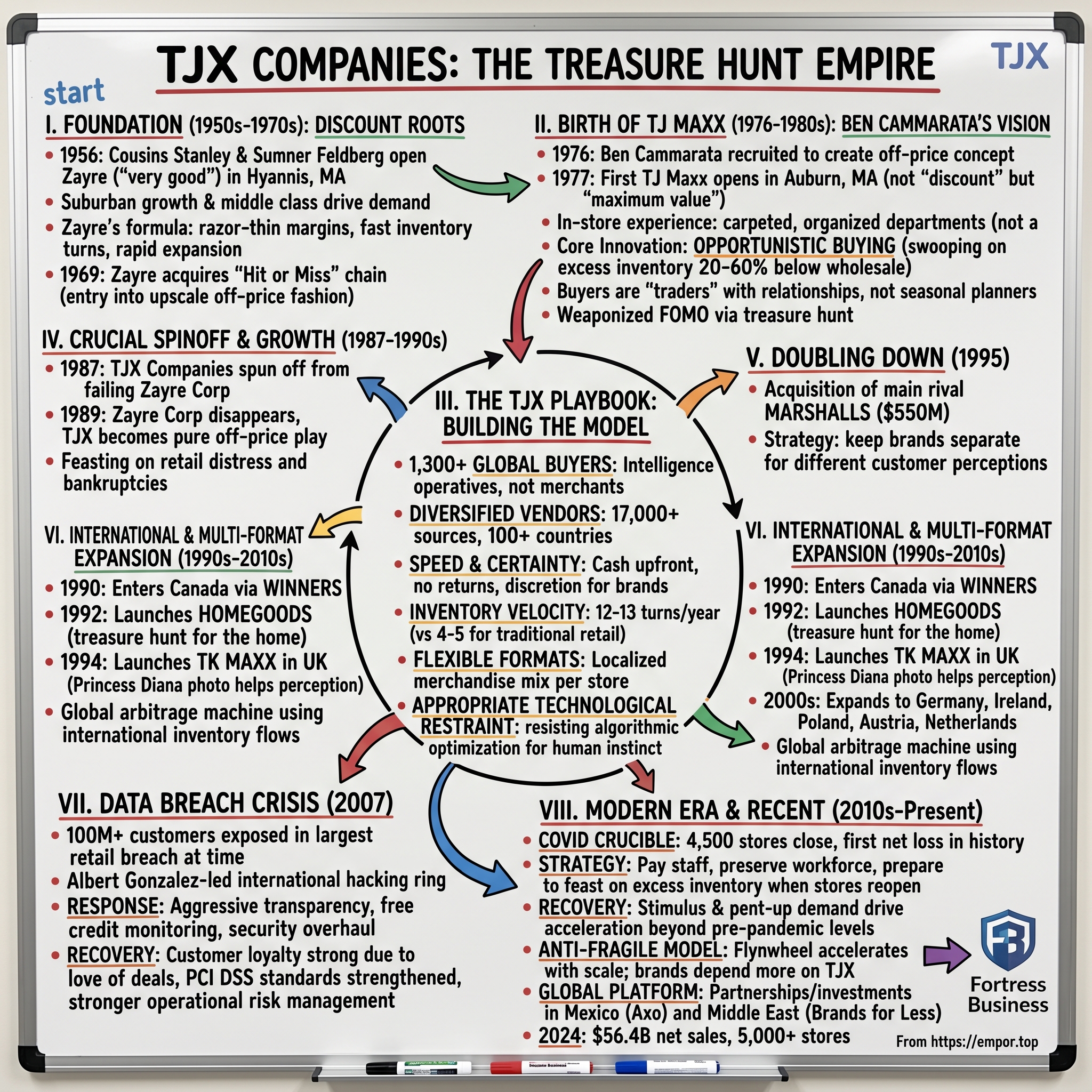
TJX Companies: The Treasure Hunt Empire
I. Introduction & Cold Open
On a Wednesday morning in March 2026, a queue formed outside the Diagonal Mar shopping centre in Barcelona. The store behind the doors had no loyalty app, no livestream, no algorithmic feed. It was 2,100 square metres of shelving stocked with cosmetics, footwear, cookware and apparel that nobody in Spain had ever seen assembled in quite that combination, priced well below what the same labels fetched a few kilometres away on Passeig de Gràcia.1 It was the first TK Maxx in Spain — country number ten for a company that has spent five decades insisting that the most durable thing in retail is not convenience, but surprise.
Two months later, on a conference call from Framingham, Massachusetts, the same company reported that comparable sales across its 5,200-plus stores had risen 6% in a single quarter, that every one of its four divisions had grown customer transactions, and that earnings per share had jumped 29%.2 This is not a startup. The TJX Companies turned fifty in 2026. It carried a market value near $180 billion in late July 2026 — larger than Nike, larger than Starbucks, larger than every US department store chain combined — and it did so while generating roughly 2% of its sales online.3
The obvious question is how. The interesting question is whether it lasts.
TJX's business is deceptively easy to describe and brutally hard to copy. It buys other people's mistakes. When a brand overproduces, when a department store cancels an order, when a direct-to-consumer label discovers that demand was a spreadsheet fantasy, someone has to make the inventory disappear without wrecking the brand's price architecture. TJX is that someone, at a scale nobody else operates: more than 1,400 buyers working a universe of roughly 21,000 vendors across more than 100 countries, feeding stores whose assortment changes several times a week.4 The company calls the resulting shopping experience a treasure hunt. Behind the phrase sits a genuine economic engine — one that converts the apparel industry's chronic forecasting failure into gross margin.
But a business built on other people's inefficiency carries an uncomfortable dependency, and the most honest version of the TJX story takes that seriously. Management says merchandise availability is "off the charts" and that the bigger TJX becomes, the more availability it sees.2 That is an assertion, not a law of nature. It is also, so far, supported by results: fiscal 2026 net sales surpassed $60 billion for the first time, comparable sales rose 5% on top of a 5% increase the year before, and every division comped 4% or better.5
This is the story of how a struggling Massachusetts discount chain accidentally incubated the company that would eat it, how that company turned opportunistic buying into an industrial process, and what a sophisticated investor should actually watch to know whether the machine is still working — or whether the retail world is finally getting organised enough to stop feeding it.
 Subscribe on LinkedIn
II. The Zayre Foundation: Discount Retail Roots (1956-1976)
The name was a joke that stuck. In 1956, cousins Stanley and Sumner Feldberg opened a store in Hyannis, Massachusetts, and called it Zayre — Yiddish for "very good."6 Hyannis in 1956 was Kennedy country, a coastal town of yacht clubs and summer money. The Feldbergs were selling to the people who worked there.
Post-war American retail was splitting in two. Department stores kept their marble floors, their commissioned salespeople and their 40-50% markups. Underneath them, a new class of merchant was betting that suburban families with cars and mortgages would trade service for price. Zayre took the second bet, and the arithmetic worked: thin margins, fast turns, big boxes on cheap land. Sales doubled every second or third year, and by the early 1970s the single Hyannis store had become a chain of more than 200.6
The pivotal moment, though, was not a Zayre store at all. In 1965, a small operation opened in Natick, Massachusetts, called Hit or Miss. It sold upscale women's clothing at deep discounts — not damaged goods, not last decade's styles, but recognisable merchandise at prices that seemed to violate the rules. Its founders had discovered something that the entire apparel industry knew and nobody discussed publicly: high-end manufacturers and retailers systematically produce and order too much, and they need a discreet place for the excess to go. Hit or Miss grew fast enough that within four years it caught Zayre's attention, and in 1969 Zayre bought it — its first step into upscale off-price fashion.6
For most of the next decade, the acquisition looked like a footnote. Zayre's main event was its own discount department stores, and its own discount department stores were beginning to rot. The boxes got bigger, the merchandise mix got muddier, and the operational discipline that made discounting work started to slip. Meanwhile Walmart and Target were doing the unglamorous work of building computerised replenishment systems while Zayre still ran on paper and instinct.
The instructive part, for anyone studying corporate strategy, is what Zayre's leadership did with the anomaly. Hit or Miss was small, but it threw off profit out of proportion to its footprint. Rather than treating it as a curiosity, someone at corporate asked the obvious follow-up: if opportunistic buying worked this well for women's apparel, why stop there? That question — asked inside a company whose core business was already sliding — is what produced everything that followed. Zayre funded its own replacement, and did so on purpose.
The lesson has aged well. Incumbents rarely die because they cannot see the disruptive model; they die because the disruptive model is too small to matter to the P&L when the decision has to be made. Zayre got the first half right and the second half wrong. It nurtured the new business. It did not fix the old one.
It is worth noting how much of modern TJX is already visible in this period, because it explains why the company's culture has proved so stable across three chief executives. The Feldbergs' original insight — that inventory turns matter more than markup — is still the operating religion. The Hit or Miss acquisition established that upscale merchandise could be sold at discount without either the brand or the retailer being damaged, which remains the central bargain with vendors. And the geography stuck: TJX still runs from Framingham, Massachusetts, a twenty-minute drive from the Natick store where the off-price idea entered the company. Retail histories usually feature a discontinuity where a new management team imports a new philosophy. TJX's does not.
III. Birth of TJ Maxx: Ben Cammarata's Vision (1976-1987)
In 1976, Zayre recruited Bernard "Ben" Cammarata away from Marshalls, where he was general merchandising manager, and handed him a mandate that was unusually open-ended for a public company in decline: build a new off-price chain selling family apparel and home fashions, and don't build it like anything else we own.7 The first TJ Maxx stores opened in 1977.7
Cammarata's insight was less about stores than about the order of operations. Traditional retailers commit early. They forecast a season, place purchase orders months in advance, take delivery, and then discover whether they were right. Being wrong is expensive in two directions: markdowns on what didn't sell, and lost sales on what did. Cammarata inverted the sequence. His buyers would show up after the forecast failed — buying closeouts, cancelled orders, production overruns and pack-away at prices far below wholesale, and pushing the goods to the floor while the season was still live.
That inversion required a different kind of employee. A conventional apparel buyer builds a plan and fills it. A TJ Maxx buyer had to be comfortable walking away, holding cash, and buying an odd assortment of sizes because the price was irresistible. It also required a store design that could absorb chaos: no walls between departments, few permanent fixtures, selling floor space that could expand and contract as merchandise arrived. That physical flexibility, which TJX still describes in its filings today as a core enabler of the buying model, is the unglamorous infrastructure underneath the retail theatre.4
What made the model commercially safe for vendors was discretion. A liquidator who dumps 50,000 units of a luxury label under a banner screaming closeout damages the brand. TJ Maxx mixed merchandise across labels and price points so thoroughly that a shopper rarely knew whose overproduction they were holding. The vendor's mistake vanished; the vendor's price architecture survived. That is a service, and TJX has been charging for it in the form of buying discounts ever since.
By the mid-1980s the contrast inside Zayre Corp. had become impossible to argue with. In 1986, profits at the Zayre discount chain — aimed at low- to middle-income shoppers — fell, while TJ Maxx, Hit or Miss and the Chadwick's of Boston catalogue business, all aimed at middle- and higher-income customers, kept growing. That year the parent opened 35 more TJ Maxx stores and 31 new Hit or Miss locations.6 The capital was flowing to the children, not the parent.
There is a temptation to tell this as a story about one visionary merchant, and Cammarata deserves the credit he gets. But the more transferable observation is structural. TJ Maxx worked because it made money out of a permanent feature of the apparel industry — the impossibility of accurately forecasting fashion demand twelve months ahead — rather than out of a temporary pricing advantage. Discount department stores were competing on cost of operations, a position that Walmart would eventually win by outspending everyone on logistics. Off-price was competing on a different axis entirely, one where being large and being fast mattered more than being cheap to run. Zayre's board would soon be forced to choose between the two.
IV. The Spinoff: Creating TJX Companies (1987-1989)
By 1987 the Zayre boardroom had the atmosphere of a family that has agreed not to discuss the diagnosis. The numbers made the discussion unavoidable. That year, Zayre created a new entity, The TJX Companies, Inc., with TJ Maxx, Hit or Miss and Chadwick's of Boston as its initial banners, and took it public while retaining majority control.7 On paper it was a corporate reorganisation. In substance it was a valuation exercise: let the market price the good business separately, because the market clearly was not paying for it inside the bad one.
The separation clarified everything, including how bad the core had become. In the first half of 1988, Zayre's discount chain posted operating losses of $69 million on sales of $1.4 billion. Observers blamed technological inferiority, poor store maintenance, mispricing and inventory pileups, and openly speculated that the company was ripe for takeover.6 Through all of it, the TJX subsidiary kept generating profit.6
What followed was one of the more decisive acts of corporate triage in American retail. Zayre sold the entire chain of more than 400 Zayre stores to Ames Department Stores. The consideration was $431.4 million in cash, a receivable note, and roughly $140 million of Ames cumulative senior convertible preferred stock.6 Read the structure carefully and you can see the negotiating position: a seller who wanted out took paper from a buyer who was leveraging up to consolidate a weakening industry. Ames filed for bankruptcy within a few years, and the Zayre nameplate disappeared with it.
Then, in June 1989, Zayre Corp. acquired the outstanding minority interest in TJX, merged with the subsidiary, and renamed itself The TJX Companies, Inc. The newly named company began trading on the New York Stock Exchange, with Cammarata as chief executive and president.67 The discount retailer founded in Hyannis had formally ceased to exist, and its offspring had taken the corporate shell.
For investors, the episode is worth more than its narrative charm. Two things happened simultaneously that rarely happen together. Management identified which of its businesses had a structural advantage rather than a cyclical one, and it then acted on that identification with real finality — selling the legacy chain outright rather than nursing it through another three years of turnaround plans. The cost was the company's own name. The benefit was that the surviving entity entered the 1990s with a single model, a clean balance sheet relative to its peers, and no internal constituency arguing for capital to be spread across two incompatible strategies.
There is a governance observation buried in the sequence that is easy to miss. The 1987 partial spin-off and the 1989 full merger were, in effect, a two-step transaction: first establish a public market price for the good business, then use that established value to buy in the minority and retire the old identity. Doing it in one step would have required the board to argue that the legacy chain was worthless while shareholders still owned it. Doing it in two allowed the market to reach that conclusion on its own. Whether by design or by circumstance, it is a template that has been reused many times since by conglomerates unwinding a declining core, and it works for the same reason each time — separate reporting forces a comparison that consolidated reporting obscures.
The timing was fortunate in a way the board could not have engineered. The late 1980s and early 1990s produced a wave of retail restructurings as leveraged buyouts soured and department stores struggled with debt. Every distressed retailer was, from TJX's seat, a supplier. The company that emerged from Zayre's collapse was structurally positioned to feed on exactly the kind of chaos that had killed its parent.
V. The Off-Price Playbook: Building the Business Model
Walk into any TJ Maxx and the merchandising looks almost careless. Racks are dense. Sizes are incomplete. A $300 handbag sits near a $30 one. Signage is minimal. Nothing about the environment suggests the operating discipline required to produce it, which is precisely the point.
The core mechanism is simple to state. TJX buys quality, fashionable, brand-name and designer merchandise and sells it at prices generally 20% to 60% below what full-price retailers — department, specialty and major online — charge for comparable goods every day.4 The merchandise comes from closeouts, cancelled orders, overruns, and specialised purchases negotiated directly with manufacturers, sourced from more than 100 countries by that 1,400-strong buying organisation working the roughly 21,000-vendor universe.4
The subtlety is in when they buy. TJX buys close to need. As the company describes it in its own filings, buying closer to need gives its buyers more visibility into consumer trends, fashion and pricing, which helps them buy better and reduces markdown exposure.4 That single sentence contains most of the model's economics. A conventional retailer's gross margin is determined months before the customer votes; TJX's is determined days or weeks before. When you are wrong less often, you mark down less, and lower markdowns show up as merchandise margin.
The second mechanism is the treasure hunt itself, and it deserves to be taken seriously rather than treated as marketing copy. Because assortments change constantly and quantities are genuinely finite, scarcity at a TJX store is real rather than manufactured. A customer who sees something and hesitates may not find it next week. That produces two commercially valuable behaviours: higher visit frequency, and a willingness to buy on impulse across categories the shopper did not come in for. On the Q4 fiscal 2026 call, Herrman described HomeGoods customers as finding it "impossible to only spend $100 when they walk in" — a boast, but one consistent with a division whose annual sales passed $10 billion.85
The third mechanism is flexibility, and it is the one competitors most consistently underestimate. TJX buyers operate without walls between departments; if a category is working, buying dollars, floor space and people move toward it within weeks. Herrman described the process on the first-quarter fiscal 2027 call in unusually operational terms: the company is aggressive with funding, aggressive with real estate inside the store, and aggressive about physically moving merchants toward hot categories, while backing away from weak ones faster than most retailers can.2 Fast inventory turns are what make that possible — you cannot re-cut the assortment if you are still sitting on last quarter's buy.
What ties these together is a service proposition aimed at vendors rather than shoppers. TJX takes irregular quantities, incomplete assortments and awkward timing; it pays reliably; it does not chargeback; and it does not embarrass the brand. Herrman has been explicit that buyers work to be the first call when a vendor has excess goods, and that the relationship is two-way — TJX can also introduce a brand to geographies it does not otherwise reach.2 For a European label with no distribution in Australia or Canada, an off-price sale is partly a marketing experiment.
There is a real cost to running this way, and it is worth naming. The model is labour-intensive at the store level, because unpredictable freight has to be processed and merchandised by humans on short notice, and because a densely packed sales floor requires constant attention. TJX employed approximately 377,000 associates as of January 2026, about 86% of them in stores.4 That is a structurally high exposure to wage inflation, and it is why the company's guided SG&A ratio barely moves even in strong years: incremental store wage and payroll costs consume most of the operating leverage that rising sales would otherwise deliver.8
The Logistics Nobody Photographs
There is a part of the machine that never appears in the marketing, and it is arguably the hardest part to replicate. A conventional retailer's distribution centre is a storage-and-replenishment facility: goods arrive on a schedule, sit, and flow out against forecasted demand. TJX's network has to do something closer to sorting than storing. Freight arrives in unpredictable composition — a lot of 8,000 handbags one day, 300 assorted rugs the next — and has to be broken down, allocated store by store according to each location's demographic profile, and moved out fast enough that the buy is still seasonally relevant when it hits the floor.
Herrman described the allocation function on the May 2026 call as the planning and allocation team allocating goods based on the demographic characteristics of each individual store — which is the quiet answer to the question of how one assortment strategy serves both a suburban Connecticut TJ Maxx and a Winners in Winnipeg.2 It is also why the company's capital expenditure is weighted toward distribution and infrastructure rather than new stores: of $1.96 billion spent in fiscal 2026, $851 million went to offices and distribution centres against $185 million on new stores.4
For an investor, this is where the "asset-light retailer" framing breaks down. TJX is capital-intensive in a specific place — the sortation and allocation layer — and that spending is non-negotiable, because the buying flexibility everyone admires is worthless if the goods cannot be moved and matched to stores within days.
The model also produces a permanent inventory-risk question that most investors underweight. Buying opportunistically means owning merchandise nobody else wanted, and the only way to find out whether the buy was good is to put it on the floor. Balance-sheet inventory was up 14% at the end of fiscal 2026 and up 8% at the end of the first quarter of fiscal 2027, with per-store inventory up 10% and 7% respectively.82 Management frames rising inventory as confidence in availability. It is equally a measure of capital committed to a bet that has not yet been resolved. The honest read is that inventory growth running ahead of sales growth is fine when comps are accelerating and dangerous when they are not — which makes it a leading indicator worth watching rather than a settled positive.
VI. The Marshalls Acquisition: Doubling Down (1995)
In October 1995, TJX agreed to buy Marshalls from Melville Corp. for $550 million — $375 million in cash and $175 million in junior convertible preferred stock — with four banks committing $875 million to finance the cash portion and future working capital.9 The deal closed the following month.10 The buyer was the man who had left Marshalls nineteen years earlier to build its competitor.
Melville was a conglomerate holding everything from CVS pharmacies to toy stores, and it needed focus and cash more than it needed a second off-price chain. For TJX, the strategic logic was about the shape of the industry rather than the price of the asset. Off-price is a business where buying scale is the primary advantage, because the ability to absorb an entire overrun in one transaction is what earns the first call. Combining the two largest US off-price apparel chains roughly doubled that absorptive capacity in a single stroke.
The integration decision is what makes the deal interesting. Conventional M&A logic said consolidate the banners, strip the duplication, book the synergies. Cammarata did close to the opposite. TJ Maxx and Marshalls were kept as distinct brands with separate merchandising, competing for customers and sometimes for sites, while the back office was combined into a single division — what became the Marmaxx group.11 The bet was that the overlap customers perceived was smaller than the overlap a spreadsheet would show, and that two banners could occupy more real estate and more customer occasions than one.
Thirty years of results have largely validated it. Marmaxx — TJ Maxx, Marshalls, and now Sierra and the US e-commerce sites — generated $36.6 billion of sales in fiscal 2026, with an adjusted segment profit margin of 14.4%.5 It ended that year with 2,603 TJ Maxx and Marshalls stores against an estimated long-term potential of 3,000 in the United States alone.4 The two-banner structure has not saturated; it has kept finding room.
The activist critique of this arrangement is nonetheless worth stating, because it recurs in every conglomerate discount: running parallel banners means duplicated buying teams, duplicated marketing and a store base that partly cannibalises itself. TJX's defence is empirical rather than theoretical — Marmaxx's margin is the highest of any division, and comparable sales have grown across regions and income demographics rather than concentrating in a favoured banner.5 For now, that answers the question. It would stop answering it the moment Marmaxx comps turned negative while total store count kept rising, because that combination would indicate the second banner was buying revenue from the first.
The financing structure also tells you something about the era and about management's risk appetite. TJX funded the cash portion with an $875 million bank commitment and handed over convertible preferred stock for the balance — meaningful leverage for a company of that size in 1995, taken on to buy a competitor rather than to buy back stock.9 It was the single most aggressive capital allocation decision in the company's history, and it worked. Every subsequent expansion has been either organic or comparatively small: Winners, Sierra, and more recently minority stakes rather than control acquisitions. A reasonable inference is that management learned the acquisition lesson once, concluded that the strategic gap it needed to close had been closed, and has been unwilling to bet the balance sheet again. In an industry littered with value-destroying roll-ups, thirty years of restraint after one successful large deal is a data point in management's favour.
The deeper consequence of 1995 was on the vendor side, and it is not fully visible in the financials. After the acquisition, a manufacturer with a serious inventory problem in the United States had one call to make that could solve the whole problem, and several calls to make that could solve part of it. That asymmetry is what economists would call a demand-side advantage held by the buyer — and it compounds, because every additional store makes TJX able to absorb a slightly larger overrun than the year before.
VII. International Expansion & Multi-Format Strategy (1990-2010)
The first move outside the United States was small enough to be almost experimental. In 1990, TJX acquired Winners Apparel, a Toronto-based chain of five off-price family apparel stores.7 The purpose was less financial than epistemological: does the treasure hunt travel? Canada answered yes, and Winners became the template for everything that followed. Today TJX Canada — Winners, HomeSense and Marshalls — runs 589 stores and produced $5.6 billion of sales in fiscal 2026 with an adjusted constant-currency segment margin of 13.8%, the second-highest in the company.45 It remains the only major off-price operator in the country.
Europe was the harder and more valuable test. TK Maxx launched in the United Kingdom in 1994, introducing off-price retail to a market where discounting carried a stigma and where the closest analogue was a dingy shop selling seconds.7 The name changed for trademark reasons; the model did not. Three decades later TK Maxx is Europe's largest brick-and-mortar off-price retailer of apparel and home fashions, with 673 stores across the UK, Ireland, Germany, Poland, Austria, the Netherlands and, since March 2026, Spain.4
Europe turned out to offer something the US did not: a deeper pool of premium overproduction with fewer places to clear it. Continental fashion houses produce for a fragmented market with strict brand-protection norms, and a discreet buyer able to move goods across borders — Italian production into Manchester, German returns into Dublin — is genuinely scarce. That is why TJX's international segment has always been more about access to merchandise than about labour arbitrage.
Domestically, the same period produced format proliferation with mixed results, and the failures are as instructive as the wins. HomeGoods launched in 1992 and became the second pillar of the company, because home furnishings suit impulse buying even better than apparel: nobody needs a specific size in a throw pillow.7 A.J. Wright, launched in 1998 to serve lower-income shoppers with deeper discounts, was shut down in 2011. Bob's Stores, acquired in 2003, was sold. Sierra Trading Post, bought in 2012, became Sierra — an outdoor-and-gear banner that TJX has only recently begun to push hard, reaching 145 stores by January 2026 against an estimated potential of 325.4
HomeGoods deserves more attention than it usually receives, because it quietly changed what TJX is. Apparel off-price has a natural ceiling set by fit: a shopper who wears a size 8 cannot buy the size 12 no matter how good the price. Home fashions have no such constraint. Every item is one-size-fits-all, the purchase is discretionary and aesthetic rather than functional, and the customer has no reference price for a hand-glazed ceramic lamp the way they do for a pair of jeans. That combination — no fit friction, weak price anchoring, high impulse — is close to the ideal substrate for opportunistic buying, and it explains why HomeGoods scaled from an experiment to a $10 billion division. It also explains why the company keeps emphasising that home is a strategic advantage across the whole group, with home buyers collaborating across banners rather than sitting inside a single division.8
Three formats out of five worked. That hit rate is roughly what one should expect from a company running genuine experiments, and it is a point in management's favour rather than against it — TJX closed the losers rather than subsidising them. The strategic constraint the failures revealed is that off-price works when the category has high fashion or aesthetic variance and low functional specification. Apparel and home décor qualify. Basics, workwear and sporting goods, where the customer wants a specific item in a specific size, do not.
By 2010 TJX was operating across eight countries with a store base in the thousands, and the geographic mix had become a genuine hedge: European weakness could be offset by American strength, and merchandise could be shifted between continents based on where it would sell rather than where it was bought. What the company had built was less an international retailer than a global clearing house for excess inventory — with the crucial property that its inventory could be redirected after purchase. That optionality is invisible on the income statement and central to the model.
It was also, as the company was about to discover, running on a technology base that had not kept pace.
VIII. The Data Breach Crisis & Recovery (2007)
The intrusion began in July 2005. TJX did not detect it until December 2006.12 For roughly eighteen months, attackers moved through systems that processed credit card, debit card, cheque and merchandise-return transactions, and nobody inside the company knew.
On 17 January 2007, TJX disclosed the breach. The initial estimate was 45.7 million card numbers; subsequent analysis by financial institutions suggested the true figure was closer to 100 million, making it the largest known retail data breach to that point.12 The scheme was orchestrated by Albert Gonzalez, who was ultimately implicated in the theft and resale of well over 100 million card and ATM numbers across TJX, Heartland Payment Systems and other targets, and who was sentenced to 20 years in 2010.1314 Direct costs to TJX have been estimated at more than $256 million.12
The crisis arrived at an awkward moment in the company's leadership history — Carol Meyrowitz had recently taken over as chief executive — and the response was more candid than the era's norm. TJX acknowledged the severity rather than minimising it, funded remediation, and undertook a security rebuild that consumed capital which would otherwise have opened stores.
Two things about the aftermath still matter to an investor in 2026, and neither is the obvious one.
The first is what the breach revealed about the company's technology philosophy. TJX had long practised deliberate restraint on IT spending, on the reasoning that its edge was human judgement rather than software, and that money spent on systems was money not spent on inventory. The breach exposed the flaw in the reasoning: restraint applied uniformly is not discipline, it is neglect. Security is not a growth investment, and it does not compete with inventory for returns; it competes with nothing, because the downside is unbounded. The company's current filings treat data security and IT systems as a named principal risk alongside merchandise sourcing and tariffs, which is the correct posture.4
The second is what it revealed about customer behaviour, and it is genuinely uncomfortable. Shoppers did not leave. Sales held. The episode suggests that in value retail, the emotional contract between customer and store is transactional enough to survive a breach of trust that would badly damage a premium brand. That resilience is an asset — but it is also a warning about how thin the loyalty actually is. A customer who forgives you for losing their card number because the deals are good is a customer who will leave when the deals stop being good. Nothing in the 2007 episode should be read as evidence of brand loyalty in the conventional sense.
There is a third, more subtle legacy. The breach forced TJX to build institutional capability in an area where it had none, and it did so by hiring outside expertise rather than developing it internally — the opposite of its approach to merchandising. That distinction has held ever since and is a reasonable heuristic for how the company allocates: build from within where the capability is the competitive advantage, buy from outside where it is a cost of doing business. Cybersecurity, payments and IT infrastructure sit in the second bucket. Buying, allocation and store operations sit in the first. A company that confuses the two ends up either underinvesting in hygiene or diluting its edge, and TJX has mostly avoided both since 2007.
The industry-level consequence was a tightening of payment card security standards and a permanent elevation of cyber risk in retail board discussions. For TJX specifically, the enforced modernisation left the company better instrumented than its restraint would have produced on its own — an accidental benefit, not a strategy. Within two years the company was back on offence, and about to spend the next decade proving that the internet was less of a threat to it than to almost anyone else in retail.
IX. Modern Era: Digital Age Challenges & Opportunities (2010-Present)
In March 2020, TJX closed every store it operated. For a company whose entire proposition is physical discovery, the pandemic was the purest possible stress test, and the results were ugly in the moment — fiscal 2021 revenue fell to $32.1 billion from $48.5 billion the following year's run rate implied, and net income collapsed to $90 million.15 The company suspended its dividend for part of that year, a fact its own risk disclosures still reference.4
What happened next is the closest thing the model has to a proof point. Every cancelled order, every failed direct-to-consumer brand, every department store liquidating to survive became inventory. By fiscal 2023 revenue had recovered to $49.9 billion; fiscal 2024 reached $54.2 billion; fiscal 2025, $56.4 billion; and fiscal 2026, $60.4 billion.155 Net income over the same stretch went from $3.5 billion to $5.5 billion.155 The model did not merely survive the disruption — it monetised the aftermath.
The Amazon Question, Answered by Arithmetic
The strategic question that has hung over TJX since roughly 2012 is why Amazon has not killed it. The answer is not that e-commerce is bad at selling apparel. It is that e-commerce is structurally incompatible with the specific inventory TJX buys.
Online retail requires SKU stability. To photograph an item, write copy, place it in search results and let a customer find it, the item must exist in sufficient depth and remain available long enough to be worth the cataloguing cost. TJX's merchandise is the opposite: irregular quantities, incomplete size runs, thousands of new items arriving weekly, much of it gone within days. The cost of digitising a 40-unit buy of one designer's cancelled order exceeds the gross profit on it. The store, by contrast, digitises nothing — it simply puts the goods on a rack and lets 5,000 locations' worth of foot traffic do the discovery work.
This is why TJX's online business remains a deliberate sliver — six branded e-commerce sites contributing about 2% of sales.4 The most revealing decision was the 2019 closure of the HomeGoods e-commerce operation, taken while every retail consultant in America was preaching omnichannel. Management concluded the economics did not work for that assortment and shut it. Whether one agrees or not, it is evidence of a company willing to reverse a digital investment rather than defend it — a rarer trait than it should be.
The restraint has a cost worth stating plainly. TJX has almost no first-party data relationship with most of its customers, no subscription, no meaningful switching cost. Its defence against digital competition is that the goods it sells cannot be efficiently listed online — a defence that weakens if the cost of cataloguing collapses. Automated imaging and AI-generated product listings are precisely the kind of technology that could, over a decade, lower that cost materially. This is the most credible long-term technological threat to the model, and it is not currently visible in any operating metric.
Fiscal 2026: The $60 Billion Year
The year ended 31 January 2026 was, by any measure, the strongest in the company's history. Net sales of $60.4 billion were up 7%; consolidated comparable sales rose 5%; net income reached $5.5 billion and GAAP diluted earnings per share $4.87, up 14%.5 The GAAP figure included a $0.14 per-share benefit from a credit card interchange fee litigation settlement in which TJX was a plaintiff — a non-recurring gain of roughly $419 million net of legal expenses, or about $221 million of net pretax benefit after related expenses.165 Stripping it out, adjusted pretax margin was 11.7% and adjusted EPS $4.73, up 11%.8
The divisional detail matters more than the headline. Marmaxx comped 4%; HomeGoods 5%, crossing $10 billion in annual sales with adjusted segment margin reaching 12.0%; TJX Canada comped 7%; TJX International comped 4% with adjusted constant-currency segment margin improving to 7.3%.85 Two of these are catch-up stories. HomeGoods and TJX International both run materially below Marmaxx's 14.4%, and both improved. That is where the incremental profit dollars are most likely to come from over the next several years, and it is a more durable source of earnings growth than comp acceleration.
One operational detail deserves more attention than it usually gets: shrink. Inventory loss improved 20 basis points in each of fiscal 2025 and fiscal 2026, and CFO John Klinger stated on the Q4 call that shrink is essentially back to pre-COVID levels.8 He also said, unprompted, that the easy wins are now behind them and future improvement will be smaller.8 That is the kind of forward-looking caveat that distinguishes disclosure from cheerleading, and it removes a tailwind from fiscal 2027 that the market had grown used to.
Marketing as the New Offensive Weapon
The most notable strategic shift of the past three years is one that would have been unthinkable in Cammarata's era: TJX has started to market aggressively. Historically the company treated advertising as a maintenance expense, on the reasoning that a store whose assortment changes weekly cannot advertise specific products anyway. That has changed. Herrman has described marketing repeatedly as an offensive weapon, citing distinct campaigns per banner — Marshalls' "Hustlers," HomeGoods' "never shop the same," a Canadian campaign built around the line about wondering versus winning — and Olympic tie-ins at TJ Maxx.28
What is analytically interesting is the underlying method rather than the creative. Management points to marketing mix modelling — statistical attribution of sales response to spend by channel — as the reason the budget is being deployed more efficiently, and claims a long runway for further improvement.2 This is a genuine capability upgrade for a company that historically relied on word of mouth and store visibility, and it is the clearest example of TJX adopting technology where it fits rather than where it is fashionable. It is also, notably, the one area where the company is explicitly willing to spend against a demographic target: the stated goal is attracting first-time shoppers who skew younger than the general population, while giving existing customers a reason for an extra visit.2
The measurable test is straightforward. If marketing is working as claimed, customer transaction growth should persist across divisions in periods when the macro tailwind fades. It has held so far, but the current environment is too favourable to isolate the marketing effect from the value-seeking effect.
The Consumer Backdrop of 2026
The macro environment TJX is currently operating in is unusually favourable to value retail and unusually hostile to logistics. On 20 February 2026, the US Supreme Court held that the International Emergency Economic Powers Act does not authorise the president to impose tariffs, in a 6-3 decision that unwound a large body of tariff collections and opened the question of refunds.17 The Court of International Trade subsequently directed Customs and Border Protection to process refunds through normal administrative channels.18 TJX has submitted for refunds, but Klinger stated on the May call that guidance assumes no benefit from any potential refund — an unquantified option sitting outside the numbers.2
Simultaneously, disruption around the Strait of Hormuz and damage to Russian refining capacity pushed diesel sharply higher through the first half of 2026, with the US benchmark at $4.796 per gallon in mid-July.19 For a company that moves physical goods to 5,200 stores, that is a direct cost. TJX was hedged, and the hedges contributed to a first-quarter gross margin beat — but hedges expire, and management chose to assume current fuel prices persist for the balance of the year rather than assume relief.2
The combination — cheaper goods, expensive freight, and a consumer hunting for value — is close to the ideal environment for off-price. It is also, importantly, not a permanent state.
X. The Competitive Moat: Why TJX Works
Executives at Amazon, Walmart and Target have all studied this model. Several have tried variants. The reason the copies fail is not that the concept is obscure; it is that the concept requires assets that cannot be purchased in a reasonable timeframe.
Scale That Actually Compounds
Most retail scale advantages are cost advantages: buy more, pay less per unit, spread fixed costs. TJX's scale advantage is different in kind. Its store base is an absorption mechanism. When a vendor has 500,000 units to move, the question is not who will pay the highest price per unit but who can take all of it at once, quietly, without haggling over payment terms. A 500-store off-price chain cannot — the per-store inventory would be absurd. A 5,214-store chain across ten countries can.4
This produces a genuinely circular barrier. Getting the best deals requires the scale to absorb them; achieving the scale requires the deals to fill the stores. A new entrant has to solve both simultaneously with no bridge. That is why the off-price sector has three serious players and no fourth.
Human Capital as the Real Balance Sheet
The buying organisation is where the tacit knowledge lives. TJX's buyers are trained internally over years — the company's long-standing internal education programme is designed to teach negotiation, vendor communication and product selection rather than merchandise planning in the conventional sense. Herrman returns to this point on nearly every call, and on the May 2026 call framed succession as the priority: developing the next generation of leaders to maintain continuity, with a "very deep bench."2
Investors should treat this claim with measured scepticism, because it is unfalsifiable in the short run and self-serving. But there is indirect evidence for it: TJX has entered ten countries and, per Klinger, has been successful in every one, which he attributes to years of preparation before entry rather than to speed.2 The failures that did occur — A.J. Wright, Bob's — were format errors in the domestic market, not geographic execution errors. That pattern is at least consistent with the claim that the operating capability travels.
Myth vs. Reality
Three widely repeated beliefs about TJX deserve correction.
Myth: TJX sells other retailers' leftovers. Reality: a large share is bought directly from manufacturers, including specialised purchases made specifically for TJX, and the company also sells some merchandise under in-house or licensed brands — a small share of the mix, but not zero.4 The romantic image of buyers picking through department store carcasses understates how much of the flow is planned by both sides.
Myth: the "Compare At" price is the moat. Reality: the moat is the value gap, and it is set by watching the market, not by anchoring. Herrman described the mechanism precisely on the Q4 call — when competitors' out-the-door prices move, TJX adjusts to maintain the proportional gap, following the market rather than dictating it.8 That means TJX's pricing power is derivative of everyone else's. In a deflationary apparel environment, TJX's own ticket must fall too.
Myth: TJX is recession-proof. Reality: it is recession-resilient, which is different. Fiscal 2021 demonstrated that a shock which closes stores closes the business. And the trade-down benefit that arrives in a downturn is real but bounded — a customer with no job does not trade down to TJX, they stop buying apparel.
What Would Actually Break It
The bear mechanism worth taking seriously is not Amazon and not recession. It is supply-chain competence. TJX's gross margin is manufactured out of the apparel industry's forecasting error. If AI-driven demand planning, shorter production cycles, and made-to-order or near-shored manufacturing meaningfully reduce overproduction, the pool of available merchandise shrinks and its price rises. Management's stated position is the reverse — that availability improves as TJX grows, because TJX becomes a more attractive clearing partner.2 Both can be true simultaneously for a while: TJX's share of a shrinking pool can rise faster than the pool shrinks. The tell would be sustained merchandise margin compression at flat or positive comps, and it has not appeared. Fiscal 2026 and the first quarter of fiscal 2027 both showed merchandise margin expansion.82
The second structural vulnerability is labour. This is a model that cannot be automated at the point where it creates value, because the value comes from processing irregular freight and merchandising it by hand. Rising store wages are a permanent headwind, visible in guidance: fiscal 2027 SG&A is planned flat only because lower incentive compensation offsets higher store payroll.8 That offset is a one-year mechanic, not a structural solution.
The third is concentration of judgement. A model built on buyer instinct is a model with key-person risk distributed across a few hundred senior merchants. It is not visible in any disclosure and it is not hedgeable.
XI. Playbook: Key Business Lessons
Buy Late, On Purpose
The transferable insight from TJX is about the timing of commitment, not about discounting. Most businesses commit capital before information arrives because planning cycles demand it. TJX built an organisation designed to commit after the information arrives, accepting worse selection in exchange for better prices and lower error rates. Any business with volatile demand and a long procurement cycle can ask whether some portion of its buying could be moved later. Most cannot, because their store formats, systems and vendor contracts assume early commitment. That is the real barrier — not the idea.
Preparedness Is a Capital Allocation Decision
Opportunistic buying only works if you can act when others cannot, which means holding liquidity that looks lazy in normal times. TJX ended fiscal 2026 with $6.2 billion of cash and $1.5 billion of undrawn credit facilities, and generated $6.9 billion of operating cash flow during the year.48 Herrman referred repeatedly on the Q4 call to entering the year in a strong "liquidity position" across banners — meaning open-to-buy capacity, not just cash.8 Liquidity held for optionality has a carrying cost and is frequently criticised. It is also the entire mechanism by which the company converts other people's crises into margin.
Authentic Scarcity Beats Manufactured Urgency
Every retailer claims limited supply. TJX has it. The distinction matters because customers have become extremely good at detecting fake deadlines and countdown timers, and the behavioural response to genuine scarcity — frequent visits, impulse purchase, cross-category browsing — cannot be induced by marketing alone. The cost of authentic scarcity is operational complexity and inventory risk. The benefit is a visit frequency competitors cannot buy.
Know Which Trends to Skip
TJX's e-commerce restraint is the most-cited example of strategic refusal in modern retail, and it is worth being precise about why it was right rather than treating refusal as a virtue in itself. It was right because the specific inventory does not suit the channel — an assortment-driven reason, not a philosophical one. The generalisable lesson is that the correct question about any technology is not "is this the future?" but "does this fit the specific economics of what I sell?" TJX got the answer right on e-commerce. That says nothing about whether it will get the answer right on the next one.
Capital Allocation Without Drama
The fiscal 2027 plan is instructive precisely because it is boring: capital expenditure of $2.2-2.3 billion covering new stores, roughly 540 remodels, about 40 relocations, and distribution and infrastructure investment; a quarterly dividend rising 13% to $0.48 per share, or $1.92 annually; and share repurchases originally planned at $2.5-2.75 billion, subsequently raised to $2.75-3.0 billion.82 In fiscal 2026 the company returned $4.3 billion to shareholders and spent $1.96 billion on capex, of which only $185 million went to new stores — the rest to renovating what already exists and to the distribution network.84
That mix is a strategic statement. TJX spends far more maintaining and improving its existing store base than opening new ones, and Herrman explicitly links the remodel programme to the consistency of comparable sales across stores of different ages.8 It is also a discipline claim that can be tested: if store productivity were deteriorating, remodel spending would be rising without a comp response.
Training as Infrastructure
The uncomfortable truth about TJX's culture claims is that they are the hardest part of the moat to verify and the hardest part to replicate. What can be verified is the behaviour: multi-year internal development, promotion from within, and a stated unwillingness to enter markets before the team is ready.2 For an investor, the relevant question is not whether the culture is as good as management says, but whether the company keeps behaving as though it believes it — because the moment TJX starts hiring outside merchants to accelerate growth, the thesis has changed.
XII. Bull vs. Bear Case Analysis
The Bull Case
The bull case rests on three legs, and only one of them is about the macro environment.
The first is the store growth runway, which is unusually concrete for a company this size. TJX ended fiscal 2026 with 5,214 stores and estimates long-term potential at 7,000 in its current geographies plus Spain — implying roughly 1,700 additional stores, or a third more than it has today.4 The breakdown is specific: Marmaxx to 3,000 from 2,603; HomeGoods to 1,800 from 1,042; Sierra to 325 from 145; TJX Canada to 650 from 589; TJX International to 1,225 from 835.4 HomeGoods alone represents more than 750 potential stores against a division already producing $10 billion of sales at a 12% margin. The fiscal 2027 plan adds 146 net new stores, roughly 3% growth.8 At that pace the runway is more than a decade long. On the May call, Herrman went further, hinting that the 7,000 figure may itself be revisited upward given store closures across US and Canadian retail — telling an analyst to "stand by."2
The second is margin convergence. If HomeGoods and TJX International move toward Marmaxx-like profitability, earnings grow faster than sales without any comp heroics. Both moved in the right direction in fiscal 2026 and again in the first quarter of fiscal 2027, when HomeGoods segment margin jumped 270 basis points to 12.9% and international improved 40 basis points to 4.7% in constant currency.2
The third is the demand-side environment. Department store closures reduce competition and increase merchandise supply simultaneously — a rare combination where a competitor's death helps you twice. Herrman has been direct that TJX means more to branded vendors than ever, with vendors initiating more of the senior-level meetings.8
There is also a demographic point that is easy to dismiss and probably shouldn't be: management reports that new customer acquisition skews disproportionately toward Gen Z and millennial shoppers relative to the general population, and that the customer base is balanced across income bands rather than concentrated in low-income households.28 If accurate, it means the customer base is not aging out, which is the quiet killer of most mall-era retail formats.
The Bear Case
The bear case is not that TJX is a bad business. It is that the current numbers may represent a cyclical peak being mistaken for a structural trend.
Start with the peer comparison, which is the sharpest available test and which cuts against TJX. In the same quarter that TJX comped 6%, Ross Stores comped 17% on 21% total sales growth, with operating margin of 13.4% against guidance of 11.8-12.1%, and Burlington comped 6% with sales up 14%.2021 Ross's chief executive attributed part of the strength to higher consumer spending tied to tax refunds.20 Read together, these results say something important: the entire off-price sector is being lifted by a value-seeking consumer and an unusually well-supplied merchandise market. TJX's 6% is a good number in a great environment. It is not, on this evidence, obvious share gain against its closest competitors.
Second, the quality of the recent margin beats deserves scrutiny. First-quarter fiscal 2027 gross margin rose 180 basis points to 31.3%, but the drivers were merchandise margin plus favourable inventory and fuel hedges plus expense leverage.2 Hedge gains are timing, not performance. Management said so explicitly and declined to flow the full first-quarter beat into the full-year outlook, holding roughly $0.07 of a $0.20 beat back on the assumption that current diesel prices persist.2 That is creditable conservatism — and it also confirms that a meaningful slice of the quarter was not repeatable.
Third, the tariff situation is genuinely two-sided. The Supreme Court ruling and subsequent refund process create a potential windfall not in guidance. But the same volatility that produced the refund can produce the reverse: Klinger noted on the Q4 call that guidance assumed TJX could offset tariff pressure, without quantifying the pressure.8 Herrman's own framing on tariffs — that when there is confusion, TJX's buyers "usually figure out a way to benefit" — is a statement of faith in execution rather than a mechanism an outsider can verify.8
Fourth, cost structure. Store wage inflation is permanent, shrink improvement is largely exhausted, and the fiscal 2027 SG&A plan holds flat only via lower incentive accruals.8 Fifth, the company is exposed to fuel and freight in a period of active geopolitical disruption, and its supply chain risk disclosures now explicitly reference geopolitical conflicts affecting fuel resources and inventory flow.4
Finally, governance. Carol Meyrowitz remains on the board a decade after handing over the chief executive role, alongside long-tenured directors. At the June 2026 annual meeting all directors were re-elected and say-on-pay passed, but roughly 8.4% of votes cast opposed ratifying PwC as auditor and several directors drew 5-9% against votes.22 These are not crisis-level numbers. They are the sort of low-grade signal that an activist would use as an opening, alongside the more substantive question of whether a company generating $6.9 billion of operating cash flow should be returning capital at the current rate or accelerating international investment.
Porter's Five Forces
Rivalry: high but rational, and concentrated among three US players with distinct positioning. The current environment is expanding the pie for all of them, which suppresses price competition — a condition that will not hold forever.
Buyer power: low individually, high in aggregate. No TJX customer has leverage, but the customer base has almost no switching cost, no subscription and minimal loyalty programme lock-in. Value shoppers are, by definition, disloyal.
Supplier power: structurally weak, and this is where TJX's advantage concentrates. Roughly 21,000 vendors with no meaningful concentration, and suppliers approaching TJX with a problem rather than the reverse, inverts the normal retail dynamic.4
Threat of substitutes: moderate and rising. Resale platforms, outlet malls, brand-owned clearance channels and social-commerce liquidation all compete for the same excess inventory and the same value-seeking shopper. None currently operates at a scale that threatens TJX's absorption advantage.
Threat of new entrants: very low in the US and Canada; moderate in newer geographies, where TJX itself is the entrant and where local players may have real estate and cultural advantages.
Helmer's 7 Powers
TJX holds three of Helmer's seven powers convincingly and one partially. Scale economies are the primary power, but with the important nuance that they operate on the buying side rather than the cost side. Counter-positioning is real and unusually durable: full-price retailers and pure-play e-commerce operators cannot adopt TJX's model without destroying their own — a department store that sold like TJX would forfeit its full-price margin, and an e-commerce operator would drown in cataloguing costs. Process power covers the accumulated buying tradecraft, vendor relationships and allocation systems that took decades to build and cannot be bought. Branding applies partially: TK Maxx, HomeGoods and Winners have genuine consumer standing, but the brand promise is "great value" — which is a promise about price, and price-based brands do not command premiums.
Notably absent are network economies, switching costs and cornered resource. Those are the powers that produce the most durable moats in technology, and TJX has none of them. Its advantage is real but of a type that erodes if execution slips, rather than one that persists on autopilot.
What to Actually Track
Three metrics carry most of the signal.
Comparable sales split between customer transactions and average basket. Transactions are the honest measure of whether the treasure hunt is still pulling people in; basket growth can come from mix or from price. In the first quarter of fiscal 2027 the comp was driven roughly equally by both, and every division grew transactions.2 Management deflects questions about the split, arguing it does not matter as long as the top line grows.2 It matters: a comp increasingly driven by ticket alone, with flat or falling transactions, would indicate the model is monetising existing customers rather than attracting new ones.
Merchandise margin, watched separately from reported gross margin. This is the direct read on buying quality — whether the merchants are still getting the goods at the prices the model requires. Reported gross margin bundles it with freight, fuel hedges, shrink and occupancy leverage, all of which are noise for this purpose. Sustained merchandise margin compression at healthy comps would be the first hard evidence that merchandise availability is tightening.
Segment profit margin at HomeGoods and TJX International. These two divisions are where the incremental earnings leverage sits. Convergence toward Marmaxx's level would validate the bull case on margin mix; stalling would leave the company dependent on comps and new stores alone.
The Balance
The asymmetry that made TJX attractive for two decades — a business that requires no transformation, only continued execution — is still intact. What has changed is price and expectation. The stock traded near its high in mid-2026, at a multiple that embeds continued mid-single-digit comps and steady margin expansion. The bull case no longer requires believing in something the market has missed; it requires believing that a very good operator in an unusually favourable environment keeps executing while the environment normalises. The bear case does not require a catastrophe, only a return to trend.
XIII. Recent News
First Quarter Fiscal 2027: Beating a Raised Bar
TJX reported first-quarter results on 20 May 2026 for the period ended 2 May. Net sales were $14.3 billion, up 9%; consolidated comparable sales rose 6%; pretax profit margin reached 12.0%, up 170 basis points; and diluted earnings per share of $1.19 rose 29%.2 Every division grew comps and transactions: Marmaxx 6%, HomeGoods 9%, TJX Canada 7%, TJX International 4%.2
The company raised full-year fiscal 2027 guidance across the board — comparable sales growth to 3-4% from 2-3%, sales to $63.2-63.7 billion, pretax margin to 11.9-12.0%, and diluted EPS to $5.08-5.15 against the original $4.93-5.02 — while explicitly noting it had not flowed the entire quarterly beat through, on the assumption that elevated diesel prices persist.28 Second-quarter guidance was comparatively modest at 2-3% comp growth and $1.15-1.17 of EPS, with results due in August 2026.2
The pattern here is worth noting for what it says about management behaviour rather than about the quarter. TJX has consistently guided conservatively and beaten, and it has been transparent about the composition of beats — separating repeatable merchandise margin from non-repeatable hedge gains, and flagging when a tailwind is exhausted. That is a better credibility record than most retailers of comparable size, and it is the main reason the market extends the company the benefit of the doubt on its unquantified claims about merchandise availability.
Spain, and the Question of the Ceiling
The Barcelona opening in March 2026 was followed by a Madrid store in May, with further locations planned in Castellón and Bilbao and a target of five stores in Spain by the end of the year.231 The long-term ambition reported at market entry was more than 100 outlets nationwide.24 The fiscal 2027 plan includes 19 net new European stores of which five are Spanish, plus ten in Australia.8
Spain matters less for its own contribution than as a test of whether the European expansion engine still works after three decades. Herrman's comment on the May call — that the company is internally revisiting the 7,000-store potential figure and will "be back in touch" — is the closest thing to a forward-looking growth signal the company has given in several years.2 Investors should treat an upward revision, if it comes, as a genuine change to the long-term algorithm rather than as promotional language.
Mexico and the Middle East: The Capital-Light Experiment
TJX's two recent international investments are structured differently from anything in its history. In fiscal 2025 it took a 49% stake in Multibrand Outlet Stores, the off-price physical store business of Grupo Axo in Mexico, covering more than 200 Promoda, Reduced and Urban Store locations, for $193 million including acquisition costs, with an option to increase ownership over time.425 It also completed a $358 million investment for a 35% non-controlling stake in Dubai-based Brands for Less, which operates over 100 stores primarily in the UAE and Saudi Arabia plus e-commerce.426 By the end of fiscal 2026 the carrying value of the Mexico investment was $218 million, exceeding TJX's share of net assets by roughly $181 million — the goodwill and intangibles embedded in a minority position.4
Management reports progress on the merchandising side in Mexico and continued store openings at Brands for Less, while acknowledging that the Middle East business saw softness when regional conflict was closer in.28 These stakes are small relative to the balance sheet, and neither is currently a material earnings contributor. What they represent is optionality: a way to learn a market's real estate, culture and vendor base before committing operating capital. The risk is the familiar one with minority positions — TJX gets exposure without control, and equity-method accounting makes the underlying performance harder for outsiders to assess.
Tariffs, Fuel and the Cost Environment
Two macro items dominate the current cost picture. The Supreme Court's February 2026 IEEPA decision and the subsequent refund process leave TJX with a submitted claim excluded from guidance — real value with uncertain timing.17182 Diesel remains elevated on Persian Gulf disruption and reduced Russian refining output, sitting at $4.796 per gallon on the US benchmark in mid-July 2026.19
For a retailer whose entire cost of goods depends on moving physical freight to thousands of stores, sustained fuel inflation is a genuine margin headwind that hedging can defer but not eliminate. It is also, characteristically, a source of competitive advantage: a hedged, well-capitalised operator absorbs fuel shocks that force weaker retailers into distress — and distressed retailers generate the inventory TJX buys.
What the Analyst Questions Reveal
Reading the last two calls side by side, the questions analysts keep returning to are more revealing than the answers. Three themes dominate: the composition of the comp between transactions and ticket, the durability of merchandise margin, and whether the 7,000-store ceiling is real.
On the first, management consistently declines to engage, arguing that the split does not matter as long as the top line grows.28 That is a defensible operating philosophy and an unsatisfying investor answer, because the two components carry different information about the health of the franchise. On the second, the answers have been concrete and quantified — merchandise margin drivers named, hedge effects flagged, guidance adjusted with stated assumptions.2 On the third, management moved from a flat restatement of the target in February to an open hint of revision in May, which is a meaningful change in posture within a single quarter.82
The pattern across both calls is a management team that is specific where the numbers are verifiable and general where they are not. That is a reasonable standard, and it is better than the reverse. But investors should notice that the claims doing the most work in the long-term thesis — unlimited merchandise availability, unmatched organisational tenure, an unreplicable culture — are precisely the ones that carry no disclosed metric.
Governance and Housekeeping
At the annual meeting on 9 June 2026, shareholders re-elected all ten directors, ratified PwC as auditor for fiscal 2027, and approved executive compensation on an advisory basis.22 Separately, the company's 2.25% ten-year notes due September 2026 mature during the third quarter of fiscal 2027, a routine event given $6.2 billion of cash on hand.4
XIV. Links & Resources
Primary Filings and Investor Materials
- TJX Investor Relations: investor.tjx.com — quarterly press releases, earnings call webcasts and archived transcripts
- The TJX Companies, Inc. Fiscal Year 2026 Form 10-K (filed 31 March 2026), SEC EDGAR CIK 0000109198 — the single best document for store counts by banner, long-term store potential, segment definitions and risk factors
- First quarter fiscal 2027 Form 10-Q (filed 29 May 2026), SEC EDGAR
- Annual proxy statement — executive compensation structure and board composition
- TJX Global Corporate Responsibility Report — supply chain, sourcing and workforce disclosure
Earnings Calls Worth Reading in Full
- Q4 fiscal 2026 call, 25 February 2026 — shrink normalisation, tariff assumptions, the pricing-gap mechanism, and full-year divisional detail
- Q1 fiscal 2027 call, 20 May 2026 — fuel hedge accounting, Spain, the hint at revisiting the 7,000-store target, and the transaction-versus-basket exchange
- Q3 fiscal 2026 call, 19 November 2025 — mid-year guidance raise and holiday positioning
Peer and Sector Comparison
- Ross Stores investor relations — the closest operational comparable; quarterly comps and operating margin
- Burlington Stores investor relations — the third major US off-price operator, with a different real estate and margin profile
- National Retail Federation policy commentary on tariffs and trade
- Coresight Research and GlobalData retail intelligence for store closure and market share data
Historical and Academic
- TJX corporate history: tjx.com/company/history
- International Directory of Company Histories entry on The TJX Companies — the standard source on the Zayre era, the Ames transaction and the 1989 reorganisation
- Harvard Business School cases on TJX and on off-price retailing
- Contemporaneous coverage of the 2007 data breach and the Albert Gonzalez prosecution, for the definitive account of retail's formative cybersecurity episode
Trade Press
- Women's Wear Daily and Sourcing Journal — vendor-side and sourcing coverage
- Retail Dive, Modern Retail and Chain Store Age — US retail operations
- Modaes, FashionUnited and Drapers — European expansion coverage, including the Spanish rollout
- FreightWaves — diesel, freight capacity and supply chain cost data relevant to gross margin
References
-
TK Maxx Makes Spanish Debut with Barcelona Store, Eyes Expansion to Madrid — Modaes Global, 2026 ↩↩
-
TJX (TJX) Q1 2027 Earnings Call Transcript — The Motley Fool, 2026-05-20 ↩↩↩↩↩↩↩↩↩↩↩↩↩↩↩↩↩↩↩↩↩↩↩↩↩↩↩↩↩↩↩↩↩↩
-
TJX Reports Q1 FY27 Results; Comp Sales up 6%, Pretax Profit Margin of 12.0%, and Diluted EPS of $1.19 — The TJX Companies, Inc., 2026-05-20 ↩
-
The TJX Companies, Inc. Form 10-K for fiscal year ended January 31, 2026 — SEC EDGAR, 2026-03-31 ↩↩↩↩↩↩↩↩↩↩↩↩↩↩↩↩↩↩↩↩↩↩↩↩↩↩
-
The TJX Companies, Inc. Reports Q4 and Full Year FY26 Results — The TJX Companies, Inc., 2026-02-25 ↩↩↩↩↩↩↩↩↩↩
-
History of The TJX Companies, Inc. — FundingUniverse / International Directory of Company Histories ↩↩↩↩↩↩↩↩
-
The TJX Companies, Inc. Q4 2026 Earnings Call Transcript — Insider Monkey, 2026-02-25 ↩↩↩↩↩↩↩↩↩↩↩↩↩↩↩↩↩↩↩↩↩↩↩↩↩↩↩↩
-
TJX Says It Will Buy Marshalls — The Washington Post, 1995-10-17 ↩↩
-
The TJX Companies, Inc. — Company History, Reference for Business ↩
-
TJ Maxx Data Breach: What Happened, Impact, and Lessons — Huntress ↩↩↩
-
Albert Gonzalez — Berkman Klein Center, Harvard University ↩
-
TJX Companies annual income statements, fiscal 2021–fiscal 2026 — Financial Modeling Prep, sourced from SEC filings ↩↩↩
-
TJX receives $470M in credit card settlement, as annual net sales exceed $60B — Worcester Business Journal, 2026 ↩
-
Supreme Court Strikes Down IEEPA Tariffs: What Importers Need to Know Now — Holland & Knight, 2026-02 ↩↩
-
IEEPA tariff refunds are moving forward — National Retail Federation, 2026 ↩↩
-
Russia, Strait of Hormuz combining to drive diesel higher after declines — FreightWaves, 2026-07-14 ↩↩
-
Ross Stores Reports Robust First Quarter Sales and Earnings Results, Significantly Exceeding Guidance — PR Newswire, 2026 ↩↩
-
Burlington Stores posts strong Q1 sales and earnings growth — Fibre2Fashion, 2026 ↩
-
The TJX Companies, Inc. Form 8-K, annual meeting voting results, June 9, 2026 — SEC EDGAR ↩↩
-
TK Maxx strengthens its Spanish presence with its first store in Madrid — FashionUnited, 2026-05-28 ↩
-
TK Maxx announces entry into Spanish market, to potentially open 100 stores — Apparel Resources ↩
-
The TJX Companies, Inc. Announces Plans for a Joint Venture in Mexico with Grupo Axo — The TJX Companies, Inc. ↩
-
TJX Takes Minority Stake in Brands for Less; Ups Full Year Guidance — Sourcing Journal / WWD ↩
 LinkedIn
 WhatsApp
 Reddit
 Hacker News
 Email
Email Kindle
 RSS Feed
 Spotify
 Apple Podcasts
 Amazon Music
 Audible
 YouTube