Interface Inc.: The Sustainability Revolutionary That Transformed an Industry
I. Introduction: A Plunderer's Confession
On a sweltering August day in 1994, sixty-year-old Ray Anderson stood before his company's newly formed Environmental Task Force, a group he himself had reluctantly convened. The CEO of Interface—then a billion-dollar carpet tile manufacturer—was supposed to deliver a speech about his company's "environmental vision." The only problem? He didn't have one.
"A plunderer of the Earth." That's what Ray Anderson called himself. Then he set Interface on a quest to become a regenerative company.
Today, Interface, Inc. is a global flooring solutions company and sustainability leader, offering an integrated portfolio of carpet tile and resilient flooring products including Interface® carpet tile and LVT, nora® rubber flooring, and FLOR® premium area rugs for commercial and residential spaces. The company that Anderson founded in 1973 now operates across 110 countries with manufacturing facilities on four continents.
In 2024, Interface's revenue was $1.32 billion, an increase of 4.29% compared to the previous year's $1.26 billion. Earnings were $86.95 million, an increase of 95.31%. But these numbers tell only a fraction of the story. Interface's real legacy is measured not just in dollars but in decibels of industry change—a transformation that began with a single entrepreneur's crisis of conscience and rippled outward to reshape how global corporations think about environmental responsibility.
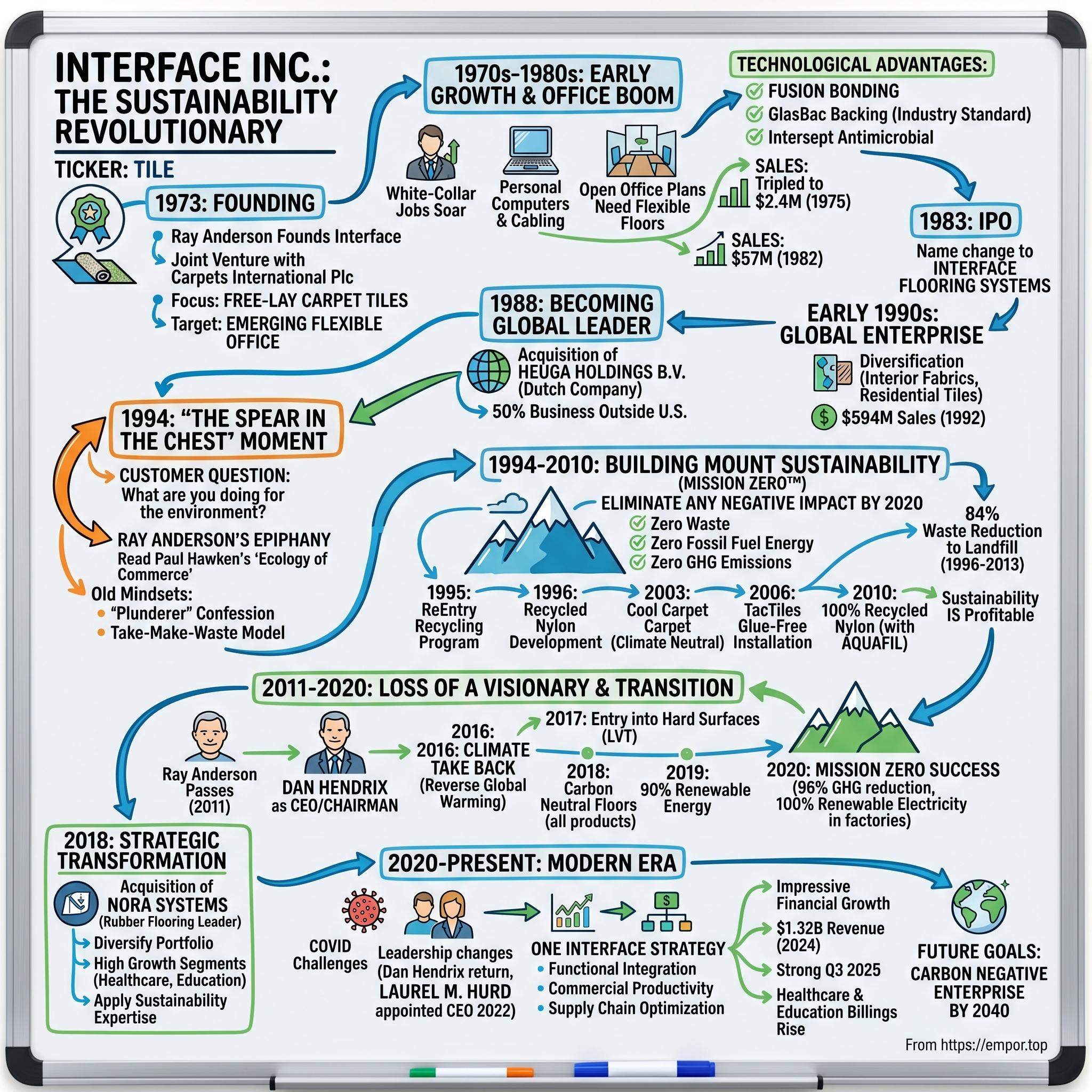
In 1973, Anderson, just shy of his 40th birthday and after nearly a decade and a half in the carpet business, founded Interface to produce the first free-lay carpet tiles in America. His timing was exquisite: Computers were just entering the workplace, with all the cabling and ventilation systems they demanded. Modular carpet tiles enabled companies to more easily reconfigure office flooring to accommodate all that underfoot infrastructure.
This article traces Interface's remarkable journey: from scrappy startup to sustainability icon, through the trials of founder succession and strategic reinvention, and into its current chapter under new leadership pursuing carbon negativity by 2040. It is a story about first-mover advantage, category creation, mission as competitive moat—and whether authenticity in sustainability can survive the departure of a visionary founder.
 Subscribe on LinkedIn
II. Founding Context & Ray Anderson's Journey
The story of Interface begins not in Georgia, but in the textile mills of Europe, where carpet tiles were already revolutionizing commercial flooring decades before Americans had even heard of them.
Ray Anderson was an honors graduate of the Georgia Institute of Technology in the school of industrial and systems engineering in 1956. He learned the carpet trade through more than 14 years at Deering, Milliken & Company and Callaway Mills.
Anderson was a Southern industrial engineer through and through—raised on Baptist values in West Point, Georgia, trained in the quantitative rigor of Georgia Tech, and steeped in the practical know-how of America's textile heartland. At Deering-Milliken, Milliken sent its head of product development, Ray Anderson, to Europe to investigate alternative carpet manufacturing processes. In July 1969, Milliken took Anderson's advice and purchased the U.S. rights to a fusion bonding manufacturing process for making carpet tiles.
This European trip planted a seed. Anderson saw something in those modular carpet squares that his employer didn't fully appreciate—a product perfectly suited to the emerging flexible office environment that would soon transform American workplaces.
The initial funding for Interface came from Anderson's personal investment and a small group of associates. Before launching, Anderson conducted thorough research, including studying the European market, which was more advanced in carpet tile usage. This early research was crucial in shaping Interface's product development and market entry strategy.
Anderson began his new company by focusing heavily on the new technological process for making carpet tiles called fusion bonding. The process implanted yarn directly into a piece of backing material without using needles or looms.
In 1973, Anderson emptied his personal savings and drew investments from friends and associates to launch what was initially called Carpets International of Georgia—a joint venture with Carpets International Plc, a British firm. Ray Anderson founds Interface as a joint venture with Carpets International Plc, a British company, to enter the emerging carpet tile market, emptying his personal savings accounts and drawing investments from friends.
At the time of his life-changing epiphany, Ray Anderson had just turned 60 and had lived the entrepreneur's dream, going from a guy with a few small investors and a crazy idea ("Why would you want to cut a perfectly good carpet into squares?" they asked him in 1973) to a millionaire CEO of a public company in 20 years.
The skeptics had a point—at least superficially. Why would anyone want to cut perfectly good carpet into squares? But Anderson understood something his critics didn't: the American office was about to transform, and carpet tiles were the perfect flooring solution for this new world.
The company was originally headquartered in LaGrange, Georgia—a small town that had been home to textile manufacturing for generations. Anderson was betting his career on a product that was virtually unknown in the United States, backed by technology that was still being refined. It was the kind of calculated risk that separates entrepreneurs from corporate executives.
III. Early Growth & The Office Boom (1973-1988)
The 1970s and 1980s delivered a macroeconomic gift to Interface that even Anderson could not have fully anticipated. America was transitioning from a manufacturing economy to a service economy, and white-collar workers needed places to sit—millions of them.
During the second half of the 1970s there was tremendous growth in the white-collar segment of the U.S. economy. About 800,000 office jobs per year were created between 1975 and 1980, causing huge demand for office furnishing. It was during this period that modular carpet systems became extremely popular among office managers and interior designers. Carpet tiles allowed designers to install floor coverings that were pleasing to the eye, while at the same time were easy to remove and replace, whether for cleaning, redecorating, or accessing wiring beneath the floor.
The timing was exquisite. Mainframe computers were giving way to personal computers, each requiring its own nest of cables. Open office plans were replacing private offices, demanding flexible, reconfigurable spaces. HVAC systems were becoming more sophisticated, with underfloor air distribution systems requiring easy access to subfloor infrastructure. Carpet tiles answered all these needs simultaneously.
CI was able to provide cutting technology superior to that of companies like Milliken, saving the company 10 percent on the cost of yarn. Other technology was made available that enabled CI-Georgia to develop special bonding equipment. This equipment made it possible to install carpet tiles without glue, bonding the four-ply carpet fibers to a fiberglass backing.
These contributions, along with the beginning of the office building boom, helped CI-Georgia triple its sales to $2.4 million by the end of 1975.
The growth trajectory was remarkable. By 1978, Interface's sales had reached $11 million. Meanwhile, the American joint venture continued to grow, with sales swelling to $57 million in 1982.
In 1982, a significant organizational change occurred: Anderson changed the name of his company to Interface Flooring Systems in 1982. The following year, Interface became a publicly traded corporation.
In 1974, Carpets International introduces GlasBac, a patented structured backing system that has become the industry standard for high-performance modular backings.
The acquisitions began in earnest. In the same period, Interface also acquired Chemmar Associates, Inc., merging it with its Interface Research Corp. subsidiary. Chemmar was the licensor of Intersept, the antimicrobial agent developed for hospital carpets. Aided by these acquisitions, Interface's sales climbed to $107 million for 1984.
By that time, after only 11 years of existence, Interface already controlled about 30 percent of the growing U.S. carpet tile market. This figure put the company in a virtual tie for the lead in market share with Milliken & Co., Anderson's former employers.
Anderson's former employer was now his chief competitor—a delicious irony for a man who had seen the potential in carpet tiles when others hadn't.
Interface swallowed up what was left of CI in 1987. CI's remaining debt was then paid off, and its broadloom carpet business sold. For 1987, Interface reported sales of $267 million, nearly double the previous year's figure.
At the time, we were growing 20% a year. This kind of organic growth, combined with strategic acquisitions, was building Interface into a global powerhouse—but Anderson wasn't finished yet.
IV. Becoming the Global Leader: The Heuga Acquisition
By 1988, Interface had established dominance in the American carpet tile market. But Anderson's ambition stretched across oceans. He had seen the European market firsthand—he knew that to truly lead the industry, Interface needed a global footprint.
Interface became the undisputed world leader in carpet tiles in 1988, with the acquisition of Heuga Holdings B.V., a Dutch company with sales of more than $200 million. Heuga was one of the world's oldest manufacturers of carpet tiles.
The pursuit of Heuga had been a five-year campaign. Interface had been trying to acquire the company since about 1983, when it was first put up for sale by the 13 children of Heuga's founder. At that time, Interface was not able to complete a deal. The company that did buy Heuga was subsequently acquired by Ausimont N.V., a firm that was not interested in the carpet tile business.
Anderson's patience paid off. From Ausimont, Interface purchased not only Heuga but Pandel, Inc., another wholly owned subsidiary. Heuga contributed manufacturing facilities in the Netherlands, the United Kingdom, Canada, and Australia. Pandel's U.S. plant produced carpet tile backing and mats. That company recorded sales of $10 million in 1987. The acquisition of Heuga expanded Interface's international business enormously, gaining the company contracts with a number of major British firms, as well as such prominent Japanese companies as Hitachi, Tokyo Marine, and Nomura Securities.
The acquisition also helped Interface further diversify into residential carpet tile sales, which had accounted for about a quarter of Heuga's European business. With the addition of Heuga, the company's revenues jumped dramatically once again, reaching $582 million.
We were really early in on internationalization because, by 1988, half of Interface's business was outside of the United States.
The company also diversified its product offerings. Interface is also the leading producer of interior fabrics for open plan office furniture systems in the United States. The fabrics for these systems, which are usually enclosed, customized work stations, are produced by the company's Guilford of Maine, Inc., subsidiary.
By the early 1990s, Interface had transformed from a regional American company into a truly global enterprise. Interface's sales rebounded somewhat in 1992. Sales for the year were $594 million. Net income increased by over 37 percent, to $12.3 million.
Anderson had achieved his dream of building a billion-dollar global enterprise. But in 1994, at the age of sixty, he would experience something that would redefine not just his company, but his entire reason for being.
V. The "Spear in the Chest" Moment: Ray Anderson's Epiphany
The pivotal moment in Interface's history arrived not with a bang but with a question—one that left its founder speechless.
In the early '90s a customer asked, "What's your company doing for the environment?" When Ray realised he couldn't answer this question, he created a company task force to solve it. As he prepared a speech to the task force kick-off meeting, he read Paul Hawken's "The Ecology of Commerce" and was deeply moved.
Anderson told an Ethics Center audience of his plans to make Interface "the prototypical company of the 21st century" with its pioneering efforts on behalf of ecological and environmental matters in business and industry. Anderson's interest in industrial ecology began when he was asked to deliver a keynote address on the environmental vision of business. At the time, "I didn't have a vision—I was only interested in compliance with standards," he said. When someone sent him a copy of Paul Hawken's The Ecology of Commerce, however, everything changed.
The story is now legend: the "spear in the chest" epiphany Ray Anderson experienced when he first read Paul Hawken's The Ecology of Commerce, seeking inspiration for a speech to an Interface task force on the company's environmental vision. Seventeen years and a sea change later, Ray estimated that Interface was more than halfway towards the vision of "Mission Zero™," in 2011, the journey no one would have imagined for the company or for the petroleum-intensive industry of carpet manufacturing, which has been forever changed by Ray's vision.
Anderson first turned his focus toward the environment in 1994 when he read The Ecology of Commerce by Paul Hawken, and also Ishmael by Daniel Quinn, seeking inspiration for a speech to an internal task force on the company's environmental vision.
The epiphany was profound and deeply personal. Deep down, Anderson realized Interface's business model was based on "digging up the Earth and turning petroleum and other materials into polluting products that ended up in landfills"—not something he wanted his grandchildren and great-grandchildren to remember him by.
The carpet industry, Anderson realized, was among the most environmentally destructive on earth. Carpet making is inherently unfriendly to the environment. Most carpet and carpet tiles are made from nylon, refined from pools of petroleum; two known carcinogens, fiberglass and polyvinyl chloride (PVC), are chief components in carpet-backing materials; the dyes used to color carpets are flushed into the region's streams.
For 21 years Interface operated instinctively under the traditional industrial model of 'take-make-waste', being heavily reliant on fossil fuels for their products, transportation and manufacturing. The turning point came in 1994 when a series of events led Ray Anderson to realize how little attention was being paid to the future, and the leading role the company could play in carving a new path, aiming towards a more sustainable industrial model and society. Interface wanted to show that if even a company that depends extensively on oil can transform itself, then any business can do it and no one will have an excuse not to do it.
Ironically, Ray's story has such impact precisely because, unlike companies seeking to retroactively green their history, he fully acknowledged that he hadn't given a thought to the environment in the 20 years before his epiphany.
This radical honesty—admitting he had been a "plunderer"—would become central to Anderson's credibility as an environmental leader. He wasn't claiming a lifelong commitment to sustainability; he was confessing to a mid-life conversion that demanded a complete rethinking of his business model.
So in 1994, Anderson broke with the old model and began anew. Standing up to naysayers (whose ranks included associates, suppliers and Wall Street analysts), he set out to transform Interface from a traditional business built on consumption and waste.
VI. Building Mount Sustainability: Mission Zero (1994-2010)
Anderson didn't just want Interface to be "less bad"—he wanted to reach what he called the summit of "Mount Sustainability," where the company would have zero negative environmental impact. It was an audacious goal that many dismissed as impossible.
Under the guidance of The Natural Step and other sustainability visionaries, a new vision for Interface was crafted—Mission Zero™; to eliminate any negative impact Interface has on the environment by 2020. Interface became the first US Company to adopt The Natural Step (TNS) framework and methodologies.
Mission Zero is the company's promise to eliminate any negative impact it may have on the environment, by the year 2020, through the redesign of processes and products, the pioneering of new technologies, and efforts to reduce or eliminate waste and harmful emissions while increasing the use of renewable materials and sources of energy.
He founded an Eco Dream Team and set lofty goals for the team to pursue: zero waste to landfill, zero fossil fuel energy use and zero greenhouse gas emissions.
The early wins came through waste reduction and recycling programs. In 1995, Interface establishes ReEntry Recycling Program, which reclaims carpet to ensure used flooring tiles do not end up in landfills. In 1996, Interface partners with yarn suppliers to develop recycled nylon.
In 2003, Interface becomes the first carpet company to receive Environmentally Preferable Product (EPP) certification for its products and the first company to introduce Climate Neutral product offering through its Cool Carpet program. In 2006, Interface unveils TacTiles, the first glue-free and sustainable flooring installation method.
One of Interface's most innovative programs emerged from an unlikely partnership. In 2012, Interface invests in the development of Net-Works, a new, inclusive business model that turns discarded fishing nets into 100% recycled content Type 6 Nylon, protects marine animals, and provides supplementary income for community members.
In 2012 in the Central Visayas, the carpet tile manufacturer Interface decided to launch the first Net-Works pilot project in partnership with the nonprofit Zoological Society of London. The aim is to create a community supply chain for nets abandoned in the water and on the shoreline. With the support of local partners, Interface has set up several collection sites scattered throughout the area where fishermen can sell used nets. These are shipped to Aquafil, an Interface supplier, and recycled using an innovative manufacturing process that produces nylon fibers from textile waste. The Net-Works program provides a solution to the environmental problem associated with stray fishing nets, is source of additional income for local people and a rich source of recycled materials.
The partnership with Italian supplier Aquafil proved transformational. Buying 100 percent-recycled nylon from Aquafil has helped Interface reduce the carbon footprint of its carpet tile by 69 percent. Learnings from this partnership also helped Interface to move forward with other initiatives, such as being able to count recycled or bio-based ingredients in 60 percent of the material used in its carpeting and 39 percent of its luxury vinyl tile.
In 2010, Interface develops first product with 100% recycled nylon with yarn supplier Aquafil.
The results, by 2010, were remarkable. It is clear Interface has successfully dispelled the myth that focusing on sustainability negatively affects the bottom line. If anything they have proven exactly the opposite. Since 1996 to 2013, Interface has reduced the manufacturing waste it sends to landfill by 84%.
But perhaps the most significant achievement of Mission Zero was that it proved sustainability could be profitable. Rather than viewing environmental responsibility as a cost, Anderson demonstrated it could be a source of cost savings, innovation, and competitive advantage.
VII. The Loss of a Visionary & Leadership Transition (2011-2020)
Anderson died on August 8, 2011, aged 77, twenty months after being diagnosed with cancer.
Ray Anderson's death raised a question that haunted sustainability advocates: Would Interface's commitment survive without its founder's evangelical leadership?
When Anderson died in 2011 at age 77, many of us wondered whether and how his vision would endure. Would Interface stay the course or revert, as so many companies do under leadership changes, to a different or more conventional strategy?
The transition to new leadership had actually begun a decade earlier. Dan Hendrix joined the Company in 1983 after having worked previously for a national accounting firm. He was promoted to Treasurer of the Company in 1984, Chief Financial Officer in 1985, Vice President-Finance in 1986, Senior Vice President-Finance in 1995, Executive Vice President in 2000, and President and Chief Executive Officer in July 2001. He served as CEO until March 2017, and reassumed the CEO position in January 2020.
Dan was appointed Chairman of the company's Board of Directors in October 2011, succeeding Interface Founder and Chairman Ray C. Anderson.
Hendrix had been instrumental in Interface's growth story from the beginning. Working as CFO at Ray Anderson's side, Dan led Interface in a series of acquisitions, both domestic and international, ranging in size from $2 million to $150 million. Several of these acquisitions nearly doubled the company in size, including the 1988 acquisition of the then-largest carpet tile manufacturer in the world, Holland-based Heuga, which firmly established Interface as the global leader in that market segment.
The company continued to push the sustainability envelope. In 2016, Interface announced its new mission, Climate Take Back, which aimed to reverse global warming. In 2018, Interface announced that all of its products, including all carpet tile and luxury vinyl tile (LVT), are carbon neutral across the entire product lifecycle through its Carbon Neutral Floors program. In 2019, 90% of Interface's energy came from renewables.
In 2016, Interface launches new mission, Climate Take Back, which aims to reverse global warming. In 2017, Interface announces entry into the hard surface flooring category with a line of luxury vinyl tile (LVT). In 2017, Interface announces Proof Positive, a first-of-its-kind, carbon negative carpet tile prototype. In 2018, Interface develops first carbon negative carpet tile backing, CircuitBac Green, to further reduce flooring's carbon footprint.
The Mission Zero goals were achieved ahead of schedule. Interface today announces Mission Zero® success ahead of its original 2020 target. Over the past 25 years, the company drove significant improvements across all key sustainability metrics internally and throughout its supply chain to help meet its objectives.
By 2020, Interface had achieved a 96% reduction in operational greenhouse gas emissions intensity, powered all of its factories with 100% renewable electricity, and drastically reduced waste.
And as of January 2019, the company achieved an important milestone. Every flooring product that Interface sells—carpet tile, LVT and rubber sheets and tiles—is now carbon neutral across its full lifecycle. After significantly reducing the carbon impact of its manufacturing operations and supply chain, Interface compensates for the remaining emissions through the purchase of carbon offsets.
VIII. Strategic Transformation: The Nora Acquisition (2018)
While Mission Zero defined Interface's brand, the company's leadership recognized that long-term growth required portfolio diversification. The carpet tile market, while growing, was facing increasing competition from hard surface flooring alternatives.
Interface announced it has signed a definitive agreement to acquire nora systems in a stock purchase transaction valued at approximately $420 million. Nora, a global leader in performance flooring and worldwide share leader in the rubber flooring category, is a privately held company that is majority owned by investment firm Intermediate Capital Group (ICG). Nora's annual revenues are approximately $280 million. Interface expects to close the transaction during the third quarter of 2018.
On August 7, 2018, Interface closed its previously announced acquisition of nora systems via a stock purchase transaction valued at approximately $400 million.
This acquisition will expand Interface's rapidly growing resilient flooring portfolio and increase its penetration into high growth segments including healthcare, life sciences, education and transportation. Nora is the leader in the nearly $1 billion rubber flooring category of the $34 billion global commercial flooring industry. Rubber flooring is ideal for applications that require hygienic, safe flooring with strong chemical resistance, and it is extremely durable compared to other flooring alternatives.
Nora systems is a leading global manufacturer of commercial rubber floor covering systems. The company has been designing and manufacturing high-performance rubber flooring for more than 80 years for a number of different markets. Nora's team of skilled professionals collaborates with architects and designers to develop performance-driven flooring solutions that help bring their projects to life.
Nora is the number one brand in rubber. Rubber has a lot of marketshare in education and healthcare, and we wanted to diversify our resilient business in those markets. We believed that if we could give the product more vision in design and infuse it with some sustainability and recycled content, we could take it into other markets. Resilient has been growing against carpet for some time now, so we had to play in the resilient market as well as the soft market. Nora fit really well with that, and it has been a great acquisition for us.
The acquisition brought Interface into segments where rubber flooring dominates—healthcare facilities, laboratories, schools, and transportation hubs. It also provided an opportunity to apply Interface's sustainability expertise to a new product category.
IX. Modern Era: COVID, New Leadership & One Interface Strategy (2020-Present)
The year 2020 brought multiple challenges: a global pandemic that devastated commercial real estate, and an unexpected leadership crisis.
Hendrix succeeds Jay Gould who was terminated after an investigation concluded that he engaged in personal behavior that violated Company policy and core values. Interface confirmed that this leadership transition is unrelated to the Company's operational or financial performance.
Interface announced that its board of directors has named Dan Hendrix, most recently chairman of the board of Interface, as president and chief executive officer, effective immediately. Hendrix served as CEO of Interface from 2001 to 2017. He will maintain his position as board chairman.
Hendrix's return provided stability during the pandemic crisis, but the board soon recruited permanent outside leadership.
Interface, Inc. today announced it has appointed Laurel M. Hurd as President and Chief Executive Officer, effective April 18, 2022. She will lead Interface on its next phase of growth, while also delivering on its mission to become a carbon negative enterprise by 2040. Hurd will succeed Daniel T. Hendrix, who has served a second stint in the CEO role since January 2020. Hendrix will continue his 39-year tenure with the company remaining as Chairman of the Board of Directors.
Hurd is a results-driven leader who brings to Interface 30 years of sales management, product development, and brand stewardship experience in both the consumer-packaged goods and the consumer durables sectors. As Segment President of Learning and Development at Newell Brands, Hurd oversaw the company's largest segment representing more than $3 billion in revenue in 2021.
Hurd has spent the majority of her career at Newell Brands. In her most recent role as head of the Learning and Development segment, she led double-digit growth of the segment and was responsible for market share expansion for the Writing category in the U.S., Canada, the U.K., and Australia. She oversaw a global supply chain including eight manufacturing plants in seven countries.
Asked what Anderson might think were he to visit Interface today, "I think he'd be damn proud," Hurd responded. "But I think he would say 'Guys, you're just getting started.' He'd be incredibly proud of the company that he built and yet wouldn't be at all satisfied."
The "One Interface" strategy has become the centerpiece of Hurd's leadership approach. The company's "One Interface" strategy, focused on global functional integration, enhanced commercial productivity, supply chain optimization, and brand elevation, is demonstrably yielding positive results.
The results from the first quarter highlight the ongoing success of the "One Interface" strategy, which focuses on accelerating growth, improving margins, and guiding customers in design, performance, and sustainability.
When Interface started making acquisitions, it was pretty much a holding company. Ray believed that all the action was local, but when I took over, I started moving to a more functional model. I left the selling and supply chain organizations local, and I moved everything else to a corporate-function approach. When Laurel came along, she made the decision that we should make it all functional. She took the last step of globalizing Interface, and the benefit is that we get efficiency with that.
The financial results under the new strategy have been impressive. Interface Inc. reported strong financial results for the fourth quarter and full year of 2024, driven by the successful implementation of its One Interface strategy. The company achieved a 4.3% increase in net sales year-over-year, reaching $1,316 million, and nearly doubled its GAAP earnings per diluted share to $1.48 for the fiscal year. Key financial highlights include a 3% year-over-year increase in fourth-quarter net sales to $335 million and a significant reduction in total debt by 27.4% to $302.8 million. The company also reported a 174 basis point expansion in gross profit margins for the fiscal year.
Third quarter 2025 net sales totaled $364.5 million, up 5.9% and up 4.2% currency neutral. GAAP earnings per diluted share of $0.78, a 62.5% increase; Adjusted earnings per diluted share of $0.61, a 27.1% increase.
"Third quarter results exceeded our expectations, as we delivered another period of strong year-over-year growth and meaningful profitability expansion. Currency-neutral net sales increased 4%, driven by continued share gains in the Americas and increased momentum in EAAA," commented Laurel Hurd, CEO of Interface. "Our One Interface strategy continues to fuel growth as we strengthen global functions, empower local selling teams, and streamline operations. Global billings grew across all regions, all product categories, and the majority of our market segments, highlighted by a 29% increase in Healthcare and a 5% increase in Corporate Office."
A decades-long pioneer in sustainability, Interface remains "all in" on becoming a restorative business. Today, the company is focusing on carbon reductions, not offsets, as it works toward achieving its verified science-based targets by 2030 and its goal to become a carbon negative enterprise by 2040.
X. Playbook: Business & Investing Lessons
Interface's half-century journey offers several critical lessons for investors and business strategists:
1. First-Mover Advantage in Category Creation
Anderson recognized European innovation before his American competitors and brought it to the U.S. at precisely the right moment. Much of the initial growth of modular carpet can be attributed to the move in the late 70s and early 80s toward open office environments, which divided workspace into office cubicles.
2. Timing the Market
Interface's founding in 1973 coincided with massive structural changes in the American workplace. The company caught a secular tailwind that drove decades of growth.
3. Mission as Competitive Moat
It is clear Interface has successfully dispelled the myth that focusing on sustainability negatively affects the bottom line. If anything they have proven exactly the opposite.
4. Authenticity Creates Credibility
Anderson's honest admission of his company's environmental failings—calling himself a "plunderer"—gave Interface's sustainability claims credibility that retroactive greenwashing never achieves.
5. Cost Savings Through Sustainability
The Mission Zero initiative wasn't just about environmental responsibility—it was a source of hundreds of millions in cost avoidance through waste reduction, energy efficiency, and process optimization.
6. Portfolio Diversification
The nora acquisition demonstrated that even category leaders must diversify as markets evolve. The shift toward hard surfaces threatened Interface's carpet-centric business model.
7. Founder Succession
Interface navigated multiple leadership transitions while maintaining its core mission—a rare achievement for purpose-driven companies.
XI. Competitive Analysis: Porter's Five Forces & Hamilton's Seven Powers
Porter's Five Forces Analysis
1. Threat of New Entrants: MODERATE
The commercial flooring industry requires significant capital investment in manufacturing facilities, established relationships with architects and designers, and brand recognition. Interface is one of the world's largest producers of modular commercial floorcoverings, with sales in 110 countries and manufacturing facilities on four continents. However, Interface's 50-year head start on sustainability creates additional barriers as environmental credentials become purchasing prerequisites.
2. Bargaining Power of Suppliers: MODERATE-HIGH
Interface has developed strategic partnerships with key suppliers, most notably Aquafil for recycled nylon. These relationships provide competitive advantages but also create dependencies on specialized recycled materials.
3. Bargaining Power of Buyers: MODERATE-HIGH
Commercial customers—corporations, healthcare systems, educational institutions—are sophisticated buyers who evaluate total cost of ownership, sustainability credentials, and design flexibility. However, Interface's specified selling approach through architects and designers creates switching costs and relationship-based advantages.
4. Threat of Substitutes: HIGH
Resilient has been growing against carpet for some time now. Luxury vinyl tile (LVT) has been taking share from carpet tiles in many applications. Interface has responded through portfolio diversification (LVT, nora rubber flooring) and by emphasizing the unique benefits of soft surface flooring for acoustics, comfort, and sustainability.
5. Competitive Rivalry: HIGH
The competitive landscape for the interface company is dynamic, featuring major global flooring manufacturers and specialized resilient flooring providers. Key players vying for market share in the 2024-2025 period include Mohawk Industries, Shaw Industries, Tarkett, Forbo, and Gerflor. Other significant competitors identified are Milliken & Company, Armstrong Flooring, and The Dixie Group.
Mohawk and Shaw leverage their extensive product portfolios and distribution networks to compete on scale and breadth of offerings. Tarkett, Forbo, and Gerflor, with their specialization in resilient flooring, directly contend with the interface company's LVT and rubber flooring segments.
Hamilton's Seven Powers Analysis
1. Scale Economies: MODERATE
Interface's global manufacturing footprint provides cost advantages, but the flooring industry is not characterized by winner-take-all dynamics.
2. Network Effects: LOW
Limited network effects exist in flooring—this is not a platform business.
3. Counter-Positioning: HIGH ⭐
This represents Interface's primary power source. By embracing sustainability before competitors, Interface created a differentiated position that traditional manufacturers struggled to replicate without cannibalizing existing operations and investments.
4. Switching Costs: MODERATE
Specified selling through the architecture and design community creates relationship-based switching costs. Maintenance and replacement programs (ReEntry) can lock in customers. Carbon accounting requirements increasingly favor established sustainable suppliers.
5. Branding: HIGH ⭐
Interface's business model as captured by Mission Zero has given it the edge over its competitors, and the company has been setting the pace for others by being the first to publish corporate sustainability reports, receiving LEED and ISO14001 certifications, and accrediting all their products with Environmental Product Declarations (EPDs).
6. Cornered Resource: MODERATE
Partnerships with Aquafil and Net-Works provide access to recycled materials, but these are not fully exclusive arrangements.
7. Process Power: MODERATE-HIGH
Decades of sustainability innovation have created institutional knowledge and capabilities that competitors cannot easily replicate.
XII. Key Metrics for Investors
For investors tracking Interface's ongoing performance, three KPIs warrant particular attention:
1. Currency-Neutral Organic Revenue Growth
Given Interface's global footprint, currency-neutral metrics provide the clearest view of underlying business performance. Management has emphasized this metric in recent earnings calls, with Q3 2025 showing 4.2% currency-neutral growth.
2. Adjusted Gross Profit Margin
Margin expansion has been a key focus of the One Interface strategy. The company reported a 174 basis point expansion in gross profit margins for the fiscal year. Continued margin improvement would validate the operational efficiency initiatives underway.
3. Healthcare and Education Segment Billings Growth
The company's success is further underscored by a 13% increase in global billings in the Education sector and a significant 16% rise in Healthcare billings, collectively representing 29% of its gross billings for 2024. These diversified segments provide visibility into Interface's progress reducing dependence on the cyclical corporate office market.
XIII. Bull and Bear Cases
Bull Case
-
Sustainability Leadership as Structural Advantage: As ESG requirements become mandatory for many institutional buyers, Interface's decades of sustainability credentials provide a competitive moat that newer entrants cannot easily replicate.
-
One Interface Strategy Delivering: "We delivered impressive results in 2024, reflecting the early achievements of our One Interface strategy. We saw growth across all product categories, largely driven by continued momentum in the Americas, where our combined selling strategy has exceeded our expectations."
-
Healthcare and Education Diversification: Double-digit growth in these segments reduces exposure to cyclical corporate office demand.
-
Balance Sheet Strength: Interface maintains a strong balance sheet with $97.8 million in cash and a net leverage ratio of 1.1x.
-
Carbon Negative Innovation: By integrating carbon-negative materials in the CQuestBioX backing with advanced yarn technologies and specialized tufting techniques, Interface delivers carpet tiles that not only meet high standards of durability and design excellence but also contribute to a reduced environmental impact. The company offers 38 cradle-to-gate carbon-negative products across 378 color options in the region.
Bear Case
-
Secular Shift to Hard Surfaces: The long-term trend away from carpet toward LVT and other hard surfaces could constrain growth in Interface's core business, even as the company diversifies.
-
Raw Material and Tariff Risks: Large increases in the cost of raw materials, shipping costs, duties or tariffs could adversely affect Interface if it is unable to pass these cost increases through to customers.
-
Corporate Office Uncertainty: Management noted that the company's overall 4% growth in 2024, despite a 1% decline in the corporate segment, demonstrates successful diversification. However, prolonged weakness in corporate real estate could pressure results.
-
Competitive Response: As sustainability becomes table stakes, Interface's differentiation may erode. Shaw's carbon-neutral commercial production achieved in 2018 illustrates how climate commitments reposition product portfolios.
-
Currency Headwinds: With half of business outside the U.S., dollar strength creates translation headwinds.
XIV. Conclusion: Ray's Unfinished Business
In December 2025, Interface stands at an interesting inflection point. The company has successfully navigated the most dangerous moment in any mission-driven enterprise—the death of its visionary founder. Sustainability, once considered Anderson's quixotic dream, has become central to Interface's brand, operations, and competitive positioning.
"We've changed our business to change the world, and we've achieved goals we never thought were possible," said Erin Meezan, Interface chief sustainability officer. "Mission Zero has taught us important lessons about the future. It's taught us about business models, moonshot aspirations and solving material challenges with science and imagination. Mission Zero set us up to achieve our next impossible mission—Climate Take Back."
The question investors must answer is whether Interface's sustainability leadership translates into durable competitive advantage in an era when every flooring company claims green credentials. The evidence suggests it can—but only if the company continues to lead rather than follow.
Ray Anderson liked to quote the mountaineer George Mallory, who was asked why he wanted to climb Everest. "Because it's there," Mallory replied. When asked why Interface should pursue sustainability, Anderson had a different answer: "Because we're here."
Interface is here—profitable, growing, and pursuing carbon negativity. Whether it can stay ahead of competitors who are rapidly climbing Mount Sustainability themselves will determine whether Ray Anderson's legacy endures for another fifty years.
 LinkedIn
 WhatsApp
 Reddit
 Hacker News
 Email
Email Kindle
 RSS Feed
 Spotify
 Apple Podcasts
 Amazon Music
 Audible
 YouTube