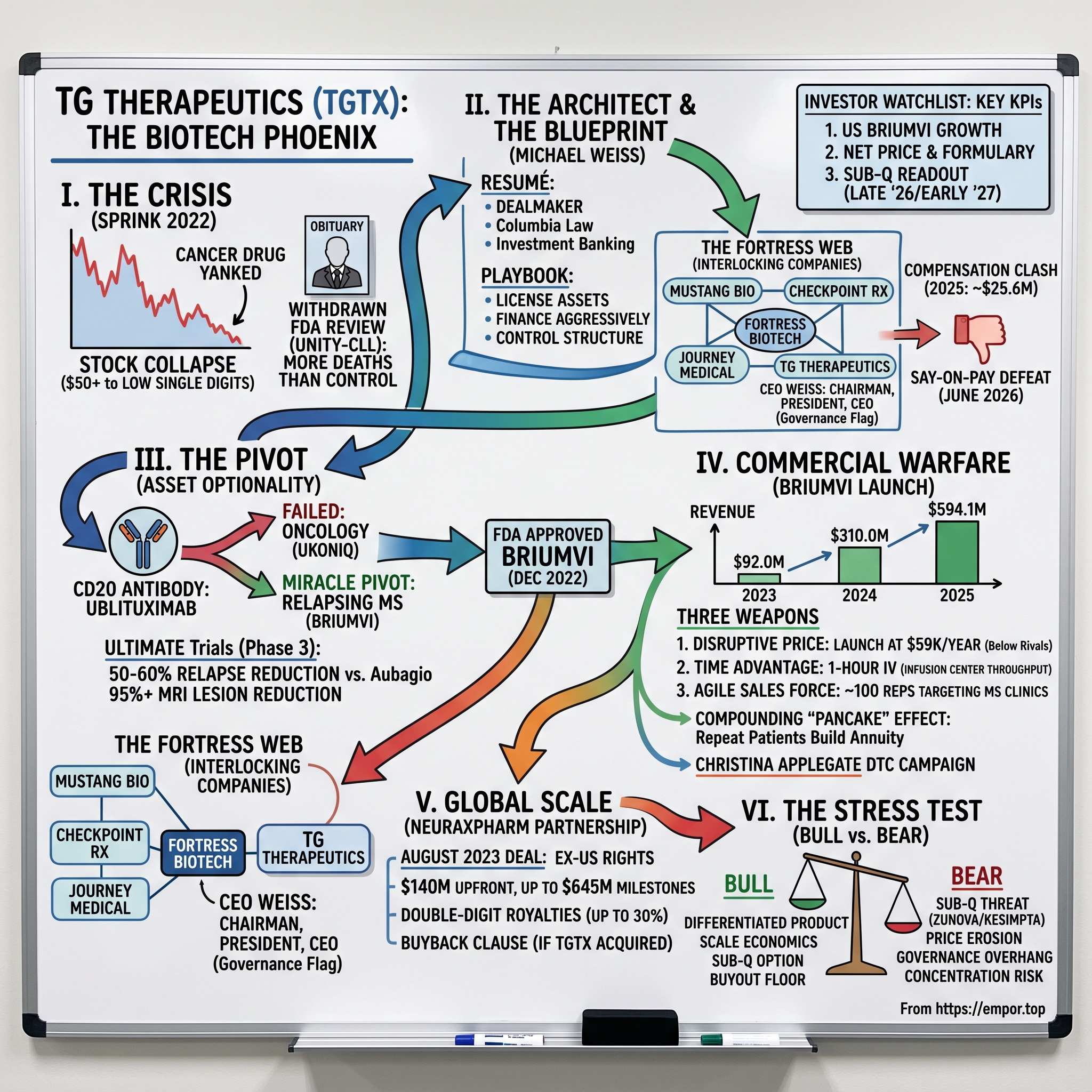
TG Therapeutics: The Biotech Phoenix & The Multiple Sclerosis Disruption
I. Introduction & The Biotech Phoenix
In the spring of 2022, if you had pulled up a chart of TG Therapeutics, you would have seen the shape of a corporate near-death experience. A stock that had traded above $50 the year before — valuing the company at more than $7 billion — had collapsed into the low single digits. The company's flagship cancer drug had just been yanked off the market.
Its lead combination regimen, the one nearly every analyst model had been built around, was being voluntarily withdrawn from FDA review because, in the pivotal trial, more patients were dying on the drug than on the comparator. On biotech message boards, the obituaries were already written. This was a company that had raised money on a dream, burned through it, and come up empty.
Now fast-forward to February 2026. TG Therapeutics reported full-year 2025 revenue of roughly $616 million, of which $594.1 million was U.S. net sales of a single product — Briumvi (ublituximab-xiiy) — a twice-a-year infusion for relapsing multiple sclerosis.1 The company generated operating income of $123 million, bought back $100 million of its own stock, and guided to $875–$900 million of global revenue for 2026.1 The same company that Wall Street had left for dead was now a profitable, cash-generating commercial enterprise competing head-to-head with Roche and Novartis.1
How does that happen? How does a micro-cap biotech with a failed cancer franchise, a withdrawn FDA approval, and a $3 stock resurrect itself into a disruptor in the $25-billion-plus multiple sclerosis market? That is the story of this episode — and it is worth telling carefully, because the easy version ("scrappy biotech beats big pharma") flatters everyone involved and explains nothing.
The miracle pivot
The pivot itself reads like screenwriting. The very same molecule that anchored the failed oncology program — an anti-CD20 antibody called ublituximab — turned out to be an extraordinary B-cell depleter. And B-cell depletion, it happens, is the most effective mechanism medicine has found for treating relapsing MS. While the market obsessed over the cancer trials, TG had quietly run two large Phase 3 studies of the same antibody in MS. Roughly eight months after the oncology franchise imploded, on December 28, 2022, the FDA approved Briumvi for relapsing forms of MS.2 The narrative flipped overnight from "bankrupt cancer play" to "neurology launch," and the stock began a long climb back.
The commercial ramp
What followed was not a slow grind but a genuine acceleration. U.S. net sales went from $92.0 million in 2023 — the first full year on the market — to $310.0 million in 2024, to $594.1 million in 2025.1 Roughly doubling revenue two years running is rare in specialty pharma, and it is the single most important fact in the TG story: the market voted, prescription by prescription, that a company with no prior neurology footprint had built a product physicians wanted to use.
But an investor should hold two thoughts at once. Briumvi is a real commercial success. It is also a one-product company whose founder-CEO was awarded $25.6 million in 2025 compensation — a package shareholders formally rejected at the 2026 annual meeting.56 The triumph and the governance controversy are part of the same story.
A word on the word "profitable"
It is worth being precise about that headline $447.2 million net income for 2025, because taken at face value it wildly overstates the underlying earnings power of the business.1 Of that figure, roughly $340 million was a one-time, non-cash income-tax benefit — the release of a deferred-tax-asset valuation allowance that the company had carried during its money-losing years.1
In plain English: because TG had accumulated years of losses, it held tax assets it previously assumed it might never use; once profitability became durable, accounting rules let it recognize their value all at once, inflating reported net income. Strip that out and the real operating engine produced about $123 million of operating income on roughly $616 million of revenue.1 That is still a genuinely profitable specialty-pharma business — a remarkable thing for a company that nearly folded — but it is a $123 million business, not a $447 million one. A careful reader treats the gap between the two numbers as a lesson in why net income and cash earnings can diverge.
That distinction matters because the company is now allocating that cash. In 2025 TG completed a $100 million share-repurchase program, buying back roughly 3.5 million shares at an average price of about $28.55, and the board authorized a second $100 million program.1 For a biotech that spent a decade issuing stock to survive, a company now retiring its own shares is a striking role reversal — and, as we will see, a controversial one given the amounts flowing the other way to the CEO.
The themes
Three threads run through everything that follows. The first is asset optionality — the almost accidental insurance policy of running the same molecule through two unrelated diseases at once, which is the only reason this company still exists. The second is disruptive pricing — how a tiny biotech used a lower list price and a shorter infusion time to pry share loose from far larger rivals. The third is the Fortress Biotech ecosystem — the web of interlocking companies, dual executive roles, and related-party dealings that surrounds the man at the center of it all. To understand how TG survived, you first have to understand him.
 Subscribe on LinkedIn
II. The Architect & The Corporate Blueprint: Michael Weiss and the Fortress Web
Michael S. Weiss does not have the résumé of a scientist. He has the résumé of a dealmaker who learned to speak biology. A graduate of Columbia Law School, Weiss began his career as a corporate attorney at Cravath, Swaine & Moore — one of the white-shoe firms where young lawyers learn how capital, contracts, and control actually work.3 He left the law for investment banking and then for the operating side of biotech, and that lineage matters: the through-line of his career is not a molecule but a method — license an overlooked asset, finance it aggressively, and control the corporate structure around it.
The Keryx template
Before TG, Weiss ran Keryx Biopharmaceuticals as chairman and CEO from 2002 to 2009.3 Keryx is where the template was forged. Weiss steered the company toward an in-licensed asset that would eventually reach the market as Auryxia (ferric citrate), a phosphate binder for patients with chronic kidney disease. The strategy was pure Weiss: identify an overlooked compound, license it, and build a company around shepherding it through trials and approval.
He also became known for something less flattering: heavy cash burn, repeated equity raises, and abrupt strategic turns that pitted him against skeptical shareholders. Keryx endured public disputes over its direction and its spending, the sort of shareholder friction that follows a leader who asks the market to keep funding a long, expensive journey on faith. The pattern that would define TG — bet big, dilute freely, and ask investors to trust the long game — was visible more than a decade earlier. Investors evaluating TG today are, in effect, evaluating the third act of a career-long playbook, and the earlier acts contained both the vindication (Auryxia did reach patients) and the friction (shareholders did not always enjoy the ride). Neither the triumphalist nor the cynical reading of Weiss is complete without the other.
Founding TG and the parallel-track instinct
Weiss founded TG Therapeutics in December 2011 and has held the combined titles of Chairman, President, and CEO ever since.3 Concentrating all three roles in one person is itself a governance flag — there is no independent chair to check the chief executive — but it also explains how TG could make the bet-the-company decisions it did without a board fight. When the oncology program was collapsing and the MS program was quietly maturing, the person deciding how to allocate the last of the cash and the person running the trials were the same person.
There is a temperament that comes through in the way Weiss runs earnings calls and communicates with investors: promotional, self-assured, unusually willing to talk about the stock price and capital allocation rather than confining himself to clinical data. He talks like a fund manager who happens to run a drug company.
On the Q4 2025 call he told listeners plainly that the board would "not hesitate" to buy back stock, "including adding leverage to reduce our share count," and that "we purchased shares to create long-term value, not for the optics."1 That is not how most biotech CEOs talk. It is how a former investment banker who thinks the market is misvaluing his equity talks. Investors will read that confidence as either conviction or hubris depending on how the story ends — and the honest truth is that it has, at various points in this saga, been both.
The Fortress ecosystem
Here is where the story gets genuinely unusual. Weiss also serves as a director and Executive Vice Chairman at Fortress Biotech, a publicly traded company that operates less like a drug developer and more like a biotech holding company or incubator.34 Fortress spins up a constellation of "partner companies" — public and private entities such as Mustang Bio, Checkpoint Therapeutics, and Journey Medical — that share capital, management talent, and licensing relationships.4 Founders and executives sit on multiple boards; assets and services flow between related entities; royalty and equity stakes crisscross the group.
For an investor, the Fortress web is neither automatically sinister nor automatically benign — but it is a permanent question mark. Interlocking boards and overlapping executive roles create structural conflicts of interest: when the same people sit on both sides of a transaction, the ordinary check of arm's-length negotiation weakens. TG's own filings disclose related-party relationships tied to this ecosystem, and a skeptical analyst is right to ask, on every deal, whose interests were actually being optimized. None of this is hidden — it is disclosed in the proxy and 10-K — but disclosure is not the same as alignment.
The incubator model itself is worth understanding on its own terms, because it is a genuine strategy, not merely a governance quirk. The idea is that drug development has enormous fixed costs — legal, regulatory, financing, administrative — that a lone startup must bear alone. A holding structure lets a constellation of partner companies share those overheads and the same seasoned management talent, spreading the cost of expertise across many shots on goal.
From the sponsor's perspective, it is a portfolio: most partner companies will fail, but the structure captures equity and royalty interests in all of them, and one big winner pays for the rest. TG, in a sense, is the winner that justifies the model. The problem for a TG shareholder specifically is that the model's logic is optimized for the sponsor's portfolio, not for any single partner company's minority holders. When your CEO's incentives are spread across an ecosystem, you cannot assume your company is always his first priority — and you are relying on disclosure and board oversight, rather than undivided focus, to protect you.
The compensation clash
Which brings us to the moment the tension became public. For fiscal 2025, Weiss received total compensation of roughly $25.6 million, including about $23.55 million in stock awards on top of an $875,000 salary and a $1.15 million bonus.5
In a year when the company earned $123 million of operating income, a package of that size represents a meaningful transfer of value from shareholders to the CEO — and shareholders noticed.
At the June 2026 annual meeting, the advisory "say-on-pay" vote failed, with roughly 48.9 million shares cast against versus 31.9 million in favor.6 Proxy advisors and institutional holders rarely mobilize a majority against a founder-CEO unless they see a genuine disconnect between pay and the interests of outside owners.
A say-on-pay vote is non-binding; the board can ignore it. But a defeat is a rare and pointed rebuke, and it tells you that even holders who love the Briumvi launch are uneasy about how the founder is paid relative to the company's size and to the dilution they have absorbed. Weiss's willingness to reward himself in stock is, in his framing, alignment — he wins when the stock wins. In the framing of the majority that voted no, it is a governance problem dressed up as alignment. Both readings will recur throughout this story. To see how the alignment argument even became possible, we have to go back to where TG's assets came from — because Weiss did not invent a single one of them.
III. The License: LFB, Rhizen, and the Genesis of the Portfolio
There is a myth about biotech that the value is created in the lab, by scientists in white coats discovering molecules. For a company like TG, that myth is exactly backwards. TG never discovered ublituximab or umbralisib. It bought the rights to develop them — cheaply, early, and from partners who could not or would not commercialize them alone. This is the capital-light in-licensing model, and it is the foundation of everything the company became.
Why licensing beats inventing
The logic is brutal and rational. Discovering a novel drug from scratch takes years and hundreds of millions of dollars, most of which is spent on molecules that never work. A small company with limited capital cannot afford that lottery. What it can afford is to shop the global pipeline for de-risked or neglected assets — molecules that someone else invented but lacked the money, focus, or regulatory appetite to push forward — and to license them for a modest upfront payment plus future milestones and royalties. You are effectively renting someone else's science and betting you can develop and sell it better than they could. It concentrates risk in execution rather than discovery.
There is a myth worth puncturing here — the idea that a biotech's value equals the cleverness of its founder's science. TG is a standing rebuttal. Weiss's genuine skill was never bench chemistry; it was recognizing which overlooked molecules were mispriced by their owners and structuring deals to capture them cheaply. The value creation, when it came, was in development strategy, regulatory navigation, financing, and commercial execution — not in the invention. For investors, this reframes what to underwrite in a company like TG: you are not betting on a discovery engine, you are betting on a capital allocator's ability to pick assets and see them through. That is a very different, and in some ways riskier, skill to underwrite, because it lives almost entirely in one person's judgment.
The ublituximab deal
In January 2012, weeks after founding the company, Weiss licensed ublituximab from LFB Biotechnologies, the biotech arm of Laboratoire français du Fractionnement et des Biotechnologies — a French, state-linked plasma and biopharmaceutical group.7 TG took worldwide rights excluding France and Belgium, LFB's home territory.7 This single deal is the reason the company exists today; the antibody that would become Briumvi was acquired for a fraction of what its eventual franchise would be worth.
The science behind ublituximab is worth slowing down for, because it is central to both the cancer story and the MS story. Ublituximab is an anti-CD20 monoclonal antibody — meaning it targets a protein called CD20 that studs the surface of B-cells, a class of immune cells. Antibodies like this work partly by flagging the target cell for destruction by the rest of the immune system, a process called antibody-dependent cellular cytotoxicity, or ADCC. Think of the antibody as a homing beacon: one end grabs the B-cell, the other end waves down the immune system's "natural killer" cells to come and destroy it.
What makes ublituximab distinctive is a piece of molecular engineering called glycoengineering. Antibodies carry sugar molecules on a region called the Fc tail, and one of those sugars is fucose. TG's antibody was engineered to remove most of that fucose — it is "afucosylated."8
Stripping the fucose sharply increases how tightly the antibody's tail binds to a receptor (FcγRIIIa) on those killer cells. In plain terms: remove the sugar, and the homing beacon gets far louder, so the immune system destroys B-cells more efficiently, at lower doses and in less time.8 That potency advantage is not marketing gloss — it is the mechanistic basis for Briumvi's shorter infusion, which later became a commercial weapon.
The umbralisib deal
Two years later, in 2014, TG added a second, complementary asset, licensing umbralisib (then TGR-1202) from Rhizen Pharmaceuticals, a company with Swiss and Indian roots.9 Umbralisib was an orally available inhibitor of an enzyme called PI3K-delta. If the anti-CD20 antibody was a homing beacon that flags B-cells for destruction from the outside, PI3K-delta is more like an internal ignition switch — a signaling enzyme that B-cell cancers rely on to keep growing and surviving. Block the switch, and you starve the malignant cells of the signals they need.
The trouble with the first generation of these drugs was that the same switch matters in healthy immune cells too. First-generation PI3K-delta inhibitors — most notably Gilead's idelalisib (Zydelig) — worked against cancer but carried severe autoimmune toxicities: liver inflammation, colitis, and life-threatening infections, as the drug disrupted normal immune regulation. Umbralisib was pitched as a smarter, more selective next-generation version, designed to hit the cancer-relevant target while sparing patients the worst of those side effects. That promise of a cleaner safety profile was central to the entire oncology thesis — and, as the U2 story would later reveal, it was the promise that did not fully hold.
The synergistic portfolio
Put the two assets together and you can see the design. Both attack B-cell-driven disease from different angles — one an antibody that destroys B-cells from the outside, the other a pill that chokes off their internal survival signals. Combine them and, in theory, you get a chemotherapy-free regimen more potent than either alone. TG had assembled, for pennies on the dollar upfront, a portfolio aimed squarely at B-cell cancers. For most of the 2010s, that combination — not multiple sclerosis — was the entire investment case. And for a while, it looked like the bet of the decade.
IV. The Oncology Dream: The Rise and Fall of the "U2" Regimen
They called it "U2" — ublituximab plus umbralisib, a name borrowed from the band, which tells you something about the confidence in the building. For most of the last decade, TG Therapeutics was an oncology company, and U2 was its reason to exist. The pitch was seductive: a doublet of two novel, targeted agents that could treat chronic lymphocytic leukemia (CLL) and non-Hodgkin lymphoma without traditional chemotherapy, sparing patients the toxicity of older regimens while matching or beating their efficacy.
The peak of euphoria
The dream reached its zenith in early 2021. On February 5, 2021, the FDA granted accelerated approval to umbralisib — branded Ukoniq — for two blood cancers: marginal zone lymphoma in patients who had already received an anti-CD20 therapy, and follicular lymphoma in patients who had exhausted at least three prior lines.10 It was TG's first-ever approved product, validation that the licensing playbook could actually produce a marketed drug.
Investors extrapolated wildly. If umbralisib worked on its own, and U2 was better still, and the same antibody had a shot in MS — the total addressable market looked enormous. TGTX shares vaulted above $50, and the company's market value pushed past $7 billion. For a business with modest revenue, that was a valuation built almost entirely on belief.
The word "accelerated"
That word — "accelerated" — deserves a flag, because it is where the story turns. Accelerated approval is a conditional pathway. The FDA lets a drug reach patients based on a surrogate measure (like tumor shrinkage) before survival benefit is proven, on the condition that the company confirms real clinical benefit in a follow-up trial. If the confirmatory data disappoint, the approval can be pulled. TG had its foot in the door, but the door had a spring on it.
The safety collapse
The spring snapped in the pivotal UNITY-CLL Phase 3 trial. On paper, U2 was improving progression-free survival — patients were going longer before their disease worsened. But buried in the data was a signal no oncologist wants to see: an imbalance in overall survival. More patients were dying in the U2 arm than in the control arm.11 The suspected culprits were the very properties that made the regimen powerful — profound immune suppression leading to opportunistic infections and immune-mediated adverse events. A drug that depletes B-cells and dampens immune signaling can, in some patients, leave the body defenseless.
The FDA's concern was not limited to TG. The entire class of PI3K inhibitors was under regulatory review, as agency reviewers grew alarmed about survival data across multiple drugs in the category. In early 2022 the FDA moved toward an advisory committee meeting to weigh the class — a public forum that rarely ends well for a drug already flashing a mortality signal. This is an underappreciated feature of the collapse: TG was caught not only by its own trial data but by a regulatory regime change sweeping an entire drug class. Several PI3K-delta inhibitors from other companies were withdrawn or restricted in the same window. When the FDA decides a mechanism is guilty until proven innocent, individual companies rarely win that argument, and TG did not try to.
For investors, the episode is a case study in the specific danger of the accelerated-approval business model that underpins so much of biotech. The whole appeal of accelerated approval is speed — revenue and validation years before you would otherwise get them. The whole danger is that it front-loads the reward and back-loads the verdict. TG got its euphoric $7 billion valuation on a surrogate endpoint, then had to hand it all back when the confirmatory survival data arrived. A skeptic would say the market should have discounted an accelerated approval far more heavily than it did; the euphoria of 2021 priced Ukoniq as if the confirmatory trial were a formality. It was not.
The capitulation
Weiss made the call that defines the darkest chapter of the company's history. Rather than fight a losing regulatory battle, TG retreated. In April 2022, the company voluntarily withdrew the pending U2 application in CLL and pulled Ukoniq from the market for its approved lymphoma indications, citing the evolving benefit-risk assessment from UNITY-CLL.11
In June 2022, the FDA formalized the withdrawal of Ukoniq's approval, warning patients and providers that the drug's risks in its approved uses now outweighed its benefits.12 The oncology franchise — a decade of work and the entire original thesis — was gone. To Weiss's credit, the retreat was decisive rather than drawn-out; a management team in denial can burn years and cash fighting an unwinnable fight, and TG did not. That decisiveness, ironically, is part of what freed the company to pivot.
The destruction was total. The stock that had touched $50 collapsed into the low single digits, wiping out billions in market value.1 Critics did not merely doubt the company; they declared it finished — a cautionary tale about accelerated approvals and about a management team that had over-promised. And by any fair reading, that verdict was defensible. A single-asset oncology company that loses its asset usually does die.
For long-time TGTX shareholders, the episode was a lesson in how quickly biotech narratives invert. The same investors who had celebrated the first-ever product approval in February 2021 were, fifteen months later, holding a stock that had lost roughly nine-tenths of its value with the flagship program in ruins. The bull thesis — a synergistic, chemo-free oncology franchise — did not just weaken; it was affirmatively falsified by the survival data. This is the specific, brutal risk profile of clinical-stage biotech: value is binary and event-driven, and a single dataset can vaporize a thesis that took a decade to build. Anyone underwriting TG today should keep that memory close, because the company remains, in a different disease, exposed to the same kind of single-event risk around its subcutaneous readout.
What the obituaries missed was that TG was never quite a single-asset company. The same molecule at the center of the wreckage had been quietly running a completely separate race, in a completely different disease. That parallel bet is the only reason there is a second half to this story.
V. The Pivot to Multiple Sclerosis: The Parallel Bet
While analysts were building spreadsheets for leukemia, ublituximab was running a second life in neurology — and almost nobody was watching. This is the hinge of the entire company, and it is worth appreciating how close it came to never happening. TG could easily have concentrated all its capital on the oncology program that the market was rewarding. Instead, Weiss funded an expensive, parallel Phase 3 program in relapsing MS with the same antibody. When the oncology thesis detonated, that decision looked less like diversification and more like a life raft that had been quietly inflating in the corner the whole time.
Why a cancer antibody belonged in MS
The scientific logic connects directly back to the molecule's mechanism. Multiple sclerosis is an autoimmune disease: the immune system attacks the myelin sheath that insulates nerve fibers in the brain and spinal cord, scarring the wiring and disrupting the signals that control movement, vision, and cognition. For years MS was framed mainly as a T-cell disease, but evidence mounted that B-cells were central culprits — orchestrating the attack.
And what was ublituximab? An exceptionally efficient B-cell depleter. The same afucosylated, high-ADCC potency that made it attractive against B-cell cancers made it, in principle, a superb tool for wiping out the B-cells driving MS. The company's greatest liability in oncology — how aggressively it destroyed B-cells — was its greatest asset in neurology.
The ULTIMATE trials
TG tested the hypothesis in two identically designed Phase 3 trials, ULTIMATE I and ULTIMATE II, enrolling 1,094 patients between them.13 The comparison was deliberately tough: intravenous ublituximab versus teriflunomide (Sanofi's Aubagio), an established oral MS therapy — not a placebo, but a real, approved drug. The primary endpoint was the annualized relapse rate, the average number of MS flare-ups per patient per year.
The results, published in the New England Journal of Medicine in 2022, were emphatic.13 Ublituximab drove the annualized relapse rate down to roughly 0.08–0.09 versus about 0.18–0.19 for teriflunomide across the two trials — a reduction on the order of 50–60%, meaning patients relapsed roughly half as often.13 (TG's pooled materials cite figures of 0.076 versus 0.188; the trial-by-trial NEJM numbers are slightly rounded from these.)
Even more striking was the imaging data: ublituximab reduced gadolinium-enhancing brain lesions — the MRI signature of active inflammation — by more than 95%.13 In plain terms, the drug nearly switched off the visible inflammatory activity of the disease. For a newly diagnosed patient staring down decades of potential disability, numbers like these are the difference between a life interrupted by relapses and one largely free of them — which is why, despite the crowded field, there was room for another highly effective option.
An investor should note the honest caveat management itself now emphasizes: these trials beat an oral comparator, not the anti-CD20 infusions that would become Briumvi's real competitors. No head-to-head trial has ever pitted Briumvi against Ocrevus or Kesimpta. The efficacy case rests on cross-trial comparison, which is suggestive, not dispositive. All the modern anti-CD20 therapies produce broadly similar, dramatic reductions in relapses and MRI activity; the honest scientific position is that they are more alike than different on efficacy, and that Briumvi's real-world edge would ultimately have to be argued on convenience and cost rather than on a proven efficacy advantage.
The durability question
One data point does more than any other to convert a promising launch into a durable franchise: how long the effect lasts and how well the safety profile holds up over years, not months. In MS, a chronic disease that patients live with for decades, a drug that looks great at two years but accumulates problems at five is a commercial dead end. That is why management leaned so heavily, on the Q4 2025 call, on the six-year open-label extension data from ULTIMATE I and II presented at the ECTRIMS conference in September 2025. By management's account, nearly 90% of patients were free from confirmed disability progression after six years of continuous treatment, the relapse rate translated to roughly one relapse per 83 patient-years, and no new safety signals emerged.1 Long-term extension data is not a randomized comparison and should be read with that limitation in mind — the patients who stay in an extension study are, by definition, the ones doing well. But for physicians deciding whether to start a young patient on a therapy they may take for twenty years, the absence of nasty surprises after six years is exactly the reassurance that drives prescribing. Briumvi's clinical case, in other words, got stronger the longer it was on the market — the opposite of what happened to Ukoniq.
December 28, 2022: the phoenix rises
Eight months after pulling Ukoniq from the market, TG got its resurrection. On December 28, 2022, the FDA approved Briumvi (ublituximab-xiiy) for relapsing forms of multiple sclerosis in adults.2
For a company the market had buried, it was one of the fastest reversals in biotech memory — from a withdrawn oncology drug in June to an approved neurology drug in December, using the same molecule. The stock climbed out of the single digits toward the $20s and $30s as the story rewrote itself in real time.1
But approval is not adoption. A drug on the FDA's approved list is worth nothing until physicians prescribe it and payers cover it — and Briumvi was walking into a market ruled by two of the largest drugmakers on earth. Winning that fight would require a strategy that had nothing to do with the lab.
VI. Commercial Warfare: Launching Briumvi & Undercutting Big Pharma
Imagine being handed an approved MS drug and told to go sell it — against Roche and Novartis, with no neurology sales force, no relationships with infusion centers, and a balance sheet still recovering from a near-death experience. That was TG's commercial task in 2023. What makes the next three years interesting is that the company did not try to out-spend its rivals. It tried to out-position them.
The anti-CD20 battlefield
By 2023, B-cell depletion had become the dominant high-efficacy strategy in MS, and the anti-CD20 field was crowded with giants. Roche's Ocrevus (ocrelizumab) was the undisputed leader — an intravenous infusion given twice a year, but requiring lengthy infusion sessions of roughly two to three-and-a-half hours, and generating more than $7 billion in global sales by 2025.15 Ocrevus was, and is, one of the best-selling drugs in the world; it single-handedly reshaped MS treatment and made B-cell depletion the standard of care. Novartis's Kesimpta (ofatumumab) took the opposite tack: a subcutaneous injection patients self-administer at home once a month, a convenience proposition that drove it to roughly $4.4 billion in 2025 sales, up sharply as at-home dosing won converts.16 And in the background loomed rituximab — the original anti-CD20 antibody, decades old and available as cheap biosimilars — widely used off-label in MS, particularly outside the United States, but never formally approved for the disease because no one had the commercial incentive to run the trials. Into this arena walked Briumvi, molecule number four, from by far the smallest company in the room.
It is worth pausing on the sheer mismatch. Roche and Novartis are among the largest pharmaceutical companies on the planet, with global sales forces, entrenched payer relationships, and marketing budgets larger than TG's entire market value at its low point. A rational observer in 2023 would have predicted that a first-time neurology marketer with roughly a hundred reps and one product would be crushed, or at best relegated to a rounding-error niche. That this did not happen is the core commercial puzzle of the story — and the answer is not that Briumvi was a better drug in any proven, head-to-head sense. The answer is that TG competed on axes the incumbents had left undefended: price, throughput, and focus.
Weapon one: the price undercut
TG's first move was to do what big pharma almost never does — compete openly on list price. Briumvi launched at a wholesale acquisition cost of roughly $59,000 per year, deliberately set below Ocrevus (whose list price ran meaningfully higher) and well below Kesimpta.14 In a U.S. drug market built on opaque rebates and confidential net prices, a transparently lower list price is a genuine lever: it eases the path onto payer formularies and gives pharmacy benefit managers a reason to favor the product.
It is worth being precise about what this did and did not prove. A lower price wins access; it does not, by itself, prove the drug is better. But for a newcomer trying to get in the door, access is the whole game — and price got TG in the door.
The independent drug-pricing watchdog ICER noted at launch that even Briumvi's lower price was, in its assessment, still above what the evidence would justify on pure cost-effectiveness grounds.14 That is a useful reminder that "cheaper than Ocrevus" is a relative claim in a category where every option is expensive.
Weapon two: the time advantage
The second weapon came straight out of the glycoengineering story. Because ublituximab is so potent a B-cell depleter, it can be delivered as a one-hour infusion for maintenance dosing (after the initial doses), roughly half the chair time of the market leader's infusion. To a patient, an hour saved twice a year is a nice-to-have. To an infusion center, it is economics.
Infusion chairs are a capacity-constrained asset; a therapy that frees up a chair in half the time lets a center treat more patients per day and bill more per chair. TG was effectively selling throughput to the people who own the chairs — a classic case of understanding the customer's customer. On the Q4 2025 earnings call, management repeatedly returned to this "1-hour, twice-yearly" profile as the durable reason physicians and centers kept choosing the product even after competitive entrants arrived.1
Weapon three: the agile sales force
The third choice was about restraint. Rather than build a bloated national sales organization to match its rivals, TG deployed a lean, targeted field force — on the order of 100 representatives — concentrated on the highest-volume MS clinics and infusion centers.
The logic is that MS prescribing is heavily concentrated among a relatively small number of high-volume neurologists; win the top decile of accounts and you capture a disproportionate share of scripts without paying for national coverage. It kept the cost structure light while revenue scaled — the operating leverage that later turned the company profitable. Notably, the company has since begun expanding that field force and adding brand marketing, a sign that the pure-efficiency phase of the launch is giving way to a more conventional, higher-spend commercial posture as it defends and extends its position.
The financial validation
Did it work? The revenue curve is the answer: $92.0 million in 2023, $310.0 million in 2024, $594.1 million in 2025.1 Fourth-quarter 2025 U.S. sales of $182.7 million grew about 92% year-over-year and 20% sequentially — an acceleration, not a plateau, three years into the launch.1
On the earnings call, the chief commercial officer stressed that growth was broad-based across academic and community settings, driven by rising new-patient starts, an expanding prescriber base, and "better-than-expected persistence" — patients staying on the drug longer than modeled.1 Broad-based growth matters analytically: a launch concentrated in a few enthusiast accounts is fragile, while one spreading across community and academic settings alike suggests the value proposition is landing widely rather than with a niche.
That persistence point is the quiet key to the whole model, and it leads directly to the competitive dynamics we will stress-test later: in MS, patients who are stable on an anti-CD20 therapy rarely switch. Every patient TG lands and keeps becomes an annuity. But the same logic protects the incumbents' patients from being poached — which is exactly why Briumvi's continued share gains against Ocrevus matter so much. Management's claim that it is "not seeing any decreases in the switches from Ocrevus to Briumvi," even after Roche launched a subcutaneous version, is the kind of assertion an investor should watch the data to confirm.1
The compounding "pancake" effect
There is a subtle financial mechanic beneath the revenue curve that management described vividly on the call: because Briumvi is dosed twice a year and patients stay on it, each cohort of new patients "pancakes" on top of the last. A patient started in early 2024 is still generating revenue in 2025 and 2026, sitting underneath every new cohort layered above. Over time the business becomes less dependent on winning new starts each quarter and more underpinned by a growing installed base of repeat patients — which is precisely why management said the business is becoming "more predictable."1 This is the annuity turning visible in the numbers. It is also the reason a slowdown in new-patient starts would not immediately show up in revenue: the installed base masks it for a while. An investor tracking this company has to look past the reported revenue line to the underlying new-start trend, because the two can diverge for several quarters.
From lean to brand-building
The other notable evolution is that the company that launched with a deliberately lean sales force has begun spending on brand. In late 2025 and into 2026, TG expanded its field organization and, more conspicuously, launched a national direct-to-consumer campaign — including a partnership with the actress Christina Applegate, who has spoken publicly about living with MS, to launch a patient-education platform that debuted around Super Bowl LX.1 Direct-to-consumer advertising is a big-pharma tactic, and its appearance here signals both confidence and a shift in strategy: a company that once won on price and throughput is now investing to build a consumer brand and defend category leadership. The bull reads this as a scaled franchise reinvesting in growth; the skeptic notes that DTC is expensive, hard to measure, and a sign that the easy, targeted share gains may be maturing. Management conceded on the call that it is "hard to single out a single factor" driving demand — an honest admission that the return on the DTC spend is not yet cleanly quantifiable.1
Domestic success, in any case, was only half the ambition. The rest of the world was a market TG could not afford to build alone.
VII. The International Dimension: The Neuraxpharm Partnership & Global Scale
Here is a problem every successful mid-cap biotech eventually faces: you have a product the whole world could use, and no realistic way to sell it to the whole world. Building commercial infrastructure across Europe — dozens of countries, each with its own regulator, pricing authority, language, and reimbursement maze — can cost more than a company like TG could responsibly spend, and it would divert management from the U.S. launch that was actually working. TG's answer was to rent a distribution network rather than build one.
The August 2023 deal
On August 1, 2023, TG announced a global commercialization agreement with Neuraxpharm, a Germany-based specialty pharmaceutical group focused on central-nervous-system disorders.[^17] Neuraxpharm took over commercialization of Briumvi across most of the world outside the United States, Canada, and Mexico — the territories where TG retained control or had previously partnered.[^17]
TG got a European sales machine without hiring a single European sales rep. For a company that had, barely a year earlier, been fighting for survival, outsourcing the enormous complexity of ex-U.S. commercialization was less a luxury than a necessity — but it was structured to be a lucrative one.
The economics were structured to give TG cash now and upside later. Neuraxpharm paid $140 million upfront, plus an additional $12.5 million on the first European launch, and committed to up to $492.5 million in further launch and commercial milestones — a headline deal value of up to roughly $645 million.[^17]
On top of that, TG earns tiered, double-digit royalties on Neuraxpharm's net sales, reaching up to 30% at the highest tiers.[^17] Royalties of that magnitude are unusually generous for the licensor, and they reflect both the strength of Briumvi's clinical package and Neuraxpharm's calculation that a ready-made, de-risked MS product was worth paying up for. For a specialty distributor without its own late-stage neurology asset, renting TG's drug was cheaper and faster than developing one.
For a company that had recently stared at insolvency, this was elegant financial engineering. The $140 million upfront helped fund the U.S. launch and shored up the balance sheet at a critical moment, while the royalty stream — potentially up to 30 cents on every dollar of ex-U.S. sales — preserved long-term upside without long-term cost. The trade-off is real and worth naming: by handing away ex-U.S. commercialization, TG capped its economics on a huge slice of the global market. Thirty percent of someone else's sales is a lot less than 100% of your own. Management judged that certainty and capital efficiency beat the risk and expense of going it alone — a defensible call for a company that had just learned how quickly cash can vanish.
The early results of the arrangement are still modest and worth keeping in perspective. In 2025, TG recognized only about $12.8 million of revenue from products supplied to Neuraxpharm and $9.4 million in royalty and other revenue — a rounding error next to the $594.1 million U.S. franchise.1 European launches unfold country by country through slow national pricing and reimbursement negotiations, so the ex-U.S. contribution will build gradually, if at all, over years rather than quarters. An investor should therefore treat the international opportunity as a genuine but back-loaded and unproven call option — potentially valuable if Neuraxpharm executes across dozens of fragmented markets, but not yet demonstrated in the numbers. The structure protects TG's downside (it bears little cost) while capping its upside (it collects a royalty, not the whole margin). That is the correct trade for a company that could not afford a European misadventure, but it is not the trade a company confident in its own execution would make if capital were unlimited.
The buyback clause
Buried in the contract was its most strategically clever term. TG retained the right to buy back the ex-U.S. commercial rights from Neuraxpharm, exercisable for a two-year window in the event that TG itself is acquired.[^17] Read that again, because it is doing a lot of work. It means that if a large pharmaceutical company wanted to acquire TG for its worldwide franchise, the acquirer would not find Briumvi's international rights permanently locked up in someone else's hands. TG can reclaim them, delivering a clean, unencumbered global asset to a buyer.
In effect, the clause keeps TG "acquisition-ready." It removes a structural obstacle — fragmented global rights — that might otherwise deter an acquirer or depress a takeover price. Whether or not TG is ever acquired, the option itself has value: it preserves the buyout optionality that is central to the bull case we will examine later. It is the kind of provision you would expect from a management team that thinks like dealmakers, because it is.
A skeptic might read the same clause less charitably. A management structure obsessed with keeping the company "clean for a buyer" is, arguably, a management structure oriented toward an eventual sale rather than toward compounding value for public shareholders over the long run. There is nothing wrong with building to sell — many biotechs exist precisely to be acquired — but investors should be clear-eyed that the incentive structure here, from the buyback clause to the stock-heavy compensation, points toward a liquidity event as the ultimate payoff. That is a different proposition than owning a durable, independent compounding franchise, and it shapes what kind of investor TG suits. Which raises the harder question this story has been circling: is a company run this way building durable value for its owners, or optionality for its founder? To answer, we have to extract the general lessons and then stress-test them.
VIII. The Playbook: Biotech Capital Allocation, Portfolio Resilience, and Founder Alignment
Step back from the narrative and TG becomes a case study — a compact set of lessons about how small biotechs survive, and about the uncomfortable trade-offs baked into that survival. None of these lessons is free of cost, which is exactly what makes them worth studying.
Lesson 1: parallel pipelines are insurance you can't buy later
The first and most important lesson is the one the market underrates until it saves a company: run the same asset through more than one disease when you can. TG would almost certainly have gone bankrupt if ublituximab had only ever been trialed in leukemia. The MS program was not a diversification strategy dreamed up after the oncology failure — it was a parallel bet made years earlier, and it was already sitting at the Phase 3 finish line when it was needed. The lesson for investors is subtle: optionality has to be funded before you know you need it, which means it always looks like undisciplined spending in the moment. The dilution that critics attacked in 2019 and 2020 was partly what paid for the life raft in 2022.
Lesson 2: pricing is a penetration weapon, not just a margin lever
Big pharma treats list price as sacred and competes through hidden rebates. TG did the opposite, using a transparently lower wholesale price to bulldoze through formulary friction. The insight is that in a market defined by opacity, transparency itself is a differentiator — a clear, lower list price gives every payer an easy reason to say yes. The limitation, which we will return to, is that a price set as a weapon can become a ceiling: once you have positioned yourself as the value option, raising price or defending net realization against deeper-discounting rivals gets harder.
Lesson 3: sell to the customer's customer
The Briumvi adoption story is often told as "physicians preferred it," but the sharper version is that infusion-center economics did a lot of the selling. By halving chair time, TG improved the throughput and billing capacity of the businesses that actually deliver the drug. Understanding that the neurologist writes the script but the infusion center feels the operational pain — and designing the product's real-world advantage around that second party — is a lesson in seeing the whole value chain rather than just the prescriber. The uncomfortable corollary, which the bear case will press, is that an advantage built on infusion-center economics evaporates the moment the market stops using infusion centers. A moat made of chair time is only as wide as the practice of infusing patients — and the whole industry is being pulled toward at-home injection.
The uncomfortable meta-lesson: distinguishing skill from luck
Threaded through all four lessons is a harder one about how to read this management team. The parallel MS bet looks like foresight in hindsight, but it was funded during years when the same behavior was criticized as undisciplined dilution — and the parallel oncology bet, funded with equal conviction, failed outright. The same person, applying the same high-variance method, produced both the triumph and the disaster. That should make an investor humble about attributing the comeback purely to genius. Some of it was genuine insight into B-cell biology; some of it was that the company had two lottery tickets and one of them hit. The discipline for an investor is to price the process — aggressive, founder-controlled, high-variance capital allocation — rather than to extrapolate from the single outcome that happened to work. Processes repeat; outcomes do not.
Lesson 4: founder-led capital aggression cuts both ways
Finally, there is Weiss himself. His willingness to dilute shareholders repeatedly to fund Phase 3 trials was, for years, the single most criticized feature of the company. In hindsight, that aggression built a multibillion-dollar franchise from a near-dead balance sheet. But "it worked" is survivorship bias talking; the same aggression, applied to a program that failed, would simply have been called reckless — and in the oncology franchise, it partly was. The honest lesson is that founder-led capital aggression is a high-variance strategy. It can manufacture a phoenix, and it can incinerate capital, and the same personality trait drives both outcomes. That is precisely why the governance questions around this particular founder are not a side issue — they are the core of the investment case.
Which is where a fair-minded investor has to stop admiring the comeback and start pressure-testing it.
IX. The Investor Stress Test: Governance, compensation controversies, and the Bull vs. Bear Case
A great turnaround story is seductive, and seduction is where investors lose money. So let us do what a skeptical long/short investor or an activist would do: attack the case from every angle and see what survives.
Myth versus reality
Three pieces of consensus narrative are worth fact-checking before going further. The first myth is that "Briumvi is a better drug than Ocrevus." The reality is that no head-to-head trial exists; Briumvi's advantages are about convenience and price, not proven superior efficacy or safety, and the modern anti-CD20 agents are broadly comparable on the clinical measures that matter. The second myth is that "TG is now a highly profitable company," anchored on the $447 million net-income headline. The reality, already dissected, is an operating business earning roughly $123 million, with the rest a one-time tax accounting entry. The third myth is that "the CEO's interests are perfectly aligned with shareholders because he's paid in stock." The reality is more complicated: heavy stock compensation aligns direction but not magnitude, and when the board grants tens of millions in awards and then borrows to buy back the resulting dilution — over the objection of a majority say-on-pay vote — alignment starts to look like a one-way ratchet. Holding these corrected pictures in mind is the price of thinking clearly about the stock.
The governance stress test
Start with the thing management would least like to discuss. The 2026 say-on-pay defeat was not a rounding error — a clear majority of voted shares rejected the CEO's compensation.6 Layer that on top of a structure in which the same individual is Chairman, President, and CEO, sits atop a web of Fortress-affiliated entities with interlocking boards and related-party dealings, and has a long personal history of aggressive dilution, and you have a governance profile that would make any activist's checklist.345 The bull can fairly respond that stock-heavy pay aligns Weiss with shareholders and that the Fortress relationships are fully disclosed. But "disclosed" and "aligned" are not synonyms, and a board that concentrates this much authority in one person while overriding a failed pay vote is asking shareholders for a large measure of trust. The correct posture is not outrage; it is vigilance. Governance risk here is a permanent, structural discount factor, not a one-time event.
Prepared remarks versus the Q&A
Management credibility is best judged where the script ends and the analysts begin. On the Q4 2025 call, the prepared remarks were a polished growth narrative — "we didn't just grow, we scaled," Weiss said, describing Briumvi as "becoming a foundational therapy in relapsing multiple sclerosis."1 The Q&A was where the harder questions lived, and to management's credit, they were engaged rather than dodged. Analysts from Evercore, TD Cowen, Cantor, Goldman Sachs, and JPMorgan pressed on two themes in particular.
The first was net-to-gross pricing. Analysts noted that first-quarter revenue guidance looked conservative and probed whether payers were extracting deeper discounts. Management's answer was that the softness was a seasonal Q1 dynamic — deductible resets and benefit re-verifications, plus heavy use of co-pay assistance — and "not a structural change in how we think about gross to net."1 That is a plausible explanation, and it is consistent with how specialty-drug seasonality usually works. It is also exactly what you would say if net price were quietly eroding, so it belongs on the watch list rather than in the "resolved" column.
The execution track record
There is a genuine positive to weigh against the governance concerns, and intellectual honesty requires stating it: on the operating metrics that management can actually control, the company has delivered. The first full launch year beat Street expectations. Revenue then roughly doubled two years running. Management has set guidance and, so far, met or reaffirmed it — on the Q4 2025 call it reaffirmed the $825–$850 million U.S. and $875–$900 million global 2026 targets rather than walking them back, and framed a conservative first quarter as a known seasonal pattern rather than a demand problem.1 For a company whose founder was, a few years earlier, accused of chronic overpromising in oncology, a multi-year record of hitting commercial targets is meaningful evidence. Target-setting discipline and consistent delivery are exactly the behaviors a credibility assessment should reward.
The nuance is that guidance for 2026 looks deliberately conservative relative to the demand commentary — management described "record" new-patient enrollments while guiding to more modest revenue growth, prompting analysts to probe how much cushion is built in.1 Conservative guidance from a team that then beats it is a benign pattern; it is the opposite of the overpromising that sank the oncology story. But it also means the reported numbers may understate underlying momentum, which is one more reason to watch new-patient starts rather than the headline revenue line. The commercial execution, in short, has earned a measure of trust that the governance and compensation conduct has not. Both judgments are part of the same honest ledger.
The second theme was the competitive threat from subcutaneous administration, and it is important enough to treat as its own risk.
The substitute threat: Ocrevus Zunovo and the subcutaneous shift
In September 2024, the FDA approved Ocrevus Zunovo — a subcutaneous version of Roche's market leader, co-formulated with an enzyme called hyaluronidase, that can be injected in roughly ten minutes twice a year.17 This is the single most direct threat to Briumvi's core value proposition.
Briumvi's operational edge was "faster than IV Ocrevus." A ten-minute subcutaneous injection that bypasses the infusion chair entirely does not just beat Briumvi's hour — it can, in principle, make the entire infusion-center advantage irrelevant. Add Kesimpta's established at-home monthly injection, and the strategic risk is that the market migrates toward convenience formats where Briumvi, as an IV product, cannot compete. This is the crux of the bear case, and it is not hypothetical: on the Q4 2025 call, management acknowledged that competitors were "highlighting accelerating subcu uptake," even as it argued Briumvi kept gaining share within the IV segment.1
TG's answer is to build its own subcutaneous Briumvi, and the race is very much live. On the Q4 2025 call, management said the subcutaneous Phase 3 trial was roughly 75% enrolled, testing every-two-month and quarterly self-administered dosing via auto-injector, with pivotal topline data expected in late 2026 or early 2027 and a potential launch in 2028.118 Management argues that a subcutaneous option "could nearly double our total addressable market."1 The bear notes the obvious timing problem: Roche and Novartis are already selling subcutaneous products today, and TG's version is years from market. In a category with high switching costs, patients who settle onto a rival's convenient format in 2026 and 2027 may never be available to switch when Briumvi's subcutaneous version finally arrives.
The rest of the pipeline: optionality or distraction?
Two other programs deserve mention, not because they move the numbers today but because they define the shape of the company beyond a single product. The first is the ENHANCE trial, which tests consolidating Briumvi's two initial infusions (day 1 and day 15) into a single 600 mg dose. It sounds mundane, but it is a smart, low-risk convenience play: if it works, it removes a visit and further simplifies the regimen, with topline data guided to around mid-2026 and a potential 2027 launch.1 The second is more speculative — the company has begun exploring Briumvi in additional autoimmune indications (it has treated a series of myasthenia gravis patients in a Phase 1 study) and is studying an in-licensed allogeneic anti-CD19 CAR-T therapy, azer-cel, in progressive MS.1 Management noted that demand for the azer-cel trial is "exceeding available trial slots," which it framed as evidence of unmet need.1
An investor should weigh these two ways. The bull sees a company sensibly extending a proven B-cell-depletion platform into a pipeline of autoimmune shots on goal — real optionality on top of the cash-generating core. The skeptic hears echoes of the "diworsification" that plagued the oncology era: a founder who likes to accumulate assets, pursuing new programs while the market would rather he simply maximize the one drug that works. Given this management's history of aggressive, exploratory spending, the burden of proof is on TG to show that pipeline expansion is disciplined rather than empire-building — which is exactly the tension the say-on-pay vote crystallized.
The buyback-and-leverage debate
One more governance wrinkle deserves attention because it sits at the intersection of capital allocation and self-interest. Management has signaled willingness to add leverage — take on debt — specifically to buy back more stock.1 Using borrowed money to shrink the share count is a value-creating move if the shares are genuinely undervalued and the cash flows are durable; it is a value-destroying one if either assumption proves wrong, because debt does not care whether the subcutaneous trial reads out well. For a single-product company facing an intensifying competitive threat, layering financial leverage onto operating risk is a bolder bet than it first appears. And there is an uncomfortable optics problem an activist would seize on: a company simultaneously issuing large stock awards to its CEO and borrowing to buy back the resulting dilution is, in effect, monetizing shareholders to pay the founder while telling them the stock is cheap. Both things can be defensible on their own; together they are exactly the sort of related pattern that erodes trust.
Second-layer risks: concentration everywhere
Beyond competition, the deeper structural vulnerability is concentration. This is a company with essentially one commercial product, one mechanism, sold predominantly in one country, discovered by someone else, and manufactured through a specialized biologic supply chain. Each of those is a single point of failure. A biologic like ublituximab is grown in living cell cultures, not synthesized like a small-molecule pill, which makes its manufacturing complex, capital-intensive, and dependent on a limited set of qualified facilities. On the Q4 2025 call, management flagged meaningful spending on subcutaneous manufacturing and "secondary manufacturer start-up activities," a reminder that building redundant supply is both necessary and expensive.1 A manufacturing interruption, a batch failure, or a supply-chain disruption would hit 100% of revenue, because there is no second product to cushion it. Concentration cuts the other way too: because everything rides on Briumvi, the operating leverage is enormous when things go well — but there is no diversification when they do not.
There is also a customer-concentration wrinkle worth noting. Like most specialty drugs, Briumvi reaches patients through a small number of specialty distributors and is paid for by a concentrated set of payers and PBMs. That structure is efficient but gives those intermediaries negotiating leverage — the same leverage that shows up as gross-to-net pressure.
None of this is unusual for the industry, but for a single-product company it means the downside scenarios are correlated in a way a diversified pharma's are not. When the risks all trace back to one molecule, they tend to arrive together rather than offset one another.
The frameworks: 7 Powers and Porter's Five Forces
Run TG through Hamilton Helmer's 7 Powers and the picture is mixed. There is a plausible cornered resource in the glycoengineered ublituximab patent estate and the afucosylated-potency know-how — a genuinely differentiated molecule that competitors cannot simply copy.
There is a real element of switching costs: MS patients stable on an anti-CD20 therapy, and fearful of relapse, are famously reluctant to change brands, which turns Briumvi's installed base into a durable annuity. What TG conspicuously lacks is scale economies or network effects against opponents many times its size; its "power" is narrow and product-specific, not structural. A cornered resource plus switching costs can sustain a profitable niche, but neither insulates the company from a superior delivery format arriving from a better-capitalized rival.
Porter's Five Forces sharpens the threats. Rivalry is intense and getting worse, waged by two of the best-resourced drugmakers in the world. The threat of substitutes is high and immediate — the subcutaneous shift is the defining example.
Buyer power, concentrated in payers and PBMs, is significant, which is precisely why Briumvi had to lead with price. Supplier power (specialized biologic manufacturing) and the threat of new entrants (including eventual biosimilars once patents lapse) are less pressing near-term but non-trivial over a long horizon. Put together, the five forces describe not a fortress but a beachhead — a defensible position that must be actively and continuously defended, at cost, against larger armies.
The operating-leverage engine
One number underpins the entire bull case and deserves to be understood plainly: the gross margin on a biologic like Briumvi is extraordinarily high, on the order of 90%. Once the manufacturing process is running, the marginal cost of the drug itself is small relative to its price. That means the economics of the business are dominated not by cost of goods but by the fixed costs of selling and developing — the sales force, the marketing, the trials.
The consequence is powerful operating leverage. In 2025, revenue growth vastly outpaced the growth in operating expenses: the company added hundreds of millions in sales while operating costs (research and SG&A, excluding non-cash comp) rose to roughly $328 million, producing about $123 million of operating income.1 As revenue scales toward and past $1 billion, each incremental dollar of sales drops disproportionately to profit, because the cost base grows far more slowly than the top line. This is why a specialty-pharma franchise that reaches scale can become a cash machine — and why management can credibly talk about generating positive cash flow "in 2026 and beyond."1
The bear's rejoinder is that operating leverage works in reverse too. If net price erodes or volume growth stalls while the company is simultaneously spending on subcutaneous manufacturing, DTC advertising, and pipeline expansion, the same leverage that magnifies profit on the way up magnifies the pain on the way down. Leverage is not a one-directional gift; it is an amplifier. For now it is amplifying good news, but the direction is not guaranteed.
The bull and bear case
Distilled, the two sides of TG look like this.
The bull case: Briumvi is a genuinely differentiated product taking share in a large, growing market, and the company has already proven it can execute a launch far better than its size implied. The high-gross-margin, operating-leverage economics mean cash generation compounds as revenue scales.
The subcutaneous Briumvi program is a multibillion-dollar option on defending against the convenience threat and roughly doubling the addressable market. And the Neuraxpharm buyback clause keeps TG a clean, attractive acquisition target for an immunology-focused acquirer, providing a potential takeout floor under the equity. In this reading, an investor owns a scaled, cash-generative franchise with a free option on the subcutaneous market and a plausible buyout underneath it.
The bear case: Roche's Ocrevus Zunovo and Novartis's Kesimpta capture the entire subcutaneous market before TG can enter, confining Briumvi to a shrinking IV segment. Intensifying competition triggers price and rebate wars that compress net realized price per patient — the erosion analysts keep probing.
And the governance profile — concentrated control, a rejected pay package, continuous dilution risk, and the Fortress web of related-party overlaps — steadily transfers value from minority shareholders and caps the multiple the market is willing to pay. In this reading, the product wins and the shareholders still lose. It is a genuinely uncomfortable possibility, because it does not require Briumvi to fail commercially — only for the value it creates to leak away to competitors and insiders.
Both cases can be partly true at once, which is the honest state of the investment. The way to tell which is winning is to watch a small number of specific signals.
The three KPIs that matter
An investor does not need to track everything. Three metrics carry most of the signal.
First, U.S. Briumvi net product revenue growth against the $594.1 million 2025 baseline and the $825–$850 million 2026 guidance.1 This is the clean scoreboard for whether the launch is still accelerating, plateauing, or rolling over — and whether management's guidance discipline holds. Because the installed base of repeat patients can mask a slowdown in new starts, the sharper investor watches the direction of new-patient enrollment underneath the revenue line, which management characterizes but does not fully quantify.
Second, net price and PBM formulary position — the gross-to-net spread and the depth of discounting required to keep access. This is the early-warning system for the pricing-erosion bear case, and it is exactly what analysts keep probing on the calls. A widening gap between gross and net sales, or public signs that payers are demanding deeper rebates to keep Briumvi on formulary, would be the first quantitative evidence that competition is biting.
Third, the subcutaneous Phase 3 (SC301) readout and timeline, expected late 2026 or early 2027.118 This single data event, more than any other, determines whether TG has a credible answer to the convenience threat or is stranded in the IV segment. Everything else is commentary; these three are the story.
X. Epilogue & The Subcutaneous Horizon
There is a reason biotechs make for the most gripping business stories and the most treacherous investments. In few other industries can a single trial result add or erase billions of dollars in a morning, or a molecule left for dead in one disease become a franchise in another.
TG Therapeutics is a near-perfect specimen of the genre: a company that was clinically and financially destroyed in the first half of 2022 and, using the very same molecule, was profitable and growing by 2025.1 The lesson is not that comebacks are common — they are not — but that in biology, the value of an asset is contingent on where you point it.
As of mid-2026, the company sits at an inflection point that will define its next chapter. The near-term catalysts are stacked: topline data from the ENHANCE trial (aimed at collapsing the initial two-dose schedule into a single infusion), early readouts from an allogeneic CAR-T program in progressive MS, and — the one that matters most — pivotal data from the subcutaneous Briumvi program at the turn of the year.1 Ex-U.S., the European rollout under Neuraxpharm is still in its early innings, a royalty stream whose eventual size is not yet visible in the numbers.[^17]
What makes biotech the ultimate high-risk, high-reward sector is precisely this compression of enormous value into discrete, unpredictable events. A consumer company's fortunes turn over years of same-store sales and brand-building; a biotech's can turn in a single morning when a trial reads out. TG has already lived both sides of that coin — the euphoria of an approval and the devastation of a withdrawal — with the same molecule, in the space of less than two years. That whipsaw is not an aberration in this industry; it is the industry. The investor's task is not to predict the unpredictable readouts but to understand the asymmetry: how much is already priced in, how binary the next catalysts are, and whether the balance sheet and the franchise can absorb a disappointment.
There is a version of the next few years in which the subcutaneous data are strong, TG defends its position against the convenience threat, the European royalties build, and the company either compounds as an independent or is acquired at a premium — the bull case made real. There is another version in which the subcutaneous readout disappoints or arrives too late, the market migrates to at-home rivals, net price erodes under competitive pressure, and the governance overhang caps whatever value the product creates. Both are live. The evidence to distinguish them will arrive, as it always does in this sector, in a handful of data releases and a few quarters of net-revenue prints.
And then there is the human overhang. Michael Weiss engineered one of the great biotech resurrections and, in the same stretch, lost a shareholder vote on his own pay.6 Whether he can mend that relationship — or whether he even feels he needs to, given a board that concentrates authority in his hands — is a live question that bears on how much of the value Briumvi creates will actually accrue to outside shareholders. On the Q4 2025 call he closed with a line that captured both the ambition and the swagger that define this company: "We're just getting started."1
The scientific achievement is real: a glycoengineered antibody, licensed for pennies, potent enough to depend on for a shorter infusion, now anchoring a growing MS franchise. The corporate achievement is real too, and more double-edged: a founder-dealmaker who bet the company, diluted his way through the wilderness, and structured every contract to keep his options open.
What happens next depends on data readouts no one can predict and on a competitive shift — toward subcutaneous, at-home therapy — that is already underway. The phoenix has risen. Whether it can outrun the giants now flying at it, and whether its passengers share in the flight, is the story still being written.
References
-
TG Therapeutics Reports Fourth Quarter and Full Year 2025 Financial Results — TG Therapeutics, 2026-02-25 ↩↩↩↩↩↩↩↩↩↩↩↩↩↩↩↩↩↩↩↩↩↩↩↩↩↩↩↩↩↩↩↩↩↩↩↩↩↩↩↩
-
TG Therapeutics Announces FDA Approval of Briumvi (ublituximab-xiiy) — TG Therapeutics, 2022-12-28 ↩↩
-
Fortress Biotech Corporate Overview and Partner Companies — Fortress Biotech ↩↩↩
-
TG Therapeutics 2026 Proxy Statement (DEF 14A) — SEC, 2026-03 ↩↩↩
-
TG Therapeutics Annual Meeting Voting Results (Form 8-K) — SEC EDGAR, 2026-06 ↩↩↩↩
-
TG Therapeutics Completes Licensing Agreement With LFB Biotechnologies for Ublituximab — GlobeNewswire, 2012-03-02 ↩↩
-
Ublituximab: an anti-CD20 monoclonal antibody with enhanced ADCC — Frontiers in Neurology review, 2024 ↩↩
-
TG Therapeutics Annual Report (Form 10-K), umbralisib/Rhizen license terms — SEC ↩
-
TG Therapeutics Announces FDA Accelerated Approval of Ukoniq (umbralisib) — TG Therapeutics, 2021-02-05 ↩
-
TG Therapeutics Announces Voluntary Withdrawal of the U2 BLA/sNDA and Ukoniq — TG Therapeutics, 2022-04-15 ↩↩
-
Ukoniq (umbralisib) Drug Safety Communication: FDA Approval Withdrawn Due to Safety Concerns — U.S. Food and Drug Administration, 2022-06-01 ↩
-
Ublituximab versus Teriflunomide in Relapsing Multiple Sclerosis (ULTIMATE I and II) — The New England Journal of Medicine, 2022-08-25 ↩↩↩↩
-
TG Therapeutics prices Briumvi at the lowest for any branded MS therapy, but ICER says that's not low enough — Managed Healthcare Executive, 2023 ↩↩
-
Roche Full Year 2025 Results and Ocrevus Commercial Performance — Roche, 2026-01-29 ↩
-
Novartis Annual Report on Form 20-F, Kesimpta 2025 net sales — SEC, 2026 ↩
-
FDA Approves Genentech's Ocrevus Zunovo (ocrelizumab & hyaluronidase-ocsq) for Relapsing and Primary Progressive MS — Genentech, 2024-09-13 ↩
-
Evaluating Subcutaneous Ublituximab (Briumvi) in Patients with Relapsing Multiple Sclerosis (SC301) — ClinicalTrials.gov, NCT07211633 ↩↩
 LinkedIn
 WhatsApp
 Reddit
 Hacker News
 Email
Email Kindle
 RSS Feed
 Spotify
 Apple Podcasts
 Amazon Music
 Audible
 YouTube