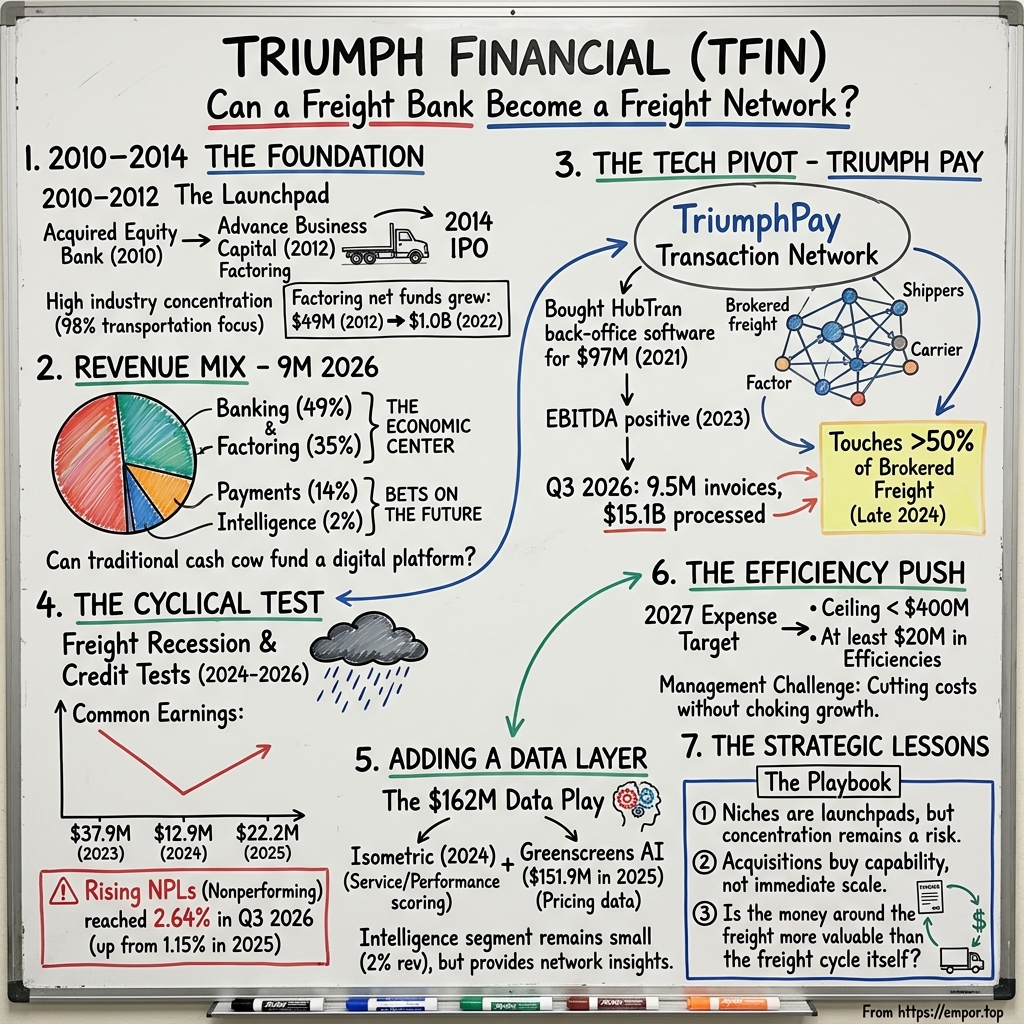
Triumph Financial: Can a Freight Bank Become a Freight Network?
I. The network that grew while trucks stood still
Picture a truck stop off an interstate in the winter of 2024. The lot is full, but not because business is booming. Freight rates have been sliding for the better part of two years, small carriers are parking rigs they cannot keep busy, and the broker who hired a driver to haul a load of paper towels across three states is in no hurry to pay. The driver's invoice, a single sheet that says a load was picked up, delivered and signed for, sits in a queue somewhere. Until it is paid, the diesel on the next load goes on a credit card.
That invoice is the hero of this story. It is also the reason a mid-sized bank holding company in Dallas has spent more than a decade trying to turn itself into something no regulator has a tidy category for. In early 2025, while most of the trucking industry was still nursing the longest freight downturn in recent memory, Triumph Financial told its shareholders that its payments network was now touching more than half of all brokered freight in the United States.1 Invoice prices were falling, trucks were standing still, and yet more and more of the paperwork behind American freight was flowing through Triumph's pipes.
The momentum did not stop there. In the third quarter of 2026, Triumph's Payments business processed about 9.5 million invoices worth roughly $15.1 billion.2 Do the division and the average invoice was about $1,600, which is roughly what one truckload of freight is worth. Every one of those invoices represented a carrier waiting for money, a broker or shipper owing it, and a moment where somebody had to check that the load was real, the amount was right and the bank account at the other end belonged to the right company.
So here is the puzzle. A network that grows through a recession sounds like the holy grail of business models: the kind of asset that compounds regardless of the cycle. But reach is not the same thing as profit. A toll road that carries more cars only matters if the toll holds, and Triumph has not yet shown that the toll on its network is large, durable or rising. The story of this company is the story of what it earns from that reach, and of what it has cost to build it.
The stakes in late 2026 are unusually clear. On the one hand, earnings were recovering. Third-quarter net income rose to $13.4 million from $1.7 million a year earlier, and net interest income grew about 17% year over year.3 On the other hand, the bank's loan book was flashing warnings. Nonperforming loans climbed to 2.64% of total loans at the end of September, up from 1.15% at the end of 2025.3 And management had just made a promise investors could hold it to: noninterest expense in 2027 would come in below $400 million, helped by at least $20 million of efficiencies.4 A recovery, a credit scare and a cost pledge all landed in the same quarter.
Underneath that is a bigger question about how this company is wired. Triumph is, legally and economically, a bank. Its deposits, loans and factoring receivables generate most of the money. Wrapped around them is a payments platform and a small data business that management hopes will one day earn more than the investments poured into them. The bet is that the steady, cyclical business of lending against freight invoices can fund the slower, more ambitious business of becoming the place where freight invoices get settled. Whether the second business ever pays back the first is the central question for anyone looking at this stock.
It helps to be precise about who is who. Triumph Financial, Inc. is the listed company, a Texas financial holding company whose common shares trade on the New York Stock Exchange under the ticker TFIN and are also listed on NYSE Texas.5 It has no outside parent. Inside it sits TBK Bank, SSB, the state savings bank that holds the deposits and makes the loans, along with the transportation businesses: factoring, the payments network known as TriumphPay, and the newer Intelligence unit.6 When this story says Triumph, it means that whole consolidated group, because that is what a shareholder owns.
To understand how a Dallas bank ended up sitting in the middle of the American trucking industry, you have to go back to a distressed bank, a group of investors with a plan, and the day they bought a trucker's invoice.
 Subscribe on LinkedIn
II. A bank bought a trucker's invoice
In November 2010, the United States was two years past the worst of the financial crisis, and small banks in Texas were still failing or limping. One of the limpers was Equity Bank, a Dallas savings bank with no meaningful ability to originate its own loans and no deposit franchise to speak of. An investor group led by Aaron Graft raised about $45 million to buy it and recapitalize it.7 At the end of that year, the new company had about $251 million of assets and, after its first acquisition, 29 full-time employees.7 By any reasonable standard it was a tiny, unglamorous bet: a broken bank, a modest pile of capital and a founder who believed he could build something more interesting on top of it.
Graft has run the company ever since, which makes him one of the longer-tenured founder-chief executives in American banking.6 That continuity matters, because nearly every strategic choice in this story, from the early acquisitions to the payments network to the current cost program, traces back to the same leadership team and the same thesis. Investors evaluating Triumph today are not judging a new management team's plans. They are judging a sixteen-year record.
The early work was cleanup: stabilizing a distressed balance sheet and building the lending and deposit machinery the bank had lacked. The more consequential move came in 2012, when Triumph bought Advance Business Capital, a factoring company focused on transportation.8 It was not a large deal. At the time of acquisition, the business had about $49 million in what Triumph calls net funds employed, essentially the money it had out working in purchased invoices.8
To see why that purchase mattered, you need to understand factoring, which is one of the oldest forms of finance there is. Imagine a three-truck carrier in Arkansas. It hauls a load for a freight broker and sends an invoice, but the broker's terms say it pays in thirty or forty-five days. The carrier, meanwhile, has fuel, insurance, tires and drivers to pay this week. A factor solves that mismatch by buying the invoice. It advances most of the money right away, collects the full amount from the broker later, and keeps a fee for its trouble and its risk. For a small carrier, the factor is often the difference between taking the next load and parking the truck.
For a bank, factoring is attractive and dangerous in equal measure. It is attractive because the yields are high and the assets turn over quickly; an invoice bought today is usually collected within weeks. It is dangerous because the business requires specialist knowledge of who is creditworthy, which brokers pay, which carriers are real and which documents might be forged. Triumph bought that knowledge in 2012, and it turned out to be the seed of everything that followed.
By the time Triumph Bancorp went public in 2014, applying to list on the Nasdaq under the ticker TBK, it described itself as a community bank with "a focus on niche commercial finance products."7 Factored receivables were about $156 million at the middle of that year, roughly 17% of the loan portfolio.7 The IPO filing showed a company that still looked mostly like a regional lender, with some planned proceeds going to redeem government TARP preferred stock and retire senior debt, but with a distinctive specialty growing in one corner.7
Then the specialty kept growing. Triumph added banks to deepen its deposit base, and it added factors to deepen its position in trucking. In 2018 it bought Interstate Capital, another transportation factor, and in 2020 it acquired the factoring assets of Transport Financial Services, known as TFS.9 Each deal brought more carriers, more broker relationships and more data on who paid on time. By the end of 2022, the factoring business that had started with about $49 million in net funds employed had grown to about $1.0 billion.8 That is roughly a twentyfold increase in a decade, and it reshaped what kind of company Triumph was. As late as its 2016 annual report the parent still called itself Triumph Bancorp, a name that announced a bank.10 Today it is Triumph Financial, and its shares trade on the New York Stock Exchange as TFIN.5 The new name was a public signal that the company wanted to be judged as something more than a lender with a specialty.
The change in name tracked a change in temperament. A conventional community bank grows by adding branches in neighbouring towns, buying the bank down the road and lending to the businesses it already knows. Triumph's growth after the IPO looked more like that of a specialist finance company that happened to own a bank charter. The charter mattered because it provided something a stand-alone factor could never get cheaply: insured deposits. An independent factor typically borrows from banks or the bond market to fund its advances, and pays a lender's margin for the privilege. Triumph could fund its invoice purchases with customer deposits, which cost less and, in normal times, stay put. That funding edge is a quiet but real advantage, and it is one reason the factoring arm could keep buying competitors' books.
The strategic logic was clean. A factor finances carriers while they wait to be paid. A bank can take those same carriers' deposits, lend to the brokers and shippers on the other side, and process the payments flowing between them. If one company stands in the middle of that ecosystem, it can see more of the flow, price risk better and sell more services to each participant. That was the theory. It is still the theory.
But focus has a cost, and Triumph's filings are frank about it. By the end of September 2026, about 98% of the company's factored receivables were transportation-related.3 That is not an accident or a drift; it is the strategy. Triumph chose to know one industry deeply rather than many industries superficially. The consequence is that a growing share of the company rises and falls with the fortunes and the credit quality of American trucking, an industry famous for brutal cycles, thin margins and a long tail of small operators who can disappear between one quarter and the next.
So the factoring acquisition gave Triumph something most regional banks never find: a specific customer, a specific industry and a reason to exist beyond geography. It also tied the company's earnings to a market it does not control. The next question was obvious to Graft and his team, and it is the question this story keeps returning to. Could the business of buying invoices become the doorway into something larger, a network where the invoice itself, not just the loan against it, became the product?
III. The invoice pays for the platform
Go back to the carrier in Arkansas. The load has been delivered, the paperwork signed, and the invoice is ready. At that moment, Triumph can show up in that carrier's life in three different ways. It can buy the invoice through its factoring business and advance cash immediately. It can process the payment through TriumphPay when the broker eventually settles. Or it can supply the bank account into which the money lands. Increasingly, it hopes to do all three, and to sell the broker data on what the next load should cost.
Each of those roles is a different business with different economics, and the most common mistake in thinking about Triumph is to blur them together. So it is worth taking them apart one by one.
Banking is the oldest and largest. It earns money the way banks always have, by paying less for deposits than it earns on loans and by charging fees for transactions and services.6 Its loan book includes commercial real estate, commercial and industrial loans, equipment lending and a mortgage warehouse business that finances home lenders between closing a mortgage and selling it. Factoring earns interest and fees on the invoices it buys.6 Payments earns transaction fees, often priced per invoice, along with interest on related receivables when it advances money to carriers.6 And Intelligence, the newest piece, sells fixed-fee software subscriptions that are recognized over the life of each contract.6
Now the proportions. In the first nine months of 2026, Banking supplied about 49% of segment revenue and Factoring about 35%.3 Payments contributed about 14%, and Intelligence about 2%.3 Put plainly, roughly 84 cents of every revenue dollar still came from the two businesses that look most like traditional lending. The payments network is the headline, and it is growing, but it is not yet the engine. The data business is a rounding error with a big ambition.
That proportion is the most important thing to hold onto when thinking about this company. Triumph's narrative is about networks, platforms and data. Its income statement is still mostly about spreads, credit and the price of money.
Factoring shows why the distinction matters. In the third quarter of 2026, Triumph bought about $4.5 billion of invoices, up from about $3.0 billion a year earlier.2 That is roughly 50% growth in purchase volume in a freight market that was still soft, which sounds spectacular. But volume is only one of the levers. What Triumph earns depends on how many invoices it buys, how large each invoice is, what discount it can charge, what it pays for the deposits that fund the advances and how many of those invoices go bad. Freight prices drive invoice sizes; when rates fall, every invoice is smaller and the fee on it shrinks. Competition drives the discount. Interest rates drive funding costs. And credit, as later chapters show, can erase a quarter's growth in a single client failure. Payment dollars alone do not reveal how much Triumph keeps.
The same caution applies to Payments. Management said on its third-quarter 2026 call that the repricing of its payments contracts was largely complete and that future growth would depend more on volume and on cross-selling other services to the same customers.4 That is a revealing admission. It means the easy lift from raising prices on existing customers is behind the company, and the next leg has to come from more invoices and more products per customer. Triumph does not disclose a consolidated recurring-revenue share or standard contract lengths and minimums, so investors cannot easily judge how sticky that revenue is.6
A simple way to see the difference between the businesses is to follow one $1,600 invoice through each of them. If Triumph factors it, the company puts most of that $1,600 of its own money at risk for a few weeks and earns a discount on it, which is attractive when brokers pay reliably and painful when a client turns out to be fraudulent or insolvent. If Triumph merely processes the invoice through TriumphPay, it puts little or no capital at risk and earns a much smaller fee, but it can do that millions of times without growing the balance sheet. If Triumph holds the carrier's account, it earns the spread on the deposit while the cash sits there. The first business is a lender's business, priced on risk. The second is a processor's business, priced on convenience. The third is a banker's business, priced on trust. Triumph's long-term argument is that owning all three around the same invoice lets it do each better than a competitor that owns only one. The near-term reality is that the lender's business still pays most of the bills.
Step back and the long-run record tells a sobering story. In 2015, Triumph's operating revenue, defined as net interest income plus noninterest income, was about $124 million.11 By 2025 it had grown to about $439 million, roughly three and a half times larger.6 Over the same decade, net income available to common shareholders went from about $28 million to about $22 million.116 Revenue more than tripled; common profit fell.
That gap is the clearest single clue to Triumph's economics. Some of it reflects acquisitions, which add revenue along with costs and goodwill. Some reflects the move into transportation technology, where Triumph has been spending heavily on engineers and software before the revenue arrives. And some reflects the freight recession, which compressed factoring yields and raised credit costs. Whatever the mix, the conclusion is unavoidable: a decade of growth and strategic reinvention has not yet translated into higher earnings for common shareholders. Profits recovered in 2025 from a trough the year before but remained below the roughly $38 million earned in 2023.6
There is one more thing listeners trained on industrial companies need to unlearn here. For a manufacturer or a software company, a classic test of earnings quality is whether profit turns into operating cash flow. For a bank, that test barely works. In 2025, Triumph's consolidated operating cash flow was about $67 million, against net income of about $25 million.6 That looks like excellent conversion, but it tells you very little. The real action in a bank's cash flow statement is elsewhere: loan growth used about $451 million of cash in investing activities that year, while deposit growth supplied about $129 million through financing.6 A growing bank consumes cash to make loans and gathers cash by taking deposits. The parent company's own cash flow is different again, slightly negative in 2025, because profits stayed inside the subsidiaries rather than being paid up.6
So the right questions for Triumph are bank questions. Are the loans good? Is there enough capital to absorb losses? Is the funding stable? And is the business growing its earnings faster than its risks? Those questions anchor the rest of this story.
The arithmetic of the business also explains why management chose its path. A bank that specializes in factoring earns a net interest margin far above what most community banks can manage; Triumph's was about 5.9% in the third quarter of 2026.3 Those high-yielding, fast-turning factoring assets throw off the cash that pays for engineers, software and acquisitions. In effect, the invoice pays for the platform.
But a bank that funds a technology build-out from its lending spread has made itself dependent on two things it does not control: the freight cycle that sets invoice values, and the credit cycle that determines how many of them get paid. The question that drove Triumph's most consequential acquisition was whether it could build a business that did not depend so heavily on either, by charging a fee every time a freight invoice moved, whether or not Triumph lent a dollar against it.
IV. Triumph paid $97 million for the paperwork behind freight
In 2021, freight was booming. Pandemic-era demand had sent spot rates soaring, brokers were drowning in paperwork, and every small carrier in America seemed to have more loads than trucks. That year Triumph paid $97 million in cash to buy HubTran, a small software company that automated the back-office work of freight brokers and factors: receiving carrier invoices, matching them to delivery documents, checking for errors and getting them ready to pay.9
To a casual observer, it looked like a bank buying an accounts-payable software startup at the top of a freight cycle. To Graft, it was the missing piece of a different business. Triumph already had TriumphPay, a payments operation that sat between brokers and carriers and, in its early form, often advanced money on its own balance sheet. HubTran gave it the software layer that brokers and factors used every day. Combine them, and Triumph could aim to move from financing invoices to running the rails those invoices traveled on.
Why a network might matter
The value proposition is easiest to grasp through the pain it targets. Freight billing is astonishingly manual. A typical brokered load produces a rate confirmation, a bill of lading, a proof of delivery and an invoice, often as scanned PDFs or phone photos. A broker paying thousands of carriers must check that each invoice matches the agreed rate, that the carrier was the one actually hired and that the payment is going to the right bank account. When the carrier has factored the invoice, the broker must also pay the factor rather than the carrier, and must know which factor holds which invoice. Mistakes mean double payments. Fraud, in the form of fake carriers and stolen identities, is a persistent menace.
Think of it like the old system of paper cheques before card networks. Every merchant had to decide whether to trust each cheque, call the bank, wait for it to clear and absorb the occasional bounce. Card networks did not eliminate risk; they standardized the checking, guaranteed the flow and charged a small fee for it. Freight payments in the 2010s still looked a lot like the cheque era, with each broker running its own verification process and each factor chasing its own collections.
TriumphPay's pitch was that one shared network could digitize all of that. Invoice presentment, audit and payment could happen in one place among brokers, carriers, shippers and factors. Brokers would spend less on manual processing and lose less to fraud. Factors would get paid faster and with fewer disputes. Carriers would get access to cash more quickly. And Triumph, sitting in the middle, would collect a fee on each invoice and see data on a large share of the industry's payment flows.
There is real evidence that this proposition resonated. By early 2025, management said the network touched more than half of brokered freight, a scale that would be hard to reach without real broker and factor adoption.1 TriumphPay reached positive EBITDA in 2023, meaning the payments business stopped losing money on an operating basis for the first time.8 And in June 2024, Triumph announced a strategic relationship with C.H. Robinson, one of the largest freight brokers in North America, which gave TriumphPay access to Robinson's enormous carrier base.12 Distribution of that kind is precisely what a network needs: one large partner can bring tens of thousands of carriers into contact with the platform.
In 2025, Triumph pushed further toward the carrier with financial services built around LoadPay, a product that gives carriers an account to receive and manage their freight payments.4 If brokers pay through TriumphPay and carriers bank through LoadPay, Triumph controls both ends of the transaction, which is the kind of closed loop that payment networks dream about.
What volume does not prove
Now apply the skeptic's lens, because this is where the story is most contested.
First, scale claims need context. Triumph has described itself as the second-largest transportation factoring company in the United States.8 It does not publish comparable market shares for its payments network, and there is no independent ranking that lets an outsider test the "more than half of brokered freight" claim against competitors. The phrase "touched" is doing a lot of work; an invoice can touch a network in many ways, not all of which generate meaningful revenue. Triumph competes with specialist factors such as RTS Financial and eCapital and with carrier-finance and fuel-card providers such as WEX, among many others. Investors should treat management's scale language as a claim about reach, not as proof of dominance.
Second, network effects have to survive buyer power. Brokers choose how to pay carriers, and carriers choose which factor to use. Large brokers have in-house systems and leverage to negotiate. Carriers can and do switch factors. Triumph does not disclose top-customer revenue shares, retention rates or price realization for Payments; its 2023 to 2025 annual reports identify no customer above 10% of revenue.6 Without retention data, investors cannot tell how much of the network is sticky and how much is rented.
Third, and most telling, management's own words on the third-quarter 2026 call narrowed the moat argument. Pricing on Payments contracts, management said, had largely been reset, and growth from here depends more on volume and cross-selling.4 That is a reasonable thing for a growing network to say. But it also means Triumph is not yet demonstrating the hallmark of a true network moat, which is the ability to raise prices over time without losing customers. A network that must grow mostly by adding volume at stable prices looks more like a good processing business than an unassailable toll road.
Then there is the price tag. Triumph paid $97 million for HubTran.9 Public data on HubTran's revenue at the time of acquisition is not available, so there is no clean multiple to benchmark it against. The better benchmark is the outcome. Two years after the deal, the Payments business it fed turned EBITDA positive.8 By 2026, Payments was supplying about one-seventh of segment revenue.3 That is not a home run measured against the original ambition of building a freight-payments standard, but it is a measurable operating business that exists in large part because of the acquisition. As capital deployment goes, HubTran passes the most basic test: it bought a capability that became a business.
What it has not yet done is prove the network can carry the company. That is the distinction worth carrying into every earnings call: how many of the network's transactions actually generate fees, how fast invoice revenue grows relative to invoice volume, how many carriers use LoadPay and how much of the network's growth falls through to margin. The scale numbers are the ones management leads with. The monetization numbers are the ones the company does not break out, and on the third-quarter 2026 call the clearest signal on pricing was the admission that the repricing lever had largely been pulled.4
The honest verdict is that HubTran helped Triumph build a real operating business with real distribution, and the C.H. Robinson relationship and LoadPay show the company is pushing that distribution to carriers. But reach alone does not establish a moat. The evidence that would settle it is retention, price realization and sustained growth in Payments operating income, especially through a weak freight quarter. Until those numbers appear, the network is promising but unproven.
And the network was about to get its hardest test. The freight boom that had made HubTran look like a growth bet in 2021 was already turning into something much uglier, and the recession that followed would expose how much of Triumph's story still depended on trucks moving.
V. The freight recession tested the promise
By July 2024, Triumph's management was describing the freight downturn in terms usually reserved for wars. The freight recession, they told shareholders, was in its 30th month.13 Two and a half years of falling rates had squeezed carriers, shrunk invoice sizes and driven thousands of small trucking companies out of business. For a company whose largest growth engine was buying and processing freight invoices, it was like running a toll road during a fuel shortage.
The damage showed up plainly in the earnings. Net income available to common shareholders fell from about $38 million in 2023 to about $13 million in 2024, a drop of roughly two-thirds.6 Factoring yields compressed as invoice sizes shrank. Transportation activity weakened. Credit costs rose.
The easy story is that this was all the freight market's fault. And for much of 2023 and 2024, that was largely the story management told. But by the end of 2024, management said something more interesting: the freight recession was not the primary cause of all the pressure on its results.114 Some of the shortfall came from Triumph's own execution and decisions, including the pace and cost of its technology investment and specific credit problems that had nothing to do with the macro environment.
That acknowledgement is worth dwelling on, because it is rare. Most management teams facing a two-year industry recession would happily let the macro take the blame. Graft's team chose to distinguish between what was cyclical and what was controllable. That does not make the controllable problems smaller. But it is a credibility signal, and it set up the standard by which investors can judge what came next: if the problems were partly self-inflicted, the fixes should be partly self-delivered.
The quiet credit warning
The recovery did come. Common earnings rebounded to about $22 million in 2025.6 But a closer look shows how much of that rebound came from a single resolution rather than ongoing operations.
That resolution was the USPS episode. A large carrier client of Triumph's factoring business had hauled mail for the United States Postal Service. Triumph had bought its invoices, but payments owed on those invoices were misdirected, leaving Triumph with a $19.4 million receivable from the Postal Service at the end of 2024.6 For months it was an open question whether Triumph would recover it in full. It did. A settlement in July 2025 fully resolved the receivable and produced an $11.5 million positive pretax impact.6 In context, that one benefit equaled about a third of Triumph's roughly $33 million of 2025 pretax income.6 Strip it out and the 2025 recovery looks considerably more modest.
That is not a criticism of the settlement; collecting money you are owed is good banking. But it means the 2025 earnings rebound was flattered by a one-time recovery, and it means the 2026 numbers are the cleaner test. Those numbers, as of the third quarter, were better. Net income in the third quarter of 2026 rose to $13.4 million from $1.7 million a year earlier, helped by stronger net interest income.3
The problem was underneath. Nonperforming loans, the share of the book where borrowers have stopped paying as agreed, more than doubled in nine months, to 2.64% at the end of September 2026 from 1.15% at the end of 2025.3 Total past-due loans rose to about 3.1% from about 2.7%.3 Meanwhile the allowance for credit losses, the reserve set aside to absorb expected losses, fell to 0.68% of loans from 0.73%.3 Rising problem loans and a falling reserve ratio is the combination that makes bank investors nervous, because it means either management is confident the problem loans are well collateralized or reserves are lagging the risk.
Two pockets drove most of the deterioration. The first was commercial real estate: about $95 million of nonperforming CRE loans at quarter-end.3 That is a reminder that Triumph's bank is not purely a freight business; it carries the same office and property risks as other regional lenders. The second was factoring itself: about $17 million of nonperforming factored receivables, of which one large client accounted for a $15.5 million increase.3 A single client failure in a business that runs on thousands of small invoices tells you that concentration can hide inside apparent diversification.
There is also Tricolor. TBK Bank acts as agent on a $60.5 million floorplan facility, a revolving line that finances a dealer's vehicle inventory, and holds about $22.5 million of it.3 The borrower's collapse into bankruptcy left competing creditors claiming the same collateral. Triumph says the collateral supports its exposure, but it also acknowledges that the competing claims may need to be resolved in bankruptcy court.6 That is not a fatal exposure for a bank with about $5.7 billion of loans held for investment, but it is the kind of tail risk that can turn a good quarter into an ordinary one.3
It helps to translate the reserve figures into money. An allowance of 0.68% on a book of roughly $5.7 billion is about $39 million set aside for future losses.3 Nonperforming loans at 2.64% of the same book are roughly $150 million. Nonperforming does not mean lost; much of that is secured by real estate, vehicles or invoices that can be collected or sold. But the ratio shows how much of the cushion depends on collateral holding its value. If even a quarter of the nonperforming balance turned into actual losses, the charge would approach the entire reserve, and every dollar of extra provisioning would come straight out of the earnings that were just starting to recover. That is why the reserve ratio moving down while problem loans moved up is the single most important tension in the 2026 numbers.
The geography of the loan book adds a further layer. About 42% of Triumph's non-factoring loans sat in four states, Texas, Illinois, Colorado and Iowa, at the end of September 2026.3 A bank that thinks of itself as a national transportation specialist still carries a regional lender's concentration in its traditional book, and its commercial real estate exposure behaves like every other regional bank's when property values or occupancy weaken.
On the third-quarter 2026 call, analysts pressed management on rising credit costs. Management's answers were most persuasive where they were specific: naming the CRE loans, the large factoring client and the Tricolor collateral position. They were less persuasive where they leaned on general freight-cycle explanations.4 The auditor, for its part, had flagged the judgment in forecasting expected credit losses as its critical audit matter in the 2025 annual audit, with an otherwise clean opinion.6 That is standard for banks, but in a year when nonperforming loans more than doubled, it is the right judgment to watch.
So the verdict on the recession is mixed. The earnings recovery is real; the third quarter of 2026 was meaningfully better than a year earlier. But it has not erased the credit warning, and the reserve ratio moved in the opposite direction from the problem-loan ratio. Management deserves credit for separating controllable problems from macro pressure. The next test is whether nonperforming loans stabilize, whether net charge-offs stay contained and whether the Tricolor dispute resolves near the carrying value.
Meanwhile, even as it worked through the credit cycle, Triumph was spending real money on a different bet: that the data flowing through its network could become a business of its own.
VI. $162 million for a data layer
Every freight invoice carries a price: what a broker paid a carrier to move a particular load between two particular places on a particular day. Collect enough of those, and you have something valuable. You can tell a broker what a lane should cost next week. You can tell a shipper which carriers deliver on time. You can spot a carrier that suddenly changes its bank account details, which is often the first sign of fraud.
Triumph decided to buy that capability rather than build it. In 2024, it acquired Isometric Technologies for about $10 million, adding tools that score carrier and broker service and performance.6 Then, in 2025, it made a much larger move: it bought Greenscreens.ai, a company that uses machine learning to forecast short-term freight pricing, for about $151.9 million.6 The consideration was about $139.1 million in cash and $12.7 million in stock, and Triumph booked about $111.9 million of goodwill.6 Together, those deals put roughly $162 million into what became the Intelligence segment.
The strategic fit is easy to see. Greenscreens gives brokers pricing intelligence at the moment they quote a load. Isometric scores how carriers and brokers perform. Fold that into a payments network that already sees a large slice of brokered freight, and Triumph could offer something a pure payments processor or a pure data vendor could not: pricing, performance and payment data in one place, each reinforcing the other. In theory, better data makes the network more valuable to join, and a bigger network makes the data more accurate.
A simple analogy captures what Greenscreens sells. A freight broker quoting a shipper is a bit like a used-car dealer quoting a trade-in price on the spot. Quote too high and the broker loses money when it hires a carrier; quote too low and the shipper goes elsewhere. Historically, brokers relied on experienced staff, rate boards and gut feel. A pricing model trained on large volumes of recent transactions promises a faster and more consistent answer, lane by lane and day by day. For a broker handling thousands of quotes a week, a small improvement in accuracy can be worth a great deal, because the broker's whole profit lives in the narrow gap between what the shipper pays and what the carrier accepts.
In practice, Intelligence remains tiny. It supplied about 2% of segment revenue in the first nine months of 2026 and was still losing money.3 That is not an earnings engine. It is a call option.
The disclosure makes it hard to judge the price. Triumph integrated Greenscreens into the Intelligence segment and did not separately report its revenue or earnings afterward.6 Without that, investors cannot calculate a defensible purchase multiple, and there is no basis for claiming Triumph either overpaid or got a bargain. What is clear is the balance-sheet consequence: most of the price landed as goodwill, which means most of what Triumph bought was expectation rather than tangible assets. If those expectations are not met, goodwill can be written down, and that would be a direct hit to book value.
The commercialization record so far is not encouraging. On the third-quarter 2026 call, management acknowledged that customer attrition followed the Intelligence acquisitions and that execution had lagged its plan.4 That is a candid admission, and it fits the pattern of management being willing to name its own shortcomings. But it also confirms that buying a data company and turning it into a growing revenue stream are different things. Triumph has not quantified the attrition or said which customers left, so the cause can only be inferred. One plausible reading is uncomfortable for the network thesis: a freight broker that buys pricing intelligence is sharing sensitive information about its margins, and it may hesitate to share that with a company that also finances carriers and processes payments for its competitors. Neutrality is a feature in data businesses, and a vertically integrated owner can erode it simply by owning it.
Set this against the HubTran story and the contrast is instructive. HubTran was bought for $97 million and fed a Payments business that turned EBITDA positive within two years. Greenscreens cost about one and a half times as much, and so far the segment it joined is smaller and still loss-making. That does not mean the Greenscreens deal was a mistake; data businesses often take longer to commercialize than payments businesses. But it does mean that Triumph's acquisition record is not uniformly strong, and that each new strategic purchase deserves its own proof.
What would change the verdict? The evidence would be specific: Intelligence revenue growing quickly, customer retention stabilizing after the post-acquisition attrition, the segment reaching operating breakeven, and evidence of cross-selling, such as Intelligence customers adopting Payments or Factoring services, or vice versa. Until those numbers appear, Intelligence is strategic adjacency, not a profit pool.
There is one more variable, and it cuts both ways. Artificial intelligence is the obvious accelerant for freight-pricing tools; better models trained on more data should produce better forecasts. But AI also lowers the barriers for competitors. If a well-funded rival or a large broker can build comparable pricing intelligence with commodity models and its own transaction data, Triumph's data advantage narrows. The filings do not yet show which effect will dominate, and management has not quantified it.6
So Triumph now carried three bets at once: a bank exposed to freight and real estate credit, a payments network that had proven it could make money but not yet that it could raise prices, and a data business that had not yet proven it could keep customers. All of that required people and spending. And by 2026, investors had begun asking a pointed question: how much would all of this cost, and when would it start paying off?
VII. The sub-$400 million promise
The third-quarter 2026 earnings call had a particular texture. Results were better. Net income was up sharply from a year earlier. But the question analysts kept returning to was not about revenue. It was about expense. Management had promised that noninterest expense in 2027 would come in below $400 million, supported by at least $20 million of efficiencies.4 Analysts wanted to know where those savings would come from and when they would show up.
Graft's answer was partly reassuring and partly not. Management said investors should expect efficiencies to begin showing up earlier than the second half of 2027.4 But it declined to detail the specific actions on the call.4 For a company asking investors to believe it can cut costs while continuing to invest in Payments and Intelligence, that silence is notable. A cost target without a cost map is a promise, not a plan.
Some perspective on the size of the promise helps. Twenty million dollars is about one-twentieth of a $400 million expense base, which is meaningful but not heroic for a company that has just spent several years building out software teams and integrating acquisitions. Set against earnings, though, it looms much larger. Triumph's entire 2025 pretax income was about $33 million.6 If the efficiencies arrive in full and revenue holds, the savings alone would be worth more than half of last year's pretax profit. That is why investors care so much about the timing and the source. A cost program of that size is not a footnote to the earnings story; it may be the earnings story for 2027.
The target matters because Triumph's expense base has grown faster than its profits for years. Some of that growth was the price of building a technology business inside a bank: Triumph capitalized between about $17 million and $22 million of software development each year from 2023 through 2025.6 It does not separately disclose research and development, which sits inside operating expenses.6 Premises and equipment purchases spiked to about $63 million in 2024 as the company spent on its headquarters, then fell to about $16 million in 2025, which also included proceeds from selling property.6 And headcount, which peaked at about 1,550 full-time equivalents at the end of 2024, fell to about 1,450 by the end of 2025.6 The workforce was already shrinking before the formal efficiency program was announced.
That pattern suggests the cost target is plausible. The company has already shown it can reduce headcount and property spending. The harder question is whether it can hit the ceiling without starving the businesses that are supposed to justify the strategy. An expense target met by cutting engineers from Payments or sales staff from Intelligence would technically satisfy the promise while undermining the thesis.
The pay vote
The cost conversation also intersects with governance, because investors have recently signaled discomfort with how Triumph pays its leaders.
Aaron Graft's total compensation was about $4.6 million in 2025, up from about $3.3 million in 2023.15 Over the same span, net income fell from about $41 million to about $25 million.6 His 2025 package included a stock-award component of about $2.8 million, and the broader incentive structure combined annual financial and operating targets with long-term equity awards.15 Chief Financial Officer Brad Voss, in the role since 2021, earned about $1.6 million in 2025.15
Shareholders noticed the gap between rising pay and lower profits. The 2025 say-on-pay vote received only about 72% support, down from an average of about 97% over the previous five years.15 For a nonbinding vote that most companies pass with ease, that is a meaningful signal. The board responded the way boards usually do: it reported reaching out to holders representing more than 41% of the shares and added disclosure on how it sets targets and how pay outcomes relate to them.15
Here is the telling detail. At the April 2026 annual meeting, after that outreach and expanded disclosure, the say-on-pay vote drew about 13.6 million shares in favor and about 5.6 million against.16 That works out to roughly 71% support among votes cast for or against, essentially unchanged from the year before. The outreach did not move the needle. A significant minority of shareholders remained unconvinced that pay was aligned with performance.
That does not imply misconduct. Triumph's board is largely independent, with eight of nine directors deemed independent, and the company's related-party lending is small and described as ordinary-course.156 Graft's beneficial ownership of about 206,000 shares amounts to under 1% of the common stock, which means his personal fortune is tied to the stock but he does not control the company.15 There is no controlling shareholder; the largest holder, BlackRock, owned about 14% as of early 2026.15 The dissent is better read as a credibility signal: investors want the payoff from a decade of strategic investment to show up in earnings before they reward it in pay.
Set against the longer record, management's credibility is mixed. On the positive side, it built Payments to positive EBITDA, paid for HubTran in cash without issuing stock and acknowledged when the freight recession was not the whole story.89 On the negative side, Intelligence suffered attrition after its acquisitions, execution lagged plan and the cost program was announced without a detailed roadmap.4 The pattern across the shareholder letters from mid-2024 to mid-2026 is a company that has grown more willing to name its problems, and the third-quarter call finally put a number on the fix.13174
The test is straightforward and measurable. If 2027 noninterest expense comes in below $400 million while Payments operating income stays positive and transportation investment continues, management will have delivered on a specific, verifiable promise, and the pay debate will look different. If the target is missed, or met only through cuts that stall the network, investors will have their answer. Either way, that number will shape how the market prices the company's two identities.
VIII. Analysis & Bear vs. Bull Case
On November 13, 2026, Triumph's stock closed at about $60, giving the company a market value of roughly $1.4 billion.18 That price was about 1.5 times book value per share.18 Measured against tangible book value, which strips out the goodwill and intangibles from its acquisitions, the multiple was closer to 3 times.18 The trailing price-to-earnings ratio was about 31, reflecting depressed recent earnings, while the forward multiple, based on analysts' expectations for higher profits, was closer to 19.18
Those numbers capture the identity problem in one glance. A plain regional bank with Triumph's recent returns would typically trade much closer to its tangible book value. A fast-growing fintech with a dominant network might trade at a far higher multiple of earnings. Triumph sits uncomfortably in between. The gap between book and tangible book is itself part of the story: much of what shareholders own is goodwill from deals like Greenscreens, which is only worth what those businesses eventually earn.
So the investor's challenge is simple to state and hard to answer. How much of today's price is supported by present bank and factoring earnings, and how much assumes that the transportation platform succeeds? Reliable peer-multiple comparisons are hard to construct because there is no clean public peer that combines a bank, a factor, a payments network and a data business. That itself is a reason the market struggles to price it.
Why it could win
The bull case rests on reinforcing assets. Triumph has specialized underwriting knowledge in transportation, built over more than a decade of buying freight invoices. It has a factoring business management describes as the second-largest in the country.8 It has a payments network that reaches a large share of brokered freight, with positive EBITDA and distribution through partners like C.H. Robinson.1812 And it has pricing and performance data that, if integrated well, could make the whole platform more useful. Each piece makes the others more valuable: factoring brings carriers, payments brings brokers, data brings insight and the bank funds it all with a high-margin deposit base.
The numbers that would confirm this are specific: transportation revenue growing faster than freight volumes, Payments operating income rising, and network engagement measured in fee-generating transactions rather than touched invoices. Third-quarter 2026 factoring purchases, up about 50% year over year, are the strongest current evidence that customers are choosing Triumph even in a soft market.2
Why it may not
The bear case is that the bank's problems absorb the platform's promise. Freight concentration means Triumph's largest growth engine moves with a deeply cyclical industry. Nonperforming loans more than doubled in 2026 while the reserve ratio fell.3 Customers have choices, and the company does not disclose retention or price realization.6 Intelligence remains only 2% of segment revenue and is loss-making.3 And the cost of building all of this has kept common earnings below where they were a decade ago.
Michael Porter's five forces frame the competitive pressure clearly. Buyers, meaning brokers and carriers, have real alternatives: many factors, multiple payment processors and their own in-house systems, so their bargaining power is meaningful. Suppliers of capital are mostly depositors, and Triumph's deposit base is reasonably diversified, though about $1.7 billion of its $6.5 billion in deposits were estimated to be uninsured.3 New entrants face moderate barriers; factoring requires capital and credit skill, but payments and data products are easier to replicate, especially with AI. Substitutes include brokers paying carriers directly and carriers using fuel cards and other financing. And rivalry among factors and regional banks is intense. The potential network advantage depends on workflow integration and repeat transaction density, which the disclosed data do not yet prove.
Hamilton Helmer's seven powers framework sharpens the question. Triumph's strongest candidate power is a nascent network economy: the more brokers and factors use TriumphPay, the more valuable it becomes to carriers and vice versa. But the evidence for durable network effects is limited to scale claims; there is no disclosed evidence of the price increases or retention that real network power produces. Switching costs exist through workflow integration, but customers who have multi-sourced or left after acquisitions show they are not prohibitive. Counter-positioning is a plausible but untested power: a bank that is also a payments network can offer things a pure fintech cannot, and vice versa. Cornered resource, through proprietary transaction data, is the most interesting long-term power, but it is undermined if AI commoditizes freight-pricing models. Scale economies, branding and process power are weak or unproven. The honest verdict is that Triumph has a distinctive strategy with potential network and data powers, but none of them is yet proven by pricing or retention.
The capital-deployment record narrows the bull case without rejecting it. HubTran's $97 million was followed by positive EBITDA in Payments.98 Greenscreens' roughly $152 million, most of it goodwill, has not yet yielded separately disclosed revenue or earnings.6 That does not prove overpayment, but it means the larger, more recent deal is still a bet.
The balance sheet also deserves a place in the thesis. At the end of September 2026, Triumph held about $1.03 billion of cash, up from about $250 million at the end of 2025.3 That is ample liquidity, but holding so much cash rather than lending it dragged net interest margin down to 5.93% from 6.29% a year earlier.3 Some of that cash reflects mortgage-warehouse deposits that are expected to run off; how management redeploys it will shape margins in 2027. Capital is not the constraint: the bank's capital ratios remained above regulatory minimums, and Weiss Ratings assigned TBK Bank a B rating in August 2026, citing excellent capitalization but only fair profitability and liquidity.19 Non-deposit borrowings are modest, mainly subordinated notes and junior subordinated debentures that rank ahead of equity, alongside a $45 million perpetual preferred issue.6 There has been no recent large common equity raise.6
Now imagine the skeptical long-short investor who sits down with all of this. Their first question would be about portfolio complexity: why does a mid-sized bank need four segments, three of them in transportation, and would the pieces be worth more apart? A pure-play payments network valued on its own growth, and a well-run specialty bank valued on its tangible book, might together command more than the hybrid does today. Their second question would be about accountability: pay rose while profits fell, a large minority of holders said so twice, and the cost target arrived without a line-item plan. Their third would be about disclosure. A company asking to be valued partly as a network should report the metrics networks are judged on, namely retention, revenue per transaction and segment-level operating income trends, with enough consistency that outsiders can track them. None of those challenges proves the strategy wrong. Each is a reasonable price of admission for asking the market to pay above tangible book.
Management's implicit answer is that the pieces are worth more together because the data and the relationships flow among them: factoring clients become Payments users, Payments brokers become Intelligence customers, and the bank funds the whole loop cheaply. That answer is coherent. Its proof would be cross-selling metrics, and the company does not yet publish them.
Ownership adds a small but telling signal. Kayne Anderson Rudnick, a concentrated quality-focused manager, cut its stake from about 12% in early 2025 to about 6% by mid-2026.2021 That does not prove anything about the company's prospects, but it shows that one of the more patient, conviction-driven holders reduced its exposure as the recovery story unfolded.
Pull it together and the most important things to track are clear. The first is credit: nonperforming loans at 2.64% and rising, alongside net charge-offs and the allowance ratio, now at 0.68% and falling. The second is the payments engine: Payments operating income and invoice growth, with about 9.5 million invoices in the latest quarter. The third is Intelligence revenue and operating income, still about 2% of segment revenue and loss-making. Add 2027 noninterest expense as the management-execution checkpoint. The available evidence supports a distinctive strategy, not yet a proven moat.
IX. Playbook: Business & Investing Lessons
There is a moment in this story that captures its whole arc. In 2012, a small Dallas bank bought a transportation factor with about $49 million at work. A decade later that business had grown about twentyfold, and it had become the doorway to a payments network that turned EBITDA-positive in 2023. Yet in 2026, the data unit bought to extend that network was still just 2% of segment revenue. The distance between those three moments is the distance between a good strategic idea and a material profit pool. Four lessons fall out of it.
The first is that a niche can be a launchpad, but concentration comes along for the ride. Factoring gave Triumph a specific industry, specific customers and specific knowledge that most regional banks never develop. That specialization is why the company has a payments network at all. But the same specialization means 98% of factored receivables depend on one industry, and a single large client's failure can erase a quarter's credit progress. Founders who build in a niche get depth and focus. Investors who buy them get the niche's cycle whether they want it or not.
The second is that a network is proven in the income statement, not just on the map. Triumph can say its network touches more than half of brokered freight, and that may be true. But the proof of a network is not how many transactions touch it; it is whether the owner can price, retain and profit from them. Payments' move to positive EBITDA is real progress. Retention, price realization and sustained operating income are the evidence that would turn reach into a moat.
The third is that acquisitions buy time and capability; they do not buy commercialization. HubTran showed that a well-chosen deal can accelerate a strategy. Greenscreens showed that the same playbook does not automatically work twice, especially when the acquired customers react to a new owner by leaving. Every acquisition is a promise that the acquirer can do something with the asset that the asset could not do alone. That promise has to be earned in revenue.
The fourth is that when the cycle turns, name what you control. In late 2024, Triumph's management said the freight recession was not the primary cause of all its problems. That admission is the foundation of the current efficiency program and of whatever credibility the sub-$400 million target carries. Management teams that blame the macro for everything leave investors no way to judge them. Those that separate the controllable from the cyclical give investors something to hold them to.
There is a quieter fifth lesson, and it belongs to the bank charter: cheap funding is a strategy, not just a utility. Triumph could keep buying factoring books and paying for engineers because insured deposits funded high-yielding invoices at a margin most lenders cannot match. That funding advantage is the least glamorous part of the story and arguably the most important. It is also the part that turns most sensitive when credit sours, because the same balance sheet that funds the platform also absorbs the losses. A platform built on a bank's spread inherits the bank's risks along with its money.
Taken together, Triumph's history is a lesson in strategic adjacency. A bank that lends against freight invoices was well placed to build a payments network around them, and a payments network was well placed to add data. Each step made sense. But each step also lengthened the distance between strategic fit and actual earnings. The lesson is not that adjacency is wrong; it is that every adjacent step needs its own proof.
X. Epilogue
Tonight, Triumph enters the end of 2026 with three things in hand: an earnings recovery, a credit warning and a cost promise. Third-quarter profits were up sharply from a year earlier. Nonperforming loans were more than double what they were at the start of the year. And management had committed to bringing 2027 noninterest expense below $400 million with at least $20 million of efficiencies, starting before the second half of the year.
Somewhere in Dallas, the cash pile that dragged on the third-quarter margin is still sitting on the balance sheet, waiting for a decision about where it goes next. Somewhere on an interstate, a carrier is hauling a load whose invoice will be worth a little more or a little less than last year's, depending on a freight market that has been promising a recovery for longer than most drivers care to remember. And somewhere in a bankruptcy courtroom, lawyers are arguing over who owns the cars that once sat on Tricolor's lots.
The next moments that will decide the story are already on the calendar. The fourth-quarter 2026 results, due in early 2027, will show whether the credit deterioration stabilized or spread, and whether the cash pile began to be redeployed into loans. The first quarters of 2027 will reveal whether the efficiency program is real, because savings that arrive earlier than the second half should be visible in the quarterly expense run rate. And the Tricolor bankruptcy proceedings will determine whether TBK Bank's collateral claim holds.
Each outcome points somewhere different. If nonperforming loans stabilize and charge-offs stay modest, the 2026 earnings recovery will look like a genuine turn rather than a pause before losses. If factoring and Payments revenue hold up through another weak freight period, and revenue grows faster than expenses, the case that the network can survive the cycle gains real evidence. If Intelligence revenue grows and the segment moves toward breakeven, Greenscreens and Isometric will start to look like products rather than strategic adjacency.
But the opposite outcomes are equally plausible. A second wave of credit problems would absorb the expense savings. A Payments business that grows volume without operating income would confirm that the network is a processor, not a toll road. And an expense target met by cutting the very engineers who build the platform would satisfy the letter of the promise while undermining its purpose.
There is also the question of the stock's two identities. If the bank stabilizes and the platform stalls, the market will likely keep pricing Triumph as a specialty lender whose premium to tangible book depends on credit staying clean. If the platform starts producing clearly rising operating income while credit normalizes, the debate shifts toward how much a freight-payments network is worth on its own. Neither path is guaranteed, and the next twelve months are likely to tilt the argument one way or the other more than the past five years did.
The direction is clear. The outcome depends on execution. The next few quarters should show whether Triumph's freight network can grow through a soft market and pay for itself, or whether it remains an expensive appendage to a freight-focused bank.
XI. Outro
Go back one last time to the carrier at the truck stop, waiting on a $1,600 invoice. Triumph can buy that invoice and advance the cash. It can process the broker's payment when it comes. It can hold the carrier's account and offer data to the broker about what the next load should cost. No other bank has tried to stand in so many places around a single freight invoice.
That is what makes Triumph unlike a conventional bank, and it is also what remains unproven. The company has built the connections; it has not yet shown that they compound into lasting profit. Triumph's bet is that the money around the freight can become more valuable than the freight cycle itself.
References
-
Q4 2024 Shareholder Letter — Triumph Financial, 2025-01-22 ↩↩↩↩
-
Q3 2026 Shareholder Letter — Triumph Financial, 2026-10-21 ↩↩↩
-
Q3 2026 Form 10-Q — Triumph Financial, 2026-10-21 ↩↩↩↩↩↩↩↩↩↩↩↩↩↩↩↩↩↩↩↩↩↩↩
-
Q3 2026 Earnings Call Transcript — Stock Analysis / Quartr, 2026-10-22 ↩↩↩↩↩↩↩↩↩↩↩↩
-
Q3 2026 Form 8-K — U.S. Securities and Exchange Commission, 2026-10-21 ↩↩
-
2025 Form 10-K — Triumph Financial, 2026-02-11 ↩↩↩↩↩↩↩↩↩↩↩↩↩↩↩↩↩↩↩↩↩↩↩↩↩↩↩↩↩↩↩↩↩↩↩↩↩
-
Triumph Financial and C.H. Robinson Announce Strategic Relationship — Triumph Financial, 2024-06-17 ↩↩
-
Q2 2024 Shareholder Letter — Triumph Financial, 2024-07-17 ↩↩
-
Q4 2024 Earnings Call Transcript — Triumph Financial, 2025-01-23 ↩
-
2026 Proxy Statement — Triumph Financial, 2026-03-11 ↩↩↩↩↩↩↩↩
-
2026 Annual Meeting Voting Results — U.S. Securities and Exchange Commission, 2026-04-23 ↩
-
Q2 2026 Shareholder Letter — Triumph Financial, 2026-07-21 ↩
-
Kayne Anderson Rudnick Schedule 13G/A — Triumph Financial, 2026-08-13 ↩
 LinkedIn
 WhatsApp
 Reddit
 Hacker News
 Email
 Kindle
 RSS Feed
 Spotify
 Apple Podcasts
 Amazon Music
 Audible
 YouTube