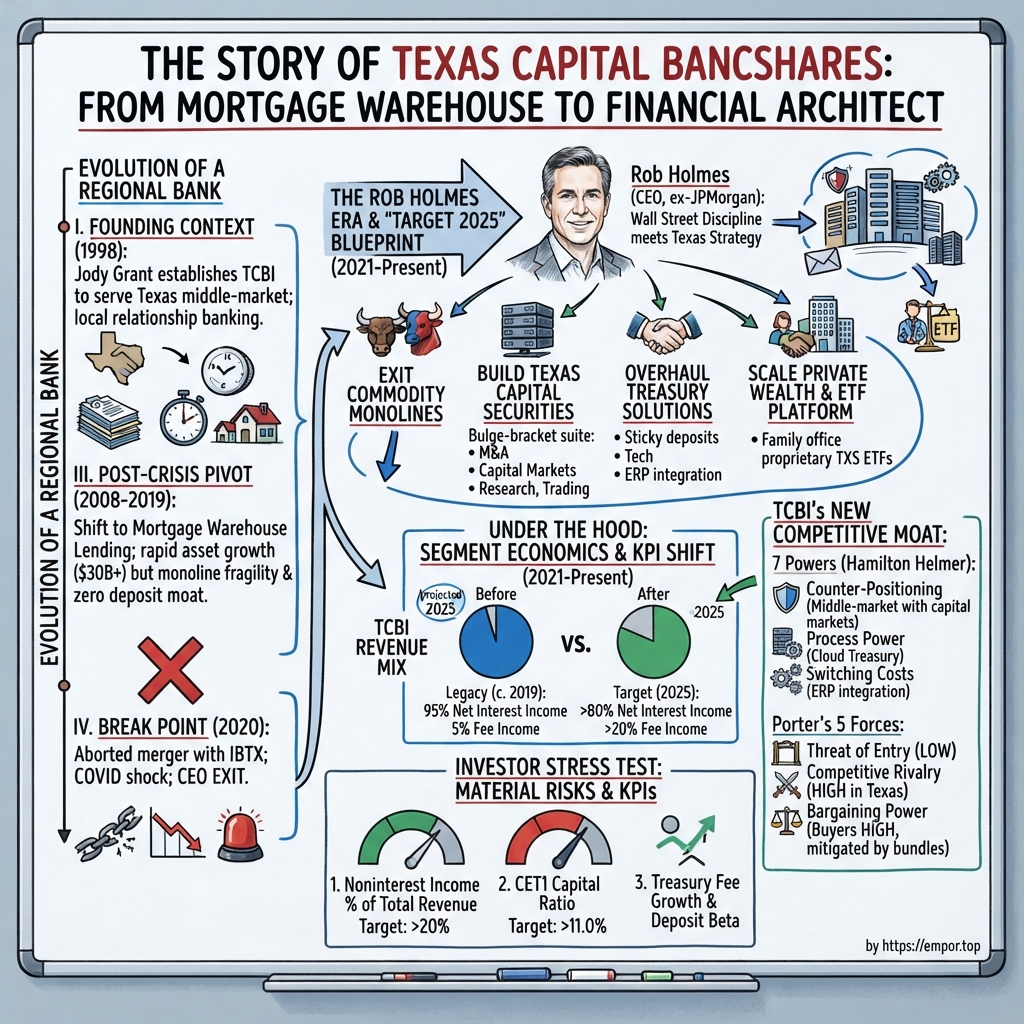
Texas Capital Bancshares: The Story of Texas's Financial Architecture
I. Introduction & Episode Roadmap
On a July afternoon in 2026, a Dallas bank chief executive went on a public earnings call and stated what most of his peers only mutter in private. Asked why his company had failed to win a shareholder vote to move its state of incorporation from Delaware to Texas, Rob Holmes did not deflect. He said his shareholder base was too institutional, that those institutions had listened to "irresponsible uninformed proxy advisers," and added, for the transcript: "And I'll go on the record and say it. And it's a problem, and they have too much power."3
That is not how bank CEOs usually talk, making it a revealing starting point for the story of Texas Capital Bancshares. The company's recent history has been an exercise in doing what regional banks are rarely expected to do.
Regional banks are typically expected to gather low-cost deposits, extend loans at a spread, maintain a tight efficiency ratio, and expand the balance sheet. Texas Capital spent five years doing the opposite: systematically downsizing loan-producing units, recruiting senior investment bankers who produced no immediate loans, building a broker-dealer from scratch in a region lacking a major investment banking hub, and telling investors that loan growth was an outcome, not a strategy. In September 2021, when Holmes outlined this vision, market reaction ranged from skeptical to hostile. He acknowledged as much on the subsequent quarterly call: "The duration of the build was met with some frustration, which I certainly understand but came as no surprise to any of us."14
Five years later, the financial metrics reflect that shift. Noninterest income reached 22% of total revenue in the second quarter of 2026, up from 18% a year earlier and roughly half that when the plan was announced.3 Tangible book value per share hit $76.98, marking its ninth consecutive quarterly record.3 The company initiated its first-ever common dividend in April 2026.21 Management describes the transformation as complete and states the firm has entered a phase of "consistent execution."20
That is the management narrative. Investors face a more critical question: does this represent a genuine structural improvement in earnings quality, or a well-narrated rotation from one cyclical revenue stream into another? Under a more skeptical view, the bank may have simply exchanged volatile mortgage warehouse spread income for volatile capital-markets fee income—spending heavily in the process and labeling the outcome diversification.
Why Texas Capital matters right now. The company held roughly $31.5 billion in total assets at the end of 2025,2 trading on NASDAQ as the holding company for Texas Capital Bank.1 It remains small enough to avoid being classified as a national money-center bank, yet large enough to play a significant role within the Texas economy—which ranks as the ninth-largest globally. Headquartered in Dallas amid a major corporate relocation wave, the bank is testing a broader strategic question: can a regional bank build institutional-grade capital markets capabilities organically, without acquisition, and use them to defend its commercial franchise against both money-center banks and private credit funds?
A second reason makes the company worth studying beyond Texas. Texas Capital offers an unusually transparent case study in corporate restructuring. Its initial conditions were documented in a dated public strategic plan, and its subsequent actions—what was sold, what was hired, and what was refused—were disclosed quarter by quarter. Unlike many corporate turnarounds where targets shift and disclosures remain selective, Texas Capital's results can be evaluated directly against its original benchmark.
The framing question. Strip the geography away and what Texas Capital attempted was a complex organizational feat: retraining a commercial lending workforce to sell a broader suite of financial services. In commercial banking, such transitions often stall. A banker evaluated for decades on loan volume does not automatically transition into a coverage officer orchestrating loan syndications, treasury services, and advisory pitches. Achieving that shift requires changing incentives, changing personnel, or both.
Holmes addressed this challenge by importing an operating model from his former institution—where he spent thirty-one years at a major bank that treated lending as an entry point rather than the primary product. He then spent years restructuring the executive team, technology infrastructure, and compensation models around it. Whether that model has taken permanent root in Dallas forms the central question of this analysis, tracked quarter by quarter through product-level fee disclosures.
The roadmap. The analysis begins in the aftermath of the 1980s Texas banking collapse, which created the void Texas Capital was founded to fill in 1998. It traces the bank's post-2008 expansion into national mortgage warehouse lending—a highly profitable business with low barriers to entry—and the balance sheet concentration that resulted. It examines the strategic crisis of 2019–2020: a proposed merger of equals with Independent Bank Group, its termination during the early weeks of the pandemic, and the immediate departure of the CEO. The narrative then reviews the Holmes era in detail: the strategic commitments, divestitures, infrastructure investments, and associated costs. Finally, it evaluates segment economics, applies strategic frameworks to test management's claims against historical performance, and concludes with three key metrics that will determine whether the transformation succeeded.
The story begins where any examination of Texas banking must start: with the collapse of the 1980s.
 Subscribe on LinkedIn
II. The Founding Context & The Golden Age of Texas Banking (1998–2007)
In 1988, the federal government executed an unprecedented regional intervention. It bailed out First RepublicBank Corporation, the largest bank holding company in Texas, and shepherded its merger into North Carolina's NCNB.4 The following year, MCorp and Texas American Bank failed. By the time the collapse ended, 425 Texas commercial banks had failed between 1980 and 1989, alongside eight of the ten largest bank holding companies operating in the state in 1985.4
The regional fallout ran deep. Prominent Dallas and Houston institutions—including Republic National, First National, and Texas Commerce—had long financed the state's oil booms, skylines, and ranches through personal relationships. But when crude oil plunged from $35 a barrel to under $10, commercial real estate tumbled with it. Concentration risk that had previously passed for local expertise stood exposed as an undiversified bet on a single commodity.5
Out-of-state institutions replaced the fallen Texas banks. NationsBank absorbed First RepublicBank and later became Bank of America, while Chemical Bank acquired Texas Commerce, eventually becoming part of JPMorgan Chase. Deposits remained in Texas, but primary credit decision-making migrated to Charlotte and New York.
The void. This structural shift created the market failure that Texas Capital Bank was founded to address. Beyond generic slogans about "local decision-making," the 1990s void in Texas was tangible. For an out-of-state institution, a Dallas middle-market manufacturer generating $60 million in annual revenue was a minor credit line evaluated through national scoring frameworks rather than direct site visits. An entire tier of Texas middle-market business owners shifted in less than a decade from core banking relationships to standardized portfolio line items.
The founding. Joseph M. "Jody" Grant recognized this gap from inside the industry. Having served as chairman and CEO of Texas American Bancshares—one of the failed institutions—and later as chief financial officer of Ross Perot's Plano-based Electronic Data Systems (EDS), Grant assembled a founding team of veteran Texas bankers and business leaders. In December 1998, they launched Texas Capital Bank with roughly $80 million in initial capital, marking one of the largest de novo bank capitalizations in U.S. history.67
Grant's strategy targeted this middle-market gap directly: hire experienced local commercial bankers, grant them local credit approval authority, and serve middle-market companies across the Texas Triangle—Dallas–Fort Worth, Houston, Austin, and San Antonio. The bank deliberately eschewed a retail branch network and consumer banking products to focus entirely on middle-market business owners and corporate clients. In 2001, American Banker named Grant its Community Banker of the Year.6
Two structural choices defined the initial operating model. First, the $80 million starting capital allowed the bank to underwrite significant commercial credit lines immediately, bypassing the slow ramp-up period typical of de novo banks. Second, the startup drew financial and technical support from Electronic Data Systems, where Grant had served as chief financial officer.6 Leveraging EDS's operational infrastructure and corporate network gave Texas Capital enterprise-level capabilities from its inception.
The model, and what it deliberately omitted. Texas Capital built its balance sheet without consumer retail branches, drive-through tellers, or consumer mortgage originators. Deposit gathering relied on commercial clients and their executive owners. Lending targeted middle-market companies with annual revenues generally between $10 million and $500 million—a segment large enough to require sophisticated commercial credit yet small enough to value direct senior banker coverage.
The geographic footprint mirrored the state's economic structure. Rather than operating as a single market, the Texas Triangle encompasses four distinct metropolitan economies: Dallas–Fort Worth (corporate headquarters, logistics, and financial services), Houston (energy, petrochemicals, and healthcare), Austin (technology and government), and San Antonio (defense, healthcare, and manufacturing). Establishing local credit authority across all four metro areas provided geographic and sector diversification within Texas, directly countering the single-commodity concentration that had doomed predecessor institutions in the 1980s.
Riding regional population growth, expanding commercial construction, and a favorable credit environment, the bank grew steadily. On August 13, 2003, holding company Texas Capital Bancshares completed its initial public offering on NASDAQ under the ticker TCBI.6 Grant guided the institution through this initial expansion, serving as chairman and CEO until retiring in 2008, and remaining on the board of directors until 2013.6
What to take from this era. Texas Capital's initial success stemmed from a distribution advantage rather than product innovation. The bank offered standard commercial lending products, but delivered them with faster turnaround times, direct access to executive decision-makers, and local underwriting authority.
However, the founding model carried clear strategic limitations. It relied almost entirely on spread lending and contained virtually no fee-based capital markets capabilities or structural lock on client operating accounts. While this spread-lending model thrived during the credit expansion from 1998 to 2007, its core vulnerability became evident when macroeconomic conditions changed and interest rates plummeted toward zero.
III. The Post-Crisis Pivot: Mortgage Warehousing & Monoline Drift (2008–2019)
In 2010, commercial bank management teams across the country faced a daunting operational environment. The Federal Reserve had reduced short-term interest rates effectively to zero and signaled they would remain low indefinitely. Loan demand from operating businesses remained weak as companies prioritized balance sheet deleveraging over capital expansion. Consequently, net interest margins—the spread between deposit costs and lending yields that powers bank earnings—were continually compressing. Public equity investors, accustomed to growth, pressed executives for a strategic response.
Texas Capital identified a lucrative alternative, turning to a line of business that drove rapid balance sheet expansion for nearly a decade.
The mechanics, in plain terms. When a non-bank mortgage originator approves a residential home loan, it requires immediate capital to fund the transaction at closing. Lacking retail deposit bases, the originator borrows from a commercial bank on a short-term secured line, pledging the underlying mortgage as collateral. Within two to three weeks, the originator sells the loan into the secondary market—to government-sponsored enterprises like Fannie Mae and Freddie Mac or private investors—and repays the bank line before repeating the cycle.
This process defines mortgage warehouse lending. Its operational characteristics are distinct: assets turn over roughly every 10 to 20 days, creating a short-duration credit portfolio well-suited for shifting rate environments. Because the underlying collateral consists of newly underwritten, agency-eligible mortgages, historical credit losses are minimal. Originators also maintain their escrow and operational cash balances with the lending bank, generating non-interest-bearing deposits. During mortgage refinancing booms, this business scales rapidly without requiring proportional increases in commercial banking headcount.
Texas Capital expanded aggressively into the sector, becoming one of the largest mortgage warehouse lenders in the United States. Warehouse credit dominated the bank's asset growth, pushing total assets past $30 billion. By 2019, the company reported $312 million in net income, or $6.23 in earnings per share—on the surface, a record financial performance.2
Why the business was so seductive. The economic rationale stemmed from regulatory capital treatment. Banking rules mandate equity reserves based on asset risk weighting. While a standard commercial loan to an operating business carries a full risk weight, a 20-day advance against an agency-eligible mortgage carries far lower economic risk than its regulatory weighting implies. Consequently, each dollar of equity supported a substantially larger volume of warehouse lending than traditional corporate credit. Combined with portfolio turnover of roughly 18 times a year, fee generation per dollar of balance sheet was extraordinary.
The line of business also required minimal incremental overhead. Onboarding a new middle-market corporate client in Houston requires hiring relationship managers, waiting up to 18 months for credit lines to season, and absorbing ongoing overhead. Extending a warehouse line required only credit committee approval and legal execution—a transaction-driven exercise rather than a long-term distribution build. In an era when banks struggled to deploy excess liquidity, the operational leverage was compelling.
The bank expanded its mortgage footprint further by introducing correspondent lending—purchasing closed mortgages from smaller originators for aggregated secondary resale—and assembling a mortgage servicing rights portfolio tied to approximately $14 billion in loans.15 Each addition shifted the institution deeper into national mortgage finance and further from its origin as a dedicated Texas middle-market lender.
The fragility underneath. However, the structural features that drove warehouse lending's profitability also exposed the bank to severe underlying vulnerabilities.
Minimal economic moat. Non-bank mortgage originators operate as price-sensitive institutions, maintaining credit lines across multiple warehouse providers and shifting volume for minor pricing differentials. The business offered negligible switching costs, workflow lock-in, or relationship durability. If a competing bank reduced pricing by 15 basis points, originators reallocated volume immediately. Texas Capital's executive leadership later characterized the legacy operation as one that "by definition was a subpar loan-only business."21
Volatile deposit dynamics. The escrow balances supporting the warehouse book fluctuated directly with mortgage origination activity. During origination spikes, deposits flooded the balance sheet; when interest rates rose and refinancing activity slowed, those deposits departed rapidly—withdrawing liquidity precisely when stable funding was most critical. Rather than serving as sticky core funding, these balances behaved like cyclical liquidity. To compensate, the bank gathered substantial volumes of rate-indexed wholesale deposits that repriced instantly alongside Federal Reserve policy rate moves.
Cyclical sensitivity. Earnings became heavily dependent on 30-year fixed mortgage rates—a macro variable outside management's control or ability to hedge—rather than Texas corporate expansion or middle-market credit performance.
Monoline drift and credit risk. As warehouse margins compressed, management sought asset yield in higher-risk categories. The bank increased its exposure to commercial real estate and established specialized finance verticals. This pattern reflected classic monoline drift: an institution whose primary engine loses pricing power often reaches for higher-yielding credit risk to sustain earnings targets.
The investor lens on this decade. Evaluating bank performance requires distinguishing between the level of earnings and the sustainability of their source. Throughout the 2010s, Texas Capital delivered strong headline profitability and rapid asset growth. Yet those earnings relied on a commoditized business model with low barriers to entry, price-sensitive clients, and deposit flows tied to mortgage volume cycles.
To casual observers, the 2019 financial results reflected a top-tier regional commercial bank. A closer examination of balance sheet composition revealed a leveraged exposure to national mortgage origination volume, operating under a Texas banking charter. This distinction carried major valuation implications, though equity markets took several years and a market disruption to fully price the risk.
By 2019, Texas Capital presented a dual identity: its investor presentations portrayed a high-performing Texas commercial institution, while its balance sheet operated as a nationally focused, wholesale-funded specialty lender. That structural divergence was manageable during favorable mortgage volumes, but it created an urgent strategic challenge when the board evaluated long-term funding stability.
IV. The Break Point: The Aborted Merger & The 2020 Crisis (2019–2020)
On December 9, 2019, Texas Capital Bancshares and Independent Bank Group announced an all-stock merger of equals valued at approximately $5.5 billion, intended to create an institution with roughly $48 billion in assets.8
The transaction terms revealed key strategic priorities. Texas Capital shareholders were set to receive 1.0311 shares of Independent Bank Group for each share owned, resulting in 55% ownership of the combined entity compared to Independent's 45%.8 However, the parent holding company was to assume the Independent Bank Group name, trade under Independent's ticker symbol (IBTX), and move its corporate headquarters to Independent's home base in McKinney, Texas. Only the operating bank subsidiary would retain the Texas Capital name.8
What the deal revealed. Independent Bank Group operated a traditional retail branch network with stable, low-cost community deposits from North Texas households and small businesses. Texas Capital possessed substantial commercial lending assets but lacked matching low-cost core funding. The proposed combination was fundamentally a deposit acquisition structured as a strategic partnership. Under then-Chief Executive Officer Keith Cargill, management concluded that purchasing a retail deposit network offered the fastest path to lowering its cost of funds.
While strategically understandable, the terms acknowledged that fifteen years of aggressive balance-sheet growth had left Texas Capital unable to efficiently fund itself from its own liability base. Yielding the holding company name, ticker symbol, and headquarters despite holding a 55% equity stake suggested Texas Capital was negotiating out of necessity rather than strength.
The 2020 market disruption. In March 2020, the onset of the pandemic severely disrupted fixed-income markets. For a mortgage warehouse lender, the shock was immediate. Prices on mortgage-backed securities dropped rapidly. Originators hedging pipeline risks via short positions in to-be-announced (TBA) securities faced severe margin calls as prices diverged. Secondary market liquidity for non-agency paper temporarily dried up, extending loan dwell times on warehouse lines. Certain non-qualified mortgage (non-QM) originators failed under liquidity pressures, while commercial real estate and corporate loans across the banking sector faced potential credit impairment.
This market stress highlighted the structural vulnerabilities of warehouse lending. Warehouse providers absorb counterparty risk from originators and liquidity risk from secondary markets rather than long-term mortgage credit risk. In orderly markets, loans clear within two to three weeks. In March 2020, secondary market friction coincided with originator margin calls, leaving lenders holding illiquid assets extended to financially strained counterparties.
Simultaneously, Independent Bank Group faced economic headwinds from its focus on North Texas commercial real estate and small-business lending. Evaluating credit quality across both loan books became increasingly difficult during a period of acute market volatility.
The collapse. On May 26, 2020, the two companies mutually agreed to terminate the transaction, citing the significant impact of the COVID-19 pandemic on global markets and on the companies' ability to realize the benefits they had expected.9 The announcement disclosed that Keith Cargill, then 67, would step down as president, chief executive officer, and director, effective immediately.910 Chairman Larry Helm took over as interim CEO while the board ran a national search.10
The diagnostic. Following the termination, Texas Capital operated as a $37.7 billion-asset bank2 characterized by high relative funding costs, cyclical deposit volatility tied to mortgage originations, an expense structure designed for a larger merged entity, an abandoned strategic plan, and an interim executive team. Full-year 2020 net income fell to $66 million, or $1.12 per share, down from $6.23 the year before.2
That 82% drop in annual earnings per share demonstrated that historical profitability relied far more on favorable cyclical conditions than durable structural advantages. Addressing these operational challenges required a fundamental strategic reset—and executive leadership familiar with large-scale corporate turnarounds and institutional banking structures.
V. The Rob Holmes Era & The "Target 2025" Blueprint (2021–2023)
On October 27, 2020, Texas Capital named Rob C. Holmes chief executive officer and president, effective January 2021.11 Holmes joined from JPMorgan Chase, where he had spent 31 years, serving since 2011 as Global Head of Corporate Client Banking and Specialized Industries—a role with end-to-end responsibility for delivering treasury management, credit, and investment banking solutions to corporate clients across North America, Europe, and Asia.1112
This was an unconventional hire for a $30 billion regional bank. Holmes had never served as a chief executive; he had spent his career operating a client coverage model. In that model, commercial lending functions as an entry point rather than the primary product, with profitability driven by treasury management, loan syndication, hedging, M&A advisory, and private wealth management. Holmes arrived in Dallas at an institution where lending had long served as the standalone product.
Assembling the room. Holmes rebuilt the executive team with leaders from larger money-center institutions. Matt Scurlock was named chief financial officer, providing detailed analytical commentary on earnings calls and walking analysts through margin dynamics and portfolio mix shifts. In April 2026, Scurlock expanded his responsibilities to become President of Texas Capital Bank, consolidating financial and operational leadership.21 Executive recruiting continued over several years, adding a chief legal officer in 2021,14 followed by external hires for chief operating officer, chief human resources officer, and chief digital and information officer across 2025 and 2026.213
September 1, 2021: the plan. After a seven-month strategic review of operations, business lines, and capital allocation, Holmes presented a multi-year turnaround plan to investors.13 The strategy rested on four pillars, unified by a rejection of balance sheet expansion as a primary objective.
First, exit the commodity businesses. In April 2021, the bank agreed to sell its mortgage servicing rights portfolio—tied to roughly $14 billion in mortgage loans—to PHH Mortgage while winding down its correspondent lending aggregation unit.15 The largest divestiture followed in September 2022, when Texas Capital agreed to sell its insurance premium finance subsidiary, BankDirect Capital Finance, to a subsidiary of Truist Financial for approximately $3.4 billion in cash, closing the transaction on November 1, 2022.171830 The divestiture removed a substantial earning asset from the balance sheet on the strategic premise that it did not foster core commercial banking relationships in Texas.
Separately, the bank spent 2021 and 2022 allowing billions of dollars in higher-cost, rate-indexed wholesale deposits to run off. Although total deposits declined by double-digit percentages during this period, management characterized the contraction as an intentional shift away from single-service, out-of-market deposits toward core client operating accounts.27
Second, build an investment bank. Holmes argued that commercial lending should capture full client relationship value rather than ceding profitable fee opportunities to external firms. On the September 2021 presentation call, he noted: "We currently incur the cost of client acquisition, and in almost all cases, the investment of capital in the form of loans, precisely for the opportunity to provide these types of value-added solutions... We would like to control the quality of the execution from end to end and we want to capture the full value of our relationships."14
On January 10, 2022, the company launched Texas Capital Securities as an SEC-registered broker-dealer and member of FINRA and SIPC, offering M&A advisory, capital markets underwriting, loan syndication, sales and trading, and corporate hedging.16 Rather than competing for standalone open-market mandates, the unit was designed to cross-sell financial services into the bank's existing commercial, real estate, and mortgage finance client base.31 In a September 2022 strategy update, management reiterated that the broker-dealer was developed to serve as an integrated service arm rather than an independent business line.28
Third, rebuild treasury management. Commercial operating accounts—which handle corporate payroll, receivables, and payment originations—represent sticky, low-cost deposit liabilities because changing providers requires reconfiguring a client's financial operations. To capture these accounts, Texas Capital upgraded its technological capabilities, investing in cloud architecture, application programming interfaces (APIs) for direct client system integration, real-time payment processing, and digital client onboarding.
Treasury management expansion emerged as a key fee engine. Treasury product fees grew 24% in 2025,20 and in the second quarter of 2026, the bank onboarded its largest single-quarter cohort of new treasury clients since beginning to track the metric four years earlier.3
Fourth, scale private wealth. On July 13, 2023, the firm introduced its first exchange-traded fund, the Texas Capital Texas Equity Index ETF, which tracks 216 public companies headquartered in Texas, weighted by sector contribution to state GDP and market capitalization.19 While modest in asset size, the ETF serves as a prominent marketing vehicle reinforcing the bank's Texas-focused identity.
Rebuilding the broader private wealth platform required significant operational overhaul. Holmes noted that while the division existed prior to his arrival, "the infrastructure was poor," necessitating a custodian transition, upgraded digital client interfaces, and a restructured service model.21 In early 2026, the company appointed Jay Klingman—who had led middle-market and business banking for five years—to head a consolidated Private Bank and Family Office unit, following the recruitment of a senior family office executive from a money-center bank six months prior.21 Management based this expansion on state wealth demographics, emphasizing that Texas leads the nation in family office concentration, with the highest density located in Dallas.21 Private wealth fees remain modest, totaling $5.1 million in the second quarter of 2026 on $4.8 billion in assets under management.3 While management reported that approximately one-third of closed M&A transactions generated follow-on wealth management referrals, the business line remains the smallest of the strategic pillars.
Technology, and how to read the AI claims. Management framed its operating model around being "banker-led and technology-enabled," deploying capital into core digital architecture alongside client-facing applications. Over five years, the bank built a centralized cloud data environment designated "Big Sky," developed more than 250 internal APIs, and launched an internal artificial intelligence platform named "Ranger." Management reported that approximately 80% of employees accessed the AI platform within a four-week window in early 2026.21 The AI deployment encompasses three operational areas: automated workflows for loan operations and fraud detection, an internal tool builder for employee workflows, and selective third-party software integrations.21
Discussing the technology initiative, Holmes noted his initial frustration with implementation timelines before concluding that data architecture was the critical bottleneck, stating: "to do AI really well, you need a great data platform."21 For a regional bank of Texas Capital's size, establishing enterprise data infrastructure early provides foundational operational support, though near-term financial returns are more likely to manifest as operating cost discipline rather than direct fee revenue generation.
The cost, honestly stated. Building institutional capabilities while unwinding commoditized lending units created substantial financial drag. Full-year 2021 net income fell to $254 million, significantly below 2019 performance levels.2 Results in the third quarter of 2021 included a $12 million technology write-off after executive leadership reassessed existing software assets and decommissioned legacy systems.14 The financial trough occurred in fiscal 2024, when GAAP net income fell to $77.5 million, or $1.29 per share, impacted by balance sheet repositioning and elevated restructuring expenses.2
Holmes established a public performance benchmark at the outset of the turnaround: achieving a 1.10% return on average assets by the third quarter of 2025.22 When analysts questioned on the September 2021 call whether that target represented the ceiling of the platform's profitability, Holmes responded: "The answer is, of course not. We believe the platform we are doing is capable of much more."14 Subsequent performance against that multi-year benchmark is evaluated in Sections VIII and IX.
VI. Under the Hood: Segment Economics, Business Drivers & Capital Markets Realignment
Strip the narrative away and a bank comes down to three operational variables: what it lends, what it charges for services, and what it pays for funding. At Texas Capital in 2026, all three have shifted, and the direction of those movements matters far more than any single quarter's financial print.
The commercial engine. Period-end commercial loans reached $13.0 billion in the second quarter of 2026, up $1.2 billion or 10% year over year, marking the tenth consecutive quarter of commercial loan growth.3 The composition of that growth is more informative than its overall pace. Executive leadership has noted that the majority stems from new client acquisition rather than higher utilization on existing credit lines. Total commitments rose roughly $2.8 billion, or nearly 15%, year over year in the first quarter, while line utilization stood at roughly 45%, down slightly from the prior year.21 For analysts evaluating loan expansion, growth driven by new client acquisition at stable utilization indicates market share gains, whereas expansion driven by existing clients drawing down lines often signals borrower stress.
In contrast, commercial real estate balances contracted to $5.1 billion, down 9% year over year, with management guiding to a roughly 12% decline in full-year average balances.3 Holmes's explanation on the second-quarter 2026 call was unhedged: originations from the bank's primary real estate clients had touched a decade low, competitors were pricing aggressively and loosening structural terms, and "we are not forced to participate."3 Later in the call he extended that critique to general commercial lending, noting the firm had walked away from transactions on underwriting structure and expected those borrowers to return "when the clients trip under the current structure they chose."3
That posture represents either disciplined risk management or a rationalization for lost deal volume—a distinction difficult for outside investors to verify in real time. What can be tracked over the full credit cycle is whether the shrinking commercial real estate portfolio yields fewer non-performing loans than peer balance sheets.
The fee engine. Fee diversification marks the most substantial operational shift. Noninterest income reached $75.1 million in the second quarter of 2026, up 39% year over year and representing roughly 22% of total revenue, compared to 18% a year earlier.3 For historical context, the three focus fee units—treasury management, private wealth, and investment banking—together generated $47.4 million for the entire year of 2020.20 By 2025, those same segments produced $192 million.20 The company now generates more fee income in a single quarter than it produced during an entire pre-transformation year.
Within that total, investment banking and trading income reached $42.8 million in the second quarter of 2026, up 34% year over year.3 Treasury product fees reached $12.5 million, up 8%.3 Wealth management and trust fees rose to $5.1 million, up 38%, supported by $4.8 billion in assets under management.3
But look closely at the composition, because the label "fee income" hides very different animals.
Treasury management fees represent stable, recurring revenue. They are contractually structured, tied directly to transaction volumes, and bundled with the core client operating deposits that fund the balance sheet. While they expand predictably—growing 8% to 14% year over year across recent quarters,321 supported by gross payment volume growth exceeding 10% in four of the past five years21—treasury fees alone rarely drive equity valuations. However, they serve as the primary mechanism for lowering the institution's long-term cost of funds.
What "treasury management" actually means. Beyond the industry terminology, treasury management addresses an operational necessity for commercial enterprises. Operating companies manage daily cash flows, receiving funds via wire, check, card, and automated clearing house transfers while disbursing payments to vendors, payroll, and tax authorities. Operating balances reside across multiple accounts and currencies, requiring finance teams to monitor real-time liquidity and short-term cash positions. A commercial bank's treasury platform provides the software and clearing infrastructure to execute these transactions.
The key competitive factor is technology integration. Under legacy banking models, corporate finance staff manually logged into banking portals to export cash reports into internal accounting software. Under Texas Capital's updated architecture, corporate client software connects directly to the bank via application programming interfaces (APIs)—automated digital pipelines that exchange data without manual intervention. Payment commands originate within the client's internal software, account balances refresh automatically on internal dashboards, and banking operations integrate directly into back-office workflows.
This integration creates substantial switching costs. Replacing a basic web portal requires minimal operational adjustment, whereas replacing an integrated payment layer requires a full software re-implementation, system testing, staff retraining, and operational risk to payroll processing. Holmes has described this product suite—encompassing embedded banking, real-time payments, digital onboarding, and international wire transfers—and highlighted an advisory sales approach where treasury specialists consult on corporate workflow architecture rather than selling individual products, attracting mid-market clients with complex operational requirements.3
This structural lock-in is a logical strategy, though its financial impact manifests gradually through stable core deposit retention rather than immediate fee spikes—which is why the performance metrics in Section X track deposits and fees together.
Investment banking and trading revenue displays opposite characteristics: high growth margins paired with cyclical volatility. Capital markets services represent the largest component of total noninterest income. With management guiding to $160 million to $175 million in investment banking fees for full-year 2026 against a total noninterest revenue target of $270 million to $290 million,3 capital markets activity accounts for roughly 60% of total fee guidance. Capital markets activity routinely contracts during broader economic slowdowns, as evidenced in 2025 when market volatility delayed M&A transactions and corporate issuances into the second half of the year.20
Management argues that its fee engine is gaining structural stability. On the second-quarter 2026 earnings call, Holmes stated the business "is getting easier to predict as we mature and the fees are repeatable, more sustainable refinancings of existing clients and more granular overall."3 Scurlock emphasized that 2025 investment banking transaction volume rose roughly 40% while average transaction size declined, characterising the trend as broader client penetration rather than reliance on isolated mega-mandates.20 Disclosed debt distribution figures support this volume expansion: in 2025, the firm arranged approximately $30 billion in debt across term loan B, high-yield, and private placement markets, alongside $19 billion in lead-left bank syndications—totaling roughly $49 billion—and ranked as the second-largest arranger of traditional middle-market loan syndications nationwide.20 In the first quarter of 2026, the broker-dealer ranked first in that category.21
Beyond market league tables, client integration metrics highlight the cross-selling model in practice. More than half of investment banking fees generated outside sales and trading in the six months ending March 2026 originated alongside new commercial banking relationship acquisitions.21 This sequence reflects management's intended operational model: investment banking capabilities secure the initial corporate relationship, which then yields treasury management accounts and core operating deposits. In the second quarter of 2026, roughly one-third of non-trading investment banking fees originated from new commercial or corporate banking clients, while one-third of closed M&A advisory mandates produced follow-on wealth management referrals.3
A notable detail from that quarter reveals the firm's specific coverage niche: every closed M&A transaction year-to-date involved the sale of a middle-market, privately held, Texas-based, family-owned business.3 While this represents a defensible market position, transaction volume in this segment remains dependent on owner liquidity timing and broader macroeconomic conditions.
Funding: the argument the whole strategy rests on. Texas Capital's strategic thesis relies heavily on altering its liability structure and reducing deposit costs. Operational progress is reflected in recent funding metrics:
The mortgage finance self-funding ratio—measuring mortgage escrow deposits as a percentage of total mortgage warehouse loans—declined from 107% in the fourth quarter of 2024 to 85% a year later, to 80% in the first quarter of 2026, and to 71% in the second quarter.20213 This reduction reflects an intentional runoff of volatile escrow deposits in favor of commercial operating balances. Client interest-bearing deposits excluding brokered and index-linked accounts expanded by $1.7 billion, or 10%, in 2025.20 Commercial noninterest-bearing deposits increased by $546 million, or 18%, from the third quarter of 2025 through the second quarter of 2026.3
Concurrently, management restructured the mortgage warehouse business model. Enhanced credit structures—arrangements that significantly lower regulatory capital requirements against warehouse advances—expanded from 59% of period-end mortgage finance balances at year-end 2025 to 69% by mid-2026, lowering the portfolio's blended risk weighting to 54%.203 Management estimated this capital optimization generated 113 basis points of Common Equity Tier 1 (CET1) capital since the fourth quarter of 2024.3 Concurrently, over 75% of mortgage warehouse clients utilize broker-dealer services, and nearly all maintain active treasury management accounts.20
This restructuring altered the economics of the legacy warehouse unit. Rather than exiting the business, Texas Capital transformed a commoditized lending line into what Holmes describes as "more of an industry vertical than a mortgage warehouse," operating with reduced capital intensity while generating auxiliary fee streams.21
And now the caveat. These structural adjustments have not protected net interest margins from near-term compression. Net interest margin stood at 3.43% in the first quarter of 2026, was guided down to 3.35%–3.40% for the second quarter, subsequently printed below that target, and was guided to the low-3.20% range for the third quarter.213 Management attributed the margin compression to balance sheet mix—specifically seasonal shifts into lower-yielding mortgage warehouse advances funded partly by higher-cost brokered certificates of deposit—and projected the third quarter of 2026 as the cyclical margin trough.3 However, sequential reductions in margin guidance highlight that funding costs remain sensitive to interest rate environments and deposit market competition.
Scurlock summarized the industry-wide funding environment directly, stating: "we think the cost of funding for the industry is going to go higher over time, and our strategy and resource allocation contemplate the mix of businesses and services we will need to earn an acceptable return against that reality."21 Holmes reiterated that perspective, observing that deposit liabilities across the banking sector have faced growing commoditization since the 2008 financial crisis, "and that issue won't abate."3
This framing clarifies management's core economic premise: Texas Capital is not projecting immune status against broader industry deposit competition, but is attempting to construct an operating model capable of generating target returns despite elevated industry funding costs.
The plumbing behind the balance sheet. Two balance sheet management transactions illustrate how liability structuring supports capital efficiency.
First, during the first quarter of 2026, the company issued $400 million in fixed-to-floating senior notes due 2032 at a 5.301% coupon, utilizing a portion of the proceeds to redeem $375 million in holding company subordinated debt in May.213 The refinancing lowered annual interest costs. Management noted the redemption was enabled by risk-weighted asset reductions in the mortgage finance division, which eliminated the need for the regulatory capital treatment previously provided by the subordinated notes.21
Second, the bank active managed duration risk through interest rate swap overlays. To stabilize net interest income across changing rate cycles, Texas Capital executed received-fixed swap contracts that synthetically convert floating-rate commercial loans into fixed-rate yields. Through 2025 and 2026, the treasury desk systematically replaced maturing positions with higher-yielding instruments: executing $1.0 billion at 3.41% in the fourth quarter of 2025, $500 million at 3.45% in the first quarter of 2026, and $400 million in two-year received-fixed swaps at 3.87% effective June 2026.20213
Build versus buy. Management made a deliberate structural choice in establishing its capital markets division. Texas Capital constructed its investment bank organically—recruiting individual coverage teams, securing regulatory licenses, and absorbing upfront compensation expenses through operating results—rather than acquiring an established boutique advisory firm during a period of elevated M&A valuations. Organic development requires longer setup timelines and creates near-term expense drag without immediate offsetting revenue. However, it avoids goodwill write-downs, eliminates corporate integration risks, and ensures investment bankers operate within the bank's unified coverage framework rather than functioning as an isolated unit.
Regarding bank-level M&A opportunities, Holmes has maintained a consistent posture, indicating that acquisitions remain an option but noting that target valuations have lacked financial discipline, adding that "we do not have to do anything."213 For an executive team pursuing a multi-year restructuring, disciplined capital preservation remains a core benchmark for market credibility.
VII. The Playbook: Strategy, 7 Powers & Porter's 5 Forces
Strategic frameworks are useful only until they become tools for confirmation bias. Evaluating Texas Capital's model requires testing each claimed competitive advantage against practical market constraints and observable execution.
Counter-positioning — the primary claim, and the strongest one. Hamilton Helmer's concept of counter-positioning describes a business model an incumbent cannot adopt because doing so would damage its existing, higher-margin operations. Texas Capital's strategy hinges on providing middle-market Texas companies—typically those generating between $50 million and $500 million in annual revenue—with genuine capital markets capabilities alongside traditional commercial credit.
Money-center banks already possess these investment banking capabilities, but they lack the economic incentive to cover mid-market clients at that scale. For institutions like JPMorgan Chase or Bank of America, a $200 million loan syndication for a privately held Texas manufacturer falls below the fee thresholds required to justify internal resource allocation. To Texas Capital, that same deal represents meaningful revenue; to a money-center bank, it is an inefficient use of coverage bandwidth. That difference reflects rational resource allocation based on enterprise cost structures rather than operational oversight.
Conversely, Texas regional peers face structural barriers to adopting this model. Building a full-service broker-dealer depresses the efficiency ratio for years, requires hiring specialized talent at higher compensation levels than traditional commercial bankers, and generates minimal initial revenue during the construction phase. Peer institutions such as Cullen/Frost Bankers and Prosperity Bancshares have earned premium equity valuations precisely by avoiding such investments—focusing instead on lean, low-cost, deposit-rich commercial banking. Replicating Texas Capital's roadmap would force those peers to intentionally degrade the efficiency metrics their shareholders prioritize.
What would falsify it? The thesis falls apart if the middle-market capital markets opportunity is smaller than projected, or if independent boutiques and private credit funds capture that deal flow without holding bank balance sheets. Texas Capital's top-two national rankings in middle-market loan syndications2021 demonstrate clear commercial traction. However, loan syndication league tables measure transaction volume arranged rather than total fee pool, and arranging credit for middle-market borrowers remains a market with expanding competition.
Switching costs — real but narrower than the pitch suggests. The firm's primary switching costs stem from its treasury management platform rather than its investment banking services. When a client integrates its enterprise resource planning system directly into a bank's payment infrastructure via application programming interfaces (APIs), migrating operating accounts to another institution becomes a complex, multi-quarter operational project. Holmes highlighted clients utilizing the platform for embedded banking, real-time payments and receipts, cross-border transfers, and digital onboarding.3 Behavioral data supports this stickiness: more than 90% of newly acquired commercial and industrial clients adopt treasury management services.21
The limit: M&A advisory carries virtually no switching costs, as every transaction mandate is competitively bid. Sales and trading operates as a market-spread business. Consequently, roughly 60% of total fee revenue lacks structural lock-in; the true switching costs reside within the approximately 17% generated by treasury management. Investors must distinguish between transaction-driven fee income and sticky operational revenue when assessing earnings durability.
Scale economies — the weakest claim. Management contends that technology investments will amortize across an expanding client platform over time. While directionally sound, Texas Capital remains a $31 billion institution competing on technology against money-center banks forty to eighty times its asset size. When Holmes details an internal multi-model artificial intelligence platform named Ranger, a centralized data architecture called Big Sky, more than 250 internal APIs, and 170 processes mapped for agent automation,21 the proper framing is progress rather than technological dominance. Major national banks deploy far greater capital into similar initiatives. The realistic assessment is not that Texas Capital holds a technological edge over money-center giants, but that its digital capabilities exceed those of typical $30 billion regional peers, providing sufficient operational sophistication to win its targeted mid-market client base.
Porter's Five Forces and competitive pressures.
Buyers (corporate borrowers) exert considerable bargaining power when commercial credit is commoditized. Holmes's repeated observations regarding "irrational behavior" on pricing and loan structure across commercial real estate and corporate lending3 acknowledge that corporate borrowers hold pricing power in the current market environment. Bundling commercial loans with syndication and treasury management mitigates buyer power but does not eliminate it.
Suppliers (depositors) retain significant structural power across the banking sector. Executive leadership has explicitly acknowledged this secular trend. Rather than attempting to absorb rising deposit costs, management's strategy focuses on generating fee income to offset compressed interest margins.
New entrants encounter high regulatory, capital, and licensing barriers in chartered commercial banking, keeping de novo bank formations near historical lows. However, viewing the threat through traditional banking charters understates competitive risks.
The primary new entrants consist of financial technology firms intermediating corporate cash flows without holding deposits, software vendors embedding treasury workflows while renting underlying banking infrastructure, and non-bank institutional capital providers operating outside regulatory capital rules. Software providers, in particular, pose an insidious long-term risk: if a vendor captures the corporate finance workflow, client switching costs transfer from the bank to the software platform. This trend threatens to erode the relationship depth that underpins Texas Capital's integrated coverage strategy.
Substitutes represent the central strategic challenge. Private credit funds now originate middle-market debt at scale without deposit bases or bank capital mandates. Texas Capital's counter-strategy focuses on participating in private credit markets rather than competing directly against them. In 2025, the bank arranged approximately $30 billion of debt for clients outside traditional bank channels;20 in the second quarter of 2026 alone, it placed $10 billion of non-bank debt and $3 billion of equity.3 Additionally, on June 30, 2026, Texas Capital Alternative Asset Management established a strategic relationship with Phoenix Merchant Partners to provide direct lending to core middle-market companies, supporting Phoenix's launch of Spurstone, a Dallas-headquartered, perpetual-life non-traded closed-end credit fund targeting middle-market borrowers generating $100 million to $1 billion in annual revenue.26 Holmes explained that coverage bankers present both bank underwriting and private credit solutions, noting that "when we do that, we generally get treasury business as well as investment banking."3
This structural response allows the bank to monetize disintermediated credit flows while securing ancillary fee business. However, it introduces operational complexity around credit risk placement, fee transparency, and potential conflicts of interest that may only become fully visible during a credit downturn.
The peer set, and why comparisons mislead. Market commentary frequently groups Texas Capital alongside traditional Texas institutions like Cullen/Frost Bankers, Prosperity Bancshares, and the former Cadence Bank. Measured against conventional banking metrics, Texas Capital often appears less efficient. Cullen/Frost maintains a low-cost deposit franchise established over a century of Texas operations, while Prosperity has historically operated with an efficiency ratio significantly lower than Texas Capital's cost structure.
However, direct metric comparisons overlook key strategic differences. Traditional regional peers monetize low deposit costs. Having relinquished that position, Texas Capital attempts to monetize product density per client relationship. For its fee-generating business lines, the relevant benchmark is not a traditional regional bank, but the corporate and investment banking division of a money-center institution operating in a mid-market coverage niche. Judged strictly on efficiency ratio, Texas Capital will consistently lag branch-heavy, deposit-rich commercial banks. Evaluated instead on fee revenue per dollar of assets or total revenue per corporate relationship, its operating profile diverges noticeably from standard regional bank benchmarks.
Rivalry within the Texas market continues to intensify. Huntington Bancshares completed its acquisition of Houston- and Tupelo-based Cadence Bank in early February 2026, establishing a $279 billion regional institution with 390 added branches across Texas and the Southeast, alongside top-five deposit market share in both Dallas and Houston.25 While major mergers increase competitive scale, they also create operational disruption that allows competing banks to recruit displaced bankers and clients. Addressing the competitive impact, Holmes reported gains across loan originations, deposit accounts, and talent acquisition, while declining to quantify specific deal flow, noting: "I'm not sure which is really being driven by the disruption or just good client coverage by our bankers."3
VIII. Stress Test: Management Credibility, Governance & Activist View
Credibility in banking is not established by a single strong quarter; it is demonstrated when executive commitments at inception match operational conduct four years later, especially through periods of stress.
The record, tested against itself. In September 2021, Chief Executive Officer Rob Holmes committed to achieving a 1.10% return on average assets by the third quarter of 2025.22 Management met that target in the third quarter of 2025 and followed it with a 1.2% adjusted return in the fourth quarter.2022 For full-year 2025, the adjusted return on average assets reached 1.04%—a 30 basis point improvement over 2024, though below the 1.10% annual headline target.20 Management leads with the quarterly milestone, characterizing the roughly 73 basis point organic expansion in return on assets since the third quarter of 2021 as the largest among commercial banks with over $20 billion in assets during that period.22
A notable aspect of executive disclosures has been narrative consistency across reporting periods. Strategic updates published in September 2022 and September 2024 maintain the exact four pillars, sequence, and vocabulary established in the initial 2021 presentation and reinforced on quarterly earnings calls.282932 In corporate turnarounds, management teams often adjust strategic priorities to fit shifting operational outcomes. Texas Capital's public disclosures have remained stable, allowing investors to evaluate execution directly against original benchmarks.
More instructive than headline targets is executive behavior during periods of financial drag. Management intentionally allowed total deposits to contract by double digits, framing the runoff as a deliberate exit from high-cost, rate-indexed wholesale funding.27 The firm sold its $3.4 billion insurance premium finance subsidiary,17 guided commercial real estate loan balances down while competitors pursued volume, and absorbed a fiscal 2024 in which GAAP earnings per share fell to $1.29.2 Each decision depressed short-term financial metrics to prioritize balance-sheet restructuring.
Capital allocation reflects a similar long-term orientation. Since 2020, Texas Capital repurchased 14.6% of its starting shares outstanding at a weighted average price of $64.33 while increasing its tangible common equity ratio by 340 basis points20—expanding total share repurchases to roughly 16.5% of starting shares by the second quarter of 2026.3 Retiring a sixth of the share base while strengthening capital ratios required deploying regulatory capital freed up by restructuring the mortgage warehouse division. Chief Financial Officer Matt Scurlock has outlined strict pricing parameters, noting the firm repurchases shares near or below 1.3 times tangible book value and redirects capital elsewhere when valuations exceed that threshold. When asked in July 2026 whether repurchases occurred during that month, executive leadership confirmed none were executed.3 This policy enforces a genuine constraint on capital deployment, even when short-term share price support might benefit executive profiling.
Where the narrative gets slippery. Three aspects of management's messaging warrant analytical scrutiny.
First, the heavy reliance on promotional investor relations language. Recent earnings calls repeatedly emphasize "record" achievements—record fee income, record tangible book value, record client onboarding, and nine consecutive record quarters. While specific operating gains are notable, quarter-over-quarter growth in tangible book value per share is a mechanical outcome for a profitable bank retaining earnings while buying back shares.
Second, the absence of forward-looking return targets. When asked in July 2026 whether management would set new profitability targets after return on assets ran below 1.2% for two consecutive quarters, Holmes declined to specify a metric. He noted, "I don't know that we've given guidance on profitability going forward," pointing instead to tangible book value growth and positive operating leverage.3 Having achieved its 2025 benchmark, management has not published a replacement target, reducing quantitative accountability for future performance.
Third, the heavy reliance on adjusted metrics. Financial commentary relies heavily on adjusted earnings per share, adjusted pre-provision net revenue, adjusted noninterest expense, and adjusted return on assets. While specific exclusions—such as divestiture gains, portfolio repositioning losses, and special FDIC assessments—are standard, the divergence from full-year 2024 GAAP net income of $77.5 million2 highlights the importance of evaluating reported figures alongside adjusted measures.
Myth versus reality
Four common assumptions surround Texas Capital's transformation. Examining each reveals a more nuanced reality.
Myth: Texas Capital exited mortgage warehouse lending. Reality: Average mortgage finance loans expanded to $6.3 billion in the second quarter of 2026, up 18% year over year, with full-year guidance calling for roughly 15% average growth.3 What changed was not the division's presence but its architecture: deploying enhanced credit structures, securing treasury management services across nearly all clients, and establishing broker-dealer relationships with more than three-quarters of them.20 The bank preserved asset volume while improving overall relationship returns.
Myth: Fee diversification isolates Texas Capital from rate cycles. Reality: Second-quarter 2026 net interest income of $260.4 million compares against $75.1 million in noninterest income,3 leaving spread revenue at more than three-quarters of total top-line receipts. Expanding noninterest income to 22% of revenue moderates interest rate sensitivity relative to traditional spread lenders, but it does not eliminate net interest margin exposure.
Myth: The Delaware reincorporation vote reflected a broader shareholder revolt. Reality: The vote was a narrowly defeated governance proposal on a contested legal question, drawing roughly 45% support.23 Management retains board backing, introduced a common dividend in the same month, and faces no activist proxy contest. The primary issue was not investor confidence in strategy, but executive management's public reaction to the vote's outcome.
Myth: Texas geographic exposure is purely advantageous. Reality: Economic expansion in Texas provides client acquisition opportunities alongside credit concentration risk. The corporate relocations that expand commercial lending pipelines also fueled a rapid wave of multifamily real estate construction, leading to increased rental concessions and credit risk-rating downgrades within the loan portfolio.3 Operating within a single state exposes the franchise to regional economic cycles regardless of geographic diversification claims.
The governance battle. In February 2026, following board discussions that began in July 2025, Texas Capital's directors voted to pursue reincorporation from Delaware to Texas, citing cost savings and operational alignment.23 At the April 2026 annual meeting, the proposal failed, drawing 44% to 45% support, with approximately 18.2 million shares in favor against more than 22 million opposed.233 Proxy advisory firms Institutional Shareholder Services and Glass Lewis recommended against the proposal, arguing the move would weaken shareholder protections and make derivative suits substantially more difficult.2324
The company responded critically, expressing disappointment and publicly blaming the proxy advisers' "ill-informed influence."24 Holmes stated publicly that "there is not one drawback" to the change and added, "I cannot think of one reason why we shouldn't be incorporated in the state of Texas."23 Management announced plans to submit the proposal again.233
An activist's read of that episode. Regardless of the comparative merits of Texas and Delaware corporate jurisprudence, the governance outcome demonstrated an executive response that faulted external advisers rather than addressing shareholder concerns. Securing 45% support indicates a divided investor base on a complex corporate governance issue. However, executive commentary characterizing dissenting shareholders as having "listened to irresponsible uninformed proxy advisers"3 signals a defensive stance toward shareholder pushback. The legal protections that make Texas corporate statutes attractive to management—such as an expanded business judgment rule and heightened standards for derivative suits—reduce shareholder oversight capabilities, creating a structural tension between executive discretion and shareholder rights.
The bear case, assembled. The expense base remains elevated: adjusted noninterest expense reached $202.8 million in the second quarter of 2026, up 7% year over year, against quarterly run-rate guidance of roughly $125 million in compensation and $75 million in non-compensation expenses.3 Capital markets talent requires competitive compensation regardless of deal flow, exposing operating leverage during periods of reduced market activity. The investment banking platform has operated for four years primarily during favorable market conditions, leaving its earnings resilience unproven through an extended downturn. Furthermore, credit performance reflects emerging stress: criticized loans increased in the second quarter of 2026, driven by multifamily commercial real estate borrowers extending rental concessions to maintain occupancy, alongside commercial and industrial borrowers facing demand and margin pressure.3 Net charge-offs reached $16.1 million, or 26 basis points annualized, split between commercial and industrial and commercial real estate loans,3 while net interest margin guidance was reduced twice across two consecutive quarters.
The bull case, assembled. Geographic positioning provides structural tailwinds: more than 200 corporate headquarters have relocated to Texas since 2020, including Charles Schwab, Tesla, Oracle, and CBRE.33 Noninterest income reaching 22% of revenue reduces sensitivity to interest rate cycles relative to traditional spread lenders, while Holmes has noted there remains "plenty of room to grow" toward the 30% fee ratios achieved by larger platforms.3 Capital ratios rank near the top of the regional banking peer group, with a Common Equity Tier 1 (CET1) ratio of 12.07% and a tangible common equity to tangible assets ratio of 9.87% at mid-2026—having peaked at 10.56% at year-end 2025—against a target CET1 floor of 11%.320 The allowance for credit losses, standing at 1.78% of loans excluding mortgage finance, ranks in the top decile of peers, with management applying downside economic scenario weightings at their highest level since 2021.3 Holmes summarized the commercial rationale for maintaining elevated capital reserves, stating that clients "never ask us about our financial condition or anything else because they see how much capital we carry. So it serves a purpose, and it's helping us win business."3
Both cases are grounded in empirical disclosures. The ultimate investment outcome depends primarily on the trajectory of capital markets fee generation and credit performance over the next two years.
IX. Strategic Position, Material Risk Radar & The 3 Critical KPIs
A practical lens for evaluating Texas Capital in mid-2026: management has completed the initial conversion of the bank from what it historically was into what it plausibly might become. The operational pivot is real, but the structural proof of earnings durability remains unproven.
Risk one: credit quality, specifically in multifamily real estate. The commercial real estate portfolio has contracted for years—deliberately and at a faster pace than management originally guided—yet recent credit friction has originated from this specific segment. The underlying mechanism differs from a traditional default cycle. Multifamily properties in the lease-up phase have offered rental concessions to maintain occupancy across Texas markets. These concessions lower net operating income, which in turn triggers debt service coverage covenant defaults. Such covenant breaches compel bank underwriters to issue risk-rating downgrades, even when project equity remains substantial and sponsor backing is strong. Management has noted explicitly that in most instances, material project equity and sponsor support remain intact.213
This dynamic represents a grade migration challenge rather than an immediate credit loss event. However, risk-grade migrations frequently precede actual loan losses, and criticized asset balances have drifted higher rather than stabilizing. The central credit question is whether Texas metro markets—which have absorbed substantial new multifamily supply—achieve rent stabilization before real estate sponsors exhaust their liquidity reserves.
Risk two: a permanently higher cost of funds. Executive leadership has acknowledged that industry-wide deposit liquidity is becoming structurally more expensive. Cumulative interest-bearing deposit beta reached approximately 75% through the first quarter of 2026,21 meaning three-quarters of central bank policy rate movements passed directly through to depositors. Furthermore, management's forward balance-sheet model assumes an 80% deposit beta going forward.3 For an institution advancing a strategic thesis built on funding stabilization, this assumption reflects a critical distinction: the bank has restructured its funding mix, but not its structural funding price. The strategic calculation relies on fee income and capital efficiency expanding sufficiently to sustain returns as deposit costs rise—a proposition that remains untested across a full credit cycle.
Risk three: capital markets volatility and execution risk. With investment banking and trading generating approximately 60% of guided noninterest revenue,3 a prolonged slowdown in corporate advisory or underwriting would impact Texas Capital more severely than a traditional regional lender. The performance during 2025—when macro volatility delayed corporate M&A and equity issuances into the second half of the year20—served as a mild rehearsal for broader market disruption. An extended capital markets drought would test both the firm's revenue durability and its fixed compensation structure simultaneously.
Risk four: key personnel retention. The transformation relies heavily on recruited external talent. The investment bankers, treasury management consultants, private wealth advisors, chief operating officer, chief human resources officer, and chief digital and information officer were largely hired within the past five years. Chief Executive Officer Rob Holmes reorganized executive leadership responsibilities again in April 2026.21 Ongoing executive restructuring can signal an evolving operating model optimized for growth, or one that has not yet settled into operational stability. In either case, a strategy reliant on senior lateral recruits carries inherent retention risks, particularly if equity compensation loses relative competitive value.
Risk five: regulatory oversight and governance exposure. Texas Capital operates in a jurisdiction where state lawmakers have actively updated corporate statutes to attract business relocations, and the bank's own reincorporation initiative aligns it directly with that regional policy direction. The failed shareholder vote remains an active governance overhang, with management expressing intent to resubmit the proposal to shareholders, potentially at a special meeting.23 Concurrently, operating a registered broker-dealer, an asset management division, an exchange-traded fund complex, and a private credit vehicle expands the institution's regulatory surface area well beyond that of a traditional commercial lender. Each entity entails distinct supervisory oversight, compliance standards, and potential conflict-of-interest scrutiny.
Risk six: operational and conflict risks in private credit. The strategic partnership with Phoenix Merchant Partners represents the bank's newest capital markets capability. Structurally, the arrangement enables coverage bankers to offer corporate clients a comprehensive financing menu—including bank credit, syndicated debt, high-yield placement, or private credit direct lending—capturing transaction fees regardless of the chosen structure. However, this integrated model implies that the same institution may advise a borrower on capital structure, arrange its debt placement, and maintain an interest in the vehicle holding the underlying credit. While financial institutions manage these overlapping roles using disclosure protocols and information barriers, such structures draw heightened regulatory scrutiny during credit downturns. The initial vehicle, Spurstone, was scheduled to launch in the third quarter of 2026 supported by anchor institutional commitments.26 Given the absence of historical operating data, investors should view this platform as strategic optionality carrying tail risk rather than a seasoned earnings contributor.
Secondary operational signals. Two subtle indicators outside headline financial metrics warrant ongoing observation. First is credit loss allowance positioning. Management noted that the weighting assigned to downside economic scenarios in its credit loss model stands at its highest level since 2021.3 Maintaining conservative reserve assumptions while peer institutions release credit provisions signals either heightened underwriting caution or the establishment of a reserve buffer that could cushion future earnings. Second is the trajectory of professional and legal expenses. The second quarter of 2026 reflected elevated costs associated with new commercial initiatives and the resolution of legacy problem credits, which management projected would decline during the second half of the year.3 Because credit workout expenses typically precede loan charge-offs, any persistent elevation in professional fees would warrant closer analytical scrutiny than the absolute dollar figures suggest.
The three KPIs that matter
While financial disclosures provide dozens of operating metrics, three core key performance indicators will determine the ultimate outcome of Texas Capital's strategic pivot.
1. Noninterest income as a percentage of total revenue. This ratio measures whether the bank's business model transformation is structural or superficial. Noninterest income reached 22% of total revenue in the second quarter of 2026, compared to the original 15% to 20% target established at the turnaround's inception and roughly half that proportion in prior years.3 Management has since indicated that a fee ratio exceeding 30% represents a realistic long-term objective based on larger institutional banking models.3 Evaluating this metric requires observing its performance through an adverse capital markets environment: if fee revenue remains above 20% during a downturn in corporate deal activity—supported by treasury management and private wealth fees—the platform's structural diversification will be validated. Conversely, a retreat toward historical mid-teen levels would indicate that management merely exchanged one cyclical revenue engine for another.
2. Capital strength, specifically Common Equity Tier 1 (CET1) and tangible common equity ratios. Management maintains a stated CET1 capital floor of 11%, with the actual ratio exceeding 12% in mid-2026.3 Elevated capital buffers serve three distinct functions beyond balance-sheet safety: they supply capital for share repurchases that have retired roughly one-sixth of common stock, function as a commercial differentiator that reassures corporate treasury clients, and preserve strategic flexibility to pursue acquisitions or navigate market dislocations without dilutive equity raises. Analysts should monitor whether excess capital is deployed with strict pricing discipline or allowed to erode without generating clear return on equity gains.
3. Treasury management fee expansion evaluated alongside noninterest-bearing deposit trends. Tracked in tandem, these metrics provide the cleanest evidence of whether commercial clients are integrating core operational banking accounts with Texas Capital rather than utilizing the bank solely for credit extension. Treasury product fees expanded 24% in 202520 and rose 8% year over year in the second quarter of 2026,3 while average commercial noninterest-bearing deposits stabilized at approximately 13% of total deposits.3 If treasury management fees continue to compound while noninterest-bearing balances remain flat or decline, it would indicate that the bank is selling fee-based services without capturing primary operating accounts—suggesting relationship depth is narrower than fee disclosures imply. Concurrent expansion across both metrics would confirm that the liability restructuring strategy is taking hold.
Secondary quarterly metrics—such as net interest margin, investment banking quarterly prints, and overall loan expansion—provide less signal regarding long-term structural transformation. Net interest margin figures are frequently distorted by seasonal balance-sheet fluctuations, as mortgage warehouse balances expand during spring and summer months and temporarily compress blended asset yields. Investment banking revenue experiences quarter-to-quarter volatility driven by transaction timing, where individual transaction closings can swing reported figures. Finally, total loan growth represents an outcome rather than a primary strategic input; evaluating the institution solely on credit volume would contradict management's core premise that loan expansion must follow relationship depth.
Assessing Texas Capital's multi-year execution requires focusing on the core indicators that directly test whether the firm is building a durable, fee-rich, corporate banking franchise.
X. Epilogue & Episode Wrap-Up
In 1998, a group of Texas bankers who had lived through the collapse of their regional industry founded Texas Capital on a simple premise: out-of-state money-center banks were unwilling to perform the customized relationship work required to serve middle-market Texas companies. For nearly a decade, that distribution model succeeded. But when post-2008 monetary policy depressed net interest margins across the banking sector, the institution sought yield in national, commoditized mortgage warehouse lines that diverged from its original regional mission.
That evolution illustrates a broader pattern across regional banking. Institutions rarely commoditize through a single catastrophic error; they do so through a series of individually rational decisions—each intended to sustain short-term growth, yet collectively eroding the relationship depth that justified their origin. The proposed 2019 merger of equals with Independent Bank Group represented the ultimate result of that drift: a bank that had assembled a high-volume asset-generation engine discovered it lacked the stable liability base to fund it, proposing to resolve the deficit by acquiring another firm's retail deposit network and surrendering its own holding company identity.
The restructuring led by Rob Holmes represents an attempt to reverse that trajectory. The most strategic element of the transformation is not the broker-dealer itself, but the willingness to reduce balance sheet scale in order to deepen client relationships—divesting a $3.4 billion premium finance subsidiary, shedding high-cost wholesale deposits, curtailing commercial real estate exposure during an aggressive market cycle, and absorbing the resulting earnings drag. Few executive teams execute such pivots, primarily because enduring years of depressed reported earnings tests investor and board tolerance.
This sequence highlights how commercial banks risk strategic drift. Commoditization rarely stems from superior competitor innovation; it emerges from short-term financial pressure. When compressed net interest margins threaten earnings, management teams often turn to asset classes that generate immediate volume without requiring intensive client coverage. The strategy initially succeeds, evolving into the primary growth driver. Over time, however, the institution realizes that its underlying earnings engine no longer matches the core franchise narrative presented to shareholders.
Reversing that drift is costly precisely because it replaces rapid balance-sheet volume with labor-intensive relationship building, forcing the income statement to absorb upfront operating expenses years before fee benefits materialize. Texas Capital's 2024 results—where GAAP net income fell to $77.5 million—stand as the primary evidence of that trade-off. Any executive team attempting a similar restructuring must anticipate being measured by the multi-year trough of the build rather than solely by peak quarterly prints.
What to watch from here. Five key developments will clarify the firm's long-term trajectory:
First, whether Texas Capital Securities can secure lead advisory mandates during market downturns, given that the broker-dealer was built and expanded during relatively favorable market conditions. Second, whether criticized loan migrations in the multifamily commercial real estate portfolio stabilize as property lease-ups complete or progress into actual credit losses. Third, whether treasury management fees and noninterest-bearing deposit balances expand in tandem—validating the core operating account strategy—or diverge, which would indicate fee growth without funding durability. Fourth, whether executive leadership establishes a new, time-bound financial target following the expiration of the 2025 benchmark, or relies primarily on tangible book value accumulation. Fifth, whether management approaches the planned vote on reincorporating to Texas as a collaborative shareholder engagement or as a pushback against proxy advisory recommendations.
A critical qualitative variable involves talent retention. Each pillar of the strategy—the loan syndications desk, treasury management advisors, the family office group, and enterprise technology teams—relies on senior personnel recruited over the past five years. Many of these professionals were incentivized by the opportunity to build a new platform rather than maintain an established operating structure. With management declaring the foundational build complete in 2026, transitioning from build mode to steady-state execution tests organizational retention. Retaining key coverage and technical talent through this operational shift will serve as an essential indicator of platform stability.
Final thoughts. Texas Capital Bancshares does not represent an institution defending an entrenched competitive moat. Instead, it reflects a regional bank that recognized its structural vulnerabilities and spent five years attempting to construct competitive advantages through product density, capital strength, and deeper corporate coverage. The evidence supporting the turnaround is tangible: noninterest income has tripled from pre-transformation levels to 22% of revenue, the funding mix reflects higher commercial deposit quality, capital repurchases have reduced outstanding shares by roughly 16.5% while maintaining capital ratios near top-peer levels, and the firm holds top national rankings in middle-market loan syndications.
Conversely, counter-evidence remains equally visible: capital markets revenue accounts for nearly 60% of guided fee income, deposit costs remain subject to broader industry pricing pressures, criticized assets have expanded in commercial real estate, the operating expense structure is permanently elevated, and executive leadership has not published a replacement for its original profitability benchmark.
The bank is testing whether combining local coverage with institutional-grade capital markets capabilities can outperform both money-center institutions above it and traditional regional lenders alongside it. That strategic bet has delivered operational progress through a supportive economic environment. Whether it survives an adverse credit and capital markets cycle remains the ultimate test of the franchise.
References
-
Texas Capital Bancshares Investor Relations Portal — Texas Capital Bank ↩
-
SEC Filings & Form 10-K Reports — Texas Capital Bank Investor Relations ↩↩↩↩↩↩↩↩
-
Texas Capital Bancshares Q2 2026 Earnings Conference Call — Texas Capital Bank Investor Relations, 2026-07-22 ↩↩↩↩↩↩↩↩↩↩↩↩↩↩↩↩↩↩↩↩↩↩↩↩↩↩↩↩↩↩↩↩↩↩↩↩↩↩↩↩↩↩↩↩↩↩↩↩↩↩↩↩↩↩↩↩↩↩↩↩↩
-
The Texas Banking Crisis: Causes and Consequences 1980–1989 — FDIC / FRASER, St. Louis Fed ↩↩
-
A Historical Overview of Banking in Texas — Texas State Historical Association ↩
-
Jody Grant, Distinguished Alumni Award Recipient — Southern Methodist University, 2013 ↩
-
Texas Capital Bancshares and Independent Bank Group to Combine in Merger of Equals — GlobeNewswire, 2019-12-09 ↩↩↩
-
Texas Capital Bancshares, Inc. Announces Mutual Agreement to Terminate Proposed Merger With Independent Bank Group, Inc. — GlobeNewswire, 2020-05-26 ↩↩
-
Texas Capital, Independent terminate merger — American Banker, 2020-05-26 ↩↩
-
Texas Capital Bancshares, Inc. Names Rob C. Holmes Chief Executive Officer and President — GlobeNewswire, 2020-10-27 ↩↩
-
Texas Capital hires JPMorgan Chase exec as its next CEO — American Banker, 2020-10-27 ↩
-
Texas Capital Bancshares Strategic Update, Form 8-K Exhibit 99.1 — U.S. Securities and Exchange Commission, 2021-09-01 ↩
-
Texas Capital Bancshares Q3 2021 Earnings Conference Call — Texas Capital Bank Investor Relations, 2021-10-20 ↩↩↩↩↩
-
Texas Capital Bank Announces Agreement to Sell Its Mortgage Servicing Rights Asset to PHH Mortgage — GlobeNewswire, 2021-04-21 ↩↩
-
Texas Capital Bancshares Announces Launch of Texas Capital Securities — citybiz, 2022-01-10 ↩
-
Texas Capital Bank's $3.4 Billion Sale of BankDirect Capital Finance to Truist — Cravath, Swaine & Moore LLP ↩↩
-
TCBI Completes Sale of its Insurance Premium Finance Business — Texas Capital Bank, 2022-11-01 ↩
-
Texas Capital Launches Its First Exchange Traded Fund — Texas Capital Bank, 2023-07-13 ↩
-
Texas Capital Bancshares Full Year and Q4 2025 Earnings Conference Call — Texas Capital Bank Investor Relations, 2026-01-22 ↩↩↩↩↩↩↩↩↩↩↩↩↩↩↩↩↩↩↩↩↩
-
Texas Capital Bancshares Q1 2026 Earnings Conference Call — Texas Capital Bank Investor Relations, 2026-04-23 ↩↩↩↩↩↩↩↩↩↩↩↩↩↩↩↩↩↩↩↩↩↩↩↩↩↩↩↩↩
-
Promises Kept: Texas Capital's Transformation — Texas Capital Bank, 2025-10-22 ↩↩↩↩
-
Why one bank is determined to reincorporate in Texas — American Banker, 2026 ↩↩↩↩↩↩↩
-
Texas Capital stays incorporated in Delaware after shareholders reject 'Dexit' vote — Yahoo Finance, 2026 ↩↩
-
Huntington Bank Completes Merger with Cadence Bank, Expanding Presence Across Texas and the South — Huntington Bancshares, 2026-02 ↩
-
Phoenix Merchant Partners and Texas Capital Alternative Asset Management Announce Strategic Relationship to Serve the Core Middle Market — PR Newswire, 2026-06-30 ↩↩
-
Texas Capital's large deposit runoff was deliberate, executives say — American Banker ↩↩
-
TCBI Announces Continued Execution of its Strategic Transformation — Texas Capital Bank, 2022-09-06 ↩↩
-
Texas Capital Bancshares, Inc. Shares Strategic Business Update — Texas Capital Bank, 2024-09-06 ↩
-
Truist to acquire Texas Capital's premium finance business — American Banker, 2022-09-06 ↩
-
Quarterly Earnings Reports, Transcripts & Webcasts — Texas Capital Bank Investor Relations ↩
 LinkedIn
 WhatsApp
 Reddit
 Hacker News
 Email
Email Kindle
 RSS Feed
 Spotify
 Apple Podcasts
 Amazon Music
 Audible
 YouTube