The Bancorp: The Bank Behind the Fintechs
I. The bank that wants to be a fintech company
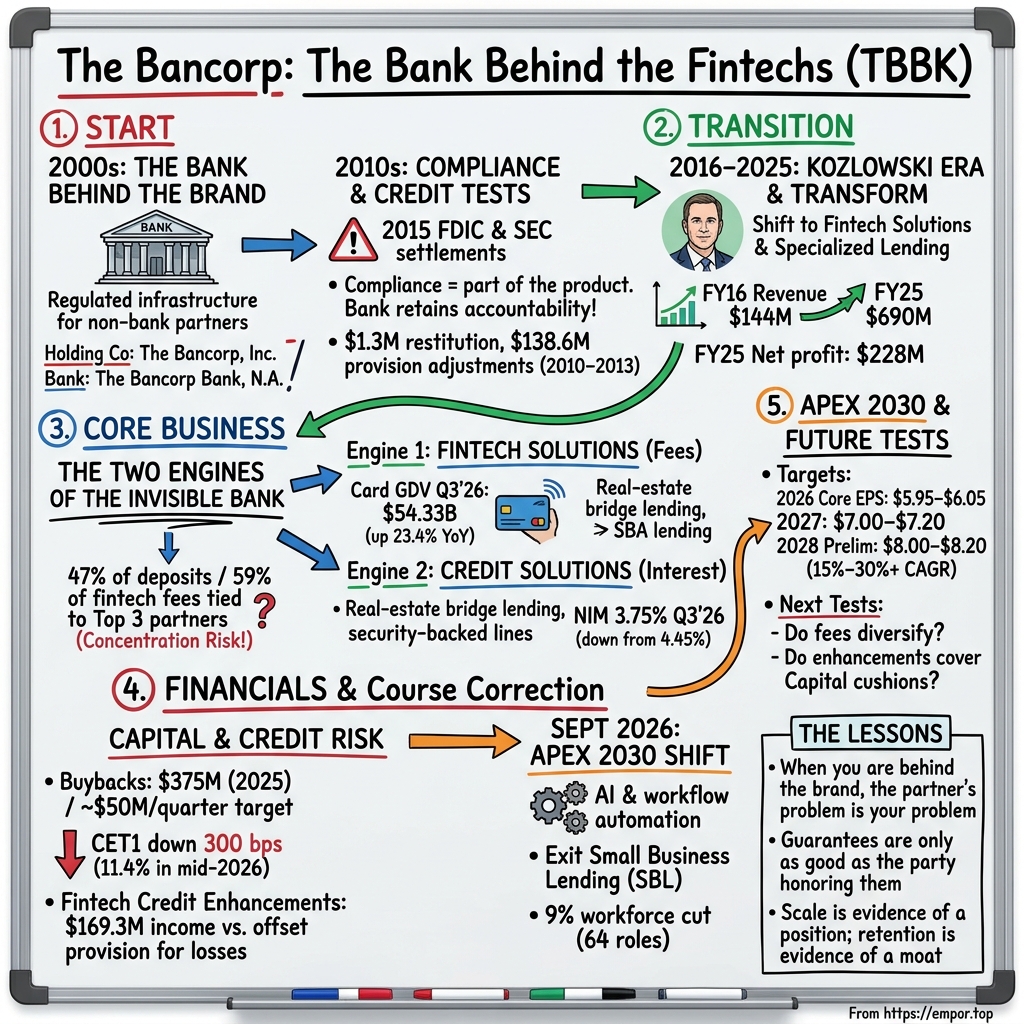
On October 29, 2026, Damian Kozlowski had a good quarter to report and a harder message to deliver. The Bancorp had earned $62.8 million in the third quarter, up from $54.9 million a year earlier, and diluted earnings per share had jumped almost 30% to $1.53.1 Return on equity, a measure most banks are happy to see in the low teens, came in at 36%.1 Card spending running through the bank's systems had reached $54.3 billion in a single quarter, almost a quarter more than a year before.1 By the scoreboard most bank investors keep, this was a company firing on every cylinder.
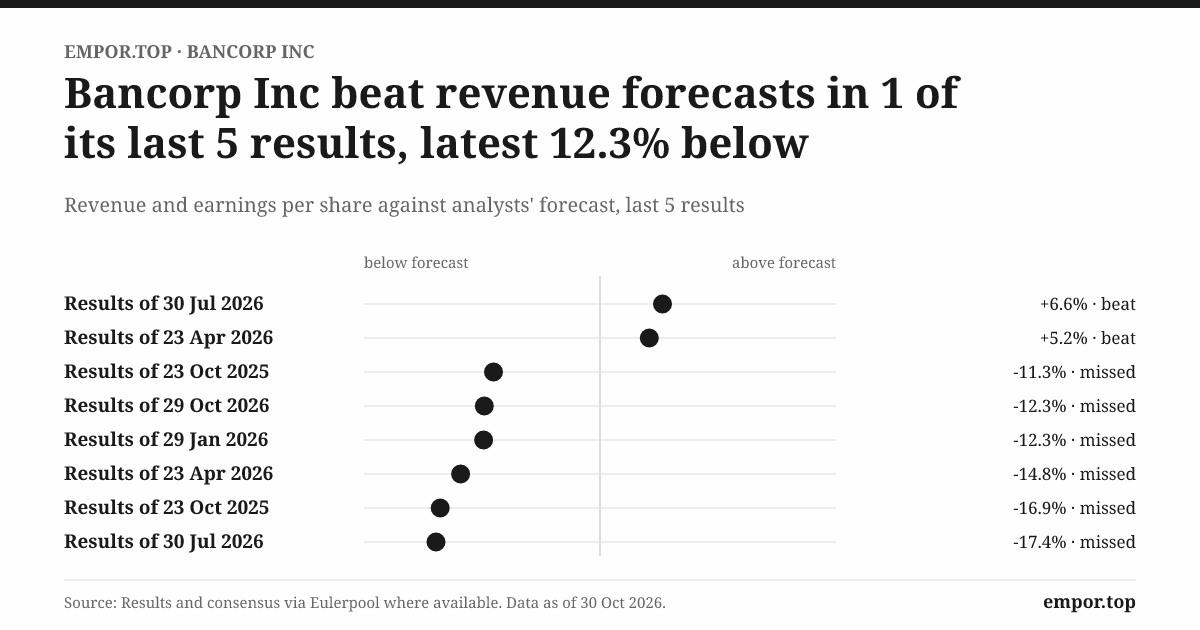
Then came the forward look. Kozlowski held his 2026 guidance for core earnings of $5.95 to $6.05 a share, introduced what he called a "baseline" of $7.00 to $7.20 for 2027, and set preliminary guidance of $8.00 to $8.20 for 2028.1 He added a sentence that tells you a great deal about how this company thinks about itself: "Our guidance in 2026, 2027 and 2028 includes stock buybacks."1 The bank expected to repurchase $200 million of its own shares in 2026, $50 million a quarter, and to target buybacks from 2027 through early 2028 of roughly 100% of adjusted net income.1
That is not how a typical community bank talks. A typical community bank talks about branches, loan officers, deposit gathering in its home county and a dividend that rises a few cents a year. The Bancorp pays no dividend at all.2 It has no branch network to speak of. Most of the people who use its products have never heard its name. When someone swipes a prepaid card for a paycheck, moves money through a popular consumer app, or draws on a small credit line embedded in a fintech's interface, the logo on the screen belongs to the fintech. Underneath it, regulated and accountable, sits The Bancorp Bank, N.A., a nationally chartered bank in Wilmington, Delaware.
That arrangement is the whole story. Fintech companies want to offer accounts, cards and loans, but most of them are not banks and cannot hold insured deposits or plug directly into the card networks. A sponsor bank lends them its charter, its compliance machinery and its balance sheet. The fintech gets a product it could not legally offer alone; the sponsor bank earns fees on the transactions, cheap deposits to fund its lending, and in some cases interest and fees on loans the fintech originates through it. The Bancorp's own materials describe it as the No. 1 U.S. issuer of prepaid cards and the sixth-largest issuer by debit and prepaid volume.4 It is, in effect, a bank that wants to be valued like infrastructure.
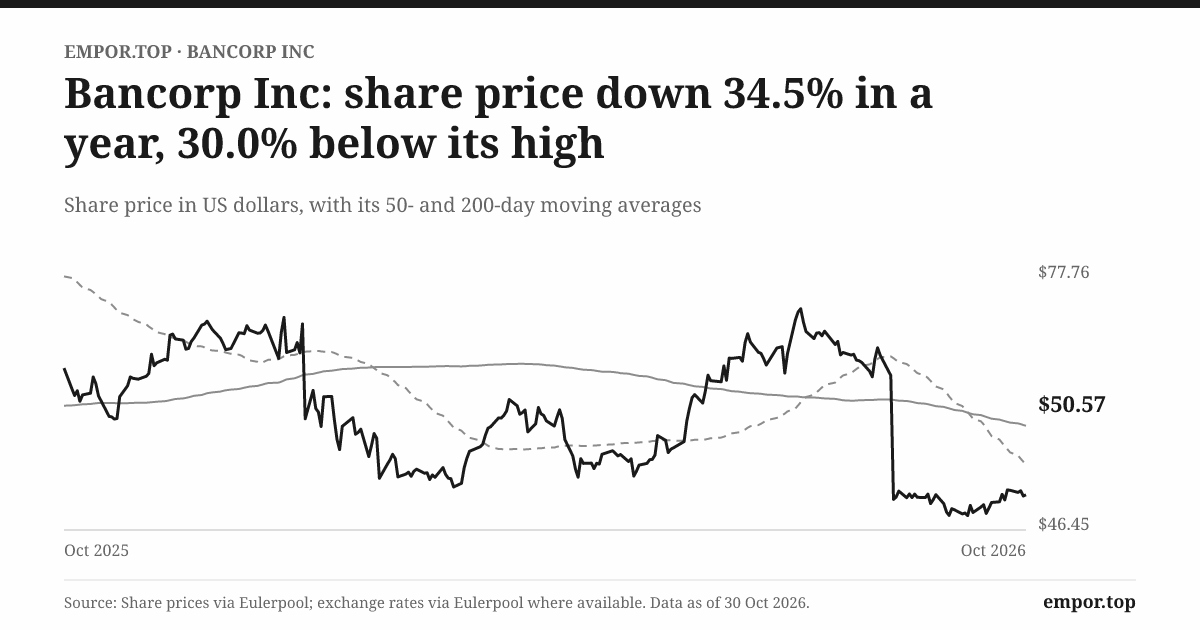
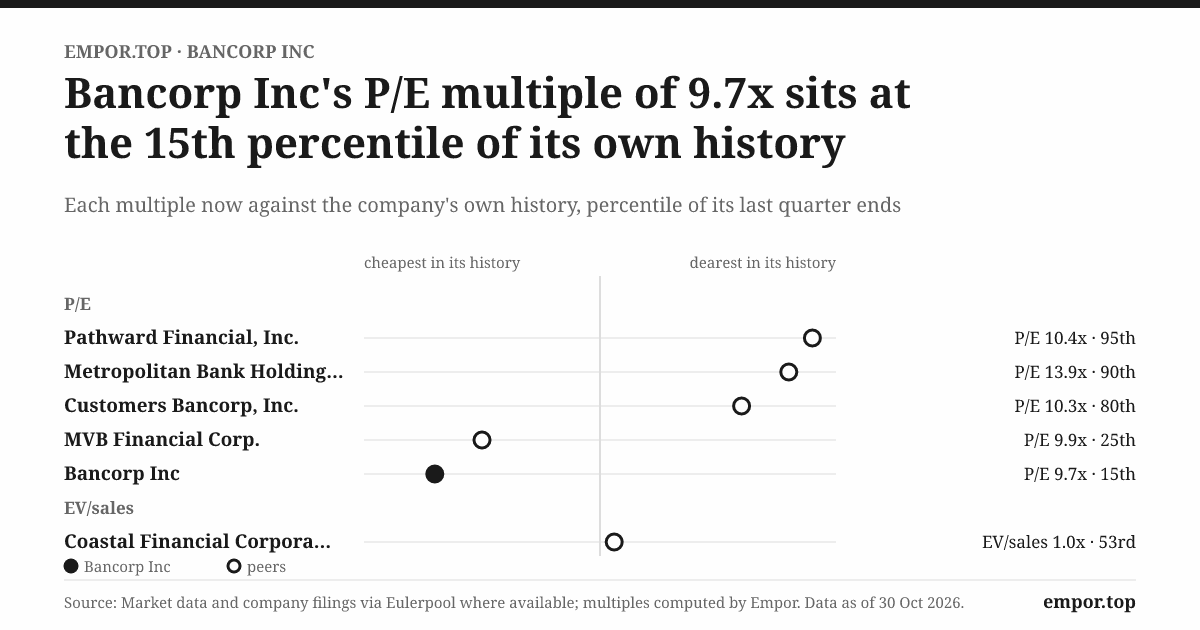
The market has not quite granted the wish. As of October 30, 2026, the stock stood at $50.57, about a third below its 52-week high of $77.20, giving the company a market value of about $2.2 billion. At that price the shares traded at about 9.7 times trailing earnings, below their own five-year median of 11 times, and at about 3.1 times book value. The price-to-book multiple is the tell. Investors are paying a premium to the accounting value of the equity, as they would for a business with unusually high returns, but they are paying a below-average multiple of those returns, as they would for earnings they do not fully trust.
That tension frames four questions this story has to answer. The first is whether partner growth is diversified, or whether a handful of large fintech relationships are carrying the bank. The second is whether the protections that sit behind its fintech loans, the guarantees and reserves that partners post, really work when a partner is under stress. The third is whether pouring nearly all of its earnings into buybacks is a smart use of capital for a bank whose capital ratios are already falling. The fourth is whether an earnings model that has compounded profit at more than 20% a year over the past five years can hold up as interest rates fall and credit conditions change.2
Those questions are not academic, because the October guidance itself contained a revision that most headlines skipped. Six months earlier, Kozlowski had told analysts that the company's expectation for 2027 earnings was $8.10 to $8.30 a share.10 He repeated the figure in July.114 By October, the $8 handle had moved to 2028, and 2027 had become a $7 "baseline."1 The earnings engine is working. But the forecast depends on partner growth, new initiatives, efficiency gains and continued capital return arriving on schedule, and one year of that schedule just slipped. This story is an investigation into the business behind those earnings: where its advantage comes from, what could break it, and which numbers will tell the difference. It starts with a lawyer-turned-banker who decided, at the turn of the millennium, that a bank did not need branches at all.
 Subscribe on LinkedIn
II. The bank behind the brand
By 2000, Betsy Cohen had already built and sold one bank. She had founded Jefferson Bank in Philadelphia in 1974 and, as chief executive and a major shareholder, grown it into the largest bank headquartered in the city by the time it was sold to Hudson United Bancshares.65 She came to banking with more than three decades of experience across real estate, banking and financial law, and real estate lending.5 Most entrepreneurs who sell a bank retire, or start another one that looks like the first. Cohen started one that looked like nothing else in Philadelphia.
The Bancorp Bank began operations in August 2000.5 It had no tellers waiting behind glass and no row of branches along a suburban commercial strip. A business school profile in 2004 described it as "a pioneer in electronic banking" that had grown "without a single physical branch."6 The parent company called itself an internet bank delivering services through its banking subsidiary.5 That was a fashionable description at the time, when every financial institution with a website briefly imagined itself as a technology company. What made The Bancorp different was not the website. It was the willingness to let other companies sell banking under their own names while the bank stayed in the background.
That idea, private-label banking, put the partner's name on the product while The Bancorp held deposits, issued cards and answered to regulators.
The corporate structure that investors buy today reflects that division of labor. The Bancorp, Inc. is the listed holding company, a Delaware corporation whose shares trade on Nasdaq under the ticker TBBK.8 Its wholly owned subsidiary, The Bancorp Bank, N.A., generates the vast majority of the group's revenue and income.2 By 2004 the parent was already presenting itself as the company that delivered services through the bank, and that holding-company structure is the vehicle through which shareholders have owned the business ever since.5 The point is not a piece of corporate trivia. It explains why everything that matters to the investment case, from deposits and loans to fee income and regulatory capital, lives inside the bank, while the holding company owns the shares, issues the debt and decides how much capital to send back to shareholders. In 2025 the bank paid $282 million of dividends up to its parent, an internal transfer that funds the parent's buybacks and debt service but is eliminated when the two are consolidated.2
The structure also creates a layering that bondholders and shareholders should understand. When the holding company sold $200 million of senior notes due 2030 in 2025, those notes were obligations of the parent alone, unsecured and not guaranteed by the bank.17 The bank's depositors and creditors stand ahead of them in any claim on the bank's assets.17 For an equity investor, the practical lesson is simple: the parent's flexibility depends on the bank's ability to pay dividends upward, and that ability depends on the bank's capital ratios and its regulators.
Cohen led the company through its formative years. Her imprint remains in the core idea of a bank that serves companies rather than walk-in customers. But the investment case today is shaped by a different leader and a different decade. The bank Cohen built had a second line of business that, for a time, looked more conventional than its prepaid and private-label operation: commercial and real-estate lending to relationships in its home region. That business, and the prepaid cards that made the bank responsible for millions of strangers, would both come back to haunt it. The defining asset of The Bancorp was never a consumer brand or a branch network. It was a regulated bank willing to stand behind other people's products. The next chapter showed what that willingness costs when the products go wrong.
III. Prepaid cards made growth a compliance test
Two days before Christmas in 2015, the Federal Deposit Insurance Corporation announced a settlement with The Bancorp Bank.7 The bank agreed to pay a $3 million civil money penalty and an estimated $1.3 million in restitution to about 21,000 customers the regulator said had been harmed.7 The dollar amounts were modest for a bank of its size. The substance was not.
The FDIC described the bank as an issuer of prepaid cards for non-bank entities, which is exactly the business Cohen had pioneered.7 The problems it identified ran through three parts of that business. The bank had failed to provide promised protections when customers tried to resolve errors on their accounts. It had failed to deliver promised benefits in a debit-card rewards program offered with a third-party service provider. And it had charged deceptive fees when debit transactions on a general-purpose reloadable prepaid card were declined.7 The regulator treated these as unfair and deceptive practices under the Federal Trade Commission Act.7
Each of those failures happened in a place where the customer probably thought they were dealing with someone else. A cardholder disputing a charge was likely calling a number printed by a program manager. A rewards program belonged, in the customer's mind, to the company that marketed it. A decline fee appeared on a card with another brand's logo. Yet the regulator did not send the bill to the program manager or the marketing partner. It sent it to the bank. That is the iron law of partner banking, and The Bancorp learned it in public: when you lend your charter to someone else's product, you also lend your name to its mistakes. Regulation does not outsource accountability.
The prepaid settlement arrived in the middle of a separate and more damaging episode, this one on the lending side. In 2012, The Bancorp was still running the relationship-banking model common among regional lenders, cultivating long-standing ties with businesses and individuals in its geographic region and giving them the attention of senior management.8 The Securities and Exchange Commission later found that the bank had leaned too heavily on those relationships when judging credit. Risk ratings and impairment decisions had relied on borrowers' and guarantors' reputations, their history with the bank and their expected future business, while indicators of financial distress were repeatedly overlooked.8
The details in the SEC's order read less like an accounting dispute than a character study. In one case, a guarantor of a $20 million loan relationship was criminally convicted in 2012, but the bank did not evaluate the relationship for impairment; it sought an additional guarantee from the guarantor's brother instead, and when the brother missed payments, the bank increased a line of credit and used it to pay overdue balances.8 In another, a high-profile executive's credit line was increased several times so he could make quarter-end payments on delinquent loans, on the strength of his reputation and a business license rather than his financial condition.8 The bank relied on pre-financial-crisis real-estate appraisals long after the crisis had passed.8 Credit files were incomplete, and for years the bank had no reliable process for identifying troubled debt restructurings.8
The consequences landed in two waves. In November 2014, the company disclosed that it would discontinue its commercial lending operations and focus on specialty finance lending.8 In April 2015 it told investors that financial statements for 2012, 2013 and part of 2014 could no longer be relied on, because charges for loan losses should have been taken earlier.8 The restatement filed that September added about $138.6 million of cumulative loan-loss provisions for 2010 through 2013.8 The adjustment for 2012 alone exceeded the pre-tax income the bank had originally reported, turning a profitable year into a loss.8 In 2019 the SEC concluded the matter with a cease-and-desist order and a $1.4 million civil penalty, which the company accepted without admitting or denying the findings.8
It would be easy, and wrong, to treat this record as proof that the fintech model must fail. The loan misclassifications came from an old-fashioned regional lending book, not from prepaid cards or payments, and that book was wound down. The period the SEC examined ended in 2014, two years before the current chief executive arrived. Nothing in the record shows that the same controls or the same decision-makers persisted unchanged into the business that exists today. Investors who use the 2015 to 2019 episode as a blanket indictment of today's management are overreaching.
But the record does establish something more durable than a scandal. It shows that, at this bank, compliance and credit accounting are not back-office chores. They are part of the product. A partner bank's value to a fintech is precisely that it can be trusted by regulators, card networks and auditors; when that trust cracks, the cost shows up as penalties, restatements and, for a time, an inability to grow. The fact that the bank lost $96 million in 2016, its last deep loss, shows how heavy the clean-up bill was.2 That history is the right lens for reading later control problems, including one that would surface in the current leadership era. Which raises the question of the man who was hired to rebuild the place.
IV. Kozlowski's decade-long bet on partner banking
Damian Kozlowski arrived in June 2016 with a résumé that read like a tour of American finance's grander rooms.9 He had spent most of the 2000s at Citigroup's private bank, serving at various points as chief executive of the global private bank, president of the U.S. private bank, chief operating officer and chief financial officer, and global head of business development and strategy.9 Before that he had been a managing director at Bank of America Securities.9 He had run a financing company, Alpha Capital Financing Group, and then spent six years as chief executive of Modern Bank, a small New York institution, before taking the job in Wilmington.9 He holds an MBA in finance from Wharton.9
That combination matters for understanding what he did next. Private banking is a business built on trust, risk management and a small number of large, valuable relationships. Running a small bank teaches how much regulation weighs on a lean organization. Kozlowski brought both instincts to a company that had just been through a restatement, a regulatory settlement and a decision to exit its traditional commercial lending book. He did not try to rebuild The Bancorp as a regional lender. He doubled down on the stranger part of the franchise, the part that served fintech companies, and paired it with a handful of specialized lending businesses that did not depend on local relationships.
The decade that followed is the strongest exhibit for the bull case. Net profit went from a $96 million loss in 2016 to $228 million in 2025.2 Over the five years through 2025, net profit compounded at about 23% a year, and earnings per share rose from $1.35 in 2020 to $5.18 in 2025.2 Return on equity, which had been negative in 2016, reached about 33% on a simple year-end measure in 2025.2 Most of that improvement happened on Kozlowski's watch, and it is fair to credit him with the strategy that produced it. It is also fair to note that the starting point was unusually low. Measured from a loss year, almost any recovery looks heroic, so the more revealing span is the past five years, when the business was already clean and still grew earnings at more than 20% a year.
The headline revenue series is a worse guide, and it is worth understanding why. Measured the way data providers define a bank's revenue, The Bancorp's top line rose from about $144 million in 2016 to about $690 million in 2025, but it fell almost 3% in 2025 even as net profit rose about 5%.2 In the third quarter of 2026, that same revenue measure fell almost a fifth year over year while net income rose 14%.1 For a bank, revenue is a slippery concept. It can be stated before or after interest expense, with or without the gross-up of credit-enhancement income that partners pay to offset loan losses, and different providers make different choices. When a measure falls 19% in a quarter in which card volume rose 23%, fees rose 19% and loans grew 9%, the measure is telling you about its own construction rather than the business.1 The right gauges for this bank are fintech fees, net interest income, payment volumes and loan balances.
The strategic shift is visible in how the bank's balance sheet is funded. By mid-2026, fintech partners supplied $8.1 billion of deposits, about 96% of the total.4 Those deposits cost the bank around 1.6% on average, far below what a bank must pay to attract savings through advertising or brokers.4 That is the quiet economic engine of the Kozlowski strategy. Every prepaid card balance, every payroll account and every consumer app wallet that sits at The Bancorp is a low-cost deposit, and the bank lends those deposits out in specialized loan books that earn far more than the deposits cost.
Kozlowski has also been unusually willing to state targets in public. His April and July guidance set a 2027 target that slipped by a year in October.101141 That kind of specificity invites accountability, and the record so far is mixed in an informative way. The release tied the longer-range outlook to "three major Fintech initiatives along with platform efficiency and productivity gains" from restructuring and the adoption of AI tools.1 In other words, the outlook now leans more heavily on initiatives that have not yet been proved in the income statement. A management that sets a target, misses the timing by a year and says so in a press release is behaving more credibly than one that never commits. But investors should weigh the slip, because much of the bull case rests on guidance arriving on time.
The sharper setback came earlier. In early 2025, the company filed its 2024 annual report without the auditor's final approval and consent, and then had to file an amended report.12 The amendment added a reserve for certain consumer fintech loans, with no reported impact on net income, and management identified material weaknesses in its year-end closing procedures and in the accounting for credit enhancements.12 That is not a footnote. A material weakness in the controls around the exact mechanism that protects the bank's fintech lending, under the chief executive who built that business, is a real credibility blow. It also coincided with turnover in the finance chair: the proxy records a sequence from former chief financial officer Paul Frenkiel to interim chief financial officer Martin Egan before Dominic Canuso joined in November 2025.9
Canuso is a meaningful hire. He had been chief financial officer of WSFS Bank, a larger Delaware lender, from 2016 to 2023, and ran its Cash Connect division, a business that deals in the plumbing of cash logistics and ATMs.9 He came to The Bancorp after a stint as chief financial officer of Capital Bank.9 Management reported that the weaknesses were remediated and that controls were effective at the end of 2025, and the auditor issued an unqualified opinion on that year's statements.2 That is genuine evidence of repair. It is not yet a long record.
So the decade-long bet has produced real earnings growth and a deposit franchise that ordinary banks would envy. It has not, by itself, proven a durable advantage, because the same years also show a slipped forecast and a control failure in the business's most sensitive accounting. The proof has to come from how the machine actually makes money, which means opening the hood.
V. The invisible bank's two engines
Picture a cardholder buying groceries with a debit card issued through a fintech app. The tap takes less than a second. In that second, the merchant's terminal sends a request through the card network to the issuing bank, which checks the balance in the cardholder's account and approves the purchase. The cardholder sees the fintech's logo on the card and in the app. In many such programs in the United States, the issuing bank is The Bancorp. It holds the account, settles the transaction with the network, and earns a slice of the interchange fee the merchant pays for accepting the card.
That single transaction contains the first of The Bancorp's two economic engines. The company calls it Fintech Solutions, and it works in the order a transaction travels. First comes program sponsorship: the bank issues the cards and holds the deposit accounts behind prepaid, debit and other programs that partners design and market. Next comes payment processing, for card transactions and for ACH transfers, the electronic bank-to-bank payments that move paychecks and bills. Last, and increasingly important, comes sponsored lending: credit products that partners originate through the bank, from secured cards to short-term cash advances.2 The bank earns card, ACH, payment-processing and consumer-credit fees from all of this.2
In the third quarter of 2026, gross dollar volume on the bank's cards, the total amount spent, reached $54.3 billion, up 23.4% from a year earlier.1 Total fintech fees were $41.8 million, up about 19%.1 Within that, prepaid, debit, ACH and other payment fees rose about 11% to $34.1 million, while consumer credit fees from fintech loans jumped 72% to $7.7 million.1 Those numbers reveal two things at once. The core payments franchise is growing, but its fees are growing more slowly than the volume running through it, which suggests that each dollar of spending is earning the bank a little less, through partner mix, pricing or revenue-sharing. Meanwhile the newest fee line, credit, is growing fastest from a smaller base. The growth story is migrating from moving money to lending it.
The second engine is the balance sheet, which the company calls Credit Solutions. It is a set of specialized lending businesses that have little in common with a neighborhood bank's book. Real-estate bridge lending provides short-term loans on income-producing properties while owners reposition or stabilize them. Institutional lending includes security-backed lines of credit, loans secured by investment portfolios and offered through wealth managers. Small Business Administration lending and fleet leasing for vehicle fleets round out the group.2 Over the year to September 2026, total loans grew about 9% to $7.26 billion, driven mainly by bridge lending, up about $295 million, and security-backed and insurance-backed lines, up about $222 million.1
Each engine runs on different fuel. Fintech fees depend on how much partners' customers spend and move, whether partners stay, and what share of the economics the bank keeps. Lending income depends on loan balances, the cost of funding them, the quality of underwriting and the losses that follow. The appeal of the model, when it works, is that the first engine supplies the fuel for the second. Partner deposits are cheap, and the bank lends them out at specialty-lending yields.
That is also why the net interest margin, the difference between what the bank earns on its assets and pays on its funding, deserves close attention. In the third quarter it was 3.75%, down from 4.45% a year earlier and 3.85% in the prior quarter.1 Some of that is the rate environment, as falling short-term rates squeeze yields on floating-rate assets. Some of it is a deliberate shift in mix. On the April call, Kozlowski acknowledged that the economics of the bank's large relationship with Chime, a consumer fintech whose credit product draws heavily on the bank's balance sheet, run at roughly a 3% margin, below the bank's average.10 He called Chime "a very unique relationship" and said the bank was unlikely to have ten like it.10 Margin decline, in other words, is partly the price of growth in the bank's lowest-margin, most balance-sheet-intensive partner business. Earnings have still risen because buybacks shrink the share count and fees rise. But a margin that falls 70 basis points in a year is a real headwind, and it means more of the earnings case rests on fees and capital return than a year ago.
One line in the income statement requires special care. In 2025 the bank reported $328.3 million of total noninterest income, of which $169.3 million was fintech loan credit-enhancement income.2 That is not fee revenue in any ordinary sense. When a partner's borrowers default, the bank records a provision for the loss, and when the partner reimburses the bank under its credit-enhancement agreement, the bank records the reimbursement as income. The two largely offset: in 2025 the bank recorded a similarly sized provision for fintech loan losses.2 Anyone who reads the noninterest-income line and sees a fast-growing fee business is counting the same loan losses twice, once as a cost and once as revenue. The enhancement income is evidence that the protection is working, not evidence of profitable growth.
The same mismatch explains why a data provider's revenue line can fall while the bank's earnings rise. As fintech charge-off rates fell, from about 23% annualized a year earlier to about 10% in the third quarter of 2026, the provisions and the matching enhancement income both shrank.1 A revenue measure that includes the enhancement gross-up will drop even if nothing about the bank's real business has weakened. The release's fee, interest, loan and volume measures tell the actual story, and that story was one of growth.
Cash flow statements mislead in a similar way. For an industrial company, comparing operating cash flow with profit tests whether earnings are real. For a bank, cash movements are dominated by loan growth, deposit flows and securities purchases. In 2025, operating cash flow was $265 million and free cash flow about $258 million, close to net profit of $228 million.2 But the same year included a $1.17 billion net increase in loans and about $420 million of deposit growth, movements that dwarf the operating figures and reflect the balance sheet growing, not earnings being collected.2 The useful tests of earnings quality for this bank are credit losses, reserve adequacy and capital, not cash conversion.
So where does the economic value come from? The honest answer is both engines, tightly coupled. Fee growth is the clearest sign of a franchise with momentum, and it is the line that most clearly separates The Bancorp from a conventional lender. The loan book is where the earnings are amplified and where the risk is held. Precise comparisons of segment profit belong to the segment note in the annual report, not to inferences from consolidated totals. What the totals do show is a business that has become more dependent on partner-originated credit as its payments fees grow more slowly than its volumes. That makes the next question unavoidable: how much power do those partners have?
VI. A leading sponsor bank without a proven lock-in
The Bancorp likes to describe itself by its rankings, and the rankings are impressive. In its July 2026 investor presentation, the company repeated those rankings, citing industry data from April 2026.4 Trailing twelve-month gross dollar volume across its fintech programs reached $196 billion.4 For a bank with fewer than $10 billion of assets, those are extraordinary numbers. Banks many times its size issue fewer cards.
The annual report tells a second story beside the first. At the end of 2025, the bank's three largest deposit partner relationships accounted for $3.83 billion of deposits, about 47% of the total; the next three accounted for another 17%.2 Measured by income, the top three relationships generated $83.5 million, or 59%, of fintech fees, and every dollar of the $169.3 million of fintech credit-enhancement income.2 The company does not name these partners in its concentration disclosure.2 It does not need to for the conclusion to be clear. Six relationships supply almost two-thirds of the deposits that fund the whole bank.
To understand why that matters, it helps to think about where power sits in this industry. The sponsor-bank field includes The Bancorp, Cross River, Pathward, Sutton Bank and Green Dot, which owns its own bank, alongside processors such as Marqeta that sit between banks and fintechs. Their businesses are not directly comparable: some lean on lending, some on tax-refund products, some on processing, and there is no consistent public market-share ranking across the group. What they share is a common customer, the fintech company, and that customer has choices.
A war-gamer looking at this market would start with the buyers. When three partners supply nearly half the deposits and well over half of fintech fees, those partners have leverage in every renewal negotiation. They can ask for a larger share of interchange, a higher rate on their deposit balances or better credit terms. Next come the rivals. Alternative sponsor banks and processors can contest new programs, and large fintechs increasingly run multiple bank relationships at once. Then there is the threat of substitution at the top: a fintech large enough can seek a bank charter of its own. Asked about fintech charters on the July call, Kozlowski said, "We don't think it's going to impact us."11 That is a claim, not evidence; the evidence will be whether the largest partners stay.
Against those forces stand real frictions. Moving a card program from one issuing bank to another is not like switching a phone carrier. Every card has to be reissued, deposit accounts migrated, network registrations changed, compliance programs re-documented and regulators kept informed. Kozlowski told analysts in July that building the bank's platform had cost "well north of $100 million" over ten years, which hints at the investment a challenger must match.11 Regulation raises the entry bar further, because new sponsor banks attract heavy supervisory attention. And the bank's small asset size gives it a specific edge that larger banks cannot easily copy.
The honest test of a moat is not ranking but behavior. A moat would show up as partner tenure measured in many years, renewals on stable or improving terms, fee yields per dollar of volume that hold steady, and new programs that diversify the largest relationships rather than merely adding to them. The company does not disclose contract duration, renewal rates, price realization or partner-level retention.2 It describes products and volumes, but not the price per transaction or the minimum commitments in its agreements.2 So investors can see scale, but not stickiness.
The one clue that does exist cuts both ways. Third-quarter card volume rose 23%, while prepaid, debit and ACH fees rose 11%.1 If partners had no bargaining power, fees would roughly track volume. A gap of that size is consistent with partners capturing more of each dollar's economics, with a mix shift toward lower-yield programs, or with both. Neither explanation is alarming on its own, but neither looks like pricing power.
So the evidence supports a narrower claim than the rankings suggest. The Bancorp has scale, experience and operational integration that make it a serious contender for any large fintech program, and switching away from it is costly and slow. That is a specialized position. It is not a proven wide moat, because the partners on the other side of the table are few, large and well informed, and the bank publishes none of the retention data that would prove they are locked in. Current growth is strong; concentration means that losing a single relationship could matter far more than any headline volume trend implies. And the bank's exposure to its partners extends beyond deposits and fees, into the guarantees that protect its fastest-growing loans.
VII. When a guarantee becomes a counterparty risk
The 2025 fintech credit-enhancement income and loan-loss provision nearly offset.2 In the real world, behind them sit thousands of consumers who borrowed through a fintech app and did not pay the money back, and a set of agreements under which the partner who originated those loans agreed to make the bank whole.
The structure is simple to describe and harder to evaluate. The bank makes the loans, because only a bank can. Some are credit cards secured by the customer's own deposit balance. Others are unsecured, short-term extensions of credit that the bank itself describes as at risk of complete loss if not repaid.13 The partner markets the product, sets much of its design and agrees, through credit enhancement, to bear the losses. In July 2025 the company described these arrangements as a full guarantee by partners against losses, with the bank holding cash collateral for expected losses on dollars already lent.13 At the end of 2025 all fintech loans were covered by partner enhancement agreements, and the recognized enhancement asset, the amount partners owed the bank under those agreements, had risen to $31.1 million from $12.9 million a year earlier.2
An analogy helps. Imagine a landlord who rents an apartment to a student whose parents have co-signed the lease. If the student stops paying, the landlord does not lose money, so long as the parents pay. The landlord's risk has not disappeared. It has moved from the student to the parents, and it depends entirely on whether the parents can and will honor the promise. The Bancorp is the landlord, the borrowers are the students, and the fintech partners are the parents. The bank still originates and services the loans, depends on partners to replenish reserves and cover losses, and warns that a partner's failure to do so could leave it exposed beyond its net reserve position.2
That is why concentration and enhancement are the same issue seen from two sides. The top three partner relationships by income generated all of the bank's 2025 enhancement income.2 If one of those partners ran into trouble, the bank would face higher losses on loans just when the counterparty promising to cover them was least able to pay. Losses in consumer credit tend to rise in exactly the economic conditions that strain fintech balance sheets, so the protection is weakest when it is most needed. That is not a prediction of failure. It is a description of correlated risk.
The scale of the losses being covered is worth understanding. In the third quarter of 2025, annualized net charge-offs on fintech loans ran at about 23% of balances; a year later the rate was about 10%.1 Those are numbers that would be catastrophic on an ordinary consumer loan book. Here they are expected, because the products are short-duration, high-turnover credit priced and backstopped accordingly. The improvement over the year is encouraging, and in April management credited a secured product that "did outperform" for allowing a lower reserve on part of the book.10 But it also means that comparing fintech loans with ordinary bank loans is misleading. Most fintech loans do not accrue interest at all, so the standard nonaccrual figures banks report are not a useful gauge for that portfolio.2
The bank's conventional book tells a separate, more modest story. Nonaccrual loans rose from $27.9 million at the end of 2024 to $55.7 million a year later, and loans 90 days or more past due went from none to $18.2 million.2 Because most fintech loans never enter nonaccrual status, those figures speak mainly to the conventional book, where real-estate bridge loans have been working through a difficult period. Management told analysts in April that the bridge-lending problem was "a bubble" that was "working through the system."10 By September 2026, criticized assets, the loans examiners flag for closer watch, had fallen to about $167 million from about $269 million a year earlier, and annualized non-fintech charge-offs were just 0.07% of loans.1 That is evidence the conventional book is healing.
Then there is the filing failure. When the original 2024 annual report was filed without the auditor's final approval and consent, the amendment that followed added a reserve for certain consumer fintech loans, with no net-income impact reported.12 Management identified material weaknesses in its closing procedures and in the accounting for credit enhancements.12 Months later, the SEC's staff wrote to the company's interim chief financial officer asking for much fuller disclosure: the bank's role and obligations in these arrangements, including any minimums for enhancements to apply; the material contractual terms, including caps or restrictions; which products are covered; and the risks, including concentration, failure to obtain collateral and reimbursements not paid by third parties.13 The letter did not allege wrongdoing. But it asked, in the plain language of a regulator, the exact questions an investor should ask.
The counterevidence deserves a fair hearing. The 2025 annual report received an unqualified audit opinion, and management concluded that controls were effective at year-end, saying the weaknesses had been remediated.2 The auditor singled out the qualitative factors in the allowance for credit losses as a critical audit matter, which means it spent extra effort on the judgment involved.2 Fintech charge-off rates fell over the following year, and the enhancement mechanism has worked as designed through a period of high losses. That is evidence of remediation and of a structure that performs in ordinary conditions.
It is not proof that the arrangements cannot fail. Credit enhancements turn borrower risk into partner risk, and partner risk is concentrated. The claim that the bank is fully protected therefore narrows to a smaller, more defensible version: the bank is protected so long as its largest partners remain solvent and willing, and so long as the accounting for the arrangements stays sound. The evidence that would confirm or falsify that claim is specific: realized losses and recoveries by program, the size and timing of partner reserve replenishments, the share of enhancement income tied to the top relationships, and the next several years of audit and control findings. The bank's capacity to absorb a surprise, if one came, depends on its capital. And capital is exactly what the buyback program has been spending.
VIII. The $375 million buyback meets the capital constraint
In 2025, The Bancorp bought back 5.6 million of its own shares for $375 million.2 Its net income that year was $228 million.2 The company, in other words, returned roughly one and two-thirds times its annual earnings to shareholders in a single year, and shareholders' equity fell from about $790 million to about $690 million as a result.2 In the same year the holding company sold $200 million of senior notes due 2030.17 For a bank, that is an aggressive combination.
The buyback is the defining capital decision of the Kozlowski era. There is no transformative acquisition in this story, no deal that underwrites the thesis or needs to be judged by its returns. Instead there is a steady, deliberate shrinking of the share count. By June 30, 2026, the company had returned $885 million through repurchases since 2022 and reduced its shares outstanding by about a third.4 It repurchased $252 million of stock in 2024, then the $375 million in 2025, and $150 million in the first three quarters of 2026.21 Its July presentation stated the aim plainly: to "seek to return ~100% of Net Income to shareholders annually."4
The effect on per-share earnings has been large. When a company retires a third of its shares, each remaining share owns a larger slice of the profit, so earnings per share can grow much faster than net income. Between 2022 and 2025, net income rose about 75%, while diluted earnings per share rose from $2.30 to $5.18, about 125%.2 Kozlowski's guidance for 2026 to 2028 explicitly includes further buybacks.1 Part of the earnings growth investors are being promised is therefore not growth in the business at all. It is the arithmetic of a smaller denominator.
Whether that arithmetic creates value depends on two things: the price paid and the capital left behind. On price, the timing has been uncomfortable lately. The company bought shares at an average of $57.46 in the second quarter and $60.81 in the third, and its average for the first nine months of 2026 was $59.16.151 On October 30 the stock closed at $50.57. That gap is not a full verdict on value, since a buyback at $59 can still be a good deal if the shares are worth more than that, but it shows that the company has recently been paying more than the market now offers. Management told analysts in April that the plan was to return all of its net income until the stock reached a higher multiple, which is a value-sensitive framing in words.10 The actual program, a fixed $50 million every quarter, is not price-sensitive at all.
On capital, the signal is clearer. KBRA, the rating agency, affirmed The Bancorp's investment-grade ratings with stable outlooks in July 2026, citing its fee generation, strong earnings, low funding costs and granular deposit base.3 But it also reported that common equity tier 1 capital, the core cushion regulators watch, was 11.4% at the end of June, about 300 basis points lower than a year before, largely because of buybacks.3 KBRA said capital remained sufficient, but it listed lower capital ratios after substantial repurchases among its concerns, and it named a change in capital management, alongside credit deterioration and the loss of an economically significant partner, as a potential trigger for pressure on the ratings.3 At the end of September the company's CET1 ratio was 11.37%, and its tier 1 leverage ratio, which compares capital with total assets rather than risk-weighted ones, was 7.26% at the holding company and 9.03% at the bank.1
There is a structural reason the bank can run lean. The company says it is managing its total assets to stay below $10 billion, a threshold set by the Federal Reserve's Regulation II, which implements the Durbin Amendment.4 Banks above that size face caps on the interchange fees they can earn on debit cards; banks below it do not. For a bank whose business is issuing debit and prepaid cards, staying small is worth a great deal, and The Bancorp ended 2025 with about $9.4 billion of assets.2 Because it cannot grow its balance sheet much, it generates more capital than it can use internally, and buybacks are the natural outlet. Management has also moved some deposits off its balance sheet, reporting $1.34 billion of them in early 2026, a tool that helps keep total assets under the line.10
That logic is real, but it has limits. A bank whose assets are capped still needs capital against the loans it holds, and the company's strategy is to tilt that capped balance sheet toward fintech lending, which carries much higher loss rates even when partners guarantee them. In April, Kozlowski described an ambition for fintech loans to grow from an original target of about 10% of the balance sheet toward something "more like 30% or 40%" over three to four years.10 A riskier mix within the same asset ceiling uses more capital, not less, at exactly the time capital ratios are falling.
Management alignment offers some comfort. The 2026 proxy shows Kozlowski owning 932,212 shares, about 2.2% of the company, as of April 1, 2026, a stake worth roughly $47 million at the October price.9 His 2025 compensation of about $4.5 million included $2.5 million in stock awards and $1 million in options on top of a $1 million salary.9 Shareholders approved executive pay at the 2026 annual meeting by about 34.6 million votes to 1.2 million.16 A chief executive with that much stock has reason to care about the share price, but also reason to favor the per-share earnings that buybacks reliably produce.
A skeptical investor, the kind who writes long letters to boards, would ask the obvious question without any animus. Should a bank that is returning nearly all its earnings, borrowing at the holding company, and shifting its capped balance sheet toward riskier lending retain more of its capital while its partner base is so concentrated? The case for the buyback is that the bank has nowhere else to put the money and that the stock is cheap. The case against is that capital is the one thing a bank cannot raise quickly in a crisis, and that the ratings agency has already flagged it. Both arguments have merit. The deciding evidence will be whether CET1 stabilizes while buybacks continue, and whether risk-weighted assets grow faster than retained earnings. Meanwhile, management has started to reshape the business to fund its next phase, and it has started by cutting.
IX. Apex 2030: a new growth promise and a retreat
On September 4, 2026, The Bancorp announced what it called an organizational alignment.14 It would eliminate 64 currently filled positions, about 9% of its workforce, and leave another 16 vacated positions unfilled.14 It would restructure its Small Business Lending business and stop new retail and wholesale originations by the end of 2026, while continuing to serve existing customers and the existing portfolio.14 It expected about $5.6 million of charges, mostly severance and related costs, and about $14 million of annualized savings from the 80 positions; combined with a reorganization of its institutional banking unit in late 2025, the company expected more than $20 million of annualized run-rate savings.14 The changes, it said, were made "to refine workflows, expand automation and artificial intelligence, optimize costs and allocate capital."14
"We have a clear strategic map of where The Bancorp is headed," Kozlowski said.14 The map has a name: Apex 2030. As laid out in the July 2026 investor presentation, it combines the established businesses, for which the company projects annual earnings growth of 10% to 15%, with incremental initiatives that it says could add another 5% to 15% or more, for a total of 15% to 30% or more in annualized earnings-per-share growth.4 The plan aims to "transform balance sheet towards fintech dominated mix" while continuing the existing capital-return policy and managing to the $10 billion asset cap.4
The strategic map has four parts. Keep sponsor-bank leadership in payments. Keep the specialty lending businesses that earn their place, notably bridge lending and the security-backed lines. Launch embedded finance, in which the bank provides financial products directly inside non-financial companies' platforms. And send the capital the bank cannot use back to shareholders. It is a coherent plan, and much of it extends what has already worked.
The Small Business Lending exit is the most interesting piece, because it is a retreat rather than a promise. SBA lending is a respectable business, partially guaranteed by the federal government, and a natural fit for a bank that wants specialized lending lines. The company has not published a detailed account of why it no longer fits, beyond describing the move as restructuring the business and as part of capital allocation.141 The likely logic is visible in the plan's own priorities: under a $10 billion ceiling, every dollar of assets has to compete for space, and a staff-intensive origination business competes poorly against fintech credit that partners originate and guarantee. That reading is consistent with the plan but not confirmed by the company. Either way, the move shows a management willing to shrink a business that does not meet its return hurdles, which is a healthier habit than defending every line forever. It also shows that not every lending opportunity has fit the strategy, and that the bank's portfolio choices are still moving.
Artificial intelligence enters the story at the right scale. Management presents AI tools as a way to make the existing organization more productive, not as a new product line that will generate revenue.141 The savings it has quantified, about $14 million a year from the September restructuring, are meaningful for a bank earning about $240 million a year, but they come from fewer people, not new business. Treating The Bancorp as an AI story would be a category error.
Embedded finance is where the promises are most specific and least proven. In April, Kozlowski said there was "very little revenue in store for embedded finance in 2026," more in 2027, and that the company planned to announce at least one client in 2026.10 In July he said the bank "should soon make an announcement on our first embedded finance partner."11 The pattern across the two calls is consistent in direction but shows the usual drift of new-product timelines: revenue was always a 2027 event, and the client announcement moved from "this year" to "soon."
The credit sponsorship business shows a similar texture. In April, management said fintech loan growth had "outran our internal expectations" and that a large new program with Cash App had launched and would ramp up through 2026 and 2027.10 In July, it said credit sponsorship balances "continue to surpass our expectations," that two more programs were expected within six months, and that it was working toward about $2 billion of fintech loans by year-end, with average fintech loans then at about $1.39 billion.11 Period-end balances have swung with payment timing, and at the end of September fintech loans stood at $936.6 million, about 13% of total loans.1 That figure is well below the year-end goal, though period-end and average balances can differ sharply in this business. Whether the $2 billion arrives is one of the most concrete tests management has set itself.
Then there is October's reset of the 2027 target, which pushed the $8 range to 2028.10111 Put next to the July promise of 15% to 30% or more annual earnings growth, that change matters. Growth from the 2026 guidance midpoint to the 2027 baseline midpoint is about 18%, still within the range, but at its low end, and it includes buybacks. The plan's upper range depends on initiatives, productivity and implementation timing, and the first year of it has already been pushed back.
There is also a limit to what investors can check. The company does not report research and development as a separate line, so there is no way to see whether its investment in software is rising.2 Capital spending on property and equipment was about $7 million in 2025, modest for a business that calls itself technology-led, and year-end headcount was 733, with no comparable historical series in the annual report.2 Those figures fit an efficient, asset-light bank, but they do not show whether the investment behind Apex 2030 is rising fast enough to support its targets.
The verdict on Apex 2030, for now, is that it is a plausible plan built on a real franchise, with a retreat that shows discipline and promises that have already slipped once. The fintech shift fits the fee growth the bank has actually delivered. The earnings targets remain forecasts, and the October reset is the clearest sign yet that their timing is uncertain. The next step is to weigh the whole case at once.
X. The case for and against the bank under the app
Take the same quarter and read it twice. In the first reading, card spending, fintech fees and net income grew, loans expanded, criticized assets fell and return on equity reached 36%.1 In the second, the margin narrowed, buybacks reduced capital, three partner relationships dominated deposits, and the 2027 earnings target slipped.12 Both readings are accurate. The investment question is which one describes the future.
The bull case runs like this. More Americans manage money through apps, and those apps need a bank. The Bancorp's regulatory and operational expertise, built over more than two decades, helps it win programs; its position below the Durbin threshold gives it interchange economics larger banks cannot match. Partner integrations make switching slow and costly. Low-cost partner deposits fund specialty loans, and the bank earns high returns while shrinking its share count. Under this reading, a stock at under 10 times earnings is pricing a fintech infrastructure franchise as if it were an ordinary regional bank.
The bear case is just as coherent. Partners can capture more of the economics or leave, while credit enhancements may fail when losses rise. Falling margins and a shift toward fintech credit make earnings more sensitive to rates and losses. Buybacks running at about 100% of earnings leave less room for error as capital ratios fall.
A disciplined way to weigh the two is to run the industry through Michael Porter's five forces. Buyer power is the dominant force: the top three partners supply nearly half of deposits and most fintech fees.2 Rivalry is real but bounded: other sponsor banks and processors compete for programs. Regulation moderates the threat of new entrants, since a new sponsor bank needs a charter, a compliance program and supervisory comfort that take years to build. Substitution comes mainly from the largest fintechs acquiring charters of their own. Supplier power is low; the bank's main inputs are deposits, which partners provide, and technology, which it has largely built. Four of the five forces are manageable. The one that is not, buyer power, is the one that matters most.
Hamilton Helmer's seven powers offer a second lens, focused on what could give the bank durable excess returns. Scale economies exist in compliance and operations, since a large issuer can spread the fixed cost of a mature compliance function over billions in volume; the platform investment is evidence of that.11 Switching costs are plausible, given the pain of reissuing cards and migrating accounts, but the bank does not disclose the retention data that would quantify them. Cornered resource comes closest to describing the Durbin position: the bank's size below $10 billion is a regulatory advantage, but it is self-imposed and shared by competing small sponsor banks, so it limits growth as much as it protects margins. Process power may exist in the bank's ability to onboard and supervise complex programs, but past control failures show it is not fully proven. Network effects, brand and counter-positioning are weak or absent: partners do not become more valuable because other partners use the same bank, and consumers do not choose the bank at all. The result is a business with two or three partial powers and none that is fully proven.
That points to the indicators worth tracking, and there are three. The first is fintech fee growth set against card volume growth, because the relationship between them is the best public window into partner bargaining power. In the latest quarter, fees grew more slowly than volume.1 The second is the net interest margin, read alongside realized credit losses and enhancement income, because together they show whether the shift toward fintech credit is earning its risk. The margin remains under pressure.1 The third is CET1, read with buyback pace and partner concentration, because capital is what stands between a surprise and a crisis. The ratio was 11.37% at the end of September.13
Valuation has to be read in bank terms. The stock looks inexpensive on earnings and expensive on book, a combination that reflects high returns and doubts about their durability. Buybacks have also shrunk book value and lifted reported return on equity, making the premium harder to interpret. The industrial yardsticks some screens offer, free-cash-flow yield and price-to-sales, say little about a bank, as the mismatch between reported revenue and actual activity shows.
The investment spine, then, is clear. The Bancorp has a credible answer to the question of why it might win: scale, specialized expertise, a Durbin-advantaged position and growing fintech activity. It has not supplied equal proof that its partners are sticky, or that its enhancement structures will insulate it through a period of stress. A below-median earnings multiple is not a bargain signal on its own when capital, credit and concentration are all changing at once. The verdict hangs on evidence the bank has not yet produced, and some it has never published. The lessons of the story, though, are already visible.
XI. Lessons from the bank behind the app
Go back to December 2015 and the 21,000 prepaid customers who received restitution because a bank they had probably never heard of had mishandled their disputes, rewards and decline fees.7 Then fast-forward to the third quarter of 2026, when that same bank processed $54.3 billion of card spending in three months.1 The distance between those two moments is the story of what a partner bank can become. The lessons are about what it can never stop being.
The first lesson is that when you are the bank behind someone else's brand, the customer's problem is still your problem. The prepaid settlement was a small fine for a big principle: a charter cannot be rented out without its obligations. Every program a sponsor bank adds extends its reach and its liability at the same moment. Founders building on rented charters, and investors pricing the banks that rent them, should treat compliance as the product, not as overhead, because the regulator always knows whose name is on the license.
The second lesson is that a guarantee is only as good as the party that must honor it. The Bancorp's fintech loans default at rates no ordinary bank would tolerate, and the bank does not lose money because partners cover the losses. That is a sound design in ordinary times. But the $169.3 million that partners paid in 2025 all came from the top three relationships, which turns borrower risk into partner risk and concentrates it.2 When the SEC's staff asked the bank to explain its role, the caps, the restrictions and what happens if reimbursements are not paid, it was asking the right question.13 The value of a backstop is measured on the worst day, not the average one.
The third lesson is that a buyback is a capital decision before it is an earnings-per-share decision. Shrinking the share count by a third since 2022 has lifted per-share earnings far faster than profit, and management has built its guidance on continuing the practice.41 For a technology company, returning all earnings may be costless. For a bank, every dollar of capital returned is a dollar not available to absorb a loss, and the bank's core capital ratio fell about three percentage points in a year.3 The test of a bank's buyback is not how much it lifted EPS, but what capital ratio it left behind and what price it paid.
The fourth lesson is that scale is evidence of a position, while retention is evidence of a moat. Being the largest U.S. prepaid issuer and the sixth-largest debit and prepaid issuer is a real achievement.4 It shows that fintechs choose this bank. It does not show that they stay on improving terms, because the bank does not publish renewals, tenure or pricing, and its fees have recently grown more slowly than its volumes.12 Rankings tell you who is winning today's programs. Retention tells you who will own tomorrow's economics.
XII. The next three tests
The next earnings call will open with management's guidance either intact or revised.1 After the recent reset, the quality of the explanation will matter almost as much as the numbers. A management team that walks through what changed, program by program, in both prepared remarks and analyst questions, earns more credibility than one that simply restates a range.
The first test is partner concentration. Total card volume will almost certainly keep growing; the question is whether growth broadens beyond the largest relationships. The annual report for 2026 will update the share of deposits and fees from the top three partners. If those shares fall while volume rises, diversification is real and the bank's bargaining position improves. If they rise, or if any large partner announces a migration, a second bank relationship or its own charter, the concentration risk will move from theoretical to live. The embedded-finance launch and the ramp of new credit programs are the most visible ways the bank could diversify, and the promised year-end fintech loan level of about $2 billion is a concrete marker.11
The second test is credit. Investors should watch realized fintech losses and partner reserve replenishments next to enhancement income and provisions, alongside the control disclosures in the next annual report. If losses stay contained, enhancement income keeps matching provisions, and the auditor again finds controls effective, the enhancement structure will have passed another year of evidence. If the gap between losses and reimbursements widens, or if the expanded disclosures the SEC requested reveal caps and conditions that limit the protection, the bank's real exposure will turn out larger than its income statement suggested.13 The conventional book also bears watching, as bridge loans continue to work through their troubled period.
The third test is capital. CET1, risk-weighted asset growth and repurchases need to be read together. If the ratio stabilizes around current levels while the bank continues to buy back stock and grows fintech loans, the capital plan will have shown it can fund both. If it keeps falling, KBRA's warning about capital management becomes a live consideration, and the board will face the choice between slower buybacks and slimmer cushions.3 Earnings-per-share accretion alone cannot settle whether capital is being deployed well.
Each of these outcomes maps onto one of the story's central questions. Partner diversification answers whether growth is broad enough to survive the loss of a relationship. Credit performance answers whether enhancements really protect the bank. Capital trends answer whether buybacks are returning a genuine surplus. Together they will show whether the earnings model is as durable as its recent returns suggest. Tonight, the earnings engine is running hot, the guidance has been reset once, and the evidence that would settle the bigger questions has not yet arrived.
XIII. The bank nobody sees
Somewhere in America right now, someone is tapping a card that carries another company's name. The payment clears in less than a second. The cardholder will never think about which bank approved it, and that is exactly how the system is designed to work. The bank is invisible to the customer and indispensable to the transaction.
It is never invisible to everyone. Regulators know whose charter sits behind the card, as The Bancorp learned when it paid restitution to customers who thought they were dealing with someone else.7 The same arrangement remains both its edge and its exposure.
References
-
The Bancorp Reports 3Q 2026 EPS of $1.53, ROA of 2.51% and ROE of 36.0% — The Bancorp, Inc., 2026-10-29 ↩↩↩↩↩↩↩↩↩↩↩↩↩↩↩↩↩↩↩↩↩↩↩↩↩↩↩↩↩↩↩↩↩↩↩↩↩
-
The Bancorp, Inc. 2025 Annual Report on Form 10-K — The Bancorp, Inc., 2026-02-25 ↩↩↩↩↩↩↩↩↩↩↩↩↩↩↩↩↩↩↩↩↩↩↩↩↩↩↩↩↩↩↩↩↩↩↩↩↩↩↩↩↩↩
-
KBRA Affirms Ratings for The Bancorp, Inc. — KBRA, 2026-07-31 ↩↩↩↩↩↩
-
Q2 2026 Investor Presentation — The Bancorp, Inc., 2026-07-30 ↩↩↩↩↩↩↩↩↩↩↩↩↩↩
-
CEO Interview: Betsy Cohen, The Bancorp Bank — The Wall Street Transcript, 2004-04-05 ↩↩↩↩↩
-
Drexel Business Leader of the Year: Betsy Z. Cohen — Drexel University LeBow College of Business, 2004-10-27 ↩↩
-
FDIC Announces Settlement with The Bancorp Bank — Federal Deposit Insurance Corporation, 2015-12-23 ↩↩↩↩↩↩↩
-
In the Matter of The Bancorp, Inc., Order Instituting Cease-and-Desist Proceedings — U.S. Securities and Exchange Commission, 2019-09-20 ↩↩↩↩↩↩↩↩↩↩↩↩
-
2026 Proxy Statement — The Bancorp, Inc., 2026-04-13 ↩↩↩↩↩↩↩↩↩↩
-
The Bancorp Q1 2026 Earnings Call Transcript — StockAnalysis, 2026-04-24 ↩↩↩↩↩↩↩↩↩↩↩↩
-
The Bancorp Q2 2026 Earnings Call Transcript — StockAnalysis, 2026-07-31 ↩↩↩↩↩↩↩↩↩
-
2024 Form 10-K/A Annual Report — The Bancorp, Inc., 2025-04-07 ↩↩↩↩
-
SEC Comment Letter on 2024 Form 10-K/A — U.S. Securities and Exchange Commission, 2025-09-18 ↩↩↩↩↩
-
Apex 2030 Organizational Alignment — The Bancorp, Inc., 2026-09-04 ↩↩↩↩↩↩↩↩
-
2026 Annual Meeting Voting Results, Form 8-K — The Bancorp, Inc., 2026-06-01 ↩
-
Senior Notes Due 2030 Prospectus, Form S-1 — The Bancorp, Inc., 2025-08-08 ↩↩↩
 LinkedIn
 WhatsApp
 Reddit
 Hacker News
 Email
 Kindle
 RSS Feed
 Spotify
 Apple Podcasts
 Amazon Music
 Audible
 YouTube