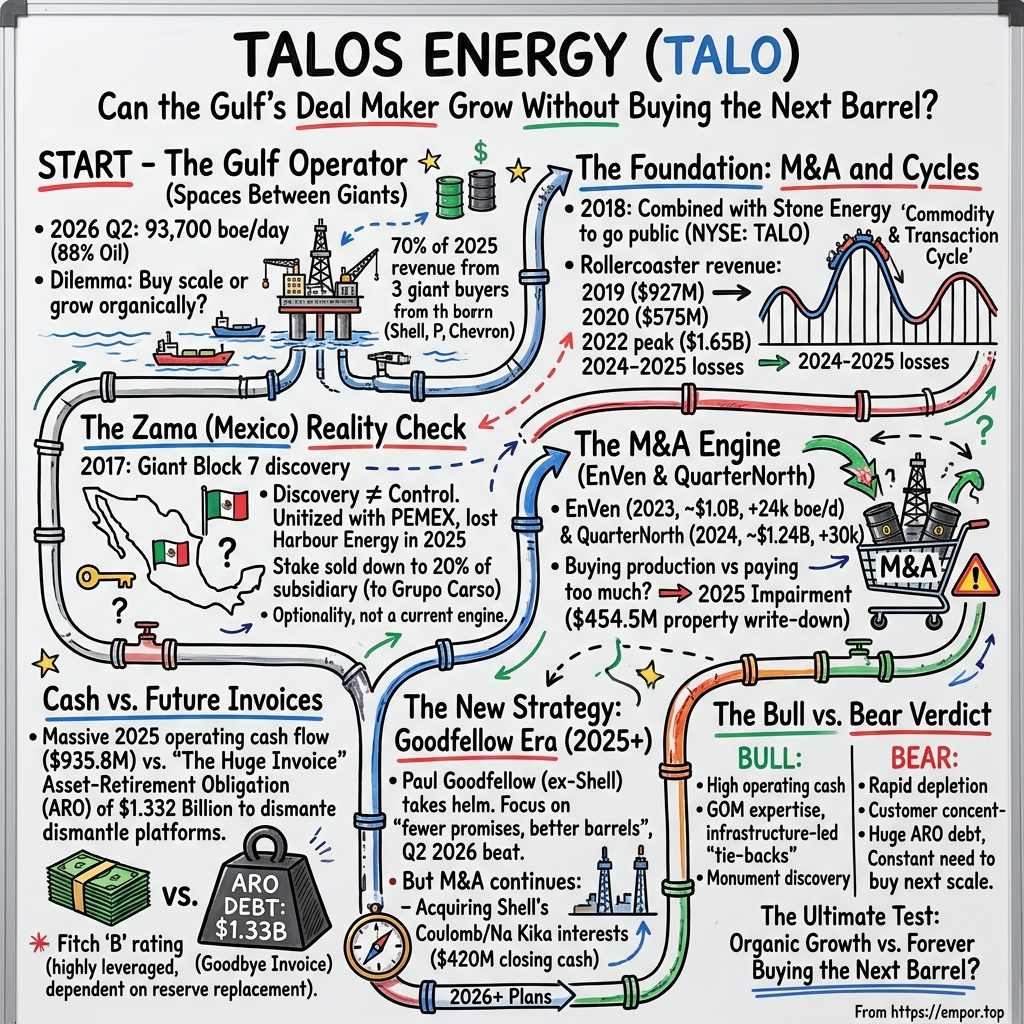
Talos Energy: Can the Gulf's Deal Maker Grow Without Buying the Next Barrel?
I. Ninety-Four Thousand Barrels, and a New Deal
In early August 2026, Talos Energy reported a quarter its managers had been waiting a long time to show off. Across its platforms and subsea wells in the deepwater Gulf, the company had produced an average of 93,700 barrels of oil equivalent a day in the second quarter, above the top of its own guidance range.1 Almost three-quarters of that was oil, and oil was expensive: Talos realized close to $100 a barrel for its crude in the quarter.2 Revenue came in at about $665 million, net income at about $150 million, and adjusted free cash flow, the company's measure of cash left after operating costs and capital spending but before working-capital swings, reached $231.6 million, which management called a record.1 Paul Goodfellow, the former Shell deepwater chief who had run the company for about seventeen months, called the quarter "another meaningful step forward in the execution of our strategy."1
Then, in the same release, Talos raised its full-year production outlook for the business it already owned, to 87,000 to 91,000 barrels of oil equivalent a day from an original 85,000 to 90,000, and pointed to something bigger.1 It was waiting to close an acquisition of deepwater oil assets from Shell. On September 22, 2026, it did. A Talos subsidiary took a 50% working interest in Shell's Coulomb field, along with operatorship, and a 25% interest in the Na Kika platform and the Kepler, Ariel, Fourier and Herschel fields that feed it, a hub that BP operates.3 Talos bought alongside an affiliate of Ridgewood Energy; the pair paid an unadjusted $1.7 billion, and Talos's share came to $420 million in net cash at closing.3 On the August call, management tied the assets to roughly 18,000 barrels of oil equivalent a day of second-quarter production.2
So here is the puzzle at the heart of this story. Talos has had very good quarters before, and it has had very bad years. When you lay its history end to end, the big steps up in production, cash flow and reserves have tended to arrive in bursts, and the bursts have tended to coincide with deals: the 2018 combination with Stone Energy, the 2023 purchase of EnVen, the 2024 purchase of QuarterNorth, and now Shell's Coulomb and Na Kika interests. Between those step-ups, the oil fields did what oil fields do. They declined.
That is not a scandal. It is the physics of the business. An offshore well is a draining reservoir with a pipe on top, and every barrel produced is a barrel that must eventually be replaced, either by drilling, by squeezing more out of existing wells, or by buying someone else's barrels. Talos ended 2025 with 174.7 million barrels of oil equivalent of proved reserves while producing about 94,600 barrels of oil equivalent a day for the year.4 Divide one by the other and the answer is roughly five years. If Talos stopped investing tomorrow, its proved inventory would be exhausted, on paper, in about the time it takes a child to go from kindergarten to fifth grade. Everything in this company is a race against that clock.
The stakes in that race are larger than the production line suggests, because offshore oil comes with two other claims on cash. One is debt. Talos carries more than a billion dollars of bonds, rated in single-B territory by Fitch and S&P.56 The other is the bill for the end of a field's life. At the end of 2025, Talos carried $1.332 billion of asset-retirement obligations, the accounting estimate of what it will cost to plug its wells and remove its platforms when the oil runs out.5 Those costs do not go away when production falls. They become due precisely when the revenue that might have paid for them has gone.
The second-quarter numbers, then, are both real and incomplete. They are real because a company does not beat its own production guidance and post adjusted free cash flow that management had called a record by accident. Well uptime, intervention work and cost control all show up in that quarter. They are incomplete because a $100 oil price flatters every offshore producer, because the next step in Talos's scale came, once again, from an acquisition, and because the price of that acquisition included not just $420 million of cash but a share of Shell's future decommissioning bill, secured at closing by roughly $195.5 million of surety bonds.3
The question this story tries to answer is the one a long-term owner would ask over a decade, not a quarter. Is Talos building a growing offshore producer, one that can turn the cash from its Gulf platforms into new barrels at attractive cost? Or is it a company that keeps buying the scale its old fields use up, so that every few years it must find another seller, another financing and another integration? The answer will not come from a single press release. It will come from the evidence the company has left behind since it listed, and from a few events that will unfold over the next year. To understand both, start with what Talos actually does, and why a company its size can find room in a basin dominated by some of the largest corporations on earth.
 Subscribe on LinkedIn
II. A Gulf Operator Built for the Spaces Between Giants
Picture a deepwater well a few thousand feet below the surface of the Gulf. It was drilled years ago, completed with sand screens and valves, and connected by a steel flowline along the seabed to a platform miles away. Every hour, oil, gas and water flow up through that pipe, are separated on the platform's deck, and leave through export pipelines that run to shore. The geologist who found the reservoir gets the credit in the company history. But in a mature basin, what decides whether that well makes money this year is often far less glamorous: whether the platform stays up during a storm, whether the export pipeline has space, whether a sand screen clogs, and whether the company can get a rig or an intervention vessel out to fix the well quickly when it does.
That is the world Talos lives in. It is an exploration and production company, an E&P in industry shorthand, and its product is barrels. It sells crude oil, natural gas and natural gas liquids by volume at prices tied to the market, mostly under contracts of less than a year, and it reported no firm sales commitments at the end of 2025.5 In 2025, oil made up 88% of revenue, gas 10%, and NGLs the remaining 2%, and all of the revenue came from U.S. operations.5 There are no subscriptions here, no software, no recurring service fees. If the wells flow and the price is high, revenue rises. If a platform shuts in or the price falls, revenue falls with it.
The way to think about the economics is as a simple multiplication with three moving parts. The first is volume, which depends on how many wells are producing, how fast each declines, how often the facilities are running, and whether the company buys more fields. The second is price, which Talos does not control, though hedges and pipeline differentials shape the price it actually realizes. The third is cost, which includes the expense of running platforms, the capital spent drilling new wells, the interest on debt, and the slowly approaching cost of abandonment. Talos's whole strategy is an attempt to tilt the first and third parts in its favor, because it can do nothing about the second.
How does a company of Talos's size compete in a basin where Shell, BP and Chevron operate some of the largest deepwater developments in the world? Partly by not competing head-on. The majors pursue giant projects with multi-billion-dollar hubs. Their attention, by design, flows to the largest opportunities. That leaves smaller reservoirs near existing infrastructure, older fields that need careful attention, and acreage that does not fit a major's portfolio. Talos, along with independents such as Murphy Oil and the privately held LLOG, lives in those spaces. Murphy is the closest listed comparison and produced roughly 189,000 barrels of oil equivalent a day worldwide in 2025, about twice Talos's volume, though Murphy's mix of onshore U.S., Canadian and international assets makes it an imperfect mirror.7
The thing Talos sells to investors, as opposed to refiners, is a claim about operating skill. In the second quarter of 2026, 81% of its production came from fields it operated.1 Operating a field means making the decisions: where to drill, when to intervene, how to run the facility. A non-operating partner writes checks; an operator writes the plan. Talos argues that by controlling platforms and pipelines in the Gulf, and by employing a technical staff that knows the region's geology, it can connect new discoveries to existing infrastructure, extend the life of producing assets, and do both at lower cost than building a new system from scratch. The company had about 700 employees at the end of 2025, including about 400 offshore.5
The logic of infrastructure is easy to grasp with an analogy. Imagine owning a highway interchange in a growing region. Every new development nearby has to connect to your roads, and the cheapest projects are the ones closest to your ramps. In the deepwater Gulf, a platform with spare processing capacity, which the industry calls ullage, is that interchange. A small discovery that would never justify its own platform can be economic if it can be tied back to an existing one a few miles away. That is why deepwater operators prize hubs, and why many of the acquisitions in this story came with platforms attached. When Talos announced its purchase of EnVen in 2022, for example, it emphasized that the deal brought five major deepwater facilities with open capacity.8
But it is worth being precise about what this advantage is and is not. It is a cost and risk advantage on specific projects near specific infrastructure. It is not a pricing advantage. Talos cannot charge more for its oil because it operates a platform well. It sells into a global market and gets the market price, minus quality and transport adjustments. And its buyers are few and enormous. Shell Trading bought 35% of Talos's 2025 revenue, ExxonMobil 23%, and Chevron 12%, so roughly seven of every ten dollars Talos earned came from three counterparties.5 Those buyers are creditworthy, and the short-term, market-priced contracts mean Talos is not locked into a bad deal for years. But it also means the company's revenue rests on a small number of very large customers who are themselves competitors in the same basin.
Now give the explainer a scene. Somewhere on a Talos field, a production chart is sloping downward, as it always does. The reservoir pressure falls, water creeps into the well, output drifts lower month by month. The engineers have a few options. They can perform a workover, re-entering the well to clean it out or open a new zone. They can drill a new well into an untapped part of the reservoir. They can do nothing, and let the decline run. Or the platform itself can go down, for a hurricane or a mechanical failure, and the whole chart drops to zero for a week. Talos's second-quarter results noted about $1.75 per barrel of one-time well intervention costs and, on the call, management described a workover at its Genovesa field that finished ahead of schedule and revealed a lower zone that might add about four million barrels.12 That is the business in miniature: small, practical decisions, repeated thousands of times, deciding whether production holds.
The question for an investor is whether Talos can make those decisions better than the next operator, and at lower cost, consistently enough to sustain production without constantly buying more. Capital spending gives a first clue. Talos spent $481.9 million on capital expenditures in 2025, about 27% of revenue, after spending about 26% in 2024 and about 39% in 2023.5 That is material reinvestment, but spending is an input, not a result. A dollar spent on a dry hole and a dollar spent on a prolific well look the same on the cash-flow statement.
So the competitive test this story will return to is straightforward to state and hard to pass. Majors have more capital, larger portfolios and their own trading arms. Other independents compete for the same acreage, the same rigs and the same acquisition targets. Talos's case rests on focus, operating control and the selection of assets near infrastructure it already understands. If that case is true, it should show up in a long public record of growth that does not depend entirely on deals and commodity prices. Talos has been public since 2018, so that record exists. It begins with a merger.
III. Stone Made Talos Public, but the Numbers Never Became a Straight Line
On May 10, 2018, a new ticker appeared on the New York Stock Exchange: TALO.9 It was not the product of an initial public offering, with bankers pricing shares and a founder ringing a bell. It was the result of a combination between Talos Energy LLC, a private Gulf operator backed by private-equity sponsors, and Stone Energy, a longtime independent Gulf producer. Tim Duncan, Talos's co-founder and chief executive, called it "a transformational combination," in which shareholders would benefit from "increased scale and liquidity."9 The combined company held about 205 million barrels of oil equivalent of proved and probable reserves at the end of 2017 on a pro forma basis, about 150 million of them proved.9
That origin matters for how one reads everything that follows. A company that lists through a business combination does not have a clean, like-for-like history before the event. The figures for Talos before 2018 describe a smaller private company. The figures after describe a merged one. Any "growth rate" that spans the two is partly a measure of the merger, not of the oil fields.
With that caveat in hand, the revenue record still tells a story. Talos reported $258.8 million of revenue in 2016 and $927.6 million in 2019.10 The jump is real, but most of it is Stone's contribution and the Ram Powell acquisition that came with the combination, not organic output. Then came 2020. The pandemic crushed oil demand, prices briefly turned negative in some U.S. markets, and Talos's revenue fell to $575.9 million.11 A year later, as prices recovered, it rose to $1.24 billion, and in 2022, with oil soaring after Russia's invasion of Ukraine, it reached $1.65 billion.1112 Revenue then fell back in 2023, rose to almost $2 billion in 2024 with QuarterNorth's barrels, and settled at $1.78 billion in 2025.512
Plot that on a chart and you do not get a line. You get a mountain range. And the profit line is even more jagged. Talos lost money in 2016 and 2017, made money in 2018 and 2019, lost money in 2020 and 2021, earned $381.9 million in 2022 and $187.3 million in 2023, and then lost $76.4 million in 2024 and $494.3 million in 2025.51012 Those swings are not the work of a single bad decision. They are what happens when a business with high fixed costs, large noncash depletion charges and full exposure to commodity prices meets an oil market that can move 50% in a year.
Here is the uncomfortable lesson for anyone trying to value a company like this. An offshore producer can report rising revenue for three very different reasons. Prices can rise, which costs the company nothing and can reverse just as quickly. The company can buy fields, which adds volume but also adds debt or shares, and the return depends on the price paid. Or its own wells can perform better: higher uptime, lower decline, successful new wells. Only the third is a sign of an operating edge that compounds. The first is luck. The second is a capital-allocation decision whose result will not be known for years.
Talos's public record mixes all three, and it does not separate them cleanly. In 2024, for instance, QuarterNorth contributed $503.4 million of revenue from March, when Talos acquired it, through year-end.12 Strip that out and 2024 revenue would have been well below 2022's peak. In the first half of 2026, revenue rose to $1.137 billion from $937.8 million a year earlier, but that period coincided with much higher oil prices than 2025.113 The record shows a company that can expand. It does not establish a steady organic growth rate, and the investor who extrapolates any single year's revenue change is extrapolating the oil price as much as the company.
There is one more thing the merger era left behind, and it is the most important. In the year before it listed, Talos had already made the discovery that would define its ambitions for the next half-decade. The listing documents could point to the U.S. Gulf for cash flow, but they could also point south, to Mexico, for transformation. That discovery was Zama, and for a while it looked like the thing that would turn a midsize Gulf operator into something much larger.
IV. Zama Put Talos on Mexico's Map—and Then Changed Who Held the Levers
On July 12, 2017, Talos announced that its Zama-1 exploration well, drilled in about 546 feet of water roughly 60 kilometers off the Mexican coast, had found oil.14 It was not just any find. Zama-1 was the first offshore exploration well drilled by the private sector in Mexico's history, the product of energy reforms that had opened the country's waters to foreign operators after nearly eight decades of state monopoly.14 The well encountered between 558 and 656 feet of net oil pay, and Talos estimated the field held 1.4 to 2 billion barrels of gross oil in place, above its pre-drill estimates.14 Talos was the operator, with a 35% stake alongside Sierra Oil and Gas and Premier Oil.14 Duncan called it "both a historic and significant discovery."14
For a company of Talos's size, Zama was a lottery ticket that had paid out. A billion-barrel field, operated by Talos, in shallow water close to shore: it was the kind of asset that could reshape a company's long-term production profile. And it was, in a technical sense, a triumph. Talos's geologists had picked the spot, its engineers had drilled the well, and the rock delivered.
Then geology met politics. Zama's reservoir did not stop at the edge of Talos's Block 7. It extended into an adjacent block held by PEMEX, Mexico's state oil company. When a reservoir straddles two licenses, the owners must unitize it: agree to develop the field as a single unit, with shares allocated by how much oil lies on each side. Unitization is standard practice. The question that matters is who operates the unit. In 2021, Mexico's Ministry of Energy designated PEMEX as the operator.15 Talos, which had found the field, would no longer run its development. Under the unitization, Talos Mexico's share of the whole field was set at about 17.4%.16
That decision changed everything about what Zama could mean for Talos. An operator controls the pace of development, the engineering choices and the timeline to first oil. A minority partner in a state-operated project controls none of those things. It can advise, it can vote, and it must pay its share of the costs. Zama turned from Talos's growth engine into Talos's minority investment.
What Talos did next tells you how management came to value that position. In September 2023, it sold 49.9% of Talos Mexico, the subsidiary holding the Zama stake, to Zamajal, a subsidiary of Grupo Carso, the industrial conglomerate controlled by the family of the Mexican billionaire Carlos Slim.16 The price was $124.75 million, of which $74.85 million was paid at closing and $49.9 million was due on first production.16 Talos kept control and agreed to co-lead drilling and infrastructure work for the project.16 Duncan described Carso as bringing "critical local presence and global commercial reputation."16
Fifteen months later, Talos agreed to sell more. In December 2024, it struck a deal to sell another 30.1% of Talos Mexico to Zamajal for $49.7 million at closing plus $33 million due on first commercial production from Zama, about $82.7 million in total.15 That sale was completed in March 2026, after Mexican regulatory approvals.17 Talos now owns 20% of a subsidiary that owns 17.4% of Zama, which works out to about 3.5% of the field on a look-through basis. A discovery Talos once operated outright has become, in economic terms, a small passive interest.
The operator changed again in the meantime. In December 2025, Mexico's Ministry of Energy approved the transfer of Block 7's operatorship from Talos Mexico to Harbour Energy, and then the transfer of Zama's operatorship from PEMEX to Harbour, which holds a 32.22% gross interest in the unitized field.18 The project's lead is now a company that bought into it, not the one that found it.
There is a related-party thread here that is worth handling with care rather than drama. Control Empresarial de Capitales, controlled by the Slim family, became Talos's largest shareholder, holding about a quarter of the company.19 Zamajal, the buyer of Talos Mexico, is owned by Grupo Carso and Control Empresarial.1517 So Talos sold a Mexican asset to entities linked to its largest shareholder. In 2024, a family office also bought $312.5 million of Talos's $1.25 billion second-lien notes from the initial purchasers, and Talos paid Banco Inbursa a $2.7 million advisory fee.5 At the end of 2025, Talos had a $2.8 million receivable from Carso for services on the Lakach project, about 0.16% of annual revenue.5 None of these figures is large relative to Talos's revenue. But Talos does not provide a full schedule of related-party revenue and costs, and it does not describe the pricing of these items as arm's length, so the total economics of the relationship cannot be quantified from what it discloses.5
What is the lesson of Zama for the listed company? The bull reading is that it proves Talos can find oil. That is fair. Few companies of its size can point to a billion-barrel-class discovery. The bear reading is that it shows how far discovery is from cash flow. Nine years after the well, Zama has not reached first production, Talos no longer controls it, and the company has sold most of its stake for a combined price, including contingent payments, of about $207 million. The calibrated conclusion is somewhere between: Zama demonstrated technical capability, but its contribution to the listed company has been narrowed to limited optionality. The contingent payments due on first production are the most concrete remaining link.
Talos has not walked away from Mexico. In its second-quarter 2026 update, it described a farm-in with Repsol on Block 29, where the partners have made the Polok and Chinwol discoveries, with a final investment decision targeted for 2027.12 On the call, an analyst asked directly how this differed from Zama, and management pointed out that the Block 29 discoveries sit entirely within the block, with Repsol as operator, so no unitization with a neighbor is required.2 That is a sensible answer, and it also shows that the Zama lesson has been learned. But it is a plan for a future project, not a source of current revenue.
If Mexico is no longer the main road to transformation, the question becomes whether Talos can create scale in the basin it knows best. Its answer, from 2022 onward, was to buy it.
V. EnVen and QuarterNorth: The Deals That Rewrote Talos's Scale
On January 15, 2024, Talos announced that it would buy QuarterNorth Energy, a privately held Gulf producer, for $1.29 billion.20 The timing was striking. Less than a year earlier, Talos had closed its purchase of EnVen Energy, another private Gulf operator.21 Duncan called QuarterNorth "one of Talos's most significant milestones."20 Within about thirteen months, a company that had spent years describing itself as a disciplined operator had agreed to two transactions that together cost well over $2 billion and added more than 50,000 barrels of oil equivalent a day. This is the chapter where Talos stopped being a midsize Gulf operator hoping to grow and became a consolidator.
Start with EnVen. Talos announced the deal on September 22, 2022, when oil prices were high and Gulf assets were fetching good prices in the cash-flow sense.8 EnVen was a deepwater specialist: about 24,000 barrels of oil equivalent a day of production, more than 80% oil, more than 90% operated, with about 420,000 gross acres and five major deepwater facilities with spare capacity.8 Talos valued the deal at about $1.1 billion, paying with 43.8 million new shares, $212.5 million of cash, and the assumption of about $50 million of EnVen's net debt.8 EnVen's owners ended up with about a third of the combined company.8 The deal closed in February 2023, leaving Talos with about 126 million shares outstanding.21
What did Talos promise? It said the deal would be more than 13% accretive to free cash flow per share in 2023, including at least $30 million of annual synergies, mostly overhead savings.8 It also pointed to EnVen's infrastructure, more than $160 million of restricted cash and receivables set aside for abandonment, and a pro forma leverage ratio below 0.8 times.8 Duncan described it as "a logical, in-basin expansion."8
The second deal was bigger, and it came with heavier financing. Talos expected QuarterNorth to produce about 30,000 barrels of oil equivalent a day in 2024, roughly 75% oil and about 95% operated, from fields including Katmai, Big Bend, Galapagos, Genovesa and Gunflint.20 It held about 69 million barrels of oil equivalent of proved reserves, with a PV-10, the standard industry measure of the present value of proved reserves discounted at 10%, of about $1.7 billion.20 Talos offered 24.8 million shares and about $965 million in cash, backed by $650 million of bridge financing.20 In practice, it funded the cash with new debt and a public offering of 34.5 million shares in January 2024.5 By the time the purchase accounting was final, the price was $1.57 billion gross and $1.24 billion net of the cash QuarterNorth had on hand.12
The promises were bolder this time. Talos said QuarterNorth would be more than 65% accretive to free cash flow per share in 2024 and 2025 at the strip prices of the day, and accretive to net asset value, reserves and production per share.20 It projected about $50 million of annual synergies by year-end 2024, and it said the deal would improve its base decline rate by about 20%.20 That last claim deserves a pause, because it is the most interesting one. If QuarterNorth's fields really did lower Talos's decline, the deal was not just buying barrels. It was buying time.
So did Talos overpay? The honest answer is that the disclosed numbers do not prove it either way, but they do allow a few comparisons. On a flowing-barrel basis, the market's shorthand for producing assets, EnVen cost about $46,000 per daily barrel of production at its announced value, and QuarterNorth about $43,000. On a proved-reserve basis, QuarterNorth's net price of $1.24 billion against 69 million barrels works out to about $18 per proved barrel. And QuarterNorth's announced PV-10 of $1.7 billion exceeded the net purchase price. By those measures, Talos did not pay an obviously excessive price for either business, and it paid somewhat less per barrel for the larger one.
But each of those measures has limits worth stating. PV-10 is calculated at a point in time using specific price assumptions; it is not a guaranteed return, and a lower oil price or higher costs can shrink it quickly. The accretion promises were forecasts made at strip prices, and Talos has not published a reconciliation showing how much free cash flow per share actually rose because of each deal. The synergy targets are similar. And there is no clean public set of comparable deepwater Gulf transactions that would allow anyone to declare a "fair" industry price per barrel. The Gulf's large deals are few, their terms vary, and many involve private sellers who disclose little.
Then there is the warning light. In 2025, Talos recorded a $454.5 million noncash impairment of its oil and gas properties, after recording none in 2024.5 Under the full-cost accounting method Talos uses, companies must compare the book value of their oil and gas properties each quarter with a ceiling based largely on the discounted value of proved reserves at trailing average prices. When prices fall, the ceiling falls, and if book value is above it, the excess is written off. Talos attributed the 2025 charge to lower average oil prices.4 It recorded another $145 million of impairment in the first quarter of 2026.13
It is tempting to read those write-downs as proof that EnVen and QuarterNorth were mistakes. That reading goes too far. Full-cost impairments apply to the company's whole pool of U.S. properties, not to individual acquisitions, and Talos does not attribute the charge to specific fields. But it would be equally wrong to dismiss the charge. An impairment means that the capitalized cost of Talos's properties, a cost swollen by two large acquisitions made at mid-cycle and high-cycle prices, exceeded what those reserves were worth under the accounting test at lower prices. That is a warning about the value of the assets Talos bought and built, even if it is not a verdict on any one deal.
There is a smaller, adjacent story that rounds out the capital-allocation record. During the same years, Talos built a carbon-capture and sequestration business, Talos Low Carbon Solutions, with projects along the Gulf Coast including Bayou Bend, Harvest Bend and Coastal Bend. It was presented as a growth avenue that played to Talos's subsurface skills. In March 2024, Talos sold the entire business to TotalEnergies for about $142 million including adjustments, and booked a gain of about $87 million.22 Financially, that was a reasonable exit. Strategically, it was a reversal: a growth platform the company had promoted did not become a durable Talos business. The epilogue to the sale was less tidy. About $12.5 million of deferred consideration from the deal was not paid when it came due in 2025, and Talos recorded an $8.9 million expense after concluding collection was doubtful.5
What do the two big deals add up to? They added more than 50,000 barrels of oil equivalent a day of announced production, along with more operated infrastructure and a deeper inventory. They also brought tens of millions of new shares, a new layer of bonds, and a carrying value that the 2025 price decline partly wiped out. The investor's question is not whether the acquisitions added barrels. They obviously did. It is whether Talos can now replace what it produces without needing another large transaction. And on that question, the arrival of the Shell assets in September 2026 is not reassuring evidence, because it is another transaction. The more relevant test lies in the cash those barrels throw off, and in the claims stacked against that cash.
VI. The Cash Arrives; So Do the Claims on It
Open Talos's 2025 annual report to the income statement and the bottom line is grim: a net loss of $494.3 million.5 Turn a few pages to the cash-flow statement and the picture changes completely: cash from operations of $935.8 million.5 The same company, the same year, the same oil. One page says it lost half a billion dollars; another says nearly a billion dollars of cash came in the door. Which is true?
Both, and the gap between them is the single most important thing to understand about how an offshore producer works. Start with the largest bridging item: $1.056 billion of depreciation, depletion and amortization.5 Depletion is the accounting expense of using up reserves. When Talos buys or develops a field, it records the cost as an asset; as it produces the oil, it expenses a share of that cost per barrel. No cash leaves the company when depletion is recorded; the cash left years earlier, when the field was bought or drilled. Add the $454.5 million impairment, also noncash, and $125.3 million of accretion, the annual increase in the present value of the abandonment liability as the deadline gets closer, and most of the gap is explained.5 Smaller timing items from derivatives and working capital make up the rest.
So the cash really did arrive. The loss is not evidence that Talos is burning money. But it would be a mistake to treat depletion as a mere accounting quirk to be ignored. Depletion measures something real: the reserve base shrinking. A company that reports strong cash flow while its reserves shrink is not printing money; it is converting an asset into cash. The only way to keep doing that is to spend enough to replace what is depleted. That is why operating cash flow alone flatters a business like this, and why the more honest measure is what is left after the capital needed to stand still.
Now trace where the cash went. In 2025, Talos spent $481.9 million on capital expenditures.5 It bought back 12.6 million of its own shares for about $119.5 million.5 It paid interest on more than $1.2 billion of bonds carrying coupons of 9% and 9.375%.5 And it spent money plugging wells and removing old structures. Talos's own adjusted free cash flow for 2025, which it calculates before working-capital changes, was $417.7 million.4 That figure does not deduct abandonment spending, and that is where a careful reader should pause.
The receivables line offers a small, useful clue about the quality of the cash. Net trade receivables fell to $323.1 million at the end of 2025 from $404.3 million a year earlier, and the allowance for credit losses fell to $17.7 million from $25.5 million.5 With buyers such as Shell, ExxonMobil and Chevron, that pattern is what one would expect: large, solvent counterparties paying on short terms. The one notable collection failure in 2025 was not a trade customer at all but the overdue carbon-capture sale consideration. It is a specific lapse, not a sign of broad credit stress among Talos's buyers.
The balance sheet carries three different kinds of claims, and they are worth separating. The first is funded debt: at the end of 2025, $625 million of 9% notes due 2029 and $625 million of 9.375% notes due 2031, with an undrawn $700 million revolving credit facility and covenants in compliance.5 Net debt was about $887 million, or 0.7 times trailing adjusted EBITDA, Talos's measure of operating cash earnings before interest and taxes.4 The second is leases, about $15.6 million, small enough to set aside.5 The third is the asset-retirement obligation, a future claim on cash.5
That obligation deserves its own explanation. When a company installs an offshore platform or drills a well, U.S. regulations require it eventually to plug the wells, cut the casing below the seabed and remove the structures. The asset-retirement obligation is the present value of those future costs. It is not debt: there is no lender, no coupon, no maturity date in the usual sense. But it is a real future claim on cash, and in the offshore Gulf it is large. Talos's own disclosures include minimum plugging and abandonment spending commitments and surety bonding requirements, and federal litigation over offshore decommissioning financial assurance remains part of the backdrop.5 By June 30, 2026, the obligation had risen to about $1.394 billion, even though Talos had not yet added the Shell assets.13 In the first half of 2026, Talos spent about $40.6 million settling these obligations.13 Then, at the Shell closing, it took on its share of the decommissioning liabilities for Coulomb and Na Kika and posted about $195.5 million of surety bonds as security, with a requirement that half the security be held in cash escrow from the end of 2032.3
Credit analysts read this balance sheet with care. On March 4, 2026, Fitch affirmed Talos's B issuer rating and revised its outlook to stable.6 Fitch's constraints read like a summary of this story: production below 100,000 barrels a day, the challenge of reserve replacement, leverage, liquidity and refinancing, and the risk of higher bonding or abandonment demands.6 It identified production above 100,000 barrels a day, positive free cash flow and leverage below two times as factors that could support an upgrade.6 S&P, in April 2025, also affirmed a B rating with a stable outlook, but lowered its rating on the second-lien notes to B+ because it expected lower recoveries for those bondholders in a default.23 Single-B is a speculative-grade rating. It does not imply distress, but it does mean lenders demand high coupons and watch the company closely.
Talos used the 2026 oil rally to improve its debt stack. It issued $800 million of 8% notes due 2034 and used the proceeds to redeem the $625 million of 9% notes due 2029, with the remainder going toward the Shell acquisition.1 It also secured an increase in its borrowing base from $700 million to $850 million, effective at the Shell closing.13 At June 30, 2026, before the deal closed, Talos reported $577.6 million of cash, about $1.18 billion of liquidity, and net debt of about $672 million, or 0.5 times trailing adjusted EBITDA.1 Those are comfortable numbers. But they are a snapshot taken before $420 million of acquisition cash went out the door, and a post-closing balance sheet has not yet been published.
Put it together and the arithmetic is uncomfortable but clear. In a good price and production year, Talos's cash flow can cover its capital program, its interest and a meaningful buyback, with some left over. But that surplus is measured before the steady, rising cost of abandonment, and it is earned from assets that consume capital simply to hold their output flat. The 2025 impairment showed what happens to carrying values when prices fall. The question of who decides how to divide this cash, and how wisely, falls to a leadership team that is barely two years old.
VII. Goodfellow's First Plan: Fewer Promises, Better Barrels?
On March 1, 2025, Paul Goodfellow walked into Talos's Houston headquarters as the third person to lead the company in about seven months.24 Tim Duncan, the co-founder who had led the company through the Stone combination, Zama, EnVen and QuarterNorth, had stepped down in 2024.24 Joseph Mills, a director who took over on an interim basis, resigned abruptly in January 2025.24 For a company whose investment case rests on operating credibility, a revolving door at the top was not a good look. The board needed someone who could steady the ship and, ideally, someone whose résumé said "deepwater operator" in capital letters.
Goodfellow's did. He joined Shell in 1991 and spent more than three decades there.24 From April 2019 to August 2023 he ran Shell's global deepwater business as executive vice president, overseeing operations in the U.S. Gulf, offshore Mexico, Brazil, West Africa, Malaysia and the North Sea.24 Before that he had led Shell's wells organization, responsible for drilling, completion and well intervention worldwide, and he had run Shell's businesses in the UK and Ireland and its unconventional operations in the U.S. and Canada.24 His last job at Shell was something different again: executive vice president and group chief internal auditor.24
That combination is worth dwelling on. A deepwater executive knows how big projects get built and how platforms are kept running. A wells executive knows the unglamorous work of interventions, the very work that decides whether a mature field holds production. And an internal auditor's job is to find the gap between what an organization says it does and what it actually does. If you were designing a CEO for a company with a reputation for deal-making and uneven delivery, that is not a bad template. In August 2025, Goodfellow was joined by a new chief financial officer, Zach Dailey, who had previously been controller and chief accounting officer at Marathon Oil.19
How is Goodfellow paid, and what does the pay reward? His reported 2025 compensation was $9.35 million, of which $6.51 million was stock awards and $1.87 million was a cash bonus under the annual incentive plan.19 Much of the stock was a sign-on award intended to replace pay he forfeited by leaving Shell: one-third time-vested restricted stock and two-thirds performance shares that vest only if Talos's 60-day average share price reaches $14 and then $16.19 His base salary is $975,000, and he is expected to own Talos stock worth six times that amount.19 Talos's annual bonus plan for 2025 weighted adjusted free cash flow at 40%, production at 25%, safety at 20%, and operating costs, overhead and emissions reductions at the remainder; it paid out at 153.5% of target.19 Its longer-term performance shares are based on absolute and relative total shareholder return over 2025 to 2027.19
There is a lot to like in that design. Free cash flow is the heaviest single measure, and the equity is meaningful. But note what is missing. There is no explicit metric for organic reserve replacement, and none for returns on acquisitions. A plan that rewards production and free cash flow can, in principle, be satisfied by buying production and free cash flow. That does not mean Goodfellow will do so carelessly. It means the incentive system does not, by itself, protect shareholders against the pattern this story has been examining. As for the price hurdles, Talos shares traded around $18 in October 2026, comfortably above the $14 and $16 thresholds set for the sign-on award.25 The stock's rise has coincided with a much higher oil price, which is a reminder that share-price hurdles in an E&P company partly measure the commodity.
What did Goodfellow actually change? In early 2026, Talos reframed itself as aiming to become a "leading pure-play offshore E&P."4 The label is evocative, but labels are cheap. More concrete was a cost and efficiency program: Talos said it realized $72 million of free-cash-flow enhancements in 2025 against an original year-end target of $25 million, and it set a 2026 target of $100 million.4 Exceeding an internal target by nearly three times is good evidence of focus, though the company defines and measures these enhancements itself, so outsiders cannot audit them line by line. Production guidance tells a cleaner story. Talos beat its second-quarter target and raised its full-year outlook.14 That is exactly the behavior a skeptical investor wants to see: modest targets, then delivery above them.
Yet the capital-allocation record under the new team is not purely organic. In 2025, Talos made the largest repurchase in its public history.5 It set a framework of returning up to 50% of annual free cash flow through buybacks.1 Then, in June 2026, it signed the Shell deal, financed in part with a new bond issue.13 The buyback paused in the second quarter because of a blackout tied to the acquisition.1 In other words, the pure-play strategy includes acquisitions. That is not a contradiction; a focused offshore company can still buy offshore assets. But it does mean that the new management team has, within its first eighteen months, taken the same basic route to scale that its predecessors did.
The August call showed both faces of the strategy. In prepared remarks, management emphasized progress at Monument, a Walker Ridge development where the first well found about 250 feet of net pay.12 In the Q&A, analysts pushed toward the future. Goldman Sachs asked how Coulomb would compete for capital in 2027. KeyBanc asked what signals would show that Talos was growing. Citi asked about the cadence of buybacks. Others asked about a new block in Honduras, Mexico's Block 29, and how Talos would allocate space on the Na Kika platform.2 Management answered that buybacks would resume in the second half, that pro forma leverage would stay below one times through 2027, and that the operated Coulomb opportunity would compete for capital in 2027.2 The answers were concrete. They were also a reminder that the questions analysts care most about are the ones that require years to answer.
Governance offers a smaller signal. At the June 2026 annual meeting, say-on-pay passed easily, with about 135 million votes for and 6.4 million against.26 But Neal Goldman, the independent chairman since 2018, received about 23.2 million votes against, materially more opposition than other directors.1926 That is a signal of shareholder scrutiny worth tracking, not evidence of a broader revolt. The board is majority independent, and the chairman role is separate from the CEO's.19
The ownership picture is also shifting. Control Empresarial built its stake through 2023 and 2024, prompting Talos to adopt a shareholder-rights plan in 2024.5 In December 2024, the two sides signed a cooperation agreement under which Control Empresarial agreed not to raise its stake above 25%, and Talos agreed to end the rights plan.15 That agreement was later extended to December 16, 2026.19 As of March 31, 2026, Control Empresarial owned about 24.7% of Talos, or 41.2 million shares.19 Since then it has been selling. Its most recent filing showed a sale of about 2.1 million shares on October 19, 2026, at an average of about $18, leaving it with 24.5 million shares.25 On the March share count, that is roughly 15% of the company, down from almost a quarter. The largest shareholder is shrinking, which reduces one concentration of influence but also removes a large holder who had appeared to be a patient strategic partner.
So how should one judge the new team? One year is not enough. The evidence so far is encouraging: realistic guidance, delivery above it, cost savings above target, and a more conservative balance sheet. But management credibility in an E&P company is earned over a full commodity cycle and measured in things that are slow to show up: organic reserve replacement, the return on the Shell acquisition, and the cash left after abandonment spending. Those are the tests. Before turning to them, it is worth putting Talos's whole competitive position under the microscope, because the bull and bear cases both turn on whether the company has an advantage at all.
VIII. Analysis & Bear vs. Bull Case
Imagine a reservoir engineer showing a low-decline producing field on a spreadsheet. The production curve slopes gently. The proved reserves, discounted at 10%, produce an attractive value. It looks like a bond with a commodity kicker. But the spreadsheet does not show the platform that needs maintenance, the riser that will need replacing, the future workovers, or the cost of plugging every well and hauling the topsides to shore in twenty years. An investor in Talos has to look past the spreadsheet to those costs, because that is where the edge, if there is one, either shows up or disappears.
Start with the moat argument, made once and with evidence. Talos's claimed advantage has three parts. First, infrastructure access: it operates platforms and pipelines that can accept new production cheaply, which lowers the cost of developing nearby discoveries. Second, operating control: with about 81% of production operated, it decides the pace of activity and can prioritize uptime and interventions.1 Third, deepwater experience: a technical workforce that understands Gulf geology and a CEO who ran one of the world's largest deepwater businesses. QuarterNorth's thesis added a fourth element, a lower base decline rate that would reduce the capital needed to hold production flat.20
How much of that is proven? The infrastructure argument has real support. Monument, a development in which Talos holds about 29.7% alongside operator Beacon Offshore, is being tied back to the Shenandoah facility, with first production expected by the end of 2026 at 20,000 to 30,000 barrels of oil equivalent a day gross.1 That is precisely the kind of project infrastructure makes possible. The operating argument has its best evidence in 2026: production above guidance and a rising outlook.1 The lower-decline claim is the least proven. Talos has not published a base-decline figure that would allow outsiders to compare its pre- and post-QuarterNorth decline rates, and its 2026 standalone guidance sits below its 2025 production, partly because of a small shelf divestiture.14
Now apply the industry-structure test, the way Michael Porter would. Buyer power is high. Three buyers took about 70% of 2025 revenue, and they buy a commodity at market prices.5 There is no lock-in and no ability for Talos to charge a premium. Supplier power is meaningful: deepwater rigs, vessels and specialized services are concentrated, and Talos's recent contract for the West Vela drillship from mid-2027 is a reminder that rig costs are a negotiation, not a given.2 The threat of substitutes is a slow-moving one: oil faces long-term competition from electrification, but over the life of Talos's current reserves, demand for crude is not the main risk. Rivalry is intense for acreage, infrastructure and acquisitions, with majors such as Shell, BP and Chevron, independents such as Murphy, and private operators such as LLOG all competing. And the threat of new entrants is moderate: the capital, technical skill and regulatory bonding required to operate in deepwater are high, though private-equity-backed newcomers have entered the basin repeatedly.
Hamilton Helmer's seven powers framework sharpens the point. Of the seven sources of durable advantage, which could Talos possess? Scale economies: no, not against majors twice to ten times its size. Network effects: none. Switching costs: none for its buyers. Brand: irrelevant to a commodity. Counter-positioning: arguably a small amount, in that majors are structurally less interested in small tiebacks and mature fields, leaving room for a focused operator. Process power, meaning organizational know-how that is hard to copy: possibly, but it would show up as consistently better uptime, lower costs or higher reserve additions than peers over many years, and that record is not yet established. Cornered resource: partially, in the form of owned infrastructure and spare capacity in specific locations. The honest verdict is that Talos has a plausible operating niche, built on infrastructure and focus, but not a demonstrated moat in the sense that would protect returns through the commodity cycle.
The economics that drive returns are worth spelling out because they cut both ways. High oil weighting is a blessing when prices rise; the near-$100 crude of the second quarter of 2026 is a large part of why free cash flow set a record. But oil weighting is also a curse when prices fall, as the 2025 impairment showed. Production declines, unplanned downtime, drilling costs, hedging losses, pipeline differentials and access to export capacity all shape how much cash each barrel actually produces. In the second quarter, lease operating expenses were about $18 per barrel of oil equivalent, including roughly $1.75 of one-time intervention costs.1 That is a reasonable cost per barrel at $100 oil and a much thinner margin at $60.
Give the bull case its strongest form. Talos generated almost $936 million of operating cash flow in a weak price year, 2025.5 In 2026, with much higher prices, it posted record quarterly free cash flow, beat production guidance and raised its outlook.1 Its leverage was about 0.5 times at June 30, 2026, and it refinanced its nearest bond at a lower coupon and a longer maturity.1 It has development projects with near-term production, Monument above all, and an appraisal well at the Daenerys discovery, spud on July 1, 2026, with results expected by year-end.1 The Shell assets add operated production at Coulomb and a stake in an established hub at Na Kika. A management team led by an experienced deepwater operator has set conservative targets and beaten them. If oil stays elevated and the operations stay reliable, Talos could cross Fitch's 100,000-barrel threshold with the Shell barrels included.
Give the bear case equal weight. The 2025 impairment of $454.5 million, followed by another $145 million in early 2026, shows that the carrying value of Talos's properties was too high for the prices of that period.513 The company carries a single-B credit rating.623 Its revenue depends on three buyers. Its asset-retirement obligation was about $1.39 billion at mid-2026 and grew further with the Shell deal.313 Its reserve life is about five years. And its new management, despite its emphasis on organic improvement, has already returned to acquisitions as a source of growth. In the bear case, depletion, price volatility, leverage and abandonment costs absorb the apparent cash advantage, and Talos needs a new deal every few years to keep production level.
What about the options further out? Monument's first well found the pay it was looking for.1 Daenerys is still being appraised.1 Block 29 in Mexico and a new operated block offshore Honduras, where Talos has taken an 80% interest subject to government approval of part of it, are exploration and development options.12 Zama remains a minority interest with contingent payments. History offers a sobering base rate for converting such milestones into revenue: Zama, the company's greatest technical success, has yet to produce a barrel nine years after discovery, and the carbon-capture business was sold before it generated meaningful revenue. Each of these options should be treated as worth something only when it produces oil economically.
Three indicators matter more than any others for following this story. The first is production against guidance, and the uptime behind it: the latest reading was 93,700 barrels a day in the second quarter, above guidance, with a full-year standalone outlook raised to 87,000 to 91,000.1 The second is organic proved-reserve replacement, meaning reserves added through drilling and revisions rather than acquisitions, compared with production. Proved reserves stood at 174.7 million barrels at the end of 2025, about five years of output, and Talos does not headline an organic replacement ratio in its results.4 The third is free cash flow after capital spending, interest, buybacks and abandonment cash: Talos reported $417.7 million of adjusted free cash flow for 2025 before working capital, and plugging and abandonment spending is guided at $100 million to $130 million for 2026.4
A word on valuation, which should be treated as data, not a verdict. At about $18 a share in October 2026, and with roughly 170 million diluted shares implied by second-quarter earnings, Talos's equity was worth on the order of $3 billion.125 At the end of 2025, its proved reserves carried a PV-10 of about $3.2 billion, with probable reserves adding about $2.3 billion more, both calculated on the lower prices of 2025.4 Add net debt and the cost of the Shell purchase, and the market is valuing the company above the PV-10 of its proved reserves alone. That implies investors are paying for some combination of higher oil prices than the 2025 reference price, probable reserves, and future development. It does not imply a specific fair value. Earnings are too volatile, and a single commodity year is too thin a sample, to justify any target or peer multiple.
The case, then, comes down to a narrow question. Does Talos's operating niche let it earn enough per barrel, through a full price cycle, to replace its reserves, service its debt and fund its abandonment? The record so far says the niche is real but narrow, and that it has needed acquisitions to grow. That is not a fatal flaw. It is a reason for close scrutiny.
IX. The Offshore Lessons Talos Had to Learn
Put three moments side by side. In July 2017, a Talos rig in shallow Mexican waters drills into hundreds of feet of oil-bearing sand and the company announces a historic discovery.14 In 2025, the same company writes down $454.5 million of its oil and gas properties because lower prices made its book value impossible to support.5 In September 2026, it hands $420 million to Shell for a stake in someone else's producing fields.3 A discovery, a write-down, and another bet on barrels that already flow. Together they make up the arc of a company learning, sometimes expensively, what offshore oil really costs.
The first lesson belongs to QuarterNorth. Its lower base decline was a genuine virtue, worth paying for in a business where every barrel is chasing a depletion clock.20 The later ceiling-test charge across Talos's property base was a reminder that acquisition price still matters.512 The decline rate buys the investor time to earn back the price. It does not earn it back automatically. For any acquisitive producer, the lesson is the same: a low decline rate can buy time; it cannot cancel the price paid.
The second lesson belongs to Zama. Talos did the hard part. It picked the prospect, drilled the well and found one of the most significant shallow-water discoveries of its era.14 Its stake has since been sold down twice, and Harbour now leads development.181617 Exploration success is a necessary condition for value, but not a sufficient one. Control of development, the right to decide when and how a field is built, is what turns a discovery into cash flow on a schedule a shareholder can plan around. Finding the field is one victory; owning the timetable is another.
The third lesson belongs to the end of every field. Talos's abandonment bill was already large by mid-2026, and the Shell deal added to it, backed by almost $200 million of surety bonds.3513 Every barrel a deepwater well produces moves that obligation a little closer to the present. Investors who look only at operating cash flow are looking at the inflow without the matching outflow that arrives decades later. In the offshore Gulf, the cost of leaving is not a footnote; it is part of the price of every barrel. Every offshore barrel comes with a future invoice.
The fourth lesson belongs to Goodfellow's first year. After the leadership changes, he beat and raised Talos's modest 2026 production target, and exceeded its cost-saving target by a wide margin.14 That is how trust is built in a business where the market has heard plenty of accretion forecasts. It is also how trust can be lost: one missed quarter, one disappointing appraisal well, one acquisition that underdelivers, and the record resets. A plan earns credibility one guidance range at a time.
X. Epilogue
As of October 2026, Talos stands at an interesting threshold. The Shell transaction has closed,3 and Talos has refinanced its nearest bond and expanded its credit facility.13 Monument is moving toward first oil, while Daenerys remains under appraisal.11 Oil remained strong in the second quarter, and Talos's largest shareholder has been selling into that strength.225
The next twelve months will put the core thesis to the test in a way that past years could not, because the inputs are now unusually clean. The first event is the post-closing balance sheet. Talos's third-quarter results, and the pro forma financial statements it must file for the Shell assets, will show how much of the $420 million came from cash and how much from the revolver, what net debt looks like with the new barrels, and how much covenant headroom remains.3 If leverage stays well below one times, as management projected on the August call, the deal will look financially comfortable.2 If the post-deal numbers show leverage drifting higher while oil prices ease, the Shell purchase will start to look like the latest in a series of transactions that borrowed against the future.
The second event is production reporting. Talos's standalone guidance for 2026 is 87,000 to 91,000 barrels a day, and its third-quarter guidance of 81,000 to 85,000 reflects the shelf divestiture and other timing.1 With the Shell barrels now included, the reported total should jump. The careful reader should ask how much of each quarter's production comes from the newly acquired fields and how much from the underlying base. If the base holds near guidance and Monument comes online on schedule, Talos will have demonstrated organic momentum alongside the acquisition. If the base slips and the acquired barrels mask it, the old pattern will have repeated.
The third event arrives in early 2027 with the year-end reserve report. That report will show whether Talos added more proved reserves through drilling, revisions and new projects than it produced in 2026, separate from what it bought. It will also show how much the asset-retirement obligation has grown with the Shell assets, and how much Talos spent on plugging and abandonment against its guided $100 million to $130 million.4 Those two numbers, organic reserve replacement and abandonment cash, are the closest thing this company has to a scorecard.
The fourth is the ownership question. Control Empresarial's approaching agreement expiry and reduced stake leave an ownership question.1925 Whether it continues to sell, holds, or renegotiates its relationship with Talos will shape both the stock's overhang and the company's governance. Talos's remaining Mexico interests also warrant attention.117
Finally, the timelines for Talos's remaining options are worth watching.12 Each one will either convert into economic production or not. The history of this company says to wait for the oil before counting it.
The tension that remains is the one this story began with. Talos can buy scale quickly, and it has proved it can run what it buys. What it has not yet proved, over a full cycle, is that its own drill bit can replace what its wells produce.
XI. Outro
Go back to the platform in the Gulf. On a calm day, it is a remarkable machine: a steel island miles from shore, pulling oil from rock thousands of feet below the seabed and sending it through pipes to refineries on the coast. In the second quarter of 2026, Talos's platforms and wells moved oil at a strong clip.1 Every one of those barrels paid for something: salaries, interest, buybacks, the next well.
But underneath the flowing pipes, an invoice is slowly coming due. Each well will eventually need to be plugged; each platform will need to be cut free and carried away. Talos's abandonment bill was already large at the end of 2025, and it has grown since.513 That is the test that will define Talos: whether each new barrel pays for the one after it, and for the long, expensive farewell at the end.
References
-
Talos Energy Announces Second Quarter 2026 Operational and Financial Results — Talos Energy, 2026-08-04 ↩↩↩↩↩↩↩↩↩↩↩↩↩↩↩↩↩↩↩↩↩↩↩↩↩↩↩↩↩↩↩↩↩↩↩↩↩
-
Talos Energy (TALO) Q2 2026 Earnings Call Transcript — The Motley Fool, 2026-08-11 ↩↩↩↩↩↩↩↩↩↩↩↩↩
-
Coulomb and Na Kika Acquisition Close, Form 8-K — Talos Energy, 2026-09-24 ↩↩↩↩↩↩↩↩↩↩↩↩
-
Talos Energy Announces Fourth Quarter and Full Year 2025 Results — Talos Energy, 2026-02-24 ↩↩↩↩↩↩↩↩↩↩↩↩↩
-
2025 Annual Report — Talos Energy, 2026 ↩↩↩↩↩↩↩↩↩↩↩↩↩↩↩↩↩↩↩↩↩↩↩↩↩↩↩↩↩↩↩↩↩↩↩↩
-
Fitch Revises Talos Outlook to Stable; Affirms IDR at 'B' — Fitch Ratings, 2026-03-04 ↩↩↩↩↩
-
Talos Energy Announces Strategic Acquisition of EnVen Energy — Talos Energy, 2022-09-22 ↩↩↩↩↩↩↩↩
-
Talos Energy Inc. Completes the Previously Announced Strategic Combination Between Talos Energy LLC and Stone Energy Corporation — Talos Energy, 2018-05-10 ↩↩↩
-
Talos Energy Announces Fourth Quarter and Full Year 2021 Results — Talos Energy, 2022-02-24 ↩↩
-
Talos Energy reports significant discovery offshore Mexico — World Oil, 2017-07-12 ↩↩↩↩↩↩↩
-
Talos Energy divests additional stake in Zama field to Grupo Carso — Oil & Gas Journal, 2024-12-17 ↩↩↩↩
-
Talos Energy Completes Mexico Transaction with Grupo Carso — Talos Energy, 2023-09-27 ↩↩↩↩↩↩
-
Basham, Ringe y Correa advised Zamajal on the acquisition of an additional 30.10% stake in Talos Energy México 7 — Basham, Ringe y Correa, 2026-03-25 ↩↩↩↩
-
2026 Definitive Proxy Statement — Talos Energy, 2026-04-22 ↩↩↩↩↩↩↩↩↩↩↩↩
-
Talos Energy Announces Strategic Acquisition of QuarterNorth Energy — Talos Energy, 2024-01-15 ↩↩↩↩↩↩↩↩↩
-
Talos completes acquisition of EnVen — Offshore Magazine, 2023-02-13 ↩↩
-
Form 10-Q for the quarter ended June 30, 2024 — Talos Energy, 2024 ↩
-
Talos Energy Rating Action — S&P Global Ratings, 2025-04-04 ↩↩
-
Talos Energy appoints Shell executive as CEO — Oil & Gas Journal, 2025 ↩↩↩↩↩↩↩
-
Control Empresarial de Capitales Form 4 — SEC, 2026-10-21 ↩↩↩↩↩
-
2026 Annual Meeting Results, Form 8-K — Talos Energy, 2026-06-05 ↩↩
 LinkedIn
 WhatsApp
 Reddit
 Hacker News
 Email
 Kindle
 RSS Feed
 Spotify
 Apple Podcasts
 Amazon Music
 Audible
 YouTube