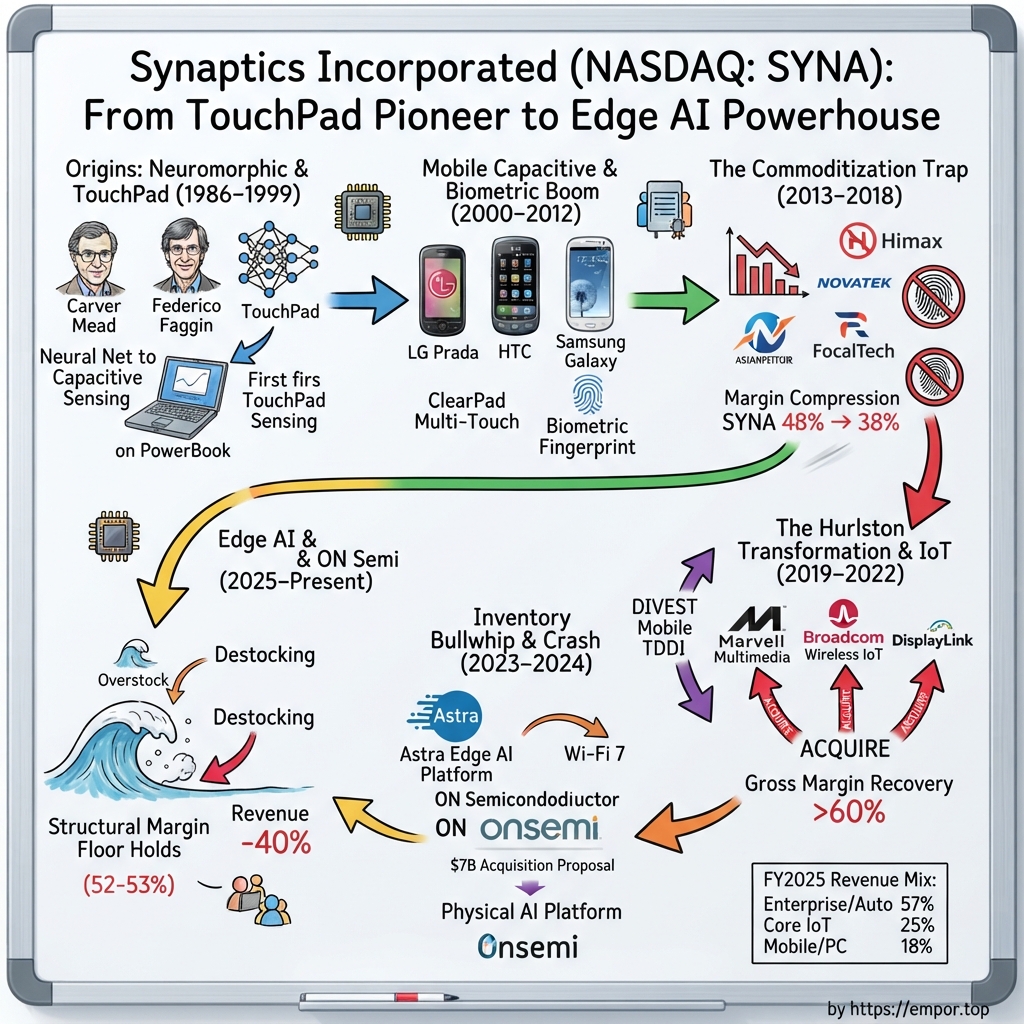
Synaptics Incorporated (NASDAQ: SYNA): From TouchPad Pioneer to Edge AI Powerhouse
I. Introduction & Episode Roadmap (0:00 – 0:12)
On the evening of June 25, 2026, two press releases went out simultaneously from Scottsdale, Arizona, and San Jose, California. Onsemi, the $30-billion-plus power-and-sensing provider that spent a decade reinventing itself around silicon carbide and automotive image sensors, announced it had agreed to acquire Synaptics Incorporated in an all-stock transaction valuing the company at roughly $7 billion in enterprise value. The fixed exchange ratio of 1.350 Onsemi shares for every Synaptics share represented a premium of about 19% relative to the volume-weighted average closing prices of both stocks over the prior ten trading days. Upon closing, Synaptics shareholders would own roughly 12% of the combined entity. The transaction's stated ambition was grand: to position Onsemi "at the intersection of Power, Sense, Connected Compute and Control," the four pillars of what the industry terms Physical AI.1
For a company founded forty years earlier to build silicon that mimics human brain function, the acquisition offered a full-circle ending. Synaptics was established in 1986 by two prominent semiconductor pioneers: Federico Faggin, who led the design of the world's first commercial microprocessor at Intel before co-founding Zilog, and Carver Mead, the Caltech professor who co-authored the foundational textbook on very-large-scale integration and pioneered neuromorphic computing. Their founding purpose was to commercialize analog neural networks—chips engineered to perceive visual and auditory data much like humans do.4 Four decades later, Synaptics was being acquired for that exact capability—AI compute at the edge—after spending most of the intervening years generating revenue from a far more prosaic technology: the glass trackpad under a user's thumb.
The tension between founding vision and operating reality defines Synaptics' history. Over four decades, the company has operated as a neuromorphic research lab, a near-monopoly supplier of notebook TouchPads, a high-volume Android touchscreen vendor, a fingerprint-sensor contender, a display-driver consolidator, a pandemic-era work-from-home beneficiary, an inventory destocking casualty, and an Edge AI narrative stock now absorbed into a larger semiconductor platform. Along the way, it generated an instructive capital-allocation record in mid-cap semiconductors—instructive because major strategic bets foundered before turning around, and because subsequent gains proved less durable than management projected.
Today, Synaptics is a fabless chip designer generating roughly $1.2 billion in annual revenue, employing about 1,700 people across fifteen countries. It sells human-interface chips, wireless connectivity silicon, video-compression engines, and low-power AI processors into PCs, automobiles, smart homes, enterprise offices, and—increasingly, management hopes—robots.23 Its fiscal year 2026, which ended June 27, 2026, produced $1,197.2 million in revenue (up 11% year-over-year) alongside a GAAP net loss of $490.8 million, driven almost entirely by a $425.3 million non-cash charge to write down U.S. deferred tax assets.2 Both numbers are central to the company's financial profile, yet they point in opposite directions. Reconciling them forms the core analytical challenge of this evaluation.
This historical context provides a critical framework for evaluating the business. Synaptics has operated under four distinct business models across forty years—research lab, module supplier, high-volume commodity chip vendor, and diversified specialist—only the first and last of which were pursued by deliberate strategy. The middle two were dictated by shifting market demand. That history cautions against viewing forward-looking management claims as settled competitive positions rather than testable hypotheses.
This narrative unfolds across six distinct phases: 1. The initial neuromorphic moonshot that pivoted into laptop TouchPads, establishing a core franchise with PC original equipment manufacturers. 2. The smartphone expansion, during which capacitive touch scaled to hundreds of millions of units as Synaptics supplied the Android ecosystem while Apple developed in-house solutions. 3. The commoditization trap between 2013 and 2018, when two major acquisitions expanded revenue but delivered minimal operating profit. 4. The 2019–2022 portfolio restructuring under Chief Executive Michael Hurlston, executed through targeted divestitures and serial acquisitions. 5. The post-pandemic inventory correction, which reduced revenue 45% from its peak and tested management's structural claims. 6. The current chapter: leadership transition, a strategic bet on Edge AI processors named Astra, and the acquisition by Onsemi that now determines ultimate shareholder value.
The central question underlying all six phases remains unchanged since 1994: can Synaptics convert pioneer technical innovations into sustained economic profits, or will its initial category breakthroughs repeatedly yield to larger, lower-cost, or better-distributed competitors? The historical record warrants a rigorous examination.
 Subscribe on LinkedIn
II. Origins: Neuromorphic Pioneer to TouchPad Inventor (1986–1999) (0:12 – 0:38)
Carver Mead's laboratory at Caltech in the mid-1980s was an unlikely birthplace for a laptop component supplier. Mead had already transformed the semiconductor industry through his work with Lynn Conway on structured VLSI design, establishing a repeatable methodology for laying out chips with hundreds of thousands of transistors. Yet by the mid-1980s, Mead turned his focus to biological computation. Observing that a retina processing a visual scene or a cochlea decomposing sound operated orders of magnitude more efficiently than digital computers, Mead concluded that the industry had overlooked the analog behavior of transistors. By operating transistors in their subthreshold region and wiring them into artificial neural structures, engineers could build silicon that mimicked biological nervous systems.
Federico Faggin approached the problem from the opposite direction. Having designed the silicon-gate technology that made integrated circuits practical, led the Intel team that delivered the 4004 microprocessor, and co-founded Zilog—where his Z80 chip powered early personal computers—Faggin had built the digital architecture Mead sought to bypass. In 1986, Mead and Faggin co-founded Synaptics to commercialize analog VLSI chips for artificial neural networks and pattern recognition, naming the company in direct reference to biological synapses.4
The venture was roughly three decades ahead of its time. The commercial ecosystem lacked training data, scalable backpropagation frameworks, specialized manufacturing processes, and viable corporate buyers. In 1990, neuromorphic silicon remained a research endeavor without a market. What Synaptics did possess was a core technical capability: extracting subtle signals from noisy analog environments and classifying patterns using minimal power.
The company's commercial breakthrough arrived through an unglamorous pivot. Notebook computers in the early 1990s relied on trackballs—mechanical spheres that accumulated dust, jammed easily, and added physical thickness to portable chassis. Synaptics engineers realized that a finger moving across a grid of capacitive electrodes generated the exact type of noisy analog signal their pattern-recognition algorithms were designed to process. In 1994, Synaptics shipped the world's first commercial capacitive TouchPad.4 Within a few years, trackballs disappeared from mainstream notebooks.
This pivot established Synaptics' long-standing business model. Rather than selling standalone integrated circuits, Synaptics supplied complete module assemblies comprising sensor substrates, controller silicon, and custom firmware. Delivering integrated modules allowed the company to capture a larger share of the bill of materials, though it also required solving complex engineering challenges inside customers' electrically noisy enclosures.
Inventing the TouchPad provided a technical milestone, but firmware created the commercial franchise. A laptop trackpad is less a sensing problem than a rejection problem: the controller must distinguish intentional touch from a resting palm, a shirt cuff, or electromagnetic interference from display inverters just centimeters away. Because every laptop model presented unique electrical environments, each design required custom tuning.
This customization built meaningful switching costs at the OEM engineering level. Once computer manufacturers like Compaq, IBM, HP, or Dell validated a Synaptics module within a platform architecture, switching suppliers threatened product launch schedules and required months of re-validation for a low-cost part.
However, that competitive insulation had structural limits. A notebook manufacturer buying a TouchPad in 1998 was not paying for scarce raw materials or an impenetrable patent portfolio; it was paying to outsource a complex integration problem on tight, 14-month product cycles. While monetizable, that service carried a price ceiling defined by the cost for OEMs to build in-house solutions—a cost that dropped steadily as capacitive touch technology matured.
For roughly a decade, this dynamic produced a lucrative niche: high market share in an expanding category, healthy gross margins, low capital intensity, and an asset-light structure. Synaptics owned no wafer fabrication facilities then and operates none today, relying on external foundries for chip fabrication and third-party OSAT providers for packaging and testing—a model that minimizes capital expenditures while ceding pricing power and supply allocation to foundry partners.3
Viewed from 2026, Synaptics' founding vision proved prophetic rather than flawed. Mead and Faggin were correct about the necessity of neuromorphic computing, even if their timing missed by thirty years. The core thesis—low-power silicon executing localized sensing and decision-making at the edge—aligns directly with the capabilities driving Onsemi's acquisition. Synaptics spent four decades monetizing the mechanical by-product of its founding vision while waiting for edge AI markets to mature.
That history established a repeating strategic pattern: Synaptics routinely pioneered human-interface categories, only to face margin compression and market share erosion once those technologies standardized and invited lower-cost competitors. While high qualification friction and module complexity preserved the TouchPad franchise, Synaptics' subsequent product lines lacked those defensive barriers just as consumer electronics entered a period of rapid expansion.
III. The Smartphone Revolution: Capacitive Touch & Multi-Touch Scale (2000–2012) (0:38 – 1:08)
In December 2006, LG Electronics announced a phone designed with the Italian fashion house Prada. The KE850 featured no physical keypad, replacing it with a slab of glass and a capacitive touchscreen, and shipped in January 2007—weeks before Apple unveiled the iPhone. The touch solution inside was supplied by Synaptics, which announced its ClearTouch design win for what it described as LG's new high-fashion touchscreen phone.5
It stands as one of the great near-misses in semiconductor history: Synaptics supplied the first commercial capacitive-touchscreen phone, but missed the platform that would define the industry. Apple chose to design its touch subsystem in-house alongside other suppliers, setting a trajectory that shaped Synaptics' next fifteen years as an interface supplier to the broader non-Apple ecosystem.
For a time, that position yielded immense growth. Synaptics adapted its notebook capacitive sensing technology to small-format screens through its ClearPad product line, positioning itself directly beneath the exploding Android ecosystem. Synaptics touch sensors powered the T-Mobile G1, the first commercial Android handset launched in 2008, and soon expanded into devices from Samsung Electronics, HTC, LG, and emerging Chinese manufacturers including Huawei, Xiaomi, OPPO, and vivo. These vendors required touch controllers at volumes far exceeding traditional notebook production. As a result, Synaptics' annual revenue expanded from $548.0 million in fiscal 2012 to $663.6 million in fiscal 2013, and reached $947.5 million in fiscal 2014, with gross margins near 49% in fiscal 2013—reflecting the financial profile of a specialized analog chip provider with strong pricing power.
Apple's decision to build in-house carried long-term structural implications. Apple tightly integrated its touch subsystem with its proprietary display and application processor roadmaps, treating the human interface as a core product differentiator rather than a commodity component. Conversely, Android OEMs relied on merchant vendors to accelerate time-to-market against Apple. While this created a massive, rapidly expanding market for Synaptics, it lacked the volume stability of a single anchor customer and exposed the company to the fierce pricing pressure of a fragmented client base.
Synaptics had completed its initial public offering on the Nasdaq under the ticker SYNA in early 2002. The public listing provided capital currency to fund its mobile expansion, enabling its fabless manufacturing model to scale by ordering additional foundry wafers rather than committing capital to build internal fabrication plants.
However, public market status also altered corporate incentives. Where a private specialist might prioritize profit margins, a public company operating in a hyper-growth market faces relentless pressure to capture market share. For nearly a decade, Synaptics prioritized unit volume—a strategy that expanded top-line revenue until commoditization began eroding profitability.
The underlying technical challenge explains both Synaptics' early margin strength and its eventual pricing compression. A capacitive touchscreen measures subtle changes in electrical capacitance as a finger approaches a grid of transparent electrodes. Extracting clean multi-touch data from an environment plagued by electrical noise from the adjacent display required sophisticated analog engineering. In 2008, few engineering teams possessed this capability, providing Synaptics with a defensible technological moat.
Yet technical scarcity diminishes over time. As capacitive reference designs matured, foundry processes improved, and specialized engineering talent spread across the industry, the barriers to entry lowered. Concurrently, smartphone OEMs consolidated into a small group of high-volume buyers that enforced aggressive multi-sourcing procurement. Samsung, for instance, routinely distributed touch controller orders across three competing vendors to drive down unit costs.
Multi-touch capability temporarily extended Synaptics' technological lead. Tracking two, five, or ten simultaneous contacts at sixty frames per second while suppressing palm rejection required enhanced sensing precision and processing power. Each incremental technical hurdle bought Synaptics additional years of premium pricing, but could not prevent eventual standardization.
Two structural vulnerabilities established during this era continue to shape Synaptics today. The first is geographic exposure: Synaptics remains deeply embedded in the Asian electronics supply chain. In fiscal 2026, China represented $536.8 million of total revenue and Taiwan accounted for $363.4 million, together comprising roughly three-quarters of overall sales, compared to just $23.6 million billed in the United States.3 While these numbers reflect customer billing locations rather than final point-of-sale demand, they highlight where commercial and operational risks reside. The second is customer concentration: in fiscal 2026, two customers accounted for more than 10% of total revenue each, at 17% and 11% respectively.3 A component supplier with this revenue profile possesses limited leverage when negotiating long-term pricing.
By 2012, management recognized that touch controllers were transitioning from premium differentiators to cost-sensitive commodities. To sustain growth, Synaptics needed to either move up the component integration stack or acquire adjacent product categories before commoditization eroded its remaining core margins. Synaptics chose to pursue both strategies aggressively through acquisitions—a decision that would become one of the most consequential capital allocation pivots in the company's history.
IV. The Commoditization Trap & M&A Overpay (2013–2018) (1:08 – 1:42)
In July 2013, Apple shipped the iPhone 5s featuring Touch ID, based on technology acquired from AuthenTec in 2012. Overnight, fingerprint authentication shifted from a niche enterprise feature to an essential requirement for premium smartphone bills of materials. Android original equipment manufacturers urgently required a competitive alternative, but lacked an immediate internal solution.
Synaptics moved quickly. In October 2013, it agreed to acquire Validity Sensors for $255 million to establish a capacitive fingerprint authentication business.6 Eight months later, the company executed a larger transaction: in June 2014, it agreed to buy the display driver unit of Renesas Electronics, known as Renesas SP Drivers, for $475 million.7 The strategic rationale centered on component integration. Mobile displays required both a touch controller and a display driver integrated circuit. Fusing these functions into a single Touch and Display Driver Integration (TDDI) chip promised OEMs reduced board area, lower component counts, and bill-of-materials savings, allowing Synaptics to capture the combined product solution.
The Validity acquisition was easier to justify with 2013 information: fingerprint sensing was becoming universal, Synaptics possessed adjacent capacitive sensing expertise, and letting competitors control the device's secondary interaction surface carried strategic risk. The Renesas deal was bolder and carried greater structural risk, as Synaptics acquired a commodity, low-margin business on the premise that integrating it with higher-margin touch silicon would create a protected offering—a thesis dependent on TDDI remaining technically difficult to manufacture.
While the strategic rationale appeared sound on paper, financial performance diverged significantly.
Revenue expanded in line with deal expectations, rising 80% from $947.5 million in fiscal 2014 to $1,703.0 million in fiscal 2015. However, gross profit grew by only 33%, from $436.1 million to $578.7 million, causing consolidated gross margin to contract from 46.0% to 34.0% in a single year. Synaptics purchased $755 million in incremental revenue that generated roughly $143 million in gross profit, trading gross margin percentage for absolute top-line volume.
Margin compression continued in subsequent years. Gross margin registered at 34.9% in fiscal 2016, 30.5% in fiscal 2017, and 29.4% in fiscal 2018 on $1,630.3 million of revenue, resulting in a GAAP net loss of $124.1 million. By comparison, in fiscal 2013 prior to both transactions, Synaptics generated $98.9 million in net income on $663.6 million of revenue at a 49.1% gross margin. Revenue had grown by roughly two-and-a-half times, while bottom-line profitability dissolved into net losses.
Historical falsification pass — testing the touch and biometric moat claim. Management repeatedly asserted during this period that early scale in TDDI and fingerprint sensing would establish a defensible interface franchise with sticky OEM relationships. The financial statements provide strong disconfirming evidence: between fiscal 2014 and fiscal 2018, consolidated gross margin fell by roughly 1,660 basis points despite 72% revenue growth. This pattern reflects category commoditization, where unit market share can be maintained or expanded while economic returns deteriorate because marginal competitors dictate market pricing.
Competitive dynamics accelerated this decline. Taiwanese and Chinese fabless designers—such as Himax, Novatek, and FocalTech in display and touch, alongside Goodix in fingerprint sensing—entered the market with lower cost structures and no legacy margins to protect. Chinese handset OEMs readily qualified these lower-cost suppliers. Subsequently, Apple's introduction of Face ID on the iPhone X in 2017 reduced reliance on capacitive fingerprint sensors at the premium tier, while the broader market transitioned to under-display optical solutions where Synaptics held no proprietary advantage. Once rival suppliers mastered the underlying analog design challenges, the technological barrier dissipated.
The capital-allocation consequences were ultimately marked to market. In December 2019, Synaptics agreed to divest its Asia-based mobile LCD TDDI business—the direct successor to the Renesas acquisition—to an affiliate of Hua Capital. The transaction closed on April 16, 2020, for $120 million in cash plus an estimated $19.4 million for inventory on hand.10 A business purchased for $475 million was exited six years later, following substantial ongoing investment, for a fraction of its original acquisition price—providing concrete empirical evidence of capital misallocation prior to 2019.
Verdict on the claim: rejected. Early scale in touch controllers and biometrics failed to produce an enduring competitive moat, generating instead a temporary head start in categories whose technical entry barriers dissolved over a five-year cycle. The relevant analytical test for current operations is whether the restructured portfolio—specifically wireless connectivity and Edge AI processors—can demonstrate pricing power and margin stability that touch and TDDI could not sustain. Subsequent sections return to that question with empirical financial data.
This historical record illustrates a key capital-allocation principle: when evaluating acquisitions of adjacent product lines, strategic rationale alone is insufficient. Acquirers must evaluate whether an acquired unit's gross margins elevate or dilute the corporate average, and model the financial impact if pricing in the target category compresses by 20%. Synaptics deployed $730 million in capital across these two acquisitions, with the resulting financial impact recorded on its balance sheet and income statement.
Management attempted to diversify its business before margin pressures peaked. On June 12, 2017, Synaptics announced two acquisitions simultaneously: Conexant Systems, a smart-home voice and audio processing specialist, for $300 million in cash plus 726,666 common shares, and Marvell Technology's Multimedia Solutions business for $95 million in cash, which had generated approximately $94 million in revenue in its preceding fiscal year.9 These transactions provided far-field voice and video system-on-chip capabilities targeted at the expanding smart-speaker and set-top-box markets.
While strategically aligned with emerging voice-interface trends, commercial results fell short of expectations. Major smart-speaker customers, including Amazon and Google, possessed strong incentives to press component suppliers for price concessions and ultimately develop custom silicon in-house. By fiscal 2019, Synaptics generated $1,472.2 million in revenue at a 33.8% GAAP gross margin while posting a GAAP net loss of $22.9 million. Facing persistent margin compression and unfulfilled strategic turns, the board initiated a leadership transition to restructure operations.
V. The Strategic Pivot to IoT & Serial M&A (2019–2022) (1:42 – 2:18)
Michael Hurlston took over as president and chief executive in August 2019 with a resume that read like a specification sheet for the job. He had spent roughly two decades at Broadcom, running wireless connectivity businesses at the company that effectively defined merchant Wi-Fi silicon, then served as chief executive of Finisar through its sale. He knew the connectivity roadmap, he knew Broadcom's asset base intimately, and — this turned out to matter more than anything — he knew which parts of it Broadcom no longer wanted to fund.
His playbook was unusually legible, and he executed it in about eighteen months.
Step one was subtraction. The mobile LCD TDDI divestiture removed a large block of low-margin revenue from the top line and, more importantly, removed the R&D and operating expense required to keep competing in a price war Synaptics could not win. Shrinking revenue on purpose is the hardest thing a public-company management team can do, and it is the most reliable early signal that someone is optimizing for economics rather than optics.
Step two was buying assets whose value was structurally protected by something other than raw silicon cost. On July 23, 2020 Synaptics completed the acquisition of assets and manufacturing rights associated with Broadcom's wireless IoT business — Wi-Fi, Bluetooth and GNSS/GPS technologies covering home automation, smart displays and speakers, media streamers, IP cameras and automotive — in a deal announced at $250 million in cash. Hurlston's framing at the time was explicit: the transaction "accelerates our broader strategy of shifting toward our IoT business and allows for the opportunity to redeploy our capital to drive top-line growth while increasing profitability with higher gross and operating margins."11 Fifty-one Broadcom employees came across with inducement equity grants.11
Eight days later, on July 31, 2020, Synaptics closed its $305 million all-cash acquisition of DisplayLink Corp., announced on July 20.12 DisplayLink is the least understood and most economically interesting asset the company owns, so it deserves a plain-English explanation.
When you plug a laptop into a docking station and three external monitors light up, something has to get pixel data from the laptop to the displays. The native approach uses DisplayPort signals tunnelled through USB-C, which requires the laptop, the cable and the dock to all support the right standard — and in a corporate fleet with five laptop generations from three vendors, they don't. DisplayLink solves it differently.
It compresses the display output in software on the host machine, ships it over ordinary USB as data, and decompresses it in a dedicated chip in the dock. The compression codec has to be fast enough that a user dragging a window sees no lag, and good enough that text stays crisp. That is a hard software problem wrapped around a modest piece of silicon, and it produces two commercially valuable properties: it works with essentially any host, and the value lives in a driver stack that a competitor cannot photocopy off a datasheet.
For an enterprise IT department managing a heterogeneous laptop fleet, universal is the whole product. That is a genuine switching-cost position, and it is the closest thing in the Synaptics portfolio to what Hamilton Helmer would call process power — an advantage embedded in accumulated engineering practice rather than in a patent or a cost curve.
Step three was to keep going. On December 2, 2021 Synaptics completed the acquisition of DSP Group for approximately $549 million in cash, adding voice processing, ultra-low-power wireless and edge audio AI, financed with a new seven-year $600 million senior secured term loan.13 It was the largest deal of the Hurlston era and the one that would age least well.
The financing matters here, because it is where the risk entered. Synaptics funded the largest deal of the era with debt, and by fiscal 2024 the balance sheet carried $1.0 billion of borrowings, including a $600 million term loan and $400 million of 4.00% senior notes.8 A company can survive a 45% revenue decline with that structure, and Synaptics did — but it spent fiscal 2025 repairing it, repaying the remaining $583.5 million term loan balance and issuing $450 million of 0.75% convertible senior notes due 2031 at an initial conversion price of roughly $99.69 per share, alongside $49.9 million spent on capped call transactions to blunt the dilution.8 That is competent liability management. It is also a reminder that the transformation was financed on borrowed money into the top of a demand cycle.
The reported results through fiscal 2022 were, on the surface, a vindication. Revenue grew from $1,333.9 million in fiscal 2020 to $1,339.6 million in fiscal 2021 and then to $1,739.7 million in fiscal 2022, a company record. GAAP gross margin went from 40.7% to 45.6% to 54.2%. Non-GAAP gross margin reached 60.0% in fiscal 2022 against 53.6% the prior year, and the company reported records for revenue, gross margin, non-GAAP operating margin, earnings per share and cash flow.14 GAAP net income was $257.5 million. Against a fiscal 2019 base of $1,472.2 million in revenue, a 33.8% gross margin and a net loss, the transformation looked complete.
The analytical caution to register at this exact moment — and it is the caution that the next two years would validate — is that fiscal 2022 was not a clean read on structural mix. It was a mix shift running on top of the most distorted demand environment in modern semiconductor history. Every enterprise on earth was buying docking stations for home offices. Every consumer was buying streamers, cameras and smart speakers. And critically, in a shortage, customers order more than they need and suppliers ship everything they can make. A gross margin achieved in a period of universal scarcity tells you something about mix, and something about the absence of price competition, and it is very difficult to tell from outside which is which.
The correct question in August 2022 was not "has Synaptics structurally re-rated its margins?" It was "how much of this 60% gross margin survives a normal demand environment?" The answer arrived faster than almost anyone expected.
VI. The Post-Pandemic Inventory Bullwhip & Destocking Crash (2023–2024) (2:18 – 2:44)
The bullwhip effect is a well-established concept in supply chain management: a modest reduction in end-user demand triggers amplified order cuts further up the supply chain. Synaptics operates near the tip of that whip. When a smart-camera manufacturer experiences a 10% drop in end-market sell-through, it reduces its build plan by 20%, prompting its contract manufacturer to cut chip orders by 40%. At the end of the line, the distributor holding inventory halts new orders entirely until existing warehouse stock clears. Throughout 2021 and 2022, concerned about supply shortages, every layer of the electronics supply chain ordered excess inventory. When consumer and enterprise demand normalized, purchasing ground to a sudden halt across all tiers.
The company's earnings call on May 3, 2023, provided a stark test of management's supply-chain visibility. Chief Executive Michael Hurlston acknowledged the unexpected shift: "We have been surprised by the slower pace of inventory draw down. Sell through hasn't returned to the degree we expected largely because our customers have further reduced their forecasts in response to weakening end demand." He highlighted a sudden turn in enterprise markets: "Another unanticipated macro change was the deterioration in corporate confidence toward the end of the quarter." Consequently, management pushed back its timeline, noting that "recovery will take longer than we initially forecast and we now anticipate that the inventory bleed will take us deep into calendar 2023."15
The financial metrics reflected the abrupt slowdown. Third-quarter fiscal 2023 revenue fell 31% year-over-year to $327 million. Fourth-quarter revenue guidance was set at $210 million to $240 million, representing an additional 31% sequential decline at the midpoint. Hurlston estimated that Synaptics was "shipping between $75 million and $125 million below where it should" even after adjusting for weaker demand.15
Historical falsification pass — testing management's supply visibility. The issue under evaluation is not whether management caused the industry downturn, as cyclical contractions lie outside an individual chipmaker's control. Rather, the test centers on the implicit premise that management's channel visibility and customer relationships provide an accurate gauge of true end demand. Empirical disclosures indicate that Synaptics repeatedly revised its timeline for the inventory correction. Management anticipated a near-term bottom in February 2023, but extended the expected inventory drain "deep into calendar 2023" by May. By August 2024, Hurlston observed that inventory overhang had "plagued us for the last six quarters or so," acknowledging that shipments remained depressed even after distributor stockpiles cleared. As he noted: "We'd expected once inventory to clear out to get to a much higher level of shipment. We're not there because I think that on top of the inventory problem, there has been a demand issue that's been underlying it."16
These developments revealed two sequential forecasting errors: an underestimation of channel inventory levels, followed by an overestimation of underlying end demand. Verdict: the claim of reliable demand visibility is rejected for this cycle. What the record does show is executive transparency in acknowledging the shortfall. Hurlston deliberately restricted shipments to avoid flooding distribution channels, noting that forcing excess inventory onto customers "causes churn with customers, and they remember that."15 This strategy sacrificed short-term revenue to preserve long-term commercial relationships.
That decision carries an important lesson for evaluating semiconductor suppliers. A chip vendor facing channel saturation can choose between two operational responses. It can continue shipping to distributors to cushion near-term quarterly revenue, risking severe long-term channel disruption. Alternatively, it can intentionally under-ship relative to consumption, converting inventory overhang into an immediate top-line contraction while protecting customer goodwill. Synaptics selected the second approach, resulting in sharp revenue declines in fiscal 2024. Consequently, subsequent revenue expansion in fiscal 2025 and fiscal 2026 reflected a recovery from artificially suppressed shipment levels rather than purely new end-market demand.
The financial impact of the destocking cycle was substantial. Fiscal 2023 revenue dropped 22% from its peak to $1,355.1 million. Fiscal 2024 revenue fell an additional 29% to $959.4 million—a cumulative 45% decline from peak levels. Within segment results, Enterprise and Automotive revenue declined from $853.7 million in fiscal 2023 to $570.0 million in fiscal 2024, while Core IoT revenue dropped from $309.9 million to $177.6 million.8 Operating performance shifted from $154.3 million in GAAP operating income in fiscal 2023 to a GAAP operating loss of $101.6 million in fiscal 2024.
Throughout the downturn, management maintained that strategic portfolio restructuring established a permanent gross-margin floor, asserting that Synaptics was no longer vulnerable to the 30% gross margins of its historical commodity mobile business. On the May 2023 earnings call, Hurlston and former Chief Financial Officer Dean Butler reiterated a 57% non-GAAP gross margin target, stating: "When demand is back at its normal levels and we sort of get through this inventory correction, we continue to believe 57% is the right level."15
The margin floor held. Non-GAAP gross margin reached 53.0% in fiscal 2024 at the trough of the cycle.16 This result demonstrated structural progress, as gross margins remained well above the 29.4% GAAP margin recorded in fiscal 2018 despite a nearly 50% revenue contraction. The restructured product mix successfully absorbed fixed R&D costs during a severe volume downturn.
However, gross margins did not return to peak levels. The 60.0% non-GAAP gross margin recorded in fiscal 2022 remained unrepeated, with non-GAAP gross margins measuring 53.0% in fiscal 2024, 53.6% in fiscal 2025, and 53.7% in fiscal 2026.2 Three years after the inventory correction began, with annual revenue recovering to $1.2 billion and Core IoT sales expanding 43%, gross margin remained near fiscal 2021 levels—approximately 330 basis points below management's 57% target. The financial data indicates that peak pandemic-era margins reflected temporary supply-scarcity pricing rather than a permanent structural re-rating. While the portfolio transformation elevated baseline profitability from historical lows of 30% to over 50%, margin expansion proved more limited than management projections suggested.
This pattern of structural progress alongside overextended guidance defined the strategic transition that followed.
VII. Current Management, Segment Economics, & Industry Structure (2:44 – 3:24)
On January 28, 2025, Michael Hurlston notified the Synaptics board that he was resigning, effective February 3—just five days later—to become chief executive of Lumentum Holdings. With no succession plan in place, the board appointed Chief Financial Officer Ken Rizvi as interim chief executive while retaining his CFO responsibilities, named Chairman Nelson Chan executive chairman, and retained an executive search firm.17 Rizvi had served as CFO for barely six months, having joined the company on July 15, 2024.8
The departure left the company in a precarious governance position. The architect of Synaptics' portfolio transformation exited on five days' notice, midway through a multi-year turnaround, to lead a firm in a completely different market sector. While company disclosures specified that the resignation involved no disagreement regarding operations, accounting, or strategy,17 a mid-cap semiconductor maker emerging from a 45% revenue collapse was left without a permanent chief executive while its financial officer was tasked with dual executive roles.
The executive search concluded four months later. On May 21, 2025, Synaptics appointed Rahul Patel as president, chief executive officer, and director.18 Patel brought a background closely mirroring Hurlston's, having spent thirteen years at Broadcom—rising to senior vice president and general manager of its Wireless Connectivity Group—followed by a decade at Qualcomm Technologies as group general manager of Connectivity, Broadband, and Networking.8 Holding an M.B.A. from Santa Clara University, Patel possessed deep executive relationships across the Wi-Fi standards ecosystem and with tier-one OEM procurement leads.
Fifteen months later, on August 20, 2026—two weeks after reporting fiscal 2026 financial results and two months following the merger announcement—Ken Rizvi resigned as chief financial officer to pursue another opportunity. Synaptics disclosed that the departure involved no disagreement over operations, accounting policies, or financial practices, adding that Rizvi would serve as an advisor through September 30, 2026, while Patel assumed the role of principal financial officer through the merger close. Citing the pending Onsemi transaction, the board opted against searching for a permanent CFO, bringing back a former chief accounting officer as a consultant.22
While running lean during a pending acquisition is an understandable cost-control measure, the resulting executive structure remains concentrated. Synaptics currently relies on a single executive serving simultaneously as chief executive officer and principal financial officer of a publicly traded company carrying roughly $837 million in debt ahead of a crucial shareholder merger vote.
The segment picture. Synaptics reports under a single operating segment but breaks down top-line results across three primary product categories, each reflecting distinct operational trajectories in fiscal 2026.3
Enterprise and Automotive represented the largest share at $641.1 million, accounting for roughly 54% of total revenue. Segment sales rose 5.1% year-over-year, driven by higher unit shipments, favorable product mix, and increased intellectual property licensing revenue.3 The unit encompasses the DisplayLink docking business, video interface controllers, enterprise audio processors, and automotive display drivers. Historically the company's highest-margin category—described by Hurlston in 2024 as generating gross margins "clearly well above" the company's 57% corporate target16—the segment remains sensitive to corporate IT spending, which has faced budget competition from enterprise AI infrastructure investments.
Core IoT generated $389.7 million, representing about 33% of total revenue, and expanded 43.1% year-over-year. Growth was driven by higher unit volumes and an 8.0% increase in average selling prices, alongside contributions from the Broadcom wireless asset integration.3 Expanding selling prices within a growing product category marked a notable contrast to the severe price erosion that characterized the mobile touch business a decade earlier. This category houses Synaptics' Wi-Fi 6, 6E, and 7 combo chips, Bluetooth Low Energy silicon, and the Astra edge processor family.
Mobile generated $166.4 million, comprising approximately 14% of overall sales, down 13.2% year-over-year due to an 8.1% decline in average selling prices and reduced IP licensing revenue.3 Consisting primarily of OLED touch controllers for Android smartphones, the category represents the remainder of Synaptics' legacy business. Management has deliberately allowed the segment to contract relative to the broader portfolio to reduce exposure to aggressive smartphone component price competition.
Incentives and corporate governance. Executive compensation at Synaptics is structured heavily around equity performance. Annual cash bonuses are tied to explicit targets for total revenue, non-GAAP gross margin, and non-GAAP operating profit. Long-term equity incentives are divided among market stock units linked to relative total shareholder return against the Russell 2000 Index, performance stock units evaluated against a one-year non-GAAP earnings-per-share metric with three-year vesting, and time-vested restricted stock units. In fiscal 2025, long-term equity accounted for approximately 89% of the chief executive's target compensation and 81% for other named executive officers.24
This compensation structure embeds two distinct design signals. Tying cash incentives to gross margin and operating profit directly addresses the strategic missteps of the 2013–2018 era, when Synaptics acquired volume at the expense of profitability. However, benchmarking relative shareholder returns against the broad small-cap Russell 2000 Index—rather than a specialized semiconductor index—allows equity awards to vest based on broader sector momentum rather than outperformance against direct chipmaking peers.
Shareholders have broadly supported the compensation framework. At the 2024 annual meeting, the advisory say-on-pay resolution passed with 96% approval.24 However, a separate vote on the corporate equity incentive plan received a lower 81% approval rating, reflecting investor sensitivity to equity dilution at a firm where stock-based compensation equaled 12.5% of annual revenue.224 Due to the mid-year executive transition in fiscal 2025, no chief executive received an annual cash incentive payout for the year.24
Foundry dependency and policy risks. As a fabless chip designer, Synaptics relies entirely on external partners for manufacturing. The company does not publicly disclose the names of its silicon foundries, noting only in regulatory filings that it depends on third-party wafer foundries and outsourced assembly and test providers. Risk disclosures highlight that qualifying alternative foundries requires substantial time and that foundry partners allocate capacity based on larger customers with greater purchasing leverage.3 Management acknowledged these pricing dynamics during a May 2023 investor call, confirming that input price increases from major foundry partners could not be passed along to end customers in the near term.15
Geopolitical and trade policy present additional operational considerations. In its fiscal 2025 annual report, Synaptics noted that on August 6, 2025, the U.S. government proposed a 100% tariff on imported semiconductors, with potential exemptions for manufacturers investing in domestic facilities. The filing stated that Synaptics relies heavily on Asian foundry partners for silicon fabrication and warned that enacted tariffs could increase production costs or necessitate supply chain reconfigurations.8 With roughly three-quarters of revenue billed to customer locations in China and Taiwan and less than 3% in the United States, proposed trade restrictions represent a material structural exposure.
Working capital metrics also demonstrate short-term volatility. In the March 2026 quarter, operating cash flow reached $21.8 million compared to non-GAAP net income of $44.1 million, as accounts receivable collection days extended from 39 to 50 days and inventory days increased from 101 to 106 days.21 These quarterly fluctuations underscore that cash flow metrics at mid-cap chipmakers can vary significantly based on supply chain timing, making annual cash flow trends a more reliable baseline for financial evaluation.
Competitive dynamics. Synaptics operates across distinct product categories facing varied competitive environments. In wireless connectivity, the company competes against major providers Qualcomm and MediaTek, which possess greater scale and the ability to bundle Wi-Fi chips with mobile application processors, as well as Realtek in value segments and Silicon Labs and Nordic Semiconductor in low-power Bluetooth. In enterprise display controllers, Synaptics faces Realtek alongside emerging Taiwanese designers. In automotive touch and display drivers, competition includes Novatek, Himax, FocalTech, and Texas Instruments. In Edge AI processors, Synaptics competes against established industrial embedded suppliers including NXP Semiconductors, STMicroelectronics, Ambarella, and Texas Instruments.
Market narratives versus operational realities. Three persistent industry assumptions regarding Synaptics warrant examination:
First, the belief that Synaptics has permanently eliminated commoditization risk. In reality, the company reduced its exposure primarily by divesting its mobile LCD display business rather than reversing market pricing dynamics. The remaining mobile business continues to generate 14% of overall revenue under ongoing average selling price pressure.3
Second, the view that DisplayLink holds an unassailable monopoly in enterprise docking. While DisplayLink maintains a strong proprietary position in multi-display compression, its long-term market opportunity depends on addressing heterogeneous laptop fleets—a hardware fragmentation challenge that universal connectivity standards are gradually diminishing.
Third, the assumption that licensing Broadcom's wireless technology provided an effortless competitive entry. In practice, Synaptics committed approximately $450 million in cash across two transactions to secure non-exclusive technology rights while remaining dependent on an external development roadmap.1183
Synaptics occupies a specialized position across multiple product lines—touch sensing, wireless connectivity, video compression, and edge AI processing—without holding volume leadership in any individual market. Its strategic thesis relies on integrating these distinct technologies into a unified edge-computing platform whose value exceeds the sum of its standalone components—the precise rationale underpinning Onsemi's $7 billion acquisition proposal.
VIII. Strategic Moat & Playbook: 7 Powers & 5 Forces Analysis (3:24 – 3:58)
Analytical frameworks are only useful if they are permitted to return uncomfortable conclusions. Evaluating Synaptics through Hamilton Helmer's 7 Powers model reveals a company with one strong power, one moderate power, and a conspicuous absence across the remaining categories.
Hamilton Helmer's 7 Powers Assessment
Process Power — the strongest claim, with clear structural boundaries. DisplayLink's core advantage stems from years of accumulated engineering in building a real-time display compression stack that functions across heterogeneous host machines. Rather than relying on a patent thicket, it rests on a decade of software tuning that a competitor would need to replicate. Behavioral evidence supports this position: enterprise IT departments standardize on DisplayLink-powered universal docks because they cannot standardize their laptop fleets. Consequently, Enterprise and Automotive remained Synaptics' largest and highest-margin category through a volatile industry cycle.3
However, this advantage faces a substitution threat outside management's control. As native USB-C and Thunderbolt display protocols become more reliable and ubiquitous across PC processors from Intel, AMD, and Arm-based vendors, the host fragmentation problem DisplayLink addresses gradually shrinks. This represents a structural erosion of the underlying problem statement. While DisplayLink provides genuine process power, the capability is bounded and unlikely to remain permanently insulated from native alternatives.
Switching Costs — moderate to high, but concentrated in automotive. Qualifying a touch or TDDI controller for an automotive cockpit requires a multi-year validation process, and once qualified, the silicon typically remains in production throughout the vehicle model's lifecycle. Management even noted during the 2024 auto downturn that slower adoption of new technology provided a temporary cushion, stating that "our existing TDDI solutions are expected to remain in production longer."16 This reflects real customer lock-in. However, automotive remains a modest slice of total revenue, and high switching costs work in both directions: while customers are reluctant to swap out qualified components, suppliers have minimal leverage to raise prices during extended production runs.
Scale Economies — a net disadvantage rather than a power. Generating roughly $1.2 billion in annual revenue and spending $381.8 million on R&D, Synaptics competes in Wi-Fi 7 and next-generation connectivity against industry giants with research budgets an order of magnitude larger.3 The company has managed this gap primarily by licensing external connectivity IP rather than funding foundational standards development internally.
This strategy of licensing external roadmaps has proven rational for a mid-cap designer, keeping Synaptics broadly competitive across current Wi-Fi generations. However, purchasing access to a roadmap differs fundamentally from steering one. In standards-driven markets, market leaders that chair technical working groups and introduce initial implementations define interoperability baselines, forcing downstream vendors to certify against their architecture. Synaptics remains positioned in that secondary tier.
Cornered Resource — a capability advantage, not an asset monopoly. Proponents argue that Synaptics' licensing agreements with Broadcom provide access to tier-one wireless IP without requiring tier-one R&D spending. The initial 2020 asset acquisition secured Wi-Fi, Bluetooth, and GNSS technology along with manufacturing rights.11 On July 31, 2023, Synaptics added Wi-Fi 7, Bluetooth 6.0, and enterprise true-wireless-stereo IP to the agreement, extending its initial market exclusivity by three years through 2026.19 In January 2025, Synaptics expanded the relationship, paying $200.3 million in cash—representing $247.9 million in total purchase consideration including $47.6 million in replacement equity awards—for additional Broadcom Wi-Fi assets covering virtual reality, Android smartphones, and consumer audio, structured as non-exclusive licenses for three existing products alongside rights to eight roadmap deliverables.8
Examining the contractual structure reveals critical operational limits. These assets are non-exclusive licenses.3 Broadcom retains full rights to license the underlying technology to third parties. Synaptics does not control the engineering roadmap; it has contracted for specific deliverable items. In its fiscal 2025 annual report, Synaptics stated those deliverables were expected through September 2027, but in its fiscal 2026 filing, the timeline extended to May 2028—an eight-month delay disclosed a year later.83 Furthermore, market exclusivity in designated segments extended only through 2026.19
By definition, a cornered resource is an asset competitors cannot secure at any price. Synaptics instead holds a licensing contract subject to renewal risk, a revised delivery schedule, and reliance on one of the semiconductor industry's most commercially aggressive counterparties. While this offers a practical capability boost relative to internal R&D capabilities, it does not constitute a cornered resource, creating long-term uncertainty for Core IoT growth expectations.
A counter-argument warrants consideration. Broadcom has consistently monetized IoT-grade wireless IP through Synaptics because the fragmented, service-heavy market falls below Broadcom's revenue-per-engineer threshold. As long as that commercial logic holds, the partnership remains operationally durable despite lacking formal contractual exclusivity. However, this relies on counterparty alignment rather than a defensible economic moat.
Branding, Counter-Positioning, and Network Economies — non-existent. Synaptics sells component silicon to corporate procurement teams based on technical specifications and pricing. The business commands no consumer brand premium, operates no business model incumbents are structurally disincentivized to copy, and generates no demand-side network effects.
Porter's 5 Forces Assessment
Threat of new entrants: low to moderate. Analog mixed-signal engineering, custom firmware, and extended OEM qualification cycles present significant barriers to early-stage startups. However, as demonstrated during the mobile touch era, these barriers offer limited protection against well-capitalized Asian fabless competitors operating with lower cost structures.
Bargaining power of buyers: high and expanding. Customer concentration remains pronounced, with two distributors representing 17% and 11% of total revenue in fiscal 2026.3 The buyer base comprises major PC OEMs, smart-home vendors, and smartphone manufacturers, all of which maintain aggressive multi-sourcing strategies. The impact of buyer leverage is evident in the mobile segment, where average selling prices declined 8.1% in fiscal 2026.3
Bargaining power of suppliers: high. Operating as a fabless designer, Synaptics relies on external foundries without long-term capacity guarantees, leaving the company exposed to supply constraints and limited ability to pass along foundry price increases during demand downturns.315
Threat of substitutes: moderate to high and structural. Substitution operates through two primary channels. In enterprise docking, expanding native display protocols within host processors gradually diminishes the need for discrete compression silicon. In wireless connectivity, application processors from Qualcomm and MediaTek that integrate Wi-Fi and Bluetooth eliminate standalone sockets altogether in devices built on their platforms. Synaptics' strategy of targeting non-integrated sockets and offering standalone System-on-Chips through its Astra platform is logically sound, but remains unproven at scale.
Competitive rivalry: high. Synaptics faces intense rivalry from established semiconductor vendors featuring standardized interfaces and procurement environments where buyers actively support alternative supply sources.
Evaluating the complete competitive structure shows that Synaptics possesses specialized process power in DisplayLink, a defensible niche in automotive interfaces, and a connectivity segment anchored by contractual licensing rather than proprietary technology. While these assets support a capable specialized chip designer, they do not constitute an impenetrable competitive moat. The stabilization of non-GAAP gross margins at 53% to 54% across three vastly different demand environments—falling short of management's 57% target—underscores the competitive constraints embedded in the business model.
IX. Historical Falsification & Stress Test: Testing Thesis Claims (3:58 – 4:28)
Every investment case for Synaptics rests on a combination of three key claims. Each has a sufficiently long operating record to evaluate. Two of those claims fail in their strong form.
Claim one: serial M&A creates accretive shareholder value.
The pre-2019 track record was already established: $255 million spent on Validity Sensors for fingerprint technology that Apple rendered obsolete at the premium tier within four years,6 and $475 million spent on Renesas SP Drivers,7 which was later exited for $120 million plus inventory.10
The more instructive test is the Hurlston-era record, which underwrites the current portfolio and presents a more mixed outcome than standard narratives suggest. DisplayLink, acquired for $305 million, represents a successful transaction,12 anchoring the largest and highest-margin product category six years later. Similarly, Broadcom's wireless IoT assets, purchased for $250 million,11 enabled Core IoT revenue to grow 43% in fiscal 2026 alongside rising average selling prices.3
However, the $549 million acquisition of DSP Group—the largest transaction of the era—did not deliver comparable results.13 In fiscal 2024, Synaptics wrote off $16.0 million of acquired in-process R&D, stating bluntly that the decision resulted from "a lack of commitment from certain key customers, no anticipated customer migration to the IPR&D technologies acquired from DSPG and no further development or investment planned for this project."8 Rather than a routine valuation adjustment, the write-down acknowledged that a specific technology thesis failed to find commercial buyers.
This impairment was not an isolated event. In fiscal 2025, the company wrote down an additional $13.8 million on a technology license acquired in fiscal 2024, citing "a lack of potential customers, no alternative uses for the acquired technology and no further development or investment planned."8 In fiscal 2026, Synaptics recorded another $6.8 million impairment on intangible assets.2 Across three consecutive fiscal years, technology write-downs totaled $36.6 million, each driven by a lack of commercial customer adoption.
Verdict: narrowed, not rejected. The Hurlston-era acquisitions were directionally aligned with strategy, and two of the three major transactions created durable value. However, the record does not justify describing management's capital allocation as surgical or disciplined without qualification, and it contradicts claims that the company stopped acquiring technology it could not monetize. The forward test rests on whether the eight Broadcom roadmap intangibles on the balance sheet convert into commercial products on schedule, or follow the DSP Group assets into impairment.
Claim two: Edge AI and the Astra platform represent a major new growth vector.
The technical development is real and supported by prominent partnerships. Astra launched on April 8, 2024, featuring the SL-series of AI-native embedded processors and the Machina development kit.20 By May 2026, Synaptics had introduced a next-generation Coral development board powered by the Astra SL2610—incorporating the first production deployment of Google's RISC-V-based Coral NPU alongside Synaptics' proprietary Torq NPU architecture—taped out a semi-custom AI-native microcontroller for a major OEM with sampling planned for fall 2026, and won an Embedded World award for a monolithic SoC integrating Wi-Fi 7, Bluetooth 6.0, and Edge AI compute.212
However, execution timelines reveal disconfirming evidence regarding commercialization dates. On the August 8, 2024 earnings call, former CEO Michael Hurlston informed investors that while customer traction was ahead of schedule, Astra products would not contribute materially until the second half of fiscal 2026.16 Fiscal 2026 ended on June 27, 2026. Yet during the May 7, 2026 call—within the window originally expected for material contributions—CEO Rahul Patel stated that management anticipated a meaningful ramp in calendar 2027, with semi-custom designs entering production in the first half of calendar 2027 and ramping in the second half.21
The timeline for material revenue contributions shifted by eighteen to twenty-four months across an executive transition without explicit acknowledgment of the delay. Because Synaptics does not break out Astra revenue separately, the lack of disclosure is itself notable for a product line described as the core organic growth driver.
This delay follows a historical pattern. In May 2023, management projected that Synaptics was on track to build a $1 billion wireless business within three to five years, citing a $4.3 billion IoT opportunity funnel and major prospective customers.15 Three years into that window, total Core IoT sales—encompassing wireless, processors, and adjacent components—measured $389.7 million.3 While achieving 43% annual growth, the segment reached roughly 39% of its revenue target with two years remaining in the timeline.
Verdict: unproven, with an unfavorable historical base rate. Synaptics has a history of optimistic timeline modeling for converting technical milestones into commercial revenue, driven largely by extended embedded design cycles. The observable key performance indicator to evaluate this thesis is whether Astra revenue grows sufficiently for management to provide separate disclosure during calendar 2027, and whether Core IoT average selling prices continue to expand. If Core IoT growth decelerates toward the mid-teens in fiscal 2027 while selling prices flatten, the Astra commercialization thesis will have missed its projected timeline again.
Embedded silicon design cycles are inherently long, and an eighteen-to-twenty-four-month gap between processor launch and material revenue is common in industrial and automotive markets. The critical observation is not that Astra is late by broader industry standards, but that Synaptics set public target dates and allowed them to pass without explanation—marking the third instance in a decade of an unfulfilled growth timeline.
Claim three: the corporate transformation established a structurally higher margin and earnings base.
This claim holds true, though in a more modest form than management presents. The gross margin floor is demonstrable: a 53.0% non-GAAP gross margin at the fiscal 2024 cyclical trough compares favorably to a 29.4% GAAP gross margin at the fiscal 2018 low point.16 Non-GAAP operating margin reached 20.0% in the June 2026 quarter, marking a thirteen-quarter high and a 300-basis-point year-over-year increase, while non-GAAP earnings per share rose 27% to $4.58 for fiscal 2026,2 with operating cash flow reaching $149.4 million.2
The constraint lies in margin expansion ceilings. Non-GAAP gross margins of 53.0%, 53.6%, and 53.7% across fiscal 2024, 2025, and 2026 remained consistently below the company's 57% target established in 2023.21516 Furthermore, GAAP performance diverged significantly from non-GAAP metrics due to substantial stock-based compensation, which reached $149.3 million in fiscal 2026, or 12.5% of total revenue, up from $112.8 million the prior year.2 Synaptics recorded a GAAP operating loss of $67.1 million in fiscal 2026—an improvement from the $94.1 million loss in fiscal 2025, but still a loss during a period described operationally as a recovery year.
A critical disclosure in the fiscal 2026 financial report underscores this divergence. In the fourth quarter, Synaptics recorded a $425.3 million non-cash tax charge to establish a full valuation allowance against its U.S. federal deferred tax assets, citing "primarily based on our three-year cumulative adjusted taxable loss position for U.S. federal income tax purposes as of fiscal 2026."3 As a result, net deferred tax assets decreased from $408.8 million to $6.2 million, and stockholders' equity declined from $1,394.9 million to $929.5 million.2
While non-cash in nature, the charge reflects a formal accounting determination that Synaptics' U.S. operations generated cumulative tax losses over three consecutive years and could not assure near-term taxable income to utilize those tax assets. Verdict on claim three: intact, but materially narrower than presented. The company established a durable gross margin floor near 53%, but empirical evidence does not support a structural re-rating to the 57% target.
X. The Edge AI Bet, ON Semi Deal, & Investment Case (Bull vs. Bear) (4:28 – 4:58)
To evaluate what Onsemi acquired, consider what Physical AI entails beyond industry marketing. While a software language model processes text in a cloud data center, a physical robot must sense its environment, execute decisions in milliseconds, actuate motors, and adapt instantly when an object slips. That operational loop requires four distinct hardware components in silicon: power conversion, environmental sensors, localized edge compute, and motor control. Prior to the transaction, Onsemi possessed two of the four in leading positions—intelligent power delivery, including silicon carbide, and automotive image sensing—but lacked edge compute capabilities and wireless connectivity solutions.
Synaptics spent four decades developing those missing elements, alongside a capability unique among the transaction partners: capacitive sensing engineered to extract precise signals from electrically noisy analog contact surfaces. On the May 2026 earnings call, CEO Rahul Patel described how that expertise applies to humanoid robotics: touch controllers measuring subtle changes in a compressible layer to detect force, slip, and proximity, enabling a robot hand to grip an object without crushing it, with the technology extending from hands to feet. Patel reported a robotics pipeline of more than thirty-five customers globally, noted that Synaptics had sampled silicon to three additional original equipment manufacturers beyond its first humanoid design win, and estimated current content at a few tens of dollars per platform—concentrated in tactile sensing and bus interfaces, substantially higher than the company's content in traditional markets.21
Patel was notably cautious regarding timeline expectations, telling analysts that management was being very cautious in including those numbers in its calendar 2027 plan and characterizing the robotics market as still a greenfield.21 That restraint reflects a management team declining to embed speculative addressable market estimates into formal guidance—a prudent posture given the company's history of commercialization delays.
The transaction. Under the June 25, 2026 definitive agreement, each share of Synaptics common stock converts into 1.350 Onsemi shares, implying roughly 12% pro forma ownership for Synaptics shareholders with no cash consideration except for fractional shares. Onsemi expects $200 million in annual synergies alongside accretion to non-GAAP earnings per share within eighteen months of closing, and projects the combination will expand its addressable market by $30 billion to $243 billion by 2030. One Synaptics director will join the Onsemi board. Closing is expected in mid-2027, subject to Synaptics stockholder approval, antitrust clearance under the Hart-Scott-Rodino Act, and approvals from applicable foreign investment regimes.13 Onsemi filed its Form S-4 registration statement containing the proxy statement and prospectus on August 21, 2026, with the transaction requiring approval by a majority of Synaptics' outstanding shares.23 Qatalyst Partners advised Synaptics, while Morgan Stanley and J.P. Morgan advised Onsemi.1
The termination provisions highlight where the boards perceive execution risk. Synaptics must pay Onsemi a $235.0 million break fee if it terminates the deal for a superior proposal or if its board modifies its recommendation. Conversely, Onsemi owes Synaptics a $320.0 million regulatory termination fee if the transaction fails due to an antitrust or foreign investment injunction or an inability to secure required regulatory approvals by the end date.3 A reverse termination fee larger than the forward break fee—and representing over a quarter of Synaptics' annual revenue—is the negotiated price of regulatory risk, which both boards agreed Onsemi should bear. For a target company that bills roughly 45% of its revenue into China and 30% into Taiwan, the regulatory body representing the primary hurdle is clear.3 Recent semiconductor merger history underscores the difficulty of securing such approvals.
Because the consideration consists entirely of stock at a fixed ratio, Synaptics shareholders are taking on Onsemi equity risk rather than receiving a guaranteed cash payout. In late August 2026, Synaptics stock traded around $95 per share against Onsemi near $73, making the 1.350 exchange ratio worth roughly $98 per share—a modest arbitrage spread reflecting real but manageable regulatory completion risk over a ten-month closing timeline. Underwriting Synaptics at current price levels requires assessing three distinct factors: Onsemi's core end markets, the likelihood of Chinese regulatory clearance, and the standalone valuation of Synaptics if the merger fails.
An additional asymmetry warrants attention in this all-stock structure. Synaptics shareholders are accepting direct exposure to Onsemi's primary end markets—automotive and industrial power, silicon carbide, and image sensors—which face cyclical headwinds following a slowdown in electric vehicle growth. Because the 19% premium was calculated against the ten-day volume-weighted average prices of both stocks prior to the announcement, the exchange ratio locks in relative market valuations from late June 2026 and contains no price collar.1 Investors who view Synaptics as undervalued relative to Onsemi are effectively bound to a fixed conversion ratio.
The bull case.
- Core IoT exhibits genuine pricing power. Fiscal 2026 Core IoT revenue expanded 43.1%, driven by a 25.8% increase in unit volume and an 8.0% increase in average selling prices.3 Rising selling prices within a growing product category signal true technical differentiation. By contrast, mobile segment units remained flat while average selling prices fell 8.1% during the same period, offering a clear internal benchmark of portfolio pricing leverage.3
- Enterprise and Automotive offer a multi-year recovery runway. Enterprise and Automotive revenue grew 5.1% in fiscal 2026, remaining well below its fiscal 2023 level of $853.7 million.83 As corporate IT hardware budgets normalize following three years of heavy enterprise AI infrastructure spending, a refresh cycle in enterprise personal computers and docking stations provides upside without requiring new product launches.
- Physical AI provides additive optionality with higher content value. Unlike the smart-speaker expansion of 2017, the primary customer base in robotics does not consist of hyperscalers with the internal resources and incentives to replace merchant silicon with proprietary designs.
- The transaction effectively transfers standalone execution risk. Merging into a larger, more diversified semiconductor platform converts a subscale designer's standalone risk into equity in a vendor with global manufacturing scale and distribution reach—reflecting an implicit recognition of the headwinds facing standalone mid-cap chipmakers.
- Broadcom IP deliverables provide a contractual product roadmap. Whatever the limitations of a non-exclusive license, Synaptics has secured and disclosed eight specific technology deliverables from Broadcom, converting a portion of its three-year product pipeline from an R&D uncertainty into a contractual commitment.3 For a firm with an annual R&D budget of $381.8 million competing against rivals spending billions, this arrangement substantially de-risks the technical roadmap compared to pure internal development.
The bear case.
- Scale disadvantages remain difficult to overcome organically. Market leaders Qualcomm and MediaTek routinely bundle wireless connectivity silicon with primary application processors, effectively locking Synaptics out of integrated sockets. While Synaptics aims to counter this by marketing standalone processors, doing so requires competing directly against NXP Semiconductors, STMicroelectronics, and Texas Instruments—established suppliers with decades-long customer relationships and extended product lifecycle guarantees.
- DisplayLink faces gradual, structural protocol substitution. As host processor architectures incorporate improved native multi-display support, the core integration problem addressed by DisplayLink steadily contracts. Because this unit represents Synaptics' highest-margin product line, this shift poses an ongoing structural drag beyond management's operational control.
- Astra commercialization has experienced timeline slippage without revenue disclosure. The shift from management's August 2024 projection of material revenue in the second half of fiscal 2026 to its May 2026 guidance anticipating a ramp in calendar 2027 represents a notable timeline delay.1621
- Governance structures are unusually thin during a critical transition. The company operates with a chief executive of fifteen months who also serves as principal financial officer, no active search for a permanent chief financial officer, an executive chairman appointed during an emergency transition, and an upcoming merger vote.1722 While not indicative of wrongdoing, this concentration reduces independent oversight during a pivotal corporate event.
- Regulatory completion risk leaves standalone exposure. If regulatory authorities block the deal, Synaptics receives a $320 million termination fee but reverts to standalone operation after a year of trading primarily on deal arbitrage, navigating the departure of its chief financial officer and operating under merger-pendency operating restrictions.3
- Customer concentration introduces dual-sided operational exposure. Having two customers account for more than 10% of total revenue creates pricing vulnerability during contract negotiations, even if multi-year platform qualifications provide short-term volume stability.3
An activist investor analyzing the business prior to the merger announcement would likely have highlighted three structural concerns: that management should either achieve or retire its 57% gross margin target after three years of missed guidance; that stock-based compensation reaching 12.5% of revenue is excessive for a company recording GAAP operating losses—especially when $92.7 million in fiscal 2026 share repurchases retired only 1.3 million shares, serving primarily to offset equity dilution;2 and that a subscale chipmaker facing scale competition should seek a strategic combination. Ultimately, the board reached the same conclusion.
XI. Key Performance Indicators & Epilogue (4:58 – 5:10)
Strip away the narrative, and three core metrics determine whether the Synaptics investment thesis is executing. They are worth tracking directly rather than through management's framing.
Core IoT revenue growth and average selling price trends. Revenue growth alone can be bought through sheer volume, and Synaptics has previously suffered from expanding unit shipments into collapsing prices. The operational combination disclosed in fiscal 2026—unit volume up 25.8% alongside an 8.0% increase in average selling prices—demonstrates true product differentiation.3 If average selling prices flatten or turn negative while unit volume continues climbing, the wireless and processor franchise is following touch controllers and TDDI down the same commoditization path, regardless of headline revenue growth.
Non-GAAP gross margin against the 57% target. This metric serves as the clearest scoreboard on whether portfolio restructuring delivered a permanent structural mix re-rating or temporary scarcity pricing. Three consecutive years of non-GAAP gross margins at 53.0%, 53.6%, and 53.7% represent the baseline reality.2 Sustained movement above 55%, driven by high-margin processor mix rather than a cyclical snapback in enterprise IT spending, would provide the first concrete evidence supporting the structural transformation thesis.
Regulatory clearance milestones on the Onsemi merger. For equity holders today, merger completion dominates all other considerations over a twelve-month horizon. The specific observable events include the effectiveness of the Form S-4 registration statement, the date and outcome of the Synaptics special shareholder meeting, and—the primary operational hurdle—clearances under non-U.S. antitrust and foreign investment regulatory regimes.233 The $320 million reverse termination fee reflects how seriously both corporate boards evaluate that regulatory hurdle.
A note on metrics excluded from the primary list: inventory days—both internal and across distribution channels—represent the single best early-warning indicator for a fabless chip vendor entering or exiting a cyclical downturn. It is excluded as a primary thesis KPI because it diagnoses cyclical timing rather than competitive positioning, indicating when a destocking phase is forming rather than whether Synaptics' economic moat is widening. For reference, inventory days measured 106 at the end of the March 2026 quarter, compared to an internal target management has historically placed closer to 70.2115
Return on invested capital would ordinarily serve as a primary fourth metric. It is less informative here due to the pending transaction: a firm being acquired at a fixed exchange ratio will not have the runway to demonstrate a multi-year capital-allocation record, and its fiscal 2027 capital deployment remains constrained by merger-pendency covenants.3
A final observation regarding corporate disclosures: Synaptics reports under a single operating segment and provides top-line revenue by product category without disclosing category-level profitability. While standard under reporting guidelines, this reporting structure prevents external verification of a central economic thesis—whether Core IoT generates higher profit margins than the enterprise category it is intended to eventually surpass. Management has offered directional guidance, describing edge processors as carrying gross margins above the corporate average, but the underlying margin data remains undisclosed.21
Epilogue.
Three primary lessons emerge from Synaptics' forty-year operating history, none of which align with standard corporate narratives.
First, being first to market does not construct a durable economic moat. Synaptics invented the TouchPad, supplied the first commercial capacitive touchscreen smartphone, and established an early fingerprint-authentication business. It failed to convert any of those pioneering breakthroughs into sustained economic profits because in each instance, the underlying technical challenge—extracting clean signals from noisy analog environments—became standardized over time, while large volume buyers mandated secondary supply sources. The durable assets inside the company are not its initial inventions, but rather capabilities embedded in proprietary software and integration workflows, such as DisplayLink, or protected by multi-year qualification cycles, as in automotive.
Second, a corporate portfolio can undergo a genuine operational restructuring while remaining over-promised. Chief Executive Michael Hurlston executed a necessary turnaround: selling a declining business at a loss rather than defending it, acquiring three higher-margin assets, and raising the company's trough gross margin by more than twenty percentage points. That represented meaningful corporate surgery. At the same time, management established a 57% gross margin target the firm missed for three consecutive years, projected a $1 billion wireless business on an unachievable timeline, and promised material Astra processor revenue in a fiscal year that ended with the commercial ramp deferred to calendar 2027. Both statements are accurate. Investors who focus solely on management's narrative buy an incomplete story, while those who dismiss it entirely overlook the structural elevation of the earnings floor.
Third, an all-stock transaction reflects clear operational realities. Onsemi is paying roughly $7 billion to acquire a combination of capabilities—tactile sensing, wireless connectivity, video compression, and edge AI processors—that Synaptics developed but lacked the scale to fully monetize in markets where long-term returns accrue to integrated systems platforms rather than standalone component suppliers. Synaptics' shareholders are offered pro forma equity participation in that larger platform rather than a cash payout. Whether that outcome represents strategic value or operational necessity depends on execution in fiscal 2027—a year Synaptics will navigate awaiting regulatory approvals, led by a chief executive who also serves as principal financial officer, selling into a robotics market management itself characterizes as greenfield.
Forty years after Carver Mead and Federico Faggin set out to build silicon that perceives and processes data like a biological nervous system, the company they founded is being acquired for that precise capabilities stack. It required a fourth strategic act, three technology write-offs, and an acquiring partner to realize that vision.
References
-
onsemi to Acquire Synaptics to Enable the Next Generation of Intelligent Systems for Physical AI — onsemi / Synaptics joint press release, filed with the SEC, 2026-06-25 ↩↩↩↩
-
Synaptics Reports Fourth Quarter and Full Year Fiscal 2026 Results — Synaptics Incorporated, Form 8-K Exhibit 99.1, 2026-08-06 ↩↩↩↩↩↩↩↩↩↩↩↩↩
-
Synaptics Incorporated Form 10-K for the fiscal year ended June 27, 2026 — U.S. Securities and Exchange Commission, 2026-08-10 ↩↩↩↩↩↩↩↩↩↩↩↩↩↩↩↩↩↩↩↩↩↩↩↩↩↩↩↩↩↩↩↩↩
-
Synaptics' Founders Were Pioneers in Machine Learning — Synaptics Incorporated, 2019-08-30 ↩↩↩
-
Synaptics Provides ClearTouch Solutions for LG's New High-Fashion Touchscreen Phone — Synaptics Incorporated ↩
-
Synaptics Buys Validity for $255 Million — EE Times, 2013-10-14 ↩↩
-
Synaptics to Buy Renesas Display Driver Unit for $475M — EE Times, 2014-06-11 ↩↩
-
Synaptics Incorporated Form 10-K for the fiscal year ended June 28, 2025 — U.S. Securities and Exchange Commission, 2025-08-21 ↩↩↩↩↩↩↩↩↩↩↩↩
-
Synaptics Accelerates Consumer IoT Strategy with Acquisitions of Conexant Systems, LLC and the Multimedia Solutions Business of Marvell Technology Group — Synaptics Incorporated, 2017-06-12 ↩
-
Synaptics Closes Transaction to Divest Mobile LCD TDDI Business — Synaptics Incorporated, Form 8-K Exhibit 99.1, 2020-04-16 ↩↩
-
Synaptics Completes Acquisition of Broadcom's Wireless IoT Business, Accelerating IoT Growth Opportunity — Synaptics Incorporated, 2020-07-23 ↩↩↩↩↩
-
Synaptics to Acquire DisplayLink, Extending Video Interface Market Leadership — Synaptics Incorporated, 2020-07-20 ↩↩
-
Synaptics Completes Acquisition of DSP Group and Updates Current Guidance — Synaptics Incorporated, 2021-12-02 ↩↩
-
Synaptics Reports Fourth Quarter Fiscal 2022 Results — Synaptics Incorporated, 2022-08-04 ↩
-
Synaptics Incorporated Third Quarter Fiscal 2023 Earnings Conference Call, prepared remarks and analyst Q&A — Synaptics Incorporated, 2023-05-03 ↩↩↩↩↩↩↩↩↩
-
Synaptics Incorporated Fourth Quarter Fiscal 2024 Earnings Conference Call, prepared remarks and analyst Q&A — Synaptics Incorporated, 2024-08-08 ↩↩↩↩↩↩↩↩
-
Synaptics Announces CEO Transition — Synaptics Incorporated, 2025-02-03 ↩↩↩
-
Synaptics Names Rahul Patel as President and Chief Executive Officer — Synaptics Incorporated, 2025-05-21 ↩
-
Synaptics Enters a New Wireless Deal with Broadcom — Synaptics Incorporated, 2023-07-31 ↩↩
-
Synaptics Astra AI-Native IoT Platform Launches with SL-Series Embedded Processors and Machina Foundation Series Development Kit — Synaptics Incorporated, 2024-04-08 ↩
-
Synaptics Incorporated Third Quarter Fiscal 2026 Earnings Conference Call, prepared remarks and analyst Q&A — Synaptics Incorporated, 2026-05-07 ↩↩↩↩↩↩↩↩
-
Synaptics Incorporated Form 8-K reporting Chief Financial Officer transition — U.S. Securities and Exchange Commission, 2026-08-21 ↩↩
-
ON Semiconductor Corporation Form S-4 Registration Statement containing the proxy statement/prospectus for the proposed merger with Synaptics Incorporated — U.S. Securities and Exchange Commission, 2026-08-21 ↩↩
-
Synaptics Incorporated Notice of 2025 Annual Meeting of Stockholders and Proxy Statement (Form DEF 14A) — U.S. Securities and Exchange Commission, 2025-09-16 ↩↩↩↩
 LinkedIn
 WhatsApp
 Reddit
 Hacker News
 Email
Email Kindle
 RSS Feed
 Spotify
 Apple Podcasts
 Amazon Music
 Audible
 YouTube