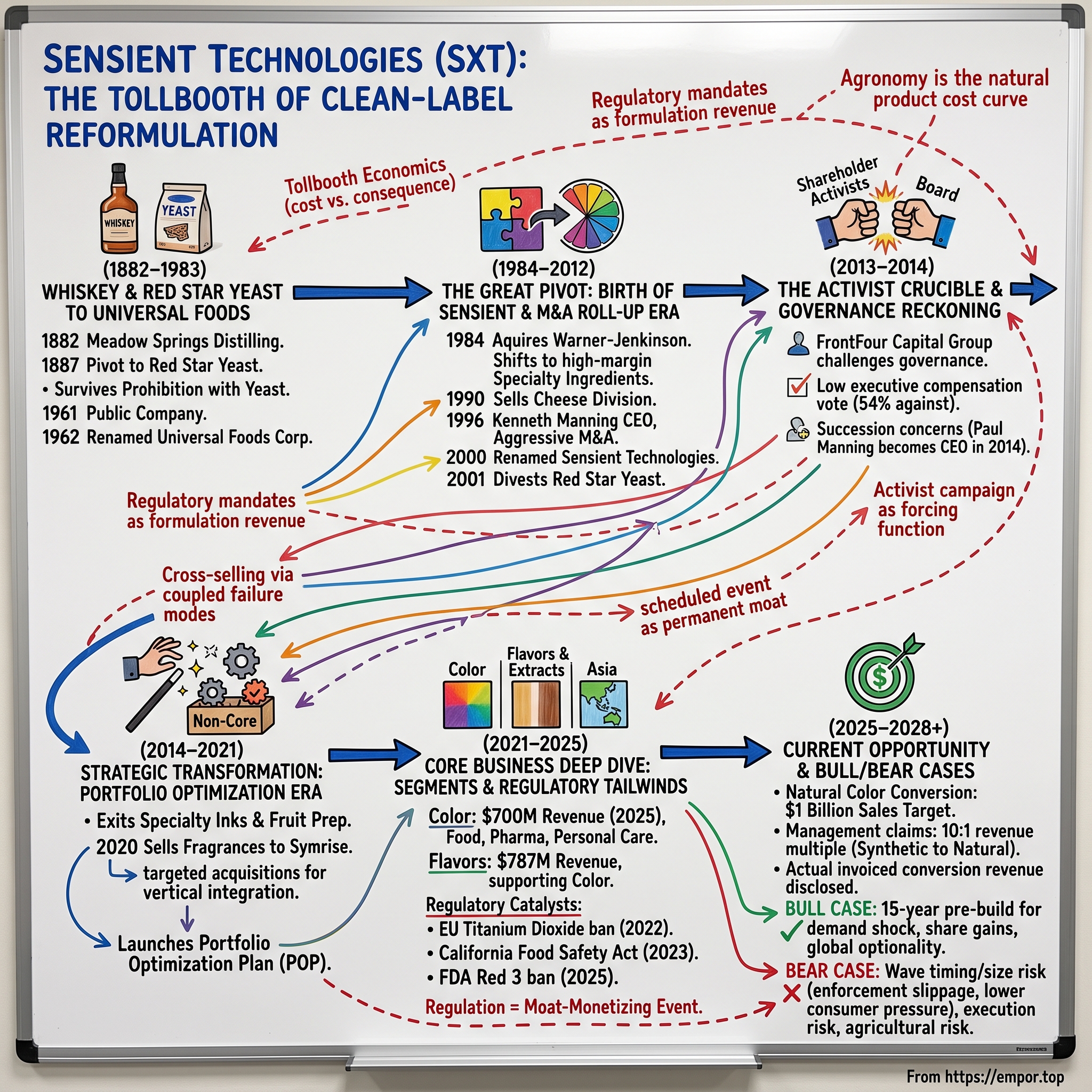
Sensient Technologies: The Tollbooth of Clean-Label Reformulation
I. Introduction & Episode Roadmap
A walk through an American supermarket in the summer of 2026 reveals a quiet industrial revolution. The strawberry milk in the dairy case is a subtly different shade of pink than it was eighteen months ago. Gummy bears have been reformulated. Frosting at the in-store bakery no longer bleeds into the cake sponge. None of these changes are advertised loudly, and few shoppers notice them. Yet nearly all of them required technical centers in Milwaukee, St. Louis, Lima, or Istanbul to solve a challenge food scientists had anticipated for two decades: making natural beet extract match the visual stability and intensity of Red 40.
The company behind a substantial share of those reformulations is Sensient Technologies Corporation, an ingredient supplier largely unknown to consumers despite its ubiquity in household food products. Sensient manufactures colors, flavors, and extracts for major global brand owners. In fiscal 2025, the company generated $1.61 billion in revenue and $207.1 million in operating income, earning $3.16 per diluted share.1 It employs roughly 4,070 people globally, with 807 working in research, quality assurance, agronomy, and technical roles — an unusually high concentration of specialized technical personnel for a specialty chemical supplier.2 Sensient has also paid an uninterrupted quarterly dividend since 1962.2
Sensient's ingredients represent a modest percentage of a finished product's bill of materials, yet carry disproportionate commercial risk. Color is a minor cost input in packaged foods, but it serves as the primary visual trigger for consumer perception. Pharmaceutical tablet coatings similarly cost a fraction of a cent per pill, while remaining a locked specification in regulatory filings. Cosmetic pigments dictate visual performance in personal care products. In each category, the ingredient functions as a tollbooth item: inexpensive to purchase, but high-risk to replace or bypass.
The central question is how a 144-year-old Milwaukee whiskey distillery built and maintained these positions. The company's trajectory spans Prohibition, a 1960s conglomerate expansion, a contentious 2014 shareholder revolt, and a decade-long portfolio restructuring that focused operations on three core segments. This evolution culminates in the middle of the largest food reformulation wave in a generation, driven by regulatory shifts across Europe and the United States restricting petroleum-derived synthetic dyes.
The company's trajectory follows six key phases. First is the century-long transition from Meadow Springs Distilling to Red Star Yeast, Universal Foods, and ultimately Sensient. Second is the roll-up era under Kenneth Manning, which expanded the asset base while creating operational complexity. Third is the 2014 activist campaign, in which FrontFour Capital Group challenged governance, capital allocation, and executive succession, culminating in a shareholder vote against the executive compensation proposal. Fourth is the divestment period, during which Sensient exited fragrances, inks, and underperforming dehydrated onion operations. Fifth is the construction of its competitive moat through high switching costs, agronomic capabilities, and regulatory catalysts. Finally, the analysis evaluates the bull and bear cases, examining the evidence behind Sensient's position in the natural color transition.
Evaluating those claims is essential. Management has told investors the U.S. natural color conversion represents "the single largest opportunity in Sensient's history" and has targeted $1 billion in total natural color sales.3 That target is ambitious for a business whose entire Color group generated $700.6 million in revenue in 2025.1 Assessing whether this figure serves as a reliable forecast or a long-term aspiration requires tracking management's disclosures of actual invoiced conversion revenue.
A central structural theme defines the company: Sensient is not primarily a growth business benefiting from an unexpected regulatory shift. Rather, it is a specialty supplier that spent decades establishing high customer switching costs, and is now capturing value as external regulatory timelines accelerate demand. The analytical focus rests on evaluating the durability of those capabilities against the timeline of regulatory conversion.
Understanding why this position is durable requires examining the origin of a distillery that survived 1919.
 Subscribe on LinkedIn
II. From Whiskey & Red Star Yeast to Universal Foods (1882–1983)
In December 1882, three Milwaukee entrepreneurs — Leopold Wirth, Gustav Niemeyer, and Henry Koch Jr. — incorporated the Meadow Springs Distilling Company.4 The firm shipped its first barrel of whiskey on July 5, 1883.4 Late nineteenth-century Milwaukee was a center for German immigrants, malt houses, and brewing capital, making a new distillery an unexceptional enterprise. What made this firm durable was an unexpected byproduct.
Distilling generates yeast. In 1887, the firm renamed itself the National Distilling Company and began selling that yeast commercially under the Red Star brand.4 For three decades, yeast remained a side venture. Then the Eighteenth Amendment arrived, making the sideline the core business. By 1919, the company had reorganized as the Red Star Yeast and Products Company, and whiskey production ceased.4 Sensient's corporate history summarizes the shift simply: founded in 1882 as a producer of whiskey and gin, the enterprise survived Prohibition by pivoting to yeast.5
This transition revealed a structural pattern. Sensient was not built on a single foundational idea from a visionary founder. Instead, at four distinct junctures across 140 years, the company discovered that its primary commercial opportunity lay adjacent to its original core. That recurring adaptiveness represents the most consistent strategic trait in its history.
The 1919 pivot was remarkable given the era's context. Prohibition eliminated much of the American distilling industry, yet Red Star survived because its secondary product — previously sold as a bulk item to bakers — had established a consumer brand with retail shelf presence in home kitchens. When distilling became illegal overnight, the business did not need to build a customer base from scratch; it already owned space in the baking aisle. Sensient's most valuable assets have repeatedly emerged from quiet sidelines of its primary operations.
When Prohibition ended in 1933, Red Star did not resume whiskey production. By 1937, the firm formally designated yeast as its core business.4 It went public in 1961 on $12.1 million in sales and renamed itself Universal Foods Corporation in 1962 — a title reflecting broad ambition rather than current operations.4 That expansionist mindset mirrored the era. During the 1960s conglomerate wave, capital markets rewarded diversification, encouraging firms with healthy balance sheets to acquire unrelated assets.
Universal Foods followed that strategy. It acquired Stella Cheese Corporation in 1963, and by 1968 controlled roughly 20% of the U.S. aged Italian cheese market.4 Through the 1970s, it expanded into soft-drink bottling by acquiring 7-Up franchises, and added gourmet food operations. The company listed on the New York Stock Exchange in 1977.45 By the early 1980s, Universal Foods operated a broad conglomerate portfolio out of Milwaukee — selling yeast, cheese, bottled soda, dehydrated vegetables, and specialty foods primarily into the American grocery channel.
The underlying economics were difficult. Cheese was a thin-margin spread business tied to raw milk prices. Bottling was a regional franchise operation dependent on sugar, aluminum, and route distribution density. Dehydrated vegetables depended heavily on crop yields and weather. Each segment shared three structural vulnerabilities: input costs were dictated by unhedged commodities, output prices were constrained by powerful grocery buyers with easy substitutes, and capital intensity remained high.
Such structural dynamics capped returns on invested capital regardless of operating efficiency. The company lacked pricing power to capture economic surplus. When milk prices fell, retail buyers negotiated lower prices; when milk prices rose, processors absorbed the cost until price increases could be pushed through to reluctant retail buyers. This margin squeeze defined mid-century food processing, driving the wave of industry consolidation, debt-leveraged buyouts, and corporate breakups in the 1980s. Conglomerates of this model appeared profitable when inflation expanded nominal revenues, but suffered under return-on-capital metrics.
The structural shift was clearest in retail distribution. As American grocery chains consolidated in the early 1980s, market power shifted decisively away from mid-sized regional processors. Selling cheese, soda, and dried onions provided Universal Foods with little defensive leverage against supermarket buyers. Conversely, supplying proprietary, formulation-locked color specifications directly to consumer brand manufacturers — operating one step upstream and invisible to retailers — offered significant pricing power and customer stickiness.
Universal Foods executed this strategic pivot through an asset swap rather than a standard cash purchase, reflecting the board's assessment of its existing operations. In 1984, the company traded four 7-Up bottling plants to Philip Morris for St. Louis-based food color manufacturer Warner-Jenkinson Company and roughly $10 million in cash.4 Though modest on paper, the transaction marked a decisive turning point in the corporate narrative.
Inside Warner-Jenkinson, Universal Foods acquired a fundamentally different business model. Food colorings are not generic commodities chosen solely on price. They are precise, proprietary specifications. A customer's product formula is engineered around the color, extensively tested against it, and — in pharmaceuticals and regulated food categories — formally registered in regulatory filings. The ingredient supplier acts as an integrated technical partner in product development rather than a transactional vendor. Consequently, gross margins are higher, capital requirements per dollar of revenue are lower, and established customer relationships face high switching barriers.
The operational contrast was stark. A commodity cheese buyer routinely compares prices among multiple suppliers. A specialized color buyer relies on the supplier whose application scientists spent months in the customer's pilot plant perfecting a shade under specific heat, light, and acidity conditions. The former is a price negotiation; the latter is an embedded technical dependency. Universal Foods had spent a century on the wrong side of that dynamic.
Having spent a hundred years learning that commodity processing meant permanently yielding margin to input suppliers or retail channels, Universal Foods acquired a business built on structural switching costs in 1984. Over the next sixteen years, the company systematically reshaped its portfolio around that high-margin specialty model.
III. The Great Pivot: Birth of Sensient & The M&A Roll-Up Era (1984–2012)
The dismantling took longer than the initial expansion phase had. In 1990, under Chief Executive Guy Osborn, Universal Foods sold its cheese division, which then generated $873 million in annual revenue — signaling board recognition that scale in dairy did not translate into high-margin value.4 With the bottling assets already gone, the remaining company reoriented around colors, flavors, and yeast, though yeast served as an increasingly awkward legacy.
In October 1996, Kenneth P. Manning became president and chief executive.4 Manning was the central figure of Sensient's second act, and his strategic orientation was aggressively acquisitive. Under his leadership, the company purchased flavor, color, aroma, and pigment businesses across North America, Europe, and Asia through the late 1990s, reaching $920.2 million in revenue by 1999.4 The underlying logic was straightforward: specialty ingredients is a sector driven by technical breadth, and technical breadth could be acquired faster than it could be built organically. Every acquired entity brought formulas, application laboratories, customer relationships, and regulatory registrations that would have required years to develop internally.
In 2000, the company renamed itself Sensient Technologies Corporation, replacing Universal Foods with a title derived from "sense" — signaling a pivot toward sensory attributes rather than retail groceries.5 The rebrand coincided with portfolio restructuring. In August 2000, Sensient announced the sale of Red Star Yeast to French group Lesaffre et Compagnie; after the U.S. Department of Justice raised antitrust concerns, the transaction closed in February 2001 for $113 million in cash, with Sensient retaining a 20% stake in Minn-Dak Yeast Company.4 The enterprise that had been saved by yeast in 1919 divested its core yeast operations in 2001. The transition from food processor to specialty ingredient supplier was complete on paper.
Manning continued acquiring assets. The roll-up expanded Sensient into adjacent color markets that shared similar gross margin potential but served distinct customer bases. Cosmetic colors and personal-care ingredients provided access to beauty brand owners, where pigment performance — particle light scattering and shade consistency across skin tones — represents the primary product attribute. Pharmaceutical colors and tablet coatings positioned Sensient inside regulated drug manufacturing, where a coating system performs vital functional work by protecting active ingredients, controlling dissolution rates, and enabling pill identification, and where the supplier is explicitly designated in regulatory filings.
Among these categories, pharmaceutical applications offered the strongest structural defense. A tablet coating operates as a functional film rather than simple ornamentation: it masks taste, protects active compounds from moisture and light, controls release timing in the digestive tract, and provides the visual identity that distinguishes medications for patients and pharmacists. Modifying a coating formula requires amending regulatory documentation — establishing switching costs enforced by statutory mandate rather than customer preference. This regulatory locking mechanism turned pharmaceutical colors and coatings into a highly defensible revenue stream.
Sensient also expanded into specialty industrial applications, including digital inkjet inks. While technically sharing color chemistry, industrial inks operated under a fundamentally different commercial model. Inkjet formulations competed on chemical specifications, price, and printhead compatibility against major chemical manufacturers, shared no customer overlap with food or pharmaceutical divisions, and lacked the formula-lock characteristics that protected Sensient's core portfolio. In retrospect, this expansion illustrated a common roll-up error: mistaking a shared technical vocabulary for a shared business model.
By the late 2000s, Sensient appeared to have validated its strategy. The firm had exited commodity food processing, achieved global scale within specialized markets, and operated under a chief executive who had led the company for over a decade. Beneath the top-line performance, however, three operational and governance challenges were compounding.
The first challenge was operational fragmentation. A roll-up assembled over fifteen years across dozens of transactions inherited dozens of manufacturing facilities, disparate IT infrastructure, and an expansive tail of stock-keeping units (SKUs). Because each SKU represented a customer's specific formulation, retiring low-volume products proved difficult. In specialty ingredients, this structural dynamic often causes ongoing capital expenditure to absorb operating leverage.
The SKU proliferation problem remains central to specialty chemical and ingredient economics. Unlike standard consumer goods that can be rationalized based on sales volume, every specialty ingredient SKU represents a customer-qualified, tested, and potentially registered formulation. Discontinuing a low-volume product is therefore a relationship and regulatory decision rather than a simple inventory choice. Over time, operational complexity accumulates, transforming an ingredient supplier into a custodian of historical customer specifications with an elevated cost structure.
The second challenge involved revenue quality. A significant portion of Sensient's revenue remained exposed to commodity fluctuations. The dehydrated vegetable business — consisting of onion, garlic, and capsicums grown under annual agricultural contracts in the western United States — represented agricultural processing with an industrial drying stage.2 Its financial results fluctuated with crop yields, weather patterns, and farmer planting decisions. Simultaneously, industrial inks competed strictly on price against major chemical firms. These business lines diluted corporate operating margins and complicated long-term financial modeling for investors.
The third challenge centered on corporate governance. Extended director tenure alongside a long-serving chief executive created an environment vulnerable to oversight drift. By 2014, an activist shareholder campaign highlighted that average director tenure reached thirteen years, only one independent director had joined the board in eight years, and four directors averaged twenty years of service.6 While not inherently improper, these conditions reduced board independence and delayed scrutiny of capital allocation efficiency.
Capital markets increasingly reflected these operational friction points. Activist investors noted that Sensient's capital expenditure relative to industry peers was roughly double, while projected revenue and adjusted earnings growth lagged behind sector benchmarks, and the firm failed to earn its cost of capital in six of the preceding ten fiscal years.6 This financial profile exhibited the classic signature of an un-integrated roll-up that purchased top-line growth without capturing operational efficiencies. Operating margins in the flavors and fragrances division declined from 16.1% in 2009 to 13.9% in 2013.6
This margin compression highlighted a deeper structural issue. In genuine specialty ingredient markets, input cost inflation is routinely passed through to customers, and product mix improves over time. Multi-year margin compression in a specialty segment indicates that a portion of the product portfolio lacked true pricing power and was sold on volume and price rather than proprietary technical dependency. Activist investors subsequently outlined a $75 million cost-reduction opportunity to address these operational inefficiencies.6
When the board announced its executive succession plan in 2013, the underlying tensions escalated into a public proxy dispute.
IV. The 2014 Activist Crucible & Governance Reckoning
On April 24, 2014, Sensient's shareholders gathered for the annual meeting.7 The company had spent months in a proxy contest with FrontFour Capital Group, a Greenwich-based activist fund that had nominated four candidates—James R. Henderson, James E. Hyman, Stephen E. Loukas, and William E. Redmond Jr.—for election to the board. Sensient, represented by Jones Day, successfully defended its slate.8 By the standard scorekeeping of proxy contests, management won.
It did not feel like winning. On the advisory vote on executive compensation, 19,324,925 shares were cast in favor and 22,552,943 against, with 3,478,816 abstaining.7 Roughly 54% of the voting shares rejected the pay package.
To appreciate how unusual that outcome was, consider the baseline. Say-on-pay votes in the United States routinely pass with more than 90% support; outright failures occur in low single-digit percentages of the Russell 3000 in a typical year, and governance researchers track individual rejections by name. Although advisory and non-binding, the vote carries immense weight precisely because shareholders have no formal power to compel change—making a rejection a pure act of public signaling. It demonstrates that shareholders no longer trust board oversight. A board can survive such a vote, but it cannot ignore the signal or expect the following year's proxy season to be simple.
The substance of FrontFour's campaign rested on three main arguments, requiring a distinction between verifiable financial metrics and rhetorical framing.
The first was performance. FrontFour argued that Sensient had underperformed its specialty ingredient peers on total shareholder return and had failed to earn its cost of capital across most of the preceding decade. This was a verifiable argument regarding capital allocation: deploying substantial capital without generating commensurate incremental return constituted the strongest element of the activist case.
The second was governance and executive succession. Kenneth Manning was retiring as chief executive, and the board had elevated Paul Manning, then president and chief operating officer, effective February 2, 2014.9 Paul Manning had joined Sensient in 2009 as general manager of Food Colors North America, became president of the Color group in 2010, and was appointed president and chief operating officer in October 2012.9 He holds a bachelor's degree in chemistry from Stanford University and an MBA from Northwestern University.10 FrontFour's characterization was blunt: it described Paul Manning as the son of the outgoing chief executive, noting that another son, John Manning, had been named a vice president.6 The activist also highlighted interlocking board relationships—Kenneth Manning, William Hickey, and Hank Brown all served together on the board of Sealed Air, where an acquisition had preceded a severe stock decline and a $1.2 billion write-down.6
The third was compensation. FrontFour claimed that Kenneth Manning and general counsel Richard Hobbs had received compensation above direct industry peers and had monetized roughly $70 million of stock and options over ten years while never purchasing shares on the open market.6 Regardless of individual figures, the argument resonated with proxy advisory firms and ultimate shareholders.
Examining the succession dispute requires careful distinction. A family succession does not inherently represent poor governance, nor does an internal promotion automatically constitute nepotism. Paul Manning had led the Color group—the segment that ultimately emerged as the company's most valuable asset—for four years before becoming chief operating officer, backed by a directly relevant technical background. The substantive governance concern was not that the new chief executive shared a surname with the outgoing leader. Rather, it was that a long-tenured, interlocked board with minimal recent refreshment selected an insider without a visible external search process at a firm facing simultaneous criticism over capital efficiency.
Furthermore, FrontFour's own financial arguments presented a logical contradiction regarding succession. The activist argued that Sensient had underperformed peers by 95% and 90% over three- and five-year periods, respectively—spans that overwhelmingly predated Paul Manning's appointment as chief executive in February 2014.6 One cannot logically cite a decade of historical underperformance to criticize the incumbent regime while simultaneously attributing that legacy to an incoming executive. Activist presentations are advocacy documents, requiring readers to separate core financial facts from persuasive framing.
The 2014 proxy contest served as a pivotal moment because of how it altered incentives for the incoming chief executive. Paul Manning inherited a corporation whose shareholders had formally recorded a vote of no confidence regarding board compensation decisions, alongside an activist case alleging chronic capital misallocation. He also inherited an operational structure assembled through decades of acquisitions, where divesting business lines carried an implicit admission of past strategic errors.
Successors in family-linked leadership transitions rarely dismantle inherited structures. The prevailing behavioral pattern is to preserve a predecessor's portfolio long past its commercial utility. Kenneth Manning remained board chairman—a position he had held since 1997—until Paul Manning succeeded him on April 21, 2016, upon the elder Manning's retirement from the board.11 The transition proceeded gradually, offering ample opportunity for strategic continuity.
While many chief executives in that setting defend inherited assets, subsequent evidence shows that Paul Manning systematically dismantled them. The fragrance business was sold. The digital inks division was divested. The dehydrated vegetable operation was restructured rather than expanded. Subsequent acquisitions became targeted, technical, and infrequent rather than large and continuous. Whether this shift reflected internal conviction or external pressure cannot be definitively determined from public disclosures; for investors, the distinction is secondary to the sustained change in capital allocation behavior.
The governance arc closed twelve years later. At the annual meeting on April 23, 2026, shareholders approved the advisory compensation proposal with 37,494,068 votes in favor and 1,158,895 opposed, while re-electing all nine director nominees.12 That 97% approval rate represented a complete reversal of the 2014 vote. While high approval does not guarantee an optimal compensation structure, it demonstrates that the credibility deficit created in 2014 has been resolved.
The 2014 proxy battle was neither a simple victory for activist pressure nor a routine defense by incumbent management. A company possessing a strong core asset—a comprehensive color business built through acquisitions—had allowed an uncompetitive capital allocation and governance structure to develop around it. The core technical asset remained viable; the administrative discipline surrounding it required overhaul.
The mechanism for that overhaul was a decade of strategic divestment and simplification.
V. Strategic Transformation: The Portfolio Optimization Era (2014–2021)
Following the 2014 proxy battle, Sensient shifted from aggressive M&A roll-ups toward systematic portfolio simplification, unwinding non-core assets to focus on specialty formulation.
Sensient began by exiting operations that lacked strategic fit. The company divested its specialty industrial inks operation, which competed on price against major chemical firms without sharing customer overlap with core food or pharmaceutical lines. Sensient similarly sold a yogurt fruit preparation business.13 While modest in isolation, these sales eliminated non-core revenue streams that diluted operational focus.
The largest divestiture occurred on November 23, 2020, when Sensient announced the sale of its Fragrances business — including its aroma chemical and fragrance compounding facility in Granada, Spain — to Symrise.13 Neither party disclosed the purchase price, though Symrise reported that the unit generated approximately €77 million in fiscal 2019 revenue. Chief Executive Paul Manning stated that the sale aligned with plans to focus the portfolio and position Sensient as an advanced provider of specialty ingredients.13
The transaction reflected pragmatic scale considerations. While fragrance compounding offers attractive gross margins, the industry is dominated by large global suppliers such as Givaudan, Firmenich, IFF, and Symrise. Generating under €100 million in annual revenue left Sensient without the scale required to compete effectively. Divesting the division reduced reported top-line growth but redirected capital toward core operations where the company held defensible positions.
Evaluating divestitures requires distinguishing between temporary top-line reduction and long-term capital discipline. Removing profitable but sub-scale assets lowers reported revenue immediately while freeing management attention and capital for higher-return opportunities. That capital reallocation proved effective in colors, though the strategic logic remained more complex in agricultural ingredients.
Sensient retained its agricultural ingredients division — supplying dehydrated onion, garlic, capsicums, and other vegetables contracted annually with growers in the western United States — representing the most commodity-exposed unit on its balance sheet.2
The risks of retaining agricultural processing materialized in 2025. The division faced lower sales volumes and elevated crop costs throughout the year, culminating in late fourth-quarter weather disruptions. Atmospheric river rains in California disrupted harvesting, which, combined with plant operational delays, resulted in a $3 million one-time inventory write-down.3
The strategic rationale for retaining the unit rests on supply integration. Dehydrated vegetables serve as core raw materials for savory flavor formulations; controlling the agricultural supply chain provides cost advantages and raw material assurance that pure formulators lack. Management characterized 2025 as an operational trough, noting on its year-end conference call that the division had reached a revenue inflection point and harvested its largest crop on record, while framing the severe weather impacts as non-recurring.3 While securing a record harvest addresses historical inventory shortages, the division's earnings remain inherently tied to annual crop cycles.
Alongside divestitures, Sensient launched a formal restructuring initiative. The company introduced its Portfolio Optimization Plan in the fourth quarter of 2023, targeting facility optimization, administrative centralization, headcount reductions, and global operational efficiency.2 The program required $15.8 million in pre-tax charges during 2025 — equal to $13.8 million after tax — including $6.3 million recorded in the fourth quarter.1 In its fiscal 2025 annual report, Sensient noted that planned restructuring actions were substantially complete, while cautioning that long-term cost savings depend on successful capacity rationalization and smooth operational execution across consolidated plants.2
In place of broad M&A roll-ups, Sensient adopted a targeted acquisition strategy focused on controlling the natural color supply chain from agricultural inputs to finished formulations — a strategy marketed as "seed to shelf."
On March 14, 2018, Sensient acquired the natural color business of GlobeNatural in Lima, Peru, adding carmine, annatto, and anthocyanin extraction capacity.14 Carmine, derived from cochineal, and annatto are among the most supply-constrained natural colorants globally, with Peru serving as a primary sourcing hub. Chief Executive Paul Manning cited supply security, cost stability, and sustainable sourcing as key acquisition drivers.14 The facility now functions as Sensient's Lima processing site, providing an internal supply of carmine, annatto, and botanical extracts.2
On July 10, 2018, Sensient acquired Mazza Innovation, a Vancouver-based extraction company utilizing pressurized water technology to extract botanical compounds without chemical solvents.15 Traditional botanical extraction relies on organic or petroleum-derived solvents that require subsequent removal, leaving potential trace residues. Mazza's pressurized water process eliminates chemical solvents entirely, aligning directly with food, cosmetic, and nutraceutical brand requirements for clean-label product positioning. Manning highlighted the technology as a driver for cost-effective, clean-label product development.15
Sensient continued adding targeted technical capabilities in 2025. On February 14, 2025, the company acquired Biolie SAS, a French natural extraction firm, for $4.9 million in cash, net of $200,000 in assumed debt.2 Founded in 2012 based on research at the University of Lorraine, Biolie developed patented enzymatic extraction methods that use enzymes rather than solvents or high heat to break plant cell walls.16 The unit was integrated into Sensient's beauty business, which maintains its headquarters and primary manufacturing operations in France.16 The modest purchase price reflected a focused acquisition of specific processing technology rather than capital expansion.
Agronomic development forms the final element of the upstream strategy. Synthetic dyes are highly concentrated chemical compounds, whereas natural color extracts are inherently dilute, requiring higher volume to achieve equivalent shade intensity. This ratio dictates the "cost-in-use" for food manufacturers — the key financial metric determining whether reformulating with natural colors is commercially viable.
Sensient addresses cost-in-use through selective seed breeding. The company developed Purple Royale, a patent-pending non-GMO black carrot strain bred specifically for high anthocyanin concentration and root volume.17 Sensient operates vertically integrated black carrot farming and processing alongside a natural food colors plant near Istanbul, Turkey.2 According to regulatory filings, other key botanical inputs — including beta-carotene, beet, potato, butterfly pea flower, spirulina, and paprika — are secured through local grower and extraction partnerships.2
Proprietary seed strains and solvent-free extraction aim to lower customer cost-in-use relative to open-market ingredient buyers. However, vertical integration provides a durable advantage only if upstream assets are scarce and difficult to replicate. Land contracts alone offer limited barrier to entry; management acknowledged that agricultural expansion by competitors has increased acreage dedicated to color crops.3 While proprietary genetics and specialized extraction represent stronger technical barriers, their net impact on formulation economics remains unquantified in public disclosures.
By 2025, accelerating regulatory mandates across major markets forced packaged food manufacturers to begin large-scale natural color conversions.
VI. Core Business Deep Dive: Segments, Economics, & Regulatory Tailwinds
Sensient reports three segments, and understanding them requires understanding that they are not equally important to the investment case.
The Color group generated $700.6 million of revenue in 2025 and $141.3 million of operating profit, with revenue up 8.1% and profit up 18.2% over the prior year.1 Its adjusted EBITDA margin improved to 23.7% from 22.1%.3 The group spans three quite different end markets: food and beverage colors, pharmaceutical colors and coatings, and personal care and cosmetic ingredients. Combined with Flavors & Extracts and Asia Pacific, Color contributed just over half of the three groups' aggregate operating profit on roughly two-fifths of their aggregate revenue. That asymmetry is the entire reason the stock behaves the way it does.
The Flavors & Extracts group was the largest by revenue at $786.9 million but delivered $100.7 million of operating profit — revenue down 0.9%, profit up 3.8%.1 Within it, the flavors, extracts and flavor ingredient product lines grew 3.4% in local currency with significant profit growth, while the agricultural ingredients business dragged.3 Its adjusted EBITDA margin of 16.7% is respectable for a formulation business and structurally below Color's, which is what you would expect: flavor formulation is more customized, more competitive, and lacks the regulatory chokepoints that make color sticky.
The Asia Pacific group is managed geographically rather than by product, and generated $168.2 million of revenue and $36.6 million of operating profit in 2025.1 It is the smallest and, by margin, competitive with Color. It maintains local technical support and sales offices in China and Indonesia and research and development in Singapore.2 Its 2025 was disrupted — fourth-quarter local currency revenue fell 1.9% on supply chain disruptions caused by tariff activity — which is a useful reminder that a regionally managed segment carries macro exposure the product segments do not.3
Within Color, the three sub-lines behave quite differently and are not disclosed separately, which is a real limitation for outside analysis. Food and beverage colors is the sub-line driving the current story. Pharmaceutical colors and coatings is the slowest-moving and most defensible, sold through Sensient's pharmaceutical unit alongside coating systems marketed under the Instacoat name.18 Personal care and cosmetic ingredients is the most cyclical, tied to beauty industry inventory cycles and to a customer base that reformulates for fashion reasons at least as often as regulatory ones.19 Management referenced personal care and pharma both performing strongly on the Q2 2026 call, but investors cannot verify the mix independently — a meaningful disclosure gap given that Color is now the segment on which the entire equity story rests.20
One further structural point about the Flavors & Extracts group deserves stating, because it changes how the segment should be valued. Its slower growth and lower margin make it look, on the surface, like the part of the portfolio a focused investor would want sold. That reading is probably wrong. The flavor organization is what allows Sensient to solve the second-order problems its own color conversions create — off-notes, texture changes, processing behavior — and a color company without a flavor company beside it has to send the customer somewhere else to finish the job. The segment's strategic value is partly as insurance on the Color group's growth, which does not show up anywhere in its own margin line.
Consolidated gross margin was 33.5% in 2025, and research and development costs, which Sensient records inside selling and administrative expenses rather than as a separate line, were $52.9 million.2 That is roughly 3.3% of revenue — modest against pharmaceutical benchmarks, substantial against food processing ones, and appropriately placed for a company whose R&D is mostly applied formulation work done alongside customers rather than blue-sky discovery.
Regulation as accelerant, not moat
The most important thing to say clearly is that regulation is not Sensient's moat. Regulation is the event that makes Sensient's existing moat monetizable, on a schedule, all at once. The distinction matters because moats persist and events do not.
The sequence began in Europe. In May 2021 the European Food Safety Authority concluded that titanium dioxide could no longer be considered safe as a food additive, citing an inability to rule out genotoxicity. The European Commission adopted Regulation (EU) 2022/63 on January 14, 2022, withdrawing the authorization for E171; after a six-month transition, food produced or placed on the EU market after August 7, 2022 could not contain it.21 Titanium dioxide is the workhorse opacifier of the food and pharmaceutical world — the thing that makes a tablet coating white and opaque, or a frosting bright rather than translucent. Replacing it is genuinely hard, because white is not a pigment problem, it is a light-scattering problem.
Sensient's answer is its Avalanche portfolio, marketed for softgels, hard capsules, tablets, lozenges and gummies, which the company says it developed over nearly a decade in anticipation of exactly this need.22 Whether Avalanche captured "dominant" share is not something any public disclosure establishes; what the European ban did establish is that a supplier who had spent ten years pre-building a replacement was in a very different position from one who started in 2022.
The American sequence has been faster and messier. California Governor Gavin Newsom signed Assembly Bill 418, the California Food Safety Act, on October 7, 2023, banning the sale of food containing FD&C Red No. 3, potassium bromate, brominated vegetable oil and propylparaben effective January 1, 2027, with civil penalties up to $5,000 for a first violation and $10,000 thereafter.23 One detail is frequently misreported: titanium dioxide was in the original bill and was removed before passage.23 California banned four additives, not five.
Federal action followed. On January 15, 2025 the FDA revoked the authorization for FD&C Red No. 3 in food and ingested drugs, invoking the Delaney Clause on the basis of rat carcinogenicity data — while noting the mechanism is species-specific and that the evidence does not show human health risk at relevant exposures.24 Food manufacturers were given until January 15, 2027 to reformulate; drug manufacturers until January 18, 2028.2425 Then on April 22, 2025, HHS and the FDA announced a broader intention to phase petroleum-based synthetic dyes out of the U.S. food supply — initiating revocation for Citrus Red No. 2 and Orange B, and stating an intention to work with industry to eliminate Blue 1, Blue 2, Green 3, Red 40, Yellow 5 and Yellow 6 by the end of 2026.26
That last action is where investors should be most careful. Red 3 is a legal revocation with statutory deadlines. The six remaining dyes are, so far, an announced intention to work with industry — not a rule. The difference between a rule and an understanding is the difference between a contract and a hope.
It is also worth noting what the FDA actually said about the science, because the popular version of this story is wrong in a way that matters for durability. The agency's own position was that the Delaney Clause compelled revocation because Red 3 induced cancer in male rats through a species- and sex-specific hormonal mechanism, while the evidence did not establish human health risk at relevant exposures.24 In other words, the ban is a statutory obligation triggered by animal data, not a finding of consumer harm. That distinction does not slow the reformulation wave — brands must comply either way — but it does mean the regulatory logic could evolve, and it explains why some of the broader dye phase-out has proceeded through industry commitments and consumer pressure rather than rulemaking.
States have added their own pressure and their own uncertainty. West Virginia enacted House Bill 2354, which banned seven synthetic dyes from school meals effective August 1, 2025 and would extend a statewide ban to foods and drugs from January 1, 2028.27 On December 23, 2025, a federal judge in the Southern District of West Virginia preliminarily enjoined enforcement of the 2028 provisions pending litigation; the school-meal provisions already in force were not enjoined.28 Asked about this on the Q4 2025 call, Paul Manning argued that customer commitment was no longer legislation-dependent — that conversion was being driven by what consumers in the U.S. and Canada want, and pointed to Walmart's stated intention to convert sooner than the industry's 2028 deadlines.3 That may be true. It is also exactly what a management team would say about an adverse legal ruling, and it should be treated as a claim to be tested rather than a fact.
Why brands cannot run two recipes
The mechanism that turns state-level rules into national reformulation is worth spelling out, because it is the load-bearing assumption of the entire thesis. A national brand could theoretically ship a California-compliant version and a Texas version. In practice it will not, because doing so doubles the number of formulas, packaging plates, artwork approvals, warehouse SKUs, production changeovers and quality specifications, and creates the permanent risk that the wrong pallet ends up in the wrong distribution center — a compliance failure and a public-relations problem simultaneously. The cheapest path is one recipe that satisfies the strictest jurisdiction. This is the same logic by which California's vehicle emissions rules historically set the national standard, and it is well understood by every food company's regulatory affairs department.
The conversion math, and what has actually been invoiced
Sensient's stated opportunity rests on an arithmetic identity management has repeated across multiple calls. The company has roughly $100 million of synthetic color revenue with the potential to convert, and conversions to natural colors carry revenue multiples of approximately 10 to 1 on average to achieve a comparable shade.3 Ten times $100 million is the $1 billion goal. The multiple is not a price increase; it reflects the far higher usage rates natural colors require, which the 10-K explicitly identifies as the reason conversion demands complete reformulation of customer product formulas.2
The important development is that management began disclosing what it has actually billed. Roughly $5 million of conversion revenue was invoiced across the third and fourth quarters of 2025.3 Cumulative invoiced conversion revenue reached about $20 million by the end of the first quarter of 2026.29 In the second quarter of 2026 alone, the Color group invoiced approximately $25 million.20 Manning explained the translation on the Q2 call: a quarter's invoicing typically represents about four times that in projected annualized revenue for the launched products, though he cautioned that conversions distort the normal pattern because retailers work through synthetically colored inventory first, meaning early purchase orders can understate the eventual run rate.20
Take that at face value and the current annualized conversion run rate is somewhere around $100 million and possibly higher — meaning Sensient is roughly a tenth of the way to its billion-dollar target, with conversion deadlines still ahead. That is real, measurable progress and it is also a long way from done. An analyst on the Q2 call did the arithmetic out loud: reaching $1 billion implies roughly $250 million of conversion invoicing per quarter by late 2028 or early 2029, and Manning agreed that was approximately right.20 Investors now have a quarterly number to track against a stated destination, which is a materially better disclosure regime than the industry norm.
Competitive position
Sensient is not the largest company in its industry and never will be. For fiscal 2025, Givaudan reported group sales of CHF 7,472 million, up 5.1% on a like-for-like basis.30 Symrise reported revenue of €4,929 million with organic growth of 2.8%.31 IFF reported approximately $10.9 billion of revenue for 2025 and has been actively reshaping its portfolio.32 dsm-firmenich, formed by merger, is larger still. Against that field Sensient is a specialist an order of magnitude smaller.
Its 10-K makes the more defensible claim: competition in color is diverse, with most competitors specializing in either natural colors and coloring foods or in synthetic dyes and pigments, and Sensient believes it gains advantage as the only major basic manufacturer of a full range of color products spanning both.2 That is a narrower and far more testable statement than "global number one," and it is the one investors should hold management to. In natural colors specifically, the credible competitive set includes the pure-play Oterra, the agricultural giant ADM, and the specialist Kalsec — companies that do not carry Sensient's combination of synthetic capability, pharmaceutical and personal care access, and upstream agronomy, but which are entirely capable of taking share in individual applications.
The scale gap has a real consequence that bulls tend to gloss over. Sensient's research and development budget is a fraction of Givaudan's or IFF's in absolute dollars, and if natural color becomes the single most attractive growth pocket in food ingredients, the larger players have both the capital and the customer access to buy their way in. The counterargument is that color is a peculiarly poor fit for a flavor house's organisation — different chemistry, different application science, different agronomy, different regulatory pathway — and that the industry's history of trying and retreating supports Sensient's position. But "they tried before and it did not work" is a weaker moat than "they cannot."
The competitive question that matters is not who is biggest. It is whether Sensient's ten-year head start on natural color chemistry and supply chain is a two-year lead or a ten-year lead once the industry's demand curve moves. On the Q2 2026 call, when an analyst raised IFF's divestiture of a functional and natural color unit, Manning declined to treat it as a threat and characterized the divested natural color exposure as smaller and concentrated in carmine and annatto — parts of the market he suggested Sensient plays in differently.20 The answer was confident and unquantified, which is how most competitive questions get answered on earnings calls.
VII. Playbook: Business & Investing Lessons
1. Tollbooth economics live in the gap between cost share and consequence share.
A specialty ingredient supplier can maintain pricing power through economic downturns, inflation, and retail consolidation because its product represents a minor share of a customer's total cost while determining a major share of the product's performance. A color or flavor system is a small line item in a bill of materials, yet it dictates visual appeal, taste, and regulatory compliance. Sensient's Form 10-K describes its source of competitive position in these exact terms: process and application expertise, product quality, technological advancement, and customer service, rather than price.2 The broader investment lesson centers on identifying suppliers whose customer failure mode results in a product recall or line shutdown rather than a simple price rebate.
To determine whether a supplier genuinely occupies a tollbooth position, investors can evaluate the operational consequences on the day a vendor fails to deliver. If a customer can switch to an alternative supplier at a slightly higher cost, the vendor lacks tollbooth economics. But if substituting an ingredient without re-qualifying the formula risks an off-spec batch, consumer complaints, or regulatory re-filing, the supplier holds structural pricing power. The underlying economics stem from the severity of the customer's failure mode rather than the vendor's absolute market share.
2. Regulatory bans convert commodity revenue into formulation revenue.
When regulatory mandates phase out synthetic dyes, ingredient suppliers do not simply lose a product line. Instead, they replace a low-cost, concentrated molecule with a complex botanical system requiring extensive application support, stability testing, and taste-masking formulation. Sensient's disclosures quantify this transition, projecting roughly ten dollars in natural color revenue for every dollar of synthetic color displaced to match the same shade.3 However, a ten-to-one top-line expansion on agriculturally sourced materials does not yield a ten-to-one profit expansion, and Sensient has not disclosed the precise gross margin percentage on conversion revenue.
3. In natural products, agronomy is the cost curve.
In natural ingredients, the ultimate operational constraint is neither customer demand nor chemical synthesis, but pigment yield per acre. The supplier that controls seed genetics, agricultural partnerships, and extraction efficiency dictates the final cost-in-use—the metric deciding whether a consumer brand reformulates a flagship product or discontinues it. Sensient has addressed this challenge by developing proprietary black carrot strains, establishing multi-continent farming contracts, and deploying solvent-free extraction. On the second-quarter 2026 conference call, Chief Executive Paul Manning stated that he aims to keep supply chain disruptions off earnings calls by holding buffer inventory on sensitive raw materials, maintaining secondary backup formulas, and contracting growers across both hemispheres to ensure year-round harvesting.20 This operational mitigation strategy represents concrete risk management rather than generic corporate reassurance.
4. Cross-selling is real when the failure modes are coupled.
Replacing synthetic dyes with higher concentrations of natural colorants frequently introduces off-notes—unintended flavors or aromas that distort established food profiles. Sensient's flavor division developed specialized taste-masking platforms to neutralize these sensory side effects, with Paul Manning noting on the second-quarter 2026 call that competing flavor houses lack a comparable incentive to focus on this intersection because they lack equivalent color operations.20 Regardless of whether that competitive claim holds universally, the strategic rationale remains compelling: the Flavors & Extracts segment's primary value extends beyond its standalone operating margin by addressing formulation challenges created by the Color group's conversion growth.
5. An activist campaign is a forcing function, not a verdict.
FrontFour Capital lost its 2014 board election but ultimately influenced corporate strategy. Sensient's subsequent capital allocation—divesting digital inks and fragrances, reducing acquisition size, and linking executive compensation to return on invested capital—aligned far more closely with FrontFour's critique than with management's initial proxy defense. For investors, the takeaway is to evaluate proxy contests for their diagnostic insight rather than the immediate vote tally, and to monitor whether identified capital inefficiencies are subsequently addressed over time.
The accompanying lesson centers on the multi-year timeline required for structural transformations to materialize in financial results. FrontFour launched its campaign in 2014, the fragrance divestiture closed in 2020, and the Portfolio Optimization Plan launched in late 2023 was completed in early 2026. The resulting operating margin expansion and conversion revenue growth became fully visible only in 2026. Throughout most of this twelve-year period, Sensient reported financial performance resembling that of an average mid-cap specialty supplier. Investors who wait for a full portfolio transformation to show up in trailing financial statements before acting risk missing the stock's valuation re-rating.
6. Beware the temptation to treat a scheduled event as a permanent moat.
Analyzing Sensient requires distinguishing between a durable competitive position in specialty formulation and a temporary, regulatory-driven step-change in market demand. The underlying switching costs represent the core asset, whereas the regulatory wave represents a finite harvest. Mistaking a temporary conversion wave for a permanent long-term growth rate creates valuation risk when demand eventually normalizes back toward historical mid-single-digit baseline levels. Management recognizes this transition, focusing recent commentary on prospective growth drivers across Latin America, Asia, pet food, over-the-counter pharmaceuticals, and personal care.20 While these end markets represent viable expansion opportunities, none carry the statutory compliance deadlines driving the current North American and European food reformulations.
VIII. Strategic Analysis: 7 Powers, 5 Forces, Management Audit, & Bear vs. Bull Case
Seven Powers: what is actually load-bearing
Under Hamilton Helmer's framework, Sensient's primary power is switching costs, and they are unusually well documented because management has described the mechanism in detail. Manning's account on the Q4 2025 call is worth paraphrasing precisely: reformulating a product with natural colors is functionally a new product launch. A brand that has sold the same formula for forty or fifty years faces formulation work, application testing, potentially consumer testing, six-to-twelve-month stability testing, compliance and labeling questions, and packaging redesign that can itself take six to twelve months. Get it wrong and the color looks off, the stability fails, or an unexpected taste appears — with, in his words, a hugely detrimental impact to the brand.3 That is switching cost stated as risk rather than as price, which is what makes it durable.
The pharmaceutical version is stronger still, because the coating system is named in regulatory documentation and changing it can require filings.
The secondary powers are weaker and should be labeled honestly. Process power — accumulated, hard-to-copy operating know-how — is plausible in extraction and application formulation, evidenced by the fact that the company employs 807 people in R&D, quality assurance, agronomy and laboratory functions and maintains most of its formulae as trade secrets rather than patents.2 Trade secrecy is a double-edged choice: it avoids disclosure but provides no legal exclusion. Cornered resource is the most-claimed and least-proven. Purple Royale genetics, the Mazza and Biolie extraction platforms, and the Avalanche opacifier portfolio are genuine assets, but the 10-K states plainly that the businesses are not materially dependent upon any particular patent, trademark or formula.2 That is management telling investors, in the required legal language, not to overweight the IP story.
Scale economies work against Sensient at the corporate level — it is far smaller than Givaudan, IFF or dsm-firmenich — and for it within the specific niche of full-range color manufacturing. There is no meaningful network effect, no branding power with end consumers, and no counter-positioning in the Helmer sense, since incumbents can and do sell natural colors.
Five Forces: where the pressure actually comes from
Buyer power is the force most commonly underestimated. Sensient's customers are among the most sophisticated procurement organizations on earth, and while switching a commercialized formula is expensive, specifying the next new product is not. Buyer power is therefore low on the installed base and high on new business — which is precisely why win rates on new launches, not price on existing volume, are the competitive battleground. Management's own emphasis on "new sales wins" quarter after quarter is an implicit acknowledgment of this.
Supplier power is genuinely elevated and the company's response is the vertical integration described earlier. Concentrated botanical inputs — carmine from Peru, spirulina, paprika, black carrot — have thin global supply and are exposed to weather and politics. The 2025 California rain event, and an ongoing antidumping and countervailing duty case involving paprika oleoresin imports from India that the 10-K explicitly flags as a cost risk, are both live illustrations.2
Threat of substitutes is currently low and directionally falling, because the substitute — synthetic dye — is being removed by law in a growing list of jurisdictions. But the honest version of this force includes a substitute management rarely discusses: no color at all, or less color. Manning addressed it directly and dismissed it, saying he could not think of a customer choosing to use less color to save money and that the vast majority are striving to match their existing synthetic shade.20 If that changes — if a major brand successfully markets a visibly paler product and consumers do not care — the ten-to-one multiple deflates.
Rivalry is moderate and idiosyncratic, since the 10-K notes Sensient competes with only a few companies across multiple product lines and generally encounters different competitors in different lines.2 New entrants face real barriers in application labs, regulatory registrations and grower networks, but the barriers are capital and time, not physics. The most credible entry threat is a large agricultural or chemical player deciding the conversion wave justifies building.
Management credibility: the behavioral record
The useful question about Paul Manning, now in his thirteenth year as chief executive and chairman since April 2016, is not whether he is impressive on calls. It is whether the numbers he promises turn up.
The record over 2025 and 2026 is, on this test, good. Guidance for 2026 was initially set in February at mid-single-digit to double-digit local currency revenue growth and GAAP diluted EPS of $3.60 to $3.80.1 After a first quarter in which revenue rose 11.1% to $435.8 million and diluted EPS rose 28.4% to $1.04, the outlook was raised.33 After a second quarter in which revenue rose 11.6% to $462.1 million and diluted EPS rose 36.4% to $1.20, GAAP EPS guidance was raised again to $4.10 to $4.20 — roughly 12% above the original range.34 The market's reaction to the first-quarter print, a roughly 16% pre-market move, tells you the beat was not anticipated.29
Two raises in two quarters is evidence of conservative target-setting, which is the desirable failure mode. There is also evidence of the less desirable kind. Asked on the Q2 call why third-quarter Color margin guidance implied a step down from the second quarter's underlying performance, Manning attributed it to mix and said explicitly that he did not want to disappoint — that the company wanted to give analysts "a number you can really kind of take to the bank."20 That is candid about sandbagging in a way most executives are not, and it is also a reminder that guidance here is a floor rather than a forecast.
More telling is how management handles bad news. On the Q4 2025 call, Manning explained the Color group's fourth-quarter deleverage — 7% revenue growth against only 7.2% profit growth — by stating flatly that he had chosen to invest ahead of the conversion wave, and that without those investments the group could have shown roughly 20% profit growth instead.3 He then laid out an explicit deleverage path: worse in Q1, less in Q2, much less in Q3 and Q4. Investors can check that against outcomes, and the first half of 2026 came in better than his own path implied, which he attributed on the Q2 call to winning more business earlier than budgeted rather than to expense timing.20 Specific, checkable, and subsequently checked is a meaningfully higher standard of disclosure than the sector average.
The counterweight is tone. Manning's language on calls has become notably promotional — telling analysts on the Q4 2025 call to "pay attention to the big picture," asking rhetorically to be shown another food ingredients business growing this way, and on the Q2 2026 call declaring it "a good time to be in this company."320 None of this is a red flag by itself. It is worth noting because a management team that has bet the capital plan on a single thesis has strong incentives to keep that thesis unqualified in public.
Capital allocation: the discipline is now being spent
Here is the most consequential shift in the story, and it deserves to be stated plainly rather than folded into the bull case. After a decade of shrinking the portfolio and paying down debt, Sensient is now in a heavy investment cycle. Capital expenditure guidance for 2026 is $150 million to $170 million, trending toward the top end, against $89 million actually spent in 2025 — nearly a doubling.203 Total natural-color-related capital spending is planned at $225 million to $250 million across 2025 through 2028, with more than $125 million expected in 2027.3 Working capital is rising too, as the company builds natural color inventory.
The funding consequence is visible. Net debt to credit-adjusted EBITDA stood at 2.3 times at both December 31, 2025 and June 30, 2026, with management expecting it to move into the mid-to-upper 2s later in 2026.320 Interest expense was guided to roughly $36 million for 2026, up about $6 million year over year, and the chief financial officer stated explicitly that this increase is what constrains EPS growth relative to EBITDA growth.3 Share repurchases have been suspended in practice: none were made in 2025, and management has said it does not anticipate buybacks in the near term.220 The dividend continues — $1.64 per share paid in 2025, with a $0.41 quarterly rate declared in January 2026.2
An activist looking at this today would ask a sharper question than FrontFour asked in 2014. It would not be about pay. It would be: you are levering up to build capacity for a conversion wave whose size you have estimated from a ten-to-one multiple on $100 million of legacy revenue, on a timetable set partly by a federal "intention" that is not a rule and partly by a state law currently enjoined. What happens to the returns on this $250 million if the wave arrives two years late or two-thirds as large? Management's answer — that customers are committed regardless of legislation — is plausible and is being partially validated by invoiced conversion revenue. It is not yet proven. Tornehl's stated goal of pushing return on invested capital to the mid-teens is the right yardstick; against a 2025 base in the high single digits, it is also a large promise.20
Bull case: why this could work
The strongest version of the bull case is not "regulation is good for Sensient." It is that Sensient spent fifteen years pre-building for a demand shock that has now arrived, and that the pre-building is what converts a cyclical event into share gains that persist afterward. Manning has said the strategic shift was made over fifteen years ago in anticipation of exactly this conversion.20 The supporting evidence is concrete: a full-range color manufacturer with upstream agronomy, two extraction technology platforms, an opacifier portfolio developed for nearly a decade before the European ban, a flavor group building taste-masking specifically for color off-notes, and 2026 Color group results — 20.6% revenue growth and 40.1% operating profit growth in the second quarter — that indicate share is being won, not merely volume absorbed.34
The second bull argument is optionality outside the United States. Mexico announced a Red 3 ban with a mid-2028 industry deadline.20 Latin America is, on management's estimate, roughly one-third naturally colored today, and Asian markets remain heavily synthetic.20 Europe converted around 2008 to 2009 with far inferior technology, which Manning argues creates an upgrade market rather than a closed one.20 Pet food, over-the-counter pharmaceuticals and personal care are all identified as follow-on waves. If even part of that materializes, the "what happens after the U.S. converts" question — the single biggest bear objection — has an answer.
The third is that Color's margin structure has held up through the investment phase. Management guided the group to mid-20s adjusted EBITDA margins and warned of a first-half dip of perhaps 100 basis points; instead Q1 came in flat year over year at 24.4% and Q2 reached 26.3% excluding one-time tariff refunds.2920 Absorbing a step-change in growth investment without margin compression is evidence of pricing power rather than assertion of it.
Bear case: what would break it
The most serious bear risk is timing and size of the conversion wave rather than its existence. The West Virginia injunction is the concrete example: a statewide ban that was supposed to take effect in 2028 is currently blocked.28 The federal phase-out of the six remaining major dyes is an announced intention, not a promulgated rule.26 If enforcement slips and consumer pressure proves softer than management believes, brands facing tight margins have every incentive to delay a reformulation that costs them ten times more per unit of color.
The second is agricultural and input risk, which is not hypothetical here. The 2025 California atmospheric river event and the resulting inventory loss demonstrated how quickly weather converts into a quarterly miss.3 Crop costs in agricultural ingredients rose significantly through 2025 while volumes fell.3 Vertical integration mitigates supply risk but increases operating leverage to bad harvests — the company owns more of the exposure it used to buy.
The third is execution risk in the capacity build. Roughly a quarter of a billion dollars of natural color capital, deployed across multiple geographies over four years, in parallel with a working capital build, funded partly by debt, is a genuinely demanding program for a company of this size. Manning himself identified capital as every bit as important as securing raw materials, noting that truckloads of black carrot are useless without the plant capacity to process them.3 If commissioning slips while conversion orders arrive, the company misses revenue it has already spent to capture.
Fourth, the GAAP-to-non-GAAP gap deserves scrutiny. The Portfolio Optimization Plan generated $15.8 million of pre-tax charges in 2025 that were excluded from adjusted results, following larger charges in prior years.1 Management describes the plan as substantially complete, which should shrink the gap going forward — and that is exactly the claim to verify, since a restructuring program that keeps producing "one-time" charges eventually stops being one-time.2
Fifth, customer concentration of decision-making, if not of revenue. Sensient's revenue is spread across thousands of customers, but the timing of the conversion wave is being set by a very small number of actors: a handful of global consumer packaged goods companies and, critically, Walmart, whose stated conversion expectation management has repeatedly cited as a demand catalyst.20 That is a concentrated dependency on a small set of decisions the company does not control. If two or three of those actors slip their timelines by a year, Sensient's capacity comes online into a slower ramp than planned.
Sixth, the base business is not growing quickly. Flavors & Extracts revenue declined in 2025, Asia Pacific was disrupted by tariffs, and consolidated local currency revenue grew 3%.13 Strip out the conversion story and Sensient is a low-single-digit grower. That means the multiple the market assigns is now attached almost entirely to the conversion thesis — which is precisely why the invoiced-conversion disclosure has become the number that matters.
Finally, a quiet second-layer concern: inventory days sit well above 200 and are rising as natural color stock builds, and free cash flow in 2025 was compressed by the capital program, with operating cash flow of $127.8 million against $157.2 million the prior year.2 That is the expected shape of an investment year. It is also the shape of a company whose cash conversion would deteriorate meaningfully if the revenue does not show up on schedule.
Two smaller items belong on the radar rather than in the thesis. The company has flagged an antidumping and countervailing duty case involving paprika oleoresin imports from India as a potential cost exposure — a reminder that a globally sourced botanical supply chain is also a trade-policy surface.2 And tariffs have cut both ways in 2026: they disrupted Asia Pacific demand in late 2025, then delivered roughly $5 million of one-time refunds in the second quarter of 2026, worth about $0.09 of earnings per share, which management explicitly said will not repeat.320 Investors adjusting quarterly comparisons should strip that out; management, to its credit, disclosed it unprompted rather than letting it flatter the margin narrative.
The three KPIs that matter
Given all of the above, the tracking list is short.
First, quarterly invoiced natural color conversion revenue.
Management has committed to disclosing this figure each quarter, and it is the only direct, non-estimated measure of whether the $1 billion thesis is on track. Its trajectory, not its level, is the signal.
Second, Color group adjusted EBITDA margin.
Management has anchored expectations in the mid-20s. Holding that band while revenue grows at high-teens rates would demonstrate that conversion revenue carries specialty economics; a persistent slide below it would suggest the ten-to-one revenue multiple is being purchased with margin.
Third, return on invested capital.
With roughly a quarter of a billion dollars of natural color capital and a rising working capital base going in, and management targeting the mid-teens, ROIC is the single measure that tests whether this cycle creates value or merely revenue. It is also the exact metric on which the company was attacked in 2014, which gives it a certain narrative symmetry.
Everything else — quarterly EPS beats, foreign exchange translation, the GAAP-to-adjusted bridge, even consolidated revenue growth — is downstream of those three. An investor who watches conversion invoicing, Color margin and returns on the capital being deployed to generate them has the complete argument in three numbers. An investor who watches the headline beat has almost none of it.
IX. Epilogue & Future Outlook
Inside a Sensient application laboratory, product development resembles translation as much as chemistry. On one bench sits a decades-old confection colored with a petroleum-derived dye. On the adjacent bench sits the reformulated version, colored with heat-stable beet extract or a spirulina blue engineered for high-temperature candy processing, paired with a flavor system designed to neutralize the pigment's faint vegetal note.20 For consumers, the transition is invisible — achieving visual parity without altering product taste.
The next decade in food colorings will be shaped by a technological convergence reflected in Sensient's recent capital deployment. Botanical agronomy — breeding crops for pigment concentration — provides near-term cost reductions. Enzymatic and solvent-free extraction, brought in through the acquisitions of Biolie and Mazza, represents the medium-term efficiency curve.1615 Beyond both sits precision fermentation: manufacturing pigment molecules in engineered microorganisms, decoupling color production from weather and land availability. Chief Executive Paul Manning has acknowledged this shift, noting that emerging technologies may eventually reduce the company's reliance on traditional agricultural supply chains.20 Whether Sensient leads this transition, acquires relevant platforms, or faces competition from biotechnology specialists remains a key question for the 2030s. A strategy reliant on agronomic assets faces structural risk if fermentation renders crop cultivation secondary.
Precision fermentation replaces open-field agriculture with controlled fermentation tanks. Traditional natural red color production requires growing black carrots, harvesting and processing the crop, and standardizing pigment yields — a multi-month cycle subject to weather and crop variability. Precision fermentation uses engineered yeast or bacteria fed with sugar to produce identical pigment molecules in days within a facility. If scaled efficiently, this technology would diminish the competitive advantage of specialized seed strains and acreage contracts, shifting value toward owners of microbial strains and fermentation infrastructure.
Two factors cushion this competitive threat in the medium term. First, regulatory approvals present a barrier: microbially derived colorants require distinct safety filings and labeling disclosures, and consumer acceptance of fermentation-derived ingredients remains untested relative to botanical extracts. Second, pigment synthesis does not eliminate the need for application science. Integrating a fermented colorant into a complex food matrix like ultra-high-temperature processed dairy requires specialized formulation and flavor-masking capabilities. That application expertise represents a distinct moat, independent of agricultural supply integration.
The near-term operational focus remains centered on regulatory conversion deadlines. Sensient entered the second half of 2026 following two consecutive earnings guidance increases, supported by high-teens local currency revenue growth in the Color group. Quarterly invoiced conversion revenue expanded from roughly $5 million total across late 2025 to $25 million in the second quarter of 2026, alongside an expanded capital expenditure program.20 Statutory deadlines driving U.S. reformulations — January 2027 for Red 3 in food, and January 2028 for ingested drugs and several state enactments — fall within the next eighteen to thirty months.2427
This expansion involves operational asymmetry. Sensient is deploying capital on a self-funded schedule to build processing capacity ahead of regulatory timelines and brand adoption rates. Building capacity too early creates capital drag, while building too late risks missing customer reformulations. Because food and pharmaceutical brand owners lock in ingredient suppliers during product qualification, missing a conversion window results in a lost multi-year relationship rather than a missed order. This dynamic explains management's decision to accept near-term margin pressure and invest ahead of demand, making execution over the next eight quarters critical to capital returns.
This transition marks the latest phase in a long sequence of corporate adaptations. The original 1882 distillery became a yeast manufacturer when Prohibition banned alcohol production, expanded into a diversified food conglomerate during the 1960s, reoriented toward specialty ingredients following a 1984 asset swap, and refocused on natural colors as leadership prepared for eventual regulatory bans on synthetic dyes. Across each era, corporate longevity depended on reallocating capital in response to external shifts.
The strategic question is whether another portfolio adjustment will be required. By committing capital, balance sheet leverage, and investor guidance to the natural color transition, Sensient has concentrated its business risk around a single catalyst wave. The underlying switching costs, application know-how, and processing infrastructure are documented in financial filings. However, the pace of adoption remains tied to administrative rulemaking, state legislation, and brand owner execution. Having navigated regulatory and market shifts for 144 years, Sensient's upcoming quarters will test whether its front-loaded capital investments generate the long-term returns projected for the natural color conversion.
References
-
Sensient Technologies Corporation Reports Results for the Quarter Ended December 31, 2025 — Sensient Technologies Investor Relations, 2026-02-13 ↩↩↩↩↩↩↩↩↩
-
Sensient Technologies Corporation Form 10-K for fiscal year 2025 — Sensient Technologies Corporation, 2026-02-13 ↩↩↩↩↩↩↩↩↩↩↩↩↩↩↩↩↩↩↩↩↩↩↩↩
-
Sensient Technologies Corporation 2025 Fourth Quarter and Year-End Earnings Conference Call Transcript — Sensient Technologies Corporation, 2026-02-13 ↩↩↩↩↩↩↩↩↩↩↩↩↩↩↩↩↩↩↩↩↩↩↩
-
Sensient Technologies Corporation — Company Profile, Information, Business Description, History — Reference for Business ↩↩↩↩↩↩↩↩↩↩↩↩↩
-
FrontFour Responds To Sensient Technologies' Campaign Of Misinformation — PR Newswire, 2014 ↩↩↩↩↩↩↩↩
-
Sensient Technologies Corp Form 8-K/A — U.S. Securities and Exchange Commission, 2014 ↩↩
-
Sensient Technologies successfully defends against proxy solicitation by FrontFour Capital Group — Jones Day, 2014-04 ↩
-
Sensient Names Paul Manning President, CEO Effective Feb. 2014 — Perfumer & Flavorist, 2013 ↩↩
-
Sensient names Paul Manning chairman — BizTimes Milwaukee, 2016 ↩
-
Sensient Technologies (SXT) investors back board, pay plan and Ernst & Young — StockTitan, 2026-04 ↩
-
Sensient Technologies Corporation to Sell Its Fragrances Business to Symrise — Sensient Technologies Investor Relations, 2020-11-23 ↩↩↩
-
Sensient Technologies Completes Acquisition of Natural Color Business from GlobeNatural — Sensient Technologies Investor Relations, 2018-03-14 ↩↩
-
Sensient Technologies Acquires Mazza Innovation — Sensient Technologies Investor Relations, 2018-07-10 ↩↩↩
-
Sensient Beauty Acquires White Biotechnology Expert, Biolie — Sensient Beauty, 2025 ↩↩↩
-
Cost-Effective Natural Red Beverage Colors — Sensient Food Colors ↩
-
Earnings call transcript: Sensient tops Q2 2026 estimates on color demand — Investing.com, 2026-07-24 ↩↩↩↩↩↩↩↩↩↩↩↩↩↩↩↩↩↩↩↩↩↩↩↩↩↩
-
Titanium Dioxide is No Longer Authorised as a Food Additive in the EU from 7 August 2022 — Food Safety Authority of Ireland, 2022 ↩
-
California Food Safety Act Signed Into Law, Officially Banning Four Toxic Additives by 2027 — Food Safety Magazine, 2023-10 ↩↩
-
Color Additive Petition From Center for Science in the Public Interest, et al.; Request To Revoke Color Additive Listing for Use of FD&C Red No. 3 in Food and Ingested Drugs — Federal Register, 2025-01-16 ↩↩↩↩
-
HHS, FDA to Phase Out Petroleum-Based Synthetic Dyes in Nation's Food Supply — U.S. Food and Drug Administration, 2025-04-22 ↩↩
-
West Virginia Passes Law Prohibiting the Use of Seven Food Dye Ingredients — Covington & Burling LLP, 2025-03 ↩↩
-
Enforcement of West Virginia's Food Dye Ban Temporarily Halted — Haynes Boone, 2025-12 ↩↩
-
Earnings call transcript: Sensient Technologies Q1 2026 beats expectations, stock surges — Investing.com, 2026-04-24 ↩↩↩
-
Symrise delivered solid organic sales growth and strong profitability improvement for 2025 — Symrise, 2026 ↩
-
IFF Reports Fourth Quarter and Full Year 2025 Results — International Flavors & Fragrances Inc., 2026 ↩
-
Sensient Technologies Corporation Reports Results for the Quarter Ended March 31, 2026 — Sensient Technologies Investor Relations, 2026-04-24 ↩
-
Sensient Technologies Corporation Reports Results for the Quarter Ended June 30, 2026 — Sensient Technologies Investor Relations, 2026-07-24 ↩↩
 LinkedIn
 WhatsApp
 Reddit
 Hacker News
 Email
Email Kindle
 RSS Feed
 Spotify
 Apple Podcasts
 Amazon Music
 Audible
 YouTube