Standex International: The Conglomerate That Escaped the Conglomerate Discount
I. Introduction & Episode Roadmap
On the morning of July 31, 2026, a conference line opened in Salem, New Hampshire, and an executive who had spent twelve and a half years leading Standex International opened his remarks with something close to a victory lap. "A year ago," Chief Executive David Dunbar told analysts, "we made the claim that we are at an inflection point as a company and that our results in fiscal year 2026 would show that. I'm happy to look back on the year and see that it has indeed played out."1
It is the standard cadence of corporate presentations, but a specific structural claim gave this statement weight. Dunbar was not simply highlighting a strong quarter. He was arguing that a 71-year-old American holding company — one that spent decades acquiring cash-generative industrial businesses across unrelated markets, trading at a persistent conglomerate discount — had successfully reshaped its business model. In the fourth quarter of fiscal 2026, 73% of Standex's sales originated from what the company designates as its Engineered Components businesses.1
The underlying figures outline the investment thesis. Standex closed fiscal 2026 with net sales of $891.6 million — representing 12.8% total growth and 5.5% organic growth — alongside a record adjusted operating margin of 19.4%, a record adjusted gross margin of 42.0%, and record adjusted earnings per share of $8.74.23 Looking forward, management projects sales to top $1.1 billion with an adjusted operating margin exceeding 23% by the end of fiscal 2028.1
The scale of this shift becomes clear when contrasted with the company's past. In fiscal 2009, Standex generated $604.5 million in sales but only $20.2 million in net income — down by more than two-thirds from $67.9 million the prior year — while cutting its U.S. workforce roughly in half.4 On a comparable revenue base, the company's underlying earnings capacity has fundamentally altered.
The narrative spine
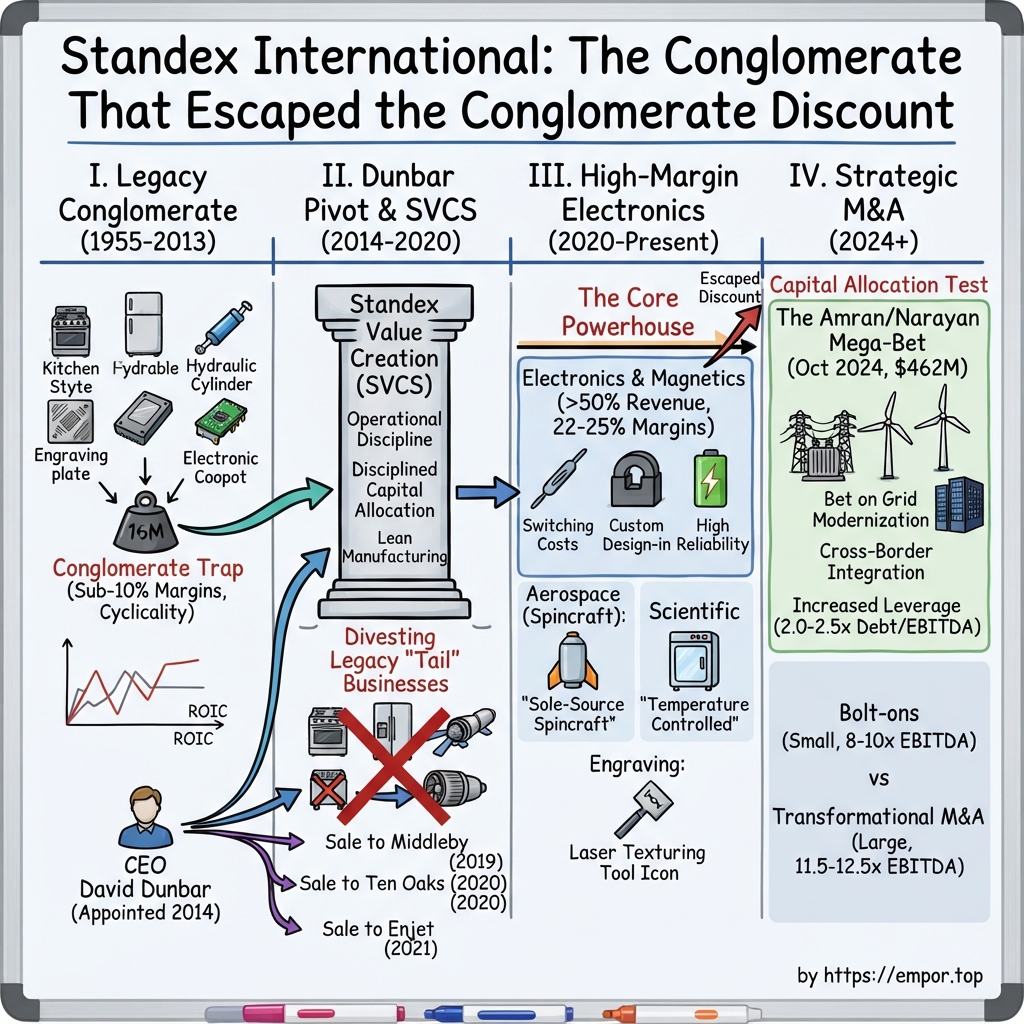
The story of this transformation unfolds in four movements.
The conglomerate trap (1955–2013). Standex spent its first six decades as a traditional holding company, assembling a varied mix of small manufacturing units — commercial ovens, walk-in coolers, hydraulic cylinders, mold engraving, air distribution components, and electronics. The business was tied together by a central treasury and a dividend record rather than a shared operational model.
The Dunbar pivot (2014–2020). A career industrial operator arrived from Pentair, introduced a structured management system modeled after Danaher, and began divesting non-core, lower-margin segments.
The margin machine (2020–2024). Electronics grew into the company's core engine. High-reliability components like reed switches, custom magnetics, and sensors — which cost small sums relative to the mission-critical systems they protect — began driving consolidated operating profits.
The capital allocation test (2024–present). In October 2024, Standex deployed approximately $462 million to acquire two instrument-transformer businesses in Houston and India. The transaction was the largest in the company's history and converted a debt-free balance sheet into a levered position.5
The questions worth arguing about
Two primary questions define the company's future outlook.
First: is the Standex Value Creation System — the company's internal operating methodology — a genuine operational advantage, or is the margin expansion largely the mathematical result of divesting low-margin assets and buying higher-margin units? Structural portfolio shifts offer finite benefits, whereas genuine operating capabilities compound over time.
Second: what establishes Standex's competitive moat in custom magnetics and sensing? The company operates alongside larger peers, competing against Littelfuse — a business with roughly $2.2 billion in revenue — and TE Connectivity, which recorded net sales of $17.3 billion in fiscal 2025.67 By comparison, Standex's entire Electronics segment generated $475.0 million in fiscal 2026.2 Because scale is not the differentiator, performance depends on specialized advantages.
Both questions find baseline evidence within the company's historical record. That record displays period challenges alongside structural margin improvements, creating a narrative far richer than a standard conglomerate label suggests.
 Subscribe on LinkedIn
II. The Legacy Conglomerate: From Household Goods to Industrial HODL (1955–2013)
Standex does not have a founding myth with a garage in it. It has something better: a founding myth about an exit.
In the years after the Second World War, John Bolten Sr. built a vinyl sheeting company called Bolta Plastics alongside his son John Jr., Samuel Dennis III, and Daniel Hogan — a former Navy officer who was also Bolten Sr.'s son-in-law. They took it from roughly $1 million of annual revenue to $28 million in under a decade, and in 1954 they sold it to General Tire and Rubber for $4 million. Then came the decision that defined everything after. Rather than start another plastics company, the group took the proceeds and bought two businesses with nothing in common: Standard Publishing, a Cincinnati publisher of religious materials dating to 1866, and Roehlen Engraving, a Rochester, New York maker of steel-engraved embossing rollers. They put them under one roof and called it Standard International Corporation.19
Sit with that pairing for a moment, because it is the entire corporate DNA in miniature. A hymnal publisher and an engraving roller manufacturer share no customers, no technology, no supply chain, and no distribution. What they shared was that both threw off cash and both could be bought cheaply by men who had just proven they could operate. That was the thesis. Not synergy — availability.
The formal corporate record picks up the story from there: the company became public in 1964, was incorporated in its current form in 1975 as the successor to the 1955 entity, and adopted the Standex International name in 1973.219 It has paid a dividend every single quarter since that 1964 listing.2 In July 2026, the board declared the 248th consecutive quarterly cash dividend, raising it 6.3% to $0.34 a share.1 Sixty-two years without a missed payment is a genuine achievement — and also a constraint that shaped how the company thought about itself for half a century.
The acquisition machine ran hard. Under Hogan, who succeeded Bolten Sr. as president, the company pursued niche-market leaders wherever it found them, eventually completing more than 125 acquisitions. The portfolio at various points included Everedy cookware, Lestoil, Bon Ami cleansers, and Coca-Cola bottling franchises in South America.19 A New Hampshire industrial company bottling soft drinks on another continent is not a strategy anyone would design today. In the conglomerate era, it was simply Tuesday.
One thread from those first purchases is worth flagging now, because it runs all the way to the present. Roehlen Engraving — steel rollers that press patterns into material — became the core of what the company then called its Industrial Group, and the surface texturing franchise Standex still owns today descends from it, though it now trades under later-acquired brands rather than the Roehlen name.192 Of the two businesses bought with the Bolta proceeds, the engraving line is the one that outlasted every subsequent regime and every strategic redirection. Whether that reflects genuine durability or simple inertia is a question this story returns to.
The original blueprint was of its era. Post-war America was full of small, profitable, family-owned manufacturers with no succession plan. A holding company could buy them at modest multiples, leave the managers in place, take the cash upstairs, and pay it out. Repeat. Diversification was the strategy, not a byproduct of it.
By the 2000s, the result was a genuinely odd collection. Standex made commercial ovens and fryers under the APW Wyott, Bakers Pride, BKI, and Ultrafryer brands.8 It made walk-in refrigeration under Master-Bilt and Nor-Lake.9 It made telescopic hydraulic cylinders for dump trucks. It made air distribution products sold into residential construction. It engraved textures into automotive interior molds. And, almost incidentally, it made reed switches and custom magnetics — a business that would eventually swallow the company but which, at the time, was simply one segment among five or six.
The economics of holding everything
The trouble with this model was not that the businesses were bad. Individually, several were fine. The trouble was structural, and it showed up in three places.
The first was capital allocation. When a corporate center owns fifteen unrelated businesses and no shared operating system, the annual budgeting process becomes a negotiation rather than a return calculation. Every unit argues for its capital on the basis of what it needs, not what it earns. Dunbar would later describe the pre-2014 portfolio in terms that made the point without saying it directly: the lowest-margin business in the corporation, he told analysts in early 2024, had been running at low single-digit operating income.10 Capital was flowing into businesses that could not clear their cost of capital.
The second was end-market exposure. Commercial foodservice equipment, residential air distribution, and construction hydraulics are all late-cycle capital goods sold to buyers who defer purchases the instant credit tightens. That is the opposite of diversification. It is correlation dressed as diversification.
The third was that nobody was compounding anything. Research and development ran at roughly 0.6% of sales.10 For a company selling engineered components, that is close to maintenance spending — enough to keep existing products alive, not enough to create new ones.
Historical falsification: did diversification actually stabilize anything?
The core defense of the conglomerate structure is that owning uncorrelated businesses smooths cash flow through cycles. Standex's own record during the 2008–2009 financial crisis is the strongest available test of that claim, and it does not survive it.
Fiscal 2009 sales fell to $604.5 million, a decline of more than $35 million. Net income collapsed to $20.2 million from $67.9 million — a 70% drop.4 The declines were not isolated to one segment. They occurred across all product groups, with the largest hits in the air distribution business, which depended on new residential construction, and in hydraulics, which served general construction. Management responded with facility closures and headcount reductions that took the U.S. workforce from roughly 2,200 to roughly 1,100 employees, targeting $36 million of annualized savings.4 Sales bottomed around $578.5 million in fiscal 2010 before recovering.
Consider those results carefully. A portfolio explicitly assembled for diversification lost 70% of its net income in a single year and cut half its domestic workforce. The businesses were uncorrelated in what they manufactured, but highly correlated in who bought them: buyers of discretionary capital equipment. The evidence leads to a clear rejection of the diversification thesis.
That is the inheritance Standex handed to its next chief executive: a dividend record it could not break, a portfolio that had just proven it did not do the one thing it was assembled to do, and a small electronics business that nobody outside the company had noticed.
III. The Dunbar Pivot: SVCS and the Great Portfolio Pruning (2014–2020)
David Dunbar arrived at Standex on January 20, 2014, and he did not come from the world of holding companies. He came from the world of operating systems.11
His career reads like a guided tour through the American process-industrial establishment. He began at Honeywell in industrial automation and controls, rising to lead the company's automation sales and service operations in the western United States. From 1997 to 2009, he held senior executive roles at Emerson Electric — serving as president of Emerson Process Management Europe, president of Machinery Health Management, and president of Emerson Climate Technologies Refrigeration. Then, from 2009 through late 2013, he ran the global Valves and Controls unit that joined Pentair through its merger with Tyco Flow Control.11
Emerson and Pentair were not holding companies in the legacy Standex mold. They were multi-industry operators built around standardized management systems — disciplined pricing, plant-level productivity metrics, systematic talent reviews, and structured problem-solving. Dunbar spent seventeen years in that environment before taking charge of a company that lacked a unified operating framework.
What SVCS actually is
The Standex Value Creation System (SVCS) was management's operational response. Stripped of corporate branding, the methodology rests on four pillars: a Balanced Performance Plan, Growth Disciplines, Operational Excellence, and Talent Management.2 The intellectual lineage is recognizable — a small-cap adaptation of the Danaher Business System, which itself drew from Toyota's production system.
The underlying mechanics are straightforward. Every business unit follows the same continuous-improvement rhythm. Pricing moves from an ad-hoc sales decision to a structured corporate discipline. Capital is allocated based on projected returns rather than historical expectations. Management also established a strict portfolio benchmark: Dunbar informed investors that Standex evaluated every unit against a minimum requirement of 15% operating margin potential, retaining only those capable of reaching that threshold.10
To complement the operational system, management introduced a top-line framework called "GDP+." The concept asserts that a specialty component manufacturer should outpace broader industrial production by shifting engineering and sales resources toward high-growth secular markets. In its annual disclosures, Standex explicitly identifies these target areas: power grid, defense, commercial space, life sciences, renewable energy, and electric vehicles.2
Selling the tail
Executing the portfolio transformation, however, required nearly a decade of strategic divestitures.
The Cooking Solutions Group was the first major exit. On February 27, 2019, Standex signed a definitive agreement to sell the unit — comprising APW Wyott, Bakers Pride, BKI, and Ultrafryer — to The Middleby Corporation for $105 million, completing the transaction on April 1.8 As a dedicated commercial foodservice equipment manufacturer, Middleby could extract greater value from the brands than a diversified holding company could. The industrial logic was sound, and the transaction succeeded.
The exit from the Refrigerated Solutions Group followed a different financial reality. Standex announced the sale of its Master-Bilt and Nor-Lake refrigeration brands to Ten Oaks Group on March 13, 2020, closing the deal on April 16 for $11 million.9 For two long-established commercial refrigeration lines, an $11 million purchase price represented an exit transaction rather than a premium valuation.
Enginetics, the jet engine components unit, was sold to Enjet Aero on March 31, 2021, for approximately $11.5 million in cash. Standex disclosed pre-tax charges of $14.5 million to $15.5 million tied to the transaction, including roughly $13 million in goodwill and intangible asset write-downs.12 The non-cash write-down exceeded the cash proceeds from the deal.
The sale of Procon Pumps to Investindustrial on February 28, 2023, yielded $67.0 million in cash and a pre-tax gain of $62.1 million13 — providing capital to fund targeted acquisitions.
Portfolio restructuring extended well beyond the initial target window. On March 5, 2026, Standex completed the sale of Federal Industries, its display merchandising business, for $68.3 million in cash, realizing a pre-tax gain of $57.1 million.214 Federal generated approximately $35.7 million in fiscal 2025 revenue, but its pre-tax income contracted from $9.3 million in fiscal 2024 to $7.3 million in fiscal 2025 and $4.0 million in fiscal 2026 — reflecting clear earnings deterioration heading into the sale.2 Following the divestiture, Standex folded Hydraulics into Engraving and renamed Engineering Technologies as Aerospace & Defense, establishing the four reporting segments operating today.2
Historical falsification: how disciplined was the discipline?
The primary narrative surrounding the Dunbar era highlights rapid, decisive portfolio optimization. A close inspection of the timeline presents a more nuanced reality.
The structural cleanup spanned twelve years rather than a single presidential term. Standex held commercial cooking assets for five years after Dunbar took office and retained commercial refrigeration for six, carrying both through cyclical downturns before exiting. The realized valuations — $11 million for the refrigeration business and $11.5 million for a jet engine component maker that prompted a ~$13 million intangible write-down — indicate that underperforming units were retained long after their peak asset value had eroded. While the goodwill impairment reflected legacy capital allocations, the write-downs were ultimately absorbed during Dunbar's tenure.
Furthermore, organic growth across the retained operations remained volatile during the divestiture period. In the second quarter of fiscal 2024, consolidated organic revenue fell 7.4%, driven by declines of 5.7% in Electronics, 15.6% in Scientific, and 17.8% in Engineering Technologies.10 For fiscal 2025, organic sales for the consolidated company declined 7.5%, offset entirely by acquisitions.2 Portfolio rationalization outpaced underlying organic sales expansion for several years.
What the record does confirm, however, is sustained margin expansion on variable volume. Between January 2014 and January 2024, Standex raised its gross margin from 33.4% to 40.3% on roughly the same revenue base, increased R&D investment from 0.6% to 2.9% of sales, and consolidated fifteen operating units down to six.10 The empirical evidence demonstrates that Standex successfully built core operational capabilities, even as it experienced a prolonged and costly exit process for legacy assets. The decisive test going forward is whether organic growth can compound without reliance on acquired revenue.
That question leads directly to the segment tasked with providing the answer.
IV. The Core Powerhouse: Electronics, Magnetics, & Custom Reed Switches
Somewhere in a factory in Kofu, Japan, a machine seals two thin ferromagnetic blades inside a glass tube filled with inert gas. The blades do not touch. Bring a magnet near, and they snap together, completing a circuit. Take it away, and they spring apart. That is a reed switch. The design dates to the 1930s. It contains no semiconductors, no firmware, and no software update path.
It is also, in the right application, irreplaceable — and it is the technological seed of what now accounts for more than half of Standex International.
Why a three-dollar part has pricing power
In fiscal 2026, the Electronics segment generated $475.0 million in net sales, an 18.7% increase, producing $121.3 million in segment operating income at a 25.5% operating margin.2 Generating 53% of consolidated revenue, the division accounted for roughly two-thirds of Standex's segment-level operating profit. In the fourth quarter of fiscal 2026, segment sales reached a record $129.1 million with a 27.2% adjusted operating margin.1
Those figures reflect financial returns closer to specialty instrument makers than traditional industrial component suppliers. The explanation highlights the core of the company's competitive moat.
Standex describes its strategy as "Customer Intimacy" built on a "Partner/Solve/Deliver" model.2 Rather than selling catalog components, the company co-engineers parts directly into customer product designs. An automotive supplier developing a battery management system for an 800-volt electric vehicle architecture requires a switch that tolerates high voltage, severe vibration, and fifteen years of thermal cycling. Establishing that specification involves twelve to twenty-four months of joint engineering. Upon completion, the custom part number is locked into the customer's bill of materials and embedded in its safety and regulatory compliance documentation.
The switching economics follow directly from that integration. A component costing a few dollars may sit inside a $60,000 electric vehicle. Re-qualifying an alternative vendor requires re-running validation programs, re-certifying safety compliance, and accepting operational risk on a component whose failure disables the broader system. While a procurement unit might save a dollar per part, the engineering organization must sign off on the associated failure risks. This structural asymmetry — trivial unit cost relative to catastrophic system failure risk — enables low-cost engineered components to maintain pricing power that commodity parts cannot sustain.
Chief Executive David Dunbar provided investors with specific figures illustrating this dynamic in electric vehicles. On Standex's second-quarter fiscal 2024 conference call, he noted that roughly 11 million electric vehicles were sold globally in the prior year, with approximately 3 million operating at 800 volts or higher. Standex held component content on roughly 60% of those high-voltage platforms and about 30% of lower-voltage models, securing higher dollar value per vehicle on high-voltage architectures.10 At the time, the company had won design positions on two Mercedes platforms, with geographically 50% of its EV sales concentrated in Europe and 45% in China.
That geographic distribution insulates Standex's EV franchise from U.S. policy shifts, aligning its performance instead with European and Chinese OEM production volumes.
Who Standex actually competes against
The competitive landscape in ultra-custom magnetics and reed sensing remains fragmented. In reed switches and magnetic sensors, the most direct publicly traded peer is Littelfuse, which offers sensing components within a broader electronics portfolio generating approximately $2.2 billion in total revenue.7 Privately held Bourns competes in magnetics and sensing. Across broader power components and connectivity, Vishay Intertechnology generates roughly $3 billion in sales, while TE Connectivity serves as the industry scale benchmark with $17.3 billion in net sales for fiscal 2025.6
While Standex lacks the scale of those larger competitors, its operational model does not require head-to-head volume competition. TE Connectivity's cost structure relies on high-volume standardization; executing a twenty-month custom engineering program for a customer purchasing four million units annually at three dollars each presents limited return for TE's organization. Standex's business model relies on remaining nimble enough to pursue niche custom programs while offering engineering capability that customers cannot readily duplicate internally.
Standex has also used targeted acquisitions to consolidate specialty niches. The company invested $29.2 million to acquire custom magnetics maker Minntronix on July 31, 2023, and spent $20.9 million for Japanese reed relay manufacturer Sanyu Switch on February 19, 2024, followed by a $3.5 million purchase of Sanyu Electric Pte Ltd that May.15 The acquisition of the Japanese reed relay business did not elevate Standex to Littelfuse's scale, but it increased design-in barriers within semiconductor test and measurement applications while adding manufacturing capacity. Electronics President Flavio Sarcevic told analysts in July 2026 that the Kofu reed switch facility could expand output by 20% to 25% in fiscal 2027 compared to fiscal 2026, supported by newly commissioned machinery.1
The next technology bet, and how to weigh it
Management has also begun outlining a longer-term growth opportunity tied to shifting power infrastructure.
Data centers and industrial systems are increasingly transitioning toward 800-volt direct current architectures. Higher operating voltages allow facilities to transmit equivalent electrical power through thinner copper wiring with lower resistive losses — a critical efficiency gain for data centers drawing power equivalent to small municipalities. Implementing these high-voltage DC architectures requires newly rated switching, sensing, protection, and power conversion components.
When asked on the July 2026 call whether Standex had product lines beyond power grid applications to participate in data center infrastructure growth, Dunbar offered a measured response. He confirmed that Standex's legacy Edge business generates several million dollars in revenue supplying grid diagnostic and monitoring instrumentation and noted that management was evaluating combined sales channels to scale the unit. However, he stated explicitly that data center expansion was not included in the capacity roadmap presented to investors. Regarding 800-volt DC opportunities specifically, Dunbar noted that Standex was developing compatible components, but cautioned that commercial market penetration remained a few years away.1
That disclosure frames the opportunity as an unbooked technical development initiative rather than near-term revenue. Given Standex's historical experience with adjacent market optionality — such as the pandemic-era surge and subsequent contraction in its Scientific segment — base-case projections warrant excluding these long-dated opportunities until they materialize as firm order backlog.
Historical falsification: does the moat hold through a cycle?
The central investment premise asserts that high switching costs insulate the Electronics segment from semiconductor and industrial downturns. Standex's operational performance over the past three fiscal years provides a clear test of that claim.
In fiscal 2024, Electronics organic revenue contracted 7.4% due to demand softness across appliance and general industrial end markets in China and Europe.15 Performance weakened further in fiscal 2025, with segment organic sales falling 8.3% amid broad-based end-market declines in industrial applications, transportation, and utilities.2 Reported segment revenue grew 24.3% in fiscal 2025 only because recent acquisitions contributed $104.4 million in acquired sales.2 The segment experienced two consecutive years of mid-to-high single-digit organic sales declines, masked at the top line by M&A.
This cyclical downturn clarified the nature of Standex's competitive moat. Custom design specifications dictate which supplier receives component orders when an OEM manufactures, but they do not force an OEM to maintain production levels or compel distribution channels to carry inventory. On Standex's second-quarter fiscal 2024 call, Dunbar identified bare switch orders through distribution channels as a key leading indicator, noting that channel demand fluctuates first in both market downturns and recoveries because unmounted switches are used broadly across applications and prototyping.10 That operational reality confirms that a portion of the segment remains exposed to standard distribution channel cycles rather than fully locked-in sole-source programs.
Consequently, design-in switching costs preserve market share and unit pricing within customer programs rather than insulating shipment volumes across industrial cycles. Standex operates as a share-stable, cyclically exposed business rather than a defensive safe haven. That structural position remains financially attractive: market share stability allowed Electronics to maintain margin expansion, raising operating margins from 19.9% in fiscal 2024 to 22.0% in fiscal 2025 and 25.5% in fiscal 2026 despite organic volume declines.2 However, evaluating the segment on a defensive valuation multiple assumes cycle resistance that the historical record does not support.
Fiscal 2026 performance demonstrated initial recovery across the division. Electronics organic revenue expanded 12.9% in the fourth quarter, supported by a segment book-to-bill ratio of 1.27 on approximately $165 million in orders, with management reporting that every operating unit within the division achieved a book-to-bill ratio above 1.2.1 Because order intake leads recognized revenue by several quarters, order volume remains the primary metric for tracking organic recovery.
V. Precision Niche Engineering: Aerospace & Defense, Scientific, & Engraving
There is a manufacturing process called spin-forming that looks, from a distance, like industrial pottery. A flat metal disc is clamped onto a rotating mandrel and pressed by rollers until it flows into a curved shape — a dome, a cone, a hemispherical bulkhead. Executed at heavy gauge with exotic alloys, it produces a single-piece structure without welds. In rocket manufacturing, welds represent potential failure points.
That capability defines Standex's Spincraft unit, explaining how a New Hampshire industrial company maintains positions in launch vehicle supply chains.
Aerospace & Defense: real capability, lumpy revenue
The segment — comprising Spincraft operations in Billerica, Massachusetts; New Berlin, Wisconsin; and Newcastle upon Tyne in the U.K., alongside the McStarlite business in Harbor City, California — manufactures fuel tank domes, rocket engine components, crew vehicle and unmanned spacecraft bulkheads, nacelle inlet lipskins, missile nose cones and sub-assemblies, and naval propulsion components.2
Fiscal 2026 delivered strong segment growth, with net sales climbing 31.6% to $135.0 million and operating income rising 42.3% to $22.0 million. Acquired growth from the full-year contribution of McStarlite provided $17.5 million, while defense project activity drove $14.5 million, or 14.1%, in organic expansion.2 In the fourth quarter of fiscal 2026, adjusted operating margin expanded by 410 basis points to reach 22.5%.1
The defense pipeline represents the newer growth catalyst, and executive communications have been notably detailed regarding its scope. On the July 2026 conference call, Chief Executive David Dunbar disclosed that missile-related revenue moved from roughly $9 million in fiscal 2025 into the teens for fiscal 2026, with management projecting $40 million to $80 million over the next four years and expressing high confidence in reaching at least the $40 million baseline. Specific program positions include the SM-3 and PrSM missiles, alongside legacy electronics components on Patriot missile systems and active development work for next-generation platforms.1
The competitive moat in this business rests on program qualification rather than proprietary technology alone. Flight-critical hardware requires the supplier, the specific manufacturing process, and frequently the production facility to achieve qualification. Re-qualifying an alternative spin-forming vendor for a rocket fuel tank dome involves a multi-year validation process that prime contractors rarely undertake solely for modest procurement savings.
However, structural variability remains present in the financial performance, as management acknowledges. Electronics President Flavio Sarcevic informed analysts that the business experiences quarterly order lumpiness, with operating margins swinging between 18% and 22% based on project mix, establishing roughly 20% as a reasonable full-year expectation.1 The historical record reflects this volatility: Engineering Technologies revenue contracted 17.8% year-over-year in the second quarter of fiscal 2024 due strictly to project timing, with Dunbar attributing part of the decline to Navy nuclear vessel funding being reallocated to support active global conflicts.10 Expanding defense budgets do not automatically guarantee rising segment revenue; capital allocation shifts between defense programs dictate whether revenue materializes for specific component suppliers.
For investors, Aerospace & Defense represents a technologically qualified franchise subject to quarterly revenue lumpiness, where multi-year growth depends on specific missile and space programs navigating government budget cycles.
Scientific: the clearest failed thesis in the portfolio
The Scientific segment manufactures laboratory and medical-grade refrigerators and freezers, ultra-low temperature freezers, cryogenic storage tanks, blood bank refrigerators, and environmental chambers, distributing through medical and laboratory channels to hospitals, pharmacies, research universities, and biotech institutions.2 Primary competitors include Thermo Fisher Scientific, PHCbi, and Helmer Scientific.
During the initial phase of the COVID-19 pandemic, market narrative categorized cold storage as a structural growth category. Historical results contradicted that assumption. Segment revenue expanded approximately 40% in fiscal 2021 and 6% in fiscal 2022 before contracting for two consecutive years, dropping roughly 11% in fiscal 2023.10 In the second quarter of fiscal 2024, revenue fell 15.6% year-over-year as demand for COVID-19 vaccine storage units normalized and retail pharmacy purchasing slowed.10
A subsequent demand shock emerged from institutional funding constraints. Standex's fiscal 2025 and fiscal 2026 annual reports attributed Scientific's organic sales declines directly to reduced purchasing by academic and research institutions affected by National Institutes of Health grant cutbacks.2 While fiscal 2026 segment revenue grew 4.7% to $75.7 million, the expansion was driven entirely by the Custom Biogenic Systems acquisition, as organic sales declined 2.0%.2
These empirical results tested the thesis that medical cold storage constitutes locked-in healthcare infrastructure. Demand volatility demonstrated two structural limitations: first, channel-mediated demand surges do not equal long-term customer lock-in, as distributor inventory overstocking causes order cutbacks once channel fill concludes; second, exposure to grant-funded academic institutions introduces public budget sensitivity independent of product quality or switching costs.
Consequently, the structural lock-in premise gives way to a narrower financial profile: a modest revenue base generating solid margins supported by eventual product replacement cycles. Sarcevic highlighted this replacement dynamic as the primary recovery driver, noting that installed units typically operate four to seven years before replacement, positioning the 2021 demand peak within the current replacement window.10 Fourth-quarter fiscal 2026 results indicated initial momentum, with organic revenue rising 5.0% on pricing adjustments and slight market recovery, generating a 28.6% adjusted operating margin — though management noted that non-recurring tariff refunds contributed to that margin level.1 The timing and magnitude of the broader replacement cycle remain to be verified by subsequent order flow.
Engraving & Hydraulics: the cash-generating remnant
The fourth operating segment combines Standex's legacy industrial operations, managed as a single reporting group. Engraving applies specialized surface textures and finishes to manufacturing tooling — such as dashboard and door panel grain patterns — utilizing chemical etching, laser texturing, and soft-trim processes under the Mold Tech, Piazza Rosa, and Tenibac-Graphion brands. Hydraulics produces telescopic and piston-rod hydraulic cylinders for dump trucks, refuse vehicles, construction equipment, and mining applications under the Custom Hoists brand.2
In fiscal 2026, segment net sales reached $182.3 million, up 1.7% as foreign exchange benefits offset a 0.6% organic sales contraction, while operating income expanded 8.9% to $27.4 million due to internal cost actions.2 Fourth-quarter segment revenue fell 9.7% year-over-year.1 Performance in fiscal 2025 had shown steeper declines, with sales dropping 13.0% following delays in North American automotive platform launches.2
The Engraving division relies on specialized technical execution. Historically, automotive interior textures were produced via chemical acid etching — a process that is labor-intensive, environmentally restricted, and difficult to standardize across international manufacturing facilities. The segment has transitioned toward digital laser texturing, where digital files control ablation machinery. This allows global automakers to maintain identical interior texture specifications across production facilities in North America, Europe, and Asia. Standex markets this standardized surface finish capability globally as a service model,2 securing niche margins and steady cash flow.
Nevertheless, both units remain exposed to macro cycles beyond management control. Engraving revenue depends on automotive OEM model refresh schedules, with revenue historically softening during the third fiscal quarter due to Chinese New Year downtime across its Asian operations.10 Hydraulics revenue tracks dump trailer and refuse vehicle production; through fiscal 2024, order fulfillment was constrained by OEM heavy-truck chassis shortages that delayed vehicle assembly rather than weak underlying cylinder demand.10
The strategic rationale for retaining the segment rests on Engraving's recurring alignment with auto model restylings and Hydraulics' history of steady cash generation through industrial cycles. Conversely, maintaining a zero-growth segment inside a portfolio positioned as a high-margin engineered components business highlights the structural tension between holding legacy cash units and eliminating the conglomerate discount.
VI. The Capital Allocation Crucible: The $462M Amran/Narayan Mega-Bet & M&A Benchmark
For a decade, Standex's acquisition playbook followed a consistent template: small, adjacent, cash-funded bolt-ons.
The company acquired Agile Magnetics in 2018 for custom high-frequency magnetics, Renco Electronics in 2020 for inductors and transformers, Sensor Solutions in fiscal 2022, Minntronix for $29.2 million in July 2023, and Sanyu Switch for $20.9 million in February 2024, followed by Sanyu Electric Pte Ltd for $3.5 million that May.15 Each addition integrated directly into Electronics, underwent optimization under the Standex Value Creation System, and accreted to operating margins.
The funding model was equally disciplined. When Standex divested Procon for $67.0 million in early 2023, Chief Executive David Dunbar outlined how capital was recycled: reinvesting into Sanyu and Minntronix while returning excess cash through dividends and share repurchases.10 By the end of the second quarter of fiscal 2024, Standex held $142.4 million in cash against just $6.2 million in net debt — effectively operating with a debt-free balance sheet.10
On October 28, 2024, however, management departed sharply from this modest bolt-on strategy.
The deal
Standex acquired 100% of Amran LLC, a privately held instrument transformer manufacturer based in Houston, Texas, alongside 90.1% of Narayan Powertech Private Limited, an India-based counterpart, in separate transactions. Total consideration for Amran reached $179.7 million — comprising $153.7 million in cash and 152,299 Standex shares valued at $26.0 million — while the 90.1% stake in Narayan cost $261.9 million in cash. Combined enterprise value was initially stated at approximately $462 million and finalized at $467.5 million in the annual report,52 marking the largest transaction in Standex's history by an order of magnitude.
The acquisition brought Standex into low- and medium-voltage instrument transformers — a specialized niche whose economic characteristics parallel the company's core reed switch model. High-voltage electrical substations carry currents that would destroy delicate monitoring equipment. An instrument transformer steps down high power levels into precise, proportional signals that digital meters, protective relays, and grid automation systems can process safely. If an instrument transformer's ratio drifts, utilities face billing errors; if it fails entirely, protective relays fail to detect critical grid faults.
Because unit failure endangers broader substation infrastructure, specifications are stringent, switching costs are high, and switchgear original equipment manufacturers lock custom designs into their equipment platforms. Standex partnered directly with OEMs to co-engineer custom transformer components tailored to specific power grid platforms.2
The target assets offered a lucrative financial profile. At announcement, Amran and Narayan generated roughly $100 million in combined calendar 2024 revenue, maintained an adjusted EBITDA margin above 40%, and had delivered a three-year compound annual revenue growth rate of approximately 30%.5 To fund the cash consideration, Standex drew down existing cash balances, tapped current credit lines, and secured a $250 million 364-day term loan, subsequently refinancing the debt by expanding its revolving credit facility from $500 million to $825 million.2
Valued at approximately $462 million on $100 million in revenue and 40%-plus EBITDA margins, the transaction represented an entry multiple of 11 to 12 times trailing EBITDA — a noticeable premium over Standex's historical 8-to-10-times M&A range, though a discount relative to public grid technology peers. The purchase price allocation highlights the reliance on intangible value: $136.0 million was assigned to identifiable intangibles — including $28.7 million in indefinite-lived tradenames and $107.3 million in customer relationships amortized over twelve years — while $298.4 million was booked as goodwill.2 With goodwill accounting for nearly 70% of total consideration, the transaction represents an explicit underwriting bet on customer retention and market growth rather than physical asset value.
What has happened since
Nearly two years post-announcement, financial results have outperformed initial transaction terms. Consolidated grid revenue — combining Amran and Narayan under the Standex Grid brand — reached approximately $148 million in fiscal 2026, compared to roughly $100 million at the time of acquisition.1 Electronics President Flavio Sarcevic confirmed to analysts that segment profitability remained robust, noting that margins "are continuing to be very strong, kind of in line to historical levels. They have not declined."1
To capture expanding grid demand, Standex embarked on a major manufacturing capacity expansion. In July 2026, Sarcevic detailed six concurrent workstreams: plant productivity and automation programs targeted to unlock up to $40 million in annual capacity by fiscal 2030; a greenfield plant in Croatia opened in May 2026 projected to add $75 million in capacity (up from an initial $60 million estimate); new low-voltage production lines in Mexico contributing $25 million; a Texas facility lease tripling localized footprint to over 200,000 square feet to add $60 million in revenue capacity starting in fiscal 2028; and operational shift expansions in India providing $45 million and $50 million in incremental throughput. In Houston, management introduced a fourth shift to maintain near 24/7 manufacturing operations.1
The Croatian facility illustrates management's aggressive positioning. Built to satisfy European OEM requests for localized manufacturing, the facility provides operational visibility through 2030 and serves as a strategic wedge into a $1.2 billion European market — explicitly operating as a platform for the next phase of European growth rather than a single plant.1 Constructing capacity ahead of firm long-term contracts allows Standex to capture share during supply shortages, though it exposes the business to fixed-overhead drag should regional grid expenditures slow.
Management projects total grid sales of $180 million to $200 million in fiscal 2027, scaling toward a fiscal 2030 target of $340 million to $440 million.1 Chief Executive David Dunbar outlined the modeling assumptions behind those figures, noting that while initial underwriting targeted 15% annual growth, stronger operational traction enabled management to lock in the lower bound of guidance while treating the top $100 million as dependent on market conditions and operational execution.1
On June 26, 2026, Standex agreed to acquire the remaining 9.9% minority stake in Narayan for approximately $64.0 million, closing the transaction on July 2.2 Under the original shareholder agreement, minority owners held a three-year put option, while Standex retained a call option exercisable in year four at the higher of initial valuation or 12 times trailing EBITDA.2 Sarcevic stated that Standex initiated early negotiations, paying approximately 15 times trailing twelve-month EBITDA to expedite investment decisions and remove accounting complexity around how capital deployed into the Indian business would be attributed.1
Management highlighted that combining the initial 2024 purchase price with the $64.0 million buyout yields an effective blended entry multiple of 7 to 8 times fiscal 2026 EBITDA. While mathematically accurate, that calculation credits the initial purchase price with two years of subsequent operational growth; evaluated in isolation, the $64.0 million buyout for the final 9.9% stake carried a premium multiple above the original agreement's contractual floor.
Historical falsification: is this the same capital allocator?
The central thesis tested by this acquisition is management's commitment to balance-sheet conservatism and low-risk bolt-on execution. The Amran and Narayan acquisitions mark a structural shift in risk tolerance rather than a continuation of past capital allocation practices.
Net debt expanded from $6.2 million in early fiscal 2024 to $448.0 million at the end of fiscal 2025, pushing net leverage to 2.6 times EBITDA.1016 Standex subsequently reduced leverage, closing fiscal 2026 with net debt of $339.2 million and a net leverage ratio of 1.8 times, supported by a bank covenant leverage ratio of 2.41 times (against a 3.5-to-1 limit) and interest coverage of 4.97 times (against a 2.75-to-1 threshold).12 The company maintains ample debt headroom and continues to pay down principal.
While credit metrics remain manageable, operational complexity has increased substantially. Standex is coordinating manufacturing operations across the United States and India while concurrently constructing greenfield sites in Croatia and Mexico and tripling its footprint in Texas. Executing four major capital projects alongside a cross-border integration represents an operational leap for an organization that previously absorbed single, smaller bolt-on acquisitions. Sarcevic acknowledged these operational constraints, noting to analysts that "some of these things take time as far as getting the machinery in."1 Conversely, Wall Street analysts have questioned whether expansion pace is sufficient, pointing to fourth-quarter grid orders of roughly $55 million as modest relative to fiscal 2027 targets and asking whether Standex was moving fast enough.1 Standex faces a dual risk: expanding too slowly risks losing market share to competitors, while building excess capacity leaves the firm vulnerable if utility capital spending moderates.
Governance and financial disclosures also warrant ongoing evaluation. Fiscal 2026 financial statements recorded a $21.0 million remeasurement charge to reflect the redemption value of Narayan's noncontrolling interest, recorded through net income attributable to redeemable noncontrolling interest.2 This accounting adjustment reflected strong financial performance at Narayan, illustrating the earnings volatility inherent in structured buyout provisions. Additionally, related-party disclosures show Narayan maintains lease agreements in India with Narayanshree Infrastructure LLP and relatives of the former minority owners, totaling $2.0 million in inventory transactions and $0.3 million in rent in fiscal 2026.2 While financially modest, these ongoing transactions merit continued tracking following the full equity buyout.
The evidence points to a refined strategic diagnosis: Standex remains a disciplined operator of acquired assets, but management significantly expanded its risk appetite in late 2024. To date, financial results have validated the transaction. The benchmark for evaluating this strategic shift going forward will be whether grid sales achieve the targeted $180 million to $200 million range in fiscal 2027 while maintaining segment margins, and whether net leverage continues falling toward the sub-1.5x level while capital expenditure runs at the guided $45–55 million.1
VII. Playbook, Moat Analysis, & Management Credibility
Strip away the individual operating segments and transaction history, and Standex's corporate strategy reduces to a single, repeatable framework: acquire engineered component manufacturers where unit cost is low, system failure consequences are expensive, customer engineering teams lock in the supplier specification, and end-market demand outpaces general industrial production. Management then applies the Standex Value Creation System (SVCS) operational toolkit to optimize the cost base while maintaining pricing power.
Evaluating that model against established strategic frameworks highlights both structural strengths and clear constraints.
Seven Powers
Process Power — moderate, backed by tangible but unconfounded evidence. SVCS execution has delivered clear operational gains, raising gross margins from 33.4% to a record 42.0% and expanding consolidated adjusted operating margins from roughly 10% a decade ago to 19.4% in fiscal 2026.102 Notably, operating margins expanded during two consecutive years of negative organic revenue growth — providing a rigorous demonstration of plant-level productivity separate from volume leverage. However, because management simultaneously divested lower-margin operations and acquired higher-margin businesses, external observers cannot cleanly separate operational productivity gains from portfolio mix shifts.
Switching Costs — strong within customer design programs, weak across macroeconomic cycles. Custom engineering and qualification protect market share and unit pricing once components are locked into customer product architectures. However, high switching costs offer no defense against end-market volume drops when OEM customers reduce production during broader industrial downturns.
Cornered Resource — modest. Spin-forming metallurgy, proprietary tooling expertise, and defense flight qualifications establish meaningful entry barriers for Aerospace & Defense. Yet these assets reside within a division generating $135 million in revenue, representing specialized process knowledge and program qualification rather than exclusive, unreplicable assets.
Scale Economies — absent by design. Operating at roughly 1/36th the revenue scale of TE Connectivity, Standex intentionally avoids head-to-head competition in high-volume, standardized component markets where scale drives unit cost advantages.
Counter-Positioning and Network Effects — absent. The portfolio contains no business-model asymmetries that larger incumbents cannot emulate, and no network effects exist across its operating units.
Porter's Five Forces
Buyer power is moderate overall, varying significantly across business lines. Automotive Tier-1 suppliers negotiate aggressively on volume pricing, but re-qualification costs constrain their leverage. In Aerospace & Defense, a concentrated base of defense prime contractors maintains substantial control over program contract terms.
Supplier power remains low. Key raw inputs such as copper, specialty steel, and glass are standard commodities. Input cost spikes compress operating margins temporarily until contractual price adjustments take effect — an inflationary lag Standex managed effectively as gross margins reached record levels during the 2022–2023 inflation cycle.
Threat of substitutes represents the key technological risk facing the core division. Solid-state and Hall-effect sensors continue replacing mechanical reed switches in cost-sensitive applications. Standex mitigates this trend by offering Hall-effect, inductive, and conductive sensing technologies alongside its legacy reed switch lineup.2 Nevertheless, the reed switch business represents a mature technology defended by operational reliability and regulatory qualification rather than fundamental product novelty.
Rivalry remains fragmented across specialized niche markets but intensifies whenever product categories become sufficiently standardized to attract larger component competitors.
Threat of new entrants is constrained by multi-year customer design-in cycles and qualification requirements, providing the strongest structural defense in the company's portfolio.
Management credibility, judged on behavior
Chief Executive David Dunbar's leadership team has demonstrated a consistent record of achieving multi-year operational targets. In February 2021, Standex established three-to-five-year guidance calling for mid-single-digit organic revenue growth, an EBITDA margin exceeding 20%, and return on invested capital (ROIC) above 12%. Three years later, the company reported a 19.6% EBITDA margin and 12.3% ROIC — meeting the capital efficiency threshold and nearly achieving the margin target ahead of schedule.10 Management reported the performance candidly, explicitly noting the slight EBITDA margin shortfall.
Strategic messaging has also maintained multi-year consistency. The company's fiscal 2028 targets — driven by new product rollouts, fast-growth end markets, and a 3% baseline industrial growth assumption — have been presented under the same analytical framework since 2023. When industrial baseline growth underperformed, Dunbar addressed the deviation directly on the July 2026 conference call, clarifying that while new product and growth vectors were meeting expectations, general industrial growth had lagged for eighteen months and could push the fiscal 2028 timeline back by one to two quarters.1 Explicitly identifying the specific underperforming variable and signaling schedule flexibility reflects transparent guidance management.
Management has also acknowledged execution failures promptly. In the fourth quarter of fiscal 2026, Electronics adjusted operating margin contracted 140 basis points year-over-year. Dunbar attributed part of the decline to a mismanaged enterprise resource planning (ERP) implementation at two major U.S. plants within the Edge magnetics business that went live around December, costing several million dollars in quarterly margin. He detailed the root cause, assigned new operational leadership to lead corrective actions, and characterized the disruption as transitory.1 While investors must verify whether operational margins recover, the disclosure was specific and unprompted.
Governance practices display a mixed profile. Shareholders approved say-on-pay proposals with 99.1% support at the 2024 annual meeting, and Standex maintains anti-hedging, anti-pledging, and clawback policies adopted in August 2023.17 Executive equity holdings reflect modest alignment rather than founder-level stakes: Dunbar beneficially owned 158,704 shares (1.32% of outstanding stock) as of July 31, 2025, while all directors and executive officers combined held 2.52%.17 Dunbar significantly exceeds the stock ownership guideline requiring five times base salary.
Conversely, board structure presents a standard corporate governance concern. In 2016 — two years into his tenure and before the strategic portfolio transformation had been validated — the board elected Dunbar as Chair while he retained the CEO role.17 Combining these titles concentrates board leadership in the executive whose performance the directors oversee, doing so just as Standex embarked on a decade of portfolio restructuring and a major capital deployment program. Mitigating measures are conventional: an independent board majority, fully independent committees, and a Lead Independent Director (Michael A. Hickey, serving since the 2024 annual meeting).17 While the board reviews leadership arrangements annually, combining the Chair and CEO roles represents an ongoing governance issue, particularly after a decade without a published executive succession plan.
Incentive plan mechanics warrant careful examination. For fiscal 2025, annual cash incentives for the CEO and CFO were weighted 40% toward net sales, 30% to adjusted operating income, and 30% to adjusted EPS — all absolute dollar metrics rather than margin percentages, organic growth rates, or return metrics.17 Furthermore, proxy disclosures show that threshold, target, superior, and actual baseline values for all three metrics were adjusted upward to reflect the Amran and Narayan acquisitions due to the transaction's size and timing.17 Consequently, acquiring a high-margin business directly increased annual bonus metrics in the transaction year. However, actual financial achievement reached only 68.5% of target for the top executives.17 Meanwhile, long-term incentive awards remain tied to return on invested capital, adjusted relative to total shareholder return against the S&P 600 Capital Goods Index — a structure aligned with capital discipline.17
A key metric evaluating operational execution appears in internal workforce data. In 2014, internal promotions filled roughly 35% of management openings; by 2024, Dunbar reported that the ratio had inverted, with internal candidates filling the majority of key leadership positions.10 Across a global organization of approximately 4,100 employees across 37 international locations — of whom only 1,400 are located in the United States — a strong internal talent pipeline indicates that the Standex Value Creation System has taken root operationally rather than remaining a management presentation concept.2
Executive leadership transitions warrant continued tracking. On the February 2024 conference call, Dunbar noted he had reached retirement eligibility under Standex's equity compensation plan, while emphasizing that he had no immediate departure plans.10 Over two years later, no successor has been named. In May 2026, Flavio Sarcevic was promoted to Executive Vice President-Corporate and Group President-Electronics while continuing to serve as CFO until a replacement is hired.18 Dunbar characterized the appointment on the call as a natural progression, arguing that serving as CFO at Standex is functionally equivalent to operating as Chief Operating Officer.1 While reflecting executive scope, that structure leaves a single officer directing both the finance function and the largest operating division during an active CFO search and the concurrent retirement of the Chief Legal Officer.1
VIII. The Skeptical Investor Stress Test & Current Risk Radar
Imagine an activist letter arriving at Salem, New Hampshire. What would it say?
The conglomerate remnant argument
It would open with a simple observation. Standex presents itself as an engineered components company serving grid, defense, space, and electrification markets. Two of its four segments fit that description. The other two do not fit it equally well, and one of them — Engraving & Hydraulics — delivered $182.3 million in revenue during fiscal 2026, accompanied by a 0.6% organic sales contraction and a 15.0% operating margin, creating a drag against a consolidated operating margin approaching 20%.2 In the fourth quarter of fiscal 2026, segment revenue dropped 9.7% year-over-year while Electronics expanded 12.9% organically.1
The activist case writes itself: divest the legacy assets. Automotive mold texturing and dump-truck hydraulics share no strategic overlap with grid transformers or high-voltage sensing. A dedicated automotive tooling or off-highway equipment buyer could evaluate those operations on their standalone earnings power, while sale proceeds could pay down debt and fund grid expansion. Most importantly, a complete exit would eliminate the remaining holding-company overhang, offering Wall Street a pure-play engineered components business after twelve years of incremental divestitures.
Management's counterargument has remained consistent: the legacy operations generate dependable free cash flow that finances high-return investments in Electronics without diluting shareholders through equity offerings. In fiscal 2026, Standex generated $64.7 million in free cash flow on $891.6 million in net sales, with $35.0 million produced in the fourth quarter alone.13
Both perspectives carry weight, but Standex's historical record breaks the tie against the "hold and harvest" defense. Management has run this experiment four times over the past decade. Cooking Solutions was retained until 2019. Commercial refrigeration was held until 2020 before selling for just $11 million. Jet-engine component maker Enginetics was kept until 2021, generating pre-tax write-downs that exceeded the cash proceeds. Most recently, Federal Industries was retained until 2026, during which its pre-tax income contracted from $9.3 million in fiscal 2024 to $4.0 million in fiscal 2026 while being prepared for divestiture.2 The historical pattern shows Standex retaining mature units past their peak asset value, realizing diminished returns upon exit. That track record suggests the remaining legacy businesses risk a similar delayed disposition, using the cash-generation rationale that preceded each prior exit.
Current material risk radar
Grid capacity execution and utility capex. This represents the central operational risk, as the growth thesis for Amran and Narayan, the fiscal 2028 financial targets, and planned capital expenditures of $45 million to $55 million in fiscal 2027 all depend on grid spending.1 While aging Western electrical infrastructure, industrial electrification, and data center power demand represent genuine tailwinds, these trends are widely recognized, driving industry-wide capacity expansion. Standex is simultaneously deploying capital across new projects in Croatia, Mexico, Texas, and India into an environment where sell-side analysts have questioned whether current order intake supports the planned manufacturing ramp.
Cross-border integration and India exposure. Integrating Narayan introduces large-scale manufacturing in India to an organization whose institutional experience primarily rests on smaller U.S. and European acquisitions. Standex's international footprint now encompasses 37 locations generating 42% of total net sales.2 The company's annual risk disclosures explicitly identify foreign exchange controls, currency repatriation restrictions, and international regulatory shifts as material operating risks.2
Goodwill concentration. Total goodwill reached $581.6 million as of June 30, 2026 — representing a substantial proportion of consolidated equity, with $298.4 million originating from the Amran and Narayan acquisitions alone.2 Standex's annual impairment test incorporated a 9.89% weighted average cost of capital and a 2.5% terminal growth rate, concluding that the fair value of all four reporting units substantially exceeded their carrying values; management disclosed that a 100-basis-point increase in the discount rate would not alter that finding, and terminal growth could slow to 1.0% before triggering an impairment.2 While these sensitivity disclosures demonstrate adequate valuation headroom, they underscore that the single largest asset on the balance sheet reflects projected cash flows from recently acquired operations.
Semiconductor and industrial destocking. Demand cyclicality across general industrial and electronics channels remains an active risk. Organic sales in the Electronics division contracted in two of the past three fiscal years, demonstrating that custom product lock-in does not shield shipment volumes when OEM customers reduce production or draw down inventory.
Customer and program concentration in Aerospace & Defense. Revenue across space and defense applications depends on a concentrated group of commercial launch providers and active defense procurement contracts. While Standex disclosed no single customer accounting for over 10% of consolidated revenue in fiscal 2026, project timing in this segment has repeatedly introduced quarterly revenue and margin volatility.
Physical and geographic concentration. Operational continuity across core component lines remains vulnerable to localized disruptions. In late July 2026, an earthquake struck southern Japan near the Sanyu Relay facility in Kumamoto; Chief Executive David Dunbar reported no employee injuries and minimal operational disruption, though several staff members experienced personal property damage.1 Because primary reed switch manufacturing is concentrated in Japan, major seismic events present ongoing supply-chain risks for the company's highest-margin division.
Liquidity headroom. Standex closed fiscal 2026 holding $178.7 million in cash and equivalents alongside approximately $148 million in available credit facility liquidity.1 This liquidity position provides operational flexibility but remains modest while simultaneously funding four global facility expansions, explaining management's decision to prioritize debt reduction over share repurchases following the Amran and Narayan acquisitions. Deleveraging serves as a prerequisite for maintaining future deal capacity, as Dunbar reiterated on the July 2026 call that Standex intends to pursue further acquisitions targeting high-margin businesses serving fast-growth end markets.1
IX. Bull vs. Bear Case & What to Watch
The bull case
The positive thesis does not require heroic assumptions; it simply requires Standex's current operating trajectory to persist for another two years.
The primary evidence of momentum lies in order intake. Standex exited fiscal 2026 with a record quarterly order intake of approximately $270 million and a consolidated book-to-bill ratio of 1.18, led by Electronics at 1.27.1 Because order intake leads recognized revenue by several quarters, a book-to-bill ratio above 1.2 across every operating unit within the largest division provides clear empirical proof that industrial destocking has begun to reverse.
Beneath those aggregate figures, three distinct growth drivers are expanding concurrently. First, new product revenue increased by $27 million in fiscal 2026 — rising from $40 million to $67 million to add 300 basis points to top-line growth — while management targets $90 million in new product sales for fiscal 2027 supported by more than 20 planned product introductions.1 Second, revenue from designated fast-growth end markets grew by $80 million to reach $264 million, representing roughly 30% of total sales, with guidance projecting a 20% increase to exceed $310 million.1 Third, planned grid capacity expansions aim to scale Standex Grid revenue from $148 million in fiscal 2026 to between $340 million and $440 million by fiscal 2030.1
If these trajectory vectors hold, management's fiscal 2028 targets — $1.1 billion in revenue and an adjusted operating margin exceeding 23% — are achievable through organic execution alone. Chief Executive David Dunbar emphasized this point on the July 2026 earnings call, noting that two consecutive years of roughly 12% annual sales growth would achieve the fiscal 2028 guidance without relying on additional M&A.1 Under those conditions, the valuation case for a market re-rating strengthens: an engineered components manufacturer producing 23% operating margins alongside double-digit grid growth and expanding defense revenue warrants a premium over traditional diversified industrial multiples.
The bear case
The cautious counter-thesis rests on the concern that fiscal 2026 represented a cyclical peak for a company whose underlying operations remain more volatile than the prevailing transformation story suggests.
First, recent financial results complicate the assumption of uninterrupted margin expansion. In the fourth quarter of fiscal 2025, consolidated adjusted operating margin reached 20.6%, up 350 basis points year-over-year.16 In the fourth quarter of fiscal 2026, however, adjusted operating margin contracted 70 basis points year-over-year to 19.9%.1 Over the same period, Electronics adjusted operating margin fell 140 basis points.1 While management attributed the margin pressure to growth investments and enterprise resource planning (ERP) integration disruptions at two Edge facilities — while reiterating a target of 30% Electronics margins "pretty soon"1 — the contraction demonstrates that margin expansion is not linear. Furthermore, concurrent facility expansions in Croatia, Mexico, Texas, and India will generate fixed overhead and startup costs before generating full operational revenue.
Second, top-line growth has grown increasingly concentrated. Across Standex's four reporting segments, organic expansion in fiscal 2026 was driven primarily by Aerospace & Defense at 14.1% and Electronics at 7.8%, while the remaining two divisions were flat or slightly negative.2 Within Electronics, grid infrastructure represents the primary growth engine. As Standex becomes increasingly dependent on power grid demand, segment diversification offers less structural downside protection than the multi-division structure implies, leaving consolidated earnings vulnerable to any slowdown in utility capital spending.
Third, balance-sheet leverage represents an active financial commitment. Long-term debt totaled $518.0 million as of June 30, 2026, carrying estimated interest obligations of $141 million over the next five years and expected quarterly interest expense of approximately $7 million.21 While debt service remains manageable relative to current cash flow, financial flexibility would narrow if grid demand softens while the company maintains its guided annual capital expenditure program of $45 million to $55 million.
Fourth, portfolio rationalization remains incomplete. With roughly 20% of total revenue tied to legacy automotive tooling and truck hydraulics, the rationale for a conglomerate valuation discount persists. Standex's historical record indicates that retaining mature, low-growth assets past their strategic utility risks prolonged operational drag, followed by eventual exit transactions at depressed valuations.
The three KPIs that matter
Evaluating the resolution between the bull and bear cases centers on three observable key performance indicators.
1. Electronics organic revenue growth. As the division generating roughly two-thirds of total operating profit, Electronics organic sales expansion serves as the primary operational gauge. This single metric reflects channel destocking recovery, grid component demand, and new product commercialization. Management projects double-digit organic growth for fiscal 2027, with Group President Flavio Sarcevic signaling potential high-teens to low-20s growth against the first-quarter comparison base.1 Sustained double-digit organic expansion would validate the portfolio transformation thesis, whereas a return to the negative organic sales figures recorded in fiscal 2024 and fiscal 2025 would undermine the case for a valuation re-rating.
2. Standex Grid revenue against disclosed capacity milestones. Management has established explicit revenue targets — guiding to $180 million to $200 million in fiscal 2027 and $340 million to $440 million by fiscal 2030 — tied directly to specific facility expansions in Croatia, Mexico, Texas, and India.1 Tracking reported grid sales against this capacity roadmap provides the clearest test of whether the $462 million Amran and Narayan acquisitions are generating expected returns. Order intake across the grid business warrants equal scrutiny, particularly given sell-side observations that fourth-quarter order volume trailed the implied revenue trajectory.
3. Consolidated adjusted operating margin. Moving from the 19.4% adjusted operating margin recorded in fiscal 2026 to management's target of 23%-plus by fiscal 2028 requires approximately 360 basis points of margin expansion while absorbing fixed startup expenses across four global manufacturing projects.31 Consolidated margin performance will distinguish genuine operational productivity under the Standex Value Creation System from historical margin gains driven primarily by divesting low-margin assets. Expanding operating margins on a stable portfolio base would provide definitive evidence of compounding internal operating capability.
X. Epilogue
There is a version of the Standex story that presents it simply as selling underperforming assets and buying higher-margin businesses. That explanation is not wrong. Over twelve years, the company divested more than half its revenue base, consolidated its operating units from fifteen down to six, and redeployed capital into components with structurally superior economics. Any private equity firm would recognize the playbook.
What that simple version leaves out, however, is the operational execution that is far harder to replicate. Standex expanded gross margin from 33.4% to 42.0% and consolidated adjusted operating margin from roughly 10% to 19.4% while, for two of the most recent three years, organic revenue was shrinking.1032 Portfolio arithmetic alone cannot produce that result; it requires underlying operational improvement.
The strategic lessons extend beyond a single industrial company. The first is that pricing power resides in a specific structural position: mission-critical components that represent a minor fraction of a customer's bill of materials but whose failure disables the entire system, embedded within design cycles long enough that requalification costs far exceed the part's purchase price. That structural asymmetry is how a $475 million division generates a 25% operating margin while competing against peers thirty times its size. The second lesson is that an operating culture takes far longer to establish than corporate presentations imply — and the true test of its strength is not how it performs during cyclical peaks, but how margins hold up when sales volumes decline.
The third lesson is a caution. Standex built a decade-long reputation for balance-sheet conservatism and low-risk bolt-on acquisitions, then deployed roughly half its market capitalization in a single October to acquire two instrument-transformer businesses in Houston and India. Past corporate behavior does not guarantee future immunity. While the Amran and Narayan acquisition has outperformed initial underwriting assumptions — with revenue rising roughly 50% in under two years while maintaining historic margin levels — the business has been owned for just twenty-two months, its goodwill remains the largest asset on the balance sheet, and its long-term growth targets require executing four concurrent facility expansions across three continents.
Based on the evidence, Standex has escaped the worst version of the conglomerate trap. Whether it has permanently shed the conglomerate discount is a different question — one that will be answered not by corporate positioning, but by whether grid revenue and Electronics organic growth hit the targets management has committed to achieve.
References
-
Standex Fiscal Fourth Quarter and Fiscal Year 2026 Earnings Conference Call — Standex International Investor Relations, 2026-07-31 ↩↩↩↩↩↩↩↩↩↩↩↩↩↩↩↩↩↩↩↩↩↩↩↩↩↩↩↩↩↩↩↩↩↩↩↩↩↩↩↩↩↩↩↩↩↩
-
Standex International Corporation Annual Report on Form 10-K for fiscal year ended June 30, 2026 — U.S. Securities and Exchange Commission, 2026 ↩↩↩↩↩↩↩↩↩↩↩↩↩↩↩↩↩↩↩↩↩↩↩↩↩↩↩↩↩↩↩↩↩↩↩↩↩↩↩↩↩↩↩↩↩↩
-
Standex Reports Fiscal Fourth Quarter and Fiscal Year 2026 Financial Results — PR Newswire, 2026-07-30 ↩↩↩↩
-
Standex Sees Earnings Tumble in Fiscal Year — NH Business Review, 2009 ↩↩↩
-
Standex Acquires Amran Instrument Transformers and Narayan Powertech — Standex Electronics, 2024-10-29 ↩↩↩
-
TE Connectivity plc Fourth Quarter and Full Year Fiscal 2025 Results, Form 8-K Exhibit 99.1 — U.S. Securities and Exchange Commission, 2025-10-29 ↩↩
-
Littelfuse, Inc. Annual Report to Shareholders, Form ARS — U.S. Securities and Exchange Commission, 2026 ↩↩
-
Standex Signs Definitive Agreement to Sell Cooking Solutions Group to The Middleby Corporation — Standex International Investor Relations, 2019-02-27 ↩↩
-
Standex Completes Sale of Refrigerated Solutions Group — Standex International Investor Relations, 2020-04-16 ↩↩
-
Standex Fiscal Second Quarter 2024 Earnings Conference Call — Standex International Investor Relations, 2024-02-02 ↩↩↩↩↩↩↩↩↩↩↩↩↩↩↩↩↩↩↩↩↩
-
Standex International Names David Dunbar President and Chief Executive Officer, Form 8-K Exhibit 99 — U.S. Securities and Exchange Commission, 2013 ↩↩
-
Standex International Announces Divestiture of Enginetics Corporation, Form 8-K Exhibit — U.S. Securities and Exchange Commission, 2021 ↩
-
Standex Announces Sale of Procon Pumps Business to Investindustrial — Standex International Investor Relations, 2023-02-02 ↩
-
Standex Announces Divestiture of Federal Industries to AeriTek — Standex International Investor Relations, 2026-03-09 ↩
-
Standex International Corporation Annual Report on Form 10-K for fiscal year ended June 30, 2024 — U.S. Securities and Exchange Commission, 2024 ↩↩↩
-
Standex Reports Fiscal Fourth Quarter and Fiscal Year 2025 Financial Results — PR Newswire, 2025-07-31 ↩↩
-
Standex International Corporation Definitive Proxy Statement, Form DEF 14A — U.S. Securities and Exchange Commission, 2025-08-25 ↩↩↩↩↩↩↩↩
-
Standex Announces Promotion of Ademir Sarcevic to Executive Vice President, Corporate & Group President, Electronics — Standex International Investor Relations, 2026-05-12 ↩
-
Standex International Corp. — International Directory of Company Histories, via Encyclopedia.com ↩↩↩↩
 LinkedIn
 WhatsApp
 Reddit
 Hacker News
 Email
Email Kindle
 RSS Feed
 Spotify
 Apple Podcasts
 Amazon Music
 Audible
 YouTube