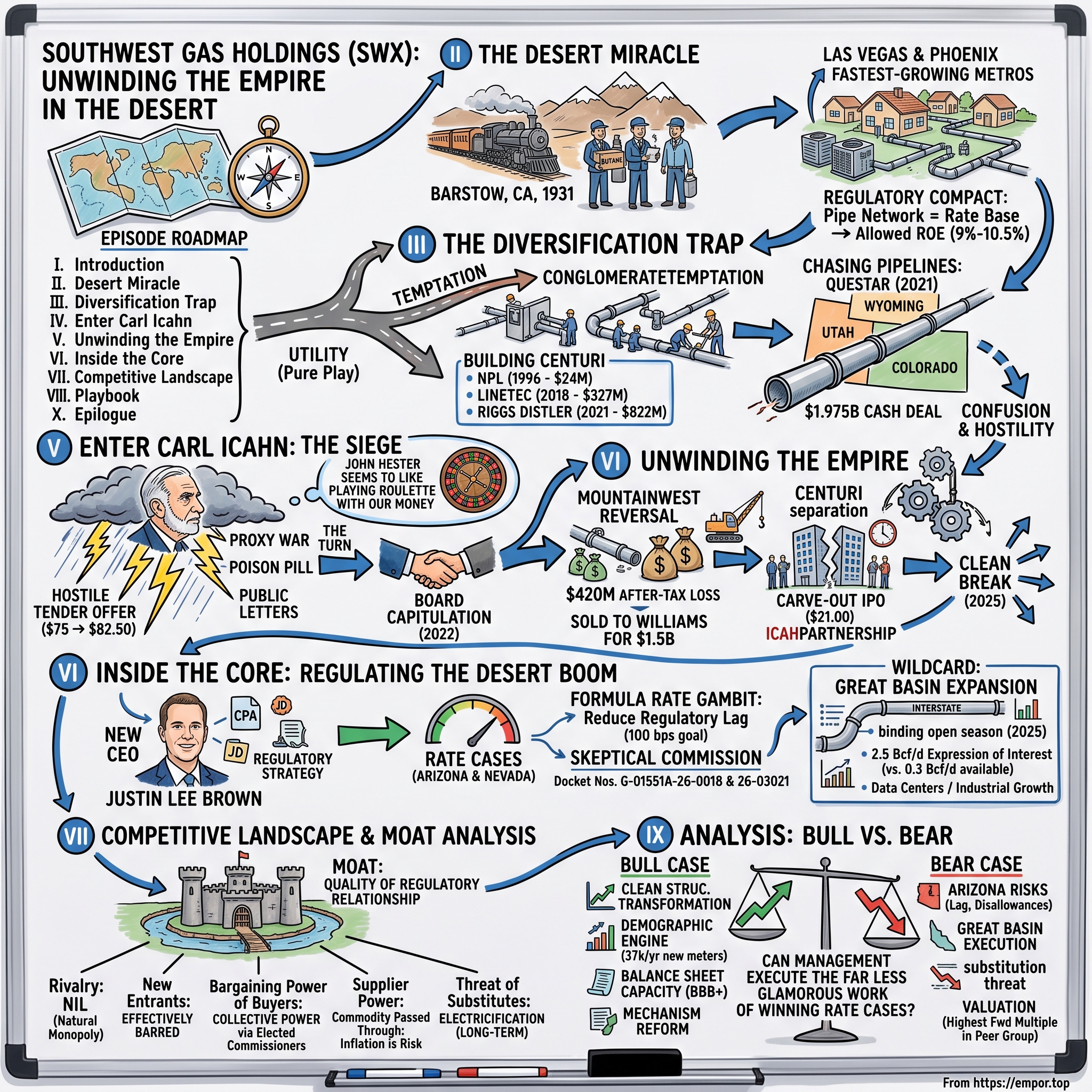
Southwest Gas Holdings, Inc.: Unwinding the Empire in the Desert
I. Introduction & Episode Roadmap
There is a particular kind of company that Wall Street is supposed to find boring. It sells a commodity it does not mark up. Its prices are set by politically appointed commissioners in state capitals. Its customers cannot leave, and it cannot really grow except at the pace at which people build houses in its territory. It exists to convert steel pipe into a regulated return, year after year, decade after decade. The stock is bought by retirees and bond-substitute funds. Nothing happens.
Then, in the autumn of 2021, something happened.
A Las Vegas–headquartered natural gas distributor serving roughly two million meters across the Mojave, the Sonoran Desert, and a thin slice of Northern California announced it would pay $1.975 billion in cash for a Rocky Mountain interstate pipeline system it had never operated, in a business it had never been in, from a seller that had just been blocked from selling it to Warren Buffett.1 Within weeks, Carl Icahn had bought a stake, launched a hostile tender offer for the entire company, and begun publishing open letters of a venom rarely aimed at a utility board. Over the next four and a half years, Southwest Gas Holdings would lose its chief executive, reverse the pipeline acquisition at a loss measured in the hundreds of millions, spin out and then completely sell down the unregulated infrastructure services business it had spent thirty years assembling, retire every dollar of holding-company debt, and emerge in 2026 as something it had not been in a very long time: a pure-play regulated gas utility.
That is the story. It is unusual because activist campaigns at regulated utilities are rare — the sector's shareholder base is passive, the regulatory approval process is a natural poison pill, and there is rarely enough slack in the corporate structure to justify the fight. Southwest Gas was the exception, because management had voluntarily created the slack.
The interesting question for an investor in 2026 is not whether Icahn was right. He was, on the narrow question of the pipeline deal, and the market has largely conceded the point. The interesting question is what the company is now, whether the simplification has actually produced a better business or merely a simpler one, and whether the new management team — installed in May 2026 — can execute the far less glamorous work that determines a utility's returns: winning rate cases.
Here is the roadmap.
We start with the foundation — how a butane distributor in a Mojave railroad town became the gas utility for two of the fastest-growing metros in America, and, more importantly, how regulated utilities actually make money. This matters more than it sounds. Almost every strategic error in this story traces back to management's discomfort with the constraints of the regulatory compact.
Then the conglomerate temptation: why Southwest Gas built Centuri, a multi-billion-dollar unregulated pipeline construction contractor, and why it then chased a midstream pipeline system at precisely the wrong moment.
Then the siege — Icahn's tender offers, his letters, and the board's capitulation.
Then the unwinding, which was expensive and mostly correct.
And finally the new era: Justin Lee Brown's operational-and-regulatory strategy, the rate cases pending right now in Arizona and Nevada, a surprising new growth option in the form of a transmission expansion in Northern Nevada, and the honest bull and bear cases for a utility that is asking the market to re-rate it toward its premium peers.
 Subscribe on LinkedIn
II. The Desert Miracle: Southwest Gas's Origins & The Regulatory Compact
Barstow, California, in 1931, was a railroad division point in the middle of the Mojave — a Santa Fe repair yard, a few thousand people, and a great deal of sand. It is not where you would locate the origin story of a $6 billion-plus public company. But in that year three men — Harold G. Laub, Joe Gray, Jr., and John Koeneman — started a business delivering butane to the town.2 Laub became the company's first president and held the job until 1964, a thirty-three-year tenure that would be unremarkable in a family firm and is extraordinary in a public utility.2
Butane distribution in a desert town is a modest business. What made it into something else was not the founders' brilliance but their geography. Southwest Gas happened to plant itself in the path of the single largest internal migration in American history.
The company crossed into Arizona early — first natural gas service to Douglas, Arizona came in 1933, within two years of founding.2 But the real inflection was demographic. Post-war Southern Nevada and central Arizona did not grow; they exploded. Air conditioning made the desert habitable, federal water projects made it survivable, and Las Vegas and Phoenix became the fastest-expanding metropolitan areas in the country. Laub followed the growth and moved the corporate headquarters to Las Vegas, where the company settled on Spring Mountain Road during the 1970s.2
The capital markets milestones tracked the expansion. Southwest Gas went public over-the-counter on January 24, 1956, selling 44,208 shares.2 Its stock began trading on the New York Stock Exchange on July 19, 1979 — the same year it acquired the gas distribution business of Tucson Gas & Electric, roughly doubling its customer base in a single transaction.2 A second doubling came in 1995 with additional Arizona utility assets. The company crossed two million customers on November 7, 2017, and finished 2025 serving 2,281,000.236
Notice the pattern, because it recurs later with less happy results: Southwest Gas has always grown through a combination of organic connections and periodic large acquisitions. The 1979 and 1995 deals worked, because they bought more of the same thing — regulated gas customers in adjacent desert territory. The instinct that produced them was sound. What went wrong four decades later was applying that same acquisitive instinct outside the fence.
Strip away the narrative and the business proposition was simple: be the incumbent pipe owner in territories where the number of rooftops compounds for seventy straight years. Southwest Gas did not have to be clever. It had to be present, and it had to keep laying mains.
How a gas utility actually makes money
Here is the single most misunderstood thing about a company like this, and it is worth slowing down for, because nearly every judgment later in this story depends on it.
Southwest Gas does not make money selling natural gas.
That sounds absurd — it is a gas company — but it is literally true. The molecules the company buys on the wholesale market are passed through to customers at cost. When gas prices spike, the utility does not earn a windfall; when they collapse, it does not suffer. The mechanism that makes this work is a regulatory ledger: in Arizona, the Gas Cost Balancing Account; in Nevada, the Deferred Energy Accounting Adjustment. If the utility pays more for gas than it collected from customers, the shortfall accrues in the account and is recovered later. If it collects too much, customers get it back. Think of it as a running tab between the utility and its ratepayers on commodity cost alone, trued up periodically, with the utility earning nothing on the balance.
So where does the earnings power come from? From the pipe.
A regulated utility earns a return on the capital it has invested in physical infrastructure — distribution mains, service lines, meters, regulator stations, storage, vehicles, IT systems. That accumulated, depreciated investment is called rate base. A state commission determines an allowed return on equity and an allowed capital structure (how much of the rate base is deemed to be funded by shareholder equity versus debt), and then sets customer rates at a level intended to let the utility recover its operating costs, its depreciation, its interest expense, and that allowed equity return.
The mental model is closer to a landlord than a merchant. Southwest Gas is not selling a product with a margin. It is renting out a network of steel and plastic to two million households, at a rent set by a public body, and the size of the rent check is a function of how much capital it has sunk into the ground.
That produces two consequences that drive everything else in this story.
First: growth requires spending. A utility that does not invest does not grow earnings. This is why utility capital expenditure budgets look absurd relative to revenue — Southwest Gas invested $855 million in 2025 against roughly $1.9 billion of consolidated revenue, and plans approximately $1.25 billion of capital spending in 2026 alone within a $6.3 billion 2026–2030 plan.3 For an industrial company, spending two-thirds of revenue on capex would be a distress signal. For a utility, it is the business model.
Second: there is a ceiling. The allowed return on equity is a cap, not a floor, and it sits in a narrow band — typically somewhere between roughly 9% and 10.5% across US gas jurisdictions. A utility management team that wants to earn 15% on equity has exactly one legal option: go do something else, somewhere the commission does not follow.
Hold that thought. It is the whole of Section III.
The demographic engine
What makes Southwest Gas structurally interesting rather than merely stable is the growth of its service territory. The company added roughly 37,000 new meter sets in 2025, a customer growth rate of about 1.6%.3 That number deserves translation, because in isolation it sounds trivial.
A gas utility in the Northeast or upper Midwest is typically growing its customer count at zero, or shrinking it. Every new meter Southwest Gas connects is a new home in Phoenix, Tucson, Las Vegas, Reno, or one of the smaller Arizona and Nevada communities, and it arrives attached to the capital spending required to serve it — the main extension down the new street, the service line, the meter. That spending goes into rate base. Rate base growth is earnings growth. Customer growth is therefore not a marketing metric for this company; it is the compounding engine.
Southwest Gas ended 2025 with a rate base of approximately $6.7 billion and guided to a 2026–2030 rate base compound growth rate of 9.5% to 11.5%.3 Whether that translates into shareholder returns depends entirely on whether regulators let the company earn its allowed return on the growing base — a question we will come back to hard, because the historical answer has been "not fully."
But for now, the point is that the desert handed Southwest Gas a genuinely enviable regulated franchise. Which raises the question that animates the next act: if you own one of the best-positioned gas distribution territories in the United States, why on earth would you spend three decades trying to be something else?
III. The Diversification Trap: Centuri & Chasing Pipelines
Picture the strategy session. It is the mid-1990s. You run a gas utility in Las Vegas. Your commissions in Arizona and Nevada will let you earn somewhere around 10% on equity, and not a basis point more, forever. Your stock trades like a bond. Your analysts ask about weather. And down the road, the contractors who install and replace your pipe — the ones you write cheques to — are running a business with no rate cap at all.
The temptation is obvious, and Southwest Gas gave in to it.
Building Centuri
The origin was almost accidental, and pleasingly small. NPL Construction had been founded in 1967 as Northern Gasline Constructors by a man named Noel Coon in Gonvick, Minnesota, and renamed NPL in 1983.4 By the mid-1990s Southwest Gas was NPL's largest customer, accounting for roughly 40% of its $117 million of revenue — and in 1996, Coon sold the business to that customer for $24 million.4
Twenty-four million dollars. That is the seed from which a multi-billion-dollar unregulated subsidiary grew, and it explains a great deal about why management defended it for so long. Nobody makes a bad decision buying their own pipeline contractor for $24 million. The bad decisions came later, in the compounding.
Over the following three decades Southwest Gas rolled the business up piece by piece: NEUCO on the electric side, acquired in 2017; Linetec Services, an 80% interest purchased in November 2018 for roughly $327 million; Canyon Pipeline; the Link-Line Group in Canada; and, most consequentially, Riggs Distler — a Mid-Atlantic infrastructure business tracing to 1909 — acquired in August 2021 for $822 million in cash.4 The holding structure was formalized as Centuri Construction Group in 2014 and ultimately became Centuri Holdings, a multi-billion-dollar revenue enterprise laying and replacing pipe and power infrastructure for hundreds of utility clients across the United States and Canada.
Look at the escalation. A $24 million bolt-on in 1996 became a $327 million acquisition in 2018 and an $822 million acquisition in 2021 — the last of which closed just weeks before the company announced a $1.975 billion pipeline purchase. That is not a diversification strategy unfolding patiently over thirty years. That is a company accelerating hard into non-core M&A in a single eighteen-month window, and it is the context that made 2021 explosive.
The industrial logic was not stupid. Utility infrastructure services is a real business riding a real secular tailwind — decades of aging cast-iron and bare-steel pipeline replacement programs, plus electric grid hardening. Centuri's largest customers were regulated utilities running multi-year mandated replacement programs, which produced recurring, quasi-contracted revenue. And Southwest Gas understood the customer intimately, because it was the customer.
The financial logic was where it broke down.
Utility infrastructure services is a labor-intensive, cyclical, thin-margin contracting business with meaningful working capital swings and weather exposure. It carries none of the regulatory protections of a distribution utility and all of the operational risk of a construction firm. Bolting it onto a regulated gas utility inside one holding company produced a hybrid that neither utility investors nor industrials investors wanted to own.
Wall Street's response was the classic conglomerate discount. Utility funds — the natural, price-insensitive, dividend-hungry buyers of a gas distributor — either would not own the complexity or applied a haircut to it. Industrials investors were not going to buy a $6 billion utility to get exposure to a contractor. The sum-of-the-parts was worth more separated than combined, which is a fancy way of saying the corporate structure was destroying value simply by existing.
For years this was a slow-burning inefficiency rather than a crisis. Management could argue the diversification smoothed earnings and gave the company optionality. The counterargument — that the market was explicitly telling them otherwise through the multiple — could be deflected.
Then management did something that made the argument impossible to deflect.
The Questar catalyst
In 2020, Berkshire Hathaway Energy agreed to buy a large package of gas transmission and storage assets from Dominion Energy. Antitrust regulators balked at one piece of it — the Questar Pipeline system, roughly 2,000 miles of interstate pipe running through Utah, Wyoming, and Colorado — and Berkshire eventually walked away from that portion.
Which left Dominion with an orphaned asset and a motivated need to sell.
On October 5, 2021, Southwest Gas Holdings announced it would acquire Questar Pipeline for a total transaction value of $1.975 billion, including the assumption of approximately $430 million of existing debt — roughly $1.5 billion of that in cash.127 The asset was about 2,160 miles of FERC-regulated interstate pipeline plus underground storage across Utah, Wyoming, and Colorado. The deal closed on December 31, 2021, and the company renamed the system MountainWest Pipelines, creating an entirely new "Pipeline and Storage" reporting segment.27
Consider what this actually was. A gas distribution utility with a market capitalization in the $4 billion range, whose institutional knowledge was in laying plastic pipe under suburban streets in the desert, committed roughly two billion dollars of cash — funded with debt at the holding company — to buy an interstate transmission and storage system a thousand miles from its service territory, in a business it did not operate, from a seller whose preferred buyer had just been blocked by regulators.
Management's pitch was framed in the language of the moment: the asset provided "decarbonization optionality" — the argument being that interstate pipe and salt-cavern-style storage could eventually move hydrogen or renewable natural gas — plus cash flow diversification away from state regulatory risk into FERC-regulated transmission.
There is a version of that argument that is coherent. Interstate pipelines are genuinely good assets: long-lived, contracted, federally regulated. But three things about the specific transaction were hard to defend.
The first was price. Midstream assets in 2021 were trading at depressed multiples because the entire sector had spent five years in the capital markets penalty box. Buying into that dislocation was defensible; paying a full price into it was not, and Icahn would spend the next year publishing comparisons against precedent midstream transaction multiples to make exactly that point.
The second was funding. This was a cash acquisition at a company that already carried Centuri's leverage. It stressed the balance sheet at a holding company whose entire equity story rested on funding a decade of utility capital spending. Utility investors do not tolerate perceived threats to the investment-grade rating and the dividend, because the rating and the dividend are the product.
The third — and this is the one that mattered strategically — was that it moved in exactly the wrong direction. The market had been discounting Southwest Gas for being a hybrid. Management's answer was to add a third, entirely unrelated business.
The market's reaction was immediate confusion, then hostility. And into that hostility walked a man who has made a fifty-year career out of showing up precisely when a board has just handed him a live grenade with the pin already pulled.
IV. Enter Carl Icahn: The Blistering Proxy War
Carl Icahn was eighty-five years old in October 2021. He had been doing this since the 1970s — TWA, RJR Nabisco, Texaco, Time Warner, Apple, Herbalife, Xerox. He did not need Southwest Gas. But the setup was almost a caricature of what his playbook is built for: a sleepy board, a management team that had just done a large, unpopular, debt-funded, off-strategy acquisition, an obvious sum-of-the-parts gap, and a shareholder register full of index funds and utility investors who were unhappy and had no organized way to express it.
He moved fast, and he moved loud — and the timing was surgical. On October 5, 2021, the very same day Southwest Gas announced the Questar acquisition, Icahn disclosed a stake of 2,898,676 shares, approximately 4.91% of the company.28 He had, by his own account, tried to talk management out of the deal beforehand and been ignored.
Rather than accumulate quietly and negotiate privately, Icahn then went straight to the most aggressive instrument available. On October 14 he announced his intent to replace the entire board, and on October 27 he formally commenced an unsolicited tender offer for all outstanding shares of Southwest Gas Holdings at $75.00 per share in cash.528 The board's immediate response was a shareholder rights plan — a poison pill with a 10% trigger.28
This is worth pausing on, because the mechanics of a tender offer at a regulated utility are unusual. Icahn almost certainly could not have consummated a full acquisition without state utility commission approvals in Arizona, Nevada, and California, and possibly FERC — a process that takes a year or more and that regulators would have scrutinized brutally. The tender was therefore only partly a bid to buy the company. Functionally, it was a referendum. It put a hard cash number in front of every shareholder and dared the board to explain why its own plan was worth more.
Alongside it came the letters, and the letters were vintage Icahn — part financial analysis, part public humiliation. He described the Questar transaction as disastrous and noted that he had "tried to prevent the disastrous Questar deal before it was signed by calling SWX management a number of times — but to no avail."6 He wrote that he feared the deal could be explained only by management's desire to "empire build" and entrench themselves.6 He attacked the contemplated equity funding, arguing the company would have to issue roughly $900 million to $1 billion of equity and equity-linked securities at what he called "ridiculously low prices" to "cherry-picked" investors who would then support management regardless of how value-destructive its decisions were.6
And then, in October 2021, he produced the line that got quoted everywhere and did more damage than any spreadsheet: "John Hester lives in the right city — because he really seems to like playing roulette. What bothers us is that he is doing it with our money."6
That is worth dwelling on as a tactic rather than a joke. The substance of Icahn's critique — precedent transaction multiples, pro forma leverage, dilution math — was the kind of thing that persuades analysts. The roulette line was aimed at everybody else: the retail holder, the local newspaper, the pension trustee. He distilled the entire campaign to a phrase that required no financial literacy at all: "the value destruction must stop."6
The board did what boards do. It filed a Schedule 14D-9 unanimously recommending shareholders reject the $75 offer, determining that it was inadequate, undervalued the company, and was not in the best interests of stockholders.7
Icahn raised. On March 14, 2022, the offer was increased to $82.50 per share in cash — roughly a 10% bump over the opening bid, and a 27% premium to where the stock had traded the day before his campaign began.829 The board again rejected it on March 28, this time calling the revised offer not merely inadequate but "structurally coercive" and "highly conditional."8
That characterization was not pure spin. Icahn's tender was conditional on a range of items and, because he was not going to end up owning 100% of a regulated utility, shareholders faced a genuine question about what happened to the stub. But the board's problem was that its rebuttal required shareholders to trust management's judgment about future value — and management's most recent exercise of judgment was the thing everyone was angry about. Once credibility is gone, "our plan is worth more than his cash" stops being a persuasive sentence.
The turn
And here is the delicious irony: the tender offer failed, and it did not matter. When the offer finally expired on May 20, 2022, only 2,213,597 shares — about 3.1% of the company — had been validly tendered and not withdrawn.29 Shareholders overwhelmingly declined Icahn's cash. By any literal reading, he lost.
He had already won on the other track.
Because running alongside the tender the whole time was a proxy contest to replace the board at the 2022 annual meeting. This is where activist campaigns are actually decided, because it is where the passive index holders — who will never tender into a hostile offer, but who will absolutely vote against a board that just destroyed value — get to speak. By spring 2022 the board could count the votes.
On May 6, 2022, Southwest Gas settled.9
The terms told the story. John Hester — who had joined the company in 1989 as a regulatory analyst and been chief executive since 2015 — retired as President and CEO and resigned from the board, effective immediately.30 Karen Haller, a 1997 hire who had risen to Executive Vice President and Chief Legal and Administrative Officer, was appointed President and CEO the following day.30 Four Icahn nominees were slated to join the board following the May 19 annual meeting: Andrew W. Evans, H. Russell Frisby, Jr., Henry P. Linginfelter, and — conditionally, contingent on Centuri not being spun off — Andrew J. Teno.10
The remaining terms are a clinic in how these things are actually negotiated. Icahn agreed to a standstill running to shortly before the 2023 nomination deadline, to vote in favor of the company's nominees, and to vote all of his shares in favor of any board-approved sale of the entire company.10 He agreed not to further extend or amend the tender offer, which was capped at 24.9% ownership. And the poison pill trigger was lifted from 10% to 24.9% — the board effectively conceding him the right to accumulate up to a quarter of the company.10 Board chair E. Renae Conley explained the logic plainly: the company "determined our best course of action was to eliminate the uncertainty of a proxy contest so as to concentrate our focus on the strategic process."10
A strategic review of the entire portfolio was put in motion. The board composition churned again shortly afterward — Frisby resigned in late May at the Icahn group's direction and Teno filled the vacancy; Ruby Sharma was appointed that August.10
Two observations for investors, because this is where the analytical lessons are.
First, note what the board conceded. It did not concede price — Icahn never bought the company, and shareholders who held on did substantially better than $82.50 over the following four years. It conceded control of strategy. The activist did not need to own Southwest Gas to run it; he needed four seats and a mandate to break it up.
Second, note the governance signal in the CEO succession. The board replaced a transaction-oriented executive with the general counsel. That is a specific message: the next phase of this company would be legal, regulatory, and structural work — dismantling, negotiating, filing — not dealmaking. The board was not looking for a visionary. It was looking for someone who could execute a complicated, unglamorous, multi-year unwinding without blowing anything up.
That unwinding started almost immediately, and it was expensive.
V. Unwinding the Empire: The Costly Restructuring
There is a specific corporate humiliation in selling an asset you bought thirteen months earlier, to a better-run competitor, at a large loss, at the direction of a board you did not choose. Southwest Gas experienced it in full public view.
The MountainWest reversal
In December 2022, the company announced a comprehensive simplification of its corporate structure, and the centerpiece was the disposal of the pipeline system it had just bought.11 The Williams Companies agreed to acquire MountainWest Pipelines for a total enterprise value of $1.5 billion, including approximately $430 million of assumed debt.12 The transaction closed on February 14, 2023.[^13]
Do the arithmetic slowly, because it is the cleanest illustration of capital destruction in the whole story. Southwest Gas committed $1.975 billion of enterprise value in late 2021 and exited at $1.5 billion in early 2023 — before transaction costs, before financing costs, before the management time consumed.
The accounting came in two pieces. When MountainWest was reclassified as held for sale in the fourth quarter of 2022, the company recorded a pre-tax goodwill impairment of approximately $449.6 million, part of a total pre-tax loss on reclassification of roughly $455 million; after an income tax benefit of about $101 million, the after-tax hit was on the order of $355 million.13 Then, on closing in the first quarter of 2023, an additional $66.5 million after-tax incremental loss was recorded — including a roughly $21 million true-up correcting the original held-for-sale estimate.31
Add them and the total after-tax cost lands around $420 million, at the upper end of the $350 million to $425 million range management had guided to at announcement.1331 Give management credit for that much: the loss estimate was honest and it was hit.
The true-up is a small detail worth noting for what it says about controls under stress: a nine-figure impairment computed in the middle of a proxy war, a CEO transition, and a rushed disposal process, restated the following quarter. It is not a scandal. It is a reminder that impairment accounting on a distressed sale involves judgment, and judgment made under duress is where errors live.
The strategic verdict is harsher than the accounting one. Roughly $420 million of shareholder capital — better than $6 per share against a company then trading in the $60s — was consumed by an acquisition-and-reversal round trip that added nothing to the business. To put that in the terms this industry uses: a utility earns roughly a 10% allowed return on the capital it puts in the ground, so destroying $420 million is economically equivalent to giving up about $42 million of annual earnings power in perpetuity — against a natural gas distribution segment that earned $300 million in 2025.3 Fourteen months of empire building cost the company something close to a seventh of its ongoing regulated earnings base.
Was selling still the right call? Almost certainly yes. Once the balance sheet was under pressure and the strategic rationale had lost board support, holding a non-core midstream asset to avoid crystallizing a loss would have been sunk-cost management of the worst kind. The error was the purchase, not the sale. But investors should be clear-eyed that the "activist unlocked value" narrative comes with a very large invoice attached.
The Centuri separation
The second piece was harder and took much longer, because Centuri was a real, decades-old, operating business that could not simply be handed to a buyer.
The board chose a carve-out IPO rather than an outright sale — a decision that reflected both the state of the M&A market for infrastructure services in 2023–2024 and a desire to retain flexibility on how and when to exit.
Centuri Holdings priced its initial public offering at $21.00 per share, at the top of the marketed range, and began trading on the New York Stock Exchange under the ticker CTRI on April 18, 2024.14 The deal totaled 14,260,000 shares including the underwriters' full over-allotment exercise of 1,860,000 shares, and closed on April 22, 2024.15 Concurrently, Icahn Partners and Icahn Partners Master Fund purchased 2,591,929 shares in a private placement at the IPO price, for gross proceeds of approximately $54.4 million.15 Total net proceeds to Centuri from the IPO and private placement were $328.0 million after $18.0 million of underwriting discounts and $8.0 million of expenses, which Centuri used to repay $156.0 million under its revolver and $160.0 million under its term loan.15 The stock rose 13% on debut.16
Two things about that structure are analytically interesting.
The proceeds went to Centuri, not to Southwest Gas — this was a primary offering that deleveraged the subsidiary rather than a cash-out for the parent. Southwest Gas's return came later, through selling its retained stake into the market.
And the Icahn private placement is a genuinely unusual artifact. The activist who had spent two and a half years attacking the company's capital allocation put fresh capital into the carve-out at the IPO price. Read charitably, it was a signal of confidence that anchored the book. Read skeptically, it was an activist with board representation buying into a transaction his own directors had helped design — a related-party dynamic that a governance-focused investor would at minimum want disclosed and priced at arm's length, which it was, at the public offering price.
The clean break
Southwest Gas still owned roughly 80% of Centuri after the IPO, which meant the conglomerate discount had not actually gone away — it had merely been made explicit and marked to market daily. Over 2025 the company sold down the remainder through a series of registered offerings and private placements.
The final block came on September 5, 2025: 27,362,210 Centuri shares at $19.60 per share, generating gross proceeds of approximately $535.5 million and net proceeds of roughly $525 million.17 Following that offering, Southwest Gas Holdings owned no shares of Centuri and retained no governance or consent rights.17 Karen Haller framed it plainly: the company had "successfully completed our exit from Centuri, positioning Southwest Gas Holdings as a premier fully regulated natural gas company."17
Note the exit price. Centuri IPO'd at $21.00 and Southwest Gas sold its final tranche at $19.60 — below the IPO price, seventeen months later. Total 2025 Centuri sale proceeds came to roughly $1.3 to $1.35 billion.173
The proceeds were used to repay debt — including the full retirement of the $550 million holding company term loan and the revolving credit facility balance — leaving Southwest Gas at year-end 2025 with $577 million of cash, approximately $1.3 billion of total liquidity, and no holding company debt.3 S&P upgraded both Southwest Gas Holdings and the utility to BBB+.3
That upgrade is the concrete payoff. A credit rating is not an accolade for a utility; it is an input cost. A company that will raise several billion dollars of debt over the next five years to fund rate base growth converts every notch of rating improvement directly into lower interest expense — expense that regulators allow it to recover, but which shows up in customer bills and therefore in regulatory goodwill. The balance sheet repair is real, measurable, and compounding.
So after four and a half years, one destroyed pipeline acquisition, one ousted CEO, one carve-out IPO, and a full sell-down, Southwest Gas arrived where it started in 1931: a company that distributes natural gas in the desert. The question now is whether that is enough.
VI. Inside the Core: Regulating the Desert Boom
On February 25, 2026, Southwest Gas Holdings announced two things on the same day. The first was a set of full-year 2025 results that beat the top end of guidance. The second was that Karen Haller — capping a 29-year career with the company — would retire and Justin Lee Brown, president of the utility operating company, would become chief executive effective May 8, 2026.183
The sequencing was deliberate. Haller had been hired to execute a demolition — unwind the pipeline deal, separate Centuri, repair the balance sheet, and manage a hostile activist onto and eventually off the board. That job was finished. What comes next is a different job entirely.
The new chief executive
Justin Brown is, in background, almost the precise opposite of the empire-building profile that got Southwest Gas into trouble.
He holds a bachelor's degree in accounting from Southern Utah University and both an MBA and a Juris Doctor from Gonzaga University.19 He began his career in the tax department at Deloitte & Touche, moved into commercial litigation, and joined Southwest Gas in 2004 as senior counsel in legal affairs.19 He was promoted to associate general counsel in 2006, left briefly for PacifiCorp — a Berkshire Hathaway Energy utility — and returned in 2008 as assistant general counsel focused on regulatory support and strategy.19
Then look at the sequence of roles that followed: Vice President of Pricing in 2012. Vice President of Regulatory Affairs in 2013. Senior Vice President and General Counsel in 2018. President of Southwest Gas Corporation in 2022.19
Pricing and regulatory affairs is where a gas utility's earnings are actually determined. A CEO who spent his formative years building rate cases, negotiating with commission staff, and designing tariff mechanisms is a CEO optimized for the one variable that matters most in a pure-play utility: the gap between allowed return and earned return. He is not a dealmaker, and after the last five years, that is the point.
The board paired the elevation with a compensation structure that signals what it expects: a $900,000 base salary, an annual cash incentive target of 110% of base, a one-time performance-share award with a $3.1 million target value, and a long-term equity incentive rising to 330% of base beginning in 2027 — the bulk of the package weighted toward multi-year stock performance rather than annual cash.37 Karen Haller, for her part, stepped back as an advisor through the end of 2026 at $95,000 per month, with her existing awards continuing to vest.37 It was a friendly, planned succession — the opposite of the abrupt exit that removed her predecessor.
The credibility test is not the résumé, though. It is whether the regulatory strategy he is now pushing actually works. And that strategy has a name.
The Arizona problem
Arizona is the largest of Southwest Gas's three jurisdictions and, historically, the most difficult. The March 2025 order shows why.
The company had filed in February 2024 seeking a revenue increase of approximately $126 million, later reduced to roughly $96 million through the process.20 The Arizona Corporation Commission ultimately authorized an increase of approximately $80.2 million — more than a third below the original ask — with a return on common equity of 9.84% on a 48.5% equity ratio.2021 The administrative law judge's recommended order had eliminated recovery of more than $5 million in board of director and management incentive compensation.20
That last item deserves emphasis, because it is not a routine accounting adjustment. Disallowing incentive compensation is a commission telling a utility's shareholders — not its customers — to pay for management's bonuses. It is a governance verdict rendered through the rate base, and it landed on a company that had recently destroyed roughly half a billion dollars on an out-of-state pipeline. Regulators have long memories, and Arizona's commissioners are elected, which means ratepayer anger is directly transmitted into rate orders.
The structural problem underneath the specific disallowances is regulatory lag, and it is worth explaining in plain terms because it is the central operational issue for every capital-intensive utility in an inflationary period.
A traditional rate case is backward-looking. The commission examines a "test year" — a historical twelve-month period — reconstructs what the utility's costs and investment were during that window, and sets rates going forward based on that snapshot. But the utility does not stop spending. By the time new rates take effect, the company has already invested another year or two of capital that is earning nothing, and is paying today's wages and today's interest rates against yesterday's approved cost structure.
The analogy: imagine a landlord who is only allowed to reset rent every three or four years, based on what the building cost to run in a year that ended eighteen months before the reset. In a period of stable costs, the lag is annoying. In a period of rising costs and heavy construction, it is a permanent structural drag — which is precisely why Southwest Gas earned an adjusted utility return on equity of only 8.3% in 2025 against allowed returns in the high nines.3 That roughly 150-basis-point shortfall is not weather or bad luck. It is the mathematics of lag.
The formula rate gambit
On February 27, 2026, Southwest Gas filed a new Arizona general rate case seeking an increase of approximately $101.0 million, or 10.4% of incremental annual revenues, in Docket No. G-01551A-26-0018.2221 The filing requested a return on common equity of 10.25% plus a fair value increment of 0.20%, on an actual equity layer of 50.08%.21
But the headline number is not the interesting part. The interesting part is the mechanism.
The application proposed a formula-based rate adjustment mechanism — an annual true-up designed to close the lag by comparing the utility's actual earned return on common equity against its authorized return, and adjusting rates accordingly, subject to a deadband within which no adjustment occurs.21
In plain terms: instead of waiting three years and re-litigating everything, rates would step up or down each year based on how far the utility's actual earnings drifted from the target. The deadband is the buffer zone — a range around the authorized return inside which nothing happens, so that small variances do not trigger annual filings.
Management has been explicit about the stakes. Brown outlined a goal of reducing regulatory lag in Arizona and Nevada by roughly 100 basis points through the new formula mechanisms, assuming approvals.21 One hundred basis points of earned ROE on an equity base supporting a $6.7 billion rate base is a large number — it is, roughly speaking, the difference between a utility that chronically under-earns and one that delivers what it is authorized to deliver.
This is the single most important thing to watch at Southwest Gas, and investors should be skeptical until it is granted. Formula rates are not exotic — versions exist in several US jurisdictions — but they represent a meaningful transfer of certainty from ratepayers to shareholders, and commissions do not hand them over casually. An elected Arizona commission that just docked the company $5 million for incentive compensation is not an obvious candidate to grant an automatic annual earnings true-up. The request is strategically correct. The probability of full approval is unproven.
Two details matter for anyone tracking this. The Arizona filing seeks recognition of a rate base of roughly $3.9 billion, a $705 million increase over the currently authorized level — evidence of just how fast the company has been investing since the last case.34 And the proposed effective date is April 2027.34 That is thirteen months of additional lag from the filing date alone, which is precisely the problem the formula mechanism is designed to solve, and a reminder that even a successful outcome arrives slowly.
Nevada followed on March 17, 2026, with a general rate application in Docket No. 26-03021 seeking approximately $71.3 million — roughly $66.3 million in Southern Nevada and $5 million in the north — at a requested ROE of 10.00% on a 50.05% equity ratio, against a rate base of about $2.4 billion.34 Nevada operates on a 210-day statutory clock, with hearings scheduled for August 2026 and rates proposed to take effect that October.34 Nevada has historically been the more constructive of the two large jurisdictions, and its faster procedural schedule is itself an advantage — the same request in Arizona will take roughly twice as long to reach customers' bills.
California, the smallest jurisdiction, ran late — but on the first-quarter 2026 call Brown noted that a draft decision approved a settlement at roughly 90% of the request, and that an approved memorandum account "preserves the full-year benefit to earnings," so the delay was not expected to affect 2026 results.23 Memorandum accounts are the regulatory equivalent of a placeholder: costs accrue in a tracked account while the decision is pending, and are recovered once it lands. It is a small point, but it is the kind of technical regulatory plumbing that a former VP of Pricing knows how to secure in advance.
The wildcard: Great Basin
There is one genuinely new element in the 2026 story that was not part of the Icahn-era narrative at all, and it complicates the tidy "boring pure-play utility" framing.
Southwest Gas owns Great Basin Gas Transmission Company — formerly Paiute Pipeline — an approximately 898-mile interstate transmission system running from the Idaho border down to the Nevada–California line, with an LNG peak-shaving facility near Lovelock.34 It is a legacy asset that nobody paid much attention to for decades. That changed abruptly.
The company launched a binding open season in 2025 for the "2028 Expansion Project," and secured roughly 800 million cubic feet per day of binding commitments on minimum twenty-year agreements.3435 It then received pre-filing approval from the Federal Energy Regulatory Commission in January 2026, with a targeted in-service date of November 1, 2028 and an estimated capital investment the company has framed at approximately $1.7 billion, against earlier project estimates in the $800 million to $1.2 billion range depending on final scope.335
Then came the supplemental open season in April 2026, and the result was startling. Management disclosed on the first-quarter call that the company offered roughly 0.3 billion cubic feet per day of remaining capacity and received expressions of interest totaling approximately 2.5 Bcf/d — better than eight times oversubscription.2334 Analysts spent much of the Q&A pressing on exactly the right questions: how the economics scale, how quickly non-binding interest converts into binding contracts, and what the capital requirement looks like if the project expands beyond its baseline design.23
That distinction between the 800 MMcf/d already under binding contract and the 2.5 Bcf/d of expressed interest is the one investors should hold onto. The first is money. The second is a queue.
The demand signal is almost certainly about data centers. Northern Nevada — the Reno–Sparks corridor — has become a major data center and industrial development market, and gas-fired generation is the fastest-to-deploy answer to large new electric loads. An eightfold oversubscription is a strong indication that someone with very large power needs wants firm gas transportation in that corridor.
For investors, this cuts both ways, and the tension is worth stating honestly. A $1.7 billion FERC-regulated transmission project would be roughly a 25% increase on the company's entire existing rate base — a genuinely material growth option, contracted, long-lived, and arguably higher quality than distribution capex.
It is also, structurally, a large interstate pipeline investment by a company that four years ago nearly came apart over a large interstate pipeline investment.
The differences are real: Great Basin is an existing owned asset within the service territory, expanded against contracted customer demand, rather than a $2 billion cash acquisition of a distant system. That is a materially better proposition. But the discipline question is legitimate, and a skeptical investor should watch the financing plan closely. A project of this size cannot be funded from the current cash balance alone. The equity-versus-debt mix, and whether management honors the deleveraging discipline it just spent four years establishing, will be the real test of whether the lesson took.
For now, the company has kept its promises: 2025 adjusted EPS from continuing operations of $3.65 came in above the top end of guidance, the dividend was raised 4% to $0.645 per quarter effective in the second quarter of 2026, and 2026 guidance was set at $4.17 to $4.32 with a stated 2026–2030 EPS CAGR target of 12% to 14%.3 That growth target is aggressive for a gas utility — the sector convention is mid-single digits — and it is worth understanding that it is partly a function of a depressed 2025 base, since the company is growing off a year in which it under-earned its allowed return. Growth that comes from closing a lag gap is real growth, but it is one-time in character. It does not repeat once the gap is closed.
Which brings us to the competitive question: in a business where the government sets your price, what exactly is the moat?
VII. Competitive Landscape & Power Analysis
Ask most investors to name Southwest Gas's competitors and they will say Atmos Energy, One Gas, Spire, Northwest Natural. That answer is wrong in an instructive way. Those companies are comparables, not competitors. Not one of them can sell a therm of gas to a household in Tucson. They compete with Southwest Gas for capital in the public markets and for a valuation multiple. They do not compete for customers, because in this industry, customers cannot be competed for.
To see why, run the business through Hamilton Helmer's framework.
Where the power actually is
Scale economies and cornered resource, fused into a physical monopoly. Once Southwest Gas has laid distribution mains under a neighborhood's streets, the economics of a second entrant are absurd. A challenger would need to trench the same streets, obtain the same municipal franchise, and then split the same fixed customer base — halving revenue against fully duplicated fixed costs. The incremental cost of serving one more house on an existing main is trivial; the cost of building a parallel network is prohibitive. This is the textbook natural monopoly, and it is why the industry is regulated in the first place.
Switching costs, of an unusually absolute kind. In most businesses, switching costs are friction. Here they are near-total. A homeowner cannot choose a different gas distributor. The only "switch" available is to stop using gas entirely — replace the furnace, the water heater, the range, and rewire for the electric load. That is a multi-thousand-dollar decision made once every fifteen to twenty years at appliance replacement. It is a real threat, but it operates on a decadal clock, not a quarterly one.
Counter-positioning: absent. There is no clever new business model that attacks Southwest Gas's core. Nobody is disrupting gas distribution with software.
Branding: irrelevant. No customer chooses Southwest Gas. Brand equity in a monopoly utility has essentially no economic value, though brand damage has real regulatory cost — which is precisely what the incentive compensation disallowance demonstrated.
Process power: modest but real. Operating a gas distribution system safely — leak surveys, cathodic protection, pipeline integrity management, emergency response — is genuinely hard, and utilities that do it badly experience catastrophic, franchise-threatening events. Southwest Gas's safety record is not a competitive weapon, but its absence would be an existential liability.
Which leaves the dominant force.
State power, and its price
Everything about this business runs through the regulatory compact. The state grants exclusivity; in exchange, the utility accepts an obligation to serve and a cap on its return.
The critical insight for investors is that this power is bilateral. Utility investors often treat regulation purely as protection. It is equally a constraint, and the terms are renegotiated in every rate case. A commission can effectively reduce the value of the franchise without touching the monopoly — by lowering allowed ROE, thinning the equity layer, disallowing capital as imprudent, refusing trackers, or slow-walking decisions. Arizona's 2025 order did several of these at once, and the outcome was a company earning 8.3% while nominally authorized to earn 9.84%.321
The moat, in other words, is not the pipe. Anyone can see the pipe. The moat is the quality of the regulatory relationship, and it is the one part of the business that can genuinely deteriorate.
Porter, briefly, and honestly
Run the five forces and most of them collapse to nothing. Rivalry among existing competitors: essentially zero within a service territory. Threat of new entrants: effectively barred by both economics and franchise law. Bargaining power of buyers: individually nil — a household has no negotiating position — but collectively enormous, exercised through elected commissioners and consumer advocates, which is where the real buyer power in a utility lives.
Supplier power is more interesting than it looks. The commodity itself is passed through, so gas producers have little leverage over utility earnings. But labor and materials suppliers genuinely matter in a period of heavy construction, because a utility that experiences cost inflation between rate cases eats it. And there is a nice irony here: Southwest Gas just sold the pipeline construction contractor that used to give it internal visibility into exactly those costs.
Threat of substitutes is the force that matters, and it is the bear case in its purest form.
The electrification question
The genuine long-term threat to Southwest Gas is not another gas company. It is the heat pump.
The mechanism is straightforward and slow. Modern electric heat pumps have become efficient enough to work in cold climates; induction ranges are good; electric water heaters are cheap. When jurisdictions push building codes toward all-electric new construction, gas utilities lose the new-connection growth that drives rate base. Over a longer horizon, if the customer count declines, the fixed cost of maintaining the network is spread over fewer bills, rates rise, more customers leave — the "utility death spiral." Nobody in the US gas industry has actually experienced this yet, but it is the structural risk that justifies the sector's persistent valuation discount versus electric utilities.
Southwest Gas's exposure to this is unusually favorable, and it is worth being precise about why.
California is the epicenter of building electrification policy in the United States, and it is where the terminal-value erosion is real. But California is Southwest Gas's smallest jurisdiction by a wide margin — the recent rate case there was roughly $30 million of revenue relief in a company seeking $101 million in Arizona alone.2123 The bear case's sharpest edge lands on the least material piece of the business.
Arizona and Nevada are different environments entirely — politically, and physically. These are cooling-dominated climates. The heating load is modest; the primary residential gas uses are water heating, cooking, and a comparatively light winter furnace season. That cuts both ways: it means gas has less share of household energy to lose, but it also means the economics of switching are less compelling for a homeowner, and it means the electrification policy pressure that has reshaped the Northeast and West Coast has little political constituency in Phoenix or Las Vegas. Both states have moved to restrict local gas bans rather than encourage them.
The honest formulation: Southwest Gas's near-to-medium-term growth is well protected, and the substitution threat is a terminal-value question rather than a five-year earnings question. But "terminal value question" is not the same as "not a problem." A regulated utility invests in assets depreciated over forty to sixty years. If policy shifts materially in 2035, a meaningful portion of what is being built in 2026 has not been recovered. This is the reason the whole sector trades where it does, and no amount of Sunbelt demographics makes it disappear.
The peer question
Which brings us to the comparison that actually drives the stock — and to the single most important correction an investor should make to the popular version of this story.
The received narrative is that Southwest Gas is a cleaned-up utility trading at a discount to premium peers, waiting to be re-rated. As of mid-July 2026, the numbers say otherwise. The stock traded around $92 per share with a market capitalization near $6.7 billion, a trailing P/E near 28 and a forward P/E around 20.5, with a dividend yield of roughly 2.7%.24
Now put that against the group. Atmos Energy — the long-standing quality benchmark in gas distribution, with heavy Texas and Southern capital spending, genuinely excellent regulatory mechanisms, and a decade-plus record of hitting its numbers — traded at roughly 20.0 times forward earnings.24 One Gas traded near 15.7 times. Northwest Natural near 15.6. Spire near 17.4.24
Southwest Gas is not trading at a discount to its peers. It is trading at the highest forward multiple in the group — modestly above Atmos and roughly 30% above One Gas and Northwest Natural.
That reframes the investment question entirely. The re-rating thesis has already substantially played out. The market has already given Southwest Gas full credit for the simplification, the balance sheet repair, and the S&P upgrade. What the market is now paying for is the forward guidance: a 12% to 14% EPS CAGR through 2030 against peer guidance of 6% to 8% at Atmos, 5% to 7% at One Gas and Spire, and 4% to 6% at Northwest Natural.24
So the multiple is not an opportunity. It is a liability — in the sense that it embeds successful execution of a growth plan substantially more aggressive than anything else in the sector. And a meaningful portion of that plan depends on winning regulatory outcomes that have not yet been granted.
Recall the mechanics. Southwest Gas earned an adjusted utility ROE of 8.3% in 2025 against an Arizona authorization of 9.84%, and 8.5% on a twelve-month basis through the first quarter of 2026.32123 Atmos does not trade where it trades because it is simple; it trades there because it consistently earns close to what it is allowed to earn. Southwest Gas has not yet demonstrated that it can.
The company is therefore being priced as though the formula rate mechanisms will be approved, the lag will close, and the Great Basin expansion will proceed — before any of those things have happened. That is the whole investment question, and it explains why the pending rate cases matter more than anything else on the company's agenda.
VIII. Playbook: Business & Investing Lessons
Strip away the personalities and Southwest Gas offers four transferable lessons — each of which applies well beyond utilities.
The unregulated siren song
The pattern is common enough to be a category. A management team runs a business with a structurally capped return. Compensation, ego, and investor pressure all reward "growth." The capped business cannot deliver growth beyond its regulatory ceiling. So management goes looking for growth outside the fence.
Sometimes this works. More often it produces the exact outcome Southwest Gas produced: a portfolio the market values at a discount to its parts, funded with leverage the core business must ultimately support, in businesses where the company has no genuine competitive advantage.
The diagnostic question is simple and rarely asked: why would we win in this new business? Southwest Gas had a real answer for Centuri in 1995 — it understood utility construction because it bought utility construction. It had no persuasive answer for MountainWest. A desert gas distributor had no operating edge, no cost advantage, and no proprietary insight in Rocky Mountain interstate transmission. It had only a willing seller and available debt capacity, which is not a strategy.
The generalized rule for investors: when a company with a defensible core business acquires outside that core, the burden of proof is on management to articulate a specific advantage, and "diversification" and "optionality" are not advantages. They are the words used when there isn't one.
Activism as corporate defragmenter
The second lesson is about mechanism. Icahn never bought Southwest Gas. He never won a full proxy contest. He obtained board representation and a strategic review — and that was sufficient to unwind a pipeline acquisition, separate a thirty-year-old subsidiary, and change the CEO.
What made it work was not the money. It was the sequencing: a full-company cash tender offer that forced every shareholder to hold a specific number in their hand, a public letter campaign that made the board's judgment the issue rather than the price, and a simultaneous proxy contest that gave passive index holders a low-cost way to register displeasure. Boards can dismiss a tender offer. They cannot dismiss an arithmetic count of votes.
The investor takeaway is about where activism actually works. It works where there is a structural value gap — a conglomerate discount, a non-core asset, a broken capital structure — that can be closed by a discrete transaction. It works far less well where the problem is operational underperformance, because no board vote makes a company execute better. Southwest Gas was the first kind of problem, which is why the campaign succeeded so completely.
And the cost should not be airbrushed. The unwinding consumed roughly half a billion dollars in the MountainWest round trip alone, plus four years of management attention, plus a Centuri exit executed below IPO price. The value was unlocked. It was not free.
The right CEO for the right era
Boards routinely hire the leader who fits the last decade. Southwest Gas, unusually, hired twice for the actual moment.
Haller — a lawyer — was hired to dismantle, negotiate, and separate. That is legal and structural work, and it was completed on a reasonable timeline without a credit event or a broken transaction.
Brown — an accountant-turned-lawyer-turned-regulatory-executive — has been hired to close the gap between allowed and earned return. That is not a visionary's job. It is a technician's job, and the technical fluency required is real: test-year construction, cost-of-service allocation, tariff design, mechanism negotiation, and knowing which commission staffers will accept which arguments.
The broader lesson is that CEO fit is situational, not absolute. A dealmaker in a pure-play regulated utility is a risk, not an asset — because in a business with a capped return and no competitive dynamics, the only large decisions available to a CEO are capital allocation decisions, and the temptation to make one is exactly what got this company into trouble.
For investors, this means watching what a management team is optimized for, and asking whether that matches what the business currently needs.
Regulatory lag is the silent killer
The fourth lesson is the least intuitive and the most important for anyone who owns capital-intensive regulated assets.
Investors focus obsessively on the allowed ROE headline. It is the wrong number to focus on. The allowed ROE is a ceiling; what shareholders receive is the earned ROE, and the distance between them is determined by mechanism design, not by the headline percentage.
A utility authorized 9.5% with excellent trackers, forward test years, and annual adjustment mechanisms will out-earn a utility authorized 10.25% with a historical test year and a three-year gap between cases. This is why the Atmos-style premium exists and why Southwest Gas's formula rate request in Arizona is, in economic terms, worth considerably more than the $101 million headline.
The mechanism matters more than the number. That sentence is the single most useful thing an investor can carry out of this story.
Which sets up the final question: given all of the above, what is the actual case for and against this company from here?
IX. Analysis & Bull vs. Bear Case
Why this company wins from here
The structural transformation is real and complete. Southwest Gas is now a fully regulated gas distributor with no holding company debt, a single business line, roughly $1.2 to $1.3 billion of liquidity, and a materially better credit profile — S&P upgraded both the holding company and the utility to BBB+ with a stable outlook in September 2025, taking the parent up three notches from BBB-, while Fitch moved its outlook from negative to stable that July.33233 Every reason a utility investor previously had to avoid this company — the contractor, the pipeline, the activist, the leverage, the complexity — has been eliminated. The important caveat is the one established above: this is largely reflected in the multiple already. It is a reason the business is better, not a reason the stock is cheap.
The demographic engine. Roughly 37,000 new meters a year at a 1.6% growth rate is close to best-in-class for a US gas LDC, and it is not a management achievement — it is a territory characteristic.3 Phoenix, Tucson, Las Vegas, and Reno are among the strongest household formation markets in the country, and the associated capital spending flows directly into rate base. This is genuinely durable and genuinely difficult for any peer to replicate.
Balance sheet capacity. With FFO to debt at 18.6% and no holdco debt, the company can fund a $6.3 billion five-year capital program without the equity issuance that dilutes utility shareholders.3 That distinction matters enormously in this sector, where growth funded by dilution frequently produces flat per-share earnings.
Mechanism reform as an earnings lever. If the formula rate mechanisms are approved in Arizona and Nevada, roughly 100 basis points of earned ROE improvement is available without selling a single additional therm.21 This is the highest-return "project" the company has, and it requires no capital at all.
The Great Basin option. An eightfold oversubscribed open season on a potential $1.7 billion FERC-regulated expansion represents genuine optionality that is not yet in most estimates.233
What could break the case
Arizona. This is the central risk, and it is not hypothetical. The commission has demonstrated willingness to cut requests by a third, disallow incentive compensation as a governance rebuke, and authorize an equity layer below what the company actually carries.2021 Commissioners are elected. Bills are politically salient in a state where summer energy costs are already a live issue. The formula rate request asks a skeptical elected body to grant an automatic annual earnings adjustment. Nothing about the recent record suggests it will be granted in full.
The under-earning problem may be chronic, not cyclical. An 8.3% earned return against a 9.84% authorization is the actual track record.321 Management's guidance implicitly assumes this gap closes. If mechanism reform is denied or watered down and the company continues under-earning while spending $1.25 billion a year, the rate base grows but the return on it does not — and the 12% to 14% EPS growth target becomes unreachable. The aggressive growth target is itself a risk: management has set a bar substantially above sector convention, and missing a self-imposed bar has a credibility cost.
Terminal value and electrification. Assets being built today are depreciated over decades. Arizona and Nevada are favorable jurisdictions now, but "now" is doing a lot of work in a forty-year asset life. The California territory is a live preview of what unfavorable policy looks like.
Cost of capital. A utility is a leveraged spread business. It borrows at market rates and earns a regulator-set return. When rates rise faster than commissions adjust authorized returns, the spread compresses. The BBB+ upgrade helps; it does not eliminate the exposure, and the company will be a large, repeat issuer of debt through 2030.
Execution and capital discipline. Great Basin is a project estimated in the range of $800 million to $1.2 billion, and up to roughly $1.7 billion depending on final contracted scope, at a company whose last large pipeline decision cost shareholders around $420 million.34313 The circumstances are materially different and the project is far better grounded, but investors are entitled to require evidence rather than assurance.
Valuation leaves no margin for error. This is the risk that gets least attention and probably deserves the most. The stock carries the highest forward multiple in its peer group while its earned ROE sits at the bottom.243 The market is paying a premium for a plan. If Arizona denies the formula mechanism, or grants a diluted version, or if Great Basin's non-binding interest fails to convert into binding twenty-year contracts, the 12% to 14% growth guidance becomes unreachable — and a de-rating toward the One Gas and Northwest Natural end of the range would be a substantial move independent of anything that happens to earnings.
The activist stress test
What would a skeptical investor challenge today, now that the obvious targets have been removed?
The exit price on Centuri. Southwest Gas took Centuri public at $21.00 and sold its final tranche at $19.60 seventeen months later.1417 A critic would argue the board chose a phased IPO exit — which maximized optionality and control — over an outright sale that might have captured a control premium, and that the sell-down was executed into a weakening market for infrastructure services equities. Management would counter that a clean trade sale at an acceptable price was not available and that the phased approach preserved value. Both are defensible; it is not a settled question.
The unexamined counterfactual. Roughly half a billion dollars was destroyed on MountainWest, and no member of management who approved it remains. But the board that approved the acquisition was substantially the same board that approved the reversal, and several directors persisted through both. Accountability at the director level was less complete than at the executive level.
Guidance construction. A 12% to 14% EPS CAGR target off a base year in which the company under-earned its authorized return deserves scrutiny. Part of that growth is genuine rate base compounding; part is a one-time recovery of a lag gap that cannot recur. Management has been reasonably transparent about the components, but the headline number is more flattering than the underlying run-rate.
Post-activist governance. On February 11, 2026, the company and the Icahn group mutually terminated their amended and restated cooperation agreement, and Icahn dissolved his position in Southwest Gas during the first quarter of 2026.2526 The Icahn-nominated directors — Andrew Evans, Henry Linginfelter, and Ruby Sharma — continued to serve and were expected to be renominated.25 The oversight structure that forced the discipline is now gone. Whether the discipline outlives the enforcer is an open, and not trivial, question — and it will be tested first by the Great Basin financing decision.
The three KPIs that matter
Everything above reduces to a small number of things worth tracking. Three, specifically.
1. Earned return on equity versus authorized return on equity. This is the master metric. It captures rate case outcomes, mechanism quality, cost control, and lag simultaneously. Every strategic initiative at this company — formula rates, the Arizona and Nevada filings, the operational discipline — is ultimately an attempt to move this one number. If the gap between earned and authorized narrows, the investment case is working. If it does not, nothing else compensates.
2. Rate base growth. The size of the asset the return is earned on. Watch it in conjunction with the first metric, never alone — a utility growing rate base while under-earning is spending capital at a return below its authorization, which builds a bigger business without building proportionally bigger value.
3. Net customer additions. The organic engine, and the cleanest read on whether the Sunbelt demographic thesis is intact. It is also the earliest warning signal for electrification: if new-construction connections in Phoenix or Las Vegas begin decelerating faster than housing starts, the substitution threat has arrived ahead of schedule.
Three numbers. Everything else is commentary.
X. Epilogue
In February 2026, without a press conference or an open letter, the Southwest Gas–Icahn saga simply ended. The two sides mutually terminated the cooperation agreement, nullifying all remaining rights and obligations on both sides.25 By the end of the first quarter, Icahn had dissolved his stake entirely.26 The directors he had nominated stayed on the board.
There was no victory statement. There did not need to be one. The company he had attacked in 2021 — a leveraged three-legged holding company with a pipeline it should not have bought and a contractor the market would not pay for — no longer existed. What remained was a gas utility.
It is worth being precise about the ledger, because this story gets told too cleanly in both directions.
The costs were substantial and permanent: roughly half a billion dollars destroyed in the MountainWest round trip, a Centuri exit completed below its own IPO price, four and a half years of management bandwidth consumed by governance conflict, and a regulatory relationship in Arizona damaged enough that commissioners explicitly disallowed management incentive compensation.
The gains were also real: no holding company debt, an improved credit rating, roughly $1.3 billion of liquidity, a single reportable business, a management team selected for the actual work at hand, and a capital plan that can be funded without dilution.
And the outcome, honestly assessed, is not a triumph or a tragedy. It is a company that spent thirty years trying to escape the constraints of the regulatory compact, discovered at considerable expense that it could not, and returned to doing the thing it has done since three men started selling butane in a Mojave railroad town in 1931 — putting steel and plastic in the ground ahead of the next wave of people moving to the desert.
Whether that is a good investment now turns on something far less dramatic than a proxy fight. It turns on whether a former vice president of pricing can persuade an elected commission in Phoenix to let his company earn what it is already allowed to earn.
References
-
Southwest Gas to buy Dominion Energy's Questar Pipeline for $1.975 billion — Reuters, 2021-10-05 ↩↩
-
Proud to Fuel What Matters—Yesterday, Today, and Tomorrow (History Timeline) — Southwest Gas ↩↩↩↩↩↩↩
-
Southwest Gas Holdings, Inc. Reports Fourth Quarter and Full-Year 2025 Financial Results — PR Newswire / Southwest Gas Holdings, 2026-02-25 ↩↩↩↩↩↩↩↩↩↩↩↩↩↩↩↩↩↩↩↩
-
Southwest Gas Holdings, Inc. — Schedule TO-C, Icahn tender offer materials — U.S. Securities and Exchange Commission, 2021-10 ↩
-
Southwest Gas Holdings, Inc. — Schedule TO-C, Icahn open letter to stockholders — U.S. Securities and Exchange Commission, 2021-10 ↩↩↩↩↩
-
Southwest Gas Holdings, Inc. — Schedule 14D-9 recommending rejection of the tender offer — U.S. Securities and Exchange Commission, 2021-11 ↩
-
Southwest Gas Holdings, Inc. — Schedule 14D-9/A regarding the revised $82.50 per share offer — U.S. Securities and Exchange Commission, 2022 ↩↩
-
Southwest Gas settles with Carl Icahn; CEO John Hester to step down — Reuters, 2022-05-06 ↩
-
Southwest Gas Holdings, Inc. — Form DEFA14A regarding settlement and board composition — U.S. Securities and Exchange Commission, 2022-05 ↩↩↩↩↩
-
Southwest Gas Simplifies Corporate Structure to Maximize Stockholder Value — PR Newswire / Southwest Gas Holdings, 2022-12-15 ↩
-
Williams to Acquire 2,000 Miles of Gas Pipeline from Southwest Gas for $1.5 Billion — Pipeline & Gas Journal, 2022-12 ↩
-
Southwest Gas Holdings, Inc. Reports 2022 Financial Results — PR Newswire / Southwest Gas Holdings, 2023-02-28 ↩↩↩
-
Southwest Gas and Centuri Announce Pricing of Centuri Initial Public Offering and Concurrent Private Placement — Centuri Holdings, Inc., 2024-04-17 ↩↩
-
Centuri Announces Closing of Initial Public Offering — Centuri Holdings, Inc., 2024-04-22 ↩↩↩
-
Centuri Rises 13% After Raising $315 Million in IPO, Icahn Deal — Bloomberg, 2024-04-18 ↩
-
Southwest Gas Holdings Announces Completion of Centuri Separation — PR Newswire / Southwest Gas Holdings, 2025-09-05 ↩↩↩↩↩
-
Southwest Gas Holdings Announces CEO Succession Plan — PR Newswire / Southwest Gas Holdings, 2026-02-25 ↩
-
Justin Brown — Management, Southwest Gas Corporation — Southwest Gas Holdings ↩↩↩↩
-
Southwest Gas incessant in requesting back-to-back rate increases — Energy and Policy Institute, 2025 ↩↩↩↩
-
Southwest Gas Holdings, Inc. — Form 10-Q for the quarter ended March 31, 2026 — U.S. Securities and Exchange Commission, 2026-05-05 ↩↩↩↩↩↩↩↩↩↩↩
-
Southwest Gas Holdings, Inc. — Form 10-K for fiscal year 2025 — U.S. Securities and Exchange Commission, 2026-02 ↩
-
Earnings call transcript: Southwest Gas Q1 2026 — Investing.com, 2026-05 ↩↩↩↩↩↩
-
Southwest Gas Holdings (SWX) Stock Overview — StockAnalysis.com, 2026-07-17 ↩↩↩↩↩
-
Southwest Gas Ends Icahn Cooperation Agreement, Board Remains — TipRanks, 2026-02-12 ↩↩↩
-
Carl Icahn Dissolves Share Stake In Southwest Gas Holdings; Cuts In EchoStar — Reuters via TradingView, 2026 ↩↩
-
Dominion Energy Announces Agreement to Sell Questar Pipelines to Southwest Gas — PR Newswire / Dominion Energy, 2021-10-05 ↩↩
-
Carl Icahn's tender offer for Southwest Gas sets the table for a proxy fight — CNBC, 2021-10-23 ↩↩↩
-
Icahn Enterprises Announces Extension and Amendment of Southwest Gas Tender Offer — Icahn Enterprises L.P., 2022 ↩↩
-
Southwest Gas Announces CEO Transition — PR Newswire / Southwest Gas Holdings, 2022-05-06 ↩↩
-
Southwest Gas Holdings, Inc. Reports First Quarter 2023 Financial Results — PR Newswire / Southwest Gas Holdings, 2023-05 ↩↩
-
S&P raises Southwest Gas Holdings rating to BBB+ after Centuri exit — Investing.com, 2025-09-22 ↩
-
Southwest Gas Holdings outlook revised to stable by Fitch — Investing.com, 2025-07-30 ↩
-
Southwest Gas Q1 2026 slides: regulatory progress amid earnings miss — Investing.com, 2026-05-11 ↩↩↩↩↩↩↩↩
-
Great Basin Gas Transmission Company Announces Close of Second Supplemental Open Season and Execution of Associated Binding Precedent Agreements for Natural Gas Expansion in Northern Nevada — PR Newswire ↩↩
-
Southwest Gas Holdings, Inc. — Definitive Proxy Statement (customer count and director information) — U.S. Securities and Exchange Commission, 2026 ↩
-
Southwest Gas Holdings Announces CEO Succession Plan — PR Newswire / Southwest Gas Holdings, 2026-02-25 ↩↩
 LinkedIn
 WhatsApp
 Reddit
 Hacker News
 Email
Email Kindle
 RSS Feed
 Spotify
 Apple Podcasts
 Amazon Music
 Audible
 YouTube