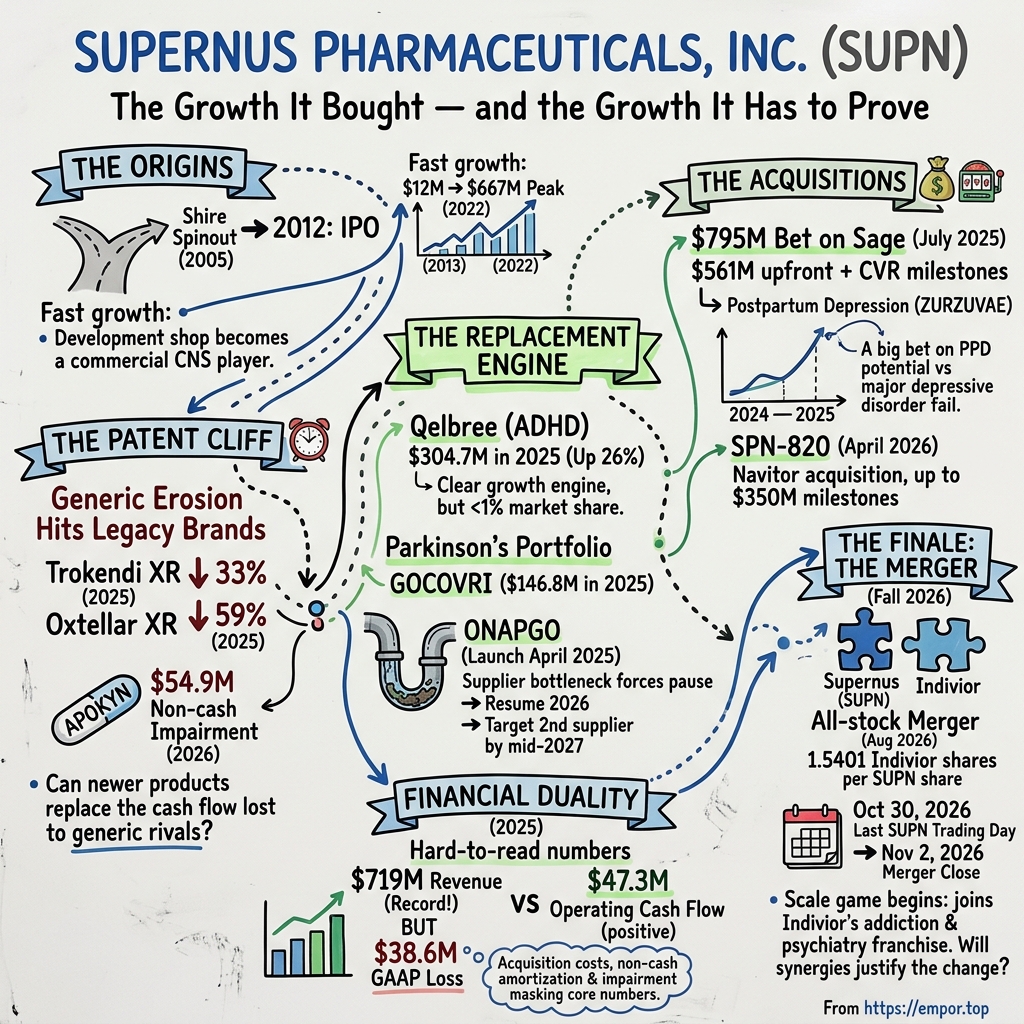
Supernus Pharmaceuticals, Inc.: The Growth It Bought—and the Growth It Has to Prove
I. The Company With Three Weeks Left on Nasdaq
On October 19, 2026, Nasdaq posted a short notice on its trader-news page about a mid-sized drug company from Rockville, Maryland. There was nothing dramatic about it. The notice said the last expected trading day for Supernus Pharmaceuticals would be Friday, October 30. The stock would halt that evening, after the after-hours session. The merger with Indivior Pharmaceuticals was tentatively scheduled to close before the market opened on Monday, November 2, and the formal suspension would follow on November 3.
Each Supernus share would become 1.5401 shares of Indivior.1 A company that had spent two decades building a business in neurology and psychiatry was being reduced to a conversion ratio and a halt time.
That routine paperwork hides a story with more turns than most mid-cap pharma stories. Supernus started as a development lab spun out of a British drugmaker. It went public at a price so far below its target range that the deal nearly failed. It then built one of the steadier commercial franchises in American central nervous system medicine, the part of pharma that treats the brain and nerves, which covers epilepsy, ADHD, Parkinson's disease and depression. Then it spent a decade watching patent clocks run down on its first products and buying or building replacements before they ran out.
The headline numbers for its last full year as a standalone company look like a success. Revenue reached a record $719 million in 2025, up about 9% from 2024.2 Look one layer down, though, and the picture gets harder to read. Net product sales, the money from the pills, pens and pumps Supernus itself sells, actually fell about 2%.
Total revenue grew mainly because Supernus had bought Sage Therapeutics in July 2025, and Sage brought along its share of a postpartum depression drug that Biogen books.2 And the record-revenue year ended in a net loss of $38.6 million, after earning $73.9 million the year before.2
So the first question this story has to answer is simple to state and hard to settle. Can Supernus's newer products, the ADHD drug Qelbree, the Parkinson's drugs GOCOVRI and ONAPGO, and the postpartum depression pill ZURZUVAE, replace the older brands that generic competition is steadily eroding? The second question is the one Nasdaq's notice raises. What does merging with a larger company built on an opioid-addiction franchise mean for the people who own Supernus today?
The merger is not a done deal in every sense, but it is close. Supernus shareholders approved it on October 15, 2026, with about 48.25 million shares in favor and only about 240,000 against.3 Indivior shareholders approved the share issuance the same day.4 As of this writing, October 24, the transaction has not closed. There is also a twist in the paperwork that the Nasdaq notice leaves out.
Indivior is the legal acquirer, but the combined company will be renamed Supernus, Inc., will be run by Supernus founder Jack Khattar, and is expected to trade on Nasdaq under the same ticker, SUPN.4 The ticker is not dying. It is moving to a much bigger company, and Indivior's existing holders will own about 56.5% of it.4
That twist sets up the whole investigation. A Supernus shareholder is about to trade a company they can judge on its own record for a minority stake in a company that carries the old name but has a different center of gravity. Before that happens, it is worth settling what the old company actually built. Which parts of its growth came from its own labs and sales force? Which parts were bought? And how much durable cash does the portfolio produce once the acquisition accounting is stripped away?
The verdict, stated up front and tested throughout, is this. The business is growing in the products that matter most for its future, and that growth is real. But a chain of acquisitions, impairments and contingent payments makes it hard to see how much lasting earning power the portfolio has, and operating cash flow fell sharply in the very year revenue hit a record.
In a week or so, that unresolved question becomes one input into a much larger company's investment case. To see why the question is so hard, it helps to go back to a laboratory in Rockville and a British parent that decided it no longer needed it.
 Subscribe on LinkedIn
II. From Shire's Development Shop to a Commercial Company
Late in 2005, a small team of scientists in Rockville found out that their employer was letting them go. Not the people, but the building, the equipment and the know-how. For years the group had worked as Shire Laboratories, the U.S. drug-development arm of the British specialty pharmaceutical company Shire. Its expertise was drug delivery, the unglamorous craft of taking a molecule that already works and redesigning how it releases into the body, so patients can take it once a day instead of three times, or get steadier blood levels with fewer side effects.
That year, a newly incorporated Delaware company called Supernus Pharmaceuticals bought substantially all of Shire Laboratories' assets and started operating on its own.5
The person who made that bet was Jack Khattar. He had joined Shire Laboratories in 1999 and became its president and CEO. From 1999 to 2004 he sat on Shire plc's executive committee. Before that he was an executive at CIMA Labs, a drug-delivery company, and earlier still he worked in marketing and business development at Merck, Novartis, Playtex and Kodak.6 He studied marketing at the American University of Beirut and earned an MBA at Wharton.6
That background matters to this story. Khattar was not a bench scientist who drifted into management. He was a commercial executive running a scientific organization, and Supernus would spend the next twenty years acting like one: willing to license, buy and repackage, and always focused on whether a product could be sold.
The first few years were the familiar biotech struggle: years of losses spent pushing reformulated epilepsy drugs through the FDA. By the time Supernus filed to go public, it had two programs close to the finish line. One was an extended-release form of topiramate, coded SPN-538, with an FDA action date in July 2012. The other was an extended-release oxcarbazepine, SPN-804, with a decision due in October 2012.5 Further back in the prospectus were earlier-stage programs, including one coded SPN-812.5 That code is worth remembering. Nine years later, SPN-812 would reach the market as Qelbree.
The IPO itself was a humbling moment. In April 2012, Supernus asked investors to pay $12 to $14 a share.5 When the deal finally priced, it sold 10 million shares at $5 each, plus about 449,000 over-allotment shares, and raised $47.6 million in net proceeds.7 Selling stock at roughly 40% of the low end of the range is the kind of discount that usually signals a company has run out of other options. Investors in 2012 were being asked to fund a reformulation shop with no approved products, and they named their price. The company took it, because independence needed cash.
What followed was the first proof that Khattar's commercial instincts were sound. The oxcarbazepine product launched as Oxtellar XR and the topiramate product as Trokendi XR, and revenue climbed fast. Revenue rose from about $12 million in 2013 to about $409 million in 2018.82 In five years, a company that once sold stock at $5 because nobody trusted it to commercialize anything had become a profitable specialty pharma business with a national sales force calling on neurologists.
The second half of the story is less tidy. Revenue reached a peak of about $667 million in 2022, fell to about $608 million in 2023 as the first generics arrived, recovered to about $662 million in 2024, and reached the record $719 million in 2025.2 The shape of that curve says something important. The original engine, two reformulated epilepsy drugs, had a fixed life.
Everything after 2020 was a race to replace them, partly with Qelbree, which came out of Supernus's own pipeline, and partly with products bought from US WorldMeds, Adamas Pharmaceuticals and Sage Therapeutics. Revenue growth in the 2020s therefore cannot be read as a clean measure of how the original business was doing. The company's size and shape kept changing underneath the reported numbers.2
It also matters what Supernus did not become. It never became a diversified conglomerate selling generics, devices or consumer health products. It stayed a developer and marketer of branded prescription medicines for the brain, sold mostly in the United States, and it owns no commercial manufacturing plants.2 That focus is the company's clearest strategic choice. It is also its main exposure, because a focused portfolio of patented brands is a portfolio of expiring assets.
The question that hung over Supernus from its first launches to its last week as a standalone company was whether its commercial platform could keep producing winners after the first wave of patents ran out. Answering it requires understanding exactly how a company like this earns money, and how little of that money is guaranteed.
III. A Prescription Is Not a Contract
Picture a pediatric psychiatrist in suburban Ohio at the end of a long clinic day. A mother has brought in her ten-year-old son, who has ADHD and has done poorly on a stimulant. It made him anxious, killed his appetite and left him irritable in the evenings. The psychiatrist writes a prescription for Qelbree. That signature looks like the moment Supernus makes a sale. It is actually the start of a negotiation in which Supernus is only one of several parties, and often not the most powerful one.
The prescription goes to a pharmacy, and the pharmacy checks with the family's insurer. The insurer, or the pharmacy benefit manager working for it, has already decided whether Qelbree sits on its formulary, the list of covered drugs, and on what terms. If coverage depends on the child first failing a cheaper drug, there may be paperwork before anything is dispensed.
Once it is approved, the pharmacy fills the bottle from inventory that a wholesaler delivered. That wholesaler bought the product from Supernus weeks earlier. The doctor chooses, the patient takes the drug, the payer decides access and price, and the wholesaler moves the boxes and pays the invoice.
Supernus records revenue when the wholesaler or specialty pharmacy takes physical control of the product. It then subtracts estimates for rebates to payers, discounts, chargebacks and expected returns.2 Those deductions are large. On Qelbree, the gap between list price and what Supernus actually keeps, known in the industry as gross-to-net, was about 49% across 2025, and management guided to 50% to 55% for 2026.9
Put plainly, roughly half the sticker price of every Qelbree bottle goes to someone else before it becomes Supernus revenue. And the share that goes out has been growing, not shrinking. Payers do not hold that leverage by accident. They decide whether a branded ADHD drug is easy or hard for a family to get.
That is why a prescription is not a contract. Patients refill, so sales recur in a loose sense. But Supernus has no subscription base, no multiyear supply agreements with patients and no disclosed recurring-revenue share.2 Every month, the business depends on doctors choosing to keep prescribing, payers choosing to keep covering, and no cheaper equivalent turning up at the pharmacy counter. Part of the license and collaboration income is also lumpy by nature: royalties and milestone payments that arrive when a partner hits an approval or a sales threshold.2
The product mix shows where that dependence sits. In 2025, Qelbree made up about 49% of net product sales and GOCOVRI about 23%. The three shrinking legacy brands, Oxtellar XR, Trokendi XR and APOKYN, together made up about 21%.2 Half the company's own product revenue now rides on one ADHD medicine. That concentration is the cost of Qelbree's success. It means the most important competitive question at Supernus is the ADHD market.
That market is huge and brutal. Khattar described its size in September 2026: about 111 million ADHD prescriptions a year, of which Qelbree accounted for about 935,000 in 2025, under 1% of the total.10 Most of the market is generic stimulants such as amphetamine salts and methylphenidate. They are cheap, familiar and effective for most patients. Among non-stimulants, generic atomoxetine and generic guanfacine are established, inexpensive options. Branded newcomers keep arriving too. In July 2026, the FDA approved Otsuka's centanafadine, sold as SIMTRIYO, for ADHD in adults and children aged six and up.
Otsuka calls it the first approved norepinephrine, dopamine and serotonin reuptake inhibitor for the condition.11 Qelbree's pitch is that it offers a non-stimulant option with a label that runs from age six through adulthood.2 That positioning is real. But a sub-1% share means the "very large market" is a runway, not a moat. Nothing yet shows that patients who start Qelbree are locked in, or that payers cannot push the price down further.
Parkinson's disease, Supernus's second franchise, works differently. GOCOVRI, an extended-release amantadine, treats dyskinesia, the involuntary movements that come with long-term levodopa therapy, and the "off" episodes when medication wears off. ONAPGO is a wearable pump that delivers apomorphine under the skin all day for patients whose symptoms swing unpredictably. These are narrower, more specialized niches where neurologists matter more than primary-care doctors. But they are not free of competition. Oral generics, older therapies and new device-based treatments such as AbbVie's VYALEV infusion all limit how much these brands can charge and how fast they can spread.12
Patents and clever formulations are the reason any of this works. They give a branded product years in which no one can copy it. But the protection is temporary by design. Supernus's own settlement agreements set dates when generics may enter, and its filings say plainly that lost sales after generic entry may never come back.2 Exclusivity in this business is a lease, not ownership.
There is also concentration downstream. In 2025, four unnamed wholesale and distribution customers accounted for 90% of gross product sales. The largest alone was 27% of sales and 35% of receivables.2 That level of concentration is normal in U.S. pharma, because three national wholesalers dominate drug distribution. But normal is not the same as harmless. A handful of counterparties controls the flow of goods and cash, and Supernus does not name them.2
Upstream, the company makes nothing itself. Supernus does not own or operate commercial manufacturing facilities. It relies on contract manufacturers and packagers such as Patheon, part of Thermo Fisher, and Catalent, on Asian suppliers of active ingredient for its epilepsy drugs, and on single partners for specific brands: Britannia for APOKYN and ONAPGO, Merz for MYOBLOC and Zambon for XADAGO.2 That model is light on capital. It also means a supplier's bottleneck becomes Supernus's revenue problem, a lesson ONAPGO would teach in 2025.
So the economic picture is a company with real but rented advantages. It earns money through doctors' choices, keeps whatever payers allow it to keep, ships through a few giant middlemen, and depends on contractors to make its products. Nothing here is unusual for specialty pharma. What makes the model risky is the time limit on each product. And for Supernus, that time limit stopped being theoretical in January 2023.
IV. The Patent Clock Starts Taking Revenue Away
Every branded drug company has a date it plans around but rarely says out loud. For Trokendi XR, the date was set years earlier in patent settlements that allowed generic sales to begin in January 2023. For Oxtellar XR, the settlement and license agreements allowed generics from September 2024.2 The patents themselves ran longer. The ten issued U.S. patents on Trokendi XR and eleven on Oxtellar XR do not expire before 2027.2 But in pharma, a settlement date usually matters more than a patent's printed expiry. Supernus had swapped years of litigation risk for certainty, and certainty arrived on schedule.
What happened next is the pattern that defines this business. When a generic version of an extended-release drug reaches pharmacies, it does not take share gradually like a competing brand. Insurers move patients to the cheaper equivalent, pharmacies substitute automatically where the law allows, and the brand's volume and price fall together. By 2025, Oxtellar XR sales had fallen 59% and Trokendi XR sales 33%, to about $41 million and $42 million respectively.2
These were the two products that had taken Supernus from a $5 IPO to a profitable company. Within about two years of generic entry, together they were barely a quarter the size of Qelbree.
The decline did not stop there. In the first half of 2026, Trokendi XR sold about $17.9 million and Oxtellar XR about $16.2 million.13 That is roughly a $68 million annual pace for the pair, still falling. Management had expected this. Its 2025 guidance had set the two drugs' combined sales at $65 million to $75 million for that year.14 Forecasting the erosion accurately is a sign of honest guidance. It is not a sign of a protected business. And Supernus warns in its filings that generic competition can permanently reduce product sales.2
The same test applies to the acquired Parkinson's portfolio, and here the results are worse because they were not fully planned. APOKYN, an apomorphine injection pen for sudden Parkinson's "off" episodes that Supernus bought from US WorldMeds in 2020, fell about 35% in 2025, to about $47.8 million.2 Then, in the second quarter of 2026, Supernus wrote down the APOKYN intangible asset by $54.9 million.
The company said the charge reflected the brand's commercial performance and a change in its long-term outlook made during the planning process.13 An impairment is an accountant's admission that an asset will earn less than the company assumed when it bought it. No cash leaves the building that quarter. But the earlier purchase is confirmed to have been worth less than its price.
Osmolex ER is the other cautionary entry. It was an extended-release amantadine tablet that came to Supernus with the Adamas acquisition in 2021.15 Supernus withdrew it from distribution in 2024.16 The episode should not be overstated. Osmolex was a small product overshadowed by GOCOVRI, its sister drug, and dropping it was a portfolio decision, not a disaster. It is still a useful data point: an FDA-approved, patented CNS product that Supernus owned and sold, and that never earned a lasting place. Approval was not enough.
Adding this up gives the real size of the replacement problem. In 2025, the three declining brands produced roughly $131 million of sales between them. In the first half of 2026 they produced about $48 million, a pace near $96 million a year.13 Even before any further decline, the newer products have to grow by tens of millions of dollars a year just to keep total product revenue flat.
And the clock is not finished. GOCOVRI's settlement agreements allow generic versions starting in June 2029, even though its patents run from 2028 to 2038.2 The product that replaces today's erosion carries its own expiry date.
That is the treadmill. Supernus does not just have to grow. It has to grow faster than its own portfolio ages, and it has to do it again every few years. The company's answer to the treadmill, more than any other product, has been Qelbree, the molecule that sat in the 2012 prospectus as SPN-812. Whether Qelbree is a lasting franchise or simply the next product on the clock is the most important question in the Supernus story.
V. Qelbree Finds Its Market—How Much of One?
On April 2, 2021, the FDA approved Qelbree, viloxazine extended-release capsules, for ADHD in patients aged six to seventeen. On April 29, 2022, the label was expanded to adults.2 For Supernus, those two dates were the end of a long internal journey. A program that investors in 2012 had barely priced into the IPO became the company's first truly new chemical-entity launch in ADHD. It reached the market in the middle of a pandemic, when sales representatives could not walk into doctors' offices.
The pitch was clear from the start. Its non-stimulant positioning was meant for patients and clinicians who wanted an alternative: children who did not tolerate stimulants, families wary of them, and adults with other conditions that made stimulants a poor fit.2 In a market where most prescriptions are cheap generics that work well enough for most patients, Qelbree's opportunity was always in the gaps, the patients for whom "good enough" was not.
The commercial evidence is solid and has been building. Qelbree sales grew from about $140 million in 2023 to about $241 million in 2024 and about $305 million in 2025, a 26% increase in the last year.2 In the first half of 2026 it sold about $167 million, up about 17%.13 Its second-quarter sales of about $89 million, multiplied by four, imply a brand running at roughly $360 million a year, as Khattar pointed out in September.10
Growth has slowed from the launch-curve years, as it always does, but it has not stalled. By any reasonable standard Qelbree has become a commercial success, and unlike the Parkinson's products, Supernus built it itself.
The details of that growth matter more than the totals, because revenue in branded pharma can rise for reasons that have nothing to do with patients. Price increases, smaller rebates or wholesalers stocking up ahead of a price change can all lift reported sales for a quarter. Qelbree's recent growth, though, has been driven by volume. On the May 2026 call, management said IQVIA prescription data showed Qelbree prescriptions up 19% in the first quarter, against about 10% growth for the overall ADHD market.
Adult prescriptions grew 27% and pediatric 15%.12 Prescribers reached about 43,000, and for the first time more adult prescribers than pediatric ones were writing Qelbree.12 Second-quarter growth was also mostly volume.13 That is the signature of a drug finding new patients, especially in the adult market, which is larger and less tied to school calendars.
Price tells a more sobering story. Gross-to-net, which was in the low 50s in early 2025 for seasonal reasons, averaged about 49% for the year, and management guided to 50% to 55% for 2026.149 Growing volume while giving away more of each prescription's list price is how branded drugs gain coverage in crowded categories. It works, but it means more prescriptions translate into somewhat less revenue per prescription. Pricing power, in other words, is not part of Qelbree's case. Volume is.
Then there is the market-share figure, which works as both the bull case and the bear case. Khattar put Qelbree below 1% of the market.10 A bull hears enormous runway. Each additional percentage point of share would be worth hundreds of millions of dollars.
A skeptic hears something different. After five years on the market, a differentiated, well-promoted drug has won little of the market. Most prescribers, payers and patients are still choosing the cheap generic stimulant, and that choice is driven by cost, habit and efficacy that a non-stimulant cannot easily dislodge.
Both readings are true, and the evidence supports a narrower version of the bull claim. Qelbree is a durable niche franchise growing faster than its market. It is not a mass-market ADHD leader, and nothing in the record shows it will become one. Its moat, as far as there is one, is differentiated positioning and patent families that the company says could run from 2029 to 2035.2 Switching costs are low, because a doctor can try a different drug at the next visit. Pricing power is weakening at the margin.
The competition is also getting sharper. Otsuka filed its centanafadine application in late 2025, and the FDA accepted it for priority review in January 2026.17 Approval came on July 24, 2026, as SIMTRIYO, a once-daily capsule for adults and children six and older. It is classified as a CNS stimulant, needs DEA scheduling before launch, and Otsuka expects it to be available later in 2026.11 So the threat is a new mechanism with a large pharma sales force behind it, though it does not share Qelbree's non-controlled status.
When analysts asked about new competition on the August merger call, Khattar said orexin-targeted drugs in ADHD were too early to judge and that he welcomed competition.18 In September he added that Supernus had seen no human data from orexin agonists yet.10 Neither answer addressed centanafadine directly, and the record does not show management explaining in measurable terms how Qelbree will defend its share against a new branded launch.
Comparing the calls shows a consistent pattern in how management talks about Qelbree. In prepared remarks, the emphasis is on prescription growth, prescriber counts and the adult opportunity. In the Q&A, analysts tend to push on price, seasonality and launch timing, and the answers are matter-of-fact. Asked on the February 2026 call about first-quarter Qelbree trends, Khattar said there was "nothing really unusual" compared with prior years.9
Supernus does not give product-level guidance. On the May 2025 call, Khattar did say he was comfortable with analysts' consensus of about $290 million for Qelbree that year.14 The brand came in above $300 million.2 On this one product, management's informal signals have been conservative rather than promotional.
So three things need to keep confirming the Qelbree story: prescription volume growth well ahead of the ADHD market, new-to-brand starts among adults, and gross-to-net that stabilizes instead of creeping higher. If those hold, Qelbree is the internally built growth engine that justifies Supernus's existence as an independent developer. If they fade, especially once SIMTRIYO is on shelves, half of Supernus's product revenue becomes a slow-growth brand on a patent clock. That explains why, years earlier, Khattar had already gone shopping for a second engine.
VI. The Parkinson's Portfolio: Bought Brands, Uneven Outcomes
In April 2020, while much of the economy had shut down, Supernus announced the largest deal in its history. It had agreed to buy the CNS portfolio of US WorldMeds, a privately held specialty pharma company in Louisville, Kentucky, for $300 million upfront plus up to $230 million in regulatory and sales milestones.[^19] The package included APOKYN, the apomorphine injection pen for Parkinson's "off" episodes; XADAGO, an add-on Parkinson's therapy; MYOBLOC, a botulinum toxin used for cervical dystonia and chronic drooling; and an apomorphine infusion pump program then called SPN-830.[^19]
US WorldMeds had produced about $150 million of net sales and about $45 million of operating earnings from these assets in 2019.[^19]
The logic was easy to see. Trokendi XR's generic date was less than three years away, and Qelbree was still awaiting approval. Supernus needed revenue that did not depend on its own epilepsy franchise, and it wanted a specialty neurology sales force that could call on movement-disorder specialists. US WorldMeds offered both at once, along with a pipeline product that fit the same doctors.
Was the price sensible? The announced figures allow a simple, company-specific check. Three hundred million dollars upfront against $150 million of sales is two times revenue. Against $45 million of operating earnings it is about 6.7 times. If every milestone were paid, the total of $530 million would be about 3.5 times sales and almost 12 times 2019 operating earnings.[^19] Those multiples look modest on paper, and Supernus paid them out of its own cash. But the multiple only means something if the earnings persist, and a portfolio built on an older injection pen had no guarantee of that.
A year and a half later, Supernus made its second Parkinson's purchase. In October 2021 it agreed to buy Adamas Pharmaceuticals for $8.10 a share in cash, about $400 million, plus contingent value rights worth up to another $1.00 a share if GOCOVRI hit sales milestones.15 Adamas brought GOCOVRI and Osmolex ER, both forms of amantadine.15 The deal closed in November 2021. Together with the US WorldMeds products, it gave Supernus a full Parkinson's portfolio and a reason for its specialty sales force to exist.
Five years on, the results for those products could hardly be more mixed. GOCOVRI has been a clear success. It reached about $146.8 million of sales in 2025, up 12%, with prescriptions up about 14%.29 It grew another 15% in the first quarter of 2026 and sold about $72.8 million in the first half.1213 For a drug whose growth is not driven by launch excitement, that is steady, specialist-driven demand.
APOKYN tells the opposite story. It fell to about $47.8 million in 2025 and was written down by $54.9 million in mid-2026.213 XADAGO and MYOBLOC have stayed small, folded into an "other" line that totaled only about $6.5 million in the first half of 2026.13 Osmolex ER was withdrawn. And the SPN-830 pump program became ONAPGO.
It won approval and launched in 2025, triggering a $25 million milestone payment to the former owners in the first quarter of that year.14 So the US WorldMeds deal produced one shrinking legacy brand, two minor products and one promising launch. The Adamas deal produced one growing franchise and one failure.
What does that record say about Supernus's skill at acquisitions? It rules out the most flattering version, that Supernus has a repeatable formula for buying brands that keep growing. APOKYN shows that a product already on the market and already earning money can still lose a large part of its sales, and an impairment of nearly $55 million is the accounting record of that loss. It also rules out the harshest version.
GOCOVRI by itself now earns almost as much as the entire US WorldMeds portfolio did in 2019, and ONAPGO came from the same deal that brought APOKYN. The fairer conclusion is narrower. Supernus is good at running a specialty sales force and at keeping a well-differentiated product growing. It is not reliably good at predicting which bought products will last. Owning a CNS product's technology is not the same as owning its future demand.
The calls from those years show how the thesis was sold. In 2020 and 2021, management framed the purchases as diversification and as building a Parkinson's platform. As a narrative, that held up. As a promise about each individual asset, it did not. And the business case that was pitched rarely put numbers on how much of the bought revenue would survive.
The most useful lesson from the Parkinson's chapter is that the outcome depended on the product, not the platform. That lesson would be tested at much higher stakes four years later, when Khattar went after a company whose main asset had barely started selling.
VII. Sage: The $795 Million Bet on a Postpartum Depression Drug
On June 16, 2025, Supernus announced it would buy Sage Therapeutics, a Cambridge, Massachusetts, neuroscience company that had once been one of biotech's brightest names. The offer was $8.50 a share in cash, about $561 million of equity value, plus a contingent value right worth up to $3.50 more per share. If every milestone paid out, the total deal value would reach about $795 million, or $12 a share. Supernus paid from its own cash.1920 The deal closed on July 31, 2025.2
To understand what Supernus was buying, it helps to remember what Sage had gone through. Sage's first approved drug, Zulresso, was a postpartum depression treatment approved in 2019 that required a continuous intravenous infusion over 60 hours under medical supervision. It carried a warning about excessive sedation and sudden loss of consciousness, and its sales were minimal.21 Sage's second act was zuranolone, a two-week oral course developed with Biogen. Sage had hoped it would treat both postpartum depression and the far larger market of major depressive disorder.
On August 4, 2023, the FDA approved it for postpartum depression as ZURZUVAE, the first oral treatment for that condition, but declined to approve it for major depressive disorder. Biogen said the agency found the evidence insufficient and asked for more study.21 Analysts at Jefferies had forecast $300 million to $500 million of peak sales for postpartum depression alone and more than $1 billion a year with depression.21 The rejection cut off the bigger opportunity.
So by 2025, Sage was a company with one commercial product in one indication, sold mostly by Biogen, plus a research platform and a pile of cash. The economics of the collaboration were specific. Supernus, as Sage's successor, receives 50% of the U.S. net revenue Biogen reports for ZURZUVAE, and the two partners share certain U.S. operating expenses. It is not a simple split of profits.19 That distinction matters. Supernus books half of Biogen's sales as collaboration revenue, but its share of the costs of selling the drug runs through its own expense lines.
Measured against actual commercial evidence, the price was demanding. In 2024, Sage's 50% share of ZURZUVAE revenue was about $36.1 million.20 The $561 million upfront payment was about 15.5 times that figure, and the full $795 million would be about 22 times. Those multiples flag execution risk, but they overstate the true cost, because Sage brought its cash with it.
Supernus's actual cash outflow for the deal, net of the cash it acquired, was about $293 million.2 On that basis the deal cost roughly eight times Sage's 2024 ZURZUVAE revenue share. That is still a bet on growth, not a purchase of steady cash flow, but it is a more manageable one than the headline price suggests.
The pitch on the June 2025 call was ambitious. Khattar called the drug "in its infancy" and said ZURZUVAE "could become the standard of care" for postpartum depression.19 Management cited about 500,000 women a year with postpartum depression symptoms, of whom only about 40% are diagnosed and about 60% of those treated, along with about 90% brand awareness among obstetricians and psychiatrists.19
Supernus also promised up to $200 million of annualized synergies, mostly from cutting Sage's general overhead and research spending, and said the deal would be significantly accretive to non-GAAP operating income in 2026. Khattar declined to say exactly how or when the synergies would be achieved.19
The early commercial evidence has been positive. After closing, Supernus booked about $53.0 million of ZURZUVAE collaboration revenue for the remainder of 2025.2 In the first half of 2026 it booked about $63.0 million, including about $35.4 million in the second quarter alone.13 On the May 2026 call, management said Biogen's reported U.S. sales had roughly doubled from a year earlier, prescriptions were up 82%, about 85% of prescriptions came from repeat prescribers, and more than 29,000 patients had been treated since launch.12 A drug that obstetricians come back to write again is a drug that is earning its place in practice.
The accounting tells a more cautious story, and it is the clue most worth noticing. The CVR had four parts: $1.00 a share if ZURZUVAE's U.S. net sales reached $250 million or more by the end of 2027, $1.00 at $300 million by the end of 2028, $1.00 at $375 million by the end of 2030, and $0.50 if Shionogi launched in Japan by June 30, 2026.19 The Japan milestone was met. Supernus booked a $20 million Shionogi commercial milestone as licensing revenue in early 2026, and it paid about $33.4 million to former Sage holders in June 2026.13
But at June 30, 2026, Supernus valued the remaining sales-based CVR liability at only about $0.2 million, against an undiscounted potential of up to $201 million.13 Fair-value estimates depend on how the contract defines sales and on the company's own forecasts. Still, Supernus's own books treat the U.S. sales milestones that were part of the original pitch as unlikely to be reached on schedule.
Sage also made Supernus's income statement much uglier in the short run. Sage contributed about $68.1 million of revenue after closing and a $63.3 million net loss.2 Acquisition-related costs totaled about $73 million, and Sage's operating costs since closing were about $50 million.9 When analysts on the February 2026 call looked for proof of the $200 million synergy promise, no realized synergy figure was given.9
The deal also brought a $523.5 million addition to the valuation allowance against acquired tax assets. That is accounting, not cash spent and not a measure of ZURZUVAE's commercial value, but it shows how much of Sage's past losses Supernus does not expect to be able to use.2
So did Supernus buy a growth franchise at a price ZURZUVAE can justify? The verdict, held with reasonable confidence, is that the drug is growing but the case is not yet proven. Prescriptions and repeat-prescriber rates show genuine demand in a disease that is badly underdiagnosed. But approval alone was never the issue. Sage had approvals for Zulresso and for ZURZUVAE, and neither delivered the business its original backers expected. What would settle the question is collaboration revenue that keeps compounding at the current rate and a disclosed synergy figure that shows the cost cuts actually happened.
Until then, Sage looks like a reasonable bet that has not yet paid back, which is less than the June 2025 pitch promised. Supernus's next launch, meanwhile, ran into a different kind of trouble: one the company had not caused through its pricing or deal-making, but through a single supplier.
VIII. ONAPGO's Launch Runs Into a Supplier Bottleneck
Imagine a Parkinson's patient in her early sixties whose days have become a gamble. Her oral medication works for a few hours, then wears off with little warning, and she freezes in a doorway or cannot get out of a chair. These "off" episodes are among the most disabling parts of advanced Parkinson's. ONAPGO is designed for exactly this patient. It is a small wearable pump that delivers apomorphine, a drug that acts like dopamine, continuously under the skin through the waking day, smoothing out the swings instead of rescuing her after they start.
Supernus called it the first and only subcutaneous apomorphine infusion device for motor fluctuations in advanced Parkinson's when it launched early in the second quarter of 2025.14
The early demand surprised even the company. Within a few weeks, more than 75% of Supernus's sales territories had produced at least one patient enrollment form, and more than 100 prescribers had submitted one.14 This was the product that had come out of the US WorldMeds deal as SPN-830. It had a historical list price of about $100,000 per patient per year, and management expected the gross-to-net discount to run 20% to 30%, far lower than Qelbree's.9 For a specialty product with relatively few patients, high price and modest discounts, a strong launch can quickly become material.
Then the supply chain caught up with the demand. On November 4, 2025, Supernus disclosed that constraints at its supplier were limiting its ability to fully meet demand.13 ONAPGO, like APOKYN, depends on Britannia as its supplier.2 The company paused new-patient starts while keeping existing patients on therapy. A pharmaceutical product made by a single partner cannot simply be moved to another factory. Any new manufacturer has to be qualified and approved by regulators, which takes many months.13 A launch that had been held back by doctors' enthusiasm was now held back by a production line Supernus did not control.
The fix came in stages. By January, there were more than 540 prescribers, more than 1,800 enrollment forms and more than 700 patients waiting in the verification queue.9 In February 2026, Supernus secured more supply from its current supplier and resumed new-patient starts.13 By April, about 645 prescribers had submitted about 2,200 enrollment forms since launch. March prescriptions reached 463, above the level before the constraint in October 2025, and the backlog had fallen to about 570 patients.12 Sales followed: about $17.3 million in 2025, then about $8.4 million in the first quarter of 2026 and about $13.5 million in the second.91213
The details in the Q&A matter as much as the headlines. Asked by Jefferies how enrollment forms turn into patients, Khattar said about 40% to 45% of forms drop out before a shipment, and the process takes "several weeks."12 So 2,200 forms is not 2,200 patients. He also stressed that the figure was cumulative since launch, not a 2026 number.12
Asked about dropout once patients start, he said rates were "fairly consistent with the clinical study, maybe a little bit more," and tied it to how quickly doses are increased.12 Those are candid answers, and they narrow the bull case. Demand is real, but the funnel leaks heavily and persistence is roughly as the trials predicted, not better.
Supernus guided to $45 million to $70 million of ONAPGO sales in 2026. When an analyst on the May call cited the top of the range as $75 million, Khattar corrected him to $70 million.12 When a Bank of America analyst asked in February whether sales could top $70 million without the second supplier, Khattar said the company did not know.9 First-half sales of about $22 million put the low end within reach and the high end dependent on a strong second half.13
The second supplier, the company's European partner, was expected to file for regulatory approval in the third quarter of 2026, with a possible decision six to nine months later. That makes mid-2027 the earliest likely date.129 Supernus is also pursuing a backup.12 Khattar said once the second supplier was running, "we will feel pretty good about 2027."12
Treat that as a test, not a solved problem. The filing and the approval are milestones the company does not fully control, and an approval delay would leave the brand on one supplier for another year. The measures that will show whether ONAPGO can become a material product are patient starts, the size of the backlog and the date of the second supplier's approval.
The contrast with APOKYN is the most revealing detail in the Parkinson's story. Both products deliver the same molecule to related patient groups, both came from the same 2020 deal, and both depend on the same supplier. One was written down in 2026. The other is the fastest-growing launch in the portfolio. That pairing captures the whole Supernus model better than any slogan.
Value comes from finding the right formulation for the right patient at the right moment, and it can disappear as fast as it arrives. The same model also makes Supernus's financial statements very hard to read, which is where the story has to go next.
IX. The Earnings Are Harder to Read Than the Sales
Here is the puzzle. In 2025, Supernus reported record revenue, and its two biggest growth products grew 26% and 12%. Yet it lost $38.6 million. In the first half of 2026, revenue reached about $427 million, putting it on pace for another record, and the company lost about $60.7 million.213 Taken at face value, those numbers describe a business that is shrinking. The sales numbers describe one that is growing. Which is right?
The first clue is cash. Operating cash flow, the money the business actually brings in from running its operations, was about $47.3 million in 2025, comfortably above the reported loss.2 In the first half of 2026 it was about $61.7 million, roughly matching the loss in size but with the opposite sign.13 Cash beating earnings means a lot of the reported losses are costs that do not consume cash right away.
The second clue is what those non-cash costs are. Walk the bridge from net loss to operating cash flow for 2025 and the add-backs are depreciation and amortization, much of it the amortization of intangible assets acquired in the US WorldMeds, Adamas and Sage deals; share-based compensation; inventory write-downs; and a $25.4 million loss on contingent consideration, mainly the rising value of the Sage CVR as the Japan milestone approached.2
In the first half of 2026, the biggest single add-back was the $54.9 million APOKYN impairment.13 Each of these is real in an economic sense. The amortization represents the cost of products Supernus bought, and the impairment records a loss of value. But none of them represents cash spending in that quarter.
The third clue is the one that makes the "it's just accounting" defense too easy. Operating cash flow was about $172 million in 2024 and about $47 million in 2025, a drop of roughly three-quarters in a year when revenue rose.2 First-half operating cash flow also fell, to about $61.7 million from about $89.1 million a year earlier.13 Some of that drop came from Sage's acquisition costs, about $73 million, and Sage's operating losses after closing.9
Some came from working capital. Receivables, inventory, prepaid assets, rebate accruals, payables and other liabilities together absorbed cash.2 Net receivables, for example, rose from about $142 million at the end of 2024 to about $188 million at the end of 2025, of which about $23 million was owed by Biogen.2
That receivables increase deserves a closer look, because rising receivables are a classic place for weak revenue to hide. The evidence here is reassuring but incomplete. Four large customers made up 91% of year-end receivables, the largest about 35%.2 These are almost certainly the national drug wholesalers, which rarely fail to pay, though Supernus does not name them. The company does not publish an aging table showing how long its receivables have been outstanding.2 The $13.5 million allowance it discloses is not a bad-debt reserve.
It covers prompt-payment discounts and contractual service fees, the routine deductions wholesalers take.2 The real judgment call is elsewhere. KPMG, the auditor, identified the estimate of expected product returns for Qelbree, Trokendi XR and Oxtellar XR as its critical audit matter. The returns reserve stood at about $37.8 million at the end of 2025.2 That makes sense. When a drug goes generic, wholesalers send back unsold, soon-to-expire branded stock, and estimating that flow requires judgment that directly affects reported revenue.
Biogen accounts for the remaining receivable question. Biogen is a commercial partner, not an affiliate, and Supernus has no parent company that could route business through related-party arrangements.2 What matters is collection timing. The amount Biogen owed grew from about $23.0 million at year-end 2025 to about $36.4 million at June 30, 2026, in line with growing collaboration revenue.13 That is normal for a partnership that settles in arrears, but it means a growing share of Supernus's revenue arrives on another company's schedule.
It also helps to see where the money goes. Research and development spending was about $106 million in 2025 and about $69 million in the first half of 2026, up from about $49 million a year earlier.213 Spending on property and equipment was only about $1.3 million in 2025.2 That ratio describes the business: a research and marketing company that rents its factories. The real capital spending shows up as acquisitions and the intangible assets they create, not as plant and machinery.
Two smaller items complete the picture. Supernus earned about $13.3 million of interest and other income in 2025 on its cash and securities. That narrowed but did not erase the $49.0 million pretax loss.2 The company runs some clinical trials outside the U.S. and does not hedge currency exposure, but substantially all of its liabilities are in dollars, so currency is a minor risk next to patents and supply.2
So what is the answer to the puzzle? Most of the GAAP loss is the accounting cost of a decade of acquisitions: amortization, contingent-payment remeasurement and an impairment. On that point, the "accounting noise" view is largely right. But the fall in operating cash flow from 2024 to 2025 is too large to dismiss that way. Part of it is one-time Sage costs that should not recur.
Part is working capital that could reverse. And part reflects a business absorbing a loss-making acquisition while its legacy cash generators shrink. Management's own 2026 guidance tells the same story. It projected non-GAAP operating earnings of $140 million to $170 million, but GAAP operating results somewhere between breakeven and a $30 million loss.9 The gap between those two numbers is the size of the accounting question.
What Supernus has not provided, and what would settle the question, is a clean bridge of operating cash flow after integration. That bridge would separate working-capital swings and acquisition-specific spending from the repeatable cash the products generate. At June 2026, the company held about $372 million of cash and marketable securities and had no drawn debt.13 That balance sheet gave it time. It also gave its CEO the ability to keep doing deals.
X. The CEO's "Disciplined Capital Allocation" Meets Another Bet
On April 1, 2026, with the Sage integration still under way, Supernus signed another deal. It bought the full rights to SPN-820, a depression drug candidate known originally as NV-5138, from Navitor Pharmaceuticals. Supernus paid no upfront cash. Instead, it agreed to run one Phase 2b study and to make milestone payments of up to $350 million tied to development, regulatory and commercial events.22
If Supernus decides, in its sole reasonable discretion, that the Phase 2 study failed, it has no further obligation to pursue milestones or commercialization.22 It was the kind of option-style structure that sounds disciplined, and in a narrow sense it is: no cash out the door today and a clear exit if the science fails.
The science has already been tested once. Supernus had been working with Navitor since an April 2020 development and option agreement.22 In October 2024, it presented open-label Phase 2a data showing quick improvements in depression scores. Management itself pointed out the study had no placebo arm, and said a placebo-controlled Phase 2b in treatment-resistant depression would read out in the first half of 2025.23 That trial did not work. On the May 2025 call, Khattar attributed the failure to dosing: "The only reason it didn't work in the phase IIb most likely is because of the dosing regimen."14
The new Phase 2b, in about 200 adults with major depressive disorder using a different twice-weekly schedule, is expected to report in 2027.129 Buying the asset outright after a failed placebo-controlled trial is a bet that the first failure was about the dose, not the molecule. That is possible. It is also what every company says after a failed trial.
There is a governance detail worth knowing. Supernus's 2026 proxy lists Khattar as a board member of Navitor Pharmaceuticals, LLC, the seller.6 The asset purchase filing does not describe the deal as a related-party transaction.22 With no upfront payment, the economic stakes today are small. But a skeptical shareholder would reasonably want to know how the board handled a deal in which the CEO sat on both sides of the table, and the filing does not say.
To judge the capital-allocation record, it helps to know the people. Khattar has been CEO since he founded the company in 2005.6 Timothy Dec, the chief financial officer, joined in 2021 after six years as CFO of OpGen and earlier finance roles at Fortress International Group and Broadwing.6 Dec is a relatively recent arrival. The acquisition strategy is Khattar's.
Set the major deals side by side and the pattern is clear. US WorldMeds cost $300 million upfront and delivered operating products with uneven results: a growing pump launch, a declining pen that was written down, and two minor brands.[^19]13 Adamas cost about $400 million and delivered GOCOVRI, now the second-largest product, along with Osmolex, which was withdrawn.1516 Sage cost $561 million upfront, about $293 million net of acquired cash, for a growing drug whose sales-based CVR milestones the company's own books now value at almost nothing.213
And SPN-820 adds a second try at a mechanism that failed its first controlled test.14 That is not the record of a reckless buyer. Each of the earlier deals brought at least one product that worked. But it is not the record that justifies "disciplined capital allocation" as a description rather than an aspiration either. The fairer description is opportunistic dealmaking with a hit rate of roughly half by product.
Pay makes the point concrete. Khattar's reported total compensation was about $15.5 million in 2025, up from about $12.6 million in 2024, during a year when the company swung from profit to loss.6 Most of it was equity: about $6.5 million in stock awards and about $7.0 million in options, on top of a salary of about $1.0 million and a cash bonus of about $0.85 million.6 Reported equity awards are grant-date values, not cash in hand, and they pay off only if the stock performs.6
The bonus is more telling. It was based entirely on corporate objectives, which the board rated at 109% for 2025. Those objectives included pipeline milestones, revenue and adjusted EBITDA, not GAAP earnings or cash flow.6 A year of record revenue and on-target adjusted metrics can earn an above-target bonus even while net income turns negative and operating cash flow falls three-quarters. Shareholders should understand that the incentive system rewards the adjusted numbers.
Ownership is the counterweight. The 2026 proxy reported Khattar's beneficial ownership at about 3.93 million shares, or 6.6%, as of April 29, 2026.6 The company's ownership profile later listed about 2.22 million directly held shares, or 3.81%, as of September 2026.[^25] Either way, Khattar has a meaningful personal stake in the share price, which is more alignment than most mid-cap pharma CEOs offer. The largest outside holders are index and quantitative funds, led by BlackRock at about 14%.[^25]
Shareholders did send a signal. At the October 15 merger vote, the merger itself passed overwhelmingly, but the advisory vote on merger-related executive compensation drew about 15.85 million votes against, compared with about 32.69 million in favor.3 Roughly one-third of the votes cast opposed the executives' merger pay. That is a notable protest in a vote where the main proposal had almost no opposition, and it suggests a real minority of holders liked the deal more than they liked how management would be paid for it.
The live calls supply the final test. On the May 2026 call, Khattar said the M&A priority was revenue-generating CNS or women's health assets the company could own outright, with late-stage assets second.12 Three months later, Supernus announced not an acquisition of a revenue asset but a merger in which its holders would end up as the minority. On the merger call, Dec defended the $125 million synergy target by pointing to the company's track record: "when we set a number, we guarantee we'll get to that number."18
The trouble is that the most recent number Supernus set, up to $200 million of Sage synergies, has not been publicly reported as achieved.199 Confidence in the next promise should depend on a disclosed accounting of the last one. And the next promise is the biggest Supernus has ever made.
XI. The Merger Turns a Portfolio Question Into a Scale Question
The conversations began almost by chance. On March 10, 2026, at an industry conference, bankers from Jefferies, Indivior's financial adviser, met Khattar to talk about a possible combination. Nine days later, Supernus's chief business officer, Bryan Roecklein, called Jefferies to pursue it. The two sides signed a confidentiality agreement at the end of March. Over the spring, both boards authorized further talks, and between late June and early July the companies swapped four rounds of non-binding proposals.4
The size of the special dividend Indivior would pay its own shareholders rose from $750 million in the June 29 proposal to up to $1 billion in the July 5 and July 7 versions.4 Supernus's board approved the deal on July 29, Indivior's on July 31, the agreement was signed August 1, and the companies announced it on August 3, 2026, the same morning both reported second-quarter results.418
The structure takes some unpacking, because it is less simple than "merger of equals" suggests. Each Supernus share converts into 1.5401 Indivior shares, a fixed ratio that does not change if either stock moves.4 Before closing, Indivior declares a $1.0 billion special cash dividend, about $8.13 per existing Indivior share, payable to its own holders.4 Supernus shareholders do not receive it. The exchange ratio was set with the dividend already taken into account.4
To fund it, Indivior lined up a $650 million senior secured term loan from Citibank. If that financing fell through, Indivior would pay $500 million at closing and the rest over the following year.4 After all this, Indivior's current holders are expected to own about 56.5% of the combined company and Supernus holders about 43.5%.4
Then comes the part that makes the deal unusual. Although Indivior issues the shares, the combined company will be renamed Supernus, Inc., will be based in Rockville, will trade on Nasdaq as SUPN, and will be run by Khattar as CEO. Dec will be CFO.418 The eight-member board splits evenly, four from each side, with Indivior's Tony Kingsley as chair.4 Supernus's management gets the name, the ticker and the corner office. Supernus's shareholders get a minority of the equity.
The ownership split makes more sense once you see what each side contributes. On the merger call, management gave figures for the twelve months to June 2026. Supernus had about $830 million of revenue, about $150 million of adjusted EBITDA (an 18% margin), about $372 million of cash and no debt. Indivior had about $1.3 billion of revenue and about $613 million of adjusted EBITDA (a 46% margin), with modest leverage.18 So by adjusted EBITDA, Supernus contributes about a fifth of the combined earnings but gets about 43.5% of the shares.
Part of the difference is Supernus's debt-free balance sheet and higher growth. Part is the $1 billion Indivior holders take out in cash before the merger. Viewed that way, the deal is less a merger of equals than a trade: Indivior holders take cash now and give up a share of future earnings, while Supernus holders get a larger stake in a more leveraged, more profitable but less diversified-by-molecule company.
What Supernus holders are buying into is mainly SUBLOCADE, Indivior's monthly injectable buprenorphine for opioid use disorder. SUBLOCADE accounted for about 69% of Indivior's 2025 net revenue, and the U.S. accounted for 85% of Indivior's sales.4 On the merger call, Indivior CEO Joe Ciaffoni reported record new-patient starts and a stable share of about 76% of the long-acting injectable buprenorphine market. He cited 12 Orange Book patents running from 2031 to 2038 and no Paragraph IV generic challenges so far, which he partly attributed to how hard the product is to manufacture.18
SUBLOCADE would be about 44% of pro forma revenue.18 These are Indivior's results, not Supernus's history. But after closing, they become the largest single driver of the investment case. A Supernus holder who worried about Qelbree's concentration at half of product sales will own a company where one addiction drug is close to half of revenue.
The promises are specific. Management projected $125 million of annual cost synergies within 12 months of closing, mostly from overlapping general and administrative costs, and gave no revenue synergy estimate.18 Including those synergies, pro forma adjusted EBITDA for the trailing year would be about $888 million on about $2.2 billion of revenue, with pro forma net debt of about $878 million, roughly one times EBITDA.18
Khattar said the company would be comfortable going to about 2.5 to 3 times leverage for acquisitions.18 Analysts from Jefferies, Piper Sandler and Bank of America all asked about business development, and the answers pointed to CNS and women's health assets in mid-to-late-stage development.18 The combined company would run four sales forces, for ADHD, Parkinson's, obstetrics and gynecology, and addiction.18
There is an obvious activist question. Supernus's debt-free balance sheet, one of its main strategic assets, is partly being used to support a $1 billion payout to the other company's holders. Supernus warned that funding the dividend would substantially reduce combined cash and securities.13 And the new company's management has said openly that it would be willing to borrow up to three times EBITDA to keep buying. Anyone who wants to judge whether the scale is worth the risk will need the first post-close balance sheet, the actual net leverage and the first disclosed synergy figures.
Supernus's independent adviser, Cantor Fitzgerald, judged the exchange ratio, with the dividend taken into account, fair to Supernus holders.4 A fairness opinion is not a forecast. The termination fees, up to $174 million owed by Indivior and up to $101 million by Supernus depending on the circumstances, show how firmly both sides committed.4
Shareholders accepted it. The merger was approved on October 15 by an overwhelming margin, and the only meaningful dissent was on executive pay.3 As of October 24, closing is tentatively set for before the market opens on November 2. Trading in the current Supernus shares is expected to end on October 30, with the formal suspension following on November 3.1 What the merger does, in effect, is change the question this story has been asking.
The issue is no longer only whether Supernus's newer products can outgrow its legacy erosion. It is whether a much larger company, run by the same management and anchored by a different franchise, can turn scale into cash. Before that new chapter begins, the old one has lessons worth keeping.
XII. Playbook: Business & Investing Lessons
Put three facts about 2025 side by side. In February 2026, Supernus announced record revenue of $719 million for the year.2 Inside that total, Oxtellar XR had lost 59% of its sales.2 And a few months earlier, the company had stopped starting new patients on its most promising launch because one supplier could not make enough product.13 Record revenue, collapsing legacy brands and a supply pause, all in the same year. That combination contains most of what this company has to teach.
The first lesson: a big market is only an invitation, and share is the proof. Qelbree's progress and its sub-1% share after five years on the market show both the opportunity and the distance left to cover.10 Investors love to hear "we have less than 1% of a huge market" as an upside story.
Supernus shows that the same sentence also describes how much ground the cheap incumbents still hold. For founders, the lesson is that being different from the market leader is not the same as replacing it. For investors, it means market size should be the start of the analysis, not its conclusion. The numbers that matter are share gains, new-patient starts and price realization, quarter after quarter.
The second lesson: a product can be approved and still fail to earn its place. Osmolex, APOKYN and Sage's products show that approval and ownership do not guarantee lasting demand.161321 At Supernus, the FDA approval letter has always been the start of the test, not the result. Any pipeline story, from SPN-820 to SPN-817, should be weighed against how often approvals in this company's own history became durable revenue.
The third lesson: buying revenue buys a clock as well as a franchise. Every product Supernus acquired came with an expiry date already printed in its patent settlements, plus a commercial life that could end sooner. The US WorldMeds and Sage deals show how quickly acquired revenue can disappoint.[^19]213
The wider point for anyone building a company through acquisitions is that the price should be measured against how long the earnings will last, not against how large they are today. In a patent business, the purchase multiple and the expected lifespan are the same calculation.
The fourth lesson: cash flow has to survive the deal. Supernus's cash-flow decline and adjusted-metric incentives make post-integration cash conversion the test.26 Adjusted EBITDA describes what a portfolio could earn. Operating cash flow after working capital describes what it does earn. Supernus's next chapter will be judged on the second.
XIII. Analysis & Bear vs. Bull Case
Imagine an investor with two charts on the screen. One shows Qelbree sales rising steadily since 2021, quarter after quarter, recently at about $89 million a quarter. The other shows Oxtellar XR, Trokendi XR and APOKYN falling together like stair steps since generics and new therapies arrived. The whole Supernus case comes down to which line moves faster, and whether the difference shows up as cash.
The bull case is not complicated, and it has real support. Qelbree keeps growing by volume, led by adults.12 GOCOVRI keeps growing.122 ONAPGO adds a second supplier on the expected 2027 schedule, its backlog clears, and it becomes a $100 million product. ZURZUVAE keeps compounding, and collaboration revenue grows.
In the second quarter of 2026, those four growth products together produced about $175.7 million in a single quarter: Qelbree about $89.2 million, GOCOVRI about $37.5 million, ZURZUVAE about $35.4 million and ONAPGO about $13.5 million.13 The declining legacy brands produced less than $24 million combined.13 On those numbers the replacement has largely happened. The growth products are now about seven times the size of the eroding ones.
The bear case is also coherent. Generic erosion continues while Qelbree's growth slows as it matures and gross-to-net widens. SIMTRIYO launches with Otsuka's sales force and takes the patients who might otherwise have tried a new non-stimulant. ONAPGO's second supplier is delayed and the brand stays capped by a single source. ZURZUVAE's growth slows short of the sales thresholds that Supernus's own CVR accounting already treats as unlikely, while Sage's cost base outlasts the promised synergies.
SPN-820 fails a second time. And the operating cash flow decline of 2025, from about $172 million to about $47 million, turns out to be partly structural rather than entirely acquisition noise.2
A Porter's five forces view helps explain why the bear case does not need anything dramatic to happen. Buyer power is high, as shown by Qelbree's gross-to-net and the concentration among wholesalers.92 Supplier power is significant because Supernus owns no plants, and ONAPGO showed what one supplier can do to a launch.213 The threat of substitutes is constant. Cheap generics dominate ADHD, while oral generics and device therapies compete in Parkinson's.1012 Rivalry is intensifying, with Otsuka's new launch the latest sign.11 New-entrant risk is lower because FDA approval and patents are real barriers, but they are temporary ones with dates that Supernus has itself agreed to.2 Overall, it is a structurally difficult industry where companies earn good margins only by staying ahead of the clock.
Hamilton Helmer's 7 Powers framework narrows things further. Supernus has no network effects, and its scale economies are modest, as the 18% adjusted EBITDA margin next to Indivior's 46% shows.18 Switching costs are low in ADHD, where a doctor can change prescriptions at any visit, and somewhat higher for an ONAPGO patient trained on a pump. Brand power exists among specialists but does not translate into pricing power, because gross-to-net is widening. The one power Supernus clearly holds is what Helmer calls a cornered resource: patents and regulatory exclusivity for specific formulations.
That power is real and time-limited. A second, weaker power is process power, the drug-delivery craft and specialty commercial skill that took Oxtellar XR, Trokendi XR, Qelbree and GOCOVRI to meaningful scale. The record shows that skill exists. It also shows it does not reliably carry over to acquired products like APOKYN and Osmolex. So the moat is narrower than the "CNS platform" label implies: temporary exclusivity plus a commercial capability that works on well-differentiated products, but not a lasting barrier.
The management test falls in the middle. On the products, management's informal signals have generally been honest and sometimes conservative. Its comments on Qelbree, legacy erosion and ONAPGO dropout held up.1412 On capital allocation, the narrative and the record diverge. Sage synergies remain undisclosed, SPN-820 is a second attempt after a failed trial, and the merger made shareholders the minority despite recent comments favoring revenue-generating acquisitions.1991412
The merger-pay vote also drew meaningful dissent.3 Management's response to the ONAPGO supply failure was a point in its favor: it gave specific recovery steps and timelines, and largely delivered on the first step.
There are three measures that matter most to follow. The first is combined growth-product sales, which stood at about $175.7 million in the second quarter of 2026 and are rising, alongside Qelbree prescription growth relative to the ADHD market, recently about 19% against 10%.1312 The second is the legacy run rate, about $48 million in the first half of 2026 and still falling, together with the product-return reserve that absorbs its decline.132
The third is operating cash flow after working capital, which fell sharply in 2025 and again in the first half of 2026 compared with the prior year.213 After closing, the third measure will be reported for the combined company, which makes it both more important and harder to separate.
On valuation, discipline means saying what the evidence supports and nothing more. Supernus's filings provide no market multiples, and there is no reliable basis here to compare its current valuation with its own history or with peers. The exchange ratio of 1.5401 is deal consideration agreed between two boards, not a market verdict on Supernus's operating earnings. Once the deal closes, the stock will price the combined company, and that company will be judged primarily on SUBLOCADE's durability and the merged business's cash flow, not on Qelbree alone.
XIV. Epilogue
It is Saturday, October 24, 2026. Supernus Pharmaceuticals has five trading sessions left as a standalone company. Its shareholders have voted, both boards have signed, and Nasdaq has scheduled the halt for the evening of October 30. Wholesalers are still shipping Qelbree. In Parkinson's clinics, nurses are still training patients on ONAPGO pumps. And obstetricians are still writing two-week ZURZUVAE prescriptions for new mothers. The products do not know about the merger. Their numbers, though, will soon be reported inside a much larger company.
The first event is closing itself, tentatively set for before the market opens on Monday, November 2.1 If it happens on schedule, Indivior's special dividend is paid and the new Supernus, Inc. begins trading as SUPN.4 The first combined balance sheet will then answer questions this story cannot: how much cash is left after the dividend, how much of the term loan was drawn, and what net leverage really is.
A post-close leverage ratio close to the one times management projected would mean flexibility.18 Anything materially higher, combined with management's stated willingness to go to three times for deals, would mean the new company's first priority is paying down debt.
The second event is whether ONAPGO's second supplier receives approval by mid-2027, if the expected filing and review stay on schedule.12 Approval would make ONAPGO a real growth product with two sources of supply. A delay would leave it capped for another year, and the company's own guidance range would be the first sign.
The third is whether ZURZUVAE approaches its first $250 million U.S. sales-based CVR threshold by the end of 2027.19 If collaboration revenue keeps growing toward that level, it would mean Supernus's own CVR accounting had been too cautious and the Sage price was more justified than it looks today. If it plateaus, the near-zero valuation of the CVR will have been the company's quiet admission, a year early, that the original pitch was too optimistic.
Then there are the less dramatic events that will matter just as much. The first quarter in which the combined company reports realized synergies against the $125 million target. The first quarter in which SIMTRIYO is on pharmacy shelves and Qelbree's prescription growth either holds near twice the market or slows. The 2027 readouts for SPN-820 and SPN-817.9 Each one is a chance to show that growth comes from products and not just from deals.
The tension that remains is the one this story started with. Does Supernus's commercial platform create durable growth, or does it need a new acquisition every few years to replace what patents take away? On the evidence of its last standalone year, the honest answer is both. Qelbree and GOCOVRI show what the platform can build. APOKYN, Osmolex and the Sage CVR show what it cannot guarantee. The merger does not settle that question. It makes it bigger.
XV. Outro
Go back to that Nasdaq notice. It was a few lines of text about a halt time and a conversion ratio, and it seemed to mark the end of a ticker. It doesn't. If the deal closes on schedule, SUPN will reappear within days under the old name, with the founder in the CEO's chair.4
The only thing that will really disappear is the company that could be judged on its own record, a record of two decades, a $5 IPO, two clear commercial successes and a long trail of patent dates.
That is the image that captures Supernus. The ticker carries on, the founder carries on, and the clock carries on. Each product it built or bought started counting down on the day it launched. The company's real skill was never a single molecule. It was the ability to find the next prescription franchise before the last one ran out of time. Now it will run that race with a much larger portfolio and with other people's money in the pot, and the stopwatch does not care what the company is called.
References
-
Information Regarding the Merger of Supernus Pharmaceuticals — Nasdaq, 2026-10-19 ↩↩↩
-
Supernus Pharmaceuticals 2025 Form 10-K — SEC, 2026-03-02 ↩↩↩↩↩↩↩↩↩↩↩↩↩↩↩↩↩↩↩↩↩↩↩↩↩↩↩↩↩↩↩↩↩↩↩↩↩↩↩↩↩↩↩↩↩↩↩↩↩↩↩↩↩↩↩↩↩↩↩↩↩↩
-
Supernus Pharmaceuticals merger vote results, Form 8-K — SEC, 2026-10-15 ↩↩↩↩
-
Indivior Pharmaceuticals and Supernus Pharmaceuticals joint proxy statement/prospectus, Form 424B3 — SEC, 2026-09-11 ↩↩↩↩↩↩↩↩↩↩↩↩↩↩↩↩↩↩
-
Supernus Pharmaceuticals 2012 S-1/A preliminary prospectus — SEC, 2012-04-27 ↩↩↩↩
-
Supernus Pharmaceuticals 2026 Proxy Statement — SEC, 2026-04-30 ↩↩↩↩↩↩↩↩↩↩↩
-
Supernus Pharmaceuticals Q4 2025 Earnings Call Transcript — Stock Analysis, 2026-02-24 ↩↩↩↩↩↩↩↩↩↩↩↩↩↩↩↩↩↩
-
Supernus Pharmaceuticals at the Wells Fargo 21st Annual Healthcare Conference, Transcript — Stock Analysis, 2026-09-10 ↩↩↩↩↩↩
-
Otsuka Receives FDA Approval for First-in-Class SIMTRIYO (centanafadine) for the Treatment of ADHD — Otsuka America Pharmaceutical, 2026-07-24 ↩↩↩
-
Supernus Pharmaceuticals Q1 2026 Earnings Call Transcript — Stock Analysis, 2026-05-05 ↩↩↩↩↩↩↩↩↩↩↩↩↩↩↩↩↩↩↩↩↩↩↩
-
Supernus Pharmaceuticals 2026 Q2 Form 10-Q — SEC, 2026-08-03 ↩↩↩↩↩↩↩↩↩↩↩↩↩↩↩↩↩↩↩↩↩↩↩↩↩↩↩↩↩↩↩↩↩↩↩
-
Supernus Pharmaceuticals Q1 2025 Earnings Call Transcript — Stock Analysis, 2025-05-06 ↩↩↩↩↩↩↩↩↩↩
-
Supernus to Acquire Adamas Pharmaceuticals in $400 Million Deal — BioPharm International, 2021-10-11 ↩↩↩↩
-
FDA accepts Otsuka's centanafadine application — Pharmaceutical Technology, 2026-01-28 ↩
-
Supernus and Indivior Merger and Q2 2026 Call Transcript — Stock Analysis, 2026-08-03 ↩↩↩↩↩↩↩↩↩↩↩↩↩↩
-
Supernus Pharmaceuticals Sage Therapeutics Acquisition Call Transcript — Stock Analysis, 2025-06-16 ↩↩↩↩↩↩↩↩↩
-
Supernus Pharmaceuticals Sage acquisition terms, Form 8-K — SEC, 2025-06-30 ↩↩
-
FDA approves Sage, Biogen's zuranolone for postpartum depression, but not major depression — BioPharma Dive, 2023-08-04 ↩↩↩↩
-
Supernus Pharmaceuticals SPN-820 Asset Purchase Agreement, Form 8-K — SEC, 2026-04-07 ↩↩↩↩
-
Supernus Pharmaceuticals SPN-820 Study Update Call Transcript — Stock Analysis, 2024-10-17 ↩
 LinkedIn
 WhatsApp
 Reddit
 Hacker News
 Email
 Kindle
 RSS Feed
 Spotify
 Apple Podcasts
 Amazon Music
 Audible
 YouTube