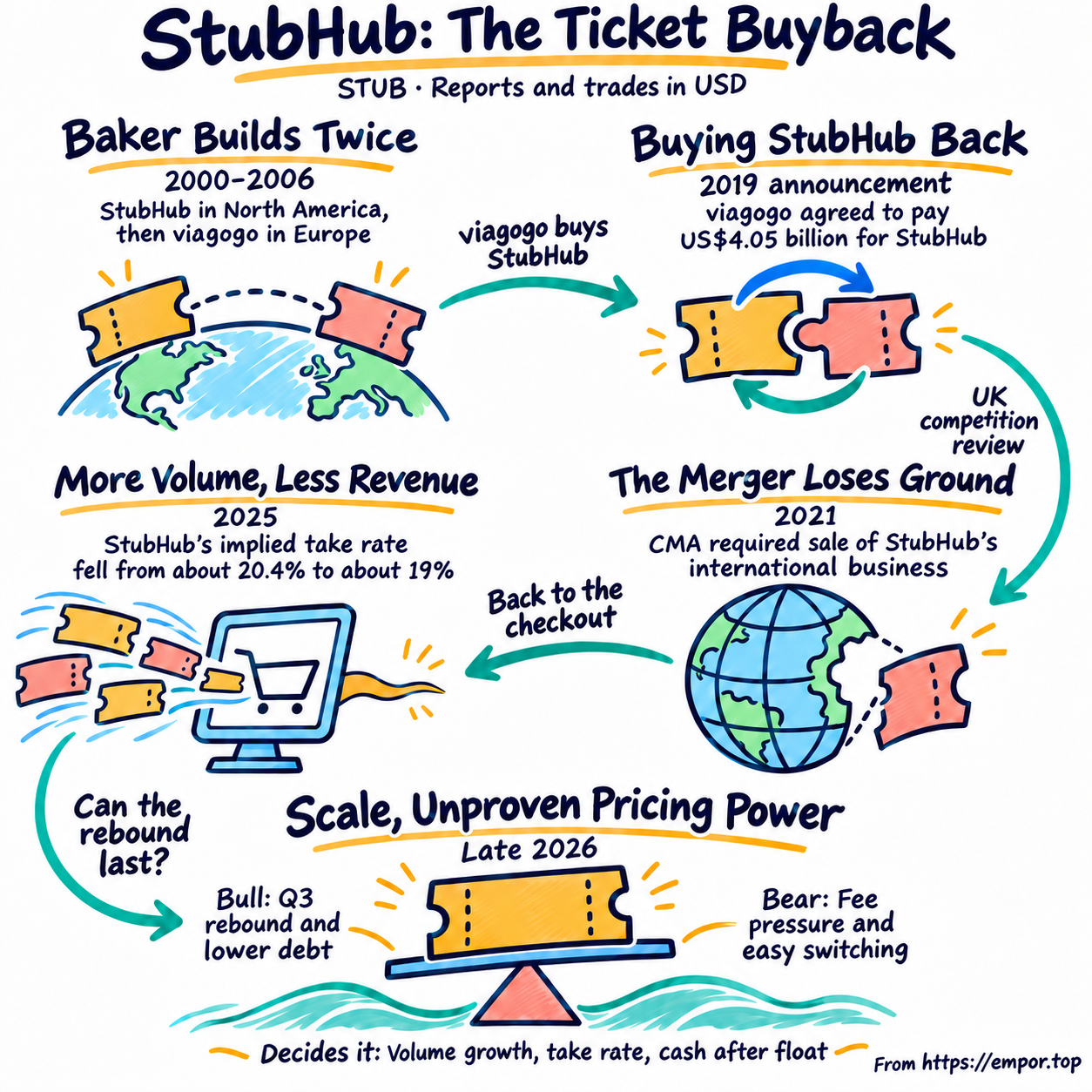
StubHub: The $4.05 Billion Ticket
I. The $502 Million Checkout
Picture the last screen before a fan buys a ticket. A seat in section 112, a price, a countdown timer, a button. In the autumn of 2026, that screen had become the most closely watched piece of real estate in the company that owns it. In April, StubHub agreed to pay $10 million to settle Federal Trade Commission allegations that it had shown ticket prices without the mandatory fees in its first price displays.12 In June, Britain's Competition and Markets Authority ordered StubHub UK to refund more than £590,000 to over 50,000 customers for the same basic sin, hiding compulsory charges until late in checkout, and fined it £889,200 on top.34 Then, on November 10, StubHub reported its third quarter: $502 million of revenue, up 7% from a year earlier, on $2.62 billion of gross merchandise sales.5
Those last two numbers hold the first puzzle of this story. About $2.6 billion of tickets moved through StubHub's marketplace in three months, yet the company booked only about a fifth of that as revenue. That is not a sign that something went wrong. It is the whole business model. StubHub does not, for the most part, own the tickets it sells. Fans and professional brokers list seats, other fans buy them, and StubHub keeps fees from both sides of the trade.6 Gross merchandise sales, or GMS, is the value of everything that changed hands. Revenue is the slice StubHub kept. In the third quarter, that slice was about 19 cents of every dollar.
So the most important number in this company is not how many tickets it sells. It is how much of each sale it can keep, and for how long it can keep keeping it. Both of the regulatory actions from 2026 touched that exact point. When a regulator forces the full price onto the first screen, the fee becomes visible earlier, the buyer can compare it against a rival's price sooner, and the room to present charges late in the funnel shrinks. The checkout is where StubHub makes its money, and in 2026 the checkout became the case.
Four questions run through everything that follows. The first is whether GMS growth can become durable fee growth, because in 2025 it did not: volume rose and revenue fell. The second is whether StubHub's scale gives it an edge that buyers and sellers cannot easily walk away from, or whether a ticket marketplace is easier to copy than its size suggests. The third is whether buying StubHub back, at the price that was paid, created value. And the fourth is about one man. Eric Baker co-founded StubHub, left it, built a rival marketplace in Europe called viagogo, and then bought his old company back.7 He still controls it through super-voting shares. Can he build a more trusted, more publicly accountable marketplace while keeping that control?
Before going further, it helps to be precise about what the listed company is. StubHub Holdings, Inc. is the consolidated group that trades on the New York Stock Exchange under the ticker STUB. It combines the North American StubHub business with viagogo's international operations. It is not an eBay subsidiary, despite how many people still remember StubHub as "the eBay ticket site", and it is not a holding company sitting above a separate viagogo.67 Everything in this story, the revenue, the debt, the lawsuits, belongs to that one group.
That boundary also tells you which evidence matters. A marketplace like this does not carry much ticket inventory, and it owns almost no factories or warehouses, so inventory turns and fixed-asset ratios say very little. The trail to follow instead runs through three things: how much GMS flows through the platform, what share of it becomes fee revenue, and how much cash is left once sellers have been paid what they are owed. The market, for its part, has already rendered a harsh provisional verdict. StubHub listed in September 2025 at $23.50 a share.7 In late November 2026, the stock traded below $5, giving the whole company a market value of roughly $1.7 billion.8 That is well under half of what Baker paid for StubHub alone in 2019.
How did a company that processes about $10 billion of tickets a year9 end up valued at less than half its own acquisition price? To answer that, the story has to go back to a founder who built the same kind of business twice.
 Subscribe on LinkedIn
II. The Founder Who Built a Second Marketplace
In 2000, the internet was full of tickets nobody could use. A season-ticket holder had a Tuesday game and a work dinner on the same night. A concertgoer bought four seats and then lost two friends to a breakup. The old answer was the scalper on the sidewalk or the classified ad, both slow, both risky, both a little shady. StubHub, launched in San Francisco that year, offered a cleaner answer: list the ticket online, let a stranger buy it, and let the website stand in the middle as the trusted party that made sure money and seats both arrived.10
Eric Baker was one of the people who built that idea. He co-founded StubHub with Jeff Fluhr, and the pair turned a business-school concept into one of the defining marketplaces of the early web.711 Baker's temperament, as his later career shows, was that of a builder who wanted to own the whole board. He did not stay to collect the payoff from the American business. He left before the company's sale and turned his attention to Europe, where ticket resale was fragmented across countries, languages and laws, and where no single marketplace had done what StubHub was doing in the United States.
In 2006 he launched viagogo.6 It was in many ways a mirror image of StubHub: the same model of fans and brokers listing seats and buyers paying fees, but built for a patchwork of European markets rather than one large American one. That choice would later shape the whole company. Viagogo grew up dealing with different currencies, consumer laws and venues, and it became a frequent target of European consumer regulators. Those scars, and that international plumbing, are part of what Baker brought back to StubHub years later.
Meanwhile, StubHub's American story moved on without him. In January 2007, eBay agreed to buy StubHub for about $310 million in cash.1011 On paper the fit was obvious. eBay was the world's best-known online auction house, and tickets were a natural category for a site built on strangers trading goods. Under eBay, StubHub became a household name in North America, signing league partnerships and turning the idea of buying a resold ticket from something faintly disreputable into something ordinary.
But being a division inside a larger marketplace has limits. eBay's priorities were its core platform, and over time it reviewed which businesses belonged inside it. That review led, in November 2019, to an announcement that eBay would sell StubHub.12 The buyer was viagogo. The founder who had walked away from StubHub before eBay bought it was now buying it from eBay.
It is tempting to tell this as a romantic homecoming, and there is something to that. Baker knew the business from both sides of the Atlantic, he had spent more than a decade running its closest European analogue, and he had a clear idea of what a combined global resale marketplace could be. The strategic promise was simple to state: American scale plus international reach, one pool of buyers and sellers, one platform. But a homecoming is also a concentration of power. The deal did not just merge two companies. It placed both of them under the direction of one founder, who kept voting control even after the company went public.7
Whether that promise paid for itself is a different question from whether it made sense. And it depends heavily on the price, which turned out to be the most expensive ticket in the company's history.
III. Buying StubHub Back for $4.05 Billion
On November 25, 2019, eBay and viagogo announced the deal: viagogo would acquire StubHub for $4.05 billion in cash.12 For eBay, it was a clean exit at a big number for a business it had bought for about $310 million twelve years earlier. For Baker, it was the move of a lifetime, a smaller, private European company swallowing a much better-known American one, financed with outside equity and a large amount of debt.
The thesis behind the price was straightforward. StubHub had scale in the United States, the largest live-events market in the world. Viagogo had reach across Europe and beyond. Combined, the company could offer sellers access to buyers in many countries and offer buyers a wider choice of seats, and it could run one technology platform instead of two. In a marketplace, more sellers attract more buyers, which attract more sellers. If that loop works, the biggest marketplace tends to get bigger and can charge for the privilege. That was the bet.
Now hold the price up against what was being bought. In 2019, the legacy StubHub business generated about $1.12 billion of revenue and $112.7 million of adjusted EBITDA, a measure of operating earnings before interest, taxes, depreciation, amortization and various other items management strips out.13 Divide the price by those figures and viagogo paid about 3.6 times revenue and roughly 36 times adjusted EBITDA. To put that in plain terms: if StubHub's 2019 earnings had stayed flat forever, it would have taken about 36 years of them to repay the purchase price, before interest on the debt used to fund it.
That multiple is high, and it would be easy to stop there and declare the deal an overpayment. The honest verdict is more bounded. A single year is a thin base for a seasonal, event-driven business whose earnings swing with tour cycles and sports calendars, and a buyer pays for what it expects the business to become, not only for what it earned last year. Viagogo has never published the synergies it expected, and there is no clean comparable deal to benchmark against: no other global ticket-resale marketplace changed hands at a similar size in that period. So the price alone cannot prove that Baker overpaid. What it does prove is that the deal needed a lot to go right. It needed combined earnings to grow far beyond StubHub's 2019 level, and it needed the debt to stay serviceable while that happened.
Almost nothing went right in the first year. The acquisition closed on February 13, 2020.6 Within weeks, the pandemic shut down concerts, games and theaters across the world. A marketplace that earns a fee on every live event suddenly had almost no live events. Worse, many of the events it had already sold were cancelled, which meant refunds, disputes and angry customers at the very moment the company was trying to integrate two organizations. Few deals in modern consumer internet history have had worse timing.
The capital structure the deal left behind would shape the next five years. The company was carrying a heavy term-loan burden in both dollars and euros, which is why debt repayment became one of the central themes of its public life. When StubHub finally listed in September 2025, the IPO raised $758 million net.7 The company repaid about $900 million of debt during 2025, and then reported roughly $1.1 billion of repayments over the twelve months to October 2026.614 By September 30, 2026, principal borrowings were down to about $1.32 billion.15 That is real progress, and it shows a business that survived the shutdown, recovered and generated enough cash and capital to shrink its debt.
But survival is not the same thing as a good return on the original price. Here is the uncomfortable arithmetic. In 2019, the buyer paid $4.05 billion for StubHub alone. In late November 2026, public investors valued the entire combined company, StubHub plus viagogo plus all the growth since, at roughly $1.7 billion of equity, with around $1.3 billion of debt beside it.815 Those numbers are not directly comparable, because the equity has been diluted, preferred investors injected capital along the way, and stock prices can overshoot in both directions. Still, the market is clearly not pricing the combination as worth much more than what was paid for half of it seven years ago.
The verdict, then, is bounded. Debt reduction and ongoing operations show survival and recovery. They do not, by themselves, establish that the purchase price earned an adequate return. And before the pandemic had even ended, a regulator had already taken away part of what the price was supposed to buy.
IV. The Merger That Lost Part of Its Map
The British competition regulator does not usually make headlines in the ticket business. But in 2020 and 2021, the Competition and Markets Authority spent months examining a simple question: if viagogo and StubHub became one company, would fans and sellers of tickets to UK events lose a meaningful choice?16
Its answer was yes. The CMA concluded that the deal could substantially lessen competition in the resale of tickets for UK events, because viagogo and StubHub were the two largest players in that specific market and the combination would leave buyers and sellers with few alternatives.16 The remedy was blunt. The combined company had to sell StubHub's international business, the operations outside North America. In practice, that meant the global marketplace Baker had just paid for came with a piece cut out of it. The divestiture was completed when the StubHub International Business was sold to Digital Fuel Capital, and the CMA closed its inquiry in September 2021.16
It is worth pausing on what this did to that thesis. The CMA did not challenge the American half, but it forced the combined company to give up StubHub's footprint outside North America, leaving viagogo as the international arm. The company still had global reach, through viagogo, but it had lost the chance to fold StubHub's international customers and brand into that reach. And it had to carry out the separation during a pandemic, when management attention and cash were already stretched. Integration was slower and more expensive than any pre-deal plan could have assumed.
There is a later twist that is easy to misread. In 2025, the CMA permitted viagogo to reacquire certain StubHub brand and domain rights in selected markets.16 Some coverage treated this as the merger being made whole. It was not. Buying back the right to use a name and a web address in some countries is not the same as getting back the international operating business that was sold. The customers, contracts and staff of that business went with the divestiture. What came back was a storefront sign, which matters for marketing and traffic, but is not a reversal.
This distinction matters for anyone reading the company's numbers. The listed company consolidates viagogo and the remaining StubHub business. Its international revenue comes from viagogo's operations and whatever it has rebuilt under reacquired brand rights, not from the StubHub International Business as it existed in 2019. When management describes StubHub as a global marketplace, that description is accurate, but the global footprint is viagogo's, not the one eBay sold.
There is also a lesson here about market definition that will come back later. The CMA's concern was specifically resale-platform services for UK events. That is not the same market as primary ticketing, where an event organizer sells tickets for the first time, or live-event promotion, where companies like Live Nation book the artists and run the venues. When people say StubHub is "the leader" or "number two" in ticketing, the claim only means something once you know which geography and which channel is being measured. In UK resale, at least, the regulator judged that viagogo and StubHub together were too dominant to combine. That is an interesting hint about scale in this industry: in one market, a regulator found the two biggest resale platforms to be meaningful competitors to one another, such that their combination threatened competition.
The CMA episode, then, narrowed the combined company's footprint and showed that global reach came with regulatory limits from the start. It also carried a question forward that the company still has to answer: does today's cross-border platform create real economic advantage, or is it just a wider storefront? The way to answer that is to look at what the platform actually earns from each ticket.
V. The Ticket Is Not the Revenue
Imagine a single pair of tickets to a stadium concert. A broker in New Jersey bought them on the day the tour went on sale. Now the broker wants a profit, so the broker lists them on StubHub. The same broker also lists them on Vivid Seats, on SeatGeek, perhaps on a couple of smaller sites. A fan in Philadelphia searches for the show, sees the pair on three different sites, and compares the final prices. Whichever site sells the tickets first, the others pull the listing. That small scene contains almost every strategic problem StubHub has.
Here is how the money moves. The seller lists. The buyer pays. StubHub collects a fee from the buyer, a fee from the seller, holds the buyer's money until the event or the ticket transfer is confirmed, then pays the seller the rest.6 Substantially all of StubHub's revenue comes from these buyer and seller fees, generally set as a percentage of the transaction's value.6 It is not a subscription business. Nobody pays StubHub a monthly fee for access, and the company does not disclose any recurring revenue or standard seller contract length.6 Every dollar has to be won again on every transaction.
There are two revenue streams, though one dwarfs the other. In 2025, transaction fees brought in about $1.71 billion of StubHub's $1.745 billion of revenue.6 The rest, about $31 million, was mostly ticket sales where StubHub acted as principal, meaning it took the inventory risk itself, usually because it had guaranteed minimum proceeds to the original issuer of certain tickets.6 That principal exposure is small, but not zero: the related inventory costs were about $35 million in 2025 and $83 million in 2024, after nothing in 2023.6 It adds risk around the edges, because a guarantee that does not sell through becomes a loss, but it does not define the model.
When more tickets meant less revenue
The growth story looks spectacular until the last year. Revenue rose from about $1.04 billion in 2022 to about $1.77 billion in 2024, growth of roughly 32% in 2023 and nearly 30% in 2024, as live events came roaring back after the pandemic and fans paid record prices for big tours.176 Then in 2025, something unusual happened. GMS kept rising, yet revenue slipped to $1.745 billion, a decline of about 1.4%.6 The company explained the drop plainly: lower transaction-fee rates and fewer principal inventory sales offset the higher volume.6
In marketplace language, that is a falling take rate. GMS reached about $9.2 billion in 2025, up 6%, while the implied ratio of revenue to GMS fell from about 20.4% in 2024 to about 19%.18 On that much volume, a drop of a percentage point and a half is worth well over $100 million of revenue a year. It is the single most revealing number in the company's recent history, because it shows that volume and monetization can move in opposite directions. A marketplace with true pricing power usually holds or raises its take rate as it grows. StubHub's fell.
Management has an answer to that, and it deserves a fair hearing. On the fourth-quarter 2025 call in March 2026, executives said the company had deliberately given up take rate through "take-rate adjustments" in order to win share, and that the shift to all-in pricing in the United States would distort comparisons until it lapped the rule's implementation in May.18 In other words, the fee cut was a choice, not a defeat. That is a plausible story; marketplaces often trade price for volume when they believe scale will pay off later. But notice what it concedes. If StubHub had to lower its fees to grow GMS by 6%, then at least part of its volume is price-sensitive, and the competitive pull toward lower fees is real. A choice to cut price under competitive pressure and a loss of pricing power look identical in the numbers. The only way to tell them apart is to watch whether the take rate recovers once the share has been won.
The third quarter of 2026 offers a partial counterpoint. Revenue and GMS each rose 7% from a year earlier, which means the take rate held steady at roughly 19% in that quarter; the CFO called it "comparable to the prior year," while noting that World Cup tickets had shifted the pricing and catalog mix.59 That is not a recovery to 2024's level, but it is not a further slide either. It is better than 2025's pattern of volume up and revenue down. But one quarter is not a trend, especially in a business where the mix of events, from World Cup matches to stadium tours to regular-season games, can shift the take rate from quarter to quarter. The real test is whether that parallel growth persists across a full year.
Who else wants the ticket
The competitive field is crowded and uneven. Ticketmaster, owned by Live Nation, dominates primary ticketing in North America and also runs a resale marketplace. Live Nation's revenue was about $23.2 billion in 2024, but that figure mixes concert promotion, venue operations, sponsorship and ticketing, so it is a sense of scale rather than a like-for-like comparison.19 In resale, StubHub's closest public rival is Vivid Seats, which reported about $776 million of revenue in 2024, and SeatGeek competes in both primary and resale.20 None of these revenue numbers are market shares. StubHub's revenue was more than twice Vivid Seats', but neither company publishes its share of the resale market, and the industry has no audited source for it.
So what is the moat, if there is one? The case for one is brand, traffic, and liquidity. StubHub is the name many American fans type first. Its marketplace has a wide pool of listings, which means a buyer is more likely to find the exact seat at an acceptable price, which brings more buyers, which attracts more sellers. That loop is real in principle.
The case against it is in the scene that opened this section. Buyers can compare sites in seconds; price-comparison tools and search engines make that easier every year. Sellers, especially professional brokers who supply a large share of resale inventory, can list the same seats across several marketplaces at once and pull them wherever they sell. That habit, called multi-homing, is poison for network effects, because it means no marketplace has exclusive supply. StubHub does not disclose retention, the share of sellers who list elsewhere, or its resale market share.6 The 2025 take-rate decline is the closest thing to direct evidence of pricing power, and it points the wrong way. The verdict here is that StubHub has real scale, but the public record does not prove strong switching costs or durable pricing power. The full test of the moat comes in the closing analysis.
The things that drive GMS are mostly outside StubHub's control: which artists tour, how many big events are in the calendar, how many get cancelled, and how much consumers feel like spending on a night out.6 When a mega-tour goes on sale, GMS jumps. When a year is light on stadium shows, it sags. That makes year-over-year comparisons treacherous and puts a premium on the one variable StubHub can influence, which is what it spends to win each buyer.
And that brings in the margin story, which is the most unsettled part of the picture. Adjusted EBITDA fell from $298.7 million in 2023 to $232.4 million in 2025, even though revenue was higher at the end of that span.176 Some of the drop came from the take-rate squeeze. A great deal of it came from marketing. Advertising expense rose from about $470 million in 2023 to $892 million in 2025.6 In 2025, StubHub spent roughly 51 cents on advertising for every dollar of revenue it booked. Much of that goes to search engines, where fans type a team or artist's name and the resale sites bid against each other for the top result.
This is the sharpest point in the whole investment case. If StubHub's brand and liquidity were a strong moat, fans would come to it directly and the company would not need to spend half its revenue renting their attention. The rising advertising bill suggests that a large share of demand has to be bought, transaction by transaction, in an auction against the same competitors listing the same seats. Some of that spending may be building a durable customer base. But the company does not disclose customer acquisition cost, repeat purchase rates or the share of traffic that arrives without paid marketing, so investors cannot yet tell how much of the advertising is an investment and how much is simply the cost of staying visible.
Management treats this as its key dial. On the second-quarter call, the CFO called sales and marketing as a share of revenue "one of the most important metrics in our financial model."21 By management's broader measure, which includes more than paid advertising, sales and marketing ran at about 54% of revenue in 2025, up from 47% in 2024.18 In the third quarter of 2026, it fell to about 45%, down nine points from a year earlier, which the CFO attributed to customer-acquisition efficiency.9 That improvement is the main reason third-quarter adjusted EBITDA jumped. It is also one quarter, flattered by a World Cup that brought buyers in on its own. If the ratio stays near the mid-40s through a normal quarter without a global tournament, the efficiency claim becomes evidence. If it drifts back above 50%, the 2025 pattern was the rule.
Scale is real. So is fee-yield pressure. Which raises the obvious strategic question: if the resale marketplace is this competitive, can StubHub find a way to get the ticket before the reseller does?
VI. Can StubHub Sell the Ticket Before the Fan Does?
On the third-quarter call in November 2026, Baker spent a good part of his time on a phrase that has become central to his pitch: "open distribution."9 The idea is that event owners—the teams, artists, promoters and venues that hold tickets first—could sell those tickets directly across many nonexclusive channels, including StubHub, using StubHub's data on demand and its reach to buyers. Instead of signing an exclusive contract with one primary ticketing company and watching a resale market spring up afterward, the event owner would distribute primary inventory to wherever the buyers are.
The contrast with the incumbent model is the point. In North America, primary ticketing has typically worked through exclusive contracts: a venue or league signs with one ticketing company, and every first-sale ticket flows through that company's system. StubHub's pitch is the opposite. Let content owners sell through StubHub without giving up the right to sell through anyone else. If it works, StubHub would get supply earlier in a ticket's life, buyers would see more inventory, and the platform would become useful before a ticket ever reaches resale.
That is strategically relevant, and it is easy to see why management emphasizes it. A resale marketplace is structurally dependent on someone else selling the ticket first. Owning part of the primary sale would make StubHub less exposed to brokers who multi-home and to rivals bidding on the same search terms.
But a strategy is not a revenue line, and here the record is thin. The core resale business still supplies nearly all of StubHub's revenue.6 The company's filings do not identify a material open-distribution revenue stream, nor do they disclose the number of partners, the volume of primary tickets sold through the channel, or the fees earned on them.615 Open distribution, so far, is a pitch and a product, not yet a business.
There is also a strategic risk inside the opportunity. If event owners start selling directly across many channels, they gain bargaining power. A team that can list its tickets on StubHub, Ticketmaster, SeatGeek and its own site at once has every incentive to negotiate down whatever fee each platform charges. Open distribution could add supply. It could also give primary sellers a new way to compress platform economics. Which outcome wins depends on whether StubHub's buyer traffic is valuable enough that event owners pay to reach it, which loops back to the moat question that the advertising bill leaves unresolved.
The way management has talked about this across three calls is more revealing than any single slogan. In March 2026, Baker called direct issuance "a transformational long-term opportunity" and said the company was shifting from a strategy led by business development, meaning deal-by-deal selling to teams and venues, to one led by product, meaning tools that event owners could adopt on their own.18 On the same call, the CFO was careful to say that the 2026 outlook excluded "any material revenue contribution" from these initiatives.18 That candor is worth noting: management did not bake an unproven product into its numbers. By November, Baker's framing had moved toward principle, describing open distribution as a way "to ensure broad transparent access to live events for fans," offering rights holders access to StubHub's global demand and pricing data, and pointing to expanding integration with primary ticketing providers.9 The language grew more confident from March to November. A disclosed financial contribution did not appear.
That pattern, a bigger vision with the same absence of numbers, is the one to watch. The shift to a product-led approach is itself an admission that the earlier, deal-led approach had not scaled. Self-service tools are the right answer to that problem in principle, because they let small venues and teams adopt the product without a sales team. But self-service adoption is precisely the kind of thing that can be counted, in active event owners, repeat listings and primary GMS, and the company has not yet chosen to count it in public. The things to look for are concrete: named partners, repeat usage by the same event owners across seasons, and a revenue or GMS figure management is willing to report. Until those appear, open distribution belongs in the column of optionality.
The same proportion applies to two other fashionable themes. StubHub's filings do not identify artificial intelligence as a current revenue line or a material cost driver; they do list changes in how search engines and platforms surface results as a business risk, which is a reminder that AI-driven search could cut either way for a company that buys so much of its traffic.6 On the November call, Baker said StubHub was not yet seeing material traffic from AI-based referrals.9 That is reassuring about today and silent about tomorrow: if fans one day ask an assistant to find two seats under $200 rather than typing a search query, the auction for attention that currently costs StubHub so much could be replaced by a different gatekeeper with different rules. Advertising on the platform is likewise not a disclosed profit engine. Neither should be treated as a present source of earnings.
What can be measured is the investment going into the product. StubHub does not report research and development as a separate expense; product-development staff costs sit inside general and administrative expense.6 What it does report is capitalized software development, the portion of engineering work treated as building a long-lived asset. That figure jumped from about $2.6 million in 2024 to $31.5 million in 2025, and reached $30.5 million in just the first nine months of 2026.615 That was a more than tenfold step-up in a single year, which signals a company building again after years of pandemic survival and debt repair. It should not be confused with total R&D, which the company does not disclose, and it should be read alongside the fact that the company had only about 900 full-time employees at the end of 2025, roughly 360 of them in customer support.6
Open distribution may be the most interesting idea in the company. But it is still an idea being paid for by the resale marketplace. And the cash that marketplace produces has its own complications, which became visible in the strange financial year of the IPO.
VII. From IPO Loss to Cash—and the Limits of the Rebound
StubHub's first reported full-year results as a public company produced a headline number that looked like a disaster: a net loss of $1.906 billion in 2025.6 For a company with $1.745 billion of revenue, losing more than its entire sales seems like a business in free fall. It was nothing of the kind. In the same year, StubHub generated $192.6 million of cash from operations.6 How can a company lose almost $2 billion and still produce cash?
The answer is an accounting event tied to the listing. StubHub had granted many equity awards that only vested once the company went public. When the IPO happened, it recognized $1.401 billion of stock-based compensation in one go, part of $1.448 billion for the full year.6 That charge reduced reported profit, but it did not consume any cash; it recorded the value of shares that employees and executives now owned. On top of that, the company booked a $479.1 million valuation allowance against deferred tax assets, another non-cash charge that reflected doubts about using past tax losses.6 Together, non-cash charges totaled about $1.93 billion.6 Strip them out, and the 2025 loss turns into a modestly positive result.
The market did not wait for that nuance. When StubHub reported its first quarter as a public company in November 2025, the IPO charge produced a large loss per share, and management declined to give guidance for the fourth quarter, citing uncertain timing of major tour on-sales. The stock fell sharply, and ended November 2025 down almost 39% for the month.22 Another heavy drop followed the fourth-quarter report in March 2026, when the stock hit a record low around $8.23 The pattern was set early: investors punished uncertainty about guidance more than they forgave the accounting.
The float is not the profit
The cash flow deserves its own scrutiny, because a marketplace has a peculiar source of cash. When a buyer pays StubHub for a ticket to a concert three months away, StubHub collects the money now but pays the seller later, usually after the ticket is delivered or the event happens. For a while, StubHub holds money that belongs to someone else. As long as the business grows, that pool of buyer and seller funds tends to grow too, and each increase shows up as operating cash flow. Insurance investors call a similar pool "float."
In 2025, changes in operating assets and liabilities contributed $147 million of cash, mainly because buyer and seller payables rose by about $107 million.6 In 2024, $261.5 million of operating cash flow included $176.3 million from operating-liability inflows, including accrued expenses and payables.6 In both years, a large share of the cash was timing, not earnings. That cash is real, and it can be used to pay down debt. But it is owed to sellers, and if the business shrinks or the timing of events shifts, it can reverse.
The 2026 World Cup turned this from theory into a live demonstration. Fans bought tournament tickets months ahead, and the cash piled up before matches were played and sellers were paid. By the second-quarter call in August, trailing twelve-month free cash flow, as management measures it, had swollen to a figure that included the World Cup float.21 By the third quarter, after the tournament ended and sellers were paid out, the same trailing measure was about $192 million, roughly 53% of adjusted EBITDA, and the CFO said the trailing twelve-month view was "the most appropriate lens."9 The float came in, and the float went out. Any investor who had annualized the summer cash figure would have been badly misled.
This is why StubHub's gross cash balance is a misleading measure of its strength. At September 30, 2026, the company held $1.167 billion of cash.15 A naïve reading would set that against $1.318 billion of principal borrowings and conclude that net debt was barely $150 million.15 But part of that cash is, in effect, seller money waiting to be paid out. Gross cash is an incomplete liquidity measure for a marketplace, and the company says so.15
The first nine months of 2026 provide a cleaner, though still incomplete, look. StubHub earned net income of $96.2 million and generated $221.5 million of operating cash flow.15 Stock-based compensation was still $142.6 million in that period, a meaningful non-cash cost, and buyer and seller payables added about $26 million of cash, a much smaller contribution than in prior years.15 That is the most encouraging pattern in the recent record: positive profit and operating cash that relies less on seller-payable timing.
The debt picture improved in step. In September 2026, Moody's upgraded StubHub's corporate family rating from B3 to B2, citing debt repayment and expected margin recovery, while flagging leverage, competition and regulatory risk as constraints.24 Management's own measure of net leverage fell to about 2.5 times adjusted EBITDA by the third quarter, from about 4.5 times a year earlier.9 In October, the company amended its loans, extending term-loan maturities to October 2033, cutting borrowing costs by a quarter of a percentage point, and shifting the mix toward dollars and away from the euro loan whose remeasurement had produced large currency losses in 2025.14 A B2 rating is still deep in speculative grade. It is evidence of credit improvement, not an endorsement of business quality, and the loans remain secured against the company's assets.15
So did the IPO-year loss obscure a healthy business? Partly. The 2025 GAAP loss is a poor guide to ordinary operations. But the recovery case still needs proof, because adjusted EBITDA had declined from 2023 to 2025 and seller-payable timing flattered operating cash flow in both 2024 and 2025. The next test is recurring cash generation after working-capital swings and after the cost of paying employees in stock. That test will be judged by public shareholders who have little say in how the company is run, which is the next part of the story.
VIII. A Public Company, Still Baker's Company
On September 17, 2025, StubHub began trading on the New York Stock Exchange.7 It sold about 34 million Class A shares at $23.50 each and raised $758 million net.7 For a company that had spent five years carrying acquisition debt through a pandemic and a forced divestiture, the listing was a financing event first. Proceeds went largely toward paying down loans.6
But the IPO was also an accountability test, and the structure answered it before the first trade. Baker holds all of StubHub's Class B shares, which carry 100 votes each, against one vote for each Class A share.7 After the offering, the prospectus showed him with about 90.4% of the combined voting power.7 Later sales and conversions changed the share base, but the 2025 annual report still described Baker as controlling more than half of the votes.6 Public shareholders, in other words, bought economic exposure to StubHub, but gained very little influence over who sits on its board or how it allocates capital.
It is important to separate economic ownership from voting control. Before the offering, venture and growth investors held large blocks of common stock: Madrone-affiliated entities owned about 27% of shares, and WestCap, Bessemer Venture Partners, PointState and Declaration Partners held stakes between about 5% and 11%.7 Those percentages describe the pre-IPO world. Preferred stock converted, some holders sold, and share counts changed, so those numbers should not be read as current ownership. What did not change is the voting structure.
Because Baker controls a majority of the votes, StubHub qualifies as a "controlled company" under NYSE rules, which lets it opt out of requirements for a majority-independent board and fully independent compensation and nominating committees.6 The filings do not establish that the board is majority independent.6 For long-term investors, that is a trade-off with two faces. A founder with secure control can invest for the long run without worrying about quarterly activists, which may be exactly what a business rebuilding its product needs. The same structure means that if the founder makes a bad call, outside shareholders have few levers to correct it.
What the pay tables say, and what they don't
Compensation offers a useful example of how to read a controlled company carefully. Baker's 2025 summary compensation, the standard number in the proxy, was about $4.53 million, and the other four named executives averaged about $5.44 million.25 Those are ordinary sums for a company of this size. The headline that caught attention was a different measure: the SEC's "compensation actually paid" figure for the CEO was negative $575 million.25 That number does not mean Baker handed back half a billion dollars. It is an accounting calculation that captures the change in fair value of previously granted equity awards, and since StubHub's stock fell sharply after the IPO, the value of his earlier awards fell with it. The proxy itself says the measure is not cash received.25
The company-wide number is the one that matters to outside shareholders. That IPO-triggered compensation was not recurring cash pay, but it was real dilution: shares that now belong to employees and executives rather than to the investors who bought at $23.50.6
At the June 2026 annual meeting, say-on-pay passed with about 2.64 billion votes for and roughly 10.6 million against, more than 99% support, and shareholders opted for a pay vote only every three years.26 Low recorded dissent is usually read as a vote of confidence. Here it is one data point, not independent validation, because Baker's Class B shares alone carry enough votes to carry almost any resolution. The vote tells you what the controlling shareholder thinks of his own pay arrangements more than what minority holders think.
Capital allocation can only be assessed from what has actually happened. The record contains one enormous acquisition financed with heavy debt; a pandemic that nearly sank it; a forced sale of part of what was bought; a decade of preferred-stock rounds raising hundreds of millions of dollars; an IPO used largely to deleverage; and now a sharp step-up in software investment.67 Using the IPO and operating cash to retire well over a billion dollars of debt is disciplined behavior. But one cannot call this a proven record of value creation when the market values the combined company below the price paid for half of it. The verdict is that the record is too short, and too dominated by the acquisition, to be judged yet.
The same applies to guidance. In November 2025, management declined to give quarterly guidance at all.22 On the fourth-quarter call in March 2026, it set annual targets.18 The path of those targets is instructive. In March, the company guided to about 9% GMS growth at the midpoint and $400 million to $420 million of adjusted EBITDA.18 In August, after a World Cup quarter in which GMS rose 34%, it raised the GMS outlook to 10% to 12% but held the EBITDA range, noting that it absorbed World Cup support costs.21 The stock fell in after-hours trading anyway, as analysts questioned what the second half would look like once the tournament had passed.21 In November, the GMS outlook rose again, to 11% to 13%, and the EBITDA range was reiterated once more.59 Three times the volume forecast went up. Three times the profit forecast stayed put. That combination is telling: more volume, the same profit. On the third-quarter call, the CFO said the outlook reflected "a range of scenarios" for when 2027 concerts would go on sale.9 The explanations have been consistent. Whether they are a forecasting habit or an excuse will be clear only after a few more years of guidance meeting results.
One near-term marker arrived in November 2026: the company announced that CFO Connie James would be succeeded by Michael Noonan on January 4, 2027, with James staying on as a consultant through the transition.27 Noonan will arrive from the CFO seat at Tripadvisor, another consumer marketplace that lives and dies by search traffic and take rates, which is either a reassuring fit or a reminder of how similar StubHub's problems are to those of every intermediary that rents its customers from Google.9 A CFO change a little over a year after an IPO is not unusual, but it comes while the company is still remediating a material weakness in its internal controls, which makes the handoff more consequential than it would be at a mature company. And that weakness connects directly to the last and most uncomfortable part of the story: the checkout itself.
IX. When the Checkout Becomes the Case
In May 2025, a new FTC rule on junk fees took effect, requiring ticket sellers to show the total price, including mandatory fees, up front. On May 14, 2025, the FTC sent StubHub a warning letter.2 The agency later alleged that in the days around the release of the NFL schedule, when demand for football tickets spiked, StubHub's first three price screens did not show the full price.12 In April 2026, StubHub agreed to pay $10 million to refund fees to affected buyers and to accept an order barring it from misrepresenting total prices, fees, final payment amounts and refund terms.2 The company neither admitted nor denied the allegations and said it disagreed with the FTC's view.2
Ten million dollars is a rounding error against StubHub's revenue. That is not why the case matters. It matters because of the mechanism. In a ticket marketplace, fees are the product. If buyers see the full price on the first screen, they can compare that full price across sites before they have invested any time in the purchase. Late-stage fee disclosure, sometimes called drip pricing, works partly because a buyer who has chosen seats and entered card details is less likely to walk away when the total jumps. Remove that friction, and conversion can fall or fee levels can come under pressure. That links the regulatory story directly to the 2025 decline in take rate.
Britain delivered the same message with sharper edges. In June 2026, the CMA concluded that StubHub UK's pricing practices between April and December 2025 had been unlawful under new consumer-protection powers, ordered it to refund about £590,000 to more than 50,000 customers, and imposed a penalty of £889,200.34 StubHub UK admitted the breach and settled, which earned a reduction in the penalty.4 It was the first secondary ticketing platform fined under the regime.4
Not every matter is settled. In July 2024, the District of Columbia's Attorney General sued StubHub for allegedly deceptive pricing and junk fees, and that case remained ongoing in the company's latest quarterly filing.2815 The IPO also triggered securities litigation from shareholders after the stock's decline.15
The right way to size these is not to add up every headline. At September 30, 2026, StubHub had accrued $115.3 million for probable legal and regulatory matters, down from $146.2 million at the end of 2025, partly because it settled and paid a $16.4 million verdict in a dispute with Spotlight Ticket Management in August.15 Separately, at the end of 2025, the company disclosed about $97.5 million of accrued transactional-tax liabilities, $42.0 million for sellers' withholding-tax obligations and $62.7 million for uncertain income-tax positions.6 Those tax items overlap with, and sit beside, the legal accrual, so they should not be stacked on top of each other as if each were a new cash loss. The broader point is that taxes and consumer law are a meaningful, recurring cost of operating a cross-border ticket marketplace, not a one-off.
The accuracy of those numbers matters more than usual because of the company's control history. The auditor gave an unqualified opinion on the 2023 to 2025 financial statements, but management reported a material weakness in internal controls at the end of 2025, covering revenue reserves, taxes, financial statement preparation and IT general controls.6 Those weaknesses had already contributed to restatements of the 2021 and 2022 financial statements and to audit adjustments in later years.6 For a company whose biggest exposures are fee reserves and tax liabilities, weak controls over exactly those areas are not a box-ticking concern. They raise the risk that the reserves will turn out to be wrong.
Then came the World Cup. On June 30, 2026, two fans filed a proposed class action in federal court in Manhattan, alleging that StubHub sold World Cup tickets that were cancelled, revoked or never delivered, and that it failed to honor its FanProtect guarantee of a replacement or refund.29 One plaintiff said she waited at a stadium for tickets that never arrived; another said his order for a Mexico–South Korea match was cancelled and refunded only after repeated complaints.29 StubHub declined to comment on the suit but said its singular goal was to get fans into events, blaming unprecedented demand and sellers who failed to transfer tickets.29 Management's own account of the tournament was mostly triumphant. On the August call, Baker said fans from more than 150 countries had attended matches with tickets bought through StubHub, and that roughly one in seven World Cup tickets sold on the platform went to buyers outside the United States and Canada, a rare piece of hard evidence that the cross-border reach viagogo brought to the merger can matter.21 He also acknowledged that "a small subset of orders experienced fulfillment issues."21 The lawsuit and the call describe the same tournament from opposite ends. These are allegations, not findings, and the case remains unresolved. But they test the core promise of a resale marketplace at exactly the moment it matters most: a fan cannot replace a once-in-a-generation World Cup match with next week's game.
Proportion is essential here. Neither the legal matters nor the World Cup complaints establish that the marketplace is broken. Millions of tickets were delivered as promised. But together they make transparent pricing and reliable fulfillment part of the investment case, because they are the two things a buyer has to believe before paying a stranger for a ticket. That brings the story to the central question: what, exactly, protects this business?
Analysis & Bear vs. Bull Case
Hold two facts side by side. In November 2026, StubHub's management described the company as the leading global ticket marketplace and reported GMS and revenue each up 7%.59 In 2025, the same company's revenue fell by about 1.4% even as GMS rose.6 One fact is a claim of leadership. The other is evidence of what leadership is worth when buyers and sellers can go elsewhere.
Start with the forces that shape any ticket marketplace. On the supply side, sellers are fragmented: no seller accounted for even 10% of amounts due from sellers at the end of 2024 or 2025, and no customer made up 10% of revenue.6 That protects StubHub from any single counterparty. But fragmentation does not mean weakness when sellers can list everywhere. Professional brokers routinely post the same seats across platforms, so their bargaining power comes from mobility, not size. On the demand side, buyers are comparison shoppers, and all-in pricing rules from the FTC and the CMA have made comparison easier. Rivalry is intense: Ticketmaster controls much primary supply and runs its own resale; Vivid Seats and SeatGeek fight for the same search traffic. The threat of substitutes comes from event owners themselves, who increasingly control resale through their own platforms or restrictions on ticket transfers. And regulators shape the rules of the game in every major market. On almost every axis, the industry structure pushes toward lower fees.
Now test the most plausible source of durable advantage, which in Hamilton Helmer's framework would be network economies: each new buyer makes the platform more valuable to sellers, and vice versa. That power exists in some marketplaces. To claim it here, one would want evidence that buyer and seller activity is reinforcing in a way rivals cannot match: rising retention, a growing share of traffic arriving without paid marketing, stable or rising take rates, and a share of supply that does not appear elsewhere. StubHub discloses none of those directly.6 The evidence it does disclose points the other way. Advertising consumed about half of revenue in 2025, which suggests demand must be bought, and the take rate fell from about 20.4% to about 19% that year. Brand is a second candidate power, and StubHub's name recognition is real, but brand power shows up as the ability to charge more for the same product, and a declining take rate argues against it. Scale economies help at the margin, because a larger marketplace spreads the cost of technology and customer support over more transactions, but they have not protected EBITDA, which fell from 2023 to 2025.6 The history does not reject the moat, but it narrows it to a smaller claim: StubHub has scale and recognition that keep it among a handful of meaningful resale platforms, without demonstrated pricing power. The KPI that would confirm a stronger claim is a take rate that holds or rises while GMS grows over multiple years.
The bull case is not trivial. GMS has kept growing, and management raised its 2026 GMS outlook to 11% to 13% growth.9 Adjusted EBITDA rose 84% year over year to $124.1 million in the third quarter of 2026, a sign that the 2025 margin squeeze may have bottomed.5 About $1.1 billion of debt was repaid in the twelve months to October 2026 alone, maturities run to 2033, and Moody's upgraded the credit.1424 Viagogo gives the company an international footprint few rivals match. Open distribution, if it gains traction, could give StubHub access to supply earlier in a ticket's life. And the valuation embeds low expectations: at a market value of about $1.7 billion, plus around $1.3 billion of gross debt partly offset by cash, the company trades at a modest multiple of its own $400 million to $420 million EBITDA guidance, though part of that cash is owed to sellers.8159 A skeptic should note the market is pricing in either lower future earnings than guided or higher risk than the guidance implies.
The bear case is grounded in the company's own record. GMS can rise while monetization weakens, as 2025 showed. EBITDA fell over 2023 to 2025 while marketing spend almost doubled. Buyers and sellers face low switching costs. Fee disclosure rules and fulfillment failures have already produced penalties, refunds and lawsuits, and the material weakness in internal controls covers the very reserves that measure those exposures. And Baker's control limits the influence of public shareholders over any of it. An activist looking at StubHub would ask four pointed questions: why advertising spending rose so much faster than revenue, what share of GMS comes from professional brokers who multi-home, why the company does not disclose basic marketplace KPIs like repeat buyers or take rate by quarter, and what return the acquisition has earned on its $4.05 billion price. Under the current structure, such an activist would have little power to force answers.
Management's own disclosures stress-test its growth claims. The raised GMS outlook came with a reiterated, not raised, EBITDA range, which means management itself expects incremental volume to carry little incremental profit.9 Its repeated reference to uncertain tour timing is a reminder that a meaningful part of growth depends on artists' calendars.9
Three numbers will tell which case is winning. The first is GMS growth, which was 7% in the third quarter of 2026 against a full-year outlook of 11% to 13%.59 The second is the take rate, revenue as a share of GMS, along with growth in transaction fees: it fell from about 20.4% in 2024 to about 19% in 2025, and held near 19% in the third quarter of 2026.65 The third is adjusted EBITDA converted into cash after recurring working-capital needs: adjusted EBITDA was $232.4 million in 2025, and nine-month 2026 operating cash flow was $221.5 million, with seller-payable timing a smaller contributor than in prior years.615 If all three move together, the bull case gains real evidence. If GMS rises while the take rate slides and cash depends on float, the bear case is confirmed.
Business & Investing Lessons
The first lesson lives in a single number: 36 times the acquired business's 2019 adjusted EBITDA. Baker knew the business intimately and had built its leading European rival. The strategic fit was clear. A strategic fit can still be an expensive fit. Knowing an asset intimately is not the same as being able to earn a return on any price for it, and a founder's conviction is the most dangerous kind of confidence when the price has no margin for bad luck.
The second lesson lives in StubHub's 2025 reversal: marketplace volume is not revenue. A ticket's face value is not your revenue. Investors in any marketplace, from ride-hailing to food delivery to freelance labor, are told to watch gross volume because it is the biggest, most impressive number. The figure that tells you whether the marketplace has power is the share it keeps, and whether that share holds when the volume grows.
The third lesson lives in the voting table: Baker's super-voting shares. The founder's control can speed the bet and narrow the feedback. It let him set the terms of the bet. The same control means that when public investors disagree, the main tool they have is selling. A founder who owns the votes but not most of the economics hears from the market only through the share price, and by then the feedback is expensive.
The fourth lesson lives in the World Cup fulfillment complaints. Trust is part of the transaction. A ticket marketplace sells something unusual: a promise from a stranger, guaranteed by a platform, about an event that cannot be repeated. The price on the first screen, the ticket in the app on match day and a refund that arrives without a fight are not customer-service details. They are the product. Every regulator's order and every cancelled match is a direct charge against the one asset a marketplace like this cannot buy with advertising.
Epilogue
StubHub enters 2027 in a better position than at almost any point since the deal closed. Recent debt, credit and operating results have improved.142415 And yet its stock trades at a fraction of its IPO price, a sign that the market does not believe the recovery is the whole story.8
The next moments that will decide which story wins are already on the calendar. The first is the full-year 2026 report, due in early 2027, which will show whether GMS growth landed inside the raised 11% to 13% range and whether adjusted EBITDA reached the reiterated $400 million to $420 million.9 If volume beats and profit merely matches, the 2025 pattern of growth without monetization will look like a habit, not an accident. If both come in strong, the 2025 squeeze starts to look like the trough.
The second is the quarterly take rate. Management does not report it as a headline metric, but anyone can compute it from revenue and GMS. If it holds near 19% while GMS grows, the fee-yield worry fades. If it slides again as all-in pricing rules spread and competitors bid for the same traffic, it confirms that StubHub's scale buys volume, not pricing power.
The third is the handoff in the finance office. Michael Noonan takes over as CFO on January 4, 2027, inheriting a material weakness in internal controls that touches revenue reserves and taxes.276 A clean remediation report next year would remove one of the quieter risks in the story. Another year of weaknesses would make every reserve figure harder to trust. Alongside that sit the D.C. Attorney General's case and the World Cup class action, either of which could reshape how the company presents fees or honors its guarantee.2829
The fourth is open distribution. Product availability is not commercialization. The proof will be commercial traction in disclosed numbers. If that appears, StubHub has a credible path to supply that does not depend on brokers. If the slogan keeps growing while the numbers stay hidden, investors should treat it as what it is today: an option, not an engine.
And beneath all of it sits a choice about cash. With debt lower and maturities pushed out, the company has room to invest more in its product, to keep paying down debt, or to start returning capital. Which path Baker picks, and how he explains it to shareholders who cannot outvote him, will say more about the company's next chapter than any growth claim. The tension that remains is the one that opened the story: the platform can clearly move billions of dollars of tickets. Whether it can keep a durable slice of each one is still unproven.
Outro
Go back to that last screen before the buy button. A seat, a price, a fee now shown up front because two governments insisted on it, and somewhere behind it a seller waiting to be paid and a fan hoping the ticket shows up on match day. About a fifth of that price stays with StubHub. Everything in this story comes down to how big that slice can be and how long it can last.
Eric Baker built this marketplace twice and bought it once. He showed he could make a ticket move from one fan's listing to another fan's screen, on two continents, through two brands, under three different owners. The question left on the table is different and harder: whether StubHub can be the place fans trust to find the ticket, and the place investors trust to turn that traffic into durable cash.
References
-
StubHub Refunding $10 Million in Fees to Consumers After Deceptive Ticket Pricing — Federal Trade Commission, 2026-04 ↩↩↩↩↩
-
StubHub UK Consumer Protection Enforcement Case — UK Competition and Markets Authority ↩↩
-
CMA Orders StubHub UK to Refund Customers Over Hidden Fees — UK Competition and Markets Authority, 2026-06-23 ↩↩↩↩
-
StubHub Announces Third Quarter 2026 Results — StubHub Investor Relations, 2026-11-10 ↩↩↩↩↩↩↩
-
2025 Form 10-K — StubHub Holdings, Inc., SEC, 2026-03-05 ↩↩↩↩↩↩↩↩↩↩↩↩↩↩↩↩↩↩↩↩↩↩↩↩↩↩↩↩↩↩↩↩↩↩↩↩↩↩↩↩↩↩↩↩↩↩↩
-
Final IPO Prospectus, Rule 424(b)(4) — StubHub Holdings, Inc., SEC, 2025-09-17 ↩↩↩↩↩↩↩↩↩↩↩↩
-
StubHub (STUB) Q3 2026 Earnings Call Transcript — The Motley Fool, 2026-11-10 ↩↩↩↩↩↩↩↩↩↩↩↩↩↩↩↩↩↩
-
eBay Inc. Form 8-K Exhibit: eBay to Acquire StubHub — SEC, 2007-01-10 ↩↩
-
eBay Confirms It Is Buying StubHub — NBC News, 2007-01-10 ↩↩
-
eBay and viagogo Announce Sale of StubHub for $4.05 Billion — SEC, 2019-11-25 ↩↩
-
Senior Credit Facilities Extension, Form 8-K Exhibit 99.1 — StubHub Holdings, SEC, 2026-10-14 ↩↩↩↩
-
Q3 2026 Form 10-Q — StubHub Holdings, Inc., SEC, 2026-11-12 ↩↩↩↩↩↩↩↩↩↩↩↩↩↩↩↩
-
viagogo / StubHub Merger Inquiry — UK Competition and Markets Authority ↩↩↩↩
-
StubHub (STUB) Q4 2025 Earnings Call Transcript — The Motley Fool, 2026-03-04 ↩↩↩↩↩↩↩
-
Live Nation Entertainment 2025 Form 10-K — Live Nation Entertainment, 2026-02-19 ↩
-
Earnings Call Transcript: StubHub Q2 2026 — Investing.com, 2026-08-12 ↩↩↩↩↩↩
-
Why StubHub Plunged in November — The Motley Fool, 2025-12-05 ↩↩
-
StubHub Stock Extends Run to Record Lows — Finviz, 2026-03-05 ↩
-
StubHub Earns Moody's Upgrade to B2 as Debt Reduction Efforts Bear Fruit — Investing.com, 2026-09-24 ↩↩↩
-
Definitive Proxy Statement — StubHub Holdings, Inc., 2026-04-30 ↩↩↩
-
2026 Annual Meeting Voting Results, Form 8-K — SEC, 2026-06-26 ↩
-
CFO Transition, Form 8-K — StubHub Holdings, SEC, 2026-11-10 ↩↩
-
Attorney General Schwalb Sues StubHub for Deceptive Pricing and Junk Fees — Office of the Attorney General for the District of Columbia, 2024-07-31 ↩↩
-
StubHub Sued by Fans Who Say Ticket Cancellations Crushed World Cup Dreams — ABC News (Associated Press), 2026-07 ↩↩↩↩
 LinkedIn
 WhatsApp
 Reddit
 Hacker News
 Email
 Kindle
 RSS Feed
 Spotify
 Apple Podcasts
 Amazon Music
 Audible
 YouTube