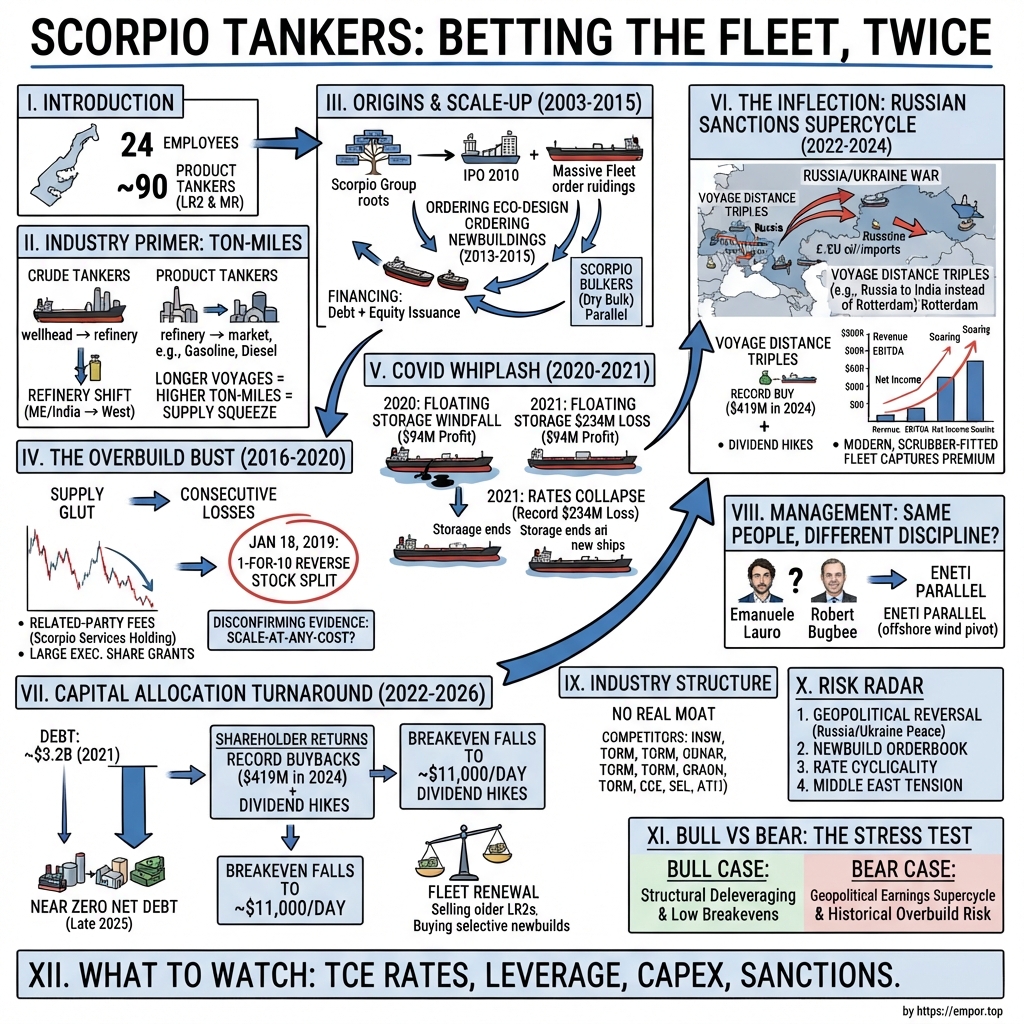
Scorpio Tankers: Betting the Fleet, Twice
I. Introduction & Episode Roadmap
In an office at 99 Boulevard du Jardin Exotique in Monaco, a short walk from the harbor where superyachts are berthed, work twenty-four people.1 That is the entire shore-based payroll of Scorpio Tankers Inc.
Between them, those twenty-four employees oversee a fleet that at the start of 2026 numbered ninety wholly owned oil-product tankers — a floating asset base worth billions of dollars, transporting gasoline, diesel, jet fuel, and naphtha across global trade routes.1 By the end of June 2026, following one of the most aggressive asset-disposal programs in the company's history, that fleet had been reduced to seventy-four ships.2
Twenty-four people. Seventy-four ships. It is one of the more extreme ratios of capital to headcount in public markets, and it reflects the company's underlying operating model. Scorpio Tankers does not employ the mariners aboard its ships — a related company owned by the founding family handles technical management. Nor does it typically arrange cargo fixtures — a separate entity owned by the same family provides commercial management.
Instead, Scorpio Tankers owns steel, finances steel, and determines when to acquire or divest steel. At its core, the company is a leveraged bet on the freight rates required to move refined petroleum products across oceans, directed by a small group of executives who have navigated shipping cycles together for decades.
That operational simplicity contrasts sharply with its volatile financial history. In January 2019, Scorpio Tankers executed a 1-for-10 reverse stock split, reducing 513,975,324 common shares to 51,397,470, with the stated purpose of improving "the marketability and liquidity of the Company's common shares."3 In practice, the share count had expanded relentlessly while the stock price collapsed, requiring corporate surgery to keep the equity tradeable for institutional investors. The company had just logged three consecutive annual losses and carried roughly $2.9 billion of debt against less than $2.0 billion of book equity.4
Seven and a half years later, on July 30, 2026, the same management team reported the most profitable quarter in company history: adjusted net income of $243.7 million, more than $1.9 billion of cash on hand, gross debt reduced to $655 million, and a daily cash breakeven of approximately $11,000 per vessel — a level the chief financial officer described as the lowest in the company's history.5 In total, Scorpio swung from roughly $2.9 billion of net debt at year-end 2021 to a net cash position of about $1.3 billion, representing a $4.2 billion balance-sheet turnaround in four and a half years.5
What drove that transformation: market conditions, or executive execution?
The evidence suggests both: predominantly macro industry tailwinds, complemented by decisive balance-sheet restructuring, with the critical debate centering on how much credit each deserves.
The narrative traces a founder-led family shipping enterprise that staged an initial public offering in 2010 and promptly leveraged its balance sheet to order modern, fuel-efficient newbuilds; an industry-wide oversupply cycle that produced four consecutive years of deficits; a pandemic that generated a brief spike in floating storage profits followed by an acute freight slump; a geopolitical conflict that reshuffled global refined-product routes and sparked the strongest rate environment in a generation; and a sustained deleveraging effort that fundamentally reshaped the capital structure.
Yet the turnaround also features governance practices that invite scrutiny: a related-party fee arrangement with family-controlled management affiliates that expanded rather than narrowed after shareholder pushback; senior executive compensation totaling $65.5 million in 2025 against net income of $344.3 million; and share repurchases that, analyzed year by year, suggest pro-cyclical buying near market peaks and negligible deployment when shares traded at steep discounts.1 Both narratives are supported by the record, and weighing them together is essential to understanding the company.
 Subscribe on LinkedIn
II. Industry Primer: What a Product Tanker Actually Does
Start with a barrel of crude oil coming out of the ground in Saudi Arabia. Before it can become anything a consumer uses, it must be refined — heated, fractionated, and chemically rearranged into gasoline, diesel, jet fuel, naphtha, and fuel oil. Two entirely different shipping industries operate on either side of that refinery gate. Crude tankers — Very Large Crude Carriers, Suezmaxes, and Aframaxes — move unrefined petroleum from wellheads to refineries. Product tankers carry finished fuels from refineries to consumer markets.
Scorpio operates on the second side of that gate across three vessel classes. Handymax vessels, at roughly 38,700 deadweight tons, handle short-haul and ice-class regional routes. Medium Range tankers, or MRs — around 50,000 deadweight tons — serve as the workhorses of the fleet, moving diesel from the U.S. Gulf Coast to Latin America or gasoline from Rotterdam to New York. Long Range 2 vessels, or LR2s — roughly 110,000 deadweight tons — handle long-haul voyages, carrying naphtha and jet fuel from the Middle East to Asia and Europe.1
Evaluating these operations requires a specific unit of measurement. Shipowners do not quote prices in dollars per ton; instead, they translate voyages into a time charter equivalent (TCE) rate — the daily net revenue of a vessel after deducting direct voyage costs like fuel and port expenses. TCE normalizes different voyages, making a three-day Caribbean run directly comparable to a forty-day journey from the U.S. Gulf to East Asia, and serves as the industry's standard benchmark for operational earnings.
Most of Scorpio's tankers do not solicit individual spot cargoes independently. Instead, they operate within commercial pools — including the Scorpio LR2 Pool, the Scorpio MR Pool, and the Scorpio Handymax Tanker Pool — where a pool manager markets a combined fleet, coordinates scheduling across participating owners, and distributes net earnings according to a fixed formula. Pooling improves fleet utilization by allowing a manager with dozens of vessels to triangulate routes, positioning a ship for its next cargo immediately after discharge rather than sailing in ballast. It also means commercial dispatch decisions are delegated to the pool manager rather than executed directly by Scorpio.
The fundamental driver of this market is often misunderstood. Product-tanker demand is not measured solely in barrels; it is measured in ton-miles — the volume of cargo multiplied by the distance traveled. A tanker moving cargo twice as far effectively absorbs twice as much fleet capacity, remaining occupied and unavailable to the broader market for double the duration.
Consequently, shipping capacity can tighten even when global petroleum consumption softens. If refined-product export volumes decline while average sailing distances expand by a greater margin, overall vessel demand rises. That dynamic is not theoretical.
On Scorpio's second-quarter 2026 earnings call, investor-relations head James Doyle noted that in June 2026, global seaborne refined-product exports dropped by 2.3 million barrels per day — an 11% decline year over year — yet longer voyage distances had "largely offset that decline, tightening effective supply and supporting a strong freight market despite lower volumes."5 Even with fewer barrels moving across the water, vessel demand remained firm.
Beneath short-term trade disruptions lies a structural shift: the geographic separation of global refining capacity from major consumer markets. Refining capacity has contracted across developed economies in Europe, Australia, and the U.S. East and West Coasts, while modern export-oriented megarefineries have opened in the Middle East, India, and China.
Doyle illustrated this shift on the same earnings call: since 2019, global refined-product demand had increased by nearly 4.5 million barrels per day compared to only 1.8 million barrels per day of net refinery additions, with the majority of new capacity located far from primary consumption centers.5
Each refinery retirement in an import market like the U.S. Northeast and subsequent replacement by capacity in hubs like Jamnagar or Jubail permanently lengthens average voyage distances without requiring an increase in oil demand. Management's assertion that this dislocation "isn't something that reverses quickly" reflects physical constraints in the construction cycle: Doyle estimated the minimum construction timeline for a modern refinery at roughly seven years, meaning facilities not already under development cannot enter service before that window closes.5
Yet structural demand growth does not grant Scorpio pricing power. Freight rates for product tankers are established through open, competitive global auctions. When a charterer seeks to transport diesel from Houston to Brazil, competing owners of modern, comparable MRs typically quote day rates within a narrow band.
Two fuel-efficient MRs of identical age and technical specifications from different shipowners command essentially identical freight rates. The business offers no brand premium, no customer switching costs, no proprietary technology, and rarely any long-term contractual lock-in beyond an individual voyage or short time charter.
Any competitive edge must therefore originate elsewhere: from low operating costs, modern vessel specifications, disciplined capital allocation across purchase and sale cycles, and a balance sheet resilient enough to weather market downturns. In a commoditized sector, these capabilities provide meaningful operational advantages, but they do not constitute an economic moat. Understanding that distinction is central to evaluating how the company came to accumulate its massive fleet in the first place.
III. Origins: A Family Shipping Business Goes Public and Bets Big (2003–2015)
Shipping families represent their own genre of capitalism. Typically European, often Mediterranean, and frequently several generations deep, they tend to operate through webs of private holding companies that outlive any single public vehicle. The Lolli-Ghetti family, whose Scorpio Group has operated in maritime transport for decades, fits that archetype precisely. Emanuele Lauro, a member of the family, joined the group in 2003 in his mid-twenties.6
Over the following decade, Lauro gave that private shipping operation a public face: a New York-listed corporation capable of raising institutional capital at scale, while the family's private operating entities retained commercial, technical, and administrative management of the ships. That structure was not incidental; it remains in place today and has served as the most persistent point of friction between the company and outside shareholders.
Understanding the corporate wiring clarifies the governance tensions that followed. Scorpio's vessels are commercially managed by Scorpio Commercial Management S.A.M., majority-owned by the Lolli-Ghetti family, in which Emanuele Lauro and Vice President Filippo Lauro hold ownership interests.
Technical management — covering crew staffing, vessel maintenance, drydocking, supplies, and safety vetting — is handled by Scorpio Ship Management S.A.M., also majority-owned by the family. Administrative services, including accounting, legal compliance, information technology, and office space, are provided by Scorpio Services Holding Limited, a third family-controlled entity.1
In practice, the listed company supplies the investment capital while the family's private affiliates manage the day-to-day operations. While common among European shipping dynasties, the structure carries distinct trade-offs. It offers clear operational leverage: an enterprise with just twenty-four shore-based employees can expand its fleet without building out internal corporate overhead. Conversely, it ensures that a material share of the cash flow generated by public equity is paid out to private entities outside shareholder ownership, under contractual terms that outside investors cannot negotiate.
Scorpio Tankers Inc. incorporated in 2009 and began trading on the New York Stock Exchange in April 2010. Lauro assumed the roles of Chairman and Chief Executive Officer alongside Robert Bugbee as President and Cameron Mackey as Chief Operating Officer — an executive trio appointed at the initial public offering who remain in place sixteen years later.6 Bugbee, an industry veteran with more than three decades in maritime finance, emerged as the public voice of the leadership team, frequently addressing capital allocation on earnings calls with candid commentary and colorful metaphors.6
The enterprise that listed in 2010 began with modest assets: a small initial fleet and an aggressive expansion plan. What followed was one of the largest speculative newbuilding programs ever undertaken by a single owner in the product-tanker sector.
The investment thesis was specific and, at the time, genuinely differentiated. Shipbuilders in South Korea and China had begun designing a new generation of "eco-design" tankers offering substantially lower fuel consumption than vessels delivered in the prior decade.
Because marine fuel represents a tanker's largest voyage expense, a vessel burning materially less fuel commands a higher time-charter-equivalent rate on the same voyage. Scorpio reasoned that by placing massive, early orders, it could assemble the youngest, most fuel-efficient fleet in the industry, achieving the commercial scale required to become a preferred carrier for oil majors and global trading houses.
The company ordered aggressively. By March 2013, Scorpio had twenty-eight product tankers under construction across three South Korean shipyards — twenty MRs, six ice-class Handymaxes, and two LR2s — while securing options for additional tonnage, including LR2 contracts at Hyundai Samho Heavy Industries and MRs at Hyundai Mipo Dockyard.7 Within weeks, the active order book climbed past thirty-three vessels. Management financed the expansion through every channel available: traditional secured bank debt, sale-and-leaseback transactions, and repeated equity offerings into an accommodating market.
The early financial returns appeared to validate the strategy. Between 2012 and 2015, revenue grew more than sixfold, rising from $115 million to $756 million, while net income swung from a $26.5 million loss to a $217.7 million profit.8 For three years, the aggressive expansion seemed not only vindicated but self-evident — often the most dangerous stage of any shipping cycle.
Management also replicated the playbook in an adjacent sector. Lauro and Bugbee simultaneously established and directed a second publicly traded company, Scorpio Bulkers, applying an identical expansion thesis to dry bulk carriers: two public vehicles, one executive team, and a shared conviction to order new tonnage aggressively ahead of anticipated market recoveries.
That strategy created the asset base that established Scorpio Tankers as one of the world's leading LR2 operators. Yet it also positioned the company for the most painful downturn in its history, as competing shipowners across the globe placed similar orders at the same shipyards, setting off an acute industry-wide supply glut.
IV. The Overbuild Bust and the Reverse Split (2016–2020)
The trouble with a good idea in shipping is that it is never yours alone. The eco-tanker thesis that Scorpio backed in 2013–2015 was correct in every respect except the one that mattered: it was also backed, simultaneously, by most of the rest of the industry. Yards in Korea and China took the orders. The ships were delivered on schedule. And a wave of new capacity hit the water into a product-tanker market that did not grow fast enough to absorb it.
The financial record of what followed is unambiguous. Scorpio Tankers lost money in four consecutive years: $24.9 million in 2016, $158.2 million in 2017, $190.1 million in 2018 and $48.5 million in 2019.4 Cumulatively, more than $420 million of shareholder capital was destroyed in the operating business during a period in which the company was simultaneously taking delivery of some of the most modern tonnage afloat. Revenue in 2017, at $512.7 million, was lower than it had been in 2015 with a far smaller fleet.8
The reason the losses were so deep is that the fleet was financed. Total debt, including finance leases, rose from roughly $2.05 billion at the end of 2015 to $2.91 billion at the end of 2018, and financial expenses alone ran at $186.2 million in 2018 and $186.6 million in 2019.4 In 2018, Scorpio Tankers generated $10.5 million of operating income and paid $186.6 million of interest. The ships were fine. The capital structure was the problem.
What the company did next is the part of the story that most directly tests every claim management makes today about capital discipline. It issued equity — repeatedly, into weakness. Split-adjusted basic weighted-average shares outstanding went from 16.14 million in 2015 to 21.53 million in 2017, 34.82 million in 2018 and 49.86 million in 2019.4 That is a tripling of the share count in four years, executed while the stock was falling and while the company was reporting losses.
Shareholders' equity rose from $1.41 billion to $1.98 billion over the same period — but only because new shareholders put in more money than the existing business lost.4 Every dollar of that increase was purchased with dilution.
There is a second, smaller detail in the same filings that says something about priorities. In 2015 and 2016 — the second of which was a loss year — Scorpio declared dividends of $4.95 and $5.00 per share on a split-adjusted basis.
In 2017, with the losses deepening, the declared dividend collapsed to $0.40 per share and stayed there through 2019.4 Paying out cash into the teeth of an overbuild and then cutting by more than 90% is not, by itself, a scandal; plenty of cyclical companies have done it. But it is directly relevant to how much weight to give the current management's insistence that today's dividend is designed to survive a downturn. They have made a dividend promise before, and the cycle took it away.
The reverse split was the visible symptom. Shareholders approved it at a special meeting on January 15, 2019, three days before it took effect, and the company simultaneously reduced its authorised common shares to 150 million.3 A board does not ask its owners to approve that motion when things are going well.
Reverse splits are not, in themselves, value-destructive — they are arithmetic. But companies do not perform them from positions of strength. This one is the cleanest available marker of how close to the edge the story had drifted.
The governance complaint, and what the record actually shows
This is the correct place — next to the losses, not quarantined in a risk section — to deal with the disconfirming evidence on the "disciplined operator" narrative, because the criticism was made contemporaneously and it was made about exactly this period.
In 2019, a critique published on Seeking Alpha under the title "Do As I Say, Not As I Do" argued that Scorpio's named executives had continued receiving large annual restricted-share grants largely irrespective of company performance, and took aim at the related-party arrangement under which the company paid entities affiliated with the founding family for commercial, technical and administrative services.9 The company's own filings let us test the substance rather than rely on the polemic.
Three findings, each of which cuts differently.
First, the disputed 1% fee. Under the administrative services agreement, Scorpio Services Holding Limited — a Lolli-Ghetti family entity — had at one point been entitled to a fee equal to 1% of the gross purchase or sale price of any vessel transaction. On September 29, 2016, the company amended the agreement to eliminate that fee for all vessel purchase or sale agreements entered into thereafter, and no such fees were paid in 2019.4 That reform predated the 2019 critique and was real.
Second, the commercial management fee cut. In September 2018, Scorpio announced that its related-party commercial manager, Scorpio Commercial Management S.A.M., would reimburse a portion of its commissions to effectively reduce them to 0.85% of gross revenue per charter fixture.10 This has often been described as a permanent concession to shareholder pressure.
It was not. The company's FY2019 annual report states the arrangement plainly: the reduction was "effective from September 1, 2018 and ending on June 1, 2019."4 It was a nine-month rebate against a standing rate of 1.25%.11 After June 2019 the headline commission structure reverted.
Third, and most damning for anyone who wants to treat 2018 as a governance turning point: the fees have since gone up. Under a 2024 Revised Master Agreement effective January 1, 2024, the flat per-vessel-per-day fees charged by the related-party commercial manager were increased by $35 per vessel per day; commissions on gross revenue per charter fixture stand unchanged at 1.50% for vessels operating in the Scorpio Pools and 1.25% for vessels outside them; and the annual technical management fee payable to the family-owned technical manager was raised by $12,500 to $187,500 per vessel plus itemised extras.1 Related-party administrative expenses rose from $15.5 million in 2023 to $19.4 million in 2024 to $21.6 million in 2025.1
The verdict this history supports: the 2019 governance critique was directionally right and remains only partially remediated. One specific abuse — the transaction fee — was genuinely eliminated, in 2016. The headline fee concession that is most often cited as evidence of responsiveness was explicitly temporary and expired on schedule. And the overall economic take by family-controlled entities has grown in absolute terms as the company has grown. This does not reject the modern capital-discipline story, which rests on debt and fleet decisions rather than on fees. But it narrows it: the discipline visible in Scorpio's balance sheet has never extended to the related-party cost base, and an investor who assumes management's 2022–2026 behaviour reflects a wholesale change in orientation toward minority shareholders is extrapolating past the evidence.
The forward test on the operating side is different and simpler. The 2013–2015 error was not fraud or fee extraction; it was ordering too many ships into a good market. As of the second quarter of 2026 the order book stood at thirteen vessels against a fleet of seventy-four — a ratio roughly an order of magnitude smaller than the 2013 position.5 Whether that restraint survives the next stretch of $70,000-a-day LR2 rates is the single most important behavioural question about this management team, and it will not be answerable for years.
Before that test arrives, though, the world threw two enormous shocks at the industry in quick succession.
V. COVID Whiplash: A Sugar High, Then a Crash (2020–2021)
In April 2020, the benchmark price of crude oil for immediate delivery briefly turned negative. The dynamic was unprecedented: for several hours, sellers were effectively paying buyers to take physical crude off their hands because commercial storage tanks had run out of space. Global oil demand had evaporated almost overnight while production continued, rapidly exhausting available land-based capacity.
When land storage fills, the ocean becomes the warehouse. Commodity traders who could buy cheap crude and refined products on the spot market and sell them forward at higher future prices — a market structure known as contango — needed temporary storage for those barrels. A tanker sitting at anchor functioned as a floating storage terminal. Charterers began booking vessels not to transport cargo, but simply to hold it. Commercial fleet supply contracted at the exact moment physical markets were inundated with surplus oil, sending freight rates soaring.
For Scorpio, the result was a paradoxical year. Amid the sharpest demand shock in modern petroleum history, the company generated revenue of $915.9 million and net income of $94.1 million — its first profitable year since 2015.8 An enterprise that had posted losses across four consecutive years of normal trade turned profitable during a global crisis. The outcome was not a testament to managerial foresight; it illustrated how loosely earnings in product shipping are tied to operational decisions under an owner's control.
The subsequent hangover was correspondingly severe. Throughout 2021, the floating-storage trade unwound as onshore inventories drained, the final deliveries from the industry's 2013–2019 shipbuilding wave entered service, and freight rates plummeted. Scorpio's revenue fell to $540.8 million — lower than its 2016 total — resulting in a net loss of $234.4 million, the largest in company history.8 Operating cash flow evaporated: EBITDA dropped to $146.3 million, barely covering financial expenses of $140.5 million.8 By year-end, the company carried $3.16 billion in gross debt against $230 million in cash, leaving a net debt position of $2.93 billion.12
That two-year sequence illustrates the fundamental nature of the product-tanker sector. In 2020, global oil consumption experienced its steepest drop on record, and Scorpio proved highly profitable. In 2021, as economic activity and oil demand rebounded, Scorpio suffered record losses. No strategic initiative originating from the Monaco headquarters accounted for either result. A single macroeconomic variable — the slope of the forward oil price curve and the financial incentive for traders to store barrels at sea — swung the company from windfall profits to deep deficits within twelve months.
For an investor, the lesson centers on forecasting limitations rather than directional trends. Forward earnings visibility in product shipping rarely extends beyond the current quarter's spot bookings, which explains why Scorpio's quarterly updates consistently lead with the percentage of revenue days already contracted for the following quarter. Beyond that narrow operating window, multi-quarter financial forecasts are little more than conjecture.
That 2021 balance sheet represents the baseline for Scorpio's subsequent transformation, and its underlying composition was precarious. Of the $3.16 billion in total debt outstanding at the end of December 2021, roughly $2.24 billion — more than 70% — was lease financing.12 Sale-and-leaseback structures are financing mechanisms shipowners turn to when commercial banks limit lending capacity. While providing immediate liquidity, they are expensive, restrictive, and heavily encumber the underlying vessels. An operator funded primarily through lease obligations has minimal room to maneuver: management cannot readily divest individual ships, renegotiate terms, or easily endure an extended market downturn.
As 2021 came to a close, Scorpio Tankers paired a modern fleet and competitive vessel operating costs with a fragile capital structure that could not withstand another prolonged downturn. Six weeks into the new year, Russia invaded Ukraine.
VI. The Inflection: Russia, Sanctions, and the Product-Tanker Supercycle (2022–2024)
Before February 2022, the largest single trade in the refined-products market was one of the shortest. Russian refineries in the Baltic and Black Sea loaded diesel and gasoil and sent it a few days' sail to Rotterdam, Antwerp and the rest of northwest Europe. Short voyage, high volume, low ton-mile intensity — from a shipowner's perspective, an enormous amount of cargo generating a modest amount of work.
The EU and UK bans on seaborne Russian crude and refined-product imports, phased in through December 2022 and February 2023, did not reduce the number of barrels the world needed. They rerouted them. Russian diesel that had sailed 1,200 miles to Rotterdam began sailing 6,000 miles to India, Turkey, Brazil and West Africa. Europe replaced the lost volumes with barrels from the US Gulf, the Middle East and India. The same molecules, roughly, in the same quantities — but each one now travelling several times as far.
This is the ton-mile mechanism from the primer, applied at the scale of global trade. No ships were removed from the fleet. No refineries closed. The effective carrying capacity of the world's product-tanker fleet simply shrank, because every ship was busy for far longer per cargo. And in an industry where fleet supply is fixed in the short run and demand is inelastic — the diesel has to move — small changes in the balance produce violent changes in price.
Scorpio's income statement registered the shock like a seismograph. Revenue went from $540.8 million in 2021 to $1.563 billion in 2022. EBITDA went from $146.3 million to $1.058 billion. Net income went from a $234.4 million loss to $637.3 million of profit.8 It is the single largest year-over-year inflection in the company's history, and it happened without Scorpio doing anything differently.
Why the money went to lenders first
There is a detail here that gets lost in the celebration of the 2022 numbers, and it explains why the share price took years to reflect them. Scorpio entered the supercycle with more than $3 billion of debt, most of it expensive lease financing. Financial expenses in 2022 were $158.3 million and in 2023 $166.7 million — meaning that a very large slice of the first two years of windfall cash flow went to lessors and lenders rather than to shareholders.8
That is the standard fate of a highly geared company at the start of an upcycle: the equity gets paid last. It is also why the deleveraging described in the next section was not merely prudent housekeeping but the single highest-return use of cash available to management at the time. Retiring a lease at an effective double-digit cost of capital is a guaranteed return; buying another ship at a cyclical high is not.
The obvious question for an investor is whether Scorpio captured this better than the average owner, and if so, why. Two mechanisms are worth separating, because one is real and durable and the other is real and contingent.
The durable one is scale and modernity. Scorpio entered the cycle with one of the largest and youngest large-vessel product-tanker fleets in the world, weighted heavily toward LR2s — precisely the segment that benefits most when the long-haul Middle East-to-Europe and US-Gulf-to-Asia trades lengthen. A trading house that needs certainty of supply on a newly rerouted arbitrage would rather deal with an owner that can offer ten ships than one that can offer two. That is a genuine scale economy, and it shows up in counterparty access rather than in headline rates.
The contingent one is scrubbers. Exhaust-gas cleaning systems allow a vessel to burn cheap high-sulphur fuel oil while complying with the IMO's global 0.5% sulphur cap, which took effect on January 1, 2020.1 The economic value of that equipment is entirely a function of the price spread between high- and low-sulphur fuel — a spread Scorpio does not control and cannot forecast.
Scorpio's fleet is heavily but unevenly fitted: as of June 30, 2026, 24 of its 25 LR2s and 26 of its 35 MRs carried scrubbers, while none of its 14 Handymaxes did.2 So the fuel-cost advantage is real and measurable on the big ships, absent on the small ones, and its value fluctuates with a commodity spread. It is a KPI-backed edge, not a moat.
The cycle held up longer than most sceptics expected. Revenue was $1.341 billion in 2023 with net income of $546.9 million; 2024 revenue of $1.244 billion produced net income of $668.8 million — higher than 2023 despite lower revenue, because the figure was flattered by gains on vessel sales as the company began monetising older tonnage into a strong second-hand market.8 That distinction matters and it recurs throughout the modern story: a growing share of Scorpio's reported profit comes from selling ships rather than from operating them.
Then 2025 delivered the reality check. Revenue fell to $938.2 million and net income to $344.3 million as rates normalised from the post-invasion peak.8 Adjusted EBITDA in the third quarter of 2025 was $148.1 million, with achieved TCE rates of $31,482 per day on LR2s and $23,962 on MRs — good money, but roughly a third of what the LR2 fleet would earn nine months later.12 The supercycle, it turned out, was not a plateau.
What the evidence supports: the 2022–2024 earnings explosion was overwhelmingly a demand-side, policy-driven event that Scorpio was well positioned to harvest, not one it created. Its fleet composition amplified the gain; its capital structure at the time meant most of the early cash went to lenders rather than shareholders. The correct read is that Scorpio is a high-beta instrument on product-tanker ton-miles with a somewhat better-than-average cost position — which is a perfectly coherent thing to own, provided you price it as such. What management did with the windfall is where the more interesting judgement lies.
VII. The Capital Allocation Turnaround: Paying Down the Past While Renewing the Fleet (2022–2026)
There is a slide that Chief Financial Officer Christopher Avella has now shown on four consecutive earnings calls, and it is the single most persuasive artefact in the bull case. It is a bar chart of net debt by date, and it goes: $2,933 million at December 31, 2021; $1,581 million a year later; $1,263 million at the end of 2023; $546 million at the end of 2024; $293 million at September 30, 2025; and, on a pro-forma basis reflecting three vessel sales and announced prepayments, $33.9 million as of late October 2025.12 By July 30, 2026 the line had crossed zero and kept going: a net cash position of approximately $1.3 billion, which Avella noted was worth roughly $26 per share.5
That is a $4.2 billion swing in four and a half years, and unlike a guidance statement it is not a claim — it is an audited, sequentially verifiable fact. It is the strongest evidence in the entire story that something about this company has actually changed.
The composition of the paydown matters as much as the amount. Recall that more than $2.2 billion of the December 2021 debt stack was lease financing.12 The single most consequential thing management did over the following four years was to get out of it — retiring expensive sale-and-leaseback structures and replacing what remained with cheaper, more flexible secured bank debt, then unsecured paper.
Avella has been explicit that this was the design: transitioning "out of expensive lease financing into more flexible, lower-cost secured debt."5 The practical effect is that ships came back unencumbered, which is precisely what made the 2025–2026 vessel-sale programme possible.
The refinancing sequence in the first half of 2026 was, on its own terms, well executed. In April the company issued $375 million of five-year senior unsecured convertible notes with a 1.75% coupon and a conversion price of approximately $100 per share; in May it reopened the same notes at over 110 to par for gross proceeds of more than $253 million, bringing the combined yield to maturity below 1%.5 It repaid $389 million of legacy secured debt maturing in 2028 that carried margins between 170 and 197.5 basis points, and on July 17, 2026 it redeemed $200 million of 7.5% senior unsecured Nordic bonds due 2030 at 106.4 to par.13 New secured facilities — $50 million from Bank of America, and a $90 million commitment from Standard Chartered and DekaBank to finance four scrubber-fitted MR newbuildings — were struck at margins of just 120 basis points over SOFR with seven-year tenors.513 As of July 30, 2026 the company had $655 million of debt outstanding, $605 million of it the convertible.5
The output of all that is the number management repeats most often: a daily cash breakeven — vessel operating costs, cash G&A, cash interest, commitment fees and scheduled amortisation — of approximately $11,000 per day.5 To put that in context, Scorpio's LR2s earned $77,749 per day in the pool and spot market in the second quarter of 2026, and its Handymaxes, the weakest segment, earned $49,210.2 Even the company's own stress case is instructive: on the first-quarter 2026 call, Lauro claimed that in an environment resembling the depth of the 2020 COVID market, the company would remain "at or above breakeven."14 Avella's arithmetic is that at a $20,000 daily TCE across the fleet, Scorpio can generate up to $246 million of annual cash flow; at $30,000, up to $520 million.5
Fleet renewal, and the awkward question of what gets counted as profit
The disposal programme has been genuinely opportunistic. Since the start of 2026 the company sold nineteen vessels, most of them eleven or twelve years old, at prices above what it originally paid for them more than a decade earlier — and Lauro noted on the second-quarter call that the last four sales, all LR2s, were completed at prices above the cost of the LR2 newbuildings currently on order.5 In the second quarter alone, ten vessels were sold for $465 million in aggregate, with a further five sold in July for $320.8 million; gains recognised in the first half of 2026 totalled $220.1 million.2
Selling a twelve-year-old asset for more than a new one costs is, on its face, excellent trading. It is also a signal about the second-hand market that cuts against the durability narrative: asset values that high are themselves a function of the same freight strength that is supposed to be structural.
The mechanics of one such trade illustrate the pattern. In early 2026 Scorpio agreed to sell four LR2 product tankers — STI Broadway, STI Condotti, STI Winnie and STI Lauren, all built in 2014 or 2015 — for an aggregate $285.8 million, while simultaneously ordering two scrubber-fitted MR newbuildings at 江苏扬子三井造船 Jiangsu Yangzi-Mitsui Shipbuilding at $46.25 million each for 2030 delivery, and stating an intention to repay all outstanding secured debt due in 2028 through early repayments of $367.8 million across several facilities.15 Sell four eleven-year-old large ships, order two new small ones, retire the debt with the difference. That is a company deliberately shrinking its asset base and its liabilities at the same time, which is the opposite of what it did in 2013.
And it introduces an accounting judgement investors should track carefully. Of Scorpio's $387.5 million of reported second-quarter net income, $154 million was a gain on the sale of ten vessels; adjusted net income excluding disposals was $243.7 million.52 In the first quarter, $65.9 million of $216.3 million of reported income was vessel-sale gains.16 These are real economic gains, properly recognised — but they are non-recurring by construction.
A fleet can only be sold once. Judging the earnings power of the operating business requires using the adjusted figures, and noticing that the gap between reported and adjusted income has widened materially in 2024–2026 relative to earlier years.
Against the disposals, the reinvestment has so far been modest. Newbuilding commitments as of late July 2026 stood at fourteen vessels — six MRs at Chinese yards at about $46.3 million each, six LR2s at roughly $72.8 million each, and two VLCCs at 한화오션 Hanwha Ocean — plus a minority equity interest of less than 15% in a joint venture building eight scrubber-fitted VLCCs for delivery between the third quarter of 2029 and the second quarter of 2030.2 With the delivery of the first MR newbuilding, STI Moxie, at the end of July, the order book fell to thirteen.5 Remaining newbuilding and joint-venture commitments totalled just over $978 million, spread across four years, against $2.2 billion of cash — a position Avella described by noting the company could hypothetically pay for every one of them today without raising a dollar.5
The claim that needs testing
Management's framing is that the dividend and the buyback are "supported by structural cash generation, not temporary conditions" — and Bugbee has been consistent and unusually specific about the philosophy. On the first-quarter 2026 call he told an analyst there would be no extraordinary dividends and no high-payout formula: the goal is "a permanent dividend that can be met through good times and bad," and he explicitly warned that payout ratios tied to a percentage of income "work great in good times and are quite tragic in other times."14 That is a conservative, testable commitment, and it has been honoured through four consecutive quarterly raises: $0.40 through 2024 and most of 2025, $0.42 in December 2025, and $0.45 from the first quarter of 2026 onward.116
But here the buyback record deserves the same scrutiny, because it tells a less flattering story and it sits inside the identical claim.
In 2024, with the stock averaging in the low seventies, Scorpio repurchased 4,653,189 common shares at an average price of $72.12 — roughly $336 million — and paid $83.5 million of dividends, for total capital returns of about $419 million.1 In 2025, with the stock trading far lower — the company issued restricted stock during the year at prices of $34.40, $40.17 and $58.49, and its two open-market repurchases that year were executed at $55.86 in February and $40.35 in March — Scorpio bought back 6,500 shares for the entire calendar year, at an average price of $47.51.1 Total spend: under $310,000. Then in April 2026, with the stock back around $71, it repurchased 1.4 million shares for roughly $100 million, and in the second quarter another 1,994,236 shares at an average of $77.72, for about $155 million.142
Set out in sequence: heavy buying at $72, essentially nothing at $40–48, heavy buying again at $72–78. Management's defence is coherent and probably sincere — 2025 was the year the balance sheet was being finished, cash was committed to unscheduled debt prepayments of $154.6 million in the fourth quarter alone, and Bugbee has framed the enlarged $500 million authorisation as an "anvil" to be used if the stock dislocates from net asset value rather than a commitment to buy on a schedule.1214 But the pattern is what it is. As of July 30, 2026, $445 million remained available under the replenished programme.2
Weighing it: the deleveraging is proven, structural and unusually well documented — this is not a claim, it is a fact, and it materially changes Scorpio's ability to survive a downturn relative to the 2016–2019 version of the company. The claim that the shareholder return framework is equally disciplined is weaker. The dividend policy is genuinely conservative and consistently articulated across calls. The buyback, on the three-year record available, has been procyclical rather than countercyclical. And the whole record is only four years long, inside an industry where a previous multi-year record of apparent competence (2013–2015) reversed completely. The honest conclusion is that the evidence supports a real and durable change in capital structure, and does not yet support a claim of superior capital allocation through a cycle. The event that would settle it is the next sustained period of sub-$20,000 TCE rates: whether the dividend holds, whether the buyback finally shows up when the stock is cheap, and whether the order book stays at thirteen.
VIII. Current Management: Lauro and Bugbee — Same People, Different Discipline?
The most striking thing about Scorpio's leadership is its continuity. Emanuele Lauro has been Chairman and Chief Executive since the April 2010 IPO. Robert Bugbee has been President since the same date. Cameron Mackey has been Chief Operating Officer since the same date.6 The people who ordered thirty-three ships into the teeth of an overbuild in 2013 are the same people running the company that today holds $2.2 billion in cash and thirteen vessels on order.
Opening his first-quarter 2026 remarks, Lauro allowed himself a rare moment of retrospection: "When Robert, Cameron, and I started this business in 2009, I cannot say that we envisioned every detail of what the company would become. But in our most ambitious plans, I remember looking at something like this."14 It is the closest thing to a victory lap in sixteen years of transcripts, and it is worth noting that he took it in the quarter after net debt hit zero, not in the quarter after net income peaked.
The dominant public voice on strategy, though, is Bugbee's, and his answers on calls are consistently the most informative material the company produces. Asked in May 2026 whether the enlarged buyback signalled a pivot in capital allocation, he declined the framing: "I do not think it creates a pivot in strategy," describing instead a sequence — first delever, then renew the fleet while taking advantage of backwardation in asset prices, then use the strengthened balance sheet to obtain cheaper financing.14 Asked whether investors should expect a large acquisition, he was blunt: "You are not going to see some massive, great big order. You are not going to see an acquisition of a competitor."14 Asked in July to speculate about how the Middle East conflict might resolve, he simply refused: "We will pass on the hypotheticals, if that is okay."16
That refusal is itself a data point. Management that declines to forecast the variable driving its earnings is being more honest than management that forecasts it — and it is consistent with the company's own risk disclosure, which states that Scorpio "cannot foresee what other sanctions or executive orders may arise that affect the trade of petroleum products."1 Investors should read that as management telling them, in filing language, that the current earnings power rests on a policy variable nobody at the company controls.
Judged on the standard that actually matters for credibility — whether the story changes when the numbers change — this team scores reasonably well. Compare the first-quarter 2026 call, delivered at the euphoric peak with LR2 bookings at $96,000 per day, against the second-quarter call three months later, delivered after rates had fallen back.16145 The framing barely moved: both open with the same list of controllables — balance sheet, cost of capital, cash breakevens, fleet optimisation, capital returns — and both decline to forecast the geopolitics. Doyle's line in July, that "records, by definition, aren't meant to last" and that "what's more important is not the peak, it's the floor," is not the language of a management team talking its own book into the high print.5
The consistency has limits, though, and one is worth naming. On both calls the supply argument is presented with an asymmetry: the crossover of LR2s into the crude trade is offered as evidence that the effective product-tanker order book is smaller than it looks, without equivalent emphasis on the reverse flow that would occur if clean rates outran dirty ones. When a mechanism is described only in the direction that helps, that is advocacy, however well-founded the underlying observation.
Compensation and ownership: the awkward numbers
Scorpio paid aggregate compensation of $65.5 million to its senior executive officers in 2025, following $62.0 million in 2024 and $59.7 million in 2023.1 The great majority of that is equity: share-based compensation, representing the amortisation of restricted stock, was $44.0 million in 2025 against $21.5 million of salaries.1 For scale, the 2025 figure equates to roughly 19% of the company's $344.3 million of net income that year, at a company with twenty-four shore-based employees.
The share issuance behind it is substantial. Scorpio issued 1,472,800 restricted shares in 2024 and 1,847,748 in 2025 to employees, employees of the related-party administrator, and independent directors, for no cash consideration.1 Set that against the 6,500 shares repurchased in 2025 and the dilution arithmetic for that year is straightforward.
Then there is the ownership disclosure, which repays careful reading. As of March 19, 2026, Lauro held 907,304 shares, or 1.75% of the company — of which 867,304 were unvested restricted stock from the 2013 Equity Incentive Plan. Bugbee held 897,087 shares, or 1.73%, of which the same 867,304 were unvested restricted stock. Mackey held 864,531 shares, of which 606,461 were unvested.1 Strip out the grants and the three founders' outright personal stakes in the company they run are, individually, well under 100,000 shares.
This is a genuine governance observation rather than a scandal: restricted stock does align executives with the share price, and the founding family separately holds 6.5% of the company through Scorpio Holdings Limited, a related party.1 But an investor who assumes the executive team is aligned because it owns a large personally-purchased stake would be mistaken. The alignment runs through grants that are issued annually regardless of outcome — which is precisely the criticism made in 2019 and, on the evidence of the 2023–2025 grant schedule, not structurally addressed since.91
The Eneti episode: a real test, with a real answer
The strongest available test of this team's capital-allocation judgement outside the tanker business is Scorpio Bulkers, and it deserves to be weighed rather than merely flagged.
On December 20, 2020, Scorpio Bulkers announced it was leaving dry bulk entirely, classifying its remaining 25-vessel fleet for sale on top of vessels already disposed of, and guided to a write-down of $475–500 million — of which $425–440 million was a non-cash impairment to fair market value and $50–60 million was cash charges, including $34–36 million to terminate vessel-related agreements.17 Lauro's stated rationale was direct: "We believe that the investment in renewables is a more attractive opportunity in the marine space going forward as opposed to dry cargo."17 The company contracted for a wind-turbine installation vessel from 대우조선해양 Daewoo Shipbuilding & Marine Engineering at an investment of up to $290 million, renamed itself Eneti Inc. in January 2021, and acquired the offshore-wind installation operator Seajacks in August 2021.171819
The outcome, which is now known rather than pending: Eneti did not go on to build a standalone offshore-wind franchise. In December 2023 it combined with the Danish operator Cadeler in a stock-for-stock exchange offer in which Eneti shareholders received 40% of the combined company; the merger completed on December 22, 2023, and the surviving entity kept the Cadeler name and moved its headquarters to Copenhagen.19
How should this be weighed against today's thesis? On the negative side of the ledger: a half-billion-dollar write-down is a half-billion-dollar write-down, and it was crystallised by the same three executives who run Scorpio Tankers, in a vehicle that had itself been built through an aggressive newbuilding programme in the middle of the previous decade.
It is direct, recent, same-management evidence of an appetite for large, thesis-driven capital bets that can go badly wrong. On the mitigating side: the pivot was executed rather than abandoned, the acquired asset base was ultimately combined into a larger and more credible platform rather than liquidated at distressed prices, and the exit came via a negotiated merger in which continuing holders received equity in the survivor — not a wipeout.
The calibrated read: the Eneti record does not reject the proposition that Lauro and Bugbee are competent operators, and it does not support the strongest bear framing of a failed vanity project. What it does is bound the claim that this team has become structurally conservative. It is evidence that the instinct to make a large, concentrated, cycle-timed bet is still present, and that when such a bet does not work, the resolution is a write-down and a change of ownership rather than a slow grind back. Applied forward, that argues for watching the order book and the VLCC joint venture — a segment outside Scorpio's core competence, entered via a minority stake with a Chinese shipbuilder Lauro described as a relationship "for many years" and justified more on strategic than financial grounds — as the leading indicators of whether the discipline is temperament or circumstance.5
IX. Industry Structure and Competition: A Business Without a Real Moat
Imagine you are a chartering manager at a large oil trader with 90,000 tonnes of jet fuel to move from the Arabian Gulf to Japan next week. You send an enquiry to the market. Within an hour you have a dozen offers back from a dozen owners, all quoting modern coated LR2s of broadly identical specification. You take the cheapest that meets your vetting standards, and you will not remember, six months later, whose ship it was.
That is the competitive reality of this industry in a single scene, and it should discipline how anyone thinks about Scorpio's supposed advantages.
The public peer set is genuinely fragmented. International Seaways operates a mixed crude and product fleet of 70 vessels; in the second quarter of 2026 it reported net income of $295 million on shipping revenues of $467 million, its best quarter in a near-decade history, and adjusted EBITDA of $345 million.20 TORM plc, one of the largest pure product-tanker operators, generated 2025 TCE earnings of $910 million and EBITDA of $571 million, achieving fleet-wide TCE rates averaging $28,783 per day — with LR2s at $35,850, LR1s at $28,262 and MRs at $26,374 — and guided 2026 EBITDA to a range of $500–900 million.21 Teekay Tankers, Hafnia and Ardmore Shipping round out the field. None of them has anything resembling dominant share. All of them ride the same freight curve.
The comparison with International Seaways is the most instructive, because the two companies have drawn opposite conclusions from the same cash flows. Seaways declared a quarterly dividend of $5.05 per share for the second quarter of 2026 — the largest in its history — and has now run a payout ratio above 85% of adjusted net income for three consecutive quarters, while operating with net loan-to-value of roughly 6% and $935 million of liquidity.20 Scorpio, by contrast, pays a deliberately modest fixed dividend and hoards the balance.
Neither approach is obviously correct. Seaways is optimising for total return in a strong market; Scorpio is optimising for the ability to buy assets in a weak one. The two philosophies will be judged against each other in the next downturn, not this one.
Run Porter's Five Forces across it and the picture is unflattering by design. Rivalry is intense: the service is undifferentiated and there are dozens of credible owners. Buyer power is high: charterers are sophisticated oil majors and trading houses that transact daily and can substitute one owner for another without cost.
Threat of substitutes is low in the short run — you cannot pipeline diesel across an ocean — but real over decades, as pipelines, regional refining and eventually fuel-mix change alter trade patterns. Threat of new entrants is moderate and, critically, capital-gated rather than knowledge-gated: anyone with money can order a ship.
Supplier power is the one force that has genuinely shifted in owners' favour, and it is worth understanding why, because it is the most durable pillar of the current bull case. Shipyard capacity is finite and has been substantially absorbed by higher-value LNG carriers and containerships, which has restrained tanker ordering industry-wide.
On the first-quarter 2026 call, Doyle noted that only 37 product tankers had been ordered year to date.14 But note the ownership of that advantage: it belongs to the industry, not to Scorpio, and it can reverse the moment yards free up slots and owners chase high current earnings — which is exactly the mechanism that produced the 2016–2019 bust.
Run Hamilton Helmer's 7 Powers and only one candidate survives contact with the evidence. There is no network economy — a tanker gets no more valuable because other people use tankers. There is no switching cost. There is no branding power; nobody pays a premium for a Scorpio-managed cargo. There is no cornered resource and no counter-positioning; competitors can and do copy every element of the strategy.
Process power is arguable at the margin — the Scorpio Pools give the commercial manager a larger book to optimise triangulation across, and Chief Commercial Officer Lars Dencker Nielsen's account of moving ships west in the second quarter of 2026 to capture the widest regional dislocations is a description of operational skill.14 But the honest classification is scale economies, and a modest version at that: a large fleet spreads a $21.5 million salary base and a fixed G&A load across more vessels, supports better access to bank and bond markets, and makes the company a more useful counterparty on multi-cargo programmes.
There are two additional edges worth naming precisely, because they are measurable rather than rhetorical.
The first is cost of capital, and it is currently Scorpio's most defensible advantage. A company that can issue five-year convertible paper at a sub-1% yield to maturity and secured bank debt at 120 basis points over SOFR has a structurally lower cost of funding than a leveraged peer paying 300 basis points.5 In a business where every owner earns the same revenue per day on an identical ship, the entire spread between owners is operating cost and financing cost.
An $11,000 daily breakeven against a peer at $16,000 is $1.8 million per ship per year of pure differential — across 74 ships, real money. This is the mechanism by which balance-sheet strength converts into competitive advantage in a commodity industry, and it is the strongest single argument in Scorpio's favour.
The second is scrubbers, already quantified: an advantage on the LR2s, largely present on the MRs, absent on the Handymaxes, and worth whatever the high-to-low-sulphur fuel spread happens to be in a given quarter.2
One structural point deserves emphasis because it changes how the supply picture should be read. Scorpio's LR2s are physically capable of carrying crude as well as clean products, and the two markets have become effectively fungible.
Nielsen told analysts in July 2026 that roughly 170 LR2s were trading clean against some 350 Aframaxes trading dirty, and that Scorpio had moved several of its own LR2s into the crude trade to capture Aframax rates above $100,000 per day.5 Doyle's inference is that because more than half the product-tanker order book is LR2s and roughly 66% of the existing LR2 fleet trades crude, "the effective product tanker order book is smaller than it appears."5 That is a genuinely useful analytical point — and it is a two-way door. Fungibility that lets clean owners escape into a strong crude market also lets crude owners flood into a strong clean market. Management is presenting a symmetric mechanism as an asymmetric benefit.
The conclusion this section supports: Scorpio competes on cost position and balance-sheet optionality, not on pricing power, and that is a materially weaker foundation than the language on its investor slides implies. It is a good version of a structurally mediocre business. That is not a criticism of the company; it is a description of the asset class, and the appropriate response is to insist that the balance sheet, not the moat, does the work in any investment case.
X. Current Risk Radar
Geopolitical reversal is the dominant risk, and it is not diversifiable. The 2022–2026 earnings environment is substantially the product of policy: EU and UK bans on Russian barrels, a US sanctions architecture that has pushed hundreds of ageing tankers into a sanctioned grey fleet, and, in 2026, a military conflict involving the United States and Iran that Scorpio's own annual report describes as having caused "a de facto closure of the Strait of Hormuz."1 The company disclosed that on March 12, 2026 the US Treasury's Office of Foreign Assets Control issued a general license temporarily authorising the sale and offloading of Russian-origin crude and products loaded before that date, including on vessels previously blocked under existing sanctions programmes — an illustration of how quickly the rules that create ton-miles can be relaxed.1 A durable Russia-Ukraine settlement with a sanctions unwind is the single most direct mechanism that would shorten trade routes back toward pre-2022 patterns and compress rates, and Kpler's analysis of the first quarter of 2026 offers a preview of the second-order effects: Venezuela's removal from sanctioned trade produced what it called the shadow fleet's first significant demand collapse in nearly a decade, with sanctioned VLCCs pushed into floating storage.22 Sanctions giveth and sanctions taketh away.
Newbuild ordering is the classic self-inflicted risk, and the industry has done this before. Doyle's own slides put the product-tanker order book at 20% of the fleet as of mid-2026, with the caveat that more than half of it is LR2s that may trade crude.5 Management's expectation is effective fleet growth of roughly 3–4% annually over three years.5 But the whole point of the 2013–2015 chapter is that order books are an output of high freight rates, not an independent variable. Two more years of $70,000 LR2 days will produce orders. The only question is whose.
Capital-return sustainability faces an arithmetic test, not a philosophical one. Revenue has already stepped down from the 2023 peak of $1.341 billion to $938.2 million in 2025.8 The $0.45 quarterly dividend on roughly 50 million shares costs about $90 million a year — comfortably covered at current rates, and by Avella's own math still covered at a $20,000 fleet-wide TCE.5 The buyback is discretionary and, on the 2025 evidence, will be the first thing to stop. Investors should size the dividend against the operating business, not against reported net income inflated by vessel-sale gains.
Refinancing and cost-of-capital risk is much reduced, but the balance sheet is actively managed rather than static. Roughly 60% of the debt structure is now unsecured with maturities in 2030 and 2031.14 The one genuinely new exposure is the convertible: $605 million of notes with a conversion price near $100 per share, settleable in cash, shares or a combination, with a maximum of about 6 million shares issuable on conversion.514 At a share price near $82 in early September 2026, that instrument is closer to the money than it was at issue. Bugbee's answer when asked how the company would settle was candid and non-committal — the trigger sits at 130% of the conversion price and "we'll address that if it happens."5 A shareholder should understand this as roughly 12% potential dilution that management has not yet committed to neutralising with cash.
Red Sea and Hormuz disruption is genuinely double-edged. Rerouting around the Cape of Good Hope more than doubles some sailing distances and is unambiguously good for rates — Doyle explicitly flagged that a repeat of the 2024 rerouting pattern "would mean incremental ton mile demand" — while simultaneously raising war-risk insurance, crew risk and operational complexity.5 Scorpio's own filings note continued attacks on commercial vessels in the southern Red Sea, and Doyle reported that Houthi forces had attacked two commercial vessels the week before the July 2026 call.15 Investors should be clear-eyed that a meaningful chunk of the current earnings stream is compensation for putting crews in harm's way.
Regulation and decarbonisation shape the asset base slowly and then suddenly. The IMO's 0.5% sulphur cap and ballast-water treatment requirements have already been absorbed. The live issues are carbon-intensity regimes and the EU Emissions Trading System, which took effect on January 1, 2024 and under which Scorpio must buy and surrender allowances; the company carried $20.2 million of EU allowance payables at the end of 2025, up from $12.4 million a year earlier, and it notes that these costs are passed to customers "in most cases."1 The larger effect is on second-hand values: rules that shorten the commercial life of older, less efficient tonnage accelerate the scrapping that underpins the supply case — while also compressing the residual value of Scorpio's own ships as they age past twenty. Nielsen described a "hard stop at 20" for vessels in the primary trade.5
Second-layer items worth a glance. Related-party concentration is a genuine qualitative risk: commercial management, technical management, administrative services, port agency, bunker supply, insurance broking and EU ETS carbon compliance are all provided by entities affiliated with the founding family, and the 2024 Revised Master Agreement requires 24 months' notice to terminate — or a payment equal to 24 months of management fees in a change of control.1 That is a meaningful structural impediment to any third party contemplating a takeover, and it is worth understanding as such. Ownership is otherwise institutionally conventional: BlackRock held 6.7% and Dimensional Fund Advisors 5.8% at year-end 2025.1 Scorpio reports under IFRS as a Marshall Islands foreign private issuer, which exempts it from certain NYSE corporate-governance standards in favour of home-country practice — a disclosure investors accustomed to US domestic issuers should note.1 The FY2025 statements were prepared on a going-concern basis with no auditor emphasis flagged in the liquidity discussion.1
Execution risk sits mostly in the newbuilding programme and the VLCC venture. Thirteen vessels on order across Chinese and Korean yards for delivery through 2030 carry the ordinary risks of shipbuilding — yard delay, specification disputes, cost inflation on owner-furnished equipment — but the more interesting exposure is the two VLCCs at Hanwha Ocean and the minority stake in an eight-VLCC joint venture. Very large crude carriers are a different trade, a different customer set and a different rate cycle from clean products, and Scorpio has no operating history in them beyond a financial stake in DHT Holdings that it sold down through late 2025.122 Lauro's own justification on the second-quarter call leaned on relationship rather than returns: the partner is the beneficial owner of the largest private shipbuilder in China, the exposure "is not meaningful compared to our balance sheet," and the transaction has "a strategic twist."5 That is a candid answer, and it is also precisely the kind of reasoning that preceded the offshore-wind pivot at the sister company.
XI. Bull vs. Bear: The Investment Case, Stress-Tested
Why this company wins from here
The bull case rests on three primary pillars, only one of which depends directly on the broader market.
The first is balance-sheet survivability. Scorpio has converted a $2.9 billion net debt burden into a net cash position and reduced its daily cash breakeven to roughly $11,000 per vessel — the lowest operating threshold in corporate history.512 That cost base means the business can generate positive cash flow at charter rates that would force heavily indebted competitors into covenant negotiations or defensive restructurings. Historically, product-tanker downturns have ended with distressed owners liquidating tonnage at steep discounts to well-capitalized buyers; for the first time since its public listing, Scorpio sits firmly on the solvent side of that trade.
The second pillar is an advantageous cost of capital — balance-sheet strength reflected on the income statement. Securing convertible debt at an effective yield below 1% alongside secured bank facilities priced at 120 basis points over benchmark rates gives Scorpio a structural margin advantage over rivals paying several percentage points more, particularly in a commoditized market where daily gross revenue is determined by competitive bidding.5
The third pillar is fleet supply, which appears considerably tighter than headline shipyard order books indicate. Twenty-one percent of the global product-tanker fleet has passed twenty years of age, a figure projected to approach 31% by 2028; approximately one-quarter of the Aframax and LR2 fleet and 9% of MR and Handymax vessels operate under international sanctions, averaging between 19 and 21 years of age; and Veson Nautical's analysis, drawing on VesselsValue data, identified approximately 713 sanctioned tankers operating outside conventional maritime channels, including 217 MRs.523 Under normal commercial conditions, much of that vintage tonnage would face demolition, and while Chief Commercial Officer Lars Dencker Nielsen contended that sanctioned vessels "will never enter into the primary trade again," that view reflects an experienced commercial perspective rather than a regulatory guarantee.5
Structural dynamics on the demand side reinforce that supply constraint: modern refinery construction requires a minimum seven-year timeline, global visible petroleum inventories dropped by more than 400 million barrels following the outbreak of conflict in early 2026, and subsequent inventory restocking will require increased refinery throughput and long-haul shipping rather than local inventory draws.5
What could break the case
The bear case begins with a candid assessment of recent history: the earnings windfall of the past four years has been driven predominantly by geopolitical disruptions and regulatory policy. Management acknowledges this reality, explicitly disclosing in annual filings that it cannot forecast future sanctions or executive orders, while leadership routinely declines to model speculative geopolitical scenarios on conference calls.1145 Consequently, current operating profits reflect an exceptionally favorable macro environment rather than a predictable baseline.
Second, the executive track record warrants historical scrutiny. The same leadership team directed an aggressive newbuilding program a decade earlier that resulted in four consecutive years of deficits and a threefold expansion in diluted share count.4 At sister company Scorpio Bulkers, management absorbed a write-down between $475 million and $500 million in 2020 to fund an offshore-wind pivot that ultimately concluded with shareholders receiving a 40% minority interest in Danish operator Cadeler.1719 During the recent market upcycle, share repurchases were concentrated near cyclical valuation highs while capital deployment halted near the lows.1 While each decision had specific tactical justifications, the cumulative record argues against awarding management a valuation premium for capital allocation, even as the team deserves credit for executing the balance-sheet turnaround.
Third, governance frictions remain unresolved. Commercial and technical fees payable to entities affiliated with the founding family expanded under a revised agreement in 2024, the widely cited 2018 commission reduction was an explicitly temporary nine-month rebate, related-party administrative expenses increased roughly 40% over two years, and senior executive compensation reached $65.5 million in 2025 against corporate net income of $344.3 million — within an organization employing twenty-four shore-based personnel.14
Fourth, reported earnings have been flattered by vessel divestments. Asset sales contributed $220.1 million in net gains during the first half of 2026 alone.2 While selling eleven-year-old ships above original cost reflects sharp commercial timing, harvesting fleet equity is inherently finite. Furthermore, capitalizing on peak second-hand valuations implies that prevailing asset prices may not remain elevated indefinitely, challenging assumptions that current freight conditions are permanent.
Fifth, the business lacks a durable economic moat. Scorpio possesses no pricing power, customer switching costs, or proprietary technology. Its core advantages — operating scale, an attractive cost of capital, and exhaust scrubbers — can be duplicated by any competitor with access to modern shipyard berths and institutional debt.
Myth versus reality
Four consensus assumptions about the company benefit from a direct review against disclosed filings:
Myth: management permanently reformed its related-party fee structure under shareholder pressure in 2018. Reality: the headline commission reduction to 0.85% ran from September 1, 2018 to June 1, 2019 and then expired; per-vessel fees were increased under a revised master agreement effective in 2024; and related-party administrative expenses have risen every year since 2023.4111 The one durable reform — elimination of the 1% vessel transaction fee — occurred in 2016.4
Myth: Scorpio has repurchased stock with disciplined countercyclical timing. Reality: the company repurchased 4.65 million shares at an average price of $72.12 in 2024, acquired just 6,500 shares at $47.51 during all of 2025, and deployed substantial capital again to buy back roughly 3.4 million shares at $71 to $78 across the first half of 2026.1142 The repurchase capacity is sizable, but execution has followed the share price upward rather than buying aggressively into discounts.
Myth: the fuel-cost scrubber advantage covers the entire fleet. Reality: 24 of 25 LR2s and 26 of 35 MRs carry scrubbers, while none of the 14 Handymax vessels do.2 Furthermore, the economic value of that hardware fluctuates entirely with the spread between high- and low-sulfur marine fuel, a commodity variable beyond management's control.
Myth: the offshore-wind diversification at the sister company remains an open venture. Reality: the initiative concluded in December 2023, when Eneti merged into Cadeler and its shareholders received a 40% equity stake in the surviving Danish entity.19
Net framing
By September 2026, Scorpio Tankers has become a far more resilient, soundly capitalized version of the cyclical shipping enterprise it has always been. The balance-sheet transformation is substantive, verifiable, and documented across several years of audited filings; the turnaround is grounded in rigorous debt retirement rather than promotional narrative.
Yet in an industry lacking structural moats, the forward investment thesis depends almost entirely on whether capital discipline endures into the next freight downturn. Across recent earnings calls, management has maintained a consistent operational focus on cost control and balance-sheet durability, matching public statements with decisive balance-sheet deleveraging. However, that discipline has unfolded during a historic industry upcycle. It has not yet faced the crucible of a severe, prolonged freight slump, and leadership's capital-allocation record from the prior bust remains an important counterweight.
Evaluating Scorpio does not require accepting or rejecting management's optimism. It requires tracking the specific operating and capital-allocation metrics that will validate or challenge the turnaround as freight rates normalize.
XII. What to Watch: KPIs and Forward Tests
1. Time Charter Equivalent rates by segment. Daily net revenue after voyage costs serves as shipping's equivalent of same-store sales, offering a direct reading on whether the global ton-mile expansion is holding or abating. Tracking day rates across vessel classes is particularly revealing, as the segments have begun to diverge: in the second quarter of 2026, Scorpio's LR2s earned $77,749 per day across spot and pool fixtures while Handymaxes generated $49,210, and third-quarter bookings through late July pointed to $65,000 for LR2s, $29,000 for MRs, and $20,800 for Handymaxes.2 The widening spread between large and mid-sized tankers illustrates how much of the fleet's current profitability relies on crude-trade crossover rather than underlying clean-product demand. If MR earnings retreat toward TORM's 2025 realized average of $26,374 per day while LR2 rates remain elevated, the market's apparent strength reflects crude-tanker tightness rather than a balanced product-tanker supercycle.21
2. Daily cash breakeven, tracked against the newbuild delivery schedule. The approximately $11,000 daily cash breakeven underpins management's claims of cycle-tested resilience.5 Yet that cost threshold faces upward pressure from two fronts: thirteen newbuildings scheduled for delivery through 2030 that will be partially debt-financed, alongside $978 million in outstanding capital commitments.25 The key test is whether breakeven costs drift higher as those hulls enter service. Maintaining a cash breakeven near $11,000 across the delivery program would confirm that Scorpio's cost advantage is structural; a drift back toward $14,000 or $15,000 per day by 2029 would indicate that the company has quietly rebuilt financial leverage while promoting a deleveraging narrative.
3. Capital returns versus adjusted free cash flow — and the order book. Evaluating share repurchases and dividends against operating cash flow excluding vessel-sale gains resolves the central capital allocation question: whether surplus cash flows to equity holders or back into shipyard orders. The 2013–2015 expansion favored steel; the 2024–2026 turnaround has prioritized balance-sheet repair and shareholder distributions. Scorpio's order book stood at thirteen vessels as of July 2026.5 If new contracts push that figure toward twenty-five or thirty ships during an extended period of high freight rates, it will indicate that the aggressive ordering patterns of a decade earlier have resurfaced.
Two secondary indicators warrant monitoring in the background.
The first is the widening gap between reported and adjusted net income. As older vessels are monetized and second-hand sales taper off, reported earnings will step down even if core shipping operations remain steady. Investors focusing exclusively on unadjusted net income risk misinterpreting an expected decline in asset disposals as operational weakness.
The second is the convertible note structure. If the shares sustain a trading price 30% above the roughly $100 conversion benchmark, leadership faces an explicit choice between issuing up to approximately 6 million common shares or deploying around $600 million in cash to avert dilution.514 How the board resolves that threshold will provide a clear read on its commitment to safeguarding per-share equity value.
Underpinning these metrics sits the primary exogenous variable: the enforcement of sanctions on Russian and Iranian oil exports, along with transit security through the Strait of Hormuz and the Bab el-Mandeb. Management has acknowledged in regulatory filings that it cannot forecast these geopolitical and regulatory developments.1 For investors, the prudent approach is not attempting to predict policy outcomes, but sizing exposure to account for the risk that geopolitical trade disruptions could normalize well before the company's balance-sheet advantage fades.
XIII. Epilogue
On July 31, 2026, a vessel named STI Moxie joined the Scorpio fleet — the first MR newbuild delivery of the current program, arriving the day after the company reported the most profitable quarter in its sixteen-year history.5 That same week, five older tankers completed their sales for $320.8 million.2 Ships out, ships in, cash accumulating in the middle. That is the shape of the enterprise in late 2026: not expanding, not shrinking, deliberately renewing its tonnage, and preserving financial optionality.
The Scorpio Tankers of September 2026 is unrecognizable as a financial entity from the Scorpio Tankers of January 2019, when it needed a reverse stock split to keep its equity tradeable. It is the same three executives, the same Monaco office, the same twenty-four shore-based employees, the same related-party management structure, and largely the same vessels. What is fundamentally different is the liability side of the balance sheet — and in a commodity business, the liability side is where companies fail.
Whether that turnaround reflects managerial wisdom or macro weather is the central question this story cannot yet definitively answer. The most balanced assessment is that management acted prudently during an extraordinary period of cash generation that it did not engineer and cannot replicate at will. Deploying a windfall to eliminate debt rather than double the fleet was the disciplined choice, and it was decidedly not the path this leadership team took the last time freight markets surged. That marks tangible progress in capital management, and the financial record bears it out.
Yet shipping has a well-documented habit of making operators look brilliant for four years at a time. The 2013 order book also looked brilliant for four years. The true test of whether Scorpio Tankers has fundamentally transformed will not arrive while LR2s earn $77,000 a day. It will arrive when day rates retreat toward $18,000, the second-hand sale-and-purchase market cools, shipyards pitch attractive construction slots, and executives in Monaco must decide whether to hoard cash or order more steel.
The durable lesson for investors is older than this company: in commodity shipping, the operators worth owning are those that use windfall years to repair their balance sheets rather than overbuild their fleets. Scorpio Tankers has now done that once. Whether management resists the temptation to undo that discipline in the next cycle is the entire investment case.
References
-
Scorpio Tankers Inc. — Form 20-F for the fiscal year ended December 31, 2025 — U.S. Securities and Exchange Commission, 2026-03-20 ↩↩↩↩↩↩↩↩↩↩↩↩↩↩↩↩↩↩↩↩↩↩↩↩↩↩↩↩↩↩↩↩
-
Scorpio Tankers Inc. Announces Financial Results for the Second Quarter of 2026 and the Declaration of a Dividend — GlobeNewswire, 2026-07-30 ↩↩↩↩↩↩↩↩↩↩↩↩↩↩↩↩
-
Scorpio Tankers Inc. Announces Reverse Stock Split to be Effective January 18, 2019 — Scorpio Tankers, 2019-01 ↩↩
-
Scorpio Tankers Inc. — Form 20-F for the fiscal year ended December 31, 2019 — U.S. Securities and Exchange Commission, 2020-03-31 ↩↩↩↩↩↩↩↩↩↩↩↩
-
Scorpio Tankers Inc. (STNG) Q2 2026 Earnings Call Transcript — Seeking Alpha, 2026-07-30 ↩↩↩↩↩↩↩↩↩↩↩↩↩↩↩↩↩↩↩↩↩↩↩↩↩↩↩↩↩↩↩↩↩↩↩↩↩↩↩↩↩↩↩
-
Scorpio Tankers — Who We Are: leadership, fleet and corporate overview ↩↩↩↩
-
Scorpio Tankers Inc. — Form 20-F for the fiscal year ended December 31, 2024 — U.S. Securities and Exchange Commission, 2025-03-21 ↩↩↩↩↩↩↩↩↩↩
-
"Do As I Say, Not As I Do" By Scorpio Tankers — Seeking Alpha, 2019 ↩↩
-
Scorpio Tankers Announces Reduction in Commercial Management Fees — Scorpio Tankers, 2018-09-18 ↩
-
Scorpio Tankers: commercial management to take the sting out of its fees — Riviera Maritime Media ↩↩
-
Scorpio Tankers Inc. Third Quarter 2025 Earnings Presentation — Scorpio Tankers, 2025-10-30 ↩↩↩↩↩↩↩↩
-
Scorpio Tankers Inc. Announces Redemption of Nordic Bonds and a New Credit Facility — GlobeNewswire, 2026-07-01 ↩↩
-
Scorpio Tankers Inc. (STNG) Q1 2026 Earnings Call Transcript — Seeking Alpha, 2026-05-05 ↩↩↩↩↩↩↩↩↩↩↩↩↩↩↩
-
Scorpio Tankers sells LR2 quartet, orders MRs as it moves to clear debt by 2028 — Riviera Maritime Media ↩
-
Scorpio Tankers Inc. Announces Financial Results for the First Quarter of 2026, the Declaration of a Dividend and an Increase to its Securities Repurchase Program — Form 6-K Exhibit 99.1, U.S. Securities and Exchange Commission, 2026-05-05 ↩↩↩↩
-
Scorpio Bulkers Exits Dry Bulk Sector for Offshore Renewables — gCaptain, 2020-12-20 ↩↩↩↩
-
Scorpio Bulkers Reveals New Name in Transition to Wind — gCaptain, 2021-01-06 ↩
-
Cadeler and Eneti Wrap Up Merger — offshoreWIND.biz, 2023-12-22 ↩↩↩↩
-
International Seaways Reports Second Quarter 2026 Results — International Seaways, 2026-08-06 ↩↩
-
TORM plc Annual Report 2025, Dividend Distribution, and Financial Outlook 2026 — TORM plc, 2026 ↩↩
-
Q1 2026 Tanker Market Outlook: Shadow Fleet Disruption and Mid-Size Strength — Kpler, 2026-02-06 ↩
-
How US Sanctions Are Driving Dark Fleet Growth and High Tanker Rates — Veson Nautical ↩
 LinkedIn
 WhatsApp
 Reddit
 Hacker News
 Email
Email Kindle
 RSS Feed
 Spotify
 Apple Podcasts
 Amazon Music
 Audible
 YouTube