Stagwell Inc.: The Challenger That Wants to Turn Marketing Into Software
The agency group that says it is becoming something else
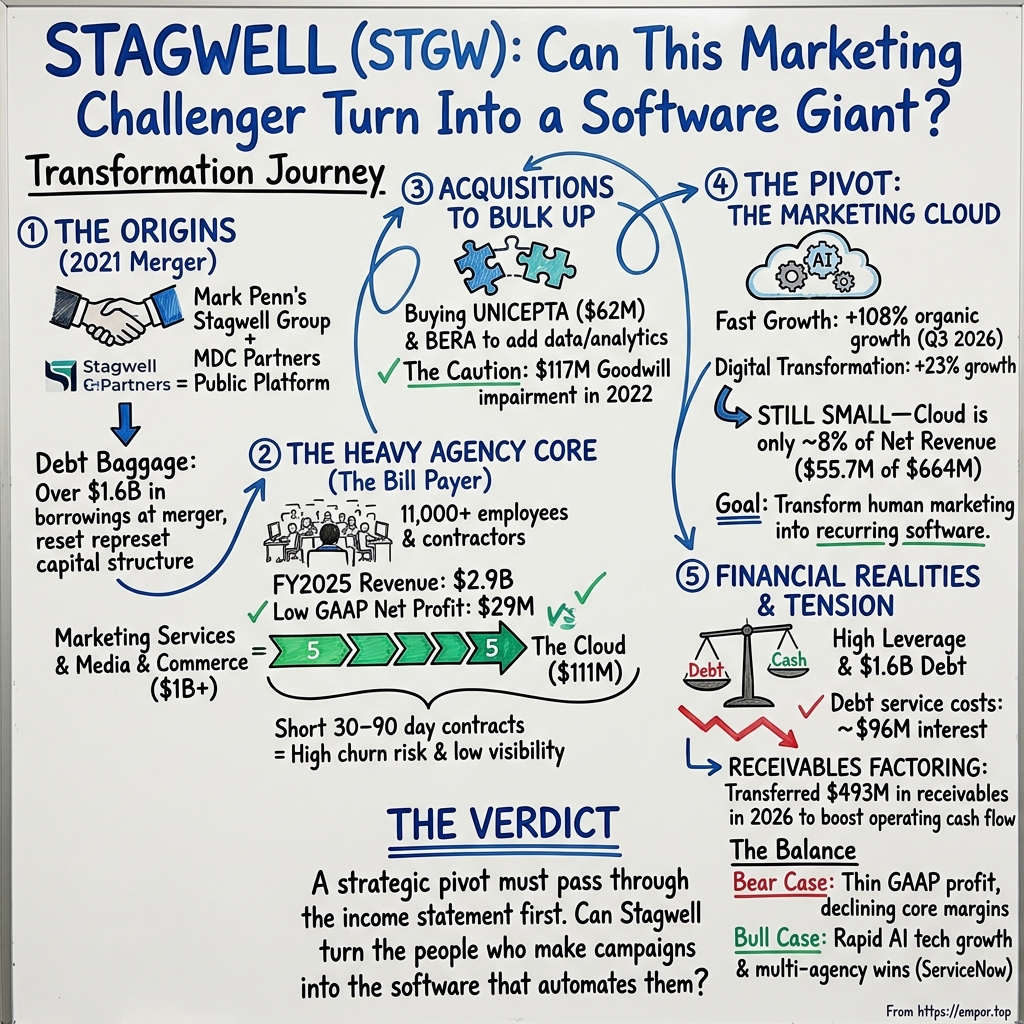
On the morning of October 29, 2026, Mark Penn got on Stagwell's third-quarter earnings call and described a company in the middle of changing species. For most of its life, the business he runs has been what Wall Street calls a marketing-services group: a federation of agencies that write campaigns, buy media, run public relations, build websites and survey consumers, all billed by the project or the hour. On that call, Penn talked about something else. He described Stagwell as pivoting toward what he called AI-powered marketing transformation, a business that sells clients software "Machines" and multi-year programs to rebuild how their marketing departments work, rather than only selling them the people who do the work.12
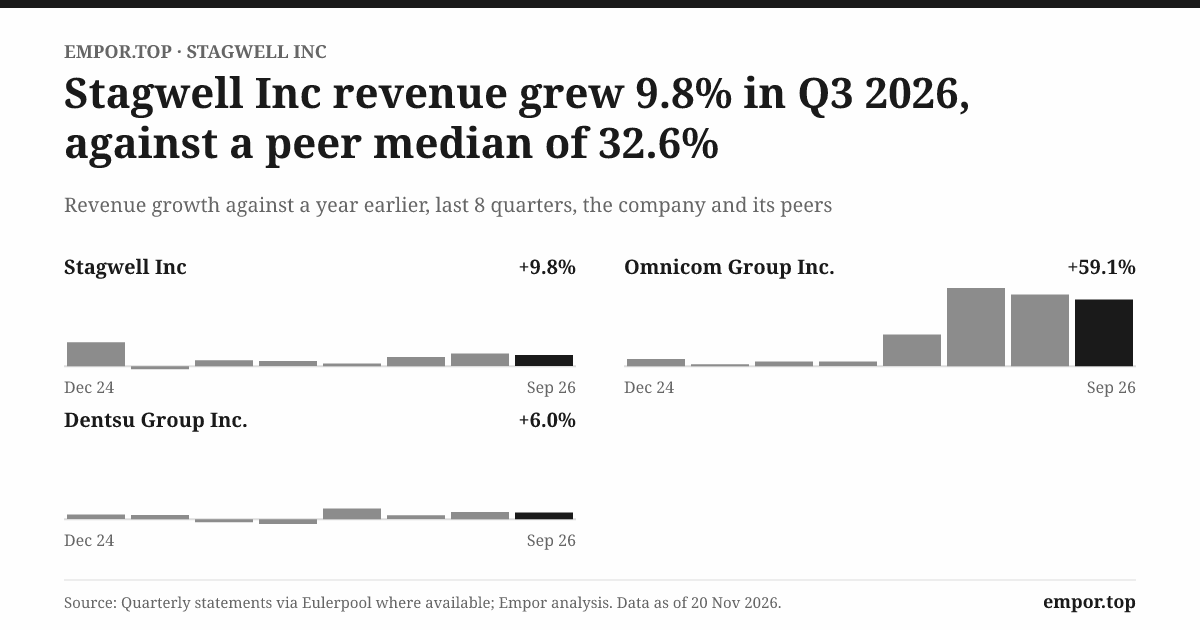
The numbers from that same morning told a more complicated story. Stagwell's total revenue for the quarter reached about $816 million, up almost 10% from a year earlier, a record for the company.1 Net revenue, the figure that strips out the media and vendor costs Stagwell passes through to clients, came to $664 million, and it grew 7.4% organically, meaning without help from acquisitions or currency.1 That is a respectable pace for an advertising business in 2026. Yet the line that measures what was left after paying for everyone and everything, GAAP operating income, fell to about $48 million from about $61 million in the same quarter of 2025, a drop of roughly a fifth.13 Add up the first nine months of the year and net income attributable to Stagwell's common shareholders was slightly below zero, a loss of around $3 million on more than $2.3 billion of revenue.3
So the company reported faster growth, a bolder strategy and lower profit, all in one release. That is the puzzle at the centre of this story. Is the AI and software pivot changing the economics of the listed company, or is it mainly changing the story told about it?
There is a reason the question matters more for Stagwell than for most companies that say the letters "AI" on a call. The business it is trying to leave behind is labor. At the end of 2025 Stagwell employed about 10,951 full-time staff and another 1,678 contractors and part-timers.4 Most of what those people sell is time and judgment, and most clients can walk away on a few months' notice. The business it says it is becoming is software, where the same product can be sold again and again without hiring another person for each sale. If that shift happens at meaningful scale, the margins, the predictability and the multiple investors are willing to pay could all change. If it does not, Stagwell stays what it has always been: a capable but subscale agency group with a lot of debt and a thin layer of profit.
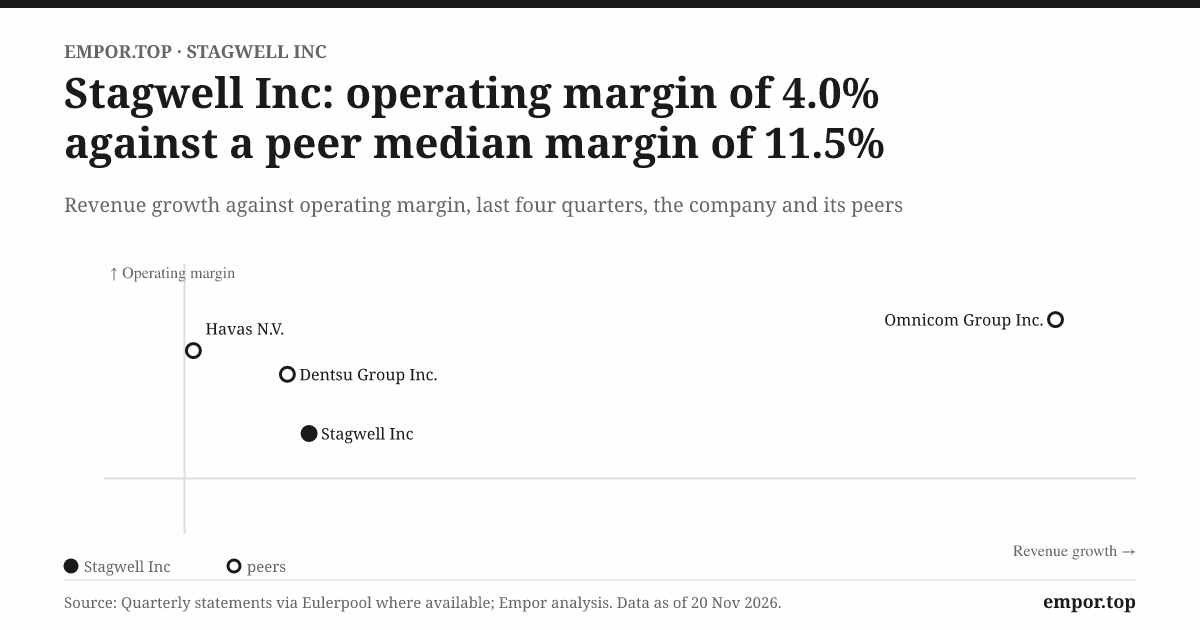
The scale makes that gap concrete. In 2025 Stagwell booked about $2.9 billion of revenue, which made it a serious company by any ordinary standard.4 Yet it kept only about $29 million of that as net profit, and its operating margin was about 5.5%.4 In other words, out of every $100 a client paid Stagwell, roughly $5.50 survived the payroll, the office leases, the vendor bills and the amortization of past acquisitions, and then interest and taxes took most of that. Net profit was about a penny on each dollar.
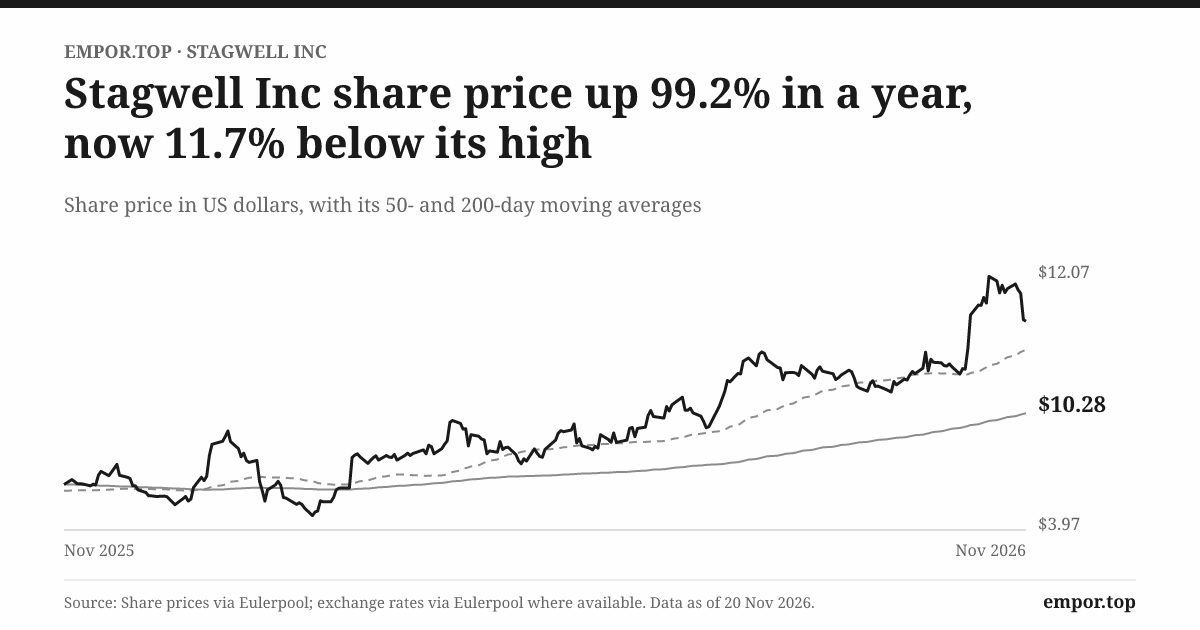
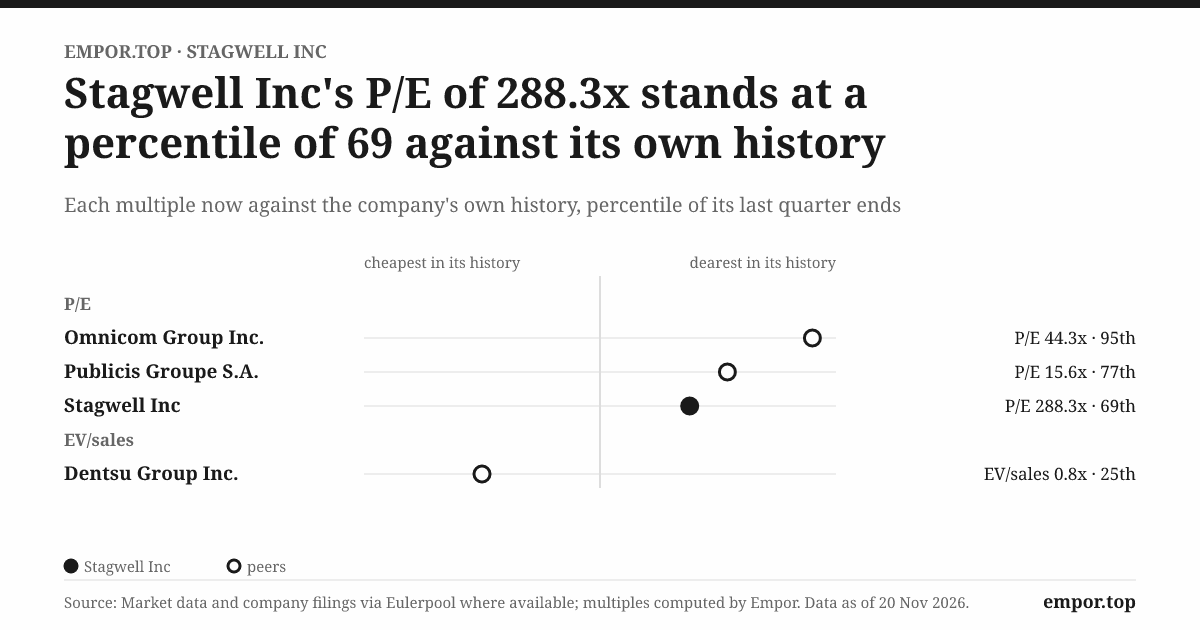
The stock market's view of that business is split down the middle, and the split is visible in the valuation. At a share price of about $10.28 on November 20, 2026, Stagwell was worth roughly $2.6 billion in equity and about $4.1 billion including its debt.4 Measured against sales, that is cheap: about 0.8 times revenue for the equity. Measured against EBITDA, the earnings before interest, tax, depreciation and amortization that agency companies like to quote, it is a fairly ordinary 11.8 times. Measured against trailing net earnings, it is absurd: 288 times, because Stagwell earned about three cents a share over the past twelve months.3 None of those multiples is wrong. They simply describe three different companies. One is a big revenue base, one is a cash-generating services operation, and one is a business whose shareholders have so far collected very little of what it produces.
The stakes, then, come down to two linked questions. Can Stagwell grow a higher-margin technology business inside a labor-intensive agency network, without the old business shrinking faster than the new one grows? And can it convert that growth into durable cash and lower debt, rather than into adjusted earnings figures that never quite reach the bottom line?
Before answering, it helps to be clear about what "Stagwell" actually is, because the name covers more history than it seems. The listed company, Stagwell Inc., was formed on August 2, 2021, when Penn's private Stagwell Marketing Group combined with MDC Partners, an agency holding company that had been public for decades.56 The accountants treated the deal as a reverse acquisition, which means the smaller private company was deemed to have bought the larger listed one. As a result, the financial history in Stagwell's filings before August 2021 belongs to the private Stagwell Marketing Group, while MDC's older public record sits in a different set of books.5 Long-run data series that stretch back to 2014 therefore splice together businesses that were not the same company. A ten-year revenue growth rate of about 8% a year sounds like a track record; it is really a stitched-together chart.
That boundary is where the story has to begin, with a political pollster who decided to build an agency empire, bought his way onto the public market, and inherited both the platform and the bills that came with it.
 Subscribe on LinkedIn
Penn's roll-up becomes a public company
Mark Penn did not come up through advertising. He came up through polling and politics. He built Penn Schoen Berland into one of the best-known opinion research firms in the United States, advised Bill Clinton during his presidency and served as chief strategist for Hillary Clinton's 2008 presidential campaign, and later spent years at Microsoft as an executive vice president and chief strategy officer.7 Those experiences shaped the way he talks about marketing to this day. To Penn, a brand is a candidate, a campaign is a contest for attention, and data about what people believe is the raw material of strategy. He is famous for numbers-heavy, fast-talking presentations, and for the conviction that the big advertising networks are too slow, too siloed and too invested in their legacy media relationships to serve modern clients well.
In 2015 Penn left Microsoft and set up The Stagwell Group, an investment platform for digital marketing businesses, with backing from investors including former Microsoft chief executive Steve Ballmer.8 Ballmer's connection is not a footnote to the story; a holding vehicle associated with him remains the largest named shareholder block in Stagwell's 2026 proxy, at about 116 million shares reported in an April 2025 filing.7 Stagwell Group's idea was simple to state and hard to execute: buy founder-led specialist firms in research, digital, communications and content, let them keep their identities, and wire them together so that a client could buy several disciplines at once without dealing with the bureaucracy of a giant holding company.
The obvious next step was scale, and scale was sitting in plain sight. MDC Partners, originally a Canadian company, owned a portfolio of well-known creative and media agencies, including names such as 72andSunny, Anomaly and Assembly, but it had spent much of the 2010s struggling with heavy debt, client losses and a series of governance controversies.8 In 2019, Stagwell invested in MDC and Penn became MDC's chief executive, which meant that the man running the private roll-up was also running the public company it would eventually swallow.58 That dual role is the most important fact about the deal that followed. Penn was on both sides of the table.
The merger agreement was announced in 2020 and closed on August 2, 2021.68 Its logic, as management presented it, was that combining the two portfolios would create a "challenger network" large enough to compete for multi-discipline clients, with a cleaner capital structure than MDC had been able to achieve alone. The new company issued equity to Stagwell Media, the vehicle that held Penn's private businesses, and entered into a new credit agreement.56 Refinancing MDC's expensive debt was pitched as a way to save roughly $20 million a year in interest.8
Yet the balance sheet that emerged from the deal tells you that "cleaner" did not mean "lighter." At the end of 2020, before the combination, the accounting predecessor reported borrowings of about $271 million.5 By the end of 2021 the combined company carried about $1.6 billion.5 Part of that jump is an accounting optical effect: the reverse acquisition meant MDC's existing debt arrived on the books as if it were new. But the economic reality was the same. Public shareholders of Stagwell Inc. now owned a business with more than a billion and a half dollars of borrowings, much of it later refinanced into a single bond, and that debt is still the frame around every capital-allocation decision the company makes in 2026.
The deal also had to survive its own shareholders. Because Penn ran MDC while his private company was acquiring it, the original terms attracted scrutiny. Indaba Capital, one of MDC's larger investors, publicly opposed the initial terms, arguing that they undervalued MDC relative to Stagwell's private assets, and the final agreement gave MDC shareholders a larger share of the combined company than first proposed.8 That episode is worth remembering not because it was unusual, since conflicted mergers often get renegotiated, but because it set a pattern that later sections will revisit: a company led by a founder-chairman with large ownership, whose transactions with his own affiliates require shareholders to trust that the board is protecting their side.
That merger distortion makes the reported five-year growth rate misleading: at about 27% a year, it reflects almost entirely the merger.5 Even the dividend line is distorted: the series shows roughly $233 million of dividends in 2021, which reflects distributions tied to the combination and the private predecessor, not a regular payout policy. Stagwell does not pay an ordinary dividend.5
What can be said cleanly is that the post-merger company has been through several distinct moods. It grew strongly in 2022, helped by a surge of political advertising and the digital boom. It then shrank in 2023, when technology clients cut marketing budgets and political spending ebbed, with revenue down about 6%.4 It recovered in 2024, with revenue up about 12%, again helped by an election year, and then grew only modestly in 2025.4 That pattern, alternating between election-year highs and off-year softness, is itself an important clue to how the business makes money, and it explains why management has been eager to talk about a steadier, software-driven growth line.
So what did the 2021 combination actually solve? It gave Penn a listed currency, a broader network and enough scale to pitch large clients. It also reset the capital structure so that interest costs, rather than impossible debt maturities, became the binding constraint. What it did not do was prove that the combined company creates more value than its parts. That proof can only come from post-merger organic growth and returns on capital, and five years on the evidence is mixed. Return on invested capital has hovered in low single digits since the deal, at about 3.5% in 2025, which is below any reasonable estimate of what the company's capital costs.4 A network can be more capable without yet being more valuable.
And the way Stagwell kept building that network after the merger, by continuing to buy specialist firms, is where the cost of growth starts to show up.
A network built by buying specialist agencies
In December 2024, a few weeks before the year closed, Stagwell bought a German company called UNICEPTA. It was not a household name, even inside the advertising industry. UNICEPTA monitors media coverage and analyses what is being said about a company across press, broadcast and social channels, the kind of service a corporate communications department uses every morning to see whether a crisis is brewing. Stagwell folded it into its Marketing Cloud group, the segment that holds its research, data and software products.49
The deal is a neat miniature of Stagwell's whole model. It was strategically coherent: a media-intelligence tool fits beside Stagwell's existing communications-software products and gives the company a bigger European footprint in a category where clients pay subscriptions rather than project fees. It was also modest in size. The disclosed purchase price was about $62 million, a mix of cash, Stagwell shares and contingent consideration, the earn-out payments that depend on how the business performs after closing.4 Of that price, about $33.3 million was recorded as goodwill assigned to the Marketing Cloud, meaning more than half the price was paid for something other than identifiable assets like software code and customer contracts.4
Goodwill is the accountant's word for the premium. When one company buys another for more than the fair value of its separately identifiable assets, the excess sits on the balance sheet as goodwill and stays there unless the business underperforms badly enough to force a write-down. It represents the buyer's belief that the whole is worth more than the parts, because of talent, client relationships, growth or synergies that cannot be itemised. In an agency roll-up, goodwill is the scoreboard. Each acquisition adds some, and each write-down is a confession that a past bet did not pay.
Here is the frustrating part for an outside investor. Stagwell disclosed UNICEPTA's price and its goodwill allocation, but not the target's revenue, margins or growth rate.4 Without those, there is no way to say whether $62 million was cheap or expensive. Media-monitoring software businesses have historically changed hands at several times revenue; agency businesses often trade at single-digit multiples of EBITDA. Depending on which category UNICEPTA most resembled and how much it earned, the same price could represent a smart purchase or a full one. The record establishes that the deal fitted the strategy. It does not establish that it was a good use of capital.
That distinction matters because Stagwell's network is built on deals like this. The company's operating model is to acquire agencies that are often still run by their founders, keep the brands intact, and then bind them together through shared selling, cross-referrals and a corporate layer that brings multi-agency teams to large clients. The theory is that a founder keeps an entrepreneurial culture under a Stagwell umbrella better than inside a sprawling network, while the parent supplies capital, back-office systems and access to bigger accounts. Contingent consideration is the glue. Founders are paid partly upfront and partly over time, according to performance, which aligns them with growth but also means Stagwell keeps writing cheques for acquisitions years after it announced them.
The strategic additions over the past two years point in one direction: toward data, analytics and creative technology. Alongside UNICEPTA, Stagwell bought BERA, a brand-analytics business that measures how consumers perceive brands over time and links those perceptions to commercial outcomes, which slotted into the same cloud segment.4 Left Field Labs, a creative-technology studio known for building digital products and experiences for large technology clients, strengthened the company's ability to sell the build-and-design work that sits between advertising and software.4 In 2026 the company added further capabilities through smaller acquisitions, including Wavelength and QStrauss.3 Read together, those deals describe a company trying to buy its way toward the parts of marketing that look more like software and consulting and less like buying TV spots.
But the most important acquisition fact in Stagwell's history is a write-down. In 2022, the company recorded goodwill impairment of about $116.7 million, spread across eight reporting units.4 A charge of that size, in a year when the company's reported net profit was about $19 million, effectively wiped out several years of the premium paid for those businesses. It is the clearest evidence in Stagwell's own record that buying capability does not guarantee earning a return on it. The charge has to be read in proportion. It covered a group of legacy units, largely in businesses that had lost clients or faced structural pressure, and it does not prove that each later deal is failing. Goodwill impairments are common in agency holding companies, and the large networks have taken far bigger ones. Still, it is a warning that the acquisition model works only if the parent can actually make acquired businesses grow faster together than they would have alone.
What has changed recently is the pace. On the fourth-quarter 2025 call in March 2026, management said it had deliberately slowed planned acquisitions during 2025 to prioritise spending on AI development, including the internal products it now markets as Stagwell Machines.10 The first nine months of 2026 show that shift in the arithmetic of growth. Of the increase in net revenue over that period, about $84.6 million came from organic growth, while net acquisitions added only about $10.5 million.3 In other words, almost all of 2026's growth came from businesses Stagwell already owned. That is the healthier kind of growth for shareholders, because it does not require new capital or new goodwill.
It also changes how to judge the acquisition strategy from here. For a decade, roll-ups in marketing services were valued on how much revenue they could add. The better test is what happens after the deal closes. Does an acquired analytics business start selling into Stagwell's large creative and media clients? Does it improve the share of revenue that recurs year after year? Does the combined margin rise? Stagwell's filings publish group-level organic growth and segment revenue, but they do not publish the post-acquisition revenue trajectory of individual targets, the rate at which acquired businesses win referrals, or returns on acquired capital.43 Without those, the honest verdict is that the strategy is coherent and the recent shift toward organic investment is sensible, but the claim that Stagwell buys well remains unproven, and the 2022 impairment narrows how much benefit of the doubt it deserves.
To see whether those acquired capabilities can earn more than they cost, one has to understand how the money flows through an agency in the first place, because the economics are stranger than the revenue line suggests.
The agency model's hidden arithmetic
Picture a campaign as it arrives at Stagwell. A beverage company wants to launch a new drink. The brief lands with a creative agency, which develops the idea, the tagline and the films. A media agency decides where the ads should run and buys the slots. A data team builds the audience segments and later measures whether the ads worked. A public-relations firm pitches stories and handles influencers. A digital studio builds the microsite and the app integration. Each of those teams bills for its work. Some of them also pass through the costs of outside vendors, such as production houses, influencers or media owners, adding a fee on top.
That flow explains a number that confuses many first-time readers of agency accounts: the difference between revenue and net revenue. When Stagwell acts as the principal in a transaction, controlling the work and taking responsibility for it, it records the full amount billed to the client as revenue, including costs it pays to third parties. When it merely arranges for a vendor to provide something, it records only its fee.4 Even under the principal treatment, a large share of the billing walks straight out the door to someone else. Net revenue subtracts those billable costs and shows what is left to fund Stagwell's own people and operations. In the third quarter of 2026, roughly $150 million of the reported top line was money passing through to vendors.1 Net revenue is the figure that matters for judging demand for Stagwell's own work. Total revenue is the figure that matters for working out cash and receivables, because Stagwell has to collect the whole bill.
Stagwell organises its businesses into five reportable segments, and the size ranking is the single most important fact about where its economics live today. In the first nine months of 2026, Marketing Services, which holds the creative, brand-building and performance-marketing agencies, generated about $673 million of net revenue.3 Media & Commerce, which plans and buys media and runs e-commerce and retail-media work, produced about $466 million.3 Communications, the public-relations, public-affairs and political advocacy businesses, produced about $333 million.3 Digital Transformation, the consultancies and studios that rebuild client websites, apps, data systems and marketing workflows, generated about $326 million.3 The Marketing Cloud, home to the software, research and data products, produced about $111 million.3
Put those numbers side by side and the story becomes visible. The segment Penn talks about most, the cloud, is the smallest by a wide margin. The segment that pays most of the bills, Marketing Services, is about six times its size. Communications, which swings with election cycles, is about three times its size. Stagwell's growth narrative lives in the two segments at the bottom of the list, but its present economics still live at the top.
The labor engine sits beneath all of it. Its people-heavy cost base and billable vendor costs are the company's two largest expense lines.4 An agency's margin is essentially the difference between what it can charge for a team's time and what that team costs, minus the overhead of offices, technology and management. When clients cut briefs, an agency cannot instantly cut people without losing the talent it will need when demand returns, so margins fall faster than revenue. When demand rises, the agency can initially stretch existing teams and margins expand. That leverage is why agency profitability swings more than agency sales.
The contracts reinforce the volatility. Stagwell's services are generally sold by engagement or project, with some subscription-based software and data-as-a-service products alongside them.4 Most contracts allow either side to end the relationship on 30 to 90 days' notice, and clients usually pay within 30 to 60 days of being invoiced.4 A three-month notice period is short. It means that a large share of next year's revenue is not contractually locked in today, and that clients have significant bargaining power at every renewal. It also explains why a quarter like the third quarter of 2026 can show strong growth in some segments and a sharp decline in others: when a big project ends and the replacement work starts later, revenue simply drops in the gap.
That is exactly what happened in Marketing Services in 2026. The company attributed the segment's decline partly to lower spending by beverage clients, partly to the timing of completed engagements transitioning to newly won work, and partly to large one-off projects in the prior year that did not recur.3 Stagwell did not name the beverage clients. The explanation is plausible and specific, but it also illustrates the core vulnerability. A services business whose largest segment can fall several percentage points in a quarter because a handful of clients shift budgets is not a business with locked-in revenue.
There is some comfort in diversification. No single client accounted for more than 4% of Stagwell's revenue in 2025, or more than 3% in 2024.4 That means no single defection can sink the company. But Stagwell does not disclose how much revenue its top five or top ten clients represent, how long its clients stay on average, or how much of each year's revenue comes from clients it also served the previous year. The large networks publish some of those indicators selectively; Stagwell publishes none consistently. For a company whose bull case rests on cross-selling and integrated client relationships, the absence of a retention metric is a meaningful gap in the evidence.
There is one other quiet flow worth noting, because it involves people close to the company. Stagwell reports related-party revenue, from a client whose founder had a significant interest in Stagwell and from affiliated entities, and that figure rose from about $6.3 million in 2025 to about $18.7 million in the first nine months of 2026, roughly 1% of revenue.437 It is not large enough to change the economics, and the company discloses it, but it is the kind of number a careful shareholder should watch, because it sits in the space between Penn's personal network and the public company's client list.
So the base business can be summarised in plain terms. Stagwell sells skilled people to large companies on short contracts, collects the cost of outside vendors along the way, earns a margin on the difference, and depends on clients' marketing budgets, which are among the first costs companies cut when they are nervous. That raises the question every agency has to answer. If the contracts are short and the delivery is people-heavy, what concrete advantage keeps clients choosing this network over the far larger ones?
The "challenger network" meets the giants
On November 26, 2025, Omnicom completed its acquisition of Interpublic Group, creating what it described as the world's leading marketing and sales company, with pro forma combined revenue of more than $25 billion.11 The deal took one of the "Big Six" advertising holding companies off the board and turned the industry's top tier into a smaller club of very large players: Omnicom, Publicis, WPP, Dentsu and Havas. For a company like Stagwell, which has spent years marketing itself as the scrappy alternative to these giants, the consolidation was both a threat and an opening. It created an even bigger rival. It also created a wave of disruption, client reviews and talent departures inside the combined Omnicom-IPG, which challengers can try to exploit.
The scale gap is not subtle. Stagwell's 2025 revenue of about $2.9 billion was roughly a ninth of the combined Omnicom.411 Publicis reported 2025 revenue of about $19.7 billion, and WPP about $17.9 billion.1213 Those comparisons are imperfect, because companies define revenue differently and report in different currencies, but the order of magnitude is clear: the leaders were six to nine times Stagwell's size. That matters most in media buying, where scale gives an agency leverage over media owners and access to proprietary data. COMvergence's annual ranking of media billings, which tracks how much advertising spend each agency group places on behalf of clients, has the large networks controlling the overwhelming majority of measured global billings, with Stagwell's media operations far down the table.14
So what can a challenger offer that the giants cannot? Stagwell's answer has three parts. The first is focus: its agencies are specialist firms that retain their names and cultures, rather than being merged into giant brands. The second is integration without bureaucracy: the parent assembles cross-discipline teams, drawing creative from one agency, data from another and communications from a third, and shares the economics through referral arrangements. The third is digital orientation: Stagwell argues that its portfolio is weighted toward the faster-growing parts of marketing, such as digital transformation, performance media and data, rather than legacy television buying.
There is real evidence of demand for that pitch. In 2025 the company won ServiceNow, the enterprise software company, in a mandate it described as the largest multi-agency deal in its history, spanning several of its businesses.10 On the third-quarter 2026 call, management cited about $586 million of trailing twelve-month net new business, a measure of the annualised value of new work won minus work lost.12 Those are not small figures for a company with roughly $2.6 billion of annual net revenue. They suggest that large clients are willing to hire Stagwell for complex work, and that the integrated pitch is landing at least some of the time.
But it is worth being precise about what those proof points establish. A win is not revenue; it is a promise of revenue over a period, contingent on the client actually spending the budgets it indicated, and cancellable on short notice. Net new business figures are management's own estimates of annualised value, not audited numbers, and they do not reveal how much existing work was lost at the same time. Stagwell does not publish win rates against named competitors, client retention rates or price realisation, the change in what it can charge for the same work. A $586 million new-business figure in a year when Marketing Services declined organically means some of the wins were being offset by losses or reductions elsewhere.
Run the industry through Michael Porter's five forces and the structure explains why proof is hard to come by. Buyer power is high: large clients routinely split their marketing across several agency groups, run periodic reviews and use procurement teams to negotiate fees down. Supplier power is moderate: the key suppliers are talent, which is mobile, and media owners like Google and Meta, which are so large they set terms for everyone. The threat of substitutes is rising: clients can build in-house agencies, use consultancies such as Accenture Song or Deloitte Digital, or work directly with technology platforms whose automated tools increasingly create and place ads themselves. The threat of new entrants is persistent, because a small agency can be started with a handful of talented people and a laptop. Rivalry among existing players is intense and getting more so, with Omnicom-IPG chasing $750 million a year of cost savings that will let it price aggressively.11
Hamilton Helmer's framework asks a sharper question: which of seven sources of durable power does Stagwell possess? Scale economies favour the giants, not Stagwell. Network effects, where each additional user makes a product more valuable to others, are not present in agency services. Switching costs are weak when contracts can be ended in 90 days, although they can be higher for embedded software and multi-year transformation programmes. Counter-positioning, the idea of a business model that incumbents cannot copy without damaging themselves, is Stagwell's most interesting claim: the giants have large legacy businesses built on media buying and traditional creative, and may be slower to sell AI tools that reduce the billable hours those businesses depend on. Brand power exists at the level of individual agencies but not at the holding-company level. No cornered resource, such as an exclusive dataset or technology, is evident. Process power, the embedded organisational know-how that is hard to copy, is possible but unproven.
The honest conclusion is that Stagwell has a differentiated pitch, not a proven moat. Its strongest claimed edge is coordination: the ability to assemble specialist teams faster and deliver measurable outcomes in areas such as digital transformation and data. The evidence that clients value that coordination is the new-business record and the ServiceNow win. The evidence that it is durable, such as retention, multi-year renewals and pricing, is not published. The company wins if clients keep finding that a smaller, integrated network gets complex projects done faster. It loses if clients learn to assemble the same specialists themselves, across several networks or in-house, at lower cost.
That is why the next part of the story, the software line that Penn talks about with such enthusiasm, matters so much. Software is the one thing that could turn a coordination advantage into a structural one.
The software line grows faster than the company
Go back to the third-quarter release and read the segment table, and one line jumps off the page. The Marketing Cloud's organic net revenue grew about 108% from a year earlier.1 Digital Transformation grew about 23%.1 In the same quarter, Marketing Services fell about 7.5% organically.1 Three segments, three completely different trajectories, inside one company. The new businesses were sprinting while the oldest and largest was shrinking.
It is easy to see why management leads with the cloud. A business that more than doubles in a year is the most exciting thing any agency group can show, and Penn has spent years arguing that the future of marketing belongs to companies that sell tools as well as talent. But the first discipline when looking at a fast-growing segment is to keep the denominator visible. In the third quarter, The Marketing Cloud generated about $55.7 million of net revenue, roughly 8% of the company's $664 million total.1 Over the first nine months it produced about $111 million, against about $673 million from Marketing Services.3 Triple-digit growth on that base adds roughly $30 million a quarter. It is a meaningful contribution to the company's acceleration, but it is not yet large enough to define the economics of a $2.9 billion business.
It also helps to separate what lives inside the cloud, because not every product has the same economics. One group consists of Stagwell's AI and enterprise tools, which the company has branded as Stagwell Machines: software agents and workflow systems that automate tasks such as producing content variations, planning media or analysing campaign results.2 A second group consists of research, data and media-monitoring products, such as UNICEPTA, BERA and the company's polling and survey businesses, which are often sold on subscription.4 A third group is not in the cloud at all, but in Digital Transformation: consulting and engineering teams that rebuild client marketing workflows, often using Stagwell's own software. Some of that work recurs, some of it is a large one-time project, and some is a services engagement dressed in software language. Investors who lump all of it together as "software revenue" will overestimate how predictable it is.
The positive evidence deserves its full weight. Management said on the third-quarter call that Stagwell had contracted about $59 million of enterprise technology products to date in 2026, more than twice its initial goal for the year, and it raised its target for 2027 enterprise technology bookings to $150 million.215 Analysts on the call asked about deal sizes, and management described typical transformation projects of $20 million to $40 million, in which a client buys a combination of software, data integration and services to rebuild how its marketing works.2 Management also said that The Marketing Cloud's margin profile is at least twice that of its services businesses.215 If that is true, every dollar that shifts from services into the cloud would raise group profitability substantially.
Here is where independent analysis has to slow down. Bookings are not revenue. A $30 million transformation contract may be recognised over two or three years, may include a large services component and may be cut back if the client's budget changes. "Contracted to date" figures are management's own count, defined by management, and they are not audited. Most importantly, the claim that cloud margins are at least twice services is not visible in Stagwell's reported segment profit data. The company does not publish a segment operating margin for The Marketing Cloud that would let an outsider confirm the claim. The 2025 annual report shows that Stagwell capitalised about $32.4 million of software development costs that year, including AI and process-automation investment, meaning those costs were recorded as assets and amortised over time rather than expensed immediately.4 Capitalisation is standard practice, but it means some of the cost of building the software does not hit operating profit in the year it is spent, which flatters near-term segment margins.
The historical record also counsels patience. Stagwell is not the first marketing company to launch proprietary software and predict that it would transform the business. Agency groups across the industry have repeatedly built data platforms and tools that ended up as cost centres or were folded back into services. Within Stagwell's own history, the 2022 goodwill impairment on legacy units is a reminder that acquired capabilities do not automatically compound. The company has run its Marketing Cloud as a separate segment for several years, and until 2026 its growth was modest. What changed this year is the acceleration, and acceleration over one or two quarters is not the same as a demonstrated business model. Product launches, impressive demonstrations and marquee pilot clients have to become renewed contracts, subscription revenue and segment profit before they can carry a valuation.
The right test, then, is commercial rather than technical. Does recognised cloud revenue keep growing over four and eight quarters, not just in one standout period? What share of it is recurring subscription revenue rather than one-time licence or implementation fees? How many customers use the products, and how many renew? Does the segment report operating profit and cash contribution that support the margin claim? Stagwell answers some of those questions in calls and presentations, but it publishes no recurring-revenue share, customer count or renewal rate for the cloud in its filings.43
There is a second-order risk that the enthusiasm can obscure. AI that makes marketing work cheaper to produce is a product Stagwell can sell. It is also a force that reduces the billable hours its services businesses depend on. If a client can produce a thousand versions of an advertisement with software instead of a team, Stagwell either sells the software and loses the team's fees, or loses both to a technology platform that offers the tool directly. The pivot is partly offence and partly defence. Penn's bet is that it is better to cannibalise the agency business with Stagwell's own tools than to let someone else do it.
So the claim survives, but in a narrower form. Stagwell's software and transformation lines are a real option with early revenue and fast growth, connected to how clients actually run their marketing. They are not yet a proven high-margin replacement for services. The confirming evidence would be several quarters of recognised cloud revenue growth, a disclosed recurring share and a segment margin that matches management's description. The falsifying evidence would be bookings that do not convert into revenue, or a growth rate that collapses once the comparison base gets harder.
Software growth, though, is only as good as the cash it eventually produces, and Stagwell's cash story has its own twist.
Cash arrives, but receivables leave the room
Imagine a client that owes Stagwell for a finished campaign. The invoice went out weeks ago; payment terms say 60 days. Stagwell could wait. Instead, it sells the right to collect that payment to a financial institution, receives most of the money immediately, and pays a fee for the privilege. The client still pays on its normal schedule, but the cash lands in Stagwell's account months earlier than it otherwise would. This is receivables factoring, and Stagwell uses it on a large scale.
The broad shape of Stagwell's cash generation is impressive at first glance. Across the twelve years from 2014 to 2025, the reported statements add up to about $1.5 billion of operating cash flow against only about $162 million of cumulative net profit.4 Cash from operations, in other words, was more than nine times reported earnings. In 2025 alone, operating cash flow was about $291 million while net profit was about $29 million.4 For a business that looks barely profitable on its income statement, that is a lot of cash.
Much of the gap has a legitimate explanation. In 2025 Stagwell recorded about $145 million of amortisation, mostly the gradual write-off of intangible assets such as client relationships and trade names bought in acquisitions, and about $48 million of stock-based compensation.4 Neither is a cash payment in the year it is expensed. Amortisation reflects money spent in the past, when the acquisitions were made, and stock compensation is paid in shares rather than cash. Add those two charges back and the distance between profit and cash narrows dramatically. That does not make them free. Acquisitions consumed real cash when they were made, and stock compensation dilutes shareholders or forces the company to buy back shares to offset it. But it does mean that reported net profit understates the cash the existing business throws off.
The receivables sales are the part that needs careful reading. In 2025 Stagwell transferred about $501 million of receivables under these arrangements, and in the first nine months of 2026 it transferred about $493 million, already almost matching the full prior year.43 The fees were about $5.6 million and $5.2 million respectively.43 Crucially, the proceeds are counted inside operating cash flow.4 That accounting is permitted and common, but it means that a portion of Stagwell's reported operating cash reflects a decision to collect earlier rather than a change in how much the business earns. If the company ever reduced its factoring, operating cash flow would fall in that period even if nothing about the underlying business changed.
The fees are modest relative to the volumes, about 1%, which suggests the facility is a cheap way to manage working capital rather than a sign of distress. Many agency groups use similar arrangements, because they routinely pay media owners and vendors before collecting from clients. The issue is not that factoring is dangerous. It is that a reader looking at Stagwell's cash conversion has to know which door the cash came through.
The receivable exposure itself is substantial. At the end of 2025, Stagwell carried about $154 million of unbilled receivables where it acted as principal, meaning work done but not yet invoiced, and about $165 million of client-billable vendor expenditures where it acted as agent, meaning costs it had paid on clients' behalf and still had to recover.4 Its allowance for doubtful accounts, the reserve against invoices it may not collect, nearly doubled from about $6.1 million to about $11.7 million during 2025.4 Debtor days, a measure of how many days of revenue are sitting in receivables, were about 113 in 2025, essentially unchanged from the prior year.4 That is a long collection cycle, consistent with large corporate clients that stretch payment terms, and it explains why Stagwell values the ability to sell receivables.
Stagwell does not disclose an ageing table showing how much of its receivables are overdue and by how long. Without one, an outsider cannot tell whether the higher reserve reflects a specific troubled client, a general tightening of standards or a rising tide of late payments. The doubling of the allowance is not alarming in absolute terms, since it remains small against hundreds of millions of receivables, but it moved in the wrong direction in a year when management was emphasising cash conversion.
Then there is the question of where the free cash went. Over the same twelve years, free cash flow added up to about $1.2 billion, operating cash minus capital spending.4 Dividends took about $233 million, almost all in 2021. Cash on the balance sheet at the end of 2025, about $105 million, was barely different from where it stood at the end of 2013.4 The rest went to acquisitions, earn-out payments, debt service, share repurchases and distributions tied to the corporate restructuring. That is not inherently bad; a company that reinvests its cash in growth should not accumulate a pile of it. But it does mean that the strong cash figures have not yet translated into a visibly stronger balance sheet, and debt remained around $1.6 billion at the end of 2025.4
Management's stated target is to convert 50% to 60% of adjusted EBITDA into free cash flow.215 On the third-quarter call, it attributed improving 2026 cash flow to operating gains, working-capital discipline and software sales.15 Those are plausible drivers. The independent test is simpler: separate the receivables-sale proceeds, watch whether free cash flow still grows, and track whether the reserve and debtor days stabilise. If cash keeps rising while factoring volumes are steady and reserves stop climbing, the business is generating it. If cash depends on ever-larger receivables sales, the conversion is being flattered.
What Stagwell does with that cash is ultimately a question about the man at the top, and how he has chosen to divide it among debt, buybacks and acquisitions.
Penn's incentives, buybacks and the debt bill
In 2026 Stagwell's board raised the company's share repurchase authorisation to $725 million, available through March 2029.3 For a company with a market value of about $2.6 billion, that is a big number, more than a quarter of the equity. It sent a message: management believed the shares were cheap. It also raised a question that sits at the heart of capital allocation at Stagwell. Should a company with about $1.6 billion of debt and net interest expense of about $96 million a year be buying back stock at all?4
To answer that, start with who is making the decision. Mark Penn remains chairman and chief executive. Ryan Greene serves as chief financial officer, having taken over from Frank Lanuto, who moved to an executive vice president role in finance, and Jay Leveton is president.7 The board determined that every director other than Penn is independent under Nasdaq rules, and Irwin Simon serves as lead independent director.7 That is a standard structure, but combining the chair and CEO roles in the founder means the lead director carries much of the weight of oversight.
Penn's ownership is the strongest alignment argument. As of April 2026, he held about 22.6 million shares directly, roughly 9.1% of the company, and shared voting and investment power over another 2.0 million shares through The Stagwell Group.7 When the share price falls, Penn loses more than any salary could compensate. That stake matters more than his pay, which was about $7.22 million in total for 2025, including a base salary of about $1.26 million.7 Compared with chief executives at the large networks, that is modest; compared with Stagwell's $29 million of 2025 net profit, it is about a quarter of what shareholders earned.
The incentive design deserves closer scrutiny than the headline pay figure. Stagwell's long-term incentive plan grants performance shares that vest according to whether the company hits multi-year targets. The 2023–2025 performance target was not met, yet the compensation committee used its discretion to vest 91% of the target shares in March 2026.7 The 2022–2024 target was also missed, and the committee vested 82% by discretion.7 Twice in a row, then, executives received most of their performance pay despite missing the performance conditions. The committee gave reasons tied to the company's strategic progress and external conditions, but the pattern undermines the purpose of having targets at all. If missing a target costs executives only about a tenth to a fifth of their reward, the target is closer to a suggestion than a hurdle.
Shareholders did not revolt. At the June 2026 annual meeting, about 213.5 million votes supported the say-on-pay resolution and about 3.8 million opposed it.16 That is overwhelming approval, but it has to be read alongside the ownership structure: Penn, the Ballmer-linked vehicle and other large holders together control a significant share of the votes. Broad support confirms that the major holders are comfortable with the arrangement; it does not prove that the arrangement rewards performance.
The capital structure itself went through an important simplification in 2025. On April 4, 2025, Stagwell Media exchanged about 151.6 million paired Class C shares and operating-company units for newly issued Class A shares.4 Before the exchange, Stagwell had an awkward structure in which the private holding vehicle owned its economic interest partly through units in the operating company, a legacy of the 2021 merger. After the exchange, everyone held the same class of shares. That made the company easier to understand and value. In March 2026 the company repurchased about 6.2 million shares from executives and employees at about $6.17 each to help them cover taxes related to that exchange.3 On the third-quarter call, management said it had repurchased about 12.1 million shares in 2026 at an average price of about $6.23.215 With the stock now above $10, those purchases look well timed in hindsight.
But buybacks have to be stress-tested against the balance sheet. At the end of September 2026, management reported net leverage, net debt divided by adjusted EBITDA, of about 2.73 times, with about $324 million drawn on its revolving credit facility and about $410 million still available.15 The company's main debt is $1.1 billion of 5.625% notes maturing in 2029.4 The revolver was expanded to $750 million and extended to 2030, and the company reported compliance with its covenants.4 That leaves no near-term refinancing cliff, but it does leave a large bond maturity less than three years away in an environment where refinancing at a similar rate is not guaranteed. Interest of nearly $100 million a year consumes a large share of operating profit, which in 2025 was about $159 million.4 Put differently, more than half of what Stagwell earned from operations in 2025 went to its lenders before shareholders saw anything.
On the fourth-quarter 2025 call, management laid out its priorities: slowing acquisitions to fund AI development, delivering cost savings, reducing leverage and improving cash conversion.10 On the third-quarter 2026 call, it said it was on track to exit 2026 with leverage in the mid-two times range.15 The direction is consistent across the calls, and leverage has fallen from about 3.42 times a year earlier.15 What is harder to reconcile is buying back stock aggressively while carrying a revolver balance of more than $300 million. Every dollar spent on shares at 2026 prices was a dollar not spent repaying debt. If the shares really were undervalued, that trade may prove wise. If the business stumbles, it will look like financial engineering at the wrong moment.
The credibility verdict stays conditional. Penn's large ownership, the simplified share structure, reported covenant compliance and a falling leverage ratio are genuine positives. The discretionary vesting after missed targets, the competition between buybacks and debt reduction, and the limited disclosure of returns on acquisitions are genuine reasons for continued scrutiny. The test is whether stated goals keep turning into delivered results, especially the mid-two-times leverage target at year-end.
That leaves the question everyone in the market is really trying to answer: what is all of this worth, and what does the current price assume?
Analysis & Bear vs. Bull Case
Stagwell's share price tells its own story about the year. On November 20, 2026, the stock closed roughly 12% below its 52-week high of $11.64 and more than double its 52-week low of $4.40.4 Anyone who bought at the bottom has more than doubled their money; anyone who bought near the top is underwater. The stock's volatility over the past year was about 52%, extraordinarily high for an agency holding company, and its largest fall over five years was about 57%. This is not a sleepy services stock. The market has been arguing about what Stagwell is.
The most eye-catching number is the price-to-earnings ratio of about 288 times, against Stagwell's own five-year median of about 112 times.3 On the surface that suggests a wildly expensive stock. In reality, it is a broken measure: trailing earnings are too small for P/E to be useful.3 The more useful multiples are EV/EBITDA of about 11.8 times and EV/sales of about 1.3 times.4 On those measures Stagwell sits within the broad range of the large listed networks. A third-quarter 2026 comparison of marketing-services peers put WPP, Dentsu, Omnicom and Publicis at roughly 0.7 to 1.5 times EV to revenue and about 4.8 to 15.6 times EV to EBITDA.17 The comparison is imperfect, because the peers use different accounting and measurement dates, but it suggests the market is not paying a huge software premium for Stagwell. It is paying something close to an agency multiple, perhaps with a modest option on the transformation.
The free-cash-flow yield of about 13.6% tells the opposite story from the P/E. On that measure, the stock looks cheap. The gap between a 0.3% earnings yield and a 13.6% free-cash-flow yield is the gap between amortisation-heavy profit and factoring-assisted cash, expressed as a valuation. Whichever measure an investor trusts more largely determines whether Stagwell looks expensive or cheap.
The bull case builds on genuine momentum. Organic net revenue growth accelerated to 7.4% in the third quarter, faster than the large networks reported in the same period.1 Digital Transformation and The Marketing Cloud are growing rapidly, and the cloud's acceleration, if sustained, would raise the share of revenue that recurs. Large wins such as ServiceNow and the reported net new business suggest that the integrated pitch resonates with big clients. Management raised its 2026 adjusted EBITDA and EPS guidance, and the nine-month adjusted EBITDA margin rose to about 18.3% of net revenue from about 16.5% a year earlier.118 Leverage is falling, the revolver has capacity and the bond does not mature until 2029, which gives the company time to execute. The consolidation of Omnicom and IPG may push clients that dislike the disruption toward challengers. And political advertising, through Stagwell's communications businesses and new ventures such as SixAM Strategies, a bipartisan public-affairs firm launched in November 2025, should benefit from the 2026 midterm cycle and the 2028 presidential race.19
The bear case rests on what the income statement and balance sheet actually show. The cloud remains small, and Marketing Services, the largest segment, declined organically in the third quarter. GAAP operating income fell year over year in both the quarter and the first nine months; over nine months, it fell from about $102 million to about $69 million.3 The adjusted-to-GAAP gap is large and recurring: in the first nine months of 2026, stock compensation was about $62 million, amortisation about $120 million and deferred acquisition consideration about $27 million.3 Those are not one-off items; they recur every year in an acquisitive, equity-paying company. Interest consumes more than half of operating profit. Cash flow depends partly on receivables sales, and the doubtful-account allowance has risen. Incentive pay vests even when targets are missed. And the moat, measured against the giants, is a pitch rather than a structural advantage.
The risk radar comes down to mechanisms rather than headlines. If corporate clients cut marketing budgets in a downturn, short contracts mean revenue can fall within a quarter, and because costs are mostly people, profits fall faster. AI can create products for Stagwell to sell, but it can also reduce the billable labour its services rely on, and technology platforms such as Google and Meta are building automated creative and media tools that bypass agencies entirely. Political work is cyclical, so off-cycle years will show softer communications revenue. Data privacy and cybersecurity matter more as Stagwell sells analytics products that handle client and consumer data; a breach would damage both reputation and the software pitch. And leverage magnifies any miss: a business with 2.7 times net leverage and $96 million of annual interest has limited room for a sustained revenue decline.
The moat remains plausible rather than proven.
Three measures will tell investors most of what they need to know. The first is organic net revenue growth by segment, and specifically whether The Marketing Cloud and Digital Transformation keep growing while Marketing Services stabilises; in the third quarter, the readings were about 108%, 23% and negative 7.5% respectively.1 The second is GAAP operating income, after stock compensation, amortisation and deferred acquisition consideration; over the first nine months of 2026, it fell by about a third year over year.3 The third is free cash flow after separating receivables-sale proceeds, alongside net leverage, which stood at about 2.73 times in the third quarter and was falling.15
The valuation settles on proof. If recognised cloud revenue keeps growing for several quarters and GAAP margins expand, the earnings base will rise and today's multiples will look modest. If bookings fail to convert into renewed revenue and cash, the market's willingness to pay for the transformation story could fade quickly, and a stock that has already doubled from its low could give back much of that gain.
Business & Investing Lessons
Somewhere inside Stagwell this month, a sales team is pitching a $30 million transformation programme to a large corporate client, while a software team down the hall is trying to make a product that clients renew every year without a pitch at all. Those two activities, the big bespoke sale and the quiet repeatable subscription, are the whole of the company's wager in one image. The lessons from this story are about what it takes to turn the first into the second.
The first lesson comes from the 2021 merger. A platform is only as valuable as the businesses it can make work together. Penn assembled a large network by combining his private roll-up with MDC's listed portfolio, and the deal gave him scale and a public currency. But that integration is still measured mainly by management's own figures. The wider lesson for founders is that a holding company only earns its corporate overhead if the sum demonstrably beats the parts. For investors, the test is retention and cross-selling data, not the number of agency logos on a slide.
The second lesson comes from the 2022 impairment. Buying capability is easy; earning back goodwill is the work. Stagwell wrote off more than $100 million of goodwill on legacy units, and it still does not publish target-level returns on later deals. Any acquisitive company can tell a coherent strategic story about each purchase. The proof is whether the acquired business grows faster under new ownership than it would have alone, and whether the company is willing to show that evidence.
The third lesson comes from the cloud. A triple-digit growth rate can still be a small line. The Marketing Cloud more than doubled in the third quarter, but remained a fraction of the company's net revenue. Growth rates are seductive because they compress the future into a single number. Investors should always ask what the growth is a percentage of, and how many quarters of compounding would be needed before the new business changes the economics of the old one.
The fourth lesson comes from the receivables. Cash is evidence, but know which door it came through. Stagwell's operating cash flow has been far stronger than its reported profits, partly because it sells receivables. Much of the gap is legitimate. Cash that arrives because the business earns it and cash that arrives because the company chose to collect early look identical on a cash-flow statement. They are not identical in what they say about the future.
The standard of proof for Stagwell's pivot is therefore simple to state. The transformation becomes real when recurring recognised revenue, GAAP profit and cash returns advance together. Any one of them alone can be produced by accounting choices, timing or a single big contract. All three together are much harder to fake.
Epilogue
Stagwell enters the final weeks of 2026 with growth accelerating but GAAP operating income falling and leverage still at about 2.73 times.1315 Management has raised its full-year guidance.1 The next full-year report, expected in early 2027, will show whether the fourth quarter, traditionally the strongest of the year and boosted this time by midterm political spending, closes that gap.
Several moments over the coming quarters will decide which version of Stagwell the market is looking at. The first is whether The Marketing Cloud's recognised revenue keeps pace with its bookings, including management's 2027 target.15 If cloud revenue grows steadily into that target and the company begins disclosing renewal or recurring-revenue data, the software claim moves from option to evidence. If bookings rise while recognised revenue stalls, it suggests the contracts are slower, smaller or more services-heavy than advertised.
The second moment is whether Marketing Services stabilises after its 2026 decline.3 A return to growth would support the claim that the decline was temporary. Continued decline would suggest that the largest part of the business is losing ground to in-house teams, consultancies or AI tools faster than the new businesses can replace it.
The third is year-end leverage and free-cash-flow conversion against management's stated targets.152 Hitting those targets while continuing to buy back shares would show the capital-allocation framework can serve both lenders and shareholders. Missing them, especially with the 2029 bonds approaching, would sharpen every concern about buybacks and debt.
The fourth, and the most important, is GAAP operating profit. If recurring costs such as stock compensation, amortisation and deferred acquisition payments begin to shrink as a share of revenue, adjusted gains will finally reach shareholders. If they do not, the gap between the story management tells and the profits shareholders receive will persist.
Those outcomes will answer the question this story began with. Stagwell will either prove itself a software-enabled challenger whose economics are genuinely changing, or remain a services network with a compelling but still emerging option attached. Tonight, the evidence supports the second description, with the first one visibly under construction.
Outro
Go back to that October morning on the third-quarter call. Mark Penn was describing a company becoming something new, while thousands of people across its agencies were doing what agencies have always done. That contrast is not a contradiction. It is the plan: turn agency expertise into tools and workflows that can be sold again and again.
Stagwell's story is the attempt to make the agency network its route into software, and to prove that route leads to better economics. It is trying to turn the people who make the campaign into software that makes the next one easier.
References
-
Stagwell Inc. Q3 2026 earnings release — SEC, 2026-10-29 ↩↩↩↩↩↩↩↩↩↩↩↩↩↩↩
-
Stagwell (STGW) Q3 2026 earnings call transcript — The Motley Fool, 2026-10-31 ↩↩↩↩↩↩↩↩↩
-
Stagwell Inc. Form 10-Q for Q3 2026 — SEC, 2026-10-29 ↩↩↩↩↩↩↩↩↩↩↩↩↩↩↩↩↩↩↩↩↩↩↩↩↩↩
-
Stagwell Inc. Form 10-K for 2025 — SEC, 2026-03-13 ↩↩↩↩↩↩↩↩↩↩↩↩↩↩↩↩↩↩↩↩↩↩↩↩↩↩↩↩↩↩↩↩↩↩↩↩↩↩↩↩↩↩↩↩
-
Stagwell Inc. 2021 Form 10-K, merger accounting and entity history — SEC, 2022-03-16 ↩↩↩↩↩↩↩↩
-
Stagwell and MDC Partners merger closing Form 8-K — SEC, 2021-08-02 ↩↩↩
-
Stagwell Inc. 2026 proxy statement — SEC, 2026-04-28 ↩↩↩↩↩↩↩↩↩
-
Stagwell closes deal to combine with MDC Partners — Axios, 2021-08-02 ↩↩↩↩↩↩
-
Stagwell Q4 2024 earnings call transcript — Stagwell, 2025-02-27 ↩
-
Stagwell Q4 and FY2025 earnings call transcript — Stagwell, 2026-03-10 ↩↩↩
-
Omnicom completes acquisition of Interpublic — Omnicom, 2025-11-26 ↩↩↩
-
COMvergence 2025 Global Billings and Market Share Report — COMvergence, 2026-06-19 ↩
-
Earnings call transcript: Stagwell tops Q3 EPS forecast — Investing.com, 2026-10-29 ↩↩↩↩↩↩↩↩↩↩↩↩
-
2026 annual meeting voting results, Form 8-K — SEC, 2026-06-12 ↩
-
Clearsight Digital, AI, and Cloud Update Q3 2026 — Clearsight, 2026-10 ↩
-
Exclusive: Stagwell launches new bipartisan public affairs firm — Axios, 2025-11-13 ↩
 LinkedIn
 WhatsApp
 Reddit
 Hacker News
 Email
 Kindle
 RSS Feed
 Spotify
 Apple Podcasts
 Amazon Music
 Audible
 YouTube