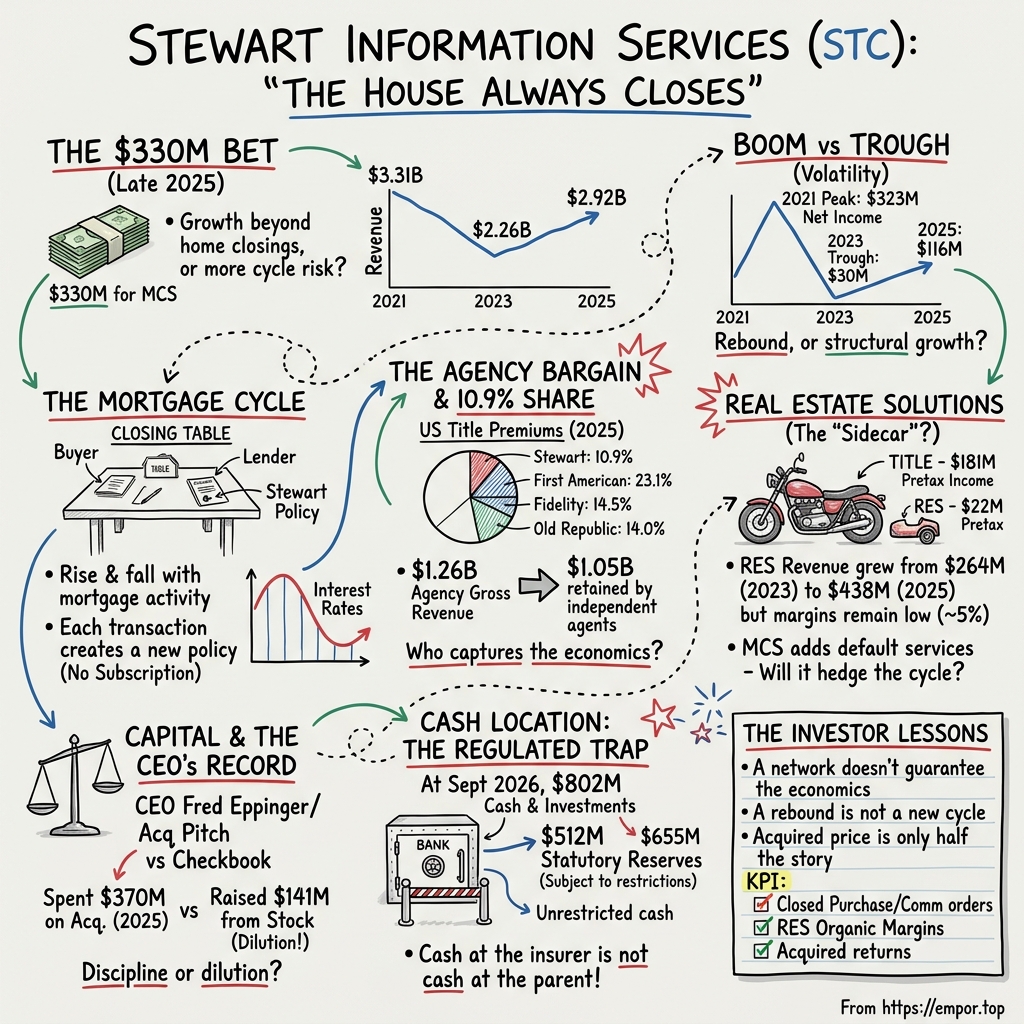
Stewart Information Services: The House Always Closes
I. The $330 Million Bet on a Housing Downturn
On November 7, 2025, a short press release went out from Houston. It did not read like a turning point. A wholly owned Stewart subsidiary called SISCO Holdings had agreed to buy Mortgage Contracting Services, a property preservation provider whose operations and technology help mortgage servicers and lenders look after the houses that secure their loans, the unglamorous field work that becomes urgent when a borrower falls behind or walks away.1 The price was $330 million, to be paid from "available company resources," and Stewart said it expected the deal to be "immediately accretive."1
The release was written in the usual flat language of corporate deals, but the sum stood out. Stewart Information Services sells title insurance, the policy that guarantees a buyer owns what they paid for. For most of its history it had made small purchases: a local title agency here, an appraisal manager there. In 2025 it spent about $370 million on acquisitions in total, and MCS made up most of that.2 The purchase closed in December 2025, and MCS kept operating as a standalone company inside Stewart's real estate solutions segment.21
The timing also stood out. That same year Stewart had sold 2.185 million new shares to the public, raising about $141 million after costs.2 So a company that had just asked shareholders for fresh equity was making the largest bet in its modern history, while the housing market it depends on was still well short of recovered.
The numbers explain the tension. In 2021, when refinancing was frantic and house prices were climbing every week, Stewart's revenue peaked at about $3.31 billion.3 Two years later, after mortgage rates had more than doubled, revenue had fallen to about $2.26 billion, a decline of nearly a third.2 By 2025 it had climbed back to about $2.92 billion.2 That was a real recovery, but it still left Stewart about $400 million of annual revenue below the boom.
Buying MCS was a way of answering a question that has followed Stewart for decades: can a company whose cash register opens only when a property changes hands build something that keeps earning when the closings stop? Property preservation is at least a plausible candidate. When mortgage delinquencies rise, servicers need more field work, not less. In principle, a business like MCS could get busier exactly when the title business gets quieter.
That is the bull case in one sentence, and the public record cannot yet confirm it. Stewart disclosed the $330 million price, but it did not disclose what MCS earned, so an outsider cannot calculate the multiple of earnings Stewart paid.14 "Immediately accretive" means only that the deal was expected to add to earnings per share. That is a low bar when the money comes from cash that was earning a few percent in a bond portfolio. The test that matters is whether the acquired business earns more than its cost of capital over a cycle.
The first full results with MCS inside showed both sides of that test. In the third quarter of 2026, revenue in Stewart's real estate solutions segment jumped 68% to about $197 million, but only about 7% of that growth came from businesses Stewart already owned. Most of the rest came from MCS and ProTitle, another acquisition.56 In the same quarter, Stewart's overall net income fell to about $30 million from $44 million a year earlier, even though total revenue rose 13%.5 Revenue was rising while profit fell, and that combination is the puzzle at the center of this story.
So the MCS deal is more than a footnote about a field-services company. It tests the whole strategy Stewart has pursued since the late 2010s, when an attempted sale of the company collapsed and new leadership promised to build it as an independent business. This story follows that test through three questions. How durable is Stewart's position in title insurance, a concentrated industry in which independent agents still own much of the customer relationship? What drove the recovery from 2023, and does it look like a new phase of growth or the ordinary rebound of a cyclical business? And can the acquisitions, MCS above all, earn their cost?
Answering any of those questions starts at the table where Stewart actually makes its money, which is the closing table.
 Subscribe on LinkedIn
II. An Old Business That Moves With the Mortgage Rate
Picture a closing. A buyer signs her name dozens of times. A lender's wire is waiting. The seller wants the proceeds, and the real estate agents want their commissions. Before any of that money moves, someone has to answer one plain question: does the seller actually own this house, free and clear?
The answer is in public records: deeds, mortgages, liens, court judgments, easements and probate files, some dating back decades. A title company searches them, finds the problems and fixes the ones it can. An old mortgage may never have been formally released, or a contractor may have filed a lien. Then an underwriter like Stewart issues a policy that promises to pay if a defect it did not catch later damages the owner or the lender.2
Stewart has been doing this work for well over a century, from its Texas roots to title commitments across the United States and in Canada and the United Kingdom, where its Canadian-dollar and pound-sterling businesses operate in local currency.2 The age of the franchise matters less as heritage than as a sign of what the job requires. The service a nineteenth-century Texas title clerk provided is, in substance, the same one Stewart provides today. The tools have moved from ledger books to databases, and a growing share of the work runs on software. The obligation is the same: certify the past so that the present transaction can go ahead.
That obligation gives the business its odd economics. Unlike car or home insurance, a title policy is generally paid for once, at closing, with a single premium. There is no annual renewal and no monthly bill. Stewart recognizes title premiums and settlement fees principally when the transaction closes. The premium varies with the transaction and the value of the property, and escrow fees are booked at closing as well.2
So Stewart's revenue is roughly the number of closings multiplied by the value of each closing. When a lot of houses change hands at high prices, revenue surges. When buyers stay home, revenue falls, and no contract cushions the decline. Stewart does not disclose a recurring share of consolidated revenue, contract lengths or minimum commitments, because for the core title product those ideas mostly do not apply.2
Mortgage rates are the main driver. Two kinds of transaction feed the title business. A purchase is a home sale: a new owner and a new owner's policy, usually with a lender's policy as well. A refinance is an existing owner replacing an old mortgage with a new one, and the new lender wants its own policy. Purchases follow the slower rhythms of jobs, household formation and housing supply. Refinances follow rates almost mechanically. When rates drop, millions of homeowners rush to refinance. When rates rise, refinancing nearly stops.
Stewart names mortgage rates and housing activity as the main drivers of its results, and its most recent quarterly filing still ties production and premiums to rates, housing activity and refinance volume.27 The order data from the third quarter of 2026 show how sensitive that is. Opened refinance orders fell about 19% from a year earlier and opened purchase orders fell about 4%, while 30-year mortgage rates moved back toward 7.5% in October.56
The long-run revenue record tells the same story. In 2013 Stewart's revenue was about $1.93 billion. Five years later, in 2018, it was about $1.91 billion.8 Across five years of a growing American economy, the company barely grew at all. Then came the pandemic, record-low rates and a refinancing frenzy, and revenue jumped to about $3.31 billion in 2021.83 Two years later it was back at about $2.26 billion.2
That record is not what a secular compounder looks like. A business with a lasting edge in a growing market would show steadily rising revenue with occasional dips. Stewart shows a long flat stretch, a spike and then a collapse. Its longevity and recognizable brand did not turn transaction-based premiums into recurring revenue. The cycle is not something happening to the business. It is part of what the business is.
There is a further complication that sets up everything that follows. Title insurance protects against defects that already exist when the policy is written. It looks backward. A policy written in 2021 can still produce a claim in 2031, but it will not produce another premium. Each new transaction requires a new policy. Stewart therefore has to win the next closing again and again, often through intermediaries who choose the underwriter.
That raises the question of whether Stewart actually owns the customer. The answer depends on the four groups that sit around the closing table.
III. The Four Groups Behind the Closing Table
Follow one home sale from start to finish. A buyer in suburban Dallas, or rural Pennsylvania, or Phoenix, signs a purchase contract. Her real estate agent, or her lender, or sometimes the builder, steers the file to a local title agency. Most buyers never choose a title insurer; they barely know there is a choice to make. The local agency opens the order, searches the county records, clears the defects and runs escrow. Then it issues a policy on paper belonging to one of the underwriters it has contracts with, and it sends that underwriter a slice of the premium.
That underwriter might be Stewart. It might also be First American, one of the companies owned by Fidelity National Financial, Old Republic or a smaller regional insurer. The agency picks.
This is the basic structure of American title insurance. Stewart operates through two channels. In the direct channel, its own offices do the search, the escrow and the closing, so Stewart keeps the whole fee. In the agency channel, independent agents do most of the work and keep most of the money. In 2025 Stewart's agency business generated about $1.26 billion of gross revenue, and about $1.05 billion of that went back to the agents as retention.2 Put simply, Stewart handed roughly five-sixths of every agency dollar back to the agent. The share Stewart keeps, which the industry calls the remittance rate, has historically been in the high teens. In the fourth quarter of 2022 it averaged 17.6%, down from 18.0% a year earlier.9
The two channels behaved differently in the latest quarter, which shows why the mix matters. On the Q3 2026 call, Eppinger said residential volume in Stewart's direct operations fell about 3% and direct refinance about 7%, while its "Main Street" commercial business grew 11% and its centralized title operations, which include the acquired ProTitle and DocSolutionUSA businesses, grew about 20%.6 Over the same period agency net revenue rose about 11%, with agency commercial premiums up about 25%.6 So the agency channel, where Stewart keeps the smallest slice, was growing faster than the direct offices, where it keeps the most. Agency growth adds volume and market presence, but each additional dollar of agency premium brings far less profit than a dollar of direct premium.
None of this is a scandal. It is the bargain that gives an underwriter national reach without having to staff an office in every county. The agent has the local relationships, the realtor referrals and the knowledge of the courthouse. The underwriter has the insurance license, the capital to back the policy, the claims department and the actuarial models. In the agency channel the underwriter's job is closer to wholesale insurer than retailer, and wholesale economics are thinner.
Four groups, and a merger the government stopped
The market those agents sell into is very concentrated. In 2025 First American's underwriters wrote about 23.1% of U.S. title premiums, Fidelity National Title's group about 14.5%, Old Republic about 14.0%, and Stewart Title about 10.9%.10 Those figures need one caveat: they are underwriter shares, and Fidelity National Financial owns several title brands, so its combined family is larger than any one of its underwriters.10 Even so, the four groups together write well over half of the country's title premiums, and the independent underwriters below them are much smaller.
How concentrated is that? In 2019 the U.S. government effectively answered the question. Fidelity National Financial had agreed to buy Stewart, which would have turned the industry's two largest families into one. The Federal Trade Commission did not approve the deal. On September 10, 2019, the companies announced they had terminated the merger agreement, and FNF paid Stewart a $50 million reverse termination fee.11 An antitrust regulator does not move to block a deal in a market where customers can easily find alternatives. The episode suggests that competition authorities saw title underwriting as a market where scale and the number of national players really matter.
The episode also left Stewart with a difficult starting point. It was a company that had agreed to be sold, had failed to close the sale and now had to persuade employees, agents and investors that it could succeed on its own. The board's answer that same day was to promote a director named Frederick Eppinger to chief executive.11 His record will come up again.
What the industry structure supports, and what it does not
Michael Porter's five forces help explain why title insurance is not just a software contest. Barriers to entry are real. Underwriting requires state insurance licenses, statutory reserves and a claims organization able to pay losses decades after a policy is written. Accumulated title records and local search expertise take years to build. Substitutes exist, such as the title-waiver pilots some lenders have tried and attorney opinion letters, but they have not displaced the traditional policy across the market. On the Q3 2026 call, Eppinger said a waiver pilot involving a large homebuilder's mortgage business had added lenders without materially widening coverage.6
The weak spot is buyer power, and here "buyer" means whoever chooses the underwriter. Lenders, homebuyers, agents, attorneys and builders may all have several providers available. Stewart does not disclose customer concentration, retention rates or the extent to which agents place business with more than one underwriter.2 In practice many agencies carry several underwriters at once and can move volume among them. That is why remittance rates are worth watching. If agents gain bargaining power, the underwriter's share of each policy shrinks.
There is a regulatory nuance as well. Title premiums are regulated state by state, and in some states rates are filed or effectively fixed. That limits a price war on the premium itself, but it also limits any underwriter's ability to raise prices. Competition shifts to service, speed, technology for agents, underwriting flexibility and, implicitly, how much of the premium the agent gets to keep.
So how strong is the moat? The concrete parts are licenses, reserves, a claims infrastructure, title records and a national distribution network, and they are enough to keep new entrants rare and the top four dominant. Those are real advantages. Other parts are less well supported by what Stewart publishes. A strong brand would show up as pricing power, and the regulated, agent-mediated premium structure leaves little room for it. Switching costs would show up as published retention, and Stewart does not publish any. A cost advantage would show up as structurally higher margins than larger rivals, and Stewart's market share is less than half of First American's.10
There is also a share question. A business with an improving competitive position usually gains share. Stewart's 10.9% in 2025 places it clearly fourth among the major groups.10 The company has not shown a multi-year gain that would indicate it is pulling customers away from larger rivals. On the evidence, Stewart is a durable national player in a protected oligopoly. It is not shown to be the advantaged player within that oligopoly.
That leaves the tension this section has been building. A national network gives Stewart reach, but reach does not ensure that the underwriter captures most of each policy's economics. And when the volume that network carries collapses, as it did after 2021, the effect on profits is much larger than the effect on revenue.
IV. The Boom of 2021, the Trough of 2023
Consider two years of the same company.
In 2021 Stewart could barely keep up. Mortgage rates were at historic lows, and Americans were refinancing, buying second homes, moving out of cities and bidding on houses sight unseen. Revenue jumped from about $2.29 billion in 2020 to about $3.31 billion, an increase of roughly 45% in one year.3 Net income attributable to Stewart reached about $323 million, more than double the $155 million of the year before.32 In November of that year, the company sold $450 million of 3.6% senior notes due in 2031, locking in cheap long-term money just before the cheap-money era ended.2 That issue turned out to be one of the better financial decisions in the story. Five years later the notes still cost 3.6% a year, while the bond portfolio inside Stewart's insurers earns money at rates set after the Federal Reserve's tightening. The company borrowed at the bottom of the rate cycle and invests at much higher yields.
In 2023 the same company with the same brand, agents and licenses earned about $30 million.2 Revenue had fallen by about a third from the peak, while profit had fallen by more than 90%.23
That gap between a one-third fall in revenue and a 90% fall in profit explains how Stewart's business really works.
Why profit falls faster than revenue
Think of a title company as a factory whose machines keep running whether or not orders come in. Direct offices have rent, salaried escrow officers, title examiners, software licenses and regional managers. Some of those costs flex with volume: agent retention moves almost one for one with agency revenue, and commissions move with closings. Many do not. When volume falls 30%, a company can lay people off and close offices, but it always lags. Revenue falls first and costs catch up later.
Four other forces make earnings move more than revenue. The first is mix. Refinances largely disappeared after 2021, and refinances are the cheapest files to process, so losing them hurts throughput badly. Commercial transactions, by contrast, can carry fees per file many times larger than a residential policy, which means a few big deals can move a quarter's profit.5 The second is claims timing. Title losses are expensed as a share of premiums and adjusted as claims develop, and a reserve estimate can move earnings even in a quiet year.2 The third is investment income, which rose as rates climbed, partly offsetting the fall in transactions. Stewart's investment income was about $45 million in 2023 and about $58 million in 2025.2 The fourth is agency mix, because every dollar of agency revenue keeps only about 17 or 18 cents for Stewart, while direct revenue keeps the whole fee before Stewart's own costs.9
Investment income deserves a closer look because it explains part of the recovery that had nothing to do with housing. In 2025 the roughly $58 million of investment income equaled about half of Stewart's attributable net income for the year.2 Realized and unrealized gains added about $13 million in 2024 and about $6 million in 2025, after a small loss in 2023.2 Part of the earnings rebound therefore came from interest rates working in Stewart's favor on the asset side, even as the same rates hurt it on the transaction side. If rates fall, the refinance business should improve, but some of that improvement will be offset by lower reinvestment yields on the bond portfolio. The hedge is real but partial, and it means the earnings recovery is not purely evidence of better operations.
Put those forces together and a title insurer behaves like a lever. Small changes in volume produce large changes in profit. That works well on the way up and painfully on the way down.
The rebound, and why it is not yet a new regime
The recovery since 2023 is real. Revenue rose to about $2.49 billion in 2024 and about $2.92 billion in 2025, and attributable net income rose from about $30 million to about $73 million and then about $116 million.2 In 2025 commercial direct title revenue grew 32% and real estate solutions revenue grew 22%.2
The question is what kind of recovery it was. Purchase orders fell 4% in 2025, which means the core residential market Stewart depends on was still shrinking even as revenue grew.2 The growth came from commercial transactions, from acquisitions and from real estate solutions. Those are genuine sources of growth. They are not the same thing as a housing recovery lifting the core business.
Measured against the cycle, 2025 net income of about $116 million was roughly a third of the 2021 peak and almost four times the 2023 trough.2 Neither number is a normal level. Treating 2021 as normal would mean assuming a pandemic refinancing boom comes back. Treating 2023 as normal would mean assuming the housing market stays frozen for good. The honest answer is that Stewart has not yet shown what it earns across a full rate cycle under its current structure.
Then came the third quarter of 2026. Revenue was about $901 million, up 13% from $797 million a year earlier.5 Net income attributable to Stewart fell from about $44 million to about $30 million, and diluted earnings per share fell from $1.55 to $0.98.5 Title segment pretax income fell about 23%, from about $62 million to about $47.5 million, even though title revenue rose about 5%.5
Breaking down the decline explains it. Title losses, the expense line for claims, rose 20% to about $23.5 million.5 Commercial revenue grew 9%, but the average commercial fee per file fell from about $17,700 to $16,300 as the mix moved toward smaller deals.5 The year-earlier quarter had included about $5.6 million of investment gains, and this quarter had none.5 Corporate expense rose, mainly because of higher interest on money borrowed to fund acquisitions.5 Title expenses stayed at about 44% of title operating revenue, so the problem was not runaway overhead.5 It was a combination of claims, mix, the absence of one-time gains and the cost of financing the expansion.
On the call, Eppinger did not present this as a good quarter. Stewart said it had "faced increased industry headwinds" that it expected to continue into the following year.5 Eppinger described existing-home sales running below four million in two of the quarter's three months and said residential activity would "continue to decay into the next quarter," while adding that he believed the industry was "setting a new floor."6 He pointed to commercial order growth as a positive and said some large commercial closings that had been expected in the quarter would likely move into the fourth. Closed commercial orders rose about 18% from the prior year.65 CFO David Hisey said the title loss ratio had been about 3.4% in the quarter and was expected to average in the mid-3% to 4% range over a year.6
That explanation is coherent. Management named the drivers, quantified most of them and did not promise an imminent recovery. The analyst questions mostly concerned commercial timing and margins in real estate solutions rather than challenging the overall earnings decline.6 What management can actually control is narrower than its tone suggests. It can manage headcount, office count, technology spending and acquisition pace. It cannot control mortgage rates, existing-home sales or when a large commercial deal closes. A "new floor" in residential activity is a forecast, and floors are only visible afterward.
So the record supports a cyclical rebound more strongly than a new growth regime. The test for Stewart is not whether revenue can bounce from a trough, since every title company's revenue does that. The test is whether purchase and commercial orders can keep profits up through a full rate cycle. Since the core business cannot yet pass that test on its own, management has been building something next to it.
V. Can Real Estate Solutions Become More Than a Sidecar?
The real estate solutions segment does not look like title insurance, and that is the point of it.
Before MCS, the segment was a collection of services sold mainly to lenders and mortgage servicers. It provided credit and property data so a lender could underwrite a borrower, appraisal management so a lender could value a house, online notarization, search services and some property-preservation work. Stewart recognizes most of these services when it delivers them, with a few recognized ratably under subscriptions.2 They are linked to mortgages, but not all in the same way as a title policy. A lender orders credit reports and appraisals for every application, including ones that never close. Servicers need property inspections and preservation when loans go bad.
The growth, and what it cost
The segment grew quickly. Revenue rose from about $264 million in 2023 to about $438 million in 2025, which made real estate solutions roughly 15% of Stewart's consolidated revenue.2 Few parts of the title industry grew that fast over that period.
Profit is where the picture changes. In 2025 the segment earned about $22 million of pretax income on that $438 million of revenue, a margin of about 5%. Title earned about $181 million.2 Almost one dollar in six of Stewart's revenue came from real estate solutions, but only about one dollar in nine of segment pretax profit did. Some of the gap reflects acquisition accounting. Amortization of acquired intangible assets is a real expense in the GAAP numbers even though it does not consume cash, and the segment's adjusted figures look better.5 Even after that adjustment, the segment has not yet been more profitable than title.
That is the context for the $330 million MCS purchase. The price was about fifteen times the entire segment's 2025 pretax income.12 Stewart was not adding a small piece to an established, high-margin platform. It was buying something large enough to change what the segment is.
Management's logic for MCS
Management's stated reasoning is straightforward. MCS adds property preservation and field services for mortgage servicers, a business the announcement said had a reputation built "over nearly four decades."1 Eppinger said the deal let Stewart "introduce our products and services to a broader audience of customers."1 Stewart already sells title, appraisal and data services to lenders. MCS brings servicer relationships that could be offered those services, and Stewart's lender relationships could be offered MCS's field work. The release described Stewart acquiring "all the operations and technology supporting mortgage servicers and lenders in their property preservation efforts."1
The more interesting argument is one Stewart implies rather than states outright. Default servicing could act as a hedge against the title cycle. Title thrives when people buy and refinance homes. Property preservation does more work when borrowers fall behind, foreclosures rise and houses sit vacant. If the two businesses really moved in opposite directions, the combination would be steadier than either part.
The filings do not yet show that this hedge works. Stewart does not disclose how MCS's earnings behaved in past downturns, how much of its revenue is recurring under multiyear servicer contracts, or how concentrated its customers are.24 Servicer field work is a competitive, labor-heavy business in which large servicers can demand lower prices. It also has its own cycle. When delinquencies are low, as they have been for most of the past decade, preservation volume shrinks, and default volumes can lag the housing cycle in unpredictable ways. The idea that MCS hedges title is plausible. It is not proven.
A warning from Stewart's own past
Stewart has been in adjacent mortgage services before, and it did not go well. In the fourth quarter of 2015, the company's mortgage services segment reported a pretax loss of about $12.5 million as its revenue fell sharply.12 That business was not MCS, and the management team was different. The point is not that MCS will repeat that loss. The point is that "adjacent to mortgages" does not automatically mean "diversified from mortgages." Services sold to the mortgage industry depend on that industry's volumes and on a small number of large lenders and servicers who can move work elsewhere.
What the latest quarter showed
The third quarter of 2026 was the first clear look at the larger segment. Real estate solutions revenue rose 68% to about $197 million, and adjusted pretax income rose about 56% to about $21 million.5 Organic growth was about 7%, excluding MCS and ProTitle.6 The adjusted pretax margin slipped from 11.3% to 10.5%, which management attributed to slower orders in appraisal and credit data and lower volume with existing accounts.56 Eppinger told analysts that same-customer credit-data volume had fallen about 6% to 7% and appraisal volume with existing customers about 4% to 5%. He said he expected margins to recover to the low-to-mid teens over the next two or three quarters if existing-home sales stabilized around 4.1 to 4.2 million.6
Eppinger also described order cancellations in parts of the segment as running "probably up to 15%" of transactions in the quarter, a reminder that a lender-services business counts orders that never become loans.6 That is the reverse of the title business, which is paid only when a deal closes. Appraisal and credit-data businesses get paid earlier in the process, which helps when applications rise and hurts quickly when borrowers walk away from rate quotes they cannot afford.
The segment's acquisitions in 2026 added more to the same business. In April Stewart bought Nationwide Appraisal Network, adding to its appraisal-management capacity, while ProTitle extended the centralized title and lender-facing services that sit between the two segments.6 Each purchase makes economic sense on its own terms. Taken together, they deepen Stewart's exposure to the mortgage origination process, not its independence from it. Appraisal management, credit data and centralized lender title are all services lenders buy when a mortgage is being made. Only MCS is clearly linked to the part of the cycle when loans fail.
That answer contains two important admissions. First, the segment that is supposed to diversify Stewart away from housing slowed because housing slowed. Credit reports and appraisals are ordered when people apply for mortgages, so they follow the same cycle as title. Second, management's margin target depends on the housing market improving. If default work were already offsetting the slowdown, the target would not depend so heavily on existing-home sales. The quarter also included about $0.9 million of MCS integration expense, which shows that integration was still underway.5
Management has also given investors a reference point for acquisition prices, though it should be used with care. In response to an analyst's question, Hisey said Stewart typically buys title businesses at four to six times EBITDA, and toward the higher end for higher-margin businesses.6 That range was about title acquisitions, not MCS. Without disclosed MCS earnings, nobody outside the company can say whether $330 million was cheap or expensive by that measure, and it would be misleading to suggest that it was. The range is useful mainly as a contrast. Stewart publishes a pricing discipline for small title deals and does not publish the equivalent figure for its largest one.
The way to judge this segment is to separate three things that Stewart's headline numbers combine: organic revenue growth from businesses owned for more than a year, pretax margin before and after acquired-intangible amortization, and the contribution of each acquisition after integration costs. Real estate solutions is growing and strategically relevant. Until it shows organic margin growth through a soft housing market, it remains a sidecar. Whether it becomes more than that depends on the person who has pursued this strategy since 2019.
VI. The CEO's Growth Promise Meets the Capital Record
Fred Eppinger did not come to Stewart as a title-industry veteran. He came as an insurance turnaround specialist.
Before Stewart, he spent about fifteen years as a partner at McKinsey & Company and then ran The Hanover Insurance Group from 2003 to 2016, a period the company itself described as one of growth.11 He was educated at the College of the Holy Cross and Dartmouth's Tuck School of Business, and he served on the boards of Centene and Australia's QBE Insurance Group.11 He joined Stewart's board in 2016. On September 10, 2019, the day the Fidelity National deal died, the board made him chief executive.11 Chairman Thomas Apel cited Eppinger's "proven track record" at Hanover as the reason he was suited to this "critical juncture." Eppinger's own message was brief: "I believe the future is bright for Stewart."11
The appointment came alongside a reshuffle that deserves a brief mention. Matthew Morris, who had been CEO since 2011, moved to the role of president and remained with the company, while John Killea continued as general counsel and chief legal officer.11 The change handed the top job to an outsider to the title industry, a professional insurance manager with consulting training, at the moment the company had to prove it could stand alone. Eppinger was 60 years old and had more than 35 years of experience in insurance finance and strategy when he took over.11
His background matters because it shaped his strategy. A McKinsey-trained insurance executive tends to see a title underwriter as a collection of underperforming parts to fix and add to. Over the following years Stewart bought title agencies in markets where it was underweight, invested in commercial title, consolidated systems, built centralized title operations and assembled a lender-services platform through acquisitions. The company spent about $73 million on capital projects in 2025, close to double the level of 2024, on technology, back-office efficiency and growth markets.2 At the end of 2025 it employed about 7,800 people.2
The current leadership team is relatively stable. CFO David Hisey has held his role since 2017.13 The 2026 proxy and the company's November 2026 filings report no CEO or CFO departures. Instead, Stewart added an independent director, Michael Brown, who qualifies as an audit committee financial expert.1314 Most of the board and its key committees are independent.13
What the CEO is paid, and what he owns
Eppinger's reported total compensation rose from about $4.2 million in 2023 to about $5.4 million in 2024 and about $7.9 million in 2025.13 Over the same period attributable net income rose from about $30 million to about $116 million.132 So pay nearly doubled while profit nearly quadrupled, which means pay moved in the same direction as results during the recovery. Most of the 2025 package was at-risk compensation: about $4.4 million in stock awards and about $2.2 million in incentive pay.13 The proxy describes a pay-for-performance design and minimum stock ownership requirements for executives.13
Two caveats apply. First, grant-date compensation is an accounting estimate of an award's value when it is granted, not what the executive eventually receives, and not what shareholders gained. A stock award worth $4.4 million on paper could be worth much more or much less when it vests. Second, a recovery from a 2023 trough flatters almost any performance plan. Shareholders also cared about how the 2023 trough came about and how deep it was.
Eppinger owned about 1.15% of Stewart's common stock as of the 2026 proxy.13 That is a meaningful personal stake, large enough that dilution and poor acquisitions cost him real money, but nowhere near control. Stewart has no controlling shareholder. Its largest holders are index funds and asset managers: BlackRock with about 13%, Fidelity's parent FMR with about 8%, then Vanguard, Allspring, Dimensional and Neuberger Berman with about 5% to 6% each.13 Most of those stakes were somewhat smaller than a year earlier, partly because new shares increased the total share count.13 The founding family's influence also faded long ago. In 2016 the old Class B shares, which had carried special board-election rights, were converted into common stock in exchange for a $12 million payment to their holders.15 Shareholders currently approve of the board's pay practices. At the May 2026 annual meeting, say-on-pay passed with about 24.6 million votes in favor and fewer than 400,000 against, and every director was elected comfortably.16
The checkbook
The way to judge capital allocation is to look at the cash. In 2025 Stewart spent about $370 million on acquisitions, most of it on MCS.2 In the same year it sold about 2.185 million new shares for about $141 million in net proceeds, stating that the money was for general corporate purposes, including potential acquisitions.2 The MCS release said that deal was funded from "available company resources."1 Both statements can be true. Cash is fungible, and once a company raises equity "for potential acquisitions" and then makes an acquisition, the source of a particular dollar does not matter much. The combined effect is that existing owners funded the expansion through dilution and through the balance sheet.
By September 2026 Stewart had also drawn about $208 million on its revolving credit facility.7 Goodwill on the balance sheet had grown from about $1.27 billion at the end of 2025 to about $1.42 billion, reflecting further acquisitions during the year.5 On the Q3 call, Hisey said Stewart had done three or four acquisitions of meaningful size in 2026, including Nationwide Appraisal Network, ProTitle and Tower Title, totaling roughly $150 million.6 Eppinger also named Rattikin Title in Fort Worth as a recent title acquisition.6 Meanwhile the board raised the annual dividend from $2.10 to $2.20 per share, which management said was the seventh increase in just under six years.6
A skeptical investor would raise four points. Over two years, the company issued equity, borrowed on its revolver, raised its dividend and bought several businesses, while its core earnings fell in the latest quarter. Each decision can be defended individually. Together they describe a company committed to expansion, financed with a mix of shareholder dilution and debt, at a point in the cycle where the title business is producing less profit, not more.
Credibility in delivery
There are positive signs in how management reports. In the Q3 2026 results, Stewart split real estate solutions growth into acquired and organic components when asked, disclosed MCS integration costs as a separate item and explained the decline in title earnings line by line.56 Those are good disclosure habits. They are not the same as a demonstrated return. Stewart does not report returns on capital for individual acquisitions, and it has not published how its earlier acquisitions performed against their original business cases.
Eppinger's promise in 2019 was that Stewart could create more value on its own than as part of Fidelity National. Seven years later the company is larger, more diversified on paper and more commercially focused, with a recovered but not peak-level earnings base. The remaining proof is not a statement that a deal is accretive when it is announced. It is the contribution of acquired businesses after integration costs, amortization and the cost of the capital used to buy them. That question about capital leads directly to where Stewart's money actually sits.
VII. Cash at the Insurer Is Not Cash at the Parent
Follow one premium dollar. A homeowner pays for a title policy at closing. If the file came through an agent, most of the dollar stays with the agent. The rest goes to Stewart Title Guaranty, the regulated insurance company that issued the policy. That subsidiary cannot spend the money however it likes. State insurance regulators require it to hold statutory reserves against future claims, which are invested mainly in bonds and limited in how they can be moved out.7
Only after those reserves are funded, and only within the limits set by insurance regulators, can the insurer pay a dividend to its parent holding company. The parent is the entity that pays interest on Stewart's bonds, pays the shareholder dividend and writes acquisition checks like the one for MCS.
So when Stewart reports cash and investments, the question that matters is where that cash sits.
The headline balance and the free balance
At the end of 2025 Stewart reported about $976 million of cash and investments, including statutory funds.2 By September 30, 2026 the total had fallen to about $802 million.7 About $512 million of that, roughly $508 million of investments and nearly $4 million of cash, was statutory reserves, mostly held by the title insurer and subject to investment and transfer restrictions.7 That leaves about $290 million that is not tied up in reserves. On the Q3 call, Hisey put cash and investments at about $300 million above statutory reserve requirements, which is consistent.6 Notes payable were about $655 million, including about $447 million of senior notes and the $208 million revolver draw.7
Consolidated cash therefore overstates what the parent can freely use. About two-thirds of the headline balance has a regulatory claim on it. Even the remainder is not all available to the parent, because some of it supports operating subsidiaries, working capital and day-to-day claims.
The flows between the insurer and the parent help show how the system works. In 2025 the title insurer paid the parent about $173 million in dividends, compared with $30 million in 2024. Unregulated subsidiaries sent the parent another $53 million.2 That large 2025 payment is what made the acquisition year possible. The parent-only schedule also showed receivables from affiliates rising to about $46 million from about $4 million.2 Those are internal transfers that are eliminated in consolidation, so they do not count as revenue. Stewart does not disclose how much more the insurer could pay out in 2026 or 2027 under the applicable state limits, and that figure is the one that would settle how much room the parent has for further deals.
The reserve portfolio itself is conservative. At September 2026 Stewart's debt securities had a fair value of about $541 million, spread across municipal, corporate, foreign and U.S. government bonds.7 Some of that portfolio supports the Canadian and British businesses, and Stewart does not hedge currency risk, which it considers immaterial. Translation swings, about $11.5 million gained in 2025 after a loss of $14.8 million in 2024, go through other comprehensive income rather than operating earnings.2 The larger risk for a bond portfolio is rate risk. When yields rise, the market value of existing bonds falls, and while that does not force a loss unless the insurer has to sell, it reduces the statutory surplus that cushions claims.
A large number that is not debt
One large figure in Stewart's filings looks alarming and is not. At the end of 2025 Stewart reported about $1.7 billion of contingent liability for third-party funds held in segregated escrow accounts pending closing.2 That is the buyer's deposit and the lender's wire waiting in escrow until the deal closes. It belongs to customers, it is kept separate and it is not funded debt. The risk it does carry is operational. Escrow accounts attract wire fraud and cyberattacks, and an escrow agent that releases funds to a fraudster can face claims. That makes cybersecurity a business risk for title companies, not just an IT concern.
Why cash flow beat earnings, and then slowed
From 2023 to 2025, Stewart's operating cash flow consistently exceeded attributable net income: about $83 million against $30 million, $136 million against $73 million, and about $206 million against $116 million.2 Part of the gap is mechanical. Depreciation and amortization, about $61 million in 2025, and stock compensation, about $17 million, reduce reported earnings without using cash.2 Cash flow also starts from consolidated net income, which includes the share of profit belonging to noncontrolling partners in some subsidiaries. Management attributed most of the 2025 increase to higher earnings and lower claim payments.2
Claims timing explains the rest. A title insurer books an estimated loss when it writes a premium, but it pays the claim later, sometimes years later. In good years that gap supports cash flow. When old claims come due, it reverses. That happened in 2026. Operating cash flow for the first nine months fell to about $103 million from about $116 million a year earlier, mainly because of higher payments on claims and operating liabilities.7 In the third quarter alone, operating cash flow was about $47 million, half the prior year's $93 million.5
The reserve behind the figures
The largest estimate in Stewart's accounts is the title-loss reserve, about $522 million at September 2026. Roughly $447 million of that represents incurred-but-not-reported losses, meaning claims Stewart expects on policies already written but that no one has filed yet.7 The amount is an actuarial judgment about the future, drawing on decades of claims history. KPMG issued an unqualified opinion on the 2025 financial statements and internal controls, and it named the title-loss reserve and goodwill impairment testing as critical audit matters, which are the areas where the auditors had to exercise the most judgment.2 The filings report no material weakness.2 A clean audit opinion does not make the reserve precise. A modest change in the estimate can affect earnings in a year when profit is already thin, and the growing goodwill balance from acquisitions means impairment testing will become more consequential if acquired businesses underperform.
What the rating agency sees
AM Best's action on November 19, 2026 gives an outside view of the same structure. It affirmed the operating title insurers' financial strength rating at A- (Excellent) and the parent's long-term issuer rating at bbb- (Good), both with a stable outlook.17 The difference between those ratings is the point of this section. The regulated insurers sit well inside investment grade. The parent holding company sits at the lowest investment-grade notch. AM Best cited the insurers' very strong balance sheet and risk-adjusted capital, five years of positive underwriting and investment results, and national scale. It also noted the limitations of title being a single line of business and its sensitivity to rates and the economy, and it warned that a significant decline in profitability or capital could lead to negative action.17
The rest of the debt structure gives Stewart time. The $300 million revolver runs to October 2030 and had about $90 million of remaining capacity in September, with an option to expand it by up to $125 million. The 3.6% notes mature in November 2031.7 Stewart reported debt-to-capitalization of about 28%, and no covenant pressure was identified.7 There is no near-term refinancing deadline.
Stewart's balance sheet is resilient, but less flexible than the headline numbers suggest. Insurer capital is strong. Parent liquidity is adequate but has limits, and the main constraint is how much the regulated subsidiary can pay up to the parent. Every future acquisition has to be funded from that dividend flow, from revolver capacity or from more shares. Stewart does not yet disclose how much dividend capacity remains, which is a significant gap for a company that has made acquisitions central to its strategy. That limit on flexibility frames the bull and bear arguments that follow.
VIII. Analysis & Bear vs. Bull Case
Two numbers frame the debate. In 2025 Stewart's title segment earned about $181 million before tax. Its real estate solutions segment earned about $22 million.2 Title produced about 85% of segment revenue and most of the operating profit. Real estate solutions produced about 15% of revenue at a pretax margin of about 5%.2 Every argument about Stewart's future is really an argument about how those two numbers will change.
The bull case
The bull case starts with industry structure. Four groups write most American title insurance, the government blocked the largest possible consolidation, and new national underwriters rarely appear.1011 In a mature oligopoly, the fourth-largest player can still earn good returns because pricing is rational and entry is difficult. Stewart has national underwriting scale, about 10.9% of premiums, and A- rated insurance subsidiaries.1017 Its agency network reaches communities where its own offices do not operate.
The bull case then points to commercial title, the part of the business that grew most clearly through the slowdown. Commercial direct title revenue rose 32% in 2025, and closed commercial orders were up about 18% in the third quarter of 2026.25 Eppinger told analysts that Stewart had seen no slowdown in data-center work.6 Commercial deals are tied to infrastructure, energy and industrial investment rather than to households refinancing, so a larger commercial book makes the cycle less severe, though it does not remove it.
Bulls also point to operational upside. Eppinger told analysts that Stewart had more than 100 automation and AI initiatives, about 50 of them already showing operational results, and said the financial benefit would take about 18 months to show fully. He also cited a "Virtual Underwriter" tool rolled out to agents.6 If automation reduces the cost of searching and examining each file, Stewart's earnings could rise faster than volumes when the housing market recovers. Finally, real estate solutions gives Stewart a growing lender-services platform that its larger rivals cannot easily copy without acquisitions of their own.
The bear case
The bear case starts with the record. Revenue was flat from 2013 to 2018, spiked in 2021 and collapsed in 2023.82 Title demand remains tied to property transactions and mortgage rates, and Stewart says so in its own filings.7 It is a smaller competitor than its two largest listed rivals. It gives up about five-sixths of agency revenue to agents.2 It has not shown that real estate solutions can offset a prolonged housing slump. In fact, the segment slowed in the third quarter of 2026 for housing-related reasons.6
Bears also note that the market rewards scale in a business where the costs of data, technology and compliance are largely fixed. Those costs are easier to absorb with First American's or Fidelity National's volume. And technology works in both directions. Stewart's own filings discuss technology-driven competition and alternatives to traditional title products.2 Title waivers, attorney opinion letters and lender-led programs have so far been tested only in pilots, but any substitute that reduces the need for a full title policy on refinances would hit the cheapest, fastest files first. There is also a nuance in the refinance business. Hisey told analysts that most of Stewart's refinance orders came from homeowners whose properties already carried a Stewart policy.6 That is helpful, because a prior policy shortens the search and gives the incumbent underwriter a natural advantage. It also means refinance growth depends on Stewart's existing book, not on taking new customers from competitors. The company's AI program is still mainly an execution story. Stewart does not quantify cost savings from automation or show a competitive advantage from it in its filings, and its larger rivals are investing as well.
Porter and Helmer, in one pass
Bringing the evidence together using Porter's five forces: barriers to entry are high, because of licensing, statutory capital, title records and claims infrastructure. Rivalry among the large incumbents is real but disciplined by state premium regulation. Supplier power mainly means labor and data, and it is moderate. The threat of substitutes is low today but not zero. Buyer power is where Stewart is most exposed, because the agent, lender or builder who steers the file holds the relationship, and Stewart publishes no data on retention or multi-sourcing.2
Hamilton Helmer's seven powers point to the same conclusion. Stewart has elements of a cornered resource in its licenses and accumulated title data, but rivals have similar assets. It has modest scale economies, but it is smaller than the two largest rivals, so scale favors them rather than Stewart. Its counter-positioning is weak, because the incumbents' business models are similar. Switching costs and brand power would show up in retention and price realization, and there is no public evidence of either. There are no network effects to speak of. The concrete powers are regulated infrastructure and distribution. Those are real, and they are shared with three larger groups.
So the moat is real at the industry level and unproven at the company level. It protects the top four from newcomers. It has not been shown to protect Stewart from the other three.
The skeptical investor's questions
A skeptical long-short investor or activist would ask three questions, and the answers would determine whether more acquisitions and dilution are justified. First, what is Stewart's organic growth, excluding acquisitions? In real estate solutions in the third quarter of 2026, it was about 7% against a 68% headline.6 Second, what return has each acquisition earned on its full purchase price, including goodwill? Stewart does not publish that. Third, how much capital can the regulated insurer pay to the parent over the next two years? Stewart does not publish that either. A company that keeps asking shareholders to trust its dealmaking should be able to answer all three.
What the market price assumes
One snapshot of market data put Stewart at about 9.7 times trailing earnings, compared with its own ten-year median of about 18.5 times. First American was at about 9 times and Fidelity National Financial at about 14 times. On a price-to-sales basis, Stewart was at about 0.4 times, compared with about 0.8 and 0.7 for its two larger peers.18 That page does not give a precise observation date, so the figures should not be treated as Stewart's valuation as of November 21, 2026. They do suggest how the market tends to view the company: at a discount to its own history on earnings, and at a lower price per dollar of revenue than its larger peers. The low sales multiple is consistent with the agency structure, since much of Stewart's gross revenue passes through to agents. A trailing P/E is a poor measure for a cyclical company, because trailing earnings already sit somewhere between a boom and a bust. A fair valuation needs a current, precisely dated multiple compared against earnings normalized over a full cycle.
Three numbers that will settle it
Three KPIs matter most. The first is closed purchase and commercial orders. In the latest quarter, closed orders rose about 4% overall and commercial closings rose about 18%, while opened purchase orders fell about 4%.5 The second is title pretax margin together with claims development. Adjusted title margin fell to 7.4% from 9.0%, and title losses rose about 20%.5 The third is organic real estate solutions growth and margin, excluding acquisitions. Organic growth was about 7%, and the adjusted margin was about 10.5%, down from 11.3%.65 At the latest reading, two of the three are moving the wrong way.
Stewart has a credible national position and room to expand lender services, but the investment case still rests on a cyclical title business. The diversification argument remains unproven until real estate solutions delivers sustained organic margin growth and the acquisitions earn returns that do not depend on the title cycle. Those conclusions point to broader lessons.
IX. Business & Investing Lessons
The 2021–2023 earnings collapse and the 2025 MCS purchase together teach more about investing in transaction businesses than any amount of theory.
The first lesson is that a network can create reach and still leave the economics with the agent. Stewart's agency network carries its name into towns it will never staff, and in 2025 that network produced about $1.26 billion of gross revenue, of which about $1.05 billion went to the agents.2 For founders and investors, the lesson goes beyond title. Any business that sells through independent intermediaries, such as insurance brokers, franchisees or resellers, should be judged on what it keeps rather than what it bills. Gross revenue reflects the size of the network. The remittance rate reflects how much of it the company actually captures.
The second lesson is that a rebound is not yet a new cycle. The same company earned about $323 million in 2021 and about $30 million two years later, with no change in brand, licenses or agents.32 The recovery to about $116 million in 2025 felt like momentum, and then the third quarter of 2026 showed rising revenue alongside falling profit.25 In a cyclical business, the useful question is not whether a company is growing again. It is what the company earns at the midpoint of the cycle. An investor who treats the rebound as the new baseline makes the same mistake as one who treated the 2021 peak as normal.
The third lesson is that the acquisition price is only half the story. Stewart told the world it would pay $330 million for MCS and that the deal would be immediately accretive.1 It did not say what MCS earned. Without the earnings, the price says nothing about value. A company that publishes a four-to-six-times EBITDA discipline for small title deals and gives no equivalent figure for its largest deal is asking for more trust than its disclosure supports.6 The wider point is that accretion at announcement measures how cheap the funding was, not how good the business is.
The fourth lesson is that cash has a location. About $800 million of cash and investments sounds like a large reserve until it becomes clear that about $512 million of it belongs, in practice, to future policyholder claims and state regulators.7 For any regulated financial company, the useful question is not how much cash is on the consolidated balance sheet. It is how much can reach the entity that pays the bills. The A- rating at the insurer and the bbb- rating at the parent describe that difference exactly.17
X. Epilogue
Tonight Stewart stands in an uncomfortable middle position. Its insurers are well capitalized and freshly affirmed.17 Its revenue is growing faster than the housing market, mainly because it has bought growth.5 Its core profit is falling. Its CEO has told investors he thinks the residential market is near a floor, and has said that he expects the headwinds to continue into next year.65
The next decisive moment is the fourth-quarter and full-year 2026 report, expected early in 2027. It will be the first full year with MCS inside the real estate solutions segment, which means investors will finally have a complete annual figure for what the enlarged segment earns. Three outcomes from that report and the ones after it would each tell a different story.
If title orders recover, title margins hold and claims stay within management's mid-3% to 4% loss-ratio range, the core business will be showing the resilience that the bull case claims.6 That would mean the large commercial closings management said had moved into the fourth quarter actually closed, and that purchase orders stopped falling. A floor would then become a fact rather than a forecast.
If real estate solutions grows organically and its margins move back toward the low-to-mid teens after MCS is integrated, as Eppinger told analysts he expected, the diversification argument gains real evidence.6 It would be stronger still if the segment kept improving while existing-home sales remained weak, because that is the only condition in which a hedge can prove it is a hedge.
If reported growth comes mainly from acquisitions while margins, operating cash flow or parent liquidity weaken, the expansion strategy will look narrower: a title company buying revenue to cover a cyclical decline, with dilution and revolver debt as the cost. The next acquisition announcement will be worth reading for what it leaves out as well as what it includes.
MCS itself should be reassessed only when Stewart gives enough segment detail to measure its contribution and return. Until then, the $330 million is a bet whose payoff has not been reported.
The story remains open because the evidence that would settle it has not accumulated yet: segment earnings through a full cycle, the return on MCS and the amount of liquidity actually available to the parent. Stewart has convinced its auditors, its rating agency and its shareholders' say-on-pay vote. It has not yet shown that it can earn steady returns when the housing market is weak.
XI. Outro
Go back to the closing table. A buyer signs, a lender wires money, and a local agent hands over a policy with Stewart's name on it. Behind that one signature are county records going back generations, an agent who will keep most of the fee, an actuary estimating claims that may not arrive for twenty years and a regulator who decides how much of the premium has to stay put. The policy may still matter decades later, when an old heir or a forgotten lien turns up.
That is the paradox of Stewart. It sells certainty about the past, but its own future depends on how many new transactions happen. Stewart sells certainty at the moment property changes hands. Its own fortunes still depend on how often those hands meet.
References
-
Stewart Strengthens Real Estate Services Portfolio by Announcing its Intent to Acquire Mortgage Contracting Services (MCS) — Stewart Information Services Corporation, 2025-11-07 ↩↩↩↩↩↩↩↩↩↩
-
2025 Form 10-K — Stewart Information Services Corporation, 2026-02-27 ↩↩↩↩↩↩↩↩↩↩↩↩↩↩↩↩↩↩↩↩↩↩↩↩↩↩↩↩↩↩↩↩↩↩↩↩↩↩↩↩↩↩↩↩↩↩↩↩↩↩↩↩↩↩↩
-
2021 Form 10-K — Stewart Information Services Corporation, 2022-02-25 ↩↩↩↩↩↩
-
MCS Merger Agreement, Form 8-K — Stewart Information Services Corporation, 2025-11-07 ↩↩
-
Stewart Reports Third Quarter 2026 Results — Stewart Information Services Corporation, 2026-10-21 ↩↩↩↩↩↩↩↩↩↩↩↩↩↩↩↩↩↩↩↩↩↩↩↩↩↩↩↩
-
Stewart Information Services Q3 2026 Earnings Call Transcript — Stock Analysis, 2026-10-22 ↩↩↩↩↩↩↩↩↩↩↩↩↩↩↩↩↩↩↩↩↩↩↩↩↩↩↩↩↩↩
-
Q3 2026 Form 10-Q — Stewart Information Services Corporation, 2026-11-04 ↩↩↩↩↩↩↩↩↩↩↩↩↩
-
2018 Annual Report, Selected Financial Data — Stewart Information Services Corporation, 2019 ↩↩↩
-
Fourth Quarter 2022 Results — Stewart Information Services Corporation, 2023-02-08 ↩↩
-
ALTA Reports 2025 Market Share and Title Insurance Premium Volume — American Land Title Association, 2026-05-22 ↩↩↩↩↩↩
-
Stewart Announces Termination of Merger Agreement with FNF and Appointment of Frederick Eppinger as CEO, Exhibit 99.1 to Form 8-K — Stewart Information Services Corporation, 2019-09-10 ↩↩↩↩↩↩↩↩↩
-
2015 Fourth Quarter Results — Stewart Information Services Corporation, 2016-02-10 ↩
-
2026 Proxy Statement — Stewart Information Services Corporation, 2026-03-25 ↩↩↩↩↩↩↩↩↩↩
-
Director Appointment, Form 8-K — Stewart Information Services Corporation, 2026-11-05 ↩
-
2016 Fourth Quarter Results — Stewart Information Services Corporation, 2017-02-08 ↩
-
2026 Annual Meeting Results, Form 8-K — Stewart Information Services Corporation, 2026-05-11 ↩
-
AM Best Affirms Credit Ratings of Stewart Information Services Corporation and Subsidiaries — AM Best, 2026-11-19 ↩↩↩↩↩
-
Stewart Information Services valuation and peer comparison — Superworth ↩
 LinkedIn
 WhatsApp
 Reddit
 Hacker News
 Email
 Kindle
 RSS Feed
 Spotify
 Apple Podcasts
 Amazon Music
 Audible
 YouTube