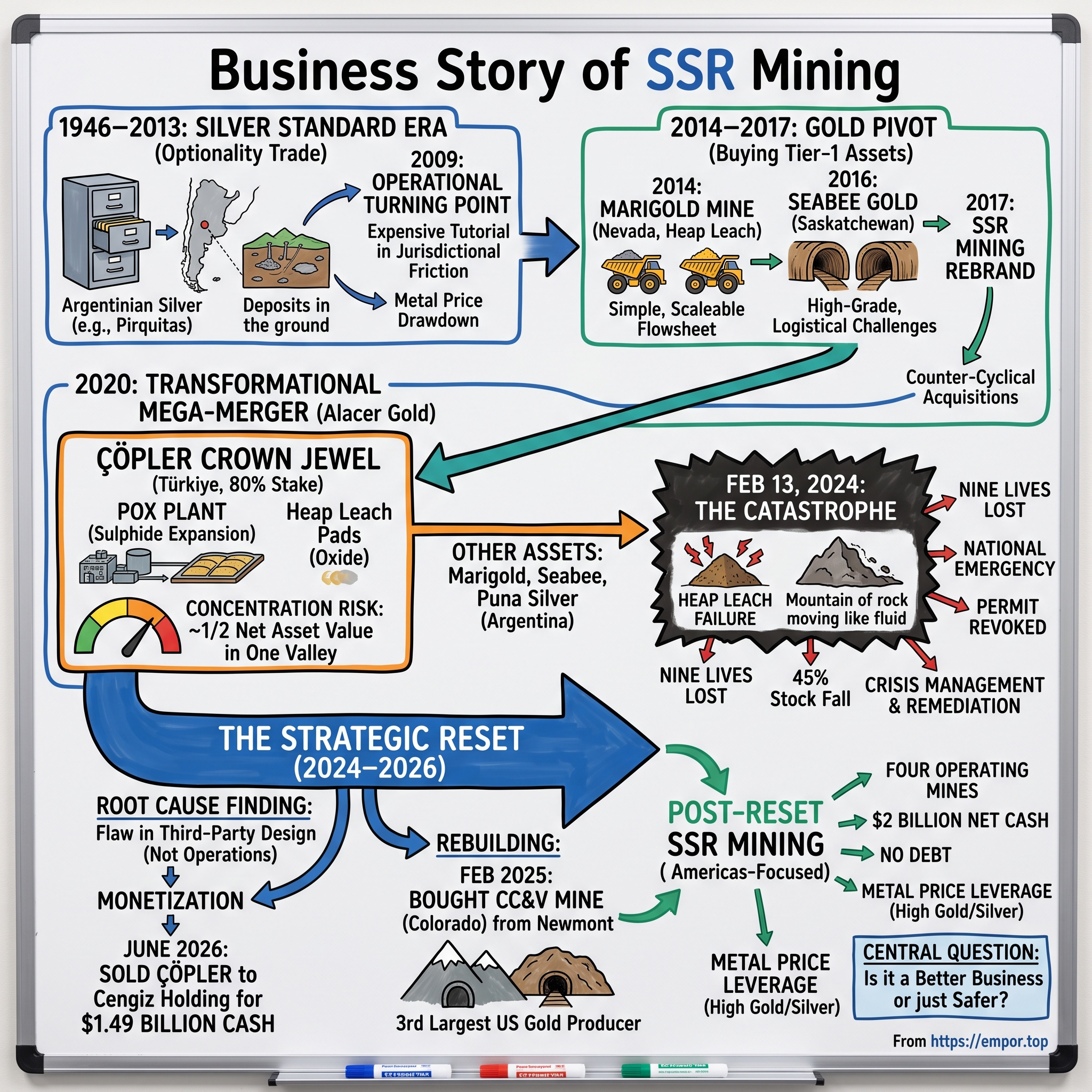
SSR Mining: From Silver Developer to the Çöpler Catastrophe and the $1.5 Billion Reset
I. Introduction & Episode Roadmap
At around 6:30 a.m. Eastern Time on February 13, 2024, the side of a mountain of crushed rock in eastern Türkiye began to move.
It was not a mountain in the geological sense. It was a heap leach pad — an engineered pile of low-grade ore, stacked in lifts, irrigated from above with a dilute cyanide solution that trickles down through the rock, dissolving gold along the way and collecting in a lined basin at the base. Heap leaching is one of the most boring, most reliable technologies in modern mining. It is essentially a very large, very slow coffee percolator. Tens of thousands of tonnes of rock, a sprinkler system, gravity, and patience.
On that morning the pad at the Çöpler mine in Erzincan province stopped behaving like a static structure and started behaving like a fluid. Something in the range of 18 to 20 million tonnes of material — commonly described in cubic-metre terms as roughly 10 million cubic metres — detached and ran downhill into the Sabırlı Valley and the adjacent manganese pit.1 Nine people who had been working at the site were unaccounted for by the time headcounts were completed that morning.1 None of them came home.
Here is the detail that makes this story almost unbearably tense as a piece of corporate history. That very same day, SSR Mining published a full suite of technical reports and multi-year guidance for all of its operating assets, a package headlined by production growth approaching 800,000 ounces by 2027 at all-in sustaining costs trending toward $1,300 per ounce.2 Within hours, the centrepiece of that plan had ceased to exist as a functioning business. The stock fell roughly 45% in early trading.3 It was, in the most literal sense, a company's future being published and destroyed on the same calendar date.
The central question. Can an intermediate precious metals producer lose its single largest profit engine — not to a commodity cycle, not to a grade miss, but to a fatal geotechnical failure and the revocation of its licence to operate — and rebuild without permanently impairing shareholder value? By July 2026, we can answer a good part of that question with facts rather than forecasts. SSR Mining sold its 80% stake in Çöpler to Cengiz Holding A.Ş. and received approximately $1.49 billion in cash at closing on June 24, 2026.4 It exited its Turkish development project three weeks later.5 It is now, by its own description, an Americas-focused gold and silver producer, and the third-largest gold producer in the United States.4
What remains genuinely open is the harder question: is the post-reset SSR Mining a better business, or merely a smaller and safer one?
The intermediate producer's trap. SSR occupies the most awkward tier in mining. Juniors are options — binary, cheap, understood to be lottery tickets. Majors like Newmont and Barrick own dozens of assets, so a catastrophe at any one of them is a bad quarter rather than an existential event. Intermediates in the 400,000-to-800,000-ounce range have just enough diversification to be marketed as "de-risked" and nowhere near enough to actually be so. When one asset carries roughly half of a company's net asset value, the correct description is not "diversified producer." It is "single-asset company with three side businesses." SSR's history is the cleanest available case study in what that distinction costs.
The roadmap. Seven decades in seven movements: the long, unglamorous Silver Standard era of holding ounces in the ground; the mid-2010s pivot to buying producing gold mines in Nevada and Saskatchewan; the 2020 merger that made a Turkish mine the company's centre of gravity; the pre-disaster asset anatomy; February 13, 2024 and its legal and regulatory aftershocks; the remediation, the root-cause finding and the divestiture; and finally the strategic and financial stress test — what actually generates cash here, what the competitive position is worth, and where the case breaks.
The story starts, as many Canadian mining stories do, with a shell company, a filing cabinet full of claims, and a very long wait.
 Subscribe on LinkedIn
II. Origins: The Silver Standard Era (1946–2013)
Picture the business model of Silver Standard Mines Limited, incorporated in 1946, in its purest form: a modest office in Vancouver, a geological library, and a portfolio of silver deposits scattered across the Americas that the company had no intention of mining.6
That was not incompetence. It was the strategy.
The optionality trade, explained. A silver deposit sitting in the ground is a call option on the silver price with no expiry date. The exercise price is the capital cost of building a mine; the underlying is the metal. When silver is cheap, the option is worth little and you do nothing but pay to keep the claims in good standing. When silver spikes, the option's value explodes and you either build, sell, or joint-venture. Meanwhile you spend almost nothing on trucks, mills, tailings dams, unions, or environmental bonds. For decades Silver Standard accumulated exactly this kind of inventory — projects like Pitarrilla in Mexico and San Luis in Peru — and marketed itself to investors as leveraged, low-cost exposure to the silver cycle.
For most of the twentieth century that pitch worked, because the buy-side had no better instrument. If you wanted silver-price exposure with torque, an explorer with a large resource and no capex was a rational vehicle.
Why the trade stopped working. Options have a cost of carry, and mining options have an unusually nasty one. General and administrative expenses, claim maintenance, technical studies and periodic drill programmes all consume cash. A company with no revenue funds that cash burn by issuing shares. So the per-share ounce count erodes year after year even when nothing goes wrong — the option decays, and it decays in the currency the shareholder actually owns.
Then the demand side changed. After the 2008 financial crisis, and with real force after gold peaked in 2011, generalist institutional capital lost patience with the entire "ounces in the ground" asset class. The market began paying for free cash flow, dividends, cost discipline and returns on capital — the things a producer generates and an explorer definitionally cannot. Streamers and royalty companies took over the job of providing clean commodity beta without operational risk, and they did it better, with actual cash flow and no dilution treadmill. The optionality model did not fail because the geology was wrong. It failed because a superior competing structure emerged for delivering the same exposure.
The Pirquitas education. Management had already read the direction of travel. The company built and commissioned the Pirquitas silver mine high in Jujuy province, Argentina, achieving commercial production in December 2009, with the mine inaugurated at a ceremony in San Salvador de Jujuy attended by Argentina's president.7 It was a genuine achievement: a first-time operator building and starting a mine at altitude.
It was also an expensive tutorial in jurisdictional friction. Argentina in that era layered export duties on concentrate, multiple official and unofficial exchange rates, restrictions on repatriating cash, and inflation that made local-currency cost control a moving target. A mine can be geologically excellent and still deliver mediocre returns to a foreign shareholder if the cash it produces cannot travel. That distinction — asset quality versus realisable-cash quality — is the single most useful lesson the company carried forward, and one it would appear to forget spectacularly a decade later in a different country.
By 2013, with gold and silver in a brutal drawdown and the equity market closed to story stocks, the conclusion was unavoidable. Silver Standard had a first mine, a hard-won operating capability, and a balance sheet with real cash. What it needed was gold, in jurisdictions where the cash could leave, bought while everyone else was panicking.
The panic obligingly arrived.
III. The Operational Transformation: Buying Gold in Tier-1 Jurisdictions (2014–2017)
In early 2014 the gold industry was in a state of institutional embarrassment. The metal had fallen roughly a third from its 2011 peak. Majors that had spent the boom acquiring anything with a resource estimate were writing down billions and firing the executives who had done the acquiring. Boards had one instruction: sell non-core assets, pay down debt, stop the bleeding.
Which is precisely the environment in which a disciplined buyer with cash gets to shop.
Marigold: the deal that changed the company. On February 3, 2014, Silver Standard announced the purchase of the Marigold mine in Nevada from subsidiaries of Goldcorp, which held two-thirds, and Barrick Gold, which held the remaining third. The deal closed on April 4, 2014 for $275 million in cash at closing, later adjusted down to roughly $268 million after post-closing settlements, funded entirely from the company's own cash balance.8
Look closely at what was bought. Marigold was not a high-grade jewel. It was a large-scale, low-grade, run-of-mine heap leach operation on the Battle Mountain–Eureka trend — the mining equivalent of a bulk commodity business. You blast rock, haul it, dump it on a lined pad without crushing or grinding it, and let solution do the work. Recoveries are mediocre and the ounces come out slowly over years. What you get in exchange is very low processing capital intensity and a simple, robust flowsheet. Marigold had produced 162,000 ounces of gold in 2013 and was guided to 142,000 to 150,000 ounces in 2014.8
Three things made this an unusually good use of $275 million. First, it was bought from motivated sellers at the bottom of a sentiment cycle, which is the only reliable way to earn excess returns in a price-taker industry. Second, it converted the buyer overnight from a single-mine emerging-markets silver producer into a gold producer with its largest operation in Nevada — the jurisdiction global mining capital treats as the benchmark for permitting predictability and rule of law. That is not merely a comfort; it changes the discount rate the market applies. Third, and least appreciated, Marigold came with an enormous contiguous land package. In heap leach mining, adjacent claims are the growth pipeline, because incremental ore can be trucked to infrastructure that already exists.
Claude Resources: buying grade, and buying a fixer-upper. Two years later, in March 2016, the company agreed to acquire Claude Resources for approximately C$337 million, about $252 million, in a share-based deal with a nominal cash component, giving it full ownership of the Seabee Gold Operation in Saskatchewan and its Santoy underground complex.[^9] The stated logic was that the combined company would produce roughly 390,000 gold-equivalent ounces at cash costs around $735 per equivalent ounce.[^9]
Seabee was the strategic complement to Marigold in almost every dimension. Marigold is wide and thin — huge tonnages, low grade, open pit. Seabee is narrow and rich — an underground mine hauling small volumes of high-grade ore to a conventional gravity and flotation mill. Blending the two smooths a portfolio: the underground mine delivers margin per tonne, the open pit delivers scale and mine life. Claude had been a chronically capital-constrained operator that never had the balance sheet to properly develop Santoy; a better-capitalised owner could invest in underground development and harvest the grade.
Two caveats belong in the ledger. Seabee sits in remote northern Saskatchewan and is resupplied largely by a seasonal winter ice road, which front-loads costs into the first quarter and makes the operation logistically inflexible — a structural feature that still shapes its quarterly cost profile a decade later. And narrow, high-grade underground mines are the least forgiving assets in mining: reserve life is typically short, grade estimates carry wide error bars, and production is hostage to development metres advanced months earlier.
The rebrand. In August 2017 Silver Standard Resources Inc. became SSR Mining Inc.9 Corporate name changes are usually noise. This one was an accurate disclosure. The company was no longer a silver optionality vehicle; it was a gold-dominant operator with three producing assets across the United States, Canada and Argentina, and its Argentine silver business had been reconfigured around the Chinchillas deposit feeding the existing Pirquitas mill.
By the close of 2017 the transformation was real and, importantly, it had been achieved with cash and stock rather than leverage. Management had earned genuine credibility as counter-cyclical buyers. The uncomfortable question is what a management team does with credibility once it has been earned — and in 2020 SSR answered it by making the largest bet in its history.
IV. The Transformational Mega-Merger: Alacer Gold & The Çöpler Crown Jewel (2020)
May 2020 was not an obvious month to announce a $1.7 billion merger. Mines around the world were shutting down for COVID protocols, travel was impossible, and due diligence teams were working from kitchen tables.
SSR Mining announced one anyway. On May 11, 2020 it unveiled an all-stock, zero-premium combination with Alacer Gold Corp., valued at roughly C$2.4 billion, in which Alacer shareholders received 0.3246 SSR shares each and ended up owning about 43% of the combined company against 57% for existing SSR holders.10 The transaction completed on September 16, 2020, with the combined entity headquartered in Denver and Rod Antal — Alacer's chief executive — installed as President and CEO.11
What "merger of equals" really meant. Zero-premium mergers are the most revealing structures in corporate finance, because neither side can claim victory on price. What each side is really trading is the composition of the future company. SSR contributed three producing mines in stable jurisdictions and a clean balance sheet. Alacer contributed one very large cash flow stream, one development project, and a management team with deep operating experience in Türkiye. SSR shareholders received scale and a step-change in near-term cash generation. Alacer shareholders received jurisdictional diversification and a re-rating vehicle. Both boards could tell an honest story.
The move of the corporate centre from Vancouver to Denver was more consequential than it looked. It shifted the company toward the US institutional investor base and the American mid-cap gold peer group. It also, in practice, put the head office several thousand kilometres and many time zones away from the asset that was about to become half the company.
The prize: Çöpler, and a chemistry problem worth understanding. Çöpler is an 80%-owned open-pit gold mine in Erzincan province in eastern Türkiye that had been in production since 2010. Its defining feature was metallurgical.
Gold ore comes in two broad flavours. "Oxide" ore is cooperative: cyanide solution can reach the gold directly, so simple heap leaching works. "Sulphide" or refractory ore is not: the gold is locked inside sulphide mineral crystals, and cyanide simply cannot get at it. Imagine gold dust sealed inside microscopic glass beads. To liberate it you must first break the beads open, and the industrial method for doing that is pressure oxidation, or POX — cooking finely ground ore in an autoclave with oxygen at high temperature and pressure until the sulphide minerals oxidise and release the gold.
Autoclaves are the most demanding equipment in gold processing. They are enormous pressure vessels handling hot acidic slurry; they are expensive to build, unforgiving to operate, and a genuine source of technical differentiation. Alacer's central achievement was building one. The Çöpler sulphide expansion was budgeted at $744 million, construction began in 2016, and the plant was completed in the second half of 2018 roughly 10% under that budget.12 Delivering a first-of-its-kind processing plant in a developing jurisdiction on schedule and under budget is rare enough in this industry to constitute a legitimate operating credential — and it was the credential Antal carried into the merged company.
So Çöpler ran two circuits side by side: heap leach pads for the remaining oxide ore, and the POX plant for the sulphides. The combination gave the mine a long stated life and, at the time, first-quartile costs.
The bull case, and the risk nobody priced. The merged company was pitched as an intermediate producer with roughly 700,000 to 800,000 gold-equivalent ounces of annual output, no net debt, and enough free cash flow to pay a dividend and buy back stock. On the numbers, that was accurate. For three years it delivered: in 2023 SSR produced 706,894 gold-equivalent ounces, generated revenue of $1.43 billion, and returned $114.0 million to shareholders through $57.7 million of dividends and $56.3 million of buybacks, ending the year with $492.4 million of cash and a net cash position of $261.6 million.13
The unpriced risk was structural, not financial. Çöpler concentrated a very large share of the combined company's net asset value and earnings into a single mining complex, in a single seismically active valley, in a country where a ministry can suspend an operation with a signature. Note carefully that this is not a criticism made with hindsight about Türkiye. Plenty of good mines operate there. The criticism is about concentration: any asset representing roughly half of a company's value creates a distribution of outcomes in which one event determines the whole result. Diversification is not a nice-to-have in mining; it is the only insurance policy that exists against geotechnical tail risk, because that risk cannot be hedged, and insurance markets price it thinly.
Antal, and a governance decision that mattered later. Rod Antal came to SSR having led Alacer since August 2013, with more than thirty years in mining and direct ownership of the Çöpler build-out.14 His management signature was cost discipline, a lean corporate structure, and an explicit, mechanical approach to shareholder returns — dividends plus buybacks as a stated framework rather than an afterthought.
In June 2023, SSR's board unanimously appointed Antal — then President and CEO — as Executive Chairman, with long-serving chair Michael Anglin moving to Lead Independent Director ahead of his retirement.14 Combining the roles of board chair and senior executive is a governance choice that shareholder advocates generally dislike, for the straightforward reason that it weakens the board's independence from the executive it is meant to supervise. As of July 2026, the company's leadership page lists Antal as Executive Chairman and shows no President or Chief Executive Officer.15 That structure has now persisted through the most serious crisis in the company's history — a fact worth holding onto for the credibility discussion later.
Eight months after that governance change, the concentration risk stopped being theoretical.
V. Segment Economics & Asset Anatomy (Pre-2024 Baseline)
Before the ground moved, it is worth freezing the frame and looking at what SSR Mining actually was in 2023 — because the received wisdom that "Çöpler was half the company" is true on value and misleading on volume, and the difference matters for judging what was lost.
Four assets, four completely different businesses.
Çöpler produced 220,999 ounces of gold in 2023 at cost of sales of $1,191 per payable ounce and all-in sustaining costs of $1,433 per ounce.13 That is a useful corrective. Çöpler was about 31% of consolidated gold-equivalent output, not half — and its 2023 unit costs were not dramatically better than the rest of the portfolio, because the oxide heap leach portion had been dwindling and the mine was in a lower-grade stretch. Its claim on roughly half of net asset value rested on the future: a long reserve life, the POX plant's capacity to process sulphide ore for two decades, and the Çakmaktepe satellite deposits feeding it. Çöpler was a duration asset. Which is exactly why losing it hurt NAV far more than it hurt that year's cash flow.
Marigold was the volume engine, delivering a record 278,488 ounces in 2023 at all-in sustaining costs of $1,349 per ounce.13 The economics of run-of-mine heap leaching are essentially a haulage business: the dominant variable cost is diesel burned moving rock, and the dominant strategic variable is the grade of what you stack. Recoveries are structurally low, so the operation lives on scale and cost control rather than metallurgy.
Seabee produced 90,777 ounces at $1,427 per ounce all-in sustaining costs — respectable, though notably no longer the sub-$800 cost leader it had been in the years right after acquisition.13 High-grade underground mines mature; as the best stopes are mined out, the mine must travel further and deeper for each ounce, and development spending rises ahead of production.
Puna produced 9.7 million ounces of silver at all-in sustaining costs of $15.37 per ounce, with the Chinchillas open pit trucking ore to the existing Pirquitas mill.13 Puna was consistently treated by the market as the portfolio's short-life afterthought — a characterisation that, as we will see, turned out to be one of the more expensive analytical errors in the SSR story.
The pattern is instructive. This was not four assets with a common operating model; it was a holding company for four unrelated technical businesses on three continents, each with its own metallurgy, labour market, currency, and regulator. That is materially harder to supervise from Denver than a single-district operator, and supervision quality is precisely what the next section tests.
Hod Maden: the growth option, and how it was actually structured. In May 2023 SSR agreed to acquire from Lidya Mines a staged interest of up to 40% in — plus operatorship of — the Hod Maden gold-copper project in northeastern Türkiye. The structure was a $120 million upfront cash payment for an initial 10% interest, closing on May 8, 2023, plus $150 million of milestone payments to earn a further 30%, payable from the start of construction through the first anniversary of commercial production, with Lidya retaining 30% and the remaining 30% held by Horizon. An additional $84 million was payable to Lidya if a further 500,000 gold-equivalent ounces of reserves were delineated.16
The geology genuinely was exceptional. A January 2026 technical report summary put Hod Maden's after-tax net present value at $1.66 billion with a 39% internal rate of return at consensus metal prices, based on a life-of-mine average head grade of 7.6 grams per tonne gold and 1.3% copper — grades that place it among the best undeveloped gold-copper deposits anywhere.17
But read the strategic logic and the risk in the same breath. The explicit rationale for Hod Maden was that it leveraged the in-country permitting relationships, workforce and infrastructure the company already had in Türkiye through Çöpler. In other words, having concentrated roughly half its value in one Turkish valley, SSR's chosen growth project deepened its exposure to the same country and the same regulatory counterparty. Diversification of assets is not diversification of risk factors when the risk factor is the sovereign.
Eight months after the Hod Maden earn-in closed, that observation stopped being an abstract portfolio-theory point.
VI. The Disaster: February 13, 2024 Heap Leach Failure
There is a particular sound engineers describe when a large earth structure begins to fail — not a crack, but a low rumble that builds. At Çöpler, whatever warning existed lasted seconds.
The material that moved was not inert waste rock. It was ore that had been irrigated with cyanide solution for years, and it ran into the Sabırlı Valley, which drains into the wider Euphrates watershed — a river system that supplies water to tens of millions of people across Türkiye, Syria and Iraq. Within hours, an industrial accident had become a national emergency and an international environmental story.
The immediate response. Turkish government agencies deployed search and rescue teams to the site almost immediately. Full operations were suspended. Search efforts were initially halted because the pad itself remained unstable — the rescue teams were working at the toe of a structure that might move again — and resumed once monitoring was established using drones and radar. Work to stabilise a portion of the pad began on February 23, 2024. A containment pond was constructed at once, a concrete curtain was installed at the bottom of the valley, and water diversion systems were built at the top of it. The Turkish government conducted monitoring of surface water, groundwater, soil and air quality, and early results reported by the authorities were negative for contamination at the locations tested.1
Speaking on the February 27, 2024 earnings call, Antal opened not with financials but with a moment of silence for the nine missing personnel, and then walked through the four operational priorities in order: recovery of the missing, pad stabilisation, valley containment, and negotiating with ministries over where the displaced material would permanently go.1 He declined to speculate on cause and asked analysts to respect the two-week-old state of the investigation. As crisis communication, it was disciplined and appropriately austere. As disclosure, it also meant investors left that call with essentially no ability to size the liability.
The regulatory guillotine. The Turkish Ministry of Environment, Urbanisation and Climate Change annulled Çöpler's environmental permit.18 Antal confirmed on the same call that the mine's environmental impact assessment approval had been revoked and that six site personnel were being detained and facing charges in connection with the incident.1
This is the mechanism that investors in single-asset emerging-market producers consistently underweight. The mine was not destroyed. The autoclaves were intact, the pit was intact, the reserves were intact. What was destroyed was the permission to use them — and permission is not an asset you can repair with capital. It is granted by a sovereign whose incentives, after nine deaths and a cyanide scare on a major river system, have nothing to do with the mine's net present value.
The financial contagion. The market's roughly 45% single-session repricing was, in retrospect, a reasonable first estimate.3 Guidance was withdrawn. The dividend and the automated share purchase plan were both suspended to preserve cash, and further investment at Hod Maden was put on hold.1
The accounting worked through in stages, and the shape of it is more revealing than the headline. Because the company decided to permanently close the heap leach pad, it fully wrote off the pad's contained gold inventory and the related processing facilities, recording $76.0 million of impairment against inventories and $38.2 million against mineral properties, plant and equipment in the first quarter of 2024 — $114.2 million in total non-cash charges.19 For the full year 2024, SSR reported a net loss attributable to shareholders of $261.3 million, reflecting approximately $272.9 million of incurred and anticipated reclamation and remediation costs, the $114.2 million of impairments, and $108.7 million of care and maintenance costs.19
The analytically important point is the composition. The impairments were non-cash and comparatively modest. The reclamation, remediation and care-and-maintenance provisions were the real damage, and they were cash. A mine that produces nothing while consuming roughly $20 million to $25 million a quarter simply to stay safe and legally compliant is a negative-yield bond with an unknown maturity. Adjusted net income for 2024 was still positive at $57.6 million once non-recurring items were stripped out, which tells you the other three mines kept the enterprise solvent.19 Prior capital discipline — no net debt going in — was what turned an existential event into a survivable one.
Legal exposure. Two putative securities class actions were filed in the US District Court for the District of Colorado, later consolidated, alleging that public statements were materially false and misleading regarding the adequacy of internal controls over safety practices and operational integrity at Çöpler.20 A parallel proposed class proceeding was commenced in the Supreme Court of British Columbia.21 These were not fringe filings; they went directly at the question of whether the company had told shareholders the truth about safety risk.
Executive change. On March 8, 2024, SSR announced that Michael J. Sparks, previously Executive Vice President and Chief Legal and Administrative Officer, would become Executive Vice President and Chief Financial Officer effective immediately, succeeding Alison White, who left to pursue other opportunities.22 The chief financial officer's chair turning over three weeks after a catastrophe is a data point investors are entitled to note, even where — as here — no public disclosure connects the two, and the successor was an internal appointment with legal and risk oversight already in his remit.
What followed was two and a half years of work that would determine whether the company had a future beyond its three surviving mines.
VII. Crisis Management, Root Cause & The Strategic Pivot (2024–2026)
Every corporate disaster eventually reaches a fork. One path is to fight — litigate, lobby, wait out the regulator, and defend the asset for as long as the balance sheet allows. The other is to establish the facts, clean up, and sell. SSR's leadership spent 2024 doing the first kind of work in service of the second.
The forensic question. The company retained Call & Nicholas, Inc., a consultancy specialising in geological and geotechnical engineering and hydrology, to conduct an independent review of the failure. The findings, announced on January 15, 2025, were technically specific and commercially enormous.
The most likely cause, CNI concluded, was a deeply rooted flaw in the third-party engineered design of the heap leach pad: the design had overestimated the shear strength of the liner system at the base of the facility, which inflated the calculated safety factors and left insufficient strength along the liner interface to hold the structure as built. Crucially, the review found that construction and operation had conformed to the engineered design parameters, and found no substantiation that excess water, blast vibration, or stacking beyond design had caused the failure.23
Translate that into plain language. A heap leach pad sits on an engineered plastic liner whose job is to stop solution escaping into the ground. That liner is also, unavoidably, the slipperiest plane in the whole structure — like building a tall pile of gravel on a sheet of wet polythene. The critical design input is how much sideways force the liner interface can resist before it slides. The finding was that the number used in the original design was too high. Every subsequent safety calculation inherited that error, and everyone downstream who did their job correctly was building and operating a structure that was never stable at full height. Antal's public framing was that knowing the failure resulted from an engineering design flaw "and not the result of a failure in our operation or construction of the pad, provides clarity" for the path forward.23
How much weight should that finding carry? It is a genuinely material fact, and it plausibly changed the company's legal and regulatory position. But independence and comprehensiveness are different properties, and two limits deserve stating plainly. First, CNI was retained and paid by SSR; its technical competence is not in question, but a company-commissioned review is not the same as a regulator's or a court's determination. Second — and more importantly for investors — "the third party's design was flawed" answers the question of proximate cause while leaving the governance question entirely open. If a company chooses to place roughly half its net asset value on top of a structure engineered by someone else, the sufficiency of its own technical due diligence on that structure is its own responsibility. The finding shifts blame for the calculation. It does not answer why the calculation was never independently re-checked at the level of scrutiny that a company-defining asset would seem to warrant.
The clean-up. The physical remediation proceeded through 2024 and 2025: material was relocated out of the Sabırlı Valley, the heap leach pad was slated for permanent closure, and the company continued to work toward final approvals for a permanent storage facility. On the February 2026 call, Antal described site activity as largely wound down in terms of material movement and rehabilitation, with the team awaiting final approvals for the storage facility and pad closure while maintaining the process plant's integrity for a potential restart.24 By then SSR had spent $149.3 million on remediation since the incident, including $21.7 million in 2025, and was guiding to $80 million to $100 million of care-and-maintenance cost for 2026.25
Read the strategy embedded in those two sentences. The company was simultaneously preparing the pad for permanent closure and preserving the POX plant in start-up condition. It was spending real money to keep the option to restart alive, while making no promise that it would. That is what a well-run negotiation looks like from the outside: the asset's value to a buyer depended entirely on whether the plant could ever run again.
Rebuilding while wounded: the CC&V acquisition. The most consequential decision of the recovery period had nothing to do with Türkiye. On February 28, 2025 — barely a year after the disaster, with Çöpler still permitless and litigation live — SSR acquired the Cripple Creek & Victor gold mine in Colorado from Newmont for $100.0 million upfront plus up to $175.0 million in milestone-linked payments, tied to approval of a permit amendment extending the mine life and to regulatory relief on flow-related permitting requirements.26
The strategic reading is straightforward: SSR replaced its lost production centre with an asset in Colorado, in the same state as its own head office, and immediately became the third-largest gold producer in the United States.26 Newmont was selling because CC&V was too small to matter in a portfolio of tier-one assets.
The results have been, by any standard, exceptional. CC&V produced 124,557 attributable ounces in 2025 at all-in sustaining costs of $1,555 per ounce — well above the top end of its guidance — and generated more than $200 million of mine-site free cash flow in its first ten months of SSR ownership.25 By the first quarter of 2026, cumulative free cash flow since acquisition reached approximately $325 million, exceeding the full $275 million headline consideration in roughly twelve months.27
Two pieces of that deal deserve credit rather than applause-by-default. The milestone structure meant SSR paid only $100 million before knowing whether the asset worked; the first $87.5 million contingent payment, relating to the Carlton Tunnel water discharge permitting work, was made in the first quarter of 2026, with a further $87.5 million due on the amendment-14 permit expected in roughly twelve to eighteen months.27 And long-term responsibility for the Carlton Tunnel discharge — the site's most awkward legacy environmental issue, potentially requiring a water treatment facility — was left on Newmont's account, with Newmont continuing to lead the regulatory dialogue.27 Contingent consideration plus a retained-liability carve-out is exactly how a buyer should structure a purchase of an unfamiliar asset from a major. A gold price that rose sharply afterwards did the rest.
The exit. On March 4, 2026, SSR announced a binding memorandum of understanding to sell its 80% ownership of Çöpler and related Turkish properties to Cengiz Holding A.Ş. — one of Türkiye's largest industrial groups, with interests across copper, gold and aluminium mining, construction, energy, metallurgy and chemicals — for $1.5 billion in cash, the entire amount payable on or before closing, supported by a $100 million deposit and a reciprocal $50 million break fee.28 A definitive share purchase agreement followed on March 24, 2026. Notably, the buyer's remaining due diligence was limited to reserves and resources, with no operational-permit condition and no financing contingency; the substantive outstanding item was Turkish regulatory approval.28 The transaction excluded Hod Maden.28 It closed on June 24, 2026, with approximately $1.49 billion received after working capital adjustments.4
Consider who the buyer was. Not an international miner. A domestic industrial conglomerate with existing mining operations and, presumably, the political and regulatory relationships needed to get a permit reinstated. That is the entire logic of the trade: the asset's value was gated by a Turkish sovereign decision, and a Turkish owner is structurally better positioned to obtain that decision than a Denver-headquartered company facing US securities litigation over the same incident. SSR sold the ounces and, more to the point, sold the permitting problem to the party best equipped to solve it.
Antal's own framing was revealing in what it benchmarked against. He said the deal would deliver "significant net asset value and cash flow accretion relative to consensus estimates."28 Relative to consensus — that is, relative to the value analysts had already written Çöpler down to. It is a carefully accurate statement, and it is not a claim that $1.49 billion approximates what Çöpler was worth on February 12, 2024. It was not. The gap between those two numbers is the permanent cost of the incident, and no amount of subsequent execution recovers it.
The Hod Maden reversal. Then came the move that most complicates the credibility picture. In January 2026, management published that $1.66 billion NPV technical report and, on the February call, described Hod Maden as reaffirmed among the better undeveloped copper-gold projects in the sector, said the company was "thrilled" to hold a development asset of that quality, quantified SSR's remaining investment at approximately $470 million funded from liquidity and free cash flow, and noted a first tunnel blast had already been fired.24 Roughly three months later, on May 15, 2026, SSR agreed to sell its 20% earned equity interest and its operatorship to Lidya Mines in exchange for an uncapped 4.0% net smelter return royalty on 100% of the project, closing on July 17, 2026.5
The economics of that swap are defensible. SSR had invested roughly $243 million in the project through acquisition, earn-in and capital spending, and by exiting it walked away from the remaining several-hundred-million-dollar construction obligation while retaining perpetual, uncapped top-line exposure to a very high-grade orebody someone else will build.5 Royalties are the highest-quality cash flow in mining: no capital calls, no cost inflation, no labour disputes. In the same restructuring, Royal Gold reduced its equity to 15% and took a 2.5% royalty, with a call option to buy 2.0% of SSR's royalty for $160 million after commercial production.5
But hold the two statements next to each other. In February, a project worth building and funding. By May, a project worth exiting. Nothing in the geology changed in ninety days. What changed was the company's willingness to hold Turkish construction risk at all — which was arguably the correct conclusion, reached in the wrong order, and communicated as strategy after the fact rather than as a change of mind. The generous reading is that a strategic review announced alongside the Çöpler sale ran its course and produced the right answer. The skeptical reading is that publishing an enthusiastic valuation for an asset you are actively reviewing for divestment sends investors a signal you then reverse.
Either way, by late July 2026 the reset was complete: no Turkish operations, no Turkish construction commitments, roughly $2 billion of cash and no debt, four mines in three Americas jurisdictions, and a royalty on a project in a country the company had just spent two years leaving.
VIII. Competitive Frameworks & Strategic Analysis
Strip away the narrative and ask the question a strategist would ask: in a business where you cannot influence your selling price, where does durable advantage come from?
The 7 Powers test, honestly applied. Hamilton Helmer's framework demands that a "power" produce differential returns that persist. Most of them simply do not exist in this industry.
Scale economies — weak to moderate. SSR is bigger than a junior and buys tyres, explosives, cyanide and diesel in larger lots. That yields modest procurement leverage and lets a corporate technical team be spread across more ounces. It buys nothing on the revenue line. There is one real scale benefit worth naming: only a producer of SSR's size can absorb a nine-figure remediation programme at one mine while continuing to invest at three others. Scale in mining is less a margin advantage than a survivability advantage — and 2024 to 2026 is the proof.
Process power — moderate, and worth more than it looks. Two genuine technical capabilities exist here. The first is autoclave operation, which SSR has now sold. The second is heap leach ore management, and it is more subtle than it sounds. On the February 2026 call, management explained that Marigold's schedule had been rebuilt around blending "durable" and "non-durable" ore, because ore with high fines content compacts under the weight of the stack above it and chokes the flow of solution through the heap.24 Picture packing coffee grounds too tightly: water stops percolating and you extract nothing. Marigold had learned this the hard way when its heap became bound up in late 2022 and early 2023. Knowing which ore can be stacked with which, and sequencing a mine plan around that constraint years in advance, is exactly the kind of accumulated operational knowledge a competitor cannot buy. It is also, note, capability earned by first getting it wrong.
Cornered resource — weak. Large contiguous land packages at Marigold, Seabee and CC&V confer local advantage: incremental discoveries can be trucked to existing infrastructure, which is why SSR could declare a maiden 200,000-ounce reserve at Porky near Seabee and advance Buffalo Valley near Marigold without building anything new.25 But no deposit here is globally scarce. There is no Grasberg, no Carlin, no unique orebody the world must come to SSR to access.
Counter-positioning, network economies, switching costs, branded pricing — absent. Gold bullion is fungible. A buyer cannot tell whose mine produced it and would not pay more if they could.
The conclusion is uncomfortable but clarifying: SSR Mining has no durable competitive moat of the type that protects margins. Its competitive position is entirely a function of asset quality, cost position, jurisdiction and capital allocation — four things that must be re-earned continuously.
Porter's five forces, and where the real pressure sits.
New entrants — low threat, and this is the industry's genuine structural protection. Building a new mine in the United States requires hundreds of millions in capital and a permitting process measured in years to decades. SSR's own experience is the illustration: CC&V's mine-life extension depends on a permit amendment management expects to take twelve to eighteen months, and that is for an existing operation with an existing footprint.27 Barriers this high are why brownfield ounces trade at a premium to greenfield ones, and why buying a producing mine from a major at the bottom of a cycle has been SSR's most reliable value creation mechanism.
Buyer power — irrelevant. Bullion sells at London Bullion Market Association reference prices. There is no negotiation and no customer concentration.
Supplier power — high and rising, and this is where margins actually get decided. The evidence is specific. Management has hedged nearly 70% of diesel exposure at Marigold and CC&V through zero-cost collars extending to the end of 2026, and quantified the sensitivity: each $10 per barrel move in oil translates to roughly $7 to $10 per ounce of consolidated all-in sustaining cost in 2026, doubling to about $20 per ounce in 2027 if the hedges are not replaced, with fuel around 10% of operating costs.27 Marigold's 2026 sustaining capital of $108 million is driven substantially by mining fleet and component replacement — capital that flows straight to a small number of global equipment manufacturers.25 And royalties are their own supplier squeeze: management attributed part of 2025's cost overrun to higher royalty payments driven by higher gold prices, which is the awkward truth that a rising gold price is not a pure margin windfall.24
Substitutes — low. Central bank buying, investment demand and physical uses keep gold's monetary role intact. Silver carries additional industrial demand from electronics and solar.
Rivalry — high, and aimed at assets rather than customers. Producers do not compete for buyers; they compete for the same finite pool of acquirable mines, the same skilled workforce, and the same institutional capital. When gold is at record levels, every intermediate producer is cash-rich and hunting simultaneously — which means asset prices rise exactly when everyone can afford to pay them. That is the competitive dynamic bearing directly on SSR's roughly $2 billion of cash today, and it is the single most important context for judging what management does next.
Where SSR sits versus peers. Against North American intermediates such as Alamos Gold, Lundin Gold and Eldorado Gold, SSR's distinguishing features are its US concentration — genuinely unusual, and valuable in a world where mining jurisdiction risk is repricing — and its cost position, which is not a strength. Guided 2026 all-in sustaining costs of $2,360 to $2,440 per gold-equivalent ounce, or $2,180 to $2,260 excluding Çöpler care and maintenance, do not place SSR in the lower half of the global cost curve.25 High-cost producers make more money than low-cost producers when metal prices rise, because a fixed cost base against a rising price produces more percentage margin expansion. They also lose money first when prices fall. SSR is, on its current cost structure, a higher-beta way to own gold, not a defensive one. Any argument that it deserves a premium multiple has to be made on jurisdiction and balance sheet, not on cost leadership.
That distinction is the frame for assessing the people making the decisions.
IX. Management Credibility, Incentives & Risk Radar
Credibility in mining is not measured by whether things go wrong — in an industry that moves mountains, things go wrong. It is measured by target-setting discipline, narrative consistency across cycles, and what happens after the miss.
What the record supports. The counter-cyclical acquisition record is real and, unusually in this industry, verifiable at the asset level. Marigold, Seabee and CC&V were each bought from a larger seller during a period of weak sentiment for the asset in question, and each was funded without material leverage. The CC&V outcome in particular is not a story about a rising gold price alone; the milestone structure, the retained-liability carve-out and an operational handover management described as a strong integration all contributed.27 Reserve replacement is likewise demonstrable rather than asserted: management's disclosure shows depletion more than replaced since 2020 before any acquisition benefit, with year-end 2025 reserves of 11 million gold-equivalent ounces, up nearly 40% year over year, held at deliberately conservative pricing assumptions of $1,700 per ounce gold and $20.50 per ounce silver against a spot environment far above both.25 Conservative reserve pricing is a genuine mark of discipline; it means the reserve base does not need a high metal price to be economic, and it leaves upside that would be manufactured, not earned, by simply raising the price deck.
Crisis handling was also, on the observable evidence, competent. The tone in February 2024 was appropriately grave, the priorities were sequenced correctly, insurers were notified in the ordinary course, and management explicitly declined to speculate on cause.1 Cash preservation was immediate. The independent review was commissioned, completed and published. The asset was cleaned up and then monetised for cash rather than paper. Very few management teams handed that situation would have reached a $1.49 billion all-cash exit inside twenty-eight months.
What a skeptical investor would press on. Four things, and they are not small.
First, the concentration decision itself. The Çöpler failure was proximately caused by a third party's engineering error. The exposure to that error was a choice made and maintained by this board and this management team — and Antal, having built the sulphide plant at Alacer, was the executive best positioned in the entire company to interrogate the pad's design assumptions. That is not an accusation of negligence; it is the observation that the person with the most technical familiarity with the asset was also the person with the most reason to be confident in it.
Second, the Hod Maden sequencing. Publishing an enthusiastic technical report and a funding plan in January and February, then agreeing to exit in May, is a narrative inconsistency of the kind investors are right to weigh. When UBS's George Eadie asked on the May call how long the strategic review might take and whether a sale could be a year from closing, Antal declined to give a timeline, saying only that the review considered all options from building the project through to sale.27 Ten days later the sale was announced. The review may well have been genuinely open until late; but the February enthusiasm and the May exit cannot both have been the company's settled view, and shareholders were not told which one to believe.
Third, governance. No separate chief executive officer has been in place since Antal became Executive Chairman in June 2023, a structure that has now persisted through a fatal accident, a permit revocation, securities litigation and two major divestitures.15 For a company about to deploy roughly $2 billion, the absence of a clear separation between the board that approves capital allocation and the executive who proposes it is a legitimate structural concern, independent of any individual's performance.
Fourth, the capital-return vacuum. This is the live issue. On the May 2026 call, Lawson Winder of BofA, Joshua Wolfson of RBC and others pressed repeatedly on why, with pro forma net cash above $2 billion and $211 million of quarterly free cash flow, the exhausted buyback authorisation was not simply renewed.27 Antal's answer was that the company needed "to take a step back to take a step forward," that the capital allocation framework suspended after the incident was being rebuilt holistically alongside emerging growth opportunities, and that the priority was to close the Çöpler deal and bank the cash.27 That deal has now closed. There is currently no dividend — it remains suspended since February 2024 — and no active repurchase authorisation. Management has been explicit that it is "staying active" in M&A with a preference for North America.27 An investor is therefore being asked to trust a framework that has not yet been published, at the exact moment the company holds the most discretionary cash in its history.
On incentives, the detailed design of executive compensation is set out in the company's management information circular rather than in the materials reviewed here, and no specific metric weightings are asserted. What can be observed is behaviour: since 2021 the company has repurchased over 29 million shares at an average price of about $21, including the $300 million programme completed in April 2026 that retired more than 9 million shares.27 That execution is worth one honest footnote. As Eadie noted on the call, the April purchases averaged roughly $32.60 per share in a window where the stock traded between about $21 and $32 — meaning the buyback was executed near the top of its own range. Sparks explained that the normal course issuer bid mechanism required instructions to be given to banks in advance, which made execution fast but price-insensitive.27 Speed and discretion are a genuine trade-off in buyback design; it is fair to note the company chose speed.
Risk radar. Political and regulatory risk has not been eliminated, only relocated: Puna sits in Argentina, and CC&V's mine-life extension depends on a Colorado permit amendment. Input cost inflation is quantified and partly hedged only through 2026, with the sensitivity roughly doubling thereafter.27 Grade and reserve risk is concrete at Seabee, where production is gated by underground development metres and the fourth quarter of 2025 saw all-in sustaining costs spike to $3,433 per ounce on approximately 9,000 ounces of output.25 Litigation risk persists: the consolidated US securities action was dismissed without prejudice on September 30, 2025 with leave to amend, and the British Columbia proceeding was granted carriage to a competing action in July 2025 — meaning neither matter is finally resolved.2921 And the largest risk is now self-inflicted by design: a balance sheet with roughly $2 billion of cash, in a record metal price environment, in the hands of a team that has publicly said it is hunting.
Which brings us to the numbers, and to the question of what this company is actually worth on its own operating merits.
X. Financial Analysis, Valuation & Bull vs. Bear Case
The financial position is the easy part. SSR ended the first quarter of 2026 with $634 million of cash and no debt, having fully redeemed its outstanding convertible notes in March, with total liquidity of $1.1 billion; it generated $211 million of free cash flow from continuing operations in the quarter and produced 110,000 gold-equivalent ounces at all-in sustaining costs of $2,433 per ounce.27 Add the $1.49 billion received in June and the company holds roughly $2 billion of net cash against a market capitalisation of a few billion dollars.4 There is no refinancing risk, no covenant risk, and no Çöpler remediation liability going forward.
The hard part is what that cash is attached to.
Myth versus reality: three consensus claims worth testing.
Myth one: SSR simply swapped Çöpler for CC&V and came out ahead. The gross numbers flatter this. Look at the two legacy mines instead. Marigold and Seabee together produced 369,265 ounces of gold in 2023.13 In 2025 the same two mines produced 208,521 ounces — Marigold 153,535 at all-in sustaining costs of $1,918 per ounce, Seabee 54,986 at $2,231.25 That is a decline of roughly 44% in two years, with unit costs up sharply at both. Consolidated output fell from 706,894 gold-equivalent ounces in 2023 to 447,207 in 2025 even with CC&V's 124,557 ounces added.1325 Management has explanations for both declines, and they are credible ones — Marigold's schedule was rebuilt around ore blending and pit expansions, Seabee is in a heavy underground development phase, and 2026 guidance of 170,000 to 200,000 ounces and 60,000 to 70,000 ounces respectively implies partial recovery.25 But the honest reading is that CC&V has been masking material erosion at the two assets SSR has owned longest. The "Americas re-rating" thesis rests substantially on one recently purchased mine and on Puna's silver leverage, not on a broadly improving operating base.
Myth two: the design-flaw finding closed the chapter. It resolved proximate cause and helped enable the sale. It did not resolve the securities litigation, which turns on disclosure rather than engineering, and which remains unresolved on both sides of the border.2921
Myth three: Puna is a short-life afterthought. This is the error worth correcting most emphatically, because it runs the other way. Puna generated more than $250 million of mine-site free cash flow in 2025 at all-in sustaining costs of $14.24 per silver ounce, exceeding its production guidance for a third consecutive year.25 In the first quarter of 2026 it delivered more than $120 million of site-level free cash flow in a single quarter at realised silver prices above $90 per ounce, with a fifth consecutive quarter of record throughput.27 For much of the past decade the market treated Puna as a depleting asset heading for closure — a point Antal himself made pointedly on the February call.24 Reserve life still runs to around 2028, and extension depends on Chinchillas pit laybacks, a satellite target northeast of the pit, and the Cortaderas underground project.27 But a mine throwing off nine-figure quarterly cash flow is not an afterthought; it is currently one of the highest-margin primary silver operations in the world, and it is arguably the least understood asset in the portfolio.
The bull case. Three legs, each with evidence behind it.
The balance sheet is the first and least arguable. Roughly $2 billion of net cash in an industry where most peers carry debt gives SSR the capacity to buy assets in a downturn — the exact playbook that produced Marigold, Seabee and CC&V — or to retire a meaningful share count if the stock lags. The optionality is real and the track record of using it is real.
The second is jurisdictional re-rating. Investors demonstrably pay more for US and Canadian ounces than for ounces exposed to expropriation, permit revocation or currency controls, and SSR has now removed its most acute source of that discount. Whether the residual "disaster discount" fully closes is unknowable, but the mechanism is legitimate: the market previously applied a country risk premium that no longer applies to the same degree.
The third is metal price leverage, which cuts both ways but is currently helping enormously. With realised gold above $4,100 per ounce in the fourth quarter of 2025 and silver above $90 in early 2026 against costs in the low $2,000s and low $20s respectively, cash margins are wide.2427 Management's own disclosure that growth projects across the portfolio are economic at reserve prices of $1,700 gold and $20.50 silver indicates the pipeline does not require today's prices to work.27
The bear case. Also three legs, and they are not symmetrical with the bull case.
Scale and cost first. The company is materially smaller than the 800,000-ounce trajectory it published on the morning of the disaster, and its consolidated cost structure now sits well above the industry's low-cost cohort.225 Because Çöpler's loss removed a long-duration asset, the reserve life supporting the remaining portfolio depends on conversions and permits that have not yet happened: Marigold's updated life-of-mine plan including Buffalo Valley is promised within twelve months, CC&V's extension needs its permit amendment, and Puna's extension beyond 2028 needs engineering work to conclude favourably.27 Each is plausible. None is banked.
Reinvestment risk second, and this is the sharpest activist argument. A company with roughly $2 billion of cash, no dividend, no live buyback authorisation, a stated appetite for North American M&A, and a production base a third smaller than three years ago has every structural incentive to buy volume. The industry's history is unambiguous about what happens when cash-rich intermediates shop at cycle peaks. Management's answer — that a holistic framework is being built and that its M&A filters require strategic fit, competition for capital, and value accretion — is reasonable but unpublished.27 The specific test a skeptic would set is simple: does the framework arrive before the acquisition, or after it?
Litigation and residual liability third. The securities actions remain open in both jurisdictions, and while the US matter was dismissed once, plaintiffs were granted leave to amend.29 Any eventual resolution is a cash cost against a balance sheet that can absorb it, but the reputational and disclosure questions are not settled by the ability to pay.
The synthesis. The reset genuinely worked as crisis management: SSR converted a stranded, permitless, politically toxic asset into cash, removed its construction exposure to the same country, and replaced its lost production centre with a mine that has already returned more than its purchase price. That sequence deserves recognition on the evidence, not on management's characterisation of it.
What has not yet been demonstrated is that the resulting company compounds value. It is a higher-cost, smaller, US-weighted producer whose current free cash flow owes an enormous amount to record metal prices, whose two longest-held mines have shrunk substantially, and whose defining decision — how to deploy roughly $2 billion — has not been made public. The bull case and the bear case are, unusually, waiting on the same single piece of information.
XI. Playbook & Core Business Lessons
Four transferable lessons, none of them specific to mining.
Concentration is a risk you take, not a risk you have. The Çöpler exposure was frequently discussed as though it were a feature of the asset. It was a decision — reaffirmed every year the company chose not to diversify away from it, and compounded when the chosen growth project sat in the same country under the same regulator. For any business, the test is not "is our largest asset high quality?" It is "what fraction of enterprise value disappears if this one thing stops working, and have we been paid for accepting that?" A crown jewel throwing off cash is the most effective possible camouflage for tail risk, because the cash arrives every quarter and the tail event arrives once.
Technical due diligence in M&A is not the same as financial due diligence, and the gap is where catastrophes live. SSR acquired Çöpler in a merger. The heap leach pad had been designed by a third party, built to that design, and operated within it — and the flaw was upstream of everything a normal diligence process examines: an input assumption about liner shear strength that inflated every safety factor calculated from it.23 Reserve audits, metallurgical reviews and financial models all pass cleanly when the underlying engineering assumption is wrong. Any acquirer of physical infrastructure — dams, pads, pipelines, plants, data centres — should be asking who calculated the governing safety assumption, when it was last independently re-derived from first principles, and whether anyone has checked the checkers.
When an asset becomes a political liability, sell it to whoever can solve the politics. SSR could have spent five years litigating and lobbying for a restart. Instead it fixed what it could physically fix, established the cause through an independent review, and sold to a domestic conglomerate with the standing to obtain a permit.28 The transferable insight is about matching an asset to the owner whose comparative advantage fits the binding constraint. When the constraint is a sovereign relationship, a foreign owner is the wrong owner at almost any price — and recognising that quickly is worth more than the discount taken on the sale.
Balance sheet conservatism is not caution; it is optionality purchased in advance. Entering 2024 with no net debt is why a company that lost roughly a third of its production and absorbed hundreds of millions in remediation and care costs never faced restructuring or emergency equity issuance — and why it could buy CC&V twelve months into the crisis, from a position of strength, while wounded.1326 The discipline that looks unexciting in good years is precisely what converts a catastrophe into a survivable event. The corollary, which SSR now faces from the other direction, is that the same conservatism becomes a liability if a large cash balance sits idle or gets spent badly.
XII. Core KPIs & What to Watch
Three metrics, and only three, carry the story from here.
Consolidated all-in sustaining cost per gold-equivalent ounce. This is the single number that determines whether SSR is a business or a leveraged bet on the gold price. All-in sustaining cost captures mining, processing, royalties, site administration and the sustaining capital needed to keep producing at the current rate — as close to a true cash cost of an ounce as the industry publishes. With 2026 guidance in the $2,180 to $2,260 range excluding Çöpler care and maintenance, SSR is not a low-cost producer, and the direction of travel matters more than the level.25 Watch it at the asset level rather than consolidated: Marigold's costs against its promised recovery in volumes, and Seabee's normalisation after the development-heavy period that pushed fourth-quarter 2025 costs above $3,400 per ounce.25 If costs keep rising while production stays flat, the cash flow is a metal price artefact. If costs fall as promised volumes arrive, the operating story is real.
Free cash flow conversion and the capital returned per share. Not free cash flow alone — mining companies can generate cash by underinvesting, which simply defers the bill. The useful test is what fraction of operating cash flow survives sustaining capital, and then what fraction of that reaches shareholders as dividends and repurchases rather than being reinvested. This is the metric that will settle the central open question. The company suspended its dividend in February 2024 and has completed but not renewed its buyback authorisation.127 The arrival, size and mechanical rules of the promised capital allocation framework — and whether it precedes or follows a major acquisition — is the most informative disclosure ahead.
Reserve replacement at the two US anchors. A mine is a depleting asset; every ounce sold must be replaced or the business is quietly liquidating itself. SSR's disclosed record of more than replacing depletion since 2020, before acquisitions, at conservative reserve pricing, is the best available evidence that the exploration function works.25 What matters now is whether that continues at the assets that carry the portfolio: the Marigold life-of-mine update incorporating Buffalo Valley and New Millennium, and conversion of CC&V's large resource base into reserves, which is gated by its permit amendment.27 Replacement achieved through drilling is compounding. Replacement achieved only through acquisition is capital recycling, and it is far more expensive.
One deliberate omission: production volume on its own. It is the number the market reacts to and the least informative of the set, because a company can buy volume at any price. Ounces are only worth counting once you know what they cost and what fraction of the cash reaches the owner.
XIII. Primary Transcript Recommendations for Downstream Analysis
For anyone extending this analysis with primary sources, four calls carry disproportionate information, and the value is mostly in the Q&A rather than the prepared remarks.
The fourth quarter 2023 call of February 27, 2024 is the crisis document. It shows management two weeks into the worst event in company history: the moment of silence, the four sequenced priorities, the confirmation that the environmental approval had been revoked and six personnel detained, the immediate suspension of the dividend and share purchase plan, and the refusal to speculate on cause.1 Read the Q&A for what analysts could not get answered — Don DeMarco of National Bank had to ask permission to ask about the incident at all, and questions about insurance recovery and remediation cost per tonne were met with candid statements that no fidelity existed yet. It is a useful benchmark for how little was knowable at the outset.
The January 15, 2025 announcement of the Call & Nicholas findings is the technical turning point, and it repays close reading of the exact language: the liner shear strength overestimation, the explicit statement that construction and operation conformed to design, and the specific ruling out of excess water, blast vibration and over-stacking.23 These distinctions determined the legal and commercial path that followed.
The fourth quarter 2025 call of February 17, 2026 is the pre-pivot baseline and the most important document for testing narrative consistency. It contains the full-year results and 2026 guidance, the reinstatement of a $300 million buyback, the Marigold ore-blending explanation, the maiden Porky reserve — and the enthusiastic Hod Maden presentation, complete with a $470 million remaining funding commitment, that the company reversed within three months.24 Anyone assessing management credibility should read this call against the May divestiture announcement.
The first quarter 2026 call of May 5, 2026 is where the capital allocation question is joined directly. Three separate analysts pressed on why the buyback was not renewed and why a dividend had not returned, and Antal's "step back to take a step forward" framing is the clearest available statement of how the company is thinking about roughly $2 billion of cash.27 The same call contains the CC&V milestone payment mechanics, the diesel hedge sensitivity, and the non-answer on Hod Maden timing that preceded the sale by ten days.
Beyond the calls, the company's regulatory filings on EDGAR remain the authoritative record for litigation status, contingent consideration accounting, and the reclamation and remediation provisions that drove the 2024 loss.30
References
-
SSR Mining (SSRM) Q4 2023 Earnings Call Transcript — The Motley Fool, 2024-02-27 ↩↩↩↩↩↩↩↩↩
-
SSR Mining Issues Multi-year Guidance and Technical Reports for All Operating Assets — SSR Mining Inc., 2024-02-13 ↩↩
-
SSR Mining sinks 45% after landslide forces suspension of Copler operations — Seeking Alpha, 2024-02-13 ↩↩
-
SSR Mining Completes the Sale of the Çöpler Mine — StockTitan, 2026-06-24 ↩↩↩↩
-
SSR Mining Exits Hod Maden In Exchange For 4% Royalty — The Deep Dive, 2026-05-15 ↩↩↩↩
-
SEC EDGAR Corporate Filings — SSR Mining Inc. (formerly Silver Standard Resources Inc.) — US Securities and Exchange Commission ↩
-
Silver Standard Resources: President of Argentina Inaugurates Pirquitas Mine — SSR Mining Inc., 2009 ↩
-
Silver Standard Completes Marigold Mine Acquisition — PR Newswire, 2014-04-04 ↩↩
-
SSR Mining Corporate and Exploration Presentation — SSR Mining Inc. via SEC EDGAR, 2017-05-01 ↩
-
SSR Mining, Alacer Gold to Create $4B Gold Producer — Mining.com, 2020-05-11 ↩
-
SSR Mining and Alacer Gold Complete At-Market Merger of Equals Transaction — PR Newswire, 2020-09-16 ↩
-
Alacer Gold: Sulphide Project Completed On Time And Under Budget — Seeking Alpha, 2019 ↩
-
SSR Mining Reports Fourth Quarter and Full-Year 2023 Results — StockTitan, 2024-02-27 ↩↩↩↩↩↩↩↩
-
SSR Mining Announces Planned Board Chair Succession — Junior Mining Network, 2023-06-08 ↩↩
-
SSR Mining Announces The Acquisition Of An Up To 40% Ownership Interest And Operatorship In The Hod Maden Gold-Copper Project — Nasdaq, 2023-05-08 ↩
-
SSR Mining Announces Results of the Hod Maden Technical Report Summary With $1.66B NPV5% and 39% IRR — Business Wire, 2026-01-28 ↩
-
Turkey rescinds Copler mine environmental permit after landslide — Mining Technology, 2024-02 ↩
-
SSR Mining Reports Fourth Quarter and Full-Year 2024 Results — Junior Mining Network, 2025-02-18 ↩↩↩
-
SSR Mining Inc. Form 10-K for fiscal year 2024 — US Securities and Exchange Commission, 2025-02 ↩
-
SSR makes changes to its leadership team — Mining Weekly, 2024-03-11 ↩
-
SSR Mining Announces Expert Findings on Cause of the Çöpler Incident — Junior Mining Network, 2025-01-15 ↩↩↩↩
-
SSR Mining (SSRM) Q4 2025 Earnings Call Transcript — The Motley Fool, 2026-02-17 ↩↩↩↩↩↩↩
-
SSR Mining Reports Full-Year 2025 Results and 2026 Operating Guidance — Junior Mining Network, 2026-02-17 ↩↩↩↩↩↩↩↩↩↩↩↩↩↩↩
-
SSR Mining Announces Closing of Cripple Creek & Victor Acquisition — SSR Mining Inc., 2025-03-03 ↩↩↩
-
SSR Mining (SSRM) Q1 2026 Earnings Call Transcript — The Motley Fool, 2026-05-05 ↩↩↩↩↩↩↩↩↩↩↩↩↩↩↩↩↩↩↩↩↩↩↩
-
SSR Mining Announces Binding Agreement to Sell Its Ownership in the Çöpler Mine for $1.5 Billion in Cash — Junior Mining Network, 2026-03-04 ↩↩↩↩↩
-
SSR Mining Inc. Form 10-Q for the quarter ended September 30, 2025 — US Securities and Exchange Commission, 2025-11 ↩↩↩
 LinkedIn
 WhatsApp
 Reddit
 Hacker News
 Email
Email Kindle
 RSS Feed
 Spotify
 Apple Podcasts
 Amazon Music
 Audible
 YouTube