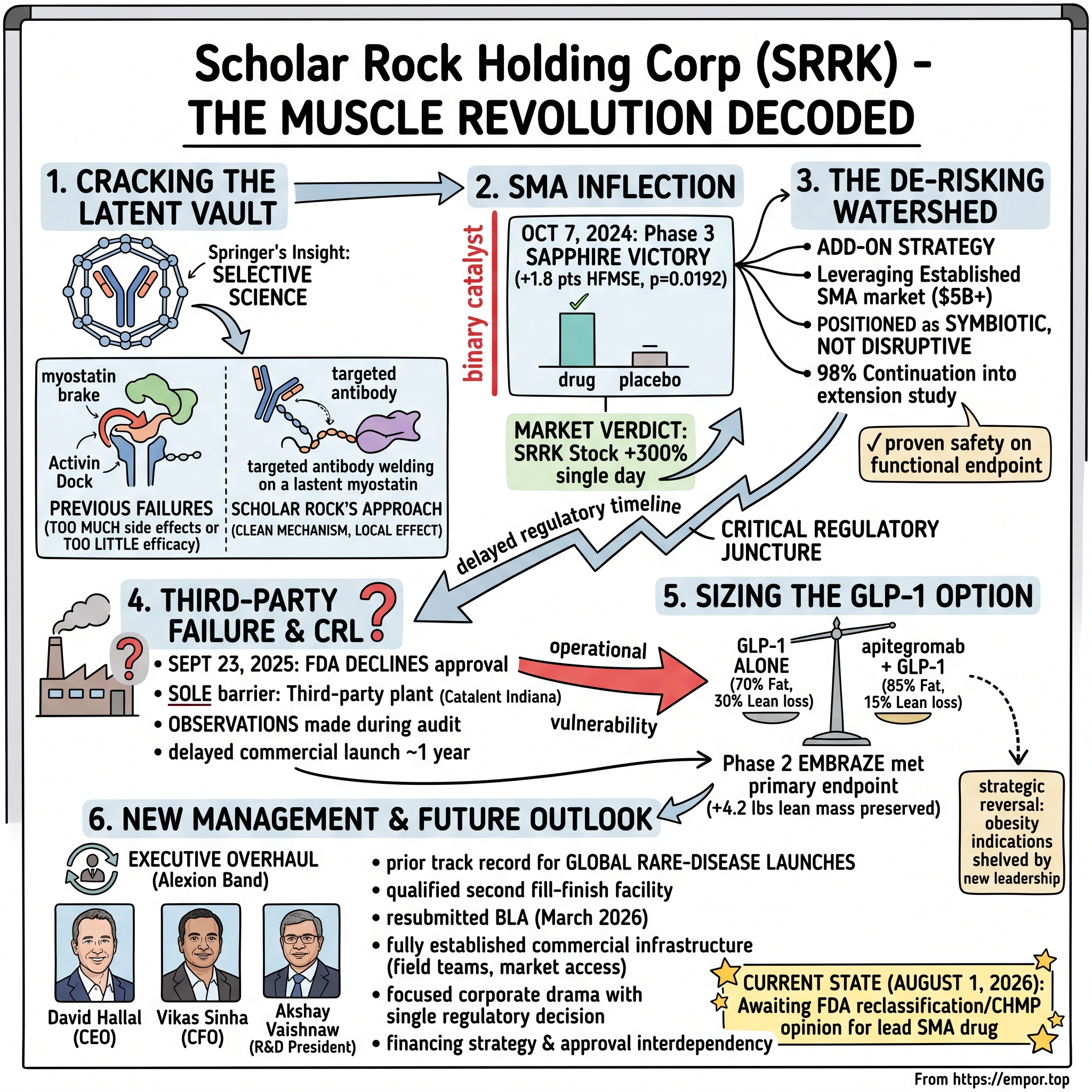
Scholar Rock Holding Corporation: Decoding the Muscle Revolution
I. Introduction & Episode Roadmap (0:00 – 0:10)
On the morning of October 7, 2024, a Cambridge, Massachusetts biotech with a modest market valuation published a press release regarding a clinical muscle scale unfamiliar to most investors. By the closing bell, Scholar Rock Holding Corporation had recorded one of the largest single-day repricings in recent biotech memory — its stock surged more than 300% on news that its lead antibody had improved motor function in children and young adults with spinal muscular atrophy.[^1]1
Almost eleven months later, on September 23, 2025, the company reported that the U.S. Food and Drug Administration had declined to approve the drug. The decision was driven neither by doubts over efficacy nor safety concerns, but by observations an FDA inspector made during an audit of an Indiana fill-finish facility that Scholar Rock does not own, operate, or control.2
That stark contrast — clinical success offset by third-party manufacturing vulnerabilities — defines Scholar Rock in the summer of 2026. The company is not yet a commercial-stage enterprise. It has never marketed a drug or recorded product revenue, and it carries an accumulated deficit of roughly $1.4 billion.3 Yet with its stock trading near $47 per share and a market capitalization of approximately $5.7 billion at the end of July 2026, equity markets price the company as though regulatory approval is largely a formality.4
The remaining hurdles suggest otherwise.
The company today
Scholar Rock is a clinical-stage biopharmaceutical company built on a specific biological strategy: targeting growth factors while they remain inactive inside precursor molecular cages within specific tissues, rather than attempting to intercept active proteins circulating in the bloodstream. The company's foundational premise was that designing an antibody to select and stabilize one of those precursor cages — in a single tissue, for one growth factor, without cross-reacting with closely related growth factors that share the same receptors — could achieve what previous drug developers had failed to accomplish.
The lead asset is apitegromab, a monoclonal antibody that binds the inactive precursor of myostatin, the body's natural constraint on skeletal muscle growth. Its initial target indication is spinal muscular atrophy (SMA), a genetic disease characterized by motor neuron loss and muscle wasting. Three approved disease-modifying therapies address the neurodegenerative aspect of the condition, but none directly treats muscle atrophy. Apitegromab is designed as an add-on treatment to existing standard-of-care therapies rather than a standalone replacement.
Why this story matters now
As of August 1, 2026, Scholar Rock stands at a critical regulatory juncture. Its resubmitted Biologics License Application carries a Prescription Drug User Fee Act target action date of September 30, 2026.5 Its European regulatory review remains paused mid-flight, awaiting an FDA inspection verdict for the third-party manufacturing plant that had still not arrived as of July 20, 2026.6 Meanwhile, its commercial infrastructure — including field teams, market access personnel, specialty pharmacy arrangements, and home-infusion partners — has been fully established and funded, sitting idle for nearly a year while burning cash without offsetting revenue.7
At the same time, a second growth vector that previously anchored the bullish investment thesis — muscle preservation during GLP-1 weight loss — has shifted. Scholar Rock conducted the clinical trial, met its primary endpoint, and published its findings in a peer-reviewed journal, but under new leadership, subsequently removed cardiometabolic indications from its active development pipeline.8
This sets up a focused corporate drama: a company with selective science, an unaddressed clinical demand, and an established commercial infrastructure, whose near-term valuation depends heavily on a single regulatory decision in a single quarter.
The roadmap
This analysis traces six key threads. First, the biological complexity of myostatin and why previous muscle-targeted drug candidates routinely failed. Second, the structural-biology discovery at Harvard that made a selective approach possible. Third, the SMA opportunity — why halting motor neuron death alone was insufficient, and how a Phase 2 trial in 58 patients expanded into a Phase 3 program. Fourth, the October 2024 trial readout, the subsequent financing, and the third-party manufacturing failure that delayed the regulatory timeline. Fifth, the obesity application that management tested and validated, but ultimately declined to advance internally. Sixth, the executive overhaul that reshaped the management suite in 2025, the new team's track record, and how investors can stress-test the remaining operational risks.
The story begins where many biotech efforts originate: with two decades of unsuccessful attempts.
 Subscribe on LinkedIn
II. The Science & The Founders: Cracking the Latent TGF-Beta Vault (0:10 – 0:25)
Picture a Belgian Blue bull. Enormous shoulders, absurd haunches, a physique that looks digitally retouched. The animal is not doped. It carries a natural mutation in a single gene — the gene encoding myostatin. Without functional myostatin, muscle simply keeps growing. The same phenotype appears in whippets, in mice, and, very rarely, in humans.
That observation, published in the late 1990s, launched one of the most seductive drug-development premises in modern pharmacology. Myostatin is a brake. Release the brake, grow the muscle. Every wasting disease on earth — muscular dystrophy, cancer cachexia, sarcopenia, ICU-acquired weakness — suddenly had an obvious mechanism to attack.
The graveyard
What followed was twenty years of expensive disappointment.
Wyeth's MYO-029 entered trials in Becker muscular dystrophy, facioscapulohumeral dystrophy, and limb-girdle dystrophies between 2005 and 2007 and failed to improve strength.9 Pfizer spent years on domagrozumab in Duchenne muscular dystrophy; the Phase 2 study in 121 boys could not beat placebo on the four-stair-climb test, and Pfizer discontinued the program.10 Acceleron's ACE-031 — a ligand trap aimed at the activin type II receptor rather than myostatin itself — did the opposite: it worked spectacularly on muscle mass, and was stopped anyway after nosebleeds and telangiectasias, the spidery dilated blood vessels that signal disrupted vascular signaling.11
These two failure modes illustrate why Scholar Rock was formed.
The first failure mode is not enough. Antibodies that mopped up mature, circulating myostatin were selective but weak. Mature myostatin in the blood is a rounding error; the biologically important pool is generated locally, inside muscle tissue, on demand. Chasing it in circulation is like trying to stop a house fire by air-conditioning the street.
The second failure mode is too much. The activin type II receptor is not a myostatin receptor. It is a shared loading dock for an entire family of TGF-beta superfamily ligands — myostatin, GDF11, activin A, and several bone morphogenetic proteins. Block the dock and you block all of them. Muscle grows, but so do the side effects, because activin and BMP signaling maintain vascular integrity and a dozen other housekeeping functions.12 Broad receptor blockade buys hypertrophy and pays for it in systemic toxicity.
The industry's tacit conclusion by the mid-2010s was that myostatin was a compelling target with no safe therapeutic window. That conclusion was flawed, but for an instructive reason: developers had been aiming at the wrong molecular state.
Springer's insight
Scholar Rock was founded in October 2012 on discoveries from the laboratories of two Harvard scientists: Timothy Springer, a professor of biological chemistry and molecular pharmacology at Harvard Medical School and a serial biotech founder, and Leonard Zon of Boston Children's Hospital. ARCH Venture Partners led the company's Series A alongside Polaris Partners and Springer himself, with Nagesh Mahanthappa as founding chief executive.13
Springer's field is structural biology — the painstaking discipline of determining the physical shape of proteins and, from shape, inferring function. His laboratory's work on the TGF-beta superfamily established a principle that turned the pharmacology of these molecules inside out.
Growth factors in this family are not secreted in active form. They are secreted as precursors: the active growth factor wrapped inside a prodomain, a molecular cage. The complex is then tethered into the extracellular matrix of a specific tissue, where it sits, inert, sometimes for extended periods. Activation is a local, mechanical, enzymatic event — a protease snips the cage, or physical force pries it open, and only then does the growth factor engage its receptor.
Springer's group published the crystal structure of the human myostatin precursor and mapped what actually holds it latent: an open, V-shaped, domain-swapped architecture whose stability determines whether the growth factor ever gets out.14 That structure is the intellectual foundation of the company. Scholar Rock calls the concept "supracellular activation" — the idea that the therapeutically crucial biology happens outside the cell, in the tissue niche, before the receptor is ever involved.15
The mechanism, in plain English
Think of myostatin as a guard dog on a chain in a specific yard. Every previous approach either tried to catch the dog after it escaped and was already running around the neighborhood (anti-mature-myostatin antibodies — too late, too diffuse), or blocked the front door of every house on the street so no dog could get in (ActRII blockers — effective, but locking out emergency services and essential deliveries as well).
Scholar Rock's antibody does neither. It binds the chain and the collar — the latent complex, in the yard, before release — and welds them together.
The structural work behind apitegromab, published in 2020, showed exactly how: the antibody recognizes a conformational epitope in the "arm" region of the prodomain, a shape that exists only on the precursor and latent forms. Binding induces conformational changes across the arm and the loops next to the protease cleavage sites, and stabilizes the latent conformation so that the proteases which would normally liberate mature myostatin can no longer reach their targets.16
Two consequences follow, and both matter commercially. First, selectivity: because the antibody recognizes a shape unique to latent myostatin, it does not bind GDF11, activin A, or the BMPs, and therefore does not carry the vascular toxicity that killed the receptor-blocking generation. Second, localization: because the latent complex is anchored in the extracellular matrix of skeletal muscle, the drug's effect is concentrated where the disease resides.
What is proven, and what is inference
Precision about the underlying evidence is essential, because biotech narratives frequently conflate mechanism with clinical outcome.
What is proven is that apitegromab has moved a validated motor-function endpoint in a randomized, placebo-controlled Phase 3 trial, and that across a clinical database now spanning more than 600 patient-years of exposure, the safety profile has not shown the receptor-mediated toxicities that stopped earlier programs.7 That is a tangible result, and it exceeds what any prior myostatin program achieved.
What is inference is the causal chain from "latent-selective binding" to "therefore the platform will generalize." Selectivity is a design feature that removes a known failure mode; it is not a guarantee of efficacy in any new indication. The company's own history underscores this distinction in miniature — Roche and its partner Chugai abandoned an anti-myostatin antibody in facioscapulohumeral muscular dystrophy in the spring of 2026, and Scholar Rock's own management conceded on its May 2026 call that it had never seen the underlying data and could not say whether the failure was tied to the molecule, the trial design, or the disease.7
A disciplined version of the platform claim is narrower than the commercial marketing: Scholar Rock solved the safety problem that defeated ActRII blockade, and demonstrated one efficacy signal in one disease where muscle function is the limiting factor. Everything beyond that remains a hypothesis with a supportive rationale.
That brings the narrative to the disease where the hypothesis was first tested — and to the distinct market structure that made it testable in the first place.
III. The SMA Inflection: From Genetic Fix to Muscle Restorer (0:25 – 0:40)
For most of the twentieth century, a diagnosis of Type 1 spinal muscular atrophy was a death sentence delivered to parents of infants. The disease is caused by mutations in the SMN1 gene; without adequate survival motor neuron protein, motor neurons in the spinal cord degenerate, and the muscles they command wither. Severity runs on a spectrum from infants who never sit to adults who lose the ability to walk in their teens.
Then, over five years, medicine addressed the neuronal driver of the disease.
Biogen's nusinersen, marketed as Spinraza, arrived first — an antisense oligonucleotide delivered by spinal injection. Novartis followed with onasemnogene abeparvovec, Zolgensma, a one-time gene therapy. Roche added risdiplam, Evrysdi, an oral small molecule. Collectively, these SMN-targeted therapies converted a fatal childhood disease into a manageable chronic condition, establishing a market that Scholar Rock's commercial leadership estimated at nearly $5 billion in annual global sales by the end of 2025.17
The gap the neuron drugs left behind
SMN restorers halt motor neuron loss, but they do not rebuild atrophied muscle or directly target the muscle tissue itself. The result, roughly a decade into the SMN era, is a large patient population that is clinically stable yet physically weak — individuals whose disease progression has stalled without substantial functional recovery.
Scholar Rock's commercial organization has frequently highlighted this residual deficit. On its fourth-quarter 2025 earnings call, management noted that 95 percent of patients continue to experience persistent muscle atrophy limiting their function and independence, while a 2025 Cure SMA survey found that 90 percent of patients identified muscle strength as their greatest unmet need.17 Additionally, company disclosures from May 2026 revealed that roughly one-third of individuals living with SMA in the United States have received two or more SMN-targeted treatments, either sequentially or in combination — a critical indicator of market dynamics.7
This pattern demonstrates two key commercial realities. First, patients and physicians are actively seeking additional benefit beyond standard SMN therapy. Second, healthcare payers have already established a precedent of reimbursing multiple high-cost SMA therapies for individual patients. While securing reimbursement for a second drug remains complex, the practice of funding multi-drug regimens in SMA is already taking place.
Positioning as an add-on
A defining element of Scholar Rock's strategy is that apitegromab was never designed to compete with existing SMN therapies from Biogen, Novartis, or Roche. Instead, it was developed to serve as an add-on treatment.
Every clinical trial in Scholar Rock's SMA program enrolled patients who were already receiving background SMN therapy. The asset's commercial rationale relies on those established therapies keeping patients diagnosed, stable, and alive. Rather than attempting to displace incumbent drugs or capture market share from existing treatments, Scholar Rock's objective is to convince prescribers to append apitegromab to current treatment plans.
This positioning offers distinct strategic advantages and operational trade-offs. As an add-on therapy, apitegromab benefits from the patient identification and diagnostic infrastructure established by existing SMN treatments. However, it also faces payer scrutiny and must demonstrate incremental clinical value for patients who are already receiving high-cost care.
From lab bench to public market
Scholar Rock completed its initial public offering on May 24, 2018, issuing 5.36 million shares at $14.00 per share to raise approximately $75 million in gross proceeds, led by Jefferies, Cowen, and BMO Capital Markets.18 Underwriters subsequently exercised their option to purchase additional shares in full, bringing the total offering to 6.16 million shares and roughly $86.3 million in gross proceeds.19
This capital raise valued the enterprise at a fraction of its current market capitalization — an amount comparable to what the company now spends in a single operating quarter. Weighted-average shares outstanding expanded from approximately 30.7 million in 2020 to roughly 114.7 million in 2025.20 Investors holding equity through the clinical development phase experienced significant share dilution as the company financed its ongoing development losses, dividing corporate growth across a substantially larger share count.
TOPAZ: the proof of concept
Initial clinical proof of concept came from the Phase 2 TOPAZ trial, an open-label study that enrolled 58 patients with Types 2 and 3 SMA, including 35 non-ambulatory participants, with a mean overall age of 7.3 years.21 While small open-label trials are designed primarily to generate hypotheses rather than secure regulatory approvals, TOPAZ provided early signal direction for the program.
At 36 months, non-ambulatory patients achieved a mean improvement from baseline of 4.0 points on the Hammersmith Functional Motor Scale Expanded, accompanied by sustained gains on the Revised Upper Limb Module and patient-reported reductions in fatigue.21 Among the broader cohort, 28 of 32 patients maintained or improved their baseline World Health Organization motor milestones, and over 90 percent remained enrolled in the study with no new safety signals identified.22
Two aspects of the TOPAZ dataset stood out. First, the findings showed functional stability and improvement over three years, contrasting with the expected natural decline observed in historical controls on background therapy alone. Second, the study achieved a retention rate exceeding 90 percent over three years, reflecting high trial adherence among participating families.
Because TOPAZ lacked a randomized placebo control group, its results remained subject to potential open-label bias and practice effects. The trial provided the necessary foundation to launch a definitive Phase 3 program. That pivotal trial, named SAPPHIRE, read out in October 2024.
IV. The De-Risking Watershed: The October 2024 SAPPHIRE Phase 3 Victory (0:40 – 0:58)
Consider Scholar Rock's financial position heading into the final quarter of 2024.
On September 30, 2024, the balance sheet held roughly $139 million in cash and short-term investments, with total shareholders' equity of about $79 million.3 With quarterly cash burn exceeding $60 million, the company faced a strict financial runway. A Phase 3 trial reading in a rare pediatric neuromuscular disease represented a classic binary catalyst — one that would either secure the enterprise's strategic future or severely exhaust its remaining capital.
What SAPPHIRE tested
The pivotal SAPPHIRE trial was a randomized, double-blind, placebo-controlled study enrolling 188 participants aged 2 to 21 with Types 2 and 3 SMA, all receiving background treatment with either nusinersen or risdiplam.23 Patients received apitegromab at doses of 10 milligrams per kilogram or 20 milligrams per kilogram, or a placebo, added to their existing background therapy. The primary efficacy analysis focused on the main age cohort of 2 to 12 years, while the older group of 13 to 21 years — comprising 22 patients on drug and 10 on placebo — served as an exploratory cohort.23
The primary endpoint measured change from baseline at 12 months on the Hammersmith Functional Motor Scale Expanded (HFMSE). The HFMSE is an objective, clinician-administered physical assessment evaluating real-world motor tasks, including sitting, rolling over, standing, and head control. Because it evaluates direct functional capability rather than biomarker surrogates, regulatory authorities view the scale as a gold standard for clinical benefit.
The result
On October 7, 2024, Scholar Rock announced that apitegromab achieved its primary endpoint, demonstrating a statistically significant and clinically meaningful improvement in motor function compared to placebo.24 Published results in The Lancet Neurology detailed a least-squares mean difference in HFMSE score of 1.8 points favoring apitegromab, with a p-value of 0.0192 in the 2-to-12 age group.2526
While secondary commentary often described the readout in superlative terms, the result represented a statistically clear success rather than an overwhelming outlier. The study met regulatory standards on a rigorous functional endpoint in a rare disease, establishing a reliable statistical margin above chance.
The responder analysis offered further clinical clarity: 30.4 percent of patients treated with apitegromab achieved an improvement of more than 3 points on the HFMSE, compared to 12.5 percent of placebo recipients — representing nearly a threefold increase in the likelihood of a major functional gain.2325 While a group mean difference of 1.8 points provides regulatory proof, a nearly one-in-three probability of achieving a 3-point gain reflects practical daily utility for patients and caregivers managing motor tasks.
The drug's safety profile remained favorable and consistent with earlier TOPAZ trial findings across all age groups. No clinically relevant dose-dependent toxicities emerged, serious adverse events aligned with expected SMA disease progression, and no participants discontinued treatment due to adverse events.23 Furthermore, 185 out of 188 participants — 98 percent — opted to continue into the ONYX open-label extension study.23
The study design contained one notable nuance regarding dosing strategy. Both the 10 milligram per kilogram and 20 milligram per kilogram arms demonstrated comparable pharmacodynamic activity, leading researchers to pool both dosage cohorts in the primary analysis to maximize statistical power. Management subsequently informed the FDA that it would seek approval specifically for the 10 milligram per kilogram dose, adhering to the regulatory guideline of filing the lowest effective dose.27 While Wall Street analysts questioned whether combining doses artificially smoothed the efficacy signal, management maintained that the identical pharmacodynamic profiles justified the pooled analysis and single-dose filing strategy.
The market's verdict, and the raise
Following the announcement, Scholar Rock's common stock surged over 300 percent in a single trading session.[^1] Industry media highlighted the event as a significant validation for a myostatin-targeting approach that many drug developers had previously abandoned.1
Management acted quickly to capitalize on the market revaluation. On October 8, 2024, the company priced an upsized underwritten public offering of roughly 10.27 million shares at $28.25 per share, alongside pre-funded warrants for approximately 354,000 shares, generating about $300 million in gross proceeds.28 Concurrent private placement transactions brought total capital raised in the round to approximately $345 million.29
This financing decision provided immediate balance sheet strength while introducing noticeable equity dilution. By executing the offering within 24 hours of the clinical readout, leadership secured capital during peak market demand, elevating cash and short-term investments to approximately $437 million by the end of 2024.3 However, issuing equity equal to roughly 10 percent of the company at $28.25 per share added share supply at a valuation well below later trading levels, representing a necessary operational trade-off to de-risk commercialization funding.
And then the factory
Scholar Rock subsequently submitted its Biologics License Application (BLA) to the FDA, gaining Priority Review with a PDUFA target action date of September 22, 2025, while filing a parallel European Marketing Authorization Application.30
During an August 6, 2025 earnings call, Chief Executive Officer David Hallal disclosed that FDA inspectors had issued Form 483 observations at two contract manufacturing facilities, including Catalent Indiana, the primary fill-finish site that was being acquired by Novo Nordisk. Hallal noted that over 70 percent of FDA manufacturing inspections in 2024 resulted in observations, characterized late-cycle regulatory discussions as constructive, and stated that the agency was working toward the September target date.27
On September 23, 2025, the FDA issued a Complete Response Letter (CRL). Compliance deficiencies at Catalent Indiana constituted the sole approvability barrier; the agency raised no issues regarding apitegromab's efficacy data, safety profile, or drug substance manufacturing.2 The company's stock declined roughly 15 percent in pre-market trading following the news.31
The setback highlighted an important vulnerability in biopharmaceutical execution. Despite successfully validating the underlying biology, meeting clinical endpoints, and advancing label negotiations, Scholar Rock's initial timeline was halted by compliance issues at a third-party facility. As Hallal later observed, Catalent Indiana was undergoing an ownership transition to Novo Nordisk, an entity not traditionally focused on contract manufacturing operations.7 Reliance on a single fill-finish vendor ultimately introduced an operational single point of failure, pushing back commercial launch expectations by approximately one year.
V. Sizing the Future Option: Muscle Preservation in GLP-1 Obesity (0:58 – 1:12)
For about eighteen months, the most exciting thing about Scholar Rock to a generalist investor had nothing to do with spinal muscular atrophy.
The logic was irresistible. Semaglutide and tirzepatide were producing weight loss at magnitudes previously achievable only with surgery. But scale weight is not body composition, and a growing body of evidence suggested that a substantial fraction of what patients were losing was not fat. If a company owned a clean, selective way to protect muscle during incretin-driven weight loss, it owned a toll booth on the largest pharmaceutical market ever created.
Scholar Rock decided to test it.
EMBRAZE
The Phase 2 EMBRAZE trial was a 24-week, randomized, double-blind, placebo-controlled proof-of-concept study in adults with obesity or overweight receiving tirzepatide. The design was deliberately simple: does adding apitegromab change the composition of the weight that comes off?
The topline, reported in June 2025, answered yes. Patients receiving apitegromab at 10 mg/kg alongside tirzepatide preserved an additional 4.2 pounds — 1.9 kilograms — of lean mass compared with tirzepatide alone, a 54.9% relative reduction in lean-mass loss, with a p-value of 0.001.32 The control-arm finding was equally notable as a piece of field-defining data: 30% of total weight lost on tirzepatide alone was lean mass. With apitegromab added, the ratio shifted from roughly 70% fat and 30% lean to 85% fat and 15% lean.32 The combination was generally well tolerated. The full results were subsequently published in Nature Medicine.33
As a scientific result, EMBRAZE did exactly what a proof-of-concept study should. It demonstrated that latent-myostatin selectivity translates from a rare pediatric neuromuscular disease into adult metabolic medicine — over 100 adults dosed, mechanism intact, safety intact. On the August 2025 call, management explicitly cited the adult exposure as supporting evidence for a broad SMA label.27
The decision management actually made
Here is where the story diverges sharply from the consensus narrative of 2024.
Scholar Rock did not build an obesity franchise. It chose not to.
On the second-quarter 2025 call, Hallal framed EMBRAZE as raising "the exciting possibility to partner" the myostatin approach in cardiometabolic disease, while stating the company's three core priorities as apitegromab approvals and launch, expansion into additional rare neuromuscular diseases, and disciplined capital allocation.27 Obesity was not on that list.
By the January 2026 strategic-priorities release, cardiometabolic disease had disappeared entirely from the company's stated objectives, which named three things: regulatory approval and commercialization of apitegromab in SMA, development in patients under two years old and in additional neuromuscular diseases, and advancement of the anti-myostatin pipeline including SRK-439.34 SRK-439 itself — once described as the obesity asset — was recharacterized as a subcutaneously administered antibody for rare neuromuscular diseases, and the company's own pipeline page as of mid-2026 lists no cardiometabolic programs at all.8
That is a genuine strategic reversal, and it deserves to be named as one rather than smoothed over.
Reading the reversal
There are two plausible interpretations, and an investor should hold both.
The charitable reading is focus. A company with roughly $480 million in liquidity, no revenue, a launch to fund on two continents, and a manufacturing crisis to resolve has no business opening a front against Eli Lilly and Novo Nordisk in the most capital-intensive therapeutic category in the industry.35 Obesity trials are enormous. Cardiovascular outcomes trials are more enormous. Partnering the asset — collecting economics without funding the war — is the rational move for a company of this size. Hallal, Sinha, and Woods all built their careers at Alexion, a company whose defining discipline was extracting extraordinary value from very small patient populations. They are running the playbook they know.
The less charitable reading is that the option is worth less than it looked. Between EMBRAZE's readout and today, the competitive field has filled in fast and from better-capitalized directions. Regeneron reported complete 26-week Phase 2 COURAGE results at the EASD meeting in September 2025 showing that trevogrumab added to semaglutide prevented roughly half of semaglutide-induced lean-mass loss while increasing fat loss, and that a triplet adding garetosmab preserved over 80% of lean body mass — though the triplet carried substantially higher discontinuations for tolerability.36 Eli Lilly's bimagrumab, acquired via Versanis, produced near-additive fat-mass reduction with lean-mass preservation in the BELIEVE trial reported in mid-2025.37 Lilly also halted a Phase 2b bimagrumab study in obesity with type 2 diabetes in September 2025 for stated strategic business reasons while continuing a separate trial.38
Note what that field looks like. Regeneron's approach uses a myostatin antibody plus an activin antibody — more efficacy, more toxicity. Lilly's uses receptor blockade — more mass, historically more receptor-mediated side effects. Scholar Rock's differentiation is precisely that it is the cleanest mechanism. But "cleanest" is a virtue that pays off in chronic, lifelong dosing in a broad population, which is exactly the setting where nobody yet has outcome data.
And no partnership has been announced. As of August 1, 2026, the cardiometabolic opportunity is an asset with a positive Phase 2, a Nature Medicine paper, and no counterparty.
The proportion that matters
For anyone building a view of this company, the arithmetic of attention should follow the arithmetic of value. Apitegromab in SMA is the engine — the asset with Phase 3 data, a filed BLA, a built commercial organization, and a dated regulatory decision. Everything cardiometabolic is a residual claim: real, potentially large, entirely unmonetized, and now explicitly outside the company's stated strategy.
The most useful way to hold the obesity story in 2026 is as a call option the company has written but not yet sold. Which raises the obvious question — who is making these calls, and what does their record say?
VI. Current Management, Execution, & Corporate Governance (1:12 – 1:26)
On April 28, 2025, Scholar Rock took an unusual step just five months before its initial target PDUFA date: it changed its chief executive.39
David L. Hallal, who had chaired the board since 2017, assumed the CEO role from Jay Backstrom, who had led the company since 2022 and remained as a strategic advisor through the transition.3940 Alongside the leadership change, the company created two new executive positions, filling them with industry veterans with shared corporate histories.
The Alexion band
Hallal spent over a decade at Alexion Pharmaceuticals from 2006 to 2016, serving as chief commercial officer, chief operating officer, and ultimately chief executive as Alexion expanded from a pre-commercial firm into a global enterprise generating over $3 billion in annual revenue across more than 50 countries. He later co-founded and led ElevateBio.41
Vikas Sinha, appointed chief financial officer, served as Alexion's CFO from 2005 to 2016 before becoming CFO of ElevateBio.42
R. Keith Woods, appointed chief operating officer, previously managed U.S. operations and the U.K. business at Alexion. He later served as chief operating officer of argenx from April 2018 to March 2023, overseeing the commercial launch of Vyvgart in rare neuromuscular disease.43
Akshay Vaishnaw, appointed to the new role of President of R&D, previously served as president of research and development and chief medical officer at Alnylam Pharmaceuticals.44
Taken together, this executive team brings extensive experience specifically tailored to launching rare-disease biologics globally rather than early-stage discovery science—a clear signal of where the board identified the company's primary operational priority.
The part of the résumé that requires a footnote
A thorough evaluation also requires examining the circumstances surrounding earlier executive transitions. Hallal and Sinha both departed Alexion in December 2016, citing personal and career reasons. Their departures occurred while the board's audit and finance committee investigated an employee's allegations regarding sales practices for Soliris, with contemporary media reports indicating the board had lost confidence in both executives.4546 Alexion stated at the time that the investigation identified no facts requiring adjustments to previously reported financial results.45 Both executives co-founded ElevateBio the following year.
Company disclosures attributed no personal wrongdoing to either executive. Nevertheless, this context remains relevant for investors evaluating the leadership team managing the balance sheet and commercial launch of a pre-revenue enterprise valued at $5.7 billion.
Behaviour over time: what the calls actually show
Beyond executive history, management performance is best evaluated through observable operational execution and communication over time.
On guidance discipline, management's record reflects transparent disclosure alongside optimistic forecasting. In August 2025, Hallal proactively disclosed the contract manufacturing inspection observations—noting that another company had reported issues at the same Catalent facility five days earlier—rather than withholding the information until the regulatory decision.27 While this disclosure weighed on the stock in the short term, it established transparency. Conversely, management's confidence on that same call that the FDA was working toward the September 22 target date proved overly optimistic when the agency issued the Complete Response Letter seven weeks later. Management acknowledged its miscalculation without faulting the regulatory agency.
On responding to regulatory setbacks, the company pursued tangible operational remedies. Following the Complete Response Letter, Scholar Rock executed three specific actions: it convened a Type A meeting with the FDA in November 2025 alongside representatives from Cure SMA and Novo Nordisk; it qualified a second U.S. fill-finish facility; and it resubmitted the BLA on March 31, 2026, incorporating both manufacturing sites to establish redundant supply pathways.47 Qualifying a secondary facility within two quarters—completing technology transfers, engineering runs, and manufacturing validation—addressed the single-source supply vulnerability that triggered the delay. During the May 2026 earnings call, Hallal acknowledged past execution gaps, stating the team committed to avoiding single-source manufacturing dependencies going forward.7
On narrative consistency, management maintained a stable core thesis in SMA while quietly shifting away from cardiometabolic development. Across four consecutive quarterly earnings calls, the company's commercial messaging for SMA remained constant: a target market of 35,000 treated patients globally, 140 key U.S. treatment centers, 2,600 target prescribers, and an established launch-readiness infrastructure.71727 In contrast, the cardiometabolic opportunity transitioned from a lead strategic focus to an unmentioned item within less than a year, with management offering limited public explanation beyond general capital allocation priorities.
Incentives, and one number that should raise an eyebrow
Scholar Rock is now led by professional executives whose alignment with shareholders relies primarily on equity compensation rather than founder ownership, and the magnitude of these grants is evident in financial filings.
In 2025, operating expenses totaled $384.6 million, including $75.6 million in non-cash stock-based compensation.17 In the first quarter of 2026 alone, operating expenses reached $102 million, driven by $80 million in non-cash stock-based compensation—meaning stock compensation in a single quarter exceeded the total recorded for all of 2025.7
Management reported the figure during the earnings call without detailed elaboration, as specific award terms are detailed in proxy filings rather than quarterly results. The economic impact was substantial: significant equity value was granted to employees within a single quarter at a pre-revenue enterprise, creating a spike in reported operating expenses. Excluding non-cash equity compensation, first-quarter cash operating expenses stood at $84 million—providing a clearer baseline for assessing cash burn.7
This compensation structure raises key governance questions regarding whether the underlying equity awards were tied to explicit performance milestones or time-based vesting, and whether an $80 million single-quarter charge is proportionate for a pre-revenue business—questions not fully addressed in earnings reports.
The balance sheet, stripped of its headline
Scholar Rock closed the first quarter of 2026 with $480 million in cash, cash equivalents, and marketable securities.35 However, underlying debt obligations provide crucial context for this total.
Of that $480 million balance, $100 million originated from a March 2026 debt drawdown and $98 million from net proceeds of at-the-market equity issuance during the quarter.7 These inflows followed $60.4 million raised in the fourth quarter of 2025 through warrant exercises ahead of a year-end expiration.17 In March 2026, the company established a credit facility with Blue Oak Capital for up to $550 million. This agreement provided $100 million at closing to refinance an existing debt facility with Oxford Finance, allowed an additional $100 million drawdown during the first quarter, reserved $150 million contingent upon FDA approval, and offered an optional $200 million tranche subject to mutual agreement.17
Consequently, total debt stood at approximately $206 million as of March 31, 2026, against the $480 million cash balance, yielding a net cash position of roughly $275 million.3 With quarterly cash operating expenses running at approximately $84 million prior to commercial launch costs, the remaining capital runway remains closely linked to regulatory outcomes—particularly as the $150 million contingent debt tranche and the potential monetization of a Priority Review Voucher both depend on FDA approval.7
Ultimately, Scholar Rock's financing strategy and regulatory approval timeline are directly interdependent. This operational concentration represents a central factor for investors as the company approaches its regulatory decision.
VII. Competitive Landscape, Helmer's 7 Powers, & Porter's 5 Forces (1:26 – 1:40)
Stripping away the narrative raises a central strategic question: if apitegromab secures regulatory approval, what prevents a competitor from capturing the market?
Helmer's 7 Powers, applied honestly
Cornered resource — strong, and the most defensible advantage. The core asset extends beyond the single antibody to encompass structural insights into latent growth-factor prodomains, the technical capability to engineer conformation-selective antibodies, and the proprietary patent estate protecting apitegromab. The technical difficulty of this approach is highlighted by competitor history: Roche and Chugai abandoned a myostatin-targeted antibody candidate in facioscapulohumeral muscular dystrophy in 2026, with Scholar Rock management noting it had never seen underlying Phase 1 or preclinical data from that program.7 The key differentiator is not merely antibody ownership, but that Scholar Rock's lead asset is backed by a positive Phase 3 efficacy readout and a clinical safety database exceeding 600 patient-years of exposure — evidence no competing myostatin candidate currently possesses.27
Counter-positioning — real and structurally advantageous. By developing apitegromab as an add-on therapy rather than a replacement, Scholar Rock leverages the commercial infrastructure of incumbent market leaders. Biogen, Roche, and Novartis spent a decade establishing diagnostic networks and identifying SMA patients, all of whom represent potential candidates for add-on treatment. Incumbents cannot easily retaliate through price reductions or product bundling, because apitegromab does not directly displace their sales or target their primary revenue streams. Management's statement during its May 2026 earnings call that the company remains agnostic regarding a physician's choice of underlying SMN therapy directly reflects this core commercial model.7
Process power — asserted, but unproven. Scholar Rock characterizes its platform as a repeatable discovery engine, pointing to a pipeline that includes a subcutaneous formulation of apitegromab, SRK-439, three undisclosed neuromuscular programs, and earlier-stage assets in oncology, fibrosis, and hematology.8 However, no secondary molecule in the portfolio has yet demonstrated efficacy in human clinical trials. Establishing true process power requires demonstrating repeatable clinical success across multiple independent programs.
Scale economies — largely absent. Scholar Rock does not maintain internal manufacturing operations. Both drug substance production and fill-finish processing are fully outsourced to third-party contract manufacturers — a dependency underscored by the regulatory delays experienced in 2025. Consequently, the company possesses no manufacturing scale advantages, operating instead with operational supply-chain risks that management has only recently sought to mitigate through secondary site qualification.
Switching costs — modest but functional upon commercialization. Monthly chronic infusions, coordinated through established specialty pharmacies and administered in many cases by home-infusion personnel from a network of over 10,000 affiliated nurses assembled by the company, establish operational routine and treatment continuity rather than formal contractual lock-in.7
Branding and network economies — not materially applicable. In rare-disease therapeutics, traditional consumer branding and network effects exert minimal influence on adoption compared to clinical data and regulatory status.
Porter's five forces
Threat of new entrants: low near-term, moderate long-term. While the biological concept of targeting latent myostatin is well understood across the industry, entry barriers remain substantial. Replicating Scholar Rock's position requires combining specialized conformational antibody engineering, multi-year clinical datasets, and specialized pediatric trial networks — representing a multi-year development timeline for potential entrants starting today.
Bargaining power of buyers: moderate to high, representing a critical unproven variable. Scholar Rock has not disclosed specific pricing figures, stating that final pricing will reflect disease severity, therapeutic benefit observed in the TOPAZ and SAPPHIRE trials, and weight-based dosing schedules that produce a variable price range.17 Management has outlined practical launch hurdles, noting that initial distribution will rely on a temporary miscellaneous J-code, state Medicaid reimbursement approvals may progress slowly, and patient demand will encounter initial payer access frictions.17 These operational dynamics indicate that early commercial revenue will reflect reimbursement processing speed rather than underlying clinical demand.
Bargaining power of suppliers: high due to single-source reliance. While contract manufacturing service markets are often viewed as commoditized, regulatory compliance at a single facility directly dictates commercial timelines. Form 483 inspection observations at a single fill-finish vendor delayed apitegromab's U.S. regulatory timeline by approximately one year and continued to delay European regulatory opinion as of July 20, 2026.6 When commercialization depends entirely on third-party compliance, supplier leverage remains substantial.
Threat of substitutes: currently low, with evolving competitive dynamics. No approved SMA treatment directly targets muscle tissue, leaving physical therapy and nutritional management as supportive care rather than direct substitutes. The key competitive variable is whether emerging or expanded SMN-restoring treatments — such as intrathecal formulations of onasemnogene evaluated in older patient cohorts, as highlighted during the May 2026 earnings call — could reduce residual muscle weakness and potentially constrain apitegromab's target population.7 Management noted that adoption will depend on approved label indications and payer coverage policies, acknowledging that long-term treatment dynamics remain to be established.
Competitive rivalry: low in SMA, but intense in cardiometabolic indications. Scholar Rock maintains a clear first-mover position in SMA muscle preservation. In contrast, any commercial entry into obesity would place the company in direct competition with significantly larger pharmaceutical developers, including Eli Lilly and Regeneron — reinforcing management's strategic decision to seek external partnership rather than fund internal development.
The synthesis
Scholar Rock's competitive position is focused and asymmetrical. In spinal muscular atrophy, the company holds a defensible first-mover advantage rooted in precursor-targeted structural biology, a complementary add-on positioning that avoids direct conflict with established SMN therapies, and an executive team experienced in rare-disease commercialization. Outside SMA, the company possesses preclinical and clinical-stage assets but lacks commercial revenue, internal manufacturing infrastructure, and the capital required to compete independently against major pharmaceutical firms.
Consequently, the company's enterprise valuation rests almost entirely on the commercial execution and regulatory approval of its lead SMA franchise.
VIII. Investment Thesis: Bull vs. Bear Case & Risk Radar (1:40 – 1:52)
Myth versus reality
Three consensus beliefs about Scholar Rock warrant critical examination.
Myth: the SAPPHIRE result was overwhelming. Reality: the primary endpoint was met with a least-squares mean HFMSE score difference of 1.8 points at a p-value of 0.0192 in the 2-to-12 age group, based on a pooled-dose analysis, while the 13-to-21 cohort remained exploratory and small.2523 The readout represents a statistically sound and clinically meaningful result. However, it is not a transformative outlier, and treating it as one risks overpromising when healthcare payers evaluate the real-world value of a 1.8-point improvement.
Myth: the CRL was a formality and cost nothing. Reality: the complete response letter delayed revenue by approximately twelve months, forcing a fully assembled commercial team to draw payroll against zero sales, triggering an additional financing round, and stalling the European approval timeline as well as of August 1, 2026.6 While the absence of scientific or safety criticism in the CRL is positive, a lost year for a pre-revenue enterprise represents a substantial financial burden.
Myth: the obesity opportunity is a free option on top of the SMA business. Reality: although the EMBRAZE trial achieved its primary endpoint with results published in a top journal, company management subsequently removed cardiometabolic indications from its active development pipeline and strategic roadmap.32348 An asset that is neither being advanced internally nor partnered externally carries uncertain stand-alone value in a valuation model.
The bull case
First, the unmet demand is documented and consistent across multiple data points. Scholar Rock is addressing a clear, quantifiable clinical gap. Survey results from Cure SMA, the persistence of muscle atrophy in most treated individuals, the fact that one-third of U.S. patients already receive multiple SMN-targeted therapies, and the 98 percent continuation rate into the ONYX extension study all indicate high demand.17723 Relative to typical biopharmaceutical launches, demand risk remains low.
Second, commercial infrastructure is fully established under experienced leadership. The sales force has been trained and deployed since mid-2025, covering approximately 140 key treatment centers and 2,600 target prescribers. Specialty pharmacy arrangements allow patients to obtain apitegromab through existing SMN distribution channels, a national home-infusion network is operational, and a European headquarters in Switzerland is managing an active compassionate-use program.717 Launch execution led by leadership that previously directed the commercial rollout of Vyvgart provides distinct operational capabilities compared to a first-time commercial organization.
Third, the potential approved label may extend beyond the clinical trial population. Although SAPPHIRE evaluated patients aged 2 to 21, management has requested an FDA label covering all individuals aged two and older. This request aligns with established SMA regulatory precedent, where targeted trials have supported broader approvals across portable mechanisms, and reflects draft label negotiations that were well advanced prior to the CRL.277 A broader label would allow Scholar Rock to target the entire prevalent treated SMA population rather than a subset.
Fourth, the clinical pipeline extends beyond a single asset. The Phase 2 OPAL trial evaluates infants and toddlers under two years old, expanding into gene-therapy-treated cohorts not included in SAPPHIRE. The Phase 2 FORGE study in facioscapulohumeral muscular dystrophy—a randomized, double-blind, placebo-controlled trial of 60 patients addressing a disease affecting over 30,000 individuals across the U.S. and Europe with no approved treatments—was scheduled to begin dosing in mid-2026. Additionally, a subcutaneous formulation of apitegromab demonstrated bioavailability and pharmacodynamics comparable to intravenous administration in Phase 1 testing, while SRK-439, designed with roughly tenfold higher potency, is scheduled for Phase 1 topline data in the second half of 2026.347
The bear case
First, enterprise value is heavily concentrated in a single external trigger. Scholar Rock's valuation rests almost entirely on one molecule in one indication clearing a single regulatory decision, with timing dictated by an inspection verdict at a third-party facility. As of July 20, 2026, the FDA had not issued an inspection classification for Catalent Indiana following its April 2026 audit, with management indicating only that clarity was anticipated in the near term.6 While qualifying a secondary fill-finish facility with commercial supply expected in early third-quarter 2026 establishes operational redundancy, it does not guarantee immediate approval, and European regulatory review remains bound to the FDA's decision on the primary facility.76
Second, capital availability is directly tied to regulatory approval. Unlocking the $150 million debt tranche and monetizing the Priority Review Voucher both depend on obtaining FDA approval.177 With quarterly cash operating expenses running at approximately $84 million prior to commercial launch costs, set against $480 million in gross liquidity and $206 million in debt, capital runway is finite if approval experiences further delays.73 While the company demonstrated its ability to raise $98 million through at-the-market equity sales in early 2026, subsequent raises following regulatory delays would occur under less favorable market conditions.7
Third, commercial pricing and payer reimbursement present unproven execution variables. Scholar Rock has not announced a wholesale acquisition cost. Because apitegromab features weight-based dosing, treatment costs will rise as pediatric patients grow. Initial distribution will rely on a temporary miscellaneous J-code, and the drug will be added as an incremental cost to existing high-cost SMN regimens, leading management to project initial access friction.17 Even with strong clinical demand, reimbursement processing delays could produce a slower initial revenue ramp than typical rare-disease models anticipate.
Fourth, strategic communication has shifted over short timeframes. The decision to transition from a dual SMA and cardiometabolic thesis to an exclusive focus on rare neuromuscular expansion within less than twelve months—combined with an executive transition five months prior to a target PDUFA date—indicates evolving corporate priorities. Positioning the business as a 50-country operating platform and an emerging global biotech powerhouse reflects ambitious messaging for an enterprise that has not yet recorded commercial product revenue.1727
Fifth, executive compensation and capital structure reflect aggressive management practices. The $80 million non-cash stock compensation charge recorded in a single quarter, the multi-tiered financing structure assembled across three quarters, and prior executive transitions at Alexion describe an aggressive operational posture. In an environment with narrow margins for execution error, these governance factors require ongoing monitoring.
Risk radar
The material risks facing Scholar Rock are narrow and specific. Regulatory and manufacturing risk remains the primary factor, having already caused a one-year commercial delay. Supply-chain concentration created that vulnerability, which secondary site qualification has mitigated but not fully eliminated. Reimbursement risk represents an upcoming commercial test, as market adoption depends on payer coverage for additive therapy. Refinancing risk is currently manageable but would increase significantly if regulatory decisions extend beyond 2026. Execution risk in launching across U.S. and European markets simultaneously is notable, though partially offset by management's commercial experience. Broad macroeconomic factors—such as trade policies, international tensions, or technological shifts—exert minimal direct impact on the company's core operating model.
The three KPIs that matter
For long-term investors, the investment thesis reduces to three key performance indicators.
One: regulatory and manufacturing resolution. Key milestones include whether the FDA issues a favorable classification for Catalent Indiana, whether the September 30, 2026 PDUFA action date is met, whether approval encompasses one or both manufacturing facilities, and the specifics of the final label—particularly the approved age range and whether dosing is restricted to 10 milligrams per kilogram. This single metric determines both commercial launch timing and access to contingent debt financing.
Two: patient conversion rates among treated cohorts. Evaluation should focus on the conversion rate of patients on background SMN therapy to combination treatment and the turnaround time for prior authorizations, rather than raw prescription counts. The baseline population consists of roughly two-thirds of the estimated 10,000 U.S. SMA patients who currently receive SMN-targeted therapy.27 While initial quarterly results will reflect miscellaneous J-code and Medicaid processing delays, adoption trends across the first four quarters will signal true market uptake.
Three: clinical validation of the broader pipeline. Topline Phase 1 results for SRK-439 expected in the second half of 2026 and Phase 2 FORGE readouts in FSHD will determine whether Scholar Rock functions as a multi-asset platform or a single-product business. While current market valuation reflects lead asset expectations, long-term valuation multiples will depend on demonstrating repeatable success across secondary assets.
IX. Strategic Playbook & Key Business Lessons (1:52 – 2:02)
Three strategic lessons extend well beyond biotechnology.
Lesson 1: target the state, not just the target
The core scientific insight in Scholar Rock's development story is that the target protein and the druggable mechanism are not identical. Myostatin was correctly identified as a key regulator of muscle growth in 1997, yet two decades of drug development failed because candidates attacked it in the wrong functional state or at the wrong location — either chasing mature protein circulating in the bloodstream or blocking shared cell-surface receptors.
The critical shift came from reframing the question: asking not merely which molecule drives disease, but at what moment, in what molecular conformation, and within which tissue environment it becomes active. Timothy Springer's structural biology work answered that question by identifying the latent precursor complex, caged within the extracellular matrix of muscle tissue, converting an intractable target into a viable therapeutic candidate.1416
The broader strategic lesson: when a validated biological target repeatedly fails in clinical development, the barrier is often not the target itself, but the level of abstraction at which developers intervene. Moving upstream to the mechanism of activation can turn a seemingly insurmountable biological challenge into a solvable structural problem.
Lesson 2: win through symbiosis, not disruption
Scholar Rock's commercial strategy — developing an add-on therapy rather than a standalone replacement — represents a deliberate structural choice.
A drug designed to displace established disease-modifying therapies like Spinraza or Evrysdi would have required head-to-head superiority trials, a switching narrative against established neurology franchises, and complex payer negotiations focused on product substitution. As an add-on, apitegromab requires only an incremental benefit argument, effectively expanding its addressable market as incumbent therapies increase patient survival and diagnosis rates.
This symbiotic strategy carries clear trade-offs. Add-on therapies remain dependent on their underlying host treatments; if future neuroprotective therapies eliminate residual muscle atrophy entirely, the rationale for an add-on diminishes. Moreover, symbiotic assets face heightened pricing scrutiny from payers, who evaluate the marginal cost against incremental clinical gains rather than evaluating a standalone cure.
In markets defined by entrenched incumbents and persistent residual disease, positioning a product as adjacent and additive rather than directly substitutive can lower market-entry barriers. Companies benefit from incumbent market development, provided the asset delivers measurable, independent clinical value.
Lesson 3: capital discipline is about sequencing, not thrift
Scholar Rock's financing history demonstrates that for pre-revenue biopharmaceutical firms, managing the cost of capital depends heavily on timing and sequencing.
The company entered its pivotal Phase 3 trial readout with approximately one year of cash runway and a shareholders' equity base under $80 million, executing a major public equity offering within 24 hours of publishing positive clinical results.328 Raising capital prior to the readout would have caused severe equity dilution, while delaying could have risked missing peak market demand. Capital discipline resided in timing the offering to follow clinical de-risking.
Subsequent financing during the regulatory delay demonstrated a distinct capital strategy: funding the post-Complete Response Letter period through warrant exercises, an at-the-market equity program, and a structured credit facility of up to $550 million that replaced an existing debt facility.17 Utilizing non-equity or structured capital is a recognized approach when market valuations are depressed by third-party operational delays rather than fundamental clinical failures. However, incurring debt in a pre-revenue enterprise shifts solvency risks onto a strict timeline governed primarily by regulatory action dates.
Capital management in binary, development-stage businesses functions as risk sequencing. Rather than solely aiming to minimize near-term dilution or borrowing costs, the objective is to structure financing so that no single operational delay forces capital raises under distressed market conditions. Scholar Rock successfully navigated two capital transitions, leaving its long-term financial trajectory dependent on upcoming regulatory outcomes.
X. Epilogue & Strategic Outlook (2:02 – 2:10)
There is a particular kind of corporate limbo that only pre-revenue biotech produces. Somewhere in the United States, in a facility Scholar Rock does not own, sit vials of apitegromab that are already manufactured, already filled, already tested. A field team has been calling on 140 treatment centers for more than a year with nothing to sell. Families in a compassionate-use program in Germany are already receiving the drug. And the entire enterprise waits on a classification letter.
That is the state of play as of August 1, 2026.
The catalyst horizon
The near-term sequence is unusually legible. The FDA's target action date on the resubmitted BLA is September 30, 2026, and management has noted that approval could arrive sooner, pointing to a Regeneron precedent involving the same facility that was approved within roughly a 60-day window following a Class 2 resubmission.7 The company expects ample commercial supply from its second fill-finish site early in the third quarter and plans to launch immediately upon approval.7
In Europe, the timeline for a Committee for Medicinal Products for Human Use opinion has shifted. A July 20, 2026 update confirmed that the European Medicines Agency is waiting on the FDA's inspection classification of Catalent Indiana following its April 2026 inspection; if reclassification comes, an opinion is expected later in 2026, and if it does not, the company will work with European regulators to substitute the second facility.6 Germany remains the intended first European launch market, where the formal AMNOG pricing process will follow initial list-price entry.7
Beyond regulatory milestones, the pipeline includes topline Phase 1 results for SRK-439 in the second half of 2026, patient dosing in the Phase 2 FORGE trial in facioscapulohumeral muscular dystrophy starting in mid-2026, continued trial enrollment in OPAL, and planned regulatory engagement regarding subcutaneous apitegromab following approval.347 The company's second-quarter 2026 financial results are scheduled for August 6, 2026.6
What this company actually is
Scholar Rock represents a genuine scientific achievement attached to an unfinished commercial enterprise. The underlying science is well validated: a structural insight from a Harvard laboratory produced a molecule that accomplished what two decades of prior attempts could not, demonstrating clear efficacy on a functional endpoint in a randomized trial. That clinical milestone explains why the company commands a multi-billion-dollar valuation.
However, equity markets are now pricing a commercial enterprise rather than an isolated molecule, and the company has yet to demonstrate the operational capabilities by which commercial biotechs are judged. It has never set a product price, negotiated a national reimbursement agreement, shipped a commercial vial, or reported a quarter of product revenue. In its most recent reported quarter, its largest single operating expense line was non-cash stock compensation. Its financing strategy and its regulatory outcome remain bound to the exact same event. Meanwhile, its second major growth thesis—which briefly attracted broad generalist investor attention—has been shelved by its own leadership.
The bridge between those two realities is roughly sixty days wide, hinged entirely on an inspector's assessment of a third-party manufacturing plant. For a long-term investor, the critical question is not whether apitegromab functions biologically. That clinical question has been answered. The remaining question is whether a management team assembled for commercial launch can convert a documented unmet need into a durable, priced, and reimbursed franchise — and subsequently repeat that success with a pipeline that has yet to deliver a second Phase 3 victory.
References
-
Scholar Rock's SMA drug meets main goal in late-stage study — Reuters, 2024-10-07 ↩↩
-
FDA Issues Complete Response Letter (CRL) for Apitegromab as a Treatment for Patients with Spinal Muscular Atrophy (SMA) Solely Related to Observations Identified at Catalent Indiana LLC Fill-Finish Facility — Business Wire, 2025-09-23 ↩↩
-
Scholar Rock Holding Corp Form 10-K for the year ended December 31, 2025 — US SEC, 2026-03-03 ↩↩↩↩↩↩
-
Scholar Rock Holding Corporation (SRRK) Stock Overview — StockAnalysis, 2026-07-31 ↩↩
-
Scholar Rock Reports First Quarter 2026 Financial Results and Recent Business Highlights — Scholar Rock, 2026-05-07 ↩
-
Scholar Rock Provides Update on Timing of Committee for Medicinal Products for Human Use (CHMP) Opinion for Apitegromab Marketing Authorisation Application (MAA) for Spinal Muscular Atrophy (SMA) — BioSpace, 2026-07-20 ↩↩↩↩↩↩↩
-
Scholar Rock Holding Corporation earnings call transcripts — Seeking Alpha ↩↩↩↩↩↩↩↩↩↩↩↩↩↩↩↩↩↩↩↩↩↩↩↩↩↩↩↩
-
Inhibition of myostatin and related signaling pathways for the treatment of muscle atrophy in motor neuron diseases — Cellular and Molecular Life Sciences, 2022 ↩
-
Pfizer drops muscle-growth antibody after it misses phase 2 endpoint in DMD — Fierce Biotech ↩
-
Myostatin inhibitor ACE-031 treatment of ambulatory boys with Duchenne muscular dystrophy: Results of a randomized, placebo-controlled clinical trial — Muscle & Nerve, 2017 ↩
-
Myostatin inhibitors in sarcopenia treatment: A comprehensive review of mechanisms, efficacy and future directions — Molecular Biology Reports, 2025 ↩
-
Scholar Rock Announces $20 Million Series A Financing — Scholar Rock ↩
-
Structure of the human myostatin precursor and determinants of growth factor latency — The EMBO Journal, 2018 ↩↩
-
Structural basis of specific inhibition of extracellular activation of pro- or latent myostatin by the monoclonal antibody SRK-015 — Journal of Biological Chemistry, 2020 ↩↩
-
Scholar Rock Reports Fourth Quarter and Full Year 2025 Financial Results and Recent Business Highlights — Scholar Rock, 2026-03-03 ↩↩↩↩↩↩↩↩↩↩↩↩↩↩
-
Scholar Rock Announces Pricing of Initial Public Offering — GlobeNewswire, 2018-05-23 ↩
-
Scholar Rock Announces Exercise in Full and Closing of Over-Allotment Option in Initial Public Offering — Scholar Rock, 2018 ↩
-
Scholar Rock Reports Full Year 2024 Financial Results and Highlights Business Progress — Business Wire, 2025-02-27 ↩
-
Long-term efficacy, safety, and patient-reported outcomes of apitegromab in patients with spinal muscular atrophy: results from the 36-month TOPAZ study — Frontiers in Neurology, 2024 ↩↩
-
New 36-Month Apitegromab Extension Data Reinforce Long-Term Substantial and Sustained Improvement of Motor Function in Phase 2 TOPAZ Trial Patients with Nonambulatory Spinal Muscular Atrophy — Business Wire, 2023-06-29 ↩
-
Scholar Rock Announces Apitegromab Meets Primary Endpoint in Phase 3 SAPPHIRE Study in Patients with Spinal Muscular Atrophy (SMA) — Cure SMA, 2024-10-07 ↩↩↩↩↩↩↩
-
Scholar Rock Announces Positive Topline Results from Phase 3 SAPPHIRE Trial — Business Wire, 2024-10-07 ↩
-
Newly Published Phase 3 SAPPHIRE Study Highlight Therapeutic Potential of Apitegromab in Spinal Muscular Atrophy — NeurologyLive ↩↩↩
-
Pivotal SAPPHIRE Trial Data Published in The Lancet Neurology — Scholar Rock ↩
-
Scholar Rock Reports Second Quarter 2025 Financial Results and Highlights Business Progress — Business Wire, 2025-08-06 ↩↩↩↩↩↩↩↩↩↩
-
Scholar Rock Announces Pricing of Upsized $300 Million Public Offering of Common Stock and Pre-Funded Warrants — Business Wire, 2024-10-08 ↩↩
-
Scholar Rock Announces Proposed Public Offering of Common Stock and Concurrent Private Placement — GlobeNewswire, 2024-10-07 ↩
-
FDA Grants Priority Review for Biologics License Application (BLA) and EMA Accepts Marketing Authorisation Application (MAA) for Apitegromab as a Treatment for Spinal Muscular Atrophy — Scholar Rock ↩
-
Scholar Rock stock falls after FDA issues CRL for apitegromab due to site issues — Investing.com, 2025-09-23 ↩
-
Scholar Rock Reports Positive Phase 2 EMBRAZE Trial Results Demonstrating Statistically Significant Preservation of Lean Mass with Apitegromab During Tirzepatide-Induced Weight Loss — Scholar Rock, 2025-06-18 ↩↩↩
-
Apitegromab for lean mass preservation during tirzepatide-induced weight loss: a randomized, double-blind, placebo-controlled phase 2 trial — Nature Medicine, 2026 ↩
-
Scholar Rock Highlights 2026 Strategic Priorities — BioSpace, 2026-01-12 ↩↩↩↩
-
Scholar Rock Reports First Quarter 2026 Financial Results and Recent Business Highlights — Business Wire, 2026-05-07 ↩↩
-
Results from Phase 2 COURAGE Trial Demonstrating Potential to Improve Quality of GLP-1 receptor agonist-induced Weight Loss by Preserving Lean Mass, Presented at EASD — Regeneron Pharmaceuticals, 2025-09 ↩
-
BELIEVE: Bimagrumab/Semaglutide Combo Yields Substantial Fat Mass Weight Loss, Preserves Lean Mass — HCPLive, 2025 ↩
-
Myostatin Blocker Preserves Muscle With GLP-1 Treatment — Medscape, 2025 ↩
-
Scholar Rock Appoints David L. Hallal as Chief Executive Officer; Also Announces Addition of Three Key Leaders to Scale for Next Phase of Growth — Business Wire, 2025-04-28 ↩↩
-
Scholar Rock Appoints Jay Backstrom, M.D., M.P.H., to be its Next Chief Executive Officer — Scholar Rock ↩
-
argenx appoints Keith Woods as Chief Operating Officer — argenx ↩
-
Alexion replaces CEO, CFO amid Soliris sales fraud investigation — Fierce Pharma, 2016-12-12 ↩↩
-
Alexion CEO, CFO to leave after losing board confidence — CNBC, 2016-12-12 ↩
 LinkedIn
 WhatsApp
 Reddit
 Hacker News
 Email
Email Kindle
 RSS Feed
 Spotify
 Apple Podcasts
 Amazon Music
 Audible
 YouTube