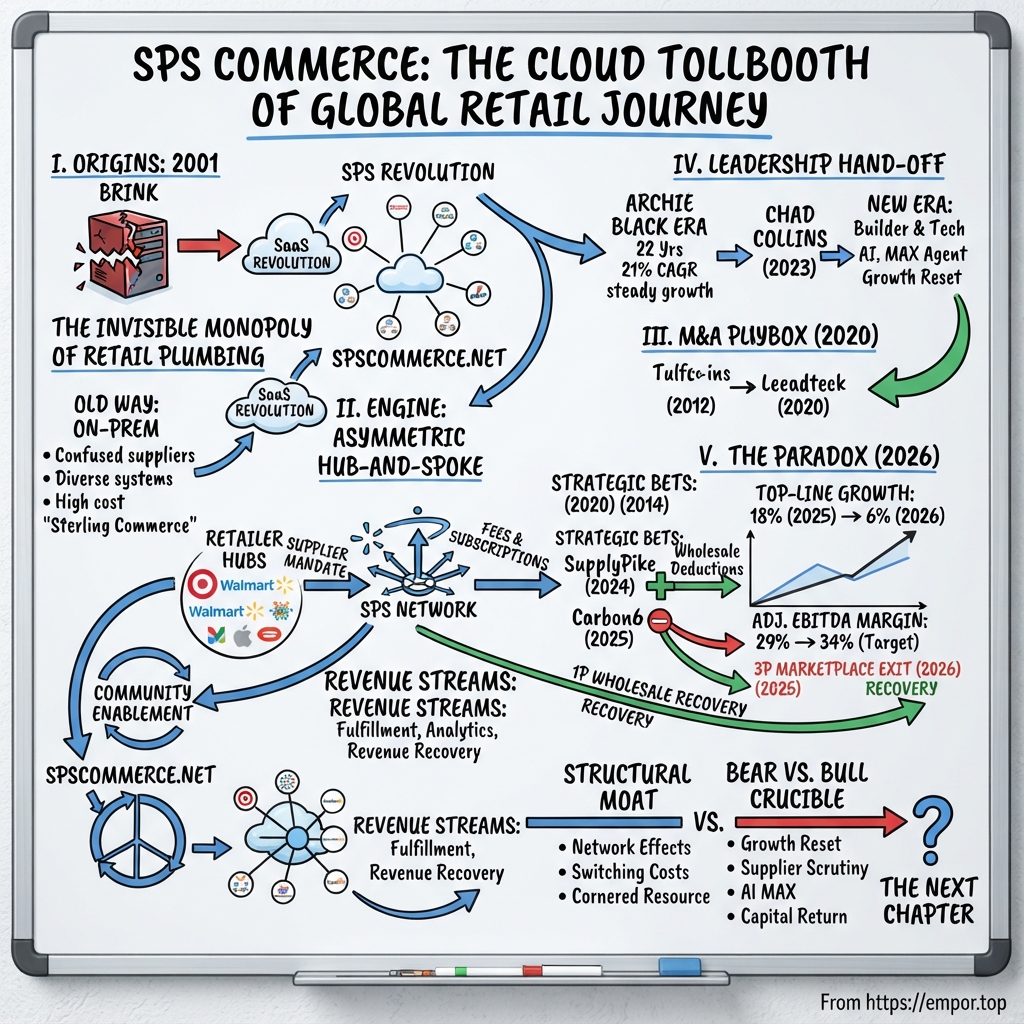
SPS Commerce: The Cloud Tollbooth of Global Retail
I. Introduction & The Invisible Monopoly of Retail Plumbing (00:00–00:15 / 15 min)
A pallet, a barcode, and a message nobody sees
Picture a loading dock outside a Target distribution center at five in the morning. A trailer backs in carrying pallets of tortilla chips from a mid-sized snack brand. Before the driver has even set the brake, the retailer's systems already know what is on that truck: how many cases, which pallets, which purchase order they belong to, and which barcode sits on which carton. If that information is missing or inaccurate, the chips may still get unloaded, but the brand faces a fine, a delayed payment, or a deduction taken straight off its next invoice.
The information that made that morning work did not travel by email or phone call. It moved as a string of dense, fixed-format electronic messages governed by a standard that predates the personal computer: Electronic Data Interchange, or EDI. In the American retail dialect, the messages have numbers instead of names. An 850 is a purchase order. An 856 is an Advance Ship Notice, the digital packing slip that tells the warehouse what is about to arrive. An 810 is an invoice. Behind every bar of soap and pair of sneakers sits a stack of these numbered documents.
Silicon Valley spent a quarter-century declaring EDI obsolete. XML was supposed to replace it. Web services were supposed to replace it. Modern APIs were supposed to replace it. Blockchain was, briefly, supposed to replace everything. Yet the numbered documents keep flowing, and one Minneapolis company built an entrenched business by standing in the middle of them.
The company in the middle
That company is SPS Commerce, Inc. (NASDAQ: SPSC). In February 2026, it reported its 100th consecutive quarter of top-line growth, a streak running back to the early 2000s, and full-year 2025 revenue of $751.5 million, up 18%.1 By mid-2026, the company described its network as spanning more than 300,000 trading relationships, processing more than 750 million transactions a year, touching more than $650 billion of gross merchandise value, and serving seven of the ten largest retailers.2
Those metrics describe an asset closer to infrastructure than software. SPS does not sell an optional tool; it sells a connection that a retailer requires its suppliers to maintain. That requirement creates the tollbooth in this story's title, explaining why the company, for most of its public life, traded like a premium compounder.
The paradox, updated for 2026
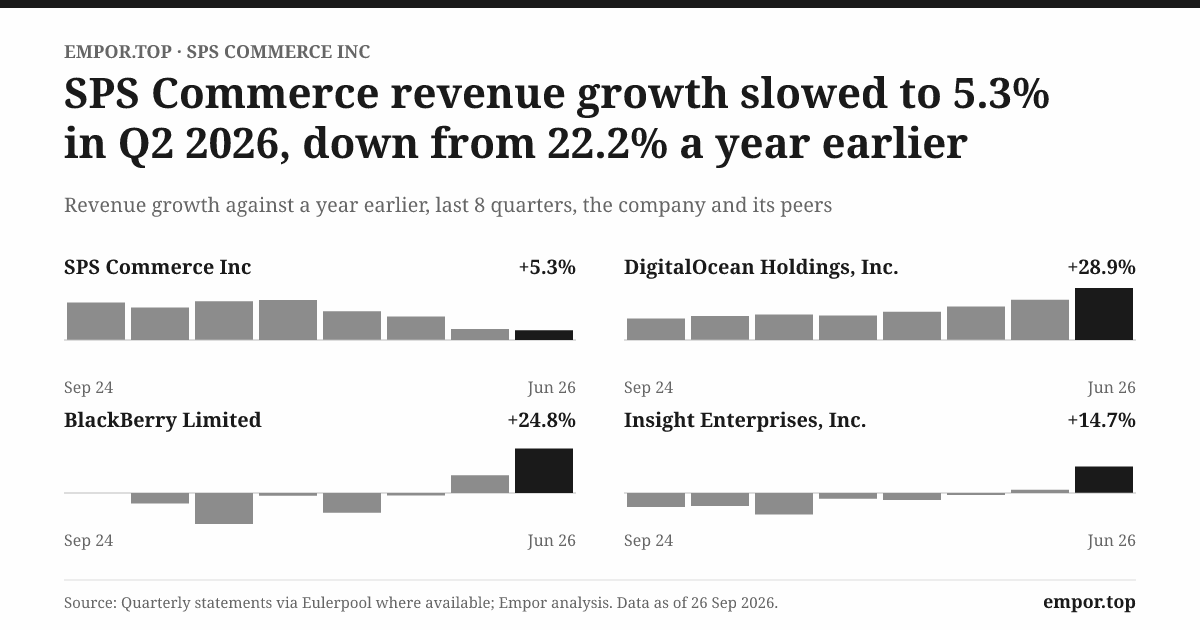
The original version of this story would have read as a straightforward compounding narrative. The 2026 reality is more complicated. The tollbooth still collects cash, with management guiding adjusted EBITDA margins to roughly 34% for 2026.2 Yet revenue growth decelerated sharply within a single year. Revenue rose 18% in 2025, slowed to 6% in the second quarter of 2026, and full-year 2026 guidance calls for 5% to 6% growth.12
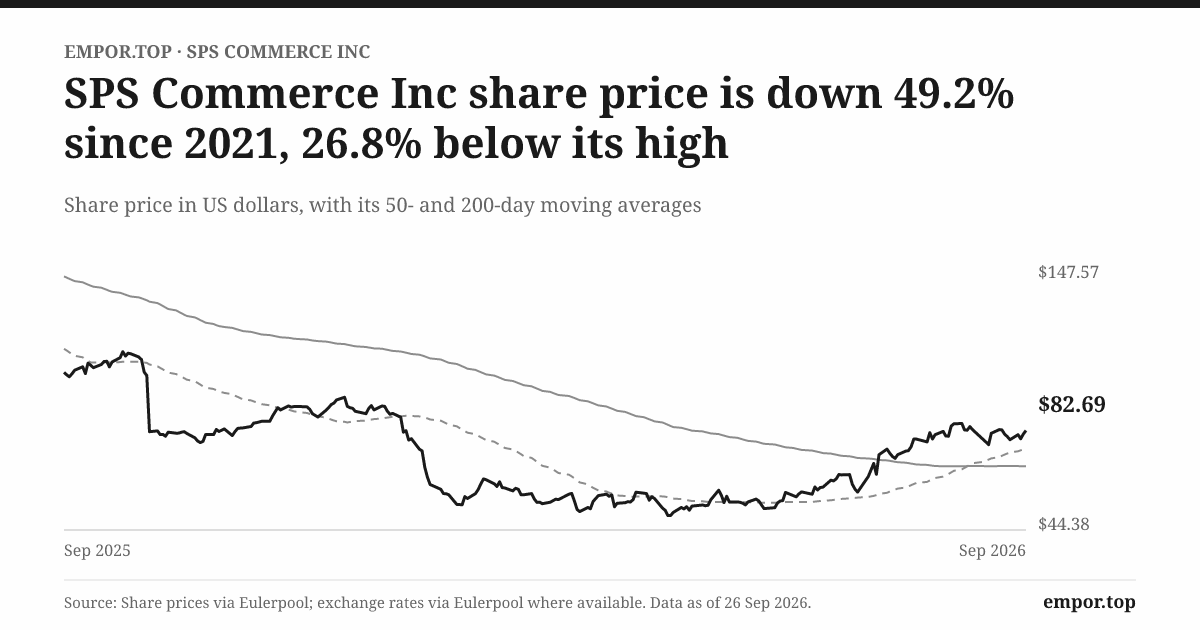
The stock market noticed before the income statement confirmed it. In November 2025, Morgan Stanley downgraded the shares at a price of about $81.65, noting they were down more than 55% for the year and well below a 52-week high of about $201.3 A company long priced as a perpetual high-teens grower suddenly faced a blunt question: was that growth ever as organic as it appeared?
The questions this story tests
The central paradox has two halves. How did a nearly bankrupt dot-com survivor turn a despised, legacy protocol into a high-margin, multi-sided network with a tollbooth across North American retail? And why, at the peak of its financial scale, did that same machine suddenly slow to mid-single-digit expansion?
The path runs through five chapters: the origin and the 2001 brink; the counter-positioning insight against legacy software vendors and private networks; the "community" engine that turns retailers into SPS's unpaid sales force; a two-decade acquisition program that ended with one deal being partially unwound within 17 months; and a leadership handoff from Archie Black and Kimberly Nelson to Chad Collins and Joe Del Preto. Along the way, each pillar of the bull case gets tested against the company's disclosed operating record.
The first test begins in St. Paul, Minnesota, with a software company that almost did not survive the dot-com hangover.
 Subscribe on LinkedIn
II. Origins, the 2001 Brink, & The SaaS Counter-Positioning (00:15–00:35 / 20 min)
St. Paul Software and the old way of doing EDI
On January 28, 1987, a small Minnesota company called St. Paul Software was incorporated.4 Its world was that of mainframes and minicomputers, where large trading partners exchanged business documents through on-premises translation software installed directly on their own machines. A supplier purchased a software license, installed it on a dedicated server, hired a specialist who understood the arcane data-mapping rules, and paid a value-added network operator to carry the messages across private lines.
For the better part of a decade, that was the entire business. It was a respectable, unglamorous niche. It was also an operational treadmill. Every new customer required another installation, another round of systems integration, and another custom set of maps to maintain. Expanding revenue inevitably required expanding technical headcount.
In 1997, the company launched the first version of what would become its hosted service, an early bet on what the software industry would later label software-as-a-service.4 The concept was simple to outline but difficult to execute: rather than installing translation software at every individual supplier, host the software centrally and allow trading partners to connect through a shared network.
The accountant who took a pay cut
Archie Black grew up in Hopkins, Minnesota, in a family of business owners; his father and grandfather ran an appliance distributor in Northeast Minneapolis.5 He studied accounting at Marquette University, graduating in 1984, then started as an auditor at Price Waterhouse before spending 11 years as chief financial officer at Investment Advisors.5
In 1998, he made an unusual career move: he took a significant pay cut to become CFO of St. Paul Software, a business already struggling financially.5 Black was not a software technologist chasing an unproven vision; he was a finance executive who examined a distressed operating model and saw an underlying asset worth rescuing.
The brink
By 2001, the dot-com crash pushed the company toward insolvency. The board elevated Black to chief executive. His initial moves were severe: the sitting CEO was removed, and roughly three-quarters of the workforce was eliminated.5 Black later described the reductions not as a restructuring to expand operating margins, but as an emergency measure "to make the next payroll."5 Of the existing executive ranks, he retained only one person, Jim Frome, and redirected the remaining resources entirely toward retail-focused hosted services.5
That same year, on May 30, 2001, the company reincorporated in Delaware under a new name: SPS Commerce.4 Frome, the lone survivor of the old management team, would stay for more than two decades, retiring at the end of 2024.6
This early brush with insolvency shaped the operating culture that followed. A company that narrowly avoided liquidation tends not to spend like a typical venture-backed software firm. SPS's subsequent reputation among public investors for conservative guidance and steady margin expansion traced directly back to a chief executive who had once been forced to decide which three out of every four employees to let go.
The architectural revolution, explained simply
To understand why SPS's network architecture disrupted the incumbents, consider a marketplace where every retail buyer speaks a distinct dialect of the same language. Under the traditional setup, a supplier selling to 20 retail chains needed 20 separate translators, each configured for one retailer's specifications. If a retailer changed a single formatting rule—such as the exact placement of a carton count on an Advance Ship Notice—thousands of suppliers had to reconfigure their internal software simultaneously.
Legacy software vendors profited from that fragmentation. Companies like Sterling Commerce, which later became part of IBM, and GXS sold software licenses and network transport directly into that complexity.4 Because their revenue depended on licensing fees, bespoke implementation hours, and per-character message volume, integration friction was not a flaw in the business model; it was the primary revenue driver.
SPS inverted that dynamic. It built a centralized translation network, mapped each major retailer's specifications once, and allowed any supplier on the platform to route transactions through that single connection. As the company noted in its 2010 annual report, "a single integration to SPSCommerce.net allows an organization to connect seamlessly to the entire SPSCommerce.net network of trading partners."4 When Target altered an intake requirement, SPS updated the mapping rule once in its central platform, and every connected vendor became instantly compliant without modifying an on-site server.
This shift represents a classic demonstration of counter-positioning, as defined by strategist Hamilton Helmer: a challenger establishes a superior operating model that incumbents cannot replicate without destroying their existing cash flows. For a legacy vendor, introducing a low-touch, standardized subscription model would have cannibalized high-margin professional services and maintenance contracts. The incumbents were not blind to the technology; they were economically constrained by their existing customer commitments.
The economics improved equally for suppliers. Under the on-premises model, a small manufacturer faced substantial upfront software licenses, consulting fees for implementation, ongoing technical staffing costs, and per-document network fees. Those expenses arrived before the brand shipped its first carton. Under SPS's hosted model, the vendor paid an onboarding fee and a predictable recurring subscription, outsourcing compliance maintenance entirely. For a mid-sized consumer goods business without an in-house IT team, that predictable cost structure was the difference between qualifying for retail distribution and remaining shut out.
The hosted model also expanded the addressable market. Legacy enterprise vendors targeted large suppliers because high implementation costs required large contract values. By reducing the marginal cost of onboarding, SPS unlocked the long tail of retail suppliers: regional food brands, independent apparel lines, and specialized manufacturers. While modest individually, these thousands of smaller vendors represented the precise cohort where retailers struggled most to enforce electronic compliance.
Why SPS survived when other dot-coms did not
The early 2000s produced dozens of business-to-business exchange platforms promising to digitize supply chains, most of which failed once capital dried up. SPS survived through operational discipline and narrow focus. Rather than attempting to build open marketplaces where buyers and sellers discovered one another, SPS focused strictly on transmitting transaction documents between trading partners with established purchase orders. It did not have to create trading demand; transaction volume was generated automatically each time a retailer issued an order.
That narrow operational focus became an enduring corporate pattern. SPS generated strong financial returns when operating directly inside established retail-supplier workflows, and encountered difficulty whenever it expanded into adjacent software categories. That dynamic would re-emerge two decades later, under much higher financial stakes.
Myth vs reality: "EDI is dead"
The myth: SPS owns an unassailable moat because EDI can never be displaced.
The record: Successive technology cycles have promised to render EDI obsolete, yet the standard persists. The protocol survives not because of technical elegance, but because the enterprise retail back office runs on complex, entrenched systems where recertifying tens of thousands of suppliers onto modern protocols poses substantial operational risk for marginal financial gain. While API-native integration platforms such as Orderful and Stedi have emerged to offer developer-friendly tooling, they have not displaced entrenched retail network hubs.
The nuance: The communication protocol itself does not constitute the company's competitive barrier, a reality underscored by SPS's own product roadmap. In early 2026, SPS introduced MAX, an agentic AI framework featuring an interface for agent-to-agent communication based on the Model Context Protocol, the open standard designed to link AI agents to software systems.7 That release demonstrates that SPS is preparing for workflows where automated agents, rather than static EDI documents, exchange business data.
The verdict: Technological evolution refines the investment thesis rather than invalidating it. While raw EDI formats may gradually diminish in relative importance, the enduring economic asset remains the compliance layer: the verified, continuously updated operational rules of retail supply chains across hundreds of thousands of commercial relationships. If that compliance infrastructure translates across future transport protocols, the network advantage holds. If standardized protocols allow retailers to publish machine-readable requirements that suppliers can integrate without an intermediary, the pricing power of the tollbooth narrows. An essential indicator for investors will be whether capabilities like MAX convert into incremental subscription revenue, demonstrating that the compliance moat transfers across technology cycles.
The underlying software architecture explains why SPS's model succeeded technically. It does not explain how the company assembled tens of thousands of paying subscribers without fielding a massive direct sales force. That achievement stemmed from an unusual, highly asymmetric go-to-market engine.
III. The Engine: Asymmetric Hub-and-Spoke Dynamics & Unit Economics (00:35–01:05 / 30 min)
The letter every supplier dreads
Picture the owner of a small specialty pet-food company who has just won distribution with a regional grocery chain. A few weeks after signing the contract, an email arrives from the retailer's vendor-compliance department. The message is polite but firm: from this point forward, every purchase order, advance shipping notice, and invoice must be transmitted electronically according to the retailer's exact technical specifications. The email adds that the retailer has selected a certified network partner to handle vendor onboarding, and notes that non-compliant shipments will incur chargebacks.
That compliance letter functions as the top of SPS Commerce's sales funnel. SPS does not have to persuade the pet-food maker that supply-chain automation is an enlightened operational investment. The retail buyer has already settled the question, backed by the implicit threat of lost shelf space.
The community flywheel
Inside SPS, this process is known as "community enablement." The commercial architecture is straightforward: SPS partners with a major retailer—the central hub—to run an onboarding campaign across its supplier base—the surrounding spokes. The retailer secures cleaner order data, fewer warehouse receiving disputes, and lower back-office administrative overhead. In return, SPS receives a pre-qualified directory of suppliers who suddenly require compliance software under strict deadlines.
The suppliers bear the financial burden. They pay upfront setup and testing fees to achieve certification with the retailer, followed by monthly subscription charges to support ongoing document transmission. Through this mechanism, the retailer's purchasing power effectively converts into SPS's commercial leverage.
The clearest demonstration of this dependency surfaced when the onboarding cadence stumbled. In the third quarter of 2025, management disclosed that several large retailer enablement initiatives had been deferred from late 2025 into the first half of 2026, compressing the one-time testing and onboarding fees SPS had modeled.8 Morgan Stanley highlighted that same structural vulnerability in its November 2025 downgrade, noting that suppliers were purchasing fewer incremental retail connections and running lower transaction volumes on monthly contracts.3
The episode provided dual confirmation for analysts. It demonstrated that retail mandates genuinely power SPS's commercial intake, while highlighting that SPS has little control over campaign timing. When a retail partner delays an onboarding schedule, SPS's expansion timeline stalls alongside it.
Why suppliers pay without much complaint (at first)
For an individual brand, an SPS invoice feels less like an optional software purchase and more like an unavoidable cost of retail distribution. Compared to the existential risk of losing a tier-one retail account over an unreadable barcode or a missing Advance Ship Notice, a regular monthly subscription is a modest operational expense. That asymmetry provides the foundation for the company's pricing stability.
The underlying customer base is also exceptionally distributed. Across each year from 2023 through 2025, SPS's largest individual customer generated less than 1% of total revenue, and recurring subscriptions accounted for 96% of total revenue in 2025.9 No single supplier possesses the negotiating weight to demand contract concessions, and no individual customer insolvency can disrupt the broader financial model.
From 12,400 customers to a larger, stranger base
At the close of 2010, the year of its initial public offering, SPS served roughly 12,400 recurring-revenue customers, generating $44.6 million in total revenue, of which 83% was recurring.4 By the end of 2024, that recurring customer roster had expanded past 45,000.10 By year-end 2025, the count reached approximately 54,600—a sharp one-year influx driven primarily by thousands of micro-merchants acquired through an expansion into third-party marketplace software.7
The composition of that total carries important analytical implications. Broad customer metrics are only informative if the underlying cohorts share similar economic characteristics. The 2025 customer total blended two divergent groups: traditional wholesale suppliers ("1P") selling into physical and digital retail channels across multiple commercial accounts, and small independent merchants ("3P") selling direct-to-consumer inventory on Amazon's marketplace. Executive leadership acknowledged that the latter group comprised "much smaller businesses" exhibiting "a higher churn rate."7
When SPS divested its third-party marketplace recovery operations at the end of June 2026, approximately 7,300 of those merchant accounts exited the platform, bringing the recurring customer base back down to roughly 46,600.11 The adjusted figure represents a smaller footprint, but one that mirrors the durable wholesale core of the enterprise.
Wallet share: the second engine
The secondary pillar of SPS's revenue growth has historically been average recurring revenue per customer, referred to internally as wallet share and tracked by Wall Street as average revenue per user, or ARPU. This metric expands as an existing supplier activates connections to additional retailers, handles higher message traffic, or adopts supplementary tools such as point-of-sale analytics.
ARPU stood at approximately $13,300 in the third quarter of 2025 and averaged roughly $14,300 across full-year 2025.87 It registered at approximately $13,550 in the first quarter of 2026 before rising to roughly $15,100 in the second quarter—a headline jump that management explicitly noted was magnified by the sudden removal of low-revenue marketplace accounts at quarter-end.1211
The broader strategic reality is that ARPU expansion must now shoulder more of the growth profile. In late 2025, management indicated that ARPU expansion represents "probably the faster growing" component of future top-line gains.8 That emphasis marks a significant departure from earlier operating eras, when new supplier additions from community enablement campaigns drove the bulk of expansion. Cross-selling an established customer base carries lower customer-acquisition costs than signing new logos, but it requires suppliers to see genuine utility in software beyond mandatory compliance.
The product lines, in plain English
SPS organizes its commercial portfolio into three principal offerings:
- Fulfillment forms the core compliance platform: processing purchase orders, shipping notices, inventory feeds, and invoices. It is the service mandated by enterprise retailers, and its revenue grew 8% year-over-year in the first quarter of 2026.12
- Analytics aggregates point-of-sale data from retail partners into visual dashboards, allowing suppliers to track sell-through rates and inventory turns across individual store locations. It represents a discretionary analytical tool that gains urgency when store shelf space tightens.
- Revenue Recovery, assembled through the acquisitions of SupplyPike and Carbon6, identifies and challenges automated retailer deductions and compliance chargebacks. It is a newer product line with a noticeably more volatile operational history.
Why the product lines reinforce each other
The economic logic linking these three tools becomes clear across the lifecycle of a retail order. The original purchase order indicates what the retailer requested. The Advance Ship Notice records what the supplier dispatched from its warehouse. The electronic invoice shows what the supplier billed. Point-of-sale data running through Analytics verifies what consumers actually purchased at the checkout register. When the retailer subsequently issues a deduction for a perceived shipping discrepancy or late arrival, Revenue Recovery cross-references that penalty against the historical operational records already archived in SPS's network.
On paper, this integration positions SPS as the sole custodian of the entire transaction record—from order generation to payment settlement and dispute resolution. In commercial execution, however, the financial return hinges on whether suppliers will pay for each module independently, and whether SPS can unite disparate software acquisitions onto a cohesive platform. Management's disclosure that network data now flags "high-probability candidates" for automated deduction disputes, prompting targeted customer outreach with estimated recovery values, represents the type of cross-product integration required to monetize the asset.11 Even so, SPS does not break out separate revenue figures for analytics or revenue recovery in its quarterly disclosures, leaving investors to assess the cross-sell momentum indirectly.
Unit economics: margins up, growth down
The long-term trajectory of SPS's operating leverage is documented across its public filings. In 2010, the business produced $5.2 million in Adjusted EBITDA on revenue of $44.6 million, generating an operating margin in the low teens.4 By 2023, Adjusted EBITDA margin reached 29% on $536.9 million in revenue.13 That margin held at 29% in 2024 before climbing to 31% in 2025, delivering $231.4 million in Adjusted EBITDA.101 For full-year 2026, executive guidance pointed to Adjusted EBITDA margins of roughly 34% at the midpoint, representing approximately 300 basis points of annual margin expansion.2
That operating performance illustrates the classic economics of a centralized software platform: once retailer data configurations and core network plumbing are established, incremental transaction volume flows through at minimal marginal cost. Yet the 2026 financial profile carries a distinct tension. Operating margins are expanding aggressively at the exact moment top-line revenue growth has compressed into the mid-single digits. In enterprise software, that divergence often signals a business transitioning from aggressive market expansion into steady cash-harvesting, regardless of how executives position the narrative. For its part, management has maintained an ongoing target of approximately two percentage points of annual Adjusted EBITDA margin improvement.7
Where the tollbooth analogy breaks down
While the retail tollbooth analogy captures the compulsory nature of the product, it oversimplifies how SPS generates cash. A conventional highway toll charges every vehicle an unalterable rate per trip. SPS bills suppliers through a combination of recurring base platform fees and tiered transaction thresholds, granting customers operational leeway to adjust how many retail connections they maintain, how many document workflows they automate, and which software modules they keep active. During economic expansions, suppliers introduce new product variants, add retail accounts, and see transaction volumes lift SPS's billing tiers automatically. In periods of macroeconomic contraction, those same suppliers audit and reduce discretionary expenses.
Consequently, SPS operates as a hybrid: part mandatory utility, part enterprise application suite vulnerable to corporate IT budget scrutiny. The tollbooth characteristics apply to the mandatory compliance connection; the traditional software dynamics apply to the discretionary modules built around it. The historical record demonstrates that these two layers perform very differently during industry stress.
Historical falsification: the supplier resentment test
The claim: Customer switching costs and structural network lock-in insulate SPS's revenue base from churn and ensure uninterrupted pricing power across macroeconomic cycles.
The strongest disconfirming evidence: The 2025 tariff environment. When consumer-goods suppliers absorbed elevated import duties and margin compression, SPS leadership observed "more spend scrutiny coming primarily on the supplier side."8 By mid-2026, Chief Executive Chad Collins noted that the 2025 supplier contract "rightsizing" had largely dissipated—confirming that commercial clients had indeed trimmed their commitments.11 Morgan Stanley highlighted that same trend, pointing to reduced connection purchases and slowing message volumes on monthly usage plans.3 Furthermore, when SPS instituted a $19.99 monthly base fee for small Amazon marketplace merchants in early 2026, the company projected that up to 4,000 sellers would discontinue their subscriptions, though it characterized the revenue impact as immaterial.12
Weighing it: The actual behavior of the customer base qualifies the initial assumption. Wholesale suppliers did not abandon the platform en masse for lower-cost integration alternatives. Instead, they trimmed optional expenditures: disconnecting peripheral retail links, moving down usage tiers, and postponing analytics purchases. The underlying compliance anchor remained intact, while the discretionary software layers fluctuated with client cash flows. Confirming that core durability, Morgan Stanley tracked organic net additions of roughly 350 to 600 customers per quarter in the run-up to its rating change.3
The verdict: Disclosed operating history refines the competitive thesis. The switching costs safeguarding SPS's core network connection remain robust. However, pricing power and upsell expansion are directly constrained by customer balance sheets, moderating when supplier margins face pressure. Because SPS does not publish formal gross or net revenue retention percentages in its earnings reports, investors must track customer count stability and ARPU progression to gauge retention. The operational benchmark that would validate the defensive thesis is a steady baseline of wholesale supplier accounts alongside a reacceleration in ARPU as supply-chain cost shocks recede.
Yet internal customer expansion represents only one dimension of the company's historical growth. For more than two decades, SPS augmented its organic model with an aggressive programmatic acquisition strategy—a playbook whose ultimate execution tests the durability of the entire platform.
IV. M&A Playbook: Programmatic Roll-Ups to Strategic Expansion (01:05–01:30 / 25 min)
Two kinds of shopping
Every programmatic acquirer eventually confronts the classic temptation of the roll-up model: early transactions are small, inexpensive, and straightforward to integrate; later, as core expansion moderates, deals become larger, pricier, and progressively further from the company's central competency. SPS's operational record reflects that trajectory closely, and its recent transactions produced the company's most visible capital-allocation setback.
SPS's acquisitions historically reflect two distinct archetypes. The first encompasses customer-base and geographic tuck-ins: acquiring smaller EDI service providers, migrating their accounts onto the centralized SPS network, and securing established retailer connections. The second involves capability expansion: acquiring adjacent software products to cross-sell to the suppliers already active on the platform.
The early tuck-ins
In August 2012, SPS acquired Edifice, a provider of retail point-of-sale analytics serving more than 500 customers, including numerous Fortune 1000 suppliers.14 Archie Black framed the transaction as the "next wave of efficiency," arguing that commercial collaboration driven by sell-through data would ultimately prove as vital as transmitting the core transactions.14 The acquisition established the foundation for SPS's Analytics product line.
In October 2014, SPS acquired Australian provider Leadtec for approximately $14.9 million, structured as $12.7 million in cash and $2.2 million in stock.15 The transaction brought integration relationships with major Australian retailers, including Woolworths, Coles, Myer, David Jones, and 7-Eleven.15 It represented a classic network extension: a modest capital outlay to secure a new cluster of enterprise retail hubs.
In December 2020, SPS paid approximately $100 million in cash for Data Masons, an EDI provider focused on enterprises running Microsoft business applications.16 Management projected roughly $20 million in 2021 revenue from the business, implying an acquisition multiple of roughly five times sales.16 The strategic logic centered on controlling the integration bridge between mid-market enterprise resource planning (ERP) platforms and the central retail network.
These early transactions were modest relative to SPS's annual cash flow, sat adjacent to the core compliance engine, and reinforced the platform's hub-and-spoke architecture. After 2023, however, the pace and scale of dealmaking shifted markedly.
The acceleration: Europe, scorecards, and deductions
In July 2023, SPS agreed to acquire TIE Kinetix, a Dutch EDI and e-invoicing provider, for approximately €64.5 million net of cash, closing the transaction that September.17[^18] The primary catalyst was regulatory: European jurisdictions were establishing mandatory electronic invoicing standards, an opportunity highlighted directly by TIE's chief executive.17 Management projected approximately $16 million in 2024 revenue from the acquired operations.17
In May 2024, SPS acquired Traverse Systems, a vendor performance and scorecarding platform, for approximately $25 million in cash and $4.3 million in common stock.18 Traverse provided tools allowing retailers and suppliers to monitor on-time delivery rates and invoice accuracy, establishing an operational bridge to the deduction challenges SPS soon targeted directly.
The big bet: SupplyPike
On August 1, 2024, SPS announced its largest transaction to date: SupplyPike, a software platform designed to track and dispute retail invoice deductions. SPS paid approximately $119 million in cash, net of cash acquired, alongside $87 million in SPS stock.19
To understand SupplyPike's commercial utility, consider the daily workflow of a consumer-brand finance department. When an enterprise retailer flags a shipment as delayed, incomplete, or mislabeled, it rarely sends an invoice for the penalty; instead, it automatically deducts the charge from its next vendor payment. These deductions accumulate across thousands of line items. While many are erroneous, disputing them manually often costs more in labor than the recovered funds are worth. SupplyPike automates both the compliance audit and the dispute filing.
Management projected that SupplyPike would contribute approximately $8 million in 2024 revenue and roughly $25 million in 2025, operating near breakeven on an Adjusted EBITDA basis in 2025.19 Across the roughly $206 million total purchase price, that guidance implied a valuation multiple above eight times expected 2025 sales—a pronounced premium over earlier tuck-ins that reflected a willingness to pay up for incremental growth.
The strategic rationale appeared coherent. Automated deduction recovery naturally complements a network that already processes the purchase orders, advance shipping notices, and invoices central to those disputes. Because SPS already archived verified documentation of what had been ordered, shipped, and billed, it occupied a distinct structural vantage point to contest invalid vendor deductions.
Doubling down: Carbon6
Five months later, SPS accelerated that strategy. On January 2, 2025, the company announced an agreement to acquire Carbon6 Technologies, a software provider for Amazon merchants, for approximately $210 million, split roughly 60% in cash and 40% in SPS equity.20 Carbon6 encompassed two flagship offerings: ChargeGuard, which assists first-party wholesale vendors in contesting Amazon deductions, and Seller Investigators, which assists third-party marketplace merchants in recovering funds lost to fulfillment discrepancies.20 Management projected approximately $40 million in 2025 revenue from Carbon6.20
Chief Executive Chad Collins stated that the acquisition would establish SPS "as a leading provider in the emerging category of invoice deduction management."20 Between SupplyPike's focus on big-box retailers like Walmart and Carbon6's focus on Amazon, SPS committed roughly $416 million to the revenue recovery sector across a five-month span.
An analysis of management's initial projections highlights the magnitude of that acquisition-driven expansion. Total revenue increased by approximately $114 million in 2025.1 If Carbon6 met its projected $40 million contribution and SupplyPike generated roughly $17 million in incremental annual revenue above its 2024 stub period—as management's guidance suggested—approximately half of the company's dollar growth in 2025 stemmed from those two acquisitions. While an analytical estimate rather than a separately reported figure, that dynamic explains why top-line growth decelerated so abruptly once both transactions entered the prior-year comparative base.
The unraveling of 3P
The third-party marketplace component of Carbon6 deteriorated almost immediately. In the third quarter of 2025, management disclosed that revenue recovery revenue trailed internal forecasts by roughly $3 million, attributing the shortfall to unexpected seasonal volatility and policy adjustments implemented by Amazon for third-party sellers.8 "The variability we saw was in the 3P area," management acknowledged.8 By the fourth quarter, Chief Financial Officer Kimberly Nelson reported that revenue recovery had trended "more to the lower end" of guidance, while third-party merchant accounts declined by 350 during the quarter.7
By the first quarter of 2026, leadership cited Amazon marketplace recovery as the primary drag on consolidated growth, asserting that excluding that segment, "the rest of the business is already growing high single digits."12
On June 30, 2026, SPS divested the third-party marketplace recovery business acquired through Carbon6, retaining the first-party wholesale deduction product that serves suppliers across retailers including Amazon, Walmart, Kroger, Target, Home Depot, and Lowe's.21 The buyer was not disclosed. SPS received $9.5 million in cash, recognized a $23.5 million loss on the divestiture, and saw roughly 7,300 merchant accounts leave the platform.11 Reflecting that write-down, second-quarter GAAP net income declined to $6.9 million from $19.7 million in the prior-year period.2
During the second-quarter earnings call, Needham analyst Scott Berg asked Collins why the company had exited an asset it had acquired so recently. Collins responded that wholesale suppliers with multi-retailer relationships represented the superior commercial opportunity, acknowledging that the third-party merchant base lacked "overlap with the other parts of our portfolio."11
Historical falsification: the capital discipline test
The claim: SPS allocates capital with discipline and does not overpay for or write off acquired assets.
The evidence for it: For more than a decade, the operating record supported that view. Early acquisitions—such as Edifice, Leadtec, and Data Masons—were modest in valuation, closely aligned with core retail compliance workflows, and absorbed smoothly into the network architecture.
The evidence against it: The third-party marketplace operation acquired within Carbon6 was purchased as part of a roughly $210 million transaction, missed financial targets within two quarters, and was divested for just $9.5 million roughly 17 months after closing, resulting in a recognized loss.202111 While the absence of a disclosed purchase-price breakdown between Carbon6's wholesale and marketplace assets prevents an exact calculation of the economic loss, the capital destruction was evident. Furthermore, the operational rationale cited for the divestiture—minimal overlap with the wholesale core—was discernible prior to the acquisition.
A secondary cost emerged through balance-sheet dilution. SPS funded both SupplyPike and Carbon6 partially through equity issued when the stock traded near record valuation multiples. Following a drop of more than 50% in the share price by late 2025, the company redirected the bulk of its free cash flow toward share repurchases, deploying $115 million, or 76% of free cash flow, in 2025, and an additional $98.4 million during the first half of 2026.72 Consequently, operating cash flow that could have built balance-sheet reserves or funded core organic initiatives was redirected to absorb dilution from acquisitions that contributed to the subsequent market re-rating.
The verdict: Disclosed results reject the broader claim of unbroken capital discipline. The defensible thesis is narrower: SPS has deployed capital effectively when acquiring businesses that fit directly into its established retailer-supplier compliance network, and struggled when venturing into adjacent cohorts such as independent marketplace sellers. The wholesale deduction business acquired through SupplyPike remains the central test. On the second-quarter call, leadership noted that SupplyPike attach rates had strengthened following a sales reorganization and realigned cross-sell incentives.11 Whether wholesale deduction management evolves into a durable, independently verified revenue contributor will ultimately determine whether the $206 million investment in SupplyPike generated value or merely bought temporary top-line expansion.
That acquisition campaign unfolded under a newly installed chief executive, raising the next question: what changed when the architects of the old SPS handed over operational control?
V. Leadership Hand-Off: The Archie Black Era to Chad Collins (01:30–01:50 / 20 min)
Twenty-two years of Minneapolis discipline
The Archie Black era can be summarized in a single operating metric. From its 2010 initial public offering until Black retired as chief executive, SPS expanded revenue at a 21% compound annual rate.6 The IPO itself was modest: shares priced at $12 in April 2010, raising approximately $33 million in net proceeds.4 By the time the business crossed $500 million in revenue in 2023, it had compiled 92 consecutive quarters of sequential top-line growth.13
The operating culture behind that record was distinctly unhurried. Black framed it around documented values, open employee communication, and hands-on logistics immersion, requiring staff to train inside distribution centers to understand warehouse floor realities firsthand.5 Financially, the blueprint paired conservative guidance and steady margin expansion with disciplined, low-risk tuck-in acquisitions. Kimberly Nelson, who served as chief financial officer for roughly two decades, served as the other half of that executive partnership and the primary public voice of the company's balance sheet.7
The succession
On July 6, 2023, SPS announced that Chad Collins would succeed Black as chief executive on October 2, 2023, with Black transitioning to executive chair.6 Collins, then 47, arrived from supply-chain software provider Körber, where he had led its software division since 2017 following its acquisition of HighJump, a logistics software firm where he served as chief executive after beginning his career as a supply-chain consultant at Cap Gemini Ernst & Young.6
The appointment signaled a deliberate strategic pivot. Collins brought 25 years of operational experience in supply-chain technology, centered heavily on warehouse management and logistics execution.6 Where Black was a finance-trained operator who had steered a distressed business away from insolvency and compounded its core compliance engine, Collins was an enterprise software builder brought in to broaden the platform's commercial footprint.
A builder's instincts, tested quickly
Collins moved swiftly to execute that expansion. Within his first 16 months, SPS announced acquisitions of Traverse Systems, SupplyPike, and Carbon6, representing roughly $445 million in aggregate cash and stock consideration.181920 Among the company's larger modern transactions, only TIE Kinetix had been negotiated during Black's tenure.17 The strategic logic was straightforward: because SPS already processed the purchase orders, advance shipping notices, and invoices establishing shipment compliance, management reasoned it should also provide the analytical software to audit vendor performance and recover disputed chargebacks.
While the commercial thesis aligned with supplier pain points, operational execution diverged. Traverse Systems and SupplyPike operated directly inside the wholesale vendor workflows SPS understood. By contrast, Carbon6's third-party marketplace recovery business served independent Amazon merchants with little structural connection to the wholesale network. Collins opted to divest the marketplace asset within 17 months of closing, absorbing a near-term GAAP loss to excise an underperforming, high-churn customer cohort from the platform.
Collins's public communication also marks a clear departure from his predecessor. While Black's quarterly commentary adhered to financial predictability and operational conservatism, Collins's presentations focus heavily on technology roadmaps, artificial-intelligence initiatives, customer case studies, and cross-selling mechanics.11 For a software company navigating a maturing core market, an expanding product portfolio is a necessary strategic response. However, it shifts the operational benchmark: where a finance-oriented leadership team is evaluated on forecasting accuracy and compounding consistency, a product-focused leadership team is judged on whether platform extensions translate into durable, profitable revenue.
Incentives
Executive compensation structure reflects that shifting mandate. The company's 2026 proxy statement outlines performance stock units within its executive compensation framework, while tasking the board's Finance and Strategy Committee with formal oversight of share-repurchase policies, proposed acquisitions, and potential divestitures.22 For public investors, the governance challenge centers on whether executive incentives reward top-line growth acquired through dilutive M&A or organic gains in per-share intrinsic value. The capital-allocation pivot in 2026 toward aggressive share repurchases and expanded margin targets indicates that board oversight has recalibrated toward capital discipline.
The broader governance transition unfolded along a deliberate schedule. By May 16, 2024, Philip Soran was serving as independent board chair, and the 2026 proxy confirmed that Anne Sempowski Ward would succeed him as chair at the 2026 annual meeting.22
New finance and commercial leadership
The second phase of the executive transition restructured the company's financial and commercial leadership. In late 2025, long-tenured Chief Revenue Officer Dan Juckniess announced his retirement, and Eduardo Rosini joined as Chief Commercial Officer on December 1, 2025, bringing more than 30 years of enterprise software go-to-market experience.8
In February 2026, SPS announced that Nelson would retire after two decades as chief financial officer, naming Joseph Del Preto as her successor effective March 16, 2026.1 Del Preto had previously served as CFO and treasurer of Sprout Social, a publicly traded software company, and stepped onto the quarterly conference calls beginning in the first quarter of 2026.112 On his second earnings call, he attributed second-quarter performance to operational discipline and "up-sell and cross-sell momentum."2
By mid-2026, SPS had replaced its chief executive, chief financial officer, and senior commercial leader within a span of roughly three years. While executive renewal is standard for a maturing enterprise, it carries operational implications: the multi-decade compounding reputation that Wall Street assigned to SPS was built by an executive bench that has largely departed. The incoming team must establish its own track record during the most complex operating slowdown the platform has faced since its 2001 restructuring.
The activist arrives
The newly assembled management team also faced immediate scrutiny from an activist shareholder. On February 12, 2026, SPS appointed two new independent directors, Michael McConnell and Fumbi Chima, under a cooperation agreement with Anson Funds that incorporated customary standstill and voting provisions.23 McConnell had previously served on the SPS board and sat on several public technology company boards, while Chima brought senior executive background across global retailers including Walmart, Adidas, and Burberry.23 Simultaneously, the board expanded its share-repurchase authorization to $300 million.23
In its public remarks, Anson stated that it identified "significant opportunities for SPS to capitalize on its market leadership to drive profitable growth."23 The strategic context was unmistakable: with the share price declining by more than half from its peak, the balance sheet generating substantial free cash flow, and recent capital allocation clouded by the Carbon6 acquisition, external investors demanded tighter cost controls and direct shareholder distributions. The accelerated commitment to share repurchases and margin expansion aligns with that activist presence, even as management frames the measures as internal operating choices.
Historical falsification: management credibility and the guidance record
The claim: SPS management forecasts with near-perfect accuracy and reliably protects investors from guidance disappointments.
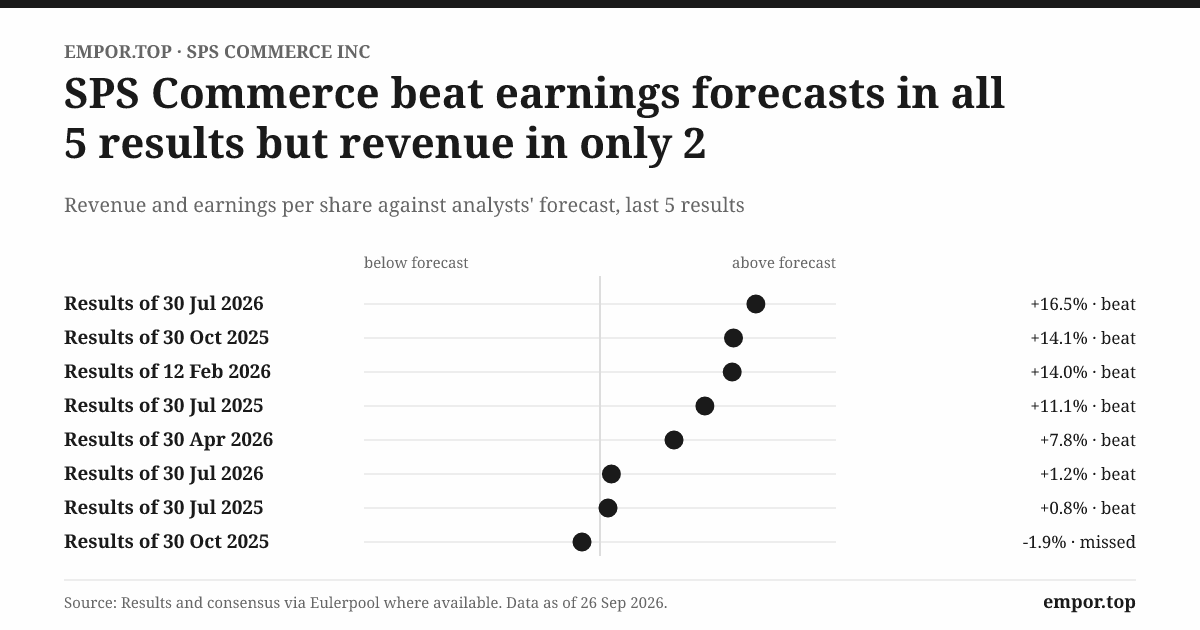
The historical record: For over a decade, public disclosures supported that reputation. In early 2024, for example, management guided to full-year revenue of $616.5 million to $619.0 million, and delivered $637.8 million—though a portion of that outperformance was driven by in-year acquisitions.1310
The recent deviation: In February 2025, executive leadership guided to 2025 revenue of $758.0 million to $763.0 million, factoring in the anticipated contribution from Carbon6.10 Actual full-year revenue came in at $751.5 million, finishing below the floor of that initial projection.1 On the fourth-quarter earnings call, management characterized the outcome as finishing "at the lower end of our revenue guidance"—a description that held true against late-year downward revisions, but obscured the shortfall against the targets set at the start of the year.7 Forward guidance for 2026 underwent successive downward adjustments: from an initial range of $798.5 million to $806.9 million in February, to $796.0 million to $802.0 million in April, and down to $788.4 million to $793.4 million in July, with the final revision reflecting the deduction of roughly $10.5 million in second-half revenue following the marketplace divestiture.1122
Reporting practices contributed to analytical lag. The company's earnings releases report consolidated and recurring top-line figures without explicitly breaking out organic revenue growth. Instead, investors had to assemble underlying organic trends from executive commentary, such as management's October 2025 indication that 2026 organic expansion would track between 7% and 8%.8 While not an obfuscation of GAAP metrics, this reporting friction obscured the extent to which headline growth had become dependent on M&A roll-ins before the slowdown materialized.
The verdict: Operating disclosures qualify the thesis. The Black-Nelson track record of conservative guidance was grounded in an organic wholesale model characterized by high visibility and mandated compliance. Once revenue expansion came to depend on acquired assets exposed to third-party seller volatility, the incoming leadership team missed its original annual projection and lowered forward outlooks over successive quarters. Management deserves credit for identifying concrete operational headwinds—including tariff disruptions, postponed retailer enablement campaigns, and Amazon marketplace policy revisions—rather than resorting to generalized macro explanations. The decisive test of credibility will be whether the recalibrated 2026 revenue guidance holds without further downward revisions outside the scope of the disclosed divestiture.
Leadership discipline faces its toughest trial when the underlying competitive fortress comes under pressure. That turns the investigation to the structural foundation of the business: how defensible is SPS's market position when measured not by company narrative, but against the competitive forces shaping retail supply-chain software?
VI. Industry Structure, Moats, & The 7 Powers (01:50–02:15 / 25 min)
A war game
Consider the strategic challenge confronting an aspiring competitor: tasked by a well-funded board with building a rival retail EDI network and capturing 10,000 suppliers within five years, where does the attack begin?
Underpricing SPS appears to be the intuitive opening move. Yet suppliers do not select SPS on cost alone; they onboard because an enterprise retail buyer mandated compliance, and because an integration failure risks chargebacks, delayed inventory receiving, or lost shelf space. To compete on price, a challenger must first achieve technical certification across every retail hub that a supplier serves—and continuously reconfigure those connections as retailers update formatting rules. A new entrant quickly discovers that the defensible product is not the core software interface; it is the underlying library of verified compliance maps, an operational asset built over decades.
The 7 Powers, applied
Strategist Hamilton Helmer's framework clarifies where SPS's economic barriers hold firm and where they thin out:
1. Network economies. Each enterprise retailer connected to SPS makes the platform more valuable to prospective suppliers, while each supplier already active on the network makes SPS more attractive to retailers planning vendor enablement initiatives. SPS's disclosed network footprint—spanning more than 300,000 trading relationships and serving seven of the ten largest retailers—is the tangible expression of that two-sided dynamic.2 The structural limitation is that these network effects are weaker than those of consumer platforms: major retailers frequently maintain integration arrangements with multiple EDI providers, and suppliers retain the technical option to connect through competing hubs.
2. Switching costs. For a supplier maintaining active connections across dozens of retail partners, changing EDI vendors requires re-testing, data re-mapping, and re-certifying every integration while daily order traffic continues uninterrupted. The financial downside of a botched migration—penalties, administrative disputes, and compromised retail relationships—far exceeds any marginal software savings. As demonstrated during the 2025 tariff pressures, however, this mechanism defends the baseline compliance connection much more reliably than it protects discretionary analytics or add-on software modules.
3. Counter-positioning. Counter-positioning served as SPS's founding advantage against legacy on-premises license-and-maintenance incumbents. That edge has naturally eroded as modern challengers deploy cloud-native architectures. Counter-positioning explains how SPS reached national scale, not how it defends that scale today.
4. Scale economies. Maintaining customized data-mapping rules for thousands of enterprise retail buyers represents a substantial fixed operating cost. Spreading that infrastructure across approximately 46,600 recurring customers following the marketplace divestiture reduces the per-supplier maintenance expense to a fraction of a standalone deployment.11 Supported by a global workforce of 2,948 employees at year-end 2025, SPS can dedicate specialized compliance teams to individual retailer specifications that sub-scale competitors cannot economically match.9
5. Cornered resource, in data form. Chief Executive Chad Collins has articulated an evolving data thesis: that 25 years of accumulated retail transaction patterns and compliance histories constitute a proprietary training foundation for automated supply-chain intelligence. Questioned regarding competitive barriers on the second-quarter 2026 earnings call, Collins argued that this transactional archive yields operational insight "not going to be available in a downloadable vendor guide."11 While strategically logical, that asset remains an unmonetized management thesis until commercial artificial-intelligence applications generate disclosed subscription revenue.
Branding and process power provide limited defensibility. Suppliers do not select SPS because of brand prestige, and its mapping and customer support workflows do not rely on proprietary operational secrets that competitors cannot duplicate.
Porter's Five Forces
- Threat of new entrants: low. Replicating a certified compliance map library and cultivating direct operational relationships with tier-one retail merchandising departments requires years of field execution. Venture-backed API platforms have streamlined developer workflows but have yet to bypass that physical onboarding requirement.
- Bargaining power of suppliers (SPS's paying customers): low to moderate. Individual vendors lack negotiating leverage, with SPS's largest customer generating less than 1% of total revenue.9 Collectively, however, suppliers retain operational discretion: during the 2025 import-cost shock, vendors trimmed peripheral connections and curtailed variable document volumes to protect working capital.3
- Bargaining power of retailers (the hubs): high. Enterprise retailers bear negligible software costs, yet they determine when vendor enablement campaigns launch and which certified network providers they recommend. The deferral of several major retailer onboarding programs in late 2025 illustrated how retail procurement schedules directly govern SPS's top-line cadence.8
- Threat of substitutes: moderate. Retailer-operated supplier web portals, direct custom API pipelines, ERP-embedded connectors, and emerging autonomous software agents each handle discrete portions of the document workflow. While none has displaced centralized EDI networks across enterprise retail, each alternative captures peripheral transaction volume.
- Competitive rivalry: moderate. The market is concentrated among a small tier of established integration networks, complemented by regional and industry-specific specialists.
The named rivals
OpenText, which integrated GXS, operates as the largest global EDI network provider. Its core strength lies among multi-billion-dollar multinational corporations across automotive, manufacturing, and industrial supply chains. For a mid-market consumer goods brand, OpenText's enterprise software stack is typically heavier and more services-intensive than SPS's hosted model.
TrueCommerce, backed by private equity, represents SPS's most direct competitor within retail and distribution EDI, competing aggressively on pre-built connectors for mid-market enterprise resource planning (ERP) and accounting software. It is the primary alternative evaluated by price-sensitive consumer goods manufacturers.
IBM Sterling, the enterprise platform descendant of Sterling Commerce—which SPS identified as an incumbent rival in its 2010 initial public offering—maintains a durable presence inside large enterprise IT departments managing hybrid and on-premises infrastructure.4
Cleo concentrates on integration infrastructure for logistics providers and industrial manufacturing, while Orderful reflects the venture-backed push to modernize transaction data exchange through developer-first API interfaces.
Rithum, formed through the merger of CommerceHub and ChannelAdvisor, leads in drop-ship management and e-commerce marketplace connectivity, operating at the intersection where wholesale supply chains meet direct-to-consumer digital channels. That competitive boundary gained clarity following SPS's 2026 marketplace exit: SPS effectively ceded independent merchant recovery to focus its resources on wholesale brand suppliers.
Where the moat is thinner than it looks
Three structural boundaries delineate SPS's actual market reach.
First, geographic concentration. SPS's network density is overwhelmingly concentrated in North American retail. Its international expansions—acquiring Leadtec in Australia and TIE Kinetix in the Netherlands—remained modest relative to its domestic base, and European markets feature deeply entrenched local EDI and e-invoicing operators.1517 International expansion remains an operational option rather than a proven growth driver.
Second, dependency on platform rules. Enterprise retailers and marketplace operators retain complete authority over their intake protocols and vendor portals. When Amazon adjusted its operational policies for third-party sellers in 2025, SPS's acquired marketplace recovery unit absorbed an immediate performance hit that management could neither contest nor mitigate.8 The strategic vulnerability applies broadly: any software offering whose economic value depends on auditing or disputing platform penalties remains exposed to unilateral policy shifts by platform owners.
Third, ERP distribution choke points. Mid-market suppliers increasingly anchor operations in cloud ERP suites whose software vendors can embed native EDI connectors or partner with competing networks. SPS's 2020 acquisition of Data Masons represented a defensive move to secure distribution inside the Microsoft enterprise ecosystem.16 If cloud ERP vendors elect to bundle standardized supply-chain connectivity directly into core financial software, the supplier's primary purchasing decision moves upstream from SPS.
These factors have not fractured the core network, but they refine its definition: SPS's economic moat is deep, regionally concentrated, and reliant on the operational alignment of major retail hubs, rather than an unassailable global franchise.
Risk radar
Beyond competitive dynamics, several non-market risks bear directly on the operating model:
- Operational continuity and cyber risk: Operating as a central transaction conduit across hundreds of thousands of retail relationships makes the platform an attractive cyber target. An extended system interruption during the peak autumn retail shipping window would directly generate the shipping errors, misdirected pallets, and deduction chargebacks SPS is engaged to eliminate.
- End-market exposure: While customer concentration is minimal, macroeconomic vulnerability is systemic. SPS's top-line momentum tracks the commercial health of wholesale suppliers, leaving transaction volumes sensitive to retail bankruptcies, wholesale order curtailments, and supply-chain tariff shocks.
- Acquisition accounting: Intangible asset valuation and purchase-price allocations carry balance-sheet risk, as illustrated by the $23.5 million recognized loss on the 2026 third-party marketplace divestiture.11
What the war game concludes
An experienced industry competitor would not attempt a front-line assault on SPS's multi-retailer compliance hub. Instead, rivals pick off distinct customer tiers: global enterprises gravitate toward OpenText or IBM, cost-conscious small vendors evaluate TrueCommerce, and digital-native direct-to-consumer merchants use marketplace automation tools. SPS's defensible territory remains the multi-retailer mid-market wholesale supplier—the precise customer cohort to which leadership returned its operational focus following the 2026 restructuring.21
Industry structure explains why SPS's core network remains exceptionally difficult to unseat. It does not ensure that the business can sustain historic growth rates—a divergence that defines the analytical debate between bulls and bears.
VII. The Skeptical Investor & The Bear vs. Bull Crucible (02:15–02:30 / 15 min)
The short-seller's pitch, delivered
Picture a skeptical long/short investor presenting to a room of portfolio managers in 2024. The pitch would have been straightforward: SPS Commerce is an infrastructure utility running on a 1970s protocol, priced like an elite cloud compounder. Its high-teens revenue growth increasingly depends on acquisitions. When those transactions lap, growth will halve, and the valuation multiple will follow.
By 2026, much of that short thesis had played out. Top-line expansion slowed from 18% in 2025 to 6% in the first half of 2026, and management's October 2025 outlook projected 2026 organic growth of just 7% to 8%, well below the high-teens pace public investors had taken for granted.128 Equity markets responded by cutting the share price by more than half.
What the skeptics failed to anticipate was the second half of the argument: that modern APIs and a supplier revolt would dismantle the core network. The operating record through mid-2026 shows that the expansion engine has slowed, but its structural plumbing remains intact.
Mechanism 1: Do modern APIs and AI agents break the moat?
The perennial bear argument is that modern protocols enable retailers and suppliers to communicate directly, bypassing the need for an intermediary network. The counter-evidence is practical and structural. Most small and mid-sized suppliers do not employ engineering teams to configure and maintain bespoke pipelines across dozens of retail endpoints. Even modern APIs still require continuous mapping, monitoring, and compliance maintenance.
SPS's strategic response is to position artificial intelligence as an incremental product layer. MAX, its agentic AI framework, reached 400 beta customers by the first quarter of 2026.12 On the second-quarter earnings call, management cited Branch Furniture achieving "90% weekly time savings" managing overdue orders, and noted that MAX caught a $290,000 invoice failure caused by incorrect product codes.11 General availability was targeted for late summer 2026, with monetized agent bundles expected late in the fourth quarter.11
Testing these claims requires distinguishing technical capability from commercial traction. Beta case studies do not equal recurring software revenue. SPS's recent foray into third-party marketplace recovery demonstrated how rapidly promising narrative extensions can unravel in practice. MAX represents a credible defensive initiative to maintain platform relevance as autonomous agents proliferate; whether it converts into a durable, monetized revenue stream remains unproven until commercial pricing takes effect and customer adoption is disclosed.
Mechanism 2: Is the growth slowdown cyclical or structural?
The optimistic interpretation is that the deceleration is largely cyclical. Import tariffs forced consumer suppliers to trim discretionary spending, enterprise retailers deferred scheduled enablement initiatives, and Amazon's policy changes impaired a marketplace business that SPS has since exited. Stripping away those transitory headwinds, management asserted that the core business was already growing in the high single digits.11
The skeptical counter-argument is that the slowdown is structural. Well before the 2025 macroeconomic disruptions, programmatic acquisitions were supplying a significant share of headline growth, while the addressable market of North American wholesale suppliers was steadily maturing. A high-single-digit grower running an entrenched utility is a solid, cash-generative business, but it is not the premium software compounder that the market once valued above $200 per share.
Disclosed operating data points to a middle ground. The drop from 18% to 6% growth was primarily mathematical: acquired revenue lapped, third-party recovery revenue deteriorated, and suppliers conducted a one-time spending rationalization under tariff pressure. At the same time, nothing in the operating record suggests the core business can naturally reaccelerate to mid-teens organic growth. The realistic baseline, supported by management's own organic outlook, is a high-single-digit grower with expanding margins.8
The activist lens
A rigorous activist critique centers on four fundamental capital-allocation and disclosure questions, several of which surfaced following Anson Funds' arrival:
- Capital allocation: Why did SPS commit approximately $416 million to two revenue recovery acquisitions in five months, then sell a significant piece of that asset base for just $9.5 million roughly 17 months later?192011
- Share count dilution: Why issue stock consideration near peak valuation multiples, only to spend most of free cash flow repurchasing shares after the stock retreated?7
- Financial disclosure: Why not report organic growth rates, net retention metrics, and product-line revenue breakdowns in a standardized, audited quarterly format?
- Margin expansion: If the core wholesale compliance network is maturing into an infrastructure utility, should capital return and operating discipline supersede speculative M&A?
Management's actions in 2026—including the $300 million share repurchase authorization, full-year Adjusted EBITDA margin guidance of roughly 34%, and the exit from third-party marketplace recovery—suggest leadership has taken the capital-allocation, share-count, and margin critiques seriously.232
The bull case
- The core tollbooth endures. Omnichannel retail complexity—spanning physical stores, drop-shipping, and digital marketplaces—multiplies document formats and compliance rules rather than simplifying them. Multi-retailer wholesale suppliers, the heart of SPS's customer base, depend heavily on a centralized compliance hub.
- Upsell becomes the primary growth vector. As retailer enablement campaigns moderate, top-line expansion pivots toward cross-selling point-of-sale analytics, wholesale deduction recovery, and eventual AI agent workflows across the installed base. Management reported that wholesale customer ARPU growth has accelerated.211
- Operating leverage and capital return. Adjusted EBITDA margins are guided to expand by roughly 300 basis points in 2026, and nearly all free cash flow is being returned through share repurchases, lifting per-share value even at modest revenue growth.212
The bear case
- A permanent growth reset. If core organic expansion settles in the high single digits and dilutive acquisitions are curtailed, the company operates as a mature utility rather than a high-growth platform.
- Supplier margin vulnerability. SPS's recurring revenue relies on tens of thousands of consumer-goods brands exposed to tariff volatility, retail distributor consolidation, and cautious consumer spending. The spend scrutiny observed in 2025 could resurface in future downturns.
- Retailer procurement timing. SPS's primary customer-acquisition engine, retailer enablement campaigns, remains entirely beholden to retail procurement timelines rather than company sales execution.
- Unproven adjacent execution. Cross-selling wholesale deduction management and monetizing generative AI tools remain unvalidated at enterprise scale, while the swift exit from third-party marketplace recovery illustrates the hazards of straying beyond core wholesale workflows.
What would change the verdict
Because the bull and bear arguments are finely balanced, tangible operating milestones will determine the trajectory rather than strategic narratives.
Evidence supporting the bull thesis would include: a reporting quarter in which organic recurring revenue growth, adjusted for divestitures, reaccelerates beyond high single digits without acquisition tailwinds; retailer enablement programs resuming on schedule to drive sequential wholesale customer gains; MAX launching paid commercial tiers with verified adoption; and first-party revenue recovery generating attach rates meaningful enough for leadership to quantify on earnings calls.
Conversely, evidence validating the bear thesis would include: additional downward guidance revisions unrelated to disclosed portfolio adjustments; an expensive acquisition executed to inflate headline growth; consecutive quarters of net customer attrition among wholesale accounts; or enterprise retailers directing vendor bases toward competing networks or proprietary direct interfaces.
The prevailing asymmetry is that 2026 financial guidance already embeds mid-single-digit growth.2 Consequently, the hurdle for positive operational surprises has lowered considerably from 2024, when the valuation priced uninterrupted high-teens growth. However, the threshold for management credibility has heightened, given that the newly seated executive team missed its initial full-year forecast.
The three KPIs that matter most
- Organic recurring revenue growth, excluding acquisitions and the third-party marketplace divestiture. This metric offers the most transparent assessment of whether the underlying retail tollbooth continues to expand, cutting through the acquired revenue that management has historically discussed only on quarterly calls.
- Average recurring revenue per customer (wallet share) across the post-divestiture wholesale supplier base. This metric gauges whether cross-selling analytics, deduction management, and AI capabilities can successfully generate incremental software revenue.
- Net additions of wholesale recurring-revenue customers. This figure monitors whether enterprise retailer enablement campaigns continue to supply the commercial pipeline; in the second quarter of 2026, management disclosed a sequential decline of approximately 200 wholesale accounts due to campaign timing.11
These three operational indicators will clarify SPS's trajectory far more definitively than strategic positioning debates. The concluding question is what SPS's multi-decade evolution reveals about the broader economics of B2B software infrastructure.
VIII. Epilogue & Playbook Lessons (02:30–02:45 / 15 min)
Back to the loading dock
Return to that loading dock outside Target. The trailer is unloaded, and the electronic shipping notice matches the physical pallets. The invoice will be processed on schedule, without a compliance deduction. Nobody standing on that warehouse dock needs to know the name SPS Commerce, and that operational invisibility is precisely the business model. The most valuable plumbing in commerce is often the kind nobody notices until it breaks.
Yet that same loading dock also frames the commercial reality of 2025 and 2026. Critical infrastructure can be indispensable and still expand slowly. SPS's quarter-century run of sequential top-line growth was genuine; so was the realization that part of its late-cycle momentum had been purchased through aggressive dealmaking, and that one of those acquisitions unraveled almost immediately.
Lesson 1: Boring problems can build durable businesses
EDI remains one of the least glamorous technologies in enterprise software, which is precisely why SPS could dominate its niche. Major enterprise software platforms pursued larger, more fashionable application markets, leaving an unglamorous but essential translation task to a Minneapolis company willing to maintain retailer specifications line by line for decades. The durability of that core compliance connection through tariff shocks, customer budget reviews, and successive waves of tech disruption supports the thesis.
Lesson 2: Asymmetric go-to-market is powerful, but it comes with a landlord
Enlisting enterprise retailers to mandate compliance software while requiring suppliers to foot the bill created one of the most cost-efficient customer-acquisition engines in B2B software. Yet retail hubs are not distribution partners in an economic sense; they function as landlords. They decide when onboarding initiatives launch, how compliance standards evolve, and which providers receive certified status. When retailers delayed major enablement campaigns in 2025, SPS learned that a commercial model powered by someone else's leverage also inherits someone else's operating calendar.
Lesson 3: Counter-positioning is a starting power, not a permanent one
SPS established its market footprint in its opening decade by offering a multi-tenant cloud network while legacy rivals defended on-premises software licenses. That architectural counter-positioning has run its course; today, competing platforms are cloud-native as well. What remains is an accumulated library of compliance maps and entrenched retail relationships—defensible assets, but narrower powers that must be preserved through operational execution, high reliability, and software breadth rather than deployment architecture alone.
Lesson 4: Roll-ups work only when they stay inside the network
SPS generated solid economic returns when its acquisitions added retail hubs, wholesale suppliers, or software capabilities anchored directly inside the purchase-order-to-invoice workflow. Its clearest capital misstep occurred when it ventured into an adjacent customer base—independent third-party Amazon marketplace merchants—that shared neither those commercial relationships nor that low-churn profile. The strategic lesson is not that programmatic M&A fails; it is that network synergies must exist in customer workflow before an acquisition closes, rather than being improvised after the wire clears.
Lesson 5: Visible growth deserves a haircut when it is partly purchased
For years, public markets anchored on SPS's headline top-line trajectory as evidence of an exceptional compounding engine. The 2025–2026 valuation reset illustrates why investors analyzing programmatic acquirers must consistently isolate how much expansion would survive if dealmaking stopped. When management explicitly framed 2026 organic revenue growth at 7% to 8%, the divergence between headline accounting growth and underlying volume expansion became starkly apparent.8 The takeaway extends well beyond SPS: an unbroken streak of top-line expansion quarters reveals very little about how much of that growth was organically generated versus acquired.
The old SPS and the new SPS
It is tempting to view SPS's corporate history as an unblemished golden era followed by an abrupt executive misstep. The operational record points to a more balanced conclusion. Under Archie Black and Kimberly Nelson, SPS engineered an exceptionally durable franchise shaped by post-bankruptcy financial discipline. That leadership team also benefited from a two-decade macro tailwind: retail supply chains were digitizing, e-commerce volume was exploding, and an ongoing series of retailer enablement programs expanded the network automatically. Chad Collins and Joe Del Preto inherited a much larger, more mature enterprise just as those secular tailwinds began to crest, and management initially deployed aggressive M&A to sustain the historic top-line pace.
When that acquisition strategy ran into operational friction, leadership pivoted toward a mature enterprise playbook: mid-single-digit expansion, expanding operating margins, sizable share repurchases, and a disciplined refocus on multi-retailer wholesale suppliers.221 Whether that transition represents a pragmatic realignment with market reality or a defensive retreat depends on whether the wholesale platform can generate incremental growth through product upselling and workflow automation.
What Collins and Del Preto must prove
The current operating chapter requires Chad Collins and Joe Del Preto to execute an operational assignment more demanding than the one their predecessors faced: engineering organic growth within a mature infrastructure asset rather than simply riding an expanding retail wave. That requires converting wholesale revenue recovery into an independently quantified contributor, migrating MAX from beta demonstrations into commercial subscription tiers, re-engaging retailer enablement pipelines as procurement schedules normalize, and proving that aggressive margin expansion and share repurchases reflect disciplined balance-sheet stewardship rather than an implicit concession that organic expansion has peaked.
The company's quarter-century run of top-line expansion has weathered its most challenging operational test since the 2001 restructuring. Whether the enterprise that averted insolvency by stripping down to its operational core can compound through its next decade by innovating across that same foundation is the strategic question its forthcoming filings will ultimately resolve.
References
-
SPS Commerce Reports Fourth Quarter and Fiscal Year 2025 Financial Results (Form 8-K Exhibit) — SPS Commerce / U.S. SEC, 2026-02-12 ↩↩↩↩↩↩↩↩↩
-
SPS Commerce Reports Strong Second Quarter 2026 Financial Results (Form 8-K Exhibit) — SPS Commerce / U.S. SEC, 2026-07-30 ↩↩↩↩↩↩↩↩↩↩↩↩↩↩↩
-
Morgan Stanley downgrades SPS Commerce stock on growth concerns — Investing.com, 2025-11-11 ↩↩↩↩↩
-
SPS Commerce, Inc. Annual Report on Form 10-K for Fiscal Year 2010 — U.S. SEC, 2011 ↩↩↩↩↩↩↩↩↩
-
SPS Commerce Appoints Chad Collins as Chief Executive Officer (Form 8-K Exhibit 99.1) — SPS Commerce / U.S. SEC, 2023-07-06 ↩↩↩↩↩
-
SPS Commerce (SPSC) Q4 2025 Earnings Call Transcript — The Motley Fool, 2026-02-12 ↩↩↩↩↩↩↩↩↩↩
-
SPS Commerce (SPSC) Q3 2025 Earnings Transcript — The Motley Fool, 2025-10-30 ↩↩↩↩↩↩↩↩↩↩↩↩↩
-
SPS Commerce, Inc. Annual Report on Form 10-K for Fiscal Year 2025 — U.S. SEC, 2026 ↩↩↩
-
SPS Commerce Reports Fourth Quarter and Fiscal Year 2024 Financial Results (Form 8-K Exhibit) — SPS Commerce / U.S. SEC, 2025-02-10 ↩↩↩↩
-
SPS Commerce (SPSC) Q2 2026 Earnings Call Transcript — The Motley Fool, 2026-07-30 ↩↩↩↩↩↩↩↩↩↩↩↩↩↩↩↩↩↩
-
SPS Commerce (SPSC) Q1 2026 Earnings Transcript — The Motley Fool, 2026-04-30 ↩↩↩↩↩↩↩↩
-
SPS Commerce Reports Fourth Quarter and Fiscal Year 2023 Financial Results — GlobeNewswire, 2024-02-08 ↩↩↩
-
SPS Commerce Acquires Edifice (Press Release, Form 8-K Exhibit 99.1) — SPS Commerce / U.S. SEC, 2012-08-07 ↩↩
-
SPS Commerce Acquires Leadtec — GlobeNewswire, 2014-10-13 ↩↩↩
-
SPS Commerce Acquires Data Masons — GlobeNewswire, 2020-12-17 ↩↩↩
-
SPS Commerce to Acquire TIE Kinetix — GlobeNewswire, 2023-07-26 ↩↩↩↩↩
-
SPS Commerce Acquires Traverse Systems — SPS Commerce via Yahoo Finance, 2024-05-09 ↩↩
-
SPS Commerce Acquires SupplyPike — GlobeNewswire, 2024-08-01 ↩↩↩↩
-
SPS Commerce to Acquire Carbon6 Technologies — GlobeNewswire, 2025-01-02 ↩↩↩↩↩↩↩
-
SPS Commerce Announces Agreement to Sell 3P Revenue Recovery Business — GlobeNewswire, 2026-06-30 ↩↩↩↩
-
SPS Commerce, Inc. Definitive Proxy Statement (Schedule 14A) — U.S. SEC, 2026-04-13 ↩↩
-
SPS Commerce Appoints New Independent Directors to the Board (Form 8-K Exhibit 99.1) — SPS Commerce / U.S. SEC, 2026-02-12 ↩↩↩↩↩
 LinkedIn
 WhatsApp
 Reddit
 Hacker News
 Email
Email Kindle
 RSS Feed
 Spotify
 Apple Podcasts
 Amazon Music
 Audible
 YouTube