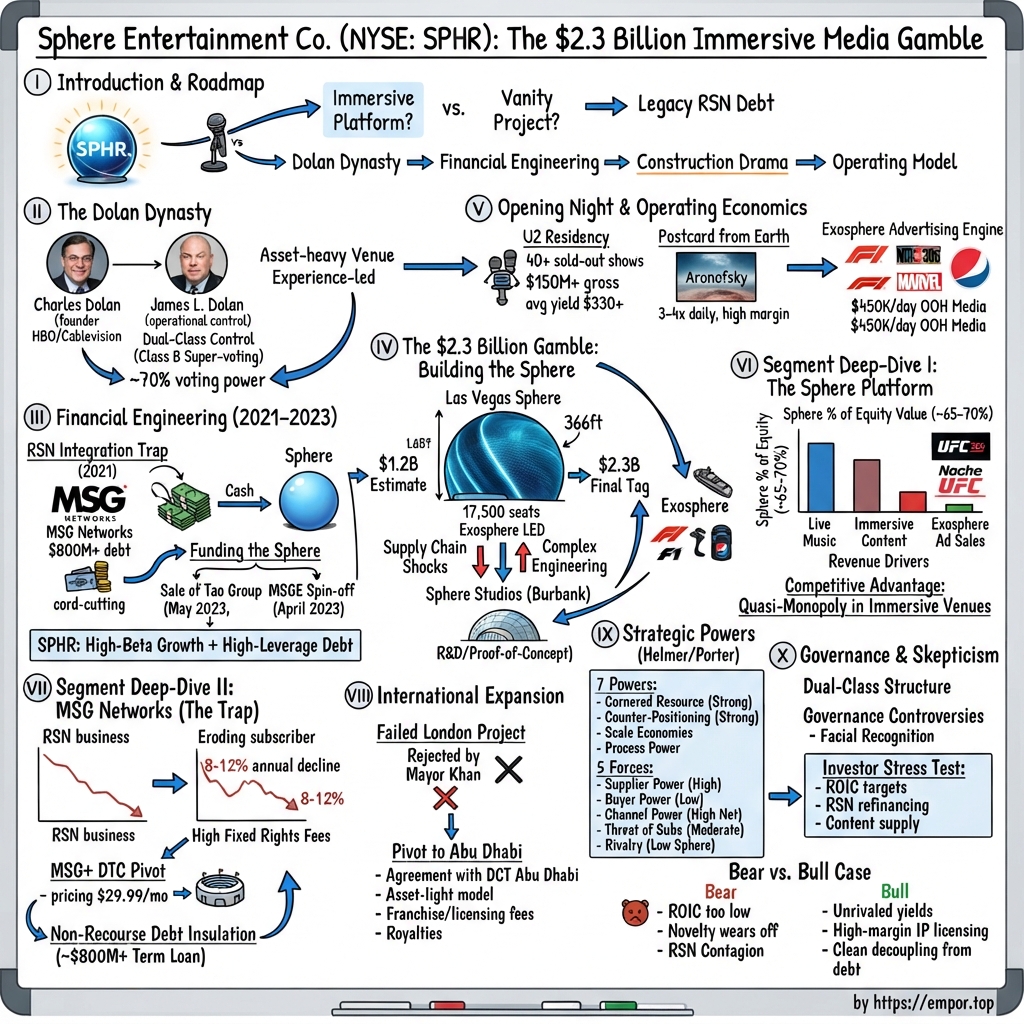
Sphere Entertainment Co. (NYSE: SPHR): The $2.3 Billion Immersive Media Gamble
I. Introduction & Episode Roadmap
At about 7:45 on the evening of Wednesday, August 28, 2025, a line of families stretched out from the Venetian's covered walkway toward the massive spherical venue. Inside, seventeen thousand people took their seats. The lights dropped. And then a Kansas farmhouse — rendered across an interior LED screen roughly 160,000 square feet in size, close enough to reality that the front rows flinched — was torn out of the ground by a tornado and thrown at the audience.1
The Wizard of Oz at Sphere had opened. Within eleven months, it had sold roughly 3.6 million tickets and generated approximately $450 million in ticket revenue.2 For scale, that is more ticket revenue from a single 86-year-old MGM musical, playing in one building, than most publicly traded live-entertainment companies generate from their entire portfolio of venues in a year.
This is the story of how a family that built its fortune on suburban coaxial cable ended up betting its public company on a 366-foot glowing orb in the Nevada desert — and how that asset performed once the initial novelty receded.
The core question. Sphere Entertainment Co. is two businesses stapled together. One is a single building in Las Vegas that cost roughly $2.3 billion to construct and that now generates the majority of the company's revenue and effectively all of its growth.3 The other is MSG Networks, a regional sports network business whose subscriber base has been shrinking at a mid-teens annual rate and whose debt was restructured out of court in 2025 at a substantial discount.4 The bull case says the Vegas asset proved out an entirely new entertainment medium and that the intellectual property behind it can be licensed globally at very high margins. The bear case says the company spent two billion dollars of shareholder capital to build one hit show, that the hit is a novelty with an unknown decay curve, and that a family-controlled board with 70%-plus voting power and a mixed capital-allocation record is now proposing to do it four or five more times.
Both cases have real evidence behind them. That is what makes SPHR worth detailed institutional analysis.
Where this story goes. The analysis begins with the Dolan dynasty and the corporate architecture that made this bet possible — a dual-class structure that gives one family the freedom to make choices no ordinary public company board would tolerate. It then traces the financial engineering of 2021 through 2023: the re-acquisition of MSG Networks, the sale of Tao Group Hospitality, and the spin-off of Madison Square Garden Entertainment Corp., a sequence that deliberately stripped the company down to a single moonshot and a declining regional media asset.
From there, construction — how a $1.2 billion budget escalated to $2.3 billion, and what the overrun reveals about the company's cost discipline. Next is opening night: U2, Darren Aronofsky, and the discovery that the venue's exterior display might be as valuable as its interior stage. Then comes an evaluation of the two segments in detail, including the crucial 2025 restructuring that shifted MSG Networks from a contagion risk to a runoff asset. The analysis turns next to international expansion — the London rejection, the Abu Dhabi franchise, and the National Harbor pivot that quietly abandoned a purely asset-light expansion model. Finally, the story evaluates management credibility against three years of earnings-call transcripts, applies an activist-style stress test, and presents the bull and bear cases alongside the essential operating metrics.
One framing note at the outset. Almost every number in the first half of this story is a construction cost or a launch statistic. Almost every number in the second half is an operating result. The gap between those two sets of numbers represents the fundamental investment question.
 Subscribe on LinkedIn
II. The Dolan Dynasty & Corporate Origins: From Cablevision to the MSG Empire
The backstory begins in Cleveland in the 1950s, with a young Charles Dolan running wire. Dolan's core insight — the one that made everything downstream possible — was that television did not have to arrive over the air. It could travel through a cable, creating a recurring subscription model. He built Sterling Manhattan Cable, wired lower Manhattan, and in 1972 launched Home Box Office. After losing control of HBO to Time Inc., he repeated the playbook, founding Cablevision Systems on Long Island.
That second venture proved decisive. Cablevision became the vehicle through which the Dolan family accumulated the assets that defined its public profile: the New York Knicks, the New York Rangers, Madison Square Garden, Radio City Music Hall, the Beacon Theatre, and the Chicago Theatre. It also established the governance architecture that persists today, an arrangement every investor in Sphere Entertainment implicitly accepts.
The structure that explains everything
Sphere Entertainment operates under a dual-class equity structure. Class A shares, traded on the New York Stock Exchange, carry one vote per share. Class B shares, held by the Dolan family group, carry ten votes each and grant the family the right to elect three-quarters of the board. As a result, the family controls in excess of 70% of the voting power while holding a substantially smaller economic stake.5
While governance critics often highlight dual-class setups as a vulnerability, the structure serves as a primary strategic driver. A conventionally governed public company with a $3 billion market capitalization rarely commits $2.3 billion to build an unproven, experimental venue in a single market. In a standard corporate board environment, early cost overruns typically attract activist investors advocating for sale-leasebacks, share buybacks, or management changes, putting pressure on institutional directors to yield.
The Dolan control structure insulates management from that external pressure. Without a mechanism for outside shareholders to force strategic changes at Sphere Entertainment, executive leadership retained the latitude to pursue the project to completion. In effect, the venue exists because the governance model allowed it.
However, that same insulation creates asymmetric risk for public investors. Protection from activist intervention also means protection from market course-corrections. When a control structure shields both creative ambition and a nearly $1 billion budget overrun, public shareholders absorb both the upside of a novel asset and the downside of capital misallocation, entirely at the discretion of the controlling family.
From venue landlord to technology company
Before 2020, Madison Square Garden Co. functioned primarily as a real estate and sports rights enterprise. It owned iconic venues and sports franchises, deriving revenue from ticket sales, broadcasting fees, and event hosting. While profitable — Madison Square Garden hosts something on the order of two hundred-plus events a year, as Executive Chairman James Dolan noted on the second-quarter 2026 earnings call — the traditional arena model was constrained by physical capacity.6 A standard venue can host only one event at a time, with each scheduling change requiring costly and time-consuming physical setup and breakdown.
The core thesis behind Sphere was to eliminate that physical operational bottleneck. By positioning the venue itself — powered by its proprietary high-resolution LED interior and immersive sound architecture — as the primary attraction, management aimed to reduce turnover costs and increase daily show counts. Dolan outlined this logic on an earnings call, stating that "when we created Sphere and created the business model around it, it was all about increasing utilization and increasing utilization through our own IP and our own content."6
This structure shifts the operational model away from traditional arena leasing toward a high-margin attraction business, akin to a flagship theme park experience or a proprietary cinema platform. Whether the venue ultimately generates an adequate return on its $2.3 billion capital expenditure remains a central financial question, which later sections of this analysis explore in detail. Nevertheless, the underlying strategic intent was clear from inception.
Executing that vision required a fundamental corporate restructuring. The Dolan family separated the legacy assets, spinning off sports franchises and traditional live entertainment venues into distinct corporate entities. What remained in the corporate container was a single moonshot paired with a legacy media asset: a high-stakes bet on immersive media.
III. Financial Engineering & Capital Deployment: The Road to SPHR (2010–2023)
Understanding how Sphere Entertainment arrived at its current balance sheet requires examining three sequential transactions executed over roughly two years. While each move appeared defensible in isolation, their combined effect created a company that was exceptionally concentrated and heavily leveraged to a single venue outcome.
Transaction one: buying back the cable network (2021)
In July 2021, Madison Square Garden Entertainment completed an all-stock re-acquisition of MSG Networks Inc., the regional sports network business previously spun off from the parent company. The strategic rationale was straightforward: MSG Networks generated substantial free cash flow, while MSG Entertainment faced massive capital expenditure requirements in Las Vegas.
In hindsight, the timing proved problematic. The transaction added a linear pay-television asset to the balance sheet just as cord-cutting accelerated from steady erosion into structural decline, bringing roughly $800 million of MSG Networks term-loan debt with it.4 The deal also drew scrutiny from minority investors, given that it was a related-party combination of two Dolan-controlled entities.
Management effectively attempted to use a declining media asset as a financial bridge for an ambitious growth project, only to discover the bridge was shorter than the distance to completion. By 2025, the cash generator intended to support the Sphere was undergoing restructuring. Any evaluation of the Dolan family's capital allocation track record must account for this transaction.
Transaction two: selling the hospitality business (2023)
By early 2023, Sphere construction costs had far exceeded original estimates, forcing the company to seek non-credit liquidity. In April 2023, management agreed to sell its controlling interest in Tao Group Hospitality — the restaurant and nightclub operator behind brands such as Tao, Hakkasan, and Lavo — to Mohari Hospitality at an enterprise value of $550 million.7 The deal closed the following month, delivering approximately $300 million in net proceeds that flowed directly toward completing the Las Vegas venue.[^8]
This divestment represented the most decisive capital-allocation move in the sequence. Although Tao was a healthy business, it remained a non-core strategic asset. Monetizing it at a full valuation before balance-sheet pressure mounted provided essential non-dilutive capital at a critical moment.
Transaction three: the spin-off (April 2023)
The final structural realignment occurred on April 20, 2023, when the company completed the distribution of its interest in a newly formed entity, Madison Square Garden Entertainment Corp., to shareholders.[^9] Legacy venue assets — including Madison Square Garden, Radio City Music Hall, the Beacon Theatre, the Chicago Theatre, and the Christmas Spectacular — were carved out into the new public vehicle. What remained, rebranded as Sphere Entertainment Co., consisted of the unopened Las Vegas venue, Sphere Studios, and MSG Networks.
This asset mix defined the central investment thesis: a pre-revenue, $2.3 billion construction project, a technology research unit, and a contracting regional sports network. By stripping away every stable, cash-generative asset, management positioned shareholders squarely at the extremes of the risk spectrum.
While corporate unbundling allowed each business to target appropriate investor bases, it also eliminated any financial safety net. From April 2023 onward, SPHR had no traditional operating earnings to absorb an initial misstep if the venue failed to attract audiences.
What the sequence reveals
This series of moves highlights three structural traits relevant to evaluating leadership execution.
First, the Dolan family demonstrated a willingness to monetize assets when necessary — a trait not always present in family-controlled public companies. Selling Tao and distributing the legacy venue business showed a commitment to funding the core initiative rather than retaining empire scale.
Second, management consistently prioritized execution speed over operational margin of safety. Each step increased asset concentration to maintain momentum for the Las Vegas launch.
Third, the company's financial reporting baseline shifted alongside its operational footprint. On June 26, 2024, the board approved changing the fiscal year-end from June 30 to December 31, resulting in a six-month transition period from July through December 2024 reported on Form 10-KT.8 Designed to align reporting with the calendar-year rhythm of the Las Vegas venue, this change means multi-year financial comparisons across 2023, 2024, and 2025 require careful adjustment for non-comparable reporting periods.
Meanwhile, construction in Las Vegas continued to advance — along with its expanding budget.
IV. The $2.3 Billion Gamble: Building the Las Vegas Sphere
When the project was unveiled in 2018, management originally budgeted the venue at roughly $1.2 billion. What eventually rose east of the Venetian, connected by a pedestrian bridge, cost approximately $2.3 billion.3 Nearly doubling a construction budget is not a minor deviation; it is a major governance event. Evaluating the asset requires understanding both what that capital purchased and why the expenditures escalated so dramatically.
What the building actually is
Behind the marketing, the Sphere integrates three distinct technology layers into a single physical structure.
The interior screen. The inside of the dome is wrapped in a 160,000-square-foot LED display that curves up, over, and behind the audience. Unlike a planetarium that projects light onto a dome surface, the Sphere's display surface emits light directly. That distinction provides exceptional brightness and image contrast, preventing the visual output from appearing washed out across such a massive surface area.
The sound. Sphere Immersive Sound, developed with German audio firm Holoplot, incorporates approximately 1,600 fixed and 300 mobile loudspeaker modules, driven by roughly 167,000 individually amplified speaker drivers.9 The key technology is acoustic beamforming. Rather than broadcasting omnidirectional sound across the auditorium, the system shapes audio wavefronts to direct targeted sound to specific seating zones. Consequently, audience members in the front and back sections experience comparable audio clarity, and the venue can theoretically transmit distinct audio streams to separate sections simultaneously.
The capture pipeline. Content delivery presents the venue's steepest technical hurdle. Standard cameras cannot capture video for a display of this geometry and resolution. To address this, the company engineered Big Sky, a custom single-lens camera built around a 316-megapixel image sensor measuring roughly three inches square, capable of recording 18K-by-18K video at up to 120 frames per second.10 Processing that footage requires a custom rendering infrastructure capable of transferring uncompressed video at data rates that would overwhelm standard post-production systems.
The building's exterior—the Exosphere—features a 580,000-square-foot programmable LED display. Its commercial model will be examined shortly, as it emerged as a distinct revenue stream that initial models had largely overlooked.
Why the budget doubled
Management has not published a detailed line-by-line cost reconciliation for the overrun. Publicly disclosed factors reflect the broader 2020–2022 operating environment: pandemic-related supply chain disruptions, sharp inflation in structural steel and specialized electronics, the expense of developing custom optics without established supplier scale, and disruption in construction management during the build.3 Senior executive turnover also accompanied the cost increases.
A balanced assessment requires distinguishing external shocks from structural design choices. While supply chain disruptions were unexpected in 2018, a significant portion of the cost overrun stemmed directly from building custom hardware with no existing manufacturing base. When a company commissions the world's largest custom cinema sensor and a 167,000-driver audio array, it is effectively funding vendor research and development. In that context, capital unpredictability is an inherent operational condition rather than an unexpected anomaly.
For institutional investors, the primary concern is how these lessons apply to future developments. Management maintains that subsequent Sphere venues will require substantially lower capital expenditure because core engineering is complete. On the fourth-quarter 2025 earnings call, Executive Chairman James Dolan addressed the estimated $1 billion budget for the proposed National Harbor project, noting: "I'm hoping we bring it in for less. We're working on that right now."11 By mid-2026, he framed the operational constraint more explicitly, stating that construction delays stemmed from the design pipeline rather than physical assembly, adding that "it's the same tech stack in Abu Dhabi as it is in National Harbor as it was in Vegas."6 That claim will face direct empirical testing. If future venues meet cost projections, the Las Vegas overrun will look like a one-time prototype expense; if overruns recur, it will signal a systemic execution issue.
The hidden asset in Burbank
A critical but under-analyzed asset in this ecosystem is Sphere Studios in Burbank, California, which houses a quarter-scale proof-of-concept dome used to develop and test content before it goes to Las Vegas.12
The facility holds strategic importance because the Sphere's display geometry and resolution are incompatible with standard digital media tools. Third-party content creators cannot simply adapt conventional film formats; productions must be authored, rendered, and mastered through the company's proprietary pipeline. Owning that toolchain creates a narrow software lock-in, forcing any partner seeking to distribute content on the platform to utilize Sphere Studios' infrastructure.
However, that control carries ongoing overhead. The Burbank studio represents a fixed operating cost that requires multiple active venues and content titles to achieve operational efficiency. With only one venue operating, the facility functions as corporate overhead; with five venues, it functions as a scalable technology platform. Consequently, international expansion is not merely an option for Sphere Entertainment—it is essential to the absorption of fixed technology costs.
When the Las Vegas venue opened on September 29, 2023, the commercial validation of this infrastructure officially began.
V. Opening Night & Operating Economics: U2, Aronofsky, and Exosphere Monetization
When U2:UV Achtung Baby Live at Sphere opened on September 29, 2023, with Bono performing against a photorealistic desert landscape that dissolved into an Andy Warhol-inspired kaleidoscope, the production accomplished a vital strategic goal: it established the venue's global brand profile before management had to explain the underlying technology.13
The residency proof point
U2 completed a 40-show run that closed on March 2, 2024, grossing $244.5 million and selling 663,000 tickets. It stood as the fourth-highest-grossing residency in Billboard Boxscore history—achieved in just six months, compared to the multi-year runs of preceding top-grossing acts.14
The underlying unit economics were striking: average ticket yields exceeded $360, generating roughly $6 million in gross ticket revenue per show. These figures aligned more closely with stadium-level grosses than traditional arena performance, achieved within a 17,000-seat footprint without the recurring transportation and setup costs of a multi-city tour.
That performance led Billboard's 2024 year-end venue rankings, with the Sphere posting a record gross above $400 million—the highest single-year total ever recorded by a concert venue.15
While these results demonstrated initial consumer demand for the medium, concert residencies represent the venue's least lucrative revenue stream. Top-tier artists command substantial negotiating leverage, securing high guarantees and favorable revenue splits because their star power fills the building. Consequently, high gross receipts yielded relatively thin operating margins for the venue operator.
Building a sustainable business model required transitioning from artist-driven events to proprietary content, a shift management initiated just one week after U2's debut.
The Aronofsky experiment
On October 6, 2023, the venue premiered Postcard from Earth, a film directed by Darren Aronofsky, shot with the proprietary Big Sky camera system, and custom-designed for the auditorium's curved display, haptic seating, wind, and scent capabilities.16 Production costs were not disclosed.
The strategic rationale highlighted a fundamental distinction in the company's business model. Concert residencies are scheduled events with shared economics, whereas proprietary film productions function as repeatable media inventory. Owned content can screen multiple times daily, seven days a week, allowing Sphere Entertainment to retain nearly all ticket sales while incurring minimal incremental operating costs for power, staffing, and facility maintenance.
Postcard from Earth served as the initial test for this high-margin attraction strategy. Although it generated steady revenue during non-concert periods and proved audience appetite for non-musical shows, it did not generate the sustained, broad-based demand required to transform the company's overall financial trajectory. That step would require a major studio intellectual property.
The accidental advertising business
While content strategy was evolving indoors, the venue's exterior generated an unexpected revenue stream.
Originally conceived for venue branding and visual spectacle, the 580,000-square-foot exterior LED display—the Exosphere—quickly evolved into a standalone out-of-home media platform. During its launch period, ad rates ranged from $450,000 for a single day to $650,000 for a full week, supported by management estimates of 4.7 million daily impressions, the vast majority generated via social media shares rather than physical passersby in Las Vegas.17 For premium event periods, such as Super Bowl LVIII week in February 2024, slot rates reached between $1 million and $2 million.18
Unlike traditional billboards that rely solely on local foot and vehicular traffic, the Exosphere monetizes secondary digital impressions captured on mobile devices globally. Because the physical display is already operating, the marginal cost of running a new advertiser's creative is negligible, making it the company's highest-margin revenue stream.
However, an advertising medium driven by social sharing carries inherent risk of novelty decay as public familiarity grows. To preserve the platform's commercial value, management adopted a policy of limiting commercial inventory. Chief Operating Officer Jennifer Koester outlined a target split of roughly 50% commercial advertising and 50% art or promotional programming, noting that artistic displays average around one million social impressions per launch.6 Executive Chairman James Dolan framed the strategy more directly during the May 2026 earnings call, telling Koester that the division was not performing effectively if inventory sold out completely.19
Whether this policy reflects deliberate brand management or softening baseline demand remains a key question for investors. Current commercial metrics support management's positioning: Koester noted full inventory sellouts during peak events like CES, alongside double-digit percentage growth among repeat advertisers such as Adobe, Google, Amazon, Delta, Anheuser-Busch, and MGM.19 In advertising, recurring spend from major corporate clients provides a strong signal that the platform offers utility beyond an initial promotional novelty.
By late 2024, Sphere Entertainment had demonstrated proof of concept across concert residencies, established a baseline for proprietary films, and developed a high-margin external advertising model. What the venue still required was a flagship attraction capable of maximizing daily screen utilization.
VI. Segment Deep-Dive I: The Sphere Platform & Content Pipeline
On the February 2026 earnings call, Executive Chairman James Dolan addressed whether the company needed to update its blockbuster attraction: "I'm not even sure to be honest whether we need Wizard of Oz 2.0 with the demand that we're seeing. But we're going to do it anyway."11
The comment captures management's shift in posture: with core demand validated, leadership moved from proving operational viability to expanding its content catalog.
The Wizard of Oz changes the math
The Wizard of Oz at Sphere—produced in collaboration with Warner Bros. Discovery, Google, and Magnopus, with tickets starting at $104—opened on August 28, 2025.1 Beyond the technical hurdle of using machine learning to upscale and expand a 1939 square-aspect film onto a wrapping screen, the show delivered immediate financial scale.
Management disclosed a rapid sales trajectory: by the February 2026 earnings call, the show had drawn roughly 2.2 million visitors and generated approximately $290 million in ticket sales.11 By early May 2026, totals reached nearly 3 million tickets and over $370 million.19 By late July 2026, attendance reached approximately 3.6 million tickets, bringing cumulative ticket revenue to roughly $450 million.6
This ticket momentum reshaped the company's financial performance. For calendar year 2025, the Sphere segment generated $781.4 million in revenue, a 27% increase over $617.7 million in 2024.20 However, the quarterly trajectory reveals the underlying operational leverage. In the quarter ending December 2025, segment revenue climbed more than 60% year-over-year to $274.2 million, while adjusted operating income (AOI) swung from a loss of roughly $800,000 to an $89.4 million profit.11 Growth continued in the March 2026 quarter, with revenue up nearly 70% year-over-year to $266.0 million and AOI reaching $74.3 million, compared to $13.1 million in the prior-year period.19 Even during the June 2026 quarter—typically a slower seasonal period for Las Vegas tourism—segment revenue grew approximately 30% to $226.4 million, producing AOI of $39.9 million versus $24.9 million a year earlier.6
What the evidence actually means. Three primary conclusions emerge from these figures. First, the venue exhibits substantial operational leverage: a 60% to 70% revenue gain expanded quarterly AOI from near breakeven to nearly $90 million, reflecting minimal incremental costs per additional screening. Second, attendance extends beyond initial novelty; Chief Operating Officer Jennifer Koester noted that the venue's capture rate among Las Vegas visitors has remained steady since debut, offering concrete evidence against rapid demand decay.19 Third, the June 2026 quarter's deceleration to 30% growth and lower sequential AOI highlights the asset's exposure to local tourism seasonality. While James Dolan attributed the moderation to summer being "definitely the low season,"6 seasonal fluctuation remains an ongoing structural characteristic of operating in a single market.
The four revenue engines, ranked by quality
Evaluating Sphere Entertainment requires separating its revenue streams by operational quality and margin profile:
- Sphere Experiences (proprietary content). Represents the highest-margin segment. Featuring owned or licensed intellectual property on negotiated terms, proprietary shows run multiple times daily with minimal changeover cost, serving as the company's core growth driver.
- Exosphere advertising, sponsorship, and suite licensing. Delivers high operating margins supported by multi-year corporate partnerships and event-driven campaigns. Management reported campaign momentum from partners including Verizon around the World Cup, Dolby during its Las Vegas summit, Coinbase amplifying a Super Bowl commercial, and an interactive Exosphere game developed with LEGO and Lucasfilm's Star Wars.611
- Concert residencies. Drives top-line revenue and brand awareness, though with lower operating margins due to artist payouts. Since U2's inaugural run, the venue has hosted the Eagles, Dead & Company, Phish, Backstreet Boys, and Metallica, which expanded its run to 24 sold-out shows after an initial eight-date announcement.19 Executive Chairman James Dolan indicated that artist demand continues to exceed available calendar dates.
- Brand events and live sports. Offers high-profile single-event revenue but creates quarterly variability. While UFC 306 in September 2024 demonstrated the venue's capability for major sporting broadcasts,21 period-over-period comparisons fluctuate based on event timing; for example, the June 2026 quarter experienced year-over-year headwind due to fewer corporate events.6
The content pipeline is the whole ballgame
To address long-term audience decay, management is building out a recurring content slate. An updated version of The Wizard of Oz with added scenes and sensory effects was scheduled for September 2026.6 From the Edge, an original extreme-sports production designed to simulate high-intensity movement without motion sickness, remained in production through 2026.19 Additionally, in mid-2026, the company announced The Rocky Horror Picture Show at Sphere for a 2027 debut. Dolan explained that the title introduces a new genre while allowing the venue "to extend Sphere Experience showing later into the evening, increasing the utilization of the venue."6
This programming mix reflects the core operating strategy: family attractions during the day, adult-oriented titles late at night, and concert residencies on peak weekend evenings—maximizing daily revenue from a fixed physical asset.
During the July 2026 earnings call, management highlighted accelerating production timelines. While The Wizard of Oz required nearly two years to produce, Rocky Horror is projected to take under twelve months, aided by AI-assisted workflows developed during prior projects.6 Management projected that three to four distinct Sphere Experiences would be in active rotation by the end of 2027.
If achieved, shorter production cycles would significantly alter the segment's cost structure. Extending production over two years per title limits venue throughput and global expansion. Conversely, generating reusable titles in under twelve months creates a scalable library that can be amortized across multiple venues—a factor Dolan emphasized when noting that "nobody in Abu Dhabi has seen Rocky Horror Picture Show."6 Nevertheless, given past project delays, management's timeline commitments warrant continued verification against actual release schedules.
The competitive set
At present, the Sphere occupies a unique position in live entertainment. Traditional arenas and stadiums such as Madison Square Garden, SoFi Stadium, Allegiant Stadium, and The O2 compete for touring musical acts, but lack the venue-integrated media format. The closest technological comparison is Cosm, which operates shared-reality venues with domed displays in Los Angeles and Dallas, though at a significantly smaller physical scale and with a primary focus on live sports broadcasts.[^24] Lower-cost immersive projection concepts, such as Illuminarium, operate in a distinct market segment.
This venue exclusivity gives management negotiating leverage with content creators and IP owners. As Dolan observed: "the leverage is that we're the only venue that does this. So it's not like somebody else can take that product and go put it into a big immersive environment like a Sphere."19 While this advantage reflects current market scarcity rather than insurmountable barriers to entry, replicating the venue's custom content pipeline and software infrastructure represents a substantial obstacle for prospective competitors.
Attention turns next to the company's second operating segment—the legacy media unit that historically accounted for much of the balance-sheet pressure.
VII. Segment Deep-Dive II: MSG Networks & The Regional Sports Network Trap
On New Year's Day 2025, more than a million households across the New York tri-state area turned on Optimum to watch the Knicks and found a black screen. MSG Networks had gone dark on Altice USA's systems after their carriage agreement expired.22 The blackout lasted 52 days, drawing intervention from two state attorneys general before the governor of New York announced a settlement on February 22.22
The dispute provided a clear illustration of the shifting power dynamics in regional sports broadcasting. A generation ago, MSG Networks held strong leverage: controlling local broadcast rights for the Knicks and the Rangers made the network indispensable to New York cable operators. By 2025, a carriage fight with a major distributor yielded lower carriage fees rather than greater pricing power.
What the business is
MSG Networks operates MSG Network and MSG Sportsnet, holding regional broadcast rights for five professional franchises: the Knicks, Rangers, Islanders, Devils, and Sabres. Structurally, the business historically functioned as a toll collector, gathering a monthly per-subscriber affiliate fee from every pay-television household in its regional footprint, regardless of actual viewership.
That legacy model continues to dissolve. Reported subscriber declines ran at roughly 14.5% year over year in the December 2025 quarter, about 16% in the March 2026 quarter, and approximately 16.5% in the June 2026 quarter.11196 These contraction rates reflect structural cord-cutting rather than cyclical fluctuation: an annual decline rate of 16% reduces a subscriber base by half within four years.
Segment financial performance reflects this steady erosion. MSG Networks generated $120.1 million in revenue and $38.6 million in adjusted operating income (AOI) in the December 2025 quarter, followed by $120.4 million in revenue and $35.7 million in AOI in the March 2026 quarter.1119 By the June 2026 quarter, segment revenue fell to $87.3 million and AOI dropped to $11.0 million, compared to $107.1 million in revenue and $36.5 million in AOI in the prior-year period.6 While the sharp year-over-year earnings drop in the June quarter was exacerbated by prior-year retroactive media-rights adjustments, the broader downward trend remains clear.
The DTC pivot, and its limits
To counter pay-TV losses, MSG Networks launched MSG+ in 2023 as a standalone direct-to-consumer streaming service priced at $29.99 per month, $309.99 annually, or $9.99 for a single game—a single-game purchasing option unprecedented among regional sports networks.23
However, the shift faced a fundamental economic hurdle. The legacy cable bundle collected monthly affiliate fees across all subscribers, including non-viewers who subsidized the service. A standalone direct-to-consumer model collects fees only from active sports fans, requiring subscription prices that must cover heavy fixed broadcast rights costs. Offsetting the loss of broad bundle fees would require an unrealistically high digital conversion rate—a hurdle that has challenged regional sports networks across the industry.
Recognizing these constraints, management altered its digital strategy in July 2026. The company announced that global sports platform DAZN would become the exclusive direct-to-consumer streaming home for both MSG Networks and the YES Network starting with the 2026–27 NBA and NHL seasons, with existing pay-television subscribers retaining streaming access through DAZN at no additional fee.24 On the July 2026 earnings call, Executive Chairman James Dolan presented the partnership as an operational upgrade, stating, "we believe both our subscribers and content will benefit from DAZN state-of-the-art platform."6
The partnership effectively acknowledged the high cost and complexity of operating proprietary consumer software. Outsourcing digital distribution to an established global platform allows MSG Networks to leverage DAZN's scale, while pairing content with the YES Network creates a more comprehensive regional sports bundle. Still, the agreement represents a strategic retreat from building an independent digital distribution footprint, and management has not disclosed the commercial terms or revenue-share economics of the DAZN arrangement.
The restructuring that changed the story
The critical financial shift in the segment occurred through a major balance-sheet restructuring in mid-2025.
On April 24, 2025, Sphere Entertainment, MSG Networks, and its credit lenders—along with the corporate entities operating the New York Knicks and New York Rangers—entered into a transaction support agreement to restructure the network's debt out of court.25 The agreement closed on June 27, 2025, under the following core terms:4
- The existing term loan of approximately $804 million was replaced with a new $210 million facility maturing in December 2029 at SOFR plus 5.00%.
- MSG Networks executed a minimum cash payment of $80 million at closing, consisting of $65 million from MSG Networks cash reserves and a $15 million equity contribution from parent company Sphere Entertainment.
- Mandatory quarterly principal amortization of $10 million commenced in September 2025, accompanied by a contingent post-repayment cash sweep to lenders capped at $100 million.
- Local media rights agreements with the Knicks and Rangers were amended effective January 1, 2025, reducing annual rights fees by 28% and 18% respectively, removing annual rate escalators, and resetting contract expirations to the end of the 2028–29 season.
The terms of the media rights amendments highlight the influence of the Dolan control structure. The Knicks and Rangers franchises—operated under sister company MSG Sports, another Dolan-controlled entity—accepted substantial rights fee cuts to stabilize MSG Networks. While negotiated in coordination with third-party lenders to satisfy debt restructuring conditions, the transaction effectively transferred economic value between two publicly traded companies under shared family control.
The restructuring rapidly deleveraged the unit's balance sheet. Outstanding principal on the MSG Networks term loan declined to $159 million by December 31, 2025, $143 million by March 31, 2026, and $116 million by June 30, 2026, bringing net debt down to approximately $98 million.11196 Debt obligations that previously represented a major balance-sheet risk were reduced to roughly one quarter of segment revenue.
The structural point that investors kept missing
Throughout the debt restructuring, management repeatedly emphasized a key structural protection: the debt facility is recourse solely to MSG Networks. Sphere Entertainment Co. and its primary venue assets carry no corporate guarantee or debt pledge on the network's obligations.4
Prior to the restructuring, market equity valuations appeared to reflect contagious default risk, pricing Sphere Entertainment as if financial distress at the regional sports network could drag down the parent company. In practice, legal isolation meant that an insolvency or deconsolidation of MSG Networks would eliminate segment revenue contributions without impinging on Sphere venue operations or parent liquidity.
As operational cash flows from The Wizard of Oz validated the Las Vegas venue while debt risks receded, the stock underwent a sharp upward re-rating. Institutional position changes reflected this shift: Point72 Asset Management, which held a peak position of approximately 2.1 million shares in early 2025, liquidated roughly 1.3 million shares—representing about 85% of its holdings—during the six months ended September 30, 2025, capitalizing on the rally.26 While institutional profit-taking during a sharp valuation recovery is standard trading behavior, it underscores that the market's initial risk discount on the legacy media segment has largely closed.
An important structural limitation remains. Despite successful debt reduction, MSG Networks continues to experience annual subscriber losses near 16%, and its restructured media rights contracts expire at the end of the 2028–29 season. The 2025 restructuring eliminated immediate default risk and extended the operating window, but it did not halt secular decline. Even major sports milestones—such as the Knicks winning the NBA championship in June 2026, the franchise's first title since 1973—provide only temporary viewership lifts without altering underlying cord-cutting trends.27
With balance-sheet risks at the legacy media unit contained, management turned to the central strategic question facing long-term investors: whether the Sphere model can be successfully replicated across additional markets.
VIII. International Expansion: The Asset-Light Franchise Model
On November 20, 2023 — seven weeks after the Las Vegas venue opened — the Mayor of London rejected planning permission for a proposed Sphere in Stratford, east London. Mayor Sadiq Khan cited unacceptable harm to local residents, along with light pollution, heavy energy consumption, and impacts on heritage sites from the planned 90-meter-tall, 120-meter-wide structure.28 Sphere Entertainment withdrew the application in January 2024.[^32]
The rejection demonstrated a fundamental operational constraint: the Sphere's most distinctive commercial feature — its massive, continuously illuminated exterior — is also its primary regulatory liability. The concept cannot easily be deployed in high-density residential urban centers with strict environmental oversight. Consequently, the addressable market is not simply major global cities, but major global entertainment destinations where an illuminated landmark is welcomed as an amenity.
That boundary narrows the expansion universe to locations such as Las Vegas, Abu Dhabi, and dedicated resort developments.
Abu Dhabi: the pure franchise
In October 2024, Sphere Entertainment announced a partnership with the Department of Culture and Tourism – Abu Dhabi to build the second Sphere venue.[^33] The commercial structure represented the core innovation: the Department would fully fund and own the building, while Sphere Entertainment would provide design, technology, and content in exchange for development fees and recurring royalties.
Initial progress moved slowly, remaining in preconstruction throughout 2025. On the May 2026 earnings call, Executive Chairman James Dolan noted that the site had been selected but not yet disclosed, adding that the project timeline had been "minimally impacted to date by the conflict in the wider region."19 On May 14, 2026, leadership confirmed the location on Yas Island, positioned between Yas Mall and SeaWorld Abu Dhabi, with a reported construction budget of approximately $1.7 billion, a capacity of up to 20,000, and a targeted completion date by year-end 2029.2930
Under this arrangement, the $1.7 billion capital burden rests entirely with the partner. For Sphere Entertainment shareholders, the revenue model consists of upfront technology and development fees, ongoing royalties for brand and content licensing, and construction management income. Executive Vice President David Granville-Smith detailed the structure on the July 2026 earnings call, noting that the partner is "funding and they'll own the entire Sphere in a market that's across the globe from us. We have a great partnership with them, and we'll have franchise fees and royalties associated with it."6
While strategically significant, the immediate financial impact remains modest. Royalty streams from a single international venue opening in late 2029 will not materially alter near-term operating income. The primary near-term value of the Abu Dhabi deal lies in institutional validation: establishing that a sovereign-backed partner will commit $1.7 billion to the platform's proprietary technology and design framework.
National Harbor: the model quietly changes
On January 19, 2026, management introduced a development plan that altered the asset-light narrative. Sphere Entertainment, the State of Maryland, Prince George's County, and the Peterson Companies announced plans to build a Sphere at National Harbor — marking the company's second U.S. location and its first smaller-format venue, designed for roughly 6,000 seats.31 Situated adjacent to the MGM National Harbor complex, which attracts over 15 million annual visitors, the project carries an estimated construction cost near $1 billion, supported by approximately $200 million in public and private incentives.1132
Dolan described the competitive site selection process on the February 2026 call: "I'd love to tell you that we plan this right up to every little nuance. But the fact is that Virginia and Maryland, we're in a competition that spin up the process of looking at the project, and we got a very good offer kind of really great location, and we took it."11
Beyond location, the strategic shift lay in the financial structure. As analysts questioned how National Harbor would be funded throughout 2026, management's model evolved. By July 2026, Granville-Smith outlined a build-to-suit leaseback model, where a third party finances and owns the physical venue while Sphere Entertainment assumes a long-term operating lease, maintains operational control, consolidates results, and retains the operating cash flows.6
When Wolfe Research analyst Peter Supino noted market perceptions that management had shifted from an equity-partner model to debt financing with Sphere retaining full equity ownership, Dolan rejected a rigid classification, stating, "if you're looking at a cookie-cutter approach... I'm telling you that we're not going to use a cookie-cutter approach."6
This strategic shift carries dual implications for institutional investors.
From an optimistic perspective, high margins in Las Vegas suggest that franchising would unnecessarily surrender economic value. Operating a venue under a long-term lease allows Sphere Entertainment to retain operating leverage without funding initial concrete construction, adapting strategy based on real-time operational data.
Conversely, a cautious view notes that the market's recent re-rating relied on a capital-light licensing thesis. Moving toward long-term lease obligations on billion-dollar facilities introduces financial leverage, as lease commitments function economically like long-term debt. Should a 6,000-seat venue format underperform, fixed lease liabilities remain on the balance sheet.
Crucially, management has departed from a uniform asset-light model, explicitly stating that venue structures will vary by geography: domestic developments may utilize leasebacks or ownership, while international sites lean toward franchising, "depending on whether it's in the Middle East is different. We might look at it differently in Asia versus Europe."6
The ambition, stated plainly
On the July 2026 call, Dolan explicitly outlined expansion goals, stating, "I really want 5 years from now to be 5, 6 years from now have 5 venues up or more and have another 5 that are under construction."6 Granville-Smith added that the internal development team possesses capacity to manage five to six simultaneous projects, while Dolan noted he expects to announce an additional market by early 2027.6
This commitment provides a concrete benchmark for executive execution. With two venues currently active or in development, management must secure financing, regulatory approvals, and construction agreements for three additional sites to meet its five-year target — a process where local entitlement risks, as demonstrated in London, remain a factor.
IX. Playbook & Strategic Powers: 7 Powers & Porter's 5 Forces
Stripping away the visual spectacle leaves the central question for a long-term shareholder: what prevents a competitor from replicating this model, and how long does that protection last?
Hamilton Helmer's 7 Powers
Cornered Resource — strong, but narrower than it appears. Sphere Entertainment controls a distinct asset bundle: the Big Sky camera system, Holoplot audio integration, a proprietary rendering and mastering pipeline, and design patents covering the venue and its curved display architecture. Crucially, it also controls the only venue capable of exhibiting this content at scale. Combining production tooling with exhibition exclusivity creates a genuine cornered resource. The limitation is that much of the underlying hardware relies on third parties: Holoplot is an independent audio developer, and outside suppliers manufacture the LED panels. The company's true resource is system integration, operational know-how, and a multi-year head start, rather than exclusive component ownership.
Counter-Positioning — moderate to strong. Counter-positioning represents the most structural defense in the portfolio. Major venue operators like Live Nation and AEG, alongside traditional stadium owners, cannot counter the venue simply by upgrading existing facilities. The Sphere is an entirely different building format rather than a modernized arena. To match it, an incumbent would need to demolish and rebuild facilities at costs that would impair returns on existing asset bases—a classic counter-positioning dynamic where an incumbent's economically rational response is inaction. However, this asymmetry protects primarily against legacy incumbents rather than well-capitalized greenfield developers.
Scale Economies — moderate today, with potential to strengthen. Content production represents a large fixed cost amortized across screening counts and additional locations. Operating a single venue leaves Sphere Studios functioning as substantial corporate overhead. Across five venues, the production cost of a single film title spreads across multiple geographic markets and years of screening runtime. This economy of scale is not yet fully realized; it remains contingent on executing the broader international expansion program.
Process Power — moderate and improving. Planning, rendering, and streaming petabyte-scale uncompressed video, combined with turning over a 17,000-seat auditorium between live concerts and daytime matinees in under an hour, represents accumulated operational knowledge.19 Compressing production timelines from nearly two years for The Wizard of Oz to under twelve months for The Rocky Horror Picture Show provides concrete evidence of compounding process capability.6
Branding — emerging. "Sphere" established global name recognition quickly following launch. However, whether that awareness converts into sustained pricing power outside Las Vegas remains unproven.
Switching Costs and Network Economies — largely absent. Consumers face no switching costs beyond purchasing a single ticket, and no direct network effects exist among audience members. The asset's consumer pull reflects brand visibility rather than network dynamics.
Porter's Five Forces
Supplier power — high, and structurally embedded. Leverage remains concentrated among two key supplier groups. Top-tier musical artists command high guarantees and favorable revenue splits because concert residencies rely on their star power to fill dates. Similarly, major intellectual property owners—such as Warner Bros. Discovery for The Wizard of Oz—negotiate from strength, given the scarcity of globally recognized franchises and alternative distribution outlets. Executive Chairman James Dolan's assertion that "it's really up to us which ones we choose" highlights breadth of title selection, but understates the negotiating leverage top-tier properties command.19 Developing original proprietary titles like From the Edge serves as the primary strategic hedge against external licensing costs.
Buyer power — low to moderate. Individual venue visitors hold negligible bargaining leverage against a unique attraction. The primary constraint is consumer willingness to pay, which fluctuates with broader economic conditions. While Las Vegas tourism softened through late 2025 and early January 2026 before recovering, Chief Operating Officer Jennifer Koester noted that The Wizard of Oz maintained steady demand across demographic segments, including cost-conscious consumers.19 Audience resilience during softer travel periods demonstrates baseline pricing power, though the model has yet to navigate a full economic recession.
Threat of substitutes — moderate. Competition for discretionary tourist spending in Las Vegas is intense, spanning Cirque du Soleil productions, traditional concert residencies, sports events, and nightlife. While the venue is not directly substitutable in format, a $150 ticket competes against all alternative evening entertainment options in the market.
Distribution channel power — bifurcated across segments. Distribution power highlights the fundamental contrast between the company's two operating units. For MSG Networks, distributor leverage is high, as demonstrated by the 52-day Altice blackout. For the Sphere segment, channel power is negligible: the company sells event tickets and Exosphere advertising directly to consumers and corporate sponsors without intermediary platforms extracting tolls.
Competitive rivalry — low at present. No direct competitor operates at comparable scale today. However, current market exclusivity reflects a temporal lead rather than an insurmountable barrier. High capital requirements, lengthy permitting processes, and specialized content engineering create substantial entry barriers, but remain navigable for well-capitalized entrants with long investment horizons.
The synthesis. Sphere Entertainment's competitive posture relies on three pillars: temporary venue exclusivity, compounding content production capabilities, and counter-positioning against traditional arena operators. The initial venue exclusivity is the most visible yet least durable pillar, whereas the internal content production engine represents the most defensible long-term advantage. Evaluating the enterprise strategy requires monitoring production velocity at Sphere Studios alongside venue expansion timelines.
X. Management Credibility, Governance, and Skeptical Investor Stress Test
During the May 2026 earnings call, a Bank of America analyst asked a technical question regarding SG&A, to which Executive Chairman James Dolan responded: "So SG&A is a great basketball player. And when we get to the finals, I'm sure we're going to beat them."19 He then passed the question to his Chief Financial Officer.
A review of three years of earnings call transcripts reveals a consistent corporate portrait: a chief executive who is candid, discursive, occasionally flippant, deeply engaged with the visual product, and noticeably detached from fine-grained financial mechanics—which he routinely delegates to executive leadership.
The track record, honestly assessed
Where management has delivered. The venue was completed, opened, and operates as intended. The Sphere segment progressed from an operating loss to nearly $90 million of quarterly adjusted operating income within two years of opening.11 The MSG Networks debt was restructured on terms materially better than a distressed borrower usually achieves, and the balance has since been paid down from $804 million to $116 million.46 In January 2026, management refinanced the Las Vegas credit facility, extending maturity by five years to January 2031 at an improved borrowing rate with no change in the $275 million principal, while securing a new $275 million undrawn revolving credit facility.11 Furthermore, non-core assets were monetized when balance-sheet liquidity was required.
Where management has not. Construction costs nearly doubled over original estimates. The London development was pursued to a formal planning rejection, reflecting an incomplete assessment of local political and regulatory environments. Project timelines have experienced repeated slippage—evidenced by the nineteen months between the initial Abu Dhabi announcement and formal site disclosure. Finally, changing the fiscal year-end created reporting friction, obscuring multi-period comparisons during a critical transition window.
Narrative consistency. Executive messaging has remained relatively steady. The core thesis James Dolan outlined in 2023—that the business model relies on maximizing venue utilization through proprietary content—matches the strategy articulated on the July 2026 earnings call.6
The primary shift lies in the expansion financing model. Transitioning from a pure licensing framework to a build-to-suit leaseback model at National Harbor represents a meaningful strategic adjustment. While management explained the change in terms of maximizing return on investment, the shift was detailed primarily under analyst questioning rather than introduced proactively.
Cost discipline under scrutiny. Chief Financial Officer Robert Langer—who joined effective January 13, 2025, after more than 25 years in financial leadership roles at Disney—has faced persistent questioning regarding overhead expenses.33 Langer has maintained a consistent explanation across calls: cost savings identified in 2025 lowered SG&A year over year, whereas subsequent SG&A increases in 2026 quarters were driven substantially by mark-to-market adjustments on share-based awards tied to the appreciating stock price.1119 In the June 2026 quarter, SG&A rose $29.2 million to $125.6 million, and Langer disclosed that over half of the relevant awards had been cash-settled during the quarter, which should reduce future mark-to-market volatility.6
While cash-settling equity awards caps future accounting volatility, it also converts non-cash compensation expenses into direct cash outflows during periods of rising stock valuation.
The accounting judgment that deserves the most attention
Sphere Entertainment emphasizes adjusted operating income (AOI) as its primary performance metric. AOI excludes depreciation and amortization, share-based compensation, and various non-recurring items. For calendar 2025, the company reported AOI of $261.8 million—alongside an operating loss of $229.6 million.20
That $490 million gap stems primarily from approximately $336 million in annual depreciation and amortization.
In traditional corporate reporting, depreciation is often viewed as a soft, non-cash charge that understates underlying cash generation. However, for an enterprise built around a $2.3 billion facility equipped with custom LED displays, specialized optics, and complex speaker arrays, depreciation reflects the real economic wear of physical and technological assets. LED displays degrade, computing hardware turns obsolete, and consumer standards for visual fidelity escalate over time.
Valuing Sphere Entertainment strictly on adjusted operating income requires assuming that long-term maintenance capital expenditures will remain far below reported depreciation. While that assumption may hold during the venue's early operational window, it represents a central accounting judgment in evaluating the business.
A related note: the company reported positive net income for calendar 2025 despite the operating loss, driven by non-operating items including the MSG Networks debt restructuring rather than by operating performance.20 Debt forgiveness reflects balance-sheet restructuring rather than ongoing operational earning power.
Governance: the standing discount
Three structural factors define the corporate governance profile of Sphere Entertainment.
First, the dual-class equity structure concentrates voting power within the Dolan family, insulating executive management from outside shareholder intervention or activist campaigns.
Second, extensive related-party transactions connect Sphere Entertainment with sister entities MSG Sports and Madison Square Garden Entertainment. The most prominent example occurred during the MSG Networks restructuring, when the Knicks and Rangers accepted fee reductions of 28% and 18% respectively to facilitate the debt agreement.4 Inter-company dealings under common controlling ownership require public shareholders to rely on internal governance processes that lack external transparency.
Third, aggressive corporate enforcement actions have created reputational exposure. The deployment of facial recognition technology at MSG venues to identify and exclude attorneys from firms engaged in litigation against the company drew national coverage and regulatory attention.34 Such practices signal an unyielding institutional posture that prospective municipal partners, international franchise operators, and regulatory bodies evaluate when negotiating multi-year agreements.
The activist stress test
Following a sharp upward stock re-rating, an institutional stress test highlights key vulnerabilities in the bear case alongside fundamental pillars of the bull thesis.
The skeptical case.
- Single-asset content concentration: Financial growth remains heavily dependent on The Wizard of Oz in Las Vegas. Because public disclosures track cumulative ticket volume and gross sales rather than per-show capacity utilization or trailing pricing, external observers cannot easily monitor real-time demand decay until quarterly results are reported.
- Subdued capital returns: Generating approximately $260 million in company-wide adjusted operating income against a $2.3 billion facility and a contracting regional sports network yields modest cash-on-cash returns, particularly when measured against $336 million in annual depreciation.
- Shift from capital-light expansion: Transitioning toward long-term lease obligations for venues like National Harbor reintroduces fixed financial liabilities.
- Insulated governance: Shareholders lack traditional mechanisms to influence board composition or challenge capital allocation decisions.
- Institutional position reduction: Major institutional holders, including Point72 Asset Management, reduced holdings significantly during the 2025 stock appreciation.26
The management rebuttal.
Conversely, the bull case rests on tangible operational milestones: technical proof of concept is established, content production cycles are shortening and becoming more cost-effective, and sovereign partners are committing $1.7 billion to construct international venues. Furthermore, regional media debt risks have been isolated, and the balance sheet holds roughly $534 million of unrestricted cash at the Sphere level against $259 million of convertible debt and a $275 million term loan.6 Each additional venue expands the distribution network for an existing proprietary content library.
That both investment cases rely on the same underlying disclosures indicates that the platform's long-term valuation trajectory remains open to debate.
XI. Bear vs. Bull Case, Core KPIs, and Risk Radar
By August 2026, Sphere Entertainment's shares had multiplied several times over from their April 2025 lows — the stock rose 91% in calendar 2025 alone and more than 200% off that April trough by autumn.26 A company valued for two years as a distressed conglomerate spent the subsequent eighteen months being re-rated as a high-growth platform. Neither market valuation was entirely complete at the time.
The bull case
1. Powerful, demonstrated operating leverage. The financial model is no longer theoretical. Sphere segment adjusted operating income (AOI) expanded from near breakeven in the December 2024 quarter to $89.4 million a year later on a 60%-plus revenue surge.11 Because the venue's fixed operational cost base is already established, incremental screenings flow through to earnings at high margins. If daily utilization increases to three or four distinct experiences running daily by year-end 2027, as projected by Executive Chairman James Dolan, the resulting operational leverage remains exceptionally high.6
2. Scalable and reusable content tooling. Transitioning from a two-year production cycle for initial shows to producing titles in under twelve months fundamentally alters the economics. A proprietary attraction that runs indefinitely in Las Vegas before deploying to Abu Dhabi and National Harbor transforms a single-venue asset into a scalable media library, with production velocity accelerating that transition.
3. Durable, high-margin advertising streams. Double-digit percentage growth among repeat corporate advertisers, expanding multi-year sponsorships, and a strict 50% cap on Exosphere ad inventory reflect pricing discipline and lasting brand utility rather than a short-lived promotional fad.19
4. Resolved regional media contagion risk. MSG Networks transformed its balance-sheet profile, reducing term-loan debt from $804 million down to $116 million with a structured amortization schedule and digital distribution transitioned to DAZN.4624 What remains is a contracting but self-sustaining unit that is legally non-recourse to the primary venue asset.
5. Sovereign capital validating the technology platform. A commitment by Abu Dhabi's tourism authority to fully fund an estimated $1.7 billion venue represents concrete external validation of the company's proprietary design and technology platform.29
The bear case
1. Concentration across a single asset, market, and title. The company's expansion remains tied overwhelmingly to one venue in a discretionary tourist destination, driven largely by a single flagship production. Las Vegas travel patterns are cyclical, and management acknowledged softer market conditions in late 2025 and January 2026.19 A broader downturn in consumer travel would directly impact operating performance.
2. Unproven long-term demand curve. The Wizard of Oz has run for a single year. Comparing its trajectory to multi-decade Las Vegas shows like Cirque du Soleil's O overstates baseline comparability, given that O operates in an 1,800-seat theater with a fraction of Sphere's daily seating capacity.6 Sustaining high attendance across 17,000 seats multiple times per day over several years remains untested, while cumulative reporting metrics offer limited visibility into real-time utilization decay.
3. Real economic depreciation costs. The substantial gap between adjusted operating income and GAAP operating performance reflects the physical wear of a technology-intensive facility. If ongoing maintenance and hardware refresh expenses approach annual depreciation over time, net equity returns will prove substantially lower than AOI metrics suggest.
4. Unhedged expansion timelines and evolving deal models. Scaling to five global venues remains early in execution. Construction in Abu Dhabi targets a late-2029 completion, while the National Harbor project had not broken ground and was still finalizing financing as of July 2026.6 Moving toward build-to-suit leaseback structures reintroduces long-term fixed liabilities, while the 2024 London rejection illustrates persistent municipal regulatory risks.
5. Governance insulation and control concentration. Dual-class capital structure leaves public equity holders with no formal mechanism to challenge strategic direction or board decisions.
6. Ongoing structural decline in legacy broadcasting. Deleveraging has not halted secular cord-cutting, with MSG Networks continuing to lose subscribers at roughly 16% annually. Broadcast rights agreements expire at the end of the 2028–29 season, and commercial terms for the DAZN partnership remain undisclosed.
The three KPIs that actually matter
Evaluating performance quarter-over-quarter relies on three core operating metrics.
1. Sphere segment adjusted operating income and margin. This serves as the primary indicator of venue scaling efficiency versus demand plateauing. Metrics require sequential and year-over-year comparison to account for travel seasonality, given that the June quarter is structurally the weakest. Expanding margins on rising top-line revenue signal operational leverage, whereas margin compression alongside revenue gains would indicate elevated content acquisition costs.
2. Per-show attendance, average ticket pricing, and per-capita spend. While official reporting emphasizes cumulative ticket volume, disclosures regarding per-show metrics provide early visibility into demand decay prior to segment financial reporting. A reduction in management's commentary surrounding per-show utilization would signal softening underlying attendance.
3. Exosphere advertising growth and advertiser retention. Ad inventory represents the segment's highest-margin revenue stream. Multi-year sponsor expansion indicates integration into corporate marketing budgets, whereas reliance on single-event takeovers would suggest demand driven primarily by short-term novelty.
MSG Networks subscriber trends are deliberately excluded from primary key performance indicators: subscriber numbers will continue to erode at established rates, but debt isolation renders the unit secondary to core venue performance.
Current risk radar
- Consumer travel cyclicality. The primary short-term vulnerability, given reliance on discretionary tourist spending in a single market.
- Content licensing dependency. Maintaining pipeline velocity requires securing major media properties and marquee musical acts. Systemic friction in IP negotiations would restrict title rotation.
- Multi-project execution exposure. Managing five concurrent venue developments across varying financing models and regulatory environments represents significant operational complexity for an enterprise with one active venue.
- Geopolitical factors in expansion markets. Development in Abu Dhabi serves as the primary international proof point; management reported minimal impact from regional tensions through mid-2026, though geopolitical conditions remain volatile.19
- Cost of capital and lease liabilities. Refinancing the Las Vegas facility to 2031 stabilized near-term maturities, but funding future venue additions via leasebacks embeds long-dated fixed obligations at prevailing interest rates.11
- Technological obsolescence and refresh cycles. Sensory differentiation relies on maintaining visual and auditory superiority. Evolving consumer standards will dictate ongoing capital expenditure requirements for system upgrades.
XII. Epilogue & What to Watch
The most revealing exchange in three years of Sphere Entertainment earnings calls came in May 2026, when an analyst asked about cannibalization between future venues. Executive Chairman James Dolan's answer wandered before arriving somewhere unexpected: "it's not just the building itself. It's the medium. We want — we're looking to proliferate the medium." He added that fewer than ten million people had seen a Sphere. "And you just — we need more of them."19
That is not how a traditional arena landlord frames an enterprise. It is how an executive who believes he has created a new entertainment format speaks—akin to early cinema pioneers advocating for widescreen or IMAX founders promoting large-format projection. Whether that framing holds is the central strategic question. Formats that succeed evolve into scalable platforms; those that fail remain capital-intensive novelties, and the difference is rarely clear within the first few years.
As of August 2026, several conclusions are clear. The engineering bet succeeded: the facility performs to specification. The commercial bet is working in its initial phase, driven by a single proprietary attraction that sold roughly 3.6 million tickets in under a year and shifted segment performance from operating losses to meaningful adjusted operating income. Balance-sheet risk has receded, as the debt that once threatened the enterprise has been reduced to a manageable residual that remains legally non-recourse to the core venue asset. However, the strategic bet—that the venue represents a scalable global medium rather than a single attraction in Las Vegas—remains unproven, with the first international validation contingent on completing the Yas Island facility in late 2029.
What to watch, in order of importance
The performance and delivery of subsequent original experiences. An updated Wizard of Oz 2.0 is scheduled for September 2026, followed by From the Edge in late 2026 and The Rocky Horror Picture Show at Sphere in 2027. The critical variable is whether these titles arrive on schedule and within budget, and whether a second production can drive ticket sales without cannibalizing existing audience demand. A creative engine that consistently produces viable titles establishes a platform; a system that relies on a single hit remains a single successful building.
The next market announcement. Management committed to announcing an additional venue location by late 2026 or early 2027, with Dolan explicitly noting he would consider it a setback if that deadline is missed. This self-imposed timeline represents a direct test of executive credibility and strategic momentum.
Finalizing National Harbor financing terms. Management stated in July 2026 that it expected to close a third-party financing agreement for the Maryland venue in the near term. The precise financial structure of that build-to-suit leaseback will reveal how much operating upside equity holders retain and will set the benchmark for future domestic expansion.
Granularity in operating metrics disclosures. Investor transparency should be monitored as closely as official press releases. Management provided detailed disclosures on The Wizard of Oz attendance and ticket yields during initial growth phases. Maintaining that level of reporting detail during seasonally slower or decelerating periods will offer a clear signal of governance transparency.
Capital allocation as cash balances expand. With approximately $534 million in unrestricted cash at the Sphere segment alongside substantial adjusted operating income, management will face a strategic choice among funding venue expansion, debt reduction, or shareholder capital returns.6 How controlling shareholders allocate surplus capital will define the long-term governance profile of the enterprise.
Sphere Entertainment represents one of the boldest capital commitments in modern live media—an attempt to establish a novel entertainment medium and real estate asset class simultaneously, initially funded by a declining regional cable network and executed under a dual-class structure insulated from public shareholder pressure. The initial launch exceeded operational expectations while incurring substantial cost overruns. The enterprise now enters its expansion phase, framed by project development in Burbank and initial construction on Yas Island in Abu Dhabi.
References
-
…More Than You Can Imagine: The Wizard of Oz at Sphere Tickets on Sale Now at thesphere.com — Sphere Entertainment Co., 2025 ↩↩
-
Sphere Entertainment Co. Quarterly Results, Earnings Releases and Conference Call Materials — Sphere Entertainment Co. ↩
-
Inside the Las Vegas Sphere, the $2.3 Billion Immersive Arena — The Wall Street Journal, 2023-09-28 ↩↩↩
-
MSG Networks comprehensive out-of-court debt restructuring — Davis Polk, 2025 ↩↩↩↩↩↩↩
-
Sphere Entertainment Co. Form 10-K Annual Report for the year ended December 31, 2025 — SEC EDGAR, 2026 ↩
-
Sphere Entertainment Co. Second Quarter 2026 Earnings Conference Call — Sphere Entertainment Co., 2026-07-30 ↩↩↩↩↩↩↩↩↩↩↩↩↩↩↩↩↩↩↩↩↩↩↩↩↩↩↩↩↩↩↩↩↩
-
Sphere Entertainment to Sell Tao Group Stake to Mohari for $550 Million — Reuters, 2023-04-17 ↩
-
Sphere Entertainment Co. Form 10-KT Transition Report for the period ended December 31, 2024 — SEC EDGAR, 2025 ↩
-
Sphere Entertainment Unveils the Most Advanced Concert-Grade Audio System in the World: Sphere Immersive Sound, Powered by HOLOPLOT — Sphere Entertainment Co., 2023 ↩
-
Dive into the world's largest cinema image sensor, developed for Big Sky, the ultra-high-resolution camera system capturing content for Sphere — STMicroelectronics ↩
-
Sphere Entertainment Co. Fourth Quarter and Year-End 2025 Earnings Conference Call — Sphere Entertainment Co., 2026-02-12 ↩↩↩↩↩↩↩↩↩↩↩↩↩↩↩
-
Sphere Entertainment Co. Form 10-K Annual Report for FY2024 — SEC EDGAR, 2024-08-14 ↩
-
U2 Opens $2.3 Billion Sphere in Las Vegas With Mind-Bending Visuals — Bloomberg, 2023-09-30 ↩
-
U2's Final Sphere Shows Top February 2024 Boxscore Report — Billboard, 2024 ↩
-
Sphere Dominates Year-End Venues Ranking With Record-Setting $400M Gross — Billboard, 2024 ↩
-
Postcard from Earth at the Sphere in Las Vegas — American Cinematographer ↩
-
Look over Sphere: The giant, round billboard in Las Vegas, explained — Marketing Brew, 2023-11-16 ↩
-
Sphere Super Bowl ads will cost brands up to $2m each — AV Magazine, 2024-01-22 ↩
-
Sphere Entertainment Co. First Quarter 2026 Earnings Conference Call — Sphere Entertainment Co., 2026-05-05 ↩↩↩↩↩↩↩↩↩↩↩↩↩↩↩↩↩↩↩↩↩
-
Sphere Entertainment Co. Reports Fourth Quarter and Full Year 2025 Results — Sphere Entertainment Co., 2026-02-12 ↩↩↩
-
UFC 306 Takes Las Vegas Entertainment to New Heights at Sphere — Reuters, 2024-09-15 ↩
-
MSG Networks, home of Knicks and Rangers, goes dark for Altice USA's Optimum cable customers — CNBC, 2025-01-01 ↩↩
-
MSG announces $30/month price for MSG+, with a $10/game option — Awful Announcing, 2023 ↩
-
DAZN to Be the Exclusive Direct-to-Consumer Streaming Home of the YES Network and MSG Networks — Sphere Entertainment Co., 2026-07-29 ↩↩
-
Sphere Entertainment Co. Form 8-K — Transaction Support Agreement — SEC EDGAR, 2025 ↩
-
Steve Cohen Sells 85% of His Stake in Dolan's Vegas Sphere — Sportico, 2025-11 ↩↩↩
-
New York Knicks win 2026 NBA Finals: Their path to a championship — ESPN, 2026-06 ↩
-
Sadiq Khan rejects plans for MSG Sphere in east London — Dezeen, 2023-11-20 ↩
-
Yas Island to Be Home of Sphere Abu Dhabi, a New Global Icon for Immersive Entertainment — Sphere Entertainment Co., 2026-05-14 ↩↩
-
Sphere Abu Dhabi to Rise on Yas Island by 2029: $1.7 Billion Immersive Entertainment Venue Outside US — Gulf News, 2026-05-14 ↩
-
Sphere Entertainment, the State of Maryland, Prince George's County, and Peterson Companies Announce Intent to Develop a Sphere at National Harbor — Sphere Entertainment Co., 2026-01-19 ↩
-
Plans announced for second Sphere venue near Washington DC — Dezeen, 2026-01-20 ↩
-
Sphere Entertainment Names Robert Langer Executive Vice President, Chief Financial Officer, and Treasurer — Sphere Entertainment Co., 2025-01 ↩
-
How MSG Uses Facial Recognition to Ban Lawyers Fighting James Dolan — The New York Times, 2023-01-16 ↩
 LinkedIn
 WhatsApp
 Reddit
 Hacker News
 Email
Email Kindle
 RSS Feed
 Spotify
 Apple Podcasts
 Amazon Music
 Audible
 YouTube