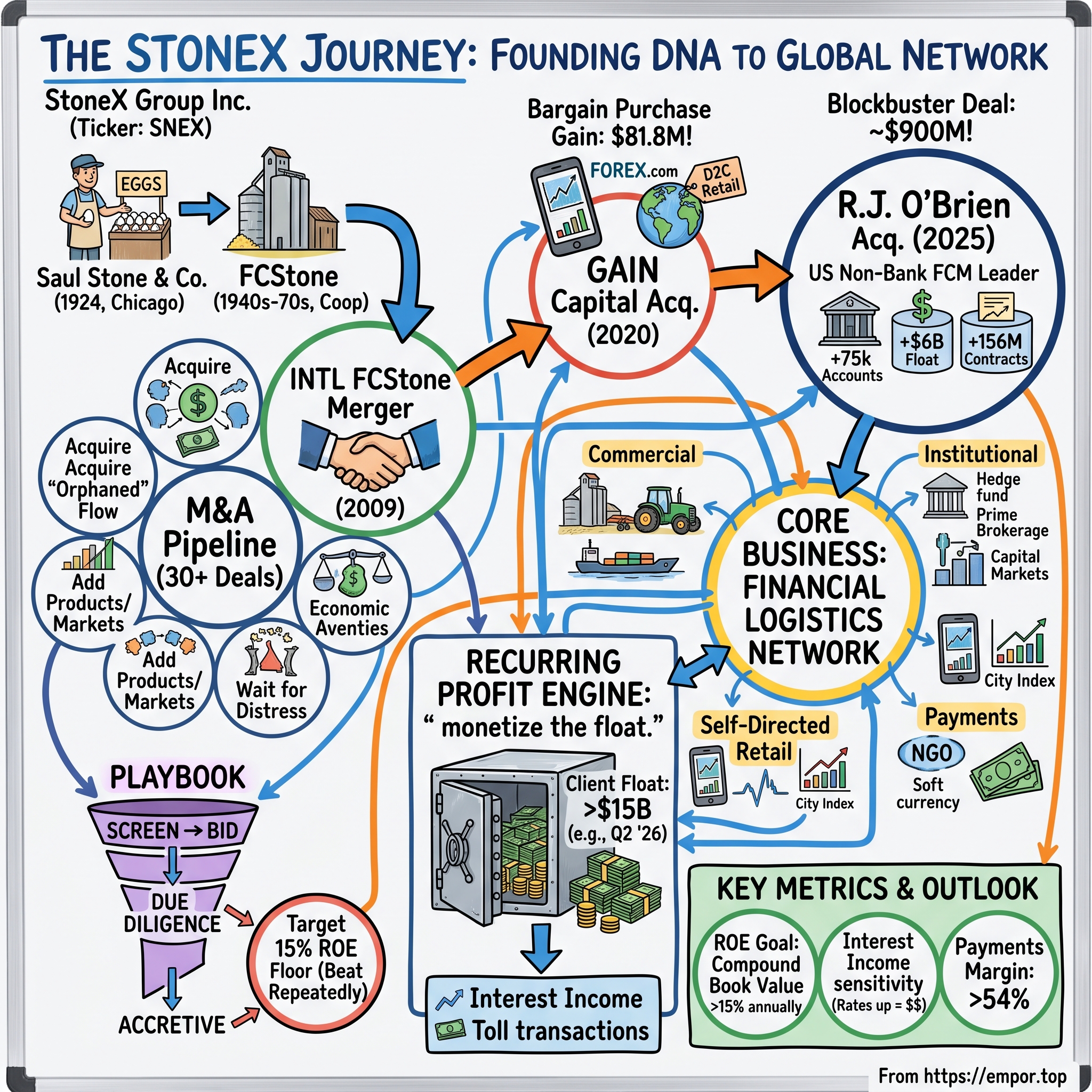
StoneX Group: The Financial Logistics Network Compounding Under the Radar
I. Introduction & Episode Roadmap
Start with a number that shouldn't make sense. In its fiscal year ended September 30, 2025, StoneX Group reported revenues of roughly $132 billion.1 That is not a typo, and it is not the number you should pay attention to. Because in the very same year, the company also reported net income of $305.9 million — a record, up 17% — on operating revenues of just over $4 billion.[^1] So which is StoneX: a $132 billion colossus or a $4 billion mid-cap? The answer to that question is the whole story, and getting it wrong is how the market kept this company anonymous for two decades.
The gap between those two figures is the tell. StoneX physically buys and sells commodities — grain, precious metals, energy — and under accounting rules the full sale price of a bar of silver or a barge of soybeans flows across its income statement as "revenue," even though the company keeps only the razor-thin sliver between what it paid and what it sold for. Strip out the pass-through cost of those physical goods and you get the metric management actually runs the business on: operating revenue. Everything about StoneX — its margins, its returns, its strategy — only comes into focus once you stop looking at the $132 billion mirage and start looking at the $4 billion of real top line underneath it.
So what is the real business? The cleanest way to describe StoneX is as a financial logistics network. Think of what UPS or a freight forwarder does for physical packages — the routing, the customs paperwork, the last mile into places the big carriers won't go — and apply it to money, risk, and commodities. A soybean cooperative in Iowa that needs to hedge next season's crop, a hedge fund that needs to clear a million futures contracts, a self-directed trader in Tokyo speculating on the euro, an NGO that needs to move dollars into a Congolese franc account in a village with no correspondent bank — StoneX runs the plumbing for all of them. And like any logistics network, it earns its keep in two ways at once: a toll on every transaction that flows through the pipes, and interest on the enormous pool of client cash that sits inside the network while it waits to be deployed.
That second engine is the one investors underappreciate. Because StoneX holds client money to margin trades and settle payments, it sits on billions of dollars of interest-bearing float — client balances that, by the second quarter of fiscal 2026, averaged $15.2 billion across listed-derivative client equity and money-market sweep balances.7 In a world of positive short-term rates, a network that earns interest on other people's cash while also charging them to transact is a genuinely powerful money machine. The catch — and we will spend real time on it — is that the same lever swings both ways when rates fall.
Before the history, one myth worth puncturing up front. The consensus glance at StoneX — when the market bothers to glance at all — files it as a low-margin commodity broker, a boring middleman whose fortunes rise and fall with grain and oil prices. The reality is nearly the inverse. Commodity brokerage is only one of four segments; the company's fastest-growing and highest-margin businesses are cross-border payments and institutional securities, and its single most powerful profit lever in recent years has been interest income on client float, which has almost nothing to do with the price of corn and almost everything to do with the level of short-term rates. The "commodity broker" label is not wrong so much as it is a decade out of date — and the gap between that stale perception and the actual, more interesting business is precisely why a diligent investor might find the company worth understanding. The corollary myth, that the $132 billion revenue figure signals a giant, we have already dismantled: it is an accounting artifact of moving physical goods, not a measure of the company's true size.
This is the arc of the episode. We start in a Chicago egg business in 1924 and a Midwestern farmers' cooperative, trace how a near-dead Florida shell company was captured in 2002 by a former emerging-markets banker named Sean O'Connor, watch that shell merge with the agricultural clearing house FCStone in 2009, and then follow the machine: more than thirty acquisitions, most of them bought cheap out of somebody else's distress, stitched onto a single clearing backbone. We will benchmark the two deals that changed the company's shape — the 2020 purchase of retail-trading platform GAIN Capital and the 2025 blockbuster acquisition of R.J. O'Brien — pull apart the four operating segments and the hidden jewel in Payments, and stress-test the whole thing against the bull and bear cases, Porter's Five Forces, and Hamilton Helmer's 7 Powers. Along the way we will keep asking the neutral question: how much of StoneX's remarkable compounding is a durable machine, and how much is a two-decade tailwind that could reverse?
It begins with eggs.
 Subscribe on LinkedIn
II. Saul Stone & The Egg Wholesaler: The Agricultural Roots (1924–1980s)
Picture Chicago in 1924. The stockyards still ran red, the grain elevators along the river fed half the world, and a young man named Saul Stone was selling eggs door to door. It is a humble image, and it is the right one, because the entire ethos of the modern company traces back to a lesson Stone learned hauling perishable goods: the money is not really in the eggs. The money is in managing the risk that the price of eggs moves against you between the day you buy them and the day you sell them.
Stone founded Saul Stone & Co. and became one of the early members on the floor of the Chicago Mercantile Exchange, back when the CME was a butter-and-egg board — literally a market for hedging dairy and poultry prices. This is the founding DNA worth holding onto: a merchant who understood that physical trading and financial hedging are two halves of one business, and that the durable, repeatable profit lives in the hedging half. A century later, StoneX still makes its best margins not by owning commodities but by managing other people's exposure to them.
The other root of the company grew a few hundred miles west, out in the American farm belt, and it grew as a cooperative rather than a family firm. In the middle of the twentieth century, grain elevator operators, farmers, and agricultural cooperatives banded together to pool their hedging and clearing needs — the entity that eventually became FCStone. Its mandate was unglamorous and specific: give the middle-market operators who actually feed America — the co-op that runs the local elevator, the processor with a few plants — access to the same futures markets and risk-management tools that the giants used.
The cooperative origin left a permanent imprint. A firm born to serve its own members rather than to extract from them starts with a client-first instinct baked into its structure, and even after FCStone left the cooperative form behind and became a commercial enterprise, that orientation persisted as a cultural asset — the sense that the customer is a long-term partner to be retained across decades, not a counterparty to be maximized on a single trade. Decades later, StoneX's management still describes itself as "a client first business" that seeks "long-term embedded relationships,"[^1] and however self-serving that language can sound from any company, in FCStone's case it traces to a genuine structural root. The lesson worth extracting is that the durability of a middle-market franchise depends less on any single product than on trust accumulated over years — trust that is slow to build, hard for a competitor to replicate, and quick to destroy with one greedy quarter.
Here is why that mattered strategically, and why it still does. The agricultural middle market is a genuinely hard customer to serve well. These are not push-button electronic accounts; they are relationships that require someone who understands basis risk (the gap between the local cash price of corn and the Chicago futures price), who knows how weather in a particular county moves a particular crop, who can talk through the mechanics of physical delivery. It is high-touch, knowledge-intensive, and — crucially — too small and too fiddly for a JPMorgan or a Goldman Sachs to bother with. FCStone's people were native to that world; they came out of the grain elevators, not out of business school.
That is the origin of what StoneX today would call its edge in the middle market, and it is best understood not as a slogan but as accumulated, hard-to-copy operational know-how. You cannot spin up a national force of people who understand grain basis and cattle-on-feed hedging over a weekend; it took decades of embedded relationships to build. Whether that know-how is a true moat or merely a nice legacy is a question we will test later — but its roots are here, in a cooperative built by farmers for farmers. The company that would eventually buy the Stone name and the FCStone franchise, however, came from a completely different world: emerging-market bond desks and a struggling Florida shell company nobody wanted.
III. Sean O'Connor's Bold Bet: The International Assets Takeover (2002–2009)
In 2002, International Assets Holding Corporation was the kind of company that shows up on a list of stocks about to be delisted. Based in Orlando, it was a tiny public broker-dealer with under $3 million of equity — a rounding error, a shell with a ticker. Most people looked at IAHC and saw nothing. Sean O'Connor looked at it and saw a chassis.
O'Connor is the central human figure of this story, and his background explains almost everything about how StoneX behaves. He and his partner Scott Branch were not commodities men; they were emerging-markets debt specialists who had worked at Standard Bank, trading the illiquid sovereign and corporate paper of countries most Wall Street desks couldn't be bothered to price. That experience taught them two habits that would define the company: a comfort operating in the neglected, high-margin corners of finance where competition is thin, and a bone-deep discipline about price, because in illiquid markets you only make money if you buy well. O'Connor would later describe himself, only half-joking, as "an old M&A banker" acutely aware that most deals fail because buyers are desperate and overpay.[^1]
The thesis O'Connor and Branch brought to IAHC was a macro read on Wall Street's retreat. In the years after 9/11, the regulatory cost of serving small, cross-border, and emerging-market clients was climbing fast, and the big global banks were responding by firing exactly those customers — the mid-market corporate that needed to hedge a currency, the institution in a frontier market that needed a counterparty willing to make a price. O'Connor's bet was that this retreat was structural, not cyclical, and that a nimble, low-cost boutique could aggregate the orphaned middle-market flow the giants were abandoning. So the two men invested their own capital, took a controlling stake in IAHC, and set about rebuilding it from the inside.
What they built first was deliberately unsexy. Rather than fight Wall Street in liquid US equities — a bloodbath of thin margins — O'Connor pointed IAHC at niches where a specialist could still earn a real spread: international market-making in American Depositary Receipts and foreign shares, trading in distressed and emerging-market sovereign debt, physical precious metals, and small-ticket cross-border foreign exchange. The connecting logic was that each of these was a market where being willing to do the hard, high-touch work — pricing an illiquid Argentine bond, moving physical gold, settling a payment into a soft currency — was itself the moat. Twenty-plus years later, that ADR market-making franchise is still there: StoneX has ranked number one in over-the-counter ADRs and foreign securities every year since 2015.7
None of this made IAHC big. By the late 2000s it was a profitable but sub-scale specialist, capital-rich relative to its size and hungry for something transformational. What O'Connor had really assembled was a set of sophisticated financial capabilities — risk products, FX, capital markets — bolted onto a public company with a clean balance sheet and an appetite to grow. What it lacked was a large, sticky customer base and industrial-scale clearing infrastructure. And in 2008, the financial crisis was about to put exactly that on the market, at a price O'Connor could stomach.
It is worth pausing on O'Connor's temperament, because it is the closest thing StoneX has to a culture. Colleagues and interviewers describe a man who thinks like a value investor first and an operator second — patient to the point of stubbornness, allergic to overpaying, and genuinely energized by the unglamorous work of due diligence.[^9] He talks about acquisitions in the language of downside protection and goodwill payback rather than vision and disruption, and he has been remarkably consistent about it across two decades of public commentary. That temperament is double-edged: it makes StoneX disciplined and hard to stampede into a bad deal, but it also produces a company that is complex, low-profile, and content to be misunderstood by a market that prefers a cleaner story. The "under the radar" quality is not an accident; it is a reflection of a leader who would rather compound quietly than be famous.
IV. The Merger of Equals: INTL & FCStone (2009)
The 2008 financial crisis is usually told as a story of who got destroyed. For StoneX, it is a story of a door swinging open. As markets convulsed and commodity prices whipsawed, FCStone Group — the descendant of that Midwestern farmers' cooperative — found itself under real stress. Extreme volatility in energy and agricultural markets had exposed it to bad customer positions and counterparty risk, and a firm built to serve the middle market suddenly needed a stronger partner and a fortress balance sheet. On the other side stood O'Connor's INTL, capital-rich, ambitious, and looking for scale it could never build organically.
In 2009 the two combined to form INTL FCStone, in what was framed as a merger of equals. The label mattered less than the fit, and the fit was almost suspiciously good. This is worth slowing down on, because it is the moment the modern company's shape was set.
Consider what each side brought. FCStone contributed the thing INTL could never have built from scratch: an unparalleled base of agricultural and commercial clients — the co-ops, elevators, and processors — plus the derivatives clearing machinery and the exchange memberships to service them at scale. This was decades of embedded middle-market relationships, delivered in a single stroke. INTL contributed the sophistication: international FX, precious metals, capital-markets and debt expertise, and structured risk products that FCStone's farm-belt clients had never been offered.
The industrial logic was cross-sell in both directions, and it is the template for everything StoneX has done since. Take INTL's FX and capital-markets products and sell them to FCStone's thousands of agricultural clients, who suddenly could hedge not just their crop prices but their currency and interest-rate exposure through one counterparty. Take FCStone's hedging and clearing muscle and offer it to INTL's international institutional clients. The merged entity became a multi-asset execution and clearing network — a place where a customer could route grain hedges, currency payments, metals, and securities through one integrated back office.
There was also a timing accident that worked in the merged firm's favor. The post-crisis wave of regulation — Dodd-Frank in the United States and its equivalents abroad — sharply raised the fixed cost of being a broker-dealer or clearing member: more capital, more compliance staff, more reporting technology. For most sub-scale firms this was a slow suffocation. For a consolidator with a growing infrastructure to spread those costs over, it was a gift, because it simultaneously raised the barrier to entry and manufactured a steady supply of distressed sellers who could no longer afford to operate alone. INTL FCStone entered the 2010s with both the appetite to acquire and a regulatory tailwind that kept the acquisition pipeline full.
The neutral observation to make here is that "merger of equals" and "obvious synergies" are exactly what management teams always say, and most such mergers disappoint. What makes the 2009 deal credible in hindsight is not the press-release logic but what followed: the combined company spent the next fifteen years demonstrably running the cross-sell playbook over and over, on target after target, and compounding capital while doing it. The merger did not just create a bigger broker. It created a machine designed to swallow other brokers — and O'Connor was about to turn that machine on.
V. The Playbook of Consolidation: A Machine of Micro-Acquisitions (2010s)
Ask Sean O'Connor how StoneX grew, and the honest answer is a spreadsheet of more than thirty acquisitions.[^1] But the number is less interesting than the discipline behind it, and the discipline is best understood as a repeatable recipe that O'Connor has described in unusual detail on earnings calls. The company gets approached with roughly 85 to 100 opportunities a year; it engages with about 70% of them, gets to initial diligence on half, full diligence on a quarter, and actually bids on around 15%.[^1] The rest of the funnel is a wall of "no."
The recipe for the ones that make it through has a few strict ingredients. First, buy from distress or neglect: target sub-scale, orphaned, or failing broker-dealers and commodity firms where the seller is motivated and the price is at or near tangible book value. Second, insist the target adds something to the ecosystem — a new product, a new client footprint, a new geography — rather than just more of the same. Third, and this is the part O'Connor emphasizes, do the diligence in-house: "roll up their sleeves," as he puts it, rather than outsource judgment to bankers, so that the team taking on the business owns the integration.[^1] Fourth, demand that the deal earn back any goodwill inside roughly 36 months and be accretive to return on equity. It is, in effect, a value-investor's approach to buying financial firms.
The 2010s produced the marquee examples. In 2011, out of the wreckage of the MF Global bankruptcy — one of the great blow-ups in futures-industry history — INTL FCStone acquired the failed firm's metals business. The prize was not just the book of clients but the status that came with it: membership as a Category 1 ring-dealing member of the London Metal Exchange, the small and exclusive club entitled to trade in the LME's open-outcry "ring." That is an access moat you cannot simply buy off the shelf; it made the firm a genuine principal in global base-metals markets.
Then came capabilities bought to fill specific gaps. In 2015, the acquisition of GX Clarke & Co. added the ability to deal in US government securities as a primary-dealer-style operation, plugging the company into the Treasury market. In 2016, the purchase of the correspondent-clearing and independent-advisory business of the failed brokerage Sterne Agee dramatically expanded StoneX's securities clearing and custody infrastructure — the unglamorous backbone that lets it hold and settle assets for smaller broker-dealers and advisors.
The synergy math was the same every time, and it is worth stating plainly because it is the engine of the whole model. Migrate the acquired firm's customer volume onto StoneX's existing clearing infrastructure so the new business rides on fixed costs already being paid. Shut down the target's now-redundant back office, compliance, and technology overhead. Then cross-sell the full StoneX product suite — FX, OTC hedging, physical logistics, securities — into the acquired client base. Bought cheap, stripped of duplicate cost, and monetized across more products: that is how a firm can pay tangible book value for a distressed broker and still generate high returns on the capital deployed. O'Connor's claim is that "almost all" of these deals went on to become multiples of their acquisition size.[^1] It is a claim worth watching rather than swallowing — but the compounding in the financials is hard to argue with.
It is also easy to over-index on the deals and miss the quieter half of the machine, which is organic product-building. The acquisitions supply raw material — clients, licenses, geographies — but StoneX's own engineers then knit new products across them. A representative example is StoneX Hedge, a proprietary grain-management platform that plugs directly into a grain elevator's inventory and back-office systems to automate hedging and merchandising; by fiscal 2025 it had surpassed a cumulative billion bushels of grain flowing across it.[^1] Another is the New York metals vault the company built out to hold more than a billion dollars of precious metal under custody as a CME-designated depository — an unusual position for a firm that is simultaneously a regulated FCM, letting it earn custody fees and interest on stored gold much the way it earns on cash float.[^1] These are not headline events, but they are the concrete evidence that the "process power" inherited from FCStone is being actively extended rather than merely defended. The acquisitions get the attention; the organic plumbing is what turns an acquired client into a multi-product one.
By 2020, though, the company decided the model needed something it had never really owned: a direct, digital relationship with the individual retail trader.
VI. The Digital Leap: Acquiring GAIN Capital (2020)
For all its sophistication, the company that entered 2020 was fundamentally a business-to-business operation — a broker to institutions, corporates, and commercial hedgers. It had no meaningful direct-to-consumer channel, no army of self-directed traders logging in from their phones. In July 2020 it fixed that in two moves: it rebranded from INTL FCStone to StoneX Group, retiring the alphabet-soup name for something cleaner,5 and it closed the acquisition of GAIN Capital Holdings.
The GAIN deal is a case study in O'Connor's price discipline, and it rewards a close look because the headline premium is deceptive. StoneX paid $6.00 per share in an all-cash transaction — a 70% premium to GAIN's undisturbed share price before the deal was announced in February 2020.4 A 70% premium sounds like an aggressive, even reckless, control price. But the premium was measured against a beaten-down stock, and against the metric O'Connor actually cared about — tangible book value — the price was modest. The equity value came to roughly $236 million,6 a small figure for a business of GAIN's scale.
Then came the accounting punchline. Because StoneX bought GAIN for less than the fair value of GAIN's net assets, purchase accounting required it to book the difference as a one-time gain — a bargain purchase gain of $81.8 million, recognized in the fourth quarter of fiscal 2020 and, because it was a non-taxable gain, flowing through with no offsetting tax charge.6 Read that carefully: StoneX bought a company and the transaction, on day one, added more than $80 million to reported earnings because the assets were worth so much more than the price. That is the mathematical signature of buying something for less than it is worth — precisely the outcome O'Connor's entire playbook is built to engineer. The neutral caveat is that a bargain purchase gain is an accounting entry, not cash in the door, and it inflates a single year's net income in a way that flatters the headline; the real test is whether the acquired business earns its keep afterward.
On that test, GAIN delivered something strategic that the accounting almost obscured. It brought two consumer brands — FOREX.com and City Index — and with them a self-directed retail franchise: hundreds of thousands of individual traders speculating on currencies and contracts-for-difference (CFDs, leveraged bets on price moves without owning the underlying). This was a genuinely different kind of customer for StoneX — high-margin, digitally acquired, and, importantly, a large new source of client cash balances. Almost overnight, StoneX had a retail deposit base to add to its float and a business whose economics swing with market volatility rather than with commodity cycles.
The honest assessment of the retail segment, five years on, is that it is a real but volatile prize. Its revenue capture gyrates violently with FX volatility — in a quiet market it can slump, in a turbulent one it can spike, as management repeatedly reminds analysts that the sensible way to model it is on a multi-year average rather than any single quarter.[^1] The swings are startling: revenue capture per million ran as high as roughly $185 in a frenzied December quarter and has troughed in the low $80s in calmer years, with management explicitly telling investors to anchor on a long-run average in the mid-$80s rather than extrapolate any peak.[^1] The flip side of that volatility is unusual operating leverage — because the cost base is largely fixed, a modest lift in volatility drops disproportionately to segment income, as in the second quarter of fiscal 2026 when a 15% rise in net operating revenue translated into a 40% jump in segment income.7 It diversified StoneX's earnings and fattened its float, but it did not make the company less cyclical; it swapped one kind of cyclicality for another. Still, the strategic point stood: StoneX now spanned the full chain from physical grain to institutional clearing to the retail trader's phone screen. What it did not yet have was undisputed scale in its oldest and most defining business — clearing futures. That would take the largest check the company had ever written.
VII. The Crown Jewel: The Massive RJ O'Brien Acquisition & Becoming the King of Non-Bank FCMs (2025)
On July 31, 2025 — two months ahead of schedule — StoneX closed the largest acquisition in its history: R.J. O'Brien & Associates, the oldest independent futures brokerage in the United States, a firm founded in 1914 that had spent a century clearing trades for farmers, funds, and the introducing brokers who bring them in.3 For a company built by buying distressed and orphaned assets on the cheap, RJO was a departure: not a fire sale but a premier, marquee franchise. The question the deal poses is whether StoneX's famous discipline survived contact with a trophy.
Look at the structure and the answer leans yes. The equity value was approximately $900 million, financed with $625 million in cash and roughly $275 million in StoneX stock — about 3.1 million shares issued to RJO's sellers.2[^1] That stock component matters more than it looks. By paying part of the price in its own shares, StoneX made RJO's sellers partial owners of the combined company, aligning them with the integration's success and sharing the risk rather than handing over all cash and hoping. It is the behavior of a disciplined buyer, not a desperate one.
Now the valuation. RJO generated 2024 revenue of $766 million and EBITDA of about $170 million, which — including the assumption of up to $143 million of subordinated debt — implied an enterprise-value-to-EBITDA multiple of roughly 5.3 times.2 For context, premier financial-infrastructure assets routinely change hands at double-digit EBITDA multiples. Paying a mid-single-digit multiple for the oldest independent FCM in the country is the kind of price that only comes from a seller who values certainty and a buyer with a reputation for closing. Whether it proves cheap depends entirely on execution — but the entry price gave StoneX a wide margin of safety.
What did $900 million buy? Scale, and a specific kind of it. RJO brought more than 75,000 client accounts and a network of roughly 300 introducing brokers — the independent salespeople who funnel customer business to a clearing firm — plus close to $6 billion of additional client float and an estimated 190 million cleared contracts a year.2 In the twelve months to September 2025, RJO cleared 156 million derivative contracts, which StoneX is consolidating onto a single combined clearing backbone.[^1] The combination made StoneX the largest non-bank Futures Commission Merchant in the United States by client assets — an FCM being the regulated entity that carries customer money and clears their futures trades — putting it in a scale bracket previously occupied mainly by the big banks.3
The synergy case is where a neutral observer should press hardest, and here the early evidence is unusually trackable. Management targeted $50 million of annual run-rate expense synergies within 24 months, plus at least $50 million of capital synergies from collapsing overlapping regulated entities.2 On the second-quarter fiscal 2026 call, CFO Bill Dunaway put hard numbers on the progress: the company had reached roughly a $32 million annualized synergy run-rate coming out of the quarter, expected to hit around $45 million by the end of fiscal 2026, with the remainder spilling into 2027 — and reaffirmed the $50 million target without raising it.7 Integration lead Abby Perkins had earlier walked analysts through the sequencing: consolidate the non-US entities in the UK, Hong Kong, France, and Singapore first as a lower-risk testing ground, then tackle the genuinely hard part — merging the two US FCMs — around the fourth quarter of calendar 2026, err on the side of caution to avoid losing client revenue, and let contract runoff deliver the tail.[^1]
It is worth situating RJO in the wider frame of what was, by O'Connor's own account, the company's most active acquisition year ever — a burst of six transactions in fiscal 2025 that reads like the whole playbook run at once.[^1] Alongside RJO, StoneX closed Benchmark, a mid-sized investment bank that brought equity research, sales-and-trading, and hedge-fund relationships; Octo Finance, a French fixed-income broker adding European credit research and bond expertise; the JBR silver-refining assets; Right Corporation, a US physical meat-trading business that gives RJO's dominant livestock-futures clients a downstream physical capability; and a stake in Bamboo, a South American payments platform serving marketplaces and ride-hailing and HR firms. Each one is small, each adds a product or a client type or a geography, and each is designed to be leveraged across the existing ecosystem — the micro-acquisition machine, still running. RJO also handed StoneX a regulated presence in the Dubai International Financial Centre, complementing its long-standing metals and retail operations in the Emirate and opening a growth market where it can now offer the full product suite.[^1]
On revenue synergies, management pointedly refused to publish a target, and their reasoning is worth crediting as a mark of candor rather than evasion: cross-sell revenue is genuinely hard to attribute — when an RJO introducing broker starts doing OTC business with StoneX, "the revenue often gets split between groups and it's hard to track," as O'Connor put it, so publishing a number they couldn't audit would be false precision.[^1] What they would commit to was directional: RJO's clients now sit behind a balance sheet roughly five times larger than RJO's own, which should let StoneX win more wallet from RJO's larger accounts, and the friction of onboarding to a private company is gone now that those clients face a US public company.[^1] The right posture as an outside observer is to treat expense synergies as largely in hand and revenue synergies as a real but unproven option. Either way, the deal reset the company's scale — and to understand what that scale actually produces, you have to open up the engine and look at the four segments.
VIII. Inside the Engine Room: StoneX's Four Segments & The Financial Logistics Network
If you want to understand how StoneX makes money, forget the corporate org chart and picture four different customers walking through four different doors into the same building — and all of their cash pooling in the same vault in the basement. The four doors are the reporting segments; the vault is the float. In fiscal 2025 the segments broke down like this.[^1]1
Commercial is the ancestral business — the co-ops, elevators, energy producers, and metals fabricators hedging their physical exposure. It generated operating revenue of about $1,005.9 million and segment income of roughly $395.5 million in fiscal 2025. This is the high-touch, relationship-heavy franchise inherited from FCStone, and it is where StoneX's middle-market knowledge shows up as pricing power. Notably, it is also where the risk lives: in the second quarter of fiscal 2026, a spike in bad-debt expense landed mostly in Commercial, a reminder that financing and clearing physical commodities means occasionally eating a customer's default.7
The middle of fiscal 2025 offered a vivid, unglamorous illustration of how this business can misfire — and how management talks about it. As tariff worries distorted precious-metals pricing, the CME gold and silver contracts that everyone, StoneX included, uses as the standard hedge began imputing a tariff premium. That broke the hedge: a firm delivering physical metal into Europe found its CME hedge no longer matched its real exposure, and closing it out meant a loss. StoneX's workaround was to deliver its own metal into the CME to preserve an effective hedge — but that meant holding and shipping physical bars for days at real cost, which crushed the profitability of a normally lucrative business and pushed precious metals close to breakeven for a couple of quarters.[^1] O'Connor narrated all of this in granular, self-critical detail on the call rather than waving it away, and noted the business had since adapted and even turned the dislocation into an opportunity.[^1] The episode is worth remembering for two reasons: it shows that "physical logistics" is a genuinely operational business with real carrying costs and things that break, and it shows a management team willing to explain a miss mechanically instead of blaming the weather. It also helps explain why the company invested to control more of the chain, buying a UK silver refiner, JBR, at the start of fiscal 2025 so it could produce its own London Good Delivery bars rather than depend on others during exactly this kind of shortage.[^1]
Institutional is the volume monster. At operating revenue of about $2,498.5 million and segment income near $385.8 million, it is the largest top-line segment by far — clearing, prime brokerage, securities market-making, and fixed income for hedge funds, banks, and broker-dealers. Notice the shape of the economics: it produces more than twice the operating revenue of Commercial but roughly the same segment income. That is the signature of a high-volume, lower-margin business — enormous flow, thin spreads, profits made on scale and on the interest earned against institutional balances. RJO's futures-clearing volumes pour into this segment and Commercial.
Buried inside Institutional is a franchise that management spotlighted in fiscal 2026 precisely because investors overlook it: equities market-making. StoneX is a principal market-maker in roughly 18,000 securities globally, holds the number-one rank in over-the-counter ADRs and foreign securities that it has defended every year since 2015, and — in a more surprising move — has scaled into the fiercely competitive world of Reg NMS US-listed stocks, where its market-making volumes have compounded at more than 130% a year since 2022.7 The strategic point Philip Smith made on the call is that this is not a standalone trading desk but a business that sits inside the integrated equities ecosystem — execution, clearing, custody, prime brokerage, and, since the Benchmark acquisition, research and capital markets — so that aggregating diverse client flow lets StoneX price and hedge more efficiently than a monoline competitor could.7 It is the clearest live example of the flywheel logic working in a business most investors don't even know StoneX is in.
Self-Directed/Retail — the FOREX.com and City Index franchise — produced operating revenue around $405.5 million and segment income of about $129.6 million. Its standout feature is margin: it throws off strong segment income relative to its size when volatility cooperates, and painfully little when markets go quiet. It is the most volatile line in the business and the one management most explicitly tells you to average across cycles.
Payments is the quiet star, and it deserves its own paragraph.
Here is the pitch. Payments generated segment income of about $116.8 million on operating revenue of just $213.8 million in fiscal 2025 — a segment margin north of 54%, by far the highest in the company.[^1] What does StoneX actually do here? It moves cross-border payments in well over 140 currencies into places the global banks find too small, too risky, or too compliance-heavy to serve — paying an NGO's field staff in a fragile-currency country, settling a multinational's obligations in a frontier market, acting as the correspondent bank of last resort where the real correspondent banks have withdrawn. It is the exact same "serve the orphaned middle market" thesis that built the whole company, applied to money movement — and because StoneX is often one of very few counterparties willing to make that payment, it earns a fat spread for the service. In March 2026 the company extended this franchise into wholesale banknotes with the acquisition of WCS International, deepening its physical-currency ecosystem.[^8] The neutral question to keep asking is whether a 54% margin is a durable structural advantage or a rent that competition and regulation eventually erode; so far it has held, but a margin that high always attracts company.
Now the vault. Every one of those four doors deposits client cash into the same pool, and that pool is the second profit engine — arguably the more important one today. Clients post equity to margin their futures positions and park cash awaiting settlement; StoneX holds it and earns interest on it. By fiscal 2025 that float had swelled dramatically, boosted by RJO, and by the second quarter of fiscal 2026 average client equity plus money-market sweep balances reached $15.2 billion.7 The mechanics are almost too good: StoneX's contracts reference the one- or three-month Treasury-bill rate, it invests the float at or slightly above that rate, and — for roughly half of those balances — it keeps essentially all of the yield rather than passing it to clients.7 O'Connor's own framing on the fiscal 2025 call is the one to remember: the goal is to grow the custodial asset pool until its recurring interest income covers the cost base, so that the volatile transactional revenue becomes "the gravy on the top."[^1]
That is the financial logistics network in one sentence: toll the transactions, and earn the float. But a machine that earns its keep on interest income is, by definition, hostage to interest rates — which is exactly where the capital-allocation philosophy and the risks collide.
IX. The Capital Allocation Philosophy & Management Analysis
Every capital-allocation story needs a number that anchors it, and for StoneX that number is 15% return on equity. Management has set it as the through-cycle floor — the minimum return it expects to earn on shareholders' capital — and the more interesting fact is how routinely it clears the bar. In fiscal 2025, StoneX reported ROE of 15.6% on book value and 17.9% on tangible book value.[^1] In the second quarter of fiscal 2026, riding volatility and the RJO addition, it posted a 26.5% ROE for the quarter and 19.8% on a trailing-twelve-month basis, with tangible-book returns higher still.7 The pattern across the cycle is a company that treats 15% as a floor rather than a target.
The compounding comes from a deliberate, and slightly unusual, capital policy: StoneX pays no dividend and retains essentially all of its earnings, plowing them back into acquisitions and organic growth. By the company's own reckoning, book value compounded at roughly a 28% annual rate over two decades — the mechanical result of earning high returns on equity and reinvesting 100% of them.[^1] On the fiscal 2025 call O'Connor underlined the difficulty of the feat: book value had grown 72% in just two years, and continuing to compound at a high rate while reinvesting all of your capital "is no easy feat."7 The neutral point is that this model only works as long as the incremental acquisitions and organic investments keep earning above the cost of capital; the day StoneX runs out of cheap distressed brokers to buy and starts reinvesting at mediocre returns, the compounding story changes character. So far, the pipeline of sub-scale targets has kept refilling.
The other thing that changed in this period was the person at the top. In December 2024, Sean O'Connor stepped back from the Group CEO role to become Executive Vice-Chairman, concentrating on the two things that are unmistakably his zone of genius: capital allocation and M&A.[^10] He remains a major shareholder, which keeps his incentives pointed at long-term compounding rather than quarterly optics — and on the earnings calls he still runs the M&A narrative personally. This is the constructive read on the transition: the founder-operator handing off day-to-day management while keeping his hands on the lever that actually created the value.
His successor as Group CEO is Philip Smith, previously head of the EMEA region and, tellingly, an architect of the high-margin Payments franchise.[^10] The symbolism is worth reading. StoneX chose a leader whose track record is in scaling a digital, capital-light payments network rather than in running physical broker branches — a signal about where management believes the next decade of growth and margin lies. By the second quarter of fiscal 2026, Smith was fronting the earnings calls, and the emphasis in his prepared remarks was notably forward-looking: a lengthy section on deploying AI across client support, settlement repair, and software development as an "enterprise force multiplier," and a spotlight on scaling the equities market-making business, where Reg NMS volumes had compounded at over 130% a year since 2022.7 It is a different vocabulary from O'Connor's grain-and-metals framing — and a bet, still unproven, that the payments-and-platforms instinct can extend the compounding.
Rounding out the trio is William Dunaway, the CFO who has been the steady hand since the 2009 FCStone merger. His fingerprints are on the conservative liquidity management and the growing use of interest-rate swaps to hedge the float — by the second quarter of fiscal 2026, StoneX held $1.8 billion of fixed-rate swaps at an average rate of 3.38% and roughly two-year duration, explicitly described as "an insurance policy" against falling short-term rates.7
Two capital-markets footnotes from this period deserve mention as second-layer diligence. First, the litigation overhang. For roughly five years, StoneX carried a cluster of legal matters that inflated its expense base — most prominently a FINRA arbitration with BTIG, a set of "option sellers" arbitrations, and a patent case inherited through the GAIN acquisition. In the second quarter of fiscal 2026 the company reported the resolution of the BTIG matter (a modest net payment) and, with it, described the end of the large-scale litigation that had driven elevated legal costs, especially over the prior two years.7 Clearing that overhang removes a recurring drag and a source of uncertainty, though it is worth noting that a firm operating this many regulated entities across this many jurisdictions will always carry some litigation as a cost of doing business. Second, in March 2026 StoneX executed a three-for-two stock split — a cosmetic move that changes nothing about value but signals a management team comfortable enough with its compounding to make the shares more accessible.7 (All per-share figures here for fiscal 2026 are on the post-split basis.)
So how credible is this management team? Judge it by behavior over time, and the record is unusually consistent. They set a 15% ROE target and beat it repeatedly. They told investors during the 2020–2022 bubble that valuations were irrational and they would sit on their hands rather than overpay — and then, on the fiscal 2025 call, O'Connor pointed back to exactly that restraint as the reason 2025 could be their most active acquisition year ever.[^1] They refuse to publish a revenue-synergy number they can't audit rather than dangle one they'd miss. And when the metals business stumbled in mid-2025 on a tariff-driven dislocation in CME pricing, O'Connor explained the mechanics in granular, unflattering detail on the call rather than glossing over it.[^1] The activist-style critiques are real and we will get to them — the sprawling complexity, the counterparty risk, the rate sensitivity — but the narrative discipline across a decade of calls and filings is a genuine mark in management's favor.
X. The Ultimate Stress Test: Bull vs. Bear, 7 Powers, and Porter's 5 Forces
Now war-game it. Strip away the narrative and ask the only two questions that matter: why does StoneX win from here, and what breaks the case? Start with the frameworks, because they discipline the answer.
Run StoneX through Hamilton Helmer's 7 Powers, and three powers show up with real evidence behind them. Scale economies are the most defensible: as the largest non-bank FCM, StoneX spreads the enormous fixed costs of regulatory capital, compliance, and clearing technology across a gargantuan and now RJO-swollen volume of trades, so its cost per contract falls as volume rises — which is precisely why it can buy a sub-scale competitor, dump its book onto StoneX's rails, and instantly improve the economics. Switching costs are real in the Commercial and Institutional franchises: a co-op or a fund wired into StoneX's clearing, financing, and OTC systems cannot rip them out without disrupting its own operations. And process power — the multi-decade, hard-to-replicate operational knowledge of coordinating physical grain, LME metals, cross-border payments, and the compliance that wraps all of it — is the fuzziest but arguably the deepest, because it cannot be bought or hurried.
The neutral qualification: these powers are strong in some segments and thin in others. In Self-Directed Retail, switching costs are low — a trader can move to a rival FX platform in an afternoon — and the moat there is brand and execution quality, not lock-in. StoneX is not one moat; it is a portfolio of businesses with very different competitive depth.
It helps to name the competition, because StoneX occupies an unusual middle ground. It is not competing with the exchanges — the CME, ICE, or LME are venues StoneX routes trades to, not rivals. Its true competitors split into two camps. On one side sit the bulge-bracket banks, which out-scale StoneX in capital but have largely abandoned the middle-market and physical-commodity clients that StoneX prizes — the very retreat that created the opportunity. On the other side sit the specialist non-bank brokers and commodity intermediaries — the London-listed Marex is the closest public comparable, along with a long tail of sub-scale FCMs and regional brokers that are, in effect, StoneX's acquisition pipeline. This is the structurally attractive position: too specialized and low-margin for the banks to bother reclaiming, too capital-hungry and compliance-heavy for new entrants to attack, and populated with exactly the kind of tired, sub-scale incumbents that a disciplined consolidator can pick off one at a time. The risk on this axis is not a single dominant rival but gradual margin compression as electronic execution commoditizes the easier products — which is precisely why StoneX keeps pushing toward the harder, stickier corners where spreads survive.
Porter's Five Forces sharpens the picture. The threat of new entrants is very low — the regulatory capital, the clearing licenses, the exchange memberships (that Category 1 LME ring seat, the FCM registrations) form a barrier that essentially cannot be scaled by a startup; this is the single most durable feature of the business. Bargaining power of customers is mixed: high-touch middle-market clients have few alternatives and limited leverage, while large institutions squeeze execution margins hard — which is exactly why Institutional runs at thin spreads and StoneX has to win on volume and float. Rivalry is intense in the commoditized institutional and retail lanes and gentler in the specialized ones (frontier payments, illiquid ADRs, physical metals) where few competitors bother to compete.
Now the bull case, stated at its strongest. StoneX is a diversified machine engineered to make money across environments: when markets are turbulent, transaction volumes and spreads spike (as they did spectacularly in the first half of fiscal 2026, with OTC volumes up 68% year-over-year and nearly every product setting records);7 when markets are calm but rates are positive, the multi-billion-dollar float throws off recurring interest income that carries the business. Layer on the RJO integration delivering trackable cost synergies, an unquantified but real revenue-synergy option, and the hyper-profitable Payments franchise scaling globally, and you have a plausible path to continued high-teens-or-better returns on equity. There is also a subtler structural improvement worth crediting: as StoneX grows as a custodian — of segregated client funds, cleared and prime-brokerage balances, and now physical gold in its own vaults — a rising share of its revenue is recurring interest and custody income rather than lumpy transactional profit. O'Connor's stated ambition is to reach a point where that recurring income covers the cost base, turning transactional revenue into upside rather than survival.[^1] If the company gets there, the earnings become more predictable and the business arguably deserves to be understood less as a volatile broker and more as a piece of financial infrastructure. The evidence for the bull case is not rhetoric; it is a decade of beating a 15% ROE floor while compounding book value, plus a demonstrably widening base of recurring income.
Then the bear case and activist stress test, which is where an honest analysis earns its keep. Three threats stand out.
The first is the rate-drop trap, and it is the cleanest risk to model. StoneX earns interest on billions of client float, so a decline in short-term rates directly cuts income that flows almost entirely to the bottom line. Management quantifies it precisely: as of the second quarter of fiscal 2026, a 100-basis-point move in short-term rates — up or down — would change annual net income by about $47.6 million, or roughly $0.58 per share on a split-adjusted basis.7 The $1.8 billion swap book softens the blow but does not remove it; a rapid, sustained rate-cutting cycle would be a genuine earnings headwind, and it is the reason the market is right to be wary of treating peak-rate earnings as a run-rate.
The second is counterparty and credit risk, the black-swan tail that comes with actually clearing and financing physical commodities. This is not hypothetical: the industry has lived through negative oil prices in 2020 and the LME nickel short squeeze in 2022, either of which could, in the wrong configuration, blow a multi-hundred-million-dollar hole in a clearing firm's equity through a single customer default. StoneX's own numbers show the mechanism in miniature — the bad-debt spike in Commercial in the second quarter of fiscal 2026, which management flagged as the direct cost of the same volatility that was juicing revenue.7 Their answer is constant client communication and disciplined risk management, and the record of avoiding catastrophic losses is real; but the tail risk is structural and permanent, and one bad day could undo years of compounding.
The third is integration and execution risk, concentrated right now in RJO. The genuinely hard part of that deal — merging the two US Futures Commission Merchants — was still in progress through mid-2026, with the final consolidation targeted for around the fourth quarter of the calendar year and management openly warning it would "err on the side of caution" and delay if needed to avoid losing client revenue during the migration.[^1]7 That caution is the right instinct, but it also means the largest and most complex slice of the promised synergies is the last to land, and the window in which clients or revenue-producing staff could defect is still open. So far attrition has been limited by management's account, but "so far" is doing real work in that sentence. A related, slower-burning risk is technology: management is now leaning publicly into AI to automate settlement repair, client support, and software development,7 which is sensible, but the same tools that make StoneX more efficient could, over time, compress the execution spreads that competitors also automate away. The company frames AI as a force multiplier; a skeptic would note it is equally a force multiplier for everyone else.
The fourth is the complexity-and-disclosure critique an activist would press. StoneX is a genuinely sprawling organization — dozens of regulated entities across grain, metals, securities, FX, retail, and payments, stitched together by serial acquisition — and that complexity makes the business hard for outsiders to fully underwrite, concentrates enormous importance in risk-management and compliance functions, and depends heavily on a small, founder-led corporate-development culture. The $132-billion-versus-$4-billion revenue optics are themselves a disclosure headache that has arguably contributed to the stock's persistent under-following. None of this is a scandal; it is the standing cost of the conglomerate-of-brokers model, and it is why the "under the radar" framing cuts both ways. The same opacity that let patient investors buy a compounder cheaply is the opacity that could hide the next problem. Which brings the whole analysis back to a simple discipline: what, specifically, should an investor watch?
XI. Playbook & Core Business Lessons
Step back from the ticker and StoneX offers three transferable lessons, each earned rather than asserted.
Lesson one: dominate the orphaned middle market. The through-line from Saul Stone's egg hedging to frontier-market payments is a single insight — when the giants abandon a customer segment because serving it is too costly or too fiddly, the opportunity is not to flee but to build an industrial-scale machine for serving exactly those customers profitably. Wall Street's post-crisis retreat from mid-market and cross-border clients was not a problem for StoneX; it was the entire business plan. The moat is the willingness and the operational capability to do the hard, high-touch, compliance-heavy work that others won't. The caution embedded in the lesson: this only works if you can serve the orphaned market at genuinely low cost, because the margins depend on efficiency, not on charging captive customers more.
Lesson two: make M&A a valuation-disciplined system, not a growth strategy. The tempting version of dealmaking is the bold, expensive, "strategic" acquisition at a high multiple to buy growth or narrative. StoneX did close to the opposite: it built a repeatable funnel that says "no" to 85% of opportunities, waited out bubbles by sitting on its hands, insisted on prices at or near tangible book (or mid-single-digit EBITDA multiples even for a trophy like RJO), and demanded a 36-month goodwill payback. The discipline is not glamorous and it is not fast, but it is what turns serial acquisition from value destruction — the usual outcome — into compounding. The evidence that it is a system rather than luck is the funnel statistics management discloses and the consistency of the criteria across thirty-plus deals.
Lesson three: build a multi-asset flywheel and monetize the customer twice. The deepest structural idea in StoneX is that physical logistics, capital-markets execution, retail platforms, and cross-border payments are not four separate businesses but one ecosystem — and that a single customer relationship can be monetized more than once: on the transaction, and again on the cash that customer leaves inside the network. The float is the secret that makes the whole thing work, because it turns a collection of thin-margin brokerages into a business that earns interest on other people's money while charging them to transact. Combine the flywheel with the middle-market focus and the acquisition discipline, and you have the closest thing StoneX has to a formula.
The lessons are clean. Whether the machine keeps running is an empirical question — and it comes down to a very short list of things to watch.
XII. Epilogue & What to Watch
Here is the strange, satisfying image to close on. A single company handles physical grain moving through Iowa elevators, refines its own silver into London Good Delivery bars, makes markets in eighteen thousand global equities, runs FOREX.com for a self-directed trader in Singapore, and routes a payment in an obscure currency to an NGO's field office in a country the banks have written off — and it coordinates all of it in service of one deeply unfashionable goal: compounding book value, year after year, by reinvesting every dollar it earns. That is StoneX. The question for the next several years is not whether the story is impressive; it plainly is. The question is which of a few specific dials keep turning.
For an investor tracking this business, the noise is enormous — four segments, dozens of products, a $132 billion revenue optical illusion — so discipline means watching a very short list of KPIs that actually capture the machine's health.
First, average client equity in listed derivatives (and total float). This single number is the base on which the interest-income engine earns, and it also proxies the health of the institutional and commercial trading franchises and the success of the RJO integration. It approached $14 billion in listed-derivative client equity by early fiscal 2026, with total float above $15 billion.7 Watch whether it grows, holds, or bleeds — because bleeding float would signal both lost customers and a shrinking interest base at once.
Second, consolidated return on equity against the 15% floor. This is the scoreboard for the entire capital-allocation philosophy. As long as StoneX earns comfortably above 15% while reinvesting everything, the compounding thesis is intact; if ROE drifts toward or below the floor — whether from falling rates, thinner spreads, or acquisitions that stop earning their keep — the story is materially different, no matter how large the revenue line gets.
Third, the Payments segment income margin. The 54%-plus margin in Payments is the clearest evidence that StoneX owns something genuinely scarce rather than just running a lot of low-margin flow. If that margin holds or expands as the segment scales, it validates the "orphaned market" moat at its purest; if it compresses under competition or regulation, it is an early warning that even StoneX's best franchise is subject to gravity. Two forces are already pressing on it in opposite directions: rising volumes and the WCS banknotes expansion argue for durability and scale, while the gradual arrival of fintech competitors in cross-border payments and the ever-present risk of a regulatory clampdown on serving high-risk corridors argue for erosion. The margin trend, quarter over quarter, will settle that argument more honestly than any management narrative can.
Everything else — the RJO synergy schedule, the swap book, the next tuck-in acquisition, the AI experiments Philip Smith is now championing — is important, but it flows through those three dials. Watch the float, the returns, and the Payments margin, and you will know whether the financial logistics network that compounded for two decades under the radar is still compounding — or whether the tailwinds that carried it are quietly turning into headwinds.
References
-
StoneX Group Inc. Form 10-K (Annual Report for Fiscal Year Ended September 30, 2025) — SEC EDGAR, 2025-11-28 ↩↩
-
StoneX to Acquire R.J. O'Brien, Creating a Market Leader in Global Derivatives — StoneX Group Inc., 2025-04-14 ↩↩↩↩
-
StoneX Group Inc. Successfully Completes Acquisition of R.J. O'Brien & Associates — GlobeNewswire, 2025-07-31 ↩↩
-
INTL FCStone Inc. to Acquire GAIN Capital Holdings, Inc. for $6.00 per Share in an All-Cash Transaction — GlobeNewswire, 2020-02-27 ↩
-
INTL FCStone Inc. Announces Rebranding of Company to StoneX Group Inc. — GlobeNewswire, 2020-07-06 ↩
-
GAIN Acquisition Gets StoneX $82 Million 'Bargain Purchase' Benefit — Finance Magnates, 2020-08-11 ↩↩
-
StoneX Group Inc. Q2 Fiscal 2026 Earnings Conference Call — StoneX Group Inc., 2026-05-07 ↩↩↩↩↩↩↩↩↩↩↩↩↩↩↩↩↩↩↩↩↩
 LinkedIn
 WhatsApp
 Reddit
 Hacker News
 Email
Email Kindle
 RSS Feed
 Spotify
 Apple Podcasts
 Amazon Music
 Audible
 YouTube