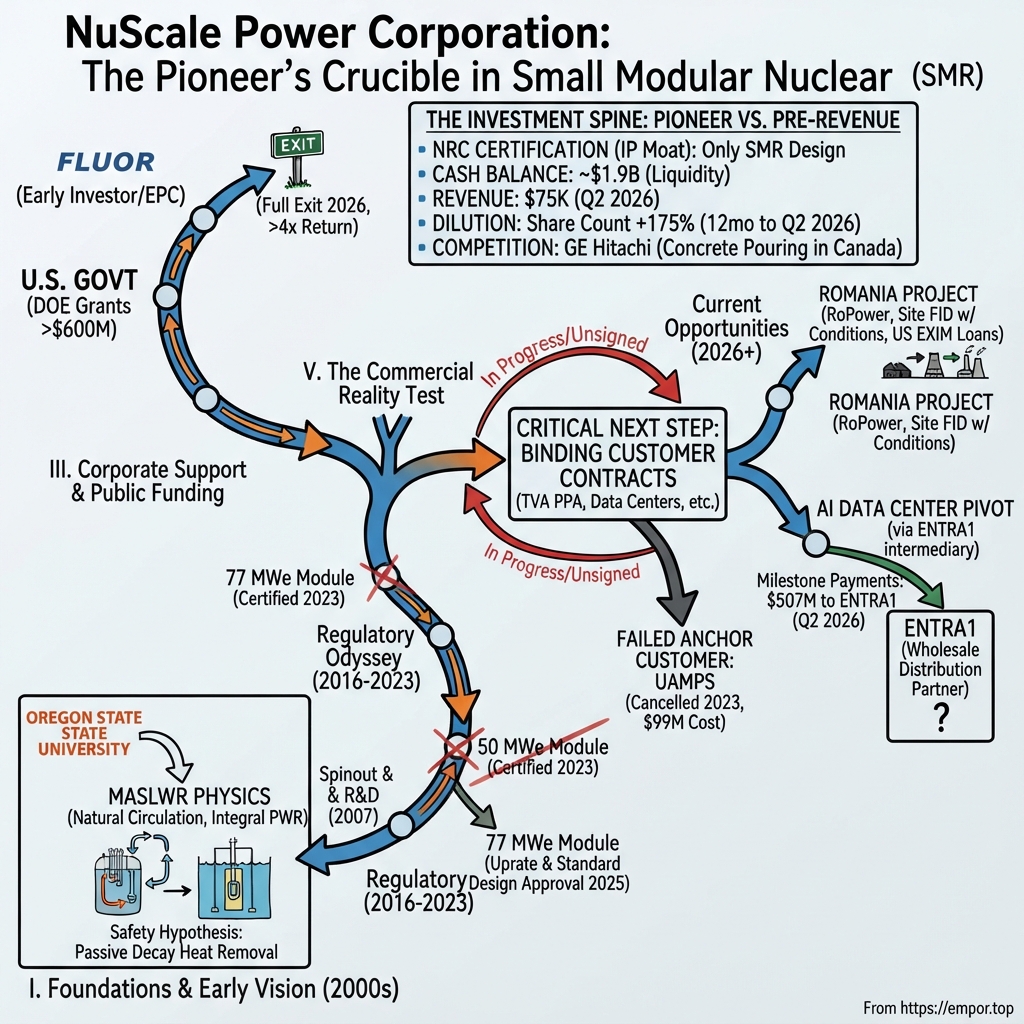
NuScale Power Corporation: The Pioneer's Crucible in Small Modular Nuclear
I. Introduction & Episode Roadmap: The Nuclear Renaissance Paradox
Two Winters, Two Verdicts
On January 19, 2023, a brief entry in the Federal Register achieved something no American regulator had done before: it certified the design of a small modular reactor. The final rule took effect one month later, officially approving a design that belonged to NuScale Power1, a company whose technology originated in a thermal-hydraulics laboratory at Oregon State University in Corvallis, Oregon2. For an industry accustomed to measuring project timelines in decades, the regulatory milestone marked a rare breakthrough. The U.S. Department of Energy celebrated it as the first time a small commercial reactor cleared the Nuclear Regulatory Commission's (NRC) full design certification process, pointing out that the agency had committed more than $600 million in federal support to NuScale's design, licensing, and siting efforts since 20141.
Ten months later, that initial optimism dissolved. In November 2023, NuScale and its anchor customer, the Utah Associated Municipal Power Systems (UAMPS), canceled the Carbon Free Power Project, which had been slated to become America's first operational SMR plant. NuScale Chief Executive John Hopkins offered a blunt postmortem: "Once you're on a dead horse, you dismount quickly."3 The project's estimated construction budget had escalated from roughly $5 billion to more than $9 billion, driving the target price of its electricity up 53 percent, from $58 to $89 per megawatt-hour. NuScale's shares, which had traded near $8 in May 2023, collapsed toward $23.
That divergence defines the central paradox of NuScale's history. By late 2023, the company had spent nearly two decades and more than half a billion dollars on its regulatory application alone while building its technology4. It secured what the industry considered the benchmark of licensing credibility. Yet at the precise moment when the boom in artificial intelligence set off an aggressive corporate hunt for around-the-clock, carbon-free power, the sector's pioneer had no customer actually building a commercial plant.
Where the Story Stands Today
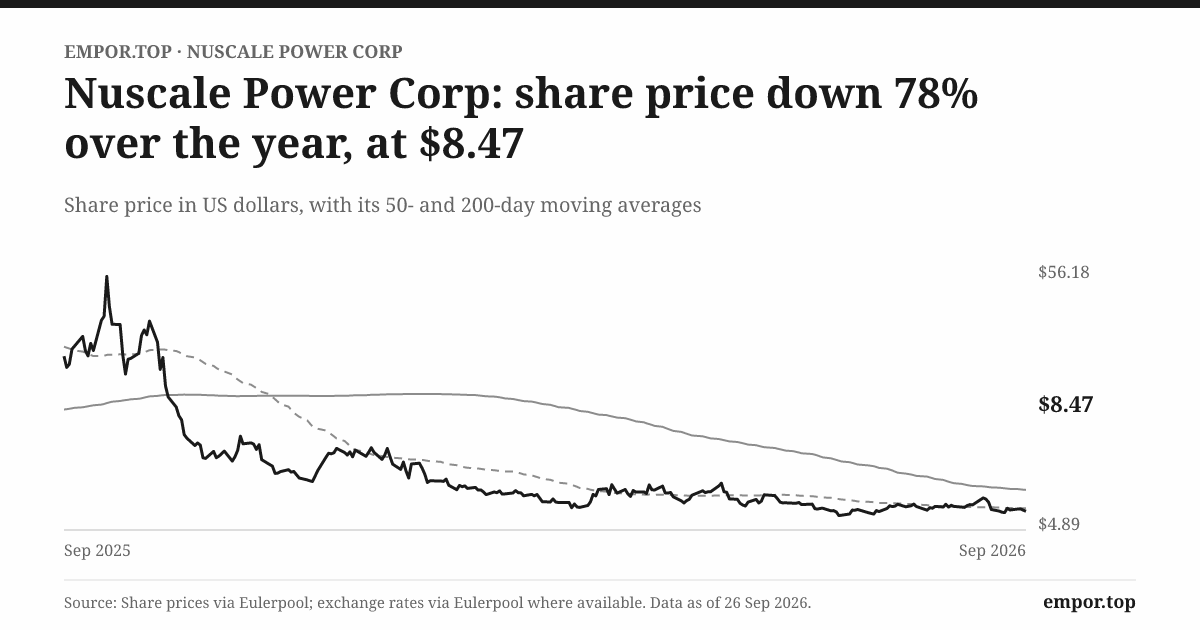
Nearly three years after that cancellation, the pattern has replayed on a much larger financial stage. NuScale closed June 2026 with roughly $1.9 billion in cash and investments, more liquidity than it has ever held5. Yet its second-quarter revenue was $75,000. That is not a typo6. The stock traded above $57 in October 2025 as market enthusiasm for nuclear-powered computing peaked, but by August 2026 it had fallen roughly 83 percent below that level7. Meanwhile, in mid-September 2026, the Tennessee Valley Authority power purchase agreement that would turn NuScale's most prominent public announcement into a binding commercial contract remained unsigned8.
The Investment Spine
The core question for long-term investors is straightforward to frame but difficult to answer: Is NuScale an intellectual-property and engineering franchise holding the only NRC-certified SMR design and positioned to collect high-margin toll-booth economics across a global buildout? Or is it an unproven, pre-revenue engineering venture afflicted by the pioneer's curse, destined to watch better-capitalized industrial rivals such as GE Vernova Hitachi pour concrete first?
This story examines that debate in sequence: the foundational physics breakthrough at Oregon State; Fluor's financial rescue and eventual exit; the grueling licensing campaign and the operational friction of upsizing from a 50-megawatt to a 77-megawatt module; the SPAC merger and the dilution machine it initiated; the collapse of the UAMPS partnership alongside short-seller scrutiny; the strategic pivot to tech hyperscalers through an intermediary called ENTRA1; the coal-to-nuclear initiative in Romania; the underlying unit economics and supply-chain bottlenecks; the broader competitive landscape; and the few decisive metrics that will determine how this experiment ends. The starting point is an engineering question an Oregon State professor posed around the turn of the millennium: what if a nuclear reactor could cool itself indefinitely without human intervention or external power?
 Subscribe on LinkedIn
II. Origins & Physics: From Oregon State University to MASLWR
A Reactor That Doesn't Need Help
Most nuclear disasters follow a familiar script. Something cuts off power to the pumps. Water stops circulating through the reactor. The core continues generating decay heat—the residual thermal energy released by decaying radioactive fission products that lingers for days after the chain reaction halts. Without cooling, temperatures climb, fuel cladding fails, and an equipment breakdown can rapidly escalate into a catastrophic meltdown. The disaster at Fukushima Daiichi in 2011 was, at its foundation, a pump-and-power failure.
In 2000, the Department of Energy's Nuclear Energy Research Initiative funded an exploratory project to design around that operational vulnerability. Known as the Multi-Application Small Light Water Reactor, or MASLWR, the program brought together the Idaho National Engineering and Environmental Laboratory, Oregon State University, and the engineering firm Nexant2. Their objective was what the collaborators described as "a small, safe and economical natural circulation reactor" generating about 45 megawatts. Federal funding ended in 2003, but researchers at Oregon State, led by nuclear engineer José N. Reyes Jr., continued the work, constructing a one-third-scale, electrically heated test facility to prove that the physics worked2.
The Physics, in Plain English
The central principle is natural circulation. Picture a pot of water on a stove: hot water rises, cooler water sinks, and a convective loop forms without needing a mechanical pump. NuScale's architecture places the reactor core, steam generators, and pressurizer inside a single tall steel vessel—a layout engineers call an integral pressurized water reactor. Water heated by the core rises through a central riser pipe, transfers its heat to steam generator tubes near the top, becomes denser as it cools, and flows naturally back down the sides to the bottom. No active components or external power sources are needed to keep that loop circulating.
The second core design element is physical scale. A 50- or 77-megawatt module generates only a fraction of the decay heat produced by a traditional gigawatt-scale reactor. That compact footprint makes it possible to submerge each module, encased within its own steel containment vessel, in an underground pool of water that serves as a permanent heat sink. The NRC's 2025 review of NuScale's larger design confirmed that its passive systems remove decay heat and keep the control room habitable without external power9. NuScale markets this capability as a "triple crown" of passive safety: safe shutdown and cooling with no operator action, no AC or DC power, and no supplemental water.
An everyday analogy illustrates the physics. A large pot of soup taken off the stove stays hot for hours because it holds significant heat relative to its surface area. A single cup of that same soup cools in minutes. A gigawatt-scale reactor core is the pot: after shutdown, it generates so much residual heat that operators must deploy electric pumps, backup diesel generators, and layers of active safety systems to prevent core damage. A NuScale module functions like the cup. It is small enough that the surrounding pool of water can absorb its leftover heat for an extended period without boiling dry. Small size is therefore central to NuScale's safety case, rather than just a commercial packaging decision.
The Business Hypothesis Hidden in the Physics
The commercial thesis follows directly from the engineering. If gravity and convection handle emergency cooling, a power plant can eliminate vast quantities of expensive, safety-grade equipment: emergency diesel generators, redundant motor-driven pump networks, and miles of seismic-qualified, safety-class wiring. Modules small enough to be built in a factory and shipped by truck, rail or barge9 could also shift nuclear construction away from high-risk field sites and onto controlled assembly lines. In theory, that modular manufacturing approach promised lower costs and faster deployment.
Yet that hypothesis remains the unresolved tension running through NuScale's story, because it has never been validated at commercial scale. Nuclear regulators have certified the underlying physics; whether that physics translates into economically competitive electricity remains unproven.
The Spinout, and the Near-Death Experience
In 2007, Oregon State University granted NuScale Power exclusive rights to commercialize the technology, along with continued access to the university's test facility. By 2008, the startup had notified the NRC that it planned to seek design certification2. Then came a financial shock outside the scope of any business plan. In January 2011, NuScale's primary financial backer, the Kenwood Group, came under investigation by the Securities and Exchange Commission. The investment firm later pleaded guilty to running a Ponzi scheme that had nothing to do with NuScale, but Kenwood's assets were frozen just as NuScale depended on follow-on funding. NuScale, which had raised about $35 million and employed roughly 100 people, was forced to cut staff heavily while its executives searched for a lifeline10.
At the same time, the product design kept changing size. The baseline concept NuScale took to the NRC in 2008 was a 45-megawatt module2. In 2011, the company was still describing 45-megawatt modules that could be grouped into plants of up to 540 megawatts11. The version regulators ultimately certified in 2023 was rated at 50 megawatts, and the version the company actively markets today is 77 megawatts. While each incremental increase made engineering and economic sense on paper, each revision also reset portions of the licensing and commercial process—a compounding friction that comes to a head in Section IV.
For public-market investors, this origin story established a pattern that recurred throughout NuScale's corporate life. The company's technical foundations were rigorous from the beginning, but its balance sheet remained chronically fragile. That financial vulnerability explains how a global engineering and construction conglomerate ultimately came to own the business.
III. The Corporate Lifeline: Fluor’s Sponsorship & The DOE Grant Engine
The Rescue
In October 2011, Fluor Corporation, the Texas-based engineering and construction firm with nuclear project experience dating back to the 1950s, acquired a majority stake in NuScale1112. The transaction price was remarkably modest: Fluor paid about $3.5 million for control and pledged nearly $30 million in working capital10. NuScale's formal announcement characterized Fluor's financial commitment as "in excess of $30 million"11. In return, Fluor secured exclusive rights to deliver engineering, procurement, and construction (EPC) services for future NuScale commercial plants12.
The industrial logic appeared sound. NuScale would handle the engineering, design, and regulatory licensing of the nuclear steam supply system—the reactor modules themselves—while Fluor served as the turnkey EPC contractor responsible for erecting the balance of the plant. A cash-strapped startup with an unproven reactor suddenly commanded the institutional backing of a Fortune 500 contractor renowned for executing complex global megaprojects. Paul Lorenzini, NuScale's chief executive at the time, stated that Fluor's capital and credibility would "ensure that we maintain a leadership position." Speaking on behalf of Fluor, group president John Hopkins emphasized that pairing Fluor's EPC track record with NuScale's passive design "will provide the assurances" risk-averse electric utilities required11. Within roughly a year, the Fluor executive who made that public pitch would be running NuScale.
Enter John Hopkins
In December 2012, Fluor installed one of its own senior leaders at the top of the startup. John Hopkins had spent nearly three decades climbing the ranks at Fluor, holding senior posts that included group president of its Government Group, head of global services, and an executive handling a two-year NATO assignment in Turkey13. Rather than a nuclear physicist, Hopkins was a seasoned corporate operator, contract negotiator, and lobbyist. He held a finance degree from the University of Texas at Austin and went on to chair the U.S. Chamber of Commerce14. That fluency in Washington politics proved indispensable, as NuScale's subsequent decade would depend every bit as much on federal appropriations as on commercial contracts.
The move was no temporary loan of executive talent. Hopkins retired from Fluor at the end of March 2013 to commit fully to NuScale, explaining that he "strongly believe[d] in NuScale's SMR technology and the potential it has to produce safe, reliable, scalable power"13. David Seaton, Fluor's chief executive at the time, lauded Hopkins for his "significant leadership role" across nearly three decades at the engineering firm13. Hopkins brought an energetic, deal-oriented posture to NuScale: comfortable sharing conference stages with cabinet secretaries, congressional committees, and utility chiefs, he consistently articulated the company's trajectory through the rhetoric of historic milestones.
By late 2026, Hopkins had led NuScale for nearly 14 years—a remarkably prolonged tenure for an unprofitable, pre-revenue venture. For public market investors, that executive continuity is a double-edged sword. It provided a steady hand through a tortuous regulatory review, but it also means that the management team offering today's commercial promises is the very same leadership responsible for yesterday's unfulfilled construction timelines.
The Public-Private Funding Machine
In December 2013, the Department of Energy awarded NuScale up to $226 million in matching funds through its SMR Licensing Technical Support program2. Federal funding expanded significantly with the launch of the Carbon Free Power Project alongside UAMPS; in October 2020, the DOE approved a multi-year cost-share award of up to $1.4 billion for the proposed deployment3. By the agency's own accounting, more than $600 million in federal taxpayer assistance flowed into NuScale's reactor design, licensing submissions, and site-selection efforts between 2014 and 20231.
Fluor steadily matched that public underwriting with private capital. Although its initial 2011 entry cost was negligible, Fluor calculated its cumulative cash investment in NuScale at $570 million by the time it ultimately exited the venture15. In functional terms, Fluor acted as the patient private-equity sponsor of a decade-long research and development program, co-funding corporate operations alongside federal grant dollars while NuScale navigated the regulatory maze.
This non-dilutive federal and corporate backing kept NuScale afloat through the 2010s without forcing it to sell dilutive public equity or take on high-yield debt. Yet it also left an indelible imprint on the company's organizational DNA. For over a decade, NuScale was structured to satisfy nuclear safety inspectors and federal grant administrators. That bureaucratic skill set is fundamentally distinct from the commercial discipline required today: convincing skeptical utility executives and corporate energy buyers to sign binding, multi-billion-dollar commercial contracts.
Myth vs. Reality: Was Fluor a Permanent Balance Sheet?
The claim: Fluor's backing gave NuScale a permanent, insulated corporate sponsor, and the credibility of a tier-one EPC partner.
The record: Fluor behaved like a venture investor, and an exceptionally disciplined one. On November 6, 2025, Fluor and NuScale announced a definitive agreement under which Fluor would convert its remaining equity interests into Class A common shares and dispose of them through a structured, volume-limited distribution program targeted for completion by the second quarter of 2026. As part of that exit, Fluor waived certain legacy commercial-arrangement claims and agreed to reduce its economic rights under the tax receivable agreement16. In February 2026, Fluor disclosed that it had sold 71 million NuScale shares for $1.35 billion, concurrently deploying more than $700 million into its own share repurchases since late 202517. In April 2026, Fluor divested its final 40 million shares for $473 million. That closing transaction brought Fluor's cumulative gross proceeds from NuScale share sales since September 2025 to approximately $2.43 billion—a lucrative return against the $570 million in total capital Fluor invested over the life of the partnership15. NuScale's quarterly filing for the period ending June 30, 2026, confirmed that Fluor no longer holds any Class A shares and is no longer classified as a related party18.
The verdict: The claim is narrowed. Fluor functioned as a corporate incubator that captured roughly a fourfold return on invested capital, not as a permanent financial backstop. That departure carries two critical ramifications for public investors. First, a controlling shareholder liquidated hundreds of millions of shares directly into the open market alongside NuScale's own capital-raising efforts—an aggressive supply overhang examined in Section V. Second, NuScale can no longer lean on a deep-pocketed parent to absorb project-level cost overruns, warranty liabilities, or completion guarantees on its first-of-a-kind installations. While Fluor continues to perform subcontracted engineering tasks for NuScale—and company management noted on its third-quarter 2025 earnings call that Fluor still retained a board seat at that time19—the relationship has transitioned from parental sponsorship to an arm's-length commercial vendor arrangement. Whether NuScale can project sufficient financial strength on its own will become apparent as prospective first-of-a-kind customers decide whether to demand third-party balance-sheet wraps. With Fluor fully exited as an equity owner, NuScale's principal commercial asset is its regulatory approval—and the historical reality of that regulatory standing is far more complex than the top-line headlines convey.
IV. The Regulatory Odyssey: NRC Certification & The Uprate Dilemma
Twelve Thousand Pages
On New Year's Eve 2016, a team in Oregon completed the largest document in NuScale's history: a formal request asking the U.S. government to certify that a reactor small enough to ship by truck and cooled entirely by natural physics could be built anywhere in the country without re-litigating its core safety design. Regulators at the Nuclear Regulatory Commission had never evaluated a commercial reactor operating purely on gravity and convection, and NuScale's engineers could not foresee that the baseline product they were submitting would be commercially obsolete before its certificate was published.
On December 31, 2016, NuScale formally submitted its Design Certification Application to the NRC. The filing spanned more than 12,000 pages alongside 14 separate topical reports, and NuScale ultimately supplied over 2 million pages of supporting technical documentation during regulatory audits4. The company calculated that it had invested more than $500 million, backed by Fluor, and over 2 million labor hours to assemble the submission4. The NRC issued its Final Safety Evaluation Report on September 1, 2020, approving an architecture centered on 12 submerged modules generating 50 megawatts apiece, totaling roughly 600 megawatts per plant4. The final rule codifying that certification was published in January 20231.
Navigating that initial review required dismantling long-standing regulatory assumptions. Because the NRC's rules were written for gigawatt-scale plants equipped with active, motor-driven safety systems, NuScale had to justify, requirement by requirement, why a plant relying on convection and gravity did not require the redundant pumps, backup diesel generators, and emergency water supplies mandated for traditional reactors. Each technical exemption NuScale secured established a regulatory precedent that subsequent applicants could adopt.
The 77-Megawatt Problem
While the NRC was reviewing that 50-megawatt design, testing and analysis revealed that the same basic module could operate at higher thermal output. NuScale's engineers uprated it to 250 megawatts thermal and about 77 megawatts electric9. The economic rationale was clear: because nuclear civil works and balance-of-plant infrastructure represent substantial fixed costs, extracting roughly 54 percent more electricity from essentially the same hardware dramatically lowers the capital cost per kilowatt. NuScale reconfigured its flagship commercial offering around this higher rating: the US460, a standard plant grouping six 77-megawatt modules to deliver roughly 462 megawatts9.
Understanding the commercial fallout requires distinguishing between two different regulatory milestones. A Design Certification is codified as a formal federal regulation. Once issued, the design's core safety profile is legally settled for any utility referencing it—analogous to a standardized architectural blueprint that a builder can deploy without re-arguing its engineering. A Standard Design Approval, by contrast, is a lighter administrative instrument. It certifies that NRC staff have found the engineering acceptable for reference, but it lacks the statutory finality and legal insulation against third-party challenges that full certification confers. For prospective utility customers, the distinction introduces an element of regulatory nuance; for NuScale's sales pipeline, it created another hurdle to explain.
The underlying complication was that the certified design covered a 50-megawatt module NuScale no longer intended to commercialize. In regulatory terms, the 77-megawatt module was a distinct design. NuScale submitted a new Standard Design Approval (SDA) application, which the NRC docketed in 2023. The agency completed its review in under two years and below projected cost, issuing the approval in late May 2025920. Yet even that milestone carried a major practical qualification: while future developers can reference the SDA, any utility seeking to construct a facility still needs to obtain site-specific construction and operating licenses covering local seismology, hydrology, and meteorology9.
Myth vs. Reality: The Certification Moat
The claim: Being first through NRC certification gave NuScale a regulatory lead of five to seven years that rivals could not close.
The record: The 2023 certification covered a module size NuScale no longer planned to sell. From early 2023 until mid-2025, the company was actively marketing the 77-megawatt design, which lacked formal regulatory approval. Meanwhile, industrial competitors capitalized on the regulatory pathway NuScale had cleared. In Canada, Ontario Power Generation secured a licence to construct a GE Vernova Hitachi BWRX-300 at Darlington in April 2025, targeting completion of the first unit by the end of the decade and commercial service in 2030, supported by a first-unit budget of C$6.1 billion alongside C$1.6 billion in shared infrastructure21. In the United States, the Tennessee Valley Authority applied for a construction permit for its own BWRX-300 at Clinch River. By July 2026, NRC staff had recommended issuing that permit after finishing the safety evaluation about five months ahead of schedule22.
The verdict: The claim is narrowed. NuScale continues to hold the only NRC design certification in the SMR industry, and it holds a second approval for its commercial design5. That dual standing is real, and it eliminates a meaningful layer of technical risk for prospective buyers. But a moat is designed to keep competitors at bay, and this one has not. GE Vernova Hitachi has a commercial unit under construction in Canada and a U.S. construction permit nearing final issuance, achieving both milestones without ever obtaining a standalone design certification. At the same time, the regulatory process itself has accelerated: NRC staff hours for the Clinch River permit review dropped from an estimated 25,000 hours to roughly 16,50022. As regulatory reviews compress, the competitive value of having pioneered the process diminishes. The definitive test of NuScale's regulatory advantage is no longer the certificate framed on its wall, but how quickly a customer files and secures an actual construction permit for a US460 plant. Navigating that protracted, capital-intensive runway without commercial revenue proved difficult to sustain on grants and contractor backing alone—which is why NuScale turned to Wall Street.
V. The Public Markets Crucible: The Spring Valley SPAC & Dilution Mechanics
The Listing
Spring 2022 was an unusual moment to go public. The boom in special purpose acquisition companies was fading, interest rates were beginning to climb, and Russia's invasion of Ukraine had suddenly propelled energy security back to the top of national agendas worldwide. For a capital-intensive nuclear venture, that macro environment presented both a headwind and an opening: while capital markets were rapidly closing to speculative growth stories, the strategic case for firm, domestic, carbon-free power had rarely looked more compelling. NuScale took the opening.
On May 2, 2022, NuScale completed its business combination with Spring Valley Acquisition Corp., a sustainability-focused blank-check vehicle, and debuted on the New York Stock Exchange the following day under the ticker SMR. The transaction was priced at an enterprise value of approximately $1.9 billion and yielded roughly $380 million in gross proceeds, including approximately $235 million from a private investment in public equity (PIPE) anchored by financial and strategic institutions23. Industrial support had begun arriving even earlier: South Korea's Doosan Enerbility had already committed more than $100 million alongside Korean financial partners over the preceding two years24.
SPAC listings had served as the default route to public capital for pre-revenue climate technology ventures throughout 2021 and early 2022, offering a liquid public currency while bypassing the intense revenue vetting typical of a traditional initial public offering roadshow. Yet the structure also exposed an engineering business governed by multi-year licensing and construction cycles to the unforgiving rhythms of quarterly earnings reports, retail momentum swings, and aggressive short sellers. After trading near $15 in August 2022, NuScale shares tumbled toward $2.54 by January 202425.
The CFO Seat
In August 2023, NuScale appointed Robert Ramsey Hamady as chief financial officer, succeeding Chris Colbert. Corporate filings outlined Hamady's career as a corporate CFO, a former investment banker at Lehman Brothers and J.P. Morgan, and an asset manager advising private equity, sovereign wealth, and family-office accounts26. The mandate was unambiguous: construct a durable financial runway as industry headwinds gathered, and the turbulence arrived almost immediately.
Survival Mode, Then Abundance
The storm broke that autumn. Following the cancellation of the Carbon Free Power Project with UAMPS in November 2023, NuScale initiated sweeping cost reductions in January 2024, cutting 154 full-time employees—roughly 28 percent of its workforce—in an effort to extract $50 million to $60 million in annualized overhead savings25. Top-line commercial receipts remained minimal, recording $22.8 million in 2023 and $37.0 million in 202427. That operational profile yielded a net loss of $348.4 million in 2024, heavily distorted by a $223.0 million non-cash accounting charge tied to the revaluation of outstanding warrants—a stark illustration of how share price volatility, rather than core reactor operations, dictated reported GAAP earnings27.
Then market sentiment reversed abruptly. Driven by surging data-center power demand from artificial intelligence workloads, nuclear equities rallied sharply. NuScale moved quickly to monetize the rebound, calling its public warrants for redemption. Roughly 97 percent of holders exercised, delivering $227.7 million in fresh cash and lifting the company's year-end 2024 cash and short-term investments to $446.7 million, up from $161.7 million just three months earlier27. From that fortified footing, management launched an equity-raising campaign of extraordinary velocity. NuScale sold 13.2 million shares for $475.2 million during the third quarter of 202528, followed by 39.3 million shares for $750.0 million in the fourth quarter29. The pace accelerated into 2026: during the first six months of the year, the company issued 89.7 million shares for $1.0 billion in gross proceeds, realizing an average price of $11.14 per share and exhausting its 2026 at-the-market (ATM) equity facility by June18. On August 11, 2026, the company established another ATM program to sell up to $750 million in additional shares through a banking syndicate led by UBS and B. Riley30.
How an ATM Works, in Plain English
An at-the-market offering operates fundamentally differently from a traditional secondary offering. Instead of pricing a large block of stock on a single night at an agreed discount to institutional buyers, an ATM allows a company to sell freshly minted shares incrementally through broker-dealers directly into regular market trading at prevailing prices. Management controls the spigot, choosing to tap liquidity when share prices surge and turn off the flow when the market softens. For a company characterized by high retail interest and volatile trading volumes, the mechanism provides an efficient, quiet capital valve. For long-term public shareholders, however, the trade-off is substantial: the corporate share count expands continuously without the public signal of a headline offering. On the third-quarter 2025 earnings call, Hamady characterized the period's issuance as raising "a sensible amount of cash" from the markets19.
What the Dilution Means
That continuous equity issuance substantially altered the company's capital structure. NuScale's weighted-average share count climbed from approximately 133 million to roughly 365 million in a single twelve-month span7. By June 30, 2026, the company's equity base comprised 410.4 million Class A shares and 19.3 million Class B shares outstanding6. For an early investor, the arithmetic was punishing: a shareholder holding a 1 percent stake in mid-2025 who refrained from committing fresh capital saw that position compressed to barely a third of 1 percent. For existing owners, such aggressive dilution creates net economic value only if the newly raised capital generates returns that comfortably exceed the proportional ownership surrendered.
Aggressive fundraising is not inherently flawed corporate governance. Raising capital when equity valuations peak to build a cash cushion is prudent treasury management, and NuScale's $1.9 billion balance meant there was no near-term solvency question57. Yet two critical qualifiers place that balance sheet in perspective. First, a large portion of the capital raised did not fund internal engineering, but went instead to ENTRA1 Energy, a strategic intermediary examined in Section VII. Second, the arrival of a fresh $750 million program mere weeks after exhausting the previous $1.0 billion authorization indicates that equity dilution is functioning as a standing funding source rather than a one-time treasury buffer.
The timing of that share supply proved equally critical. Between September 2025 and April 2026, Fluor liquidated approximately $2.43 billion of its NuScale equity holdings15. Over roughly the same interval, NuScale itself sold more than $2 billion of newly issued shares2918. That dynamic flooded the public float with well over $4 billion of equity paper in a company operating virtually without commercial revenue. Predictably, the stock slumped more than 80 percent from its peak over that stretch7. While structural fundamentals—including the non-binding status of the Tennessee Valley Authority relationship, scrutiny surrounding ENTRA1, and declining top-line revenues—undoubtedly weighed on valuations, the sheer volume of stock being absorbed by the open market contributed heavily to the decline.
Myth vs. Reality: Self-Funding Through Licensing
The claim: Capital from the SPAC business combination, combined with a high-margin licensing model, would make NuScale self-funding as modules began shipping.
The record: No commercial module has shipped. Over its four years as a publicly traded corporation, NuScale has sustained operations primarily through SPAC proceeds, public warrant exercises, and approximately $2.2 billion in ATM share sales executed across the twelve months ending June 2026282918. Commercial revenue moved in the opposite direction, declining to $31.5 million in 202529 before dropping to almost nothing in the first half of 20266.
The verdict: The claim is rejected so far. Public equity markets, rather than commercial customers, have underwritten NuScale's corporate existence. That structural reliance can shift only when firm, binding equipment orders materialize—which makes a close examination of the one project that nearly became NuScale's first commercial installation essential to understanding what lies ahead.
VI. The Commercial Reality Check: UAMPS Collapse & The Short-Seller Trial
The Plan That Looked Perfect on Paper
In 2023, municipal council chambers across Utah and Idaho became an unlikely proving ground for nuclear finance. Civic leaders accustomed to debating water tariffs and road repairs were asked to commit their residents to decades of off-take obligations from a reactor that had never operated commercially anywhere in the world. Each municipal board faced a compounding dilemma: remain committed to an unbuilt design or exercise off-ramps to protect local ratepayers as cost projections escalated.
On paper, the Carbon Free Power Project seemed structured as the ideal first commercial installation. The Utah Associated Municipal Power Systems (UAMPS), a cooperative of municipal utilities across the Intermountain West, planned to deploy NuScale modules at the Department of Energy's Idaho National Laboratory site near Idaho Falls. The plan initially envisioned a 12-module installation before developers downsized it to six 77-megawatt units delivering an aggregate 462 megawatts3. Public financial backing was substantial: the Department of Energy approved a cost-share award of up to roughly $1.4 billion3, while federal production tax credits under the Inflation Reduction Act promised to further subsidize generation costs. Supply-chain mobilization had also begun. South Korea's Doosan Enerbility commenced manufacturing the upper reactor pressure vessels for those initial six modules, an order encompassing more than 2,000 metric tons of heavy forgings, steam generator tubes, and weld material that NuScale hailed as "a significant breakthrough into the manufacturing phase"31.
The Number That Broke It
In January 2023, an updated economic projection dismantled that commercial foundation. Estimated project costs climbed from just over $5 billion to more than $9 billion, driving the target power price from $58 to $89 per megawatt-hour—a 53 percent jump that management attributed to inflationary increases in the cost of structural steel, concrete, and other materials3.
For a municipal cooperative, that cost escalation proved fatal. A local city council cannot easily tell voters that their electricity rates will jump by half to underwrite an unproven nuclear experiment. Under the project's contract, member utilities retained rights to withdraw if aggregate power subscriptions dropped below an 80 percent threshold, and subscription growth stalled as communities opted out3. On November 8, 2023, UAMPS and NuScale formally announced that they were mutually terminating the project32. NuScale agreed to pay UAMPS a $49.8 million termination fee3. With the contract canceled, the heavy forgings Doosan had begun fabricating in South Korea were left without a destination power plant.
The Short Seller Arrives
Three weeks before that termination, on October 19, 2023, short seller Iceberg Research published a report titled "A Fake Customer and a Major Contract in Peril Cast Doubt on NuScale's Viability"33. The critique targeted two central vulnerabilities. First, it asserted that UAMPS was falling far short of its subscription thresholds and argued that investors had not been fully apprised of how severe member attrition had become. Second, and more aggressively, it attacked a commercial transaction NuScale had announced on October 6. In that deal, Standard Power, an infrastructure operator with historical roots in cryptocurrency mining, outlined plans to deploy 24 NuScale modules representing 1,848 megawatts across proposed facilities in Ohio and Pennsylvania, developed alongside ENTRA1 Energy and aimed at operation by 202934. Iceberg argued that Standard Power lacked the financial resources to execute an infrastructure project anywhere close to that scale33.
Events proved Iceberg right on UAMPS within weeks. On Standard Power, NuScale's subsequent regulatory filings and operating updates through mid-2026 disclosed neither construction activity nor a binding equipment contract for those sites, as the company's commercial focus moved to TVA529. The episode also established a recurring commercial pattern: a headline-grabbing capacity figure, a counterparty with little operating track record, and an announcement that used aspirational terms like "plans" and "aims" rather than binding language34.
Myth vs. Reality: Municipal Utilities as Natural First Buyers
The claim: Public power utilities, with their long planning horizons, access to tax-exempt financing, and decarbonization mandates, would be the natural first buyers of SMRs.
The record: The most mature SMR project in the United States collapsed specifically because municipal buyers could not absorb first-of-a-kind cost escalation. Regulated, investor-owned utilities can sometimes recover construction work in progress or rate-base cost overruns across broad captive markets. A municipal cooperative, by contrast, answers directly to local elected boards and retail ratepayers who hold contractual rights to walk away.
The verdict: Rejected. Small public-power entities cannot risk their balance sheets on the developmental uncertainties of a first-of-a-kind reactor.
That failure created an underlying irony for the next chapter of NuScale's commercial campaign. Its most important prospective offtaker today, TVA, is also a public power entity. But TVA is a federal corporation with an extensive nuclear operating history, making it far better equipped to absorb project complexity than a coalition of small towns. Even so, the UAMPS lesson still applies: public buyers answer to ratepayers and political overseers, and they write contractual exit ramps into procurement deals. Investors should expect any TVA power purchase agreement to include strict price protections and cancellation rights that leave most first-of-a-kind cost risk with the developer and vendor rather than with TVA. With UAMPS gone, NuScale had to seek buyers who possessed both balance-sheet scale and the capacity to absorb risk: large commercial utilities, sovereign governments, and capital-rich technology hyperscalers. That is where the story went next.
VII. The Pivot: AI Data Centers, ENTRA1, and European Coal Repowering
The Gold Rush
In the autumn of 2024, the world's leading technology conglomerates made rapid, high-profile commitments to nuclear power. Microsoft contracted with Constellation Energy to restart a shuttered reactor at Three Mile Island to feed electricity directly to its data centers. Google struck a framework agreement to purchase power from multiple Kairos Power small modular reactors, targeting an operational debut by 2030 and an aggregate 500 megawatts by 2035. Amazon invested directly in X-energy, underwriting a four-reactor installation alongside Energy Northwest in Washington State while evaluating an SMR deployment adjacent to Dominion Energy's North Anna nuclear station in Virginia35.
NuScale's name appeared nowhere across those landmark agreements. Despite holding the industry's only NRC-certified SMR design, the sector's pioneer watched as the corporate world's best-capitalized buyers of firm, zero-carbon power chose to resurrect conventional gigawatt-scale reactors or fund rival, uncertified designs. That exclusion shaped NuScale's subsequent commercial strategy: rather than negotiating bilateral power agreements directly with corporate hyperscalers, the company routed its sales campaign through a little-known intermediary.
ENTRA1: The Intermediary
NuScale's bridge to the enterprise market ran through an alliance unfamiliar to most public equity investors. In September 2022, NuScale announced a global strategic partnership with the Habboush Group—described as an international private asset manager with four decades of experience across energy and infrastructure—and ENTRA1, an independent investment platform targeting energy transition assets36. Under the arrangement, ENTRA1 Energy became NuScale's exclusive global commercialization partner, securing the unilateral mandate to "develop, manage, own and operate" production plants utilizing NuScale's proprietary reactor technology34.
Executive leadership characterized the relationship as an efficient division of labor: NuScale would operate as an intellectual-property and technology provider focused on module engineering and manufacturing, while ENTRA1 served as "a wholesale distribution partner" tasked with originating projects and placing reactors into the field19. In theory, this structure established a capital-light operating model. NuScale could shield its balance sheet from site-level civil development and construction liabilities, leaving ENTRA1 to assemble project equity, structure debt financing, and negotiate power off-take agreements.
The TVA Announcement and the Milestone Payments
On September 2, 2025, ENTRA1 and the Tennessee Valley Authority announced a non-binding preliminary agreement to explore up to 6 gigawatts of NuScale-powered capacity—a buildout of as many as 72 modules across up to six separate generating stations in TVA's seven-state territory, which the sponsors celebrated as the largest SMR initiative in American history1929. On NuScale's third-quarter 2025 earnings call, management stated that the initial plant could start delivering power to TVA as early as 2030, analogizing the program's ultimate output to the electrical demand of the entire Dallas-Fort Worth metropolitan area19. On that same call, management stressed that ENTRA1 had been cited within an official U.S.-Japan bilateral investment framework as "positioned to receive up to $25 billion in investment capital" to finance a fleet of baseload nuclear facilities19. While an eye-catching figure, the designation represented prospective financing eligibility rather than committed capital for a specific NuScale project.
Concurrently with that announcement, NuScale entered into a Partnership Milestone Agreement that inverted standard commercial cash flows. Rather than an intermediary paying licensing fees to the technology developer, the filed agreement required NuScale to pay ENTRA1 across three distinct phases for each module block: a 15 percent milestone contribution upon ENTRA1 executing a non-binding instrument, such as a term sheet, with an eligible counterparty; 35 percent upon the execution of a binding power purchase agreement; and the remaining 50 percent upon executing an equipment manufacturing contract. The contractual contribution amounts escalate annually by the greater of 5 percent or the rate of inflation, and the agreement extends to 2045 with provisions for automatic renewal. Counterparties must maintain an investment-grade credit rating of BBB- or higher or qualify as governmental entities. Outstanding payment obligations are capped at any single time at 72 modules for the initial non-binding stage and 48 modules for the binding agreement stage37.
The non-binding TVA announcement triggered that initial payment mechanism immediately. NuScale recognized a $507.4 million expense for Milestone Contribution 1, disbursing $247.5 million in cash during 2025 and an additional $259.9 million across the first six months of 202618. That single contractual obligation served as the primary catalyst pushing NuScale's 2025 general and administrative expenses to $609.8 million and widening its net loss to $664.5 million29.
Management defended the cash outlays as an acceleration of standard corporate development expenses, arguing that NuScale was pre-funding activities it "would typically incur later in the process, such as development, project management and other services," in order to help ENTRA1 finalize project financing more quickly19. When Goldman Sachs analyst Brian Lee questioned the downside if TVA ultimately contracted for only a fraction of the 6-gigawatt headline, Chief Financial Officer Ramsey Hamady asserted that unallocated milestone payments "would roll into the next project," insisting that "it's not like it's money out the door, it's money gone"19. Lee noted that under NuScale's own regulatory filings, potential milestone payments to ENTRA1 through the power-purchase stage alone exceeded $3 billion19. Hamady countered that absorbing an immediate 72-module commitment was "probably not likely." He further contended that the third, equipment-manufacturing milestone would prove "net cash positive" because NuScale would collect equipment revenue alongside the disbursement, advising analysts to "cut in half" their estimates of net cash outflows and predicting that as projects progressed, the fee structure "will become self-funding"19.
The accounting treatment of these outlays warrants close investor scrutiny. NuScale expensed Milestone 1 directly through the income statement. For Milestone 2, Hamady acknowledged that the company's "preference obviously is to capitalize rather than to expense, but that's TBD." For Milestone 3, management expressed confidence that it was "fairly certain" it could capitalize the payments and net them against future commercial revenues19. Capitalizing subsequent milestone disbursements would shield the income statement from reporting deep operating losses, even while significant cash leaves the company. To evaluate the true financial drag of the ENTRA1 relationship, investors must track the statement of cash flows rather than reported accounting income.
The Credibility Question
During the third-quarter 2025 earnings call, Guggenheim analyst Joseph Osha raised the central operational concern confronting the partnership: whether ENTRA1 had ever developed, financed, owned, or operated a functioning infrastructure asset. Management pointed to the historical project experience of the affiliated Habboush family enterprises. Hamady then clarified the distinction: "we are talking about the principles of ENTRA1 that have developed projects," emphasizing that ENTRA1 functions as "a developer" that contracts execution to established EPC conglomerates19. Guggenheim subsequently issued a critical research note characterizing ENTRA1 as "a 3-year old company that has never built, financed or operated anything." NuScale's shares dropped 12.4 percent over the following two trading sessions38, and according to legal filings, drifted down to approximately $17 by November 2139. Shareholder litigation followed in early 202638. In its quarterly filing for the period ending June 30, 2026, NuScale disclosed a consolidated securities class action covering stock purchases from March 3 through November 6, 2025, alongside a stayed derivative action alleging fiduciary breaches18. While these lawsuits represent unproven legal claims, they introduce an ongoing liability overhang.
The tenor of executive communication on that call drew as much investor attention as the financial terms. When Citi analyst Vikram Bagri asked whether NuScale had instituted contractual safeguards to protect a half-billion-dollar outlay paid to an asset-light corporate vehicle, calling such protections "good corporate practice," Hamady replied "Absolutely," pointed to the roll-over provisions, and challenged the premise of the inquiry: "At what point do you stop doubting this partner?"19 Chief Executive John Hopkins concluded the call by declaring himself a "proof is in the pudding guy"19. That remains an appropriate standard of accountability. A leadership team confident in its strategic partner should welcome tangible verification—and ten months after that exchange, the binding TVA contract that would provide it remained unexecuted8.
Romania: The Most Advanced Beachhead
NuScale's most tangible commercial progress is situated in Doicești, Romania. There, RoPower Nuclear—a 50/50 joint venture uniting Romania's state nuclear utility S.N. Nuclearelectrica S.A. with private developer Nova Power & Gas—plans to construct six 77-megawatt NuScale modules on the site of a decommissioned coal-fired power station40[^41]. Fluor completed the Phase 2 front-end engineering and design (FEED) study for the site29. On February 12 and 13, 2026, Nuclearelectrica's shareholders approved a final investment decision (FID), and the Romanian government formally endorsed the deployment4041. Bilateral financing interest from Washington has been substantial: letters of interest from the U.S. Export-Import Bank and the International Development Finance Corporation envision up to $4 billion in project financing, complementing an approved $98 million EXIM engineering loan41.
Yet the formal stipulations surrounding the project reflect considerable institutional caution. The shareholder FID was encumbered by strict conditions detailed in confidential annexes; if any single condition is breached, "the project will be deemed unfeasible"40. The operational rollout is also phased: a single first-of-a-kind module must be constructed and performance-tested before capital is committed to the remaining five units41. Furthermore, governance friction surfaced in 2025 when Nuclearelectrica shareholders twice rejected a proposed equity investment from a South Korean private equity consortium42. Hopkins had previously warned that final investment approval could slip into "mid-to-late 2026 and early 2027"43. With Phase 2 FEED engineering concluded, NuScale experienced an immediate top-line contraction: commercial revenue fell by $12.8 million year-over-year in the first quarter of 202644, and dwindled to an inconsequential $75,000 in the second quarter6.
Romania remains NuScale's most credible showcase of genuine customer demand, underpinned by three factors: a state-backed nuclear utility acting as co-owner, active underwriting engagement from U.S. export-credit agencies, and formal sovereign approval. Yet it also demonstrates the protracted gestation period inherent to international nuclear infrastructure. On the third-quarter 2025 call, Hopkins noted that he remained in contact with RoPower executives "almost once a week," highlighting Romania's strategic ambition to establish itself as a Central and Eastern European SMR manufacturing hub19. Frequent communication and regional policy alignment are constructive indicators, but neither constitutes a binding commercial equipment order.
Myth vs. Reality: Hyperscaler Demand Becomes NuScale Orders
The claim: Rising corporate hyperscaler demand for firm, carbon-free power will rapidly translate into binding commercial orders for NuScale modules.
The record: No major technology enterprise has executed a direct, binding procurement contract for NuScale reactors. The headline-grabbing Standard Power announcement from 2023 yielded no physical construction or binding supply commitments. The widely promoted TVA deployment framework remained strictly non-binding as of mid-September 20268. Meanwhile, TVA is concurrently advancing a competing GE Vernova Hitachi BWRX-300 project at Clinch River that has already earned a formal construction-permit recommendation from NRC staff22. Above all, NuScale paid more than half a billion dollars in cash to an unproven intermediary merely to secure a non-binding preliminary framework.
The verdict: The claim is unproven, and the ENTRA1 commercial structure substantially amplifies shareholder risk. The essential catalyst required to validate the strategy is a fully executed, binding power purchase agreement with TVA and a creditworthy corporate offtaker. Yet that very achievement will trigger a 35 percent Milestone 2 payment obligation, ensuring that NuScale's most celebrated commercial milestone will coincide with another massive cash outflow. Whether those pre-funded outlays ever yield positive net returns depends entirely on the underlying unit economics of the reactor module itself.
VIII. Core Economics, Segment Data, & The Manufacturing Supply Chain
Inside the Forge
In the spring of 2023, at a Doosan Enerbility plant in South Korea, massive steel ingots passed under a hydraulic press to form the upper reactor pressure vessels for NuScale's first six commercial modules. That manufacturing order, placed in late 2022 and encompassing more than 2,000 metric tons of heavy forgings, had been destined for the Idaho deployment that was never built31. Today, those forgings stand as the most tangible physical result of NuScale's two decades of engineering: specialized metal shaped to an approved design, waiting for a power plant to house it. The underlying economics turn on a single commercial question: what will it take for a customer to actually buy modules like these?
One Segment, Two Businesses
NuScale reports a single operating segment, but in practice it houses two fundamentally different businesses. The business that exists today sells engineering services, front-end engineering and design studies, technology licensing, and historically, reimbursable cost-share work funded by the Department of Energy. That legacy activity generated $37.0 million in 202427 and $31.5 million in 202529, before trailing twelve-month revenue dropped to roughly $10.7 million by mid-20267. The second business—the commercial equipment enterprise that would justify NuScale's multi-billion-dollar valuation—would sell manufactured power modules, fuel fabrication services, and decades of recurring maintenance and plant-management software. To date, that commercial enterprise has not recorded a single dollar of revenue.
If that second business materializes, the commercial model features several distinct revenue layers. First, NuScale would sell the proprietary power modules fabricated by manufacturing partners such as Doosan, with equipment pricing governed under the ENTRA1 framework by an annual escalator tied to inflation1937. Second, the company would capture upfront fees for site licensing support, specialized engineering, and plant commissioning. Third, across each plant's projected 60-year operational life, NuScale would collect recurring high-margin royalties and fees for fuel services, spare parts, component refurbishments, and digital operating support—mirroring the lucrative aftermarket maintenance model that sustains commercial aerospace manufacturers long after an initial engine sale. Almost all of the equity value public markets assign to NuScale depends on those future recurring cash flows. Yet none of those revenue streams has begun.
The interim financial picture illustrates that structural gap. For the second quarter of 2026, NuScale reported an operating loss of $64.0 million, partially cushioned by investment income that rose $8.5 million from the prior-year period due to higher cash balances65. Across the first six months of 2026, operating cash outflows reached $372.9 million18. Approximately $260 million of that total reflected milestone disbursements to ENTRA118, leaving an underlying operational cash burn of roughly $110 million for the half-year—before any additional milestone payments that future contract signings would trigger.
Why Capital Cost Is Everything
Nuclear economics turn on a straightforward structural reality: fuel is cheap, but construction is extraordinarily expensive. The vast majority of a nuclear plant's levelized cost of electricity—the all-in generation cost per megawatt-hour over a facility's operating life—is dictated by the upfront capital required to build it and the financing charges incurred to service that debt. That dynamic explains why the revised UAMPS cost estimates proved fatal. When projected construction costs nearly doubled and borrowing rates climbed, the target power price jumped 53 percent even though the reactor's underlying physics had not changed at all3. The financial profile functions much like a residential mortgage: the purchase price of the home and the interest rate on the loan matter far more than monthly utility bills. A small modular reactor cannot win market share on marginal fuel efficiency; it must win on overnight capital cost—the hypothetical expense of building the plant instantly—and on construction speed, because every additional month on site compounds capitalized financing costs.
The UAMPS figures implied a first-of-a-kind capital cost approaching $20,000 per kilowatt once financing was included. Management's commercial thesis assumes that standardized, serial factory production will drive the cost of subsequent units substantially lower. Yet that cost curve remains an unproven management ambition rather than an observed industrial reality. The most relevant real-world benchmark in the sector comes from Ontario, Canada. There, Ontario Power Generation expects its fourth GE Vernova Hitachi BWRX-300 to cost roughly one-third less than its first—C$4.1 billion compared with C$6.1 billion—as manufacturing repetition, standardized supply chains, and on-site labor proficiencies take effect21. While a 33 percent cost reduction across four units represents an encouraging learning curve for the broader SMR industry, it also underscores the steep capital penalty borne by first-of-a-kind buyers.
That divergence between first-of-a-kind outlays and Nth-of-a-kind manufacturing costs represents the central pivot of the SMR investment thesis. Commercial aviation provides an apt comparison: building the first aircraft off a newly commissioned assembly line costs many multiples of the hundredth, as tooling stabilizes, fabrication tolerances mature, and assembly line workers eliminate operational bottlenecks. NuScale is wagering that factory-assembled nuclear modules will behave like aircraft rather than the custom-built, site-poured concrete megaprojects that historically crippled traditional nuclear construction. Management articulated that exact argument on its third-quarter 2025 earnings call, contending that production costs will fall as manufacturing scales "from first of a kind" across a prospective 72-module TVA rollout, while contractual price escalators protect equipment margins19. While that industrial logic is sound in theory, it remains entirely unproven for NuScale, which has yet to construct or assemble even its initial commercial module. Furthermore, Ontario's projected one-third cost reduction, while meaningful, falls far short of the radical cost compression NuScale's modular-factory narrative requires—and for the moment, that empirical learning curve belongs entirely to a competitor.
The Supply Chain
NuScale's most concrete physical advantage is its supply chain. Doosan Enerbility, South Korea's heavy-forging leader, serves as both a strategic shareholder—having invested more than $100 million alongside Korean partners by 202124—and NuScale's primary module manufacturing partner, having initiated fabrication of upper reactor pressure vessel materials in 202331. Because only a handful of industrial conglomerates globally, including Doosan, Japan Steel Works, and Framatome, possess the heavy forging capacity required to produce nuclear-grade vessel components at this scale, reserved manufacturing slots carry strategic value. NuScale reports relationships with more than 60 specialized supply-chain partners and more than 30 signed agreements5. In 2026, the company expanded its fuel partnership with Framatome across the United States and Europe44, and in the second quarter of 2026, Paragon secured the contract for the final engineering design of the module's safety instrumentation, known as the Highly Integrated Protection System5.
On an engineering level, these partnerships demonstrate genuine technical readiness, lending credibility to Chief Executive John Hopkins's claim that pre-deployment preparation "is now substantially complete"5. The critical commercial qualification, however, is that supply-chain readiness is perishable without binding equipment orders. Ultra-heavy forging presses, specialized fabrication yards, and nuclear fuel assembly lines are reserved for customers that commit capital and advance payments, and industrial suppliers will inevitably prioritize reactor vendors with financed, binding order backlogs. Those underlying unit economics and manufacturing realities establish the terms of the broader commercial race, which is where the story turns next.
IX. Strategic Frameworks: Porter’s 5 Forces & Hamilton Helmer’s 7 Powers
Setting the Board
Consider a utility resource-planning committee evaluating its first small modular reactor. On one side of the table sits GE Vernova Hitachi, backed by an established industrial balance sheet, with an active construction site at Darlington and TVA's Clinch River permit review nearing completion2122. On the other sits NuScale, possessing two NRC approvals, an integral pool-cooled architecture with an exceptional passive-safety profile, substantial liquid reserves, and no reactor under active construction. Across the table sit hyperscaler-backed developers such as Kairos Power and X-energy35. Applying standard competitive strategy frameworks illuminates the commercial crosscurrents shaping that procurement choice.
Porter's Five Forces: A War Game
Threat of new entrants: Low, but declining. Designing and licensing a novel nuclear reactor still demands years of engineering and hundreds of millions of dollars in upfront capital. NuScale alone spent over $500 million simply preparing its initial design certification application4. Yet regulatory pathways are accelerating. The NRC completed its review of the commercial US460 design in under two years9, while staff finished the Clinch River permit safety evaluation months ahead of schedule with roughly one-third fewer labor hours22. Each procedural efficiency achieved by regulators lowers the historical barrier to entry that NuScale paid so dearly to navigate.
Bargaining power of buyers: Extremely high. NuScale's prospective customer base is concentrated among federal power agencies like TVA, sovereign utilities such as Nuclearelectrica, and well-capitalized technology hyperscalers. Each buyer commands considerable leverage, evaluating competing reactor designs—as TVA is doing concurrently—alongside conventional clean-power alternatives. The contractual off-ramps exercised by UAMPS and the stringent conditional clauses attached to Romania's final investment decision illustrate that customers can and do walk away when costs or schedules slip. Furthermore, when counterparties are state entities or municipal consortia, shifting political and regulatory priorities can alter procurement terms at any juncture.
This buyer dynamic is compounded by NuScale's reliance on ENTRA1 as an exclusive commercialization intermediary. Rather than contracting directly with end-users, NuScale sits behind an independent platform that extracts milestone fees and dictates project origination. While a distribution partner can theoretically broaden sales reach, it also siphons transaction economics and introduces counterparty execution risks that directly affect NuScale's corporate standing.
Bargaining power of suppliers: High. Heavy forgings, nuclear-grade fuel fabrication, and safety-critical instrumentation are concentrated among a small cadre of global industrial suppliers. While NuScale's strategic partnership with Doosan Enerbility mitigates heavy-component procurement risk, the relationship remains asymmetrical: specialized fabricators can reallocate scarce forging capacity to whichever reactor vendor presents a funded, binding order book.
Threat of substitutes: Very high. A data center or industrial off-taker seeking firm, around-the-clock power can evaluate natural gas turbines, advanced geothermal, grid-scale battery storage paired with renewables, uprates and life extensions at existing nuclear stations, or restarts of shuttered commercial reactors like Three Mile Island35. Every one of these alternatives can deliver power years sooner than an unbuilt SMR.
Competitive rivalry: Intense. GE Vernova Hitachi's BWRX-300 is actively under construction in Ontario21 and nearing a U.S. construction permit with TVA22. Google and Amazon have committed capital to advanced reactor designs from Kairos Power and X-energy35. Meanwhile, legacy nuclear vendors such as Westinghouse, Holtec International, TerraPower, and Rolls-Royce SMR are competing aggressively for the same initial utility mandates. Outside Western markets, state-backed entities including China National Nuclear Corporation (CNNC) with its Linglong One and Russia's Rosatom with its RITM-200 series compete for export customers with sovereign financing packages that no Western private venture can match.
Hamilton Helmer's 7 Powers
Cornered resource: Partial and eroding. NuScale's proprietary patents, extensive thermal-hydraulic test data, and dual NRC approvals represent genuine, hard-won intellectual property. The only NRC design certification in the SMR sector remains an indisputable fact5. Yet as demonstrated in Section IV, regulatory certification alone does not create a durable barrier if rival vendors can reach commercial construction first through alternative licensing pathways.
Process power: None to date. Process power arises from years of accumulated organizational learning and proprietary manufacturing efficiencies that competitors cannot replicate. Because NuScale has yet to fabricate or assemble a complete commercial module, it possesses no operational process power.
Switching costs: Potentially high, but only post-deployment. Once an operating utility completes a NuScale facility, its ongoing fuel assemblies, proprietary replacement parts, maintenance regimens, operator licensing, and digital safety systems become tied to the vendor for the plant's multi-decade design life. While that dynamic creates formidable lock-in after a commercial plant enters service, it offers zero structural leverage in securing the initial sale.
Scale economies: An unvalidated thesis. The central investment thesis hinges on downward-sloping cost curves achieved through serial factory production. With zero commercial units manufactured to date, those scale economies remain theoretical modeling rather than demonstrated industrial reality.
Network effects: None. Electric power is a fungible commodity. A megawatt-hour fed into the transmission grid by a NuScale module confers no network benefits or positive externalities on other NuScale installations.
Branding: Mixed and defensive. NuScale established early brand equity as the premier pure-play SMR developer in public markets. However, that commercial reputation has been substantially tested by the cancellation of the flagship UAMPS project, consecutive short-seller campaigns, and lingering securities litigation.
Counter-positioning: Moderate, but commoditized. NuScale's modular architecture counter-positions effectively against legacy gigawatt-scale nuclear construction by substituting shop fabrication for field assembly. Yet this exact value proposition is shared by GE Vernova Hitachi, Holtec International, and X-energy. When an entire cohort of challengers adopts the same counter-positioning strategy against incumbent technology, the approach ceases to confer a distinctive competitive advantage.
NuScale vs. GE Vernova Hitachi: The Decisive Comparison
Among NuScale's rivals, GE Vernova Hitachi's BWRX-300 represents the most direct competitive threat: it targets the same light-water-reactor utility customer base and has already broken ground. The two engineering philosophies present distinct trade-offs for power buyers. NuScale scales incrementally through clusters of identical 77-megawatt modules—up to six in a standard US460 plant—allowing an operator to phase capital outlays and refuel individual modules while the remainder of the plant continues generating power9. GE Vernova Hitachi deploys a single 300-megawatt reactor per unit, relying on an established boiling-water design that incorporates natural circulation and passive decay-heat removal22. In theory, NuScale's multi-module architecture provides operational flexibility and more discrete manufacturing repetitions. In commercial practice, however, risk-averse buyers are gravitating toward the technology already pouring concrete, backed by a global industrial conglomerate with substantial balance-sheet capacity. Without an empirical demonstration of cost or schedule superiority, modular flexibility alone will struggle to capture utility commitments.
The Verdict of the Frameworks
Synthesizing these strategic models reveals an industry where regulatory certification was historically the paramount barrier to entry, but one where that barrier is progressively compressing. Buyers command immense leverage, alternatives abound, and NuScale possesses no fully active Helmer power today. Its most potent structural advantage—high post-construction switching costs—remains entirely contingent on closing an initial commercial sale that continues to elude it. Capital-intensive infrastructure markets ultimately reward the vendor capable of delivering an operational facility on schedule and within budget, rather than the pioneer that secured regulatory approval first. That dynamic establishes the core strategic lessons ahead.
X. Playbook & Core Investing Lessons: The SMR Pre-Revenue Trap
Lesson 1: Certification Is Not Commercialization
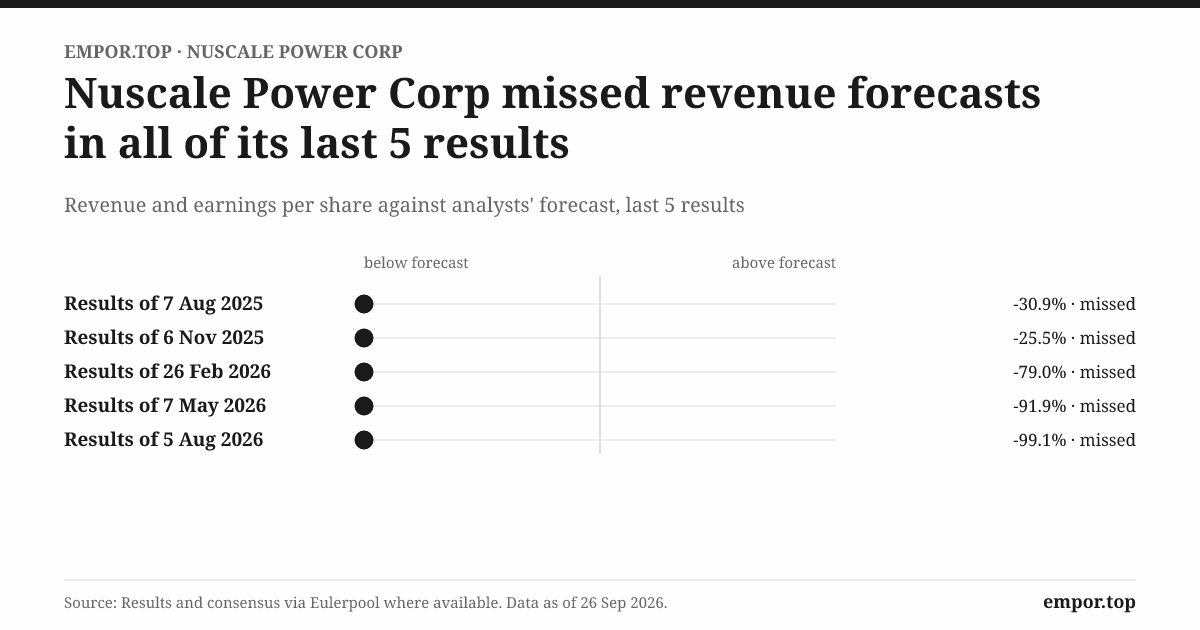
NuScale holds the most prestigious regulatory credential in commercial nuclear engineering, yet reported just $75,000 in revenue for the second quarter of 20266. A regulatory agency certifying a reactor design establishes that it is safe to construct, not that an electric utility will pay to build it. A license translates into enterprise value only if the delivered cost of its electricity undercuts competing generation alternatives—a commercial threshold the Carbon Free Power Project failed to cross when estimated costs escalated. For investors in deep-technology infrastructure, the broader lesson is to measure regulatory milestones by how effectively they de-risk a customer's procurement decision. A design certification for an unbought module eliminates little commercial risk; an approved site-specific construction permit backed by a creditworthy off-take contract eliminates a great deal.
Lesson 2: The First-Mover Curse
By blazing the initial trail through the Nuclear Regulatory Commission, NuScale effectively underwrote the regulator's institutional learning curve, absorbing more than 12,000 pages of application filings, two million pages of supporting technical documents, and over $500 million in private and public capital4. Industrial followers then capitalized on the resulting procedural precedents. At Clinch River, the NRC's safety review for GE Vernova Hitachi's competing boiling-water design advanced months ahead of schedule with roughly one-third fewer staff hours than NuScale's multi-year campaign required22. In complex infrastructure, the pioneer often builds the highway only for better-capitalized fast followers to drive the first commercial trucks down it. Pioneering regulatory clearance creates durable shareholder value only if the first mover can also be first to pour concrete; otherwise, regulatory pioneering becomes an expensive public service funded by early equity holders.
Lesson 3: Announcements Are Not Backlog
NuScale's commercial history is punctuated by sweeping headline capacity figures: twenty-four modules for Standard Power, up to six gigawatts across seventy-two modules for TVA, and a Romanian final investment decision encumbered by confidential exit conditions. Each was presented as an industry milestone, yet as of late 2026, none has materialized as a binding commercial equipment order with an advance deposit. NuScale's third-quarter 2025 earnings call underscored that divergence between public rhetoric and contract reality: while executive leadership highlighted potential 72-module deployments and an international $25 billion investment framework, Chief Financial Officer Ramsey Hamady conceded that absorbing an immediate full-scale order was "probably not likely"19. In capital-intensive industrial markets, the only verifiable indicator of commercial demand is an executed, enforceable contract paired with a committed financial down payment. NuScale's Partnership Milestone Agreement sharpens that distinction, because the company disburses substantial cash simply upon signing non-binding exploration frameworks.
Lesson 4: Follow the Direction of the Cash
In conventional commercial equipment manufacturing, cash flows from the customer to the vendor in the form of milestone progress payments and equipment deposits. NuScale's arrangement with ENTRA1 Energy inverted that relationship, requiring the technology developer to disburse more than $507 million to its channel partner before any customer signed a binding power purchase agreement or equipment order18. While management framed those disbursements as pre-funding project origination to accelerate commercial financing, subsidizing an intermediary to originate preliminary interest shifts development risk back onto the equipment vendor. Whenever an industrial technology provider finances its own sales channel, investors must separate channel-incentive disbursements from genuine customer commitments, evaluating reported commercial progress against the cash that customers actually pay rather than the cash the vendor sends out the door.
Lesson 5: Capital Structure Is Strategy
Merging with a special purpose acquisition company provided NuScale with liquid public equity, a financing mechanism management exploited effectively when market enthusiasm peaked, raising approximately $2.2 billion through at-the-market offerings across a single twelve-month span282918. Yet that transaction also tethered an engineering enterprise governed by decade-long licensing and construction cycles to the unforgiving cadence of ninety-day earnings releases, retail momentum, and aggressive short sellers. When a pre-revenue developer depends on continuous share issuance to fund corporate operations and intermediary milestone obligations, preserving an elevated equity valuation becomes an existential operational priority. In that environment, corporate announcements and non-binding preliminary frameworks face intense market pressure to function as financing catalysts—and public investors must evaluate them with commensurate discipline.
XI. The Risk Radar & Bull vs. Bear Investment Spine
The Risk Radar
Customer commitment failure (critical). NuScale's investment thesis depends almost entirely on converting non-binding preliminary frameworks with TVA, ENTRA1, and Romania's RoPower into enforceable commercial contracts. In September 2026, UBS downgraded the stock to Sell, pointing to fragile customer commitments, developmental setbacks at RoPower, and limited tangible progress with TVA. The firm's analysts modeled only a single project breaking ground by 2028, projecting roughly $700 million in cumulative cash burn between 2026 and 202845.
The ENTRA1 cash cycle (high). Potential milestone liabilities owed to ENTRA1 could surpass $3 billion as prospective projects advance toward power purchase agreements and binding equipment manufacturing contracts1938. While management characterizes these disbursements as working-capital accelerations that "stay in the system"19, NuScale has disclosed no contractual mechanism guaranteeing that the capital is returned if underlying projects stall. Corporate governance introduces an additional layer of scrutiny, as consolidated securities litigation centers on whether executives accurately depicted ENTRA1's operating track record and capabilities to public markets38.
Dilution overhang (high). On the heels of exhausting a $1.0 billion equity facility in mid-2026, NuScale established a fresh $750 million at-the-market program30. With the stock trading in the high single digits, fully tapping that authorization would require issuing an additional 80 million to 90 million shares, diluting existing shareholders by another 20 percent.
Competitive leapfrogging (high). If Ontario Power Generation brings its initial BWRX-300 into commercial service at Darlington around 203021 and the Nuclear Regulatory Commission issues TVA's Clinch River construction permit, GE Vernova Hitachi will establish the first operating commercial SMR fleet in the Western hemisphere. Subsequent utility buyers, prioritizing proven execution over modular novelty, will face strong incentives to procure an operational design that has already demonstrated its on-site cost and schedule.
Licensing and execution (moderate). Although the NRC completed its Standard Design Approval for the US460 module design, prospective plant developers must still secure bespoke, site-specific construction and operating licenses covering local environmental conditions before pouring concrete9. Even after permitting, NuScale must then successfully execute its first-of-a-kind physical deployment without the engineering parent that once absorbed project overruns.
The Activist's Stress Test
A skeptical institutional investor evaluating NuScale in late 2026 would focus on four core operational and governance questions:
First, capital allocation: What justified disbursing more than half a billion dollars in cash to an asset-light intermediary at the non-binding stage, and what contractual remedies protect shareholders if TVA ultimately deploys a competing reactor design?
Second, financial disclosure: Will management provide quarterly status disclosures for every project term sheet underlying an ENTRA1 milestone payment, enabling investors to verify which cash outlays remain at risk?
Third, executive accountability: Chief Executive John Hopkins has led the business since 2012, overseeing the cancellation of the Carbon Free Power Project and the pivot to ENTRA1. Are executive incentive compensation metrics tied to binding equipment orders and cash collections, rather than procedural regulatory milestones or short-term equity valuations?
Fourth, balance-sheet strategy: With roughly $1.9 billion in liquid reserves and another $750 million equity distribution program authorized, what is the capital preservation roadmap if binding customer commitments fail to materialize before 2027?
None of these inquiries presumes bad faith. They represent the standard due-diligence questions an unprofitable engineering business should expect—and transparent disclosures would do far more to restore institutional confidence than another aspirational press release.
The Bear Case
In the bear case, NuScale evolves into a highly capitalized engineering consultancy that never bridges the gap between regulatory milestones and commercial construction. TVA prioritizes its Clinch River BWRX-300 deployment and either defers the NuScale program or quietly lets the non-binding framework expire. In Romania, the confidential preconditions attached to RoPower's final investment decision prove insurmountable, or regional sovereign financing falls short. Meanwhile, milestone liabilities to ENTRA1 continually deplete liquid reserves, requiring repeated at-the-market share offerings that steadily dilute public investors. Without Fluor's corporate sponsorship, NuScale cannot provide the balance-sheet completion guarantees and cost-overrun wraps that risk-averse utilities demand, surrendering first-of-a-kind mandates to well-capitalized industrial conglomerates. From this perspective, the $1.9 billion cash balance is not an economic moat; it is a finite operating runway being consumed by channel-partner fees, legal defense costs, and corporate overhead.
The structural version of the bear thesis is even more direct. Under the Partnership Milestone Agreement, NuScale disburses capital to ENTRA1 upon executing preliminary term sheets and power purchase agreements, long before collecting commercial equipment revenue. If ENTRA1 continues executing non-binding preliminary documents that trigger 15 percent milestone obligations, but those frameworks fail to convert into firm customer contracts, NuScale's treasury effectively underwrites channel-partner origination fees that never generate top-line cash flow. While management maintains that unallocated milestone disbursements roll forward to subsequent projects19, that mechanism preserves shareholder capital only if new commercial opportunities continue to emerge and ultimately close.
The Bull Case
In the bull case, ENTRA1 successfully converts the TVA preliminary agreement into a binding, multi-unit power purchase agreement backed by a federal power corporation that satisfies the investment-grade credit criteria mandated by the Partnership Milestone Agreement37. Concurrently, RoPower resolves its confidential preconditions and advances into early construction at Doicești, backed by up to $4 billion in debt and equity commitments from U.S. export-credit and development agencies41. Once concrete is poured on an initial project, NuScale begins collecting milestone equipment payments for manufactured modules, and earlier partner disbursements are recovered through project-level cash flows as management has outlined19. Supported by two NRC regulatory approvals and Doosan Enerbility's dedicated forging capacity, NuScale ramps factory production and delivers follow-on units with greater speed and predictability than uncertified competitors. In this reading, the aggressive equity fundraising of 2025 and 2026 represented prudent balance-sheet fortification, ensuring the venture reaches commercial construction without facing the liquidity crisis that halted the Carbon Free Power Project.
The bull thesis also rests on a broader macro catalyst. Accelerating electrical demand from artificial intelligence data centers, industrial onshoring, and electrification is expanding the market for round-the-clock, zero-emission baseload power, and the roster of licensed, factory-built light-water reactor designs is exceptionally narrow. If utility integrated resource plans require dozens of gigawatts of new firm generation throughout the 2030s, the market will accommodate multiple SMR vendors. NuScale's modular architecture and established supply-chain alliances would position it to capture meaningful market share even if GE Vernova Hitachi pours concrete first. Under that outcome, being a fast follower to commercial operation does not extinguish the equity story; it merely points to a more measured manufacturing ramp and competitive pricing rather than an outright commercial failure.
Weighing the Spine
Both investment theses converge on a single commercial pivot: the execution of a binding power purchase agreement with TVA. The bull case requires an enforceable contract; the bear case anticipates indefinite delays, renegotiations, or quiet abandonment. That dynamic renders NuScale's equity thesis unusually binary for an enterprise holding roughly $1.9 billion in liquidity. The historical track record of converting preliminary announcements into binding procurement contracts—UAMPS terminated, Standard Power inactive, and the TVA framework non-binding for more than twelve months—cautions against treating the bull outcome as an inevitability. Conversely, NuScale's dual regulatory approvals, qualified supply-chain relationships, and fortified treasury keep that upside scenario very much alive. The empirical evidence leaves the bull case unvalidated rather than disproven—and three decisive indicators will determine which trajectory unfolds.
XII. Epilogue: 1–3 Non-Negotiable KPIs to Watch
For investors tracking NuScale's progress each quarter, the broader strategic debate distills into three tangible operational indicators.
KPI 1: Binding backlog and customer-funded procurement. Watch for the transition from exploratory announcements and FEED revenue to binding power purchase agreements, equipment manufacturing contracts, and non-refundable deposits for long-lead components—above all, an executed PPA between TVA and ENTRA1 and the initial module order that would follow. Every other metric flows from this commercial pivot. A binding PPA would demonstrate that NuScale's regulatory certification can generate a self-sustaining commercial business. Another year without an enforceable customer commitment while competitors pour concrete, by contrast, would largely validate the pioneer's curse.
KPI 2: Net cash burn and share-count growth. Track quarterly operating cash flow—particularly milestone cash disbursements to ENTRA1—alongside the expansion of the diluted share count and the pace of issuance under the $750 million at-the-market equity program. Together, these indicators reveal whether corporate value is compounding on a per-share basis or whether existing equity is being continuously diluted while the company waits for customer orders. A constructive trajectory would see operating cash burn increasingly cushioned and ultimately funded by customer deposits rather than equity sales. The troubling counter-pattern would be ongoing milestone liabilities and corporate overhead financed by consecutive ATM facilities.
KPI 3: RoPower advancing from FID to EPC execution. Nuclearelectrica's February 2026 final investment decision was both conditional and staged4041. The decisive milestone is RoPower satisfying those confidential preconditions, executing formal pre-EPC and turnkey EPC contracts, and issuing an initial module equipment order—providing NuScale with its first real-world test of translating an approved design into an operational power station. Because the Romanian project is phased to construct and performance-test a single module before approving the remaining five41, operational validation will unfold incrementally even under a favorable scenario. It nevertheless represents the earliest empirical test of whether NuScale's first-of-a-kind cost and schedule projections can withstand commercial construction.
References
-
NRC Certifies First U.S. Small Modular Reactor Design — U.S. Department of Energy, 2023-01-20 ↩↩↩↩
-
The Story Behind America's First Potential Small Modular Reactor — U.S. Department of Energy, Office of Nuclear Energy ↩↩↩↩↩↩
-
NuScale Calls It Quits in Idaho — Neutron Bytes, 2023-11-10 ↩↩↩↩↩↩↩↩↩
-
NuScale SMR receives US design certification approval — World Nuclear News, 2020-09 ↩↩↩↩↩↩
-
NuScale Power Reports Second Quarter 2026 Results — NuScale Power, 2026-08-05 ↩↩↩↩↩↩↩↩↩
-
Form 8-K: NuScale Power Second Quarter 2026 Results (Exhibit 99.1) — U.S. SEC, 2026-08-05 ↩↩↩↩↩↩
-
$10,000 in NuScale at Its 52-Week High Is Worth About $1,650 Today — Yahoo Finance / The Motley Fool, 2026-08-16 ↩↩↩↩↩
-
NuScale Power Is Closing In on a Deal That Could Transform the Small Modular Reactor Industry — The Motley Fool, 2026-09-15 ↩↩↩
-
NuScale's 77-MWe SMR Clears NRC Review, Sets Stage for First Firm Order — POWER Magazine, 2025-05 ↩↩↩↩↩↩↩↩↩
-
NuScale Power and Fluor Corporation Team Up — NuScale Power, 2011-10-13 ↩↩↩↩
-
Fluor Increases Stake in Nuclear Power — Power Engineering, 2012-02-01 ↩↩
-
Fluor's John Hopkins Assumes Role of Chairman and CEO of NuScale Power — Fluor Corporation, 2012-12-13 ↩↩↩
-
Fluor completes sale of NuScale shares, reports $2.43 billion in proceeds — Investing.com, 2026-04-23 ↩↩↩
-
Fluor and NuScale Announce Agreement Regarding Stake Monetization — Fluor Corporation, 2025-11-06 ↩
-
Fluor Receives $1.35 Billion for 71 Million NuScale Shares; Launches Trading Program for Remaining 40 Million Shares — Fluor Corporation, 2026-02-17 ↩
-
NuScale Power Corporation Quarterly Report on Form 10-Q for the period ended June 30, 2026 — U.S. SEC, 2026-08 ↩↩↩↩↩↩↩↩↩↩
-
NuScale Power FQ3 2025 Earnings Call Transcript — NuScale Power / S&P Global Market Intelligence, 2025-11-06 ↩↩↩↩↩↩↩↩↩↩↩↩↩↩↩↩↩↩↩↩↩↩
-
NRC approves NuScale uprated SMR design — American Nuclear Society Nuclear Newswire, 2025-06-02 ↩
-
Canada's first SMR project: How is CAD20.9 billion cost calculated? — World Nuclear News, 2025-05-23 ↩↩↩↩↩
-
Clinch River construction permit recommendation follows safety evaluation — American Nuclear Society Nuclear Newswire, 2026-07-01 ↩↩↩↩↩↩↩↩
-
Current Report on Form 8-K: Spring Valley Acquisition Corp Business Combination with NuScale — U.S. SEC, 2022-05-02 ↩
-
Doosan makes additional investment in NuScale — World Nuclear News, 2021-07-20 ↩↩
-
Portland-based nuclear reactor company NuScale cuts 28% of workforce, or 154 employees — GeekWire, 2024-01-08 ↩↩
-
Form 8-K: NuScale Power Announces Leadership Updates — U.S. SEC, 2023-08-07 ↩
-
NuScale Power Reports Fourth Quarter and Full Year 2024 Results — NuScale Power, 2025-03-03 ↩↩↩↩
-
Form 8-K: NuScale Power Third Quarter 2025 Results (Exhibit 99.1) — U.S. SEC, 2025-11-06 ↩↩↩
-
Form 8-K: NuScale Power Fourth Quarter and Full Year 2025 Results — U.S. SEC, 2026-02-26 ↩↩↩↩↩↩↩↩↩↩
-
Form 8-K: At-the-Market Offering Program Sales Agreement — U.S. SEC, 2026-08-11 ↩↩
-
Doosan starts forging components for NuScale SMR — World Nuclear News, 2023-05-05 ↩↩↩
-
NuScale Power, UAMPS Cancel First Planned US Small Nuclear Project — Reuters, 2023-11-08 ↩
-
NuScale Power ($SMR): A Fake Customer and a Major Contract in Peril Cast Doubt on NuScale's Viability — Iceberg Research, 2023-10-19 ↩↩
-
Standard Power Chooses NuScale's Approved SMR Technology and ENTRA1 Energy to Energize Data Centers — NuScale Power, 2023-10-06 ↩↩↩
-
Inside Google, Amazon, and Microsoft's dueling nuclear-energy investments — Fortune, 2024-10-16 ↩↩↩↩
-
NuScale Power, Habboush Group and ENTRA1 Form Strategic Alliance — NuScale Power, 2022-09-09 ↩
-
Partnership Milestone Agreement between NuScale Power, LLC and ENTRA1 Energy LLC (Exhibit 10.1 to Form 8-K) — U.S. SEC, 2025 ↩↩↩
-
NuScale faces ENTRA1 lawsuits — Nuclear Engineering International, 2026-02 ↩↩↩↩
-
NuScale Power Faces Investor Lawsuit Over ENTRA1 Partnership Disclosures and Stock Drop — TipRanks, 2026 ↩
-
Romania's Coal-to-NuScale SMR Conversion Secures FID, Moves Into Implementation with Caveats — POWER Magazine, 2026-02 ↩↩↩↩
-
Final Investment Decision Approved for Six NuScale SMRs in Romania — Neutron Bytes, 2026-02-13 ↩↩↩↩↩↩
-
SMR's Present & Future in Romania: Doicesti Project Going Forward — Energy Industry Review, 2026 ↩
-
Final investment decision for Romania's SMR project could be delayed — Balkan Green Energy News, 2025-08-11 (updated 2026-06-02) ↩
-
NuScale Power Reports First Quarter 2026 Results — NuScale Power, 2026-05-07 ↩↩
-
UBS downgrades NuScale Power stock rating on construction timeline concerns — Investing.com, 2026-09 ↩
 LinkedIn
 WhatsApp
 Reddit
 Hacker News
 Email
Email Kindle
 RSS Feed
 Spotify
 Apple Podcasts
 Amazon Music
 Audible
 YouTube