Summit Therapeutics: The Biotech David That Breathed Life Into a Keytruda Giant-Killer
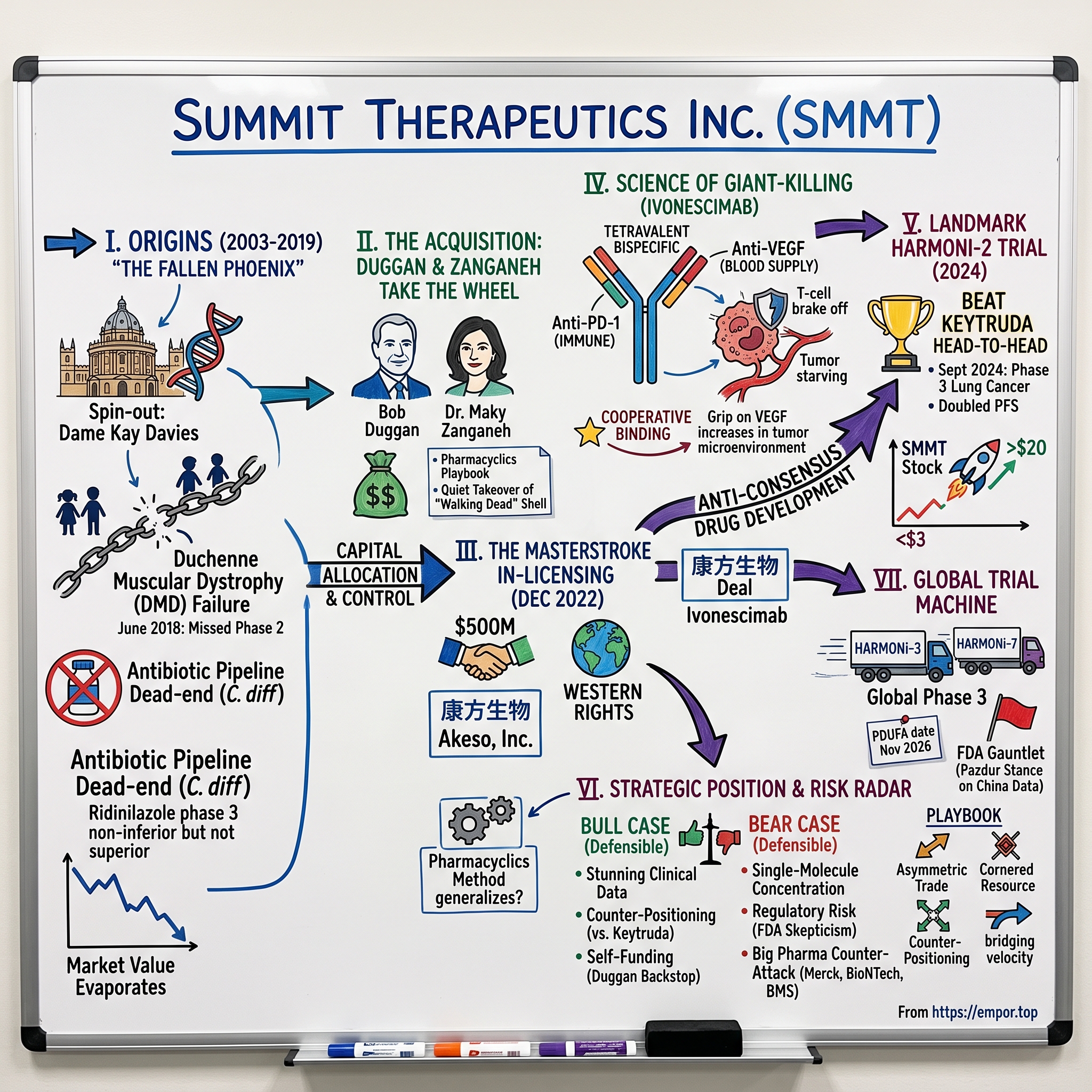
I. Introduction & Episode Roadmap
Picture a company that, in the spring of 2018, watched roughly four-fifths of its market value evaporate in a single trading session. Its lead drug—a treatment for a cruel childhood muscle-wasting disease—had just failed. Within four years it would fail again, this time with an antibiotic that worked but that no hospital wanted to pay for. By early 2022, Summit Therapeutics was, in the unsentimental language of biotech, "walking dead": a micro-cap shell with a burning cash balance, a graveyard of a pipeline, and an investor base that had long since stopped returning calls.
Now picture that same company, thirty months later, sending Merck & Co.'s share price wobbling and forcing every oncology strategist on Wall Street to redraw their models. In September 2024, at the World Conference on Lung Cancer in San Diego, Summit's licensed drug—ivonescimab—became the first therapy in the fifteen-year history of modern immuno-oncology to beat Merck's Keytruda head-to-head in a Phase 3 lung cancer trial.3 The stock, which had traded around two to three dollars at the start of that year, rocketed toward twenty and beyond, at moments pushing Summit's market capitalization above $15 billion.
This is the improbable resurrection story of Summit Therapeutics (SMMT), and it is worth telling for reasons that go well beyond a single dramatic chart. It is a case study in high-conviction, near-reckless capital allocation; in asymmetric cross-border licensing; and in anti-consensus drug development. It is also, unavoidably, a story about two people: the billionaire investor Bob Duggan and the executive Dr. Maky Zanganeh, the duo who once turned a sub-dollar cancer company called Pharmacyclics into a $21 billion sale to AbbVie—and who now own roughly three-quarters of Summit and are attempting, in their late-career second act, to do it all over again.713
Consider the raw asymmetry of the trade at the heart of this story. Summit committed $500 million upfront to license a drug it did not create; within two years, the public market was at times valuing the Western rights to that same molecule at more than $15 billion—a roughly thirty-fold markup on the entry price, created almost entirely by a single trial readout.[^1] That is the kind of return that either signals a once-in-a-decade act of insight or a once-in-a-cycle bubble, and part of what makes Summit such an instructive case is that, as of mid-2026, it is genuinely still too early to say which. The molecule works spectacularly in China. Whether it works, sells, and survives regulatory scrutiny in the West is the entire remaining question, and it is unanswered.
But a neutral observer has to hold two thoughts at once. The clinical data is genuinely stunning, and the business turnaround is real. Yet the entire ~$15 billion enterprise rests on a single molecule that Summit did not invent, that it licensed from a Chinese biotech, and that has not yet won a US approval or proven it can beat Keytruda outside of China. The bull case and the bear case are unusually far apart, and both are defensible. Our job here is to test the story, not to sell it.
Here is the road we will travel:
- The Fallen Phoenix (2003–2019): Oxford spin-out origins, the Duchenne muscular dystrophy collapse, and the dead-end antibiotic pipeline.
- Enter Bob Duggan & Maky Zanganeh: The Pharmacyclics playbook, a fortune built on ibrutinib, and the quiet takeover of a failing Summit.
- The Masterstroke In-Licensing (Dec 2022): structuring the up-to-$5 billion deal with 康方生物 Akeso, Inc. for Western rights to ivonescimab.
- The Science of Giant-Killing: why PD-1/VEGF bispecific antibodies may represent a genuine shift in immuno-oncology—and how "cooperative binding" is supposed to work.
- The Landmark HARMONI-2 Trial (2024): the readout that beat Keytruda and rewired the sector's expectations.
- The Regulatory Gauntlet & Big Pharma's Counter-Attack: the FDA's hostility to China-only data, Summit's global trial machine, and the scramble by Merck, BioNTech, and Bristol Myers Squibb.
- Financials, Management Credibility & Risk Radar: Duggan's controlling stake, the self-funding structure, single-asset concentration, and the falsifiable version of the bull thesis.
- Playbook & Frameworks: Cornered Resource, Counter-Positioning, and what founders and investors can actually take from this.
Let's start where all the drama began: not in an oncology clinic, but in a laboratory at Oxford, chasing a disease that had nothing to do with cancer.
 Subscribe on LinkedIn
II. Oxford Origins & The Double-Failure Trap (2003–2019)
The first thing to understand about Summit Therapeutics is that for the first fifteen years of its life, it was a completely different company, with a different name, a different disease focus, and a different stock exchange. The through-line to today's oncology juggernaut is almost invisible—which is precisely the point. What Duggan and Zanganeh eventually bought was not a science platform. It was infrastructure: a clean, publicly listed corporate vessel with Nasdaq access and no better ideas of its own.
Summit was founded in 2003 as a spin-out from the University of Oxford, built around the research of Professor Dame Kay Davies, one of Britain's most distinguished geneticists. The founding mission was elegant and humane. Duchenne muscular dystrophy (DMD) is a devastating genetic disorder—almost exclusively in boys—in which a faulty gene fails to produce dystrophin, a protein that keeps muscle fibers intact. Without it, muscles slowly tear themselves apart; most patients lose the ability to walk in childhood and rarely survive past their twenties or thirties. Summit's idea was to sidestep the broken dystrophin gene entirely by chemically boosting a related protein called utrophin, which the body naturally produces in fetal development. If you could keep utrophin switched on, the theory went, you might compensate for the missing dystrophin and slow the disease.
It was beautiful science, and it collided head-on with the structural trap that has swallowed so many UK biotechs. The recipe is familiar: world-class academic rigor, chronic under-capitalization, glacial trial timelines, and a dependence on dilutive equity raises—first on London's AIM market, later cross-listed on Nasdaq. The company was always one disappointing readout away from crisis, because it never had the balance sheet to absorb a failure.
That failure arrived on June 27, 2018. Summit's lead utrophin modulator, ezutromid, had reached its Phase 2 "PhaseOut DMD" trial, and the results were unambiguous: the drug missed both its primary and secondary endpoints, showing no meaningful effect on slowing muscle deterioration after 48 weeks.[^2] The market's verdict was instant and brutal. Shares fell roughly 80% in a matter of hours—by some measures collapsing from around $209 to $50 on the Nasdaq-listed ADSs.1 Fifteen years of the founding thesis were gone in a morning. Summit did the only thing it could: it euthanized the entire muscular dystrophy platform and bet what remained on its second horse, an antibiotic named ridinilazole.
Here the story tilts from tragedy toward something more like a structural lesson in market economics. Ridinilazole was aimed at Clostridioides difficile infection—"C. diff," a nasty, often hospital-acquired gut infection that can be fatal and that frequently recurs after treatment. And ridinilazole was, in a narrow scientific sense, a good drug: it was designed to be narrow-spectrum and microbiome-sparing, hitting C. diff while doing less collateral damage to the beneficial gut bacteria that broad-spectrum antibiotics wipe out. The problem was never really the science. The problem was the business model of antibiotics itself.
This is one of the quiet tragedies of modern medicine, and it is worth dwelling on because it explains why a competent drug can still be a terrible investment. When a company invents a powerful new antibiotic, the medical system's correct response is to not use it—to lock it away as a reserve weapon against resistant bugs, precisely so bacteria don't evolve around it. Good public-health stewardship is commercial poison. A blockbuster cancer drug is prescribed as widely and for as long as possible; a novel antibiotic is rationed. The result is that antibiotic developers routinely watch their science succeed and their business fail. Several companies that won FDA approval for new antibiotics in this era went bankrupt anyway.
This is not a hypothetical concern; it is a documented graveyard. In the years around Summit's antibiotic push, multiple companies that actually won FDA approval for novel antibiotics—Achaogen, Aradigm, Melinta—filed for bankruptcy or restructured, undone not by bad science but by the impossibility of earning a return on a drug the system is designed to hoard. Policymakers have spent a decade debating "pull incentives"—subscription-style payments that would reward antibiotic developers for having a drug available rather than for units sold—precisely because the free market so reliably starves them. Summit even used its own failure to argue publicly for exactly such reforms.2 None of which helped its shareholders in the moment.
Ridinilazole delivered the final blow in that grimly appropriate fashion. In its Phase 3 program, called Ri-CoDIFy—two twin trials run together—the drug actually worked in a clinical sense: it produced a numerically higher sustained clinical response rate than the standard-of-care antibiotic vancomycin (roughly 73% versus 71% in the pooled data), consistent with its microbiome-sparing design.2 But "better on the numbers" is not the same as "statistically superior," and the trials failed to demonstrate the superiority the primary endpoint required. For a tiny company betting everything on a differentiated label to justify premium pricing against a cheap generic, a statistical tie was, commercially, a loss.
So by early 2022, tally the ledger. Two lead programs, two failures, across two entirely different disease areas. A cash balance draining toward zero. A share price that had made the company a cautionary tale. Summit was, functionally, a corporate husk—a Nasdaq listing wrapped around a failed pipeline. To almost every observer, it looked like a company waiting to be delisted or wound down. To one specific observer, who thought in terms of vessels and control rather than pipelines, it looked like an opportunity that had been hiding in plain sight. That observer had done this before.
III. The Pharmacyclics Playbook: Bob Duggan & Dr. Maky Zanganeh Take the Wheel
To understand what Bob Duggan saw in the wreckage of Summit, you have to understand what he had already built once—because the Summit thesis is, quite deliberately, a photocopy of it.
Bob Duggan is not a scientist. He is not a physician. Born in Oakland, California in 1944, he is a serial entrepreneur and investor who, before he ever touched a drug company, had built and sold businesses across an almost comically eclectic range—a cookie company, outdoor advertising, consumer retail, and, most consequentially, medical robotics.19 From 1990 to 2003 he chaired Computer Motion, a pioneer of robotic surgical systems, serving as its CEO for the final six of those years; in 2003 Computer Motion merged with a rival called Intuitive Surgical, the company that would go on to dominate robotic surgery with its da Vinci system.19 Duggan is also, notably, one of the most prominent lay members of the Church of Scientology—a fact that has drawn scrutiny over the years but that is less relevant to investors than his singular and repeatable method: take a controlling stake in a broken company with one overlooked asset, install a small hard-driving team, move at reckless speed, and refuse to dilute yourself into irrelevance.
What turned a robotics executive into a cancer-drug obsessive was the worst kind of motivation. Duggan lost his son to brain cancer, and that personal catastrophe redirected his considerable capital and energy toward oncology.19 He first invested in Pharmacyclics in 2004, years before he took control of it—a detail that matters, because it tells you his conviction in the space predated the financial windfall and was rooted in grief rather than opportunism. This is the emotional substrate beneath the "capital allocator" story, and it is worth holding in mind: Duggan is not a dispassionate arbitrageur. He is a true believer, which makes him both formidable and, potentially, prone to the overconfidence that true belief breeds.
His partner's story is, if anything, more remarkable. Dr. Maky Zanganeh was born in Tehran in 1970, nine years before the Islamic Revolution. As a child she lived through the upheaval and violence of the revolution and the Iran-Iraq war; her architect parents eventually sent her to live with an uncle in Oldenburg, Germany, while they shuttled between Europe and Iran.20 She trained not as the physician her sisters became but as a dentist, graduating from Louis Pasteur University in Strasbourg in 1995 and later adding an MBA.20 Dentistry did not hold her. In 1997, through a family connection, she took a job at the Strasbourg office of an American medical-robotics company—Computer Motion. The company chaired by Bob Duggan. That is where the two of them met: not in a boardroom brawl over a biotech, but around surgical robots in the south of France. Zanganeh is herself a cancer survivor, a fact that lends her devotion to oncology the same personal weight as Duggan's.20
Both of them invested in Pharmacyclics in April 2004, and when Duggan took the chairman-CEO role in 2008, Zanganeh became his operational partner—first in business development, then as chief operating officer.20 The division of labor that would define both Pharmacyclics and Summit crystallized here: Duggan as the capital, the conviction, and the public face; Zanganeh as the relentless operator who actually ran the clinical machine, negotiated the partnerships, and drove the trials. It is a genuine partnership, not a figurehead arrangement, and understanding it is essential to handicapping Summit—because the entire "Process Power" bull argument rests on the claim that these two specific people possess a repeatable operating capability.
The proving ground was Pharmacyclics. In 2008, Duggan took over a struggling cancer-drug company whose stock had cratered to under a dollar. Inside that company sat a molecule almost nobody believed in—a Bruton's tyrosine kinase (BTK) inhibitor then known by the unlovely code PCI-32765. Pharmacyclics had reportedly considered shelving it. Duggan, working alongside Dr. Maky Zanganeh, saw a hematology franchise. Zanganeh—a dentist by training who had become a formidable operator and dealmaker—ran the operational and clinical machine while Duggan supplied capital and conviction. That molecule became Imbruvica (ibrutinib), one of the most successful blood-cancer drugs in history. They struck a co-development partnership with Johnson & Johnson's Janssen unit to share the enormous costs, and in 2015 they sold Pharmacyclics to AbbVie for approximately $21 billion, at $261.25 per share in cash and stock.13
Sit with those numbers for a moment, because they are the emotional engine of everything that followed. A company left for dead under a dollar became a $21 billion acquisition. Duggan personally walked away with a reported fortune in the billions. And crucially, he and Zanganeh had proven a method—not luck, they would argue, but a repeatable operating system for extracting value from an underappreciated asset trapped inside a mismanaged shell.
The reasonable skeptic should pause here. Pharmacyclics worked in part because ibrutinib turned out to be a genuinely extraordinary drug; plenty of other "left-for-dead turnarounds" fail because the asset was left for dead for good reasons. Pattern-matching on one spectacular success is exactly how investors talk themselves into the next disaster. Duggan's track record earns attention, not deference. The whole Summit thesis is a bet that the method generalizes—and that is precisely the thing the bear case will attack.
Duggan began accumulating Summit shares in late 2019, eventually taking a stake that early reports pegged at around 49% and an executive role at the top of the company.8 He became Executive Chairman and Co-CEO; Zanganeh joined as Co-CEO and President. The band was back together, in a corporate vehicle that had almost nothing left to lose.
What happened next is the part that genuinely distinguishes this story from a standard activist play, and it cuts in the company's favor on the question of alignment. Instead of the usual playbook—raising money through predatory PIPE deals, toxic convertible notes, or waves of warrants that grind existing shareholders into dust—Duggan largely funded Summit himself. He backstopped rights offerings, made direct equity investments, and repeatedly bought shares in the open market, plowing his own Pharmacyclics winnings back into the company. By the 2025 proxy, his beneficial ownership had climbed to roughly 74.8% of the outstanding stock, and subsequent purchases pushed it higher still.7
For investors, that ownership structure is a genuine double-edged sword, and it deserves to be named as both. On the alignment side, it is almost unheard of: the controlling shareholder and the CEO are the same person, taking nominal cash compensation, with essentially his entire net worth riding on the same common stock that minority holders own. When Duggan funds a capital raise out of his own pocket rather than issuing cheap paper to outsiders, he is protecting his own position and everyone else's at the same time. There is no clearer signal of conviction than a billionaire refusing to let anyone dilute him.
On the governance side, that same 75% stake means public shareholders are, in practical terms, along for the ride. There is no realistic prospect of an activist forcing change, no contested board vote, no hostile bid Duggan cannot block. If he and Zanganeh make a value-destroying decision—overpaying for an asset, mistiming a trial, misjudging the FDA—minority holders have essentially no lever to pull. The company's willingness to shed distractions supports the "disciplined operator" read: in 2026 Summit sold off the legacy ridinilazole antibiotic to a Toronto-based buyer, Biossil, for a token $500,000 upfront plus up to $104.5 million in milestones, formally ending its life as anything but a pure oncology company.6 The capital discipline is real. So is the concentration of power. Both are facts, and both matter. With the vessel seized and the crew reunited, the only thing missing was the asset worth betting a fortune on. In December 2022, they found it—eight thousand miles away.
IV. The $500 Million Masterstroke: In-Licensing Ivonescimab
To appreciate why the ivonescimab deal was audacious, you first have to appreciate the wall that immuno-oncology had run into by the early 2020s—because Summit was, in effect, buying a ticket to break through it.
The PD-1/PD-L1 checkpoint inhibitors—led by Merck's Keytruda (pembrolizumab) and Bristol Myers Squibb's Opdivo (nivolumab)—had been the defining pharmaceutical revolution of the 2010s. They work by releasing a molecular brake that tumors use to switch off the immune system's T-cells; take the brake off, and the body's own defenses can attack the cancer. The results in a subset of patients were so dramatic they rewrote oncology, and the market followed: this class grew into a $40-billion-plus global franchise, with Keytruda alone becoming the best-selling drug in the world at roughly $25–30 billion in annual sales.
But there was a ceiling, and everyone in the field knew it. As a monotherapy, PD-1 blockade only helped a minority of patients—response rates stalled around 20–30% in most solid tumors. The reasons are biological. Some tumors are "cold," walled off from immune cells. Many tumors build an immunosuppressive microenvironment (TME) that neutralizes T-cells even after the brake is released. And critically, tumors drive their own blood-vessel growth through Vascular Endothelial Growth Factor (VEGF), creating a chaotic vasculature that both feeds the tumor and helps it hide from the immune system. The obvious idea—combine a PD-1 drug like Keytruda with an anti-VEGF drug like Avastin—had a nasty catch: stacking two separate antibodies tended to stack their toxicities too, producing more hypertension, bleeding, and other side effects without a clean efficiency win.
This is the problem that a company most Western investors had never heard of claimed to have solved. 康方生物 Akeso, Inc. (HKEX: 9926), a Chinese biopharma co-founded by the US-trained immunologist Dr. Michelle Xia (夏瑜), had engineered a single molecule—AK112, later named ivonescimab—designed to hit PD-1 and VEGF at the same time, in a way that (Akeso argued) was not merely additive but genuinely cooperative. We will unpack that mechanism in the next section. What matters for the deal is that in 2022, this was an unproven Chinese molecule with promising but early data, and the Western biopharma establishment had largely not priced it.
Akeso itself is a signal worth reading, because it embodies a broader shift that Western investors were slow to absorb. For most of the checkpoint-inhibitor era, China was viewed by big pharma as a market to sell into and a place to run cheap trials, not as a source of genuine molecular innovation. Companies like Akeso—founded by returnee scientists trained at Western universities and companies, funded by an increasingly sophisticated domestic capital market, and armed with in-house antibody-engineering platforms—quietly began producing novel assets rather than fast-follow copies. Ivonescimab was designed end-to-end in Akeso's own labs. The bispecific was not licensed-in or reverse-engineered; it was a homegrown attempt to leapfrog the West's own checkpoint franchises. For a Western micro-cap to recognize that shift in 2022 and act on it was, in hindsight, the most important judgment call in the entire story—more important, arguably, than any subsequent trial result, because everything downstream depended on Summit correctly identifying that this particular Chinese molecule was the real thing.
Enter Summit. On December 6, 2022, the company announced a licensing agreement with Akeso that, to outside eyes, looked wildly outsized for a micro-cap with a failed antibiotic history. Summit would pay $500 million upfront—a combination of cash and Summit common stock—plus up to $4.5 billion in potential regulatory and commercial milestones, plus low-double-digit royalties on net sales, for a headline potential value of up to $5.0 billion.[^1] In exchange, Summit received exclusive rights to develop and commercialize ivonescimab across a sweeping territory: the United States, Canada, Europe, Japan, Latin America, the Middle East, and Africa. Akeso retained China and much of the rest of Asia, and would keep running its own Chinese trials in parallel—an arrangement that would later prove enormously valuable, because it meant Summit got a real-time window into large, fast, cheap Chinese readouts before committing to its own expensive global studies.
Wall Street's initial reaction ranged from skeptical to derisive. A $500 million upfront commitment—larger than Summit's entire market value not long before—for Western rights to an unproven bispecific from a Chinese company few US investors could name, run by a management team whose last two drugs had failed? Trade press captured the disbelief, framing it as Summit betting up to $5 billion that Akeso's antibody would "ascend clinical peaks."18 The consensus read was that Duggan was overpaying for a lottery ticket.
The counter-argument—the one that turned out to be right, at least so far—is a lesson in what asymmetric licensing actually is. Summit was not buying a proven asset at a proven price. It was buying optionality on a high-signal, unproven asset by absorbing the two risks nobody else wanted: clinical risk (would it replicate?) and jurisdictional risk (would Western regulators and payers accept a China-originated drug?). Set the $500 million against the comparables of the era and the logic sharpens. Gilead had paid roughly $21 billion to buy Immunomedics for the antibody-drug conjugate Trodelvy; AstraZeneca and 第一三共 Daiichi Sankyo had structured a deal worth up to $6.9 billion for the ADC Enhertu. Those were validated, de-risked assets bought at de-risked prices. Summit paid a fraction of that upfront precisely because it stepped in before the Phase 3 proof existed. That is the trade: you get the blockbuster cheaply only if you are willing to be wrong in a way that could vaporize your company. The next section explains what, exactly, Summit was betting on.
V. The Science & Economics of Ivonescimab: Why Dual PD-1/VEGF Blockade Wins
Let's do the thing that most business coverage skips and actually open up the molecule—because the entire investment case, bull and bear, ultimately reduces to whether one piece of protein engineering does what its designers claim. And the good news is that the core idea can be explained without a biochemistry degree.
Start with the two jobs the drug is trying to do. The first job is the familiar checkpoint release: block PD-1, the brake tumors use to paralyze T-cells, and you free the immune system to attack. That's the Keytruda mechanism. The second job is anti-angiogenic: block VEGF, the signal tumors send to grow their own tangled blood supply. Blocking VEGF does two useful things at once—it starves the tumor's chaotic vasculature, and, counterintuitively, it normalizes the remaining blood vessels, turning a leaky tangle into something more orderly. Orderly vessels let immune cells actually reach the tumor core instead of milling around its edges. So in principle, PD-1 blockade unleashes the T-cells and VEGF blockade builds them a road into the tumor. The two mechanisms are natural partners.
The problem, again, was that combining two separate drugs to do these two jobs was clumsy and toxic. Ivonescimab's proposed answer is architectural. It is a single, tetravalent bispecific antibody: an anti-PD-1 antibody backbone with two anti-VEGF single-chain fragments (scFv) fused onto it, so one molecule carries both functions. Think of it not as taking two separate keys on a keyring, but as forging a single key with two distinct teeth.
But the truly interesting claim—the one that, if real, explains the head-to-head data—is something Akeso calls cooperative binding, and it is worth a careful analogy. VEGF, the tumor's blood-vessel signal, is unusually concentrated inside the tumor microenvironment and much scarcer in healthy tissue. Akeso's data suggest that when ivonescimab latches onto PD-1, the molecule changes shape in a way that dramatically increases its grip on VEGF—reportedly boosting VEGF-binding affinity by roughly an order of magnitude (around 18-fold in the company's characterization). The intended effect is a kind of smart bomb: the drug binds most avidly right where both targets are densest—the tumor—and behaves more mildly in the rest of the body, where PD-1 engagement is lower and VEGF is scarce. If that holds up, it should mean more punch at the tumor and fewer of the systemic anti-VEGF side effects (severe hypertension, bleeding, poor wound healing) that made the old Keytruda-plus-Avastin combination so unappealing.
Here the neutral analyst has to plant a flag. Cooperative binding is a genuinely elegant hypothesis, and Akeso has published biochemical work supporting it. But "avidity increases in the lab" and "durably better outcomes and safety in tens of thousands of real Western patients" are separated by a great deal of unproven territory. The mechanism is a compelling explanation for the clinical results; it is not, by itself, proof. Much of the bear case lives in that gap, and we will return to it.
There is also a subtler economic logic to the single-molecule design that goes beyond biology and into commercial reality. A bispecific antibody is one drug, with one manufacturing process, one regulatory filing, one price, and one intellectual-property estate. A physical combination of Keytruda plus a separate anti-VEGF agent is two drugs, two suppliers, two margins to share, and—critically—a combination that any company can assemble once the components go generic. By fusing both mechanisms into a single proprietary molecule, Akeso and Summit created something that is both easier to commercialize and far harder to knock off with cheap generics after the Keytruda patent cliff. The architecture is a business moat as much as a biological one, which is part of why the mechanism has attracted such a stampede of imitators.
Now the economics, because a mechanism is only an investment if there's a market. Ivonescimab's development strategy targets the largest prizes in solid-tumor oncology. The anchor is non-small cell lung cancer (NSCLC)—the single biggest checkpoint-inhibitor market and the setting for the entire HARMONi franchise—attacked across multiple fronts: first-line PD-L1-positive disease (where HARMONi-2 competed), first-line combination-with-chemo settings, and the harder-to-treat EGFR-mutated, post-targeted-therapy population. Beyond lung cancer, Summit and Akeso have pushed into small cell lung cancer, colorectal cancer, triple-negative breast cancer, and head-and-neck cancer through combination studies, with new trials such as the head-and-neck ILLUMINE study and collaborations with partners including Revolution Medicines and GSK slated to begin dosing through 2026.5 Each additional indication is a call option on the same underlying molecule.
Stack those settings together and, across Summit's licensed territories, the addressable market plausibly exceeds $30 billion a year—a figure that gains urgency from a looming event on Merck's calendar. Keytruda, the $25-billion-plus incumbent, faces the expiration of key patents around 2028, opening a competitive window right as ivonescimab's global data mature. The strategic timing is not an accident; it is the whole point. But a large TAM cuts both ways for a neutral analyst: it explains why the prize is worth chasing, and it explains why every deep-pocketed competitor in oncology is now chasing the same prize. A $30 billion market does not stay uncontested.
A market that size is a target, not a guarantee, and the only thing that converts one into the other is data. Which brings us to the day the theory met a randomized trial—and to the readout that made a micro-cap the most talked-about name in oncology.
VI. The Landmark HARMONI-2 Trial & The ESMO Shockwave
Every so often an oncology conference produces a moment that reorders the field, and everyone in the room knows it while it is happening. For immuno-oncology, one of those moments arrived on a September afternoon in 2024, in a packed session hall in San Diego, when the survival curves went up on the screen and refused to converge.
Set the stage. The trial was HARMONi-2 (the naming can confuse—this specific study was designed and run by Akeso in China, distinct from Summit's own global "HARMONi" studies). It was a randomized, double-blind Phase 3 study that did something audacious in its very design: it pitted ivonescimab as a monotherapy directly against Keytruda as a monotherapy—drug versus drug, no chemotherapy backbone to muddy the comparison—in 398 patients across 55 centers in China with previously untreated, PD-L1-positive (TPS ≥ 1%) advanced NSCLC.3 For fifteen years, challengers had tried to unseat Keytruda in first-line lung cancer and failed. A head-to-head monotherapy design was a statement of extraordinary confidence, bordering on hubris. If ivonescimab lost, the story was over.
Summit had signaled the outcome months earlier, in a May 30, 2024 announcement disclosing that HARMONi-2 had hit its primary endpoint, with ivonescimab significantly improving progression-free survival over pembrolizumab.[^7] But the market wanted the actual numbers, and on September 8, 2024, Professor Caicun Zhou (周彩存) of Shanghai Pulmonary Hospital presented the primary analysis at the World Conference on Lung Cancer, with simultaneous publication in The Lancet.4 The numbers were, by the standards of a field that celebrates incremental wins, staggering.
Median progression-free survival—the time patients lived without their cancer growing—was 11.14 months on ivonescimab versus 5.82 months on Keytruda. The hazard ratio was 0.51, with a p-value below 0.0001.3 In plain English: ivonescimab roughly doubled the time before the disease progressed, and cut the risk of progression or death by an estimated 49% relative to the reigning global standard of care. The overall response rate was 50.0% versus 38.5%, and the disease control rate was 89.9% versus 70.5%.3 Just as important for the durability of the claim, the benefit held across essentially every pre-specified subgroup Zhou presented—PD-L1 high and PD-L1 low expressers, squamous and non-squamous tumors, even patients with liver or brain metastases, historically among the hardest to treat.4
Let the historical weight of that land. In roughly a decade of immuno-oncology, no drug had ever beaten Keytruda head-to-head in a Phase 3 first-line NSCLC monotherapy trial. Not Opdivo, not Roche's Tecentriq, not anyone's. Keytruda had become the immovable object at the center of solid-tumor oncology, and a $500 million bet by a twice-failed micro-cap had just produced the first drug to move it.
The market reaction was violent and immediate. Summit's stock, which had languished around two to three dollars at the start of 2024, surged into the twenties and at points beyond over the course of the year, carrying the company's market capitalization above $15 billion at its peaks. A company that had been a delisting candidate two years earlier was suddenly worth more than many established mid-cap pharmas. Merck, whose entire solid-tumor franchise rests on Keytruda's dominance, saw its shares come under visible pressure as analysts began to model, for the first time, a credible threat to first-line PD-1 monotherapy.
It is worth pausing on how genuinely unusual this was as a market event. Biotech stocks move on data all the time, but they rarely reprice an incumbent's multi-billion-dollar franchise on the strength of a single trial run by a company most portfolio managers couldn't have located on a map two years earlier. The HARMONi-2 readout did something more than mint a winner; it retroactively validated a mechanism, a management team, and a cross-border sourcing strategy all at once. Suddenly every large pharma's business-development team was asking the same question: if a $500 million license produced this, what else is sitting unpriced in the Chinese biotech ecosystem? Some of the wave of PD-1/VEGF dealmaking that followed can be traced directly to this moment.
And yet the skeptics did not go quiet—they got more specific, which is exactly what good skeptics do. The short interest in Summit remained meaningful even as the stock soared, and the bear thesis was not "the data is fake." It was narrower and harder to dismiss: that a single-country Chinese trial, however clean, is an imperfect predictor of Western outcomes; that the comparator arm's performance (Keytruda's 5.82-month median PFS) sat at the lower end of what Western trials had historically shown for pembrolizumab, raising questions about the patient population; and that a company trading at a mid-teens-billion valuation had priced in a global success that had not yet been demonstrated in a single Western patient. None of these objections could be resolved by HARMONi-2. All of them could only be resolved by trials that had not yet read out.
And yet—this is the section where the neutral observer has to interrupt the fireworks—the HARMONi-2 result, for all its drama, did not settle the investment question. It sharpened it into a single, specific, unresolved doubt. The trial was run entirely in China, in a Chinese patient population, by a Chinese sponsor. Lung cancer biology, the prevalence of certain EGFR mutations, patient demographics, prior-treatment patterns, and even the conduct of comparator arms can differ meaningfully between Chinese and Western populations. The bull heard "ivonescimab beats Keytruda." The bear heard "ivonescimab beats Keytruda in China," and immediately asked the only question that mattered for a US-listed company: will the FDA, and Western tumors, agree? That question was not academic. It had a recent, painful precedent—and it defined the gauntlet Summit had to run next.
VII. The Regulatory Gauntlet & Big Pharma's Counter-Attack
In February 2022—just months before Summit even signed its Akeso deal—the FDA sent the entire industry a message that would hang over ivonescimab's every step. An FDA advisory committee voted 14 to 1 against approving sintilimab, a PD-1 inhibitor developed by 信达生物 Innovent Biologics and partnered with Eli Lilly, for first-line lung cancer.14 The drug's data looked fine. The problem was that the pivotal trial had been run essentially entirely in China, and the agency concluded that a single-country dataset, in a population that didn't reflect the diversity of American patients, simply wasn't good enough to support a US approval.
The architect of that stance was Dr. Richard Pazdur, the influential and famously exacting head of the FDA's Oncology Center of Excellence, who publicly framed single-country China trials as "a step backward" and defended the rejection as being in patients' long-term interest.15 Pazdur is not a bureaucratic footnote in this story; he is arguably the single most powerful individual in US cancer-drug regulation, and his skepticism of China-only data packages is a durable feature of the landscape, not a passing mood. The precedent was unmistakable and it applied directly to Summit: you cannot license a Chinese oncology drug, wave a spectacular China trial at the FDA, and expect an approval. Akeso's data—including the jaw-dropping HARMONi-2 result—could inform and encourage, but it could not, on its own, get ivonescimab onto the US market.
The FDA's logic here is not xenophobia; it is a real scientific concern dressed in regulatory language, and understanding it is essential to sizing Summit's risk. Cancer biology, standard-of-care practice patterns, and even the genetics of tumors can differ across populations. Lung cancer in China skews toward never-smokers and carries different EGFR-mutation frequencies than lung cancer in, say, the American Midwest. A comparator arm's performance can differ if patients receive different subsequent therapies. The agency's demand—formalized through initiatives like Project Orbis, its framework for coordinated international review—is essentially that a drug prove itself in a patient population that looks like the one that will actually take it. For Summit, this transformed a licensing deal into an operational marathon: it was not enough to own the Western rights; the company had to generate Western evidence, at Western cost and Western speed, which is to say slowly and expensively.
This is the hard, expensive, unglamorous core of Summit's actual job, and it is where the "cheap license" starts to look less cheap. To win in the West, Summit had to build its own global, multi-regional clinical trial (MRCT) machine—running large, costly Phase 3 studies enrolling substantial numbers of US, European, and other non-Chinese patients, precisely to answer the question HARMONi-2 could not. That machine is the HARMONi franchise, and it is worth knowing the pieces:
HARMONi (the global study, distinct from Akeso's China-run HARMONi-2) tested ivonescimab plus chemotherapy against chemotherapy in patients with EGFR-mutated NSCLC whose disease had progressed after EGFR-targeted therapy—a population with few good options. It carried FDA Fast Track designation. The trial met its progression-free survival endpoint, and Summit reported an encouraging but closely scrutinized overall-survival trend.179 The nuance became the whole debate: early readouts showed a positive PFS result and an OS trend rather than a slam-dunk statistically significant survival win, and analysts pored over whether the benefit was as strong in Western patients as in Asian ones. Summit continued to update the data—including an analysis released as recently as July 22, 2026 arguing for consistent, favorable overall-survival results across Western and Asian patients.16 On the strength of the HARMONi package, the FDA accepted Summit's Biologics License Application and set a PDUFA target action date of November 14, 2026—the first real test of whether ivonescimab can clear the US regulatory bar.10
HARMONi-3 is the bigger prize and the more direct challenge: a global Phase 3 study of ivonescimab plus chemotherapy versus Keytruda plus chemotherapy in first-line metastatic NSCLC, spanning both squamous and non-squamous disease. This is the study designed to reproduce the Keytruda-beating magic in a Western-inclusive population and in the combination setting where most first-line patients are actually treated. Summit guided to an interim PFS analysis for the squamous cohort in the second quarter of 2026, with further readouts extending into 2027.5
HARMONi-7 takes the purest swing of all: a global head-to-head of ivonescimab monotherapy versus Keytruda monotherapy in first-line PD-L1-high (TPS ≥ 50%) NSCLC—essentially the Western, multi-regional rerun of HARMONi-2. It began enrolling in 2025.5 If HARMONi-7 replicates HARMONi-2's hazard ratio in a Western population, the bear case largely collapses. If it doesn't, the bull case does. Few single trials in biotech carry that much binary weight.
While Summit ran its gauntlet, Big Pharma did not sit still—and the speed of the counter-attack is itself the clearest evidence that the industry now takes the PD-1/VEGF thesis seriously. The most aggressive move came from BioNTech, the German company famous for its Covid vaccine, which in late 2024 agreed to acquire the Chinese biotech Biotheus for up to $950 million ($800 million upfront plus up to $150 million in milestones) to take full global control of BNT327/PM8002, a competing PD-L1/VEGF bispecific.11 BioNTech then went further, striking a partnership with Bristol Myers Squibb to co-develop and co-commercialize that asset across multiple solid tumors—a deal whose size signaled that BMS, too, wanted a seat at the PD-1/VEGF table rather than watching from the sidelines.12 Merck, for its part, faced the most exquisite strategic bind of all, and it is the subject of the counter-positioning analysis to come.
Merck's own response was the most telling of all, because it amounted to a confession. In November 2024—just weeks after HARMONi-2 rattled its stock—Merck struck an exclusive global license for LM-299, an investigational PD-1/VEGF bispecific, paying $588 million upfront plus up to $2.7 billion in milestones.21 Note two things. First, Merck did not defend Keytruda by dismissing the bispecific thesis; it went out and bought its own bispecific, an implicit admission that the mechanism is real and that pure PD-1 monotherapy may not be the endgame. Second—and this is almost poetic—Merck licensed LM-299 from LaNova Medicines (礼新医药), a Shanghai biotech. The world's largest oncology franchise, threatened by a Chinese-originated molecule, chose to hedge by acquiring another Chinese-originated molecule. Summit's entire sourcing thesis—that world-class innovation was hiding in China at pre-consensus prices—was validated not by its own success alone, but by Merck's decision to copy the strategy.
The competitive picture, then, is double-edged for Summit. On one hand, a wave of validation: when Merck, BioNTech, BMS, and others spend billions chasing the same mechanism, they are confirming that Summit backed the right science. On the other hand, a wave of competition: Summit no longer has the category to itself, and its pursuers have vastly deeper pockets, established manufacturing, and global commercial infrastructure that a single-asset company simply does not possess. There is also a timing nuance that cuts in Summit's favor for now—ivonescimab is years ahead of most of these programs in the clinic, with a US filing already accepted while rivals are still enrolling early trials.10 A lead measured in years is worth something in oncology. But it is a lead, not a lock. Which raises the question the playbook section must answer: what, if anything, does Summit actually own that the giants can't simply out-spend?
VIII. Playbook: Business & Investing Lessons
Strip away the drama and the Summit story crystallizes into four transferable lessons—each of which is genuinely instructive, and each of which comes with a caveat that a careful investor should staple to it.
1. Asymmetric licensing in emerging markets. The single most important decision Summit made was to look for world-class innovation where Western valuation consensus had not yet formed. In 2022, the pool of US and European investors capable of properly evaluating a Chinese bispecific antibody was tiny, and the pool willing to write a $500 million check on one was smaller still. Summit paid an upfront entry price of half a billion dollars for an asset the public markets later, at moments, implied was worth well over $15 billion in Western enterprise value.[^1] That is the textbook definition of an asymmetric bet: capped, known downside; enormous, uncertain upside. The caveat is survivorship bias. For every Summit-Akeso, there are cross-border in-licensing deals that quietly failed when the foreign data didn't replicate or the regulator balked. The lesson is not "license Chinese biotech"; it is "hunt for mispriced innovation where consensus hasn't arrived—and size the bet so a wrong answer doesn't kill you." Summit arguably violated the second half of that rule, which is why the concentration risk is so acute.
2. The concentrated capital-allocation model. The Pharmacyclics-style structure—a controlling shareholder willing to absorb close to 100% of the financing risk rather than dilute at distressed prices—is the second lesson, and it is a real edge in biotech specifically. Distressed micro-caps usually die not because their science fails but because they run out of money and are forced to raise capital on ruinous terms at the worst possible moment. A backer like Duggan removes that failure mode: Summit never had to sell its future cheaply to survive, because its chairman kept funding it.7 The company then reinforced the focus by ruthlessly shedding distractions, selling ridinilazole to concentrate every dollar and every hour on ivonescimab.6 The caveat is that this model only exists if you happen to have a billionaire who both believes in the asset and can single-handedly fund it—which is not a strategy most companies can copy, and which trades dilution risk for key-man and governance risk.
3. Counter-positioning against an incumbent blockbuster. This is the most intellectually satisfying part of the Summit thesis, and it draws on a specific competitive-strategy idea. Keytruda is not just Merck's biggest product; at $25 billion-plus a year, it is close to being Merck's whole equity story. That creates a trap. If a bispecific like ivonescimab is genuinely better than Keytruda monotherapy, Merck cannot simply embrace the new paradigm, because doing so would accelerate the cannibalization of its own crown jewel. An incumbent whose economics depend on the old standard is structurally slow to adopt the thing that replaces it—not because its scientists are blind, but because its P&L punishes the transition. That is counter-positioning: an advantage the incumbent cannot copy without harming itself. The caveat, and it is a serious one, is that Merck has enormous resources, a Keytruda patent cliff forcing it to reinvent anyway, and its own next-generation programs; "structurally conflicted" is not the same as "helpless."
4. Regulatory arbitrage and bridging velocity. The final lesson is procedural but powerful. By letting Akeso run large, fast, comparatively inexpensive Chinese trials first, Summit got a high-signal, low-cost read on whether ivonescimab worked before committing hundreds of millions to global Phase 3 studies. China's clinical-trial ecosystem can enroll patients faster and more cheaply than the West; used as a filter rather than a final answer, it let Summit de-risk its capital deployment. The catch, of course, is the sintilimab precedent: Chinese data is a filter, not a passport. The velocity advantage only pays off if the expensive Western confirmatory studies actually confirm—which is exactly what remains unproven.
There is a fifth, more uncomfortable lesson that Summit teaches implicitly, and it belongs in any honest playbook: concentration is a strategy, not just a risk. Conventional portfolio wisdom says diversify—hold multiple assets so that one failure doesn't sink you. Duggan and Zanganeh have done the opposite at every turn, deliberately narrowing Summit to a single molecule and a single thesis. In the winning scenario, that concentration is precisely what generates the outsized return: no dilution across mediocre programs, no management bandwidth wasted, every dollar and every hour aimed at the one asset that matters. In the losing scenario, the same concentration is what makes a single bad readout potentially terminal. The Pharmacyclics playbook is not a low-risk method that happens to produce high returns; it is a high-risk method whose returns are high because the risk is undiluted. Investors who admire the upside must own the symmetry of the downside. That is not a criticism of the strategy—it is the strategy, stated honestly.
Notice that all these lessons rhyme with the same underlying question: does Summit possess a durable advantage, or merely a well-timed head start? To answer that, we need to hold the story up against the formal frameworks investors use to separate moats from momentum.
IX. Strategic Position, Frameworks, & Bear vs. Bull Case
Let's war-game this properly, because Summit is an unusually clean test of whether clinical excitement translates into defensible competitive advantage. We'll run it through Hamilton Helmer's 7 Powers and Porter's Five Forces, then stress the bull thesis against the bear thesis until one of them bends.
Hamilton Helmer's 7 Powers. Of Helmer's seven sources of durable advantage, three are plausibly in play for Summit, and it is worth being honest about how solid each really is.
The strongest is the Cornered Resource. Summit holds an exclusive license to ivonescimab across the US, Europe, Japan, and other major markets, wrapped in Akeso's patent estate, which extends well into the 2030s.[^1] That is a real, contractual, hard-to-replicate asset—competitors cannot sell this molecule in these territories. The honest qualification is that a cornered resource protects the specific molecule, not the mechanism. Nothing stops BioNTech, BMS, Merck, or others from developing their own PD-1/VEGF bispecifics, and several are.1112 Summit owns ivonescimab; it does not own the idea of dual PD-1/VEGF blockade.
The second is Counter-Positioning, examined above: the structural conflict that makes it painful for Merck to cannibalize Keytruda. This is genuine but time-limited—it erodes as Keytruda approaches its patent cliff and Merck's incentive to defend the old franchise weakens.
The third, Process Power, is the most speculative. The bull argument is that Duggan and Zanganeh possess a hard-won operating capability—running fast, focused, FDA-savvy oncology development—forged at Pharmacyclics. Maybe. But process power in Helmer's strict sense means an advantage embedded so deeply in an organization that rivals can't copy it even knowing how it works. Two executives and a playbook is closer to human capital than to institutionalized process power, and human capital walks out the door. Summit's alleged edge here is real as talent but thin as a moat.
Porter's Five Forces (immuno-oncology). The industry structure is brutal, which is the backdrop against which any Summit advantage must be judged. Rivalry among existing competitors is extreme—Merck, Roche, BMS, AstraZeneca, and a wave of well-funded challengers are all fighting over the same tumors. Threat of new entrants is medium-to-high: the PD-1/VEGF space that Summit helped legitimize is now crowded with fast-followers like BioNTech/Biotheus. Buyer power is moderate: oncologist adoption is ultimately driven by hard endpoints—overall survival and PFS in guideline-defining trials—and by payers, which means data, not marketing, decides. Suppliers (contract manufacturers, trial sites) hold moderate power given the complexity of biologics manufacturing. The reading is that immuno-oncology is a structurally difficult industry in which even a great product must keep proving itself; there is no quiet, high-margin corner to retreat into.
Myth versus reality. Because Summit's story travels so well as a David-and-Goliath headline, a few consensus narratives have hardened that deserve puncturing. Myth: Summit invented a Keytruda-killer. Reality: Summit invented nothing; ivonescimab was designed by Akeso in China, and Summit's contribution is capital, Western development, and commercialization risk-taking.[^1] That is a legitimate and valuable role, but it is a licensing-and-execution story, not a discovery story. Myth: ivonescimab has beaten Keytruda. Reality: it beat Keytruda once, in one trial, in one country, on progression-free survival—a real and historic result, but not yet a Western result, not yet an overall-survival result at the level regulators treasure most, and not yet an approval.39 Myth: a big-pharma buyout is inevitable. Reality: a ~75% controlling shareholder who funds the company himself is under no pressure to sell, and any acquirer would have to negotiate with a single person whose incentives may not match the float's.7 The gap between the headline and the reality is not a reason to dismiss Summit—it is the exact space where the stock's risk and reward actually live.
The three KPIs that actually matter. Amid the noise, a long-term investor can track this company on essentially three things:
- The Western confirmatory readouts—HARMONi-3 and HARMONi-7. These are the whole ballgame. Do they reproduce HARMONi-2's hazard ratio in Western-inclusive populations and in real-world combination settings? Every other metric is secondary to this binary.
- Mature overall-survival data. PFS is a strong signal, but oncology's gold standard is overall survival—patients actually living longer. The durability of the thesis depends on the PFS advantage converting into a clear, statistically robust OS benefit without late safety surprises. The market's fixation on the HARMONi OS "trend" versus a definitive OS "win" is exactly this issue.9
- Cash runway and dilution discipline. Summit ended 2025 with $713.4 million in cash against a GAAP net loss of about $1.08 billion for the year and R&D spend of roughly $538 million.5 Global Phase 3 oncology programs are cash-incinerators. The question is whether Summit funds them without punishing dilution—and how much of any future raise Duggan absorbs himself.
Management credibility and the financial engine. How should a skeptical investor grade Duggan and Zanganeh on behavior rather than reputation? The evidence is mixed in an interesting way. On the positive side, the narrative has been unusually consistent: from the day of the Akeso deal, management said it would run global confirmatory trials, sharpen to a single asset, and self-fund rather than dilute at distressed prices—and it has, visibly, done all three, culminating in the ridinilazole divestiture and Duggan's steady open-market buying.67 They have set trial-timeline expectations and, broadly, hit the readout windows they guided to.5 That is more discipline than the average clinical-stage biotech displays. On the cautionary side, this is a management team that communicates with the promotional confidence of people who have been right before, and a neutral reader should discount tone accordingly—the HARMONi overall-survival data, for instance, has been presented by the company in consistently favorable framing even as outside analysts flagged the gap between a statistically significant PFS win and a still-maturing OS "trend."916 Confidence is not evidence. The right posture is to weight the hard endpoints and the guidance track record, and to treat the adjectives as marketing.
The financial engine is the other half of the credibility question, and here the numbers tell a stark story about what this bet actually costs. Summit burned its way to a GAAP net loss of roughly $1.08 billion in 2025 while spending about $538 million on R&D, and ended the year with $713.4 million in cash and investments.5 Global Phase 3 oncology is among the most expensive endeavors in all of business, and Summit is running several trials at once. The company's ability to keep funding that program without ruinous dilution rests, ultimately, on the same person it has always rested on: a controlling shareholder willing to keep writing checks. That is a genuine strength and a genuine dependency. An activist would also note the flip side of Summit's shareholder register—the enormous concentration in Duggan's hands means the public float is relatively thin, index and institutional ownership is structurally capped, and any 13F-watcher hoping for a superinvestor to build a disciplining position faces the reality that no outside holder can accumulate enough to matter. The company is, in the end, an extension of one man's conviction and one molecule's data.
Bull vs. Bear, stress-tested. The bull case is coherent and, on current evidence, not crazy. It runs: HARMONi-2's hazard ratio reflects a real, mechanism-driven superiority that will replicate globally; ivonescimab becomes a new foundational backbone of oncology across NSCLC and adjacent tumors; peak Western sales reach well into the billions; and Duggan and Zanganeh, having done this once, execute cleanly toward either an independent commercial launch or a multi-ten-billion-dollar acquisition by a big pharma desperate to refill its post-Keytruda pipeline. Every plank of that case has some supporting evidence today.
The bear case is equally coherent, and it attacks the joints. First, biology: Western and Chinese NSCLC populations differ, and the HARMONi global OS data—strong on PFS, more ambiguous on survival—is precisely the kind of signal that could mean the China magic is partly a population artifact.916 Second, regulation: the sintilimab precedent is real, and even with a Western-inclusive package the FDA could demand longer follow-up or reject a data set it deems China-heavy.14 Third, competition: BioNTech, BMS, Merck, and others are closing the timeline gap, and Summit's cornered resource protects the molecule but not the mechanism.11 Fourth, concentration: this is a one-asset company. There is no second product to cushion a HARMONi-3 or HARMONi-7 miss, a manufacturing (CMC) scale-up failure, or IP litigation. A single bad readout could erase most of the enterprise value—the mirror image of the single good readout that created it.
An activist or short-seller would press two additional pressure points that don't fit neatly into a bull/bear table. The first is governance: with Duggan holding ~75% and serving as Co-CEO, minority holders have essentially no independent check on capital allocation or on the terms of any eventual sale—which could be struck in ways that suit the controlling shareholder's tax and estate situation as much as the float's.7 The second is valuation: for long stretches, the market has capitalized Summit at a multiple of tens of billions of dollars of implied future value on the back of a drug that, as of mid-2026, had not yet secured a US approval or won a single Western head-to-head against Keytruda. That is a lot of certainty priced into a fundamentally binary, pre-approval asset. Both critiques are fair; neither is disqualifying; both belong in any honest model. Which leaves the one question the whole story has been building toward.
X. Epilogue & Outro
As of mid-2026, Summit Therapeutics is a company transformed almost beyond recognition from the husk Bob Duggan took over. It is now a pure-play oncology company: the last legacy asset, ridinilazole, has been sold off, and every resource points at ivonescimab and the global HARMONi program.6 The balance sheet, backstopped by a controlling shareholder who keeps writing checks, holds hundreds of millions in cash against an intensifying clinical spend.5 An FDA decision looms in November 2026, and the two readouts that will define the company's future—HARMONi-3 and HARMONi-7—are moving toward their moments of truth.105
Step back and the achievement is remarkable on its own terms, regardless of how the story ends. Duggan and Zanganeh took a twice-failed British antibiotic shell, paid a fraction of a validated asset's price for Western rights to an unproven Chinese molecule, and produced the first drug in the history of modern immuno-oncology to beat Keytruda head-to-head in a Phase 3 lung-cancer trial.3 Whether or not it ends in a $21-billion-style exit, that is already one of the more audacious corporate maneuvers in modern biotech.
But audacity is not the same as vindication, and this is where a neutral platform has to resist the pull of the fairy tale. Everything that makes Summit thrilling also makes it fragile. The concentration that let it move fast is the concentration that leaves it exposed. The China data that de-risked its capital is the China data the FDA and Western oncologists have not yet fully blessed. The controlling shareholder whose conviction funded the resurrection is the same shareholder who leaves minority investors without a vote. The molecule that is worth $15 billion on a good day is one bad readout away from being worth a fraction of that.
So the closing question is not whether Bob Duggan and Maky Zanganeh have already pulled off something extraordinary—they have. It is whether lightning can strike the same two people twice, and whether a single molecule can carry the entire weight of that expectation across the Western regulatory and clinical finish line. The HARMONi-3 and HARMONi-7 curves, when they finally appear on a screen the way HARMONi-2's did in San Diego, will answer it. Until then, Summit Therapeutics remains what it has always been under Duggan: a very large, very concentrated bet that the odds are worth it. The market has priced in a great deal of the happy ending. The trials have not yet written it.
References
-
Summit shares plunge nearly 80% after DMD drug fails — Pharmaphorum, 2018-06-27 ↩
-
Summit makes case for changes to antibiotic R&D after sharing data from failed phase 3 trial — Fierce Biotech, 2022 ↩↩
-
HARMONi-2: Ivonescimab Outperforms Pembrolizumab as First-Line Treatment in NSCLC — The ASCO Post, 2024-11-25 ↩↩↩↩↩↩
-
Ivonescimab versus pembrolizumab for PD-L1-positive non-small cell lung cancer (HARMONi-2): a randomised, double-blind, phase 3 study in China — The Lancet (ScienceDirect), 2024 ↩↩
-
Summit Therapeutics Reports Financial Results and Operational Progress for the Fourth Quarter and Year Ended December 31, 2025 — StockTitan, 2026 ↩↩↩↩↩↩↩↩
-
Summit Therapeutics Signs Agreement to Sell Phase III Asset Ridinilazole to Biossil, Inc. — Business Wire, 2026-07-14 ↩↩↩↩
-
Summit Therapeutics Inc. — Definitive Proxy Statement (DEF 14A), SEC EDGAR, 2025-04-29 ↩↩↩↩↩↩
-
Bob Duggan: Meet the US biotech billionaire taking a 49% stake in Summit — Proactive Investors, 2020 ↩
-
Summit Therapeutics' Bispecific Antibody Shows Positive Survival Trend in Non-Small Cell Lung Cancer — Applied Clinical Trials Online, 2025 ↩↩↩↩↩
-
Summit Therapeutics updates ivonescimab survival data ahead of FDA decision date — Fierce Pharma, 2026 ↩↩↩
-
BioNTech to Acquire Biotheus to Boost Oncology Strategy — BioNTech Investor Relations, 2024 ↩↩↩
-
Bristol Myers allies with BioNTech on bispecific cancer drug — BioPharma Dive, 2025 ↩↩
-
AbbVie to Acquire Pharmacyclics, including its blockbuster product Imbruvica — PR Newswire (AbbVie), 2015-03-04 ↩↩
-
FDA rejects Lilly and Innovent immunotherapy, sending signal to drugmakers — BioPharma Dive, 2022-02-10 ↩↩
-
'In the long-term interests': FDA oncology chief defends rejection of Lilly, Innovent cancer drug — Fierce Pharma, 2022 ↩
-
Ivonescimab Plus Chemotherapy Shows Consistent, Favorable Overall Survival Results in Western and Asian Patients in Updated Analysis from Global Phase III HARMONi Study — Summit Therapeutics, 2026-07-22 ↩↩↩
-
Phase 3 HARMONi Trial Meets PFS Endpoint in EGFR-Mutated NSCLC — Lung Cancer Today, 2025 ↩
-
Summit bets $5B that Akeso's bispecific antibody will ascend clinical peaks in cancer — Fierce Biotech, 2022-12-06 ↩
-
Robert (Bob) Duggan — Board Member Biography, Pulse Biosciences Inc. ↩↩↩
-
The Unlikely Path From Iranian Revolution to Billionaire Biotech CEO — Forbes (Kerry A. Dolan), 2025-06-03 ↩↩↩↩
-
Merck Enters into Exclusive Global License for LM-299, An Investigational Anti-PD-1/VEGF Bispecific Antibody from LaNova Medicines Ltd. — Merck & Co., 2024-11-14 ↩
 LinkedIn
 WhatsApp
 Reddit
 Hacker News
 Email
Email Kindle
 RSS Feed
 Spotify
 Apple Podcasts
 Amazon Music
 Audible
 YouTube