SmartStop Self Storage REIT: The Public Company Built From Other People’s Storage
I. The $874 Million Debut
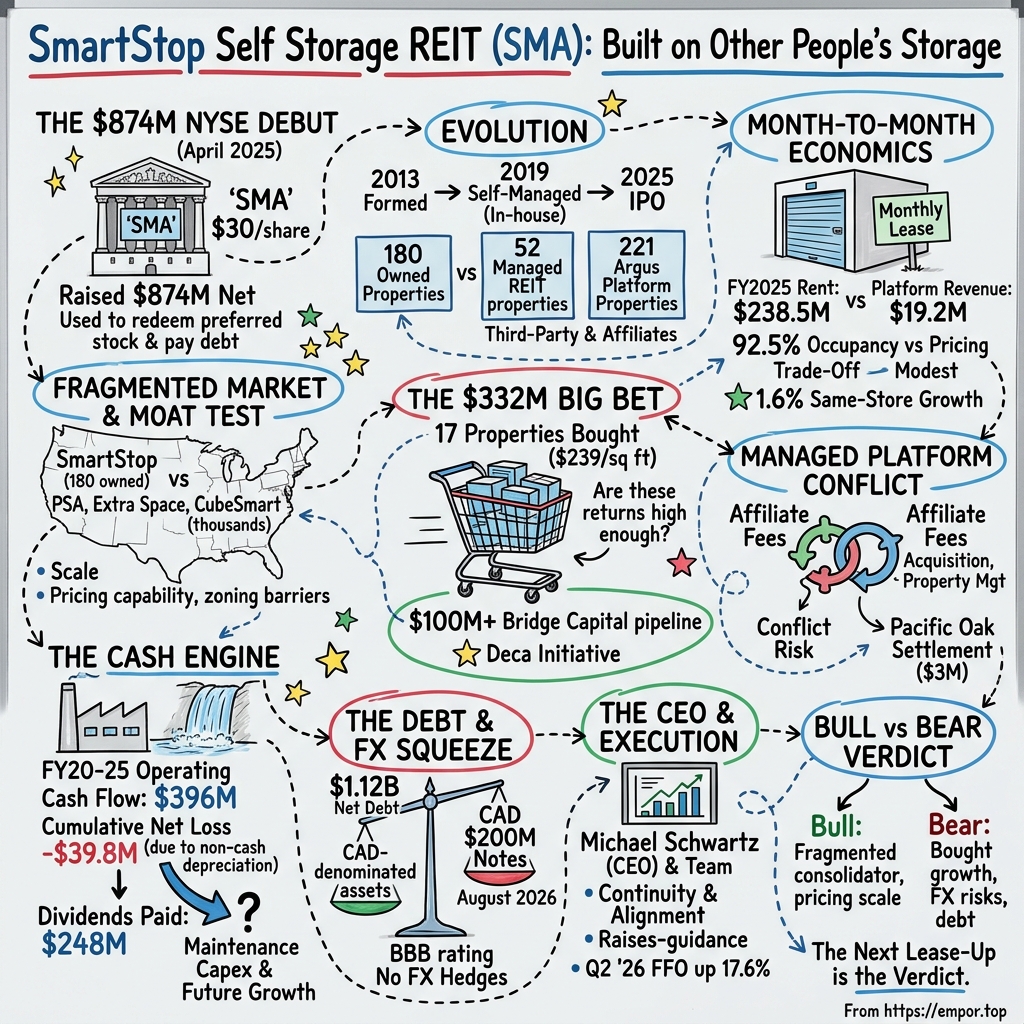
On the morning of April 2, 2025, a company that had spent twelve years living just outside the stock market finally walked onto the floor of the New York Stock Exchange. Its shares began trading under the ticker SMA at $30 apiece.1 For most listed companies, the IPO is the start of the story. For SmartStop Self Storage REIT, it was closer to the end of the second act.
Until that morning, SmartStop had been a non-traded real estate investment trust. Its shareholders had bought in through financial advisers and broker-dealers, and the price of their stock was not set by a market at all. It was set by an appraisal process: once a year, outside advisers helped the company calculate an estimated net asset value per share.
In its first year as a listed company, SmartStop still paid about $0.6 million in professional fees for that valuation exercise, a cost it noted it would never incur again.2 Price discovery had arrived, and it came with a ticker.
The money was the first headline. Including the underwriters' full over-allotment, the offering raised roughly $874 million after costs.3 That was a very large sum for a company of SmartStop's size, and almost none of it was earmarked for something new.
The company used the proceeds to redeem $200 million of preferred stock and to pay down debt, leaving the remainder to fund growth.3 In plain terms, public investors were first asked to repair the balance sheet, and only then to finance the expansion.
The chief executive put a little of his own money on the table that day. H. Michael Schwartz, the founder who had run the company since its formation, bought 18,000 shares at the $30 offering price through an entity he controls, a $540,000 purchase made directly in the offering.2
It was a modest sum next to his much larger stake held through partnership units, but it was a signal that the founder was willing to stand at the same entry price as everyone else.
So what exactly did those new shareholders buy? The honest answer requires a little care, because SmartStop is three businesses wearing one name. The first, and by far the largest, is a self-storage landlord: it owns and operates facilities and rents units to tenants by the month.
The second is a manager of affiliated non-traded REITs, the "Managed REITs," which own their own properties and pay SmartStop fees to run them. The third is a smaller business that manages storage facilities for unrelated outside owners.4
That distinction matters from the first minute. At June 30, 2026, SmartStop owned 180 operating storage properties and held 50% interests in 14 joint ventures in Canada.5 The Managed REITs owned another 52 properties, and the third-party management platform, acquired as Argus in late 2025, managed 221 more at year-end 2025.54
Add those numbers together and you get a company that touches more than 450 storage facilities. But SmartStop owns fewer than half of them. The rest belong to someone else. SmartStop collects a fee to keep the lights on and the units rented.
That is why the company's growth has to be read in three separate layers. There is the rent growth from properties it has owned for a while, which the industry calls same-store performance. There is the growth that comes from buying more properties, which enlarges revenue without proving that any individual facility is getting better. And there is fee income from managing other people's buildings, a different kind of business with different risks.
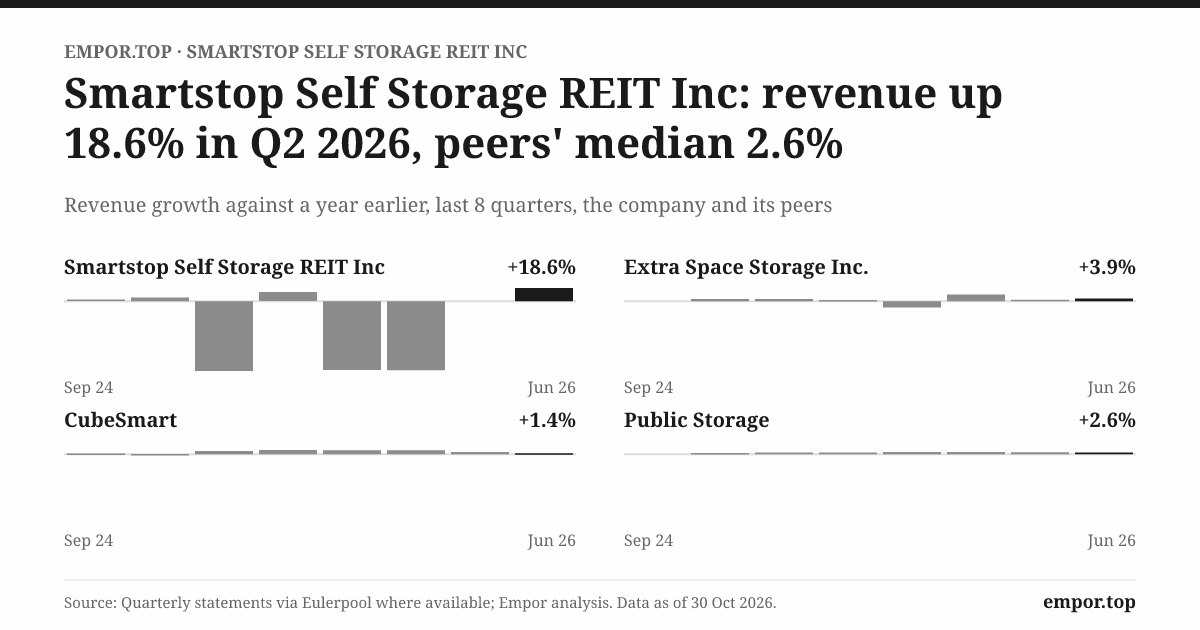
The headline numbers blur those layers together. Revenue rose to $281.1 million in 2025 from $237.0 million a year earlier.4 Yet the pool of facilities SmartStop had owned throughout both years grew revenue by only about 1.6%.2 Nearly everything else came from buying.
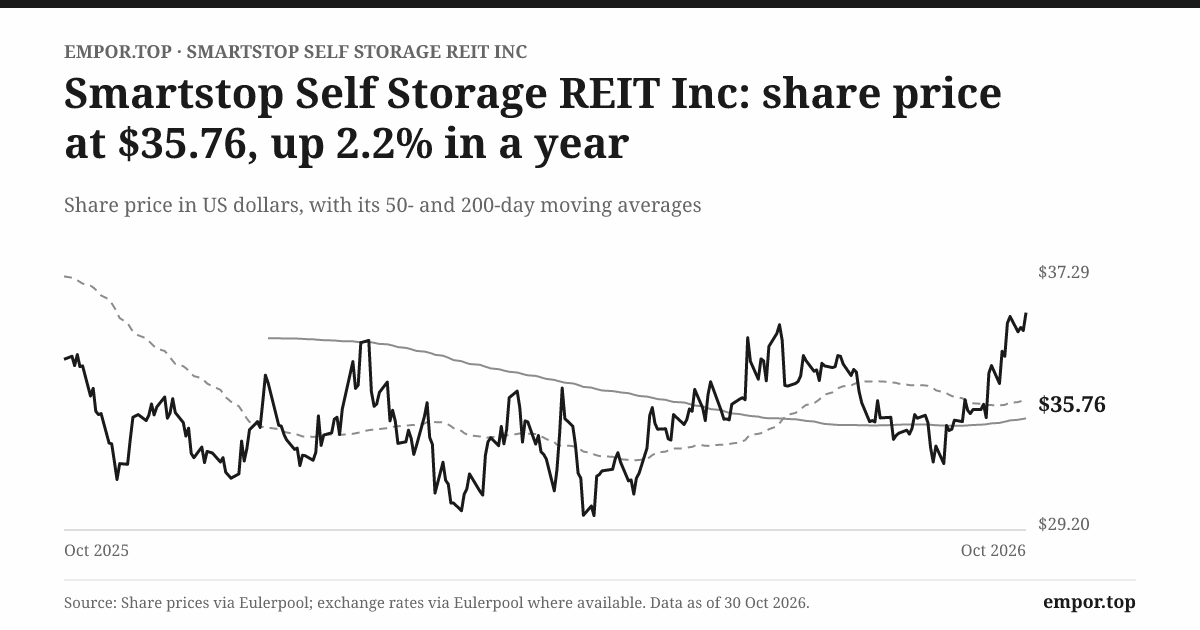
Eighteen months later, the market had rendered a preliminary judgment. On October 30, 2026, SMA closed at $35.76, its highest level of the previous year, giving the company a market value of about $2.0 billion and an enterprise value, including debt, of about $3.1 billion.6 Shareholders who bought at the IPO were sitting on a gain of roughly a fifth before dividends.
That is a respectable debut. It is not proof. The IPO reset SmartStop's balance sheet and put the company in front of a far more demanding audience. What it did not do, on its own, was demonstrate that buying more storage would create more value per share.
Three questions run through the rest of this story. Can SmartStop turn a fragmented industry, where local owners still control most facilities, into growth that actually earns its cost? Can its fee platform scale without deepening the conflicts that come from managing properties owned by entities its own chief executive also leads? And can acquisitions and dividends both fit inside an investment-grade balance sheet?
To answer any of them, it helps to understand how a storage company built for retail investors through private REITs ended up on the Big Board in the first place.
 Subscribe on LinkedIn
II. From a Non-Traded REIT to a Self-Managed Platform
H. Michael Schwartz had done this before. Long before SMA existed, he served as chief executive and chairman of an earlier company also called SmartStop Self Storage, from August 2007 until it merged into Extra Space Storage, one of the largest storage landlords in America, on October 1, 2015.2
A business-administration graduate of the University of Southern California with more than three decades in real estate, securities and corporate finance, Schwartz had built a playbook: raise money from individual investors through non-traded REITs, buy storage facilities, professionalize them, and eventually find a liquidity event for the shareholders.2
The company that would become today's SmartStop was formed in January 2013, with Schwartz as an officer and director from the start.2 For most of its life it followed the same playbook. Financial advisers sold its shares to individual investors. A separate sponsor, the entity now known as Strategic Asset Management I, or SAM, ran the business through advisory and property-management agreements, collecting fees for the service. Schwartz led both sides.
That structure is common in non-traded real estate, and it has an obvious weakness. When the people running a REIT are paid by a sponsor that earns fees on assets under management, they have an incentive to grow assets, whether or not growth improves returns for shareholders. Fees on acquisitions, fees on management, fees on capital raised: each one rewards activity.
On June 28, 2019, SmartStop changed the arrangement. In what it called the Self Administration Transaction, the REIT acquired SAM's self-storage advisory, asset-management and property-management businesses, along with certain joint-venture interests, the management team and the storage employees.2 Overnight the company stopped paying an outside manager and became the manager. Schwartz stepped back to executive chairman from June 2019 until April 2021, then returned as chief executive.2
The deal solved one problem and created another. It removed the external advisory fee and gave shareholders ownership of the people and systems that ran their properties. But it did not dissolve SAM. Schwartz remained SAM's chief executive, and SAM continued to sponsor other real estate programs, including a non-traded student and senior housing REIT that Schwartz chairs.2
SmartStop still provides administrative services to SAM, collecting about $0.7 million under that agreement in 2025, and earns fees for managing a storage property in which SAM holds a minority stake.2 The founder had moved the engine inside the public company, but kept a hand on several of the vehicles parked outside.
The self-administration transaction also made SmartStop a sponsor in its own right. Through subsidiaries, it now sponsors and advises the Managed REITs: Strategic Storage Trust VI, Strategic Storage Growth Trust III and Strategic Storage Trust X.2 Schwartz serves as chief executive, president and chairman of each.2
Those REITs raise their own money from individual investors, buy their own properties and pay SmartStop for management. Their buildings are not SmartStop's buildings, and their debts are not SmartStop's debts. But their decisions are made by people who also work for SmartStop.
That loop has a history. Three earlier sibling REITs that Schwartz led eventually merged into SmartStop: Strategic Storage Growth Trust in January 2019, Strategic Storage Trust IV in March 2021, and Strategic Storage Growth Trust II in June 2022.2 Each merger enlarged the listed company's portfolio by absorbing a vehicle its own management had sponsored and run.
Seen one way, the Managed REITs are a pipeline of seasoned properties that SmartStop already knows intimately. Seen another, they are a series of related-party transactions in which the same leadership sits on both sides of the table, and in which independent directors carry the burden of protecting each set of shareholders.
The financial team grew up inside this system too. James Barry, the chief financial officer since June 2019, began as a financial analyst at the earlier SmartStop in 2012, worked on that company's merger with Extra Space, then rose through finance roles at SAM before joining the REIT.2
He still serves as CFO of the sponsor, advisor and property-manager entities for the sponsored programs.2 This is a tight-knit, long-tenured team that knows the storage business and the non-traded REIT channel thoroughly. It is also a team whose careers have been spent on both sides of the sponsor relationship.
The road to the NYSE was slow. SmartStop first filed its registration statement for a listed offering in 2022 and amended it repeatedly before the final version in March 2025, describing the deal as its first listed public offering.7 That pre-listing prospectus is a useful snapshot.
It projected that management would own roughly 5.7% of the common stock and operating-partnership units after the offering, and it described a business that had already assembled the owned portfolio, the management platform and the Managed REIT relationships that public investors would inherit.7
So the company that rang the bell in 2025 was not a startup and not a simple landlord. It brought public investors a platform whose governance complexity a simple landlord would never face.
Whether that platform compounds value for public shareholders, or generates transactions whose economics are hard to separate, remains an open question. But first, it is worth stepping inside a storage facility, because the real engine of SmartStop is not the fee platform at all. It is a ten-by-ten room with a roll-up door.
III. The Storage Unit Is Rented by the Month
Picture the end of a tenancy. A tenant who has kept a sofa, a few boxes of tax records and a bicycle in a unit for fourteen months finally clears it out. Someone from the property sweeps the floor, checks the door, and the unit goes back into the inventory.
Within days, a new renter, perhaps someone moving apartments or someone whose parents are downsizing, signs up online and moves in. The rate they pay has been set that week by software, based on how many similar units are empty nearby and what competitors are asking.
That small cycle, repeated thousands of times a year across SmartStop's portfolio, is the whole business. Storage leases are generally month to month, with no long-term minimum commitments.4 A landlord in an office building may sign a ten-year lease and know its revenue years in advance. A storage operator knows almost nothing about next year's revenue, but it gets to reprice its product constantly.
The economics are simple to describe. Rent comes in every month. Against it sit property taxes, insurance, payroll for site staff, repairs and maintenance, utilities and marketing. What is left is net operating income, or NOI, the property-level profit before corporate overhead, interest and depreciation. Storage is attractive because those costs are relatively light: no tenant improvements, few staff per building, and a structure that needs mostly roofs, doors and paint.
In 2025, self-storage rent made up $238.5 million of SmartStop's $281.1 million of revenue.4 Ancillary revenue, the locks, boxes and fees that come with renting a unit, added about $11.0 million.4 The company also earned about $9.7 million from its tenant protection program, a damage-coverage product sold alongside units.2 Strip those layers apart and the shape is clear: tenant rent is the engine, and everything else is a supplement.
Storage operators actually run two prices at the same time. The first is the asking rate for new customers, often advertised online and often discounted with a first-month promotion to win the move-in. The second is the rate charged to tenants already inside. Industry practice is to raise existing customers' rents periodically once they have settled in, on the theory that moving belongings out is a hassle that most tenants would rather avoid for a modest increase.
That second lever is where much of the profit lives, and it is also where the risk hides. Push existing tenants too hard and some leave. When they do, the unit resets to whatever new customers are willing to pay that month, which in a soft market may be far less than the departing tenant was paying. Managers call these existing-customer rate increases "ECRIs," and the art of the business is calibrating them against move-out risk.
SmartStop leaned on that lever openly in 2026. Asked by JPMorgan's Michael Mueller about the outlook, management said it expected existing-customer rate increases at or above 2025 levels, even as it waited for new-customer rents to recover.8
Management also reported a pickup in move-outs during the first quarter, which Barry attributed to a tough comparison with the prior year and to geopolitical noise that began in March.8 The two facts belong together. A landlord raising rents on people already inside, while more of them leave, is testing exactly how sticky its customers really are.
It also means occupancy can be misleading. A facility that is 95% full of tenants paying discounted introductory rates may earn less than one that is 90% full at stronger rates. The two numbers that matter together are physical occupancy and rent per occupied square foot. Watching either one alone is like judging a restaurant by how full it is without asking what the customers are paying.
Software now sits at the heart of that judgment, and SmartStop talks about it with enthusiasm. On the second-quarter call, Barry said the company was "all in on artificial intelligence," and Green Street's Spenser Allaway asked whether its pricing amounted to so-called surveillance pricing; management answered that its models set rates from supply and demand rather than from customers' personal data.9
That exchange is a reminder that algorithmic pricing is both the industry's main tool and a growing regulatory and reputational question. The company does not disclose any revenue it attributes specifically to these tools, so their payoff has to be inferred from the same-store numbers.
SmartStop's 2025 record shows how thin the organic gains have been. Across the 149 facilities it owned through both 2024 and 2025, revenue rose about 1.6%.2 Average occupancy improved only from 92.2% to 92.5%, and annualized rent per occupied square foot inched up from $19.98 to $20.03, an increase of about 0.3%.2
Meanwhile property operating expenses rose about 3.8%, mainly because of higher property taxes and payroll.2 The result was same-store NOI growth of roughly 0.6%.2 Costs grew more than twice as fast as revenue. In a year when the company was celebrating its listing, its existing buildings barely moved.
The first half of 2026 showed the same tension from a different angle. On the first-quarter call, management reported same-store revenue up about 1.5% and NOI up about 2%, but disclosed that move-in rents per square foot for new customers were down about 7% from the prior year.8 In other words, the company was charging new arrivals noticeably less, and relying on increases to existing tenants to keep total rent rising.
By the second quarter, average physical occupancy on the same-store pool was 92.5%, about 0.6 percentage points lower than a year earlier, while annualized rent per occupied square foot rose about 1.9%.10
Management told analysts it had chosen to hold asking rates and pull back on promotions, accepting slightly lower occupancy in exchange for better pricing.9 Move-in rents per square foot were still down about 4.4% in the quarter, and web rates fell about 3.8%, before turning up roughly 1.2% in July.9
The second quarter's most striking number was not revenue at all. Same-store revenue rose about 1.3%, but same-store operating expenses fell about 3.4%, pushing NOI up about 3.7% and the operating margin to 67.3%.9 The expense decline came largely from a favorable property-insurance renewal in April and lower payroll.9
When Scotiabank's Viktor Fediv asked how durable the margin gain was, Barry acknowledged that the insurance and repair savings were partly temporary, while arguing that the savings from clustering stores in markets such as Denver were structural.9
That answer is the right one, and it is also the important caveat. A business whose NOI improves because insurance got cheaper this year has not proven pricing power. Pricing power shows up when rent per occupied square foot rises faster than costs, year after year, without occupancy sliding. SmartStop's record through mid-2026 shows modest rent progress, some cost discipline, and a deliberate trade of occupancy for rate. It does not yet show a durable edge.
The local headwinds are real and specific. Hurricane Helene, which struck in September 2024, damaged SmartStop's facilities around Asheville, North Carolina, and the company recorded a casualty loss that year.2 In the second quarter of 2026, Asheville occupancy was still about 2.3 percentage points behind the prior year, and one flood-destroyed store is slated to be rebuilt about 83% larger, with construction expected to start in early 2027.9
In parts of California, temporary restrictions on rent increases to existing tenants limited the ECRI lever, and management expected that comparison to ease later in 2026.9 These explain some weakness. They do not explain all of it.
Next to the rent engine, the management platform is a smaller machine. In 2025, Managed Platform revenue was $19.2 million, covering fees from the Managed REITs and the newly acquired third-party business.4 A further $12.5 million of revenue reimbursed SmartStop for costs it incurs running that platform, which offsets expenses rather than adding comparable margin.4 Even combined, those lines are a fraction of tenant rent.
So the essential economic fact about SmartStop is that it lives on monthly rent, repriced constantly, with modest organic growth. Frequent turnover gives an operator the chance to reprice; it also means there is no contractual backlog to fall back on when local demand softens.
The edge, if there is one, has to come from doing that repricing better than the operator across the street. And across the street, it turns out, may be one of the largest real estate companies in America.
IV. A Fragmented Market, a Small Public Footprint
Imagine a customer in suburban Denver who needs a unit by Saturday. They type "storage near me" into a search bar and get a map dotted with options: a national brand two miles away, a family-owned facility tucked behind a strip mall, a newer climate-controlled building near the highway.
Each listing shows a price. Behind those prices, several operators are adjusting rates almost daily, watching how many units of each size are empty and what the competitor down the road just did.
That screen is the battlefield. Storage is local. Customers rarely drive past three closer facilities to rent from a brand they love. They choose on location, price, availability and convenience, and they can leave at the end of any month. The competitive question for SmartStop is whether being a scaled operator lets it win more of those decisions, at better prices, than the local owner who lacks its systems.
The industry is enormous and remarkably fragmented. When SmartStop went public, its prospectus cited about 52,300 storage facilities in the United States with roughly 2.1 billion rentable square feet.11 The four listed storage REITs and AMERCO, the parent of U-Haul, together operated only about 23% of that space.11 More than three-quarters of American storage was still owned by smaller operators, private investors and families.
That fragmentation is SmartStop's opportunity, and it is easy to overstate. A market with thousands of small owners is an acquisition hunting ground and a potential source of management clients. It is also a market where barriers to entry for an individual property are low, where a new facility can open nearby if zoning allows, and where the biggest players are many times SmartStop's size.
Those biggest players are the ones SmartStop named as its listed peers: Public Storage, Extra Space Storage, CubeSmart and National Storage Affiliates.7 Their portfolios number in the thousands of facilities.12 Public Storage alone operates a national network that dwarfs SmartStop's 180 owned properties, with the marketing budget, data and cost of capital that scale provides.
Extra Space, which absorbed Schwartz's earlier company in 2015, is the other giant. SmartStop is not competing to be the largest. It is competing to be good enough, in its chosen markets, that scale differences do not matter.
Canada adds a different wrinkle. SmartStop built a meaningful position in the Greater Toronto Area and in joint ventures elsewhere in Canada, a market that once looked less crowded with institutional owners. On the second-quarter 2026 call, Schwartz warned that Public Storage's acquisition of a Canadian portfolio would create "a more competitive environment," with overlap concentrated in Toronto.9 Same-store revenue in the Toronto pool fell about 1% in constant currency that quarter, even as the joint-venture pool grew about 6.7%.9 The largest operator in the industry had just moved onto SmartStop's turf.
Canada had already shown it could be fickle for reasons beyond competition. Schwartz said tariffs and war-related uncertainty had delayed rental decisions in some pockets of the Toronto area, a reminder that storage demand follows household moves, home sales and business confidence.9
SmartStop is still building there: in early 2026 it bought a Canadian land parcel for a development joint venture with SmartCentres, a large Canadian retail-property owner.8 Development adds new supply that SmartStop controls, but it also adds lease-up risk, because a new facility can take years to fill.
How strong is SmartStop's position, really? Test it through five forces.
Start with scale and cost. More facilities in a single city let an operator share district managers, marketing spend and maintenance crews, and that effect is measurable at SmartStop.
Management said Denver went from nine stores to more than fifty owned and managed locations, and credited that density for meaningful cost savings in 2026.9 That is a genuine, local economy of scale. But at the national level, SmartStop's purchasing power and advertising budget remain far smaller than the leaders'.
Next, pricing capability. Management credits its revenue-management tools and operating platform for performance, and it reported record web reservations of more than 10,000 in April 2026, up about 25% year on year.8 Yet the hard test is same-store rent per occupied square foot, which barely moved in 2025.2 Strong lead generation that is converted at falling move-in rates is evidence of a working digital funnel, not of pricing power.
Third, customer power and switching. Individual tenants have little bargaining power over a single landlord, but collectively they have a great deal, because they rent month to month and can walk. The friction of moving belongings is the industry's quiet friend; it supports rent increases on existing tenants. It is also limited. Push too far, and the unit is reset to market.
Fourth, brand and network effects. SmartStop describes a national operating platform under a consistent brand, but its filings offer little evidence that brand preference, rather than location and price, drives customer choice or retention. A storage customer's "network" is the three facilities nearest their home. There is no network effect in the software sense.
Fifth, new entry. Land, zoning and construction costs constrain new supply in many dense markets, which protects existing facilities. But those same constraints protect the local family owner too, and new supply in a given submarket can still compress rents for several years.
Put those together and the verdict is careful. Fragmentation offers SmartStop a real acquisition and management runway, and clustering in markets like Denver shows a concrete way to lower costs. But fragmentation is an invitation, not a moat. SmartStop's claimed advantages in revenue management, operating systems and scale remain plausible rather than established, because they have not yet shown up as same-store rent and NOI growth that outpaces larger peers over multiple years.
The confirming evidence would be simple to spot: same-store NOI growing steadily without occupancy erosion or deeper promotions, in markets where SmartStop competes directly with the large REITs. Until then, much of SmartStop's growth has come from somewhere else entirely, from buying buildings. And in 2025, it bought a lot of them.
V. The 17-Property Bet—and the Price of Getting Bigger
In the months around its listing, SmartStop went shopping. It assembled a portfolio of 17 wholly owned properties, mostly in the top 25 U.S. metropolitan markets, for about $332 million.13 The portfolio added roughly 1.386 million rentable square feet, which works out to about $239 per square foot on the stated purchase price.13
That per-square-foot figure is the most tangible way to understand what SmartStop paid. It tells a listener how much capital went into each patch of rentable floor. It does not, by itself, say whether the price was good.
A newly built, climate-controlled facility in a dense coastal market can justify a very different price than an older drive-up facility in a smaller city. Without the expected cap rate, the occupancy at purchase and comparable sale prices for similar assets, there is no honest way to call the deal cheap or expensive.
What the record does show is the scale of the bet. Cash used in investing activities reached about $381 million in 2025, up from about $181 million a year earlier, mainly for real estate acquisitions and development, along with investments in joint ventures and Managed REITs.4
The company's non-same-store facilities, the properties it did not own through all of 2024 and 2025, generated about $19.4 million of NOI in 2025, compared with about $3.4 million a year earlier.2 That jump is the acquired growth. The same-store pool, by contrast, added less than $1 million of NOI.2
The value of acquired growth depends on whether each purchase earns more than the capital it consumes.
SmartStop's own investor presentation frames the broader record in grand terms: about $1.6 billion of investment activity since 2021, across on-balance-sheet acquisitions and Managed REIT investments.13 That figure combines different ownership channels and property stages, including assets that belong to the Managed REITs rather than to SmartStop. It is a measure of activity, not of shareholder returns.
A platform bought, a pipeline promised
The October 1, 2025 acquisition of Argus, a third-party storage management business, was a different kind of purchase.4 Instead of buying buildings, SmartStop bought management contracts and the people who run them. Argus contributed about $2.1 million of revenue in its first quarter inside SmartStop.4
The deal included a contingent earnout tied to future performance, and management said that operating-margin synergies would show more fully in 2027.28 The 221 properties on the platform are not owned assets, and their importance should be measured in fee contribution, not facility counts.
Early integration data was mixed but moving the right way. Management reported that, in the second quarter, the third-party platform onboarded about 90,000 square feet of new management business while about 52,000 square feet left, and that it had signed its first third-party property in Canada.9
Third-party management is a churning business: owners sell their facilities, switch managers or decide to self-manage. A platform that adds slightly more than it loses each quarter is growing, but slowly, and its value to SmartStop depends on whether it feeds acquisitions as well as fees.
In 2026, the tone on calls became expansive. On the first-quarter call, Schwartz described the market as "one of the single greatest opportunities to transact in self-storage since the Great Recession."8 Yet the company's actual buying was far smaller than that rhetoric.
In the second quarter, SmartStop bought three properties in Spartanburg, South Carolina, for about $30 million, at what management described as a high-5% cap rate.9 It raised its full-year capital-deployment guidance to between $55 million and $75 million, a fraction of the 2025 pace.9
There are two readings of that gap. The generous one is discipline. When Baird's Wesley Golladay asked about pricing, Schwartz said U.S. deals were trading around 5.5% cap rates and Canadian deals around 4% to 5%, that brokered deals were still expensive, and that the company would not chase volume.9
The less generous reading is constraint: with leverage elevated and the share price only recently recovering, SmartStop had less cheap capital to deploy than its enthusiasm implied. Both readings can be true at once.
Not every change to the portfolio in 2026 was chosen. Management disclosed that eminent-domain proceedings had taken about 80% of one property during the second quarter and about 20% of another shortly after, the kind of local, unpredictable event that a portfolio of 180 buildings will always experience.9
SmartStop also told analysts it was in ongoing talks about an institutional joint venture that could bring outside capital alongside its own, but had nothing definitive to announce.89 A partner's capital would let SmartStop buy more without stretching its own balance sheet, at the cost of sharing the returns.
The new idea in 2026 was bridge capital. In March, SmartStop announced a lending joint venture with Axxess Capital, a portfolio company of Conversant Capital, to provide short-term financing to other storage owners.8
Management described a pipeline of more than $100 million at targeted yields of 10% to 14%, mostly in preferred equity or mezzanine positions that sit behind a senior lender.8 By the second quarter, SmartStop had invested about $16.3 million at double-digit yields, and in one case had taken over management of the property behind its investment.9
The appeal is obvious. A 10%-plus yield beats a 5.5% cap rate, and lending to owners can turn into a management contract or a future acquisition. The risk is just as obvious.
Preferred and mezzanine positions absorb losses before senior lenders do, and a storage REIT is not historically a specialty lender. Targeted yields on a small, young book are not a recurring earnings stream yet. The test will be realized returns and credit losses through a full cycle.
Then came a name for it all. In July 2026, management unveiled the Deca Initiative, which Barry described as "disciplined execution, compounding appreciation," built on six pillars and pointed toward a $10 billion capitalization level as the eventual result of executing well.9
The framework spans acquisitions, dispositions and redeployment into core markets, management contracts and bridge investments. A $10 billion ambition from a company with an enterprise value of about $3.1 billion is a statement of direction, not a forecast.
A framework is only as good as its scorecard. The Deca Initiative will prove itself if it produces higher FFO per share and better returns on invested capital, and it will disappoint if it simply broadens the list of things SmartStop is busy doing. Comparing each quarter's claims about acquisition yields, integration and leverage with what actually follows is the only fair way to judge it.
Every one of these strategies, from bought buildings to bridge loans, has a common thread: SmartStop wants to earn more from storage without owning all of it. That brings the story to the business where the line between SmartStop's interest and its affiliates' interest is hardest to see.
VI. The Fee Platform Comes With a Conflict
Consider a single invoice. Each month, a storage facility owned by Strategic Storage Trust VI pays SmartStop a property-management fee. SmartStop employees run the site, answer the phones and set the prices. The building belongs to SST VI's investors. The fee lands in SmartStop's revenue. And the chief executive of both companies is the same man: H. Michael Schwartz chairs each of the Managed REITs while running SmartStop.2
That is not a hidden arrangement. SmartStop discloses it plainly. Through its subsidiaries, it earns asset-management, property-management and acquisition fees from the Managed REITs and receives substantially all of the tenant protection program revenue they generate.2 Certain SmartStop officers also serve as officers of the Managed REITs, and one director sits on each Managed REIT board, but those individuals are paid only by SmartStop.2 The question is not disclosure. It is economics and incentives.
Start with the money. In 2025, Managed Platform revenue was $19.2 million.4 That line is not all related-party revenue: it includes about $2.1 million from the Argus third-party platform, and it is reduced by about $1.1 million tied to earlier sponsor funding for SST VI.4 Within the affiliated fees, the largest pieces were about $6.5 million of property-management fees, $3.8 million of tenant-protection fees and $2.6 million of acquisition fees.4
Those pools behave very differently. Property and asset-management fees recur as long as the Managed REITs own their buildings. Acquisition fees depend on the Managed REITs buying more property, which depends on their ability to raise new money from individual investors. Tenant-protection fees depend on the insurance-like program sold with each rental. Reimbursements offset platform costs.4
How profitable is the platform? The filings offer a rough clue. In 2025, SmartStop recorded about $9.8 million of Managed Platform expenses against that $19.2 million of revenue.2 That leaves a spread of a little more than $9 million before any share of corporate overhead, a meaningful but secondary contribution next to roughly $158 million of total property NOI.2 The company does not publish a single all-in related-party revenue and cost ratio, and does not report recurring management fees separately from transaction fees in one consistent margin.
The momentum in 2026 was positive. On the second-quarter call, management reported Managed REIT platform revenue of about $6.8 million for the quarter, with recurring revenue up about 14%, and flagged a one-time fee of about $2 million from a fund consolidation expected in the fourth quarter and already included in guidance.9 That one-time fee is exactly the kind of transaction-linked income that should be read separately from recurring management.
The cost of the sponsor years
The platform's history includes some untidy endings. SmartStop had agreed to fund certain offering costs for SST VI in exchange for Series C units in SST VI's operating partnership; the excess of that funding over the units' value was treated as a reduction of platform revenue.2 That obligation ended after SST VI closed new subscriptions in June 2025.4
In the same year, SmartStop paid $3.0 million to settle matters with Pacific Oak Holding Group, covering the termination of a distribution-support arrangement, the repurchase of an SST VI advisor interest and severance for a former dealer-manager.4 These were costs of unwinding the non-traded capital-raising machine.
One small transaction illustrates how the boundaries can blur. In February 2025, SmartStop bought a storage facility in Murfreesboro, Tennessee, of about 62,100 square feet; eight months later, on October 30, 2025, it sold that facility to Strategic Storage Trust X, one of its own Managed REITs.2
There may be sound reasons for such a sale, from portfolio fit to warehousing an asset until an affiliate had capital. But it is a related-party transfer of real estate, and its fairness to both sets of investors depends entirely on independent oversight.
That oversight exists on paper. SmartStop's board has adopted a written Related Party Transaction Policy, and its independent directors reviewed and approved the material transactions between the company and its affiliates.2 Management agreements set the fee terms. The question for public shareholders is whether those controls are strong enough given the volume of transactions and the chief executive's continuing interests in SAM and the affiliated vehicles.
The verdict is measured. The platform is a real, growing, secondary revenue stream that gives SmartStop income without full ownership risk and a window into future acquisitions. It also carries a governance cost that a simple landlord would not bear.
Until SmartStop reports recurring related-party fee revenue and its net margin consistently over time, investors will have to estimate rather than measure what the platform contributes to public shareholders.
Fee income, however, is the smaller question. The bigger one is whether the cash coming off SmartStop's buildings is enough to pay the dividend and fund the expansion, or whether the next dollar of growth is always borrowed.
VII. Cash Flow Is Not the Same as Cash Available to Grow
Here is a puzzle that confuses many first-time readers of a REIT's accounts. Over the six years from 2020 through 2025, SmartStop reported a cumulative net loss of about $39.8 million. Over the same six years, its operations produced about $396 million of cash.4 How can a company lose money and generate hundreds of millions of dollars at the same time?
The answer is depreciation. Accounting rules require a property owner to treat its buildings as if they wear out steadily, charging a slice of their cost against earnings every year. In 2025, SmartStop recorded about $63.2 million of depreciation and about $10.0 million of intangible amortization.2
Neither involves writing a check that year. The tenant still pays rent; the money still arrives. Yet those charges were large enough to turn a healthy property business into a small reported loss of about $1.7 million.2
Acquisitions make the effect stronger. When SmartStop buys a building, part of the purchase price is assigned to short-lived intangibles such as the value of existing tenant relationships, which are amortized quickly. That is why intangible amortization jumped roughly tenfold in 2025, the year of the big portfolio purchase.2 The faster SmartStop grows by acquisition, the worse its GAAP earnings look in the short run, even if the deals are sound.
That is why REITs report funds from operations, or FFO, which adds real-estate depreciation back to net income. SmartStop's FFO as adjusted, a broader version that also strips out acquisition costs, debt-extinguishment losses, currency swings and one-time items, roughly doubled to about $95.5 million in 2025 from about $46.8 million.2 That sounds like a triumph. It deserves a closer look.
Three things explain most of the jump, and only one of them is operating performance. The first is acquisitions, which added NOI from the newly bought properties. The second is financing. Interest expense fell from about $72.3 million to about $59.9 million after IPO proceeds repaid debt, and distributions on preferred stock fell from about $12.8 million to about $3.6 million after the redemption.2
Together, those savings were worth more than $20 million. The third is definitions: SmartStop changed its FFO-as-adjusted calculation beginning in 2024 to add back amortization of debt-issuance costs, about $4.1 million in 2025, and it excluded about $9.5 million of one-time stock compensation tied to the IPO.2 The company says those adjustments make the figure more comparable. They also make it more flattering.
The company is candid that FFO is not cash. In its own words, FFO and FFO as adjusted are "not necessarily indicative of cash flow available to fund cash needs," including distributions to stockholders.2 For that, investors need to look at the cash-flow statement.
There, the picture improved but remained tight. Cash from operations rose to about $85 million in 2025 from about $64 million in 2024.4 Management attributed the gain mainly to a roughly $29 million improvement in net income excluding non-cash items, partly offset by about $8.1 million of unfavorable working-capital changes.4 That is real progress. But the company paid about $75 million in dividends that same year, which consumed almost nine-tenths of operating cash flow.4
The $381 million spent on investing activities therefore could not come from operations.4 It came from the IPO and from borrowing, which is why cash from financing activities was a positive $325 million in 2025.4 Over the full six years, dividends absorbed about 63% of operating cash flow, leaving a little under $150 million of internally generated cash for everything else, against hundreds of millions of acquisitions.4
The missing figure is maintenance capital spending. Every storage facility needs new roofs, repainted doors, repaved lots and replaced security systems. Those costs are real, recurring and different from acquisition or development spending.
SmartStop's filings do not provide a consistent maintenance-capex series that can be compared with revenue over time, and the company does not report a full AFFO, or adjusted funds from operations, reconciliation that subtracts recurring capital spending.4 Without it, investors cannot cleanly calculate how much cash remains after keeping the buildings in good shape.
That makes the company's cash engine harder to judge than it should be. Storage is a light-capex property type, so the maintenance figure is probably modest relative to NOI. But "probably modest" is an estimate, not a measurement, and the dividend's sustainability sits in exactly that gap.
The scorecard that matters is short. FFO as adjusted per share shows whether growth reaches each owner. Same-store NOI shows whether the existing buildings are improving. Maintenance capex and dividend coverage show whether the distribution is paid from surplus or from the balance sheet. And the balance sheet, after the IPO, had acquired an unusual accent.
VIII. A BBB Rating Meets a Canadian-Dollar Balance Sheet
In August 2026, SmartStop's operating partnership went to the Canadian bond market and sold CAD $200 million of senior unsecured notes.14 For a company headquartered in California and listed in New York, borrowing in Canadian dollars might look odd. For SmartStop, it had become routine. It was the third Canadian-dollar note sale in barely more than a year.
After the IPO's balance-sheet repair, the credit agencies took notice. Morningstar DBRS assigned a BBB rating in May 2025.15
In July 2025, Kroll Bond Rating Agency upgraded SmartStop's operating partnership to BBB with a stable outlook and rated CAD $500 million of senior notes due 2028.3 KBRA cited the IPO's roughly $874 million of net equity, improved leverage and coverage after debt repayment and the preferred redemption, and stronger access to unsecured borrowing.3
That rating mattered more than it might seem. Investment-grade status lets a REIT borrow unsecured, at fixed rates, for years at a time, rather than relying on property-level mortgages and floating bank loans. It is the difference between financing a growth strategy and merely surviving one.
SmartStop then issued another CAD $200 million of notes due 2030 later in 2025. In August 2026, it issued a further CAD $200 million; KBRA said that issue substantially completed the refinancing of 2026 maturities while extending the company's debt profile.414 Earlier in 2026, SmartStop also recast its $500 million bank facility at a cost about 30 basis points lower, with maturity extended to February 2030.8
By June 30, 2026, net debt was about $1.12 billion. Roughly $1.02 billion of it carried fixed rates, and only about $104 million floated.5 That structure protects SmartStop from sudden interest-rate spikes over the next few years. It also means the full cost of today's interest rates will show up gradually, as older cheaper debt is replaced.
The warning came in KBRA's own 2025 rationale. The agency expected 2025 acquisitions to be funded primarily with debt and leverage to approach the top of its 5 to 6 times net-debt-to-EBITDA range.3 By the second quarter of 2026, management reported its own measure of cash-flow leverage at about 6.2 times, after reducing it.9
The two calculations are not necessarily defined the same way, but the direction is clear. The leverage headroom created by the IPO had largely been spent on the 2025 buying spree. That helps explain why 2026 capital deployment guidance was so much smaller than the year before.
Then there is the currency. At June 30, 2026, about $585.6 million of SmartStop's debt, in U.S.-dollar terms, was denominated in Canadian dollars.5 The company's consolidated Canadian assets were about $257.1 million, and its Canadian self-storage revenue was about $7.5 million in the second quarter.5
Management describes its Canadian-dollar exposure as naturally hedged, because Canadian properties earn Canadian dollars that can service Canadian debt.8 That logic is sound as far as it goes, and joint-venture interests add further Canadian exposure beyond the consolidated assets.
But on the consolidated numbers, Canadian-dollar borrowing was more than twice the size of Canadian assets. Much of the Canadian debt was effectively funding a U.S. business. If the Canadian dollar strengthens, the U.S.-dollar value of that debt rises, and there is not a matching pool of Canadian income to offset it.
SmartStop has used currency forwards and options in the past to dampen this. The results swung: non-designated currency forwards produced a loss of about $3.5 million in 2025 after a gain of about $5.0 million in 2024.4 At June 30, 2026, the company reported no foreign-currency hedges in place.5 The exposure was open.
The verdict is a balance. Fixed-rate debt and the 2026 refinancing reduced near-term maturity risk, and the BBB ratings from both agencies were affirmed as stable.5 But the acquisition pace consumed much of the leverage capacity the IPO created, and the Canadian-dollar borrowing introduced a currency risk that reported earnings will feel.
The live test is narrow and measurable: net debt to EBITDA, interest coverage, maturities and hedge coverage after the next year of acquisitions. And all of those depend on the judgment of the people deciding how fast to grow.
IX. Can the Public-Market CEO Earn the Growth Narrative?
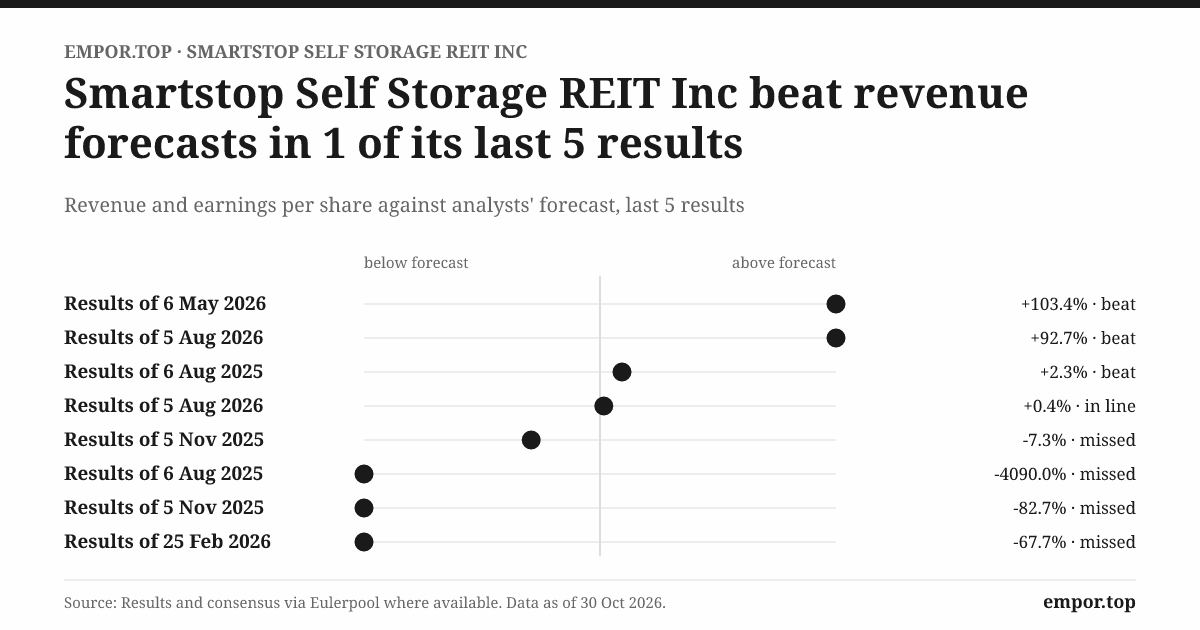
On August 6, 2026, SmartStop held its second-quarter call. The prepared remarks had a confident shape. Funds from operations as adjusted were $0.49 per share, up 17.6% from a year earlier.9 Same-store NOI was up 3.7%. Guidance went up: same-store revenue growth was narrowed to between 0.5% and 1.5%, expense guidance was cut sharply, and FFO-as-adjusted guidance moved to between $1.98 and $2.04 per share.9 Then the analysts started asking questions.
The man at the center of the call has been at the center of the company since the beginning. Schwartz, 59, has been an officer and director since SmartStop's formation in January 2013; he was CEO until 2019, executive chairman during the self-administration transition, and has been CEO again since April 2021.2
In February 2026, he also took the title of president after Wayne Johnson, the longtime chief investment officer, gave up that role; Johnson remained CIO and joined the board.2
Schwartz's style is that of a builder and a capital-raiser. His career has been defined by assembling storage portfolios through investor vehicles and then finding exits, as he did with the earlier SmartStop's sale to Extra Space in 2015.2 On calls, he speaks in big frames, about once-in-a-generation buying opportunities and long-term capitalization goals. Barry, younger and more numerical, tends to answer the analytical questions.
The compensation tells its own story. In 2025, Schwartz received about $4.85 million in total pay, of which about $3.8 million was equity awards.2 His actual cash bonus was $406,456, paid at 60% of target.2 That bonus outcome is worth noting: in the year of a successful IPO, the board's own scorecard paid him well below target. It suggests the incentive plan has some teeth.
His ownership is meaningful. On the proxy's basis, Schwartz beneficially owned about 5.0% of the company, mostly through about 2.75 million shares issuable from operating-partnership units and other securities, plus about 174,000 common shares.2 That gives him real exposure to the share price. It also means his economic interest runs mostly through the operating partnership, the same structure that came out of the sponsor era.
Shareholders responded without drama. At the June 2026 annual meeting, the advisory vote on executive pay passed with about 35.95 million votes for and about 1.40 million against, and Schwartz was re-elected with about 1.53 million votes withheld.16 That is a comfortable result, though shareholders who simply did not vote are not counted, and no shareholder holds a controlling stake. The largest disclosed holders were institutional managers such as T. Rowe Price, BlackRock and Prudential.2
The shareholder register itself was still settling. Vanguard reported owning about 6.5% of the stock in January 2026, then reported none in March after an internal realignment that split its holdings among business units, a change in how ownership is reported rather than necessarily a sale.2
For a company only eighteen months into public life, the base of long-term institutional owners is still forming, and that base will judge management on per-share results rather than on the asset growth that once satisfied non-traded REIT investors.
The governance structure is mixed. Schwartz is both chief executive and chairman, and a second executive, Johnson, sits on the board. Four of the six directors are independent, and Harold "Skip" Perry has served as lead independent director since April 2022.2 For a company with this many related-party relationships, the independent directors carry more than the usual weight.
What the analysts were really asking
The Q&A on that August call revealed the live tensions, beyond the margin question that had already drawn Barry's caveat. Golladay's question about acquisition pricing brought Schwartz's answer that brokered deals were still too expensive and the company would not chase volume.9
On the path to the top of guidance, corporate finance head David Corak said fourth-quarter revenue growth should beat the third quarter's, helped as the Asheville comparison lapsed and California rent-increase restrictions lifted, but that reaching the top of the range would require a normal off-season.9 Wells Fargo's Eric Luebchow pressed on the Asheville recovery and Public Storage's arrival in Canada.9
Compare that with the first-quarter call in May. Same-store revenue then was up about 1.5% and NOI about 2.0%, FFO as adjusted per share was up about 19.3%, and guidance was narrowed rather than raised.8
Corak told JPMorgan's Michael Mueller he expected move-in rents to reach roughly neutral by late summer.8 By August, move-in rents per square foot were still down about 4.4%, though web rates had turned positive in July.9 The forecast was roughly on track, not early.
So where does the 17.6% FFO-per-share growth come from? It is not mainly from same-store operations growing a few percent. It comes from a company that, compared with a year earlier, had more properties, much less expensive preferred capital, lower interest costs relative to its size, and some unusually helpful insurance renewals.
Those gains are real and they belong to shareholders. But most of them are one-time step-ups from the IPO recapitalization and the 2025 acquisitions, not a repeating engine. As those comparisons lapse, per-share growth will have to rely increasingly on the buildings themselves.
Management has earned credibility on some fronts. It completed a long-delayed listing, refinanced debt on time, kept expenses in check and raised guidance in a soft market. The auditor's 2025 opinion was clean, with no material weaknesses identified.4
One footnote to that clean opinion is worth knowing. Management's assessment of internal controls at the end of 2025 excluded Argus, acquired only three months earlier, as the rules permit for a recent acquisition.4 The 2026 assessment will be the first to cover the combined company, including the third-party platform, which is a natural checkpoint for the integration.
But modest same-store growth, a still-maturing acquisition record and continuing affiliate ties keep the question open. The proof will be per-share returns that persist after the IPO's one-time benefits are fully in the base.
Which brings the story to the question every investor ultimately has to answer: what is this company worth, and what does the price assume?
X. Bull and Bear: The Same Platform, Two Outcomes
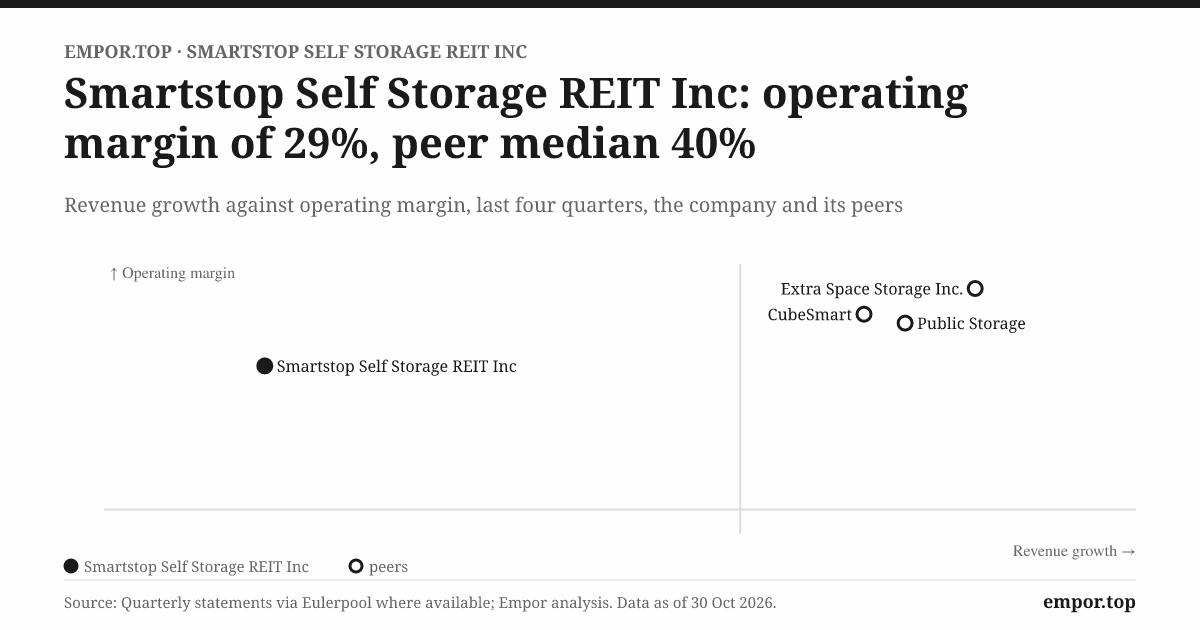
On October 30, 2026, SMA closed at $35.76, its 52-week high.6 The market valued the equity at about $2.0 billion. Headline multiples looked strange: about 69.9 times trailing earnings, 18.7 times EBITDA.6 Yet the same-store growth record was still a fraction of the headline growth implied by the enlarged portfolio. Revenue had compounded about 17.8% a year over five years, while same-store revenue grew about 1.6% in 2025.42 Which company is the market pricing?
The 69.9 times P/E is almost meaningless for a property REIT, for the reasons depreciation explained. A more useful lens is the company's own preferred measure. At $35.76, the shares traded at roughly 18 times the midpoint of management's 2026 FFO-as-adjusted guidance of $1.98 to $2.04 per share.9
That multiple is the number to compare against peers and against SmartStop's own history, using the same definitions and dates. Because SmartStop's adjusted FFO strips out more items than standard FFO, the comparison requires care.
Why the consolidator could win
The bull story begins with the market structure: fragmented storage and local clustering give a scaled operator room to improve costs, as Denver suggests.9
The bull case also rests on levers already visible in 2026: improved same-store margins, the third-party platform, bridge lending and the listed stock as acquisition currency.89
In Hamilton Helmer's language, the bull case leans on two powers. The first is scale economies at the local level: clustering lowers per-store costs. The second is a process power argument, the idea that SmartStop's revenue management and operating systems, refined across owned, managed and third-party facilities, give it a pricing and cost edge that small owners cannot replicate.
The managed platforms also hint at a counter-positioning advantage: a big listed REIT cannot easily offer management services to small competitors without seeming to compete with them, while SmartStop has built a business around exactly that.
Why the growth could stay bought
The bear story begins with the same-store record: NOI grew less than 1% in 2025, while the 2026 margin improvement relied partly on temporary insurance savings.29 Move-in rents for new customers also fell sharply in the first half of 2026.89 Consolidated growth has been bought, not earned.
The other Helmer powers are largely absent. Storage has little network effect, and switching costs and brand preference are weak. Scale economies favor the much larger Public Storage and Extra Space. On Porter's terms, buyer power is diffuse but real, the threat of new supply is local and cyclical, and rivalry is intense on the search screen where customers compare prices.
The governance and capital questions compound the operational ones. Related-party economics, maintenance capex and currency hedging remain disclosure and risk concerns, leverage is near the top of the rating agency's comfort range, and the $10 billion Deca ambition could tempt a management team whose career has been built on assembling portfolios into growth that outpaces returns.
A skeptical long-short investor or activist would ask a few pointed questions. Show the acquisition-level yields on the 2025 portfolio after a full year of ownership, and compare them with the cost of the debt that funded them. Show the FFO-per-share contribution from acquisitions separately from financing savings.
Show return on invested capital after stabilization. Disclose maintenance capex and full AFFO. Report recurring Managed REIT fees and their margin separately from transactional and one-time items. And explain why a company with this much Canadian-dollar debt carries no hedges.
None of those questions implies wrongdoing. Each one simply asks SmartStop to separate what is recurring from what is not, which is exactly what a public company with a complex structure needs to do to earn a premium multiple.
Weigh it all, and the bull case is plausible but conditional. Platform scale and selective acquisitions can compound FFO per share if same-store operations improve and leverage stays controlled. The bear case is that growth remains bought, fee economics remain difficult to separate, and financing and currency risk absorb the returns.
The history does not reject the bull case; it narrows it. SmartStop has proven it can raise capital, buy properties and refinance debt. It has not yet proven that its buildings grow faster or earn better margins than the industry's leaders.
Three numbers will settle the argument. The first is same-store NOI growth, which improved from about 0.6% for full-year 2025 to about 3.7% in the second quarter of 2026.92 The second is occupancy read together with rent per occupied square foot, where the latest results showed lower occupancy and higher rent.10
The third is FFO as adjusted per share, whose latest quarter's growth was 17.6%.9 If the first two keep improving while the third holds up after the IPO's one-time financing gains have lapsed, the bull case gains real evidence. If not, the story stays one of a company growing by acquisition in an industry where acquisition is the easy part.
XI. Lessons From a Business Built on Other People’s Storage
Go back to June 28, 2019. SmartStop brought management in-house.2 Six years later, it asked public investors to fund the next phase. Those two moments, the self-administration deal and the IPO, are the hinges on which this story turns. Each carries a lesson that reaches beyond self-storage.
The first lesson is that fragmentation is an invitation, not an advantage. A large field does not by itself give a consolidator an edge.
The edge, if it exists, must show up in operating results, not facility counts. For founders and investors in any roll-up, the size of the field is not the same as the strength of the player.
The second lesson is that a fee earned on someone else's property still has a governance cost.
The Tennessee sale to an affiliated REIT shows how easily value can move across a boundary only independent directors can police. For any company that earns fees from vehicles its own leaders run, the right question is not whether the fees are disclosed but whether they are measured net of the oversight they require.
The third lesson is that cash flow can pay the dividend and still leave growth dependent on outside capital. SmartStop's cash engine is only as strong as what remains after upkeep, interest and distributions, and the maintenance figure that would complete the picture is still unpublished.
The fourth lesson is about time. SmartStop's IPO reset produced a burst of per-share growth that reflected financing as much as operations. The lesson for investors in any newly listed company is that the year after an IPO is often the easiest comparison it will ever face. The years after that are the real report card.
Every one of these lessons ties back to a decision SmartStop made: to internalize its management, to list, to buy 17 properties at once, to lend to other owners. Each decision expanded what SmartStop could do. Whether each one expanded what SmartStop is worth per share is still being decided, one quarter at a time.
XII. The Next Lease-Up Is the Verdict
Tonight, SmartStop is at a high-water mark. Its shares sit at their highest level of the past year, its guidance was raised in August, its debt maturities for 2026 were refinanced, and its management team is talking about a $10 billion future.6914 The story is not over. It is between chapters.
The next scene is the next earnings call, when management will report third-quarter results and explain the trajectory into year-end. Three things will be on the table.
The first is whether same-store NOI growth persists without occupancy erosion or heavier concessions. Management had guided that fourth-quarter revenue growth would exceed the third quarter's, helped by easier comparisons in Asheville and in California.9 If that happens, and margins hold even as the insurance benefit fades, it will be the first real evidence that the platform is improving the buildings themselves.
The second is whether the acquired properties begin to show their returns. The 17-property portfolio has now had a full year of ownership behind it. If its NOI growth and yields hold up after debt costs and integration, the 2025 buying spree will look like a sound investment rather than a balance-sheet sprint.
The third is whether the bridge-lending book and the Deca Initiative produce disclosed, realized returns, not just targeted yields. A $100 million-plus pipeline at 10% to 14% is an ambition.8 Repaid loans, converted management contracts and acquisitions sourced from the program would be the evidence.
Behind all three sits the balance sheet. Net debt to EBITDA, interest coverage and the open Canadian-dollar exposure will determine how much room SmartStop has to keep growing without issuing new shares or straining its rating.514 If leverage drifts higher while same-store growth stays modest, the platform's ambitions will run into its capital.
Each outcome has a clear meaning. Steady same-store gains, accretive acquisitions and controlled leverage would vindicate the decision to list and the strategy behind it. Flat organic growth, slowing acquisitions and rising leverage would suggest the IPO bought a few years of growth rather than a durable engine. The public listing supplied capital and visibility. The operating results will show whether the platform deserved both.
XIII. Outro
Somewhere tonight, a tenant is carrying a box into a SmartStop unit. The rent on that unit can be reset next month. Somewhere else, the company's investment team is weighing whether to buy the next facility, lend to its owner or take over its management.
That is SmartStop's bet. Whether it can make each unit, fee and investment earn its cost remains the test.
References
-
SmartStop Self Storage REIT Announces Closing of Underwritten Public Offering and Full Exercise of Over-Allotment Option — SmartStop Self Storage REIT, Inc., 2025-04-08 ↩
-
Definitive Proxy Statement — SmartStop Self Storage REIT, Inc., 2026-04-22 ↩↩↩↩↩↩↩↩↩↩↩↩↩↩↩↩↩↩↩↩↩↩↩↩↩↩↩↩↩↩↩↩↩↩↩↩↩↩↩↩↩↩↩↩↩↩↩↩↩↩↩↩↩
-
KBRA Upgrades SmartStop OP, L.P. Issuer and Senior Note Ratings to BBB/Stable; Assigns BBB Rating to CAD $500 Million Senior Notes Due 2028 — Kroll Bond Rating Agency, 2025-07-14 ↩↩↩↩↩
-
Form 10-K for fiscal year 2025 — SmartStop Self Storage REIT, Inc., 2026-02-27 ↩↩↩↩↩↩↩↩↩↩↩↩↩↩↩↩↩↩↩↩↩↩↩↩↩↩↩↩↩↩
-
Form 10-Q for the quarter ended June 30, 2026 — SmartStop Self Storage REIT, Inc., 2026 ↩↩↩↩↩↩↩↩
-
Form S-11/A — SmartStop Self Storage REIT, Inc., 2025-03-28 ↩↩↩
-
SmartStop (SMA) Q1 2026 Earnings Call Transcript — The Motley Fool, 2026-05-07 ↩↩↩↩↩↩↩↩↩↩↩↩↩↩↩↩↩
-
SmartStop (SMA) Q2 2026 Earnings Call Transcript — The Motley Fool, 2026-08-13 ↩↩↩↩↩↩↩↩↩↩↩↩↩↩↩↩↩↩↩↩↩↩↩↩↩↩↩↩↩↩↩↩↩↩↩↩↩
-
SmartStop Self Storage REIT, Inc. Reports Second Quarter 2026 Results — SmartStop Self Storage REIT, Inc., 2026-08-05 ↩↩
-
Prospectus (Form 424B4), Size and Fragmentation — SmartStop Self Storage REIT, Inc., 2025 ↩↩
-
Investor Presentation — SmartStop Self Storage REIT, Inc., August 2025 ↩↩↩
-
KBRA Assigns BBB Rating to SmartStop OP, L.P.'s CAD $200 Million Senior Unsecured Note Issuance — Kroll Bond Rating Agency, 2026-08-19 ↩↩↩↩
-
SmartStop Receives BBB Credit Rating From Morningstar DBRS — Business Wire, 2025-05-28 ↩
-
2026 Annual Meeting Results, Form 8-K — SmartStop Self Storage REIT, Inc., 2026-06-25 ↩
 LinkedIn
 WhatsApp
 Reddit
 Hacker News
 Email
 Kindle
 RSS Feed
 Spotify
 Apple Podcasts
 Amazon Music
 Audible
 YouTube