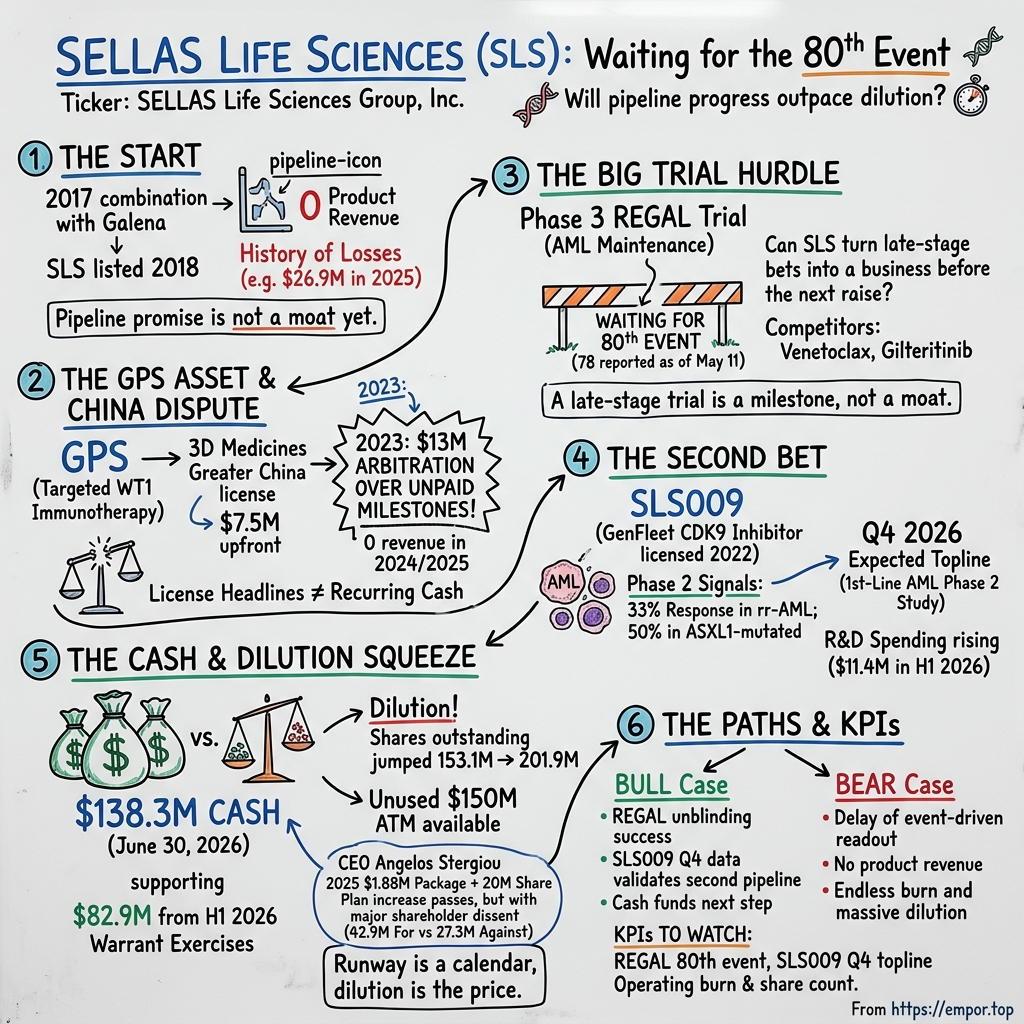
SELLAS Life Sciences Group, Inc.: Waiting for the 80th Event
I. The Trial That Has to Happen Before the Business Can
Somewhere in a database run by a contract research organization, a counter is waiting to move. It counts deaths. For years it has tracked patients with acute myeloid leukemia who enrolled in REGAL, the Phase 3 trial of SELLAS Life Sciences' lead drug, galinpepimut-S, or GPS.
When it reaches eighty, the trial's statisticians will lock the data, unblind the two arms and learn whether patients who got GPS lived longer than those who got the best treatment their doctors could otherwise offer.1 In the dry wording of the company's filings, everything SELLAS has built over almost a decade is waiting for that analysis.
On May 11, 2026, the count stood at seventy-eight.2 SELLAS has given no newer number. Its second-quarter update in August said only that the trial was "approaching" the threshold, and as of late October no announcement of the eightieth event had followed.3 So the company has spent more than five months two events short of the finish line.
For a dying patient, an event is a tragedy. For a trial with survival as its primary endpoint, it is the clock. The slower the deaths come, the longer everyone waits, and management has argued that the delay itself may be good news. Nobody outside the trial's independent committee can know yet whether that is true.
While the counter crept, something else moved very fast. At the end of 2025, SELLAS held about $71.8 million in cash. Six months later it held $138.3 million.1 No drug sale produced that jump, and no partner sent a check. It came almost entirely from investors exercising warrants, the options to buy new shares at fixed prices that SELLAS had handed out in earlier financings.
During the first half of 2026, holders exercised about 48.8 million of them and paid the company about $82.9 million.1 Those exercises created new shares, which is why the count of common shares rose from about 153 million at year-end to about 201.9 million at June 30.1 In six months, the company nearly doubled its cash and increased its share count by almost a third.
That collision of a slow clinical clock and a fast financing clock is the heart of the SELLAS story. Cash buys time, and time is what a trial with an event-driven endpoint needs. But each new share divides a future that remains hypothetical among more owners.
This episode asks whether SELLAS can turn two cancer drug candidates into a business before another financing round changes who owns that business. The first candidate is GPS, the immunotherapy now in its final Phase 3 test. The second is SLS009, a small-molecule drug that blocks a protein called CDK9, which SELLAS licensed in 2022 and is now testing in newly diagnosed AML patients.1
The market has already chosen a side in that argument, at least for now. At the close on October 23, 2026, SELLAS shares traded at $11.54, which valued the company at about $2.33 billion, against a 52-week low of $1.39.4
Subtract the June cash balance and investors were assigning more than $2 billion to a pipeline that has never sold a single dose. That price is not a forecast, and it can change in a day when the trial reads out. It is a measure of how much optimism is already embedded in the stock before the most important evidence arrives.
It is worth being clear about what SELLAS is and is not. The listed company that trades as SLS on Nasdaq came into being on December 29, 2017, when the privately held SELLAS combined with Galena Biopharma, a struggling public biotech, and took over its listing.5 Galena's earlier operating history belongs to a different business.
Treating Galena's past revenue and losses as SELLAS's growth record would be like judging a new tenant by the previous occupant's electricity bill. The listed-company story that matters runs from 2018, and through all of it SELLAS has been a clinical-stage drug developer with no product sales.6
The company says its cash should fund its current plans for at least twelve months from the date of its second-quarter financial statements.1 That sentence carries a lot of weight, and it should be read precisely. It is an accounting judgment about whether the company can keep operating, the kind every company makes when it reports.
It is not a profit forecast, it is not a promise that the next trial will be cheap, and it says nothing about what happens if REGAL succeeds and SELLAS must suddenly pay to file for approval, manufacture at commercial scale and launch a drug. The runway is a financing buffer. It buys the right to keep testing, not proof that the tests will pay.
That leaves three questions running through everything that follows. Will GPS clear its final hurdle? Can SLS009 become a second asset that matters, rather than a second cost center? And how much more dilution will the path require? There is a fourth question underneath them, and the trial cannot answer it alone. Even if one of these drugs works, can a company with thirteen full-time employees turn a statistical result into durable revenue?6 To see why that question is hard, it helps to go back to how SELLAS got onto the public market in the first place.
 Subscribe on LinkedIn
II. A Public Listing Built Around a Pipeline
Most companies arrive on the stock market with a party: a bell at the exchange, a priced offering, a roadshow full of projections. SELLAS arrived through a side door. On December 29, 2017, after Galena's stockholders approved the deal, the private SELLAS Life Sciences combined with Galena Biopharma. Galena carried out a 1-for-30 reverse stock split, issued its shares to SELLAS's owners, and renamed itself.5
Former SELLAS securityholders ended up with about 67.5% of the combined company on a fully diluted basis, and Galena's holders kept about 32.5%. The new company had only about 5.8 million shares outstanding, and it was expected to begin trading on the Nasdaq Capital Market as SLS on January 2, 2018.5
This kind of reverse merger was common in small-cap biotech at the time, and the logic is easy to see. Galena had a listing, a shareholder base and dwindling prospects. Private SELLAS had a drug candidate it believed in and needed access to public capital. Combining the two let SELLAS skip a conventional initial public offering, with its underwriters, pricing risk and demand for a crisp equity story.
The trade-off is that the company inherited no fresh cash cushion of the size an IPO would have raised, and it inherited a shareholder base that had not chosen SELLAS's science. The 2018 registration statement that followed was not an IPO prospectus; it registered an offering of securities by a company that was already trading.7
The man at the center of this was Angelos Stergiou, a physician-entrepreneur who founded private SELLAS in 2012 and has been chief executive and a director of the listed company since December 2017.8 His résumé runs through smaller drug developers, including Genesis Life Sciences, Accentia Biopharmaceuticals, Biovest International and PAION, rather than through the clinical or commercial machinery of a big pharmaceutical company.8
That background shows in how SELLAS has been run. It has been a lean company, built to license assets from others, outsource the work of trials and manufacturing, and keep the core team small. The company that combined with Galena named New York as its headquarters, appointed physician-scientist David Scheinberg of Memorial Sloan Kettering Cancer Center to its board, and named Jane Wasman chair.5
The drug Stergiou carried into the public market was GPS, licensed from Memorial Sloan Kettering. In late 2017 the company described a broad program: a completed Phase 2 study in mesothelioma, ongoing Phase 2 studies in multiple myeloma and ovarian cancer, a basket trial being prepared with Merck's Keytruda, and a Phase 3 trial in AML "planned for 2018, pending funding."5 Two words in that phrase deserve attention.
Pending funding. From its first day as a listed company, SELLAS's central clinical plan depended on raising money it did not yet have. Galena's own legacy assets, a breast-cancer peptide called nelipepimut-S and a controlled-release form of anagrelide, came along in the deal, but they never became the center of the company.5
What followed was a long narrowing. The Phase 3 AML trial did not start in 2018. When REGAL eventually got going, it enrolled patients in a specific and difficult setting: adults with AML who had relapsed, been treated again, reached a second complete remission and could not undergo a stem-cell transplant.6
Enrollment did not finish until March 2024, six years after the company first described the trial as planned.1 Meanwhile the broad basket of solid-tumor ambitions faded from the center of the story, and SELLAS became, in practical terms, an AML company with two shots: GPS as a maintenance therapy in remission, and later SLS009.
Along the way the company found one source of revenue, and only one. In December 2020 it licensed Greater China rights to GPS to a Chinese partner, 3D Medicines, which produced licensing revenue of about $1.9 million in 2020 and about $7.6 million in 2021, as SELLAS recognized an upfront fee and early payments over the period it spent transferring technology.910
A further $1.0 million milestone followed in 2022 when Chinese regulators accepted the partner's application to run clinical trials.6 After that, the revenue line went quiet. SELLAS reported no licensing revenue in 2023, 2024 or 2025, while product sales remained absent.116
The losses never stopped. SELLAS lost about $16.8 million in 2020, and the loss swelled to about $37.3 million in 2023 as REGAL enrolled and SELLAS began paying for SLS009's development.911 It then eased to about $26.9 million in 2025 as enrollment wound down.6 Plotted together, the revenue and loss lines tell a simple story. There is no growth curve here to extrapolate. The movements in the loss reflect which trials were enrolling, not whether customers wanted a product. Anyone hunting for a sales trend in SELLAS's history is reading the wrong instrument.
There is also no acquisition record to judge. SELLAS has not bought companies and so has no goodwill to write down or purchase price to second-guess. Its consequential capital decisions were licenses, the inbound deals with Memorial Sloan Kettering and later with GenFleet for SLS009, and the outbound deal with 3D Medicines, together with the decision to spend most of its money on clinical trials.6 That makes the capital-allocation question unusually clean. The company's record is a set of bets on molecules, and every dollar spent has gone into the time between pipeline promise and proof.
That gap is the through-line of the listed company's life. For almost nine years SELLAS has had to fund the waiting: waiting for money to start REGAL, waiting for patients to enroll, waiting for deaths to accrue, and waiting for a partner to pay. The single deal that was supposed to bring in non-dilutive cash, money that does not cost shareholders any ownership, is where that waiting turned into a fight.
III. The China License That Became a $13 Million Arbitration
On December 7, 2020, SELLAS and 3D Medicines announced their deal in statements from New York and Shanghai, and it read like the textbook route for a small Western biotech. 3D Medicines, or 思路迪医药 in Chinese, was a Chinese immuno-oncology company at the late clinical and early commercial stage.
It would take GPS and a next-generation version called GPS+ into Greater China, defined as mainland China, Hong Kong, Macau and Taiwan, and pay for all development and regulatory work there.12 SELLAS would keep every other market in the world, including the United States. The headline number was up to $202 million in license fees and milestones, before royalties. The cash on signing was $7.5 million.12
Stergiou called the upfront fee "non-dilutive" and said it strengthened the balance sheet.12 That was the point. A company like SELLAS has three ways to fund itself: sell shares, borrow, or rent out parts of its drug to someone else. Borrowing is close to impossible without revenue. Selling shares dilutes existing owners. Licensing territory is the third way, and in theory the best one, because a partner pays to carry part of the risk and the company keeps its shares.
The model works in stages. The partner pays an upfront fee to get the rights. It then pays milestones when the drug reaches particular points, such as a regulator accepting a trial application or a patient being enrolled in a pivotal study. If the drug is approved and sold, the partner pays royalties on sales.
For GPS in Greater China, those royalties were set in a tiered range from the high single digits to the low double digits, as a percentage of sales.12 The structure is elegant, but notice what it means. Almost all the value is conditional. The upfront fee is the only part that does not depend on the drug or the partner doing something later.
There is one more link in the chain that the headline numbers leave out. SELLAS does not own GPS outright; it licenses it from Memorial Sloan Kettering. Under that license, SELLAS owes the cancer center milestones of up to about $17.4 million per licensed product and tiered royalties in the mid-single digits on commercial sales, and it has paid minimum annual royalties since 2015.6
So SELLAS sits in the middle of a royalty sandwich. If GPS ever sells in China, 3D Medicines pays SELLAS a royalty in the high single digits to low double digits, and SELLAS in turn owes part of its own economics upstream to Memorial Sloan Kettering. The spread between what comes in and what goes out is real, but it is thinner than the partner's headline royalty rate suggests.
The early milestones did arrive. Including the upfront fee, SELLAS has received about $10.5 million in aggregate under the agreement.6 Those payments are the whole of the company's revenue history. The money was recognized as SELLAS transferred technology to its partner, and once that work was done there was nothing more to recognize until the next milestone came due.10
The next milestones were where the relationship broke. SELLAS expected two development milestone payments, totalling $13 million, once patients in China were enrolled in REGAL.6 The 2025 annual report still described about 20 to 25 patients from mainland China as expected through 3D Medicines.6 SELLAS believed the triggers had been met.
The money did not come. In December 2023 SELLAS commenced binding arbitration at the Hong Kong International Arbitration Centre, under New York law, arguing both that the milestones were owed and that 3D Medicines had failed to use commercially reasonable best efforts to develop GPS in its territory.136 3D Medicines rejected the claims.
For two and a half years the dispute sat in SELLAS's filings as a contingent claim. It was never booked as revenue and never shown as a receivable, and that accounting was correct. A receivable is money a customer has agreed it owes. A contested milestone is an argument.
SELLAS's balance sheets show prepaid expenses and other assets, not trade receivables, and they carry no ageing schedules or bad-debt reserves, because there were no ordinary sales to collect on.6 The $13 million existed only as a possibility, and anyone who counted it as cash in the bank was counting on winning a legal fight.
On July 24, 2026, that possibility closed. A sole arbitrator dismissed SELLAS's claims. The arbitrator also ordered SELLAS to bear about $0.7 million of 3D Medicines' legal fees and about $0.3 million of arbitrator and administrative costs, and SELLAS booked a charge of about $1.0 million in its second-quarter general and administrative expenses.141 3D Medicines said it would continue developing and commercializing GPS in Greater China under the license. On paper, $191.5 million of potential milestones remains, including the same $13 million that was in dispute.14
This is the place where the most popular version of the story and the record part ways. For years the China deal was often presented as a $202 million validation of GPS, with $191.5 million still to come. The record shows something narrower. The partnership produced about $10.5 million in its first two years, then nothing for more than four years.
SELLAS spent money and management attention on arbitration and lost.61 The milestones that remain have not disappeared, but every one of them depends on events SELLAS does not control: a partner it has just faced in arbitration choosing to invest, Chinese regulators accepting filings, and GPS itself producing positive data.
What does the episode say about the licensing model as a source of value for SELLAS? It narrows the claim rather than destroying it. A territorial license did bring in non-dilutive cash when SELLAS badly needed it, and it put a second set of resources behind GPS in a large market. But it also showed the model's weakness.
A small licensor has limited leverage over a partner's pace, and the legal remedy is slow, expensive and uncertain. The result is that the China deal cannot carry much of the investment case. The test of whether it ever will is concrete: a milestone payment that actually arrives in SELLAS's bank account, not a revised estimate of what might.
There is a further lesson in what the dispute did to SELLAS's options. If GPS succeeds in REGAL, the Greater China rights are already spoken for, and the partner holding them is one SELLAS has just litigated against. Any larger company considering a global deal for GPS would have to work around that. The license that was meant to make GPS more valuable has also made it slightly harder to sell whole.
So the pipeline has to carry the case. If a license can produce cash only when milestones are reached and paid, then the value of SELLAS rests on the drugs themselves, and in 2022 the company decided that one drug was not enough.
IV. The Second Bet: A $10 Million License for SLS009
On March 31, 2022, SELLAS signed for its second drug. The seller was GenFleet Therapeutics, a Shanghai company known in Chinese as 劲方医药, and the asset was GFH009, a small-molecule inhibitor of an enzyme called CDK9.15 At signing, the drug was in a Phase 1 trial in the United States and China.
It had reached the fourth of six planned dose levels, and the evidence of activity was thin: stable disease in three patients, and one AML patient whose bone-marrow blasts, the immature cancer cells, fell from 40% to 20%.15 SELLAS was buying a scientific idea with a few early clinical clues attached.
The economics were typical of in-licensing deals. SELLAS agreed to pay $10 million in upfront license and technology-transfer fees, with about $4.5 million due within a month and the remainder later.156 It took on up to $48 million in development and regulatory milestones across as many as three indications, up to $92 million more in sales milestones, and tiered royalties in the low-to-high single digits on net sales.15
In exchange, SELLAS gained worldwide rights outside Greater China, which GenFleet kept for itself. In plain terms, SELLAS paid a modest entry fee for a lottery ticket whose larger costs would come due only if the drug kept succeeding. The real expense was never the license. It was the trials SELLAS would have to fund to make the license worth anything.
To see why anyone would want a CDK9 inhibitor, it helps to picture how cancer cells stay alive. Many leukemia cells depend on a handful of short-lived survival proteins, such as one called MCL-1, which they must keep manufacturing constantly. CDK9 is part of the machinery that switches on the production of those proteins.
Block CDK9, the theory goes, and the cancer cell's supply of survival proteins runs dry within hours, like cutting the power to a factory that keeps no inventory. The challenge has always been selectivity. CDK9 belongs to a family of related enzymes, and earlier drugs that hit several of them at once caused heavy toxicity. SELLAS's pitch is that SLS009, now named tambiciclib, is unusually selective and potent.16
The first big test came in a Phase 2 trial in relapsed or refractory AML, in patients whose disease had come back or never responded, and who had already failed venetoclax-based therapy. SLS009 was added to venetoclax and azacitidine. In July 2025 SELLAS announced that the study had met all its pre-specified primary endpoints.17 Across 54 evaluable patients and all doses, the overall response rate was 33%.
At what SELLAS identified as the optimal dose, 30 milligrams twice a week, it rose to 40%. In patients with a mutation in a gene called ASXL1, which is generally associated with a poor prognosis, the response rate at that dose was 50%, or nine of eighteen.17 Median survival at the optimal dose was 8.8 months, which SELLAS compared to a historical benchmark of about 2.4 months. The company reported no dose-limiting toxicities.17
Those numbers are real signals, and in a population with few options they are worth taking seriously. They are also exactly the kind of evidence that most often disappoints later. The trial was single-arm and open-label: everyone got the drug, and the comparison was against historical figures rather than a control group treated at the same time.
Historical comparisons tend to flatter new drugs, because trial patients are selected, carefully monitored and often healthier than the patients in older datasets. The 50% figure comes from eighteen patients, chosen after the fact as a subgroup at the optimal dose. Many promising oncology signals of this size, in AML and elsewhere, have shrunk or vanished in randomized trials. None of this makes the result wrong. It makes it a reason to run the next trial, not proof of benefit.
The next trial is under way. After an end-of-Phase 2 meeting, SELLAS said the FDA recommended a study in newly diagnosed AML patients eligible for venetoclax and azacitidine, and the company designed an 80-patient randomized Phase 2 trial with two groups of patients.17 One group consists of newly diagnosed patients whose molecular profile predicts they are unlikely to benefit much from standard venetoclax and azacitidine.
The other consists of patients who start the standard regimen but show no response after two cycles.17 SELLAS said in July 2025 that enrollment would begin by the first quarter of 2026, and it did.1 As of August 10, 2026, 28 patients were enrolled, and management expects topline data in the fourth quarter of 2026.13 With roughly a third of the planned patients enrolled in August, a topline readout this year will necessarily be an early look, not the full randomized answer the trial is designed to provide.
There is a second, smaller track as well. In January 2026, IMPACT-AML, a European research network, agreed to sponsor a study of SLS009 in Europe.1 Investigator- and network-sponsored studies are a useful way for a small company to widen its evidence base without paying for every patient, and they tend to signal genuine academic interest in a drug. They also come with a trade-off that small developers know well: the sponsor, not SELLAS, controls the design and pace, so they add information rather than a timetable the company can promise to investors.
All this costs money, and the costs are now rising. Research and development expense rose to about $11.4 million in the first half of 2026, from about $7.1 million a year earlier. Management attributes the increase to manufacturing and regulatory preparation for GPS and to enrollment in the SLS009 study, and it expects R&D to keep rising.13 The SLS009 program is therefore no longer a cheap option sitting quietly in the background. It has become one of the main reasons the company's spending is going up.
Compare the scale of the scientific ambition with the scale of the company. SELLAS remained a 13-person operation as of March 1, 2026.6 It owns no factories. GenFleet supplies SLS009 through third-party manufacturers, and GPS's peptides and finished product are made by contract manufacturers.6
There is no sales force and no commercial organization in the filings. None of this is unusual for a biotech of this size. Outsourcing is how small drug developers survive, and it keeps fixed costs low. But it also means the technical progress so far has not been matched by any of the infrastructure needed to sell a drug.
The breadth of the original pitch is also worth remembering. When it signed the GenFleet deal in 2022, SELLAS described a Phase 2 AML combination trial, a Phase 1/2 basket trial in pediatric soft-tissue sarcomas that could earn a priority review voucher, and a list of possible solid tumors running from osteosarcoma to breast, lung, prostate and ovarian cancer.15 Four years later the clinical program is concentrated in AML. The rest survives mainly as designations and laboratory work.
The newest example came on September 25, 2026, when SELLAS presented data at a cancer conference showing that SLS009 killed pancreatic-cancer cells in patient-derived laboratory models, including a model resistant to the RAS inhibitor daraxonrasib, and that the combination killed more cells than either drug alone.18 The company says the results provide a rationale for testing in patients. It has announced no pancreatic-cancer trial.18 Organoids are miniature tumors grown in a dish, and they are useful for generating hypotheses. They are a long way from a market.
So the fair verdict on SLS009 is that it has moved from Phase 1 curiosity to a randomized Phase 2 study, which is real progress in four years, and its early response signals are encouraging in a hard population. It has not yet shown that those signals translate into longer or better lives in a controlled comparison, and the commercial case remains entirely prospective.
The harder test is whether a 13-person company can produce a reproducible, controlled benefit before the cost of advancing the program forces it to sell more equity. Before that test even begins, both drugs face a market in which doctors already have choices.
V. What an AML Drug Has to Beat
Picture a hematologist in a busy cancer center deciding what to do for a 70-year-old with newly diagnosed acute myeloid leukemia. AML is a fast cancer of the blood and bone marrow, in which immature white cells crowd out the healthy ones. For a patient too old or frail for intensive chemotherapy, the doctor's first move today is usually a combination of venetoclax, the BCL-2 inhibitor sold as Venclexta by AbbVie and Genentech, with a hypomethylating drug such as azacitidine.
If the leukemia carries a mutation in a gene called FLT3 and comes back, there are targeted pills such as gilteritinib. For other mutations there are other targeted options, and for patients in a first remission there is an oral form of azacitidine approved as maintenance.6 The established players include AbbVie and Genentech, Pfizer, Daiichi Sankyo, Rigel, Syndax and Bristol Myers Squibb.6
That is the world GPS and SLS009 have to enter. It is not an empty field waiting for any new drug. It is a crowded clinic where every new therapy must answer the same question: why would a doctor change what they already do?
Approval is only the first hurdle. A drug becomes a business only after it clears several more. It has to show a benefit large enough to change practice. It has to be manufactured reliably at scale. It has to satisfy regulators that the manufacturing and the data meet their standards.
Then insurers have to agree to pay for it at a price that covers the cost of all that, and somebody has to reach the doctors who will prescribe it. Large pharmaceutical companies have built machines for each of those steps. SELLAS, with its 13 employees and outsourced manufacturing, has built none of them yet.6 It cannot claim any market share today, and any market-share comparison before launch would be invention.
The cleanest way to understand GPS's proposed edge is through the patients REGAL enrols: adults in a second remission who cannot have a stem-cell transplant.6 For them, the remission is fragile. The leukemia usually returns, and when it does, survival is short.
A doctor on the REGAL steering committee, Yair Levy of Texas Oncology Baylor University Medical Center, said in December 2025 that such patients usually receive hypomethylating agents and/or venetoclax, with an expected median survival of about eight months.19 SELLAS says no drug has been approved specifically for maintenance in this second-remission setting.16
GPS is designed to train the patient's immune system to keep the leukemia in check. It is a mix of four short protein fragments, or peptides, drawn from a protein called WT1 that is found on many cancer cells, including most AML cells.6 Two of the peptides copy WT1 exactly.
The other two have a single deliberate change, a design trick the company calls the heteroclitic principle, which is meant to make the immune system respond more strongly, much as a slightly exaggerated caricature can be easier to recognize than a photograph.6 The peptides are injected under the skin with an immune-boosting additive, after a dose of a growth factor that helps prime immune cells.6 If it works, the immune system hunts down the few leukemia cells that survive the remission before they regrow.
The idea is elegant, and the earlier data were striking. In a Phase 2 study in patients in second remission, GPS-treated patients had a median survival of 21 months, against 5.4 months for patients on standard care, and 64% showed an immune response specific to GPS.16 Those Phase 2 numbers are the foundation of the bull case. The catch is the same one that hangs over SLS009's early results.
Small, early studies with historical or non-randomized comparisons often overstate benefit, and cancer vaccines in particular have a long history of promising early signals that faded in Phase 3. REGAL is the first test of GPS that compares it head-to-head, in a randomized trial, against investigator's choice of best available treatment.6 That is why it matters so much.
GPS's supporters also make a tolerability argument, and it deserves a fair hearing because it bears directly on whether doctors would use the drug. In a January 2025 webinar quoted by the company, Dr. Levy argued that up to 60% of patients receiving standard therapies suffer severe side effects, usually dangerously low blood counts that can mean repeated hospital stays, and that GPS had been very well tolerated in earlier studies.16
If that holds up in REGAL, it matters commercially: a maintenance therapy is taken for months by patients who feel relatively well, and a gentle drug is far easier to keep them on. But the claim comes from an investigator speaking in a company-hosted setting, and the safety comparison that counts will be the one REGAL reports against its control arm.
For SLS009, the proposed edge is different. It is a targeted drug meant to make the standard venetoclax-azacitidine regimen work for patients for whom it otherwise would not. SELLAS lists rival CDK9 programs, including AstraZeneca's AZD-4573 and Vincerx's enitociclib, along with earlier programs from other companies, and argues that SLS009's selectivity, and the lower toxicity it believes follows from it, set the drug apart.6 That argument will be settled by the randomized first-line study, not by the mechanism.
Run the competitive forces once and the picture becomes sharper. Patients and doctors have alternatives at every stage of the disease, so the threat of substitution is high. The buyers who pay for drugs, insurers and national health systems, have grown increasingly demanding about evidence and cost-effectiveness, especially for expensive cancer drugs that add months rather than years. The suppliers SELLAS depends on, contract research organizations, trial sites and contract manufacturers such as the Polypeptide Group, provide capabilities SELLAS does not own, and while that keeps costs flexible, it also means SELLAS has little control over capacity and timing.6
Rivalry for capital, talent and partnering terms is intense, because every small biotech with an AML asset is pitching the same handful of large companies. The one force that works in SELLAS's favor is the barrier to entry itself. A randomized Phase 3 survival trial in a narrow population takes years and many millions of dollars, and few rivals are running one in this exact setting. SELLAS says it does not believe GPS has direct competition in AML maintenance after second remission.6
Regulatory protections add a layer. GPS holds orphan drug and fast-track designations from the FDA in AML, and SLS009 has similar designations.6 Orphan drug designation can bring a period of market exclusivity after approval, while fast-track designation can speed development and review.
The patent estate around GPS is layered: its earliest composition-of-matter patent in the United States expires in 2026, while others run into the 2030s, and a patent on a next-generation version co-owned with Memorial Sloan Kettering runs to 2040. SLS009's core composition patent runs to 2038.6 Those dates matter, because a drug approved in 2027 or 2028 would spend part of its life with some patents already expired, relying on the later ones and on regulatory exclusivity.
What is missing from this picture is the evidence that usually defines a moat. There are no switching costs, because no doctor has yet prescribed either drug outside a trial. There is no pricing power, because there is no price. There is no customer retention, no brand among prescribers, and no manufacturing cost advantage, since both drugs are made by contractors. The edge SELLAS claims is entirely scientific: a novel mechanism, a narrowly defined patient population, and early data. That is a legitimate starting point for a drug developer. It is not yet a competitive advantage in any commercial sense.
That distinction is the one worth carrying forward. A mechanism can be novel without becoming a product people use. The clinical trials will decide whether GPS and SLS009 have something doctors want. Until then, the more immediate question is whether SELLAS has the money to find out, and what its shareholders gave up to get it.
VI. The Cash Bought Time—and the Warrants Bought Shares
For a pre-revenue biotech, the stock price and the bank balance are not separate stories. They are the same story told twice. When SELLAS's shares were cheap, raising money hurt. When the shares rose, investors holding warrants found it profitable to exercise them, and the cash came in on its own. That is exactly what happened in the first half of 2026.
The pattern started a year earlier. In January 2025, SELLAS raised about $23.1 million, net of costs, in a registered direct offering, a quick sale of new shares and warrants to a handful of investors.6 In September and October 2025 it ran two warrant inducements. In each, the company persuaded existing warrant holders to exercise early, typically by lowering the price and offering new replacement warrants as a sweetener. The September deal brought in about $22.0 million and the October deal about $29.1 million, both net.6 At year-end 2025 SELLAS held about $71.8 million in cash.6
Then the stock ran. Shares that had touched a low of $1.39 within the past year climbed far above the exercise prices of the warrants still outstanding.4 In the first half of 2026, holders exercised about 48.8 million warrants at a weighted average price of about $1.70 each, handing SELLAS about $82.9 million.1 Cash reached $138.3 million at June 30.1 For the warrant holders, the arithmetic was very good: they bought shares at about $1.70 that the market was valuing at several times that.
For SELLAS, the money arrived without a new offering, a discount or a banker's fee. For existing shareholders, the bill was paid in ownership. The pace was visible quarter by quarter. By March 31, SELLAS already held about $107.1 million and had about 181.3 million shares outstanding, and it had sold nothing under its new at-the-market facility.2 The second quarter simply continued the same pattern. The share count rose from about 153 million to about 201.9 million in six months, an increase of nearly a third.1
Is that a good trade? It depends entirely on what the money buys. On a per-share basis, the company had about 47 cents of cash per share at year-end and about 68 cents at June 30, so cash per share went up even as the share count rose. That is the case for the warrant wave.
The case against it is that each of those new shares will share in whatever GPS and SLS009 eventually become, and the exercise prices were set back when the market thought those assets were worth much less. The warrant overhang is now much smaller: about 9.7 million warrants remained outstanding at June 30, mostly with exercise prices between $1.41 and $2.00, which at most could bring in roughly $16 million more.1 The easy money from that source is largely spent.
Now compare the cash with the burn. In 2025, SELLAS lost about $26.9 million and used about $28.4 million of cash in operations.6 In the first half of 2026 it lost about $18.0 million and used about $16.4 million.1 The small gap between loss and cash used is ordinary bookkeeping, not hidden cash generation. Stock-based compensation of about $1.8 million and a non-cash lease charge were added back, because they appear as expenses but do not use cash.
Prepaid expenses absorbed cash, as the company paid ahead for manufacturing and trial work, and higher accrued liabilities, including the arbitration award still unpaid at June 30, partly offset that.1 There is no inventory and no capitalized research to complicate the picture, because SELLAS expenses R&D as it goes.6 That makes operating cash use an unusually honest measure of the company's cost base: it is, almost exactly, what it costs to run the trials and the public company.
The cost base is rising, and it follows the trials. R&D fell in 2025 to about $16.0 million from $19.1 million, mainly because REGAL and an SLS009 study had finished enrolling.6 It turned up again in 2026 as SELLAS paid for GPS manufacturing and regulatory preparation, and for enrollment in the first-line SLS009 study.
General and administrative expense rose too, to about $8.5 million in the first half from $5.9 million, including the arbitration charge.3 None of this tracks revenue, because there is none. Interest income on the cash pile, about $1.9 million in the first half, is the only income line of note, and it is a by-product of the warrant wave, not a business.3
The balance sheet itself is simple. SELLAS reports no borrowings, so there are no covenants to breach and no debt to refinance.1 Its only fixed obligations of note are office leases, about $1.0 million at the end of 2025 and about $0.7 million by June 2026, running through September 2027.61
The company also pays foreign vendors and partners in their own currencies without hedging, and says those losses have not been significant.6 No rating agency rates SELLAS, and none needs to: a company with no debt does not need a credit rating. The real financial question is not solvency but dependence on equity.
That dependence is formalized. In March 2026 SELLAS put in place an at-the-market program with TD Cowen, allowing it to sell up to $150 million of new shares directly into the market over time.20 As of the second-quarter filing, it had sold none.1
An ATM is a convenient tool: it lets a company raise money in small amounts whenever the price looks attractive, without a big discounted offering. It is also a standing reminder that the company expects to need more equity. Selling the full $150 million at October's prices would add roughly 13 million shares; selling it after a disappointing readout, at a much lower price, would add many more.
Put the numbers together and the runway looks comfortable on today's plans. At the first-half burn rate of about $33 million a year, $138 million is about four years of money. That is why management can say it has at least twelve months of runway with plenty of room to spare.1 But the burn is rising, and two kinds of success would raise it sharply.
A positive REGAL result would bring the cost of a biologics license application, commercial-scale manufacturing and some form of launch or partnership. A strong SLS009 readout would bring the cost of a larger, registrational trial. In biotech, success often consumes more cash than failure.
That is the capital-allocation test SELLAS now faces. The warrant wave has bought time, and plenty of it. The question is whether the next tranche of capital buys decisive clinical evidence, or mainly buys more time to wait. And the people deciding how to spend that money, and how much of the new share capital goes to themselves, answer to a shareholder base that has started to push back.
VII. The CEO's Incentives Meet the Shareholder Vote
On June 16, 2026, SELLAS's shareholders voted on a proposal that looked routine on the ballot and was anything but. The company asked to add 20 million shares to its equity incentive plan, the pool from which it grants stock options and restricted stock to employees, directors and executives.81 The context made the request large.
As of April 2026, only 7,991 shares were left available in the plan, the existing overhang of granted awards was about 2.6% of shares, and the company had about 184.5 million shares outstanding.8 Twenty million new shares would add a reserve worth about a tenth of the company to a pool that had almost run dry.
The company's own burn-rate disclosure puts that in perspective. Its adjusted gross burn rate, the share of the company granted as equity awards each year, was about 1.9% in 2025, 1.8% in 2024 and 3.2% in 2023.8 At a pace near 2% of a share base of roughly 200 million, the new reserve would last several years. Shareholders were not voting on one year's grants. They were pre-approving a multi-year supply of dilution before the trial that will determine what the shares are worth.
Shareholders approved it, with about 42.9 million votes for and 27.3 million against.21 That is close to two votes in five against, a remarkable level of dissent for a management proposal at a small company.
The CEO's own pay was the subtext. Angelos Stergiou received about $1.88 million in total compensation for 2025, up from about $1.19 million in 2024.8 Salary was $676,000. The rest came from a non-equity incentive payment of $390,390 and stock and option awards valued at about $805,000, against about $195,000 of such awards the year before.8
In January 2026, the board approved a further grant of 1,065,000 restricted stock units for Stergiou, conditional on shareholders approving the expanded plan, with one-quarter vesting each December starting in 2026.8 At October's share price, that grant alone would be worth more than $12 million, a reminder that the value of equity awards at a biotech swings with the stock far more than with any operating result.4 The advisory say-on-pay vote passed with about 52.9 million for and 15.9 million against.21
Pay rising while losses continue is not, by itself, a scandal. Small biotech boards argue, with some justice, that they must compete for scarce executive talent and that equity aligns managers with shareholders. The real issue is proportion and timing.
The CEO's 2025 incentive pay was earned in a year when the company's headline promise, the eightieth REGAL event by year-end, was missed. The equity plan increase was approved before the trial readout. Shareholders who voted no were saying something specific: pay us in results, not in progress reports.
The board is structured the way governance codes recommend. Five of its six directors are independent, the chair, John Varian, is independent and has held the role since June 2024, and the CEO is the only executive director.8 The chief financial officer, John Burns, a certified public accountant, joined in 2013 and has been CFO since February 2023, which gives the finance function continuity.8
SELLAS reported no material related-person transactions in its 2026 proxy; the licenses with 3D Medicines and GenFleet are commercial agreements with independent companies, not transfers to insiders.8 The company has no controlling shareholder. Stergiou owned or could acquire through options about 1.1 million shares as of April 2026, less than 1% of the company.8 As the share base expands through warrants and awards, any fixed holding shrinks as a percentage even when its owner sells nothing.
The audit picture is clean but bounded. SELLAS's auditor gave an unqualified opinion on the 2025 financial statements and reported no critical audit matters, and management concluded that internal controls were effective; as a smaller reporting company, SELLAS was not required to have the auditor attest to those controls.6 That is a statement about the accuracy of the 2025 accounts. It says nothing about whether the company's trial forecasts are reliable.
That is where management's record deserves the closest look, because for a clinical-stage company, credibility is measured in dates. In January 2025, after REGAL passed its interim analysis at sixty events, SELLAS said it anticipated that eighty events would be reached "this year."16 In the months that followed, the company repeated a year-end 2025 expectation.
On December 29, 2025, it acknowledged the event had not occurred, disclosed a one-time count of seventy-two, and said it would announce the eightieth event when it happened.19 Stergiou added that "every passing month may increase the probability of a successful study."19 By May 2026 the count was seventy-eight.2 By late October 2026 there had been no further announcement.
The defense of management is real. Event-driven trials are hard to forecast, because the timing depends on how long patients live, and if GPS works, deaths would come more slowly than planned. The company's own steering-committee investigator said survival "appears longer than expected."19 SELLAS did not fudge the number; it disclosed the shortfall. The critique is that the forecast was confident and specific, and it was wrong by close to a year and counting.
That matters because timing guidance feeds directly into how investors price an event-driven stock. In October 2026 a plaintiffs' law firm announced it was investigating whether SELLAS had misled investors about the timing of the GPS data, following unconfirmed reports that the threshold had been reached, and the stock fell sharply on the news.22 An investigation is not a lawsuit, and SELLAS has not confirmed the eightieth event. But the episode shows the cost of guidance that runs ahead of the data.
There is a counterexample worth noting in the same record. On SLS009, management said in July 2025 that first-line enrollment would begin by the first quarter of 2026, and it did.171 The company's operational promises have generally been kept. Its timing promises about events it does not control have not. A careful investor should weight those two kinds of statement very differently, and the next test is concrete: SELLAS has said SLS009 topline data will arrive in the fourth quarter of 2026.3 With the quarter already under way, that promise will be kept or broken within weeks.
Governance at SELLAS is therefore working in the narrow sense. The board is independent, the votes were held, and the dissent was recorded. Whether it constrains anything will show in the next round of grants and the next round of votes. Which brings the story to the question every holder of the stock must answer for themselves: what, exactly, is a $2 billion valuation paying for?
VIII. Analysis & Bear vs. Bull Case
Stand in the shoes of two investors looking at the same company on the same October morning. One sees a funded, late-stage biotech with two shots on goal, a randomized Phase 3 trial nearing its final analysis, encouraging response data on a second drug, and $138 million in the bank.
The other sees a company with no product revenue after nearly nine years as a public company, a key trial that has missed its own timeline, a lost arbitration, a share count that rose by a third in six months, and a market value of about $2.3 billion that already assumes a great deal of success.41 Both are describing real facts. The task is to weigh them.
Start with the bull case, and make it as strong as the evidence allows. REGAL is a properly designed test: randomized, with overall survival as its endpoint, which is the hardest endpoint to argue with in cancer.6 It passed its interim analysis at sixty deaths in January 2025, when an independent committee that could see the unblinded data found that GPS exceeded the predetermined futility criteria and raised no safety concerns.16 The pooled survival in the trial appears to be running longer than the company planned for.
GPS's Phase 2 data, 21 months of median survival against 5.4 months on standard care, suggest the effect could be large.16 If REGAL confirms even part of that, GPS would be the first drug approved for maintenance in second remission, a narrow setting with no direct competition and orphan protections.6 SLS009 adds a second, independent chance of success, and the warrant wave means SELLAS can reach both readouts without immediately selling shares through its ATM.
Now stress-test it. Passing a futility analysis means the drug was not clearly failing; it does not mean the drug was clearly winning. Had GPS been dramatically better at sixty events, the trial might have been stopped early for efficacy, and it was not. The longer-than-expected pooled survival is a blend of both arms; it could reflect GPS working, or a healthier-than-expected patient population, or better standard care than the trial planners assumed.
REGAL is open-label, so patients and doctors know who received GPS, which can subtly shape care, although survival is the endpoint least vulnerable to that bias. And the Phase 2 study that produced the 21-month figure was small and not randomized in the way REGAL is.16 The honest reading is that the history neither confirms nor rejects GPS. It leaves the claim intact but unproven, and only the final analysis can settle it, followed by the FDA's response to any filing.
The bear case starts where the bull case ends. Neither drug has produced revenue. GPS still needs its final analysis, then a regulatory filing, then a review that will examine not only the data but the manufacturing, and then a path to patients that SELLAS has not yet built. SLS009's encouraging results come from single-arm data and need confirmation. The China license that once promised nearly $200 million in milestones has produced nothing since 2022 and ended in a lost arbitration.14 Every quarter of waiting costs more cash than the last.
A skeptical long-short investor or activist would press hardest on three points. First, the valuation: at about $2.3 billion, the market is pricing in a high probability of REGAL succeeding and of GPS becoming a significant commercial product, in a narrow population, with a 13-person company and no commercial partner outside China.
A binary readout priced this way has a lopsided downside if it fails. Second, the dilution machinery: a newly enlarged equity plan, a $150 million ATM and a history of warrant inducements mean that the share count is a variable, not a constant. Third, communication: a missed event forecast, followed by a law-firm investigation, suggests the company should say less about timing and more about process.
Then there is the moat, argued in full once. Hamilton Helmer's seven powers framework asks what lets a business earn returns above its cost of capital for a long time. Scale economies, network economies and switching costs do not apply to a company that has never sold a product. Brand does not exist among prescribers yet. Counter-positioning, a business model incumbents cannot copy without hurting themselves, does not fit either; large drug companies are not prevented from developing AML vaccines by their own business models.
Process power, an operating advantage that rivals cannot easily replicate, is the opposite of SELLAS's model, which outsources nearly everything. The only power SELLAS can plausibly claim is the cornered resource: exclusive rights to two specific molecules, protected by patents and, if approved, regulatory exclusivity.6 That power is real but conditional. A cornered resource is worth only what the resource turns out to be worth, and the value of these molecules has not been established.
Porter's forces point the same way: SELLAS's only potential protection is the time and money required to run a Phase 3 survival study.
So three numbers matter more than all the others. The first is the status of REGAL: the event count, last reported at seventy-eight as of May 11, 2026, and the final analysis that follows the eightieth.2 The second is the progress of the first-line SLS009 study: 28 of a planned 80 patients enrolled as of August 10, 2026, with topline data promised for the fourth quarter.1
The third is the financing pair of first-half operating cash use, which was about $16.4 million and rising, alongside the share count, which stood at about 201.9 million at June 30.1 Every other metric is downstream of these three.
Conventional valuation tools do not help much. With no revenue and continuing losses, price-to-earnings and enterprise-value-to-sales ratios are meaningless. The more useful exercise is to ask what the price assumes. The market value is about $2.3 billion; subtract roughly $138 million of cash and the remainder, a bit over $2 billion, is the market's estimate of the probability-weighted value of GPS, SLS009 and whatever China milestones survive.41 That is a substantial bet for a drug whose single randomized test has not read out. The share price also swung from $1.39 to $15.88 within a year, which shows how sharply that probability estimate moves with every headline.4
The measured conclusion is that SELLAS has a credible path to winning: positive trial evidence, followed by approval or a partnership with a company that has the commercial machinery SELLAS lacks. That path is real and specific. What SELLAS does not yet have is operating or commercial proof that it holds an enduring edge. Its strengths are scientific hypotheses and funding; its weaknesses are the absence of revenue and the dependence on equity. The readouts will decide which of those matters more. In the meantime, the story already offers several lessons that do not depend on how it ends.
IX. Business & Investing Lessons
The single most revealing number in SELLAS's 2026 accounts is not a response rate or a survival figure. It is the cash from warrant exercises in the first half of the year.1 Not a license payment. Not a drug sale.
The company got richer because its own shares went up, and investors who had been handed the right to buy shares cheaply chose to use it. That fact captures the strange physics of a clinical-stage company, in which scientific hope, funding and commercial proof all move on different clocks. Four lessons follow, and each belongs to SELLAS more than to any other company.
The first lesson is that a late-stage trial is a milestone, not a moat. REGAL, the company's defining asset, has passed an independent interim review.16 Yet its final event is still pending, well past management's first estimate.216
Being in Phase 3 gave SELLAS credibility, access to capital and a market value in the billions. It did not give it a single customer. For founders, the lesson is that a pivotal trial is a question you have paid to ask, not an answer you own. For investors, the warning is sharper. Phase 3 is where many drugs that looked inevitable in Phase 2 fail, and the price of a stock before the readout reflects the market's hope, not the trial's verdict.
The second lesson is that a license headline is not recurring revenue. The 3D Medicines deal produced about $10.5 million in total, and arbitration over the next $13 million ended in a loss for SELLAS.12614
The remaining milestones still exist on paper, and they still depend on a partner that SELLAS has just faced across a hearing room. "Up to" is the most expensive phrase in biotech dealmaking. The wider point for anyone reading a licensing announcement is to count the upfront cash, discount everything conditional, and ask what the licensor can actually do if the partner slows down. SELLAS's answer turned out to be: not much, slowly, and at its own cost.
The third lesson is that runway is a calendar, and dilution is the price of the calendar. The warrant exercises extended SELLAS's runway while expanding its share base.1 Both facts are true at once, and neither cancels the other. The cash bought years of operating time at the current burn. The shares spread the eventual value of GPS and SLS009 across more owners, at exercise prices set when the market thought those assets were worth far less.
Its expanded equity plan and ATM mean the calendar can be extended again, at a price.2120 The lesson for founders is that cheap warrants issued in hard times are a mortgage on success: they get repaid when things go well, which is exactly when you would least like to sell your company's future at old prices. For investors, the useful measure is never cash alone. It is cash per share, and what each share will own when the trial reads out.
The fourth lesson is that a promising response rate is the start of the argument, not the end of it. SLS009's response signal in ASXL1-mutated patients is the kind of figure that becomes a slide headline.17 It came from a small subgroup in a single-arm trial, compared against history.
The company's response was the right one: run a randomized study in newly diagnosed patients, the setting the company says the FDA recommended.17 But the gap between a striking subgroup and a controlled, durable benefit is where much of oncology's capital has been lost. The broader principle, which applies far beyond SELLAS, is that the first good number buys the right to run the experiment that can disprove it.
Taken together, these lessons say something about how to look at any company like SELLAS. Scientific optionality, funding capacity and commercial proof are three different things. SELLAS has the first in its two drugs and the second in its bank account. It does not yet have the third, and no amount of the first two can substitute for it. The next few months will show whether the first two can be converted into the third.
X. Epilogue
Tonight, in late October 2026, SELLAS is a company suspended between two announcements. The first is the one it has been promising since early 2025: that REGAL has recorded its eightieth event. That will trigger the final analysis and result announcement, a process that takes time and is no formality.3 The second announcement is SLS009's topline data from the first-line study, which management has placed in the fourth quarter of 2026, a window that is already open and will close in about ten weeks.3
Consider what each outcome would mean. If REGAL shows a clear, statistically significant survival benefit, SELLAS will move from waiting for a trial to preparing a biologics license application, and the company has already been spending on manufacturing and regulatory work in anticipation.1 A positive result would not be approval.
The FDA would need to accept the filing, review the data and inspect the manufacturing, and SELLAS would need to decide whether to sell GPS itself or find a larger partner with a sales force. In that world, today's $138 million could disappear faster than it arrived, and the ATM would likely be used. If REGAL fails, most of the current market value, which sits far above the cash, would be at risk, and SLS009 would suddenly have to carry the whole company on the strength of a Phase 2 study.
The SLS009 readout has its own fork. A strong early signal in newly diagnosed patients would give the company a second asset with a credible next step, probably a larger randomized trial and perhaps a partner. A weak or ambiguous one would push SLS009 back toward the status of an expensive option.
Either way, the readout will be an early look.1 Whether the data arrive in the promised window is itself a test of the company's word, set against the long wait for REGAL's eightieth event.
The China thread has changed shape. The arbitration that once defined the 3D Medicines relationship is over, and SELLAS lost.14 What remains is the license and its $191.5 million of possible milestones, contingent on 3D Medicines advancing GPS and paying. If REGAL succeeds, that partner's behaviour in China will become more important, and more awkward, than it has been since 2020.
Underneath every one of these events runs the financing ledger. Each quarter will show operating cash use, any ATM sales, any remaining warrant exercises, new equity awards, including the RSUs for the CEO that begin vesting in December, and the resulting share count.18 A rising burn is not a bad sign in itself if it is buying decisive evidence. A rising share count without decisive evidence would be.
The open question, then, is not whether SELLAS has capital today. It plainly does. It is what the next tranche of capital can prove, and whether the proof arrives before the company has to raise more equity.
XI. Outro
Go back to that counter in the trial database. Seventy-eight, the last time anyone outside the trial was told, in May 2026.2 Two more deaths stand between SELLAS and the final analysis it has spent nearly nine years as a public company preparing for. In the meantime, the company remains pre-revenue, with a cash-funded runway and a larger share base.61 Its shareholders have financed the wait, and the market has priced the outcome generously before seeing it.
That is what makes SELLAS unlike most companies in this series. Its business has not started yet. It has candidates, it has the time to test them, and it has the money to keep testing for a while. What it does not have is proof. The business begins only if the evidence earns GPS or SLS009 a path to patients, and the trial is still two deaths from its final analysis trigger.
References
-
Form 10-Q for the quarter ended June 30, 2026 — SELLAS Life Sciences Group, SEC, 2026-08-11 ↩↩↩↩↩↩↩↩↩↩↩↩↩↩↩↩↩↩↩↩↩↩↩↩↩↩↩↩↩↩↩↩↩↩↩
-
SELLAS Life Sciences Reports First Quarter 2026 Financial Results and Provides Corporate Update — SELLAS, 2026-05-12 ↩↩↩↩↩↩
-
SELLAS Life Sciences Reports Second Quarter 2026 Financial Results and Provides Corporate Update — SELLAS, 2026-08-11 ↩↩↩↩↩↩↩↩
-
SELLAS Life Sciences Group (SLS) Stock Price and Overview — Stock Analysis, 2026-10-24 ↩↩↩↩↩↩
-
SELLAS Life Sciences Group Successfully Completes Business Combination with Galena Biopharma — SELLAS, 2017-12-29 ↩↩↩↩↩↩
-
Form 10-K for the year ended December 31, 2025 — SELLAS Life Sciences Group, SEC, 2026-03-19 ↩↩↩↩↩↩↩↩↩↩↩↩↩↩↩↩↩↩↩↩↩↩↩↩↩↩↩↩↩↩↩↩↩↩↩↩↩↩↩↩↩↩↩↩
-
Form S-1 Registration Statement — SELLAS Life Sciences Group, SEC, 2018-05-23 ↩
-
2026 Proxy Statement — SELLAS Life Sciences Group, SEC, 2026-04-30 ↩↩↩↩↩↩↩↩↩↩↩↩↩
-
SELLAS Life Sciences Reports Full Year 2020 Financial Results and Provides Business Update — SELLAS, 2021-03-23 ↩↩
-
Form 10-K for the year ended December 31, 2021 — SELLAS Life Sciences Group, SEC, 2022-03-24 ↩↩
-
Form 10-K for the year ended December 31, 2023 — SELLAS Life Sciences Group, SEC, 2024-04-03 ↩↩
-
SELLAS Life Sciences and 3D Medicines Announce Exclusive License Agreement for Development and Commercialization of Galinpepimut-S (GPS) and GPS+ in Greater China — SELLAS, 2020-12-07 ↩↩↩↩↩
-
Form 8-K on 3D Medicines Arbitration — SELLAS Life Sciences Group, SEC, 2023-12-22 ↩
-
Form 8-K on Arbitration Decision and Preliminary Cash Position — SELLAS Life Sciences Group, SEC, 2026-07-27 ↩↩↩↩↩
-
SELLAS Life Sciences Signs Exclusive License Agreement with GenFleet Therapeutics for Next Generation Highly Selective CDK9 Inhibitor — SELLAS, 2022-03-31 ↩↩↩↩↩
-
SELLAS Life Sciences Announces Positive Outcome of Interim Analysis for its Pivotal Phase 3 REGAL Trial of GPS in Acute Myeloid Leukemia — SELLAS, 2025-01-23 ↩↩↩↩↩↩↩↩↩↩
-
SELLAS Meets All Primary Endpoints in Phase 2 Trial of SLS009 in r/r AML and Receives FDA Guidance to Advance into First-Line Therapy Study — SELLAS, 2025-07-15 ↩↩↩↩↩↩↩↩
-
SELLAS Life Sciences Presents Preclinical Data Demonstrating SLS009 Activity in Pancreatic Cancer Models at the 2026 AACR Conference on Pancreatic Cancer — SELLAS, 2026-09-25 ↩↩
-
SELLAS Life Sciences Provides Update on Pivotal Phase 3 REGAL Trial of Galinpepimut-S (GPS) in Acute Myeloid Leukemia (AML) — SELLAS, 2025-12-29 ↩↩↩↩
-
Form S-3 Registration Statement and ATM Prospectus Supplement — SELLAS Life Sciences Group, SEC, 2026-03-19 ↩↩
-
Form 8-K, 2026 Annual Meeting Results — SELLAS Life Sciences Group, SEC, 2026-06-18 ↩↩↩
-
SLS Stock Slides As GPS Trial Disclosure Probe Escalates — StocksToTrade, 2026-10-16 ↩
 LinkedIn
 WhatsApp
 Reddit
 Hacker News
 Email
 Kindle
 RSS Feed
 Spotify
 Apple Podcasts
 Amazon Music
 Audible
 YouTube