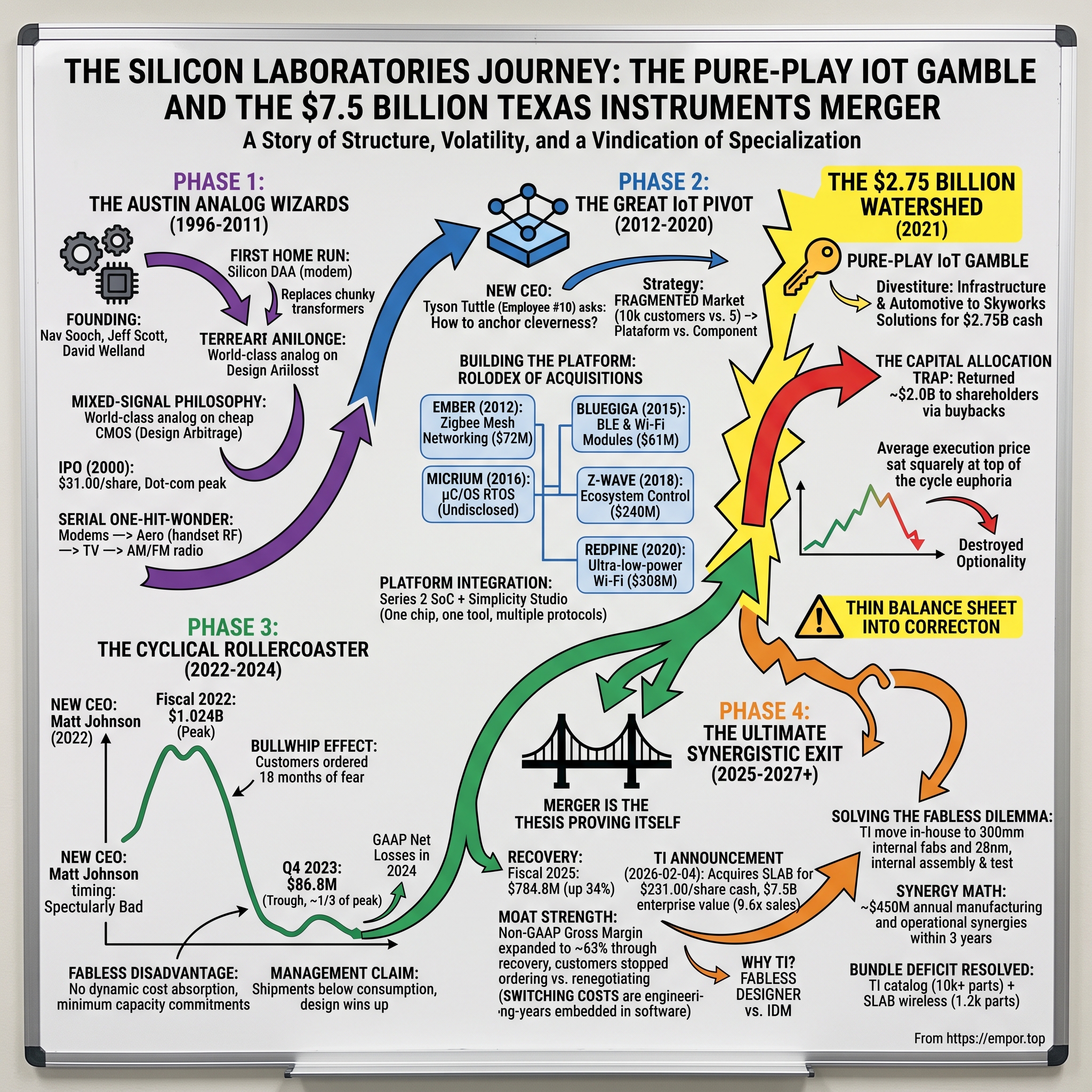
Silicon Laboratories: The Pure-Play IoT Gamble and the $7.5 Billion Texas Instruments Merger
I. Introduction & Episode Roadmap
On the morning of February 4, 2026, Silicon Laboratories did something no public company enjoys doing: it reported the best year in its recent history and, in the same breath, announced it would cease to exist as an independent company.
The fourth-quarter release landed first. Revenue for fiscal 2025 came in at $785 million, up 34% year over year — a violent snap-back from the worst downturn the company had ever endured.1 Then came the second release, from Dallas rather than Austin. Texas Instruments had signed a definitive agreement to acquire Silicon Labs for $231.00 per share in cash, an all-cash transaction valuing the company at an enterprise value of approximately $7.5 billion.2 The price represented roughly a 69% premium to Silicon Labs' unaffected trading price.3 Both boards approved unanimously. There was no financing contingency.
Do the arithmetic and the number that falls out is startling. Seven and a half billion dollars against $785 million of trailing revenue is 9.6 times sales — for a company that, two years earlier, had watched a single quarter's revenue collapse to $87 million and had spent 2024 posting deep GAAP operating losses.4 This was not a hyper-growth AI story. This was a mid-cap embedded chip designer selling radios into smart meters, garage-door openers, and glucose monitors. So what, exactly, was Texas Instruments buying?
That question is the spine of this story, and the answer is not "growth." It is structure.
The thesis
This is the story of the ultimate specialization gamble, run over thirty years by one of the most technically gifted engineering teams in American semiconductors.
Phase one: a group of Austin analog wizards spent fifteen years building beautiful, niche, high-margin chips — replacing bulky mechanical components with silicon, over and over, in modems, mobile phones, televisions, and radios. Phase two: a new CEO decided that this cleverness needed an anchor, and spent a decade buying, integrating, and welding together the pieces of a single-vendor wireless platform for the Internet of Things. Phase three: the company sold off everything that wasn't IoT, handed the proceeds back to shareholders at what turned out to be the exact top of the cycle, and then discovered — the hard way — that being a pure-play, fabless anything in semiconductors means you own 100% of your end market's volatility and none of the tools to absorb it.
Phase four is the merger. And the merger is the thesis proving itself, in a way that is simultaneously a vindication and an indictment.
The core structural tension
Everything in this story reduces to one distinction: fabless designer versus integrated device manufacturer (IDM).
A fabless company designs chips and pays somebody else — a foundry — to manufacture them. It is a capital-light, high-return-on-capital model when volumes are good. It is a brutal model when they are not, because you carry design costs, inventory, and often minimum capacity commitments without controlling the cost base underneath them. An IDM like Texas Instruments owns its own fabrication plants. TI has spent the past decade pouring capital into 300mm wafer fabs on U.S. soil, and its explicit strategic argument is that owning cheap, modern, internal capacity is the durable advantage in analog and embedded semiconductors.
TI's stated plan for Silicon Labs is exactly that: take a wireless portfolio currently built at external foundries, move it onto TI's internal 300mm lines and internal assembly and test, and harvest approximately $450 million in annual manufacturing and operational synergies within three years of closing.2 Against $785 million of acquired revenue, that synergy number is not a rounding item. It is most of the deal's economics.
Which frames the uncomfortable question we will keep returning to: did Silicon Labs get bought because its technology was so good, or because a company that owns fabs could extract value from that technology that Silicon Labs itself structurally could not? The honest answer is both — and the ratio between the two is what this story is about.
Let's start in Austin, in 1996, with three engineers, one telephone line, and a transformer they wanted to destroy.
 Subscribe on LinkedIn
II. The Austin Analog Wizards: Founding and Early Eras (1996–2011)
To understand Silicon Labs' founding, you first have to understand what a dial-up modem actually was — and why it was such an ugly piece of engineering.
When a PC modem connected to a telephone line in 1996, it could not simply plug in. Telephone networks carry lethal voltages during ringing and lightning strikes, and regulators required galvanic isolation between the phone line and the computer. The industry solved this with physics: a chunky transformer, mechanical relays, and optocouplers — a "direct access arrangement," or DAA. It was heavy, it was expensive, it was made of copper and iron, and it had barely changed in decades. Every modem shipped with one, and every modem maker hated it.
In August 1996, three engineers from Crystal Semiconductor — Nav Sooch, Jeff Scott, and David Welland — left to start a company in Austin, Texas, on the premise that this problem was not a physics problem but a design problem.5 Crystal was itself a legendary Austin analog shop (it had been absorbed into Cirrus Logic), and it had produced a particular breed of engineer: people who thought in continuous signals rather than ones and zeros, and who had an almost aesthetic objection to discrete components. They raised $5.7 million in venture capital and set to work.
The mixed-signal philosophy
Their founding insight deserves unpacking, because it explains literally every product Silicon Labs shipped for the next twenty years.
The world is analog. Sound, radio waves, voltage on a telephone line, temperature — all continuous. Computers are digital. The bridge between them is mixed-signal design, and it is genuinely one of the hardest disciplines in chip engineering, because analog circuits are exquisitely sensitive to noise, temperature, and manufacturing variation, and digital circuits generate enormous amounts of all three. The conventional wisdom was that high-performance analog needed specialized, expensive fabrication processes.
Silicon Labs' bet was the opposite: that with enough cleverness in circuit architecture, you could build world-class analog on standard, cheap, high-volume CMOS — the same commodity process used for digital logic. If you could do that, you got two enormous advantages at once. Your chips rode the cost curve of the entire digital semiconductor industry rather than sitting in a specialty backwater. And you could integrate analog and digital onto the same die, replacing a whole board of components with one part.
That is a design-arbitrage strategy, not a manufacturing strategy — which is why the company was fabless from day one. It is also why, thirty years later, being fabless became the thing that defined its ceiling.
The first home run
The DAA was the proof. Silicon Labs shipped the world's first silicon DAA commercially in April 1998, integrating the transformer, relay, and optical isolation functions onto CMOS while meeting the FCC's Part 68 regulatory requirements for telephone-line equipment.5 Modem makers could suddenly delete a fistful of components, shrink their boards, and cut cost.
The financial response was the kind of curve founders dream about. Revenue went from $5.6 million in fiscal 1998 to $46.9 million in fiscal 1999 — better than eight-fold, in one year, on essentially one product.5 That trajectory carried the company to NASDAQ. The IPO priced at $31.00 per share and became effective on March 23, 2000, raising approximately $91.0 million net to the company.56 The timing was almost comic: Silicon Labs went public within weeks of the absolute peak of the dot-com bubble.
Post-bubble: doing the trick again, and again
What happened next is the most revealing thing about early Silicon Labs. The bubble burst, the dial-up modem market began its long death, and the company survived by running the same play on entirely different markets.
In March 2001, it launched the Aero transceiver chipset — marketed as the first 100% CMOS radio transceiver for GSM mobile phones, collapsing dozens of discrete RF components into silicon.7 Radio frequency design in CMOS was, at the time, widely considered impractical for a phone's stringent requirements. Silicon Labs did it anyway, and the economics were compelling enough that handset makers took it seriously.
Then came television. Analog TV tuners were metal "cans" — literally shielded boxes full of hand-tuned coils. Silicon Labs replaced them with a chip. Then AM/FM radio receivers, which followed the identical logic and ended up in a very large fraction of the world's mobile phones and portable audio devices.
You can see the pattern. Find a market where an important function is still implemented with mechanical or discrete components. Integrate it onto CMOS. Take share on cost and size. Enjoy fat margins until the market commoditizes or disappears. Move on.
The DNA — and the flaw
This produced a distinctive corporate character: ruthless engineering efficiency, gross margins that lived comfortably in the high 50s and low 60s, and a lean cost structure. It also produced a structural vulnerability that the company's own leadership eventually named out loud.
Silicon Labs was a serial one-hit-wonder machine. Every product line had the same life cycle: brilliant disruption, rapid share gain, high margins, then erosion as competitors caught up and the underlying end market matured or got absorbed by a larger integrator. Modems died. Handset RF consolidated into the hands of giants who could bundle the entire radio subsystem. TV tuners became a commodity.
A company built this way must keep finding new mechanical components to kill, forever. That is an exhausting way to run a business, and it means revenue is a portfolio of decaying assets plus whatever the R&D lab produces next. What Silicon Labs lacked was an anchor — a market large enough, fragmented enough, and sticky enough that it could compound in one place rather than sprinting between hunting grounds.
For investors, the early era's lesson is that technical excellence produced real but impermanent economics. High margins on a declining base are not a moat. Somebody was going to have to find the company a permanent home.
That somebody joined as employee number ten.
III. Tyson Tuttle and the Great IoT Pivot (2012–2020)
G. Tyson Tuttle arrived at Silicon Labs in 1997, when the company was a handful of people and one unproven chip.8 He came from Crystal and Broadcom, he was an RF and mixed-signal engineer by training and instinct, and he spent fifteen years building the businesses that defined the company's second act — the broadcast products and the RF transceivers. He rose through CTO and COO roles, and in April 2012 the board made him chief executive.8
Tuttle inherited the one-hit-wonder problem in its acute form. By 2012, the mobile handset business — where Silicon Labs had done some of its most impressive engineering — was consolidating ferociously. Qualcomm and MediaTek were absorbing the entire radio chain into integrated platforms. A specialist selling one clever block into that supply chain was going to be squeezed on price and eventually designed out. You do not win a scale war against Qualcomm with a better transceiver.
So Tuttle asked the inverted question. Instead of chasing the biggest volumes, where scale players win, what if you went to the market where volume is fragmented — where no single customer is big enough for a giant to bother customizing for, where there are thousands of small and medium device makers, and where the winner is whoever makes it easiest for a small engineering team to ship a connected product?
That market was the Internet of Things.
Why fragmentation was the strategy
This is worth sitting with, because it is the intellectual core of the entire second half of the company's history.
In smartphones, five customers buy a billion units. Scale, cost, and negotiating leverage decide everything. In IoT, ten thousand customers buy between fifty thousand and five million units each — a smart-meter maker, a door-lock company, a commercial lighting firm, a medical device startup. None of them has the engineering bandwidth to build a wireless stack from scratch. None of them can negotiate hard on price. All of them desperately need somebody to hand them a working radio, a software stack, a development environment, and a certification path.
That is not a components business. That is a platform business wearing a component's clothing. And platform businesses have switching costs.
Tuttle's problem was that Silicon Labs owned almost none of the pieces required. It had radios. It did not have mesh networking protocols, or Bluetooth, or an operating system, or a home-automation ecosystem, or the developer tooling. So he went shopping — deliberately, and over eight years.
Building the rolodex
Ember Corporation (2012). The first and arguably most important move. Ember was the leading independent supplier of Zigbee mesh networking silicon and software — the technology that lets dozens of low-power devices form a self-healing network where each node relays messages for the others, which is exactly what you need for smart meters and building automation. Silicon Labs closed the acquisition on July 3, 2012, for approximately $72 million in initial consideration.9 It bought a protocol leadership position and, critically, the software engineers who understood networking stacks — a discipline Silicon Labs did not have.
Bluegiga (2015). A Finnish company specializing in Bluetooth Low Energy and Wi-Fi modules, acquired for approximately $61 million in cash, closing January 30, 2015.10 Two things came with it. BLE, obviously — the protocol that connects everything to a phone. But also modules: pre-certified, ready-to-solder assemblies that let a customer skip RF design and regulatory certification entirely. Modules carry lower gross margins than bare chips, but they radically lower the barrier for small customers. That is a distribution decision disguised as a product decision.
Micrium (2016). Announced October 3, 2016, this bought μC/OS, one of the most widely used real-time operating systems in embedded engineering, along with its founder Jean Labrosse, whose textbooks had taught a generation of embedded developers.11 The purchase price was never disclosed, and any figure attributed to it is unverifiable. Strategically it was the software-stack land grab: own the operating system, and you own the layer where the customer writes their code.
Sigma Designs' Z-Wave business (2018). A $240 million all-cash asset purchase, closing April 18, 2018.12 Z-Wave was the proprietary protocol that dominated professionally installed home security and automation in North America — ADT, Ring, and the alarm industry ran on it. Unlike Zigbee, Z-Wave was a closed standard with a certification regime, meaning Silicon Labs bought not just technology but control of an ecosystem. Every Z-Wave device in the world would now be certified by, and largely built on silicon from, Silicon Labs. That is about as close to a toll booth as this industry offers.
Redpine Signals' connectivity business (2020). The most aggressive and most debated deal: $308 million in cash for the wireless assets of a company whose revenue base was small enough that Silicon Labs did not disclose it in the announcement.13 What Redpine brought was ultra-low-power Wi-Fi, additional Bluetooth capability, and early edge-AI/machine-learning acceleration IP. On any conventional revenue multiple, this was an expensive purchase of engineering talent and patents rather than a business. Management framed it as buying a technology roadmap it could not build fast enough internally.
The skeptical read is worth stating plainly: this was a serial acquirer of small technology assets at rich prices, and the discipline of that program can only be judged by whether the pieces actually fused into something coherent. Many roll-ups of this type end up as a drawer full of incompatible product lines.
The platform play — the part that mattered
Which is why the integration work, not the shopping, was the real achievement.
Tuttle's team took Zigbee, Z-Wave, Bluetooth, Thread, Wi-Fi, and proprietary sub-GHz protocols, and did two things. First, they unified the silicon: the Series 2 system-on-chip platform, introduced in 2019, put a single architecture underneath all of it — one processor core family, one security subsystem, one radio architecture capable of running multiple protocols. Second, they unified the software: Simplicity Studio, an integrated development environment, plus the Gecko SDK, so that an engineer who had learned to build a Zigbee product could build a Bluetooth product without relearning the world.
Here's the plain-English version of why that combination is powerful. Before, a device maker who wanted to support two wireless standards had to buy two chips from two vendors, learn two toolchains, and manage two software stacks. After, they bought one chip, opened one program, and flipped a configuration. The value proposition stopped being "our radio is 8% more efficient" and became "you will ship your product six months sooner."
That is the moment Silicon Labs stopped selling components and started selling a platform. Whether it earned a platform's economics is a question the next decade would answer harshly — but the strategic logic was sound, and it was the first time in the company's history that its various businesses reinforced each other instead of merely coexisting.
Having built the IoT franchise, Tuttle then made the decision that defined everything after: he decided to bet the entire company on it.
IV. The $2.75 Billion Watershed and the Capital Allocation Trap (2021)
In April 2021, the semiconductor industry was in a state that veterans found almost unrecognizable. Lead times were stretching past a year. Automakers were shutting assembly lines for want of $2 microcontrollers. Customers were begging for allocation. Chip stocks were at all-time highs, and any company with the word "shortage" in its earnings call was being re-rated upward weekly.
Into that environment, Silicon Labs announced it was selling half of itself.
The divestiture
On April 22, 2021, the company agreed to sell its Infrastructure & Automotive business to Skyworks Solutions for $2.75 billion in cash.14 The deal closed on July 26, 2021, structured as an asset purchase covering the timing, power and isolation, and broadcast product lines, along with the associated intellectual property and employees.15
Understand what was leaving. This was the legacy — the descendants of the original mixed-signal magic. Precision timing chips. Digital isolators. The broadcast tuner and radio franchise. These were mature, profitable, high-margin businesses with long product lifecycles and predictable cash flow. They generated $375.7 million of revenue in fiscal 2020, per the discontinued-operations disclosure in the company's subsequent annual report.16 At $2.75 billion, the sale valued them at roughly 7.3 times trailing revenue — an outstanding price for a mature, slow-growth product portfolio, and a clear reflection of the cycle's euphoria.
The pre-tax gain was $2.423 billion; after $346.9 million of tax on the gain, the net-of-tax gain was $2.175 billion, and the company netted approximately $2.3 billion in cash after taxes and fees.16
Strategically the logic was clean. Silicon Labs emerged as a debt-free, single-market company: pure-play IoT. No conglomerate discount, no divided R&D attention, no confusing story for investors. Management could point every engineer and every dollar at one opportunity.
The problem was what they did with the money.
The capital return
Between late 2021 and the end of 2022, Silicon Labs returned approximately $2.0 billion to shareholders — essentially the entire net proceeds of the divestiture — through buybacks.
The centerpiece was a modified Dutch auction tender offer, which commenced August 3, 2021 and expired August 30, 2021, with a price range of $140 to $160 per share. The company purchased 3,994,545 shares at $160.00, for approximately $639.1 million — roughly 8.9% of shares outstanding, retired in a single transaction at the top of the stated range.17 Layered around it were a $400 million accelerated share repurchase executed with Goldman Sachs and open-market purchases, bringing fiscal 2021 total repurchases to 6.5 million shares for $1.15 billion.16 Fiscal 2022 added 6.9 million shares for $887.6 million.18
Roughly 13.4 million shares retired. About two billion dollars deployed. And an average execution price that sat squarely in the neighborhood of the highest prices the stock had ever seen.
The trap
Here is the part that a sympathetic reading cannot rescue.
Silicon Labs bought back its own stock, aggressively, using a windfall generated by cycle euphoria, during cycle euphoria, at valuations set by cycle euphoria. Every input to that decision was the same input. The company sold a mature asset at 7.3x sales because the market was hot, then immediately used the proceeds to buy its own shares at prices that were high for the same reason.
Buybacks are only value-creating if the shares are repurchased below intrinsic value. Judging that in a cyclical industry requires a view on where you sit in the cycle — and the entire semiconductor industry in 2021 was operating at demand levels that were, in hindsight, inflated by double-ordering. Management had, at that moment, the best possible vantage point on customer order patterns. The decision to convert essentially all of a once-in-a-company-lifetime liquidity event into share repurchases at peak multiples was a bet that the demand environment was structural rather than cyclical.
It was not.
There is a defensible counterargument, and it should be stated: the company had no debt, saw no acquisition it wanted at 2021 prices, and returning capital rather than empire-building is generally the more shareholder-friendly instinct. Boards get criticized for hoarding cash too. But there is a wide middle ground between hoarding $2.3 billion and spending $2.0 billion of it inside eighteen months at cycle-peak prices, and Silicon Labs did not occupy it.
The consequence
When the correction arrived — and it arrived with unusual violence in this particular corner of the market — Silicon Labs had a balance sheet that was clean but thin. It had no debt, which mattered enormously and probably saved it from something far worse. But it also had no war chest.
That eliminated an entire menu of options. It could not buy distressed competitors at depressed prices, which is precisely when semiconductor M&A creates the most value. It could not repurchase its own stock in size at the actual bottom, when it was genuinely cheap. It could not out-spend rivals on R&D through the trough to gain design-win share while everyone else retrenched. It had to survive the downturn on operating discipline alone, drawing on a revolver it would later repay.19
An investor looking at this sequence should draw a specific conclusion, and it is not simply "buybacks bad." It is that in a violently cyclical industry, the timing of capital allocation dominates its form. The same $2.0 billion deployed across 2023 and 2024 instead of 2021 and 2022 would have retired dramatically more stock and left the company with strategic optionality precisely when optionality was scarcest. The path from that decision to a Dallas boardroom in 2026 is not a straight line, but it is a visible one.
The bill came due almost immediately, and it landed on a new chief executive's desk in his first month.
V. The Matt Johnson Era & The Cyclical Rollercoaster (2022–2024)
R. Matthew Johnson took over as president and chief executive on January 2, 2022, having been named to the role by the board the previous July.8 Tyson Tuttle retired as CEO and as a director on January 1, 2022, closing out roughly twenty-four years at the company and nine in the top job.8
Johnson was not a Silicon Labs lifer. He had joined in July 2018 to run the IoT business, became president in April 2021, and arrived from NXP Semiconductors, where he had been senior vice president and general manager of the automotive business; before that, Freescale and Fairchild.20 He was, in other words, a large-company operator brought in to run a company that had just decided to become small and focused. He holds a BSEE from the University of Maine. Notably — and this is a governance detail worth flagging positively — Silicon Labs kept the chairman and CEO roles separate, with founder Nav Sooch serving as chairman.20
His timing was, by any measure, spectacularly bad.
The bullwhip
What happened between 2022 and 2024 was not a demand recession. It was an inventory event, and the distinction matters enormously for how you read the numbers.
Picture a device manufacturer in 2021. Lead times on wireless chips have stretched to fifty weeks. Competitors are getting allocation and you are not. Your production line stops if a $3 radio doesn't show up. So you do the rational individual thing: you order eighteen months of chips, and you order them from every vendor who will take the order, and you build a warehouse.
Now multiply that behavior across every customer simultaneously. Silicon Labs' order book in 2021 and 2022 was not measuring consumption. It was measuring fear. Distributors stocked up, contract manufacturers stocked up, end customers stocked up, and each layer buffered the layer below it.
Fiscal 2022 revenue reached $1.024 billion — the highest in company history and the only billion-dollar year it would ever record.21
Then the music stopped. Once supply normalized, every customer in the chain looked at a warehouse full of chips they no longer needed and did the rational individual thing again: they stopped ordering entirely, and worked down inventory. This is the bullwhip effect, and because the buffers had stacked at multiple layers, the reversal was amplified at each one.
The collapse
Fiscal 2023 revenue fell to $782.3 million.21 That was painful but survivable. What happened next was not.
The fourth quarter of 2023 produced revenue of $86.8 million — the trough, and a number that on an annualized basis represented roughly a third of peak.22 For a company with a fixed cost base built for a billion-dollar run rate, that is a catastrophe. R&D does not shrink by two-thirds. Full-year fiscal 2024 revenue came in at $584.4 million, down 25% again, and the company posted deep GAAP operating losses.21
It is worth pausing on how rare that shape is. Most semiconductor downturns take 20–30% off the top. Silicon Labs lost roughly 43% peak-to-trough on an annual basis and briefly more than 65% on a quarterly basis. Why so much worse than peers? Because of everything that came before. A pure-play company has no diversified segment to cushion the fall — the very concentration that made the equity story clean made the earnings stream fragile. And a fabless company with capacity commitments cannot flex its cost base downward the way an IDM can by simply loading its fabs with other products.
The 2021 strategy and the 2024 pain were the same decision viewed from opposite ends of the cycle.
Management under fire
The interesting question is how Johnson handled it, because that is where credibility is actually earned.
On the first-quarter 2024 call in April, with revenue at $106 million — up 23% sequentially off the bottom but still down catastrophically year over year — Johnson made an explicit, falsifiable call. "We are confident that Q4 represented the trough for us, and we expect revenue growth to accelerate from Q1 into Q2," he told analysts.19 He argued that reported revenue was not measuring demand: "end customer inventory and channel distribution inventory are both moving in the right direction… this revenue level that we're guiding is not indicative of our consumption."19
That is the pivotal analytical claim of the entire downturn, and it is the one management asked investors to believe on faith. If shipments were below consumption because the channel was destocking, then revenue would eventually have to snap back to consumption plus restocking. If, instead, demand itself had deteriorated, the trough was not a trough.
Analysts pushed hard, and they were right to. Management teams across the industry spent 2023 and 2024 blaming macro conditions for what were, in several cases, forecasting failures and share losses. Johnson's answer was to redirect attention to design wins — the metric that counts sockets secured in customer products that will ship in future years, rather than chips shipped this quarter. He pointed to specific programs: the Chamberlain Group's myQ garage platform using the xG28, a continuous glucose monitoring win in Asia-Pacific, smart metering, and electronic shelf labels.19 He also declined to walk back the company's long-term ambition, telling the call there was "no change to our commitment to the 20% compound annual growth on our revenue."19
Two readings are available. The charitable one: he correctly diagnosed an inventory phenomenon, refused to panic, protected R&D, and pointed at the leading indicator rather than the lagging one. The skeptical one: design wins are a management-controlled, unaudited metric with no standard definition, and reaffirming a 20% long-term growth target in the middle of a 43% revenue collapse is exactly the sort of thing that erodes credibility if it doesn't come true. Both readings were live at the time.
Pay and alignment
Compensation is where you check whether the pain was shared. For fiscal 2024, Johnson's total reported compensation was $7.21 million — but the composition tells the story: the compensation committee cancelled the fiscal 2024 cash bonus opportunity, and he received $0 in non-equity incentive pay.23 Performance targets were missed, and the cash bonus went to zero rather than being rescued by a discretionary adjustment or a mid-year goal reset. That is a meaningful governance data point; plenty of boards do the opposite when a cycle turns.
The offsetting observation is the one that always applies to equity-heavy packages: the bulk of the $7.21 million was stock awards granted at depressed prices, which subsequently benefited enormously from both the recovery and the merger premium. And the merger itself triggered substantial change-of-control payments — the merger proxy disclosed approximately $41.4 million in total golden-parachute compensation for Johnson.24 The 2024 bonus discipline was real; so is the observation that the ultimate payoff came from a sale rather than from standalone compounding.
By the time investors were digesting all of this, the numbers had already begun to turn — and the turn was as sharp as the fall.
VI. The Core Business Today: Segments, Economics, and the Competitive Moat
The recovery, when it came, validated at least the mechanical part of Johnson's thesis. Fiscal 2025 revenue of $784.8 million represented 34% growth, and the fourth quarter alone delivered $208 million, up 25% year over year.1 More telling than the growth rate was the margin trajectory: full-year non-GAAP gross margin was 58.5%, but the fourth quarter printed 63.6% non-GAAP — the year started at depressed utilization and ended near the company's structural potential.1
That margin recovery is the strongest evidence that the downturn really was an inventory event rather than a pricing collapse. If Silicon Labs had been losing sockets to cheaper competitors, gross margin would have deteriorated as volume returned, because share is bought with price. Instead margin expanded roughly five points as volume normalized, which is the fingerprint of a fixed-cost absorption problem, not a competitive one.
The caveat, which the headline did not carry: fiscal 2025 was still a GAAP net loss year, at $(1.98) per diluted share, against positive non-GAAP EPS of $0.92.1 The gap is stock-based compensation and amortization, and a $1.06 billion-of-revenue cost structure supporting $785 million of sales. The business recovered; it did not yet return to GAAP profitability.
The two segments
Industrial & Commercial generated $445 million in fiscal 2025, up 31% — 57% of revenue.1 This is smart utility meters, commercial and industrial lighting, building automation, asset tracking, and electronic shelf labels. The defining characteristic is time. A utility meter design cycle runs five to ten years from first engagement to volume production, and the deployed product stays in the field for a decade or two after that. Once a Silicon Labs part is designed into a meter that a European utility is rolling out to eight million households, it is there for the life of the program.
Home & Life generated $340 million, up 38% — 43% of revenue.1 Home security, connected appliances, door locks, and portable medical devices. Higher volume, shorter cycles, more consumer sensitivity, and considerably more exposed to smart-home standards adoption. Note the fourth-quarter divergence: I&C grew 37% year over year while Home & Life grew only 12%.1 The industrial side was carrying the recovery by year-end; the consumer-adjacent side was already decelerating.
That divergence is the single most useful operating detail in the release, and it is a warning as much as a data point.
The moat, honestly assessed
Apply Hamilton Helmer's 7 Powers framework and Silicon Labs scores on two, weakly on one, and not at all on the rest.
Switching costs — the primary power, and it is genuine. Here is the mechanism in concrete terms. A team building a smart lock chooses a Silicon Labs SoC. They then spend eighteen months writing firmware against the Gecko SDK inside Simplicity Studio. They tune the radio for their enclosure. They pass FCC, CE, and protocol-body certification with that specific silicon. They ship 400,000 units into homes and now owe those customers years of over-the-air security updates against that codebase. To switch to Nordic Semiconductor or STMicroelectronics, they must rewrite the firmware, requalify the radio, recertify the product, and maintain two branches forever — for a chip that costs perhaps $2.50. The switching cost is not the silicon. It is the engineering-years embedded in the software.
This is why gross margins in the high 50s and low 60s persisted through a 43% revenue collapse. Customers did not renegotiate price; they simply stopped ordering. That is a specific, evidence-backed observation about pricing power, and it is the best thing in the bull case.
Cornered resource — real but narrower than advertised. The genuinely differentiated asset is patent-protected multiprotocol radio IP: a single chip that can run Zigbee, Thread, Bluetooth Low Energy, and Matter concurrently rather than one at a time. For a device maker who cannot predict which ecosystem will win, that is valuable optionality. But it is not unique — Nordic, STMicroelectronics, NXP, and Espressif all field multiprotocol parts, and the technical gap has narrowed considerably since 2019.
Scale economies — absent, and this is the whole problem. At $785 million of revenue against competitors doing $10 billion to $17 billion, Silicon Labs had no cost advantage in manufacturing, no purchasing leverage, and R&D that had to be spread across a wide protocol surface. Everything else in this story follows from that line.
Network economies, counter-positioning, branding, process power — no meaningful claim on any of them.
The crown jewel
The Series 3 platform was the technical answer to the scale problem: if you cannot win on cost, win on capability. Silicon Labs unveiled it on May 22, 2025, and brought the first shipping parts — the SiMG301 multiprotocol and SiBG301 Bluetooth devices — to general availability on October 2, 2025.2526
Series 3 moved to a 22nm process node, a substantial jump for embedded wireless, where much of the industry still sits at 40nm and above. Smaller geometry means more transistors in the same area at lower power, which enabled two things that matter: co-packaged flash memory of up to 4MB, and enough compute headroom for hardware-accelerated machine learning at the edge. The parts pair an Arm Cortex-M33 with DSP and floating-point capability at up to 150 MHz, and separate the application, wireless, and security functions across dedicated cores.2526
Why edge AI matters here, in plain terms: today a smart camera or a voice-activated device typically ships raw data to the cloud for interpretation, which costs bandwidth, battery, latency, and privacy. Running the model on the device itself removes all four costs. Whether IoT device makers will actually pay a premium for that capability in volume is, as of mid-2026, still an open commercial question rather than a demonstrated one.
The security achievement is more concrete. On August 4, 2025, Silicon Labs announced the world's first PSA Certified Level 4 certification, with the certificate itself dated July 31, 2025.2728 Level 4 is the highest tier of the PSA scheme and requires demonstrated resilience against sophisticated physical attacks — laser fault injection, microprobing, side-channel analysis — where an attacker has the chip in hand and expensive laboratory equipment. The evaluation was performed by Keysight's Riscure lab, which confirmed it independently on August 21, 2025.29
Two honest caveats belong here, and management's own press release did not emphasize them. The certification covers the Secure Vault security subsystem as implemented on the SiXG301, not the entire SoC.27 And it was granted under a Level 4 scheme designated v2.0 BETA.27 It is a real, independently verified, first-of-its-kind achievement — and it is narrower than "the world's most secure IoT chip" implies. For customers building devices that live unattended on utility poles or in hospital corridors for fifteen years, physical tamper resistance is a genuine purchasing criterion. For a consumer doorbell, it is a marketing bullet.
The supply chain
Silicon Labs has never owned a fabrication plant. That is the founding architecture, not a later choice. Its chips are built by external foundries and, historically, assembled and tested in Asia.
Worth noting as a disclosure observation: the company has not publicly identified which foundry manufactures the 22nm Series 3 parts. Advanced-node embedded wireless capacity of that type is concentrated among a small number of suppliers globally, dominated by 台灣積體電路製造 TSMC, with 三星電子 Samsung and a handful of others accounting for most of the remainder — which means the geographic concentration risk is structural to the fabless model regardless of which name is on the purchase order.
That structural dependence is where the bear case begins.
VII. Skeptical Investor Stress Test & Risk Radar
Imagine an activist investor building a short thesis on Silicon Labs in mid-2025, before any merger rumor existed. The stock had recovered, the story was clean, the technology was genuinely good. What would they attack?
They would not attack the products. They would attack the structure — and they would have had four strong lines of argument.
1. The fabless disadvantage, in both directions
The standard defense of fabless is capital efficiency: no fabs, no depreciation, high return on invested capital. That defense holds in a stable demand environment and collapses in a volatile one, in both directions.
During the 2021–2022 shortage, Silicon Labs was a small customer competing for foundry capacity against Apple, Qualcomm, and NVIDIA. It could not simply build more. Its customers went unfilled, and some of those customers dual-sourced to competitors as a result — which is how a shortage permanently costs you share.
During the 2023–2024 collapse, the model inverted. Fabless companies typically carry capacity reservations and non-cancellable wafer commitments made during good times. Wafers arrived and became finished-goods inventory nobody wanted. Silicon Labs could not idle a fab because it had none, and it could not fill a fab with someone else's product because it had none. It simply absorbed the cost.
An IDM absorbs the same downturn differently: utilization falls, margins compress, but the fixed asset can be loaded with other product lines and the cost per wafer at the bottom is still lower than an external foundry's price at the bottom. The capital-light model outsources capital intensity, but it also outsources the shock absorber.
2. The bundle deficit
This is the argument that ultimately decided the company's fate, and it has nothing to do with the quality of a Silicon Labs radio.
When an industrial customer designs a smart meter, they need more than a wireless SoC. They need power management ICs, operational amplifiers, voltage references, analog-to-digital converters, isolation devices, and sensors. Texas Instruments, NXP, Infineon, and STMicroelectronics can supply the entire board from one catalog, one purchase order, one field applications engineer, one quality system, and one negotiation. Texas Instruments' portfolio spans tens of thousands of analog parts.
Silicon Labs arrived with approximately 1,200 products, all of them wireless connectivity.2 Excellent products — and a single line item on a bill of materials with forty of them.
As industrial and automotive customers consolidated their supplier lists (an accelerating trend post-2022, driven by the supply chain trauma), a single-point specialist is structurally disadvantaged in the procurement conversation regardless of technical merit. You cannot bundle from a position of one product category. This is Porter's supplier-power analysis running in reverse: Silicon Labs had strong power over any individual customer once designed in, and weak power in the initial platform-selection conversation against a competitor offering the whole board.
3. The Matter drag
Matter was announced as the standard that would finally unify the smart home — one protocol, and your door lock works with Apple, Google, Amazon, and Samsung alike. Silicon Labs positioned itself as the leading multiprotocol silicon supplier for exactly that transition, and it was a central part of the Home & Life growth narrative from 2021 onward.
The reality has been slower and messier. Interoperability between ecosystems proved harder than the specification implied, consumer-facing benefits arrived gradually, and the wave of Matter-driven device refresh that was supposed to lift the entire smart-home silicon market did not materialize on the promised timeline. That is visible in the numbers: Home & Life grew 38% for full-year 2025 off a devastated base, but only 12% year over year in the fourth quarter.1
The analytical point is not that Matter failed. It is that Silicon Labs' Home & Life growth thesis was substantially dependent on an industry standard whose adoption timing it did not control. Building a growth case on somebody else's consortium is a structurally weak position, and 2023–2025 demonstrated why.
4. Geopolitical concentration
Advanced wafer fabrication for this class of product is concentrated in Taiwan, and back-end assembly and test are concentrated in China and Southeast Asia. A meaningful disruption in the Taiwan Strait would not damage Silicon Labs' business; it would end it, because there is no alternative source for a 22nm design on any timescale that matters. This is not a Silicon Labs-specific failing — it is shared by every fabless designer — but a $785 million company has vastly less ability to buy geographic diversification than a $17 billion one.
Tariff and export-control policy adds a second layer. A meaningful share of IoT device manufacturing sits in China, meaning the company's chips flow through jurisdictions subject to shifting trade rules at both the input and output ends.
What the bear case did not have
To be fair to the other side, the short thesis had real weaknesses. The balance sheet was clean: $443.6 million in cash and short-term investments at the end of fiscal 2025, with no long-term debt.1 There was no refinancing risk, no covenant risk, no dilution pressure. Gross margins had recovered, proving pricing power held through the worst of it. Switching costs were demonstrably real. And design wins accumulated during the downturn were, by construction, future revenue that had not yet shipped — on the second-quarter 2025 call, management pointed to more than six billion units of wins not yet in revenue.30
So the bear case was never "this business is bad." It was "this business is too small to defend itself, and its economics belong to somebody with fabs."
Which is precisely the argument Texas Instruments made with a checkbook.
VIII. The Texas Instruments Merger: The Ultimate Synergistic Exit
Texas Instruments is the most doctrinaire capital allocator in analog semiconductors. For fifteen years its message to investors has been unchanging: own your manufacturing, build 300mm capacity because 300mm wafers yield roughly 2.3 times the die of 200mm at little more cost, keep it in the United States, sell direct to a very long tail of customers, and let free cash flow per share compound. TI does not chase fashion. When it buys something, the thesis is usually about loading its fabs.
So when TI announced on February 4, 2026 that it would pay $231.00 per share in cash — approximately $7.5 billion of enterprise value — for a fabless wireless company, the interesting question was never "is this a good technology fit." It was "what does TI think it can do with these designs that Silicon Labs could not."
The answer has three parts.
Solving the fabless dilemma
TI's release named the mechanism directly: it operates 300mm wafer fabs in the United States along with internal assembly and test, and its process technologies — specifically 28nm — are suited to Silicon Labs' wireless portfolio.2 Translation: TI intends to move the manufacturing in-house.
Consider what that does to a chip's cost structure. Today, Silicon Labs pays an external foundry a price that includes that foundry's gross margin. It pays a separate assembly and test subcontractor, including their margin. Then it applies its own margin. TI, running the same design on a depreciated internal 300mm line with internal packaging, eliminates two layers of somebody else's profit and captures them.
This is the single most important sentence in the entire story: the same chip, sold at the same price to the same customer, generates materially more gross profit inside Texas Instruments than inside Silicon Labs. Not because TI is a better company, but because TI owns the factory.
That is why the acquisition could be justified at 9.6 times revenue when the standalone business could not command that multiple in the public market. TI is not paying for Silicon Labs' P&L. It is paying for Silicon Labs' revenue line dropped onto TI's cost structure.
The synergy math
The $450 million of annual manufacturing and operational synergies within three years of close2 deserves scrutiny rather than acceptance, because it is an enormous number — it equals about 57% of the acquired company's entire revenue.
Decompose it and it becomes more plausible. A large piece is manufacturing: eliminating foundry and OSAT margin across roughly $785 million of revenue could plausibly account for a couple of hundred million dollars of gross profit at scale. A second piece is corporate overhead — a standalone public company's finance, legal, HR, IT, audit, and board costs simply vanish. A third piece is sales and marketing: Silicon Labs maintained its own global sales force and distributor relationships that duplicate infrastructure TI already runs.
Two cautions belong on the record. First, transferring a semiconductor design from one foundry's process to another's is not a copy-paste operation — it is a full silicon requalification, typically eighteen months to three years per product family, with customer requalification on top for regulated industrial and medical applications. TI's three-year window is aggressive. Second, "operational synergies" is the polite term for headcount reduction, and the disclosed figure implies substantial overlap elimination in a company of roughly Silicon Labs' size.
The distribution force multiplier
The third leg is the one the bear case predicted. TI sells to on the order of 100,000 customers across industrial and automotive markets, most of them buying analog parts from a catalog of tens of thousands. Adding roughly 1,200 wireless connectivity products to that catalog means every existing TI industrial customer can now source their radio from the same vendor already supplying their power management and signal chain.2
That is the bundle deficit resolved by acquisition. Silicon Labs spent a decade trying to build a distribution advantage through developer tooling and ecosystem control. TI already owned the distribution.
In the announcement, TI chairman and CEO Haviv Ilan framed it as cultural and additive — "Together, we can do more," emphasizing shared focus on engineering and innovation.2 Johnson's framing was more revealing about the logic: combining "our embedded wireless connectivity portfolio with Texas Instruments' scale, technology and manufacturing capabilities."2 Scale, technology, manufacturing. In that order, those are the three things Silicon Labs did not have.
Where the deal stands
The process has moved faster than the announced timetable implied. Silicon Labs stockholders approved the merger on April 30, 2026, by a margin that was effectively unanimous — 25,878,105 shares for against 7,467 against.31 The U.S. Hart-Scott-Rodino antitrust waiting period expired on May 22, 2026, clearing the domestic competition hurdle.32 That outcome was widely expected: TI has essentially no meaningful position in short-range wireless SoCs, so the combination eliminates no competitor from the market.
As of this writing in July 2026, the transaction has not closed. It remains subject to non-U.S. regulatory approvals, and the parties have guided to completion in the first half of 2027.2 Matt Johnson remains chief executive of Silicon Labs. Silicon Labs has withdrawn forward guidance in light of the pending deal — a standard practice, but one that leaves investors without a management view of 2026 demand.1
For a company that spent thirty years insisting that clever design could beat brute-force manufacturing, the ending carries some irony. Silicon Labs was right that design mattered. It was simply not right that design was enough.
IX. Playbook: Business & Investing Lessons
Lesson 1: Specialization creates something worth buying — but not necessarily something worth owning forever
Tyson Tuttle's IoT pivot was, judged on its own terms, correct. Silicon Labs would have been ground into irrelevance had it stayed a merchant supplier of RF blocks into consolidating handset platforms. By retreating to a fragmented market where no giant wanted to do the customer-by-customer work, and then building the software and tooling that made switching expensive, the company created genuine switching costs where none had existed.
The evidence is unambiguous: gross margins held in the high 50s through a revenue collapse of more than 40%, and customers stopped ordering rather than demanding price concessions. That is what a real moat looks like under stress.
But note what the moat did and did not do. It protected price. It did not protect volume, and it did not confer scale. A niche defended by switching costs is a wonderful asset — it just may be a wonderful asset that is worth more inside a larger owner than outside one. Investors evaluating specialist businesses should ask explicitly: is this specialization a path to independent compounding, or is it a path to being acquired? Both can make money. They require completely different holding periods and completely different assumptions.
Lesson 2: In cyclical industries, when you allocate capital matters more than how
The $2.0 billion buyback program of 2021–2022 is the clearest teaching example in this story. There was nothing structurally wrong with returning capital. The error was informational: the company converted a windfall generated by a cyclical peak into share repurchases priced at that same cyclical peak, using proceeds from an asset sold at 7.3 times revenue precisely because the cycle was hot.
The cost was not merely a poor average purchase price. It was the destruction of optionality at the exact moment optionality became valuable. In 2024, with competitors retrenching, assets cheap, and its own stock genuinely depressed, Silicon Labs had a clean balance sheet and no ammunition.
The generalizable rule for any cyclical business — semiconductors, shipping, chemicals, energy, homebuilding: management teams should be judged not on whether they returned capital, but on whether their capital deployment was counter-cyclical or pro-cyclical. Buying your own stock when your end markets are running above trend is, in substance, levering up into a peak. It looks like discipline on the cash flow statement and behaves like risk on the balance sheet.
Lesson 3: In semiconductors, the endgame belongs to whoever owns the factory
Silicon Labs built, by credible independent measure, an exceptional product. The first PSA Certified Level 4 security implementation in the industry, verified by an outside laboratory, is not a marketing claim — it is a genuine engineering achievement, whatever its scope caveats. Series 3 at 22nm with on-chip AI acceleration was, on the merits, ahead of much of the embedded wireless field.
None of it was sufficient. What determined the outcome was that Texas Instruments could manufacture those same designs more cheaply and sell them to a hundred times as many customers through a sales channel it already paid for. The acquisition premium was not paid for Silicon Labs' technology in the abstract; it was paid for what that technology becomes when placed on a superior cost and distribution base.
The uncomfortable implication for investors in small and mid-cap semiconductor companies: a superior product is a necessary condition for durable value, not a sufficient one. Ask where the manufacturing sits, what the customer's full bill of materials looks like, and who else can sell to that customer more conveniently. In this industry, the compounding machines have historically been the companies with the lowest cost of production and the broadest catalog — and the specialists, however brilliant, have tended to end up as line items in those catalogs.
What to actually watch from here
For a business in this position, the useful monitoring list is short. Three things carry the signal:
One: the outstanding non-U.S. regulatory approvals and the closing timeline. With stockholder approval secured and the HSR period expired, the residual uncertainty in the transaction is foreign clearance and the passage of time. Any slippage past the guided first-half-2027 window, or any indication of a substantive review in a major jurisdiction, is the single most consequential development available.
Two: the year-over-year growth spread between Industrial & Commercial and Home & Life. The fourth-quarter 2025 divergence — industrial up 37%, home up 12% — is the clearest available read on whether the recovery is broad or narrow, and on whether smart-home standards adoption is finally converting into silicon demand or continuing to disappoint.
Three: non-GAAP gross margin. Because it held through the collapse and expanded through the recovery, it is the cleanest available proxy for whether pricing power and competitive position remain intact. Sustained margin at or above the low 60s would confirm that the switching-cost moat survived the downturn undamaged; erosion would suggest competitors used the trough to buy sockets on price.
Those three, tracked over time, tell you nearly everything about whether the thirty-year story ends the way both boards decided in February 2026 that it should.
References
-
Silicon Labs Reports Fourth Quarter and Full Year 2025 Results — Silicon Labs, 2026-02-04 ↩↩↩↩↩↩↩↩↩↩
-
Texas Instruments to Acquire Silicon Labs — Texas Instruments, 2026-02-04 ↩↩↩↩↩↩↩↩↩
-
Silicon Labs DEFA14A / Merger Announcement Filing — SEC EDGAR, 2026-02-04 ↩
-
Texas Instruments to Acquire Silicon Labs — Silicon Labs Newsroom, 2026-02-04 ↩
-
Silicon Laboratories Inc. Form S-1/A Registration Statement — SEC EDGAR, 2000 ↩↩↩↩
-
Silicon Laboratories Inc. Form 10-Q (IPO net proceeds) — SEC EDGAR, 2000 ↩
-
Transceiver Chip Set Wrings Out GSM Phone Costs — Electronic Design, 2001-03-05 ↩
-
Silicon Labs Form 8-K — CEO Transition — SEC EDGAR, 2021-07-28 ↩↩↩↩
-
Silicon Labs Completes Acquisition of Ember — Silicon Labs, 2012-07-09 ↩
-
Silicon Labs Acquires Bluegiga, a Leader in Bluetooth and Wi-Fi Connectivity Solutions — Silicon Labs, 2015-02-03 ↩
-
Silicon Labs Acquires Leading RTOS Company Micrium — Silicon Labs, 2016-10-03 ↩
-
Silicon Labs Completes Acquisition of Sigma Designs' Z-Wave Business — Silicon Labs, 2018-04-18 ↩
-
Silicon Labs Completes Acquisition of Redpine Signals Connectivity Business — PR Newswire, 2020-04-28 ↩
-
Silicon Labs Announces Agreement to Divest Infrastructure and Automotive Business — Silicon Labs, 2021-04-22 ↩
-
Silicon Labs Completes Divestiture of Infrastructure & Automotive Business — Silicon Labs, 2021-07-26 ↩
-
Silicon Laboratories Inc. Form 10-K for Fiscal 2021 — SEC EDGAR, 2022 ↩↩↩
-
Silicon Labs Announces Final Results of Modified Dutch Auction Tender Offer — PR Newswire, 2021-08-31 ↩
-
Silicon Laboratories Inc. Form 10-K for Fiscal 2022 — SEC EDGAR, 2023 ↩
-
Silicon Labs Reports First Quarter 2024 Results and Q1 2024 Earnings Call — Silicon Labs, 2024-04-24 ↩↩↩↩↩
-
Silicon Laboratories Inc. Definitive Proxy Statement (DEF 14A) — SEC EDGAR, 2026-03-11 ↩↩
-
Silicon Laboratories Inc. Form 10-K for Fiscal 2024 — SEC EDGAR, 2025 ↩↩↩
-
Silicon Labs Fourth Quarter 2023 Results, Form 8-K Exhibit 99.1 — SEC EDGAR, 2024-01-31 ↩
-
Silicon Laboratories Inc. Definitive Proxy Statement (DEF 14A) — SEC EDGAR, 2025-03-12 ↩
-
Silicon Laboratories Inc. Definitive Merger Proxy Statement (DEFM14A) — SEC EDGAR, 2026 ↩
-
Silicon Labs Unveils First Series 3 SoCs, Powering the Next Wave of IoT Breakthroughs — Silicon Labs, 2025-05-22 ↩↩
-
Silicon Labs Series 3 SoCs Now Available to Power the Next Era of Connectivity — PR Newswire, 2025-10-02 ↩↩
-
Silicon Labs Extends IoT Security Leadership with World's First PSA Level 4 Certification — Silicon Labs, 2025-08-04 ↩
-
Keysight Completes Industry-First PSA Certified Level 4 Evaluation for Silicon Labs SiXG301 SoC — Keysight Technologies, 2025-08-21 ↩
-
Silicon Labs Reports First Quarter 2025 Results — Silicon Labs, 2025-05-13 ↩
-
Silicon Labs Form 8-K — Results of Special Meeting of Stockholders — SEC EDGAR, 2026-04-30 ↩
-
Silicon Labs Form 8-K — Expiration of HSR Act Waiting Period — SEC EDGAR, 2026-05-26 ↩
 LinkedIn
 WhatsApp
 Reddit
 Hacker News
 Email
Email Kindle
 RSS Feed
 Spotify
 Apple Podcasts
 Amazon Music
 Audible
 YouTube