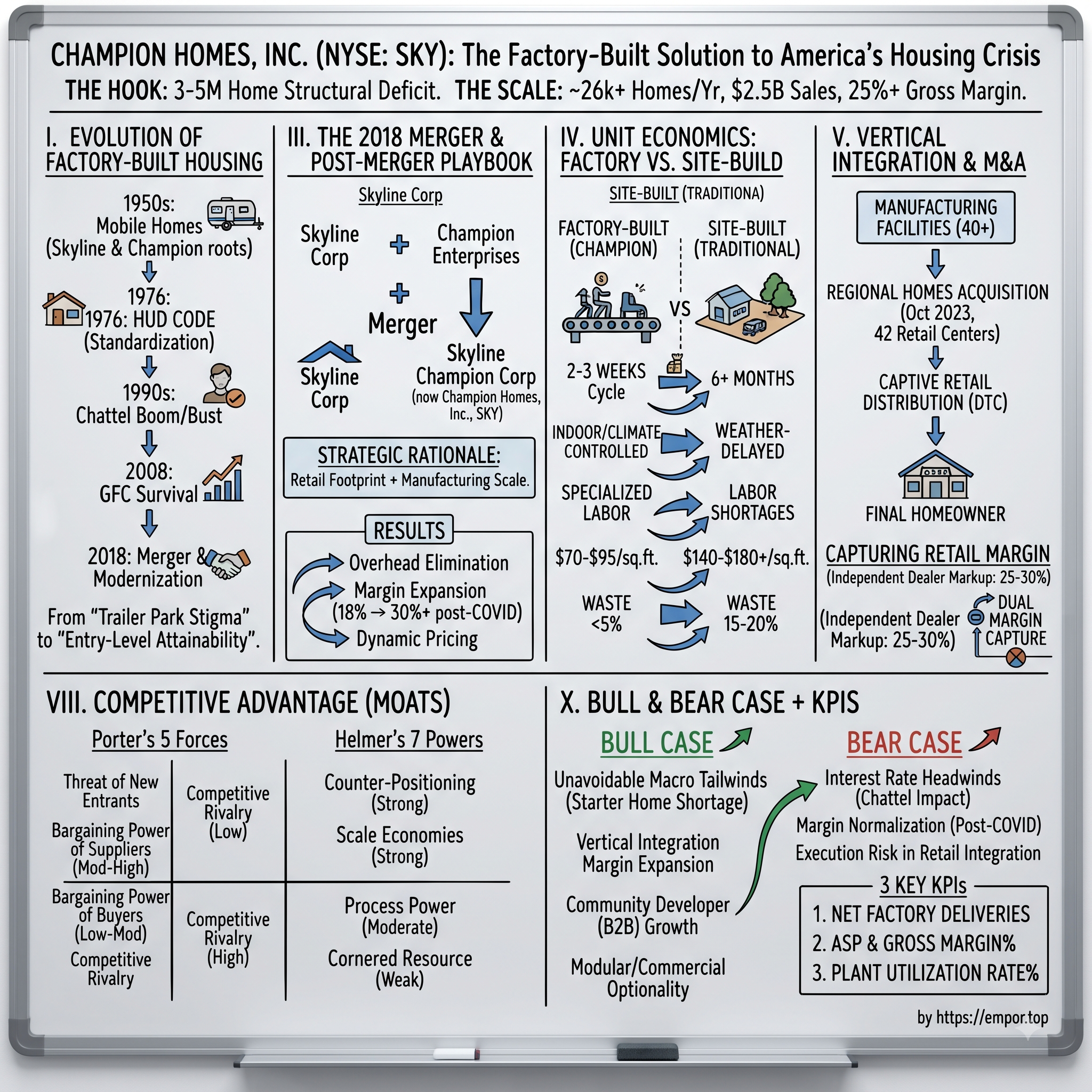
Champion Homes, Inc. (NYSE: SKY): The Factory-Built Solution to America's Housing Crisis
I. Introduction & Episode Roadmap
On an earnings call in early August 2026, Champion Homes Chief Executive Tim Larson described a legislative shift long considered unthinkable in the manufactured housing industry: federal legislation, passed with broad bipartisan support, eliminating a 50-year-old requirement forcing manufactured homes to be permanently welded onto a steel chassis.1 For half a century, that chassis functioned as the physical hallmark of the industry's lower-tier status — the element keeping manufactured homes categorized separately from traditional housing regardless of interior finishes, and allowing municipalities to exclude them from residential zoning codes with a single sentence. On July 10, 2026, the 21st Century ROAD to Housing Act became law, removing the chassis constraint.2
Larson offered a cautious response on the call. He noted that federal rulemaking, structural re-engineering, and updated transportation and installation procedures would require significant lead time. "We're not anticipating an impact in F '27 because those things take time," Larson told analysts.1 His measured tone reflects an executive accustomed to the slow pace of structural change in homebuilding.
That tension — a potentially transformative regulatory shift tempered by operational realities — defines the current crossroads for Champion Homes.
The scale today. Champion Homes is the second-largest producer of factory-built housing in North America. In fiscal year 2026, ended March 28, 2026, the company reported net sales of $2.66 billion, a 7.3% increase year over year, while selling 26,622 homes and generating $308.2 million in adjusted EBITDA.3 The company operates 46 manufacturing facilities across 20 U.S. states and three Canadian provinces, supported by approximately 9,300 employees. Significantly, Champion also owns 95 retail locations following a three-year push to acquire the distribution layer connecting its factories to home buyers.41 Today, Champion holds approximately 22.5% of the U.S. HUD-code wholesale market and roughly 2.6% of the total U.S. housing market.4 Its shares trade on the New York Stock Exchange under the ticker SKY, preserving the legacy ticker of Skyline Corporation following the company's 2024 rebranding.5
The core question. With the average price of a new single-family home in the United States approaching $500,000, factory-built housing presents a stark price contrast. Champion sells a factory-finished home at an average wholesale price of roughly $85,000, which translates to $140,000 to $150,000 when sold through its company-owned retail locations.1 Despite offering pricing significantly below traditional site-built homes, the entire HUD-code industry shipped approximately 96,000 homes in 2025 — virtually flat compared to 2024, and about one-quarter of its 1998 peak volume.6 This raises a central strategic question: why has a substantially lower-cost alternative failed to capture meaningful market share?
The primary constraints lie downstream of the factory floor: financing availability, restrictive municipal zoning, and fragmented retail distribution. Champion's strategy over the past five years has centered on addressing these three bottlenecks through retail acquisitions, vertical integration, and regulatory engagement. Evaluating the effectiveness of that strategy forms the core focus of this analysis.
The roadmap. The analysis begins with the industry's origins — two Midwestern trailer businesses founded in the early 1950s, the 1976 federal code that established modern standards, and the 1998 credit contraction that reshaped the sector. It examines the 2018 transaction that created the modern enterprise, the unit economics favoring factory construction over site-built homes, and the retail acquisition campaign — including Regional Homes, Iseman, and Homes Direct — that expanded Champion from a wholesaler into an integrated retailer. Next, the narrative reviews the December 2024 executive transition and management's performance during subsequent market cycles, concluding with an evaluation of the company's competitive positioning, structural risks, and core financial drivers.
 Subscribe on LinkedIn
II. The Origins & History of Factory-Built Housing (1950s–2010s)
The story of modern factory-built housing began in a welding garage in Elkhart, Indiana, in 1951. Julius Decio, an Italian immigrant, started building trailer coaches in a small shop — one of hundreds across northern Indiana, which became the nation's trailer capital thanks to abundant rail access, affordable land, and low labor costs.7 His son Arthur joined the business in June 1952 at age twenty-one. In June 1959, twenty-eight-year-old Art Decio launched an expansion strategy that opened manufacturing facilities in California, Texas, Louisiana, Kansas, and Oregon, establishing Skyline as a national builder.7 He took Skyline public at the start of the 1960s backed by consecutive profitable years and zero corporate debt — establishing a balance-sheet conservatism that would separate the sector's ultimate survivors from its casualties.
Two years after Julius Decio began operations in Indiana, Walter W. Clark and Henry E. George founded Champion Home Builders four hundred miles east in Dryden, Michigan, initially producing roughly two homes per week.8 Champion completed an initial public offering in 1962 and soon generated more than $30 million in annual sales. By the mid-1960s, it ranked among the five largest manufacturers in an estimated $1 billion mobile home market.8
Both enterprises produced essentially the same core product: factory-assembled housing on wheels, marketed to price-sensitive buyers and operating largely outside traditional municipal building regulations.
The 1976 HUD Code: the industry's founding act
Regulatory oversight changed fundamentally on June 15, 1976, with the enactment of the Federal Manufactured Home Construction and Safety Standards, known as the HUD Code. While conventional homebuilding in the United States is governed by local and state building codes that vary by municipality, the HUD Code established a uniform national construction standard that federally preempted local building codes for covered structures.9
This federal framework created two contrasting operational effects that continue to define the industry.
On the operational side, national preemption established the economic foundation for factory production. A manufacturer can design standardized floor plans, build uniform tooling, and distribute homes across dozens of states without adapting to individual municipal codes. By contrast, modular homes must comply with local building regulations in each destination jurisdiction. Larson underscored this operational advantage during the August 2026 earnings call, noting that a uniform federal code allows manufacturers to leverage national product specifications across their entire platform, whereas modular construction's compliance with varied local codes has historically restricted its adoption relative to HUD-code units.1
On the regulatory side, the HUD Code created a distinct legal classification that local governments quickly exploited. Because federal preemption dictates construction standards without overriding local land-use authority, municipalities frequently passed zoning ordinances barring HUD-code homes from single-family residential districts regardless of design quality or price. Five decades later, municipal zoning restrictions remain the principal structural barrier limiting factory-built housing's addressable market.
The 1990s boom and the credit bust that broke the industry
During the 1990s, the manufactured housing sector experienced an aggressive credit-fueled expansion that ultimately resulted in widespread distress.
The expansion was driven by financing structures. Because most manufactured homes were placed on leased land or family property rather than buyer-owned real estate, they were classified as personal property and financed through personal property chattel loans featuring higher interest rates and shorter terms than traditional mortgages. In the mid-1990s, specialty lenders flooded the sector, expanding the number of subprime lenders from fewer than 50 in 1993 to more than 250 by 1998.10 Underwriting criteria deteriorated as dealers chased volume commissions and manufacturers expanded capacity, driving a 30% increase in active U.S. manufacturing plants between 1990 and 1998.10
Annual industry shipments peaked at more than 373,000 units in 1998, driven largely by unsustainable credit expansion.11
The subsequent contraction proved severe and prolonged. As default rates surged, repossessed inventory climbed from approximately $300 million in early 1999 to $1.3 billion by late 2002, with lender recovery rates dropping to as low as 25%.10 The flood of repossessed units depressed pricing across the secondary market, forcing major lenders out of the industry and bankrupting retail dealerships. Annual shipments declined continuously over the following decade, bottoming near 50,000 units per year between 2009 and 2012 — an 87% reduction from peak volume.11
Skyline survived the downturn by scaling back operations. Champion experienced deeper distress, reporting a $52 million net loss in 2008 compared to a $3.9 million profit in 2007 as net sales fell 23%, before filing for Chapter 11 bankruptcy protection in Delaware in November 2009.128 Champion emerged from bankruptcy in 2010 under the ownership of an investor group led by Centerbridge Partners, MAK Capital, and Sankaty Advisors, alongside lenders led by Credit Suisse.8
This restructuring shaped Champion's current operational model. Assembled from a bankruptcy estate by credit investors who witnessed the destructive impact of excess leverage, the business adopted a disciplined capital allocation strategy that informs the net-cash balance sheet Champion maintains in 2026.
By 2017, the sector contained two primary publicly relevant entities: Skyline, a debt-free manufacturer generating approximately $237 million in annual revenue, and Champion Home Builders, a private-equity-backed operator with substantial manufacturing scale. The two companies were soon to merge.
III. The Inflection Point: The 2018 Merger & The Modern Playbook
The structure of the transaction announced on January 5, 2018, clearly signaled which party held the balance of power.
It was neither a true merger of equals nor a conventional acquisition. Champion Enterprises Holdings, LLC contributed all equity of Champion Home Builders, Inc. and CHB International B.V. to Skyline Corporation. In exchange, Skyline issued new shares such that Champion Holdings' members — investment funds associated with Bain Capital Credit, Centerbridge, and MAK Capital — would hold 84.5% of the combined company.13 The transaction closed on June 1, 2018.13 Skyline, the nominal acquirer whose stock ticker survived, retained just 15.5%.
In effect, this was a reverse merger operating as an initial public offering. The private equity sponsors obtained a public listing and a liquid stock currency for a business held since 2010 without paying underwriting fees or conducting an IPO roadshow, while legacy Skyline shareholders gained operational scale and management expertise. The combined entity listed on the New York Stock Exchange under the name Skyline Champion Corporation.14
The operational integration that followed proved far more decisive than the initial transaction. In its first full fiscal year ended March 30, 2019, the combined company generated $1.36 billion in revenue with a 17.7% gross margin, recording a $58.2 million net loss driven primarily by transaction and restructuring expenses. The 17.7% gross margin highlighted the underlying challenge: below an 18% gross margin, a factory-built housing manufacturer barely earns its cost of capital.
Integration efforts throughout fiscal 2020 and 2021 focused on structural efficiency: eliminating redundant corporate overhead across two headquarters, consolidating an overlapping brand portfolio, combining purchasing power across manufacturing plants that previously procured lumber and appliances independently, and standardizing floor plans so individual models could be assembled across multiple facilities. Gross margins rose to 20.0% in fiscal 2020 on virtually flat revenue of $1.37 billion — reflecting structural cost discipline rather than cyclical volume growth.
The pandemic distortion
The onset of COVID-19 introduced an extraordinary demand cycle that complicated evaluations of the company's normalized earning power.
The pandemic created three simultaneous catalysts for factory-built housing. Remote work expanded housing demand away from major metropolitan centers; rising site-built home prices and mortgage rates priced entry-level buyers out of traditional housing; and surging lumber prices inadvertently favored Champion. Because factory processes allowed Champion to adjust prices faster than its input costs escalated, the company expanded margins while site-built competitors faced severe supply chain delays.
The resulting financial surge was substantial. Revenue climbed from $1.42 billion in fiscal 2021 to $2.21 billion in fiscal 2022, peaking at $2.61 billion in fiscal 2023. Gross margins expanded from 19.9% to 26.3% and reached 31.0%, while net income grew from $84.8 million to $248.0 million and ultimately $401.8 million — a nearly fivefold expansion over two years.
That surge proved temporary. In fiscal 2024, ended March 30, 2024, revenue contracted 22% to $2.02 billion and net income fell 63% to $146.7 million. Fourth-quarter results were particularly muted, as gross margins dropped to 17.8% and earnings fell below five cents per share.
The downturn stemmed primarily from distribution channel dynamics rather than a collapse in underlying housing demand. Independent dealers who had built excess inventory during pandemic supply shortages spent eighteen months destocking retail lots, while community operators — institutional REITs and private owners buying homes in bulk for leased-land communities — similarly slowed purchases. Factory shipments paused while retail sales continued, illustrating a classic bullwhip effect inherent to wholesale models dependent on third-party inventory.
The capital allocation record
Throughout this volatility, management avoided balance-sheet leverage. At the fiscal 2023 peak, backed by $401.8 million in net income, the company held $747.5 million in cash against just $42.7 million in total debt. Champion entered the fiscal 2024 downturn with more than $700 million in net cash.
This capital position offers distinct operational safeguards while raising strategic questions. A cash-heavy balance sheet ensures the enterprise will not be forced into distressed asset sales during industry troughs — a vital defense in a sector where past downcycles bankrupted legacy operations. However, maintaining cash reserves through a peak does not by itself confirm allocation skill. The more demanding challenge — deploying capital into value-accretive acquisitions at disciplined valuations — began in late 2023, forming the central focus of current analytical debate.
IV. Industry Structure & Core Unit Economics
Inside a Champion manufacturing facility, the fundamental operational difference from traditional construction is immediately clear: the house moves along an assembly line while workers remain stationed at fixed locations.
A conventional site-built home relies on a rotating succession of subcontractors traveling to a fixed job site. Framers, electricians, drywall crews, and plumbers work sequentially, leaving the process vulnerable to weather delays and compounding individual overhead and profit margins. Factory construction inverts this model. A floor deck is assembled on a jig at the initial station and advances down the line. At successive stations, dedicated crews raise walls, install electrical wiring and plumbing, hang drywall, and fit cabinets, fixtures, flooring, and paint. Specialized teams perform the same precise operations using standard tooling for every home on the line.
This operational model resembles a commercial kitchen designed for high-volume preparation rather than an automotive assembly line. Ingredients and materials are standardized and pre-portioned within arm's reach, allowing workers to execute tasks with high speed and consistency.
This manufacturing approach generates three distinct cost advantages that behave differently across economic cycles.
Labor productivity. Specialization, repetition, central locations, and immunity to weather significantly reduce labor hours per square foot compared with traditional site building. More importantly, factory labor costs remain predictable because plants operate on structured shifts rather than waiting on third-party subcontractor availability. In a housing market constrained by a decade-long shortage of skilled construction labor, this productivity gain represents the company's most durable cost advantage.
Material waste and purchasing. Centralized digital cut lists reduce lumber waste, while offcuts are reused on subsequent units and raw materials remain protected from weather indoors. Furthermore, consolidating purchasing across 46 manufacturing plants enables Champion to negotiate national volume discounts with lumber mills, appliance manufacturers, and fixture suppliers. This procurement scale expands with volume, granting larger producers like Berkshire Hathaway's Clayton Homes a wider advantage over Champion, while Champion maintains a distinct cost edge over regional independent builders.
Overhead absorption. Unlike labor and materials, overhead absorption fluctuates significantly with quarterly production volumes, making manufacturing capacity utilization a critical operating metric. A plant carries substantial fixed operating costs, including physical facilities, tooling, line supervisors, and maintenance. Higher production volume spreads these fixed costs across more units. Increasing plant utilization from 59% to 65% expands gross margins without changes in pricing or input costs, whereas a decline toward 50% compresses operating margins as fixed overhead absorbs a larger share of revenue.
In the fiscal first quarter ended June 27, 2026, Champion reported a manufacturing capacity utilization rate of 62%, up from 59% sequentially and up one percentage point year over year. Management noted that this calculation includes six idled facilities currently out of operation.1 This disclosure methodology presents a conservative view of headline capacity while indicating that the company continues to carry dormant fixed overhead across six facilities as optionality for an eventual demand recovery — a holding cost maintained over several years of market softening.
The 250-mile problem
A primary physical constraint defining the competitive landscape is the high cost of transporting assembled housing units over long distances.
A standard single-section manufactured home spans 14 to 18 feet in width and up to 80 feet in length. Transporting these structures requires wide-load highway permits, escort vehicles, and specific route restrictions. Because shipping expenses accumulate rapidly with distance, the economically viable delivery radius from a plant typically caps out at a few hundred miles.
This geographic constraint alters how investors must evaluate the industry. Rather than operating as a single national manufacturing enterprise, Champion functions as roughly forty distinct regional businesses linked by unified corporate procurement and balance-sheet capital. Market share is secured plant by plant, meaning local competitive strength depends on factory proximity and order lead times relative to nearby dealers rather than overall national market share.
To control transport economics, Champion operates its own dedicated logistics subsidiary, Star Fleet. Geographic proximity also reinforced the strategic logic of Champion's acquisition of retail dealer Homes Direct. One of the eleven acquired retail locations sits adjacent to Champion's manufacturing facility in Chandler, Arizona, which already supplied the store.151 Chief Executive Tim Larson highlighted that proximity as "the model that we can replicate across those other 10 locations."15
These physical transport realities also temper expectations around the 21st Century ROAD to Housing Act. While the federal legislation removed the requirement for a permanent steel chassis, it did not eliminate the structural mechanics of moving large prefabricated modules over public roads. As Larson noted during the August 2026 earnings call, manufacturing non-chassis units requires "new engineering, transport and set considerations for HUD homes that are not built on a permanent chassis."1 The steel chassis historically served as both a legal distinction and the load-bearing frame used to tow homes from factory to site; eliminating it requires alternative structural and transport solutions.
What the price gap actually is
The magnitude of Champion's cost differential is evident in its segment pricing disclosures. On the August 2026 earnings call, Chief Financial Officer Dave McKinstray noted that Champion's average wholesale price to independent dealers is roughly $85,000, whereas homes sold through company-owned retail locations average $140,000 to $150,000.1 For full fiscal year 2026, the company reported a blended U.S. average selling price of $97,800.4
Compared with the U.S. new single-family home market, where average sale prices approach $500,000, factory-built housing occupies a distinct price tier. These figures indicate that Champion's primary growth bottleneck is not consumer demand for lower-cost housing, but rather distribution and buyer conversion. Potential buyers often face restricted financing options, exclusionary municipal zoning rules, or limited retail exposure. Consequently, the company's long-term growth trajectory depends heavily on expanding its retail distribution and overcoming downstream market barriers.
V. M&A Deep-Dive: The Regional Homes Acquisition & Vertical Integration
For most of its history, Champion's relationship with the buyer ended at the factory gate. The company sold homes wholesale to independent dealers who set retail markups, arranged buyer financing, coordinated site installation, and retained customer relationships. Under that structure, Champion captured manufacturing margins on an $85,000 factory wholesale unit, while third-party dealers captured the remaining downstream value. Over the past three years, Champion has deployed nearly half a billion dollars to vertically integrate into retail distribution and capture that downstream revenue.
Regional Homes: the anchor deal
On October 13, 2023, then-Skyline Champion closed the acquisition of Regional Enterprises LLC and its affiliates — Regional Homes — for approximately $313 million net of cash acquired, plus roughly $93 million of assumed debt primarily related to inventory floor plan liabilities.1617 The company funded the acquisition using cash on hand alongside $30 million in common stock, with the agreement including an earnout provision.16
Regional offered a distinct asset mix as the fourth-largest HUD-code manufacturer in the United States and an established retailer, operating three manufacturing facilities in Alabama and 43 retail sales centers across the Southeast, including Mississippi, Louisiana, Alabama, Florida, the Carolinas, and Texas.16 Rather than expanding standalone manufacturing capacity, Champion primarily secured a direct retail distribution channel supported by dedicated regional manufacturing.
The strategic logic of vertical integration rests on margin capture. By owning retail distribution, a manufacturer captures both manufacturing and retail margins on each unit sold, while acquiring direct consumer data on floor plan popularity, local price sensitivity, and buyer credit profiles. In fiscal year 2026, retail operations generated $975.5 million of Champion's total revenue, compared with $1.65 billion from manufacturing and $36.8 million from transportation services — shifting roughly 37% of total revenue downstream of the factory gate, compared to approximately 25% three years prior.18
This channel strategy entails structural cost trade-offs. Chief Financial Officer Dave McKinstray noted during the August 2026 earnings call that "retail runs heavier as a percent of sales to SG&A," acknowledging that expanding retail operations increases the corporate operating expense base.1 Direct ownership converts variable wholesale distribution costs into fixed operating overhead. While this fixed cost structure delivers positive operating leverage during demand expansions, it also increases fixed-cost overhead during market downturns — a dynamic that severely pressured retail-heavy builders during prior housing contractions.
The skeptic's question: did they buy the top?
The timing of the transaction raised immediate valuation questions, as October 2023 coincided with a cyclical low point in retail demand. In the two quarters following the transaction's close, Champion reported a fourth-quarter fiscal 2024 gross margin of 17.8% and minimal net earnings, driven by widespread dealer destocking and delayed capital deployment by community operators.
These conditions prompted debate over whether management acquired retail assets near peak valuation multiples.
Subsequent operational performance suggests the acquisition has remained resilient despite market headwinds. On a February 2025 earnings call, Chief Executive Tim Larson highlighted "the organic growth of the Regional Homes business and the accretive nature of the overall transaction."19 Independent financial metrics offer stronger evidence: Champion's captive retail channel expanded its share of consolidated revenue in each subsequent fiscal year, navigating a weak industry demand environment without triggering goodwill asset impairments. Carrying value for goodwill stood at $365.2 million at the close of fiscal 2026 without write-downs, while retail sales expanded year over year in both fiscal 2025 and fiscal 2026 despite broader declines in national HUD-code shipments.
However, executive continuity presents a notable qualification. Heath Jenkins, the Regional Homes chief executive who was named president of Champion's retail operations upon closing, departed the executive position on April 15, 2024 — six months after transaction close — transitioning to an advisory consulting role.20 When an acquirer pays $313 million primarily for a founder-led distribution platform and the founder steps down within two quarters, management continuity bears monitoring, even though operational integration has proceeded without major disruption.
Iseman and Homes Direct: filling in the map
Champion subsequently applied its retail integration model in two targeted regional transactions.
On May 27, 2025, Champion agreed to acquire Iseman Homes, adding ten retail sales centers across North Dakota, South Dakota, Minnesota, Montana, Nebraska, and Wyoming that generated approximately $40 million in annual revenue, explicitly to "strengthen distribution from its nearby manufacturing facilities."21 Financial terms were not disclosed upon closing in the fiscal first quarter ended June 2025.
On May 26, 2026, the company announced the acquisition of eleven Homes Direct retail locations spanning Arizona, California, Colorado, New Mexico, and Oregon, representing roughly $70 million in annualized revenue.15 The transaction closed on August 1, 2026, bringing Champion's company-owned retail store network to 95 locations.1 Management withheld transaction financial details for both deals, limiting external visibility into return on invested capital across its retail acquisitions.
The operational thesis for these additions relies on product conversion and plant utilization. Ten of the acquired Homes Direct locations currently sell competing manufacturers' homes alongside Champion models. By transitioning those sales lots exclusively to Champion brands, the company expects to capture wholesale manufacturing margins on additional units while absorbing excess plant capacity in Western facilities. Larson noted during the August 2026 call that the Western region represented the company's softest market in the quarter.1 Larson explicitly framed the transaction around revenue integration rather than expense reductions, stating, "they're a retail operator. They don't have manufacturing. So some of those traditional synergies we see, we don't see in that aspect."15
Because management explicitly disclaimed cost-synergy targets, the success of the retail expansion depends on measurable metrics: brand conversion rates and same-store sales growth across acquired locations.
How it compares
Champion's vertical integration strategy aligns with the structural framework developed by market leader Clayton Homes. Over several decades, the Berkshire Hathaway subsidiary integrated manufacturing operations, retail dealerships, and proprietary financing platforms, capturing approximately 45% of total U.S. manufactured housing shipments.22 Champion is pursuing a comparable vertical model, operating at roughly half of Clayton's national market share.
In contrast, peer competitor Cavco Industries has maintained a primary focus on manufacturing scale, highlighted by its acquisition of American Homestar. For fiscal year 2026, Cavco reported $2.245 billion in net revenue and delivered a record 20,842 factory-built homes, while its factory-built segment gross margin contracted from 22.9% to 22.1%.[^23] Champion's larger delivery volume, higher consolidated gross margin, and expanding retail mix demonstrate the relative performance advantages of vertical channel ownership over pure wholesale manufacturing in the current market environment.
The financing leg
To address downstream credit availability, Champion established a dedicated financing structure in late 2023. In August 2023, the company announced a strategic agreement with ECN Capital, the Canadian parent company of Triad Financial Services, the largest independent lender in manufactured housing.23 Closing in September 2023, the transaction comprised a C$185 million (approximately $138 million) equity investment for a 19.9% indirect interest in ECN, alongside the formation of Champion Financing LLC — a joint venture owned 51% by Champion and 49% by Triad that provides dealer floor-plan inventory loans and consumer mortgages.2324
This joint-venture structure targeted both wholesale and retail credit bottlenecks. Floor-plan financing dictates dealer inventory capacity, while consumer lending determines buyer conversion at the sales lot. By taking a minority equity stake and establishing an operational partnership rather than acquiring a full lending institution, Champion minimized direct credit risk exposure while securing financing access for its retail distribution channel and obtaining underwriting data.
The transaction subsequently yielded capital returns. Following an acquisition of ECN Capital by an investor group led by Warburg Pincus, Champion received approximately C$189.1 million for its equity stake in the quarter ended June 2026, recovering its initial investment capital while preserving the operational Triad joint venture.251 Management redeployed a portion of those cash proceeds directly into the Homes Direct retail acquisition.1 This capital sequence allowed Champion to establish captive financing access, monetize its minority equity position at a profit, and reinvest the proceeds into expanding retail distribution while retaining its underlying lending partnership.
VI. Segment Breakdown & Financial Architecture
Stripping away strategic narrative, Champion in fiscal 2026 comprised three distinct operating segments sharing a single balance sheet.
Manufacturing generated $1.65 billion in revenue, operating factories that sell HUD-code manufactured homes and modular units across four channels: independent retailers, company-owned sales centers, community operators, and builder-developers.18 Retail generated $975.5 million through company-owned sales centers, capturing consumer-level markups.18 Transportation — operating as Star Fleet Trucking to transport finished units from factories to installation sites — generated $36.8 million.18 Canadian operations, conducted through Moduline and SRI Homes across three western provinces, represented a smaller footprint, delivering roughly 900 homes at an average price of about $122,800, or slightly over 4% of consolidated revenue.4
The channel mix within manufacturing represents the key operational variable, shifting materially during fiscal 2026. Captive retail expanded to 37% of consolidated sales in the fiscal fourth quarter from 35% a year earlier, before settling to approximately 35% in the June 2026 quarter as independent dealer and community operator volumes recovered.31 This channel oscillation directly drives variations in consolidated average selling prices, requiring ongoing clarification from management.
The fiscal 2026 scorecard
Fiscal 2026 delivered solid operational growth against a muted industry backdrop. Net sales rose 7.3% to $2.66 billion, adjusted EBITDA grew 8.1% to $308.2 million, and net income reached $206.9 million, while adjusted gross margin held essentially flat at 26.6% compared with 26.7% in the prior year.3 Total units sold reached 26,622 homes — the highest volume since the company went public in 2018.3
Industry context highlights this relative performance. While overall HUD-code industry shipments fell roughly 9% year over year during the three months ended March 2026, Champion's volume declined only in the low single digits over the same period.3 Total national industry production for calendar year 2025 reached 95,938 homes, virtually flat compared with 96,236 units in 2024.6 By expanding unit volume and maintaining margins during an industry contraction, Champion gained market share, raising its wholesale market share to 22.5% in its fiscal 2026 Form 10-K from approximately 20% following the 2023 Regional Homes acquisition.4
Cash generation provided further balance-sheet strength. Operating cash flow rose 26.2% in fiscal 2026 to $303.9 million, up from $240.9 million in fiscal 2025 — achieving cash conversion above net income, which, in a working-capital-intensive business carrying $358 million in inventory, reflects disciplined working-capital management.3
The balance sheet, and what it's for
At fiscal year end, Champion held $638.3 million in cash against $109.1 million in total debt, creating a net cash position of roughly $529 million against $1.57 billion in shareholders' equity.3 Following the receipt of ECN transaction proceeds, cash balances rose to $784.7 million in the June 2026 quarter.1
Management has increasingly deployed capital toward share repurchases. Since initiating its buyback program in fiscal 2025, Champion has repurchased $330 million in common stock — approximately 8% of outstanding shares — including $200 million in fiscal 2026 and $50 million during the June 2026 quarter.31 In July 2026, the board of directors refreshed the buyback authorization to $150 million.1 Consequently, diluted share count declined from approximately 58.1 million in fiscal 2025 to about 55.2 million in the most recent quarter.
This cash accumulation raises a central capital allocation question: why does a debt-free enterprise generating $300 million in annual operating cash flow maintain nearly three-quarters of a billion dollars in liquid reserves? Management cites acquisition optionality, pointing to the Homes Direct transaction as evidence of strategic execution. However, net cash has expanded over three years despite active share repurchases and three retail acquisitions. Holding substantial cash reserves creates an ongoing drag on return on equity, placing the burden on management to demonstrate that its acquisition pipeline generates returns sufficient to justify maintaining a heavy cash buffer.
The margin question
The central financial variable for the business over the next two years is gross margin trajectory.
Adjusted gross margin averaged 26.6% in fiscal 2026 before stepping down to 25.2% in the June 2026 quarter, with management guiding to between 25% and 26% for the September quarter.1 Cost pressure stemmed from input inflation — initially across forest products, followed by steel and petroleum-linked materials — alongside a product mix shift toward lower-priced wholesale channels.31
Chief Financial Officer Dave McKinstray has noted that product price increases lag input cost inflation, projecting that pricing adjustments initiated in the June quarter would gain momentum in the second fiscal quarter as overall input inflation stabilizes at higher levels.1 This guidance establishes a clear operational benchmark. If September-quarter gross margins hold within the guided range and expand sequentially, it will demonstrate effective cost pass-through. If margins weaken further, it would lend support to concerns that Champion's post-2021 margin expansion was primarily a temporary pandemic effect returning toward historical levels.
The structural evidence indicates a middle ground. The margin expansion from 17.7% in fiscal 2019 to the mid-20% range reflects genuine structural change, with roughly one-third of the gain driven by vertical integration into higher-margin retail distribution. Conversely, the peak gross margin of 31.0% reached in fiscal 2023 was clearly inflated by pandemic supply disruptions, establishing an unsustainable baseline for normalized earnings.
VII. Current Management, Incentives & Governance
On Friday, December 13, 2024, Champion Homes issued a press release announcing that Chief Growth Officer Tim Larson had been appointed President, Chief Executive Officer, and a director, effective immediately. Mark Yost, who had led the company since 2019 through its post-merger integration, pandemic expansion, and the Regional Homes acquisition, would "be available as needed to support an orderly transition."26
An abrupt leadership transition pairing an "effective immediately" mandate with a predecessor demoted to on-call availability rarely signals a planned handoff. Champion has never publicly explained what prompted the timing, and that lack of disclosure remains a notable governance consideration for investors to weigh, even though no subsequent issues have surfaced to suggest improper conduct.
Who Tim Larson is
Larson is not a traditional housing executive, which reflects his strategic orientation. He joined Champion in May 2021 as Chief Growth Officer following a career in consumer brand management, serving as CEO of Jostens, the class-ring and yearbook company, and earlier as Chief Marketing Officer and Senior Vice President of Global Customer Excellence at Polaris Industries, the snowmobile and off-road vehicle manufacturer.26 Polaris provides the most relevant background parallel: an industrial manufacturer selling big-ticket durable goods through a network of independent dealers it does not own, where the core commercial challenge involves balancing relationships among dealers, the corporate brand, and end consumers.
That operational dynamic matches Champion's primary challenge and explains Larson's strategic framework. Since assuming the top role, his stated priorities have remained steady: innovating product lines by customer segment at targeted price points, expanding category awareness, building direct-to-consumer digital capabilities, growing the retail footprint, and disciplined capital allocation. His focus on establishing a digital "front door," implementing "good, better, best" product tiering, and deploying lead-management tools within the dealer portal reflects consumer marketing concepts applied to an industrial enterprise.119 This commercial vocabulary represents a distinct shift from traditional factory-built housing messaging.
Critically, Larson has avoided framing captive retail expansion as a confrontation with independent dealers. Asked in February 2025 about potential channel conflict, he outlined how digital marketing investments route customer leads to independent dealers, while pointing to Champion's multi-brand portfolio as the mechanism allowing company-owned and independent locations to operate in shared markets without market cannibalization.19 In the fiscal quarter ended June 2026, independent retail sales rose 4% year over year alongside growth in captive retail, indicating that independent dealers have maintained their wholesale relationships.1
The finance seat
Executive transition in finance followed a similar pattern of structured handoff. Laurie Hough retired after more than twenty years with Champion, including nine years as Chief Financial Officer, handing over responsibilities to Dave McKinstray on January 12, 2026, and remaining through May 31, 2026, to assist with the transition.27 McKinstray joined from WK Kellogg, where he served as CFO of the newly independent public entity and directed its margin enhancement program prior to its acquisition by Ferrero.27
Recruiting a CFO with margin-optimization experience from packaged consumer goods into an enterprise navigating input cost pressures aligns with management's broader strategy. It also places executives with consumer-brand backgrounds in both top leadership roles, reflecting a strategic posture that Champion's primary growth barriers center on commercial execution and distribution rather than factory operations.
Does the narrative hold up across calls?
A review of earnings call transcripts shows a consistent communications record, marked by operational transparency alongside realistic guidance limits.
The margin promise. In February 2025, Hough told analysts she expected gross margins to "return to the 26% to 27% range."19 Champion reported a 26.6% adjusted gross margin for fiscal 2026, fulfilling that benchmark.3
The inflation warning. Management alerted analysts to rising forest-product costs during the third-quarter fiscal 2026 call before the increases materialized in reported results. Executives subsequently detailed cost trends through the fourth quarter and into the first quarter of fiscal 2027, tracking sequential inflation from lumber and oriented strand board to steel and petroleum-based materials.31 Providing early visibility into cost headwinds reflects prudent communication.
The community-channel call. In November 2025, Larson warned that community operator sales would be "mixed and impact near-term sales."28 Deliveries subsequently slowed in the fourth quarter of fiscal 2026 before rebounding modestly in the first quarter of fiscal 2027, matching management's projected cadence.31
The guidance limit. In November 2025, Hough advised analysts that near-term gross margin expectations had improved to "the 26% range," raising prior guidance of 25% to 26%.28 Two quarters later, guidance stepped back to between 24.5% and 25.5%.3 While unexpected input-cost escalation caused the shift rather than flawed forecasting, the revision highlights that near-term margin targets carry a limited useful life and should be evaluated as directional signals rather than precise forecasts.
Management has also demonstrated transparency when cost pressures exceed initial estimates. During the August 2026 earnings call, an analyst noted that sequential pricing had declined despite earlier guidance expecting steady levels. Chief Financial Officer Dave McKinstray acknowledged the deviation directly, noting it was "just a little bit more of a headwind than we had initially anticipated."1 That candid posture provides credibility when assessing executive commentary.
The compensation problem
Executive compensation structure reveals contrasting governance incentives.
For fiscal 2026, the annual incentive plan for named executives relied on two company-wide metrics: consolidated earnings per share (50%) and consolidated revenue (50%), with revenue targets established at $2.324 billion for threshold payout, $2.582 billion for target, $2.840 billion for over-performance, and $3.098 billion for maximum payout.2930 Performance share units granted in fiscal 2026 vest 60% based on relative total shareholder return through March 2029 and 40% based on single-family home completion market share as of January 2029.29
This structure creates two distinct alignment outcomes.
On the annual incentive side, allocating half of executive bonuses to consolidated revenue poses structural risks. For an enterprise actively pursuing retail acquisitions — having completed three transactions over three years — a revenue-linked metric rewards management for expanding top-line scale regardless of purchase price or capital efficiency. The annual plan contains no return-on-capital metric. Given that acquisition prices for two of the three retail deals were not disclosed, investors cannot independently verify whether these transactions generate returns above the company's cost of capital, and short-term executive compensation does not require them to do so.
Conversely, the long-term incentive plan incorporates stronger alignment mechanisms. Weighting relative total shareholder return at 60% over a three-year performance period establishes a direct market benchmark. Furthermore, measuring market share against all U.S. single-family home completions rather than solely HUD-code shipments sets an ambitious target that rewards executive management only if factory-built housing captures market share from traditional site-built construction.
VIII. Strategic Moats & Framework Analysis
Evaluating Champion's long-term competitive position requires analyzing how its business model withstands industry dynamics defined by three primary manufacturers, an evolving regulatory framework, and direct competition from existing housing stock.
Hamilton Helmer's 7 Powers
Counter-positioning: real, but bounded by market segmentation. The thesis for counter-positioning holds that traditional site builders cannot adopt factory production without abandoning their core business model of optioned land banks, subcontracted labor, and asset-light balance sheets. Public homebuilders redirecting capital into factory assets would trade high valuation multiples for lower manufacturing multiples while lowering returns on capital.
However, the limits of this power are distinct: traditional homebuilders have little incentive to replicate the factory model because they serve a different customer segment. Entry-level site-built homes start near $250,000 in most markets, whereas Champion’s completed factory-built homes sit well below that threshold, minimizing direct market overlap. Counter-positioning protects Champion from a competitive threat that was unlikely to materialize. The strategic value of counter-positioning would become relevant only if Champion successfully expands into higher price tiers via its builder-developer channel and non-chassis homes. That expansion remains in its early stages. Chief Executive Tim Larson described builder-developer sales as "accelerating" and cited an off-site construction event in York, Nebraska, that drew more than 150 attendees, while continuing to characterize the channel as a small portion of overall revenue.128
Scale economies: significant, but subordinate to the market leader. Procurement leverage across 46 manufacturing plants, a captive logistics fleet, and centralized product engineering provide tangible cost advantages over regional independent producers. However, market leader Clayton Homes holds approximately 45% market share, generating greater purchasing scale and funding consumer purchases through proprietary lenders Vanderbilt Mortgage and 21st Mortgage backed by Berkshire Hathaway's cost of capital.22 Champion maintains scale economies relative to smaller competitors alongside a scale disadvantage relative to the market leader, establishing a defensible but non-dominant position.
Process power: moderate, though difficult to verify externally. Plant layout design, specialized tooling, line balancing, and the operational capability to change over production between single-section, multi-section, park models, and cabins without sacrificing throughput represent accumulated manufacturing expertise. Larson highlighted this operational flexibility when addressing how the transition to chassis-free homes would impact factory standardization, noting that "the agility of the team is a key part of that."1 A key analytical constraint is that process efficiency cannot be independently verified by external observers. While Champion's factory-built gross margins exceed those of Cavco Industries, its higher proportion of company-owned retail locations accounts for much of that margin differential.
Cornered resources: limited primarily to permitted facility locations. Raw materials such as lumber, steel, drywall, and factory labor are widely available to industry participants. The primary scarce asset in the sector is local entitlement: an operational, fully permitted manufacturing facility positioned within an economical shipping radius of a growing housing market. Securing municipal approvals for new manufacturing plants presents substantial regulatory barriers, making Champion's footprint of 46 plants across 20 states a meaningful operational barrier. However, physical footprint functions as a cornered resource only when supported by end-market demand; Champion maintained six idled facilities and closed additional plants during fiscal 2026.128
Branding, network economies, and switching costs: largely absent. Champion's Skyline brand was named the most trusted manufactured housing brand by Lifestory Research for five consecutive years through 2024, and the enterprise earned a National Association of Home Builders Best in American Living Gold Award alongside its twelfth consecutive Manufactured Housing Institute excellence award in fiscal 2026.193 While these honors assist in dealer recruitment and support broader industry normalization, they do not grant pricing power over entry-level buyers focused on monthly payments. The sector exhibits no network effects, and once a unit is installed, home buyers have no ongoing product ecosystem to switch out of.
Net assessment: Champion's competitive moat is regional, real, and moderate, grounded in volume procurement, plant proximity within delivery radiuses, and expanding retail ownership. Management's actions — maintaining idled capacity, expanding captive retail distribution, and supporting regulatory reforms — indicate an ongoing effort to widen that competitive perimeter.
Porter's Five Forces
Threat of new entrants: low. Capital requirements, HUD-code regulatory compliance infrastructure, plant permitting hurdles, and the necessity of securing retail dealer distribution within a 250-mile shipping radius make greenfield entry impractical. Industry entry primarily occurs through the acquisition of existing regional producers, driving ongoing sector consolidation.
Supplier power: moderate to high, and currently binding. Supplier power in factory-built housing stems from commodity cost exposure rather than vendor concentration. Forest products represent Champion's largest procurement expense, followed by steel and petroleum-linked inputs. Management has explicitly disclosed that product pricing adjustments lag input cost inflation.31 For example, import tariffs added approximately 0.5% to material costs in the September 2025 quarter and were projected to reach 1.0%, driven in part by a 10% countervailing and antidumping duty on Canadian lumber.28 An enterprise unable to immediately pass through raw material cost increases possesses limited supplier-facing pricing leverage.
Buyer power: bifurcated. Individual retail buyers possess minimal bargaining power due to the scarcity of alternative lower-cost housing. Conversely, wholesale intermediaries retain substantial leverage. Independent dealers, who distribute roughly two-thirds of industry volume, can allocate lot space to competing manufacturers like Clayton or Cavco, while institutional community operators purchase units in bulk. Champion's retail acquisitions directly address this dynamic by converting independent distribution channels into owned retail outlets.
Threat of substitutes: high. The primary market substitute for a new factory-built unit is not a competitor's home, but existing site-built housing inventory, rental apartments, or a buyer's decision to remain in place. When mortgage rates decline and traditional housing inventory expands, resale home availability increases at price points that compete directly with new manufactured units. Conversely, elevated mortgage rates constrain chattel-financed buyers while simultaneously restricting resale housing supply.
Rivalry: intense but regionally structured. The competitive landscape is divided among Clayton at approximately 45% wholesale share, Champion at 22.5%, Cavco with 20,842 units delivered in fiscal 2026, and a fragmented group of smaller regional producers.224[^23] Competition takes place market by market, centered on financing terms and monthly affordability. Larson described this dynamic as assisting buyers to "get to the right home at the right price point every month that they're looking to pay."1
Synthesis: The primary forces shaping Champion's operational profitability are raw material input inflation and competition from existing housing stock — variables largely outside executive control. Consequently, management's strategic focus remains centered on controllable operational levers: downstream retail distribution, captive financing access, and regulatory reform.
IX. Material Risk Radar & Skeptical Investor Stress Test
1. The chattel financing gap — the industry's original sin
The structural underperformance of manufactured housing stems directly from a foundational legal distinction: whether a structure is titled as real estate or personal property.
When a homebuyer owns the underlying land and permanently affixes the structure, the home can be titled as real estate and financed through a standard 30-year mortgage. However, when a home is placed in a leased-land community — which accounts for a substantial share of industry volume — it is classified as personal property and financed using a chattel loan. A study by the Consumer Financial Protection Bureau highlighted both the significant interest rate premium associated with chattel loans and the extreme concentration of chattel lending among a small cadre of specialty lenders.10
The underlying math presents a formidable barrier for prospective buyers. On a home priced at $85,000 to $95,000, an interest rate premium of several hundred basis points combined with a shorter loan term adds significantly to the monthly payment — the primary metric governing entry-level buyer decisions. Consequently, a home that is 70% cheaper to produce at the factory gate may offer only a modest monthly savings advantage over conventional housing when financed through chattel channels.
Champion's response has been its Champion Financing joint venture with Triad, which provides operational participation in both dealer floor-plan lending and direct retail mortgage originations.23 Chief Executive Tim Larson has noted that the partnership provides direct visibility into buyer credit quality, reporting that the joint venture has continued to perform well.1 Nevertheless, a 51/49 joint venture with a mid-sized lender does not replicate the structural advantage of market leader Clayton Homes, which leverages Berkshire Hathaway's balance sheet to back proprietary lenders Vanderbilt Mortgage and 21st Mortgage. The joint venture mitigates Champion's financing constraint, but it does not eliminate it.
Falsification test: The core investment case would be challenged if mortgage rates decline materially across the broader housing market without generating a corresponding recovery in manufactured housing shipments — confirming that chattel financing structures, rather than benchmark interest rates, remain the primary bottleneck.
2. Zoning, NIMBYism, and the ROAD Act's real significance
Municipal land-use regulation represents the second principal barrier limiting addressable market expansion. When a local government excludes manufactured housing from single-family residential zones, it effectively removes that municipality from Champion's addressable market regardless of price point or architectural quality.
This regulatory backdrop underscores the strategic context of the 21st Century ROAD to Housing Act. Signed into law on July 10, 2026, following bipartisan votes of 358–32 in the House and 85–5 in the Senate, the legislation removes the half-century-old federal mandate requiring HUD-code homes to be constructed on a permanent steel chassis while establishing the Department of Housing and Urban Development as the primary authority over energy efficiency standards for manufactured homes.23132
Eliminating the permanent steel chassis alters the structural presentation of factory-built units. Removing the chassis allows a factory-built home to be set on a conventional foundation with traditional architectural lines, achieving visual parity with site-built homes while continuing to leverage a uniform national HUD code rather than fragmented municipal building codes. Larson emphasized that management does not view the legislative change primarily as a cost-reduction measure, framing it instead as an opportunity to achieve aesthetic parity with site-built construction and expand access into municipalities that historically restricted chassis-mounted structures.1
However, federal legislative reform does not preempt local municipal zoning authority. While Congress removed a structural manufacturing requirement, it did not obligate municipal planning boards to revise local land-use restrictions. Parallel state-level legislative initiatives remain equally critical: Virginia recently enacted legislation permitting manufactured housing placement in residential districts wherever site-built homes are allowed, while Larson highlighted Kentucky, Texas, and Montana as additional states advancing toward regulatory parity.13
Implementation will require an extended multi-year timeframe. Federal rulemaking, HUD administrative procedures, structural re-engineering for chassis-free transport, and dealer retraining must occur before commercial adoption. Management explicitly excluded any financial contribution from chassis-free units in fiscal 2027, observing that past HUD regulatory updates required a year or more to execute.1 Furthermore, Larson projects ongoing market bifurcation, noting that community operators and traditional price-sensitive buyers will likely continue to favor lower-cost chassis-built designs.1
Analytical perspective: The legislative reform functions as a long-term strategic option with an uncertain adoption curve rather than an immediate earnings driver for fiscal 2027. Valuing the stock on headline statutory changes assumes rapid administrative rulemaking — historically one of the least predictable variables in housing policy.
3. The bullwhip: dealer and community inventory cycles
Champion distributes approximately two-thirds of its production volume through independent dealers financing lot inventory and institutional community operators purchasing homes in bulk. Both customer segments expand orders rapidly during demand upturns and curtail purchases sharply during contractions while liquidating existing inventory, exposing manufacturing operations to amplified demand volatility.
Fiscal 2024 demonstrated the financial impact of this inventory bullwhip. Furthermore, Champion maintains direct floor-plan credit exposure through its Champion Financing joint venture, creating a dual risk during major dealer downturns where manufacturing order volume contracts simultaneously with elevated credit exposure on financed lot inventory.
The company's vertical integration strategy provides a partial structural offset. Expanding company-owned retail distribution to 95 locations converts wholesale inventory sales into direct retail consumer transactions, dampening channel volatility. Operationally, management manages plant utilization through an explicit 4-to-12-week backlog target, matching production schedules to verified end-market delivery schedules rather than speculative forecasts. Consolidated backlog ended the first quarter of fiscal 2027 at $421.8 million — representing approximately nine weeks of production — compared with $302 million a year earlier.1 Larson detailed this operational pacing, noting that facilities adjust production slots to advance ready orders when specific customer installations face site-preparation delays.1
4. Input costs and the pass-through lag
Raw material procurement introduces recurring operating margin volatility. Champion possesses limited financial tools to hedge its primary raw material inputs — predominantly forest products, steel, and petroleum-based components — and experiences a typical one-to-two-quarter lag before passing raw material cost increases through to finished home pricing.
During periods of rapid input cost inflation, manufacturing gross margins compress initially before recovering as updated price structures flow through the order backlog. This margin lag reflects the operational reality of managing a nine-week production backlog alongside multi-month vendor supply contracts.
5. Other overhangs worth noting
Tax rate adjustments. The expiration of federal ENERGY STAR tax credits on July 1, 2026, is projected to increase Champion's effective corporate tax rate from approximately 21% to roughly 25% in fiscal 2027.13 This four-percentage-point tax rate increase represents an exogenous cost headwind to net income growth that is independent of core operational performance.
Geographic concentration and severe weather. Champion's extensive retail and manufacturing presence in the Southeastern United States leaves operations vulnerable to regional weather disruptions. Hurricane activity across North Carolina and Florida shifted delivery timing between fiscal 2025 quarters, while severe winter weather impacted production during the fourth quarter of fiscal 2026.283 Additionally, extreme weather contributed to a decline in Canadian delivery volume from 250 units to 185 units during the fiscal first quarter ended June 2026.1 While quarterly weather impacts remain transitory, they introduce measurable near-term earnings volatility.
Financial disclosures. Champion maintains a conservative balance sheet, reporting $365.2 million in goodwill against $1.57 billion in total shareholders' equity with no history of asset impairments. However, financial transparency remains limited in specific operational areas: management has withheld purchase price terms for two of its recent retail acquisitions and does not disclose the unit sales breakdown between single-section and multi-section floor plans, complicating external analysis of average selling price trends.
Capacity utilization. Champion carried six idled manufacturing facilities alongside operational plant closures during fiscal 2026, offset in part by a $3.7 million gain on the sale of one idled property.128 While management views dormant facilities as low-cost optionality to support future volume expansion, the persistent holding costs highlight that total manufacturing capacity remains above current end-market demand levels.
X. The Investment-Story Spine: Bull vs. Bear Case
Why Champion wins from here
The affordability gap is structural, and it is Champion's entire market. The gap between what entry-level American households can afford and what traditional site-built construction can deliver has widened for fifteen years without a clear mechanism for closing. Site builders face persistent labor scarcity, high land costs, and municipal regulatory overhead that keep single-family construction prices elevated. Chief Executive Tim Larson's framing — that the company's relative value proposition "only becomes more powerful in a higher cost, higher uncertainty environment" — reflects corporate advocacy, but aligns with broader housing affordability metrics.3 Champion remains one of just three national factory-built producers capable of supplying new-construction single-family homes at sub-$150,000 retail price points.
Share gains are showing up in the data, not just the narrative. In the quarter ended March 2026, broader HUD-code industry shipments fell roughly 9% year over year while Champion's unit volume declined only in the low single digits. In the three months ended May 2026, total industry shipments fell approximately 5% even as Champion's U.S. home sales expanded 1.8%.31 Outperforming broader industry volumes by several hundred basis points over consecutive quarters provides empirical support for management's commercial strategy during an industry-wide market contraction.
Vertical integration is producing measurable channel growth. Company-owned retail has expanded from roughly one-quarter of total revenue to approximately 37%, delivering organic growth across acquired locations despite a subdued overall demand environment. Expanding the captive distribution network allows Champion to capture downstream retail markups, absorb regional factory capacity, and gather direct consumer credit and design preference data.
Regulatory momentum has genuinely turned. The passage of the 21st Century ROAD to Housing Act — approved by votes of 358–32 in the House and 85–5 in the Senate — signals a durable bipartisan consensus that factory-built construction represents a key component of national housing policy.2 Paired with emerging state-level parity laws, the legislative backdrop represents the most favorable regulatory shift for HUD-code builders since the establishment of the federal HUD Code in 1976.
Optionality is real and cheaply held. Developing chassis-free homes creates long-term access to builder-developers and municipalities that historically excluded chassis-mounted structures. Supported by $784.7 million in cash and an active share buyback authorization, Champion maintains substantial liquidity while pursuing these expansion channels. Even if adoption proves slow, the baseline business remains a cash-generative regional producer holding a 22.5% national wholesale market share.
Why it might not
Margins may be reverting, and the reversion has started. Adjusted gross margins contracted from 26.6% in fiscal 2026 to 25.2% in the quarter ended June 2026, with management guiding to 25% to 26% for the September quarter.31 Persistent input cost inflation paired with delayed price pass-through risks compressing gross margins back toward historical low-20% levels. Peer competitor Cavco Industries reported factory-built gross margins declining to 22.1%, indicating that input cost pressure reflects broader sector headwinds rather than company-specific operational flaws.[^23]
Retail integration converts flexibility into fixed cost. Operating 95 company-owned retail locations embeds ongoing facility leases, store personnel, inventory floor-plan interest, and overhead into every operational period. Selling, general, and administrative expenses have averaged 16% to 17% of revenue, with management noting that total SG&A dollars will continue to rise alongside retail footprint expansion.1 Historical housing cycles demonstrate that elevated fixed retail overhead exacerbates margin compression during severe volume downturns.
The catalyst may be slower and smaller than the narrative. Management explicitly expects no financial contribution from the ROAD to Housing Act in fiscal 2027, projects that price-sensitive buyers will continue to purchase chassis-built models, and acknowledges that federal legislation does not override local municipal zoning authority.1 Consequently, commercial adoption of chassis-free construction will likely require a multi-year timeline extending well beyond near-term financial estimates.
Incentives are not fully aligned with capital discipline. The annual executive incentive plan allocates 50% of short-term bonus payouts to consolidated revenue growth — rewarding management for expanding top-line scale while Champion actively executes retail acquisitions at undisclosed valuations.2930 Without incorporating return-on-capital metrics into annual incentive formulas or disclosing purchase prices for acquisitions, short-term compensation structures remain imperfectly aligned with long-term capital discipline.
The scale leader has better weapons. Market leader Clayton Homes commands approximately 45% of U.S. manufactured housing shipments and operates captive financing subsidiaries backed by Berkshire Hathaway's low cost of capital.22 Champion consequently competes against an industry leader with lower funding costs at the primary market bottleneck: consumer credit availability.
The consumer is under visible pressure right now. Management noted that entry-level buyers are increasingly opting for base-level configurations within multi-section home lines to meet monthly budget constraints, observing that cumulative inflation "disproportionately impacts that entry-level buyer."13 Shift in product mix toward lower-priced configurations signals ongoing affordability pressure across Champion's core customer demographic.
The three KPIs that actually matter
Everything above compresses into three primary operating metrics that isolate structural performance from broader housing cycles:
1. Champion's U.S. homes sold versus industry HUD shipments. Rather than focusing solely on absolute unit volume, analysts should track the performance growth spread. Comparing Champion's growth rate against monthly HUD-code industry shipments isolates operational execution from broader macroeconomic cycles. If Champion maintains a multi-hundred-basis-point outperformance spread, it confirms that vertical retail integration and product positioning are driving market share gains. If the performance spread collapses, the structural differentiation thesis weakens.
2. Adjusted gross margin, read alongside captive retail as a percent of sales. Evaluating gross margin in isolation can mask underlying driver dynamics. Gross margin expansion driven by a higher proportion of retail sales reflects channel mix rather than pricing leverage, whereas margin expansion alongside a stable retail channel mix demonstrates genuine cost pass-through. Tracking whether mid-2026 price adjustments materialize in the September and December fiscal quarters provides a direct test of whether mid-20% gross margins represent a durable structural benchmark.
3. Manufacturing capacity utilization. Capacity utilization provides the clearest measure of manufacturing operating leverage. Operating at 62% capacity — inclusive of six idled facilities — Champion retains substantial volume growth capacity without requiring incremental growth capital expenditures. Utilization climbing toward the low-70% range while maintaining stable gross margins would provide clear evidence of sustained demand recovery.
Order backlog and lead times serve as helpful context — standing at $421.8 million and approximately nine weeks in the June 2026 quarter against management's 4-to-12-week operational target — but function primarily as leading indicators for the three core metrics above.1
XI. Epilogue & Playbook Lessons
There is a photograph worth imagining: Julius Decio's welding garage in Elkhart, Indiana, in 1951, where two men built trailer coaches for families who could not afford traditional housing. Seventy-five years later, the enterprise that grew out of that garage delivers 26,622 homes a year, holds nearly three-quarters of a billion dollars in cash, and has watched Congress remove the statutory chassis requirement that long defined manufactured homes as a secondary housing tier.
What has remained constant over seventy-five years is the core demographic: Champion continues to serve households priced out of conventional homeownership. The surrounding infrastructure — the HUD Code, chattel financing, municipal zoning, and retail dealerships — developed around that core transaction, offering varying degrees of support and friction.
Three lessons this history offers.
First: in a physical-goods business, control the constraint, not the factory. Champion's manufacturing plants were rarely the primary bottleneck. The true constraints were credit access and municipal land-use restrictions. Consequently, the company's most strategic capital deployments — the ECN/Triad partnership, retail acquisitions, and regulatory engagement — were designed to reach beyond the factory gate. When a product offers a substantial price advantage over alternatives but fails to gain market share, the primary constraint sits downstream of production.
Second: geography beats national scale when the product is heavy. Because a 250-mile shipping radius bounds transport economics, Champion functions as roughly forty distinct regional operations rather than a unified national builder. Each major retail acquisition — Regional Homes in the Southeast, Iseman in the Northern Plains, and Homes Direct in the West — was selected to align with the delivery footprint of existing factories. When physical transport costs set strict geographic boundaries, regional plant density creates greater operational value than broad national reach.
Third: balance-sheet conservatism in a cyclical industry is a strategic posture, not a temperament. Champion's predecessor entered bankruptcy in 2009 when elevated debt met a severe cyclical contraction. The reorganized company has maintained a net-cash balance sheet ever since, ensuring that when an established retailer became available in October 2023 during an industry destocking cycle, Champion possessed the liquidity to fund the transaction. The analytical question is whether carrying $784.7 million in cash reflects necessary downside protection or capital allocation drag.
Where this leaves the story. Champion Homes is neither a broken business nor an unconstrained compounder. It operates as a cash-generative, market-share-gaining producer in a sector where national volume has been depressed for twenty-five years by two structural barriers: municipal zoning restrictions and high-cost chattel financing. Zoning has now received its most significant federal legislative reform in fifty years, while chattel credit bottlenecks remain largely intact.
The bull thesis relies on three conditions: that implementation of the ROAD Act meaningfully influences local municipal zoning boards, that chassis-free construction expands Champion's addressable market, and that mid-20% gross margins represent a sustainable operating baseline. The bear thesis rests on straightforward headwinds: persistent input cost inflation, extended federal administrative rulemaking, and entry-level buyers constrained to base-tier models to manage monthly payments.
Both cases remain active. Champion is analytically distinct because, for the first time since 1976, structural industry momentum is supported by favorable federal legislative changes. That transformation will proceed slowly through HUD rulemaking dockets and state legislative initiatives. Investors can monitor progress through two primary metrics: the volume growth spread between Champion's deliveries and broader HUD-code shipments, and the company's ability to expand plant capacity utilization without sacrificing gross margins.
References
-
Champion Homes Q1 Fiscal 2027 Earnings Call Transcript — Seeking Alpha, 2026-08-05 ↩↩↩↩↩↩↩↩↩↩↩↩↩↩↩↩↩↩↩↩↩↩↩↩↩↩↩↩↩↩↩↩↩↩↩↩↩↩↩↩↩↩↩↩↩↩↩
-
Text — H.R.6644, 21st Century ROAD to Housing Act — Congress.gov, 119th Congress ↩↩↩
-
Champion Homes Announces Fourth Quarter and Full Year Fiscal 2026 Results — Business Wire, 2026-05-26 ↩↩↩↩↩↩↩↩↩↩↩↩↩↩↩↩↩↩↩↩↩↩
-
Champion Homes, Inc. Form 10-K for fiscal year ended March 28, 2026 — U.S. Securities and Exchange Commission ↩↩↩↩↩↩
-
Champion Homes Announces First Quarter Fiscal 2025 Results (including corporate name change) — Business Wire, 2024-08-06 ↩
-
HUD Code Manufactured Home Production Declines in 2025 as Post-Production Bottlenecks Continue to Suppress Manufactured Housing Industry — Manufactured Housing Association for Regulatory Reform ↩↩
-
History of Champion Enterprises, Inc. — FundingUniverse ↩↩↩↩
-
Manufactured Homes: An Alternative Means of Housing Supply — NAHB Eye On Housing, 2025-04 ↩
-
Manufactured-Housing Consumer Finance in the United States — Consumer Financial Protection Bureau, September 2014 ↩↩↩↩
-
The Role of Manufactured Housing in Increasing the Supply of Affordable Housing — Urban Institute, 2022 ↩↩
-
Manufactured Homebuilder Champion Enterprises Files for Bankruptcy Hoping to Find Buyer — Lexology ↩
-
Skyline Champion Corporation Form 8-K reporting closing of the Exchange Transaction — U.S. Securities and Exchange Commission, 2018-06-06 ↩↩
-
Skyline Announces Intent To List On The New York Stock Exchange In Connection With Exchange Transaction With Champion Enterprises Holdings, LLC — Skyline Champion Investor Relations, 2018 ↩
-
Champion Homes (SKY) Q4 Fiscal 2026 Earnings Call Transcript — AOL, 2026-05-26 ↩↩↩↩
-
Skyline Champion Announces Closing of the Acquisition of Regional Homes — Business Wire, 2023-10-13 ↩↩↩
-
Skyline Champion in Troy Closes $313M Acquisition of Regional Homes — DBusiness Magazine, 2023-10 ↩
-
Champion Homes, Inc. FY2026 Annual Report (10-K) summary — StockTitan ↩↩↩↩
-
Champion Homes Q3 Fiscal 2025 Earnings Call Transcript — Seeking Alpha, 2025-02-05 ↩↩↩↩↩
-
Heath Jenkins Transitions from Skyline Champion Leadership — TipRanks, 2024 ↩
-
Champion Homes Announces Definitive Agreement to Acquire Iseman Homes, Inc. — Business Wire, 2025-05-27 ↩
-
Berkshire Hathaway Inc. 2025 Annual Report — Berkshire Hathaway ↩↩↩↩
-
ECN Capital and Skyline Champion Announce Strategic Relationship — Business Wire, 2023-08-14 ↩↩↩
-
ECN Capital and Skyline Champion Announce Closing of Skyline Champion's C$185 Million Strategic Investment in ECN Capital — Lumber Blue Book, 2023-09-27 ↩
-
Champion Homes to Bolster Operations with Homes Direct Deal — HousingWire, 2026 ↩
-
Champion Homes Implements CEO Succession Plan — Business Wire, 2024-12-13 ↩↩
-
Champion Homes Appoints Dave McKinstray as EVP, Chief Financial Officer and Treasurer — Champion Homes Investor Relations, 2025-12-02 ↩↩
-
Champion Homes Q2 Fiscal 2026 Earnings Call Transcript — Seeking Alpha, 2025-11-05 ↩↩↩↩↩↩↩
-
Champion Homes, Inc. Definitive Proxy Statement (DEF 14A) — U.S. Securities and Exchange Commission, 2026 ↩↩↩
-
Champion Homes Outlines 2026 Meeting and Pay Plans — StockTitan proxy summary ↩↩
-
Congress Enacts the 21st Century ROAD to Housing Act: What Home Builders, Developers and Owners Need to Know — Brownstein Hyatt Farber Schreck, 2026 ↩
-
Inside the Deal: What's in the Final 21st Century ROAD to Housing Act — Bipartisan Policy Center, 2026 ↩
 LinkedIn
 WhatsApp
 Reddit
 Hacker News
 Email
Email Kindle
 RSS Feed
 Spotify
 Apple Podcasts
 Amazon Music
 Audible
 YouTube