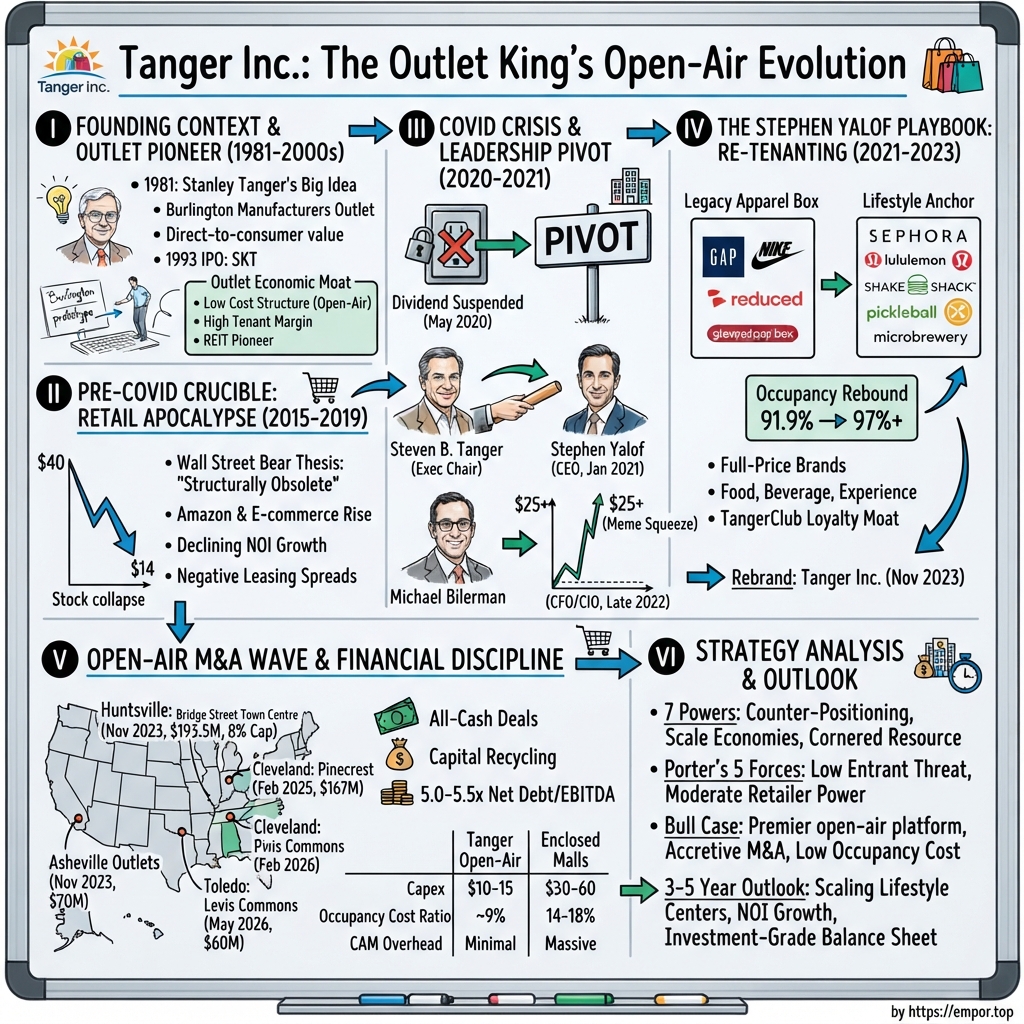
Tanger Inc.: The Outlet King's Open-Air Evolution
I. Introduction & Episode Roadmap
On the morning of August 4, 2026, Tanger Inc. did something that would have seemed absurd to almost anyone reading a research note about outlet malls seven years earlier. It raised guidance.
The company reported Core Funds From Operations of $0.64 per share for the second quarter, up 10.3% from the prior year, lifted its full-year Core FFO outlook to a range of $2.45 to $2.52 per share, and announced a 7% increase in the quarterly dividend to $0.3125 per share. Tenant sales across the portfolio ran at $487 per square foot on a trailing twelve-month basis. Net debt sat at 4.7 times Adjusted EBITDAre — conservative by any REIT standard, and startlingly conservative for a landlord whose entire asset class had been declared structurally obsolete.1
Rewind to the last day of 2020. Roughly half of Tanger's public float — 49.6% — was sold short.2 On a percentage basis, that made this small North Carolina outlet landlord one of the most aggressively bet-against companies in the United States, ranking alongside GameStop in the crowded-short leaderboards that would define the following January. The shares had closed as low as $4.26 in early April 2020, down roughly 90% from a peak above $41 in the summer of 2016.3 The dividend, increased every single year for 27 consecutive years, had been switched off.4
This is the story of what happened in between, and it is a more interesting story than "retail came back."
Because the easy version — pandemic ends, shoppers return, stock recovers — explains the first year of the recovery and almost none of the five that followed. What Tanger actually did was harder and stranger: it took a single-format, single-tenant-category real estate business with a genuinely deteriorating economic engine, replaced essentially its entire senior leadership team with outsiders from the other side of the negotiating table, systematically rebuilt what it sold and to whom, and then quietly expanded its definition of itself from "outlet centers" to "open-air retail" — a category roughly ten times larger.
Whether that transformation constitutes a durable competitive advantage or a well-executed cyclical recovery riding a favorable leasing environment is the central question of this piece, and it is not a settled one.
The narrative arc
Act I covers the birth of an industry: a shirt manufacturer's son in Greensboro, North Carolina, who noticed that his own outlet stores made more money than his factory, a 50,000-square-foot strip in Burlington, and the 1993 initial public offering that created the first outlet-only REIT listed on the New York Stock Exchange.
Act II is the crucible. The 2015–2019 period when Amazon, T.J. Maxx, and a hollowing-out of mid-tier American apparel turned the outlet business from a high-margin clearance channel into a shrinking one — and when Tanger's own management, before anyone had heard of COVID-19, told the market that same-center income would decline by roughly seven to eight percent in 2020.
Act III is the changing of the guard: Stephen Yalof, poached from the largest competitor in the business, and Michael Bilerman, the Wall Street analyst who had spent two decades grading REITs before deciding to run one's balance sheet.
Act IV is the modern playbook — re-tenanting apparel boxes with beauty, food, entertainment, and full-price brands; monetizing shopper data; renaming the company; and then buying open-air lifestyle centers in Huntsville, Asheville, Little Rock, Cleveland, Kansas City, and Toledo.
Act V is the analytical teardown: the unit economics, the 7 Powers audit, the conference-call evidence, the activist stress test, and an honest accounting of what would have to go wrong for the bull case to break.
It begins with a man who could not get a bank to lend him money.
 Subscribe on LinkedIn
II. Founding Context & The Factory Outlet Pioneer (1981–2000s)
Stanley K. Tanger spent the first three decades of his working life in a business that no longer exists in America.
His father, Moe Tanger, had founded Creighton, Inc. in Reidsville, North Carolina, in 1920 — a shirt manufacturer making private-label goods for department stores and uniforms for the military. Stanley took over in 1948. And somewhere in the running of that unglamorous business, he discovered the insight that would define the rest of his life: the five small stores he opened to clear Creighton's excess inventory directly to consumers were, per dollar of capital, extraordinarily profitable. Cutting out the department store meant capturing the department store's margin.5
In 1979 he sold the manufacturing operation to its employees. He was 56 years old, out of the shirt business, and convinced that the clearance side of it was the real business.
Two years later, in 1981, Stanley K. Tanger & Co. opened a 50,000-square-foot strip of brand-name factory outlet stores in Burlington, North Carolina — the first shopping center of its kind in the United States.6 Four banks turned him down before one agreed to lend.5 That detail is worth sitting with. The proposition Tanger was making to lenders was that manufacturers would voluntarily open their own retail stores, in a purpose-built center, an hour from anywhere, to sell last season's goods. Every part of that sentence sounded like a bad idea in 1981.
Why it worked: the brand's dirty little secret
The elegance of the outlet model was that it solved a problem the brands could not solve for themselves, and solved it in a way that made the brands more money rather than less.
An apparel manufacturer in the early 1980s carried a structural inventory problem. Some percentage of every production run came out as irregulars, some percentage of every season went unsold, and the only clearance channels available were brand-corrosive: jobbers, close-out chains, or markdowns inside the very department stores whose full-price relationships the brand depended on. Marking down a Liz Claiborne blazer at Macy's trains the Macy's customer to wait for the markdown. That is a permanent tax on the brand.
Tanger's proposition was geographic quarantine. Put the clearance store 25 miles or more from the nearest regional mall — typically on an interstate corridor between two metros, or near a vacation destination like Pigeon Forge, Tennessee — and the brand could liquidate inventory at a healthy gross margin without teaching its primary customer to wait.5 The shopper had to drive to the discount. That friction was not a bug; it was the entire product.
Early tenants read like a roll call of 1980s American apparel: Anne Klein, Liz Claiborne, OshKosh B'Gosh, Van Heusen. As the format proved out, store sizes grew from small bays to 10,000- and 15,000-square-foot boxes.5
The 1993 IPO and the birth of a public asset class
By 1993 Tanger operated 17 centers in 15 states totaling roughly 1.5 million square feet — meaningful, but still a family business.5 On May 28, 1993, it sold 4.1 million common shares to the public at $22.50. The book was oversubscribed more than six times. The stock closed its first day at $25.00.7
Tanger Factory Outlet Centers became the first outlet-only real estate investment trust listed on the NYSE, and the family retained roughly 44% of the company.5 The roughly $104 million raised retired $75 million of bank debt and funded expansion — Riverhead on Long Island, Lancaster in Pennsylvania, Branson in Missouri.5
For long-term investors, the structural point matters more than the pageantry. A REIT must distribute the great majority of its taxable income, which means growth has to be funded externally, which means the equity market becomes a permanent partner and a permanent constraint. Tanger's cost of capital would now be set daily by people who had never walked one of its centers. That would prove wonderful for two decades and nearly fatal in one.
Steven B. Tanger — Stanley's son, who had joined in 1986 — became president in 1995 while his father stayed on as chairman and CEO.5 Stanley finally stepped back from an active role on August 7, 2009, resigned the chairmanship that September, and remained a director until his death on October 23, 2010.6 He had, by then, watched the format he invented become an industry.
The economics that made it a great business
The reason outlets compounded so well for so long comes down to two structural cost advantages that are easy to state and hard to replicate.
The first is on the landlord's side. An open-air strip has no enclosed common area. No central HVAC heating and cooling a two-story concourse. No escalators, no structured parking deck, no food court requiring ventilation and staffing. Construction cost per square foot runs a fraction of an enclosed regional mall's, and the recurring common-area maintenance bill — landscaping, parking lot, lighting, security — is a rounding error next to a mall's. Lower capex per square foot means a given rent produces a higher return on invested capital, and lower operating cost means more of the tenant's reimbursement payment survives as cash flow.
The second is on the tenant's side, and it is the one that actually matters. The metric to watch is the occupancy cost ratio: total rent and charges paid by a store, divided by the sales that store generates. Think of it as the tax rate a retailer pays for the privilege of a location. In a healthy outlet center it has historically run in the high single digits. In an enclosed regional mall it has often run in the mid-teens.
That gap is not a marketing statistic. It is the difference between a store being a brand's most profitable box and its least profitable one. When a regional VP is deciding which five stores to close in a restructuring, occupancy cost ratio is the spreadsheet column that decides. For four decades, Tanger's centers sat on the safe side of that column.
Which raises the obvious question: if the economics were that good, how did the market come to value the company as a melting ice cube?
III. The Pre-COVID Crucible: Retail Apocalypse & The Short Seller Thesis (2015–2019)
In the summer of 2016, Tanger's shares traded above $41. By late 2019 they were in the mid-teens.3 Nothing had exploded. No fraud, no covenant breach, no wave of asset writedowns. The business simply stopped growing, and the market repriced a growth REIT as something else entirely.
The bear case was not stupid. It went roughly like this.
The four-front war
Front one: Amazon. The core outlet proposition was "drive 45 minutes for a discount." Every year, e-commerce made the distance more expensive relative to the alternative. A brand's own website could clear last season's inventory to the same customer with no drive, no parking lot, and — crucially — no landlord.
Front two: the off-price big boxes. TJX Companies and Ross Stores had spent two decades building a discount channel that was closer to home, open on a Tuesday evening, and offered a treasure-hunt experience that many shoppers preferred. If the customer's job-to-be-done was "buy branded apparel below retail," T.J. Maxx did that job with a five-minute drive.
Front three: direct-to-consumer. A generation of digitally native brands grew up with no clearance problem to solve, because they had no wholesale channel to protect and no department store relationship to preserve. They simply did not need outlet real estate.
Front four, and most damaging: the tenants themselves. The mid-tier American apparel brands that filled Tanger's centers — the Ascenas, the Chico's, the Gaps — were themselves shrinking. A landlord's growth is ultimately a derivative of its tenants' store-count ambitions. When your customers are collectively closing stores, your negotiating leverage inverts.
What the numbers actually showed
Here is where the analysis has to be careful, because the surface metrics looked fine and the underlying metrics did not.
For full-year 2019, Tanger reported portfolio occupancy of 97.0%, up from 96.8% the prior year. Average tenant sales productivity was $395 per square foot, up 3%. Same-center tenant sales rose 1.5%. The occupancy cost ratio was 10.0%. Superficially, a stable business.8
Underneath: same-center net operating income declined 0.7% for the year. And blended rental rates on leases that commenced during 2019 were positive 2.7% on a straight-line basis but negative 1.3% on a cash basis.8
That cash-versus-straight-line divergence is the tell, and it is worth explaining plainly. Straight-line accounting averages all the contractual rent bumps over the life of a lease, so a deal that starts low and escalates aggressively looks fine. The cash spread compares what the new tenant actually pays in year one against what the departing tenant actually paid in its final year. Negative cash spreads mean the landlord is renting the same box for less real money than before. That is not a narrative problem. That is pricing power going the wrong direction.
Management's response was defensive and, in fairness, disciplined. Tanger maintained one of the most conservative balance sheets in retail real estate, kept roughly 94% of its square footage unencumbered by mortgages, reduced debt by $143.1 million during 2019, and held interest coverage at 4.3 times.8 It repurchased approximately 1.2 million shares for $20 million, and it raised the dividend for the 27th consecutive year — by 0.7%, to $1.43 annualized.8
Read that last item slowly. A 0.7% dividend increase is not a capital allocation decision; it is a streak-preservation decision. The company was paying to keep a record intact.
The guidance that proved the bears right
The single most damning pre-pandemic data point is the one that gets forgotten because of what happened three weeks later.
In February 2020 — before any American shopping center had closed, before the word "lockdown" entered common usage — Tanger guided 2020 same-center NOI to a decline of between 6.75% and 8.25%, with average occupancy expected at 92% to 93% and FFO per share of $1.96 to $2.04 against $2.31 of adjusted FFO in 2019.8
Management was, in effect, telling the market that the business would shrink meaningfully in a normal economic year. The shorts were not predicting a collapse. They were reading company guidance.
What the era says about the prior regime
It would be unfair to characterize Steven Tanger's leadership as passive. He ran the company through the financial crisis, kept leverage low when peers levered up, and refused the over-priced acquisitions that destroyed several mall REITs. Tanger entered 2020 with the balance sheet of a survivor.
But survival is not a strategy, and the record shows a company defending a format rather than reinventing one. Capital went to buybacks and dividend continuity. The tenant roster remained overwhelmingly apparel. The physical product — an open-air strip of clearance stores with a food court that was mostly a pretzel stand — was largely the product of 1995. Occupancy stayed high because the company leased to whoever would sign, at whatever rent cleared.
High occupancy at falling rents is not strength. It is a landlord absorbing the market's verdict one lease at a time.
Then every single center closed at once.
IV. COVID Crisis, The Meme Squeeze, & The Leadership Pivot (2020–2021)
In April 2020, Tanger Factory Outlet Centers collected 12% of the rent it billed.4
Not 12% less. Twelve percent of it. Every center in the portfolio was closed under state mandate, and the tenants — many of them already fragile — simply stopped paying. There is no version of a real estate model that survives that number for long, and the company knew it.
The decision that broke a 27-year streak
On May 11, 2020, the board temporarily suspended the common dividend, conserving roughly $35 million per quarter. The Q1 dividend declared in January was still paid on May 15 to holders of record on April 30; everything after that stopped. Management committed only to distributing the taxable income required to preserve REIT status.4
For a company that had raised its dividend every year since going public, this was the end of an identity. Dividend-growth funds are mechanically forced sellers when a streak breaks, which is part of why the stock behaved the way it did. But strip away the sentiment and it was straightforwardly the right call: preserving roughly $140 million of annual liquidity against a revenue line of unknowable duration bought the company the one thing it could not otherwise buy, which was time.
The tenant carnage arrived on schedule. Ascena Retail Group — parent of Ann Taylor and LOFT, and Tanger's second-largest tenant — filed for Chapter 11 in July 2020. J.Crew and Brooks Brothers, each roughly 1.4% of rent, filed as well. The company reduced cash outflows by approximately $17.9 million over the final nine months of the year through operating cuts and deferred capital projects.9
By December 31, 2020, portfolio occupancy had fallen to 91.9% from 97.0% a year earlier. Full-year Core FFO came in at $1.57 per share against $2.31 in 2019. The company posted a net loss of $0.40 per share, including $70.3 million of impairment charges on underperforming assets. Roughly $40 million of rental revenue was simply written off.9
And yet the balance sheet held. As of January 31, 2021, total liquidity exceeded $684 million — $84 million of cash plus a completely undrawn $600 million credit facility — with no significant debt maturity until December 2023.9 The conservatism that had looked unimaginative in 2018 turned out to be the reason the company survived 2020 without a dilutive rescue financing. That is the honest verdict on the prior regime: it did not build the future, but it did not lose the company either.
The hire that changed the trajectory
Two days before the disastrous April rent-collection month began, Tanger announced something that mattered far more than any quarter's numbers.
On April 7, 2020, the company named Stephen Yalof President and Chief Operating Officer effective April 10, with a stated plan for him to assume the CEO role in January 2021. Steven B. Tanger would move to Executive Chair.10
Yalof was not a real estate financier. He was a retail operator who had spent more than 20 years inside the tenants — leadership roles in real estate at Gap Inc. and at Ralph Lauren, where he ran global real estate — before becoming CEO of Simon Premium Outlets in 2014.10 That résumé is the whole point. For most of Tanger's history, the company had negotiated with people like Yalof from across the table. Now it had hired the person who knew exactly what a brand's real estate committee cares about, what makes a store approval memo pass, and how a competitor five times Tanger's size ran the same asset class.
He also arrived with a diagnosis that a lifelong landlord would have been unlikely to reach. As he later framed it, the ambition was "to go from being a real estate company to a customer-experience company."11 Read cynically, that is consultant-speak. Read operationally, it is a claim about who the actual customer is: not just the tenant signing the lease, but the shopper whose behavior determines whether the tenant renews.
His first-year tactics were unglamorous and revealing. With vacancy spiking and national brands frozen, he pushed general managers to fill space locally. In his telling, "our general managers went to work and started knocking on doors in local marketplaces," and the company launched a minority business initiative offering reduced rent and buildout capital to help emerging entrepreneurs open stores.11 Filling a dark box with a local operator at modest rent is not a growth strategy. It is a bet that a center with lights on and traffic flowing preserves the option value of the next lease. That is an operator's instinct, not a financier's.
January 2021: when the internet arrived
Then came one of the strangest episodes in the company's history, and one that had nothing whatsoever to do with outlet retail.
Entering 2021, Tanger's short interest stood at 49.6% of float as of December 31, 2020 — a level that put it in the same statistical neighborhood as GameStop.2 The logic was mechanical: retail and hospitality REITs had been the market's favorite pandemic shorts, and Tanger was small, liquid, heavily indebted in the popular imagination, and universally described as structurally impaired.
When the WallStreetBets squeeze spilled out of GameStop and AMC in late January, it found Tanger. On January 26, 2021, the stock closed at $16.06 on 15.8 million shares. On January 27 it traded as high as $20.96 and closed at $17.86 on 27.2 million shares — roughly ten times normal volume. It had begun the month around $10.3 Macerich, Seritage, and EPR Properties were caught in the same net.2 By February 5 the shares had settled back to $13.71.3
The episode is worth including not because it says anything about the business, but because of what management did with it. There is a version of this story where a distressed, heavily shorted REIT with a broken dividend uses a violent squeeze to issue equity into retail enthusiasm. Tanger did not do that. It reinstated the dividend instead — a modest $0.1775 per share declared in January 2021, roughly half the pre-pandemic rate — and got back to work.9
The company had bought itself a second act. The question was what to do with it.
V. The Stephen Yalof Playbook: Re-Tenanting & "Lifestyling" Tanger (2021–2023)
Every turnaround begins with a diagnosis, and the diagnosis Yalof brought to Tanger was uncomfortable: the company was selling one thing, to one kind of customer, in a market that had stopped wanting quite so much of it.
The portfolio was overwhelmingly apparel and footwear. Non-apparel gross leasable area stood at roughly 19% as of 2019.12 That concentration had been a feature for forty years — outlets existed to clear apparel — and it had become the single largest source of correlated risk in the business. When mid-tier apparel contracted, Tanger contracted with it. There was no ballast.
The fix had three components, and they were pursued simultaneously.
Component one: sell to people who had never bought
The first move was to sign categories and brands that had historically refused to look at outlet centers at all.
Beauty was the obvious opening. A Sephora or an Ulta does not clear last season's inventory — cosmetics do not work that way — so on the old logic they had no business in an outlet center. But on the new logic, which is that an open-air center is a convenient, high-traffic community shopping destination, they fit perfectly. The same reasoning applied to digitally native brands opening their first physical doors, to athleisure, and to full-price specialty retail. By the second quarter of 2026, non-apparel and non-footwear had risen to 32% of gross leasable area from that 19% starting point, with the roster including names like Warby Parker and Vuori.12
That shift is the most important structural change in the business, and it is measurable rather than rhetorical. It means a wave of apparel bankruptcies no longer maps one-for-one onto Tanger's rent roll.
Component two: replace boxes with reasons to stay
The second move was about dwell time. A shopper who visits for 45 minutes buys from two stores; a shopper who stays three hours buys from five and eats lunch.
So underperforming apparel boxes gave way to food and beverage, entertainment, and experiential uses — restaurants with real kitchens rather than counter service, fitness, family entertainment. This is not costless: food and beverage tenants require grease traps, ventilation, higher landlord contributions, and more operational supervision than a clothing store that needs four walls and a cash wrap. The trade is that they generate visit frequency the apparel tenant cannot, and they generate it on Tuesday, not just Saturday.
Component three: own the customer relationship
The third move was the least visible and, arguably, the most strategically interesting.
On July 14, 2023, Tanger relaunched TangerClub as a three-tier program: a free "Blue" tier requiring only an email address; a "Gold" tier at $20 per year offering double points and elevated retailer offers; and a "Platinum" tier unlocked by spending, offering triple points and the best offers. A new mobile app launched alongside it, with the platform powered by loyalty vendor Coniq.13
The revenue from $20 subscriptions is not the point and never was. The point is that a landlord historically knew almost nothing about who walked its parking lots. It knew what its tenants reported in aggregate sales, and it knew traffic counts. It did not know that a specific household drives 38 minutes from a specific zip code six times a year and spends disproportionately on athletic footwear.
With that data, the leasing conversation changes character. Instead of pitching a brand on demographics from a census tract, Tanger can show a prospective tenant the actual origin, frequency, and category spend of the customers already visiting. In the language of the business, that converts a real estate sales pitch into a customer-acquisition sales pitch. Whether it demonstrably closes leases that would otherwise not close is not something the company discloses, and investors should treat the "data moat" framing with appropriate skepticism — every major landlord now claims some version of it. What can be verified is the leasing outcome, which is discussed below.
The proof points
Operationally, the recovery arrived faster than the pre-pandemic trend line would have predicted.
By December 31, 2021, occupancy had recovered to 95.3%, up 310 basis points year over year. Tenant sales reached an all-time high of $468 per square foot — 17.6% above 2019 levels. Core FFO rose to $1.76 per share. Cash blended rent spreads improved 650 basis points year over year and renewal spreads turned positive. Net debt to Adjusted EBITDAre fell to 5.5 times from 7.2 times.14
Two of those numbers deserve interpretation rather than recitation.
The sales-productivity figure matters because it is the denominator of the occupancy cost ratio. If a tenant's sales per square foot rise 17.6% and its rent does not, the store becomes dramatically more profitable — which means the landlord has created room to raise rent at the next renewal without making the box unaffordable. Rising tenant sales are, in a very literal sense, stored pricing power.
The rent-spread reversal matters because it is the metric that had been negative in 2019. Moving cash spreads from negative to positive is the difference between a business that shrinks organically and one that grows organically. It is the single cleanest evidence that the demand picture changed.
The honest caveat: a good deal of that improvement was cyclical. Consumers emerged from lockdowns with stimulus-inflated savings, retailers were desperate for physical distribution, and essentially no new outlet or open-air supply was being built. Distinguishing "Tanger got better" from "the market got better" requires looking at what happened when the cycle normalized — which is the subject of the later sections.
The name on the door
By 2023, the strategy had outgrown the company's name.
On May 10, 2023, coinciding with the 30th anniversary of the IPO, Tanger unveiled a refreshed visual identity built around the theme "Open Air," migrating its consumer website from tangeroutlets.com to tanger.com and rolling the new identity across all 36 centers. Yalof's framing was that "Tanger's centers have become the center of their community, where people gather and connect, as well as shop."15
The legal follow-through came that November. On November 6, 2023, the company filed Articles of Amendment with the North Carolina Secretary of State changing its name from Tanger Factory Outlet Centers, Inc. to Tanger Inc., effective at 12:01 a.m. Eastern on November 16, 2023.16
Corporate rebrands are usually noise. This one was not, because it was a promise about capital allocation. Dropping "Factory Outlet Centers" from the legal name removed the last conceptual fence around what the company was permitted to buy. Within three weeks, it would start buying.
VI. The Open-Air M&A Wave & Capital Allocation under Bilerman (2023–Present)
For eighteen years, Michael Bilerman's job was to sit in the audience and ask the hard question.
As Managing Director at Citi leading the firm's global real estate investment research franchise, Bilerman ran a team named to Institutional Investor's All-America Research Team for 14 consecutive years, including five straight years ranked number one. He had started at Goldman Sachs, spending six years across investment banking and equity research, and had accumulated close to 25 years covering the sector. Nareit gave him its Industry Achievement Award in 2020.17
Then, on September 19, 2022, Tanger announced he was joining as Executive Vice President, Chief Financial Officer and Chief Investment Officer, effective in the fourth quarter of that year.17
The move was unusual enough to be worth pausing on. Sell-side analysts move to the buy side routinely; they move into operating roles at the companies they covered far less often. The combined CFO-plus-CIO mandate is the interesting part: it meant the person setting the cost of capital was the same person underwriting the deals it funded. That structure eliminates a common REIT pathology — an acquisitions team incentivized on deployed dollars negotiating with a finance team incentivized on leverage — but it also concentrates enormous authority in one executive, which is a governance consideration rather than a compliment.
The strategic unlock
The insight Bilerman and Yalof executed on is deceptively simple.
Tanger's genuine operating advantage was never "outlets." It was the ability to lease, operate, and market open-air retail at low cost. An outlet center and a suburban lifestyle center are, from a property-operations standpoint, nearly the same asset: surface parking, no enclosed common area, modest CAM load, tenant boxes fronting a walkable street or arc. The leasing relationships overlap heavily — the same Gap, Nike, and Sephora real estate teams sign both.
If the advantage was the platform rather than the format, then restricting acquisitions to outlet centers was leaving the addressable market on the table. Outlet centers in the United States number in the low hundreds. Open-air retail centers number in the tens of thousands.
The deals, and what they reveal
The buying program that followed is best understood as a series of tests of a single underwriting thesis: buy the dominant open-air center in a mid-tier market, pay a mid-to-high eight percent first-year yield, close all-cash, and apply the platform.
Asheville Outlets came first — November 13, 2023, $70 million all-cash in an off-market transaction for a 382,000-square-foot center that was 95% occupied, with Nike, Coach, RH, and Crate & Barrel among 70 stores, at an expected first-year return in the mid-eight percent range. Yalof described it as "the dominant shopping experience in the market."18
Bridge Street Town Centre came seventeen days later, and it was the statement deal — November 30, 2023, $193.5 million for an 825,000-square-foot open-air lifestyle center in Huntsville, Alabama, again funded with cash on hand at an expected mid-eight percent first-year return. The tenant list was the argument: Apple, Lululemon, Sephora, Anthropologie, Ulta, Barnes & Noble, Dick's Sporting Goods, Belk, a Cheesecake Factory, and a 14-screen Cinemark.19
Nothing in that roster is a clearance store. Tanger had bought a full-price lifestyle center, in a market whose growth was being driven by aerospace and defense engineering employment, and Yalof framed the logic explicitly: leveraging the retail operating, leasing and marketing platforms "both in the outlet channel and through selective investments in other complementary open-air retail destinations."19
The Promenade at Chenal in Little Rock followed in December 2024 for $73.1 million.20
Pinecrest, on February 13, 2025, extended the thesis furthest. For approximately $167 million, Tanger acquired a 640,000-square-foot mixed-use district in Orange Village on Cleveland's affluent eastern edge, opened in 2018 and anchored by Whole Foods Market, with Nike, REI, Williams-Sonoma, Pottery Barn, Sephora, Warby Parker, Alo Yoga, Shake Shack, a Silverspot Cinema, and Pinstripes — plus upscale on-site residential and office components and an AC Hotel operating on the property. Expected first-year return: eight percent.21
A grocery-anchored, hotel-adjacent, office-and-apartment-inclusive property is a meaningfully different animal from a strip of factory stores off Interstate 40. That is the deal where "adjacent expansion" starts to require real scrutiny.
Legends Outlets in Kansas City, Kansas, on September 16, 2025, brought the program back toward the core: roughly $130 million plus assumption of a $115 million CMBS loan maturing in November 2027, for approximately 690,000 square feet that was 93% occupied, with AMC Theatres, Dave & Buster's, and Yard House alongside Nike and Coach, and shadow anchors including Target and ALDI. Expected first-year return: eight percent.22
The Town Center at Levis Commons closed the loop on May 28, 2026 — approximately $60 million for a 300,000-square-foot, 97%-leased open-air lifestyle center in the Perrysburg submarket of Toledo, Ohio, with Anthropologie, Sephora, Lululemon, Shake Shack, Athleta, Cinemark and Arhaus. Expected first-year return: approximately 8.5%.23 It was the seventh open-air center and the fourth lifestyle center added in three years.2
Reading the capital allocation honestly
Cumulatively, since 2019, Tanger has deployed roughly $840 million across eight acquisitions while generating approximately $185 million from ten dispositions.12 The portfolio now spans 42 properties and nearly 17 million square feet, with roughly 90% of square footage located in leading tourist destinations or top-50 metropolitan areas.12
There are three things to say about this program, and they do not all point the same way.
In its favor: the discipline is visible in the funding. Every one of these deals was done with cash on hand and available liquidity rather than issuing equity into a discounted share price, and leverage went down through the buying spree, not up — net debt to Adjusted EBITDAre stood at 4.7 times at mid-2026 against a stated target range of 5 to 6 times, with roughly $1 billion of liquidity and debt effectively 100% fixed-rate at a weighted average cost around 4%.12 All three rating agencies hold Tanger at investment grade with stable outlooks — S&P at BBB as of January 2026, Fitch at BBB as of July 2025, and Moody's at Baa2 for senior unsecured debt as of September 2025.24 A REIT that acquires nearly a billion dollars of assets while deleveraging and getting upgraded is not behaving like an empire builder.
Against it: every single deal has been underwritten at an eight-percent-ish first-year return, and every single deal has been described in nearly identical language. That consistency is either evidence of a repeatable, disciplined filter — or evidence of a house view being applied to increasingly different assets. Pinecrest's apartments and offices, and Legends' assumed CMBS debt, are not the same underwriting problem as an outlet strip. Investors have limited disclosure with which to verify that the stated yields have actually been achieved on a stabilized basis, property by property.
The pressure ahead: on the second-quarter 2026 call, Bilerman characterized the acquisition pipeline as very active while acknowledging that cap rates have compressed, requiring disciplined underwriting.2 Compressed cap rates mean the eight-percent deals are getting harder to find. The real test of this management team's capital allocation is not the deals it announced between 2023 and 2026. It is the deals it declines to do in 2027 when the yields on offer start with a seven.
Which brings the story to the machine those assets feed.
VII. Business Model & Unit Economics: Outlets, Lifestyle Centers, & Tenant Mix
Strip away the narrative and a shopping center REIT is a spread business with a physical footprint. It raises capital, buys or builds space, rents that space at a yield above its cost of capital, and defends the gap.
Understanding Tanger requires understanding four revenue mechanics and one ratio.
How the money actually arrives
Base minimum rent is the foundation — contractual fixed rent under leases typically running five to ten years, generally with annual escalators built in. This is the predictable, bond-like layer, and it is where the vast majority of revenue originates.
Percentage rent is the equity kicker. Many retail leases specify that once a store's sales exceed an agreed threshold, the landlord receives a percentage of the excess. It aligns the landlord with the tenant's volume rather than merely its solvency, and it means a genuinely great year for a retailer flows partly to the property owner. It is a small line in good times and an absent one in bad times, so it should be treated as upside rather than base case.
Tenant expense reimbursements cover common area maintenance, real estate taxes, and insurance, passed through to tenants. This is where the open-air structure earns its keep, discussed below.
Ancillary and peripheral income is the least discussed and most quietly interesting bucket. A center sitting on 40 to 80 acres at a highway interchange has land at its edges that generates no rent. Ground-leasing those outparcels to drive-thru restaurants, coffee operators, hotels, or EV charging installations converts dead asphalt into income with essentially no landlord capital. Tanger has explicitly flagged peripheral land activation as a source of incremental organic NOI, alongside announced developments adjacent to its Kansas City and National Harbor centers.2 The amounts are individually small; the returns on invested capital are individually enormous, because the land is already owned.
The ratio that governs everything
Return to the occupancy cost ratio, because it is the mechanism through which all of the above compounds — or fails to.
Picture a store doing $2 million a year in sales and paying $190,000 in total occupancy cost. Its ratio is 9.5%. Now suppose the center's marketing, tenant mix, and traffic improve, and the store does $2.3 million. If rent is unchanged, the ratio falls to about 8.3% — and the retailer's store-level margin expands meaningfully. At the next renewal, the landlord can push rent toward the old ratio and capture much of that gain without making the store any less viable than it was before.
This is why tenant sales per square foot is not a vanity metric for a landlord. It is the leading indicator of future rent.
At mid-2026, Tanger's portfolio ran an occupancy cost ratio of 9.7% against average tenant sales of $487 per square foot.1 For comparison, the same ratio was 10.0% in 2019 on sales of $395 per square foot.8 Sales productivity rose roughly 23% over that stretch while the occupancy cost ratio actually declined — meaning tenants are, on average, meaningfully more profitable in a Tanger box today than they were before the pandemic, and the landlord has not yet fully captured that improvement in rent.
That gap is the clearest quantified argument in the bull case. It is also, by construction, finite. Rent cannot be pushed indefinitely; there is some level — historically in the low-to-mid teens for enclosed malls — at which a store's economics break and the retailer walks.
Open-air versus enclosed: the cost structure that made the difference
The structural cost gap between formats deserves one more pass, because it explains why the same 2015–2020 storm that reduced several enclosed-mall REITs to restructurings left Tanger solvent.
On construction and recurring capital, an open-air center's per-square-foot burden runs a fraction of an enclosed mall's, because there is no enclosed common area to build, light, heat, cool, or refurbish every decade. Tanger's guided capital expenditure for 2026 is $65 million to $75 million, which management describes as a mid-teens percentage of NOI.2 Enclosed regional malls have historically consumed a far larger share of property income simply to stay current.
On operating cost, the CAM bill for a Tanger center is landscaping, parking lot maintenance, lighting, and security. For an enclosed mall it is central HVAC across hundreds of thousands of square feet of concourse, escalators, interior lighting, janitorial services, and security across an enclosed environment. Because CAM is largely passed through to tenants, a lower CAM bill is a direct reduction in the tenant's total occupancy cost — which loops straight back into the ratio above.
And on customer experience, the open-air format quietly won a battle nobody was fighting in 2015. Surface parking directly in front of the store, no interior corridors, easy curbside pickup, and outdoor dining turned out to be exactly the attributes consumers valued after 2020. Tanger did not engineer that shift. It simply happened to already own the format that benefited from it.
Tenant concentration
Diversification here is real but should not be overstated. No single tenant represents more than 5.2% of annualized base rent, with the largest relationships including Gap Inc., American Eagle Outfitters, Tapestry, and Nike.12
A 5.2% concentration is genuinely manageable — no single bankruptcy is existential. But the relevant risk is not single-name; it is category correlation. Even at 32% non-apparel, the majority of the rent roll still comes from discretionary apparel and footwear, and those tenants share the same macro exposure. A broad consumer downturn hits them together, which is precisely what happened in 2020.
The counter-question, then, is whether Tanger's position within that category is defensible — which requires a proper competitive analysis.
VIII. Strategy & Playbook: 7 Powers, Porter's 5 Forces, & Management Credibility
Frameworks are only useful if applied adversarially. So the test here is not whether Tanger has advantages, but whether those advantages would survive a determined attempt to compete them away.
The 7 Powers audit
Counter-positioning — real, but aging. Hamilton Helmer's most potent power exists when an incumbent cannot copy a challenger's model without damaging its existing business. Outlets counter-positioned beautifully against enclosed malls and department stores: brands could clear inventory at roughly half the occupancy cost of a mall location without training their full-price customer to wait for markdowns. The department stores could not respond, because responding meant cannibalizing themselves.
The honest problem is that this power has largely already been harvested. The department store channel that outlets counter-positioned against has been substantially destroyed — the Saks Global bankruptcy discussed below being a late chapter. You cannot counter-position against a corpse. What remains is a cost-structure advantage versus enclosed malls, which is durable but is a different and weaker thing than true counter-positioning.
Scale economies — genuine but modest, and asymmetric. Tanger's national leasing platform gives it something a single-property owner lacks: when it negotiates with Gap or Nike, it negotiates across dozens of centers at once, which supports preferred placement, portfolio-level deals, and national marketing leverage. Its 2026 general and administrative expense is guided to $80.5 million to $83.5 million against a portfolio generating well over $400 million of NOI — genuine operating leverage.25
But this is where competitive honesty is required: Simon Property Group operates a substantially larger premium outlet platform globally. Tanger is not the scale leader in its own category. Its scale advantage is real against regional and local operators, and absent against its largest peer.
Cornered resource — the strongest and most underrated power. The land is the moat. Tanger's centers occupy large parcels at interstate interchanges and in established suburban corridors, assembled over four decades when land was cheap and entitlement was easy. Replicating that today would require assembling 40 to 80 contiguous acres at a high-traffic node, at current land prices, and surviving a municipal approval process in which organized residential opposition is a near-certainty. Management has repeatedly pointed to limited new supply as a driver of leasing strength.26
This is the power most likely to persist for decades, because it is not a business practice that can be copied. It is a physical constraint.
Switching costs — moderate and often overstated. Tenant fit-out investment is real; a retailer that has spent meaningful capital building out a box is reluctant to abandon it mid-lease. But the 2020 bankruptcy wave demonstrated the limit: when a retailer restructures, leases are rejected and buildout capital is a sunk cost. Switching costs slow tenant departures; they do not prevent them.
Branding, network economies, process power, and cornered talent are not meaningfully present. Shoppers do not choose a center because of the Tanger name; they choose it because of the brands and the drive time.
Net assessment: one strong and durable power (location/entitlement), one moderate and structurally decaying power (counter-positioning), and one power where Tanger is the challenger rather than the incumbent (scale).
Porter's five forces, applied
Threat of new entrants: low. Not zero — a well-capitalized developer can build an open-air center — but the combination of land cost, entitlement difficulty, and a construction cost environment that makes new retail development hard to underwrite at current rents has kept new supply minimal. Limited new supply is arguably the single most favorable structural condition Tanger currently enjoys, and it is not of its own making.
Bargaining power of tenants: moderate and rising for the largest ones. Gap, Nike, PVH, and Tapestry each operate across many landlords and can play them off one another. The counterweight is the occupancy cost ratio: at 9.7%, a Tanger store is among the most profitable real estate a brand operates, which materially raises the cost of walking away. Power here is genuinely two-sided, which is the healthiest position a landlord can occupy.
Bargaining power of shoppers: high. The consumer has infinite substitutes and no switching cost whatsoever. This is why the food, beverage, and entertainment investment is not optional. It is the cost of remaining a destination.
Threat of substitutes: moderate and persistent. E-commerce and off-price big boxes have not gone away. What changed is that the marginal threat stopped growing as fast: brands rediscovered that physical stores are efficient customer-acquisition and returns-processing infrastructure, and digitally native brands began opening doors. The substitution threat is now a steady headwind rather than an accelerating one — but it would be complacent to assume that condition is permanent.
Competitive rivalry: low to moderate, and bifurcated. In outlets, Simon is the dominant competitor and rivalry is disciplined. In open-air lifestyle centers — where Tanger has been spending its capital — the field is far more crowded, with well-capitalized public peers and countless regional owners bidding for the same assets. Tanger's edge in that market is speed and certainty of all-cash closing, which is a transactional advantage, not a durable one.
Management credibility: the behavioral record
The most useful test of a management team is not what it says but whether its statements survive contact with subsequent quarters.
Yalof has been consistent. The strategic language of 2021 — customer experience, re-tenanting, food and beverage, non-apparel — is recognizably the same language used in 2026, with the mix data moving in the direction the language predicted. Consistency of narrative across five years of filings and calls is a genuine credibility marker, and it is rarer than it should be.
He has also been willing to explain trade-offs that make a quarter look worse. On the fourth-quarter 2025 call, he described deliberately reducing the renewal rate from a historical 95% toward roughly 80% — that is, actively declining to renew existing tenants in order to re-tenant at higher rents. That decision temporarily depresses occupancy and adds capital cost, and management said so.26
Bilerman brings a different register. His public posture is the analyst's: metric-forward, willing to reframe a question rather than accept its premise. When analysts on the second-quarter 2026 call pressed on the sequential occupancy decline, his response was to reject occupancy as the governing objective — "occupancy is just the metric and obviously we care about driving ultimately EBITDA per square foot."2
That answer is defensible and also exactly the sort of answer investors should log and revisit. Redefining the relevant metric mid-transformation is what a thoughtful operator does when a headline number understates progress — and also what a struggling one does when a headline number is deteriorating. The way to adjudicate it is not rhetoric but the subsequent NOI trajectory.
Similarly, when analysts questioned compressing leasing spreads on the fourth-quarter 2025 call, Bilerman acknowledged tougher comparisons but argued that re-tenanting at roughly 30% spreads with lower tenant allowances generates stronger cash flow than the blended headline suggests.26 That is a substantive rather than evasive answer, and it is checkable against future disclosure.
Guidance discipline is the strongest objective evidence. Tanger has raised full-year 2026 Core FFO guidance in consecutive quarters — from an initial $2.41 to $2.49 range introduced in February 2026, to $2.42 to $2.50 in May, to $2.45 to $2.52 in August — and delivered 2025 Core FFO of $2.33 per share against an initial range of $2.22 to $2.30.25271 Setting achievable targets and beating them modestly is the behavior pattern of a team managing expectations rather than promoting a story.
Governance is unremarkable in the good sense. Approximately 98% of votes cast in 2025 approved executive compensation on an advisory basis. The CEO is subject to a stock ownership guideline of six times base salary, and the long-term incentive structure includes a performance share plan with absolute and relative total-shareholder-return hurdles.28 TSR-based long-term incentives are appropriate for a REIT, though they are also blunt instruments that can reward beta.
The founding family era formally closed on May 8, 2026, when Steven B. Tanger retired as Chair after 40 years with the company and took the title Chair Emeritus, with independent director Luis Ubiñas — a director since 2019, with board experience at Electronic Arts and AT&T — becoming Non-Executive Chair.29 Handing the chairmanship of a founder-named company to an independent outsider is a governance improvement, and it happened without visible drama.
The question that remains is what all of this is worth, and what could take it away.
IX. Financial Analysis, Risk Radar, & Bull vs. Bear Stress Test
Start with the arithmetic of the recovery, because it is the spine of everything that follows.
Core FFO per share went $1.57 in 2020, $1.76 in 2021, $1.96 in 2023, $2.13 in 2024, $2.33 in 2025, with 2026 guided to $2.45 to $2.52.91420251 That is roughly a 50% increase in per-share earnings power across five years, achieved without meaningful share issuance and while reducing leverage. For a REIT — an asset class where growth usually arrives diluted — that combination is genuinely uncommon.
Full-year 2025 was the strongest evidence yet: same-center NOI up 4.3% to $407.7 million, year-end occupancy of 98.1%, tenant sales of $473 per square foot, 630 leases covering 3.1 million square feet, and blended cash rent spreads of 9.5% — composed of 28.3% on re-tenanted space and 6.5% on renewals. The FAD payout ratio was 61%, and net debt to Adjusted EBITDAre finished at 4.7 times.25
Decompose that spread number, because it is where the strategy is visible. A 6.5% renewal spread is a decent but unremarkable result — it says existing tenants are paying moderately more to stay. A 28.3% re-tenanting spread says something much stronger: when Tanger replaces a tenant, the new tenant pays nearly a third more than the old one. That is the quantitative signature of the re-merchandising thesis working. It is also the reason management is willing to let occupancy dip.
The three KPIs that actually matter
For an investor tracking this company over the next several years, most of the disclosed metrics are noise. Three are not.
First: blended cash leasing spreads, split between renewal and re-tenanted. This is the single cleanest read on whether demand for Tanger space is genuinely strengthening or merely cycling. The blended figure alone is misleading, because mix shifts between the two components move it. Watch both. Blended cash spreads reached 10.5% in the second quarter of 2026, the eighteenth consecutive positive quarter, with re-tenanted at 28.4% and renewals at 7.7%.2 A sustained drift of renewal spreads back toward zero would be the first real evidence that pricing power is fading.
Second: tenant sales per square foot alongside the occupancy cost ratio. These two must be read together, never separately. Rising sales with a stable or falling occupancy cost ratio means the landlord has unexercised pricing power in reserve. Rising sales with a rising ratio means rent is being pushed as fast as tenant economics improve, and the runway is closing. Falling sales with a stable ratio means trouble is coming to the rent roll with a lag.
Third: same-center NOI growth. This strips out acquisitions and answers the question that matters most for a company in the middle of a buying program — is the existing portfolio actually growing, or is growth being purchased? Same-center NOI rose 3.5% in the second quarter of 2026 to $106.9 million, and management raised the low end of its full-year range to 2.75% from 2.25%.1
Everything else — occupancy, quarterly FFO beats, dividend increases — is downstream of these three.
The activist stress test
A skeptical investor with a large position and a willingness to make noise would press on four points.
"You are buying at the top of the cycle." The challenge writes itself: Tanger has deployed roughly $840 million into commercial real estate during a period of elevated interest rates and uncertain retail fundamentals, into formats it has never previously operated. The management answer is that stated first-year yields of eight to eight-and-a-half percent sit comfortably above the company's cost of capital, and that lifestyle centers carry embedded rent escalators and re-tenanting upside that mature outlet centers lack. The fair verdict is that the underwriting logic is sound and the funding discipline is verifiable, but the outcomes are not yet verifiable — most of these assets have not been owned long enough to prove stabilized returns, and the company does not publish per-asset performance against underwriting.
"You are becoming a different, more complex company without saying so." Pinecrest brought residential and office components and a hotel on the property. Legends came with assumed CMBS debt. A pure-play outlet REIT with an exceptional operating platform is a legible investment; a diversified open-air owner with mixed-use exposure is a different one, competing against a much larger and more sophisticated peer set. On the second-quarter 2026 call, management explicitly declined to commit to a target format mix, defending balanced growth without predetermined targets.2 Investors are entitled to view the absence of a stated portfolio-construction target as flexibility or as strategic vagueness, and reasonable people will differ.
"Your dividend still hasn't recovered." This is the most concrete accountability point. The quarterly dividend of $0.3125 declared in 2026 remains below the $0.3575 rate paid before the 2020 suspension, six years and a full earnings recovery later.18 Management's implicit answer is that a payout ratio in the low sixties funds internal growth and acquisitions without equity issuance — which is defensible capital allocation and demonstrably what happened. But an investor who owned this for income in 2019 has not been made whole on the distribution, even as per-share earnings surpassed pre-pandemic levels.
"Occupancy is going the wrong way." Portfolio occupancy was 98.1% at year-end 2025, 97.0% at March 31, 2026, and 96.6% at June 30, 2026.25271 Management's defense is that this is deliberate. Which brings us to the most instructive episode of the current period.
The Saks trade
On January 14, 2026, Saks Global — parent of Saks Fifth Avenue, Neiman Marcus and Bergdorf Goodman — entered Chapter 11. By January 30 the company announced it would close most of its Saks OFF 5TH locations along with all remaining Last Call outlets, with liquidation sales starting January 31 and only a limited number of off-price stores continuing to trade.30
For an outlet landlord, a large off-price chain liquidating is precisely the event the bear case is built on. Tanger's response was to buy the problem. The company paid $4.3 million to recapture five Saks locations totaling roughly 140,000 square feet, and management has stated it expects rent multipliers of two to four times on permanent re-tenanting, with temporary tenants occupying roughly half the space in the interim and meaningful permanent rent not arriving until 2028.2
This is the strategy in miniature, with all its costs exposed. Paying cash to accelerate the departure of a failing tenant, accepting near-term occupancy and income drag, filling with temporary tenants, and waiting two years for the payoff is the behavior of a landlord confident in demand for its space. Yalof had signaled the posture a year earlier, saying on the fourth-quarter 2025 call that "if leases get rejected, we see that as opportunity for us."26
It is also, unavoidably, an unproven bet. The two-to-four-times rent multiplier is management's expectation, not a signed lease. Senior Vice President Doug McDonald noted on the second-quarter 2026 call that larger boxes in the 25,000-to-30,000-square-foot range require longer recapture timelines than standard 5,000-square-foot spaces.2 Investors will not know whether this trade worked until 2028 rent commences — which is exactly the kind of multi-year credibility test worth tracking.
The current risk radar
Consumer spending. Off-price and outlet retail has historically been counter-cyclically resilient — trading down is what shoppers do in a slowdown. But resilience is not immunity, and a deep recession compresses discretionary apparel spending in absolute terms. Watch tenant sales per square foot as the early warning.
Tenant credit. The Saks episode will not be the last. Private-equity-owned apparel brands carrying floating-rate debt remain vulnerable, and a cluster of simultaneous failures would overwhelm the re-tenanting machine's capacity, converting a manageable drag into a genuine occupancy hole. Management noted on the fourth-quarter 2025 call that recent bankruptcies including Eddie Bauer had not touched the top 25 tenants.26 That is reassuring about the past, not the future.
Refinancing and cost of capital. This is currently a strength rather than a risk. Debt is effectively 100% fixed-rate at a weighted average cost near 4%, with approximately $1 billion of liquidity.2 But fixed-rate debt at 4% eventually matures, and refinancing at prevailing rates would compress the spread between acquisition yields and funding costs. The assumed Legends CMBS loan matures in November 2027.22
Execution in unfamiliar formats. Operating a grocery-anchored mixed-use district with residential and office components is a different management problem than operating an outlet strip. The evidence so far is encouraging — management has stated that Kansas City, Pinecrest, and Little Rock have outperformed underwriting26 — but three properties over two years is a thin sample.
Supply. The tailwind nobody controls. Limited new open-air retail construction has been a substantial driver of leasing strength.27 If construction economics improve, that condition reverses.
The case, both ways
The bear case is that most of what has happened since 2021 is cyclical rather than structural. Tenant sales rose because consumers had money; leasing spreads turned positive because no new supply was built and retailers were expanding; occupancy hit records because the bankruptcy wave had already cleared the weak tenants. On this reading, Tanger is a well-run, low-leverage owner of a slowly commoditizing asset class, currently earning above-trend results in a favorable window, buying assets into compressing cap rates, and moving into a format where its competitive advantage is unproven and its competition is larger. The dividend, still below 2019 levels, is the honest scoreboard.
The bull case is that the structural change is real and measurable. Non-apparel GLA nearly doubled as a share of the portfolio. Tenant sales productivity is roughly 23% above 2019 while the occupancy cost ratio is lower, meaning the pricing runway is genuinely unexercised. Eighteen consecutive quarters of positive blended cash spreads is a duration of evidence that is hard to dismiss as cyclical. The company has funded a near-billion-dollar acquisition program from cash flow and liquidity while deleveraging to 4.7 times and holding investment-grade ratings from three agencies. And the platform thesis — that Tanger's leasing, operating and marketing capability transfers across open-air formats — has now been tested on seven acquisitions rather than argued in a slide deck.
Both cases rest on the same facts. They differ on how much of the improvement is Tanger's doing and how much is the market's. That question resolves, one way or the other, in the next downturn.
X. Epilogue & Key Takeaways
The most instructive thing about Tanger's transformation is what management did not do.
It did not abandon its core business to chase a new one. It did not lever up to buy scale. It did not issue equity at depressed prices to fund a pivot, or acquire a technology platform, or announce a strategic review. When the shares briefly tripled in a speculative frenzy in January 2021, it declined the invitation to sell stock into the enthusiasm.
What it did instead was ask a narrower and more useful question: what exactly are we good at, and where else does that skill apply?
The answer turned out not to be "outlet centers." Outlet centers were the historical expression of the capability, not the capability itself. The actual competency was operating low-cost, high-efficiency open-air real estate — assembling the tenant mix, controlling the expense load, driving traffic, and maintaining an occupancy cost ratio low enough that a store is among the most profitable a brand runs. That competency is format-agnostic, and recognizing it expanded the company's addressable market by an order of magnitude.
That is the transferable lesson for investors looking at any business the market has written off as structurally impaired. The question is rarely whether the product is dying. It is whether the underlying capability is dying, and whether management can tell the difference. Stanley Tanger built a business on the insight that clearance retail was more profitable than manufacturing. Forty years later, his successors found a comparable insight one layer down: the moat was never the discount. It was the parking lot, the cost structure, and the land nobody can assemble anymore.
The story is not finished, and the honest position is that the most important evidence has not yet arrived.
What to watch over the next three to five years:
The first test is whether the acquired lifestyle centers actually deliver. Bridge Street, Pinecrest, Legends and Levis Commons were all underwritten at eight-percent-plus first-year returns with growth beyond. Investors should look for evidence — in same-center NOI once these assets enter the comparable pool, and in leasing disclosure — that stabilized returns matched the underwriting rather than merely the year-one coupon.
The second test is the Saks re-tenanting. The two-to-four-times rent multiplier management expects on 140,000 square feet of recaptured space is a specific, falsifiable prediction with a 2028 delivery date.2 Few management teams offer investors such a clean scorecard on their own claims. It should be kept.
The third test is capital allocation discipline in a harder market. With acquisition cap rates compressing and the pipeline described as very active, the meaningful signal will be restraint — whether Tanger is willing to buy nothing for a year rather than underwrite a seven-percent yield to keep external growth flowing.
And the fourth, quietly, is the dividend. A payout that returns to and exceeds its pre-pandemic level, funded from a payout ratio that still leaves room for internal investment, would be the plainest possible statement that the recovery is structural rather than cyclical.
The outlet king kept his crown by deciding it was never really about outlets. Whether that turns out to be strategic clarity or a comfortable story told during a favorable stretch of the cycle is a question the next recession will answer, and it will answer it in the leasing spreads.
References
-
Tanger Reports Second Quarter Results and Increases 2026 Guidance — Tanger Inc., 2026-08-04 ↩↩↩↩↩↩↩↩
-
Tanger (SKT) Q2 2026 Earnings Call Transcript — The Motley Fool, 2026-08-11 ↩↩↩↩↩↩↩↩↩↩↩↩↩↩↩
-
Tanger Inc. Market Data & Quotes — The Wall Street Journal ↩↩↩↩
-
After 27 Years, This Outlet Mall REIT Just Stopped Its Dividend — The Motley Fool, 2020-05-13 ↩↩↩
-
History of Tanger Factory Outlet Centers, Inc. — FundingUniverse ↩↩↩↩↩↩↩↩
-
Tanger Outlet Centers Mourns the Passing of Their Founder, Stanley K. Tanger — Tanger Inc., 2010-10-25 ↩↩
-
Tanger Outlets Commemorates the 20th Anniversary of Its Initial Public Offering — Tanger Inc., 2013 ↩
-
Tanger Reports Fourth Quarter and Full Year Results (FY2019) — Tanger Inc., 2020-02 ↩↩↩↩↩↩↩
-
Tanger Reports Fourth Quarter and Full Year Results (FY2020) — PR Newswire, 2021-02-16 ↩↩↩↩↩
-
Tanger Outlets Announces Management Succession Plan — Tanger Inc., 2020-04-07 ↩↩
-
Reimagining Retail with Tanger Factory Outlet Centers CEO Stephen Yalof — Nareit REIT Magazine, March/April 2022 ↩↩
-
Tanger Q2 2026 slides: $4.7B market cap reflects outlet REIT transformation — Investing.com, 2026-08 ↩↩↩↩↩
-
Tanger Introduces Refreshed TangerClub Guest Loyalty Program — Tanger Inc., 2023-07-14 ↩
-
Tanger Reports Fourth Quarter and Full Year Results (FY2021) — Tanger Inc., 2022-02-17 ↩↩
-
Tanger Celebrates 30 Years on the NYSE and Looks to the Future with New Logo and Visual Identity — Tanger Inc., 2023-05-10 ↩
-
Form 8-K: Articles of Amendment changing corporate name to Tanger Inc. — Tanger Inc., 2023-11 ↩
-
Tanger Outlets Appoints Michael Bilerman as EVP, Chief Financial Officer and Chief Investment Officer — Tanger Inc., 2022-09-19 ↩↩
-
Tanger Announces Acquisition of Asheville Outlets in Asheville, North Carolina — Tanger Inc., 2023-11-13 ↩
-
Tanger Acquires Open-Air Lifestyle Center in Growth Market of Huntsville, Alabama — Tanger Inc., 2023-11-30 ↩↩
-
Tanger Reports Fourth Quarter and Full Year 2024 Results and Introduces 2025 Guidance — Tanger Inc., 2025-02 ↩↩
-
Tanger Acquires Market-Dominant Retail and Mixed-Use District in Cleveland, Ohio — Tanger Inc., 2025-02-13 ↩
-
Tanger Acquires Legends Outlets in Kansas City, Kansas — Tanger Inc., 2025-09-16 ↩↩
-
Tanger Acquires The Town Center at Levis Commons in Toledo, Ohio — Tanger Inc., 2026-05-28 ↩
-
Tanger Reports Fourth Quarter and Full Year 2025 Results and Introduces 2026 Guidance — Tanger Inc., 2026-02-24 ↩↩↩↩↩
-
Tanger (SKT) Q4 2025 Earnings Call Transcript — The Motley Fool, 2026-02-25 ↩↩↩↩↩↩
-
Tanger Reports First Quarter Results and Increases 2026 Guidance — Tanger Inc., 2026-04-30 ↩↩↩
-
Tanger Inc. Definitive Proxy Statement (DEF 14A) — Tanger Inc., 2026-03-26 ↩
-
Tanger Announces Board Leadership Transition — Tanger Inc., 2026-03-25 ↩
-
Saks Global to close most off-price stores amid bankruptcy process — Yahoo Finance, 2026-01-30 ↩
 LinkedIn
 WhatsApp
 Reddit
 Hacker News
 Email
Email Kindle
 RSS Feed
 Spotify
 Apple Podcasts
 Amazon Music
 Audible
 YouTube