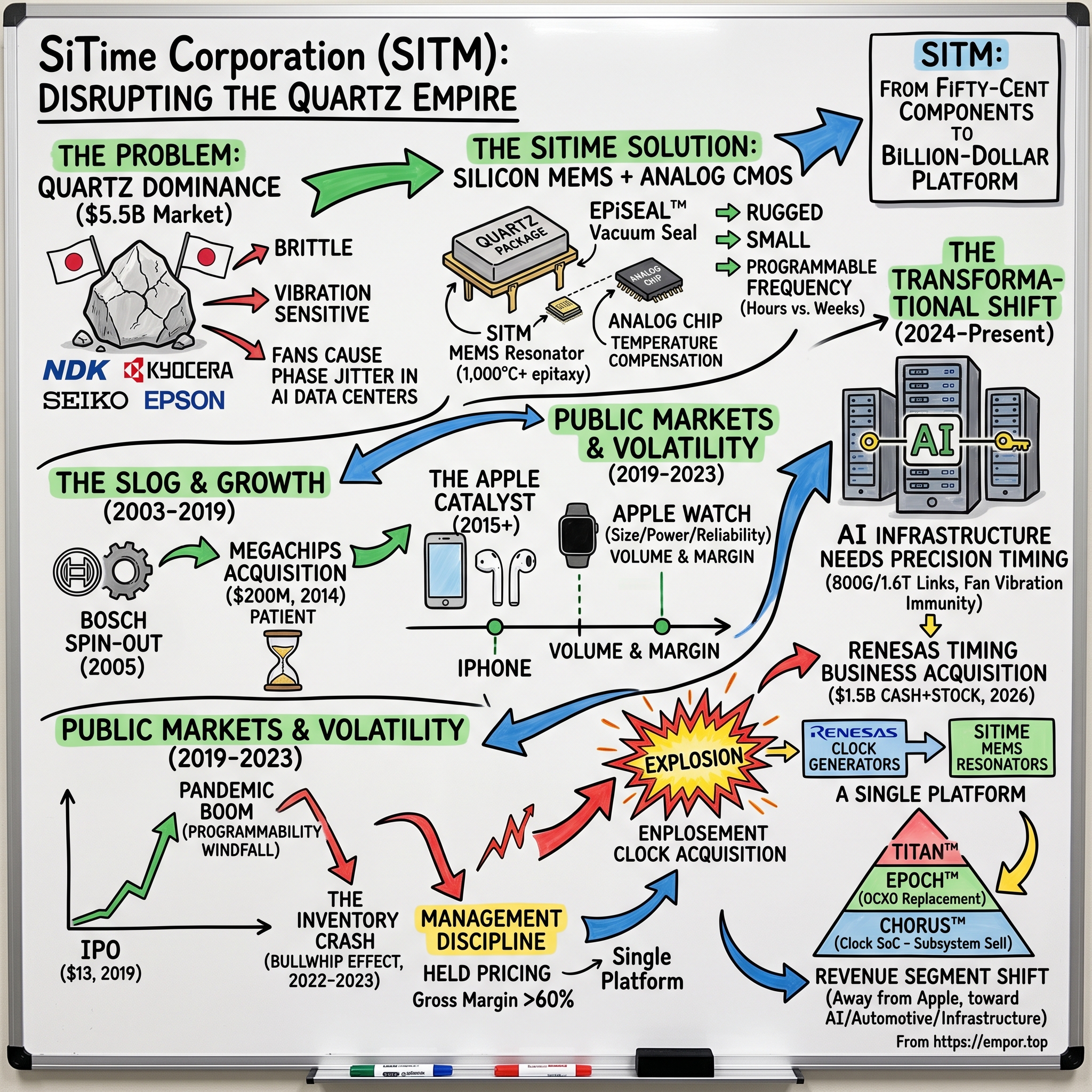
SiTime Corporation: Disrupting the Quartz Empire with Silicon MEMS
I. Introduction, Thesis & Episode Roadmap
Hold a modern smartphone in your hand and you are holding, among other things, a machine that must agree with itself billions of times per second. Every transistor switch, every packet sent, every pixel refreshed depends on a shared sense of "now." Strip away the glass and the aluminum and the marketing, and a digital device is really just a vast committee of silicon that only functions because a tiny metronome in the corner keeps everyone in time. That metronome has a name most people never learn: the timing reference. And for more than eighty years, that metronome has been made of the same material used in cheap wristwatches and kitchen clocks — a sliver of quartz crystal, sawn at a precise angle, vibrating when you feed it voltage.
It is one of the quietest monopolies in electronics. A roughly $5.5 billion industry, dominated by a cluster of Japanese and Asian manufacturers who have been slicing and grinding crystals for generations, sits underneath nearly every electronic device ever made.13 It is invisible, unglamorous, and — until recently — considered permanently settled. Nobody was going to unseat quartz. Quartz was physics. Quartz was destiny.
This is the story of the company betting its entire existence that destiny was wrong.
SiTime Corporation, which trades on the NASDAQ Global Market under the ticker SITM, makes timing references out of silicon instead of quartz. Specifically, it builds microscopic mechanical resonators using MEMS — Micro-Electro-Mechanical Systems, the same broad family of technology that puts an accelerometer in your phone and an airbag sensor in your car — and pairs them with custom analog chips that clean up and shape the signal. The company holds well over 90% of the silicon MEMS timing market, which is another way of saying that in the specific corner of the world where quartz is being replaced, SiTime is very nearly the only game in town.13
The thesis the company sells to investors is seductive in its simplicity: an asset-light silicon disruptor is prying open an asset-heavy mechanical industry, one design win at a time. SiTime was spun out of the research labs of Robert Bosch GmbH, the German industrial giant. It was bought in 2014 for $200 million by the Japanese fabless semiconductor firm 株式会社メガチップス MegaChips Corporation.4 It re-emerged as a public company in a 2019 IPO. And in July 2026 it closed the largest deal in its history — the acquisition of the timing business of ルネサス エレクトロニクス株式会社 Renesas Electronics Corporation for $1.5 billion in cash plus stock, a transaction designed to vault SiTime from a maker of fifty-cent components toward a billion-dollar "precision timing" platform.23
But a good story is not the same as a good stress test, and this article is not the company's investor-relations department. So we will hold two questions in our heads the whole way through. First: where is the genuine, defensible edge — the thing a skeptic cannot wave away — and where is it merely management rhetoric wrapped around a cyclical semiconductor business trading at a rich multiple? Second: what would have to go wrong for the thesis to break, and how close is the company to those failure lines already?
One framing is worth defusing at the outset, because it colors everything that follows. The tidy pitch — "SiTime is disrupting a $5.5 billion market" — is true in the way a headline is true and misleading in the way a headline is misleading. SiTime is not going to convert the whole timing market; the overwhelming majority of it, by units, is cheap quartz going into cost-sensitive devices where silicon MEMS has no reason to compete and never will. The realistic prize is the demanding, high-value sliver of that market — the sockets where reliability, size, and stability are worth paying for — plus the possibility of expanding what a "timing" sale even includes by moving from components to subsystems. The bull case is not that SiTime eats quartz; it is that the high-value slice grows faster than the whole and that SiTime keeps most of it. Keep that distinction close, because it is the difference between a defensible thesis and a slogan.
Here is the roadmap. We begin with the physics and economics of quartz versus silicon — why quartz won for eighty years, and where it is now genuinely breaking. Then the Bosch origin story and the long, capital-draining slog to a working product. Then the MegaChips chapter, when a patient Japanese owner shielded SiTime through its awkward adolescence and Apple arrived as its first great customer. Then the public-markets act: the 2019 IPO, the pandemic boom, and the brutal 2022–2023 inventory crash that tested whether management actually meant what it said about pricing discipline. Then the AI data-center inflection and the Renesas mega-deal that defines the company today. And finally the unglamorous but decisive work — segment economics, the competitive moat, management credibility, and the honest bull-versus-bear debate. Let's start with the rock.
 Subscribe on LinkedIn
II. The Physics & Business of Time: Why Quartz Ruled & Why It Fails in AI
Picture a wine glass. Flick it with a fingernail and it rings — a clear, sustained tone. That tone is the glass vibrating at its own natural frequency, and the reason it rings cleanly rather than thudding is that glass is a low-loss material: energy sloshes back and forth inside it for a long time before friction bleeds it away. Engineers have a name for that quality. They call it Q, the quality factor, and it is the single most important number in the timing business. High Q means a pure, stable tone. A stable tone means a precise, reliable clock.
Quartz has extraordinary Q. Cut a slab of crystalline quartz at a very specific angle — the industry standard is the so-called AT-cut — and apply a voltage across it, and it deforms; the material is piezoelectric, meaning mechanical stress and electrical charge are two sides of the same coin. Wire that deformation into a feedback loop and the crystal will vibrate at a frequency set by its physical dimensions, holding that frequency with a consistency that, for decades, nothing else could touch at anything close to the price. That is the whole miracle of quartz: it is a naturally occurring, cheap, absurdly stable mechanical tuning fork. For most of the twentieth century, asking why you would use anything else was like asking why you would build a wheel out of anything but a circle.
The Japanese empire that time built
Because quartz was the answer for so long, an entire industrial ecosystem grew up around perfecting it, and that ecosystem is overwhelmingly Japanese and Asian. The names are unfamiliar to most Western investors but they run the plumbing of the electronics world: 日本電波工業 NDK (Nihon Dempa Kogyo), セイコーエプソン Seiko Epson, 京セラ Kyocera, and Taiwan's 台灣晶技 TXC Corporation. These are not fabless design houses. They are heavy manufacturers. They grow synthetic quartz, saw it into wafers, lap and grind and etch each blank to a target frequency, mount it inside a hermetic ceramic package, and ship it by the billions. It is a business of furnaces, dicing saws, and clean rooms — capital-intensive, deeply optimized over generations, and very, very good at making a commodity part for pennies.
This is the fortress SiTime chose to attack. And on the surface it looks unassailable, because in raw unit volume quartz still wins overwhelmingly — the vast majority of the world's timing devices, something like 95% of the units, remain perfectly well served by cheap quartz.13 For a $0.03 crystal going into a toy or a thermostat, silicon MEMS has no business even showing up.
Where the rock cracks
So the interesting question is not "is quartz bad?" It plainly isn't. The interesting question is: where does eighty years of quartz optimization suddenly stop being good enough? And the answer, it turns out, is exactly where the money is going — the demanding, high-performance, physically hostile environments of AI data centers, autonomous vehicles, and advanced networking.
Three cracks matter.
The first is physical fragility. A quartz resonator is a brittle mechanical object, and like any brittle mechanical object it is sensitive to shock and, more insidiously, to vibration. Here is the counterintuitive villain: cooling fans. A dense rack of AI accelerators throws off enormous heat, which is dissipated by high-airflow fans that generate a wall of acoustic vibration. That vibration physically couples into a quartz crystal and smears its clean tone into noise — the industry calls it phase jitter. In a high-speed optical link running at 800 gigabits or 1.6 terabits per second, a smeared clock means bit errors, dropped packets, and retransmissions. The fan that keeps the chips cool can, quietly, corrupt the timing that keeps them synchronized.
The second crack is the supply chain itself. Because a quartz crystal's frequency is set by its physical dimensions, changing the frequency means physically cutting a different crystal. There is no software step. A custom-frequency quartz part can carry lead times of twelve to sixteen weeks or more, and once it's cut, it's cut — there is zero after-the-fact programmability. Remember that fact; it becomes the hero of the pandemic chapter.
The third crack is integration. Quartz cannot be shrunk below certain physical limits without losing stability, and it cannot be fabricated on the same silicon as the chips it serves. It will always be a separate component you bolt onto the board.
Silicon MEMS attacks all three at once. A MEMS resonator is a tiny mechanical structure — think of a microscopic tuning fork — etched into silicon in a standard semiconductor fab, then sealed and paired with a companion analog chip that compensates for silicon's natural weaknesses. Because it's silicon, it can be made astonishingly small, batch-produced by the billions on wafers, and — critically — programmed to any frequency after the fact by tuning the companion chip. Because the resonator is a sturdy little block rather than a brittle blade, it shrugs off shock and vibration that would rattle a crystal. SiTime markets its devices as an order of magnitude or more better in vibration immunity and dramatically more reliable in the field. Those are company claims, and we should treat them as claims — but they are claims rooted in the physics of the materials, not in marketing alone.
It helps to be concrete about the economic geometry here, because it is what makes the disruption possible at all. A quartz maker's cost is dominated by physical processing — sawing, lapping, grinding, and hermetically packaging a mechanical crystal — and those steps do not get dramatically cheaper as the industry scales, because they are governed by the physics of cutting rock, not the economics of printing transistors. Silicon, by contrast, rides the entire cost curve of the semiconductor industry: every improvement in wafer processing, every increase in wafer diameter, every advance in test automation flows straight into a MEMS resonator made the same way. A single 200- or 300-millimeter wafer can yield tens of thousands of resonators in one batch. This is why SiTime's cost structure improves with volume in a way a quartz factory's fundamentally cannot, and it is the quiet mathematical engine underneath the whole "counter-positioning" story we'll return to later.
There is a subtlety worth naming, though, lest the pitch sound too clean. Silicon MEMS is not a free lunch on every axis. A raw silicon resonator, left to its own devices, is a worse clock than quartz in the two respects that matter most — absolute frequency stability over temperature, and intrinsic noise. SiTime's entire technical achievement is not that silicon is naturally better; it is that the company learned to compensate silicon's weaknesses in the companion analog chip so thoroughly that the combined system beats quartz on the metrics customers care about, while keeping silicon's structural advantages in size, ruggedness, and programmability. That distinction matters for the investment case, because it means SiTime's moat is not a lucky material property anyone could exploit — it is accumulated engineering that took two decades to build. Which raises the obvious problem: if silicon is so much better, why did it take twenty years to work? The answer is a story about a research lab, a vacuum, and a very long time in the wilderness.
III. Origin Story: Bosch, EpiSeal™, & The Long Slog (2003–2014)
In the early 2000s, in a Bosch research center in Palo Alto and back in the company's engineering heartland in Stuttgart, a small group of MEMS engineers was wrestling with a deceptively simple problem: how do you make a mechanical resonator out of silicon that stays clean for years? Bosch had every reason to care. It was already one of the world's great MEMS companies — its sensors, the accelerometers and gyroscopes that fire your airbag and stabilize your car, were manufactured at enormous scale. The physics of making tiny silicon things move was Bosch's native language.9
Two people anchor the origin. Markus Lutz was a senior Bosch engineer who had helped invent the world's first mass-produced MEMS gyroscope — a person who understood, better than almost anyone alive, how to make a micro-mechanical structure survive contact with the real world. Aaron Partridge was a Stanford Ph.D. who had spent years on the specific, unglamorous problem of encapsulation: how to wrap a MEMS device in a package that protects it without poisoning it.9 Between roughly 2003 and 2005 their work at Bosch's research and technology center crystallized into a company, and in 2005 SiTime was founded to commercialize it.9
The vacuum that made it possible
The reason earlier MEMS-timing attempts had failed is worth dwelling on, because it explains the whole moat. A silicon resonator vibrating inside a cavity is exquisitely sensitive to whatever else is in that cavity. A few stray molecules of moisture or a whisper of chemical contamination will land on the resonator, subtly change its mass, and drift its frequency over time. A clock that drifts is not a clock. So the entire game was: how do you seal a silicon resonator inside a cavity so clean that nothing ever lands on it, and keep it that clean for the twenty-year life of the product?
SiTime's answer was the process it trademarked as EpiSeal™. Rather than gluing a lid on top of the cavity — the obvious approach, and the one that leaks — EpiSeal grows the seal. The resonator is encapsulated inside a chamber and then sealed shut using silicon epitaxy at extreme temperatures, well above 1,000°C. At that heat, contaminants are driven off and the cavity is closed with a layer of pure silicon, leaving an oxide-free, vacuum-clean enclosure with the resonator entombed inside it, permanently.9 It is the semiconductor equivalent of sealing something in amber, except the amber is grown atom by atom in a furnace. This is the crown jewel — the piece of process knowledge that competitors have spent two decades failing to replicate.
But a clean resonator was only half the invention. Silicon has an inconvenient habit: its stiffness, and therefore its resonant frequency, changes with temperature far more than quartz's does. Left alone, a silicon MEMS clock would drift badly as a device heated and cooled. SiTime's second act was to pair every resonator with a custom analog companion chip — a temperature-compensated fractional-N phase-locked loop, in the jargon — that measures temperature continuously and mathematically cancels the drift in real time. The resonator provides the raw mechanical heartbeat; the analog chip is the nervous system that keeps it honest. Neither works without the other, and designing both together is the co-design expertise that is genuinely hard to copy.
The valley of death
Having a breakthrough and having a business are different things, and SiTime spent the better part of a decade discovering the gap between them. In 2007 the company brought in Rajesh Vashist as CEO, a semiconductor veteran who had previously run Ikanos Communications, to build a commercial organization around the science.9 Vashist grasped something early that would shape the company's entire strategy: SiTime could not win by being cheaper. Competing head-on against a $0.10 Asian quartz crystal on price was, in his framing, suicide — a race to the bottom against manufacturers with fully depreciated furnaces and decades of cost optimization. SiTime had to sell reliability, size, and programmability. It had to be the premium option, not the discount one.
That was the right strategy, and it also condemned the company to years of frustration. The customers who most needed reliability — Tier-1 telecom and automotive OEMs — were precisely the customers least willing to gamble on an unproven part. Why would a network-equipment maker rip out a fifty-year-old quartz component that had never failed to qualify a startup's silicon? The burden of proof sat entirely on SiTime, and proof takes years and design cycles that a venture-funded company can ill afford.
This is the crux of why so many technically brilliant components companies die young, and it is worth stating as a general principle because SiTime's whole history is a case study in it. A better mousetrap does not sell itself when the buyer's cost of being wrong is catastrophic. For a telecom operator, a clock failure in a base station is a field recall; for a carmaker, a timing glitch in a safety system is a lawsuit. Against those stakes, "it's smaller and cheaper to reprogram" is not a winning argument — "it has ten years of proven field reliability" is, and that is the one thing a young company definitionally cannot have. SiTime had to manufacture credibility the slow way, one qualified design at a time, and the only way to survive the wait was to ship into applications where the cost of failure was low — toys, remote controls, low-end consumer gear — while it accumulated the field data that would eventually unlock the high-value sockets. Through the 2008 financial crisis and into the early 2010s, SiTime burned venture capital, shipped into those low-stakes consumer sockets, and waited for the market to believe. By 2014 it had a real technology, a growing but modest business, and a balance sheet that could not indefinitely fund the wait. It needed a patient owner with deep pockets. It found one in Osaka.
IV. The MegaChips Chapter: Strategic Patience & The Apple Catalyst (2014–2019)
On October 28, 2014, MegaChips Corporation announced it would acquire SiTime outright for $200 million in cash.4 To the Silicon Valley venture community, it looked like a fine-but-unspectacular exit for a company that had been grinding for the better part of a decade. To MegaChips — a mid-sized Japanese fabless firm best known for licensing and custom ASICs — it was a bold, risky bet on an unprofitable disruptor whose thesis had not yet been proven at scale.
Why the deal mattered more than the price
The purchase price — roughly $200 million, a mid-single-digit multiple of SiTime's then-modest revenue — is not the interesting number. The interesting thing is what MegaChips did not demand. It did not demand immediate profitability. It did not force SiTime to chase quarterly earnings by dumping product into commodity sockets. Instead it did three unglamorous things that turned out to be worth far more than the headline price. It put a real balance sheet behind SiTime, so the company stopped living quarter to quarter on venture cash. It lent supplier credibility, which mattered enormously when SiTime went to foundries like TSMC for its analog chips — a startup and a $200-million-backed subsidiary of a Japanese public company are treated very differently by a foundry allocating scarce capacity. And it supplied patient, long-horizon capital at exactly the moment SiTime needed to invest ahead of revenue.
In hindsight, this is one of the more quietly brilliant acquisitions in recent Japanese semiconductor history. MegaChips bought a pre-inflection deep-tech company, shielded it through its most vulnerable years, and then — as we'll see — monetized a stake worth many multiples of the purchase price when SiTime went public, all while retaining commercial ties. It is a case study in the specific kind of value that only patient strategic ownership can create: the value of time itself, handed to a company that needed years the public markets would never have granted it. The lesson generalizes. Asset-light deep-tech disruptors are most fragile precisely at the moment their technology works but their market hasn't arrived yet, and a corporate parent willing to absorb that gap can capture enormous returns.
Apple comes calling
The catalyst that turned SiTime from a promising subsidiary into a genuine growth company was the arrival of Apple. And the reason Apple came is a direct consequence of the physics from Part II. Apple was building a generation of products — the Apple Watch, AirPods, and ever-thinner iPhones — where every cubic millimeter and every microwatt of standby power was contested territory, and where the device would be dropped, shaken, and worn on a running wrist. Quartz struggled on all counts: too bulky at the extreme small end, and too fragile for the abuse. SiTime could engineer MEMS oscillators small enough to tuck into the impossibly crowded logic board of a wearable, sturdy enough to survive being slammed against a sidewalk, and frugal enough not to drain a tiny battery.
Winning Apple was transformational and dangerous in equal measure, and it is important to be honest about both halves. On the transformational side: Apple's volumes gave SiTime the manufacturing scale to drive down cost and the gross-margin leverage that scale brings, and — just as valuably — Apple's endorsement was a signal flare to every other OEM that silicon MEMS timing was ready for prime time. If it was good enough for Apple, the conservatism that had frozen SiTime out of Tier-1 accounts for a decade began, finally, to thaw.
On the dangerous side: Apple grew into SiTime's single largest end customer by a wide margin. In the years that followed, revenue attributable to Apple ran at roughly a fifth of SiTime's total — about 22% in 2024, 21% in 2023, and 20% in 2022 — routed through distributors whose sell-through data pointed back to Apple products.5 One customer that size is a double-edged sword that never stops cutting: it delivers volume, validation, and margin, but it also hands that customer enormous leverage over price and roadmap, and it means a single sourcing decision in Cupertino can reshape a full year of results.
It is worth sitting with what the Apple relationship reveals about SiTime's negotiating position, because it complicates the tidy "premium supplier" narrative. Apple does not pay premium prices out of sentiment; it extracts the best terms in the industry from nearly every supplier it touches, and a component vendor for whom Apple is a fifth of revenue has limited leverage to push back. The plausible reading is that SiTime's consumer margins are its thinnest, and that the strategic value of Apple was never the margin on the Apple business itself — it was the manufacturing scale and the market credibility that flowed to everything else. In other words, Apple was less a profit center than a proof point and a volume subsidy, one that let SiTime build the cost base and reputation it needed to attack the far more profitable infrastructure and automotive markets. That is a defensible use of a marquee customer, but it also means the reported blended gross margin quietly averages a lower-margin consumer book against a much higher-margin infrastructure book — a mix dynamic that becomes central once the AI segment starts to dominate.
SiTime spent the next phase of its life trying to grow everything else fast enough that Apple would shrink as a share of the whole — not by selling Apple less, but by selling everyone else more. First, though, it had to go public.
V. The Public Markets Act: IPO, Pandemic Mania, & The Inventory Crash (2019–2023)
On November 20, 2019, SiTime priced its initial public offering — and priced it, notably, at the bottom of the range. The company sold 4.3 million shares at $13.00 apiece, the low end of a $13–$15 expected band, raising on the order of $56 million in gross proceeds.[^4] MegaChips had spun its subsidiary back onto the public market but kept firm control, holding roughly two-thirds of the shares — about 66.8% at the end of 2019 — so this was less a clean exit than a partial liquidity event that let the market start pricing an asset MegaChips still owned.[^4] The tepid pricing told you how the market saw SiTime at the time: a small, single-customer-heavy timing-chip company in an unglamorous niche. The next morning, the stock told a different story, opening around $16.90 — a jump that hinted the public had more appetite for this than the bankers had guessed.[^4]
Nobody, of course, was pricing in a pandemic.
The programmability windfall
When COVID-19 shattered global supply chains in 2020 and 2021, it created the single most favorable environment SiTime could have scripted for itself. Demand for anything with a chip in it — laptops, webcams, networking gear, 5G infrastructure — exploded, while the world's semiconductor supply seized up. Quartz factories, with their physical crystal-cutting bottleneck, saw lead times balloon toward twenty and thirty weeks. And here the abstract virtue of programmability from Part II became cold, hard cash.
Because a SiTime device is a blank silicon oscillator programmed to frequency by its companion chip, the company and its distributors could hold generic inventory and configure it to a customer's exact specification in hours, not months. While a customer waited half a year for a custom quartz crystal, SiTime could ship next week. In a shortage, availability is worth almost any price, and customers paid it. Revenue surged, non-GAAP gross margins pushed past 65%, and the stock — which had opened its life in the teens — rocketed past $200 as investors extrapolated the boom.8 For a moment, SiTime looked like it had discovered a permanent structural advantage.
It had discovered a real advantage. It had also, temporarily, mistaken a bubble for a plateau.
The bullwhip
Every supply shortage that ends in panic-buying ends the same way, and the mechanism has a name: the bullwhip effect. When end demand is uncertain and supply is scarce, everyone in the chain over-orders to protect themselves — double- and triple-booking to guarantee allocation. When supply finally catches up and the fear drains out, all that phantom demand evaporates at once, and the chain chokes on inventory it no longer needs. Orders don't just slow; they stop, while customers work down the stockpiles they built in the panic.
SiTime rode the whip straight down. Full-year revenue collapsed from a 2022 peak of $283.6 million to just $144.0 million in 2023 — a decline of roughly 49% in a single year, one of the sharpest revenue drops of any comparable semiconductor company through that cycle.8 For a company that had recently been a market darling, this was an existential-feeling test, and the more revealing test was behavioral: what would management do under that kind of pressure?
The answer is the most important evidence we have about how Vashist and his team actually run the business, so it deserves scrutiny rather than applause. Faced with a revenue chart falling off a cliff, the textbook temptation is to cut prices and chase whatever commodity volume you can find to keep the fabs busy and the top line from cratering further. SiTime refused. Management held the line on pricing, declined to compete for low-margin commodity sockets, and kept non-GAAP gross margins above a 60% floor even as volumes cratered.8 On earnings calls through the trough, the team explained the bullwhip mechanics transparently rather than blaming vague "macro headwinds," and — crucially — it kept spending on R&D through the bottom, betting that the AI and infrastructure markets it was designing for would arrive before the balance sheet gave out.
A skeptic should note that holding price is easier when you have a near-monopoly in your niche and a patient shareholder base than when you're fighting for survival in a commodity market — SiTime's pricing discipline is partly a virtue and partly a luxury its market position affords. But the discipline was real, it was tested, and it held.
There is a second, subtler lesson buried in the crash that bears on how to read the company's current results. The 2021 boom margins above 65% were, in part, shortage margins — customers paying up for availability in a panic — and they were never going to be a permanent baseline. When management guided investors to a 60–65% gross-margin target rather than defending the pandemic peak, it was implicitly admitting that some of the boom pricing was transient. That is exactly the kind of candor a fundamental investor should reward, because the opposite behavior — extrapolating a bubble peak as the new normal and then missing it — is the most common way semiconductor management teams destroy their own credibility. SiTime instead reset expectations downward at the top and then delivered against the reset, which is the harder and more trustworthy sequence. That matters, because the bet the company was making through the downturn — that AI would need exactly what SiTime builds — was about to pay off spectacularly.
VI. The AI Infrastructure Transformation & Mega-M&A Expansion (2024–Present)
Walk into a modern AI data center and the first thing that hits you is the noise. Rows of accelerators drawing kilowatts each are kept alive by banks of high-airflow fans running flat out, and the result is a physical environment — vibration, acoustic energy, thermal churn — that is genuinely hostile to precision. This is the environment that turned SiTime's decade-old engineering thesis into a growth story, because it is the environment where quartz's fragility stops being a footnote and starts being a failure mode.
Why AI needs a better clock
The demanding part of an AI cluster, for timing purposes, is not the GPU. It's the network that lashes thousands of GPUs together. Training a large model means shuffling staggering volumes of data between chips over high-speed optical links running at 800 gigabits and, increasingly, 1.6 terabits per second. At those speeds the timing budget is merciless: the clock feeding an optical transceiver must hold phase jitter down to well under a hundred femtoseconds — a femtosecond being a quadrillionth of a second, a unit so small that light itself travels less than the width of a human hair in one. A clock that jitters under the fans' vibration corrupts bits, forces retransmissions, and drags down the utilization of a compute cluster that may have cost hundreds of millions of dollars. In that math, a more expensive but rock-steady clock isn't a cost — it's insurance on the whole investment. That is the pitch SiTime makes to the switch and networking builders, and it is why the company began describing AI data centers as its primary growth engine.
The proof is in the numbers, and they are striking. SiTime's Communications, Enterprise & Datacenter segment — its AI-exposed business — grew more than 100% year-over-year for seven consecutive quarters, and that engine drove full-year 2025 revenue to $326.7 million, up 61% from 2024's $202.7 million.111 The fourth quarter of 2025 alone brought in $113.3 million, up 66% year-over-year and 36% sequentially, and full-year non-GAAP earnings per share more than tripled to $3.20 from $0.93 a year earlier.1 On the Q4 2025 call, management framed the moment as an inflection rather than a cyclical bounce — the AI-datacenter demand, in their telling, was structural and durable.10
Pause on that tripling of earnings, because it illustrates the operating leverage that makes investors excited and nervous in equal measure. A capital-light business with a fixed R&D base converts incremental high-margin revenue into profit at a ferocious rate on the way up — revenue grew 61% while non-GAAP EPS grew more than 200%, the signature of a model where costs are largely fixed and the marginal dollar of AI-datacenter sales drops mostly to the bottom line. The uncomfortable corollary is that the same leverage runs violently in reverse, as 2023 already demonstrated. A business that can triple earnings on a 60% revenue gain is, by the identical arithmetic, one that can see earnings collapse on a revenue decline. Operating leverage is not a one-way gift; it is an amplifier, and it amplifies whichever direction the cycle is pointing.
That is the bullish read, and the growth genuinely supports it. The bearish read, which we'll return to, is that AI infrastructure spending is itself famously cyclical and concentrated in a handful of hyperscale buyers, and a company whose fastest-growing segment rides that wave inherits both its volatility and its customer concentration — trading, in a sense, one form of concentration (Apple) for another (a small club of AI buildout spenders). The diversification story is real, but it is diversification into a market with its own single-point-of-failure characteristics.
The product ladder: from fifty cents to fifty dollars
Underlying the AI story is a deliberate climb up the value chain, and it's worth naming the rungs because they're how SiTime intends to escape the low-margin gravity of its origins. At the bottom sits Titan™, ultra-small resonators meant to be embedded directly into a customer's own SoCs, MCUs, and power-management chips. Above it, Epoch™ is a MEMS-based oven-controlled oscillator platform aimed squarely at replacing the bulky, power-hungry, two-inch metal-can quartz OCXOs that anchor timing in telecom and data-center gear. Higher still, Chorus™ is a clock system-on-chip that fuses a clock generator and a MEMS resonator onto a single die — and this is the strategic prize, because it lets SiTime sell not a fifty-cent component but a $20-to-$50 subsystem, expanding the dollar content it captures per system by an order of magnitude. Tying it together is TimeFabric™, a software layer for dynamically controlling frequencies and optimizing a system's clock tree. The through-line is unmistakable: stop selling the cheapest possible part, and start selling the most valuable possible subsystem.
The Epoch OCXO play deserves a moment on its own, because it is the clearest illustration of the strategy. An oven-controlled oscillator is the gold standard for stability — traditionally a bulky metal can with a literal miniature heater inside, holding the crystal at a constant temperature so it never drifts, drawing meaningful power and taking up meaningful board space. These are the parts that anchor timing in cell towers and data-center switches, and they are expensive. If SiTime can deliver OCXO-class stability from a silicon MEMS device that is a fraction of the size and power, it does not just win a socket — it wins one of the highest-value, most defensible sockets in the entire timing market, one where the customer's alternative is a large, power-hungry legacy component. This is the opposite end of the value spectrum from the fifty-cent consumer oscillator, and it is where the margin math of the whole thesis is decided. The claim is credible on physics; the open question, as always, is how fast and how completely customers actually adopt it, which is why cross-sell penetration ends up being a KPI worth tracking directly.
Buying the missing pieces
SiTime couldn't build the whole ladder organically fast enough, so it bought. In December 2023 it acquired the clock-product portfolio and clock IP of Aura Semiconductor — a deal structured as $148 million in fixed payments plus earnouts capped at $120 million, tied to product deliveries and revenue through 2028.6 Aura gave SiTime something its MEMS heritage lacked: a full stable of analog clock chips — network synchronizers, jitter cleaners, clock generators, and buffers — the very silicon that sits alongside a resonator in a high-end system. It also planted an engineering flag in Bengaluru, India.6
Then came the transaction that redefined the company. In early February 2026, alongside its Q4 results, SiTime announced it would acquire the timing business of Renesas Electronics for roughly $1.5 billion in cash plus stock.2 The deal closed on July 1, 2026, with SiTime paying $1.5 billion in cash and issuing about 3.56 million shares, and Renesas taking an equity stake of roughly 11.9% in SiTime as part of the arrangement.3 The acquired business was expected to generate around $300 million of revenue in its first twelve months under SiTime, at roughly 70% gross margins, with about three-quarters of it tied to the AI-datacenter and communications end markets.2
The strategic logic is to marry Renesas's silicon clock generators — and, just as importantly, its direct relationships with thousands of enterprise and telecom accounts — with SiTime's MEMS resonators, roughly tenfold-expanding the clocking portfolio and giving SiTime a distribution reach it could never have built alone.2 The closest comparable is Skyworks Solutions' $2.75 billion purchase of Silicon Labs' infrastructure and automotive timing business in 2021, another attempt to consolidate the analog-timing landscape.12 But the structural logic differs in an important way: Skyworks bought a business adjacent to its own, whereas SiTime is buying the complementary half of its own product — Renesas's silicon clock generators are precisely the chips that sit next to a MEMS resonator in a high-end timing system. If the integration works, SiTime does not just add revenue; it can present customers with a single vendor for the entire clock subsystem, resonator and generator together, which is a genuinely differentiated offer that neither Renesas nor SiTime could make alone. That is the bull's version of the deal.
There is no getting around the scale of what SiTime has taken on, though, and the financing tells the story. A company that finished 2025 with $326.7 million in revenue is absorbing a roughly $300-million business and a $1.5 billion cash outflow in one move, funded by the large cash balance it had deliberately built plus the equity it issued, with Renesas itself taking an ownership stake of roughly 11.9% as part of the consideration.13 Handing a major supplier of the acquired assets a double-digit equity position is a notable governance wrinkle — it aligns Renesas with SiTime's success, but it also seats a large industry player on the shareholder register with interests that may not always match those of ordinary holders. This is not a bolt-on; it is a bet-the-company transformation, and its success or failure will define the next five years. Which makes it worth pausing to understand exactly how this business actually makes money.
VII. Business Segments, Unit Economics, & Financial Mechanics
Strip away the AI narrative and the M&A headlines, and SiTime is at bottom a fabless semiconductor company with an unusual cost structure and three quite different businesses stapled together. Understanding those three businesses — who buys, at what price, at what margin — is the difference between owning the story and understanding the company.
Three businesses wearing one logo
The first and most important, for the thesis, is Communications, Enterprise & Data Center — the AI-facing segment. It runs roughly 35–40% of revenue, it is growing the fastest by a wide margin, and it carries the highest average selling prices, from several dollars to fifty-plus dollars for the richest clock-SoC subsystems, at the highest gross margins in the company, north of 70%.2 This is the segment the entire investment case is built on, and its rise is what re-rated the stock.
The second is Automotive, Industrial & Aerospace, roughly 20–25% of revenue. This is the patient, high-quality part of the business. Qualification cycles run three to five years, which is agonizing to sell into but is itself the moat: once a SiTime part is designed into a car's driver-assistance module or an aerospace system, it is extraordinarily sticky, because re-qualifying a safety-critical clock is a multi-year ordeal no customer undertakes lightly. These are also the applications with the most punishing temperature and vibration demands — exactly where silicon MEMS commands a structural premium over quartz rather than competing on price.
The third is Mobile, Consumer & IoT, roughly 40–45% of revenue and home to the Apple relationship. This is the high-volume, lower-ASP business — fifty cents to a dollar-fifty per part — and it is the segment most exposed to customer concentration and consumer cyclicality.5 The honest way to frame it is as a cash engine rather than a growth engine: it throws off the volume and scale that fund the R&D powering the higher-value segments, but it is not where the future margin expansion comes from. The strategic project of the last few years has been, in effect, to grow segments one and two fast enough that segment three's concentration risk keeps shrinking as a share of the whole.
The capital-light engine
What makes the economics attractive — when volumes cooperate — is the fabless model. SiTime owns no fabs. Its MEMS resonators are manufactured on Bosch's wafer lines, drawing on the same manufacturing base Bosch built for its automotive sensors; its analog companion chips are fabricated largely at TSMC on mature nodes; and packaging and test are handled by third-party OSAT partners. The company's own capital spending for maintenance runs at only a low-single-digit percentage of revenue. That is the definition of a capital-light business: it converts revenue growth into cash without having to pour billions into new factories, and it can flex output up and down with the cycle because the fixed manufacturing burden sits on its partners' balance sheets, not its own.
The interesting wrinkle — and it is a genuine strategic vulnerability hiding inside the fabless virtue — is that SiTime's manufacturing depends heavily on Bosch, the very company it was spun out of. There is no ready second source for EpiSeal-grade MEMS wafers, because the process is proprietary and inseparable from the specific fab lines it runs on. That gives Bosch a structurally strong hand: it is simultaneously SiTime's foundational technology parent, its critical supplier, and a party whose own strategic priorities SiTime does not control. A prudent investor should watch the durability and terms of that relationship as closely as any customer metric, because a fabless company is only as reliable as its foundries, and SiTime's most important foundry is single-source by design. The TSMC dependency for analog silicon is more ordinary — TSMC is everyone's foundry — but it too means SiTime competes for wafer allocation against far larger customers, a disadvantage that can bite precisely when demand is hottest.
The flip side of capital-light is that SiTime's most important input isn't a factory — it's R&D, which the company runs at roughly a quarter to nearly a third of sales to defend its technology lead.10 That is a heavy, deliberate reinvestment rate, and it is the price of staying ahead in a business where the whole moat is process and design knowledge. The strategic wager underneath all of it is ASP expansion: shift the mix from discrete fifty-cent oscillators toward $30-plus clock-SoCs, and the served market the company can address widens from around $1 billion toward $4 billion or more.2 Whether that TAM expansion is real demand or aspirational math is one of the central questions a skeptic should press — but if the mix shift is real, the operating leverage on a capital-light base is genuinely powerful. To judge whether that leverage is defensible or fleeting, we have to war-game the competitive position.
VIII. Hamilton Helmer's 7 Powers & Porter's 5 Forces Analysis
Every great disruption story eventually has to answer a deflating question: fine, you won — but can you keep winning, or will the incumbents and the giants simply take it back? To answer that for SiTime, it helps to run the business through two disciplined frameworks rather than vibes. Hamilton Helmer's 7 Powers asks what durable advantages a company actually possesses. Porter's 5 Forces asks how attractive the surrounding industry structure is. Used together, they separate the parts of the SiTime thesis that are load-bearing from the parts that are decoration.
The 7 Powers
The primary power, and the one that makes SiTime genuinely interesting, is Counter-Positioning. The quartz titans — NDK, Epson, Kyocera, TXC — cannot simply pivot to silicon MEMS, and the reason is not that they lack the talent. It is that they have billions of dollars of sunk capital in quartz-specific plant: the growing furnaces, the slicing and grinding lines, the ceramic-packaging factories. To embrace MEMS aggressively would be to strand those assets and cannibalize the profitable business that funds them. The incumbent's own success becomes its cage — the classic counter-positioning trap, where the leader can see the disruption coming and still be unable to respond, because responding destroys its existing economics. This is the deepest and most defensible piece of the SiTime story.
The second power is a blend of Cornered Resource and Process Power: the EpiSeal™ encapsulation process, a patent portfolio numbering in the thousands, and the accumulated, hard-won expertise of co-designing MEMS resonators with high-performance analog CMOS. This knowledge is not written down anywhere a competitor can buy it; it lives in two decades of iteration. It is real, but it is worth noting it is the kind of advantage that erodes slowly rather than never — patents expire, and process secrets can eventually be reverse-engineered by a determined, deep-pocketed rival.
Third, Scale Economies, though here we should be careful. SiTime's scale advantage is not the classic manufacturing kind — it's fabless — but rather the ability to spread a very heavy R&D budget across billions of shipped units, which a sub-scale competitor cannot match. Fourth, Switching Costs: once a SiTime device is designed into an AI motherboard, an optical module, or an automotive control unit, replacing it means re-qualifying and often re-laying-out the board, an expensive and risky exercise a customer avoids unless forced. In automotive and aerospace, as noted, those switching costs are near-absolute.
The 5 Forces
Run the industry structure and the picture is mostly, but not uniformly, favorable. The threat of new entrants is very low — the technical, process, and IP barriers to silicon MEMS timing have taken decades and hundreds of millions of dollars to surmount, which is exactly why SiTime has had the market largely to itself. Competitive rivalry within MEMS is low, given SiTime's 90%-plus share, but that framing flatters the company: in the broader timing and clocking market it is now entering with Chorus and the Renesas assets, it runs directly into Analog Devices, Texas Instruments, and Microchip Technology — large, sophisticated analog firms for whom clocking is one line in a vast catalog. Rivalry there is real.
There is also a war-gaming question the frameworks don't quite capture: what stops a giant like Analog Devices, Texas Instruments, or Microchip from simply deciding that MEMS timing is strategic and buying or building its way in? The honest answer is "nothing permanent, but a lot of friction." These firms have the balance sheets and the analog talent to fund a MEMS program, and any of them could in principle acquire a challenger or license a process. What they lack is EpiSeal-equivalent process maturity and the two decades of field-reliability data that make conservative customers comfortable — the same barrier that nearly killed SiTime in its youth now protects it from well-funded latecomers. That is a real but not eternal moat; it buys years, not forever, and a determined incumbent willing to lose money for a decade could eventually contest it. SiTime's defense is to keep climbing the value chain faster than anyone can catch the bottom of it.
The bargaining power of buyers is genuinely split: high for Apple, which is large enough to dictate terms, and moderate-to-low for the fragmented base of enterprise, industrial, and defense customers who need SiTime more than SiTime needs any one of them. The bargaining power of suppliers is a real and under-discussed dependency: SiTime relies on Bosch for MEMS wafers and TSMC for analog silicon, and neither is a relationship it can casually replace — a fabless company's fate is partly in its foundries' hands. And the threat of substitutes is the honest asterisk on the whole story: quartz remains cheaper and entirely adequate for the roughly 95% of timing applications that are low-stakes and cost-sensitive.13 SiTime is not going to take those. It is going after the high-value 5%, and its entire valuation depends on that slice growing and on SiTime keeping most of it. The moat is real where it matters most; it is just narrower than the "disrupting a $5.5 billion market" headline implies. Whether the company converts that structural edge into durable returns comes down, as it always does, to the people running it.
IX. Management Credibility, Governance & Skeptical Investor Stress Test
The best framework in the world tells you what a business could do. Management tells you what it will do, and the only honest way to judge management is by behavior over time — targets set and hit or missed, narratives that stay consistent or quietly shift, and how a leadership team acts when the numbers turn against it. SiTime gives us more than a decade of that record to examine.
The people at the top
Rajesh Vashist has been CEO since 2007 — an unusually long tenure that spans the venture wilderness, the MegaChips ownership, the IPO, the pandemic boom, the bullwhip crash, and the AI inflection.9 That continuity is itself a data point: this is not a management team that discovered its strategy last quarter. Vashist's defining trait, visible across the whole record, is pricing discipline verging on stubbornness — the refusal, stated for years and then actually honored during the 2023 downturn, to chase unprofitable market share. In an industry where the standard failure mode is buying revenue with price, a CEO who has demonstrably declined to do so through a genuine crisis has earned a measure of credibility that most management teams only claim.
Beth Howe joined as CFO in November 2023, arriving from a senior finance background at Hewlett-Packard — and her timing is worth noting, because she stepped in near the very bottom of the cycle, when the job was about liquidity preservation and cost discipline rather than riding a boom.7 Under her tenure the company rebuilt a formidable cash position — well north of $500 million heading into the Renesas deal — which is precisely what gave SiTime the ammunition to write a $1.5 billion check without wrecking its balance sheet.1 A conservatively financed balance sheet going into the largest acquisition of the company's life is not an accident; it is the visible output of a deliberate capital-allocation posture.
That capital-allocation record deserves a harder look, because it contains a decision reasonable investors can debate. As the stock recovered and pushed well past $200, SiTime tapped the equity market to raise capital rather than lever up with debt — a choice that dilutes existing shareholders but keeps the balance sheet clean and preserves the flexibility to do exactly the kind of large acquisition it later did. Issuing stock at a rich valuation to fund growth is, arguably, textbook opportunistic capital management: use an expensive currency while you have it. But it also quietly signals that management itself views the shares as valuable currency rather than a screaming bargain, and it means the burden of proving the Renesas deal was worth the dilution now falls squarely on execution. A capital raise near a high is defensible; it is also a promise that the cash will earn more than the shares given up to raise it, and that promise has not yet been kept — only made. Governance-wise, the other item on the ledger is the concentration of the chairman and CEO roles in one person. Rajesh Vashist holds both, which streamlines decision-making but weakens the board's independence from management at exactly the moment — a transformational integration — when a strong, independent check on the CEO's judgment is most valuable.
Where a skeptic pushes
Credibility earned is not credibility unlimited, and a serious investor should press on three pressure points.
The first is Apple concentration. Roughly a fifth of revenue tied to a single end customer, routed through distributors, is a standing vulnerability.5 If Apple dual-sources its MEMS timing, or simply uses its scale to grind down annual pricing, the consumer segment could contract fast and with little warning. Management's counter — that the explosive growth of the AI, communications, and automotive segments is steadily shrinking Apple as a percentage of the whole — is genuine and supported by the segment growth rates, but it is a race, and the company has not yet crossed the finish line into true diversification.
The second is integration and execution risk, and it is the largest overhang today. Bolting a $300-million Renesas business and the earlier Aura assets onto a company that itself did $327 million in 2025 is an organizational step-change.13 The entire cross-sell thesis — pushing SiTime's MEMS resonators into thousands of legacy Renesas accounts — is unproven, and semiconductor history is littered with acquisitions that diluted margins and distracted management rather than compounding them. A skeptic is entitled to withhold judgment until the combined entity shows a few quarters of clean integration, and to watch closely for the classic warning signs: margin dilution, unexpected charges, or a suddenly vaguer narrative on the calls.
The third is valuation. After the run from the teens to well over $200 and beyond, SiTime trades at rich multiples of both sales and earnings that price in years of flawless execution — sustained AI-datacenter growth, gross margins held above 60% and pushing toward the high end of a 60–65% target, and a smoothly digested Renesas deal.2 None of those are guaranteed, and a valuation that assumes all of them simultaneously leaves little margin for error. High multiples are not a flaw in the business; they are a transfer of risk from the company's operations to the shareholder's entry price, and that is worth saying plainly. With the credibility and the risks laid side by side, we can finally weigh the two cases against each other.
X. Bear vs. Bull Case, Key KPIs, & Strategic Playbook
So where does this leave a long-term investor trying to decide whether SiTime is a generational disruptor or a well-run cyclical priced for perfection? The honest answer is that both readings are internally consistent, and the gap between them comes down to a handful of things that are, at least, concretely measurable. Rather than pretend to resolve the debate, the useful work is to name the metrics that will resolve it and to state each side of the case at its strongest.
The three KPIs that actually matter
Ignore the noise and watch three things.
First, the mix shift away from Apple and toward enterprise, AI data center, and automotive. This single ratio captures the entire diversification thesis. If the Communications, Enterprise & Data Center and Automotive segments keep compounding and Apple keeps shrinking as a share of the whole, the concentration risk that has shadowed the company since 2015 quietly dissolves. If that shift stalls, the bear's single-customer worry moves back to center stage.
Second, the non-GAAP gross margin floor. SiTime's whole identity is that it does not compete on price. The proof of that identity is its ability to hold gross margins above 60% through a downturn, as it did in 2023, and to push toward the upper end of its 60–65% target as the Renesas mix comes in.12 The day margins break that floor is the day the "premium, not commodity" thesis is in genuine question.
Third, clock-SoC and Renesas cross-sell penetration — the adoption of Chorus™, Epoch™, and the integrated Renesas clocking portfolio in high-ASP sockets. This is the direct scoreboard for whether the up-the-value-chain strategy and the biggest acquisition in company history are actually working, or whether SiTime remains, at heart, a maker of discrete oscillators that overpaid for a growth story. The tell to watch for is average selling price and dollar-content per system: if those climb as the combined portfolio ships, the platform thesis is real; if the acquired business simply runs alongside the legacy oscillator business without the promised cross-sell, then SiTime paid a platform price for a bolt-on, and the market will eventually notice.
A note on how to use these three together: they are designed to catch the company lying to itself before it lies to shareholders. Rising infrastructure mix with falling gross margin would signal that SiTime is buying AI revenue with price — the exact discipline breach management swore off. Rising revenue with flat ASP would signal the cross-sell isn't landing. A healthy quarter looks like all three moving the right way at once; a quarter where they diverge is the early warning that the narrative and the numbers have started to part company.
The bear case
The bears have a coherent and non-trivial argument. AI infrastructure spending is cyclical, and SiTime has now hitched its fastest-growing segment to the single most hyped and most capital-intensive investment cycle in technology; when the inevitable digestion phase arrives and hyperscalers pause to absorb the capacity they've built, high-margin optical-transceiver timing demand could soften quickly, and this is a company that has already shown, in 2023, exactly how violently its revenue can whip. Layer on the Apple risk, the real possibility of integration indigestion following a bet-the-company acquisition, and a valuation that has left no room for stumbles, and the bear case is not a caricature — it is a serious reading of a great business that may simply be priced beyond its risks.
The bull case
The bulls counter that this is what the early innings of a genuine platform shift look like. Silicon MEMS still holds only a low-single-digit slice of the $5.5 billion timing market, which means the runway is measured in a decade of penetration, not a quarter of demand.13 If SiTime cements itself as the default clocking supplier for AI infrastructure — the indispensable, rock-steady heartbeat inside every high-speed switch and optical module, immune to the vibration that degrades quartz — it occupies a position no incumbent can easily counter-position their way into. And if the Renesas acquisition delivers on its logic, it converts SiTime from a niche MEMS specialist into a consolidated precision-timing powerhouse addressing a $4-billion-plus market at 60%-plus margins. That is the "Nvidia of timing" framing management would love investors to adopt — and while the phrase is marketing, the underlying claim, that timing is an unglamorous but non-optional layer of AI infrastructure with one clear technology leader, is not obviously wrong.
What the story actually teaches
Two durable lessons outlast whatever the stock does next. The first is that counter-positioning is the disruptor's most powerful weapon: an asset-light silicon challenger can topple an asset-heavy mechanical incumbency not by being cheaper, but by attacking on a dimension — reliability, size, programmability — where the incumbent's sunk capital becomes a liability it cannot shed. The second is the quiet power of strategic patience: MegaChips' willingness in 2014 to shield a pre-inflection deep-tech company through the years when its technology worked but its market hadn't yet arrived created value that no impatient owner could have captured. SiTime's next chapter will test whether the company that was once the beneficiary of that patience can now show the operational discipline to digest a transformational acquisition — and whether the quartz empire, eighty years secure, has finally met a challenger it cannot outlast.
References
-
SiTime Reports Fourth Quarter and Fiscal Year 2025 Financial Results — SiTime, 2026-02-04 ↩↩↩↩↩↩
-
SiTime to Acquire Renesas' Timing Business — SiTime, 2026-02-04 ↩↩↩↩↩↩↩↩
-
SiTime Corp closes $1.5B Renesas timing business deal (Form 8-K) — StockTitan / SEC, 2026-07-01 ↩↩↩↩
-
SiTime to be Acquired by MegaChips for $200M — SiTime, 2014-10-28 ↩↩
-
SiTime Corporation Form 10-K for fiscal year 2024 — SEC / SiTime, 2025-02-14 ↩↩↩
-
SiTime Completes Acquisition of Clock Products from Aura Semiconductor — SiTime, 2023-12-01 ↩↩
-
SiTime Appoints Beth Howe as EVP and Chief Financial Officer — SiTime, 2023-11 ↩
-
SiTime Corp Form 8-K, Q4 and Full Year 2023 Financial Results — SEC, 2024-02 ↩↩↩
-
SiTime (SITM) Q4 2025 Earnings Call Transcript — The Motley Fool, 2026-02-04 ↩↩
-
SiTime Reports Fourth Quarter and Fiscal Year 2024 Financial Results — SiTime, 2025-02 ↩
-
Skyworks to Acquire Infrastructure & Automotive Timing Business from Silicon Labs for $2.75B — Skyworks Solutions, 2021-04-22 ↩
-
MEMS Timing Industry Analysis & SiTime Market Dominance — Yole Group, 2024-05-15 ↩↩↩↩↩
 LinkedIn
 WhatsApp
 Reddit
 Hacker News
 Email
Email Kindle
 RSS Feed
 Spotify
 Apple Podcasts
 Amazon Music
 Audible
 YouTube