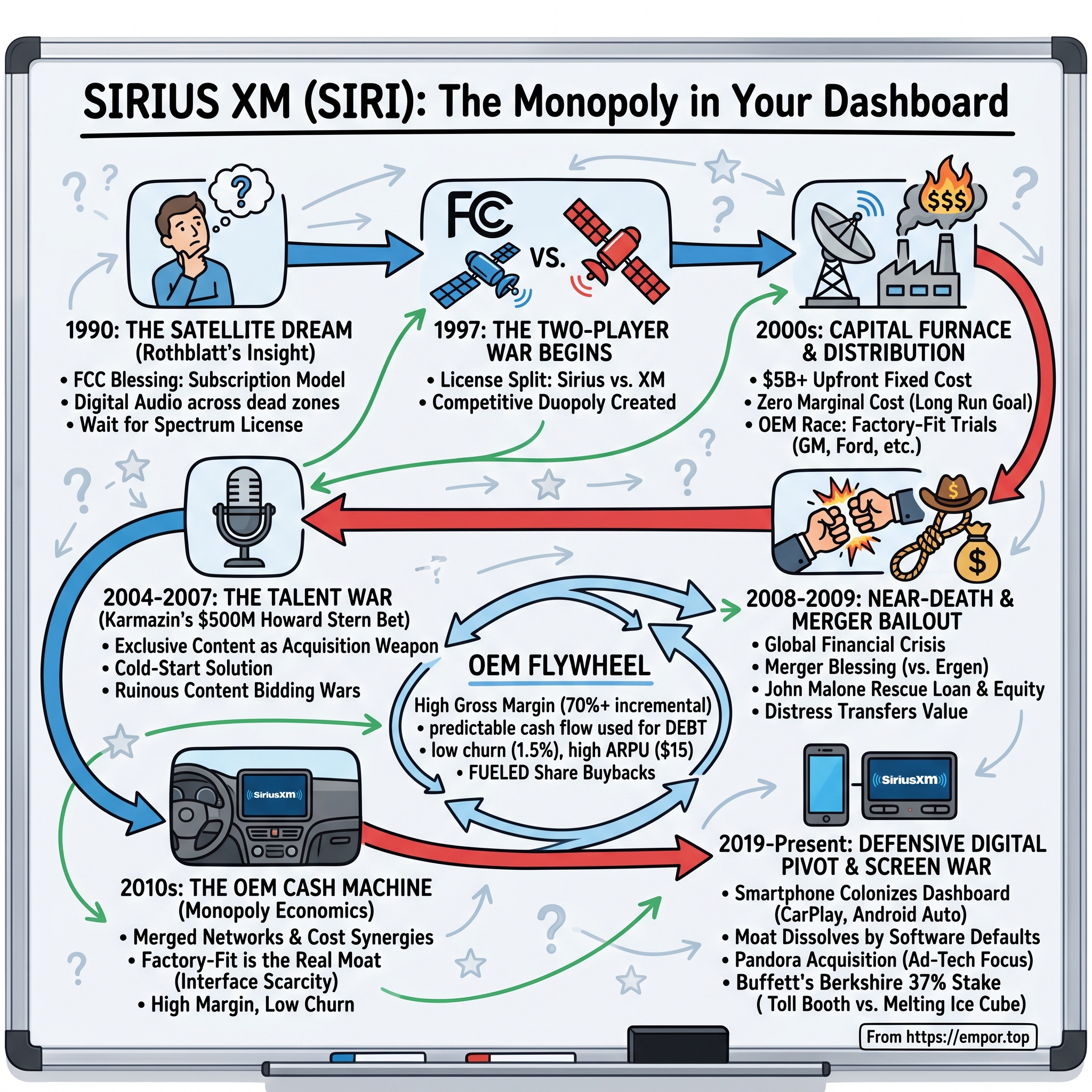
Sirius XM Holdings Inc. (NASDAQ: SIRI): The Monopoly in Your Dashboard
I. Introduction & Episode Roadmap
Picture the physics of it for a moment. Roughly 22,000 miles above the equator, a cluster of satellites the size of school buses hangs in geostationary orbit, firing a digital audio stream down through the atmosphere to receivers embedded in tens of millions of car dashboards below. The same signal that reaches one pickup truck idling in a Kansas driveway reaches every other vehicle in North America at exactly the same instant, for exactly the same cost. That is the strange and beautiful economics at the heart of Sirius XM Holdings: a company that spent more than five billion dollars building an orbital broadcasting system before it earned a meaningful dollar of profit, and then, once the constellation was aloft and the automakers were locked in, watched its marginal cost of serving the next customer fall to essentially zero.
The result is one of the purest natural monopolies in American media. SiriusXM is the only satellite radio operator in the United States, factory-installed in the overwhelming majority of new vehicles, feeding tens of millions of free trials into a subscription funnel every year. In 2025 it generated $8.56 billion in revenue and about $1.26 billion in free cash flow while carrying roughly 33 million subscribers.2 And yet the market treats it not as a fortress but as a melting ice cube.
Here is the paradox that makes this story worth two hours. The most credible endorsement in the history of value investing sits on one side of the ledger: Warren Buffett's Berkshire Hathaway built a stake exceeding 37% of the company, treating SiriusXM as a classic toll-booth cash machine trading at a single-digit multiple of free cash flow.1 On the other side sits an existential question. The moat was never really the satellites. It was the fact that SiriusXM owned the hardware interface in the dashboard — the physical tuner, the preset buttons, the branded channel guide. As Apple CarPlay and Android Auto colonize the center screen of nearly every new car, the driver's default is no longer a SiriusXM button but a smartphone that already holds Spotify, YouTube Music, and a bottomless well of free podcasts. When the interface changes, does the monopoly still matter?
That is the thesis spine of this episode. Satellite radio is an extreme case of an upfront-fixed-cost, zero-marginal-cost business. Once you accept that framing, everything about SiriusXM — the capital furnace of the early years, the ruinous talent bidding wars, the near-bankruptcy, the buyback machine, the Pandora acquisition, the Liberty Media financial engineering, and Buffett's arrival — becomes a chapter in a single argument about whether a hardware-locked distribution moat can survive a software-defined dashboard. The point of what follows is not to predict how it ends, but to lay out honestly what would have to be true for the bulls to be right, and what the bears are watching for that would prove them right instead.
It is worth naming a common misconception up front, because it colors how people think about the stock. The consensus narrative treats SiriusXM as "a radio company," which invites a lazy comparison to the terrestrial broadcasters that have been in structural decline for years. That framing is wrong in an important way. SiriusXM is not really in the radio business; it is in the recurring-subscription business, and its economics — the low churn, the high gross margin, the predictable cash conversion — look far more like a utility or a subscription software company than like a local FM station dependent on advertising cycles. The bull and bear cases both hinge on getting this distinction right. The bears are not wrong that the product is a legacy audio format; the bulls are not wrong that the cash flows behave like an annuity. The interesting question is which of those two truths dominates over the next decade, and that is what the rest of this story is really about.
The roadmap runs in eleven movements: the satellite dream and the years of burning capital; the Howard Stern content war; the merger and the brush with Chapter 11; the golden age of cash conversion; the defensive push into digital audio and advertising; the modern era of churn, streaming stumbles, and the Liberty simplification; a look under the hood at the segments and the management team; the playbook lessons; a formal strategic analysis; and finally, what to watch. It starts where all monopolies start — with an idea that sounded, at the time, completely insane.
 Subscribe on LinkedIn
II. The Satellite Dream & Capital Furnace Years (1990–2004)
In 1990, a lawyer named Martine Rothblatt was managing a satellite navigation system called Geostar, working under the space visionary Gerard O'Neill, when she had a deceptively simple insight. The same satellite signals used to track the location of trucks could just as easily carry music and talk programming.3 Rothblatt was, by her own description, a "spectrum geek" — a UCLA-trained lawyer and MBA who had spent years arguing electromagnetic spectrum cases before the Federal Communications Commission and had already helped win FCC approval for satellite television.3 She understood something most engineers did not: the hard part of satellite radio would not be the rockets. It would be the regulation.
That year she founded Satellite CD Radio, betting that Americans driving across the geographic dead zones of the continent — the long empty stretches where terrestrial FM and AM signals dissolve into static — would pay for crisp, coast-to-coast digital audio that never faded. Rothblatt's most consequential move was not technical but structural: she persuaded the FCC to bless a subscription-funded model rather than the advertiser-supported approach that had defined broadcast radio for seventy years.3 That single regulatory decision built the business model of everything that followed. (Rothblatt herself would exit the story before it got interesting; in 1996, after her young daughter was diagnosed with a rare and fatal lung disease, she taught herself biology and founded the biotech company United Therapeutics to develop a treatment — a second act arguably more remarkable than the first.3)
It helps to understand, in plain terms, why satellite radio was such a monstrous engineering and financial problem in the first place. A terrestrial FM station is a tower that sprays a signal a few dozen miles in every direction; to cover a country you string together thousands of local stations, each with its own local programming and its own local advertising. Satellite radio inverts that entire model. Instead of thousands of towers, you place a handful of transmitters in space, high enough that a single spacecraft can illuminate an entire continent at once, and you broadcast one national signal that every car receives simultaneously. The upside is obvious: one national channel lineup, no local infrastructure, coverage from Miami to the Yukon. The downside is that you cannot start small. There is no such thing as launching a satellite radio service in one city as a pilot; you must build and launch the whole orbital system, spend the whole fortune, and pray the market shows up. It is the opposite of a lean startup — a business that demands you bet the entire company before you learn whether anyone wants the product.
And the signal itself is fragile in ways terrestrial radio is not. A satellite broadcast requires a clear line of sight from the receiver up to the spacecraft, which is why the two companies had to bolt an entire secondary network of ground-based repeaters onto their satellite systems — transmitters mounted on buildings and towers in dense cities to catch the signal and rebroadcast it into the urban canyons where skyscrapers block the sky. So the "satellite" radio companies were, in truth, running two overlapping national networks at once: one in orbit and one on the ground. Every mile of that redundancy cost money, and every dollar was spent before the first subscriber bill went out.
The company petitioned the FCC for nearly seven years before winning its spectrum license in the S-band around 2.3 gigahertz. Crucially, the FCC did not hand the market to a single winner. It structured the American satellite radio industry as a deliberate duopoly, licensing two national operators: Rothblatt's venture, which rebranded as Sirius Satellite Radio, and a rival, XM Satellite Radio. The regulator had, in effect, drawn the map of a two-player war and then stepped back to watch it unfold — a structure that would define the industry until the government itself was asked to bless its collapse fifteen years later.4
Then came the money furnace. Building a satellite radio business meant financing everything before a single subscriber paid a cent: designing and building spacecraft with Boeing and Space Systems/Loral, buying launches, insuring against the very real risk that a rocket would explode on the pad, and then constructing networks of terrestrial repeaters in the urban canyons of New York and Chicago, where skyscrapers blocked the line-of-sight signal from orbit. Cumulatively, the two companies incinerated well over five billion dollars of capital before either generated meaningful revenue. This is the defining feature of the business and the source of its eventual moat: the barrier to entry was not cleverness or brand or code. It was the willingness to set fire to billions of dollars of investor capital on the mere hope of a market that did not yet exist.
Distribution was the second front, and here the race was won in the automakers' assembly plants, not the electronics aisle. XM sprinted to an early lead by turning General Motors and Honda into partners and investors, wiring XM receivers directly into new vehicles on the production line. Sirius countered by locking in Chrysler, Ford, BMW, and Mercedes-Benz. This was the birth of the "factory-fit" model — the genuinely durable idea of the entire saga. Rather than convincing consumers to buy an aftermarket radio and mount it on the dashboard, the companies convinced automakers to build the tuner into the car itself and bundle a free trial with the sale. Every new vehicle became a subscriber-acquisition machine that the automaker helped pay for.
But factory-fit hardware is a distribution pipe, not a reason to subscribe. A tuner welded into a dashboard is worthless if there is nothing playing through it that a listener cannot get for free. Both companies had built the road. Neither yet had a reason for anyone to drive down it. Solving that cold-start problem would require the single most expensive bet in the history of radio — and a man whose voice terrestrial broadcasters were desperate to be rid of.
III. The Talent Bidding Wars & The $500M Howard Stern Pivot (2004–2007)
For four decades, Howard Stern had been the most valuable and most censored voice in American radio — a shock jock whose broadcasts generated audiences in the millions and FCC indecency fines in the millions to match. In October 2004, Sirius did something that made Wall Street gasp: it signed him to a five-year contract valued at roughly $500 million.5 The number was so large it seemed like a category error. Sirius, a company that had never turned a profit and counted its subscribers in the hundreds of thousands, had just committed half a billion dollars to a single broadcaster.
The logic, once you sit with it, was ruthless and correct. Satellite radio's fatal weakness was that its content — music channels, sports, news — was largely available free somewhere else. What terrestrial radio could never offer was Howard Stern uncensored, liberated from FCC content rules that did not apply to a subscription service beamed from space. Stern was not just talent; he was the answer to the cold-start problem. He was a reason to pay. And he came with a built-in migration event: when he moved, his most devoted listeners would follow, converting free terrestrial audience into paying satellite subscribers essentially overnight.
The architect of the deal understood this better than anyone because he had employed Stern before. Six weeks after the signing, Sirius named Mel Karmazin its CEO.5 Karmazin was a legend of terrestrial radio — the former president of CBS and COO of Viacom, a relentless, numbers-obsessed operator who had been Stern's boss at Infinity Broadcasting. Colleagues described a man who could recite ad-sales figures from memory and who ran a radio empire on the conviction that the business was fundamentally about one thing: putting content in front of ears and charging for the attention. He knew exactly what Stern was worth to a subscription business, and he brought a salesman's conviction that content exclusivity, not spectrum, was the real weapon. Stern began broadcasting on Sirius in January 2006, and the migration thesis broadly held: the subscriber base swelled into the millions as the shock jock dragged his audience up into orbit with him.
What made the Stern gamble so instructive was not the size of the check but the theory of value behind it. Karmazin was not buying a radio host; he was buying a switching event. Every business built on subscriptions lives or dies on its ability to give a customer a reason to make the small, annoying effort of signing up and paying — and the single most reliable way to trigger that effort is to make a piece of content unavailable anywhere else. Stern's audience did not have to be persuaded that satellite radio was, in the abstract, a good idea. They simply had to want Stern badly enough to follow him to wherever he went. By moving the one voice millions of people organized their mornings around, Sirius converted a diffuse "someday" interest in satellite radio into an immediate "today" purchase decision. That is the underrated genius of the deal, and it is a template — exclusive content as a subscriber-acquisition weapon — that Netflix, HBO, and every streaming service would later run at vastly larger scale.
Stern lit the fuse on an arms race. Sirius and XM, already bleeding cash, began outbidding each other for marquee content as if the loser would cease to exist — which, in a duopoly, was not far from the truth. Sirius grabbed NFL broadcasting rights; XM took Major League Baseball. The roster of exclusive names read like a cross-section of American celebrity: NASCAR, Oprah Winfrey, Martha Stewart, uncensored music channels curated by human programmers. Each deal was defensible in isolation and ruinous in aggregate.
Here is the analytical trap that this period reveals, and it is a pattern that recurs in the SiriusXM story like a genetic tic. Every one of these content and distribution costs was a fixed cost paid up front, while the revenue arrived slowly, subscriber by subscriber, month by month. On top of the content bills sat escalating subscriber acquisition costs — the hardware subsidies and revenue-share payments funneled to automakers and electronics retailers to keep the trials flowing. Both companies were growing subscribers rapidly and losing hundreds of millions of dollars a quarter doing it. Rapid growth was not evidence of a healthy business; it was the accelerant on the fire. The bet was that scale would eventually spread those enormous fixed costs across a base large enough to make the math work. That bet was correct in the long run. But the long run nearly never arrived, because the two companies ran out of time and money at the worst possible moment in modern financial history.
IV. Near-Death Experience, Regulatory War, & The John Malone Bailout (2008–2009)
By February 2007, the arithmetic had become undeniable to the two men running the war. Combined, Sirius and XM were burning cash at a rate that neither balance sheet could sustain, with debt maturities looming. So Karmazin and XM chairman Gary Parsons did the only rational thing left: they proposed to merge, framing it as an all-stock combination of equals. Two companies the government had deliberately created as competitors now wanted the government's permission to become one.
What followed was a fourteen-month regulatory siege. The National Association of Broadcasters — the lobbying arm of terrestrial radio, whose members had every reason to want their satellite tormentors kept apart — argued that combining the only two satellite radio licensees would create an illegal monopoly. The merger's defenders made the counterargument that would define the entire case: that satellite radio was not a market unto itself. In March 2008, the Department of Justice's Antitrust Division closed its investigation and let the deal proceed, concluding that the two companies did not primarily constrain each other's pricing and that the relevant competitive universe included terrestrial radio, MP3 players like the iPod, HD radio, and audio streamed through mobile phones.[^7] The DOJ, in other words, accepted that the enemy was not the other satellite operator but the entire in-car audio landscape — a definition that, with grim irony, describes exactly the competitive threat that haunts SiriusXM today.
The FCC took until July 2008 to give its blessing, and it extracted conditions in return: a three-year cap on prices, a commitment to interoperable radios, and a requirement to set aside a slice of channel capacity for noncommercial, public-interest programming.4 The monopoly was now legal. Whether it could survive long enough to enjoy its monopoly was another question entirely.
Because the merger closed directly into the teeth of the Global Financial Crisis. U.S. auto sales — the lifeblood that fed new trial subscribers into the funnel — collapsed toward 30-year lows as credit markets froze. If nobody was buying cars, nobody was starting SiriusXM trials. Worse, the freshly merged company faced debt maturities it could not refinance, because the credit markets that would normally roll that debt over had simply stopped functioning. And circling the wounded company was Charlie Ergen, the famously aggressive founder of EchoStar, who had been accumulating SiriusXM's distressed debt in what looked like a classic loan-to-own play: let the company slide into bankruptcy, then seize control through the debt he held. SiriusXM was days from filing for Chapter 11.
Enter the master financial architect. John Malone — the media dealmaker whose Liberty Media empire was built on a career-long mastery of leverage, tax structures, and buying assets when everyone else was terrified, and whom Wall Street had long nicknamed the "Cable Cowboy" — stepped in with a rescue loan of about $530 million.6 The terms were the definition of a pound of flesh: a punishing interest rate reported around 12.5%, plus a preferred equity stake amounting to roughly 40% of the company, board representation, and a pathway toward eventual control.6 Karmazin reportedly resented the terms, and understandably so. He had spent years building the merged company only to be forced, at gunpoint effectively, to hand a huge slice of its future upside to an outside financier for the crime of needing cash at the exact moment cash was impossible to find. But the alternative was Ergen and a bankruptcy court, and in a bankruptcy Karmazin's equity — and his control — would likely have been wiped out entirely. Faced with losing a slice or losing everything, he took the slice.
The episode is a clinic in how distress transfers value. In a functioning credit market, a company throwing off the cash flows SiriusXM would soon produce could have refinanced a few hundred million dollars of debt without blinking. But in February 2009, the credit market was not functioning; lenders were hoarding capital, and a solvent business with a temporary liquidity gap was indistinguishable, to a panicked market, from a doomed one. Malone's edge was not a secret spreadsheet. It was temperament — the willingness to underwrite the difference between "cannot pay this month" and "will never be worth anything" when almost no one else had the nerve or the capital to do so. He was paid extraordinarily for that nerve, and he earned it.
It is worth pausing to appreciate what this deal became. Malone deployed roughly half a billion dollars into a company the market had left for dead, and that investment metastasized over the following years into a controlling stake worth many billions — one of the single most lucrative rescues in modern media history. The lesson is not that Malone was lucky. It is that in a zero-marginal-cost natural monopoly, the moment of maximum financial distress and the moment of maximum underlying value can coincide precisely, and the investor who can tell the difference between a liquidity crisis and a solvency crisis stands to make a fortune. Malone had made that distinction. Once the auto market healed and the merger synergies landed, the cash machine everyone had feared was dying would roar to life.
V. The OEM Cash Machine: Monopoly Unit Economics & Satellite Moats (2010–2018)
Survival flipped a switch. With the two networks combined and no competitor left to bid against, the destructive dynamics of the previous decade reversed almost mechanically. The merger let SiriusXM shut down duplicate satellite operations, consolidate overlapping repeater networks, collapse two executive teams into one, and — most importantly — stop the insane bidding wars, because there was no longer anyone to bid against. Every dollar of cost that the war had inflated could now be squeezed back out. And as U.S. auto sales climbed out of their crisis trough, the trial-subscriber funnel refilled automatically. The company did not need a brilliant new strategy. It needed to stop fighting itself, and let the machine run.
Understanding why that machine was so extraordinary requires deconstructing the factory-fit flywheel. Start with installation: satellite hardware came built into a commanding share of new vehicles produced in North America. Every one of those cars rolled off the line carrying a promotional trial — typically three to twelve months of free service bundled with the vehicle. When the trial expired, SiriusXM converted a meaningful slice of those drivers into paying, self-paying subscribers, historically around a third. That conversion rate is the load-bearing number in the entire enterprise. It means the automakers, at their own partial expense, were continuously handing SiriusXM a torrent of pre-qualified prospects, and roughly one in three chose to keep paying.
The unit economics that fell out of this flywheel were the stuff of investor daydreams. Average revenue per user settled durably above fifteen dollars a month. Monthly self-pay churn ran remarkably low — the company's most affluent, most habitual, most suburban commuters simply did not cancel — anchoring a base that behaved less like fickle streaming users and more like utility ratepayers. And sitting underneath it all was the zero-marginal-cost miracle: transmitting audio from orbit to thirty-three million receivers cost essentially the same as transmitting to one. Once the satellites were up and the content was made, every incremental subscriber arrived at a gross margin north of 70%. There is almost no other consumer business where the hundred-millionth customer costs the same to serve as the first.
It is worth dwelling on why the churn number is so extraordinary, because it is the quiet hero of the entire investment case. Most subscription businesses live in terror of churn: streaming services routinely lose and re-acquire a third or more of their subscribers in a year, spending furiously on marketing just to stand still. A monthly self-pay churn in the ballpark of 1.5% implies that the typical paying subscriber sticks around for the better part of five years or more. That kind of stickiness does not come from a slick app; it comes from habit and demographics. SiriusXM's core customer is an older, affluent commuter who has been listening to the same handful of channels on the same drive for a decade, for whom the monthly charge is trivial and the act of cancelling is more friction than it is worth. Low churn on a high-margin base is a compounding machine — it means the company keeps almost every dollar of revenue it has already won, so growth spending translates almost entirely into net new value rather than replacement.
The capital-allocation flywheel that Liberty built on top of these economics deserves to be understood precisely, because it is the mechanism that made SIRI a wealth-creation story for a decade and also planted the seeds of today's constraint. A monopoly with predictable cash flows can safely support debt in a way a volatile business cannot; lenders will happily fund a toll booth. So Liberty ran the company with a deliberate slug of leverage and directed the free cash flow — after the modest interest bill — into buying back stock. As the share count shrank year after year, each remaining share laid claim to a larger piece of the same cash flow, so earnings and free cash flow per share climbed even when total revenue barely moved. It was a machine for manufacturing per-share growth out of a business that was, at the top line, only growing modestly. The catch, invisible while cash flows were rising, is that this strategy quietly consumes financial flexibility: the debt taken on to juice per-share returns is still there when the operating tide turns, and it is precisely that debt that now limits how hard management can lean on buybacks.
There is one cost line inside the flywheel that deserves a moment, because it is where the automakers extract their toll: subscriber acquisition cost. To keep the trials flowing, SiriusXM pays the car manufacturers — through revenue-share arrangements and hardware subsidies — for the privilege of being built into their vehicles and bundled with new-car sales. Spread across the subscribers who actually convert and stay for years, that acquisition cost is comfortably absorbed by the high-margin, low-churn revenue stream it produces; a few hundred dollars spent to win a customer worth many times that over a five-year life is excellent math. But the arrangement also encodes the company's central vulnerability in a single relationship. The automakers control the dashboard, the trial, and the installation, which gives them enormous and permanent leverage to demand a larger slice of the economics over time — and the same automakers are the ones deciding how prominently to feature CarPlay and Android Auto. SiriusXM's most important distribution partners are therefore also the gatekeepers of the interface shift that threatens it, an uncomfortable dependency that no amount of monopoly rhetoric erases.
The question then became what to do with the resulting river of cash — and here Liberty Media's fingerprints are everywhere. Under Malone's controlling influence, SiriusXM generated well over a billion dollars of free cash flow a year and deployed it into one of the most aggressive share-repurchase campaigns of the decade, retiring more than half the company's outstanding shares over roughly ten years. The mechanism was deliberate: use the predictable cash flows of a monopoly to support a modest, steady level of debt, then funnel free cash into buybacks that continuously shrank the share count and lifted earnings per share, all while keeping leverage in a controlled band. It was financial engineering in service of a genuinely great operating business — a rare combination.
The skeptic's footnote deserves airtime, though. A buyback machine flatters per-share metrics even when the underlying business stops growing, and it quietly loads the balance sheet in a way that only looks conservative as long as the cash flows hold. For most of this decade, they held magnificently. But the entire edifice rested on one assumption that the 2010s never seriously tested: that the driver would keep reaching for the SiriusXM button. As the decade closed, a new generation of threats appeared on the horizon — not in orbit, but in the palm of every driver's hand.
VI. Defensive M&A: The Pandora Overpayment & Audio Adtech Pivot (2019–2022)
The threat was not another satellite operator. It was the smartphone and the pipe it rode in on. By the late 2010s, 4G LTE networks and unlimited data plans had turned every phone into a radio station with infinite channels. Spotify, Apple Music, and a fast-growing podcast ecosystem offered vast on-demand libraries — much of it free — and they were beginning to colonize the one place SiriusXM had always owned uncontested: the car. Management's response was to try to buy its way into the digital audio future rather than build it, and the centerpiece of that strategy was a deal that remains hotly debated.
Step back and the strategic anxiety is easy to understand. SiriusXM's whole business was a bet on a specific piece of scarcity: in a car, disconnected from the internet, a coast-to-coast broadcast that never dropped out was genuinely valuable, and nothing else could match it. The mobile data revolution dissolved that scarcity. Once a phone could stream unlimited audio over cellular networks at near-zero marginal cost to the listener, the "no dead zones" pitch that had justified satellite radio's existence lost much of its force. Worse, the streaming services were not merely substitutes; they were structurally different animals. Spotify and Apple Music offered on-demand, personalized, algorithmically curated audio — the listener chose exactly what to play — while satellite radio offered curated linear channels a listener tuned into. For a generation raised on picking their own songs, "we choose the playlist for you" is a hard sell, however good the curation. SiriusXM was, in short, defending a linear-broadcast product in a world sprinting toward on-demand.
In September 2018, SiriusXM agreed to acquire Pandora, the pioneer of internet radio, in an all-stock transaction valued at roughly $3.5 billion.7 The strategic rationale was coherent on a slide: pair SiriusXM's premium, subscription-funded satellite business with Pandora's enormous ad-supported streaming audience, and you would dominate both the paid and free tiers of American audio, with a bridge to sell subscriptions into Pandora's tens of millions of listeners. The reality was thornier. Pandora was, by the time SiriusXM bought it, a structurally declining asset — steadily losing streaming-music share to the superior on-demand catalogs and personalization of Spotify and Apple Music. SiriusXM was, in effect, buying a melting asset to defend against melting, and the market's long-run verdict would eventually show up in the accounts: the company later wrote down billions in goodwill, and its 2024 results swung to a net loss of roughly $2.1 billion driven substantially by such non-cash impairment charges — before recovering to $805 million of net income in 2025.2 A $3.5 billion defensive acquisition that later requires multibillion-dollar impairments is, by definition, a capital-allocation question worth asking hard.
But there is a genuinely important nuance the headline overpayment story misses, and it explains why the deal was not pure folly. Pandora did not just bring declining listeners; it brought technology. Shortly before the SiriusXM deal, Pandora had itself acquired AdsWizz, a programmatic audio ad-tech platform, for roughly $145 million.8 AdsWizz was the crown jewel: it gave the combined company the machinery to insert and monetize targeted audio advertising not just on its own properties but across third-party podcasts and streaming apps it did not own. In other words, the Pandora deal quietly turned a satellite subscription company into an audio advertising technology company — a business with a completely different growth vector than the maturing car-radio franchise.
SiriusXM then bolted on the rest of a podcast-and-advertising stack. In July 2020 it acquired the podcast platform Stitcher from the E.W. Scripps Company for up to $325 million — $265 million in cash plus earnouts — pushing aggressively into podcast production, distribution, and ad sales.8 It layered on exclusive and semi-exclusive deals for marquee podcasts, chasing the same prestige-content logic that had driven the Stern era: signing high-profile shows and personalities to lock audiences onto its platforms.
And here the genetic tic reappears. The podcast bidding wars of the early 2020s rhymed uncomfortably with the talent bidding wars of the mid-2000s: large, up-front cash commitments for exclusive content that delivered brand prestige and buzzy headlines but struggled to demonstrate a clean return on invested capital or to arrest the churn quietly building in the core satellite base. There is a recurring pattern in this company's history of paying celebrity prices for content on the theory that exclusivity drives subscriptions — a theory that worked spectacularly with Stern in a world of hardware scarcity and works far less reliably in a world where a podcast is one tap away on a free app. The important distinction the market learned to draw is between content spending that acquires and retains paying subscribers, which is investment, and content spending that merely buys buzz, which is expense dressed up as strategy.
The strategic instinct underneath the deals — own the advertising technology layer that can be monetized far beyond your own subscribers — was sound and, in AdsWizz, genuinely valuable. The execution — overpaying for a fading streaming brand and for exclusive content whose ROI was hard to prove — is exactly the kind of thing a skeptical investor should interrogate. The most charitable reading is that SiriusXM used the Pandora deal to buy itself a second business model — advertising-supported digital audio and the ad-tech to run it — that is structurally independent of the aging car-radio franchise, and that this optionality could matter enormously if it scales. The least charitable reading is that the company spent $3.5 billion, later wrote much of it off, and bolted on hundreds of millions more in podcast and platform deals to acquire a business that competes in the brutally low-margin, royalty-heavy world of ad-supported streaming against far larger players. Both readings contain truth, and a neutral investor should hold them simultaneously rather than resolving the tension prematurely. Whatever the digital pivot achieved, it did not stop the ground from shifting under the company's feet. That shift was about to arrive at the one place SiriusXM could not afford to lose.
VII. Modern Era: Streaming Glitches, Churn, & The Liberty Simplification
Walk through a new-car showroom today and the disruption is visible on the dashboard. The center of nearly every new vehicle is now a large touchscreen, and the first thing most drivers do is plug in a phone and mirror it through Apple CarPlay or Android Auto. In an instant, the driver's audio world becomes the phone's world: Spotify, YouTube Music, Apple Podcasts, whatever the driver already uses. The physical SiriusXM preset buttons — the tactile interface that was, all along, the real distribution moat — recede into a submenu. SiriusXM did not lose its satellites. It lost the screen. And when younger car buyers who never had a satellite habit slide behind the wheel, they default to the apps already glowing on their phones, which is precisely why self-pay subscribers in the core segment have been grinding lower.
The subtlety worth grasping is that this is a distribution disruption, not a product disruption. SiriusXM's content did not get worse; the sports rights, the Stern-era channels, the curated music stations are all still there. What changed is the default. For twenty years, the path of least resistance for a driver was the button already wired into the dash, and defaults are astonishingly powerful — most people simply use whatever is easiest, and satellite radio made itself the easiest thing to reach. CarPlay and Android Auto reset the default to the phone, and once the phone is the default, SiriusXM is no longer the thing you fall into by inertia; it is a thing you have to actively choose and pay for over free alternatives that are equally one tap away. A moat made of defaults is invincible right up until someone else controls the default, at which point it evaporates without a shot being fired. That is the mechanism the bears are pointing at, and it is real.
SiriusXM's technical answer to the screen problem is a platform it calls 360L, which fuses the satellite broadcast with an internet-connected, app-like interface built into the car itself — a smarter, on-demand-capable dashboard experience meant to compete with the phone on its own terms rather than surrender to it. Management has emphasized 360L's steady rollout, noting on recent calls that it now reaches more than half of new SiriusXM-enabled vehicle sales and that 360L-equipped subscribers show higher usage and better conversion.2 Whether an embedded automaker interface can hold attention against a smartphone that the driver already loves is an open empirical question, but it is at least a coherent strategy: if you cannot beat the phone by owning a button, try to beat it by making the built-in experience genuinely good.
Management understood the danger and tried to meet drivers where they now lived: outside the car and inside an app. In December 2023, SiriusXM relaunched its standalone streaming application, intended to capture out-of-vehicle listeners and reposition the brand as an all-platform audio service rather than a hardware-bound one. The relaunch stumbled. Users reported interface friction, missing legacy channel presets, and a general sense that the new app was a downgrade from muscle memory. The self-inflicted friction landed at exactly the wrong time, adding to churn pressure. It was a credibility hit, and a revealing one: a company whose entire history was built on controlling a physical interface discovered that building a great software interface — the thing its competitors do reflexively — is genuinely hard.
While the operating business fought the screen war, the ownership structure underwent the most important financial event in the company's recent history. For years, Liberty Media had held its controlling stake in SiriusXM through a tracking stock — Liberty SiriusXM Group, ticker LSXMA/LSXMK — a paper construct that represented the roughly 83% economic interest without being the operating company itself. Tracking stocks are a classic John Malone instrument, brilliant for tax and structuring purposes, but they tend to trade at a persistent, frustrating discount to the underlying asset, and by the 2020s that overhang had outlived its usefulness. In September 2024, Liberty Media split off the Liberty SiriusXM tracking group and merged it directly into Sirius XM Holdings, collapsing the whole apparatus into a single public company trading under the ticker SIRI on Nasdaq.9
For readers who find tracking stocks baffling — and they are genuinely baffling — it helps to translate the structure into plain language. A tracking stock is a share that is designed to mirror the economic performance of a specific business, but it is issued by a parent holding company and does not actually give the holder direct ownership of that business. In SiriusXM's case, an investor who wanted exposure to the operating company faced a choice: buy SIRI shares directly, or buy Liberty's tracking stock, which supposedly represented Liberty's large stake in that same SIRI. In theory the two should have moved in lockstep. In practice the tracker persistently traded below the value of the SIRI shares it was meant to represent, because the market distrusts the extra layer of holding-company complexity, worries about taxes and control, and demands a discount for the confusion. That gap — the "tracking-stock discount" — was free money that never quite belonged to anyone, and it sat on the company's valuation like a stone for years. The 2024 combination simply removed the middle layer, so that a share of SIRI was, at last, just a share of SIRI.
The simplification did what it was designed to do — it eliminated the tracking-stock discount and produced one clean, straightforward equity — but it also handed the newly standalone SIRI a sobering balance sheet. The combined entity carried substantial leverage; by the end of 2025 the company held roughly $9.5 billion of net debt and a net-debt-to-adjusted-EBITDA ratio of about 3.6 times, with management guiding toward the low-to-mid-three-times range.2 A monopoly with a melting subscriber base and $9.5 billion of debt is a very different investment than a monopoly with a fortress balance sheet, and the deleveraging path became the central financial storyline.
Which brings us to the most famous shareholder in the story. The 2024 combination created an arbitrage and a clean security, and Warren Buffett's Berkshire Hathaway — which had been accumulating the Liberty tracking stocks — moved decisively into the merged company, disclosing a large position around the September 2024 close.[^3] By October 2024 the stake was roughly 32%, some 3.6 million shares purchased in a single stretch for about $87 million on top of the existing holding.10 Berkshire kept buying through 2025, lifting its ownership past 37% of the outstanding shares.1 The rationale is textbook Buffett: a business trading at a single-digit multiple of predictable free cash flow, throwing off a dividend, protected by a genuine monopoly and a sticky, affluent, habit-driven customer base with real pricing power. It is exactly the kind of unglamorous, cash-gushing, out-of-favor franchise that Berkshire has historically loved to own, and the sheer size of the stake sends a message that Berkshire views the downside as protected by the cash flows even if growth never returns.
But the endorsement cuts two ways, and a careful investor should resist treating a famous name as a substitute for analysis. Buffett has been wrong before, and even when he is right, a controlling-scale position by a single holder concentrates the register in a way that can cut against minority shareholders — it reduces the effective float, ties the stock's fortunes to one investor's decisions, and removes the realistic possibility of an outside acquirer paying a control premium. There is also a subtler point: Berkshire's original entry was partly a merger-arbitrage trade on the Liberty tracking-stock discount, not necessarily a fifty-year buy-and-hold conviction call on satellite radio's terminal value. Reading the position as unqualified proof that SiriusXM will thrive is exactly the kind of authority-following the framework of this analysis is meant to guard against. Whether the stake represents a value investor's masterstroke or a value trap dressed in a monopoly's clothing is the question this entire company now poses — and the answer lives in the segment-level numbers.
VIII. Segment Financials & Management Credibility
Split SiriusXM into its two engines and the picture sharpens considerably. The first engine — the SiriusXM segment — is the satellite subscription business, and it remains the overwhelming majority of the company. Roughly 33 million subscribers pay for it, full-year 2025 subscription revenue was about $6.49 billion, and it throws off the high-margin cash that funds everything else.2 Its health is measured by three vital signs: ARPU, which held at $15.11 for 2025 and edged up about 1% to $14.99 in the first quarter of 2026 as price increases offset promotional plans; self-pay churn, which actually improved to 1.5% for the full year, a genuinely impressive number for a business supposedly in secular decline; and trial conversion, the roughly one-in-three rate at which factory trials become paying subscribers.211 The tension in these numbers is the whole debate in miniature: churn and ARPU are holding beautifully, which says the existing base is loyal and price-tolerant, while net additions keep sliding, which says the top of the funnel — new, younger drivers — is not converting the way it used to.
The second engine — the Pandora and off-platform advertising business — is the digital-audio and ad-tech operation, a materially smaller slice of revenue with a completely different economic profile. It is advertising-driven rather than subscription-driven, and its margins are far thinner than the satellite business because it pays heavy music-licensing royalties to rights organizations and shares revenue with podcast partners. This is the crux of why the two segments cannot be evaluated by the same yardstick: a dollar of satellite subscription revenue drops to the bottom line at more than seventy cents of gross margin, while a dollar of ad-supported streaming revenue arrives already encumbered by royalty payments to the music labels and rights organizations that own the songs. Pandora's underlying audience, meanwhile, has been shrinking for years as listeners migrated to on-demand rivals, which means the advertising segment is running up a down escalator on its legacy streaming side even as its podcast and programmatic sides grow. The segment's value, in other words, is not the fading Pandora listenership; it is the ad-technology machinery and the third-party inventory that machinery can monetize.
That is precisely where the optimism lives: podcast advertising and programmatic audio sold through the AdsWizz stack across inventory SiriusXM does not even own. In the first quarter of 2026, total advertising revenue grew 3% while podcast advertising specifically jumped 37% — the fastest-growing line in the company, even if it starts from a small base.11 The strategic logic is elegant on paper: rather than fighting the streaming giants for subscribers, become the plumbing and the sales force that monetizes audio advertising everywhere, taking a cut of the entire ecosystem's growth regardless of which app the listener happens to be using. The open question a neutral analyst must keep asking is whether this thin-margin, competitive, royalty-burdened business can ever grow large enough and profitable enough to offset the slow erosion of the fat-margin satellite cash cow. So far, it is a promising second act, not a proven one.
The single most consequential recent move on the advertising side arrived in 2026: SiriusXM struck a deal to become the exclusive U.S. advertising sales representative for YouTube's audio inventory, a partnership management said would extend its addressable reach to roughly 255 million monthly listeners — nearly 90% of the U.S. population aged 13 and up.11 This is the counter-narrative to the melting-ice-cube thesis in its clearest form. If SiriusXM cannot own the screen, perhaps it can own the ad-sales layer that monetizes audio everywhere, including on the very platforms disrupting it. Whether this becomes a real profit engine or another prestige deal with fuzzy ROI is unproven — management itself framed material revenue as a 2027 story — and a neutral observer should file it as promising optionality, not a delivered result.
On management, the record is genuinely mixed and worth judging by behavior rather than rhetoric. CEO Jennifer Witz, who joined the company in 2002 and took the top job in January 2021, brings a deep operational background in subscription marketing, but she inherited the impossible task of managing decline gracefully while investing for a digital future. Her credibility took a real hit in the buggy 2023 app relaunch, and the market remains openly skeptical of the company's ability to reinvent itself in software. The cost-discipline story, by contrast, is where management has actually delivered: the company exceeded its $200 million cost-savings target for 2025, achieving roughly $250 million, and set a fresh $100 million target for 2026.211 Capital returns were concrete too — about $501 million returned to shareholders in 2025 through dividends and buybacks, alongside $669 million of debt reduction.2
The way management talks about the business on its earnings calls is itself a useful tell. Listen to the recent calls and you hear a consistent pivot in emphasis: away from the old growth story of ever-rising subscribers and toward the language of stabilization, free cash flow, cost efficiency, and deleveraging. On the first-quarter 2026 call, Witz leaned hard on the improvement in the trend — self-pay net losses of 111,000 that were nonetheless a 192,000-subscriber improvement over the prior year, with an additional 124,000 companion subscriptions cushioning the decline, and churn at a historic low of 1.5%.11 That is a carefully constructed narrative: not "we are growing" but "we are shrinking more slowly, and the base we keep is more loyal and more profitable than ever." A skeptical analyst should notice both the honesty and the framing — the numbers are real, but presenting a smaller subscriber loss as momentum is the kind of glass-half-full accounting that deserves scrutiny rather than applause. The more persuasive evidence of credibility is behavioral: management set explicit, measurable cost and cash-flow targets and then hit or beat them, which is worth more than any adjective in a press release.
The pivot to advertising and free cash flow is also, whether management says so or not, an implicit admission about the core. When a company that spent two decades selling the superiority of its subscription product starts emphasizing how it will monetize other people's audio through an ad-sales network, it is telling you where it thinks the growth is no longer coming from. That is not damning — adapting to reality is what good management does — but a neutral observer should read the strategic shift as a signal about the maturity of the satellite franchise, not merely as an exciting new opportunity.
The finance chair, notably, is turning over at a delicate moment. Longtime CFO Tom Barry stepped down at the end of 2025, and in November 2025 SiriusXM named Zac Coughlin — a veteran finance executive from PVH, Nike's Converse, LVMH's DFS, and a decade at Ford — as CFO effective January 1, 2026.12 Bringing in an outsider with heavy consumer and automotive credentials, rather than promoting from within, is itself a signal: the board wants operating and capital discipline from someone with no attachment to the legacy playbook. Executive incentives are tied to adjusted EBITDA, free cash flow, and self-pay retention — sensible metrics, though a cynic would note that a base of loyal, aging subscribers can flatter retention numbers for years even as the franchise slowly ages out. The management verdict, then, is neither hero nor villain: disciplined and credible on cost and cash, unproven and behind on the digital and demographic transition that will decide the company's fate.
IX. Playbook: Business & Investing Lessons
Upfront fixed cost versus zero marginal cost creates the most durable monopolies — and the most brutal entry gauntlet. The defining lesson of satellite radio is that when an industry demands billions of dollars of infrastructure before it can serve a single customer, the barrier to entry is not intelligence or execution but sheer capital appetite and survival. The eventual survivor inherits a business where every incremental customer arrives at 70%-plus gross margin. The catch, which SiriusXM's history illustrates twice over, is that the same fixed-cost structure that later mints cash will first try to kill you: the years of burning capital nearly ended the company before the monopoly economics could ever be enjoyed. Natural monopolies are magnificent to own and terrifying to build.
A distribution moat built on hardware can be dissolved by software. For two decades, SiriusXM's real advantage was not the satellites but the physical tuner and preset buttons it owned in the dashboard. The moment the industry's interface shifted from physical buttons to a mirrored smartphone screen, that advantage began to erode — not because the satellites stopped working, but because the driver stopped reaching for them. Owning the channel matters only for as long as you own the interface the customer touches. This is the single most transferable lesson in the entire story, and it applies to any company whose moat depends on controlling a piece of physical real estate that a software layer can abstract away.
Defensive acquisitions of declining assets destroy value unless they smuggle in something durable. Buying a structurally shrinking business to defend against disruption usually just imports the disruption onto your own balance sheet, as the later goodwill impairments demonstrated. The redeeming exception is when the target carries a genuinely valuable capability the acquirer could not easily build — in this case, the AdsWizz advertising technology that came bundled with a fading streaming brand. The discipline the lesson demands is brutal honesty about which part of the deal you are actually buying: the declining asset, or the hidden jewel inside it. Pay for the jewel; do not pay up for the corpse it came wrapped in.
Financial engineering can create enormous value, but complexity eventually has to be paid down. John Malone's tracking-stock architecture generated real value for Liberty Media shareholders for the better part of fifteen years, and the emergency rescue and buyback machine were genuine feats of capital allocation. But complex ownership structures carry a persistent discount, and once underlying operational growth slows, that complexity becomes a liability that has to be simplified — as it finally was in 2024. Financial engineering is a supplement to a good business, never a substitute for one; when the operating story weakens, the market stops paying for the cleverness of the structure.
X. Strategic Analysis: 7 Powers, 5 Forces, & Bull vs. Bear Case
Hamilton Helmer's 7 Powers
Run SiriusXM through Helmer's framework and its powers turn out to be real but unevenly distributed. Its Cornered Resource is strong and genuine: exclusive FCC S-band spectrum licenses, orbital slot allocations, and a library of long-term exclusive content contracts — Howard Stern, the NFL, and a roster of sports and personalities that competitors cannot replicate. Its Scale Economies are equally strong and flow directly from the zero-marginal-cost structure: enormous fixed costs for satellites and content are spread across roughly 33 million subscribers, producing cash conversion few media businesses can match. Switching costs and branding are moderate and, crucially, demographically concentrated — high among the older, affluent, suburban drivers who prefer physical buttons and curated human channels, but weak to nonexistent among younger buyers who never formed the habit. And Counter-Positioning is where SiriusXM is genuinely weak: it cannot aggressively reposition against Spotify or Apple without cannibalizing the high-ARPU satellite cash cow it depends on, which is the classic incumbent's dilemma.
Porter's Five Forces
The Five Forces sharpen the same tension. The threat of substitutes is very high and rising — CarPlay, Android Auto, Spotify, YouTube Music, Apple Podcasts, and free podcasting all compete for the same finite in-car listening time. Supplier power is high: record labels, sports leagues, marquee talent, and the automakers themselves all hold leverage to demand larger revenue shares. Buyer power is mixed — individual consumers face minimal switching costs and can cancel in a click, while the automakers who control factory installation wield enormous leverage over distribution terms. Barriers to entry are effectively absolute in satellite and near-zero in streaming, which is precisely the strategic trap: SiriusXM's fortress protects a castle that customers are increasingly choosing not to visit. And competitive rivalry is nonexistent within satellite radio and ferocious within the broader battle for the dashboard. The framework confirms the paradox: a monopolist in a shrinking niche, a minnow in the growing ocean around it.
The Bull Case
The bull case rests on cash and endorsement. SiriusXM generates well over a billion dollars of free cash flow a year — roughly $1.26 billion in 2025, guided to about $1.35 billion in 2026 and targeted toward $1.5 billion in 2027 — against a valuation that has often sat at a single-digit multiple of that cash.211 At that multiple, the business does not need to grow to reward shareholders; it merely needs to not collapse, while dividends and debt reduction do the work. Berkshire Hathaway's 37%-plus stake is both a signal of perceived intrinsic-value floor and a practical backstop on capital allocation.1 The factory-fit funnel keeps feeding millions of trials annually, churn among the core base remains remarkably low at 1.5%, ARPU is still rising, and the AdsWizz-and-YouTube advertising strategy offers a real, if unproven, path to monetize audio far beyond the satellite subscriber base.11 The bulls are, in essence, betting that this is a durable toll booth that the market has mistaken for a dying one.
The Bear Case
The bear case is demographic and financial, and it is not easily dismissed. Younger drivers default to their phones, and no amount of loyalty among aging suburban subscribers changes the arithmetic of a funnel whose top is narrowing as CarPlay and Android Auto become universal. Low churn on a base that is not being replenished is not stability; it is a slow, dignified wind-down. The roughly $9.5 billion of net debt and 3.6-times leverage constrain the buyback machine that drove so much of the historical per-share return, forcing cash toward deleveraging rather than repurchases until the ratio falls.2 Content costs keep inflating even as the audience shrinks — renewing sports and marquee talent requires large cash outlays spread over fewer paying ears. And the Pandora experience is a live warning that management's instinct to buy its way out of disruption can destroy capital. The bear's summary is blunt: this is a melting ice cube, and even a cheap ice cube melts.
The Activist Stress Test
A skeptical activist would press on three fronts. First, capital allocation: was the $3.5 billion Pandora deal and the subsequent podcast spending a defensible use of shareholder money, given the later impairments, and is management now disciplined enough to prove it learned the lesson? Second, the controlling-shareholder dynamic: with Berkshire above 37%, minority holders effectively ride alongside a single dominant investor whose interests may not always align with theirs, and the float, while expanded, is heavily concentrated. Third, the transformation risk: the 2023 app debacle is exhibit A that this company struggles to execute in software, the one skill the next decade demands. None of these is fatal, but a neutral analyst should keep all three in view rather than taking the monopoly's durability on faith.
The KPIs That Actually Matter
Strip away the noise and three metrics tell you almost everything about how this story is unfolding. The first is SiriusXM self-pay net additions and monthly churn — the single clearest read on whether the core franchise is stabilizing or bleeding out; churn drifting above the mid-1% range or net additions deteriorating faster than guided would confirm the bear thesis in real time. The second is SiriusXM segment ARPU — the truest test of pricing power, because a monopoly that cannot raise price without losing customers is not much of a monopoly. The third is free cash flow and net leverage — the measure of whether the company can deleverage toward the low-three-times range while sustaining its dividend, which determines how much of the cash flow ever reaches shareholders. Watch those three, and the annual reports and earnings calls will tell you which way the tide is running long before the share price does.
XI. Epilogue & Outro
SiriusXM is one of the strangest survival stories in American business: a company that set fire to more than five billion dollars building a radio station in space, cornered a legally sanctioned monopoly, nearly died in a bankruptcy court in the winter of 2009, was rescued by one of the great financiers of the age, and emerged as a multibillion-dollar cash machine that now counts the most celebrated value investor in history as its largest shareholder. It is a monument to the power of upfront-fixed-cost, zero-marginal-cost economics — and, increasingly, a case study in how a moat built on hardware can be quietly bypassed by software.
The company now fights its final and most consequential battle, and it is not against another satellite operator or even against Spotify directly. It is against the smartphone screen in the center of the dashboard, and against a generation of drivers who never learned to reach for a satellite radio button. The bull's wager is that a genuine toll booth, throwing off well over a billion dollars a year and trading at a single-digit multiple, can reward shareholders through dividends and deleveraging even with no growth at all — that the market has priced a stable monopoly as a dying one. The bear's wager is that the ice cube is real, the melt is structural, and the debt limits the ways management can fight back. The evidence for both cases sits in three numbers — net additions and churn, ARPU, and free cash flow against leverage — that will be reported every ninety days. The satellites will keep firing their signal down to the dashboard regardless. The only question that matters is whether anyone in the next generation of cars will still be listening.
References
-
Where Will Sirius XM Stock Be in 3 Years? — The Motley Fool, 2025-11-26 ↩↩↩
-
Sirius XM (SIRI) Q4 2025 Earnings Call Transcript — The Globe and Mail, 2026 ↩↩↩↩↩↩↩↩↩↩
-
FCC Approves Merger of Sirius and XM Satellite Radio With Conditions — Federal Communications Commission, 2008-07-25 ↩↩
-
Five More Years at Sirius XM for Howard Stern — Rolling Stone, 2010-12-09 ↩↩
-
Rescue Plan for Sirius Involves Liberty Media — The New York Times, 2009-02-17 ↩↩
-
Sirius XM to Buy Pandora in $3.5 Billion All-Stock Deal — The Wall Street Journal, 2018-09-24 ↩
-
SiriusXM Buys Stitcher for $325 Million, Steps Up Its March Into Podcasts — TechCrunch, 2020-07-13 ↩↩
-
Liberty Media and SiriusXM Complete Transaction — Liberty Media Corporation, 2024-09-09 ↩
-
Warren Buffett's Berkshire Hathaway Raises SiriusXM Stake Post-Liberty Deal — The Hollywood Reporter, 2024-10 ↩
-
SiriusXM (SIRI) Q1 2026 Earnings Transcript — The Motley Fool, 2026-04-30 ↩↩↩↩↩↩↩
-
SiriusXM Appoints Zac Coughlin as Chief Financial Officer — PR Newswire, 2025-11-18 ↩
 LinkedIn
 WhatsApp
 Reddit
 Hacker News
 Email
Email Kindle
 RSS Feed
 Spotify
 Apple Podcasts
 Amazon Music
 Audible
 YouTube