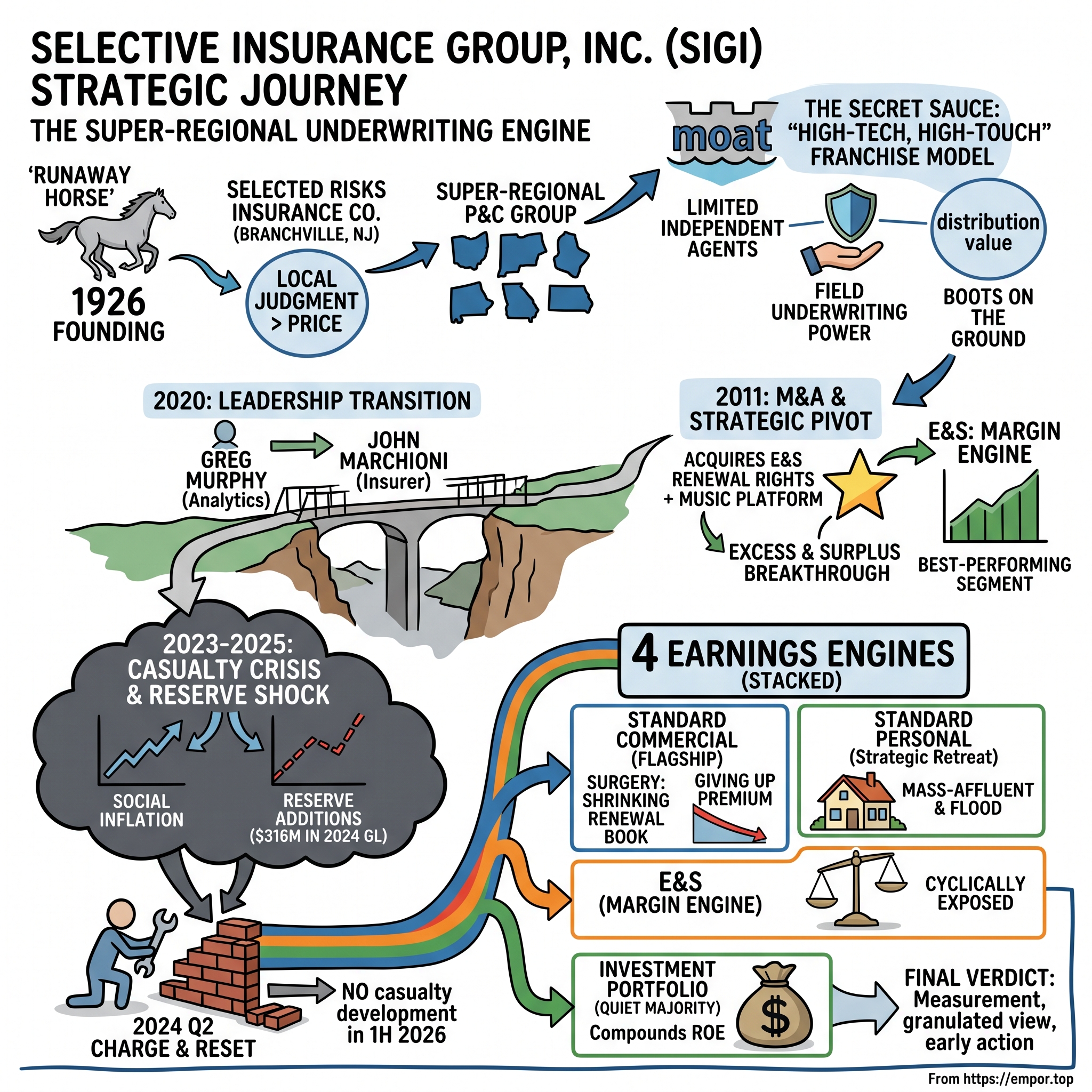
Selective Insurance Group (NASDAQ: SIGI): The Super-Regional Underwriting Engine
I. Introduction & Episode Roadmap
On a Friday morning in May 2026, a group of executives from a company headquartered in a New Jersey town of roughly 800 people stood on the NASDAQ podium and rang the closing bell. The occasion was a double anniversary: one hundred years in business, and fifty years as a publicly traded company.1 It was the kind of milestone that invites a victory lap.
Selective Insurance Group did not get one. Two months later, on July 24, 2026, the same chief executive opened an earnings call by reporting that net premiums written had fallen five percent year over year — the company was deliberately shrinking its largest business.2 New business in Standard Commercial Lines was down twenty-two percent. Retention in the worst-performing slice of the renewal book had been pushed from eighty-one percent down to fifty-five percent on purpose, by hitting those accounts with average rate increases of eighteen percent and watching most of them walk.1
That is the story worth telling. Not the century of survival, but the two years in which a company famous for underwriting discipline discovered that its own reserves had been wrong, wrote a check for it, and then chose to give up premium rather than pretend the problem had passed.
The core thesis, and what would falsify it
Selective is a "super-regional" property and casualty insurer — bigger than a state-level mutual, far smaller than the national giants. AM Best ranked it the thirty-fourth largest P&C group in the United States on 2024 net premiums written, and rates its insurance subsidiaries "A+" (Superior).3 It sells nothing directly. Every dollar of premium arrives through an independent agent or a wholesale broker.
The claimed edge has two halves. The first is distribution: rather than appointing thousands of agencies and fighting for a sliver of each one's business, Selective appoints a deliberately limited set — roughly 1,680 standard-lines distribution partners operating out of about 2,940 offices — and tries to become one of the two or three carriers whose products those agencies reach for first.3 The company calls this "franchise value." The second half is the operating model: instead of centralizing underwriting authority in a head-office tower, Selective pushes decision-makers physically into local markets, alongside the agent and the insured.
The question this article tests is whether that structure actually produces measurably better underwriting than the alternatives, or whether it is a well-articulated culture story that happens to sit on top of ordinary results. The honest answer, on the evidence of the last three years, is: less than the marketing implies, and not lately.
The modern drama
Between 2023 and 2025, Selective added roughly $373 million of unfavorable prior-year development to its general liability reserves alone — $55 million in 2023, $316 million in 2024, and $40 million in 2025.3 The 2024 concentration produced a second quarter that few insurance investors will forget: a combined ratio of 116.1 percent, an operating loss, and a full-year guidance revision from 96.5 percent to 101.5 percent in a single afternoon.4
Combined ratio is the industry's core scoreboard, and it is simple: losses plus expenses, divided by premiums earned. Below 100 percent, the underwriting business makes money before any investment income. Above 100, it does not. A 116.1 percent quarter means that for every dollar of premium earned, the company spent about $1.16.
Then it got fixed — or at least, it stopped getting worse. Full-year 2025 came in at 97.2 percent, an improvement of nearly six points, with operating return on equity of 14.2 percent.5 Through the first half of 2026, Selective reported no prior-year casualty reserve development at all, in any segment or line of business.2
Roadmap
What follows traces the arc: the 1926 founding in Branchville and where the field-underwriting instinct actually came from; the anatomy of the franchise agency model and whether the moat is real; the 2011 purchase of a small excess-and-surplus platform that became the company's best-performing segment; the 2020 handover from a twenty-year CEO to a twenty-two-year insider; the reserve shock and the conference-call transcripts where management's credibility was tested in public; the four engines that produce the earnings today; and finally the frameworks, the bear case, and the two or three numbers that actually matter from here.
Start with the horse.
 Subscribe on LinkedIn
II. Founding Roots & Early Evolution: From Branchville to Super-Regional (1926–1990s)
Daniel L.B. Smith ran a small chain of general stores in Sussex County, New Jersey, in the years after the First World War. He also ran an insurance agency out of the front window of the Branchville store — the D.L.B. Smith Agency, which was less an office than a desk with a view of the street. According to the company's own account of its origins, a runaway horse was the trigger: the incident that pushed Smith from selling other companies' policies to concluding that the metropolitan carriers serving his rural clients were charging too much and servicing them too poorly.6
In 1926, Smith and several colleagues put together $20,000 and founded Selected Risks Insurance Company.6 The name was the strategy. This was not a company built to insure everything; it was built to insure the risks its founders could actually see — farm owners, rural households, the automobiles beginning to appear on Sussex County roads.
Why the location mattered more than it looks
Branchville sits about sixty miles from Manhattan and roughly a hundred from Hartford, the twin capitals of American insurance capital and American insurance actuarial science. That distance was not a handicap so much as a forcing function. A carrier headquartered in Hartford could build a business on statistical abstraction — pooling thousands of policies, pricing off industry loss costs, and never meeting a policyholder. A carrier headquartered in a town of a few hundred people could not. Its underwriters knew the insureds. Its claims adjusters ran into them at church.
That is the cultural genome of what would later be marketed as "field underwriting." It did not begin as a strategy. It began as the only available method.
The corporate structure evolved quickly in the early years. Selected Risks became a stock company in 1928, renamed Selected Risks Indemnity Company; a sister firm, Selected Risks Fire Insurance Company, was formed in 1929 to write automobile and property coverage; the two merged back together in 1958.6 The geographic story followed the road network: Pennsylvania, Maryland, Delaware and the District of Columbia in 1937; Rhode Island, Connecticut and West Virginia in the mid-1940s; Virginia in 1962.6
The fork in the road that defined everything after
The critical decision came later, and it was a decision not to change.
Through the second half of the twentieth century, American personal insurance underwent a distribution revolution. Carriers built captive agency forces. Then they went direct — first by mail and telephone, later online. The economics were compelling: cut out the intermediary's commission, own the customer relationship, use advertising to substitute for local presence. For standardized personal auto, this worked spectacularly.
Selective did not follow. It stayed with the independent agent — the local business that represents multiple carriers and advises the client on which one to use. The bet was that small and mid-sized commercial risk is fundamentally different from personal auto. A contractor with six trucks, a fabrication shop, a regional food distributor: these accounts have idiosyncratic exposures that do not compress cleanly into an online form. Someone has to walk the site. Someone has to decide whether the sprinkler system and the loading dock and the driver roster add up to an acceptable risk at a given price.
The independent agent, in that model, is not a cost to be engineered away. The agent is the distribution infrastructure — and the agent's judgment about which carrier deserves the best account is the thing worth competing for.
The holding company that houses all of this, Selective Insurance Group, Inc., was incorporated in New Jersey in 1977; the operating company took the Selective name in 1986.36 By the late 1990s the company was pushing hard into the Midwest, adding nine states — Illinois, Indiana, Iowa, Kentucky, Michigan, Minnesota, Missouri, Ohio and Wisconsin — across 1997 and 1998, and reaching Massachusetts in 2007.6
What seventy years bought
By the turn of the millennium Selective had something more durable than scale: it had a definition of itself. It was a commercial-lines specialist that competed on service and local judgment rather than price, distributed exclusively through independent agents, and headquartered itself deliberately far from the industry's centers of gravity. KPMG has audited the company since 1964 — a sixty-two-year auditor relationship that is itself a small artifact of institutional continuity.3
The corporate footprint still reflects the origin story. Selective owns its Branchville building on fifty-six acres; the underwriting organization operates from six regional offices spread across the footprint, with Branchville serving the Northeast, Allentown and Hunt Valley the Mid-Atlantic, Charlotte the South, and Scottsdale the West.3 Of roughly 2,800 employees, about 1,380 are home-based and 810 sit in regional offices — meaning the majority of the workforce is deliberately positioned away from headquarters.3
That is not an accident of the pandemic. It is the 1926 business model, digitized. Which brings us to what the company built on top of it.
III. The Secret Sauce: The "High-Tech, High-Touch" Franchise Model
Picture an independent insurance agency in Allentown or Charlotte. It is a small business — maybe fifteen people, often family-owned, sometimes into its third generation. On the wall or in the software are the carriers it represents. A large agency might be appointed by twenty or thirty of them.
Here is the economic reality that governs everything: those twenty or thirty carriers are not equal. Two or three of them get the first phone call when a good account comes up for renewal. The rest get the leftovers — the accounts the preferred carriers declined, the risks nobody wants, the price-shopping.
Selective's entire distribution strategy is an attempt to be one of the first two or three.
The franchise concept, and what "franchise" actually means here
The Independent Insurance Agents & Brokers of America estimated in a 2024 study that roughly 39,000 independent property/casualty agents and brokers operate in the United States — a figure that had declined three percent from its 2022 study, reflecting steady consolidation in the channel.3 Against that universe, Selective's standard-lines appointments number around 1,680.3 Roughly 730 of those also sell its personal lines. About 6,520 sell its flood products — a much wider net, because flood is a distinct federal program rather than a franchise relationship.3
So Selective is appointed by something on the order of four percent of the independent agents in the country. That scarcity is the point. An appointment is meant to be worth something to the agency, because the agency is not competing with a dozen other Selective-appointed shops down the road.
The company describes the objective in its own annual report as allowing agency principals "to fully realize the significant franchise value" of the appointment.3 Translated: we will give you enough territory and enough support that our contract becomes an asset on your balance sheet, and in exchange you will give us your best accounts.
One caution on a widely repeated statistic. The claim that Selective captures fifteen to twenty percent or more of a partner agency's total commercial volume, and routinely ranks top-three in the drawer, is a long-standing part of the company's marketing narrative. Selective does not disclose a current, audited figure for average share of partner wallet in its SEC filings, and this article does not treat it as a verified number. What is verifiable is the direction of the appointment strategy: Selective added a net one hundred agency locations in 2025 and two hundred in 2024 — measured, deliberate expansion rather than mass appointment.3
Field underwriting, explained without jargon
Here is the mechanism in plain terms. In a centralized model, an agent submits an application electronically to a processing hub. An underwriter who has never seen the business, and may be several states away, evaluates it against guidelines and returns a quote. Speed depends on queue position. Judgment depends on what fits in the file.
In Selective's model, underwriting authority sits with people who live in the territory. They visit sites with the agent. They see the equipment, the housekeeping, the driver behavior, the roof. And critically, they can commit — price and terms, in the room.
The company reinforces this with a dedicated layer of 88 field-based Risk Management Specialists, whose job is not to sell but to inspect and advise: recommending improvements that reduce a customer's property, liability and workers' compensation exposure.3 Two things happen at once. The insured gets a service a price-shopping direct writer cannot easily replicate. And Selective gets proprietary information about the risk before it prices the risk.
That second effect is the underwriting argument. Insurance suffers from adverse selection — the phenomenon where the customers most eager to buy are disproportionately the ones most likely to claim. Better information is the only defense. The claim behind field underwriting is that boots on the ground generate information the competition's spreadsheet does not have.
The "high-tech" half
The technology story is less glamorous than the field story but arguably more important to the expense line. Selective has spent years integrating with agency management systems so that policy data flows automatically, building straight-through quoting for the smallest commercial accounts, and pushing pricing analytics down to the point of sale so the field underwriter has loss-cost benchmarks and risk scores in hand rather than back at the desk.3
The current frontier is artificial intelligence, and the company is unusually specific about governance: it has established an Artificial Intelligence and Model Governance Committee, reporting to its Executive Risk Committee, to control how models are acquired, built, deployed and relied upon in insurance decisions.3 Management has told investors it is pursuing "general-purpose, industry-trained, and agentic artificial intelligence solutions" to drive efficiency and improve underwriting and claims outcomes.3
Investors should treat this as stated intent, not demonstrated results. The plausible near-term benefit is expense: automating file handling and claims triage. The plausible long-term benefit is loss-ratio improvement through better risk selection. Neither has yet shown up as a disclosed, quantified gain.
Myth versus reality: does the model actually out-underwrite?
This is where an independent look diverges sharply from the consensus story.
The persistent narrative — repeated in sell-side notes, company presentations, and outlines like the one behind this article — is that Selective beats the industry combined ratio by two to four points over rolling ten-year periods, and outperforms mega-cap carriers on underwriting profitability.
The recent record does not support the second half of that claim.
For full-year 2025, Selective's combined ratio was 97.2 percent.5 The Travelers Companies reported 89.9 percent for the same year, with an underlying combined ratio — stripping catastrophes and reserve development — of 83.9 percent.7 Cincinnati Financial, arguably Selective's closest philosophical peer as an agent-centric carrier, reported 94.9 percent and marked its fourteenth consecutive year of underwriting profit.8 Selective's 2024 combined ratio was 103.0 percent, meaning it did not earn an underwriting profit at all that year.5
On expenses, Selective runs a full-year underwriting expense ratio around 30.8 percent, and management has guided to approximately 31.5 percent for 2026 as technology investment continues.51 That is competitive, and notably better than the 32–33 percent often cited for the company — the high-touch field model has not, in fact, produced a bloated cost structure. But an expense ratio near thirty-one percent is roughly in line with agent-distributed peers, not dramatically better.
The defensible version of the claim is narrower and still meaningful: Selective's ten-year average operating return on equity was 12.1 percent, and it exceeded that average in 2025.5 That is a respectable through-cycle return for a mid-cap P&C carrier, achieved without taking heroic investment risk. It is not evidence of structural underwriting superiority over the largest carriers.
So what does this mean for an investor? The franchise model is real, and it plausibly explains why Selective can grow in new states and retain good accounts without buying business on price. It does not, on the last three years of evidence, explain a durable underwriting advantage over the best-run competitors. The moat, if it exists, shows up in access and persistency — not yet in a lower loss ratio.
Which raises the obvious question: if the standard commercial business is only average, where does the outperformance come from? Part of the answer arrived in 2011, from Arizona.
IV. M&A and Strategic Pivots: The E&S Breakthrough (2011)
By the late 2000s, Selective had a structural problem that had nothing to do with execution.
It wrote standard, admitted insurance. "Admitted" means the state insurance department approves your rates and your policy forms before you can use them. That approval is a consumer protection and a genuine constraint: when loss costs move, an admitted carrier files for a rate change and waits — sometimes months, occasionally longer, and sometimes gets less than it asked for. In a soft market, when competitors are cutting price, an admitted carrier's ability to walk away is its only real weapon.
There is another market. Excess and surplus lines — "E&S," or the non-admitted market — exists for risks the standard market will not write at any filed rate. A demolition contractor. A bar with a late-night license. A vacant industrial property. In E&S, the carrier sets its own rates and writes its own forms without prior approval. Freedom of rate and form is the defining feature.
Selective had essentially no presence there. In 2011, it bought one.
The transaction
The mechanics were unusual, and the sequencing tells you the strategy came first and the vehicle second.
In August 2011, Selective completed a renewal rights transaction with Alterra Capital, acquiring the right to renew a book of E&S business that had produced roughly $77 million in 2010 premiums.9 A renewal rights deal buys no company and no reserves — it buys the opportunity to write the business as it comes up for renewal. Cheap, low-risk, and useless without a licensed platform to write it on.
So on September 20, 2011, Selective announced it would purchase Montpelier U.S. Insurance Company from Montpelier Re U.S. Holdings for approximately $55 million.9 The price was set on the company's net asset value as of June 30, 2011, and included roughly $3 million of tax benefit carryforwards.9 The target had written about $48 million of gross premium in 2010, exclusively in commercial contract binding authority E&S business.9 Crucially, Montpelier Re retained all unearned premium and all loss reserves for business written before closing — meaning Selective bought a licensed, staffed, systems-equipped platform with essentially no legacy liability attached.9
The deal closed on December 31, 2011. The company was renamed Mesa Underwriters Specialty Insurance Company, or MUSIC. Selective kept the Scottsdale, Arizona office and retained the unit's existing president to run it.9
Why this was a well-designed deal
Strip away the insurance vocabulary and this was a clean piece of corporate chess. Selective wanted a capability, not a book of business. It acquired the book cheaply through renewal rights, then acquired the minimum viable platform to hold it — licenses in all fifty states, an underwriting team that knew the segment, and the IT and financial reporting infrastructure to run it.9 It explicitly refused to take on the seller's past claims.
The price deserves emphasis. Fifty-five million dollars is a rounding error in P&C M&A. The same era produced multi-billion-dollar specialty consolidations, many struck at large multiples of book value, many of which delivered goodwill impairments and integration distraction. Selective bought roughly net asset value for an operating platform. It is difficult to overpay when you are paying for the box rather than the contents.
"Contract binding authority," the segment MUSIC specializes in, deserves a plain-English translation. It means Selective delegates limited authority to wholesale brokers to bind small E&S risks directly, within a tightly defined appetite, without submitting each one for individual underwriting. Think of it as a franchise agreement for small hard-to-place risks: high transaction volume, small individual policies, and a business that lives or dies on the quality of the rules you give the broker.
What E&S has actually delivered
Fifteen years on, the segment is the company's best performer, and by a wide margin.
In 2025, E&S wrote $631.2 million of net premiums, up eleven percent, at a combined ratio of 87.8 percent — nearly ten and a half points better than the Standard Commercial segment's 98.3 percent.5 It has become roughly thirteen to fourteen percent of total net premiums written, up substantially from the sub-ten-percent share it long occupied.5 Selective now writes E&S in all fifty states and the District of Columbia, and distributes through approximately 80 wholesale general agents operating from 260 offices, plus an in-house managing general agent that gives its retail agents direct access.3
The strategic value goes beyond the margin. When a franchise agent has a risk Selective's standard companies will not write, the agent no longer has to send that client to a competitor's wholesaler. The relationship stays inside the house. That is a genuine, if modest, synergy — and it is the kind that shows up in agent loyalty rather than in a synergy table.
But the segment is now facing its own cycle turn, and management said so plainly on the July 2026 call: E&S renewal pure price rose only 3.4 percent in the second quarter, property pricing was slightly negative, premiums declined two percent, and more capacity is entering the market — including admitted carriers expanding their appetite into E&S territory.12 Marchioni's framing was notably unromantic: E&S "historically has exhibited more cyclicality than the admitted market."1
That is worth holding onto. The E&S margin buffer is real, but it is a cyclical asset, not a permanent one.
Capital allocation: what the company actually does with the money
Selective's stated priority order is organic underwriting growth first, dividends second, opportunistic repurchases third. The behavior is broadly consistent with the words, with some tension worth noting.
The company targets returning twenty to twenty-five percent of earnings through dividends and repurchases opportunistically on top.1 In 2025 it returned $182 million to common stockholders and grew book value per share eighteen percent.5 In the second quarter of 2026, it bought back $32 million of stock at an average price of $84.72, leaving $108 million on the authorization, and returned roughly forty-five percent of after-tax net income in total.2
There is a leverage story underneath. In the first quarter of 2025 Selective issued $400 million of 5.90 percent senior notes due 2035, using part of the proceeds to make a $200 million capital contribution into the insurance subsidiaries.3 Debt to total capitalization rose from fourteen percent at the end of 2024 to twenty percent at the end of 2025.5 That is still conservative against the company's own twenty-five percent internal threshold, but it is a meaningful step up — and it happened in the immediate aftermath of a reserve charge. An investor should read that as management choosing to fortify statutory capital rather than shrink, which is defensible, but it did consume balance sheet flexibility.
One widely repeated claim about capital returns should be flagged rather than asserted: the company's record of consecutive annual dividend increases is often cited as thirty-plus years, but a specific verified count is not disclosed in the filings reviewed for this article. What is disclosed is the current quarterly common dividend of $0.43 per share.2
The E&S build-out gave Selective a second engine. The next question was who would be running the machine.
V. The Leadership Transition: Greg Murphy to John Marchioni (2020)
Gregory E. Murphy became chief executive of Selective in 1999 and chairman in 2000. He held the combined role for two decades — an eternity in an industry where activist pressure and merger waves shorten tenures considerably.
The record of those twenty years is unusually easy to summarize because the numbers are large and clean. Net premiums written roughly tripled, from about $750 million to about $2.5 billion.10 Commercial lines operations expanded from sixteen states to twenty-seven.10 The company entered the E&S market. Total shareholder return over his tenure was reported at 1,081 percent, with market capitalization up more than six and a half times.10
What Murphy is less often credited for is the shift in method. Under his leadership Selective moved from a relationship-driven regional carrier to a relationship-driven carrier with analytics — deploying predictive modeling into underwriting and building digital claims and telematics tools including SWIFTClaim and Selective Drive.10 The "high-tech, high-touch" formulation belongs to that era. It was the answer to a real strategic threat: if data was going to commoditize risk selection, a company whose advantage was local knowledge needed to prove local knowledge and data were complements rather than substitutes.
The successor was never in doubt
John J. Marchioni joined Selective in 1998 as a Government Affairs Specialist — which is to say, he began his insurance career as a lobbyist rather than an underwriter. He came from the Commerce & Industry Association of New Jersey, where he had been vice president of government relations.11 A Princeton graduate who later completed Harvard's Advanced Management Program and earned the Chartered Property Casualty Underwriter designation, he is by background a policy and strategy person who learned the technical craft on the job.11
His path through the company is the most revealing thing about him. He moved from government affairs to Assistant Vice President and then Vice President and Director of Government Affairs; in 2004 became a Vice President and Strategic Business Unit Leader; in 2005 took over Personal Lines and Flood as a Senior Vice President; in October 2007 was promoted to Executive Vice President and Chief Field Operations Officer; and in September 2013 became President and Chief Operating Officer with responsibility for insurance operations, strategy, actuarial, human resources, marketing and IT.11 In 2018 finance and legal were added to his reporting lines.11
Read that sequence again. The company deliberately routed its future CEO through the field operations job. If you wanted to design a succession that guaranteed the next leader would defend the distributed operating model, this is exactly how you would do it.
The formal choreography was equally deliberate. Selective nominated Marchioni to its own board in February 2019, with lead independent director J. Brian Thebault describing the move as "consistent with our efforts to position the company for its next phase of growth."11 He was elected in May 2019. The succession was announced on October 30, 2019, and he became CEO on February 1, 2020 — with Murphy moving to an executive chairman role.10
Then, six weeks into the job, the pandemic arrived. Then, four years in, the reserves broke.
Alignment: what management is actually paid for
Selective's compensation design is disclosed with reasonable clarity, and it is worth examining because it shapes behavior in a business where the temptation to under-reserve is structural.
The financial goals underlying incentive compensation are built on four measures: GAAP combined ratio, non-GAAP operating return on common equity, statutory net premiums written growth, and statutory operating return on policyholder surplus.12 Strategic goals are set on measures such as pricing and customer metrics.12 In assessing the CEO and named executives, the compensation committee explicitly weighs results against budget and projected industry results, performance relative to the ROE target, underwriting profitability as measured by combined ratios, ability to profitably grow premium, investment income against budget and benchmark, and retention of top talent.12
The 2026 proxy's own framing of 2025 is notable for its candor: it recorded that the 97.2 percent combined ratio "was slightly above our 95% long-term target," while noting the significant improvement over 2024.12 Companies that grade themselves against a target they missed are, at minimum, not hiding the scoreboard.
Officers are subject to stock ownership guidelines that must be met within five years, with an annual November valuation date and consequences for falling short; non-employee directors must own five times their annual retainer.12 Hedging of company stock is prohibited for officers, directors and employees.12
The design has a genuine tension in it that investors should see clearly. Two of the four financial metrics — combined ratio and operating ROE — are improved in the short run by booking lower reserves. The third, premium growth, is improved by writing more business. A compensation system built on those metrics does not automatically reward the decision to add $316 million to general liability reserves in a single year and blow through your own guidance.
Which is precisely what happened next.
VI. The Casualty Inflation Crisis & Reserve Shock (2023–2025)
Selective's second-quarter 2024 earnings call was scheduled on short notice. The investor relations officer thanked participants twice for joining "on short notice."4 For a company that had spent decades cultivating a reputation for predictability, the scheduling itself was the first piece of information.
The monster, explained
The macro force behind all of this goes by the name "social inflation," and it deserves a plain explanation because it is genuinely different from ordinary inflation.
Ordinary inflation raises the cost of things — repairing a truck, replacing a roof, paying a hospital bill. Social inflation raises the cost of verdicts and settlements independently of the underlying economic damage. The drivers are litigation funding, where outside investors finance lawsuits in exchange for a share of the award; increasingly sophisticated plaintiffs' bar tactics; a rise in so-called nuclear verdicts running into eight and nine figures; and a general shift in how juries value pain and suffering.
For an insurer, this is uniquely dangerous in "long-tail" lines. General liability claims can take five, seven, ten years to settle. The insurer collects the premium in year one and estimates the ultimate cost using historical patterns. If the environment changes underneath those patterns, every accident year still open on the books is wrong simultaneously — and you find out slowly.
Marchioni described exactly this on the 2024 call, in language that was more revealing than he may have intended: the phenomenon was "somewhat unprecedented in that the entire diagonal has been moving. All accident years and all evaluation periods have shown a movement higher in terms of severity emergence."4
The "diagonal" is actuarial shorthand for the newest column of data across every accident year at once. When the whole diagonal moves, it is not one bad year. It is the model.
Inflection point one: 2023
Selective's first meaningful admission came in 2023, and it was modest. The company recorded $55 million of unfavorable prior-year development in general liability, plus $8 million in commercial automobile, largely offset elsewhere — total net unfavorable casualty development for the year was just $10 million.3
Two things about the 2023 action mattered later. First, it was concentrated in older accident years — management subsequently characterized the year-end 2023 general liability action as "mostly associated with accident years 2020 and prior," and largely 2019 and prior.4 Second, and more importantly for reading the run of play: the company was still reporting large favorable development in workers' compensation, $74.5 million of it in 2023, which masked the casualty deterioration in the headline number.3
That is not an accounting trick — it is how consolidated reserve development works. But it does mean the 2023 disclosure understated how much stress was building in the liability book.
Inflection point two: the July 2024 shock
The second quarter of 2024 removed all ambiguity.
Selective recorded $176 million of net unfavorable prior-year casualty development in Standard Commercial Lines — $166 million in general liability and $10 million in commercial auto — worth 16.3 combined ratio points.4 Catastrophe losses from 28 separate events added another 8.4 points.4 The combined ratio came in at 116.1 percent, producing an operating loss of $1.10 per diluted share and a quarterly operating return on equity of negative 9.6 percent.4
The critical detail is where the money went. Ninety percent of the general liability action related to accident years 2020 through 2023 — recent years, not old ones.4 The company simultaneously took $28 million, about 2.6 points, into the current accident year, because if you conclude 2022 and 2023 were worse than you thought and you keep your forward trend assumption, arithmetic forces 2024 higher too.4
The outline behind this article describes a "$45M reserve charge" in the second quarter of 2024. That figure does not match the disclosed amounts, and the accurate numbers are the ones above.
Management's assumption disclosure was, to its credit, unusually transparent. Selective had raised its assumed general liability loss trend to nine percent for 2024, from four percent in 2020 — and stated that the nine percent assumed no frequency improvement at all, meaning it was entirely severity.4 Marchioni laid out the arithmetic in the Q&A: the company had assumed roughly five percent average loss trend across 2020 through 2023, and its updated evaluation put the actual figure closer to 6.5 percent, composed of frequency running about four percent better than expected offset by severity running near ten percent.4
Guidance moved five points, from a 96.5 percent full-year combined ratio to 101.5 percent, with the catastrophe load raised half a point to 5.5.4 Chief Accounting Officer Tony Harnett — serving as interim CFO at the time, itself a signal of transition inside the finance function — delivered the line that management wanted remembered: "Our results in the quarter are an earnings event, not a capital event."4
The Q&A, where credibility is actually tested
Prepared remarks are written. Q&A is not. The July 2024 exchanges are worth reading closely because they show what analysts believed and what management would and would not concede.
Michael Phillips of Oppenheimer put the reputational question directly: what do you say to those who argue this is a Selective-specific problem, that the book is different? Marchioni's response was a mix of defense and an unusual admission. He argued the portfolio had been stable across industry verticals, hazard mix and limits profile, so there was nothing to suggest a changed risk profile. But he also acknowledged a real structural exposure — "our book is a little bit heavier in GL than some of our peers" — and, remarkably, took ownership of an earlier communication failure, explaining that a list of problem states circulating in the market "came out of my response to a question last quarter" and had been picked up without the surrounding context.4
Michael Zaremski of BMO pushed on the question every reserve-charge investor asks: is this a kitchen sink, or the first of many? He also pressed on why commercial auto had not been strengthened proportionally. Marchioni's answer was substantive rather than deflective: commercial auto has a shorter tail, so the severity shock had already been recognized there, and the line had been carrying eight to ten percent rate increases for roughly five years — far more earned rate to absorb trend than general liability, which had been running four to six percent industry-wide against a much higher trend.4
Grace Carter of Bank of America asked the subtlest question of the call: after this experience, would management be slower to recognize good news? Marchioni did not really answer it, retreating to the philosophy that carried reserves are always set in the context of prevailing risk factors.4 That is a fair description of actuarial practice. It is also an answer that preserves discretion.
On the third consecutive quarter of additions, Marchioni made the most consequential admission of the call: beyond reacting to emergence in the quarter, the company had "also contemplated some additional risk associated with some potential continuation of these trends" — deliberately over-reserving relative to observed data after being wrong twice in a row.4
Did the reset hold?
This is the only question that ultimately matters, and there is now two years of evidence.
The answer is qualified yes on general liability, and no on commercial auto.
General liability development fell from $316 million in 2024 to $40 million in 2025.3 On the July 2026 call, Marchioni stated that GL reserves had "been very stable" across the eight quarters since the charge, with the small 2025 movements attributable to umbrella business, which Selective includes in the GL line and which was driven by auto exposure.1
Commercial auto, meanwhile, went the other way — $19.5 million of unfavorable development in 2024 became $120.4 million in 2025, related to accident years 2022 through 2024 with 2024 the primary driver, as the company experienced what it described as a re-acceleration of severity growth.3 Personal automobile also deteriorated.3 Total net unfavorable casualty development in 2025 was $77.5 million, again cushioned by $90 million of favorable workers' compensation development.3
So the line that management said was adequately reserved in 2024 — commercial auto, defended on the call with the shorter-tail and earned-rate argument — is the line that broke in 2025. That is a real mark against the 2024 analysis, and an investor should weight it.
The 2026 evidence so far is cleaner: no prior-year casualty reserve development in any segment or line in either the first or second quarter.2 But Selective did react to something new — higher-than-expected commercial auto frequency in the first half, which it pushed into current-year loss ratios rather than waiting.1 Marchioni offered a hypothesis (a heavy northern winter), then explicitly declined to lean on it: "rather than put full weight on that hypothesis, we thought it was prudent to react to what we saw."1
That is the behavior pattern that matters more than any single number. Twice now — in the current accident year in 2024, and again in 2026 — management has chosen to take the charge early on incomplete information rather than wait for confirmation. Whether that reflects genuine conservatism or the scar tissue of having been publicly wrong, the revealed preference is consistent.
The industry context also argues this was never a Selective-specific failure. Marchioni told analysts in July 2026 that the industry added a little over $10 billion of adverse general liability development in calendar 2024 and another $8 billion-plus in calendar 2025.1 Selective was early and loud. It was not alone.
What it now has is a repaired balance sheet and a much harder question: how to grow.
VII. Segment Breakdown & Financial Engine
Selective is best understood as four businesses stacked on one balance sheet. Three of them underwrite risk. The fourth quietly generates more profit than any of them.
Standard Commercial Lines: the flagship, under construction
This is the company. Standard Commercial accounted for roughly 78 to 79 percent of net premiums written, generating $3.84 billion in 2025 — general liability, commercial property, commercial auto, workers' compensation and businessowners' policies, sold to small and mid-sized enterprises across 36 states and the District of Columbia.53 The average policyholder pays about $20,600 a year.3 That number tells you the customer: not a Fortune 500 risk manager, but a contractor, a manufacturer, a municipality, a nonprofit.
The 2025 combined ratio was 98.3 percent — an improvement of nearly six points on 2024, but still well short of the company's 95 percent target.5 Retention runs in the low eighties rather than the "exceeding 88 percent" figure sometimes cited: 82 percent in the fourth quarter of 2025 and 81 percent in the second quarter of 2026.52
The most interesting thing happening in this segment is not the margin. It is the surgery.
Through the first half of 2026, Selective has been deliberately splitting its renewal book by performance and treating the halves differently. On the July call, management disclosed the mechanics with unusual granularity: retention in the best-performing cohort held at 89 percent, unchanged year over year, while retention in the worst-performing cohorts was driven from 81 percent down to 55 percent, with renewal rate increases on that cohort rising from 11.5 percent to 18 percent.1 Simultaneously, new business fell 22 percent as stronger new-business pricing collided with a competitive market and pushed hit ratios down from the mid-thirties into the low thirties.1
Of the six-point premium decline in the segment in the second quarter, management attributed three points to lower new business and three points to renewal actions on the worst cohorts.1
There is also a concentration issue being addressed in the open. Contractors represented 43 percent of commercial lines premiums in 2025 — a heavy weighting toward exactly the casualty-oriented business that social inflation punishes hardest. Through the first half of 2026, contractors accounted for 33 percent of new business, and contractor retention declined about two points.1 Marchioni was careful to frame this as line-of-business diversification rather than a retreat from construction, which he called "a good business for us for a long time."1
The analytical read: this is a company sacrificing near-term revenue to reshape a mix problem it can name precisely. That is more credible than a vague promise of margin improvement. It is also unproven — the earn-through takes years, and it assumes the accounts being retained are genuinely the good ones rather than simply the ones that accepted a price increase.
Standard Personal Lines: a strategic retreat, executed reasonably well
Personal lines is now about eight percent of premium — $397.7 million in 2025, down eight percent — and the direction of travel is intentional.5
The old business was mass-market auto and home, competing against direct writers with enormous advertising budgets and structurally lower acquisition costs. That was not a fight worth having. The pivot has been toward the mass-affluent customer, where service matters more than price, alongside flood insurance written under the National Flood Insurance Program's Write Your Own arrangement — a business in which Selective ranks as the fourth-largest carrier by 2024 direct premiums written.3
The flood business deserves a note because its economics are unusual: under Write Your Own, the carrier services the policy and the federal program bears the loss. That is why flood premium appears in the segment and flood catastrophe losses largely do not — reinsurance recoverables from the NFIP for Hurricane Helene losses were fully ceded.3
The transition has been genuinely painful and is genuinely improving. The 2025 combined ratio was 100.6 percent — an underwriting loss, but nearly nine points better than 2024's 109.3 percent.5 Through the first half of 2026 it reached 94.1 percent, ahead of the company's 95 percent target, with new business down 36 percent and renewal price increases near nine percent.21 Average new-business home values now exceed $1 million, and target-market business is approximately 70 percent of homeowners premium.1 Results remain weaker in New Jersey than elsewhere.1
Shrinking a book while improving its margin is the correct sequence. The open question is whether a sub-$400 million personal lines operation has enough scale to justify the fixed cost of competing in fifteen states.
Excess & Surplus: the margin engine, now cyclically exposed
Covered in depth earlier, so only the current data point: E&S delivered a 91.8 percent combined ratio in the second quarter of 2026 and 90.7 percent for the first half, comfortably ahead of the 95 percent target, on premiums that declined two percent.2
That is the segment functioning exactly as designed — holding margin discipline while the market softens, rather than chasing volume into a deteriorating rate environment.
The investment portfolio: the quiet majority of the earnings
Here is the fact that reframes the whole company. In the second quarter of 2026, Selective's insurance operations contributed 2.3 points of return on equity. The investment portfolio contributed 13.9.2
The portfolio has grown to $11.58 billion, against total assets of $15.62 billion.2 It is conservatively built — average credit quality A+, duration 4.3 years, weighted overwhelmingly toward fixed income and short-term investments, with public equities, commercial mortgage loans and alternative investments in private equity, private credit and real estate strategies making up the remainder.23
The earnings power is a direct gift of the rate cycle. After-tax net investment income rose from $362.6 million in 2024 to $421.2 million in 2025, and management raised full-year 2026 guidance from $465 million to $480 million mid-year.52 The pre-tax portfolio yield reached 5.2 percent in the second quarter of 2026, with fixed income at 5.5 percent.2 For context on the mechanism: in the second quarter of 2024, Selective invested over $500 million of new money at an average pre-tax yield of 6.4 percent against a portfolio book yield of roughly 4.8 percent.4 Every such dollar permanently raises the run rate.
Two structural drivers amplify this. Operating cash flow ran at 25 percent of net premiums written in 2025, meaning the portfolio grows without new capital.3 And invested assets per dollar of common equity sit at $3.34, so a modest yield improvement is levered more than three times into return on equity.2
An honest investor conclusion: Selective's recent double-digit operating ROE — eight consecutive quarters of it, as management noted in July 2026 — is substantially an interest-rate story rather than an underwriting story.1 The underwriting business is running near breakeven-to-modestly-profitable. The portfolio is carrying the return. That is not a criticism; it is how insurance balance sheets work in a high-rate environment. But it means the equity is more exposed to the rate cycle than the "disciplined underwriter" narrative suggests, and a sustained decline in yields would expose how much work the standard commercial book still has to do.
VIII. Playbook: Business, Underwriting, & Investing Lessons
Strip the specifics away and Selective offers four transferable lessons — two about business design, two about how to analyze any insurer.
Scarcity is a distribution strategy. The instinct of most growth-hungry companies distributing through intermediaries is to appoint more of them. More shelf space, more shots on goal. Selective did the opposite, and the logic generalizes: when your intermediary controls the customer relationship and can choose among suppliers, your leverage comes from being important to them. An agency that has one Selective appointment in its territory and derives meaningful revenue from it will protect that relationship. An agency that is one of twenty appointments will not. The cost of this strategy is a hard ceiling on growth rate — you cannot appoint your way to a good quarter — which is precisely why so few companies choose it. Note also the corollary risk: as the independent agency channel consolidates, each surviving agency becomes larger and more powerful, and the balance of that relationship shifts.
Push authority to where the information is. The deeper lesson of field underwriting is not about insurance at all. It is that in businesses where the critical inputs are observed rather than reported, decision rights should sit with the observer. Centralization optimizes for consistency and cost; localization optimizes for information quality. Standardized personal auto — where the inputs are a driving record, a vehicle identification number and a credit score — should be centralized and algorithmic. A fabrication shop with a solvent storage problem should not be. The mistake most companies make is applying one answer to both. The countervailing truth is that distributed authority is expensive and produces inconsistency, which is why the technology layer exists: to give the local decision-maker the central organization's data without taking away the decision.
Insurance earnings are opinions; losses are facts that arrive later. This is the single most important thing a generalist investor can internalize about the sector. When an insurer reports quarterly profit, a large portion of that number is an estimate of claims that have occurred but not yet been reported or settled. Management chooses that estimate. The choice is constrained by actuaries, auditors and regulators, but it is a choice. This is why the reserve development line — how much a company adds to or releases from prior years' estimates — is the closest thing to a lie detector in insurance analysis. Consistent favorable development suggests conservative reserving. A sudden large addition means prior earnings were overstated. And what happens after a charge tells you most of all: does the company reset once and hold, or bleed for eight quarters? Selective's record is mixed on this test — general liability held after 2024, commercial auto did not.
A large, conservative investment portfolio is strategic optionality, not just yield. It is tempting to treat an insurer's bond portfolio as a passive asset. It is better understood as the thing that lets management make hard underwriting decisions. A carrier whose entire earnings stream depends on this quarter's underwriting result cannot afford to walk away from underpriced business, because the revenue loss is immediate and the margin benefit is deferred. A carrier earning a substantial return on invested assets can shrink a book by five percent and still post a double-digit return on equity — which is exactly what Selective has been doing through 2026. The portfolio buys the discipline. The corollary is uncomfortable: when yields fall, that discipline gets more expensive.
The next question is whether these advantages constitute a genuine moat or simply a well-run business. Two frameworks help separate the two.
IX. Strategic Frameworks: Helmer's 7 Powers & Porter's 5 Forces
Hamilton Helmer's 7 Powers Analysis
Helmer's framework asks a strict question: does the company possess something that both raises its returns and is genuinely hard for a determined competitor to copy? Applied honestly, Selective scores on fewer dimensions than the bull case assumes.
Process Power — present, but modest. Process Power is the advantage that comes from an organizational routine embedded so deeply that a competitor cannot lift it out. Selective's field underwriting architecture qualifies in form: a national carrier cannot bolt local binding authority onto a centralized hub without dismantling the hub, and the accumulated relationships between specific underwriters and specific agencies are not transferable. But Helmer's test is ultimately empirical, and the empirics are weak. Cincinnati Financial runs a comparable field-based, agent-centric model and posted a better 2025 combined ratio; Travelers runs a far more centralized model and posted a much better one.87 Process Power that does not show up in relative loss ratios is culture, not power.
Counter-Positioning — largely absent, and often overstated. Counter-Positioning requires a business model the incumbent cannot adopt without damaging its existing business. Direct writers genuinely cannot easily serve complex commercial risk, which is a real structural constraint. But the large agent-distributed carriers face no such barrier — Travelers, Chubb, The Hartford and CNA all sell through independent agents and can appoint whomever they like. Selective's approach is a choice about intensity of relationship, not a model competitors are structurally barred from copying. That is differentiation, not Counter-Positioning.
Scale Economies — working against Selective, not for it. This is the uncomfortable one. In insurance, scale confers real advantages: a larger loss dataset for pricing models, better reinsurance terms, fixed technology costs spread across more premium, and greater catastrophe diversification. At roughly $4.9 billion of net premiums written, Selective is a fraction of Travelers' size. Its expense ratio near 31 percent, guided toward 31.5 percent as technology spending rises, reflects exactly this — the same AI and platform investments must be funded from a smaller revenue base.51
Cornered Resource — moderate and eroding. Multi-generational relationships with agency principals are a genuine asset, and Selective's 34th-place industry ranking alongside its "A+" financial strength rating gives it credibility that a new entrant would need a decade to build.3 But independent agencies are consolidating — the count of independent agents fell three percent between the 2022 and 2024 industry studies — and consolidation transfers power from the carrier to the increasingly large agency.3 The relationship with a founder-principal in Allentown is a cornered resource. The relationship with a private-equity-backed national brokerage is a procurement negotiation.
Switching Costs — real at the agency level, thin at the policyholder level. An agency that has integrated Selective's systems, trained staff on its appetite and built a book with it faces meaningful friction in moving. A policyholder facing an eighteen percent renewal increase apparently does not — as the collapse from 81 percent to 55 percent retention in the worst cohort demonstrated.1
Branding and Network Economies — not material. Commercial insurance buyers do not pay a premium for a brand; they buy what their agent recommends at a defensible price. And an additional Selective policyholder confers no benefit on existing policyholders.
The composite verdict: Selective possesses moderate Process Power and a moderate Cornered Resource, offset by a genuine Scale Economies disadvantage. That is a defensible niche business, not a fortress.
Porter's 5 Forces Analysis
Threat of new entrants — low. State-by-state licensing, statutory capital requirements, and the practical necessity of a strong AM Best rating create real barriers. Selective's own filings state plainly that the AM Best rating "most significantly influences our ability to write insurance business," because agents recommend carriers partly on financial strength and because placing business with a weakly rated carrier exposes the agent to errors-and-omissions liability.3 But the barrier is porous where it matters most: capital can enter through managing general agents and E&S startups without building a full admitted carrier — precisely the dynamic Selective flagged in July 2026 when it noted new capacity flowing into E&S.1
Bargaining power of suppliers — moderate and rising. The relevant suppliers are agents, reinsurers and capital. Agent power is discussed above and trending unfavorably. Reinsurer power showed up concretely in the July 1, 2026 renewal, where Selective's casualty excess-of-loss treaty provided $87 million of protection above a $3 million retention — a retention that rose from the $2 million level of two years earlier.24 Notably, though, the terms improved on the participation side: co-participation in the first layer fell from 20 percent to 8 percent, with all remaining layers fully placed, and the property per-risk treaty limit rose $20 million to $115 million above a $5 million retention.1 That combination — higher retention, better placement terms — reads as a softening reinsurance market meeting a company that is retaining more risk by choice.
Bargaining power of buyers — moderate. Commercial buyers shop at renewal, especially in a competitive market. Retention in the low eighties is respectable but not lock-in, and the sensitivity of the poorly-performing cohort to price makes clear that loyalty has a price ceiling.
Threat of substitutes — low, with a long-tail caveat. Workers' compensation and auto liability are legally mandated; property coverage is required by lenders and landlords. The structural substitution risk comes from self-insurance and captives, but those are options for large corporations, not for a policyholder paying roughly $20,600 a year.
Rivalry — high, and currently irrational. This is the force that dominates the near-term investment case, and Marchioni's July 2026 description of it was the most analytically interesting passage of the call. His argument: the industry is generating underwriting losses in both general liability and commercial auto liability, nobody is publicly claiming casualty loss trends are moderating, and yet general liability pricing has not remained firm. His explanation was that carriers are subsidizing casualty losses with unusually strong results in property, specialty, workers' compensation and personal lines — and his prediction was that as margins in those lines compress, pricing pressure will return to casualty.1
That is a specific, falsifiable thesis about competitor behavior. It is also, conveniently, a thesis that justifies Selective's decision to shrink. Investors should track whether it proves correct, because the entire premium-decline strategy rests on it.
X. Investment Story Spine, Risk Radar, & Bear vs. Bull Stress Test
Why Selective wins from here
The reserve reset appears to have held on the line that broke it. General liability development collapsed from $316 million to $40 million, and the first half of 2026 produced no casualty development anywhere in the book.32 After two years of reserve anxiety, six months of clean quarters is meaningful evidence — not proof, but the right shape.
The portfolio compounds regardless of the underwriting cycle. Net investment income has grown at a mid-to-high-teens rate for two consecutive years, and guidance was raised mid-2026.52 With operating cash flow at a quarter of premiums and invested assets levered over three times to equity, this engine runs largely independent of the underwriting result.32
The company is demonstrably willing to shrink. Sacrificing six percent of commercial premium and 22 percent of new business is a costly, visible action — the kind that is difficult to fake and unpleasant to explain.1 Marchioni anchored it to precedent, telling analysts that Selective saw "this movie before in 2010 and 2011 where growth flattened because we were focused on making sure we had underwriting and pricing discipline," followed by roughly nine percent compound annual growth over the subsequent decade.1
Geographic runway remains. Since 2017 Selective has added fourteen states to its commercial footprint, including Kansas in 2025, with Montana and Wyoming opening on July 1, 2026.31 Expansion states produced $430 million of premium in 2025, roughly nine percent of the total.3 That is real, if slowing — management has said explicitly that the pace of expansion is moderating as it approaches a near-national footprint.3
Why Selective may not win
Commercial auto is the unresolved wound. The $120.4 million of unfavorable 2025 development, driven primarily by accident year 2024, came in a line management had specifically defended in 2024 as adequately reserved.34 And in 2026, frequency deteriorated further, requiring current-year loss ratio increases.1 Two independent problems — severity and frequency — in a line the company had already called solved.
The shrink strategy is a bet on competitor behavior. If rivals do not raise casualty pricing, Selective faces a choice between continued premium decline and abandoning its price discipline. Marchioni conceded hit ratios have already fallen from the mid-thirties to the low thirties.1 A multi-year premium decline against a fixed expense base pushes the expense ratio the wrong way.
Geographic concentration is a genuine, disclosed exposure. The 10-K states directly that hurricane peril is the company's most significant natural catastrophe exposure, driven by concentration in the Northeast and Mid-Atlantic, and that this risk drives the tail of its modeled loss distribution.3 Personal lines carries the sharpest sensitivity: catastrophe losses ran 18.8 combined ratio points in that segment in 2024 and 10.1 points in 2025.5
The scale disadvantage compounds over time. Technology and AI capability are increasingly fixed-cost, winner-takes-more investments. Selective is funding them from roughly one-sixth of Travelers' premium base.
Current risk radar
Social inflation with no near-term relief. Marchioni's July 2026 assessment of tort reform was notably unenthusiastic: Georgia moved first with significant reforms, South Carolina targeted liquor liability, North Carolina imposed significant restrictions on third-party litigation financing, and New York acted on claims fraud. His verdict was that these remain "idiosyncratic items on a state by state basis and not broad based enough to impact the direction of severity trends," and that he does not expect significant change in the near term.1 Management is pricing for the environment to persist, not improve.
Severe convective storms and property volatility. The company raised its catastrophe load from roughly 3.5 points a few years ago to 5 points by 2024, and its 2026 guidance assumes 6 points.42 That trajectory tells its own story about climate-driven loss frequency.
Retention of more risk on the balance sheet. The higher casualty retention noted above transfers more volatility onto Selective's own books.
Execution risk in the headquarters relocation. Selective leased a new facility in Short Hills, New Jersey, with corporate operations relocating from Branchville beginning mid-2026 and continuing through 2029.3 The new office opened during the second quarter of 2026.1 Asked directly on the July call whether the move had caused disruption or turnover, Marchioni said it had not affected growth, noted the underwriting organization is not moving and Branchville will retain a large underwriting operation and the flood business, but acknowledged plainly that "of course, a move like this is disruptive" and that it affects a little under twenty percent of the workforce, staged over years.1 That is a reasonable answer. Multi-year headquarters relocations nonetheless have a long history of quiet talent attrition.
The activist and skeptical-investor stress test
A skeptical long/short investor would press on four fronts.
Reserve adequacy, still. Management confirmed no change in its view of loss trend as of July 2026 and attributed the current-year adjustment purely to frequency.1 The skeptic's counter is the IBNR question Zaremski raised — whether the incurred-but-not-reported reserves being booked for the 2026 vintage are appropriately higher than prior vintages. Marchioni's response was analytically sophisticated and slightly evasive: he directed the analyst to Schedule P, then cautioned that IBNR ratios cannot be read in isolation because claim disposal rates have fallen industry-wide, lengthening cycle times and mechanically requiring higher IBNR. He volunteered that Selective's auto disposal rates have held up well but that, for the industry and by implication for Selective, general liability cycle times have lengthened — "which creates a additional level of risk when you are looking at those IBNR ratios."1 That is an unusually candid flag from a CEO. It is also not a number.
Capital allocation with a shrinking top line. Selective repurchased stock in the second quarter of 2026 while premiums declined and while carrying debt-to-capital near twenty percent following the 2025 note issuance.2 An activist could argue either direction: that buybacks should be far more aggressive given reduced capital needs from a shrinking book, or that no capital should leave the building until the casualty reserves have seasoned another two years. Asked whether the payout ratio should rise, CFO Patrick Brennan acknowledged that "given slower growth, that certainly does change the demand for capital," but held the line on the 20–25 percent dividend framework plus opportunistic repurchase, framing the decision around maintaining consistent returns on equity.1 That is a defensible answer that concedes the premise without changing the policy.
Governance and disclosure. The disclosure record is genuinely a strength. Selective published its assumed loss trend by line for years before the charge, added a historical reserve development exhibit to its investor presentation in the middle of the crisis quarter, discloses cohort-level retention and pricing, and grades itself against a missed target in its own proxy.4112 The harder governance question is the incentive design discussed earlier: financial metrics that reward lower reserves and higher premium growth, in a company that just spent two years correcting both.
Portfolio complexity and non-core assets. There is little to attack here. Ten insurance subsidiaries, three reporting segments, a conservative portfolio with modest alternatives exposure, and no meaningful diversification into unrelated businesses. Whatever else Selective has done, it has not diworsified.
The bull and bear cases converge on a single unresolved question, which is also where an investor should focus.
XI. Epilogue, KPIs to Watch, & Final Verdict
In January 2026, Selective closed the books on a year that would have looked, from a distance, like a triumph: a 14.4 percent return on common equity, an eighteen percent increase in book value per share, and a fourth quarter with a 93.8 percent combined ratio and no prior-year casualty reserve development at all.5
Six months later it reported that it was voluntarily giving up business.
That juxtaposition is the company. Selective is not, on current evidence, a structurally superior underwriter — the peer comparison does not support it, and the last three years contain a large reserve error the company itself has documented in detail. What it appears to be is something less glamorous and possibly more useful: an organization that measures its own book at a granular level, acts on what it finds faster than it is forced to, and is willing to absorb visible revenue damage rather than write business it believes is mispriced.
Whether that discipline compounds into superior long-term returns depends on things not yet knowable — whether casualty pricing firms, whether commercial auto stabilizes, whether the reshaped book earns through at the margins management expects, and whether interest rates stay high enough to keep the investment engine carrying the load.
The three KPIs that matter
The underlying combined ratio, by segment. The headline number is noise — dominated in any given quarter by weather and reserve decisions. Strip out catastrophes and prior-year development and the underlying combined ratio measures whether current business is priced adequately for current loss trend. Watch it at the segment level, because the three segments are on entirely different trajectories: E&S and personal lines are both running ahead of the 95 percent target, while Standard Commercial sat at 99.7 percent for the first half of 2026.1 The whole investment case reduces to whether that flagship number moves toward 95, and management's own 2026 guidance of 96.5 to 97.5 percent — with the caveat that results will land near the top of the range — sets the bar to measure against.2
Renewal pure price versus loss trend, in general liability and commercial auto specifically. "Renewal pure price" means the rate change on the same risk with the same exposure — the honest measure, excluding growth in the underlying business being insured. It only matters relative to loss trend. As of the second quarter of 2026, general liability pricing rose 8.7 percent, commercial auto 9.3 percent, and auto liability specifically approached 13 percent.1 The moment pricing in these lines decelerates faster than loss trend, margin improvement stops. This is the leading indicator; everything else is confirmation.
Operating return on equity, decomposed. Management's target is 12 percent, and it has been exceeded for eight consecutive quarters.12 But the composition is the whole point. In the second quarter of 2026, insurance operations contributed 2.3 points and investments 13.9.2 An investor tracking only the headline ROE would miss that the underwriting business is contributing a small fraction of the return. The number worth watching is whether the insurance contribution rises over time — because that, and only that, would demonstrate that the franchise model produces underwriting alpha rather than merely underwriting adequacy.
Final thoughts
A century after Daniel Smith put twenty thousand dollars behind the proposition that a local company could serve rural New Jersey better than a distant one, the successor organization is still arguing a version of the same case: that proximity to the risk produces better decisions than distance and scale.
The evidence for that proposition is more ambiguous today than the company's own framing suggests. The largest and most centralized competitors are currently posting better underwriting results. The scale advantages in data and technology are accruing to the biggest players. The agency channel through which Selective's entire strategy runs is consolidating into fewer, larger, more powerful hands.
What is not ambiguous is the behavior. When the reserves proved wrong, the company took the charge, disclosed the assumptions, sat through the questions, and then reduced the size of the book rather than trade price for volume. That does not guarantee the outcome. In an industry where the temptation is always to book optimism and hope the losses arrive after the current management team has moved on, it is the behavior most worth watching — and, when it recurs across cycles, the one most worth paying for.
References
-
Selective Insurance Group Q2 2026 Earnings Conference Call Transcript — Selective Insurance Group Investor Relations, 2026-07-24 ↩↩↩↩↩↩↩↩↩↩↩↩↩↩↩↩↩↩↩↩↩↩↩↩↩↩↩↩↩↩↩↩↩↩↩↩↩↩↩
-
Selective Reports Second Quarter 2026 Results, Form 8-K Exhibit 99.1 — Selective Insurance Group / U.S. Securities and Exchange Commission, 2026-07-23 ↩↩↩↩↩↩↩↩↩↩↩↩↩↩↩↩↩↩↩↩↩↩↩↩
-
Selective Insurance Group, Inc. Annual Report on Form 10-K for the year ended December 31, 2025 — U.S. Securities and Exchange Commission, 2026-02-09 ↩↩↩↩↩↩↩↩↩↩↩↩↩↩↩↩↩↩↩↩↩↩↩↩↩↩↩↩↩↩↩↩↩↩↩↩↩↩↩↩↩
-
Selective Insurance Group Q2 2024 Earnings Conference Call Transcript — Selective Insurance Group Investor Relations, 2024-07-19 ↩↩↩↩↩↩↩↩↩↩↩↩↩↩↩↩↩↩↩↩↩↩
-
Selective Reports Fourth Quarter and Year-End 2025 Results, Form 8-K Exhibit 99.1 — Selective Insurance Group / U.S. Securities and Exchange Commission, 2026-01-29 ↩↩↩↩↩↩↩↩↩↩↩↩↩↩↩↩↩↩↩
-
History of Selective Insurance Group — Selective Insurance Group, Inc. ↩↩↩↩↩↩
-
Travelers Reports Excellent Fourth Quarter and Full Year Results — The Travelers Companies, Inc., 2026-01-19 ↩↩
-
Cincinnati Financial Reports Fourth-Quarter and Full-Year 2025 Results — Cincinnati Financial Corporation, 2026-02-09 ↩↩
-
Selective to Acquire Montpelier Re E&S Unit for $55M — Insurance Journal, 2011-09-21 ↩↩↩↩↩↩↩
-
Selective Insurance Taps Marchioni to Succeed Murphy in 2020 as CEO — Insurance Journal, 2019-10-31 ↩↩↩↩↩
-
Selective to Nominate John Marchioni to Stand for Election to Board of Directors, Form 8-K Exhibit 99.1 — Selective Insurance Group / U.S. Securities and Exchange Commission, 2019-02-06 ↩↩↩↩↩
-
Selective Insurance Group, Inc. Definitive Proxy Statement (Schedule 14A) — U.S. Securities and Exchange Commission, 2026-03-26 ↩↩↩↩↩↩↩
 LinkedIn
 WhatsApp
 Reddit
 Hacker News
 Email
Email Kindle
 RSS Feed
 Spotify
 Apple Podcasts
 Amazon Music
 Audible
 YouTube