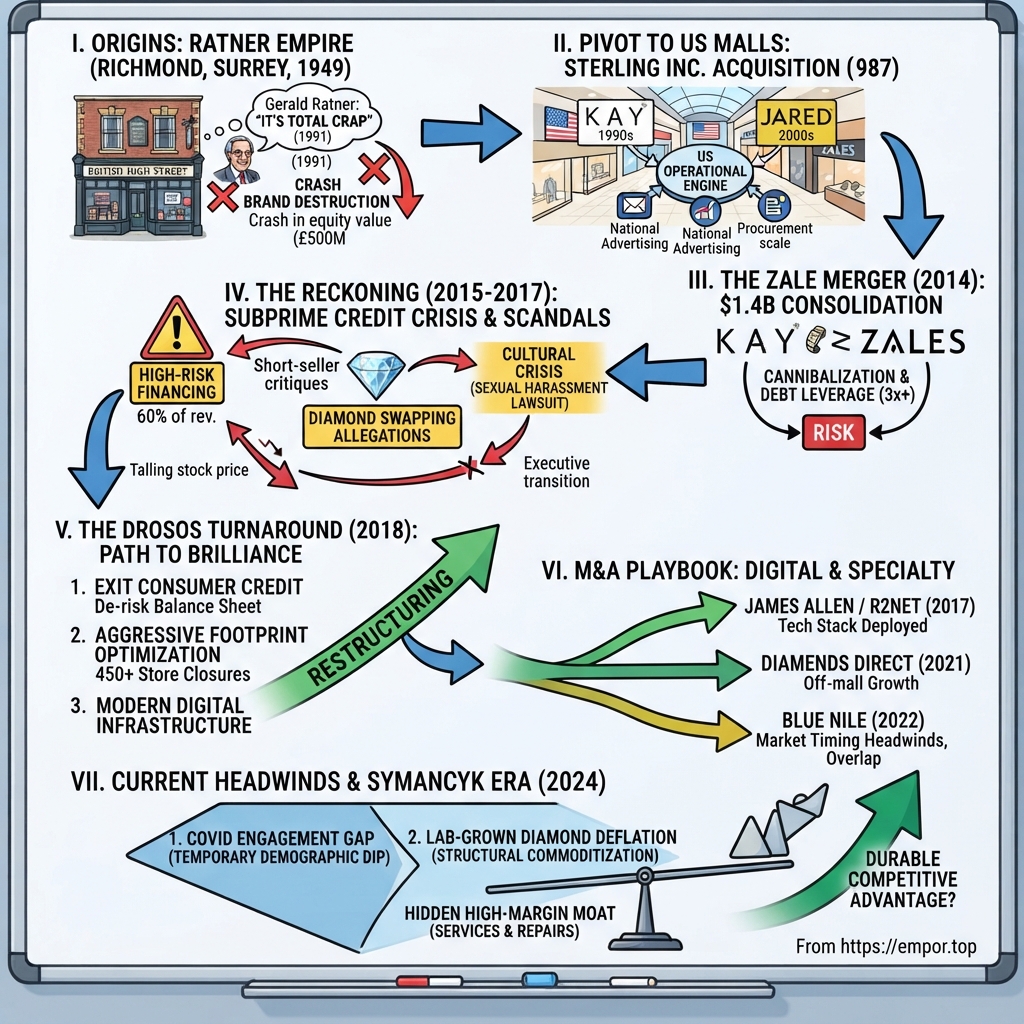
Signet Jewelers: The Diamond Consolidator's High-Stakes Turnaround
I. Introduction & The Retail Alchemy of Love
There is a particular kind of American retail square footage that almost no one thinks about until they need it, and then they think about nothing else for six weeks. It sits on a mall concourse between a Bath & Body Works and a shuttered Gap, or in an off-mall strip center beside a Chipotle. It is lit like an operating theater. Behind the glass counter, a salesperson trained to read hesitation explains the difference between a VS1 and a VS2 clarity grade to a twenty-eight-year-old who, until ninety minutes ago, did not know diamonds were graded at all.
That transaction — emotional, infrequent, information-asymmetric, and for most buyers the largest discretionary purchase made outside of an automobile — is the core business of Signet Jewelers Limited. Signet owns Kay Jewelers, Zales, Jared, Blue Nile, James Allen, Diamonds Direct, Peoples in Canada, Banter by Piercing Pagoda, and H.Samuel and Ernest Jones in the United Kingdom. By its own account, it has been the largest retailer of diamond jewelry in the United States for years, and a meaningful share of American engagement rings passes across its counters.
What makes Signet worth an investor's close attention is not the romance. It is the wreckage. Within the memory of currently serving executives, this company has survived: a chairman who destroyed roughly half a billion pounds of market value with a single after-dinner joke; a $1.4 billion merger that put two of its own banners across the hallway from each other in hundreds of malls; a short-seller campaign that argued credibly the company was a subprime lender wearing a jeweler's costume; viral allegations that its repair centers were swapping customers' diamonds; a class action alleging systemic sexual harassment that reached the top of the organization; a pandemic that closed every single store; a demographic air pocket in engagements caused by that same pandemic; and, most recently, a technology shock that collapsed the wholesale price of its core product by more than eighty percent.
Signet is still here. That is the reality to reckon with. By the mid-2020s, the company had shed its consumer credit book entirely, closed hundreds of unproductive doors, acquired its two largest digital competitors, retired a substantial portion of its own equity, and operated with net debt near zero.
Yet survival is not the same as an investment case, and this analysis is not a victory lap. The question that actually matters for a long-term owner is narrower and harder: does Signet possess a durable competitive advantage, or does it simply possess scale in a shrinking, deflating, structurally unattractive category?
The bull thesis to test runs roughly as follows. Signet is no longer a mall merchant, and it is no longer a disguised specialty finance company. It is an industrial-scale, data-instrumented diamond supply chain with a national advertising budget and a physical service network, wearing the costume of emotional luxury retail. Its edge, if it has one, is procurement and marketing efficiency — the ability to buy polished stones at lower cost and reach more couples per advertising dollar than anyone else in a category where roughly sixty percent of volume still sits with independent jewelers.
The counter-thesis is equally clean. Signet has never demonstrated pricing power. It demonstrated the opposite: when the company removed the in-house credit subsidy that had propped up its comparable-store sales, those sales stagnated for years during one of the longest economic expansions in American history, and management had to close hundreds of stores just to halt operating deleverage. A business that must shrink to hold its margin is not a business with a moat. It is a business with a cost position.
Both readings are defensible from the same set of facts, which is what makes the company compelling to examine. The roadmap begins in Richmond, Surrey, in 1949, with the most spectacular own-goal in the history of British retail. It traces the American mall roll-up and the Zale merger, then examines the 2015–2017 near-death experience, because that period explains the company's current governance and capital allocation posture better than anything management says on an earnings call. From there, the narrative follows the turnaround under Gina Drosos, the three-acquisition digital playbook, and the twin structural headwinds — the engagement gap and lab-grown deflation — that define the business today under Chief Executive Officer J.K. Symancyk, before stress-testing the entire investment case.
Start with the joke.
 Subscribe on LinkedIn
II. Origins: The Ratner Empire and the Ultimate Corporate Blunder
On the evening of April 23, 1991, Gerald Ratner stood before six thousand guests at London's Royal Albert Hall. The occasion was the Institute of Directors' annual convention, a premier gathering of the British business establishment. Ratner was forty-one years old, presided over the world's largest jewelry chain by store count, and enjoyed a reputation as one of the most charismatic executives in British retail, gifted with an instinct for self-deprecating humor.
Addressing the audience, Ratner explained how his company could sell a cut-glass sherry decanter with six glasses on a silver-plated tray for just £4.95: "Because it's total crap." He then went further, observing that a pair of Ratners earrings cost less than a Marks & Spencer prawn sandwich, "but probably wouldn't last as long."
The room erupted in laughter. The British tabloids did not.
Understanding why a single punchline nearly destroyed the enterprise requires understanding what Ratners had become. Founded in Richmond, Surrey, in 1949, the company began as a modest family jewelry shop in the austerity of post-war Britain. Over the next three decades, it expanded into a small chain on the British high street, where jewelry retail was traditionally defined by independent merchants, family names over the doorway, and hushed, intimidating deference.
Gerald Ratner assumed leadership of the family business in 1984 with roughly 130 stores and systematically dismantled the conventions of the trade. He recognized years before his competitors that the mass-market jewelry buyer was not an elite connoisseur, but an aspirational working-class shopper seeking the feeling of luxury at an accessible price. Ratner stripped away the solemnity. He filled store windows with bright orange promotional posters, packed display counters with £4.99 earrings, priced aggressively, turned inventory rapidly, and captured high-street foot traffic at industrial scale.
The commercial formula succeeded immediately. Ratner aggressively consolidated the market, acquiring H.Samuel in 1986 and Ernest Jones in 1989. By the end of the decade, Ratners commanded a dominant share of the British jewelry market — a degree of category concentration rare in discretionary retail.
Yet the company's most momentous strategic step occurred across the Atlantic in 1987. Ratner purchased Sterling Inc., an Akron, Ohio-based jeweler dating to the early twentieth century, for approximately $210 million. Sterling operated primarily in suburban shopping malls, which were then the most powerful retail distribution engine in the United States. Sterling went on to absorb Kay Jewelers and later developed Jared, an off-mall destination superstore format. At the time, neither Ratner nor his board recognized that this transatlantic acquisition would eventually eclipse the parent company.
Then came the speech at the Albert Hall.
The mechanics of the ensuing collapse illustrate a fundamental vulnerability in aspiration-driven retail. Ratners' customers were not shopping for throwaway novelties; they were purchasing the dignity of fine jewelry within a modest household budget. By ridiculing his own merchandise before an audience of wealthy executives, Ratner signaled to his customers that they were fools. In ninety seconds, the chief executive revoked the emotional permission structure that made the transactions possible.
The retribution was swift. Front-page tabloid coverage persisted for weeks, and customers abandoned the stores. Roughly £500 million in equity value vanished, same-store sales dropped by double digits, and the company — heavily burdened by debt from its acquisition spree — faced a liquidity crisis it could barely manage. An emergency restructuring followed, culminating in November 1992 with Gerald Ratner's forced resignation from the company bearing his family name.
Corporate erasure came next. In September 1993, the business rebranded as Signet Group plc, selecting a name referring to an ancient seal ring that carried none of the previous brand's notoriety. Storefront signage was stripped, but the damage was permanent: the "Ratner Effect" entered business vocabulary as the defining term for an executive who publicly destroys the value of their own product.
Over the subsequent fifteen years, the company's economic center of gravity underwent a structural reallocation. While the British high street stagnated, the American mall platform expanded. Kay and Jared delivered the vast majority of operating income. In 2008, Signet aligned its corporate structure with its commercial reality, shifting its corporate domicile to Bermuda and establishing its primary listing on the New York Stock Exchange under the ticker SIG, before eventually relinquishing its London quotation altogether.
For prospective investors, this origin story established two lasting legacies. The first is structural: Signet operates as a predominantly American retailer encumbered by a legacy British branch and organized under a Bermudian corporate umbrella — an operational architecture shaped by historical accident rather than strategic design. The second is cultural: an organization with deep institutional memory of how quickly customer trust can evaporate. That vulnerability would be tested again a generation later, and the second time, leadership would prove far slower to respond.
III. The American Mall Hegemony & The $1.4B Zale Merger
Picture an enclosed American shopping mall in 2013. Walking the concourse, a shopper passed a Kay Jewelers on the left, and ninety seconds later, a Zales on the right. Both stores occupied roughly 1,200 square feet. Both showcased diamond solitaires priced between $1,500 and $4,000. Both ran national television campaigns, and both relied on commissioned sales associates working from similar scripts. To the couple strolling the hallway, the only noticeable distinction was the sign above the entrance.
In February 2014, Signet moved to own both storefronts.
Understanding that logic requires examining the peculiar structure of the American jewelry trade, which diverged from almost every other major retail sector. The domestic jewelry market was a $60-billion-plus industry, and the vast majority of it — by store count and by sales volume — belonged to independent, family-owned operators. There was no Walmart of jewelry, no Home Depot consolidating the category. For over a century, the fragmented trade had resisted corporate roll-ups.
The explanation lies in working capital. Fine jewelry retail is balance-sheet intensive in ways that routinely punish scale-seekers. Merchants must carry substantial inventories of gold and polished diamonds — assets that are expensive, slow-turning, and exposed to volatile commodity price swings. Retailers must also win trust on products consumers cannot independently assess, an asymmetry that historically favored local, multi-generational family jewelers. Furthermore, the mall era required committing to long, inflexible leases in retail properties whose foot traffic individual tenants could not control.
Signet's strategy was to industrialize the operational levers independent jewelers could not match. National television advertising provided immense scale advantages: Kay's ubiquitous jingle, "Every Kiss Begins with Kay," reached millions of households at a cost per impression no regional competitor could match. Bulk procurement yielded comparable leverage: purchasing polished stones directly from cutting centers in Surat and Antwerp secured volume discounts and, crucially, consignment and deferred-payment terms that allowed Signet to display inventory on retail counters without paying for it upfront.
On that operational engine, the company established two distinct domestic anchors. Kay served as the high-volume mall workhorse, geared toward mid-market price points, frequent gifting occasions, and entry-level bridal purchases. Jared provided the strategic counterweight: a larger, off-mall destination superstore featuring on-site bench jewelers, an expanded assortment, and a substantially higher average ticket. Jared mattered because it demonstrated that Signet could operate profitably outside enclosed shopping centers — a capability that would prove critical in subsequent years.
Then came the Zale acquisition.
Zale Corporation, Signet's primary competitor in North America, had struggled for years with thin operating margins in the low single digits, well below Signet's historical low-teens performance. Alongside its flagship Zales brand in the United States, the company operated Peoples Jewellers in Canada, the Piercing Pagoda kiosk network, and the heritage British banners Mappin & Webb and Goldsmiths.
Signet agreed to acquire Zale for $21.00 per share in cash, a transaction valued at roughly $1.4 billion, completing the deal in May 2014.[^1] The transaction united the continent's two largest specialty jewelers, creating an enterprise with approximately 3,600 retail doors and pro forma revenue exceeding $6 billion.
The strategic rationale appeared compelling on paper: purchase a struggling rival at a discount, apply Signet's disciplined supply chain and merchandising infrastructure, and capture the operating margin spread. Signet paid roughly 0.7 times revenue and approximately 9.5 times EBITDA — reasonable multiples for mature specialty retail. If management could lift Zale's margins even halfway toward Signet's own baseline, the acquisition would justify its purchase price.
Instead, the merger created three structural complications:
The leverage. Signet financed the acquisition with bridge loans, term debt, and senior notes, driving adjusted leverage comfortably above three times debt-to-EBITDAR. While manageable during an economic expansion, that debt burden left little cushion when top-line growth plateaued and the company's lending practices faced outside scrutiny eighteen months later.
The cannibalization. The post-merger synergy model assumed Kay and Zales appealed to different customer segments. In hundreds of suburban malls, they fought for the exact same buyers. Two Signet-owned stores stood across the hall from each other, discounting merchandise in an expensive, self-inflicted turf war. Signet would spend the following decade trying to establish genuinely distinct identities for the two banners.
The distraction. Integrating a 1,600-door retail chain with separate IT systems and depressed margins absorbed executive focus at the precise moment leadership needed to be examining its own balance sheet.
The analytical takeaway is not that acquiring Zale was inherently an error; it delivered genuine category scale and an unrivaled portfolio of retail brands. Rather, the integration laid bare the actual source of Signet's market power. The company's competitive advantage stemmed from cost and distribution reach, not from brand-driven pricing power. A retailer with genuine pricing power does not worry about two of its own banners competing across a mall corridor; it raises prices and allows the weaker concept to phase out. Signet could not command that pricing flexibility, and the friction of the Zale merger made that limitation undeniable.
The acquisition also left the company vulnerable at an inopportune moment. By 2014, another substantial operation had expanded within Signet — one that had far less to do with retailing fine jewelry than with underwriting consumer credit.
IV. The Reckoning: Subprime Credit, Scandals, and the Brink of Collapse
A thought experiment that a handful of short sellers ran in 2015 changed how the market valued Signet for the better part of a decade.
Consider the underlying economics of selling a $3,000 diamond ring to a customer with a 580 credit score. The retailer books roughly 35% to 40% gross margin on the merchandise. But rather than paying $3,000 upfront, the customer enrolls in an in-house private-label credit card at an annual interest rate above 20%, paying down the balance over several years. The retailer keeps that receivable directly on its balance sheet while recording the retail transaction immediately at full price in its comparable-store sales figures.
That mechanic forced a fundamental question: what business was Signet actually in?
By 2015, in-house financing backed approximately 60% of Signet's domestic revenue, according to company disclosures. The receivables book had swollen to roughly $1.8 billion on the balance sheet. Store associates, compensated on commission, faced strong incentives to steer shoppers toward credit approvals at the cash register, effectively acting as originators rather than retail underwriters.
In buoyant economic conditions, the arrangement operated as an efficient growth engine; in a downturn, it became a compounding liability. Credit availability directly generated retail demand. A consumer unable to disburse $3,000 in cash could commit to an $89 monthly installment. Every incremental credit approval registered immediately as a comparable-store sales gain, which Wall Street rewarded with an earnings multiple typical of an expanding specialty retailer. The latent underwriting exposure sat quietly in an allowance for doubtful accounts, to be recognized only when borrowers defaulted.
Short seller Marc Cohodes and analysts at Grant's Interest Rate Observer anchored their critique on that structural mismatch. The specific dispute focused on recency-based delinquency accounting: critics contended that Signet's methodology allowed past-due accounts to be reclassified as performing after a modest partial payment. If executed systematically, that treatment would understate delinquency rates and postpone loan charge-offs. Signet disputed the allegations, insisting its accounting practices complied fully with prevailing standards.
The valuation consequences were straightforward and punitive. A healthy specialty retailer commanded a price-to-earnings multiple in the mid-to-high teens. An unhedged subprime consumer lender, carrying cyclical and levered balance-sheet risk, traded closer to a mid-single-digit multiple. To the extent that Signet's reported earnings depended on an internal credit engine, the equity market had mispriced the enterprise by a multiple of two to three.
That critique proved to be the decisive analytical turning point in Signet's modern history. While the accounting technicalities remained contested, the short thesis correctly diagnosed the underlying business model. The most compelling validation came from management's subsequent response: Signet dismantled and permanently exited its in-house credit operation. Companies do not abandon core, profitable capabilities unless the model itself has become untenable.
Operational and reputational crises followed in rapid succession.
The first arrived on retail counters in 2016. Investigative reports and customer complaints circulated widely, alleging that Kay Jewelers repair centers had replaced customers' natural diamonds with synthetic or lower-grade stones during routine cleanings and ring resizings. Signet denied systemic misconduct, noting that documented complaints represented an infinitesimal share of total repair transactions.
Yet the nature of the allegation struck directly at the foundation of the business. Jewelry retailing depends on consumer trust in quality certifications that buyers cannot independently verify. Moreover, preserving the company's lifetime warranty required customers to bring their rings into stores every six months for inspection—a retention program that required handing over the exact merchandise at the center of the controversy. The dispute called into question the integrity of the transaction itself.
A second crisis emerged internally. In 2017, documents were unsealed from private arbitration proceedings linked to an employment class action against Sterling Jewelers, Signet's principal American operating subsidiary. Sworn declarations from hundreds of current and former employees alleged pervasive sexual harassment, discriminatory compensation and promotion practices, and an entrenched hostile culture at corporate gatherings that extended into executive ranks. The U.S. Equal Employment Opportunity Commission had pursued a parallel systemic sex-discrimination action, which was resolved in 2022 through a consent decree that imposed financial remedies and mandated independent oversight of corporate employment practices.1
The cumulative impact triggered a sharp market repricing. Signet shares, which traded near $150 in late 2015, broke below $50 during 2017. In July 2017, Chief Executive Officer Mark Light stepped down, citing health reasons. The board appointed Virginia "Gina" Drosos, an independent director and former Procter & Gamble executive, to lead the enterprise.
Drosos assumed control of an organization facing severe, overlapping headwinds: a $1.8 billion credit book widely viewed by investors as toxic, an incomplete and costly integration of Zale, equity value down two-thirds from its peak, active federal regulatory scrutiny, and a vast physical footprint bound to long-term mall leases precisely as enclosed shopping centers entered structural decline. It was an operational predicament that conventional merchandising adjustments had no chance of solving.
V. The Drosos Turnaround: "Path to Brilliance"
Gina Drosos came to Signet without a traditional background in jewelry. She had spent roughly twenty-five years at Procter & Gamble, rising to group president of global beauty, and subsequently led a women's health medical device company before joining Signet's board of directors in 2012. That corporate pedigree shaped her executive approach in ways that proved decisive.
Procter & Gamble has long operated as a rigorous academy for two disciplines: consumer segmentation and brand architecture. A P&G executive is trained to evaluate, systematically: which consumer, with which specific need, buys which brand, and why does that banner exist at all? Signet had spent years acquiring retail banners while investing little effort in distinguishing them. Kay, Zales, and Jared were three different names across three storefronts, offering substantially overlapping assortments to substantially overlapping shoppers.
In the spring of 2018, Drosos initiated "Path to Brilliance," a multi-year restructuring framework developed alongside Chief Financial Officer Joan Hilson, who joined in 2019 and would become the central figure of operational continuity in executive ranks. The turnaround strategy rested on three pillars designed to confront the company's structural vulnerabilities directly: de-risk the balance sheet, downsize the retail footprint, and build modern digital infrastructure largely from scratch.
Pillar one was the exit from consumer credit, executed in two distinct phases.
In October 2017 — months before Path to Brilliance was officially unveiled, reflecting the urgency of the balance-sheet threat — Signet finalized the sale of its prime credit receivables to Alliance Data Systems, the parent of Comenity Bank and later renamed Bread Financial. The prime book, representing roughly $1.0 billion, was transferred essentially at par for cash, while Signet entered a long-term agreement under which Alliance Data would underwrite and service the private-label credit card portfolio going forward.[^3]
The prime portfolio was the straightforward half of the transition. The non-prime receivables represented the acute vulnerability that short sellers had emphasized. In June 2018, Signet completed the second phase, selling its non-prime credit assets to investment funds managed by CarVal Investors and Castlelake. Crucially, the transaction included forward-flow agreements ensuring that future non-prime originations would be offloaded upon creation rather than accumulating on Signet's balance sheet.[^4] The non-prime portfolio was sold at a discount to book value, and Signet absorbed the capital loss.
That discount reflected the market-clearing cost of the transformation: Signet was carrying loan assets at values higher than third-party specialty lenders were willing to pay. Management absorbed the write-down to permanently extricate the retailer from banking operations.
The economic implications were immediate and structural. Signet ceased bearing balance-sheet credit risk. Customers retained access to financing — under the auspices of regulated financial institutions — but economic contractions would no longer penalize Signet twice through declining retail transactions and compounding loan defaults. In exchange, however, Signet surrendered both the finance-charge margin and the ability to manufacture comparable-store sales growth by loosening internal underwriting standards.
That divestment also exposed an uncomfortable operational reality: once the credit subsidy vanished, Signet's underlying retail performance proved remarkably weak. Between 2015 and 2019 — an era characterized by low unemployment, expanding wages, and buoyant consumer spending — the company's same-store sales either stagnated or retreated, while operating margins eroded. This historical record provided the most potent empirical counterweight to the thesis that Signet's physical scale represented a genuine economic moat, demonstrating that the business struggled to grow during one of the most accommodative macroeconomic expansions on record.
Pillar two focused on the retail footprint, executed through aggressive contraction. Between 2018 and 2021, Signet closed well over 450 underperforming locations, the vast majority situated in enclosed shopping malls. Management framed the downsizing as portfolio optimization, but the underlying dynamic was clear: the company was forced to shrink its footprint to match declining mall traffic, relying on store closures because it lacked the brand-driven pricing power to offset traffic declines.
The closures coincided with a brand-segmentation strategy drawn directly from the consumer packaged goods playbook. Kay was reoriented toward sentimental gifting and accessible bridal jewelry. Zales was repositioned around fashion-forward merchandise and female self-purchasers, directly curbing the inter-store cannibalization that had plagued mall concourses. Jared was repositioned upward toward accessible luxury, custom design, and higher transaction values. Concurrently, Signet shifted real estate development toward off-mall strip and lifestyle centers while negotiating shorter, more flexible lease agreements, converting fixed occupancy liabilities into variable operational options.
Pillar three centered on digital commerce, an initiative executed primarily through acquisitions examined in the following section.
In March 2020, this restructuring faced an unprecedented operational shock. Signet shuttered more than 2,800 retail stores almost overnight. For a business model predicated on customers inspecting high-value, emotionally charged merchandise under counter lighting, the pandemic posed an existential threat. Management responded by drawing down its revolving credit facility, suspending cash dividends and share repurchases, and rapidly deploying virtual jewelry consultations — video appointments pairing customers with remote store associates — conducting hundreds of thousands of sessions within months.
What followed was an unprecedented demand surge across discretionary retail. Consumers emerged from initial lockdowns with restricted options for travel, dining, and live entertainment, funneling surplus household savings into physical luxury goods, including diamonds. Reopened storefronts encountered extraordinary retail demand. Free cash flow expanded rapidly across fiscal 2021 and 2022, enabling Signet to extinguish funded debt and accumulate substantial liquidity reserves.
The analytical reality is that Drosos executed the balance-sheet de-risking with discipline, only to encounter an extraordinary cyclical windfall that inflated top-line figures and made the structural turnaround appear far more complete than the underlying retail economics warranted. Management's operational restructuring de-risked the balance sheet; the post-pandemic stimulus funded its revival. Distinguishing those two dynamics is essential to evaluating Signet's normalized earnings power — an inquiry that took on immediate urgency as the social isolation of the pandemic quietly eliminated hundreds of thousands of relationships from the future bridal pipeline.
VI. The M&A Playbook: Digital Pioneers & Specialty Bridal
There is a specific moment in the modern diamond-buying experience that Signet did not invent and had to acquire: the 360-degree, high-magnification video of the individual stone under consideration, rotating on a smartphone screen to display every internal inclusion.
Before that capability existed, purchasing a diamond online required an extraordinary leap of faith in a spreadsheet. A consumer was asked to commit several thousand dollars to an alphanumeric row of grading metrics — carat, cut, color, and clarity — describing an object never seen in person. High-resolution imaging collapsed that informational asymmetry by allowing buyers to inspect their specific stone. In an industry where the historical rationale for the independent jeweler rested on personal trust, the technology marked a fundamental structural shift: it transferred trust from the salesperson behind the counter to the digital rendering.
Signet executed three major acquisitions between 2017 and 2022 to navigate that transition, yielding three sharply divergent outcomes.
R2Net / James Allen, September 2017 — $328 million in cash.
Signet acquired R2Net, the parent company of online bridal retailer James Allen, during the same quarter Gina Drosos assumed executive leadership. James Allen was an agile, digitally native merchant catering to younger demographics, but its primary asset lay deeper in the enterprise: R2Net owned proprietary 360-degree diamond display technology alongside a sophisticated digital inventory platform.
The strategic premise was not merely acquiring an e-commerce storefront; it was purchasing an enterprise technology stack to deploy across roughly 2,800 brick-and-mortar stores. Signet executed that integration, transforming R2Net's imaging and inventory infrastructure into the digital operational backbone for Kay, Zales, and Jared. Judged against that explicit mandate, the transaction represented the most effective capital deployment of the turnaround era. Signet acquired a proprietary capability it could not have engineered internally within an acceptable timeframe, at a valuation modest relative to the group, and scaled the platform across its entire retail portfolio rather than isolating it within a single banner.
Diamonds Direct, November 2021 — $490 million in cash.
Four years later, capitalized by post-pandemic free cash flow, Signet acquired Diamonds Direct — a network of roughly two dozen off-mall bridal superstores concentrated across high-growth Sunbelt metropolitan markets — at a valuation of approximately 1.1 times sales.[^5]
The commercial logic served as the brick-and-mortar counterpart to the digital strategy. Diamonds Direct operated destination showrooms generating average order values several times higher than Signet's typical mall counters, achieving exceptionally high sales volume per store. The acquisition expanded Signet's reach into higher-income bridal demographics in regions experiencing rapid population growth, establishing a presence in an off-mall format consistently gaining share from conventional shopping centers. Because the business was already solidly profitable, Signet purchased established earnings rather than an operational turnaround. On available financial disclosures, it proved to be the more resilient and accretive of management's subsequent transactions.
Blue Nile, August 2022 — $360 million, all cash.
In August 2022, Signet acquired the pioneer of digital fine jewelry. Blue Nile had introduced online diamond retailing in the late 1990s, completed an initial public offering, was taken private in 2017 by Bain Capital and Bow Street, and was preparing to return to the public markets through a special purpose acquisition company when Signet bought the business outright for roughly $360 million — approximately 0.7 times revenue.[^6]
On the surface, the valuation appeared compelling: an established heritage brand and a substantial digital revenue stream acquired at less than one turn of sales. Evaluated against operational outcomes, however, the acquisition warrants rigorous scrutiny. The transaction became the clearest stress test of whether Signet's capital allocation possessed the disciplined execution management claimed after 2018.
Three operational liabilities compounded.
First, assortment and customer overlap. Signet already controlled James Allen. Blue Nile and James Allen marketed comparable bridal assortments to an essentially identical online demographic through identical digital channels, routinely bidding against one another for the same digital search terms. In such an architecture, synergy often amounts to paying an acquisition premium merely to halt self-cannibalization — a defensible tactical gain, but far less valuable than purchasing incremental category growth.
Second, underlying economics. Under private equity sponsorship, Blue Nile generated negligible operating margins while maintaining international operations that introduced organizational complexity without commensurate profitability. A multiple of 0.7 times revenue appeared inexpensive against retail comparables, but top-line multiples are attractive only if revenue eventually converts into operating cash flow. Blue Nile's top line largely did not.
Third, and most destabilizing, timing. The transaction closed directly into the sharpest cyclical and structural downturn the fine jewelry category had experienced in decades. The post-pandemic trough in engagements and the rapid wholesale deflation of lab-grown diamonds arrived simultaneously. Management was forced to execute a complex integration — consolidating Seattle administrative operations, shuttering unprofitable brick-and-mortar showrooms, and migrating Blue Nile onto R2Net's technology stack — against a severely deteriorating demand environment. Substantial restructuring charges materialized in fiscal 2024, leaving the digital segment's operating margin profile structurally lower than the legacy brick-and-mortar business.
The analytical verdict across the three transactions is consistent: Signet has demonstrated capability as an acquirer of proprietary operational tools, but mediocrity as an acquirer of pure top-line revenue. R2Net secured an infrastructure technology that elevated operations across the entire enterprise. Diamonds Direct secured a productive destination format that Signet lacked. Blue Nile, by contrast, purchased a competing revenue stream on the eve of a category contraction, relying heavily on synergies derived from dismantling a rivalry Signet had previously fostered through James Allen. That is a narrower and far more sobering assessment than the narrative of flawless M&A discipline.
The record also complicates the broader turnaround thesis. Between Zale in 2014 and Blue Nile in 2022, Signet's two largest acquisitions both produced severe operational friction and required protracted restructuring. Any objective assessment of capital allocation must weigh that integration friction as heavily as the balance-sheet de-risking under Drosos. The definitive operational metric going forward remains the standalone operating margin of the consolidated digital segment relative to the consolidated group: if the combined James Allen and Blue Nile operations cannot generate group-average margins at maturity, the financial logic of the digital roll-up will have been disproven on Signet's own income statement.
The punitive timing of the Blue Nile integration leads directly into the twin structural disruptions that now govern the company's entire investment thesis.
VII. The Modern Headwinds: The Engagement Cliff & Lab-Grown Deflation
Signet's merchandising team maintains what it describes internally as an engagement tracker — a data model designed to forecast future bridal demand by monitoring relationship milestones across the broader population: when couples begin appearing in each other's social media feeds, when they move in together, and when they travel as a pair. The underlying premise is that engagements are rarely spontaneous. They represent the culmination of a dating lifecycle that typically spans two and a half to three-plus years.
In 2020, management projected that model forward and confronted a stark arithmetic reality.
If engagements lag initial relationship formation by roughly three years, and relationship formation collapsed in 2020 because pandemic restrictions prevented people from meeting in person, then the engagement ring market was slated to contract sharply by 2023. There was little management could do to avert the decline: the couples who ordinarily would have become engaged in 2023 had simply never met in 2020.
This dynamic became known as the "COVID engagement gap" — a demand shock that was predictable years in advance, largely outside management's control, and mathematically destined to normalize once relationship formation resumed. Annual U.S. engagements dropped from approximately 2.8 million before the pandemic toward the low-two-million range at the trough. For a retailer whose highest-ticket, most profitable merchandise sits in the bridal display, a deficit of several hundred thousand engagements in an annual cohort is not merely a soft quarter; it represents a multi-year void in the income statement until relationship pipelines refill.
Management deserves credit for identifying the demographic deficit early and articulating it to investors. Yet the narrative also invites scrutiny. Across fiscal 2024 and fiscal 2025, Signet lowered full-year sales and comparable-sales guidance mid-year on more than one occasion, leaning heavily on the engagement trough to explain the shortfall.[^7][^8] The trough was undeniably real. But a headwind that leadership had modeled years in advance offered a questionable rationale for mid-course guidance cuts, since a known, quantified demographic drag should have already been incorporated into baseline forecasts. When an executive team misses projections established with full visibility into the primary category headwind, the shortfall typically stems from variables left unmentioned: heightened promotional discounting, softness in discretionary fashion jewelry, and pressure on competitive price realization.
That disconnect represented a forecasting and credibility challenge rather than a pure demand shock — and it established the immediate operational backdrop facing incoming leadership.
The second structural force proved far more intractable, because unlike demographic cycles, it may never reverse.
The lab-grown diamond shock. Stripped of industry mystique, a diamond is simply carbon crystallized in a specific isometric lattice. For centuries, producing that lattice required geological heat and pressure deep within the Earth over billions of years, creating natural scarcity. Over the past two decades, however, two manufacturing methods achieved industrial scale. Chemical Vapor Deposition deposits carbon atom by atom from heated gases inside a vacuum chamber, effectively printing crystal structures. High Pressure High Temperature subjects carbon to mechanical presses that replicate deep-mantle geological forces. Both methods produce genuine diamonds — chemically, optically, and physically indistinguishable from mined stones, identifiable only through laboratory spectroscopy that detects microscopic growth patterns.
When manufacturing capacity expanded rapidly, primarily across India and China, the market responded as economics dictates for a manufactured commodity devoid of natural scarcity. Wholesale prices for lab-grown stones plunged by more than eighty percent over a four-year span. Diamonds that commanded thousands of dollars at wholesale early in the decade traded for a few hundred dollars by the mid-2020s. Because pricing is governed by manufacturing scale and electrical efficiency rather than geological scarcity, the category has no obvious pricing floor.
For a jeweler, this created a trap disguised as a gift.
The gift phase unfolded through fiscal 2022 and 2023. Over-the-counter retail prices for lab-grown diamonds declined at a much slower pace than wholesale production costs. Retailers like Signet procured stones at rapidly falling costs while pricing them against consumer reference points still anchored to expensive mined gems. Gross margins on synthetic stones climbed well above the 35% to 40% range typical of natural diamonds. Consolidated gross margin expanded accordingly, creating what appeared on paper to be structural operating leverage.
The trap phase is purely mathematical, and it highlights the central economic dilemma of the sector: retailers do not deposit margin percentages at the bank; they deposit gross profit dollars.
The mechanics are straightforward. When a store sells a natural diamond engagement ring for $4,500 at a 40% gross margin, it generates $1,800 in gross profit — cash that funds the store lease, associate commissions, and national marketing campaigns. If the shopper instead opts for an aesthetically comparable lab-grown ring retailing at $1,800 with an enviable 60% gross margin, the margin percentage looks superior, but gross profit drops to $1,080 — a 40% reduction in dollar intake.
Yet the physical overhead remains unchanged: the storefront lease costs the same, the sales associate still invests ninety minutes guiding the purchase, and the national broadcast campaign incurs identical airtime rates. Lab-grown substitution raises reported gross margin while shrinking the dollar contribution per transaction and per labor hour. Faced with that dilution, a merchant has only two viable strategic paths: expand transaction volume substantially to offset lower average order values, or aggressively protect the mix of natural stones.
Signet responded by pursuing a deliberate bifurcation strategy. Management directed lab-grown inventory aggressively toward fashion jewelry and female self-purchasers, where falling price points unlocked previously prohibitive price tiers and generated genuine unit volume. Concurrently, the company sought to defend natural stones and premium designer mountings within the bridal department, where emotional gravity and heirloom narratives still command premium transaction values.
Whether that bifurcation succeeds remains an unresolved question: the early evidence is mixed, and the strategy operates more as a defensive hedge than an enduring solution. The framework hinges on whether consumers continue to regard bridal rings as an exceptional category where geological origin carries social prestige. If incoming cohorts conclude that a chemically identical stone at a fraction of the cost represents the smarter financial choice — and cultural stigmas surrounding synthetic stones dissolve — bridal average unit retail will reset permanently lower, leaving merchandising teams unable to recoup lost profit dollars through volume alone.
That structural shift makes average unit retail in North American bridal the single most diagnostic metric across Signet's financial statements. Neither comparable-store sales nor gross margin percentages offer equivalent clarity: average unit retail alone reveals whether the enterprise is sustaining transaction value or merely preserving unit volumes at steadily eroding price tiers.
That was the complex operating environment awaiting the company's incoming leadership.
VIII. Current Leadership, Governance, and Capital Allocation
In August 2024, Signet announced that Gina Drosos would retire and that J.K. Symancyk would succeed her as chief executive, formally stepping into the role later that year.[^9]
Evaluating the outgoing tenure clarifies the operational inheritance handed to her successor. Drosos assumed leadership of an enterprise burdened by a troubled receivables book, an unresolved discrimination crisis, an unintegrated $1.4 billion acquisition, and a collapsing share price. She stepped down having reduced net debt near zero, eliminated internal consumer credit exposure, rationalized the retail fleet, deployed a functioning digital platform, and lifted operating margins well above the roughly 4% baseline of the pre-turnaround era. Along the way, the company returned more than a billion dollars to shareholders.
That record was substantial, but two caveats qualify it. First, the post-pandemic luxury windfall supplied much of the cash that funded the balance-sheet turnaround. Second, leadership never demonstrated that Signet could expand its core retail operations organically in an ordinary operating environment; the pre-pandemic stagnation was never disproven, merely interrupted by a cyclical surge.
J.K. Symancyk arrived with an executive background instructive precisely because it lay outside jewelry. He had served as chief executive of Petco Health & Wellness, chief executive of Academy Sports + Outdoors, and previously president of the private Midwestern supermarket chain Meijer. The unifying discipline was large-format, high-SKU, omnichannel merchandising anchored by customer loyalty programs. Petco, in particular, served as a case study in converting transactional retail into recurring service revenue through grooming, veterinary care, and subscription models.
That skill set maps directly onto Signet's most underappreciated asset, examined in the following section: its service business. It maps less cleanly onto high-emotion, infrequent luxury sales, where the operating cadence diverges completely from moving pet supplies or athletic apparel. The skeptical case on the appointment is straightforward: a mass-merchant executive often responds to top-line weakness with promotional discounting, yet aggressive discounting in fine jewelry erodes the aspirational brand equity that sustains retail margins. That, after all, was the central lesson of the Royal Albert Hall.
The most consequential governance detail in the transition was what did not change: Joan Hilson remained in senior financial leadership. Having co-architected the credit exit and the balance-sheet restructuring, her continuity represents the strongest evidence that the disciplined capital allocation framework survives the chief executive transition.
Incentives. Executive compensation shifted after 2018 toward adjusted operating income, return on invested capital, and relative total shareholder return. Yet the most structurally significant change was subtractive rather than additive: dismantling the sales-volume metrics that had previously rewarded aggressive credit origination at the counter. Flawed incentive design was not an incidental detail in Signet's prior crisis; it was an underlying cause. Eliminating the mechanism that manufactured that vulnerability carried far more governance weight than adopting return-on-capital modifiers.
The Leonard Green cleanup. The most revealing capital allocation decision of the recent period had nothing to do with stores.
In 2016, amid the credit controversy, falling equity prices, and an urgent need to project financial stability, Signet issued $625 million of 5% Series A Convertible Preferred Shares to private equity sponsor Leonard Green & Partners. It was rescue-adjacent financing deployed substantially to fund share repurchases. The transaction also created a permanent senior claim above the common equity, introducing a persistent dilution overhang that capped the financial upside available to ordinary shareholders in any subsequent recovery.
In April 2024, Signet agreed to repurchase half of Leonard Green's preferred stake — approximately 4.1 million preferred shares — for $414 million in cash, while amending the remainder to net-share settlement terms.[^10] The transaction eliminated a meaningful portion of the fully diluted share count in a single stroke, removing an artificial ceiling on per-share earnings.
That step represented sound capital allocation, but it warrants precise framing. Signet expended $414 million to partially unwind a bespoke capital structure established eight years earlier. That action constituted balance-sheet remediation rather than value creation. The preferred equity was originally issued because previous leadership had backed the enterprise into an acute vulnerability requiring emergency capital. Retiring it at a fair price reflected a disciplined response to a legacy misstep, rather than exceptional strategic foresight.
Concurrently, Signet reduced its diluted share count through open-market repurchases funded by operating cash flow, while maintaining net leverage below one turn of EBITDA. For a business characterized by cyclical demand and substantial working-capital commitments, balance-sheet conservatism provides necessary defense.
The critical question to pose against this capital allocation record is straightforward: if Signet repurchases its own shares aggressively at depressed multiples while cautioning investors that its core bridal market sits in a demographic trough and wholesale diamond prices face deflation, which thesis does leadership actually embrace? Share buybacks at low multiples prove highly accretive if the downturn is temporary and cyclical, but value-destructive if the revenue and price deflation prove permanent and structural. Signet is, in effect, executing a substantial capital wager on its own bull case. Long-term shareholders must evaluate the repurchase program for what it is: a levered bet on mean reversion in relationship formation and the durability of mined diamond bridal demand, rather than a risk-neutral return of surplus capital.
That tension raises a deeper question: where do Signet's underlying operating profits actually originate once an investor looks past the stone in the engagement ring?
IX. Segments, Unit Economics, and The Hidden High-Margin Moat
Walk into a Jared on a Saturday morning and look toward the back of the showroom rather than the display cases upfront. There is a jeweler's bench. Behind it sits an artisan with a loupe, a torch, and a set of hand tools, resizing a band, resetting a loose stone, or conducting the semi-annual inspection that keeps a customer's lifetime diamond warranty in force.
That bench is the most underappreciated asset in the company, and arguably the only capability that cannot be replicated by an online storefront.
Segment structure is straightforward. North America accounts for essentially the entire enterprise — generating more than ninety percent of both consolidated revenue and operating profit through Kay, Zales, Jared, Diamonds Direct, Blue Nile, James Allen, Peoples, and Banter by Piercing Pagoda. The division delivers annual revenue in excess of $6 billion, with adjusted operating margins fluctuating between the high-single and low-double digits in recent years.2
International represents the historical residue: primarily H.Samuel and Ernest Jones across the British high street, generating a few hundred million dollars in revenue at low single-digit margins. The UK banners contribute a negligible fraction of group profit against a backdrop of persistent consumer discretionary weakness and declining high-street foot traffic. Analytically, the international segment represents a legacy holding rather than a growth driver, and its preservation raises an ongoing capital allocation question: why a retailer with a Bermudian domicile and an overwhelming operational focus on North America continues to carry a subscale British retail chain.
Services is where the compelling unit economics reside.
Signet sells extended service plans — structured warranties covering routine maintenance, damage, and inspection-backed lifetime stone guarantees — alongside bespoke custom design, ring repairs, and in-store piercing. Collectively, these activities generate several hundred million dollars in annual revenue at gross margins substantially above retail merchandise, estimated well in excess of 65 percent. The incremental cost of an inspection or a minor repair performed by an on-duty bench jeweler in an already-leased storefront is negligible.
Three structural dynamics make the services segment strategically significant beyond its gross margin profile:
First, it converts an infrequent, once-a-decade transaction into an ongoing commercial relationship. Because warranty coverage mandates periodic in-store inspections, each visit creates repeat foot traffic — and repeat foot traffic drives incremental jewelry sales.
Second, in direct contrast to the lab-grown diamond headwind, service revenue is tied to transaction volume rather than stone value. If the average bridal ring price deflates, merchandise gross profit dollars shrink. Yet repairs, resizing, and warranty attachments scale with unit volume and the cumulative installed base of rings in circulation, completely independent of carat prices. An environment defined by higher unit sales at lower price points poses far less threat to the services business than to the display counter.
Third, the physical bench network represents an authentic competitive barrier. Signet employs a vast cohort of trained bench jewelers — a specialized trade constrained by a contracting apprenticeship pipeline. A digitally native competitor like Brilliant Earth can match Signet's high-resolution imaging, digital assortment, and competitive pricing. It cannot repair a bent prong on a Tuesday afternoon in suburban Ohio.
In Hamilton Helmer's strategy framework, this physical infrastructure functions as a cornered resource — a scarce, difficult-to-replicate asset acquired and sustained on advantageous terms. It represents the single most defensible element of Signet's competitive posture, yet management consistently highlights it far less than its economic value warrants.
The argument faces an obvious constraint: services generates several hundred million dollars of high-margin cash attached to a multi-billion-dollar merchandise operation. It functions as a durable moat around a modest outpost, not around the entire kingdom. The segment cannot fully offset a protracted decline in bridal ticket sizes, even if it provides a meaningful financial cushion.
The analytical balance rests on reconciling two realities: Signet's core merchandise operation is a scale-driven, low-differentiation, deflation-exposed retailer lacking proven pricing power, while its services business operates as a compact, high-return, defensible annuity anchored to the physical fleet. The investment thesis hinges on whether that service annuity can compound rapidly enough to cushion the enterprise while the broader retail business stabilizes.
That is precisely the tension that competitive strategy frameworks are designed to test.
X. Strategic Frameworks: Porter's 5 Forces & Hamilton Helmer's 7 Powers
Evaluating the fine jewelry industry through formal competitive frameworks strips away marketing sentiment and clarifies underlying economics. The resulting picture is not flattering, but the exercise proves valuable primarily for what it rules out.
Porter's Five Forces
Bargaining power of suppliers — moderate, and tilted in Signet's favor. Signet ranks among the largest global purchasers of polished diamonds outside the elite European luxury houses, sourcing directly from cutting and polishing hubs in Surat and Antwerp. That procurement volume commands wholesale discounts and, more importantly, favorable consignment and deferred-payment arrangements that sharply curtail working-capital requirements. The upstream supplier base remains fragmented and, amid ongoing lab-grown substitution, under increasing commercial pressure. This procurement scale is an authentic structural advantage. It is also the only competitive force where Signet holds the decisive upper hand.
Bargaining power of buyers — moderate to high, and intensifying. A shopper equipped with a smartphone and the standardized four-C grading criteria can cross-reference stone specifications across Signet's banners, Brilliant Earth, Costco, and numerous digital marketplaces within minutes. Two variables temper that price sensitivity: emotional urgency and the desire to inspect high-value purchases in person before committing. While both factors provide genuine insulation, neither is strengthening over time.
Threat of substitutes — high, and the central strategic risk. Lab-grown diamonds represent the primary threat, functioning not as an inferior substitute but as a chemically identical commodity manufactured at a fraction of the cost. Beyond manufactured diamonds lie alternative gemstones such as moissanite, as well as broader competition for discretionary wedding budgets. When couples weigh a six-thousand-dollar ring against venue upgrades, travel, or home down payments, they make financial trade-offs that conventional jewelry merchandising cannot readily overcome.
Threat of new entrants — low. This dynamic provides genuine structural defense. A prospective entrant must finance massive, slow-turning precious metal and diamond inventories before generating initial sales, establish complex compliance infrastructure to satisfy global standards such as the Kimberley Process, and fund sustained national advertising to cultivate consumer trust. Few discretionary retail sectors penalize undercapitalized newcomers more aggressively.
Competitive rivalry — high and structurally fragmented. Signet's primary competitive challenge comes not from an individual corporate peer, but from thousands of independent, family-owned jewelers who collectively retain the majority of industry sales. Above them sit luxury conglomerates like Tiffany & Co. under LVMH and Cartier under Richemont, which command aspirational brand equity and pricing power Signet cannot replicate. Below them operate warehouse clubs and mass retailers like Costco and Walmart, which treat diamond jewelry as low-margin, basket-building inventory. Alongside them sit digitally native platforms. Signet remains hemmed in from four distinct competitive angles.
The net assessment is straightforward: Signet operates within a structurally challenging category where market dominance rests on cost and distribution efficiency rather than pricing power. That reality does not render the enterprise uninvestable, but it dictates that investment returns must stem from supply-chain execution, capital discipline, and disciplined market-share consolidation, rather than favorable industry economics.
Hamilton Helmer's 7 Powers
Scale economies — strong, and the primary operational engine. Signet deploys national advertising campaigns across broadcast television and sports sponsorships at levels that regional chains cannot approach, amortizing that spending across thousands of retail doors and digital storefronts. Paired with procurement leverage, this scale constitutes the company's most durable advantage. Crucially, it operates as a cost advantage that sustains unit share across a fragmented marketplace, rather than conferring the ability to unilaterally lift gross margins.
Network economies — absent. One couple purchasing an engagement ring creates no incremental utility for subsequent buyers. The commercial model generates no positive network effects, and investors should remain skeptical of any narrative suggesting a platform flywheel.
Counter-positioning — historically adverse, now neutralized through acquisition. Digitally native merchants originally established an effective counter-position against Signet by bypassing mall lease liabilities, minimizing inventory carrying costs, and offering upfront pricing transparency. Signet countered by acquiring James Allen and Blue Nile directly. While that roll-up absorbed immediate competitive friction, it left the underlying vulnerability unaddressed: future digital disruptors will continue to emerge outside Signet's corporate perimeter.
Switching costs — negligible at purchase, modest thereafter. Switching costs are nonexistent when selecting an initial bridal ring. However, maintaining the company's lifetime diamond warranty requires mandatory semi-annual in-store inspections, establishing a tangible post-purchase retention loop. This recurring interaction represents the services division expressed as a structural competitive power.
Branding — moderate, but historically fragile. Slogans like "Every Kiss Begins with Kay" generate widespread unaided brand awareness. Yet high consumer recognition does not translate into pricing power. Signet's corporate history has twice illustrated how rapidly retail brand equity can erode — first during the 1991 Ratner episode, and later following diamond-swapping allegations. A brand that requires continuous defensive spending rather than permitting premium pricing functions as an operational prerequisite rather than an economic power.
Cornered resource — moderate. The proprietary bench jeweler network constitutes a genuine, scarce operational asset insulated by a contracting artisan labor pipeline. Signet also maintains demographic tracking data to forecast bridal demand lifecycles; however, while predictive models assist working-capital planning, forecasting industry demand does not equate to capturing commercial market share.
Process power — moderate. An integrated global supply chain, extensive consignment management, and rapid custom assembly capabilities deliver tangible operational efficiencies, though these competencies rarely translate into sustained retail pricing leverage.
The composite verdict is unambiguous: Signet commands one strong power in scale economies, one moderate and defensible power through its cornered bench-service network, and a collection of weak or absent advantages elsewhere. That profile describes an enterprise capable of generating acceptable returns through operational discipline and shareholder-friendly capital allocation within an unforgiving retail environment — a markedly narrower economic foundation than the industrial platform suggested in standard bull arguments.
Testing those operational realities against the broader financial record provides the necessary benchmark for what the enterprise can actually deliver.
XI. Historical Falsification Layer: Testing the Thesis Claims
Evaluating the investment thesis requires testing each material claim of the bull case against the strongest disconfirming evidence in Signet's own operating record.
Claim 1 — Signet's scale constitutes an unassailable retail moat
The vulnerability mechanism: digital disintermediation, loss of price realization, and consumer indifference to which banner hangs above the storefront.
The strongest disconfirming evidence: the 2015–2019 operating record. During a sustained macroeconomic expansion marked by rising employment and real wage growth, Signet's same-store sales stagnated or contracted, gross margins compressed following the removal of the in-house credit subsidy, and the company shuttered more than 450 stores simply to halt operating deleverage. This performance serves as potent counter-evidence because it was recent, enterprise-wide, financially material, and occurred under supportive macroeconomic conditions that offered no external justification.
Verdict: narrows the claim substantially. Signet does not possess an economic moat anchored in pricing power. Rather, it commands an operational cost position—procurement volume and national advertising scale—that permits it to consolidate market share in a fragmented industry without commanding premium retail pricing. That represents an authentic but far narrower competitive advantage, dictating that equity returns must stem from disciplined share gains and capital efficiency rather than structural margin expansion.
Forward KPI: Signet's same-store sales growth benchmarked against overall U.S. fine jewelry retail sales. Consistent outperformance validates the market-share consolidation thesis; performance in line with the broader category demonstrates that Signet is merely drifting with industry cyclicality, rendering its scale unremunerative at the margin.
Claim 2 — Management quality and guidance discipline
The vulnerability mechanism: recurring guidance revisions, attribution of operational shortfalls to external macro headwinds, and opaque forward framing.
The strongest disconfirming evidence: multiple mid-year reductions to full-year sales and comparable-store sales guidance across fiscal 2024 and fiscal 2025, where executive commentary attributed the shortfalls primarily to the post-pandemic engagement trough.[^7][^8] The engagement gap, however, was derived from management's own proprietary tracking model years in advance. A known and self-quantified demographic drag cannot simultaneously serve as the primary explanation for missing mid-course projections. The accompanying pressures—elevated promotional discounting and soft demand across discretionary fashion jewelry—were consistently downplayed in executive commentary.
Weighed against this record, previous leadership delivered on its defining structural commitments: exiting consumer credit, rationalizing the retail footprint, and substantially de-risking the corporate balance sheet.
Verdict: intact on structural execution, unproven on near-term forecasting, and untested under new leadership. The Drosos administration executed complex structural transformations with discipline while proving less dependable on short-term projections. J.K. Symancyk inherits the operational platform without having established a forecasting track record in the sector.
Forward KPI: the variance between initial full-year operating income guidance and realized results across consecutive fiscal years. A narrowing spread represents the only reliable metric of restored forecasting credibility, regardless of narrative explanations.
Claim 3 — Digital M&A creates value
The vulnerability mechanism: overpaying for digital brands whose organic momentum slows post-acquisition, balance-sheet goodwill impairments, and channel cannibalization.
The strongest disconfirming evidence: Blue Nile, which Signet acquired directly into a category demand contraction. The brand overlapped with James Allen, an asset Signet already operated, necessitating administrative consolidation, showroom closures, and integration charges in fiscal 2024, all while operating at digital margins structurally below the legacy brick-and-mortar fleet.[^6][^7]
Verdict: rejects the broad synergy thesis while validating a narrow capability acquisition model. The R2Net transaction generated durable enterprise value because Signet acquired a proprietary technology stack and deployed it across the entire physical store fleet. The Blue Nile acquisition, by contrast, purchased overlapping top-line revenue in an identical digital channel without demonstrating comparable economic returns. Future digital transactions must be evaluated through the cautionary lens of Blue Nile rather than the operational success of R2Net.
Forward KPI: standalone operating margins of the consolidated digital banners benchmarked against consolidated group operating margins.
Claim 4 — Lab-grown diamonds are margin-accretive
The vulnerability mechanism: a wholesale price collapse that erodes gross profit dollars per transaction, as detailed in Section VII.
The strongest disconfirming evidence: the trajectory of consolidated gross margins alongside bridal average unit retail. The initial phase of lab-grown adoption delivered substantial percentage gross margin expansion. The subsequent phase produced falling bridal average unit retail, requiring higher unit volume simply to hold absolute gross profit dollars flat—an impossible offset during a period when the total pool of domestic engagements was contracting.
Verdict: rejects the thesis as framed. Lab-grown diamonds are percentage-margin accretive but gross-profit-dollar dilutive, and overhead liabilities are satisfied with cash dollars rather than percentage points. Lab-grown functions effectively as an offensive product in fashion jewelry, where lower price points unlock incremental unit demand, but presents a severe defensive vulnerability in bridal.
Forward KPI: average unit retail in North American bridal, monitored in direct tandem with bridal unit volume. Tracking either metric in isolation obscures the underlying profit contribution.
Claim 5 — Balance sheet strength is durable
This thesis element warrants rigorous testing because it is the claim most frequently accepted without scrutiny. While Signet maintains negligible net debt, the company's operating history demonstrates recurrent balance-sheet volatility: it levered above three times debt-to-EBITDAR to acquire Zale in 2014, and in 2016 issued $625 million in convertible preferred stock to a private equity sponsor under acute balance-sheet distress—a dilutive security it subsequently paid $414 million in cash to partially retire.[^10]
Verdict: intact on current disclosures, but qualified by a historical tendency to re-lever for corporate acquisitions and dilute equity under stress. Balance-sheet conservatism represents a post-2018 operational policy rather than an indelible corporate trait, and an attractive acquisition target would test that discipline. The event that would falsify the thesis is unambiguous: a large, debt-financed acquisition.
XII. Bull vs. Bear Case & What to Watch
The bull case
The bull thesis does not require Signet to operate as an exceptional business. It requires three specific dynamics to hold simultaneously, beginning with demographic normalization.
The engagement pipeline normalizes. The multi-year slump in bridal demand stemmed from a dated, non-recurring disruption: the suppression of relationship formation during 2020 lockdowns. Because the dating lifecycle typically spans two to three-plus years, that cohort was delayed rather than permanently eliminated. As relationship pipelines refill, U.S. engagements should recover toward historical baselines. For a retailer whose most profitable merchandise sits in the bridal display, an expanding engagement cohort flows directly through to operating profit with meaningful operating leverage, since storefront leases, national advertising, and bench jewelers represent largely fixed costs. This demographic mean reversion represents a tangible medium-term tailwind.
Services expands into a durable earnings anchor. If warranty attachment, repairs, bespoke design, and piercing continue to compound, the high-margin service annuity can support consolidated operating margins irrespective of wholesale diamond pricing. Symancyk's background in loyalty programs and recurring services at Petco aligns directly with converting infrequent, transactional foot traffic into an ongoing commercial relationship.
Disciplined capital return compounds per-share value. Operating with negligible net debt and dependable free cash flow, Signet has retired a meaningful portion of its common equity. Continued open-market repurchases executed at modest valuation multiples can generate per-share earnings growth without requiring aggressive top-line expansion. For an enterprise with stable underlying cash flows, retiring undervalued equity offers a potent mathematical lever.
The bear case
Lab-grown deflation proves structural and permanently lowers bridal ticket sizes. If incoming cohorts conclude that a chemically identical manufactured diamond at a fraction of the cost is the rational choice, bridal average unit retail will reset permanently lower. Gross profit dollars per transaction would contract irrevocably. Because Signet's fixed overhead — mall leases, store staffing, and national advertising — was scaled to historical transaction values, an influx of engagement volume would yield more units at severely impaired dollar margins, forcing operating leverage to work in reverse.
Persistent mall degradation strains remaining concourse locations. While Signet closed hundreds of underperforming locations and negotiated shorter lease commitments, the retailer remains exposed to enclosed shopping centers. Continued foot-traffic erosion across secondary malls threatens to transform remaining Kay and Zales stores into operating drags, requiring further store closures that trigger recurring restructuring charges and top-line sales leakage.
Execution risk under new leadership. When comparable-store sales weaken, the conventional instinct of mass-market retail leadership is to stimulate volume through promotional discounting. In fine jewelry, persistent discounting is corrosive: it erodes the aspirational pricing integrity that underpins the transaction, echoing the cultural misstep that derailed Ratners decades earlier. Symancyk has yet to navigate a full multi-year cycle in fine jewelry, leaving his operational discipline under sustained category pressure untested.
Portfolio complexity and capital discipline questions. A skeptical assessment emphasizes four persistent structural friction points: a subscale British operation that generates minimal operating profit and consumes managerial focus; the operational complexity of managing numerous retail banners with overlapping customer demographics, risking internal cannibalization; a recurring pattern where large acquisitions are followed by costly restructuring and integration charges; and the residual Leonard Green convertible preferred position, which continues to sit senior to common shareholders.
The calibrated view
Both cases rest on the same underlying data, and their resolution depends on two observable dynamics. Demographic recovery in engagement volume is largely an arithmetic progression that will unfold over time. Conversely, whether bridal transaction values can withstand lab-grown diamond deflation is an open question that hinges on consumer cultural norms rather than managerial intervention.
An investor who expects engagement rings to preserve their social prestige as natural-stone heirlooms sees a cyclically depressed, cash-generative business aggressively retiring its own shares. An investor who views that convention as eroding sees a retailer whose core merchandise faces structural commoditization — where market scale merely secures a larger share of a shrinking profit pool.
Timing complicates the outlook. Demographic normalization in engagements is the nearer-term and more predictable catalyst; lab-grown substitution in bridal is the slower, more profound structural threat. A multi-year cyclical rebound could readily coexist with long-term terminal value erosion, creating a prolonged divergence between reported operating results and underlying economic durability.
The three KPIs that matter
Evaluating Signet's trajectory ultimately centers on three diagnostic metrics:
1. Same-store sales divided between bridal and fashion. Consolidated comparable-store sales obscure underlying reality because they conflate two distinct drivers: demographic cycles in bridal against discretionary consumer spending in fashion. Only a disaggregated breakdown reveals whether the demographic engagement recovery has materialized.
2. Average unit retail in bridal, evaluated alongside unit volume. This relationship serves as the definitive gauge for lab-grown substitution. Rising unit sales accompanied by falling average unit retail indicates that deflationary pressure is eroding dollar gross profits. Conversely, stable transaction values paired with growing unit volume confirms that the natural-diamond defense is holding. Neither figure provides adequate clarity in isolation; together, they reveal the health of the core merchandise pool.
3. Free cash flow conversion and the diluted share count. This pairing monitors whether management adheres to its declared capital discipline. Resilient conversion of net income into free cash flow, accompanied by steady share repurchases and negligible leverage, validates that the disciplined capital allocation framework endures under current leadership. Conversely, re-leveraging the balance sheet, pausing share retirements, or pursuing another debt-financed acquisition would indicate a return to legacy missteps — an operational deviation that warrants the closest scrutiny.
 LinkedIn
 WhatsApp
 Reddit
 Hacker News
 Email
Email Kindle
 RSS Feed
 Spotify
 Apple Podcasts
 Amazon Music
 Audible
 YouTube