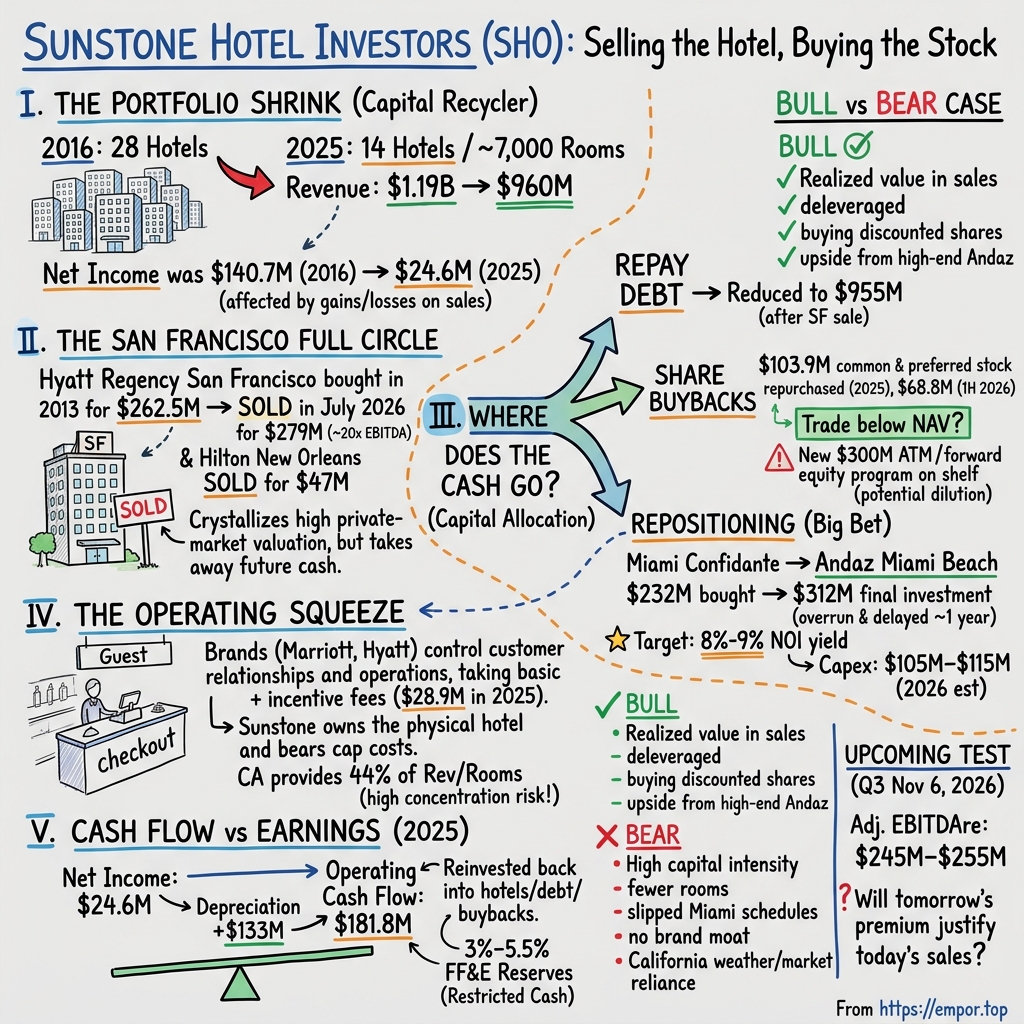
Sunstone Hotel Investors: Selling the Hotel, Buying the Stock
I. The Hotel Sold for Tomorrow’s Growth
On July 30, 2026, the keys to an 821-room tower at the foot of Market Street in San Francisco changed hands. The Hyatt Regency San Francisco, with its famous atrium lobby and its long relationship with the city's convention trade, went from Sunstone Hotel Investors to funds affiliated with Blackstone Real Estate for a gross price of $279 million, or roughly $340,000 for every room.1 Guests checking in that evening would not have noticed a thing. The same brand was on the door, the same operator ran the front desk, and the same housekeepers turned down the same beds. What changed was who owned the building, and who would carry the cost of waiting for San Francisco to come back.
Sunstone's chief executive, Bryan Giglia, framed the deal in a way that is worth sitting with. He told analysts that the hotel had sold for a multiple of nearly 20 times its trailing EBITDA, and that the sale let Sunstone "get paid for that future growth while eliminating the risk of getting there."2 That is an unusual thing for an owner to say about its own asset. Most public companies tell investors that the growth is coming and that they intend to be there when it arrives. Sunstone said, in effect, that the growth might well come, that somebody else could wait for it, and that the buyer had already paid for it.
Twenty times trailing earnings is a rich number for a hotel. Turn it upside down and it says the buyer accepted a current return of roughly 5% before setting aside money for future renovations, which only makes sense for someone who expects the earnings to rise a lot. Giglia described the property as "a low-yielding asset" and warned that ongoing cost pressures in the San Francisco market would "elongate and create risk to the recovery and earnings."2 Blackstone, in other words, was buying a recovery story. Sunstone was selling one.
Then came the second half of the decision, which is where the story really begins. With the cash in hand, Sunstone repaid $25 million on its revolving credit line, taking total debt to $955 million, and reported roughly $430 million of cash including restricted balances.1 It also kept buying its own shares. By August 5, the company had repurchased about $70 million of common and preferred stock during 2026, a figure that had more than doubled since the end of June.1 Management's argument was simple: the price a private buyer paid for one San Francisco hotel was, in Giglia's words, "well in excess of where we are trading."1 If the market valued the whole portfolio at less than the hotels would fetch one by one, why buy another hotel when the stock was the cheapest hotel portfolio on offer?
Put yourself in the boardroom for a moment. You have a pile of cash from a sale. You can buy another hotel, at prices the CEO says still show "a disconnect" between buyers and sellers.2 You can pay down more debt, which lowers risk but earns only the interest you stop paying. Or you can buy back stock that management believes trades below the private-market value of what the company owns. Each choice is a bet, and each one changes what a Sunstone share will be worth in five years.
That framing contains three questions, and this story is organized around them. The first is about growth. Sunstone has said its remaining hotels have room to grow, especially after a string of renovations, but the property it just sold was supposed to be one of its growth engines. The second is about capital allocation. Selling an asset at a high price only creates value if the cash earns more somewhere else, so the real scorecard is value per share, not dollars returned. The third is about control. Sunstone does not run its hotels. Marriott, Hyatt, Hilton and other operators employ the staff, run the reservations systems and hold the relationship with the guest. An owner that controls neither the brand nor the front desk has to win somewhere else, and the question is where.
So the verdict on the San Francisco sale, at least for now, is a split one. The deal crystallized a high private-market valuation for a hotel whose near-term earnings were weak, and it lowered debt. But whether it created value depends on what Sunstone earns with the money next, and on whether the remaining hotels can grow without the asset that was meant to carry part of the recovery. To understand why a hotel company would choose to sell growth rather than wait for it, it helps to see how Sunstone became a seller in the first place.
 Subscribe on LinkedIn
II. A Hotel Owner That Became a Capital Recycler
Sunstone Hotel Investors listed on the New York Stock Exchange in 2004 as a self-managed real estate investment trust that owned hotels and left the job of running them to others.3 The structure has stayed the same ever since. A Maryland corporation owns an operating partnership that owns the buildings, and a taxable subsidiary leases the hotels and hires the managers who actually run them.3 That arrangement exists for tax reasons, because a REIT generally cannot earn operating income from running a hotel directly, but it also defines the company's character. Sunstone is a landlord with a very active interest in what happens inside its buildings, without the power to run them itself.
For much of its life, the company behaved like most hotel REITs in a recovery: it bought. In the years after the financial crisis, when hotel values had collapsed and capital was scarce, buying full-service hotels in big cities looked like the obvious trade. The Hyatt Regency San Francisco purchase in late 2013 was part of that phase, a big urban hotel bought with fresh equity on the theory that a tight city would only get tighter.4 By the end of 2014, the portfolio had grown to 30 hotels.5
Then the direction reversed. By 2016, Sunstone owned 28 hotels and reported revenue of about $1.19 billion.6 By late 2019, local business press was describing the company as a seller rather than a buyer, with 20 hotels in the portfolio, down from 30 five years earlier.5 The logic was that late in the cycle, private buyers were paying full prices, and an owner that sold its weaker or more capital-hungry properties could reinvest in fewer, better ones. Then the pandemic shut hotels altogether, and the pruning that followed it continued in the same direction. By the end of 2025, Sunstone owned 14 hotels with about 7,000 rooms.3 After the San Francisco sale, it owns 13 hotels with 6,178 rooms.1
Here is the first figure that complicates the comfortable version of this story. Revenue in 2025 was about $960 million, still roughly a fifth below the 2016 level, even after nine years of room-rate inflation.36 That is not a failure in itself. A company that deliberately sells half its hotels should expect its top line to shrink. But it means Sunstone is not a growth story in the ordinary sense. It is a portfolio-selection story, and a selection story has to be judged on whether each share now owns a better and more valuable slice of hotel real estate than it did before.
Net income makes that judgment harder, not easier. Sunstone earned about $141 million in 2016 and about $25 million in 2025, which looks like a collapse until one notices how much of the path was driven by selling hotels.36 In 2023 the company booked a $124 million gain on hotel sales, which inflated that year's profit; in 2025 it booked an $8.8 million loss on a sale.3 For a company whose strategy is buying, fixing and selling buildings, accounting profit swings with the timing of transactions. It tells an investor very little about whether the remaining hotels earn more than they used to.
The modern mission statement fills the gap the numbers leave. Sunstone now describes itself as an owner of a smaller collection of high-quality urban, group-oriented and resort hotels, properties where location and physical quality are hard to copy.3 It spends heavily to reposition them, through renovations, brand changes and new restaurants. And it sells when it judges that the return on the next dollar of investment has fallen below what the market will pay for the hotel today. That last clause is the one that makes Sunstone different from a buy-and-hold landlord. The company treats every hotel as potentially for sale at the right price.
There is something attractive about that discipline, and something that should make an investor cautious. The attraction is that a recycler does not fall in love with its assets. The caution is that a recycler's results depend heavily on its timing, on the prices private buyers happen to offer, and on its ability to find something better to do with the proceeds. An owner that keeps selling has to keep answering one question: if the portfolio keeps getting smaller, what exactly is making the part that remains worth more? To answer that, the story has to go inside one of the hotels and follow the money from a guest's credit card to Sunstone's bank account.
III. The Guest Pays for a Night; Sunstone Owns the Building
Imagine a convention delegate booking a room at the Hilton San Diego Bayfront, the 1,200-room hotel that sits beside the city's convention center.2 The delegate probably books through a Hilton app or website, or through a block the convention organizer negotiated with Hilton's sales team. Hilton Honors points go into Hilton's loyalty account, not Sunstone's. The person at the front desk, the housekeeper and the banquet server are employed by the hotel's operator. The building, the land lease, the ballrooms and the renovation bill belong to Sunstone. When the guest checks out, almost every relationship that touched them belonged to someone else.
This is the central puzzle of a hotel REIT. The company owns the most expensive and least movable part of the business, and the most valuable relationship in the business, the one with the customer, belongs mainly to the brand.
How a room becomes revenue
The basic unit of the hotel business is the occupied room night. A hotel earns room revenue every time it sells a night at a daily rate, and the industry boils its performance down to a single number called RevPAR, or revenue per available room.3 RevPAR is occupancy multiplied by the average daily rate. A hotel that is 80% full at $300 a night earns RevPAR of $240; one that is 60% full at $400 a night earns the same RevPAR, though with very different costs, because a full hotel needs more housekeepers. Food, beverage, meetings, parking, spas and resort fees add revenue beyond the room, and in a big group hotel those out-of-room dollars can be enormous. Sunstone's own guidance tracks both: room RevPAR, and a broader total RevPAR that includes everything else a guest spends.1
Hotels are among the most cyclical forms of real estate because their "lease" is one night long. An office tenant signs for ten years; a hotel guest signs for one evening. Demand moves with leisure travel, with the corporate travel budget, with the group calendar of the local convention center, with sporting events and with the state of the economy.3 Group bookings give some forward visibility, because associations book room blocks years in advance, but they do not remove the cycle. When a convention center has a thin year, a group hotel next door feels it immediately, which is exactly what happened in San Diego in 2026.
There are no customer contracts to speak of. Sunstone does not report any customer above 10% of revenue, nor the share of revenue from repeat guests, and it has no minimum purchase commitments from anyone.3 Demand is spread across thousands of travelers and hundreds of meeting planners, so the usual question about customer concentration simply does not apply. The concentrations that matter are elsewhere: which operator runs the hotels, which brands are on the doors, which cities the rooms are in, and which booking channels deliver the guests.
Where an owner can win
The competitive landscape has two layers. On one layer sit the other owners. Host Hotels & Resorts is the giant among hotel REITs, with a market capitalization of around $16.5 billion in an October 2026 snapshot, about seven times Sunstone's roughly $2.2 billion.7 Pebblebrook Hotel Trust sits near Sunstone in size, and DiamondRock Hospitality is another close peer.7 On the other layer sit Marriott, Hilton and Hyatt, the brand and management platforms that are far larger than any hotel owner. They are not direct comparables, because they mostly own little real estate and earn fees, but they hold a great deal of the power in each hotel Sunstone owns.
Run the competitive forces through a single Sunstone hotel and the picture becomes clear. Guests have plenty of power, because they can switch hotels with a few taps, and online travel agencies and price-comparison tools make rates transparent. The brands have power too, because they control loyalty programs and reservations systems that deliver a large share of the guests, and they charge for that through franchise and system fees built into the cost of running the hotel. Operators have power through management contracts that are long and hard to terminate. New supply and alternative lodging, from short-term rentals to new luxury hotels, give guests other choices. Against all of that, the owner's main protection is the one thing nobody else can replicate: a particular building on a particular piece of land. A resort on the beach in Wailea, or a hotel attached to the San Diego convention center, can be hard to replace even if the owner never meets a single guest.
That is Sunstone's strongest case. The company's argument for an edge rests on selecting well-located luxury, resort and group hotels and then actively managing and repositioning them, through renovations, brand conversions and new food and beverage concepts that let a hotel charge more. There is evidence that the approach can work at the property level. When Sunstone converted the Oceans Edge Resort into the Hilton Key West Resort & Marina on July 1, 2026, Giglia reported early lifts in average rates, longer booking windows and more direct bookings through the brand's own website.2 At the Westin in Washington, D.C., he said the hotel's transient rate index, a measure of its rates against competing hotels, had risen to 123 from 106 in 2019.2
But a property that wins is not the same as a company with a durable moat. Sunstone does not own the brands or their distribution systems. It does not disclose repeat-guest retention, booking-channel costs or anything that would show a customer advantage it carries from one hotel to the next.3 Nor has it published a long-run growth record that beats its peers; its revenue base is still below 2016 after a deliberate shrink. What the evidence supports is an asset-quality thesis: good buildings in good places, bought and improved by a team that knows what it is doing. That is a real thing, but it is a thesis about real estate, and real estate's edge is location, which can be bought by anyone with enough capital and the willingness to pay the price.
Even the brand programs cut both ways. On the second-quarter call, Giglia said Hilton and Marriott initiatives were lowering some cost loads and sales and marketing costs for owners, savings he expected to grow over several years.2 He also said he had not heard of comparable fee relief from luxury brands.2 Translation: the technology investments the brands are making in booking and distribution may eventually lower an owner's costs, but the brands decide how much of that benefit to pass along. The owner is the price-taker in that negotiation.
That leaves the exposures that really matter. At the end of 2025, Marriott affiliates managed six of the 14 hotels, and Hyatt managed three.3 Northern and Southern California produced 44% of Sunstone's rooms and 44% of its revenue, and the company's filing flags weather, competition and local economic conditions in California, Florida, Hawaii and Washington, D.C., as concentration risks.3 With 14 hotels, a single soft convention calendar or a single storm can move the whole company's results, and in 2026 both happened. With six of the hotels in one operator's hands, Sunstone's negotiating position on fees, staffing and service standards is bounded by its dependence on that relationship.
So Sunstone owns the building, and the guest pays for the night. The question that follows is how much of what the guest pays actually reaches the owner, after everyone who stands between them takes a share.
IV. Who Gets Paid Before the Owner Does?
Sunstone's headquarters is a small place. At the end of 2025 the company had 37 corporate employees.3 Its hotels, meanwhile, employ thousands of people, all of them employees of third-party managers.3 That split is the most important fact about how the company makes money. Sunstone writes the cheque for the payroll, through the hotel's operating accounts, but it does not hire, train or direct the staff who deliver the product.
The managers are paid for that work through fees. Basic management fees are generally 2.5% to 3.0% of a hotel's revenue, and incentive fees kick in when a hotel's operating profit clears thresholds set out in each agreement.3 Combined, basic and incentive fees came to $28.9 million in 2025, about 3% of revenue, compared with $26.8 million in 2024 and $34.7 million in 2023.3 The swings are telling. Incentive fees rise when hotels earn more, and they fell as the portfolio shrank and some hotels' profits slipped below their thresholds. Brand franchise fees, loyalty charges and reservation costs come on top of management fees, buried in the hotels' operating expenses.
Is this a sweetheart arrangement? The answer is no, at least not in the sense investors usually worry about. Sunstone is not a subsidiary of a hotel company, and it is not controlled by a sponsor that also owns the managers. Its 2026 proxy says that since the start of fiscal 2025, it had no related-party transaction above $120,000 in which a related person had a material interest.8 The management fees are material costs, but they are ordinary market contracts with large public operators, not transfers to insiders. The governance question here is about bargaining power, not self-dealing.
The bargaining-power question is a real one, because of how the fees are built. A basic fee based on revenue rewards the manager for selling more rooms and more banquets, whether or not those sales make money for the owner. If a hotel fills its rooms with lower-rate transient guests and pays more in labour to service them, revenue rises and so does the basic fee, even while the owner's margin shrinks. The incentive fee is meant to correct that, by paying the manager more only when profits clear a hurdle. But the owner alone bears the cost of the building's renovations, the debt that financed it and any property-level inefficiency that sits below the incentive threshold.
San Diego in the second quarter of 2026 showed how that tension plays out. The convention calendar was weak, so the hotel lost the high-spending group guests who fill ballrooms and buy banquets. Transient demand rose 19%, which partly filled the rooms, but transient guests spend much less outside their rooms than group guests do.2 Total RevPAR at the hotel fell 8.4%, and the shift toward transient business pushed up costs at the same time.2 Excluding Andaz, comparable expenses across the portfolio rose 4.4% in the quarter, and Giglia said that excluding San Diego, cost growth per occupied room would have been 1.2 percentage points lower.2 The owner absorbed the margin squeeze; the manager's basic fee was based on the revenue that remained.
None of this is unusual. Every hotel REIT lives with the same structure, which is why the sector trades as a group on the cycle. But it bounds what an owner can promise. Sunstone's influence runs through asset management: it negotiates budgets, pushes operators on staffing models, decides on capital projects and, ultimately, chooses which brand and which manager a hotel should have. It can change the flag on a building, as it did in Key West. It cannot walk into a kitchen and change the menu itself.
The evidence that would settle whether the arrangement is a good deal for shareholders is not published. Sunstone does not report property-level results by manager, nor does it break down revenue and cost by booking channel.3 Without that, an investor cannot see whether Marriott's distribution earns back its fees better than Hyatt's, or whether a direct booking costs Sunstone materially less than one through an online agent. The company reports the outcome, hotel by hotel in its supplemental materials, but not the full anatomy of who took what along the way.
What an investor can see is the shape of the bet. Sunstone's return depends on keeping its buildings attractive enough that brands and managers can charge high rates, and on negotiating hard enough that the owner keeps a fair share of what those rates bring in. The most direct lever it controls is capital: where it spends money on its buildings, and how much. No project tests that lever more vividly than a pink-and-white hotel on Collins Avenue in Miami Beach.
V. The Portfolio Bet That Took Longer and Cost More
In May 2022, Sunstone announced that it would buy The Confidante Miami Beach from an affiliate of Hyatt Hotels for $232 million.9 The hotel sat on about an acre and a half of oceanfront land that Sunstone would own outright, with 339 rooms, a pool deck facing the Atlantic and the bones of an Art Deco-era property that had been modernized before.9 The plan was ambitious: gut and rebuild the hotel into a luxury resort under Hyatt's Andaz brand, with a relocated ocean-view lobby, new restaurants, a reinvented pool, a larger share of suites and upgraded meeting space.9 Hyatt would stay on as manager.9 The deal was announced barely two months after Bryan Giglia became chief executive.89
Giglia was an unusual choice to lead a deal-making story, and that is part of why the Andaz matters. He joined Sunstone in 2004 after accounting roles at Hilton Hotels, spent nearly a decade in the finance team running capital markets, planning and investor relations, became chief financial officer in 2013 and chief executive in March 2022.8 He is, by training, a numbers person who grew up inside the company, the kind of executive who knows what each hotel earns down to the banquet line. Andaz was his chance to show that a finance-minded owner could also create value with a shovel.
The price of a beach
The entry price was high, and Sunstone did not hide it. The company paid about $684,000 per room, or 17.3 times forecast 2022 hotel EBITDA, which worked out to a 5.0% return on forecast net operating income.9 For context, that is the kind of yield an investor might earn on a safe bond in a normal rate environment, for an asset that carries the risks of an operating hotel. The justification lay in what would come after the renovation. Sunstone planned to spend about $60 million on the repositioning, bringing its all-in basis to roughly $900,000 per room, and targeted a stabilized net operating income yield of 8% to 9% on that total investment.9
The structure of that promise is worth understanding, because it is how all repositioning deals work. The buyer pays a full price for today's earnings and then spends heavily to create a better hotel that will earn far more. If the renovation succeeds, a 5% yield on the purchase price becomes an 8% or 9% yield on the larger total, and the owner has effectively manufactured a better asset than it could have bought. If the renovation runs late or over budget, or if the market softens before the new hotel is stabilized, the owner is left with an expensive building earning a thin return.
Whether $684,000 per room was cheap or expensive for oceanfront Miami Beach depends on comparisons that Sunstone did not publish: a matched set of luxury transactions in the same market at the same time. The 17.3 times multiple and the 5% yield establish that Sunstone paid a full price. They do not, on their own, establish that it overpaid. The honest test is the one Sunstone set for itself: the 8% to 9% stabilized yield.
Promise versus delivery
Then the timeline started to move. Sunstone initially planned for the renovation to begin in phases in the fourth quarter of 2022 and finish, with the rebranding, in the first half of 2024.9 Sunstone later pushed substantial completion to late 2024, and the Andaz Miami Beach finally opened in May 2025, roughly a year after the original target.3 The budget moved too. The renovation estimate rose from about $60 million to roughly $70 million, and Sunstone added about $10 million of further return-generating projects, bringing the total investment to around $312 million against the roughly $292 million implied at purchase.39
Those changes are not catastrophic, and Sunstone disclosed them as they happened. Large hotel renovations in coastal Florida during a period of construction-cost inflation have a long record of running late. But the changes matter for two reasons. First, they raise the bar: an 8% to 9% yield on $312 million requires about $25 million to $28 million of annual net operating income, more than the same yield on $292 million. Second, every quarter of delay is a quarter in which a $232 million asset earned almost nothing. In the first half of 2025, while the hotel was still finishing its renovation, Andaz posted an EBITDA loss.1
Now look at what the open hotel has delivered. In the second quarter of 2026, Andaz Miami Beach ran at 72% occupancy and an average daily rate of about $470, and contributed about $2.8 million of EBITDA.2 Over the first six months of 2026, which include Miami's winter high season, it generated about $33 million of revenue and $9.3 million of adjusted EBITDA.1 Sunstone expects it to add about 4.5 percentage points to the company's whole-year RevPAR growth.1 A signature restaurant, Bazaar Meat, was built and staffed for a debut in the fall of 2026, timed to catch the next high season.2
Here is the reveal, and it is a sobering one. If the strongest half of the year produced about $9 million of EBITDA, the hotel's run-rate in its first full year of operation sits well short of the $25 million-plus a year that the stabilized yield implies, and net operating income, which deducts a reserve for future renovations, sits lower still. That is not proof of failure. New luxury hotels typically take two to three years to ramp up, the new restaurant had not yet opened, and group bookings for a newly opened resort take time to build. But it means the Andaz case is still a forecast. The hotel has opened; the return has not yet arrived.
Andaz also shapes how investors should read Sunstone's headline growth. In the first quarter of 2026, portfolio RevPAR growth excluding Andaz was 5.7%, and in the second quarter it was 4.3%, against 9.3% including the new hotel.101 Much of the company's apparent acceleration was the arithmetic of comparing a newly opened luxury resort with a year when it was a construction site. Strip that out and the underlying portfolio was growing at a healthy but unspectacular mid-single-digit pace, slowing from the first quarter to the second.
Andaz was the biggest bet, but not the only one. Sunstone spent about $103 million on its portfolio and other assets in 2025, down from $157 million in 2024, when the Miami Beach rebuild was at its peak.3 It ended 2025 with $38.9 million of renovation construction commitments, and expected $105 million to $115 million of capital investment in 2026, a range raised partly because of storm damage at the Wailea Beach Resort in Maui that insurance is expected to largely cover.31 San Diego's meeting space was under renovation during the soft quarter, and the Key West conversion carried its own costs.2
So the capital program is continuous, not episodic, and that has a consequence for the whole investment case. Sunstone does not renovate once and then harvest. It renovates, then renovates again somewhere else, then sells a hotel whose next renovation it does not want to fund. The forward test for Andaz is precise: stabilized hotel NOI and EBITDA against the full $312 million, measured once the opening ramp is over and the company's comparisons no longer include a hotel it sold. Until that number arrives, the Andaz is a plausible growth driver with an incomplete scorecard, and its delayed schedule counts against the forecasting record of the management team that made it.
The cash to fund all of this has to come from somewhere. And when an investor looks for it in Sunstone's income statement, the first impression is that it is not there.
VI. The Cash Flow Looks Better Than the Earnings Line
Open Sunstone's 2025 annual report to the income statement and the bottom line is almost alarming: net income of about $24.6 million on revenue of $960 million, a profit margin of under 3%.3 Turn a few pages to the cash flow statement and the picture changes completely. Cash from operations was about $182 million, more than seven times the reported profit.3 For a company with almost no inventory and no factories, a gap that wide is the kind of thing that makes a forensic accountant sit up. Is the profit understated, or is the cash flow flattering?
The answer is mostly the plumbing of real estate accounting. The biggest item in the bridge from profit to cash is depreciation, about $133 million in 2025.3 Accounting rules require Sunstone to write down the cost of its buildings and furniture over time, as though they were wearing out on a fixed schedule, and that charge reduces profit without any cash leaving the building. Add roughly $8.7 million of stock-based compensation, which is paid in shares rather than cash, and about $3.8 million of amortised financing costs, and most of the gap is explained.3 The rest is small adjustments, including the loss on the hotel sold that year.
The second thing a careful reader checks is working capital, because a company can inflate operating cash flow by squeezing suppliers or deflate it by letting customers pay late. In 2025, working capital barely moved. Receivables contributed about $2,000 to operating cash flow, a rounding error, while payables and other liabilities added about $2.4 million.3 In other words, the cash flow was not dressed up by stretching anyone's payment terms. The gap between profit and cash is the honest result of depreciation.
But the comfort only goes so far, because operating cash flow is not free cash flow. The buildings that accounting depreciates on paper really do wear out. Carpets fray, mattresses sag, bathrooms date, and a luxury hotel that falls behind its competitors on condition loses its rate premium quickly. That is why Sunstone's management and franchise agreements require it to set aside a reserve for furniture, fixtures and equipment, typically 3.0% to 5.5% of a hotel's revenue each year.3 At the end of 2025, $76.4 million sat in restricted FF&E reserves, money that belongs to the hotels' future renovations rather than to shareholders.3
Follow the cash out of the business and the picture sharpens. In 2025, Sunstone made portfolio investments, paid dividends on its common and preferred stock, refinanced debt, and spent $103.9 million repurchasing common and preferred shares.3 Measured against $182 million of operating cash, the property spending alone consumed more than half. Put differently, depreciation is not a fiction for a hotel owner; it is a rough estimate of a bill that arrives in irregular, often larger, instalments. The difference between Sunstone's profit and its cash flow is real, but much of it is spoken for.
There is one more kind of interest income worth noticing in the same accounts. Interest and other income came to about $11 million in 2025, about 44% of pretax income, a ratio that looks dramatic but mostly reflects how small pretax income was in a year with a loss on a hotel sale.3 The components were ordinary: about $5.8 million of interest income on cash, $3.9 million from construction-claim settlements, and $1.1 million of net property-insurance recoveries.3 The construction settlements are one-time recoveries, not recurring earnings, and an investor building a picture of the underlying hotels should take them out.
A newer clue in the receivables
The receivables line deserves a closer look, because it is where hotel companies can quietly hide stress. At the end of 2025, net receivables were $33.7 million, of which $16.6 million was trade receivables, mostly money owed by groups and corporate clients billed after their stays.3 Bad-debt expense was a trivial $445,000, close to the prior two years.3 Sunstone keeps an allowance against doubtful accounts but publishes no ageing table and no customer-specific overdue balances, so an investor cannot see how long any of that money has been outstanding.3
By June 30, 2026, receivables had risen to $50.8 million, and the first half's operating cash flow included a $15.3 million use from receivables.11 There are innocent explanations. The first half included the busy season at the Andaz, a hotel that had very little to bill a year earlier, and insurance claims at Wailea can create amounts owed to the company. Seasonal swings in group billing also move the line around. But a 50% rise in six months is the kind of movement worth watching. If it reverses by year-end, it was seasonal; if it persists, it would suggest slower collections somewhere in the portfolio.
On the other side of the ledger sits a pattern that runs in Sunstone's favour. Contract liabilities, mostly advance deposits from groups and guests, were $47 million at the end of 2025, and $45.6 million of those deposits turned into revenue during the year.3 Meeting planners pay part of the bill before they arrive, which means a group hotel is partly financed by its customers. That cash is a promise to deliver rooms and ballrooms later, not profit already earned, but it is a sign of real forward demand.
So the gap between profit and cash is not a warning sign; it is depreciation doing what depreciation does. The warning, if there is one, is quieter: the cash that remains after a hotel owner keeps its buildings competitive is far smaller than the operating cash flow headline suggests. That is the context in which Sunstone decided to sell its San Francisco hotel rather than pay for its next chapter.
VII. The San Francisco Hotel Comes Full Circle
Go back to December 2013. San Francisco was in the middle of a technology boom, cranes hung over South of Market, and hotel rooms in the city were among the hardest to find in the country. Sunstone's chief executive at the time, Ken Cruse, announced that the company had completed its purchase of the Hyatt Regency San Francisco for $262.5 million, about $327,000 per room for the 802-room hotel.4 The deal was funded with the proceeds of a common-stock offering the company had completed a month earlier, and Cruse pointed to the city's favourable supply and demand dynamics and to more than three million square feet of office space under construction within five blocks of the hotel.4 It was, he said, "highly consistent with our stated plan to improve the quality and scale of our portfolio."4
That is the thesis worth remembering as the story jumps forward. Sunstone bought the Hyatt Regency because it believed San Francisco's office and convention economy would keep rooms scarce and rates rising. It funded the deal with new shares, which means existing shareholders gave up a slice of the company in exchange for this hotel. And it paid for the hotel at a moment when the city's prospects looked as bright as they ever had.
Then came a long and uneven decade. San Francisco's hotel market grew through the late 2010s, and Sunstone invested in the property over the years it owned it; by the time of the sale, the hotel had 821 rooms, 19 more than when Sunstone bought it.14 Then the pandemic emptied the city's offices, and the downtown recovery that followed was slower than in almost any other big American market. Office vacancies stayed high, convention attendance took years to rebuild, and labour costs, governed by local union contracts, kept rising. A hotel that had been bought as a growth asset spent years as a recovery bet.
By the summer of 2026, Sunstone faced a choice. San Francisco was still expected to contribute growth; the convention calendar and corporate travel were improving, and some investors saw the city as one of the most leveraged plays on a hotel recovery in the country. But the hotel's current earnings were thin, and Giglia said that cost pressures in the market would stretch out the recovery and add risk to it.2 He chose to sell, and Blackstone's funds paid a price equal to nearly 20 times trailing EBITDA.12
Both halves of management's explanation deserve to be kept together. The first is that the price reflected growth that had not yet arrived, which is a polite way of saying the buyer was paying for Sunstone's own original thesis, a decade late. The second is that the cost of reaching that growth, in operating expenses and probably in another major renovation, was uncertain enough that Sunstone preferred to collect the price now. A seller that genuinely believed the recovery was close would have waited. A seller that believed the buyer was overpaying for a slow recovery would sell. Sunstone's choice says which camp it was in.
Did the hotel earn its keep?
Here the consensus narrative and the record diverge. The headline version is that Sunstone sold the hotel for more than it paid. That is true in nominal dollars, by about $16.5 million, over twelve and a half years. It is not, on its own, evidence of a good investment. A proper return calculation would add up the cash the hotel produced during ownership, subtract the renovation spending Sunstone put into it, add the sale proceeds and compare the result with what the capital could have earned elsewhere over the same period. Sunstone has not published that calculation for the hotel, and the inputs it would need, cumulative capital spending and hotel-level cash flow over the whole holding period, are not laid out in one place in its filings.
What can be said is narrower. A sale price only about 6% above the purchase price, before counting a decade of capital improvements and before adjusting for inflation, suggests the hotel's value roughly treaded water while Sunstone owned it. The investment return, if it was adequate, came from the operating cash flow of the good years before 2020, not from appreciation. And because the purchase was funded with new shares, the hotel's performance over that decade is part of the reason the company's share count once grew, before the buyback era began shrinking it.
The San Francisco exit was not the only recent example of the recycling strategy in action. In 2025, Sunstone sold the Hilton New Orleans St. Charles for $47 million and used the proceeds, together with cash on hand, to fund share repurchases.3 That sale produced the $8.8 million accounting loss that weighed on 2025 net income. A small, older hotel sold below its book value is a reminder that recycling is not always a story of selling at a premium. Sometimes it is a story of exiting a hotel whose next renovation would cost more than it would return.
Sunstone describes its ambition as being a premier steward of capital, and the San Francisco sale is its best exhibit for that claim.3 But a steward is judged on the whole round trip, not on the exit price alone. Selling well is only half the job. The other half is what the company does with the $279 million, and that is where the story turns from hotels to the stock market.
VIII. Buybacks, Debt and the New Shares on the Shelf
There is a particular kind of arithmetic that hotel REIT managements love, and Sunstone has leaned into it harder than most. If the stock market values a share of the company at less than the hotels behind it would fetch in a private sale, then every dollar spent buying back stock buys hotel real estate at a discount. Selling a hotel at a full private price and using the proceeds to buy back shares at a public discount is, on paper, a way to capture the gap twice.
Sunstone has been running that play for years. In 2025 it repurchased about 11.6 million common shares and 63,124 preferred shares for a total of $103.9 million.3 Management said that from the start of 2022 through 2025 it had repurchased about 14% of the shares outstanding, a substantial shrinkage for a company of its size.3 In 2026 the board restored the repurchase authorization to $500 million, and the buying continued.11 By August 5, the company had bought about 4.4 million common shares in 2026 at an average of $9.24, plus Series H and Series I preferred shares at discounts of roughly 16% to 20% to their liquidation value.1 About $437 million of authorization remained.1
The preferred buybacks are a subtle and often overlooked piece of the strategy. Preferred stock is a form of capital that pays a fixed dividend and ranks ahead of common shareholders. When Sunstone buys back a $25 preferred share for about $20, it retires a fixed obligation at a 20% discount, which is roughly equivalent to repaying debt below face value. CFO Aaron Reyes told analysts that the year's repurchase activity was accretive to both net asset value and earnings per share.2 For the preferred, that claim is close to self-evident. For the common, it depends on what the shares are actually worth.
The buybacks sit on top of a capital structure that is moderate but not trivial. At the end of 2025, Sunstone had $930 million of debt, made up of $760 million of unsecured term loans and $170 million of senior notes.3 In January 2026, $65 million of Series A notes matured and were repaid with a delayed-draw term loan, so debt moved around rather than shrinking.3 By June 30, debt was $980 million; after the San Francisco sale and the revolver repayment, it fell further.111
None of that debt is secured by individual hotels, which gives Sunstone flexibility to sell properties without unwinding mortgages. The company amended and restated a $1.35 billion unsecured credit facility in September 2025, and said afterward that it had no debt maturities before 2028.12 The term loans mature in 2029 and 2030, with options to extend to 2031 subject to fees and conditions, and $475 million of the $500 million revolver was available at the end of June, subject to financial covenants.11 Reyes put net leverage at 2.6 times trailing earnings, or 3.6 times when preferred equity is counted as debt.2 For a cyclical business, that is a comfortable but not cautious position. The 3.6 times figure is the more honest one, because preferred dividends must be paid before common shareholders see a cent.
The interest-rate exposure is modest. At June 30, about 59% of the debt was fixed or swapped to fixed, and Sunstone estimated that a 50-basis-point move in rates would change annual interest expense by about $2 million.11 The company's derivatives are interest-rate swaps, and their fair-value swings move reported interest expense around from period to period; in the first half of 2026 they reduced it by about $4 million.11 The company has not cited a rating-agency assessment in its recent filings, so the credit picture rests on the issuer's own disclosures about covenants and maturities.
The shelf beside the buyback
Then, four days after the second-quarter results, Sunstone filed paperwork that pointed the other way. On August 10, 2026, it entered into a new distribution agreement for an at-the-market and forward equity program allowing it to sell up to $300 million of common stock over time.1314 The new program replaced an earlier ATM of the same size under which no shares had been sold.1311
An at-the-market program lets a company sell shares into the market in small amounts at prevailing prices. A forward-equity feature lets it agree to sell shares at today's price but deliver and collect the cash later, which is useful for matching equity to a future acquisition. Neither creates new shares until it is used. But the juxtaposition is striking: a company that says its stock is too cheap to issue, and cheap enough to buy back by the tens of millions, also put a $300 million issuance program on the shelf.
There are reasonable explanations. Shelf programs are cheap insurance, and companies renew them routinely so that they can raise equity quickly if the share price rises above net asset value, at which point issuing stock to buy hotels becomes the accretive move. A company genuinely committed to buying at a discount and selling at a premium should, in theory, have both tools ready. But an investor should treat the ATM as a dated option on dilution. The events that settle the matter are actual issuance and forward settlements, which will show up in the share count.
Valuation is where the argument becomes testable, at least partly. In an October 19, 2026 snapshot of hotel REITs, Sunstone traded at about 12.2 times forward funds from operations, a measure of cash earnings commonly used for REITs, compared with roughly 11 times for Host, Pebblebrook and DiamondRock.7 That is an interesting result for a company whose management argues its stock is cheap. On that snapshot, the market was paying a modest premium for Sunstone relative to its closest peers, perhaps for its lower leverage, its resort mix or the Andaz ramp. A comparison with Sunstone's own historical multiple is not available from the same source.
The snapshot also allows a rough check on the buybacks. Applying a 12.2 times multiple to the midpoint of Sunstone's 2026 adjusted FFO guidance of $0.93 to $0.98 a share implies a share price somewhat above the $9.24 average the company paid for common stock earlier in the year.17 If that reading is right, the 2026 purchases look well timed so far. But the more important question is not whether the stock rose after the buybacks. It is whether the stock trades below what the hotels are really worth.
On the second-quarter call, Giglia said the company's focus was still to repurchase at a discount to NAV, and that buybacks remained a better use of capital than acquisitions at current prices.2 When Baird analyst Michael Bellisario asked about the deal market, Giglia said more $75 million to $150 million full-service hotels were coming to market, but that pricing still showed a disconnect in competitive processes.2 Reyes described the common buybacks as being at "a meaningful discount to consensus estimates of NAV."2
A skeptic would push on that phrase. Consensus NAV is an estimate built by analysts, mostly from cap rates and assumptions about hotel earnings, not an appraisal. Sunstone's recent sale at nearly 20 times trailing EBITDA is one real data point, but a sale of a recovery asset to one of the world's largest private buyers does not prove that every hotel in the portfolio would fetch a similar multiple. The skeptic would also ask the harder question: over a full cycle, have Sunstone's repurchases produced better per-share returns than peers that bought fewer shares and more hotels?
That question has an activist edge in 2026. In April, Land & Buildings, a REIT-focused investment firm, named Sunstone among 21 REITs whose total shareholder returns had trailed the peers their own boards selected for pay benchmarking over the trailing one, three and five years, and urged shareholders at such companies to vote against say-on-pay and compensation committee members.15 The firm said its funds might hold securities of the companies it named, including Sunstone.15 This was not a proxy contest, and Land & Buildings did not nominate directors. But at the May annual meeting, director W. Blake Baird received about 16.3 million votes against, the most of any nominee.16
The scorecard that settles the buyback debate is concrete: the shares actually retired, the diluted share count, unrestricted cash, net debt including preferred equity and, above all, net asset value per share. The gross dollars returned are the wrong number to celebrate. The right number is whether each remaining share owns more hotel value than it did before, and that depends heavily on the judgement and incentives of the people making the calls.
IX. What the Numbers Ask of the People in Charge
Bryan Giglia arrives at each earnings call with a story that is unusual for a hotel CEO: the company has sold a hotel at a high multiple, retired stock, kept leverage moderate and still has a large renovation program in progress. He is fluent in the numbers, as one would expect from someone who spent nine years as the company's CFO, and his answers on calls tend to be specific: expense growth by hotel, basis points of RevPAR contribution from Andaz, group pace by year.28 Around him sit Robert Springer, the president and chief investment officer responsible for deals, and Aaron Reyes, the chief financial officer.8
The team has slimmed. Former chief operating officer Christopher Ostapovicz left in January 2025,8 and in May 2026 Sunstone eliminated the general counsel position.16 David Klein's separation agreement provided for $1.5 million in cash, less the value of accelerated equity, the vesting of awards covering 73,920 shares, and up to 18 months of health coverage.16 For a company of that size, removing two senior roles is a meaningful change in the cost base, and a sign that management sees a smaller portfolio needing a smaller headquarters.
Pay against a moving profit line
Giglia's total reported compensation was about $4.52 million in 2025, up from about $3.95 million in 2024.8 That equals about 18% of the year's net income, a ratio that sounds alarming but mostly reflects how volatile net income is when hotel sales generate gains and losses. In 2023, when a big sale gain lifted net income above $200 million, the same pay would have looked like a rounding error. Neither comparison is a clean measure of whether the CEO is paid fairly for the recurring cash the business generates.
The better comparison is the structure of the pay. Giglia's annual bonus is based entirely on company objectives.8 In 2025, adjusted FFO per share counted for 15% of it, capital recycling for 35%, investment and rebranding for 25% and asset management for 25%.8 The FFO target was $0.92 a share; the company delivered $0.86, above the $0.83 threshold but below target.8 The other three categories were scored on a one-to-five scale, at between 2.65 and 2.83.8
This is where an activist would lean in. Only 15% of the CEO's bonus depended on a hard per-share earnings measure. Sixty percent depended on capital recycling and investment, activities the board scores qualitatively, and which can look successful in any single year without proving a durable per-share return. A sale at a high multiple counts as good capital recycling the year it happens; the redeployment of the proceeds will not be judged for years. In fairness, the board's scores in 2025 were middling rather than generous, which suggests the qualitative scoring was not a rubber stamp.
Long-term pay is tied more tightly to shareholders. Performance-based units make up 75% of the annual equity award, vest after three years based on Sunstone's total shareholder return relative to an index, and are cut by a quarter if the company's absolute return is negative.8 There is no minimum payout on either the annual bonus or the equity plan.8 That design means the CEO's largest awards depend on beating peers, the test Land & Buildings said Sunstone had been failing.15
Alignment through ownership is real but bounded. Giglia beneficially owned 789,798 shares as of March 2026, including unvested time-based awards, worth roughly $7 million at the average price the company paid for its own stock in 2026.81 He holds further performance units that vest only if conditions are met.8 That is a meaningful stake relative to his annual pay, enough that a falling share price hurts him personally, but it is not founder-level ownership. Reyes has until January 1, 2029 to meet the executive share-ownership threshold.8
Promises and explanations
The best way to judge management is to compare what it promised with what it delivered. Andaz Miami Beach was this team's signature promise, and it opened about a year late and cost about $20 million more than first planned.93 The revisions were disclosed along the way, and the cost overrun is modest relative to the total. But a company that asks investors to trust its judgement on when to buy, when to renovate and when to sell has to be judged on its forecasts, and the biggest forecast it made ran late and over budget.
Management's explanations of weak spots, on the other hand, have been specific. On the second-quarter call, Giglia attributed San Diego's softer quarter to a weaker convention calendar, a meeting-space renovation and prior-year property-tax appeals that flattered the comparison, and he quantified how much the hotel's mix shift drove expense growth.2 He also pointed to record second-quarter group production of $26 million at the hotel and double-digit growth in group pace for 2027.2 When JPMorgan's analyst asked whether second-half guidance was conservative, Reyes declined the flattering label and called it "a reasonable expectation," while noting that July had run ahead of plan.2 That is the language of a team that would rather beat a sober forecast than miss an exciting one.
Governance looks clean on paper. The nine-member board was independent except for the CEO, with Douglas Pasquale as independent chairman since 2015.8 Say-on-pay received 95.5% approval in 2025 and more than 96% in prior years.8 The proxy states there were no material related-party transactions above $120,000 since the start of fiscal 2025.8 Against that sits the dissent visible in Baird's 2026 vote and the outside critique of relative returns.1615
So the record is mixed enough to demand execution evidence rather than trust. Giglia has meaningful skin in the game and a long-term incentive plan that punishes underperformance against peers. But the annual bonus rewards activity, the Andaz forecast slipped, and an outside investor has publicly argued that the company's returns have trailed the very peers its board chose. That brings the story to the question that sits beneath every section so far: is Sunstone a platform that creates value, or a cyclical owner whose results depend on timing?
X. Analysis & Bear vs Bull Case
Lay the scorecard on the table as it stands in October 2026. One hotel sold to Blackstone at a price management says the stock market would never pay. About $70 million of common and preferred stock retired in 2026 by early August. A rebuilt luxury resort in Miami Beach in the middle of its ramp-up. A storm-damaged Maui resort being repaired with insurance money. A San Diego convention hotel waiting for a stronger calendar. And a capital program of $105 million to $115 million for the year.1 The question is whether those pieces add up to a disciplined value-creation platform or to a cyclical real-estate owner that has been good at selling.
Two ways to read the same hotels
The bull case begins with the buildings. Sunstone owns upper-upscale, luxury and resort hotels in established markets, and the properties include ones that are genuinely difficult to replicate: an oceanfront resort on owned land in Miami Beach, a beachfront resort in Wailea, a convention hotel in San Diego, a newly flagged resort and marina in Key West.32 Renovations and brand conversions can lift rates at those properties, and the early evidence from Key West and the Westin in Washington supports that.2 The Andaz ramp is visible in the 2026 numbers, and if it reaches its stabilized yield it will add a meaningful layer of earnings to a 13-hotel portfolio.1
The second leg is the balance sheet. After the San Francisco sale, Sunstone reported about $430 million of cash including restricted balances, against $955 million of debt, no maturities before 2028 and leverage of 2.6 times, or 3.6 times including preferred.12 That gives the company room to keep buying stock, to buy a hotel if the private market offers a bargain, or to absorb a downturn.
The third leg is opportunistic capital allocation. Management has shown it will sell assets when private buyers pay full prices, and retire stock and preferred at discounts. If the shares trade below conservatively estimated NAV, and if management keeps the discipline to stop buying when they do not, that loop can compound per-share value even with modest hotel growth. The mid-single-digit RevPAR growth excluding Andaz and the guidance raise in August show a portfolio with healthy, if unspectacular, demand.1
The bear case starts with the same numbers read differently. Excluding Andaz, portfolio RevPAR grew 4.3% in the second quarter, slowing from 5.7% in the first.110 Revenue in 2025 remained below its 2016 level.36 Expenses grew faster than revenue in parts of 2025 and 2026, and Giglia guided to 2026 expense growth of 3.5% to 4%.2 Underlying growth is modest, and the headline acceleration is mostly Andaz arithmetic.
The second bear point is capital intensity. A company that spends roughly $100 million a year on its buildings, while setting aside 3% to 5.5% of revenue for furniture and fixtures, converts much less of its operating cash into distributable value than its headline cash flow suggests.3 Every hotel needs its next renovation, and the San Francisco sale was, in part, an admission that one of them would cost more than it was worth.
The third is the capital stack. Restricted cash is not all freely deployable; much of it is reserved for property capital needs.3 Debt and preferred equity remain senior to common shareholders, revolver availability is subject to covenants, and the new $300 million ATM can add shares.1113 The per-share value thesis rests on a NAV that is estimated rather than appraised, and on management's discipline to buy only below it.
Run the competitive forces once, in full. Buyer power is high at the level of the individual guest, who can compare prices instantly and switch hotels with no cost; it is moderate for group buyers, who commit years ahead but negotiate hard. Supplier power is significant: the brands control loyalty programs and distribution, and the managers hold long contracts and charge fees on revenue. The threat of substitutes is real, from short-term rentals to new luxury hotels. The threat of new entry is low in Sunstone's best locations, where land and zoning are scarce, and higher in cities where new supply can be built. Rivalry among owners is mainly a fight for capital and for assets, and Sunstone is smaller than Host and roughly matched with Pebblebrook.7
Through Hamilton Helmer's seven powers, the case narrows further. Sunstone has no network effects, no meaningful switching costs for guests and no scale economies relative to Host or the big brands. It has no proprietary technology. Branding power belongs to Marriott, Hilton and Hyatt, not to Sunstone. The only power with real evidence behind it is a form of cornered resource, the specific sites it owns, which matters only as long as those sites stay scarce and the company bought them at a price that leaves room for a return. Process power, in the sense of a repeatable skill at repositioning hotels, is the claim management would most like to make, and the record does not yet prove it: the Key West conversion is early, and Andaz took longer and cost more than planned.
So the competitive position is a modest one. Sunstone's portfolio can be differentiated by location, brand and physical quality, but guests can switch among hotels, and the company lacks the scale and direct customer platform of Marriott, Hilton or Hyatt. That is not a moat at the company level; it is a collection of good locations owned by a capable allocator.
The material risks run through specific mechanisms. Travel demand and group bookings can weaken in a slowdown, and group hotels feel convention cancellations quickly. Labour, insurance, utilities and construction costs can outpace room-rate gains, which is exactly what drove the San Francisco sale. California concentration means that roughly two-fifths of revenue is exposed to one state's economy, and the Wailea storms in March 2026 showed how severe weather can disrupt a resort for months, even when insurance eventually pays.32 Floating-rate debt adds a modest rate sensitivity of about $2 million a year for each half-point move.11
Other exposures are limited. The portfolio is entirely in the United States, and the company discloses no foreign-currency revenue or FX hedges; its derivatives are interest-rate swaps.113 The second-quarter 10-Q lists no legal proceedings, and the 2025 annual report describes routine claims along with customary environmental indemnities that carry no stated term or damage limit.113 No material tax demand or regulatory action is identified in those filings, and EY's audit opinion on the 2025 statements was unqualified.3 On credit, the company's own disclosures about its $1.35 billion facility, its covenants and its maturity schedule are the available evidence; no rating-agency rationale is cited in its recent filings.1211
The three numbers to watch
Three measures will settle the debate better than any narrative. The first is comparable-hotel RevPAR growth excluding Andaz and the hotels sold, which stood at 4.3% in the second quarter and had slowed from the first quarter. The second is Andaz Miami Beach's EBITDA run-rate against its $312 million investment, which reached about $9.3 million in the first half of 2026 against a stabilized target implying roughly $25 million or more a year.1 The third is per-share value: the diluted share count and net debt including preferred, which together show whether recycling and buybacks are making each share more valuable after any ATM issuance. Those three numbers will reveal whether Sunstone's judgement compounds, and they lead naturally to what the story has to teach.
XI. Lessons from Owning the Hotel
Go back to the Hyatt Regency San Francisco, the same building, from beginning to end. Bought in 2013 on a thesis about office construction and scarce rooms.4 Expanded and improved over a decade. Held through a boom, a pandemic and a recovery that would not hurry. Sold in 2026 to a buyer willing to pay for growth the seller no longer wanted to wait for.1 Every lesson Sunstone has to teach lives somewhere in that arc, or in the Miami Beach hotel that took its place as the company's growth story.
The first lesson is about the entry price. A beautiful hotel is not automatically a good investment; the purchase basis has to leave room for the next renovation. Andaz Miami Beach shows the risk: Sunstone paid a full price for the property, and its renovation estimate rose before added projects brought total investment higher.9 In the hotel business, the building is never finished. An owner who pays a full price today is also committing to pay for the next renovation and the one after that, so the margin for error has to be built in at the start.
The second lesson is about the exit. Selling well is only half of capital allocation; the next use of the proceeds has to earn more per share. San Francisco's sale illustrated the gap management sees between private and public value.2 But a sale is a conversion of one asset into cash, and cash earns nothing until it is put to work. If the proceeds buy back stock below true NAV, the sale was a win. If they sit idle, or if the company later issues shares through its new ATM at a lower price, the win evaporates. The round trip is the test, never the exit.
The third lesson is about who owns the guest. When the brand owns the guest relationship, the property owner has to win through location, execution and price discipline. Sunstone's edge rests on choosing the right buildings, pushing the operators to run them well and refusing to overpay. That is a narrower edge than a technology platform or a consumer brand, and it has to be earned again with every transaction.
There is a wider lesson here for any investor looking at an asset-heavy business that does not control its own customers. In such businesses, the owner's real product is judgement: about which assets to hold, when to spend on them and when to let them go. The financial statements report the consequences of that judgement with a lag of years, through depreciation that understates the real cost of upkeep and gains on sale that overstate the return. The only honest test is per-share value over a full cycle, counting every dollar spent, every delay endured and every share issued or retired.
For a founder or a manager, the lesson is equally pointed. Sunstone's leadership has built a company that will sell anything at the right price, including assets it once called its future. That is a rare kind of discipline. But it also means the company's success rests on getting the next decision right, and the one after that, with no brand or network to carry it through mistakes. Which raises the question of what the next decisions will be.
XII. Epilogue
Tonight, Sunstone is a company of 13 hotels and 6,178 rooms, a little smaller than it was in the spring, with roughly $430 million of cash and restricted reserves on hand after the summer's sale and $955 million of debt.1 Its shares have been bought back by the millions. Its biggest hotel project is open but not yet earning what was promised. And its management has raised its guidance, now calling for $245 million to $255 million of adjusted EBITDAre and $174 million to $184 million of adjusted FFO in 2026, with capital spending of $105 million to $115 million.1
The next moment that will test the story comes soon. Sunstone has scheduled its third-quarter earnings call for November 6, 2026.17 Management guided that the third quarter would contribute only about 20% of full-year EBITDA, a seasonal low point, with the fourth quarter carrying the balance after a strong first half.2 The first thing to listen for is whether the quarter lands against the raised guidance, and whether management continues to separate the portfolio's own growth from Andaz's contribution. If comparable growth excluding Andaz slows further from the second quarter's 4.3%, the claim that the remaining hotels can grow without San Francisco will look thinner. If it holds or accelerates, helped by a strong group calendar in San Diego in the fourth quarter, the sale will look better timed.
The second thing to watch is Andaz. The fall debut of its signature restaurant was supposed to position the hotel for its second high season.2 The coming winter will be the first in which the resort operates as a complete product, and the numbers it produces through early 2027 will show whether a stabilized 8% to 9% yield on $312 million is within reach or drifting further away.
The third is the trio of operational stories management has asked investors to follow. San Diego's group pace for 2027 was up double digits, and its meeting-space renovation should be behind it.2 Wailea's roof and exterior repairs were scheduled for later in 2026, with insurance reimbursements expected to cover most of the extra cost; about $6 million had been received by the second-quarter call.2 And the 2027 convention calendars in Sunstone's group markets will help set the tone for next year's growth.
The fourth, and the one that matters most for the per-share case, is what happens to the San Francisco money. It can repay debt, sit in the bank, buy back more shares, fund a new hotel or be supplemented with new equity through the ATM. Each choice says something about how management sees the gap between its stock price and the private market. If the stock rises toward NAV, the logic of buybacks weakens and the logic of issuance strengthens; if hotel prices fall, the logic of buying hotels returns. The company's credibility as a capital allocator will rest on whether its choices change in the right direction when the prices do.
So the near-term story turns on underlying hotel performance and on what Sunstone does with its cash, not on headline growth. The central questions remain open: can comparable growth persist once Andaz stops lifting the comparisons; is the renovation program earning its cost; and are the buybacks increasing value per share or merely returning capital while an equity shelf waits in the wings? The next call will not settle all three. It will show whether management's logic holds when the prices around it move.
XIII. Outro
Somewhere in a Sunstone hotel tonight, a guest is checking out. The building stays behind, along with a renovation schedule, a reserve for new furniture, a share of $955 million of debt and a question that only the owner has to answer.1
That leaves Sunstone with a defining test: can it keep selling tomorrow's promise at a premium, then make the cash it keeps today worth more, faster than the rooms wear out?
References
-
Sunstone Hotel Investors Reports Results for Second Quarter 2026 — Sunstone Hotel Investors, 2026-08-06 ↩↩↩↩↩↩↩↩↩↩↩↩↩↩↩↩↩↩↩↩↩↩↩↩↩↩↩↩
-
Second-Quarter 2026 Earnings Call Transcript — Stock Analysis, 2026-08-06 ↩↩↩↩↩↩↩↩↩↩↩↩↩↩↩↩↩↩↩↩↩↩↩↩↩↩↩↩↩↩↩↩↩↩↩
-
2025 Annual Report on Form 10-K — Sunstone Hotel Investors / SEC, 2026-02-27 ↩↩↩↩↩↩↩↩↩↩↩↩↩↩↩↩↩↩↩↩↩↩↩↩↩↩↩↩↩↩↩↩↩↩↩↩↩↩↩↩↩↩↩↩↩↩↩↩↩↩↩
-
Sunstone Hotel Investors Completes the Acquisition of the Hyatt Regency San Francisco — Sunstone Hotel Investors, 2013-12-02 ↩↩↩↩↩↩
-
Sunstone’s Strategy: Hotel Seller, Not Buyer — Orange County Business Journal, 2019-11-26 ↩↩
-
2016 Annual Report — Sunstone Hotel Investors, 2017-02-23 ↩↩↩↩
-
Hotel REITs: List of Hotel REIT Stocks for 2026 — Hoya Capital, 2026-10-19 ↩↩↩↩↩
-
2026 Proxy Statement — Sunstone Hotel Investors / SEC, 2026-03-18 ↩↩↩↩↩↩↩↩↩↩↩↩↩↩↩↩↩↩↩
-
Sunstone Hotel Investors to Acquire The Confidante Miami Beach and Reposition as Andaz Miami Beach — Sunstone Hotel Investors, 2022-05-04 ↩↩↩↩↩↩↩↩↩↩↩
-
Sunstone Hotel Investors Reports Results for First Quarter 2026 — Sunstone Hotel Investors, 2026-05-05 ↩↩
-
Second-Quarter 2026 Form 10-Q — Sunstone Hotel Investors / SEC, 2026-08-06 ↩↩↩↩↩↩↩↩↩↩↩↩
-
Sunstone Hotel Investors Completes $1.35 Billion Amended and Restated Credit Agreement — Sunstone Hotel Investors, 2025-09 ↩↩
-
ATM and Forward Equity Distribution Agreement, Form 8-K — Sunstone Hotel Investors / SEC, 2026-08-10 ↩↩↩
-
Prospectus Supplement Form 424B5 — Sunstone Hotel Investors / SEC, 2026-08-10 ↩
-
2026 Executive Compensation Halftime Report — Land & Buildings, 2026-04 ↩↩↩↩
-
Annual Meeting Results and Executive Separation, Form 8-K — Sunstone Hotel Investors / SEC, 2026-05-05 ↩↩↩↩
-
Sunstone Hotel Investors Schedules Third-Quarter 2026 Earnings Release and Conference Call — Sunstone Hotel Investors, 2026-09-18 ↩
 LinkedIn
 WhatsApp
 Reddit
 Hacker News
 Email
 Kindle
 RSS Feed
 Spotify
 Apple Podcasts
 Amazon Music
 Audible
 YouTube