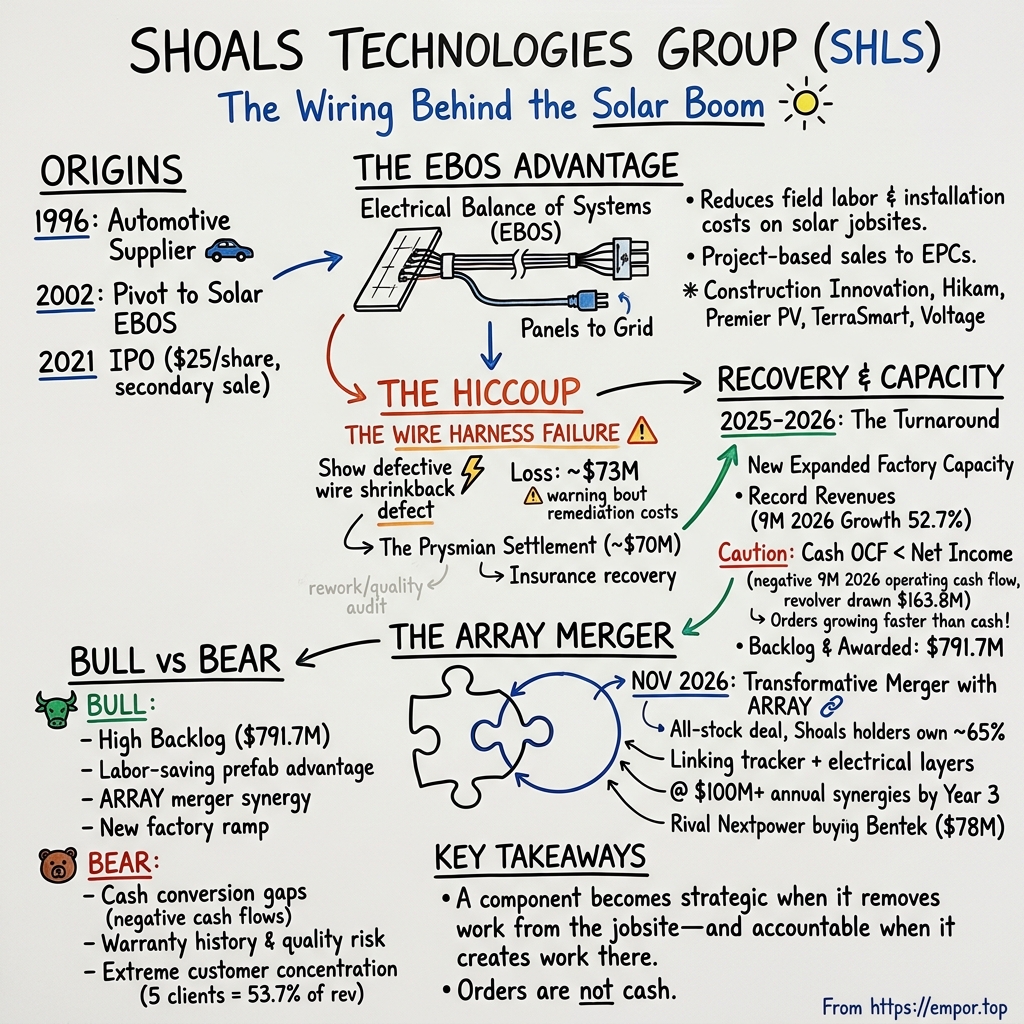
Shoals Technologies Group: The Wiring Behind the Solar Boom
I. The Quarter That Became a Merger Announcement
On the morning of November 4, 2026, Shoals Technologies Group had two very different stories to tell, and it told them back to back. The first was the kind of quarter every manufacturer hopes for. Revenue had reached $195.3 million, the highest in the company's history and about 44% above the same quarter a year earlier.1 Across the first nine months of the year, sales had grown by more than half, 52.7%, after a stretch in which the company had looked as if it might be shrinking into irrelevance.2 The factory that had given management so much trouble earlier in the year was, by its account, finally producing at the pace it had been built for.3
The second story turned the first into a footnote. In the same breath, Shoals announced that it had agreed to combine with ARRAY Technologies, the solar tracker maker whose steel rows hold panels up and turn them to follow the sun across the sky.4 The deal was all stock. Each Shoals share would be exchanged for 1.6931 ARRAY shares, and when the arithmetic was finished, the people who owned Shoals would own about 65% of the combined company, with ARRAY's holders owning the other 35%.53 ARRAY would be the legal acquirer and the surviving company, but Shoals' chief executive, Brandon Moss, would run it, and Shoals' chairman, Brad Forth, would chair the board.3
That pairing is unusual enough to deserve a pause. Companies usually announce mergers from weakness, after a bad year has made the case for a lifeline, or from strength, when a rich share price makes acquisitions cheap. Shoals announced one in the middle of a rebound, with growth back but with profit margins still well below where they had been and with cash flow still lagging the revenue line. A record quarter and a decision to give up independence arrived on the same day. Investors were entitled to ask which of the two was the real news.
To answer that, it helps to know what Shoals actually sells. Walk onto a utility-scale solar farm under construction, and most of what catches the eye belongs to someone else: the panels, made by module manufacturers; the steel trackers, made by companies like ARRAY; the inverters that turn direct current into alternating current for the grid. What lies between them is less photogenic. Every panel must be connected to the next, every row to a combiner, every combiner to an inverter, and all of it must survive decades of heat, cold, rain and ultraviolet light. That electrical web, the wiring, harnesses, connectors and fuses that move power across hundreds of acres, is the electrical balance of system, or EBOS, and it is Shoals' business.6
The merger therefore joins the two halves of a solar farm's "balance of system", the things that are neither the panel nor the inverter. ARRAY makes the structure the panels sit on; Shoals makes the wiring that carries their power away. Management's pitch was that customers could buy both together, and that most projects today did not: only about one in five solar projects used both companies' products, the executives said on the call.3
Four questions follow, and they carry the rest of this story. The first is what made Shoals important on a jobsite in the first place, because a company that sells wire into a commodity-like market needs a reason for customers to prefer it. The second is whether that reason survived the defect that struck some of Shoals' wire harnesses, when insulation began shrinking back in the field and turned a reliability story into a remediation project. The third is whether the 2026 rebound is producing cash as well as revenue, because through nine months it had not: the company reported a profit, yet its operations consumed cash.2 The fourth is whether ARRAY makes Shoals more valuable or merely larger.
A boundary belongs at the start. As of this writing, Shoals remains a standalone listed company. The merger requires both companies' shareholders to vote in favour, regulators to clear it, and a registration statement to become effective, and the companies expected it to close in the first quarter of 2027.53 The exchange ratio is a deal term; the combined company's 2027 revenue and profit ranges are management projections; the synergies are a target. None of them is a completed outcome. What is real now is a company that rebuilt its sales after a hard two years, at the cost of thinner margins and stretched working capital, and then chose to tie its future to a larger partner.
The verdict, before the evidence, is this: the growth rebound is real, but it arrived with margin and cash-conversion questions still open, and the merger is a strategic answer whose value depends on integration and synergies that have not yet been earned. To see why those questions matter so much, the story has to go back to a small Tennessee company that did not start out in solar at all.
 Subscribe on LinkedIn
II. From Automotive Components to Solar Jobsites
Portland, Tennessee, sits a short drive north of Nashville, in the kind of rolling countryside where manufacturers have long set up shop because land is cheap and labor is steady. It was here, in 1996, that Dean Solon started the business that became Shoals.78 Solon was an inventor by temperament, a man who liked to solve problems with his hands, and the first problems he chose to solve had nothing to do with sunlight. The early company made components for the automotive and other industrial markets, which taught it the disciplines that mattered later: repeatable assembly, tight tolerances, and the habit of building things that would be bolted into somebody else's larger product.8
In 2002, the company found a different application for those skills.7 Solar power in the United States was then a niche, closer to a science project than an industry. Utility-scale solar farms of the kind that now cover thousands of acres barely existed, and the companies building the first large arrays were still improvising how to wire them. One of the early customers was First Solar, the American thin-film module maker, which needed components for its panels and installations.78 From there, Shoals moved closer to the people who actually built solar plants, the engineering, procurement and construction firms, or EPCs, which take a developer's project and turn it into steel, glass and wire in a field.
Why would a young industry leave room for a specialist like Shoals? Because the early solar business was obsessed with the price of panels, and much less with the cost of everything around them. As panel prices fell year after year, the share of a project's cost spent on labor, installation and electrical work grew in relative importance. A field crew that spent days stripping wires, crimping connectors and digging trenches to bury cable was a cost that no panel price cut could fix. The opportunity was not to make better copper. It was to move work from the field to the factory, and that is the idea Shoals built on.
Solon matters to this story mainly because he embodied that idea. He was the founder-inventor whose instinct was to prefabricate, to arrive on site with something that plugged together rather than something that had to be built. He is not the protagonist of what follows. By the time Shoals became a public company, the founder had already sold control, and the company's future would be run by professional managers answerable to public shareholders.
The sale of control came first. In 2017, Oaktree Capital, the Los Angeles investment firm known for distressed and private-equity investing, acquired a controlling stake in the business.8 Under Oaktree, Shoals became a growth story in a fast-growing market. Revenue grew 39% in 2019 over 2018, and through the first nine months of 2020 it grew another 28% over the same period a year earlier.8 Those are the numbers of a company riding both a rising market and a rising share of it.
Then came the public listing. In January 2021, Shoals sold shares to the public on Nasdaq at $25 each.9 The structure of that offering is the first clue to what public investors were actually buying. The company itself sold 11.55 million new shares, raising money for its own purposes. The rest, 77 million shares, were sold by an Oaktree-controlled entity.98 Put simply, for every share that brought fresh capital into Shoals, almost seven more simply transferred an existing owner's stake to a new one. The IPO was principally an exit.
The legal wrapping was also more complicated than a plain listing. Shoals went public through an "Up-C" structure, a common private-equity arrangement in which the listed company owns a controlling interest in an operating partnership, here Shoals Parent LLC, while pre-IPO owners keep an economic stake directly in that partnership.8 Attached to it was a tax receivable agreement, a contract under which the listed company would pay existing owners most of the tax savings it captured from the structure. Such agreements are invisible on a factory floor but very visible in accounts. When Shoals terminated its agreement in 2022, it booked a gain of $110.9 million, which helped lift net income attributable to the company to $127.6 million that year.10 That number later looks like a peak earnings year. It is not. Most of it was a one-time accounting consequence of unwinding the ownership structure, and the structure itself was simplified in 2023.6
So the origin story, stripped to essentials, is a change in application. A Tennessee manufacturer carried its assembly know-how into an industry where installation simplicity was worth as much as the component itself, grew fast enough to attract private equity, and was then handed to the public market by an owner that wanted out. The question that remained was whether the idea that made Shoals attractive, wiring that saved labor in the field, was a durable advantage or simply a good product in a good market.
III. The Wiring That Promised to Make Solar Simpler
Picture a solar farm halfway through construction. Hundreds of acres of graded dirt have been laid out in rows, and the steel posts of the trackers march toward the horizon. Panels are being clipped on by the thousand. Somewhere behind the installers, another crew is dealing with the wire. Each panel comes with short leads. Strings of panels must be joined, and the strings gathered into larger cables, and those cables routed to combiner boxes and then to inverters. In the old way of doing things, much of that work happened by hand, in the field, often in heat, with electricians cutting cable to length, attaching connectors, and digging trenches to bury the runs that linked the rows.
Shoals' pitch is that most of that work can be done before the truck arrives. Its "Big Lead Assembly" and related harness products are wiring systems designed for a specific project, cut and assembled in a factory, and shipped ready to plug together.6 Instead of crews building the electrical network from raw cable, they unroll a preassembled system and click it into place. Fewer connections are made on site, fewer combiner boxes are needed, and less trenching may be required. The analogy is a modern kitchen that arrives as flat-pack cabinetry cut to the floor plan, rather than a pile of lumber and a carpenter with a saw.
The company describes its competitive edge in those practical terms. Its filings list reliability, product performance, installation cost and customer support among the factors on which competitors are judged, and argue that prefabricated systems can reduce installation labor and cost.6 That is a credible proposition, and it explains why EPCs, who carry the risk of construction budgets and deadlines, became Shoals' main customers. The majority of revenue comes from EPCs.6
How the money comes in matters as much as what is sold. Shoals does not sell subscriptions or licences. It sells, project by project, a negotiated package of systems and components. Most contracts are accounted for as a single performance obligation tied to one project, and revenue is recognized over time as the units are manufactured rather than when they are delivered or installed.62 Customers typically pay deposits of 10% to 20% of the contract value, which helps fund production, and the related obligations are usually fulfilled within a year.6 Some agreements also include tiered volume discounts or rebates, which reward the largest buyers for buying more.6
That structure gives Shoals some visibility, but it is not recurring revenue in the software sense. A deposit is a commitment to a project, not a commitment to the next one. When a developer delays construction because of financing, permitting, tariffs or interconnection queues, Shoals' revenue moves with it.6 The business is a supplier to a construction cycle, and its revenue shares that cycle's lumpiness.
Shoals reports a single operating segment, and the heart of it remains utility-scale solar.6 Around that core, the company has built a wider catalog. It sells components to original equipment manufacturers, including, in 2024, the leading U.S. module maker; it sells into battery energy storage systems; and it has courted commercial, community and industrial projects and EV charging installations.11 More recently, it has promoted AirLink, a product aimed at data-center power distribution, which was still in testing in August 2026, with the company then targeting a live test installation later that year.12 These are real efforts, and some have revenue. Battery storage contributed about $20 million in the second quarter of 2026, although Moss warned that storage orders "will be episodic".12 But the commercial and industrial business was quoting about $40 million of opportunities while recording about $10 million of revenue in 2024, and data centers have yet to produce disclosed sales.11 Until they show up as material revenue, they are options on the future, not pillars of the present.
The R&D line is telling. Shoals expenses research and development as incurred and has described the amount as "not material" in each of 2023, 2024 and 2025, without disclosing a dollar figure.6 That does not mean the company does no engineering; product design for a specific project is part of the service. It does mean Shoals is not a technology company in the sense of outspending competitors on proprietary research. Its edge, if it has one, lives in process and execution.
Where the advantage runs out
Here the strongest version of the Shoals case meets its limits. To prove a durable moat, a supplier would want to show customers who stay for years, prices that hold or rise, a share of the market that grows against competitors, or switching costs that make multi-sourcing painful. Shoals publishes none of those measures. It does not disclose customer retention, price realization, market-share trends or any recurring-revenue metric.6 What it does disclose cuts the other way. In early 2025, management said it had used pricing "to engage with customers" for long-term agreements and new segments, adding that the price impact "is expected to lessen over time".11 A company with unassailable pricing power does not usually need to discount to win long-term agreements.
The competitive field is also crowded. Shoals' own filings name Construction Innovation, Hikam America, Premier PV, TerraSmart and Voltage as competitors, along with Nextpower, the tracker giant formerly known as Nextracker, through its Bentek electrical business.6 ARRAY, now the merger partner, competes in adjacent structural products rather than EBOS itself. None of these rivals publishes EBOS revenue in a way that allows a clean market-share comparison, and Shoals does not publish one either. The honest description is that the public record is stronger on the list of competitors than on their relative scale.
Shoals has treated its designs as defensible intellectual property and has gone to court to prove it. Its campaign against Voltage has been long and uneven. In January 2025, the U.S. International Trade Commission declined to uphold an administrative judge's initial determination in Shoals' favour, and the company appealed while filing a new case on other patents.11 By mid-2026, management said Shoals had prevailed in its 2025 ITC case against Voltage.12 Then, on August 26, 2026, a jury awarded Shoals $96.4 million in damages against Voltage, and the court issued a preliminary injunction.2 Voltage may still seek post-trial remedies, so Shoals treats the award as a contingent gain and has not booked it.2 The litigation shows that Shoals believes its designs are worth protecting. It also shows that rivals were close enough to copy them that the fight was necessary, and that the legal outcome took years and reversals to secure.
The verdict on the product is therefore narrower than the marketing. Shoals' practical edge is a preassembled, engineered EBOS package that is intended to reduce field labor and simplify installation, and the company's growth suggests that customers value it. The filings identify the right competitive factors but do not establish a durable price premium or a switching-cost moat. And one of those factors, reliability, is precisely the one that would soon be put on trial. Before that happened, though, Shoals had to live through the more ordinary test of being a public company.
IV. The IPO Turned a Private Growth Story Into a Public Test
The bell rang for Shoals in late January 2021, and the timing could hardly have been better for the sellers. Clean-energy stocks were in the middle of a speculative surge, interest rates were near zero, and investors were hungry for anything that touched decarbonization. At $25 a share, the IPO valued the company as a high-growth industrial with a clean-energy halo.9
The way to read that offering is from the seller's side of the table. Oaktree, which had bought control only a few years earlier, sold most of the shares,9 and Shoals itself sold the rest.9 At the offering price, that meant roughly $290 million of gross proceeds to Shoals before fees and close to $1.9 billion to the selling holder. Public investors, in other words, were not funding a factory expansion. They were buying the right to share in a business whose owner had decided the moment had come to cash out.
That is not a criticism in itself. Private-equity owners sell; that is their job. But it shaped the investment from the start. The new shareholders were underwriting a fast-growing project supplier with exposure to construction timing, customer concentration and product quality, and the sellers who knew the business best were reducing their exposure. In time, the ownership register changed completely. By March 2026, the largest holders above 5% were index and active fund managers: BlackRock at 13.5%, T. Rowe Price at 10.2% and Vanguard at 8.1%. Oaktree no longer appeared among them, and no controlling holder was identified.13 Shoals had become a widely held public company with no dominant owner to discipline management, which raises the importance of the board and of shareholder votes later in the story.
For a while, the public test went well. Revenue rose from $326.9 million in 2022 to $488.9 million in 2023, an increase of roughly half in a single year.10 Utility-scale solar was booming, helped by the Inflation Reduction Act's tax credits, and Shoals' prefabricated systems fit the push for faster, cheaper installation. The income statement looked even better than the revenue line, at least on the surface: 2022 net income attributable to Shoals was $127.6 million, though most of it came from the one-off tax receivable agreement termination gain.1010 The next year's $40.0 million is a far better guide to the company's ordinary earning power at that time.10
The leadership changed during this period, too. Jason Whitaker had led Shoals through the IPO. In July 2023, Brandon Moss became chief executive, marking the start of a different management regime.1013 Dominic Bardos had joined as chief financial officer in October 2022.13 It was this team that would inherit the problem that turned Shoals' public story from growth to defense.
Investors who bought at the IPO had been promised, implicitly, that Shoals' economics were scalable: that more volume through a factory making engineered wiring would produce more profit per dollar of sales. The next three years tested that promise twice. The first test was a defect in the product itself. The second was a revenue line that, after years of steady climbing, suddenly fell. When revenue growth stopped being smooth, product remediation and margin pressure tested whether the company's economics were as scalable as its sales.
V. The Harness Failure That Put Reliability on Trial
The problem began quietly, the way field defects usually do. Customers reported that on some Shoals wire harnesses already installed at solar projects, the insulation around the wire was pulling back from the connectors, shrinking and exposing what should have been covered.6 On a solar farm, exposed conductors are not a cosmetic issue. They are a safety and reliability concern on equipment carrying high-voltage direct current across a field that may be exposed to rain, heat and wildlife. Every affected harness had to be found, inspected and repaired or replaced, and much of that work had to be done in the field, at sites that had been built precisely so that nobody would have to touch the wiring again.
That is the cruel irony of the shrinkback episode. Shoals' entire proposition was that factory-built wiring removed work from the jobsite. A defect in factory-built wiring put work back on the jobsite, and it put it there after the project was supposed to be finished.
Shoals traced the defect to wire supplied by Prysmian, the Italian cable maker that is one of the world's largest, and sued.6 That attribution matters to the legal fight over who pays. It matters less to customers. The EPCs and developers who bought harnesses bought them from Shoals, and it was Shoals that had to manage the remediation, answer for the warranty, and bear the cost while the litigation moved through the courts.
The first estimate of the damage was wide enough to be alarming. In 2023, Shoals estimated that the loss could range from $59.7 million to $184.9 million.6 That spread, a factor of three between the low and high cases, told investors that the company did not yet know how many harnesses were affected or how costly each repair would be. Over time, the estimate narrowed and settled on a best estimate of $73.0 million.6 By the end of 2024, management said the remaining warranty liability for the matter stood at $39.9 million, and the company had spent $13.1 million on remediation in the fourth quarter of that year alone.11
The cash consequences then arrived in full. In 2025, Shoals paid $41.0 million for shrinkback remediation.6 By September 30, 2026, $72.2 million of the $73.0 million estimate had been incurred, leaving just $0.8 million of the liability on the books.2 On the narrow question of whether the estimate held, the answer is yes: the best estimate stayed at $73 million while nearly all of it was spent. That is a better outcome than the high end of the original range suggested. Still, Shoals warns that additional failures could materially increase the estimate, so the matter is mostly, not entirely, behind it.2
The settlement, and what it does not fix
The legal fight ended in 2026. Shoals and Prysmian settled for $70.0 million, of which $64.8 million was covered by insurance. An initial payment of $65.5 million arrived in June 2026, and the court entered final judgment on September 30.2 That recovery covers most of the $73 million estimated loss. It is worth keeping the two ideas apart, though. The warranty liability is Shoals' obligation to its customers; the settlement is Shoals' recovery from its supplier. They land in the accounts at different times and in different lines, and a recovery does not erase the operational burden of years of field remediation, the management attention it consumed, or the doubts it raised among customers about a product sold on reliability.
There is also a newer problem that the settlement does not touch. In the first nine months of 2026, Shoals recorded $8.9 million of general warranty expense for product-quality remediation and rework, compared with just $0.3 million in the same period of 2025, and the general warranty liability rose to $4.9 million from $0.3 million at the end of 2025.2 That is not shrinkback. It is a separate set of quality matters, smaller in scale but growing at a time when the company was ramping a new factory. On the second-quarter call, Bardos attributed part of the gross-margin decline to "costs incurred to address product quality matters, including rework and corrective actions".12 The real test, then, is not whether the original estimate stays fixed. It is whether new product-quality costs fall.
It is worth listening to how management talked about the recovery at the bottom of the cycle. On the call in February 2025, Moss and Bardos told investors that they continued to believe an adjusted gross margin "at or above 40% is appropriate in the long term".11 Asked by Morgan Stanley's Andrew Percoco where pricing pressure was concentrated, and whether it was "purely a Voltage issue," Moss pointed to long-term agreements, new customer pricing and a mix shift toward lower-margin components, and repeated the expectation of "the 40% range in the long term".11 Roth Capital's Philip Shen asked for the quarterly shape of margins; Bardos called the first quarter the low point and warned that the factory move could cause inefficiencies along the way.11 On the 2025 outlook, Bardos was careful: margins would improve through the year, but "I'm not sure that I would guide to a 40% fully this year".11
Set those remarks beside what followed. By the second quarter of 2026, gross margin was about 30%, and by the third quarter it had climbed only to 31.9%.123 The decline was attributed to the move into the new facility, product mix and rework.12 The explanations were consistent and specific, which counts in management's favour: they named the factory transition as a risk before it happened, and named it again when it hurt. But the destination they described in early 2025, margins at or above 40%, was further away eighteen months later than it had been when they described it. A promise about the long term cannot be falsified in the short term, but it can drift, and this one drifted.
The episode bears directly on the moat claim. An advantage built on reliability is tested most severely by a product failure that creates field work, warranty expense and litigation. Shoals survived the test financially, largely thanks to the settlement. Whether it survived commercially is harder to judge, because the company does not disclose customer retention or win rates. The 2026 revenue rebound suggests that customers did not abandon it en masse. The rising rework costs suggest the quality question is not yet closed.
Shareholders, for their part, registered unease in the one place they could. Support for Shoals' say-on-pay proposal, the advisory vote on executive compensation, fell to about 61% in 2025, after more than 80% in each of 2023 and 2024.13 At the April 2026 annual meeting, the next say-on-pay vote drew 87.9 million votes for and 54.5 million against, and two directors, Jeannette Mills and Lori Sundberg, each had roughly 40 million or more votes withheld.14 A drop of that size is a signal of dissent, though not proof of any particular cause; it may reflect the share-price decline, the remediation saga, the design of the pay plan, or all three. What it shows is that a meaningful minority of owners were unhappy with how pay and performance lined up during the hardest years in the company's public life. Those years gave way to a sudden return of growth.
VI. A New Factory and a Sudden Return to Growth
Moving a factory is one of the most dangerous things a manufacturer can do, and Shoals chose to move three at once. Rather than continue to run several smaller sites, management decided to consolidate its production into a single new facility in Tennessee, a 14-acre site that would give it room to grow and the chance to redesign its lines.1112 The lease for the expanded manufacturing facility began in September 2025.6 "Anytime you move 3 facilities into 1, it's a complex move," Bardos told analysts in August 2026, which was both an understatement and an explanation.12
The backdrop to that bet was a business that had just shrunk. Revenue fell 18% in 2024, to $399.2 million, from $488.9 million the year before.10 On the call that February, management described an unusual year. Its largest customer, identified only as Customer A, had fallen to 26.4% of revenue from 36.3% in 2023, and project schedules had slipped, with some held up around the U.S. election cycle.11 More than 10% of 2024 revenue, management added, came from customers who had bought less than $1 million combined the year before, which they presented as evidence of new customer wins.11
The revenue curve that followed is not a straight line, and it should not be told as one. Revenue climbed from $326.9 million in 2022 to $488.9 million in 2023, fell to $399.2 million in 2024, and recovered to $475.3 million in 2025, still just short of the 2023 peak.106 Then, in the first nine months of 2026 alone, Shoals booked $499.2 million, more than in all of 2025.2 In August, management guided to full-year 2026 revenue of $600 million to $640 million.12 For a company that had been shrinking eighteen months earlier, that is a remarkable reversal.
The 2025 revenue outcome also tells something about management's forecasting. In February 2025, it had guided to revenue of $410 million to $450 million for the year.11 The actual figure, $475.3 million, beat the top of that range.6 On the revenue side, at least, this team underpromised and overdelivered.
What caused the 2026 jump? Management's account has several parts: strong demand, higher project volume, market-share initiatives and, in the third quarter, "meaningful productivity improvements made on our factory floor".23 Each of those is plausible, and the reported numbers support some more than others. The volume increase is beyond doubt. The share gains are harder to verify, because Shoals publishes no market-share data. And the factory productivity claim is best tested not by revenue but by margin, which is where the picture becomes less tidy.
The margin the growth did not bring
For every $100 of sales in the first nine months of 2025, Shoals kept about $37 after the direct costs of making its products. In the first nine months of 2026, it kept about $31.2 In plain terms, the company was selling half again as much, and earning noticeably less on each dollar. If a factory becomes more productive, its gross margin usually rises as fixed costs are spread over more units. Shoals' margin fell, even as volume surged.
Management explained the decline with three culprits: ramp-up inefficiency as the new facility came online, product mix, and the costs of rework and corrective actions for product-quality matters.12 The general warranty line confirms the third: it rose from $0.3 million to $8.9 million year over year.2 Mix and pricing are harder to see from the outside, because the company does not break them out, but the earlier admission that pricing was used to win long-term agreements suggests that some of the volume came at a lower price. The direction in the third quarter was better: gross margin of 31.9% was about 1.6 percentage points higher than in the second quarter, and adjusted EBITDA came in at roughly $40 million, about 20% of revenue.3 One quarter of improvement is a beginning, not a trend.
The order book offers some visibility on what comes next. At September 30, 2026, backlog and awarded orders totaled $791.7 million, down 1.2% from June but up 9.8% from a year earlier.1 The two halves of that figure are not equal. Backlog means signed orders or minimum purchase commitments with take-or-pay terms. Awarded orders are projects that Shoals has been chosen to supply but for which contracts have not yet been signed.1 Neither is guaranteed revenue, since projects can be delayed or cancelled, and a growing share of awarded rather than signed orders would mean visibility is softer than the headline suggests. The trend also shows bookings slowing to the pace of shipments: the order book grew sharply from early 2025 into mid-2026, then flattened as the third quarter's record shipments drew it down. Third-quarter bookings of about $186 million roughly matched revenue, a book-to-bill ratio of about one.3
So is this an operating turnaround, a market rebound, or both? The fairest reading is that it is a volume rebound that has not yet produced an operating turnaround. Demand came back, Shoals captured it, and the new factory ultimately helped it ship more. But the unit economics did not improve along with throughput, and a part of the decline is due to quality costs that a well-run factory should eventually eliminate. The key operating test from here is simple to state: as throughput rises, does gross margin rise and rework fall, or is Shoals buying growth with price concessions and quality costs?
There is another way to measure whether growth is healthy, and it is less forgiving than the margin line. It asks where the cash went.
VII. The Orders Are Growing Faster Than the Cash
There are two financial statements that every manufacturer's investors read, and in 2026 Shoals' told different stories. The income statement for the first nine months showed net income of $29.7 million.2 The cash-flow statement showed that the company's operations had consumed $5.8 million of cash over the same period.2 A profitable company that burns cash is not necessarily in trouble. It is, however, a company whose profits have not yet become money in the bank, and the gap needs explaining.
The explanation begins in 2025. That year, Shoals reported net income of $33.6 million, but operating cash flow of only $17.1 million.6 Three items did most of the damage. Receivables, including unbilled amounts, absorbed $51.9 million as customers owed more money at year-end than at the start. Warranty payments, mostly for shrinkback remediation, absorbed $41.0 million. And inventory absorbed $35.1 million as the company built stock.6 Payables, deferred revenue and accrued expenses provided some cash back, but not enough to close the gap.6 In effect, the profit was real, but it was tied up in the warehouse and in receivables from customers, and a large slice of it went to fixing harnesses installed years earlier.
That shortfall also tested a promise. In February 2025, management had guided to 2025 operating cash flow of $30 million to $45 million.11 The actual figure came in at $17.1 million, well below the bottom of that range.6 Revenue had beaten guidance; cash had missed it. When Mark Strouse of JPMorgan asked about cash flow on that early 2025 call, Bardos attributed the expected pattern to timing, with working capital tied up in the first half.11 Timing explained some of it. The year ended short anyway.
In 2026 the pattern intensified. Through nine months, inventory absorbed $61.5 million and receivables a further $21.5 million, while warranty payments fell to $6.9 million now that the shrinkback remediation was largely complete.2 The warranty burden had eased, in other words, but the working-capital burden had grown, as is common when a manufacturer is scaling up quickly. When Barclays' Christine Cho asked about cash and leverage in August, Bardos said inventory had been built in the first half "in advance of some of the step-up in cost," and that the company expected to "turn a significant amount of cash in the back half".12 The third quarter delivered part of that: $28.9 million of operating cash flow, which allowed Shoals to pay down $33 million of its revolving credit facility.3
Yet the arithmetic of the year remains demanding. In August, management guided to full-year 2026 operating cash flow of $65 million to $85 million.12 With the first nine months at negative $5.8 million, that range would require roughly $70 million to $90 million of cash generation in the fourth quarter alone, more than double the third quarter's record. That is not impossible for a business that collects on large shipments at year-end. But the company missed its operating cash flow range in 2025, and the fourth quarter of 2026 will show whether the inventory built in the first half turns into cash as quickly as management said it would.
Who owes the money
Customer concentration raises the stakes on collection. In 2025, the largest customer accounted for 19.1% of revenue and 25.2% of receivables, and the five largest together accounted for 53.7% of revenue.6 In the first nine months of 2026, three customers each exceeded 10% of revenue, at 20.7%, 12.4% and 10.2%, and one customer represented 24.7% of receivables at September 30.2 Shoals identifies these customers only by letter. Nor does it publish an ageing schedule showing how long receivables have been outstanding.62
There is a mildly encouraging trend inside that concentration. The largest customer's share of revenue fell further, to 19.1% in 2025.116 The company has, in other words, become less dependent on its single biggest buyer, which is a genuine improvement. But the top five still account for more than half of sales, so a pause by one large EPC, or a credit problem at one, would still be consequential.
The receivables themselves look clean on paper. At September 30, 2026, net trade receivables were $159.8 million, against an allowance for credit losses of just $334,000, lower than the $496,000 allowance at the end of 2025 despite a higher receivables balance.26 Of the total, $24.1 million was retainage, money withheld by customers until a project milestone or completion.2 The tiny allowance could reflect a history of good collections from creditworthy customers, which is plausible for large EPCs, or simply that nothing has gone wrong yet. Without an ageing schedule or write-off history, outsiders cannot tell the difference. With one customer accounting for about a quarter of receivables, the exposure is worth watching.
The financing behind all this is a bank revolver, not bonds. At September 30, 2026, Shoals had drawn $163.8 million on its revolving credit facility, up from $136.8 million at the end of 2025, with $84.8 million still available.2 An amendment had temporarily raised the facility's capacity from $200 million to $250 million for 18 months, with a maximum total leverage covenant of 4.00 times and a maturity in March 2029.2 Shoals carried no term loan, and the cash on its balance sheet was only $7.7 million.2 On the August call, Bardos described the leverage of about 1.6 times as "perfectly acceptable".12 It is comfortably within the covenant. The question is direction: a company that keeps drawing on its revolver to fund inventory is using its bank to finance growth, and that only works if the inventory eventually ships and the customers pay.
The cash shortfall, then, is mainly a matter of working capital and warranty payments, not an absence of reported earnings. It may reverse as orders ship and customers pay. But growth is worth less if inventory, collections or warranty demands keep consuming cash. The indicators that will say the most are the simplest ones: receivables, inventory, warranty payments, and how quickly the order book becomes cash. Those questions were open when Shoals' board decided that the answer to the company's next chapter lay partly outside it.
VIII. The $78 Million Bet on Integration
The move that changed the competitive map was not made by Shoals. In May 2025, Nextpower, then still called Nextracker and the largest maker of solar trackers, announced that it was buying Bentek, a maker of electrical balance-of-system products, for about $78 million including a contingent earnout.15 On its own, the price was modest; Nextpower is many times Shoals' size. But the logic was pointed. A tracker company that already sold the steel structure of a solar plant would now sell the wiring as well, and could offer customers a single package for the two largest pieces of balance-of-system equipment.
For Shoals, that was a competitive signal of the first order. Its largest tracker rival had become an EBOS competitor. On the August 2026 call, RBC's Chris Dendrinos asked Moss directly about the wire-management business after a peer's acquisition; Moss replied that Shoals continued to partner with multiple tracker companies.12 Eighteen months later, Shoals answered with something larger than a partnership.
The Bentek purchase is a useful reference, but not a valuation comparable. It was a smaller cash acquisition with contingent consideration; the Shoals and ARRAY deal is a stock-for-stock merger between two listed companies of meaningful size. What the comparison establishes is strategic, not financial: the industry's largest player had decided that trackers and wiring belong together, and Shoals and ARRAY were now betting on the same idea.
What the merger promises
The terms were set out in the November 4 agreement. Shoals shareholders would receive 1.6931 ARRAY shares for each share they owned, a fixed exchange ratio that would not adjust if either share price moved before closing.5 On a basic share count, former Shoals holders would own about 65% of the combined company.3 Reuters valued the deal at roughly $1.32 billion and calculated that the ratio implied a 7.2% discount to Shoals' last closing price before the announcement.16 Shoals shareholders were thus being asked to take a majority of a larger company at a price below where their own shares had traded, a structure more like a merger of equals with a twist than a conventional takeover premium.
The strategic case rested on coverage. On the call, the executives said only about 20% of solar projects used products from both companies, implying that roughly 80% of matched projects used only one.317 Moss described a cross-selling opportunity of about $2.5 billion, larger than the two companies' combined revenue.3 The other mechanism was cost: overlapping public-company expenses and overheads alone were said to be worth more than $20 million a year.3
The synergy target was ambitious and, importantly, back-loaded. Management targeted $35 million of annual run-rate synergies in the first year, rising to more than $100 million by year three.3 In the first year, more than half would come from costs, which management controls. By year three, about one-third would be cost savings and two-thirds commercial, that is, additional sales from cross-selling.3 That distinction matters. Cost synergies depend on executing an integration. Revenue synergies depend on persuading customers to buy something they do not buy today, and they are historically the less reliable kind.
The combined company also came with an outlook. For 2027, management projected revenue of $2.2 billion to $2.4 billion and adjusted EBITDA, including synergies, of $410 million to $480 million.317 It also projected net debt of 2.6 times EBITDA on a pro forma 2026 basis, falling to less than two times in 2027.3 Those are management projections, and the EBITDA range assumes synergies that have yet to be earned.
ARRAY's balance sheet is part of what Shoals holders would be buying. ARRAY carries preferred stock, and the merger terms included its partial retirement: $161.3 million to be redeemed within 90 days of closing at 93 cents on the dollar, and a further $156.3 million committed over three years at 96 cents, with at least $52 million at each of the first three anniversaries.3 Together, that would reduce the preferred by more than 60%.3 Paying it off requires cash, at a time when Shoals itself had less than $8 million on its balance sheet and analysts on the call noted pro forma cash of about $30 million.23 Moss said no new debt was needed to complete the merger and that the company would work with its lending syndicate to maintain ample liquidity after closing.3 The combined company's ability to fund the redemptions out of operations, rather than by borrowing, is one of the first things to watch after close.
ARRAY was not standing still either. It had just closed the acquisition of AWM at the end of August 2026, and its third-quarter adjusted gross margin of 22.8% included a 3.3-point charge for a reserve related to 45X manufacturing tax credits.3 Its order book was $2.6 billion, up 42% from a year earlier.3 The partner, in other words, was a lower-margin business than Shoals with its own recent integration under way.
What the analysts asked
The call's question-and-answer session revealed as much as the presentation. Goldman Sachs' Brian Lee asked first how much of ARRAY's guided growth was organic, given its acquisitions; Moss said the range was organic, with ARRAY's chief executive Kevin Hostetler noting about eight months of AWM overlap.3 Lee then asked whether the deal was a response to "the inroads from Pure and Nextpower." Moss did not name competitors, answering that "there is a big belief these companies are better together than separate" and that the deal created "a comprehensive solution of category leaders".3 Later analysts pressed on channel differences, with Shoals selling mostly to EPCs while ARRAY increasingly sells directly to developers and utilities, on liquidity, and on priorities for capital; management said synergy capture came first and further acquisitions later.3
The non-answer on competition is worth a moment. It would be hard to believe that Nextpower's integration did not influence the timing. That is not a criticism: responding to a competitor's strategy is a legitimate reason to merge. But it changes the frame. The deal is as much defensive as offensive, a way to ensure that Shoals is not shut out of tracker-led bundles.
The deal also comes with a cost of breaking it. In specified circumstances, Shoals would owe ARRAY a $40.3 million termination fee.5 And until closing, management attention will be split between running a business with open margin and cash questions and planning an integration with a partner that is itself digesting an acquisition.
Shoals itself has no acquisition at the centre of its recent record, so the merger is a new kind of test for this management team. Its main capital moves have been different. In June 2024, it paid $25 million for an accelerated share repurchase, initially receiving 2.2 million shares, and held 3.9 million treasury shares at the end of 2025.6 Buying back stock in a year when revenue fell 18% and remediation was absorbing cash was a choice that, in hindsight, competed with the working capital the business would soon need. The larger allocation was to capacity: capital spending rose to $33.0 million in 2025 from $8.4 million in 2024, within the range guided at the start of the year, and continued at $17.5 million in the first nine months of 2026.6112 The factory investment will earn its return only if productivity and margin recovery follow.
The strategic logic of the merger is plausible. Integrated sourcing, coordinated design and cross-selling could save customers installation time and cost, and the industry's largest player had already made the same bet. But the deal is not proven by its synergy targets. The fixed exchange ratio, the discount to the pre-deal price, the preferred-stock redemptions, combined leverage and the companies' execution record will determine whether Shoals shareholders capture that value. Whether they will depends, in the end, on the strength of the business they are contributing.
IX. Analysis & Bear vs. Bull Case
Put two documents side by side on a desk. One is the third-quarter order book: $791.7 million of backlog and awarded orders, up almost 10% from a year earlier.1 The other is the warranty note: shrinkback costs almost fully incurred, but a fresh line of rework expense that grew more than twentyfold in a year.2 Customers are clearly still placing orders with Shoals. The question is what, exactly, they are rewarding, and whether it is something competitors cannot easily replicate.
Start with the buyers, because they hold the most power in this industry. Shoals sells mostly to EPCs and developers, and the five largest customers generated 53.7% of revenue in 2025.6 Contracts are negotiated project by project, some carry volume discounts and rebates, and management has acknowledged using pricing to secure long-term agreements.611 Those are the marks of strong buyers. A large EPC building dozens of projects a year can play suppliers against each other, and its procurement team knows it.
Rivalry among suppliers is real and fragmented. The named competitors, from Voltage and Premier PV to Nextpower's Bentek, show a field that includes both specialists and a tracker giant with the scale to bundle.6 Barriers to entry are moderate: EBOS is engineering and assembly work, not a technology that requires billions in research, and Shoals' own research spending is too small to disclose.6 Patents provide some protection, as the Voltage litigation shows, but the very need to litigate shows that competitors could produce similar products.2 Suppliers of copper and cable have influence over cost, and the Prysmian episode shows that a supplier's defect can become the buyer's warranty problem. The threat of substitutes is less about a new technology replacing wire and more about competitors' integrated packages that make standalone EBOS less necessary. Switching costs, finally, are not quantified. A customer that designs a project around Shoals' system may find it inconvenient to switch mid-project, but nothing in the record shows that customers cannot multi-source across projects.
Where the power might lie
Hamilton Helmer's seven powers framework asks which, if any, durable advantages a company possesses. Shoals' strongest candidate is process power: the accumulated know-how of designing and prefabricating project-specific wiring in a factory, which is hard to copy in all its detail. The company's growth through the 2024 trough, and its share gains among new customers in 2024, are consistent with that.11 But process power is supposed to show up as better margins or better quality than rivals, and Shoals' margins have fallen while its quality costs have risen. The shrinkback defect, even though it originated with a supplier's wire, weakens reliability as an unquestioned differentiator.
The other powers are thin. Scale economies are possible in a single large factory, but they are not yet visible in the margin. Network effects do not apply. Switching costs are unproven. Brand matters in a market that buys on reliability, but a brand built on reliability has taken a hit, and there is no evidence of a price premium. Shoals has no cornered resource; its patents are contested, and the Voltage award is not yet final. Counter-positioning, a business model that incumbents cannot copy without hurting themselves, has arguably moved against Shoals, since Nextpower can now bundle EBOS with trackers in a way a standalone EBOS supplier cannot. The ARRAY merger is, in part, an attempt to neutralize that.
The verdict on the moat is therefore narrower than a bull would like. The history does not reject the claim that Shoals has a real operating edge in preassembled EBOS, but it narrows it: the edge is a process advantage that wins business, not a structural barrier that protects prices or margins. What would confirm a broader moat is gross margin recovering toward the long-term level management described while rework costs fall. What would falsify it is volume continuing to grow while margins stay stuck near 30%.
The optimistic reading starts with demand. Utility-scale solar and battery storage remain large and growing markets in the United States, and on the November call Moss called it "a high 30s, low 40s gig market for the foreseeable future".3 Shoals has a substantial order book, a new factory that by the third quarter was finally producing at volume, and a customer base that has become less dependent on its single largest buyer.136 Third-quarter cash flow and margin both improved sequentially.3 The shrinkback matter is largely paid for and largely recovered through the settlement.2 The Voltage award, if it survives post-trial motions, could add a significant cash recovery that has not been booked.2 And the ARRAY merger, if it works, gives Shoals access to tracker customers that buy directly from developers and utilities, and a bundle to compete with Nextpower's. On this view, 2026 was the hard year of transition, and 2027 is when a larger factory and a combined catalog begin to earn their keep.
The pessimistic reading starts with the record. Revenue has reversed before, sharply, in 2024, and could do so again when project schedules slip.10 Gross margin in 2026 is well below the year before and further below the level management described as appropriate in early 2025.211 Customer concentration remains high, with the top five buying more than half of output.6 Warranty costs have risen again, from a different source than shrinkback.2 Operating cash flow was negative through nine months, the revolver balance rose, and the company missed its 2025 operating cash flow guidance by a wide margin.2611 Competition from bundled offerings is intensifying, and the merger, while defensive, brings integration risk, ARRAY's preferred stock, combined leverage, and a partner with lower margins. On this view, Shoals' growth is being purchased with price, quality costs and working capital, and the merger is a way to change the story rather than fix it.
Brandon Moss, who became chief executive in July 2023 and is expected to lead the combined company, is central to both cases.103 His reported total compensation was $5.96 million in 2025, down from $8.11 million in 2024, while "compensation actually paid", a measure that reflects changes in the value of equity awards, rose from $2.34 million to $11.23 million as the share price recovered.13 The 2025 incentive plan for senior executives rewarded adjusted EBITDA, adjusted free cash flow, revenue growth and cumulative adjusted diluted earnings per share.13 Moss's disclosed beneficial ownership was below 1% of the company.13
Measured against behaviour over time, the record is mixed. On revenue, management beat its 2025 guidance. On cash, it missed by a wide margin. On margins, the 40% long-term ambition voiced in early 2025 drifted further away, although the explanations offered for the shortfall have been consistent and specific rather than vague. The 2025 say-on-pay vote of about 61% is a reminder that a meaningful share of owners was unpersuaded that pay matched results.13 Inclusion of adjusted free cash flow in the incentive plan is the right instinct; the outcome in that metric is exactly where the company has struggled. A skeptical investor would want to see how the pay plan for the combined company weighs cash conversion and synergy delivery, and how it accounts for the integration.
There is one housekeeping oddity worth noting in passing. The 2026 proxy reports 1,290 global employees while also listing 1,480 U.S. employees and four outside the United States, so the company's own headcount figure is internally inconsistent and cannot support a reliable trend.13 It is a minor point, but in a business whose margin question turns on factory productivity, headcount is a figure that should add up.
The three numbers that will decide it
Three measures will say more than any others about where Shoals is going. The first is gross margin together with warranty and rework expense: nine-month gross margin stood at 30.6%, down from 36.6%, with the third quarter at 31.9% and moving up, while general warranty expense had risen to $8.9 million.23 The second is operating cash flow relative to net income, which was negative through nine months against nearly $30 million of profit, though the third quarter was strongly positive.23 The third is the conversion of backlog into revenue alongside customer concentration: an order book of $791.7 million, up year over year but down slightly from June, with the top five customers still accounting for more than half of revenue.16
Valuation is best treated as data rather than verdict. The merger itself put a price on Shoals: about 1.69 ARRAY shares per share, a deal Reuters valued at roughly $1.32 billion, at a small discount to the pre-announcement price.165 That price implies that the market and both boards see more value in the combination than in Shoals standing alone, or at least that Shoals' shareholders are willing to accept a discount for a majority stake in a broader company. Whether that is a good trade depends on the combined company's cash flows and leverage after closing, compared with what management projected. That is not something operating evidence alone can settle today, and it is where the story's lessons begin.
X. Business & Investing Lessons
Go back to the jobsite one more time. After the insulation started to shrink back, a different crew arrived to find and replace affected harnesses at a site already generating power. The product that removed labor from the field had put it back, and the bill went to the company whose name was on the box.
That image holds the first lesson. A component becomes strategic when it removes work from the jobsite, and accountable when it creates work there. Shoals' value proposition was never the copper. It was the promise that the electrical network would be simpler, faster and more reliable to build. That promise made Shoals a growth company, and it also made Shoals responsible for the field when the wire failed. The shrinkback episode put a price on a promise that extends beyond the factory gate.6 For founders, the lesson is that the more of the customer's work a product absorbs, the more of the customer's risk it absorbs too. For investors, it is that the reliability claim at the heart of a prefabrication business is only as strong as the weakest supplier in its bill of materials.
The second lesson lives in the gap between the two financial statements. Shoals' growth story in 2026 was told in records: record quarterly revenue, a near-record order book and record shipments from a new factory. Yet operating cash flow was negative through nine months, while its income statement showed a profit.2 In 2025, it beat its revenue guidance and missed its cash guidance.611 A project supplier's growth is not finished when the order is signed or even when the revenue is recognized. It is finished when the inventory ships, the customer pays, and the warranty claims stay quiet. Any investor who measures a manufacturer by its revenue growth alone is measuring the easy half.
The third lesson concerns the factory itself. Shoals made that bet by consolidating three plants into one in 2025.6 It was the right kind of investment for a company whose edge is process. But capacity is a bet, not a result, and the first year in the new building brought rework, inefficiency and lower margins.12 A new factory buys the option to be more productive. It takes several quarters of rising margins, not one record quarter of revenue, to show that the option has been exercised.
The fourth lesson is about the merger, and it is the one most likely to be tested in public over the next three years. A merger can combine product catalogs in a day; it takes years of customer wins and cash returns to prove the combination. On November 4, 2026, Shoals and ARRAY could truthfully say they had agreed to create a company that would sell both the structure and the wiring of a solar farm.4 They could not yet say customers would buy both together in enough volume to justify the synergy target, much of which depends on new sales.3 Nextpower's purchase of Bentek showed that the largest player in the industry believed in the bundle.15 Belief is a starting point. What turns it into value is the moment an EPC that buys Shoals' wiring and someone else's trackers decides, on the next bid, to buy both from one supplier.
XI. Epilogue
Tonight, Shoals is a company in between. Its third quarter was the best in its history by revenue, its margin is improving from a low point, its biggest product-quality dispute is largely settled, and its factory is producing at volume. It is also a company with a revolver balance higher than at the start of the year, a margin still well below where it was eighteen months ago, a fresh line of rework costs, and a pending merger that will, if completed, turn its shareholders into the majority owners of a different company with a different name.23
The next moments are close and observable. The first comes with the fourth-quarter results, early in 2027. They will show whether the company delivered anything like the full-year operating cash flow it guided to in August, which would require a fourth quarter far stronger than the third.122 They will show whether gross margin continued to climb from 31.9%, and whether the general warranty line, which had risen so sharply through nine months, began to shrink.32 If cash flow arrives in size, inventory falls and rework recedes, the story of 2026 becomes one of a painful but successful transition. If inventory keeps building, receivables keep rising and margins stay near 30%, the growth will look more like volume bought with price and quality costs.
The second set of moments belongs to the merger. The companies still have to file the S-4 registration statement and joint proxy, put the deal to both sets of shareholders, obtain regulatory clearance and close, which they expected to happen in the first quarter of 2027.53 Shareholder votes at both companies will be the first public verdict on the exchange ratio. Shoals' owners will be voting to accept a discount to their pre-announcement price in exchange for the combination, and the same shareholders who registered dissent on pay in 2025 will now have a say on the company's whole future.1316 After close, the redemption of ARRAY's preferred stock within 90 days will be the first practical test of the combined company's liquidity.3
The third set of moments will stretch over years. Run-rate synergies of $35 million in the first year are mostly costs and are within management's control.3 The more than $100 million targeted by year three depends mostly on cross-selling, and that is where the deal will be won or lost.3 The combined company's 2027 revenue and EBITDA ranges, and its target of getting net leverage below two times, give investors yardsticks to measure against.3 The Voltage litigation also remains open: a jury award of $96.4 million is not cash until post-trial challenges are exhausted.2
Each outcome maps onto the story's central questions. A rising order book with falling warranty costs and stronger cash conversion would support the recovery case and suggest that Shoals' process edge is reasserting itself. Persistent margin pressure or growing working-capital needs would weaken it, and would suggest that the merger is being asked to supply an advantage the standalone business could not. The tension that remains is simple to state and hard to resolve: Shoals has proved that customers still want its wiring, but not yet that it can make that wiring dependable, profitable and cash-generative at the same time.
XII. Outro
Return to the solar farm from the opening. The trackers turn slowly with the sun. The panels glint. Under and between them, miles of cable run row after row toward the inverters and out to the grid, unnoticed by almost everyone who drives past. That is how wiring is supposed to be: invisible when it works.
Shoals built a public company out of that idea. Its future now turns on whether it can make that wiring as dependable as it is convenient, as cash-generative as it is popular, and more valuable joined to ARRAY's steel than standing on its own. The cable run is easy to overlook when it works. Shoals has learned, at considerable cost, that it is impossible to ignore when it fails.
References
-
Shoals Technologies Group Q3 2026 earnings release — SEC, 2026-11-04 ↩↩↩↩↩↩
-
Shoals Technologies Group Q3 2026 Form 10-Q — SEC, 2026-11-04 ↩↩↩↩↩↩↩↩↩↩↩↩↩↩↩↩↩↩↩↩↩↩↩↩↩↩↩↩↩↩↩↩↩↩↩↩↩↩↩
-
Shoals Technologies Q3 2026 results and merger call transcript — Stock Analysis, 2026-11-04 ↩↩↩↩↩↩↩↩↩↩↩↩↩↩↩↩↩↩↩↩↩↩↩↩↩↩↩↩↩↩↩↩↩↩↩↩↩↩↩↩↩
-
ARRAY Technologies and Shoals Technologies Group Announce Transformative Merger — Shoals, 2026-11-04 ↩↩
-
Shoals Technologies Group 2025 Form 10-K — SEC, 2026-02-24 ↩↩↩↩↩↩↩↩↩↩↩↩↩↩↩↩↩↩↩↩↩↩↩↩↩↩↩↩↩↩↩↩↩↩↩↩↩↩↩↩↩↩
-
Shoals Technologies Group Form S-1/A — SEC, 2021-01-25 ↩↩↩↩↩↩↩
-
Shoals Technologies Group Announces Closing of Initial Public Offering — Shoals, 2021-01-29 ↩↩↩↩↩
-
Shoals Technologies Group 2024 Form 10-K — SEC, 2025-02-25 ↩↩↩↩↩↩↩↩↩↩
-
Shoals Technologies Q4 2024 earnings call transcript — Stock Analysis, 2025-02-25 ↩↩↩↩↩↩↩↩↩↩↩↩↩↩↩↩↩↩↩↩↩↩
-
Shoals Technologies Q2 2026 earnings call transcript — The Motley Fool, 2026-08-11 ↩↩↩↩↩↩↩↩↩↩↩↩↩↩↩↩
-
Shoals Technologies Group 2026 Proxy Statement — SEC, 2026-03-20 ↩↩↩↩↩↩↩↩↩↩
-
Shoals Technologies Group 2026 Annual Meeting results, Form 8-K — SEC, 2026-05-01 ↩
-
Nextracker Reports Q4 and Fiscal Year 2025 Financial Results, including Bentek acquisition — Nextpower, 2025-05-14 ↩↩
-
ARRAY to buy Shoals in $1.32 billion all-stock deal — Reuters via MarketScreener, 2026-11-04 ↩↩↩
 LinkedIn
 WhatsApp
 Reddit
 Hacker News
 Email
 Kindle
 RSS Feed
 Spotify
 Apple Podcasts
 Amazon Music
 Audible
 YouTube