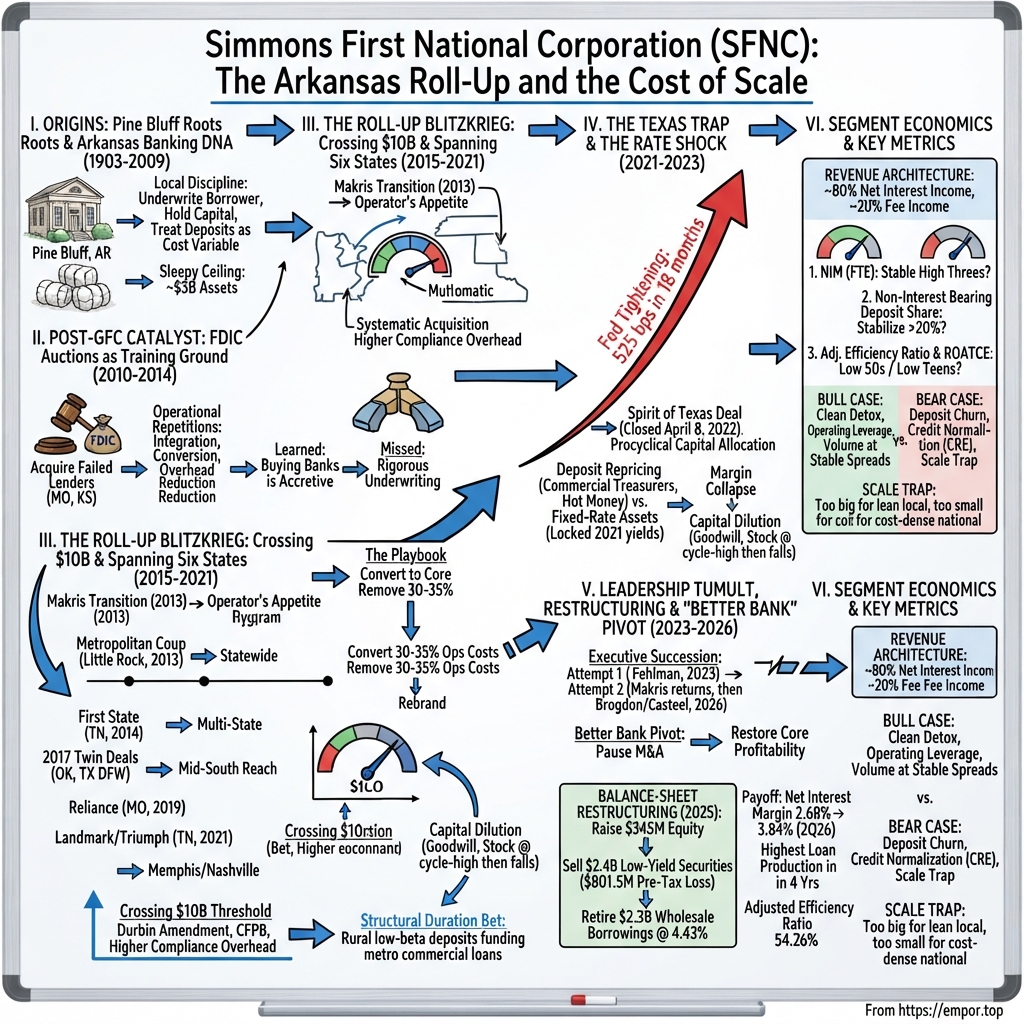
Simmons First National Corporation (NASDAQ: SFNC): The Arkansas Roll-Up and the Cost of Scale
I. Introduction & Episode Roadmap
On a Thursday morning in October 2025, Simmons First National Corporation told shareholders that it had lost $562.8 million in a single quarter — roughly $4.00 per share for a company whose stock was trading in the high teens.1 For a bank whose entire market capitalization at the time hovered around $2.5 billion, that was the kind of figure that typically precedes a regulatory consent order, an emergency fire sale, or outright failure.
It preceded none of those. Nine months later, the company reported net income of $66.7 million, a net interest margin of 3.84 percent — up 78 basis points year over year — and its highest quarterly loan production in nearly four years.23 The loss had been deliberate. Management had sold roughly $2.4 billion of low-yielding securities at an $801.5 million pre-tax loss, funded partly by raising $345 million in new equity, in a balance-sheet restructuring aimed at restoring the bank's earning power at a discount.14
That single sequence — an engineered half-billion-dollar loss as an act of balance-sheet surgery — provides the clearest entry point into the Simmons story. But understanding why a 123-year-old Arkansas bank required such drastic intervention requires looking back through a decade of acquisitions, an interest-rate shock that arrived with punishing timing, and an executive succession that had to be attempted twice.
The hook. How did a quiet community lender founded in 1903 in Pine Bluff, Arkansas — an institution built to withstand Mississippi River floods, cotton price collapses, and the Great Depression — expand into a roughly $27 billion regional franchise spanning six states, only to collide with the fastest monetary tightening cycle in forty years and spend the following four years unwinding what it had spent a decade assembling?
The central paradox of regional banking. In a world of near-zero interest rates, a regional bank roll-up can look like a perpetual motion machine. An acquirer trades at a premium multiple of tangible book value, buys a smaller institution at a discount multiple, and strips out 30 to 40 percent of the target's operating expenses within twelve months. Earnings per share rise, the valuation multiple holds, and the playbook repeats. The arithmetic is seductive precisely because it does not depend on underlying operational improvements — only on keeping the spread open between the acquirer's equity currency and the target's purchase price.
What that arithmetic conceals is a structural duration bet. Every acquired balance sheet arrives with two hidden clocks: how long fixed-rate assets remain locked at yesterday's low yields, and how quickly depositors will demand tomorrow's higher rates. In a stable rate environment, few examine those clocks. When the Federal Reserve raised the cost of money by 525 basis points in eighteen months, both clocks went off at once — forcing the bank to discover whether its acquired deposits were durable customer relationships or rate-sensitive hot money.
Simmons ran that experiment in public, and the results are unusually legible.
Where this goes. The story begins in the Arkansas Delta, examining why one of America's smaller, less affluent states produced a disproportionate share of regional banking empires. It traces the post-crisis FDIC auctions where Simmons learned to acquire distressed lenders at deep discounts and developed an appetite for dealmaking. It follows the aggressive expansion under George Makris Jr., scaling the institution from roughly $3 billion in assets to well beyond $25 billion. It pauses on April 8, 2022 — the day Simmons closed its Texas acquisition, just weeks after the Fed began tightening — to test the claim that this was a disciplined serial acquirer. It details the margin collapse and deposit repricing that followed, an executive succession that had to be redone, and the balance-sheet restructuring that culminated in that October 2025 loss. Finally, it dissects the business through segment economics, Porter's five forces, Hamilton Helmer's seven powers, the activist case, and the vital operating metrics that will settle the argument over its future.
The fundamental question is not whether Simmons survived. It did. The question is whether what emerged is a structurally better bank or simply a smaller institution rescued by a more favorable yield curve — two outcomes that look remarkably identical on a one-year chart.
 Subscribe on LinkedIn
II. Origins: The Pine Bluff Roots & The Arkansas Banking DNA (1903–2009)
Pine Bluff, Arkansas, sits in the alluvial flatland where the Arkansas River bends toward the Mississippi. In 1903, when Dr. John Franklin Simmons organized a national bank there, the town was a cotton and timber entrepôt — a place where fortunes were made and unmade by the price of a commodity nobody local controlled and by a river that periodically decided to relocate.5
That geography shaped the local credit culture. A bank in the Delta in the first half of the twentieth century faced a recurring threat: when a flood or a commodity price collapse struck the region, farmers could not service their crop loans, and a lender either possessed the capital and conservatism to absorb the losses or ceased to exist by spring. The institutions that survived were not the aggressive lenders. They were the ones that underwrote the borrower rather than the collateral, held more capital than regulators required, and treated deposit costs as the one variable within their control.
Simmons persisted under that discipline. It secured a national charter, compounded quietly across Jefferson County and surrounding communities, and spent most of a century operating as a well-capitalized, family-influenced, deeply local lender with little ambition beyond its home market.
The Arkansas banking mystery
Arkansas presents an intriguing paradox in American finance. It remains a comparatively small state — home to roughly three million residents, with per capita income persistently below the national median — yet it has produced an unusual concentration of bankers who built multi-state franchises. Bank OZK, led for decades by George Gleason from Little Rock, became one of the largest and most profitable commercial real estate construction lenders in the United States. Home BancShares, developed by Johnny Allison under the Centennial Bank brand, combined rigorous cost discipline with serial acquisitions to create one of the industry's lowest efficiency ratios. Arvest Bank, owned by the Walton family, constructed a dominant retail branch network across four states. And Simmons joined that cohort.
Part of the explanation lies in historical regulation. For much of the twentieth century, the Arkansas constitution imposed a strict usury ceiling that capped loan interest rates relative to the Federal Reserve discount rate — a restriction that remained firmly binding until eased by federal preemption and subsequent state constitutional amendments. When a lender cannot price for risk by charging higher interest rates, it is left with only two operational levers: drive funding costs below those of competitors, and avoid bad loans. A generation of Arkansas bankers developed their playbooks around those two constraints because the third was legislated away.
That background formed a durable operational discipline, but it had clear geographic limits. Deposit conservatism cultivated in Pine Bluff did not easily translate to metropolitan markets like Houston, where corporate treasurers and commercial depositors actively manage cash through money market funds and specialized liquidity platforms.
The sleepy ceiling
By 2009, Simmons had expanded incrementally to roughly $3 billion in assets. The bank was profitable, well-capitalized, and regionally contained. Yet it confronted a structural scale challenge that was about to alter the economics of community banking nationwide.
The Dodd-Frank Act, signed into law in 2010, introduced an extensive regulatory apparatus that imposed disproportionate overhead on smaller institutions. A $3 billion bank and a $30 billion bank required comparable investments in compliance infrastructure, cybersecurity, core processing software, and regulatory reporting systems — yet the larger institution spread those fixed overhead costs over ten times the earning asset base. At the same time, the rapid rise of digital and mobile banking transformed digital capabilities from a customer convenience into a costly, baseline operational requirement.
For an institution with $3 billion in assets, the emerging math presented a stark choice: remain independent and watch operating expenses steadily erode profitability against a slow-growing rural deposit base, or pursue acquisitions to achieve competitive operating scale.
Simmons chose to expand. What enabled that shift — transforming a century-old Delta lender into an active regional consolidator — was the wave of distressed bank failures that emerged in the wake of the 2008 financial crisis, arriving just as the board was weighing its strategic options.
III. The Post-GFC Catalyst: FDIC Auctions as the Acquisition Training Ground (2010–2014)
The FDIC's failed-bank resolution process is one of the more peculiar recurring auctions in American finance. A troubled bank fails on a Friday afternoon. Over the weekend, a pre-qualified acquirer assumes the deposits, takes over some or all of the assets, and reopens the branches Monday morning under a new nameplate. Depositors experience virtually no disruption. The acquirer frequently pays nothing — or receives an FDIC cash subsidy — to absorb the franchise.6
Between 2008 and 2012, this auction mechanism operated continuously across the lower Midwest, where community lenders had concentrated heavily in land development and residential construction loans just as the housing market collapsed. Missouri and Kansas were dense with casualties.
Simmons stepped in.
In 2010, it acquired the failed Southwest Community Bank of Springfield, Missouri, along with Security Savings Bank of Olathe, Kansas. In 2012, it took Truman Bank in St. Louis and Excel Bank in Sedalia, Missouri.6 None of these transactions were transformative on their own; together, they added only a few hundred million dollars in assets. What they provided was far more consequential for a first-time acquirer: operational repetitions.
The economics of buying from the receiver
Understanding why FDIC transactions differ structurally from standard M&A clarifies the strategic confidence Simmons carried into the next decade.
In a conventional bank acquisition, a buyer pays a premium over tangible book value for a franchise and assumes the full credit risk of the acquired loan book, betting that the seller's underwriting matches its disclosures. In an FDIC-assisted transaction, the government absorbs much of that uncertainty. Loss-share agreements of that era typically had the agency covering the vast majority of credit losses on designated assets. Acquirers often booked an immediate gain on acquisition because the assets were transferred at a discount to marked value. Most importantly, the core prize — low-cost core deposits — came packaged with established branch networks in metropolitan markets that would have required substantial capital and years to build de novo.
Simmons used those assisted deals to enter Springfield, Kansas City, and St. Louis without building a single branch from scratch. The effective entry cost into three major regional markets was zero or negative.
Yet that structure carried a subtle analytical risk that shaped everything that followed. FDIC transactions teach an acquirer that buying banks is invariably accretive. They do not teach an institution how to rigorously underwrite an unassisted target's balance sheet, because federal loss-sharing handles that cushion. The capabilities developed in the receiver's auction room — swift integration, core systems conversion, and overhead reduction — are real, but incomplete. The capability that fails to develop is the one most essential at the top of a credit cycle: the discipline to walk away from a flawed balance sheet.
The Makris transition
In 2013, George A. Makris Jr. became chairman and chief executive.7 He was not a career banker. Makris had spent decades running M. K. Distributors, a wholesale beverage distribution business based in Pine Bluff, and had served on the Simmons board since 1997. Beverage distribution centers on delivery routes, fleet assets, inventory turns, and rigorous unit-cost control — an operational framework that translates directly to branch banking, where money is a commodity and operating margins depend on moving it as efficiently as possible.
Makris brought an operator's appetite for consolidation and little institutional nostalgia for the notion that a Pine Bluff bank should remain a local lender. Under his leadership, Simmons shifted from opportunistic bidding to a systematic acquisition program.
The Metropolitan coup
The proof of that strategic shift arrived later that same year. Metropolitan National Bank, a roughly $1 billion Little Rock lender, buckled under bad real estate loans, forcing its holding company into bankruptcy. Because the asset went to auction in bankruptcy court rather than through an FDIC weekend resolution, Simmons faced open, competitive bidding against other regional suitors.
Simmons won the auction for $53.6 million.7 The purchase roughly doubled the bank's footprint in central Arkansas and secured substantial commercial deposit share in Little Rock — the state's political capital, its largest metropolitan area, and the commercial center of its legal and corporate establishment. For an institution that had spent a century anchored in a smaller secondary market, the Metropolitan transaction transformed Simmons into a statewide franchise.
The bank maintained that momentum. Delta Trust & Bank of Little Rock followed soon after, adding an established trust and wealth management division that would prove more durable than many credit assets acquired during that era. Simmons then acquired First State Bank of Union City, Tennessee, an institution with roughly $1.9 billion in assets that pushed the franchise across state lines and lifted total assets beyond $7 billion.
By the end of 2014, Simmons had evolved from a $3 billion Arkansas community bank into a multi-state regional player with an established integration playbook, an executive team committed to dealmaking, and a board accustomed to rapid balance-sheet growth. The strategic dilemma confronting management was no longer how to scale, but whether to halt before the regulatory hurdles at $10 billion in assets, or push aggressively through them.
IV. The Roll-Up Blitzkrieg: Crossing $10 Billion and Spanning Six States (2015–2021)
Every American bank executive of that era recognized the significance of a single threshold: ten billion dollars in assets.
Crossing that line triggered the Durbin Amendment, capping debit card interchange fees and cutting roughly in half a revenue stream that had been dependable, high-margin fee income. It also brought direct supervision and examination from the Consumer Financial Protection Bureau, accompanied by annual stress tests, heightened risk governance requirements, and a substantially larger compliance infrastructure.
Industry executives referred to the corridor just past that mark as the valley of death. Between roughly $10 billion and $15 billion in assets, an institution absorbed the full regulatory overhead of a regional bank — often tens of millions of dollars in annual compliance expenses and lost interchange revenue — before building an earning asset base large enough to absorb those costs. Return on assets almost inevitably fell before it could recover.
Faced with that math, an executive team had two realistic options: remain safely below the threshold or race through the middle ground as quickly as possible. Simmons chose speed.
The 2017 twin deals
On October 19, 2017, Simmons closed two acquisitions simultaneously.8 Southwest Bancorp of Stillwater, Oklahoma — the parent of Bank SNB, with roughly $2.5 billion in assets — gave the bank footprints in Oklahoma City, Tulsa, and parts of Colorado. First Texas BHC of Fort Worth, the parent of Southwest Bank with roughly $2.0 billion in assets, delivered a commercially significant asset: an established middle-market lending franchise in the fast-growing Dallas–Fort Worth metroplex.
Closing two bank transactions on the same day made an assertive operational statement. It signaled that management believed its systems integration could handle dual conversions concurrently, while minimizing the period of disruption for staff and depositors. It also concentrated integration and credit risk into a single operating quarter — a bet that appeared vindicated when both transitions proceeded smoothly.
Simmons moved past $15 billion in assets, establishing branch networks across Arkansas, Missouri, Tennessee, Kansas, Oklahoma, Colorado, and Texas.
The underlying strategic logic was straightforward: deploy low-cost deposits gathered in slower-growing rural markets to fund commercial loans in expanding metropolitan centers. Pine Bluff and rural Missouri routinely generated more core deposits than local commercial borrowers required, while Dallas and Fort Worth generated more loan demand than local deposits could support. Linking the two regions created what appeared to be an efficient geographic funding model.
That model depended on a critical assumption: that rural and community deposits would remain low-cost and loyal when interest rates moved.
Consolidating the mid-South
The acquisition campaign continued across adjacent markets. In 2019, Simmons acquired Reliance Bancshares of Des Peres, Missouri — a $1.5 billion lender with roughly twenty branches — expanding the St. Louis metropolitan presence it had first established through the Truman Bank receivership seven years earlier.
In 2021, the company executed another simultaneous pair of transactions, purchasing Landmark Community Bank of Collierville, Tennessee, and Triumph Bancshares of Memphis. Together, the two lenders added roughly $3.2 billion in assets, giving Simmons a leading deposit share in Memphis while opening an entry into Nashville, one of the most vibrant metropolitan economies in the Southeast.
The playbook, and what it optimized for
By 2021, the integration process had become programmatic. Acquired banks were converted onto Simmons's core technology platform within six to nine months. Management consistently removed 30 to 35 percent of the target's operating costs by closing overlapping branches and centralizing IT, compliance, loan review, and administrative operations at headquarters in Arkansas. Finally, every acquired facility was rebranded under the Simmons Bank name.
The playbook delivered predictable operating efficiencies, but its design had an inherent blind spot: every step focused on cutting overhead. The process did not systematically evaluate the interest-rate sensitivity of acquired deposits, nor did it adjust for the duration risk embedded in inherited fixed-rate loans and investment securities.
Throughout a decade when the federal funds rate remained pinned near zero and the yield curve stayed relatively flat, that omission carried no visible penalty. The company's reported earnings reflected planned cost reductions, which arrived on schedule. Management, the board, and equity analysts had years of quarterly filings demonstrating that the consolidation strategy generated earnings growth.
What the strategy lacked was a real-world test under an aggressive monetary tightening cycle. That test arrived in the spring of 2022, just as Simmons prepared to close the largest transaction in its history.
V. The Texas Trap & The Rate Shock Crucible (2021–2023)
In November 2021, the ten-year Treasury yielded around 1.5 percent, the federal funds rate was effectively zero, bank stocks traded at healthy premiums to tangible book value, and "transitory" remained the consensus description for inflation. That was the month Simmons agreed to buy Spirit of Texas Bancshares.
Spirit of Texas was a roughly $3.2 billion institution headquartered in Conroe, north of Houston, with about 37 branches spread across Houston, Dallas–Fort Worth, Austin, San Antonio, and Corpus Christi. In a single transaction, it offered a franchise spanning the entire Texas growth triangle. The consideration was approximately $581 million in stock and cash.[^9]
The deal closed on April 8, 2022.[^9]
The Federal Reserve had raised interest rates for the first time in that cycle on March 16, 2022 — twenty-three days earlier. Over the following eighteen months, the central bank lifted its policy rate by 525 basis points in the sharpest tightening sequence since the early 1980s.
Testing the claim: is Simmons a disciplined serial acquirer?
This was the core thesis of the Simmons narrative from 2013 through 2021 — that management had built a repeatable, accretive, and disciplined acquisition engine. That proposition deserves to be tested against the strongest counter-evidence in the company's own history, and the Texas transaction provided it.
First, consider the price. Simmons paid a premium to tangible book value for Spirit of Texas at a moment when bank valuations generally, and Texas franchise multiples specifically, sat near the top of their post-crisis ranges. Paying up for an expanding market can be defensible in isolation. Paying up for a growth market using equity trading at a cycle-high valuation, while funding it at a cycle-low cost of capital, was an approach that could only succeed if both conditions endured.
Next, consider the balance sheet Simmons actually acquired. Spirit of Texas brought a commercially oriented loan book and business operating accounts across metropolitan Texas. On the asset side, that meant commercial credit originated largely in 2020 and 2021, when loans were booked at yields between 3 and 4 percent. On the liability side, it meant commercial deposits managed by corporate treasurers and business owners alert to prevailing yields.
Both sides of that balance sheet came under pressure simultaneously and for the same reason. The acquired loans remained locked at their low 2021 yields for years. The deposits, by contrast, repriced within quarters — commercial clients in Houston holding seven-figure operating balances did not wait for a relationship banker's call before shifting funds into higher-yielding Treasury bills. Marginal funding costs quickly surpassed the yields generated by the acquired assets.
Then came the capital dilution. The acquisition added substantial goodwill and other intangibles to the balance sheet — assets that produced no interest income, offered no liquidity, and were deducted from regulatory capital calculations. Furthermore, the transaction was financed partly with stock issued when Simmons traded near $30 per share. Over the subsequent two years, the share price fell into the mid-teens, cutting the market value of the equity currency used to fund the purchase roughly in half.
The weighed conclusion. The record does not merely complicate the disciplined-acquirer narrative; it refutes the version that mattered most — the idea that Simmons allocated capital counter-cyclically. The largest acquisition in the bank's history was agreed to at the peak of the valuation cycle, closed at the exact turning point of monetary policy, and was funded with company stock at its high-water mark. That was procyclical capital allocation executed with conviction.
What survives is a narrower and more grounded achievement: Simmons demonstrated genuine skill at operational integration and cost reduction. Acquired platforms were converted onto core systems, projected expense synergies were captured, and none of the purchases triggered a credit catastrophe. Those achievements reflect operational competence rather than superior capital allocation, though a decade of zero interest rates allowed the two to look indistinguishable. The forward test is straightforward: the next time bank valuations expand and Simmons trades at a premium currency, will management repeat the pattern?
Testing the claim: is there a low-cost deposit moat?
The second structural premise was that Simmons's legacy community branch network provided sticky, low-beta core funding — that deposits gathered across Pine Bluff, Paragould, and Jonesboro would reliably subsidize commercial lending in Dallas and Houston.
The evidence from 2022 through 2024 substantially narrowed that claim.
Non-interest-bearing deposits — the bedrock of franchise value in commercial banking, representing funds that cost nothing and remain due to operating inertia — dropped from roughly 30 percent of total deposits at their 2021 peak into the low twenties. As of the second quarter of 2026, they stood at 22 percent of total deposits.3 While not a structural collapse, that represented a lasting reset that stripped away nearly a third of the institution's zero-cost funding base.
At the same time, the bank's total cost of deposits climbed from near zero to a peak well above 2 percent. During the regional banking panic of March 2023 — triggered by the failures of Silicon Valley Bank and Signature Bank, which prompted corporate depositors nationwide to scrutinize uninsured cash balances — Simmons shored up liquidity just as many regional peers did: through brokered and wholesale deposits, Federal Home Loan Bank advances, and high-rate promotional certificates of deposit.
Each of those funding channels signaled the limits of the legacy deposit base. A bank protected by an impenetrable, low-cost deposit moat does not need wholesale funding to stabilize its balance sheet. The reliance on those instruments showed that a decade of metropolitan expansion had diluted the rural funding cushion faster than the strategic narrative acknowledged. In 2023, the marginal depositor was no longer a farmer in Jefferson County, but a commercial treasurer in Harris County.
The weighed conclusion. The deposit moat claim was not baseless, but its protective power was overstated. The community network still provided valuable core funding, and a 22 percent non-interest-bearing mix remained solid for a mid-sized regional bank. Yet the belief that this base would insulate Simmons from aggressive interest-rate repricing proved incorrect. The forward test is whether that non-interest-bearing deposit share can hold above 20 percent through a sustained rate-easing cycle, and whether funding costs decline as quickly on the way down as they climbed on the way up. Delayed downward repricing paired with rapid upward repricing is the classic signature of an unprotected deposit base.
The margin trough
The financial impact registered directly in the bank's net interest margin. After historically running comfortably above 3.5 percent and occasionally topping 4.0 percent, the margin contracted sharply. The bottom arrived in the fourth quarter of 2023, when the net interest margin hit 2.68 percent on a fully taxable equivalent basis.9
For context, a bank generating a 2.68 percent margin on roughly $25 billion in assets, while supporting the overhead of a six-state branch network, was barely covering operating expenses and loan-loss provisions. Net income in that quarter dropped to $23.9 million — representing an annualized return on assets well below 0.50 percent.9
At the same time, the securities portfolio — billions of dollars in fixed-income paper acquired during the era of rock-bottom interest rates — sat on deep unrealized mark-to-market losses. Under regulatory accounting rules, losses on available-for-sale securities pass through accumulated other comprehensive income, eroding stated tangible book value without affecting reported earnings. For securities categorized as held-to-maturity, unrealized losses bypass the financial statements altogether unless the paper is liquidated.
This accounting dynamic became a defining issue for regional banking during the tightening cycle. An institution was not economically sound simply because its quarterly income statement stayed positive. Holding underwater assets funded by market-rate liabilities merely delayed the economic impact rather than eliminating it. A bank facing that imbalance had only two strategic paths: wait out a decade of maturities, or take the hit, sell the bonds, and restructure the balance sheet.
Simmons would ultimately choose the second path. Before doing so, however, the institution had to resolve a leadership crisis at the top.
VI. Leadership Tumult, Restructuring, & The "Better Bank" Pivot (2023–2026)
The cleanest way to assess a management team is not to read what it says about strategy. It is to look at what it does when the strategy stops working.
A succession that had to be run twice
In January 2023, George Makris Jr. handed the chief executive role to Bob Fehlman, a longtime Simmons finance and operations executive, and transitioned to executive chairman. On paper the move was textbook: an internal successor with deep institutional knowledge, promoted on a planned timeline, with the outgoing chief executive retained to ensure continuity.
Two years later, that arrangement had unwound. Fehlman retired at the end of 2024, and Makris re-assumed the chief executive role effective January 1, 2025.
A chief executive returning from the chairman's seat two years after a planned handoff is almost always a governance signal rather than a strategic one. It indicates the board concluded mid-flight that the transition was not working, precisely as the bank absorbed severe margin compression from rising interest rates. That reversal was not necessarily proof of an unqualified appointment — Fehlman inherited a punishing macroeconomic environment — but it contradicted the narrative of smooth, predictable executive continuity.
The second transition was handled far more deliberately. On August 4, 2025, Simmons announced that Makris would retire as chairman and CEO at the end of 2025; that Jay Brogdon, then president, would assume the CEO role and join the boards effective January 1, 2026; and that Marty Casteel, a former Simmons Bank chairman and CEO and a sitting director, would become chairman of both the holding company and the bank on the same date.1011
The structural difference from the first attempt was significant. In 2023, Makris retained the executive chairmanship while the new chief executive ran the bank — an arrangement that kept the predecessor's authority firmly in the room. In 2026, Makris stepped down entirely and the board appointed a separate chairman, formally dividing the roles. Whether by deliberate design or hard-earned experience, the second transition afforded the incoming chief executive far more operational latitude.
Jay Brogdon
Brogdon brought a distinctly different professional background to the leadership suite. He spent more than a decade as a financial institutions investment banker at Stephens Inc. — the Little Rock investment bank that has anchored Arkansas capital markets for generations — following four years at Deloitte. He joined Simmons as chief financial officer in 2021 and rose to president in January 2023.1112
That background matters in a specific way. A career banker's instinct in a margin crisis is to grow out of it through higher lending volume, more branch openings, and aggressive deposit gathering. An investment banker's instinct is to treat the balance sheet as a portfolio of marked positions and determine which ones must be liquidated. An accountant's training adds the complementary discipline of examining what stated numbers may be obscuring.
Brogdon's public message remained consistent after taking the financial helm: the bank's serial acquisition strategy was paused until core profitability could be restored. Reviewing the fourth quarter of 2025, he described financial results as having "exceeded expectations across the board," crediting balance-sheet repositioning, revenue growth, and strict expense control.13 By the second quarter of 2026, he highlighted committed loan production of $1.8 billion — "its highest quarterly level in almost four years" — while emphasizing that pricing discipline had kept the net interest margin steady.3
Executive compensation reinforced that strategic pivot. The company's incentive framework tied executive awards to return on average tangible common equity and relative total shareholder return against a peer index of regional banks, delivered largely through performance share units.14 Relative total shareholder return against an industry benchmark is a demanding hurdle compared to nominal earnings-per-share targets, because management cannot satisfy it simply by riding a broader market or interest-rate recovery.
The Better Bank pivot and what it actually cost
The restructuring proceeded in stages, and the sequence reveals far more than any single quarterly figure.
First came incremental adjustments. In the third quarter of 2024, Simmons sold available-for-sale securities at a $28.4 million pre-tax loss — a modest portfolio repositioning typical of steps taken across the regional banking sector.15 By the fourth quarter of 2024, net interest margin had edged back up to 2.87 percent, an improvement of 19 basis points year over year, driven primarily by easing deposit costs and lower borrowing balances. Net income reached $48.3 million for the quarter.9 It was measurable progress, but at a pace that would have required years to fully repair the franchise.
Then came the decisive intervention. In 2025, Simmons raised approximately $345 million in gross proceeds — roughly $327 million net — through a common stock offering, issuing about 18.7 million new shares and expanding its share count from roughly 126 million to approximately 145 million.4 Management used that fresh equity capital to absorb a comprehensive balance-sheet overhaul: reclassifying approximately $3.6 billion of held-to-maturity securities into available-for-sale, liquidating roughly $3.2 billion of those holdings, and applying about $2.4 billion in proceeds to eliminate roughly $2.3 billion of expensive wholesale borrowings and non-relationship deposits that carried an average cost of 4.43 percent, while reinvesting roughly $500 million into higher-yielding securities paying around 4.85 percent.4
The accounting impact hit in the third quarter of 2025: an $801.5 million pre-tax loss on the bond sales, a $0.6 million loss on early debt extinguishment, and a reported net loss of $562.8 million, or $(4.00) per diluted share.118 Adjusted earnings for the quarter stood at $64.9 million, or $0.46 per share — demonstrating that ordinary banking operations continued while the balance sheet was cleared of underwater assets.1 Full-year 2025 concluded with a reported net loss of $397.6 million, compared to adjusted net earnings of $233.1 million, or $1.73 per diluted share.1317
The reality behind the repositioning. Stripped of corporate presentation, the bank recognized in a single quarter the economic losses it had carried off the income statement for three years — and had to sell roughly 15 percent of the company to new and existing shareholders to absorb the blow. The actual economic loss had been incurred back in 2021 and 2022, when low-yielding securities were purchased at the trough of the rate cycle. The 2025 restructuring did not create that loss; it accelerated its accounting recognition, trading a decade of depressed asset yields for immediate earning power.
Characterizing that maneuver as courageous is only half the story. Taking the loss was the economically sensible choice — the expected value of accelerating the recognition was undeniably positive, and equity markets validated the strategy by absorbing the stock offering. Yet it was also an intervention necessitated by prior misjudgments, funded by diluting existing shareholders by roughly 15 percent at a valuation far below the price at which the bank had issued stock to acquire Spirit of Texas three years earlier. Both realities belong in the same ledger: an executive team issuing shares at $18 to clean up securities acquired when the stock traded near $30 has demonstrated effective remediation, not strategic foresight.
The payoff, so far
The operating results that followed the restructuring showed measurable improvement across the franchise.
Net interest margin climbed from 3.50 percent in the third quarter of 2025 to 3.81 percent in the fourth, before reaching 3.84 percent in the first quarter of 2026 and holding at that level through the second.13163 Funding pressures eased as the total cost of deposits fell to 1.93 percent.2 Total assets, which had peaked near $27 billion during the height of the roll-up, contracted to $24.8 billion as management intentionally shed wholesale funding and pruned the investment portfolio.2 Total loans expanded to $18.1 billion.2 Operating leverage improved in tandem: the adjusted efficiency ratio dropped to 54.26 percent, compared to a reported 58.72 percent.2 Capital cushions remained solid, with Common Equity Tier 1 capital standing at 11.60 percent and the tangible common equity ratio at 8.91 percent.3 Adjusted pre-provision net revenue increased 40 percent year over year, with management indicating the bank remained on course for double-digit growth in that metric through 2026.2 Capital return also resumed, as Simmons repurchased 0.7 million shares during the quarter at an average price of $21.52, leaving roughly $161 million remaining under its 2026 buyback authorization.2
That margin recovery warrants scrutiny, because much of the initial rebound was mechanical rather than operational. Liquidating underwater securities and retiring expensive wholesale borrowings automatically raises average asset yields while lowering liability costs — an arithmetic reset rather than an organic commercial gain. The more meaningful operational signal was that the margin held firm at 3.84 percent through the second quarter of 2026, even after the immediate mathematical boost from the restructuring had annualized, while loan production accelerated.3 Maintaining margin stability while simultaneously expanding credit origination indicates that the bank was pricing new loans at or above its existing portfolio yield — the clearest test of competitive commercial discipline.
One quarter of that is not a trend. Four would be.
VII. Segment Economics & The Hidden Optionality
Strip away the narrative, and a commercial bank is an uncomplicated machine: it rents money from one group of people, lends it to another, and earns the spread between the two, minus operating overhead and credit losses. Everything else is detail. But those details determine whether the machine possesses genuine durability.
Community and retail banking
Roughly 230 branches across Arkansas, Missouri, Tennessee, Texas, Oklahoma, and Kansas gather the funding base — about $19.7 billion in total deposits as of mid-2026.2 The segment encompasses consumer checking and savings, small-business banking, and local lending.
This remains the engine that generates low-cost, low-beta core deposits in secondary and tertiary markets such as Pine Bluff, Jonesboro, Fort Smith, and Jackson, Tennessee. A retail depositor in those communities often banks where their family has banked for decades, maintaining checking accounts, a mortgage, and a safe deposit box at the same institution without shopping for yield on a modest checking balance.
That inertia provides real economic value. Yet, as the 2022 to 2024 rate cycle demonstrated, it is neither boundless nor self-expanding. Rural deposit bases rarely experience secular growth, as demographic trends across much of the Delta remain flat to declining. The community franchise functions essentially as a depreciating annuity of low-cost funding: highly profitable, difficult for outside competitors to replicate, but steadily shrinking as a share of an institution expanding into metropolitan centers.
Commercial and corporate banking
This is where the asset yields live: commercial real estate, commercial and industrial lending, construction, and agricultural credit, concentrated in Dallas–Fort Worth, Houston, Nashville, Little Rock, and St. Louis. The division accounts for the vast majority of the loan portfolio and, correspondingly, the bulk of net interest income.
The structural challenge is that commercial credit in major metropolitan areas is largely a commodity. A qualified middle-market borrower in Dallas can routinely secure competitive terms from multiple regional peers, money-center banks, credit unions, and private credit funds. Simmons holds no structural pricing advantage in those markets; it operates as a mid-sized regional competitor vying against lenders that possess either deeper local roots or lower corporate funding costs.
Where an institution of this scale can genuinely compete is on decision speed and relationship continuity: providing commercial clients direct access to decision-makers, delivering credit approvals in days rather than weeks, and keeping the same relationship banker on the account across multiple years. That is a tangible commercial advantage, but it cannot be verified directly from regulatory filings. Investors must infer its presence through loan volume originated at stable spreads — precisely the dynamic that surfaced in the second quarter of 2026.
Wealth management and trust
The most underappreciated asset in the franchise, inherited directly from the Delta Trust acquisition in 2014, is trust and wealth management — overseeing several billion dollars in assets under administration while generating recurrent fee revenue with no balance-sheet usage or credit exposure.
Trust relationships carry outsized strategic value because they represent some of the stickiest business in commercial banking. A family holding a multi-generational trust rarely relocates the account because an alternative institution offers a marginally better rate on cash balances. Estate and fiduciary relationships involve legal and administrative complexities that insulate them from interest-rate fluctuations. In an industry where few revenue lines are truly defensible, fiduciary services stand out.
The primary limitation is scale. Wealth and trust fees provide a dependable contribution to the income statement, but they do not alter the broader revenue profile. The bank's consolidated earnings remain overwhelmingly dictated by the spread on its loan and deposit books.
Mortgage and specialized lending
Mortgage banking, which provided substantial non-interest income during the refinancing boom of 2020 and 2021, fell sharply as mortgage rates rose and was restructured into a smaller, purchase-focused operation. That retrenchment was a rational adjustment — mortgage origination is a volatile, cyclical business offering little durable franchise value for a regional bank of this size — but it removed a fee stream that had previously helped cushion net interest volatility.
More notable is the company's push into specialized commercial verticals, including equipment finance, healthcare lending, and private banking. The strategic goal is to diversify away from commercial real estate concentrations into relationship-intensive sectors offering wider lending spreads. Yet that initiative remains an ambition with a limited operating record. Developing specialized lending verticals requires hiring established teams who bring portable client portfolios — an expensive proposition, with client retention proving even more demanding over time. It represents a potential source of future margin expansion, but it does not yet warrant a premium valuation.
The revenue architecture
Net interest income dominates the income statement, generating roughly four-fifths of total revenue, with non-interest fee income providing the remainder. That ratio represents the defining structural reality of Simmons as an investment: the company is fundamentally a leveraged play on the spread between its asset yields and funding costs, two variables largely dictated by the Federal Reserve and competitive market pricing rather than executive discretion.
This creates a markedly different risk profile from regional peers that generate substantial revenue from payments processing, treasury management, or capital-markets advisory. It leaves the earnings stream more cyclical, heavily dependent on the shape of the yield curve, and harder to forecast across an economic cycle. It also makes the operating metrics that follow unusually critical — because in a business this dependent on spread income, there is nowhere for a compressing margin to hide.
VIII. Industry Structure, 7 Powers, & Porter's 5 Forces
                       ┌──────────────────────────────────────────────┐
                       │           THREAT OF NEW ENTRANTS             │
                       │                   LOW                        │
                       │ High regulatory barriers, capital hurdles,   │
                       │ FDIC charter scarcity, compliance overhead.  │
                       └──────────────────────┬───────────────────────┘
                                              │
┌───────────────────────────────┐             │             ┌───────────────────────────────┐
│     BARGAINING POWER OF       │             ▼             │     BARGAINING POWER OF       │
│          SUPPLIERS            │   RIVALRY AMONG EXISTING  │           BUYERS              │
│       (DEPOSITORS)            ├─►       COMPETITORS     ◄─┤        (BORROWERS)            │
│         MODERATE              │         INTENSE           │         MODERATE              │
│ Sticky small-town core vs.    │ Mid-South battle: OZK,    │ Metro CRE borrowers easily    │
│ hot metro deposit churn;      │ HOMB, Arvest, Cadence,    │ shop loan spreads across      │
│ money market fund options.    │ Frost, and super-regionals│ regional & national banks.    │
└───────────────────────────────┘             ▲             └───────────────────────────────┘
                                              │
                       ┌──────────────────────┴───────────────────────┐
                       │          THREAT OF SUBSTITUTES               │
                       │                 MODERATE                     │
                       │ Fintechs (SoFi), Private Credit / Direct     │
                       │ Lending funds, Treasuries, Brokered Cash.    │
                       └──────────────────────────────────────────────┘
Porter's five forces
Rivalry: intense. Simmons occupies a challenging middle tier. Above it sit super-regionals and money-center giants like Regions, PNC, Truist, and JPMorgan Chase, backed by funding costs, technology budgets, and commercial product suites it cannot replicate. Beside it operate regional specialists that lead on distinct dimensions: Bank OZK on construction lending volume and yields, Home BancShares on operating efficiency, Cullen/Frost on Texas commercial deposit franchise depth, and Arvest on private-market, multi-generational patience. In commercial banking, rivalry manifests primarily as spread compression, and spread compression functions as a recurring penalty on an undifferentiated business model.
Suppliers — depositors: moderate overall, bifurcated underneath. This force fundamentally shaped Simmons's performance during the monetary tightening cycle. Rural retail depositors exercise limited bargaining power, leaving deposits largely intact despite negligible yields. Metropolitan commercial depositors exercise substantial power, and actively moved balances into higher-yielding alternatives. Consolidated deposit metrics obscure this divide, which is why the non-interest-bearing deposit mix serves as a more reliable indicator of franchise health than the blended cost of deposits.
Buyers — borrowers: moderate. Creditworthy commercial borrowers in metropolitan markets shop financing terms aggressively across competing institutions. In contrast, small businesses and consumer borrowers in secondary community markets face fewer credit alternatives, which is where the bank retains whatever modest pricing power it possesses.
Substitutes: moderate and rising. On the liability side, money market funds and Treasury bills operate as low-friction alternatives to bank deposits. The 2022 to 2023 liquidity squeeze demonstrated that the switching cost for a corporate treasurer is minimal. On the asset side, private credit funds have expanded market share in middle-market corporate lending and entered commercial real estate. Because direct lenders are unencumbered by bank capital rules or deposit-retention mandates, they can underwrite flexible loan structures that commercial banks cannot match, creating structural rather than merely cyclical competitive pressure.
New entrants: low. De novo bank formation has remained near historic lows for more than a decade. Restrictive charter approvals, rigorous initial capital requirements, and expanding regulatory compliance frameworks make starting a new bank economically impractical. This dynamic provides a durable barrier that protects established incumbents and helps stabilize sector returns despite intense internal rivalry.
Hamilton Helmer's seven powers
Helmer's framework asks a more demanding question than Porter's: not whether regional banking is structurally viable, but whether Simmons possesses a persistent competitive advantage that rivals cannot arbitrage away.
Scale economies: weak to moderate. With approximately $25 billion in total assets, Simmons commands meaningful technology, administrative, and compliance leverage over the $1 billion to $3 billion community lenders across Arkansas and Missouri. However, it commands no such advantage against the $100 billion-plus institutions competing in Dallas, Houston, and Nashville. An adjusted efficiency ratio in the mid-fifties represents solid operational execution, but still trails the most efficient operators in the region. Scale benefits exist, but only when measured against smaller community banks.
Network economies: none. Traditional bank deposits and commercial loans do not become inherently more valuable to an individual client because other clients use the same institution.
Counter-positioning: none. Simmons runs a standard regional banking model centered on commercial lending and branch-based deposit gathering. It employs no business architecture or distribution channel that larger competitors would find economically irrational or damaging to copy.
Switching costs: moderate, and unevenly distributed. Commercial treasury management services — including payroll routing, automated clearinghouse origination, remote lockboxes, and integrated enterprise accounting software — generate operational friction that makes changing banks a multi-month corporate project. Primary retail checking accounts linked to direct deposits and automated bill payments provide comparable inertia, while wealth and trust accounts present legal and fiduciary barriers to exit. Commercial credit, by contrast, carries minimal switching friction; borrowers routinely refinance with a competitor to capture a narrower spread. Consequently, switching costs protect the operations that gather low-cost deposits and generate fee revenue, but offer little insulation in the metropolitan loan portfolios that generate the bulk of net interest income.
Branding: moderate in the core, negligible at the edge. In Arkansas, the Simmons name carries more than a century of community prominence and civic relationships. In Houston or Dallas, it functions as an unfamiliar out-of-state logo competing against long-established Texas institutions and dominant national brands. Franchise recognition is strongest where economic and population growth is slowest — meaning brand power is concentrated where expansion opportunities are limited.
Cornered resource: none. The bank holds no proprietary core processing software, exclusive regional operating licenses, geographic lending monopolies, or structural regulatory exemptions.
Process power: unproven. The Better Bank restructuring and the expansion into specialized commercial lending verticals represent an effort to develop differentiated credit underwriting and client delivery capabilities. Process power requires years to establish and is difficult to verify early. A strategic plan accompanied by several quarters of post-restructuring operating progress is insufficient to confirm a durable, uncopyable institutional capability.
The synthesis. Under Helmer's criteria, Simmons relies on a single durable power: moderate switching costs within commercial treasury management, legacy retail core deposits, and fiduciary trust relationships. That power is supplemented by a modest scale advantage over local community banks and a recognized regional brand within its home state. Together, they represent an array of modest, localized strengths operating in a commoditized industry shielded by regulatory entry barriers. This foundation is adequate to generate acceptable returns across an ordinary credit cycle, but insufficient to produce persistent premium valuations.
That brings into focus the question a skeptical investor would ask next.
IX. Activist & Skeptical-Investor Stress Test: The Core Dilemma
A potential activist campaign against Simmons would not center on credit quality or governance scandals, where the public record offers little ammunition. Instead, it would focus squarely on size.
The scale trap
The central critique confronts a basic question: is $25 billion the most difficult scale at which to operate in American commercial banking?
The argument is compelling because the structural economics are straightforward. At this size, Simmons shoulders nearly the full regulatory and technological apparatus of a regional bank: heightened supervisory scrutiny, extensive risk governance, formal capital planning requirements, and heavy technology expenditures needed to deliver digital platforms that can compete with the engineering budgets of national leaders.
Yet it captures neither of the two structural advantages that justify those fixed overhead costs. It lacks the funding cost benefits and dense deposit networks of a money-center bank, and it lacks the specialized underwriting edge of a focused operator like Bank OZK, which built deep domain expertise in a single lending niche rather than maintaining a conventional presence across six states.
The economic critique follows a familiar curve: commercial banking rewards two distinct operating profiles — lean, local institutions with negligible corporate overhead, and multi-hundred-billion-dollar giants that can amortize technology and compliance investments across vast balance sheets. The space between is an operational trough. Simmons spent a decade expanding through that corridor, only to settle in the middle.
The branch question
A second line of critique targets the bank's network of roughly 230 branches across six states.
The supportive case views these locations as essential deposit-gathering infrastructure. Lenders cannot easily gather low-beta retail balances in secondary markets like Paragould through a mobile application alone; community deposit franchises still rely heavily on physical presence and familiar local personnel.
The skeptical counterargument highlights the structural decline in branch transaction volume over the past fifteen years. Commercial clients operate predominantly through digital treasury platforms, while maintaining brick-and-mortar facilities in slow-growing rural markets generates ongoing occupancy expenses against stagnant deposit bases. Every unrecovered dollar of occupancy cost feeds directly into the efficiency ratio, where Simmons already trails the most disciplined operators in its footprint.
An activist investor would probe branch-level unit economics: average deposit balances, operating costs per location, and how many branches consume more in overhead than they contribute in funding value. Simmons does not disclose branch-level economics in its annual report, which is standard practice across regional banking but leaves external observers unable to evaluate the network's true underlying efficiency.1719
Commercial real estate concentration
The third pressure point centers on credit composition. Simmons maintains substantial exposure to non-owner-occupied commercial real estate and multifamily loans, much of it underwritten between 2018 and 2021 when capitalization rates sat near historic lows and borrowing costs were suppressed.
Reported credit metrics have remained manageable. The net charge-off ratio ran at 20 basis points in the second quarter of 2026, with the allowance for credit losses at 1.32 percent of loans and non-performing loans at 0.79 percent as of the first quarter and improving through the year.31613
Yet net charge-offs function as a lagging indicator in commercial real estate. The immediate risk rarely begins with sudden default; it emerges at refinancing. A commercial property financed in 2020 at a 3.5 percent interest rate against peak valuations must eventually refinance at higher prevailing rates and lower appraised collateral values. Borrowers must either inject fresh equity or request concessions, dynamics that do not register as immediate losses but surface over time through loan modifications, non-accrual migrations, and higher loan-loss provisions.
This represents the primary unquantified vulnerability on the balance sheet, one that standard public disclosures cannot fully illuminate. What the disclosures do confirm is that the upcoming maturity schedule is visible and dated, and that Simmons entered it with an allowance for credit losses above 1.25 percent alongside a Common Equity Tier 1 ratio near 11.6 percent — a serviceable cushion, if not an exceptional one.
Management's defense, and how much of it holds
Management's defense against the scale critique relies primarily on funding synergy: community branches supply low-beta core deposits to support commercial lending in faster-growing metropolitan markets, creating a combined franchise more valuable than either model in isolation. The historical record on this is mixed. The mechanism worked during the decade of zero rates and is demonstrating renewed traction in 2026, where a 1.93 percent cost of deposits with a 22 percent non-interest-bearing mix is a decent outcome for a commercially oriented bank.23 Yet it faltered during the sharpest phase of the monetary tightening cycle, precisely when a core deposit franchise is expected to deliver its greatest protection.
On the balance sheet, the de-risking argument rests on firmer empirical ground. Wholesale borrowings have been eliminated, underwater securities have been recognized and liquidated, regulatory capital ratios remain sound, and the loan-to-deposit ratio at 92 percent is within a normal operating band.2 Regardless of the strategic path that brought the institution to this juncture, the balance sheet it operates today is materially cleaner than the one it managed through 2023.
The core tension of the activist argument is that it critiques strategic position rather than short-term operational execution. Current operating execution is disciplined. The structural position, however, remains inherently constrained: sustained operational improvement cannot entirely erase the reality that $25 billion in assets is an awkward scale at which to deliver consistent, premium equity returns.
X. The Investment Spine: Bull vs. Bear & What to Watch
Why it could win from here
The core bull argument does not depend on anything new happening. It depends on what has already happened continuing to flow through.
The balance sheet detox is complete and paid for. The low-yielding securities are sold, the losses are recognized, the high-cost wholesale funding is retired, and the capital to do it has already been raised and diluted. That means every quarter from here compares against a cleaned-up base rather than dragging a legacy problem. Net interest margin at 3.84 percent against a trough of 2.68 percent represents well over 100 basis points of recovered spread on roughly $22 billion of earning assets — a transformation in earning power that the cost base has not had to grow to support.39
Operating leverage is the second leg. Adjusted pre-provision net revenue growing 40 percent year over year while the adjusted efficiency ratio improved to 54.26 percent means revenue is growing several times faster than expense.2 In a bank, that is the entire game.
Third, loan growth has resumed without margin sacrifice — $1.8 billion of committed production in a quarter, the highest in nearly four years, with the margin unchanged.3 Growing volume at stable spreads is the only version of growth that creates value in this industry.
And fourth, capital return has restarted. Buybacks at $21.52 average against a tangible book value that the repositioning cleaned up represent a defensible use of capital, with roughly $161 million of authorization remaining.2
Why it could break
Deposit competition does not stay benign. If the Federal Reserve eases and deposit costs fall slower than asset yields — which is the historical pattern for banks without genuine franchise deposits — the margin gives back some of its gain. The asymmetry risk is real precisely because the deposit moat was shown to be narrower than claimed.
Credit normalization is the second threat, and it is the one that could move fastest. Reserve builds in the commercial real estate and multifamily books would flow straight through earnings, and unlike margin compression, credit deterioration is not reversible by repositioning a securities portfolio.
Third, without acquisitions, Simmons is dependent on organic loan growth across a footprint whose rural components are demographically flat. Texas and Tennessee grow; Arkansas and the Delta largely do not. If metro competition intensifies while community markets stagnate, the bank has no growth engine and no M&A currency to buy one.
Fourth, and most subtly: the temptation to restart the roll-up. Management has been clear that acquisitions are on hold. If the stock recovers to a premium multiple and the board's decade-long instinct reasserts itself, the entire cycle described in this article becomes available to run again. Nothing in the governance structure prevents it. The compensation design — weighted to relative shareholder return and tangible equity returns — cuts against it, which is a genuine constraint, but a soft one.
The three things worth tracking
The revenue architecture is concentrated enough that a small number of metrics carry almost all of the information. Three are sufficient.
One: net interest margin on an FTE basis. This is the single number that determines whether the restructuring was a permanent improvement or an accounting artifact. A meaningful portion of the recovery from 2.68 percent to 3.84 percent came mechanically from selling low-yielding assets and retiring expensive liabilities. The question is whether the margin holds in the high-threes through a period when no further repositioning is occurring and rates are moving. Sustained stability there confirms structural improvement; drift back toward the low threes says the gain was one-time.
Two: the non-interest-bearing deposit share, and the direction of deposit costs relative to asset yields. At 22 percent of deposits, this is the cleanest available measure of franchise quality.3 If it stabilizes or rises while deposit costs continue drifting down, the community funding thesis survives in its narrowed form. If it erodes further, Simmons is a spread lender with no funding advantage, which is a materially different business to own.
Three: the adjusted efficiency ratio and return on average tangible common equity. These test whether the Better Bank cost work reaches the bottom line and stays there. An adjusted efficiency ratio sustained below the mid-fifties, paired with returns on tangible common equity in the low teens, would be evidence that the scale-trap critique is wrong — that $25 billion can generate competitive returns with disciplined operation. Persistent readings above the high fifties would confirm it.
The risk radar, kept to what is material
Commercial real estate refinancing. Dated, scheduled, and unquantifiable from outside. The mechanism is debt service coverage failing at maturity, not borrower distress today.
Metropolitan deposit churn. Texas and Tennessee competitors have both the funding cost and the local relationships to take commercial treasury accounts. Every lost operating account is replaced with more expensive money.
Regulatory threshold creep. Approaching $30 billion in assets would bring incremental supervisory expectations. The current strategy — grow loans while holding total assets roughly flat — keeps that threshold at a distance, but successful organic growth eventually collides with it.
Execution risk in the vertical build-out. Specialized lending teams are expensive to hire and easy to lose, and the strategy has not yet produced observable results.
XI. Durable Business & Investing Lessons
One: M&A accretion is often a function of the interest-rate regime rather than managerial skill. For a decade, Simmons executed a playbook that reliably expanded earnings per share: buy a smaller competitor at a discount multiple, strip out operating costs, and repeat. The operational integration was real, the overhead reductions were real, and the immediate earnings accretion was real. What the model quietly depended on, however, was access to rock-bottom funding costs and an equity currency trading at a premium valuation — neither of which lay within management's control. When both reversed simultaneously, that same playbook left behind unamortized goodwill, substantial equity dilution, and a duration mismatch that took three years and an $800 million realized pre-tax loss to unwind. The broader lesson is not that bank acquisitions are inherently flawed, but that an acquirer's track record compiled entirely within a single interest-rate regime reveals very little about its capital allocation discipline across a full economic cycle.
Two: deposits are not fungible. The industry reports a single headline number — total deposits — and financial models often treat it as a uniform liability. In practice, it comprises at least three distinct funding tiers. There is relationship money, which stays through any interest-rate cycle because the account is tied to operating convenience and the depositor does not actively shop for yield. There is rate-sensitive money, which remains only as long as yields match prevailing market alternatives. And there is wholesale funding, which is simply rented liquidity. A dollar gathered in Pine Bluff and a dollar gathered in Houston look identical on a balance sheet, but they behave entirely differently under monetary stress. For an investor evaluating a regional franchise, the non-interest-bearing deposit mix serves as the single most revealing disclosure, offering the clearest proxy for how much of the balance sheet represents genuine relationship funding rather than hot money.
Three: shrinking a balance sheet is sometimes the right decision, but it remains an admission. Deliberately contracting assets from roughly $27 billion to $24.8 billion to restore operating margins and per-share returns runs counter to every institutional incentive in regional banking, where asset milestones often serve as reputational currency for executive teams. Simmons carried out that contraction, and its operating metrics subsequently improved. Yet the context matters: the shrinkage was corrective remediation of a balance sheet assembled by the same institution, funded by issuing equity at a deep discount to the valuations at which shares were traded during the acquisition spree. The generalizable principle is that investors must distinguish between an institution that shrinks from a position of strength — returning excess capital because reinvestment hurdles are unattractive — and one that shrinks out of operational necessity to repair an underwater portfolio. The resulting income statements can look indistinguishable, but the implications for long-term capital allocation are entirely different.
Four, implicit in all of the above: watch what gets recognized versus what gets deferred. Between 2022 and 2025, the defining reality of Simmons was absent from its income statement. It resided instead in the widening gap between the carrying value of its investment securities and their underlying market values, sheltered inside accumulated other comprehensive income and held-to-maturity designations. An investor who examined only reported earnings saw an institution maintaining modest, steady profitability. An investor who scrutinized the balance sheet saw a bank carrying hundreds of millions of dollars in unhedged, unrecognized economic losses. The second assessment proved to be the accurate one, and the data was visible in regulatory filings the entire time.
XII. Epilogue: The Next Act for Simmons Bank
On January 1, 2026, Jay Brogdon assumed the chief executive role and George Makris Jr. departed without an executive chairmanship or a transitional seat, while an independent former bank CEO took the board chair.10 That marked the formal end of a two-decade era in which Simmons defined itself through geography: more states, more branches, and more assets.
The new story is arithmetic: margin, efficiency, return on tangible equity, and the ability to expand loan production without surrendering spread. It is a less dramatic narrative, but for shareholders, a considerably more vital one.
Two paths are visible from here.
In the first, Simmons operates as a disciplined mid-South regional lender — expanding loans in Texas and Tennessee at a mid-single-digit pace, preserving a net interest margin in the high threes, driving its efficiency ratio into the low fifties, and returning capital through share repurchases and dividends. That path delivers a durable, if unspectacular, compounding profile. It demands no acquisitions, no macroeconomic tailwinds beyond an orderly yield curve, and sustained underwriting discipline from an executive team that has maintained it for roughly four quarters.
In the second, the scale-trap critique prevails over the longer term. Heightened competition compresses commercial lending spreads, community deposits continue to decline as a share of overall funding, technology expenditures escalate, and corporate returns settle at levels that fail to justify independence. At that stage, Simmons becomes what many institutions of its size eventually become: an acquisition target. A super-regional seeking turnkey distribution across the Texas growth triangle, Nashville, Memphis, and St. Louis — complete with an integrated, repaired branch network across six states and a stabilized core deposit base — would find the franchise attractive. The bank that spent a decade acquiring competitors would itself be acquired.
Neither outcome is yet determined, and the four quarters following the restructuring provide too brief an operating window to decide between them. What is clear is that Simmons has eliminated the vulnerabilities that would make the second outcome forced rather than chosen. An institution weighed down by deep unrecognized securities losses and a collapsing margin possesses few strategic options. An institution holding an 11.6 percent Common Equity Tier 1 capital ratio, a 3.84 percent net interest margin, and a repaired securities portfolio retains several.3
For banking operators, the transferable lesson is that the most demanding capital allocation decision is rarely which asset to buy, but knowing when to stop. For investors, the takeaway is narrower and more fundamental: in a business whose revenue is driven almost entirely by spread, the quality of the liability base represents the entire franchise — and its true durability is tested only when liquidity becomes expensive. Simmons discovered the limits of its own liabilities in 2023. How management navigates that reality over the coming years remains the central question.
References
-
Form 8-K Exhibit 99.1 — Simmons First National Corporation Reports Third Quarter 2025 Results, SEC EDGAR, 2025-10-16 ↩↩↩↩
-
Form 8-K Exhibit 99.2 — 2Q26 Earnings Summary, Simmons First National Corporation, SEC EDGAR, 2026-07-16 ↩↩↩↩↩↩↩↩↩↩↩↩
-
Simmons First National Corporation Reports Second Quarter Results — Simmons Bank Investor Relations, 2026-07-16 ↩↩↩↩↩↩↩↩↩↩↩↩
-
Form FWP — Fixed Income Investor Presentation, Simmons First National Corporation, SEC EDGAR, 2025-09 ↩↩↩
-
Simmons First National Corporation Investor Relations — Simmons Bank ↩
-
FDIC Failed Bank List — Federal Deposit Insurance Corporation ↩↩
-
George Makris Jr. on Scaling Simmons Bank from Pine Bluff Across the Mid-South — Arkansas Business, 2023-08-21 ↩↩
-
Simmons First National Corporation Completes Acquisitions of Southwest Bancorp, Inc. and First Texas BHC, Inc. — GlobeNewswire, 2017-10-19 ↩
-
Simmons First National Corporation Reports Fourth Quarter 2024 Results — Simmons Bank Newsroom, 2025-01-21 ↩↩↩↩
-
Simmons First National Corporation Announces CEO Retirement and Leadership Transition — Simmons Bank Investor Relations, 2025-08-04 ↩↩
-
Simmons names next chief; CEO Makris to retire — Banking Dive, 2025-08-04 ↩↩
-
Simmons First National Corporation Reports Fourth Quarter EPS of $0.54 — Simmons Bank Newsroom, 2026-01-20 ↩↩↩↩
-
Form DEF 14A Proxy Statement for 2026 Annual Meeting — Simmons First National Corporation, SEC EDGAR, 2026-04-08 ↩
-
Simmons First National Corporation Reports Third Quarter 2024 Results — Simmons Bank Newsroom, 2024-10-18 ↩
-
Form 8-K Exhibit 99.1 — Simmons First National Corporation Reports First Quarter 2026 Results, SEC EDGAR, 2026-04-16 ↩↩
-
Form 10-K for Fiscal Year Ended December 31, 2025 — Simmons First National Corporation, SEC EDGAR, 2026-02-27 ↩↩
-
Simmons First reports half-billion-dollar loss in third quarter, cites sale of $2.4 billion in securities — Arkansas Democrat-Gazette, 2025-10-16 ↩
-
SEC EDGAR Filings — Simmons First National Corporation (CIK 0000090498), U.S. Securities and Exchange Commission ↩
 LinkedIn
 WhatsApp
 Reddit
 Hacker News
 Email
Email Kindle
 RSS Feed
 Spotify
 Apple Podcasts
 Amazon Music
 Audible
 YouTube