SFL Corporation Ltd: The Ships That Pay Twice
I. Ninety Dividends, One Question
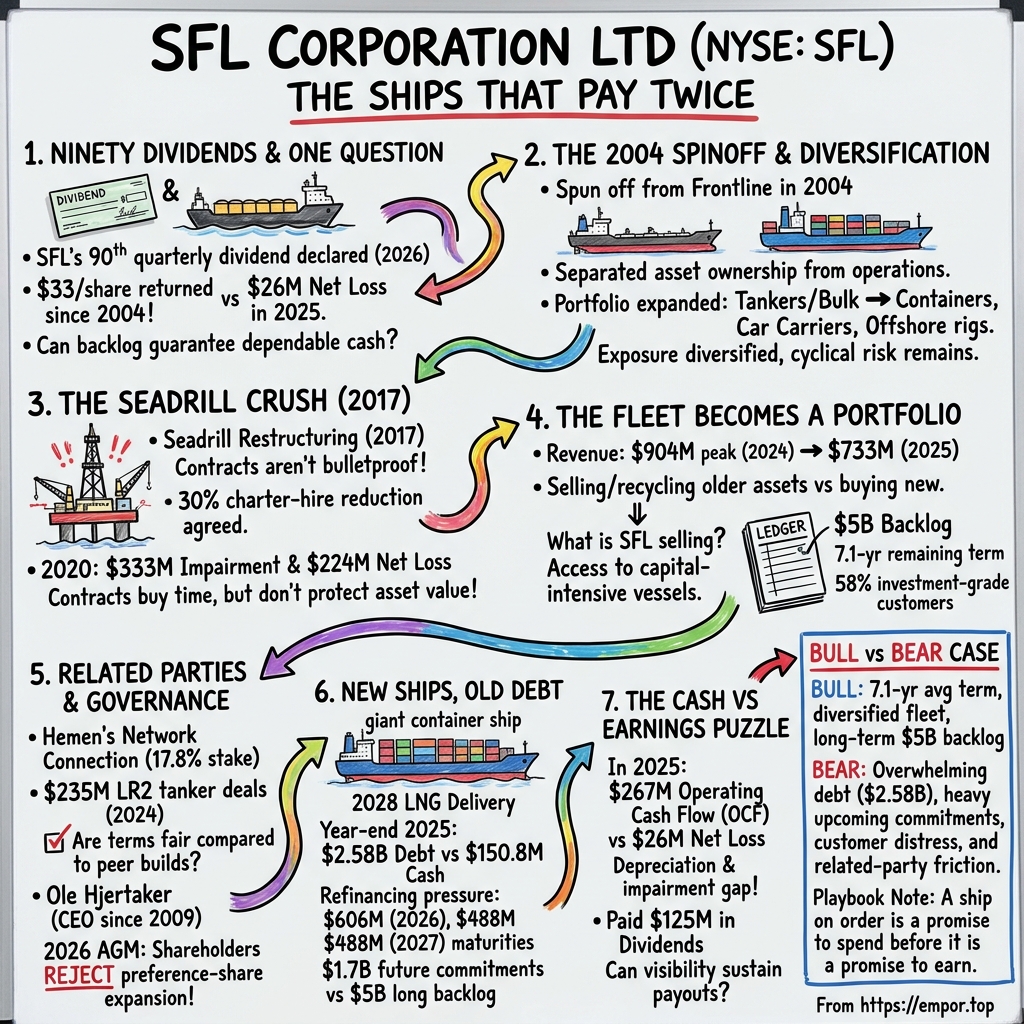
On a late-August morning in 2026, a small team in Oslo and Bermuda told the market something that very few shipping companies anywhere can say. SFL Corporation had declared a cash dividend of 22 cents per share for the second quarter, and it was the ninetieth consecutive quarterly dividend the company had paid since it listed on the New York Stock Exchange in 2004.1 Ninety in a row. Through the 2008 financial crisis, through the collapse of offshore drilling, through the near-death of its largest rig customer, through a pandemic and through a freight boom that came and went, the cheque kept arriving every three months. Ten weeks later, in November, the company made it ninety-one.2
On the third-quarter call, chief executive Ole Hjertaker put a figure on the streak. SFL, he said, had paid out "nearly $33 per share" since 2004, more than $3 billion in total.3 Then came the line that management now uses to define the company. SFL is not, in its own telling, a shipping company in the ordinary sense. It is a maritime infrastructure company: an owner of ships and drilling rigs that it rents to other businesses on long contracts. At the end of September 2026 those contracts added up to a fixed-rate charter backlog of about $5 billion, with a weighted average of 7.1 years left to run.2
That is the promise. Here is the contradiction. In 2025, the same company with ninety dividends and billions of contracted revenue reported total revenue of about $733 million and a net loss of about $26 million.4 Five years earlier, in 2020, it had lost about $224 million.5 In between, it had earned well over $100 million in some years and well under it in others. A business that sells long-term certainty to its customers has not delivered much certainty in its own reported earnings.
So the question this story is built around is a simple one, even if the answer is not. Can a fleet of ships turn long contracts into dependable shareholder cash, or do the cycles in vessel values and financing keep taking that cash back?
There are three ways the answer could go wrong. The first is that the backlog may not outlast the market cycles that change what SFL's ships are worth and what they can earn when their current contracts expire. A ship on a ten-year charter is a reliable source of income for ten years, and then it is a fifteen-year-old ship looking for work. The second is that SFL's expansion, which by late 2026 included more than a dozen vessels under construction, has to earn enough to justify the debt and commitments it requires. The third is quieter. SFL sits inside a web of companies connected to its largest shareholder, Hemen Holding, an investment company associated with the Norwegian-born shipping investor John Fredriksen, and some of its deals are struck with those relatives. Whether those ties are fairly governed matters to every outside shareholder.
It helps to draw a clear line around what SFL actually is before going further. SFL is a Bermuda-incorporated company that owns ships and offshore drilling rigs and leases them out.4 It is not Frontline, the tanker operator from which it was born, and Frontline today owns less than 1% of it.4 It is not Hemen, which owned 17.8% of SFL's shares as of March 2026 and is its largest disclosed shareholder, but is not identified as its parent.4 Frontline, Hemen, Golden Ocean, Seadrill and others appear throughout this story as customers, counterparties, sellers or shareholders. Their businesses, their profits and their fleets are not SFL's results, and confusing the two is the easiest way to misread this company.
One more distinction carries through everything that follows. Backlog is contracted future revenue. It is not cash in the bank, it is not profit, and it is certainly not free cash flow. Between a charter contract and a dividend cheque sit the costs of running the ships, the interest on the debt that paid for them, the principal on that debt, the money needed to build or buy the next generation of vessels, and the chance that a customer cannot or will not pay. The ninety-one dividends prove that SFL has, so far, always found a way across that gap. They do not prove that the gap is small.
To understand why SFL lives in that gap, the story has to go back to the moment the ships were separated from the company that sailed them.
 Subscribe on LinkedIn
II. A Fleet Separated from Its Customer
In 2003, Frontline was one of the largest tanker operators in the world, and it had a problem that many shipping companies share. Owning oil tankers ties up enormous amounts of capital, while operating them is a business of daily decisions about routes, cargoes and freight rates. The capital is patient. The freight market is not. Putting both inside one company meant that every swing in tanker rates rattled the value of a balance sheet full of very expensive steel.
The solution was to pull the two apart. SFL, then called Ship Finance International, was incorporated in Bermuda in 2003 as a Frontline subsidiary, and the following year a large block of its shares was distributed to Frontline's own shareholders in a partial spin-off of the company.4 Its shares began trading on the NYSE in June 2004.4 The original fleet was largely the Frontline fleet: Suezmax and VLCC crude tankers, along with combination carriers able to move oil, bulk or ore.4
The arrangement was elegant in the way financial engineering often is. SFL owned the ships and chartered them back to Frontline and other operators, collecting a fixed daily hire. Frontline ran the ships and took the freight-market risk. In effect, SFL became the landlord and Frontline the tenant. A landlord earns rent whether or not the tenant's shop is busy, at least until the tenant cannot pay. That last clause is the whole story of SFL in miniature.
Over the next two decades the landlord went shopping for new tenants. The fleet broadened from crude tankers and bulk carriers into container ships, car carriers, offshore drilling rigs and, later, chemical and product tankers.6 Each of those markets has its own customers, its own cycle and its own idea of what a ship is worth. A container ship chartered to one of the world's largest liner companies earns money in a very different way from a jack-up rig working in the North Sea or a Suezmax tanker trading in the spot market.
This matters for reading the growth record. Revenue rose from about $413 million in 2016 to a peak of about $904 million in 2024 before falling back to about $733 million in 2025.4 That looks like a business that nearly doubled and then gave some back. But the growth did not come from more cargo moving through an unchanged fleet. It came from SFL adding assets, swapping old ones for new ones, and in some years taking on operating roles that brought in more revenue along with more cost. The listed company is a portfolio that has been rebuilt several times, not one engine running faster.
The backlog tells the same story from a different angle. In early 2019, SFL reported a fixed-rate charter backlog of about $3.8 billion spread across 86 vessels and rigs.7 Seven and a half years later the figure was about $5 billion.2 That is growth, but slower growth than the revenue line implies, and it was achieved with a fleet that had been substantially turned over: older tankers, bulkers and offshore support vessels out, large modern container ships and car carriers in. The company that shareholders own today shares a name and a management team with the one of 2019, but many of its ships are different.
Frontline's place in the present story is therefore much smaller than its place in the origin. It is a former parent and an ongoing counterparty, providing vessel management services to some SFL ships for fees of about $2 million in 2025.4 It is not SFL's controller. The connective tissue that remains runs instead through Hemen, whose network of related companies includes Frontline, Seatankers, Front Ocean, NorAm Drilling, Paratus, Northern Ocean and River Box.4 Hjertaker himself has sat on the Frontline board since May 2022.8
The spin-off created something genuinely useful: an independent owner able to spread its exposure across many charterers and ship types, so that a bad year for tankers need not be a bad year for the whole company. But the origin also contains the lesson that the next two decades would keep teaching. Owning the ship diversifies who you depend on. It does not remove the dependence. When a charterer weakens, the owner feels it through reduced hire. When a vessel type falls out of favour, the owner feels it through impairment. When a customer fails outright, the owner gets its ship back, sometimes in poor condition, and has to find it a new job in whatever market happens to exist that day.
SFL learned all three of those lessons at once, and the teacher was a drilling company called Seadrill.
III. The Charter That Survived Seadrill's Collapse
The drilling rigs looked, for a while, like the perfect landlord asset. In the boom years of offshore oil, Seadrill, another company in the Fredriksen orbit, needed hugely expensive ultra-deepwater and harsh-environment rigs, and SFL was happy to own them and lease them back on long bareboat charters. Under a bareboat charter, the customer takes the rig more or less as an empty shell and is responsible for crewing, operating and maintaining it, while the owner collects hire. By the end of 2018 SFL still had three rigs on charter to Seadrill affiliates, West Hercules, West Taurus and West Linus, with about $1 billion of investment in those leases sitting on the books of the associated companies that owned them.7 Very few single relationships in the company mattered as much.
Then the oil price collapsed in 2014, offshore drilling budgets were slashed, and Seadrill, carrying billions in debt, slid into a court-supervised restructuring in 2017. Suddenly the credit standing behind SFL's long rig contracts was the credit of a company in Chapter 11.
What happened next is worth telling slowly, because it is the clearest demonstration in SFL's history of what a long contract is and is not worth. SFL kept receiving full charter hire on the rigs throughout Seadrill's 2017 to 2018 restructuring.7 That was the good news, and management made a point of it. The price of that continuity was a renegotiation. Under the deal, SFL agreed to temporarily reduce charter hire on the rigs by 30% from 2018 to 2022, with a catch-up afterwards.7
Put in plain terms, SFL accepted less money now in exchange for a promise of more money later. The concession bought time. It kept the rigs employed, preserved the customer relationship and avoided the far worse outcome of taking back three idle rigs in a collapsed market. But it also moved expected cash further into the future and made that cash dependent on Seadrill's recovery. A lease that had looked like a bond turned out to behave, under stress, like a loan to a struggling borrower.
The recovery did not hold. In 2020, as the pandemic crushed oil demand, Seadrill stopped paying hire in full in September and October, and the following February it filed for Chapter 11 a second time.5 Interim arrangements paid only part of the hire on West Linus and West Hercules, and the West Taurus lease was rejected in the bankruptcy process.5 For SFL, 2020 became the year the landlord had to mark its property to reality. The company recorded about $333 million of vessel and rig impairment and finished the year with a net loss, against a profit of about $89 million the year before.5
That loss is the single best piece of historical evidence against the most attractive version of the SFL story. The pitch says contracted revenue makes cash flow stable. The 2020 result says that contracted revenue does not fix the value of the asset generating it. When the customer's credit changes, the rig's value changes with it, and accounting rules force the owner to recognise that. An impairment of about a third of a billion dollars, in a company whose revenue that year was under half a billion, was large enough to turn a profitable-looking asset base into a deep reported loss.5
Taking the rigs back
The rigs did not disappear. In 2022, SFL took delivery of West Linus and West Hercules back from Seadrill.6 That changed the nature of the business in a way the headline revenue figures disguise. Instead of collecting bareboat hire, SFL now had to find drilling contracts itself, through managers, and its revenue line suddenly included full drilling-contract income while its cost line included the expense of operating the rigs.6
Linus went back to work with ConocoPhillips in Norway, and it is contracted with that customer until May 2029.3 Hercules had a harder road. When Seadrill handed it back in December 2022, SFL claimed the rig was not returned in the condition the contract required, and the two sides went to court in Norway. In October 2026, the Borgarting Court of Appeal ruled unanimously that Seadrill had breached its redelivery obligations and ordered it to pay SFL's subsidiary about $55 million in compensation, interest and costs.2 A few weeks later the same appeals court reversed a lower-court ruling in a related dispute over capital spares and ordered SFL to pay Seadrill about $12 million.2 Neither judgment is final, because either party can seek leave to appeal to the Norwegian Supreme Court.2 The net position favours SFL on paper, but the cash has not yet changed hands.
Meanwhile Hercules has been sitting mostly idle, which is why SFL's energy segment ran at just 50% utilisation in the second and third quarters of 2026.3 The rig has a 400-day contract in Canada with Suncor, expected to begin around March 2027, with extension options that could roughly double the term.3 Before then, SFL will carry elevated operating costs to prepare and move it.3
Hjertaker, on the second-quarter call, made a revealing point about rig economics: a new equivalent rig would probably cost north of $1 billion, and charter rates at current levels did not justify building one.9 That is both a reason for optimism about older rigs, since scarcity supports their earning power, and a reminder of how far the market has moved from the days when SFL's rigs were financed as long-duration income assets.
Seadrill left SFL with a question it has been answering ever since. If a customer's credit can change the value of the ship, and the owner bears the consequences either way, what should the owner do with its capital when markets improve? SFL's answer was to spread itself across more ships, more customers and more markets.
IV. The Fleet Becomes a Portfolio
Picture SFL's fleet list as it stood in the mid-2020s, and it reads less like a shipping company and more like the holdings of a specialist fund. Large container ships chartered to Maersk, MSC and Hapag-Lloyd. Car carriers on charter to Eukor and an Asia-based liner. Product tankers working for Trafigura. Crude tankers, some on long charters and two trading in the spot market. Dry bulk vessels, a shrinking group. Two drilling rigs. A minority stake in a box-ship venture called River Box.4 Each piece came with a different customer, a different cycle and a different story about what the asset would be worth at the end of its contract.
SFL's answer to Seadrill was diversification. The question is whether the portfolio became a repeatable way to allocate capital, or simply a larger collection of cyclical bets that do not all go wrong at once.
The revenue record offers clues, but it must be read carefully. Revenue climbed from about $513 million in 2021 to about $904 million in 2024.4 A casual reader might take that as a business compounding its charter income. A large part of the step-up in 2021 and 2022, however, reflected new ships and rigs joining the fleet and the consolidation of Hercules and the direct operation of Linus.6 Running a rig yourself means booking its full drilling dayrate as revenue and its full operating cost as expense, so revenue rises far more than the owner's actual earning power.
The fall in 2025 shows the same effect working in reverse. Revenue dropped by about $170 million, and most of that came from a single line. Drilling-contract revenue fell to about $96 million from about $237 million in 2024, as Hercules finished its work and went idle, while time-charter revenue, the backbone of the business, slipped only modestly from about $619 million to about $602 million.4 In other words, the core leasing book held up reasonably well. The volatile part was the rig that SFL had inherited from a failed customer.
That is the strongest evidence for the diversification thesis: when one segment collapsed, the others kept paying. It is also the strongest evidence against the idea that diversification produces smooth results. The 2025 net loss arrived anyway. On top of the drilling decline, SFL recorded about $34 million of impairment on five Supramax and two Kamsarmax dry bulk carriers, valued at what the market would pay for them, and a further $7 million loss on asset sales and charter settlements.4 The 2020 impairment had come from offshore. The 2025 impairment came from dry bulk. The cycle had simply moved from one segment to another.
Selling as well as buying
Asset sales are part of the strategy, not a footnote to it, and 2025 was a year of selling. Golden Ocean, a dry bulk company in the same shareholder network, exercised purchase options on eight dry bulk vessels, which ended the lease income and profit share SFL had been earning from them.4 Across the year SFL disposed of eight container ships, thirteen bulk carriers and a Suezmax tanker, bringing in roughly $259 million of proceeds.4 Some of those sales recycled capital out of older ships into newer ones. Others were triggered by customers exercising options written into the original charters, which is a reminder that a long charter often gives the customer a choice about the ending, not the owner.
The selling continued into 2026, and here the evidence tilts more favourably. In the third quarter SFL agreed to sell four older LR2 product tankers and three Suezmax tankers, all on charter to Trafigura, to that charterer. Management expected net cash of about $275 million after profit share and debt repayment, and a book gain of about $175 million as the ships are delivered in late 2026 and early 2027.2 Hjertaker called it "a stellar return on invested capital".3 A gain of that size is real evidence that some of SFL's tanker investments were bought well. It also means that part of the 2026 and 2027 earnings story will come from selling ships rather than chartering them, which is a one-time harvest, not recurring income.
The sale had been signposted, which matters for judging how management communicates. On the second-quarter call an analyst asked about purchase and extension options embedded in SFL's charters. Hjertaker replied that seven tankers, three Suezmaxes and four LR2s, carried options that were well in the money for the charterer, and that SFL might sell vessels under a profit-share structure rather than simply extend them.9 Within weeks, those seven ships were sold to their charterer. That is consistent messaging followed by execution. It is also a reminder of who held the option. When a charterer can buy a ship at a pre-agreed price, the owner's upside is capped by the contract, and the large gain SFL booked was the share of the rise in tanker values that the contract left on its side of the table.
So does the broader portfolio smooth the cycle or merely move it around? The record points to the second, with an important qualification. SFL's container and car-carrier charters, mostly to large liner companies, have been the steady centre. The rigs, the dry bulk ships and the spot tankers have supplied most of the volatility, sometimes as windfall and sometimes as write-down. Consolidated revenue alone cannot tell an investor which way the next year will break. Only the fleet and charter mix can.
Which raises a more basic question. When a customer signs one of those long container-ship charters, what exactly is SFL selling, and why does the customer buy it from SFL rather than anyone else?
V. Who Pays for the Ship—and What Is SFL Selling?
Imagine a container line planning its fleet for the end of the decade. It needs five large, modern, LNG-capable ships to replace older tonnage on a key trade route. It could order them from a shipyard itself, pay the instalments during construction, put the ships on its own balance sheet and own them for twenty-five years. Or it could ask someone else to do all of that and simply agree to rent the ships for ten years once they are delivered.
The second option is what SFL sells. In 2025 SFL had five container newbuildings under construction in exactly that arrangement, with about $848 million of committed construction cost still to pay and ten-year charters set to begin on delivery in 2028.4 The customer gets ships without the upfront capital. SFL gets a decade of contracted hire. Both sides are betting on something: the customer that it will need the ships, and SFL that the hire will repay the cost and the debt with something left over, plus a ship that still has value when the decade is up.
That is the business model in one transaction. SFL funds or acquires the asset, charters it to an operator, collects hire over a contracted period and carries the risks that remain: what the ship is worth at the end, the cost of maintaining and financing it, and the condition in which it comes back.
The contract types matter because they decide who bears which risk. On a time charter, SFL provides a crewed and maintained ship, through contracted technical managers, and the customer pays a daily rate for its use. On a bareboat charter, the customer takes over the ship and runs it. Voyage and pool revenue, by contrast, depends on the spot market, where SFL is exposed to daily freight rates. Then there are drilling contracts, lease-financing arrangements, profit-sharing clauses and other operating income.4 Most of SFL's 2025 revenue came from time charters; drilling was smaller and falling.4
Reading the backlog
At the end of September 2026, SFL reported about $5 billion of fixed-rate charter backlog.2 Container ships made up about 71% of it, car carriers about 11%, rigs about 7% and gas carriers and tankers roughly 5% each.3
It also moves around more than its steady image suggests. Just three months earlier, at the end of June, the backlog was about $3.8 billion with a 6.2-year term and 65% of it with investment-grade customers.1 The jump came from a cluster of new commitments in the third quarter. The investment-grade share fell to about 58% in the process.2 Including one customer rated a notch below investment grade, Hjertaker said, the figure rose to nearly 80%.3
A different measure tells a more conservative story. At the end of 2025, SFL's minimum future revenue from operating leases, which is the contractual hire on charters already running, was about $1.79 billion, including about $494 million for 2026 and about $386 million for 2027.4 The two numbers are not inconsistent, because they measure different things at different dates: the year-end figure covers only operating leases in force, while the September backlog includes newbuildings that have not yet been delivered and charters signed during 2026. But the contrast is useful. Of the headline $5 billion, a substantial part is revenue from ships that do not yet exist, and the near-term contracted run-rate is a few hundred million dollars a year that steps down as contracts expire.
The structure of the market
Why would a customer choose SFL? The honest answer is that it does not have to. Large charterers can choose among many shipowners and lessors. In container ships alone, listed lessors such as Danaos and Global Ship Lease compete for the same liner customers, and in product tankers owners like Scorpio Tankers and Ardmore Shipping are fighting for charters from the same oil majors and traders. Behind them stand Chinese and Japanese leasing houses, private shipowners and the liner companies' own balance sheets.
Run the five forces through that structure and the picture is sobering. Buyers are powerful: Maersk, MSC, Hapag-Lloyd and Trafigura are among the largest companies in their markets, they negotiate the terms, and they frequently hold purchase options or extension options that let them decide how a charter ends. SFL names these counterparties but does not disclose what share of its revenue the largest of them account for, so the concentration cannot be measured from the company's reports.4 Suppliers are concentrated too: a handful of shipyards in China, Korea and Japan build most of the world's large ships, and their order books set both the price and the delivery date of new tonnage. Substitutes are plentiful, because a liner can always buy ships itself or lease from someone else. New capital flows into ship leasing whenever returns look attractive, and rivalry for long charters with creditworthy customers is intense precisely because everyone wants the same safe contracts.
What SFL brings to that contest is capital, contracting skill, a track record of executing complex deals and a fleet broad enough to offer customers options. Its operating proof points are real: the 7.1-year term and an investment-grade majority in the backlog show that blue-chip customers are willing to sign long contracts with it.2 But neither figure shows superior returns on capital, superior pricing or a durable cost advantage over rival lessors. The filings provide little evidence that SFL can charge more than a competitor for the same ship.
Technology adds one more risk, and it is not software. A ship's competitiveness depends on its fuel efficiency and its emissions profile. SFL warns that newer, more efficient vessels can reduce the hire rates and resale values of older ones.4 A long charter on a modern dual-fuel container ship protects against that for a decade. A twelve-year-old conventional vessel coming off charter in a world of tightening emissions rules is a different proposition.
The small spot book shows what SFL gives up, and gains, by preferring contracts. Its two spot Suezmaxes earned about $133,000 a day on average in the second quarter of 2026 and about $83,000 in the third, against roughly $54,000 in the first.129 Hjertaker estimated that spot trading contributed about eight cents per SFL share in the third quarter, compared with two or three cents in earlier periods.3 After the quarter ended, one of the two ships, SFL Albany, was fixed on a three-year charter with an oil major, adding about $69 million to the backlog, while the other stayed in the spot market so SFL could, in Hjertaker's words, "ride the market a little bit".23 Swings like that are exactly what the long-charter model is designed to avoid, and a reminder that SFL still chooses, ship by ship, how much market risk to keep.
All of which lands on the risk inside the promise. A long charter secures a payment stream only while the customer keeps performing and while the ship remains worth operating. SFL's job is to choose customers and ships for which both conditions hold, and to buy them at prices that leave a margin for error. That last part, the price, is where the shareholder network enters the story.
VI. The $235 Million Deal with Hemen's Network
In the summer and autumn of 2024, three new LR2 product tankers joined SFL's fleet: SFL Tucana, SFL Taurus and SFL Tigris. LR2s are large product tankers, roughly the size of an Aframax crude carrier, built to move refined fuels such as diesel and jet fuel over long distances. The three ships cost SFL about $234.9 million in total, or about $78 million each, and they came from entities related to Hemen, SFL's largest shareholder.4 On delivery, they went straight onto long-term charters with a third party.4
Nothing about that is improper on its face. SFL discloses the transaction in its annual report, and buying delivered, chartered ships is exactly the business it describes. But a deal of this kind deserves a closer look than an ordinary acquisition, because the seller sits inside the same shareholder network as the buyer, and outside shareholders bear the consequences of the price.
The first question is why an owner would buy brand-new ships with charters attached rather than wait for bargains in the secondhand market. The logic is that SFL is not really buying a ship. It is buying a contract with a ship attached: a known customer, a known daily hire for several years and a fixed acquisition cost. The bet is that the locked-in income repays the higher upfront price, and that the owner avoids the risk of buying cheaply and then failing to find employment.
The second question is the price. About $78 million per ship stands against contemporaneous LR2 newbuilding orders placed by other owners at noticeably lower figures. Performance Shipping, for example, ordered an LR2 at Shanghai Waigaoqiao for about $62.6 million, for delivery in late 2025, and later placed a follow-on order at about $64.8 million per vessel.1011 On a headline basis, that is a premium of roughly a fifth.
But those comparisons are not like-for-like, and the differences cut in SFL's favour. The peer orders were forward contracts, paid in instalments over two years or more, delivering ships years later into an unknown market, with specifications that may differ. SFL paid for ships in the water, earning hire immediately, with charters already signed. The time value of having a ship working in 2024 rather than 2026, during a strong tanker market, is worth real money, and a charter attached on delivery removes employment risk. The public evidence therefore raises a fair question without answering it. It does not establish that SFL overpaid. The tests that would settle it are the fair-value support for the price, the charter economics on the three ships, and the independence of the approval process, and SFL publishes the transaction but not a detailed valuation of it.
The network in proportion
How large are related-party dealings overall? Smaller than the attention they attract. In 2025, Frontline charged about $2.1 million in vessel management fees and Golden Ocean about $4.0 million until mid-March, while SFL charged administrative and shared costs to Seatankers and Front Ocean.4 SFL earned about $10.7 million of operating-lease income from Golden Ocean until that company exercised its purchase options in March, down from about $54.6 million in 2024.4 Against revenue of over $700 million, those are modest sums. SFL says some of its administrative-service charges are set at actual cost plus a margin.4 Yet a small percentage does not remove the need to understand pricing, because the issue is not the size of the fees but the precedent and the approval process when a shareholder's network sits on both sides of a table.
There is one more piece that belongs in this category, and it is not a customer receivable. SFL holds a $45 million fixed-rate loan to River Box, an associate that owns four container vessels, due in November 2033 or earlier if River Box sells its ships.4 It earned about $3.4 million of interest in the first nine months of 2026.12 That is an investment in a related venture, and its value depends on River Box's ships, not on SFL's charter book.
An outside shareholder with an activist's temperament would not need to allege wrongdoing to ask pointed questions. Would SFL's investors be better served if it retained more cash, paid down debt, or proved the return on each new asset before adding the next one? Should deals with related sellers come with published independent valuations as a matter of course? Those questions do not imply that the answers are bad. They imply that a company built on capital allocation should show its working.
The capital-allocation record, taken as a whole, is genuinely mixed. On one side sit new contracted assets on long charters, and sales such as the Trafigura transaction that crystallised large gains. On the other sit the 2020 and 2025 impairments, the forced exits from dry bulk and the long recovery from the rig business. The LR2 deal can only be judged on the same terms as the rest: by what those ships eventually return. And that brings the story to the biggest capital commitment SFL has ever made, the fleet it has not yet received.
VII. New Ships, Old Debt
Somewhere in a shipyard in Asia, the steel for SFL's next decade is being cut. Five LNG dual-fuel container vessels are under construction for delivery in 2028, each committed to a ten-year charter.4 Alongside them, by late 2026, SFL had ordered more: seven container ships in all, four car carriers and three very large ammonia carriers, for a total of fourteen newbuildings due between the second half of 2027 and the end of 2029.2 The remaining capital still to be paid on newbuildings and acquisitions was about $1.7 billion at the end of September 2026.12
At the same time, SFL carries a large load of existing debt. At the end of 2025, principal borrowings were about $2.58 billion, including about $686 million of lease-debt financing, against cash of about $151 million.4 Maturities were about $606 million in 2026 and about $488 million in 2027, followed by about $415 million in 2028 and about $632 million in 2029.4 Nearly all of that debt is secured on the fleet.4 A company with that calendar needs the banks and bond investors to keep lending, year after year.
The tension at the heart of this section is simple to state. Can SFL finance its next fleet before the cash flows from its existing ships roll off?
From spending spree to pullback and back again
The investment cycle has swung hard. In 2024, cash spent on vessel purchases, capital improvements and other additions was about $645 million, roughly seven-tenths of that year's revenue.4 In 2025 it fell to about $71 million, while SFL raised about $259 million from vessel sales.4 That was a deliberate pause: the company was digesting its acquisitions, recycling older ships and riding out the drilling slump. In 2026 the pendulum swung back toward growth with a wave of new orders.
Those orders differ in an important way. The original five container ships were ordered against ten-year charters, which reduces early revenue uncertainty. The two 8,800 TEU container ships SFL agreed to acquire in 2026, for about $256 million, came with eight-year charters to an existing investment-grade liner customer.3 The three ammonia carriers, costing about $336 million, came with charters to an oil major and a global commodities group, adding at least about $250 million of backlog.3 But the four 7,000 CEU car-carrier newbuildings, costing roughly $360 million, were a different matter. Only two of them had charters, on five-year terms with a major Asian car manufacturer.9 The other two were ordered without employment and remained unfixed in November.3 At the same time, SFL fixed two of its existing car carriers, SFL Conductor and SFL Composer, on three-year charters to an Asia-based liner, adding about $83 million of backlog, which suggests the car-carrier market was still willing to pay for available tonnage.1
That is a quiet but meaningful shift. On the second-quarter call, an analyst asked why SFL was ordering car carriers on speculation. Management's answer pointed to an expected supply gap in car carriers from 2029 to 2030, and Hjertaker conceded that SFL had in the past been "reluctant to order vessels without charters".9 A company whose identity rests on contracted cash flow had placed a bet on the market. It may prove a good bet. It is nonetheless a different kind of decision from the one the backlog narrative implies.
The ammonia carriers are a growth vector worth noting without over-reading. Ammonia is moved today for fertiliser and chemicals, and many in the industry expect it to become a carrier of hydrogen and a marine fuel in a lower-carbon economy. SFL's three ships, due in 2028, give it a foothold in that trade with strong counterparties.2 But they are three ships among dozens, and they will not earn anything until they are delivered. A new market is not yet proof of meaningful earnings.
The most valuable move of 2026 was arguably an extension rather than an order. In September, Hapag-Lloyd extended charters on six 15,400 TEU container ships by seven years, pushing their expiry from 2028 and 2029 out to 2035 and 2036 and adding about $750 million of backlog.2 Extensions are the cheapest way to grow backlog: no new capital, no construction risk, just more years of hire on ships already in service. That a major liner chose to commit for a further seven years is a genuine vote of confidence in those vessels.
How the money gets raised
On the financing side, SFL has been busy. During 2026 it fully redeemed a $150 million bond due that year and tapped its senior unsecured bond due 2030, bringing that issue to $225 million outstanding at an implied yield of about 6.8%.1 The 2030 bond itself was a $150 million sustainability-linked issue carrying a 7.75% coupon, launched in 2025, whose terms tie its cost to environmental targets.13 SFL also put in place an at-the-market equity programme in March 2026, and between May and July it raised about $100 million through that programme and its dividend reinvestment plan, issuing about 8.8 million new shares.142 Management said it did not plan further share issuance.2 The company says the newbuildings themselves are to be funded with cash plus pre- and post-delivery credit facilities.3
Each of those moves extends SFL's options. Each also has a cost. Bond money at 7% to 9% coupons is not cheap, and SFL had outstanding bonds paying 8.25% and 8.875% at the end of 2025.4 New shares spread future dividends across a larger base. The 2024 base prospectus for SFL's Oslo bonds stated plainly that neither the company nor its bonds were rated by any agency.[^15] Lenders and bond buyers therefore make their own judgement about SFL's credit, and the price they charge is one of the most honest signals of how risky the market thinks the company is.
By the end of September 2026, interest-bearing debt on the balance sheet had come down to about $2.33 billion, with about $613 million due within a year, and SFL held about $112 million of cash plus $160 million of undrawn credit lines.2 That is a manageable position for a company with access to markets. It is also a balance sheet that depends on that access remaining open.
Accounting earnings can be positive while refinancing needs remain large, and the investor who looks only at the income statement will miss the second half of that sentence. What a reader really needs is the return calculation that SFL does not publish: for each delivery, what the ship cost, what it will earn, what debt is attached and what the vessel is assumed to be worth at the end of its charter. Without it, a growing backlog is a list of revenues without the costs that come with them. And the gap between revenue and cash is wider in this business than almost anywhere, as the 2025 accounts make clear.
VIII. Cash Is Not the Same as Earnings
Here is a puzzle that confuses many first-time readers of SFL's accounts. In 2025, the company reported a net loss of about $26 million. In the same year, its operating activities generated about $267 million of cash.4 How can a business lose money and produce a quarter of a billion dollars of cash at the same time? And which of those numbers tells the truth about its ability to keep paying dividends?
The first clue is depreciation. SFL charged about $235 million of depreciation in 2025.4 Depreciation is the accounting recognition that a ship wears out: a vessel bought for $100 million that will be worth little after twenty-five years has to be expensed gradually over that life. In any given year, no cash leaves the company for depreciation. That is why operating cash flow can be far higher than net income in an asset-heavy business. Add the non-cash impairments of 2025 and the gap widens further.
But it would be a mistake to treat depreciation as irrelevant. Ships really do consume economic value. A container ship earning hire today is, every year, a year closer to the scrapyard or the bargain-bin secondhand market. If an owner spends all its operating cash on dividends and never sets aside enough to replace its fleet, it is gradually liquidating itself, paying shareholders out of the capital they already own. Operating cash is the starting point for judging a dividend, not the end of the calculation.
The second clue is that SFL's quarterly earnings are full of items that have little to do with its charter book. Impairments come and go. Gains and losses on vessel sales arrive in lumps. Charter settlements, such as compensation for early termination, swing results. And derivative valuation changes, mainly on the interest-rate and currency swaps SFL uses to fix the cost of its debt, can move earnings by millions of dollars in a quarter. In the third quarter of 2026, net income of about $37 million included a gain of about $14 million on interest and valuation of non-designated derivatives, against a small loss on the same line a year earlier.12 Strip that out and the quarter looks much less impressive. Add the expected gain of about $175 million on the Trafigura sale in the coming quarters, and earnings will look much better than the underlying charter business.2 Neither swing tells the listener much about the rent the ships actually bring in.
The derivatives exist for a sensible reason. A ship lessor with billions of floating-rate bank debt and fixed-rate charter income is exposed to every move in interest rates, so SFL had fixed the cost of about $0.8 billion of its debt through interest-rate and cross-currency swaps at the end of 2025.4 It also swaps its Norwegian-krone bond back into dollars, interest and principal, so that the company's dollar charter income matches its obligations, though that arrangement can require posting collateral if the krone moves sharply.4 Hedging stabilises cash. It destabilises reported earnings, because the swaps are marked to market each quarter while the debt they hedge is not. An investor reading SFL's quarterly profit should mentally set those marks aside.
The third clue is the trend in cash. Operating cash flow fell from about $370 million in 2024 to about $267 million in 2025.4 Management attributed the drop mainly to changes in operating income and the timing of charter-hire receipts and receivables.4 That explanation is plausible: Hercules had stopped earning, the Golden Ocean bulkers had left the fleet and spot tanker earnings varied. Through the first nine months of 2026, operating cash flow was about $210 million, broadly in line with about $216 million a year earlier.12 The decline does not, on its own, signal customer distress. Trade receivables from charterers actually fell sharply during 2025, to about $12 million from about $37 million, and SFL carried essentially no credit-loss allowance against them.4 Customers are paying. There is simply less coming in than at the 2024 peak.
What the dividend has to clear
Now set the dividend against everything else the cash must cover. SFL paid about $125 million of dividends in 2025 and bought back about $10 million of its own shares.4 Measured against operating cash of $267 million, that looks comfortably covered. But operating cash is not distributable cash. The same year, SFL faced hundreds of millions of dollars of debt maturities and carried an $848 million commitment to the five container newbuildings.4 It met those obligations by refinancing debt and selling ships, not out of operating cash alone.
That is not unusual for a ship lessor. It is how the model works: debt is rolled over, assets are recycled, and the dividend is paid from the margin between charter income and the cost of capital. But it means the payout has to be judged against three things at once: vessel spending, principal repayments and refinancing. A multi-year record of cash left over after maintenance investment, debt amortisation and dividends would show whether the payout is self-funding. SFL does not publish that figure, and the long history argues for caution. The quarterly dividend was 35 cents a share in early 2019.7 By 2026 it was 22 cents.1 The streak survived. The amount did not.
On the second-quarter call, the chief financial officer noted that the 22-cent dividend equated to an annualised yield of about 7% at the then-prevailing share price.9 A yield that high is the market's way of saying it does not fully trust the payout to last, or that it demands a high return for the risk.
Three measures therefore matter more than any others for following this company from here. The first is operating cash flow after vessel capital spending. Operating cash flow was about $267 million in 2025, before about $71 million of vessel spending, and SFL is heading into a heavy delivery period.4 The second is whether net debt is falling against committed deliveries.212 The third is the economics of charter renewals and extensions, of which the Hapag-Lloyd deal is the most recent good reading. If cash after capital spending holds up, net debt falls as ships deliver and renewals come in at or above expiring rates, the dividend has firm footing. If any of those slips, the payout becomes a claim on the balance sheet.
Those numbers do not manage themselves. Behind them is a very small team, and the question of whether they can be trusted with this much capital.
IX. A Long-Serving CEO, a Concentrated Shareholder
SFL is, by any standard, a tiny organisation sitting on top of a very large fleet. At the end of 2025 it had 24 full-time employees, employed through its management subsidiaries in Norway, Bermuda and elsewhere, while the day-to-day technical management of its ships and rigs was contracted out.4 Twenty-four people oversee billions of dollars of assets. The quality of their judgement is, in a real sense, the product.
At the centre sits Ole Hjertaker. Trained at the Norwegian School of Economics, he came up through the corporate finance division of DNB Markets, a bank with deep roots in shipping and offshore lending, before joining the company.15 He served as its chief financial officer from 2006 to 2009 and has been chief executive since 2009.8 He also sits on the boards of Frontline and other Hemen-related companies.48 Aksel Olesen, another maritime-finance professional, has been chief financial officer since around 2019; he signed off on the company's results in early 2019, at the time of the Seadrill renegotiation.7 The leadership has the background the asset-owner model demands. These are people who think in terms of financing structures, residual values and counterparty credit.
Tenure, though, is not proof of good capital allocation. It only means the same people have made the decisions long enough to be judged on them, and the record they have built is the one this story has been tracing. Hjertaker steered SFL through the Seadrill restructuring, when the company kept its rigs employed and preserved full hire through the crisis at the cost of later concessions. He was also in charge when that exposure produced the 2020 loss. He oversaw the diversification into container ships and car carriers that now forms the core of the backlog, and the 2024 buying spree followed by the 2025 impairments and retreat from dry bulk. In 2026 he led the Hapag-Lloyd extension, the Trafigura sale and a new round of ordering that included, for the first time in a long while, ships without charters.
How management communicates through those moments is part of the credibility test. On recent calls, the prepared remarks have been consistent in emphasising backlog, investment-grade exposure and the dividend record. When the 2025 revenue drop came, management attributed it squarely to the drilling segment, which the accounts confirm.4 When asked about the speculative car carriers, it gave a market-based rationale and acknowledged the change from past practice.9 The third-quarter call, however, drew just two analyst questions, on whether the second spot Suezmax would be fixed and when vessels next come off contract.3 Nobody asked about return on invested capital for the new orders, dividend coverage or the falling investment-grade share. Those are the questions that matter most, and the public record has few answers to them.
What the shareholders said
Pay is the next test, and here the disclosure is thin. SFL reported about $2.2 million of aggregate cash compensation for all directors and officers in 2025, plus about $0.8 million of stock-option expense.4 It does not break out what the CEO or CFO individually earned, or how bonuses are set.4 Options give management a stake in the share price, which is something. But investors cannot see whether pay is tied to returns on capital, dividend sustainability or simply growth in the fleet. And Hemen's 17.8% stake, which belongs to a separate shareholder and not to management, says nothing about management's personal alignment.
The board, too, has a particular shape. Four of its seven directors were considered independent under NYSE standards, and SFL, as a foreign private issuer, is exempt from the rule requiring a majority of independent directors.4 The rest of the share register shows Hemen at 17.8%, DNB Bank at about 8.1% through share-lending arrangements tied to old convertible bonds, and Dimensional Fund Advisors at about 6.0%.4 Fredriksen disclaims beneficial ownership and control of the shares Hemen holds.4 No single shareholder controls the company, but one network is clearly the most influential.
Which makes the May 2026 annual meeting more interesting than most. Management asked shareholders to authorise preference shares and associated bylaw changes, a move that would have given the company a new layer of financing flexibility, potentially senior to ordinary shareholders. Shareholders rejected the proposal.16 The re-election of directors and the limit on board fees passed.16 SFL did not publish vote counts with the result, so the scale of the opposition is unknown.16 But a rejected proposal in a company with a large, connected anchor shareholder is a real signal. It is not a verdict on the whole board. It shows that shareholders were willing to say no to a broader financing authority when they were not persuaded it served them.
On related parties, the balanced conclusion is proportionate. SFL discloses its transactions and balances, describes some shared-service fees as cost plus a margin, and the amounts are modest.4 The network has clearly given SFL access to ships, deals and operating capability. What the record lacks is independent evidence on pricing for the larger transactions, like the 2024 LR2 purchase.
The clearest test of accountability is straightforward. Management should be able to show the realised return on each new investment and should be reducing debt as contracted cash arrives. When it does that consistently, trust becomes a fact rather than an assumption. Until then, the case for SFL rests on weighing what the record supports against what it does not, which is exactly where the bull and the bear part ways.
X. Analysis & Bear vs. Bull Case
At the end of September 2026, SFL had a fixed-rate backlog of about $5 billion and about $1.7 billion in remaining newbuilding and acquisition commitments, alongside debt that needed continual refinancing.2124 Two sides can look at the same picture and see very different companies.
The case for, and the case against
The bull case begins with the contracts. Most of SFL's revenue comes from time charters with some of the world's largest liner companies, car carriers and energy traders, and most of the backlog extends years into the future. Container ships alone carry a weighted remaining term of about 8.3 years.3 The customer list includes Maersk, MSC, Hapag-Lloyd, Trafigura and Eukor.4 The fleet spans container ships, car carriers, tankers, gas carriers, dry bulk and rigs, so no single market dictates the outcome. Operating cash flow has run at a quarter of a billion dollars or more a year, the dividend has never been skipped, and in 2026 SFL demonstrated it can both extend charters with blue-chip customers and sell older ships at substantial gains. In a world where new ships are expensive and shipyards are booked for years, a large, modern, chartered fleet has scarcity value.
The bear case is just as concrete. Customer concentration is not quantified, so investors cannot judge how much of the revenue depends on one or two liners. Two Suezmax tankers and two Kamsarmax bulkers were trading on spot or short-term terms in 2026, and the drilling rigs remain exposed to a volatile market.2 Charters roll off, and renewal rates depend on the market at that moment. Older vessels lose value, as the 2020 and 2025 impairments demonstrated. The share of backlog with investment-grade customers fell between June and September 2026. Debt maturities and delivery commitments limit flexibility, and the company relies on unrated bond markets and secured bank lending to roll over its obligations. Finally, two newbuild car carriers have no charters.
Testing the moat
Porter's five forces painted an unfavourable picture for shipowners. Hamilton Helmer's seven powers offer a different lens, asking what lasting advantage SFL could hold.
Scale economies are limited: a fleet of SFL's size does not obviously buy ships or finance them more cheaply than a large rival, and the company does not publish evidence that it does. Network economies do not apply. Counter-positioning, a business model incumbents cannot copy, is hard to argue when listed peers do essentially the same thing. Switching costs exist only within a charter: once a customer signs for ten years, it is locked in, but at renewal it can take its business elsewhere, and purchase options in some contracts give customers the right to walk away with the ship. Branding matters little in a business priced on dollars per day. A cornered resource could arguably be the Hemen network's deal flow, but that resource belongs to a shareholder, not to SFL, and it raises the governance questions already discussed. Process power, the hard-to-copy organisational skill, is the strongest candidate: SFL's ability to structure complex financing, contract with demanding customers and manage a varied fleet with two dozen employees is real. But process power is hard to prove without superior returns, and SFL's returns are lumpy.
The fair conclusion is that SFL's moat is unproven rather than absent. The company has financing and contracting capability and a broad portfolio, but the filings do not establish customer switching costs beyond contract terms, superior price realisation or a structural cost advantage. Fleet size alone is not a moat.
Management's growth claim deserves the same test. In favour, the 2026 extensions and new long-term charters are meaningful affirmative evidence that blue-chip customers want SFL's ships. Against it stand the Seadrill concessions, the impairments and the repeated disposals of assets that did not work. The history narrows the claim: SFL can add contracted revenue, but contracted growth still has to prove its return. The KPI that would confirm or falsify the revised claim is cash after capital spending and debt service on the 2027 to 2029 deliveries.
A skeptical investor might pose the sharpest question of all. Would shareholders accept a slower fleet-growth plan if it meant lower refinancing risk and a steadier dividend? The answer depends on whether incremental returns on new ships exceed the cost of the debt and equity used to build them. If new vessels earn returns well above a 7% to 9% cost of borrowing, growth creates value. If they merely match it, shareholders would be better off with debt reduction.
What would settle the debate is measurable: cash after maintenance spending and principal repayment; net debt once the current newbuildings are delivered; charter coverage and pricing as current contracts roll; and vessel utilisation, especially on the rigs and spot ships.
On valuation, the evidence available is limited. No set of market multiples comparable across SFL's history and its peers is available here, so this story cannot say whether the shares are priced richly or cheaply relative to their own past or to Danaos, Global Ship Lease and other lessors. The one market signal management itself cited, an annualised dividend yield of about 7% in August 2026, suggests investors are demanding a substantial return for holding the shares.9 That is consistent with a market that sees real risk behind the backlog.
XI. Playbook: What a Shipowner Can—and Cannot—Promise
Three moments define SFL's playbook for owning the asset behind someone else's business: the Seadrill restructuring, the 2020 impairment and the Hapag-Lloyd extension.
The first lesson is that a contract buys time; it does not abolish risk. The Seadrill episode showed how a customer's distress can reach SFL's balance sheet in different forms. Founders and investors who treat a signed contract as money in the bank should remember the 2020 impairment. A contract is a claim on another company's future, and that future can change.
The second lesson is that diversification helps only if the returns diversify too. SFL built a portfolio of container ships, car carriers, tankers, bulkers and rigs precisely so that one market's misery would not sink the whole. But as the 2025 loss showed, owning many different assets reduces the chance of total disaster; it does not guarantee a smooth ride. It also makes it harder for outsiders to see where the returns really come from.
The third lesson belongs to the future. A ship on order is a promise to spend before it is a promise to earn. SFL's newbuildings will require hundreds of millions of dollars before they generate a single day of hire. The financing has to be found, the shipyard has to deliver, and the customer has to still want the ship when it arrives. For SFL, the backlog on those ships is revenue it has been promised. The debt to build them is money it has already committed to owe.
The fourth lesson is subtler: the dividend streak is a measure of willingness, not of capacity. Ninety-one consecutive payments prove that SFL's management and board have always chosen to pay something. They do not prove that the payout is always covered by surplus cash, as the reduction in the quarterly dividend shows. An investor should treat the streak as a statement of intent and judge the capacity separately, using cash after capital spending and debt repayment.
XII. The Next Charter Expiration
Tonight, somewhere on the world's oceans, the ships of the SFL fleet are earning hire. Container ships are moving boxes between Asia and Europe for liner companies that have committed to them for years. Car carriers are loading vehicles. A Suezmax is trading in a spot market where, according to Hjertaker, rates in the fourth quarter of 2026 are being quoted in the hundreds of thousands of dollars a day, and about two-thirds of SFL's Suezmax days for the quarter are already booked at more than $200,000 a day.3 In Norway, Linus is drilling for ConocoPhillips. Hercules is being prepared for its move to Canada. And in shipyards across Asia, fourteen new vessels are taking shape.2
The next phase of the story turns on conversion: whether the $5 billion backlog becomes cash that stays with shareholders. Several moments will decide it.
The first is delivery. Between the second half of 2027 and the end of 2029, SFL will take on the container ships, car carriers and ammonia carriers it has ordered.2 If they arrive on time, begin their charters and earn more than the cost of financing and building them, the growth story will have been earned. If delays push revenue back while construction payments continue, or if the two unfixed car carriers arrive into a softer market, the company will have more debt and less income than planned.
The second is refinancing. Debt maturities stood at about $606 million for 2026 and about $488 million for 2027 at the end of 2025, and SFL has already worked through part of that schedule.4 Each refinancing at today's rates tests whether the market still lends to SFL on acceptable terms. Investors should watch whether the dividend remains supported after principal payments and capital spending, not just against operating cash.
The third is renewals. Each charter that ends is a moment of truth about demand, pricing and the usefulness of SFL's fleet. The next vessel to come off contract, management said in November, is a car carrier in 2028.3 The Hapag-Lloyd extension was a positive signal. The next renewals will show whether it was the rule or the exception.
The fourth is the rig business. The Hercules appeal could bring in about $55 million if the October 2026 judgment stands, partly offset by the $12 million owed on capital spares.2 The Suncor contract, due to begin around March 2027, will put the rig back to work.3 These matter, but they should be kept in proportion. Rigs make up about 7% of the backlog.3 The shipping business drives most of the revenue, and its contracts are where the real test lies.
The fifth is the harvest. The Trafigura sale should bring in roughly $275 million of net cash as the ships are delivered.2 What SFL does with that money, whether it pays down debt, funds newbuildings, buys back shares or raises the dividend, will be the clearest window yet into management's priorities.
The central question remains whether the backlog can become dependable cash for shareholders. SFL has visibility that few shipping companies can match. The return on that visibility is still to be proven.
XIII. Outro
Picture one of SFL's container ships leaving port in Asia under a multi-year charter. The liner's name is painted on its hull and its logo flies above its stacks. The cargo belongs to the liner's customers. The crew answers to managers, the route to the liner's schedule. To almost anyone watching from the quay, it is the liner's ship. But the title, the debt and the question of what the vessel will be worth in a decade belong to a company with two dozen employees and ninety-one consecutive dividends behind it.
That is what makes SFL unlike a conventional shipping operator. It rents out the machines of global trade and asks investors to trust that the contracts, the customers and the capital structure will hold together long enough for the rent to outrun the debt. Ninety-one quarterly payments tell one part of the story. The ships, the borrowings and the next round of deliveries will tell the rest. SFL owns the vessel long after it disappears over the horizon, and it owns the risk that sails with it.
References
-
SFL Corporation — Q2 2026 preliminary results release, SEC Form 6-K, 2026-08-26 ↩↩↩↩↩↩
-
SFL Corporation — Q3 2026 preliminary results release, SEC Form 6-K, 2026-11-04 ↩↩↩↩↩↩↩↩↩↩↩↩↩↩↩↩↩↩↩↩↩↩↩↩↩↩
-
SFL Corporation — Q3 2026 earnings call transcript, Stock Analysis, 2026-11-04 ↩↩↩↩↩↩↩↩↩↩↩↩↩↩↩↩↩↩↩↩
-
SFL Corporation — Annual Report on Form 20-F for FY2025, SEC, 2026-03-16 ↩↩↩↩↩↩↩↩↩↩↩↩↩↩↩↩↩↩↩↩↩↩↩↩↩↩↩↩↩↩↩↩↩↩↩↩↩↩↩↩↩↩↩↩↩↩↩↩↩↩↩↩↩↩↩↩↩
-
SFL Corporation — Annual Report on Form 20-F for FY2020, SEC, 2021 ↩↩↩↩↩
-
SFL Corporation — Annual Report on Form 20-F for FY2022, SEC, 2023-03-17 ↩↩↩↩
-
Ship Finance International — Q4 2018 results, SEC Form 6-K, 2019 ↩↩↩↩↩↩
-
Frontline — Directors and Executive Officers, Frontline plc ↩↩↩
-
SFL Corporation — Q2 2026 earnings call transcript, Stock Analysis, 2026-08-26 ↩↩↩↩↩↩↩↩
-
Performance Shipping in for LR2 newbuild at Shanghai Waigaoqiao — Splash247 ↩
-
Performance Shipping returns to Shanghai Waigaoqiao for more LR2 tanker newbuilds — Splash247 ↩
-
SFL Corporation — Q3 2026 interim financial information, SEC Form 6-K, 2026-11-04 ↩↩↩↩↩↩
-
SFL Corporation — ATM prospectus supplement (Form 424B5), SEC, 2026-03-17 ↩
-
SFL Corporation — 2026 Annual General Meeting results, SEC Form 6-K, 2026-05-12 ↩↩↩
 LinkedIn
 WhatsApp
 Reddit
 Hacker News
 Email
 Kindle
 RSS Feed
 Spotify
 Apple Podcasts
 Amazon Music
 Audible
 YouTube