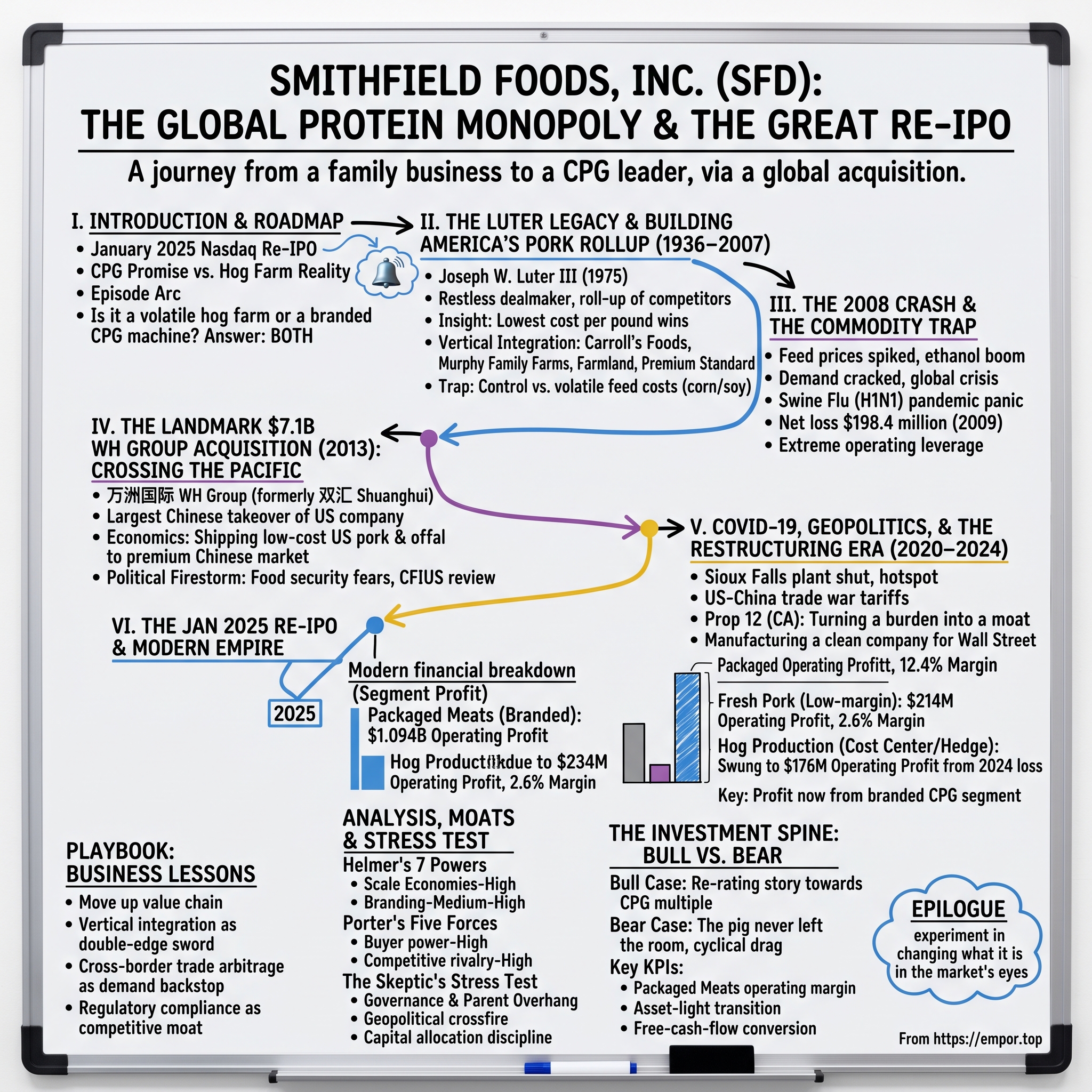
Smithfield Foods, Inc. (NASDAQ: SFD): The Global Protein Monopoly & The Great Re-IPO
I. Introduction & Episode Roadmap
Picture a January morning in 2025 on the Nasdaq MarketSite in Times Square. A meatpacker from a town of roughly eight thousand people in tidewater Virginia — a company that had not traded on a U.S. public exchange in more than a decade, and whose controlling shareholder sat in Hong Kong — is about to ring the opening bell. The bankers had originally pitched a range of $23 to $27 a share. The order book came back thin. Management swallowed hard and priced at $20.00. The stock opened, wobbled, and the financial press promptly filed the debut under "muted."1 For a business that slaughters tens of millions of hogs a year and sits on grocery shelves in nearly every American household, it was an oddly quiet re-entrance.
That quietness is the whole story, and the whole tension. Because the ticker SFD does not represent the same company that was taken private in 2013. It represents a deliberately reshaped one — smaller in raw hog headcount, larger in branded profit, stripped of its European limbs, and pointed at a single promise: that a 90-year-old commodity meatpacker can be re-underwritten by Wall Street as a consumer-packaged-goods (CPG) company that happens to own pigs.
Here is the core question this episode circles. Is Smithfield a volatile land-and-feed hog farmer, hostage to the price of corn and soybean meal and to whatever virus is circulating in the global pig herd this year? Or is it a branded packaged-meats cash machine — bacon, hot dogs, sausage, lunch meat — insulated by shelf-space dominance, cold-chain scale, and the deep pockets of its Hong Kong-listed parent, 万洲国际 WH Group (formerly 双汇国际 Shuanghui International)? The answer, as we will see, is genuinely "both," and the investment case rides entirely on which half is growing.
The arc we will trace:
- The Luter Era & the Rollup Strategy (1936–2007) — how one restless dealmaker turned a debt-laden family ham business into America's pork behemoth.
- The 2008 Commodity Crash — the near-death experience that taught management what owning 15 million pigs actually costs when the cycle turns.
- The Landmark 2013 WH Group Acquisition — the largest Chinese takeover of an American company in history, and the political firestorm around it.
- COVID, Prop 12, and the 2024 EU Carve-Out — the restructuring years that manufactured the "clean" company Wall Street would later buy.
- The January 2025 Nasdaq Re-IPO and modern financial breakdown — segment by segment, where the profit actually lives.
- Playbook, moats, management credibility, and the bull-versus-bear spine.
Let us start where every great American industrial story seems to start: with a young man who inherited a mess and decided the way out was to buy everyone else.
 Subscribe on LinkedIn
II. The Luter Legacy & Building America's Pork Rollup (1936–2007)
The town gave the company its name and its founding myth. Smithfield, Virginia, sits in peanut country, and for generations the local hams were fed on peanuts, dry-cured, and aged into something distinctive enough that "Smithfield ham" eventually became a legally protected designation. In 1936, Joseph W. Luter Sr. and his son Joseph W. Luter Jr. opened Smithfield Packing Company to commercialize that tradition — a modest regional slaughter-and-cure operation, the kind of business that in the 1930s dotted every agricultural county in America.
For four decades it stayed modest. The pivot — the moment the story becomes an American empire story rather than a regional ham story — arrived in 1975, when Joseph W. Luter III took the reins of a family business carrying roughly $25 million in revenue and a dangerous amount of debt. Luter III was not a sentimental operator. He looked at a fragmented, low-margin industry full of undercapitalized regional packers and saw a rollup waiting to happen. The insight was almost boringly simple and, in hindsight, devastatingly effective: in a business where the product is nearly identical from plant to plant, the winner is whoever has the lowest cost per pound, and the lowest cost per pound belongs to whoever has the most scale and the tightest control of the supply chain.
So Luter bought. And bought. Over the following three decades Smithfield rolled up competitor after competitor, but the truly consequential decisions were the ones that took it backward down the supply chain into the pigs themselves. In the late 1990s Smithfield acquired the hog-production giants Carroll's Foods and, in 1999, Murphy Family Farms — a pair of deals that vaulted Smithfield from being a buyer of hogs to being the largest owner of hogs on Earth. This was vertical integration taken to its logical extreme: Smithfield now controlled the chain from genetics and breeding stock all the way to the vacuum-sealed pork chop at the grocery store.
Genetics to fork — and the trap inside it
The strategic logic was seductive. If you own the sows, you own your own supply. You are never held up by an independent hog farmer during a shortage. You can standardize the animal — same genetics, same weight, same lean-to-fat ratio — so your high-speed processing plants run at maximum yield. Control, quality, predictability. On the upswing of the hog cycle, owning your inputs is a license to print money because you capture the farmer's margin and the packer's margin.
But every link you add to the chain is also a link that can strangle you. Owning 15 million-odd hogs means owning the cost of feeding them, and feed — corn and soybean meal — is a globally traded commodity you do not control. Vertical integration converted Smithfield from a processor with a variable-cost supply into an industrial farmer with an enormous, non-negotiable feed bill. We will watch that trap spring shut in the next section.
The acquisition spree continued into the branded and processing side too. Smithfield bought Farmland Foods out of bankruptcy for roughly $367 million in 2003, and in 2007 paid about $810 million for Premium Standard Farms — a deal that pushed Smithfield past roughly a fifth of all U.S. hog slaughter capacity and drew antitrust scrutiny from the Department of Justice.2 It was expensive, and it was struck near the top of the cycle, but it bought something competitors could no longer replicate: insurmountable scale in fresh pork.
Just as important, and easy to overlook, was the quiet assembly of a brand portfolio — Eckrich, Gwaltney, Farmland, Armour, Cook's, Carando. In 1975 Smithfield was selling a commodity. By 2007 it owned a shelf full of names that shoppers recognized. That distinction — commodity versus brand — is the seed of everything the modern company is trying to become. But before Smithfield could harvest it, the entire edifice nearly collapsed.
III. The 2008 Crash & The Commodity Trap
If you want to understand why the Smithfield of 2026 is so obsessed with shrinking its pig herd, you have to sit inside fiscal 2009, when everything that could go wrong for a vertically integrated hog producer went wrong at once.
Start with feed. In 2008, corn and soybean prices spiked to records, driven by the ethanol boom, a weak dollar, and speculative fervor across the entire commodity complex. For a company that had spent thirty years buying the obligation to feed millions of pigs, this was the worst possible input shock — a cost line that ballooned with no ability to simply stop buying, because a pig has to eat every day whether or not anyone wants to buy pork.
Then demand cracked. The global financial crisis gutted consumer spending and, critically, hammered the export markets that absorb the low-value cuts of the pig. And then, in the spring of 2009, came the almost cruel final blow: the H1N1 pandemic, which the press insisted on calling "swine flu" despite its having essentially nothing to do with eating pork. The label alone was enough. Import bans slammed shut across key export markets on unfounded fears, and pork demand buckled at exactly the moment feed costs were peaking.
The number that reframed the company
The result was a fiscal 2009 net loss of $198.4 million.3 For a business of Smithfield's size that figure was not existential on its own — but stacked on top of more than $2 billion of debt accumulated during the Luter acquisition binge, it very nearly was. The company that had spent three decades proving that vertical integration was a superpower spent one year discovering it was also a liability, and the balance sheet had almost no slack to absorb the lesson.
Here is the analytical takeaway, and it is the intellectual spine of the entire modern strategy. Unhedged live-hog production is not a business in the ordinary sense; it is leveraged exposure to the spread between two commodities you don't control — the price of feed going in and the price of hogs coming out. When that spread is positive, owning millions of pigs magnifies your profit beautifully. When it inverts, the same scale magnifies your losses just as beautifully, and the fixed cost of the herd does not care about your quarterly guidance. Extreme operating leverage cuts both ways.
Smithfield's response in the years after 2009 set the template for everything that followed: cure the debt, shutter inefficient plants, begin scaling back the internal sow herd, and start the long grind up the value chain — away from selling raw hogs and toward selling branded, processed, packaged meat whose price is set at the grocery shelf rather than on a commodity exchange. It was the right strategy. It was also slow, capital-hungry, and — for a family-controlled company carrying too much debt in a brutal industry — an uncertain one. What Smithfield needed was a partner with an almost unlimited appetite for pork and the balance sheet to fund the transition. That partner was about to arrive from across the Pacific.
IV. The Landmark $7.1B WH Group Acquisition (2013): Crossing the Pacific
To understand why a Chinese company would pay a rich premium for an American hog producer in 2013, you have to understand what pork means in China. Pork is not one protein among many there; it is the protein, woven into the culture and the diet, and the government treats its price with the seriousness other nations reserve for gasoline. There is a literal strategic pork reserve. And in the early 2010s, Chinese consumers had a problem: rapid urbanization and a swelling middle class were driving pork demand relentlessly upward, while domestic hog farming remained fragmented, high-cost, and — most damningly — dogged by food-safety scandals, including recurring scares over the illegal feed additive clenbuterol.
Into that gap stepped 万隆 Wan Long, the formidable chairman of 双汇 Shuanghui, China's largest meat processor, whose flagship listed arm was 双汇发展 Henan Shuanghui Investment & Development. Wan Long's holding company, Shuanghui International — soon to be renamed 万洲国际 WH Group and listed on the Hong Kong exchange under 0288 — wanted what Smithfield had: an enormous, low-cost, food-safe, industrial-scale U.S. pork supply that could be pointed at the premium Chinese market.
The deal, and the arithmetic behind it
On May 29, 2013, Shuanghui announced it would acquire Smithfield for $34.00 per share in cash, an equity value of about $4.7 billion and a total enterprise value of roughly $7.1 billion including assumed debt.4[^5] It was, at the time, the largest acquisition of an American company by a Chinese buyer in history. The price represented about a 31% premium to Smithfield's unaffected share price and valued the business at roughly 10 times trailing EBITDA — a full turn or two above where pure meatpacking peers like Tyson or Hormel changed hands.
Why overpay? Because Wan Long was not buying a meatpacker at a meatpacker's multiple; he was buying a trade-arbitrage machine. The economics of a hog are counterintuitive: Americans prize the loin and the ham and largely disdain the offal — the feet, ears, snouts, and organs — while those same "variety meats" command real prices in China. A vertically integrated U.S. supply let WH Group ship low-cost American cuts into a structurally short, premium-priced Chinese market and monetize parts of the pig that Americans would rather not think about. Viewed through that lens, ten times EBITDA for guaranteed access to the world's cheapest large-scale pork supply was not a rich price at all. It was a strategic bargain — provided the trade lane between the two countries stayed open. Hold that caveat; it matters enormously later.
The political firestorm
The financial logic did nothing to calm Washington. The idea of a Chinese company owning America's largest pork producer — its hog farms, its processing plants, and a meaningful slice of American farmland — triggered a genuine political panic. The Senate Agriculture Committee held pointed hearings. Lawmakers raised food security, food safety, and the specter of Chinese control over a strategic food supply. The deal landed on the desk of the Committee on Foreign Investment in the United States (CFIUS), the interagency body that reviews foreign acquisitions for national-security risk.
Smithfield's management, led at the time by CEO Larry Pope, navigated the review with a set of commitments that would define the company's governance for the next decade: keep American management in place, keep the headquarters in Smithfield, Virginia, maintain U.S. food-safety standards, and — the argument that ultimately carried the day — frame the deal as exporting American pork to China rather than importing anything dangerous into the United States. CFIUS cleared it, the deal closed in September 2013, and Smithfield went dark as a public company. It would spend the next eleven years as the American engine of a Chinese-controlled global protein empire — and being owned by a patient, deep-pocketed strategic parent turned out to be exactly what the long, expensive de-risking project required.
V. COVID-19, Geopolitics, & The Restructuring Era (2020–2024)
For its first several years under WH Group, Smithfield operated in relative obscurity — no quarterly calls, no public scrutiny, just the grind of paying down debt and grinding up hogs. Then came 2020, and the meatpacking industry was thrust onto the front page in the worst possible way.
When the plants became the crisis
In April 2020, Smithfield's massive pork-processing complex in Sioux Falls, South Dakota — one of the largest in the country, responsible for a meaningful share of U.S. pork — became one of the earliest and most visible COVID-19 hotspots in America. Thousands of workers stand shoulder to shoulder on a fast-moving disassembly line in a cold, damp building; it was, in retrospect, an almost ideal environment for a respiratory virus. The plant shut down. National headlines warned of meat shortages. The episode exposed, in the harshest light, the flip side of the scale Smithfield had spent decades building: concentrating enormous throughput in a handful of giant facilities is ruthlessly efficient until the moment one of those facilities goes offline, at which point a huge share of national supply vanishes overnight. Labor shortages, emergency safety retrofits, and shutdowns compressed Fresh Pork margins across the industry.
The arbitrage thesis meets the trade war
The other pillar of the WH Group thesis — shipping cheap American cuts into premium Chinese markets — ran into geopolitics. The U.S.-China trade war brought retaliatory Chinese tariffs on American agricultural products, and pork sat squarely in the crossfire. The neat picture of a frictionless trans-Pacific arbitrage lane got a lot messier, and Smithfield had to redirect volume back into domestic U.S. retail and foodservice channels and into Mexico. The lesson was that a demand backstop dependent on the political relationship between two rival superpowers is not the same thing as a guaranteed one. It is a real asset in good years and a stranded one in bad years.
Prop 12: turning a burden into a barrier
Then there was California. Proposition 12, approved by voters and ultimately upheld by the U.S. Supreme Court in May 2023, banned the sale in California of pork from breeding pigs confined below a minimum space standard — 24 square feet per sow — regardless of where the pig was raised.5 Because California is such an enormous market, a rule about how sows are housed in Iowa effectively became a national production standard. The industry howled about the cost.
Smithfield's response is a small master class in competitive strategy. Rather than fight to the last ditch, it spent heavily to convert its hog-housing facilities to comply. The reasoning: a rule that forces expensive capital investment is painful for a company Smithfield's size, but it is fatal for smaller, undercapitalized regional slaughterhouses that cannot afford the retrofit and thus lose access to the California market entirely. A regulation that raises the cost of doing business for everyone quietly advantages the player best able to absorb the cost. Compliance became a moat. Whether that moat is wide or narrow is debatable — but the strategic instinct to turn a mandate into a barrier is exactly the kind of thinking that separates scale operators from price-takers.
Manufacturing a clean company
By 2023–2024 the restructuring accelerated with an eye clearly fixed on a future IPO. Smithfield closed its historic Vernon, California processing plant in 2023, citing California's elevated operating and utility costs — the same 2022 decision it had signaled earlier when it first flagged the state's cost burden.6 It liquidated sow farms across Missouri, North Carolina, and Utah, deliberately shrinking the internal hog herd to slash live-hog commodity exposure. And in August 2024, in the most telling move of all, it carved out its European operations — including Animex in Poland and Spanish assets — decoupling them from the entity that would go public.7
Why sever a profitable European business right before selling shares? Because Wall Street pays for a clean story. A U.S.-and-Mexico-focused, packaged-meats-led pure play is far easier to underwrite — and to value against domestic CPG peers — than a sprawling trans-Atlantic conglomerate with currency exposure and unfamiliar local dynamics. The carve-out was financial staging, plain and simple: build the company you want investors to see, then invite them in. In January 2025, the doors opened.
VI. The Jan 2025 Re-IPO & Modern Empire: Segment Breakdown & Economics
Return to that Nasdaq bell. On January 27, 2025, Smithfield priced its IPO at $20.00 per share — below the $23-to-$27 range floated a week earlier — selling 26,086,958 shares, split evenly between new shares from the company and shares sold by WH Group, and raising roughly $522 million. Trading began the next day under SFD.81 The proceeds were earmarked for debt paydown and general corporate purposes, and at the offer price the whole company was valued at around $8 billion — well shy of the $10-billion-plus figure the bankers had originally teased.
The muted reception is itself a data point. Investors were being asked to pay a re-rating premium for a "packaged meats CPG company," but they could see the pig farm still attached, the Chinese parent still holding the controls, and a public float small enough to be an afterthought. Which brings us to the governance structure that shadows every share.
The controlled-company overhang
WH Group retained the overwhelming majority of Smithfield after the IPO — north of 90% of the voting shares at listing, subsequently reduced toward roughly 88% after a secondary offering later in 2025 released additional stock to the market.9 Under Nasdaq rules Smithfield qualifies as a "controlled company," which exempts it from certain independent-board requirements. In plain terms: minority public shareholders own a sliver, and WH Group decides strategy, board composition, dividends, and direction. An activist investor cannot force anything here. That is a structural feature, not a bug the company intends to fix, and it is the single largest governance discount embedded in the stock.
Shane Smith and the incentive test
The man running the operating company is Shane Smith, president and CEO since July 9, 2021, when he succeeded Dennis Organ.10 Smith's biography is unusually well-matched to the moment. He grew up on a family farm in eastern North Carolina, joined Smithfield as a financial analyst in 2003, and — crucially — spent the bulk of his career in Europe, rising to chief financial officer of Smithfield Europe and president of Smithfield Romania before becoming chief strategy officer in 2020.10 The executive who ran the European business is the same executive who carved it out and pointed the remaining company at packaged-meats margin expansion. That is a leader shaped by the operational and strategic side of the house rather than the hog-farming side — which tells you something about where he intends to steer.
The credibility test for Smith is not rhetoric; it is whether his incentives and his actions point at durable per-share value — margin, return on capital, free cash flow — rather than vanity volume. So far the behavior has matched the words, and fiscal 2025 gave him a genuine result to point to. Let us open the engine.
Segment 1: Packaged Meats — the profit engine
This is the reason the stock exists. In fiscal 2025 the Packaged Meats segment generated $8.757 billion in sales, up 5.3%, and $1.094 billion in operating profit at roughly a 12.4% margin — its fourth consecutive year above $1 billion of operating profit, and it did so despite roughly $525 million of raw-material input cost increases.11 This is the CPG heart of the company: Smithfield, Eckrich, Farmland, Gwaltney, Armour, Carando, Cook's, and the Nathan's Famous hot dogs it had long licensed. These are branded, value-added products — bacon, sausage, hot dogs, lunch meat — sold at retail and foodservice with real pricing power and comparatively low sensitivity to feed costs, because the value is in the brand and the processing, not the raw pork.
The fact that Packaged Meats absorbed half a billion dollars of input inflation and still expanded margin is the most important operating fact in the whole story. It is concrete evidence — not management assertion — that the segment can pass through cost, that its brands hold shelf space, and that mix and innovation are doing real work. This is the number that either justifies a CPG multiple or doesn't.
Segment 2: Fresh Pork — the low-margin bridge
Fresh Pork is the high-volume, low-margin middle of the pig. In fiscal 2025 it delivered $8.344 billion in sales but only $214 million of operating profit — down nearly 20% year over year, squeezed by roughly $135 million of gross-spread compression and export disruption.11 Its margin is thin by design; slaughtering and cutting hogs for grocers, foodservice, and export is a commodity-adjacent business. Its strategic role is less as a profit center than as the internal supply funnel that feeds the Packaged Meats machine, with growing side channels into pet food and — interestingly — pharmaceutical ingredients.
Segment 3: Hog Production — from profit driver to cost center
Here is where the whole 2009 lesson finally shows up in the financials. Smithfield reduced its internal hog production from 14.6 million head in 2024 to 11.1 million head in 2025 — now supplying only about 40% of the hogs its Fresh Pork segment processes, with the rest sourced from third-party contract growers.11 And the segment that had been a $144 million operating loss in 2024 swung to a $176 million operating profit in 2025, a $320 million year-over-year improvement driven by a better cost structure on the farms it kept.11
The strategic point is that Hog Production has been consciously demoted from an expansionary profit engine to an internal cost center and hedge — a way to guarantee some supply and some quality while shifting the balance-sheet weight and the commodity risk of the pigs onto contract growers. Whether it is fully "rightsized" is a fair question; 11 million pigs is still an enormous, cyclical exposure, and the 2025 swing owed as much to a favorable hog cycle as to structural change.
The optionality nobody prices
Two small businesses hint at future optionality without moving the needle today. Smithfield BioScience extracts medical-grade heparin (a blood thinner) and porcine tissue for human pharmaceutical and surgical use — genuinely high-margin value squeezed from co-products that would otherwise be waste. And Smithfield Renewables, via the Align RNG joint venture with Dominion Energy, captures methane from hog manure and converts it into renewable natural gas, monetizing an ESG liability into a tax-advantaged revenue stream. Both are real; both sit under roughly 3% of EBITDA; neither should anchor a valuation. They are lottery tickets attached to a meat company, worth noting and not worth paying much for.
Add it all up: fiscal 2025 net sales of $15.5 billion, operating profit of $1.292 billion, net income of $987 million, and diluted EPS of $2.51 — a record year, with the dividend lifted from $1.00 to $1.25 per share heading into 2026.11 The composition is the message: the overwhelming majority of the profit now comes from the branded, defensive, low-feed-sensitivity segment. That is the CPG thesis showing up in the numbers.
VII. Playbook: Business & Investing Lessons
Strip away the geopolitics and the hog cycles, and Smithfield's ninety-year arc distills into four transferable lessons — the kind a founder or corporate strategist could tape to the wall.
1. Move up the value chain or die in the dirt. The single most important decision in Smithfield's modern history was refusing to remain a hog seller. A raw pork carcass is a price-taker's product; a package of hardwood-smoked bacon with a recognized brand is a price-setter's product. The margin difference is roughly threefold, and the fiscal 2025 split — a billion-plus of operating profit from Packaged Meats versus a couple hundred million from Fresh Pork — is that principle rendered in dollars. Commodity businesses survive by being the lowest-cost producer; branded businesses thrive by owning a slot in the customer's head and on the retailer's shelf. Smithfield spent forty years migrating from the first to the second.
2. Vertical integration is a double-edged sword. Owning your supply chain is a superpower during shortages and a millstone during input-cost spikes. The same Murphy and Carroll's farms that guaranteed supply in a tight market nearly sank the company when corn spiked in 2008. The nuance the modern company learned is that you want access to guaranteed supply without necessarily owning the balance-sheet risk of it — hence the shift toward contract growers, who bear the capital and cyclical exposure while Smithfield keeps the offtake. Integration is best held as an option you can dial up or down, not a fixed cost you're married to.
3. Cross-border trade arbitrage as a demand backstop. WH Group's ownership was never only about capital; it was about creating a structural buyer for the least valuable parts of the American pig. Shipping feet, ears, snouts, and offal to Asian markets where they command premium prices turns waste into revenue and smooths the economics of the whole animal. The catch, learned the hard way during the trade war, is that an arbitrage lane running between two geopolitical rivals is only as reliable as their relationship. A structural advantage that can be closed by a tariff decree is a real edge and a real risk in the same breath.
4. Regulatory compliance as a competitive moat. Prop 12 is the cleanest example: a mandate that raises everyone's costs disproportionately hurts the smallest, least-capitalized competitors. A large operator that can afford to comply first turns the regulation into an entry barrier. This is the counterintuitive lesson that regulation is not always the enemy of the incumbent — sometimes it is the incumbent's best friend, because scale can pay for compliance that undercapitalized rivals cannot. The strategist's job is to spot which regulations divide the field in your favor.
These lessons are the "why it wins" argument. The next section stress-tests them against a skeptic.
VIII. Analysis, Moats & Stress Test
Let us war-game this business the way a thoughtful long/short investor would — first mapping the durable advantages, then poking every one of them.
Hamilton Helmer's 7 Powers
Scale Economies (High, and real). This is Smithfield's strongest power. Unmatched processing throughput, a national cold-chain logistics network, and enormous bargaining weight with retail giants like Walmart, Kroger, and Target give it a cost-per-pound advantage that a regional packer simply cannot match. In a business where pennies per pound compound across billions of pounds, scale is not a talking point; it is the whole game. The fiscal 2025 ability to eat $525 million of input inflation and still grow Packaged Meats margin is scale economics made visible.
Branding (Medium-High). Smithfield, Eckrich, Farmland, Gwaltney, and now — pending and then owned outright — Nathan's Famous carry genuine consumer recognition, especially in breakfast meats and hot dogs. But be honest about the ceiling: these are mid-tier grocery brands, not luxury goods. They earn a modest, defensible premium and shelf priority, not the fanatical loyalty of a top-tier consumer franchise. The power is real but capped.
Process Power (Medium). Decades of yield optimization in high-speed slaughterhouses and smokehouses represent accumulated operational know-how that is hard to replicate quickly. It's a genuine edge, but it is the kind rivals like Tyson and Hormel also possess; it differentiates the leaders from the minnows more than it differentiates Smithfield from its peers.
Counter-Positioning (Low-Medium). The shift to asset-light contract farming does force traditional unhedged farmers to bear commodity risk Smithfield increasingly sheds, but the large competitors are making the same move, so this is more industry evolution than a proprietary edge.
Porter's Five Forces
The forces map is sobering, and it is the honest core of the bear case. Buyer power is high — grocery retail is enormously consolidated, and a single customer, Walmart, can represent north of 20% of sales, which hands the retailer real leverage over price. Competitive rivalry is high — this is a brawl among Tyson Foods (TSN), Hormel Foods (HRL), the U.S. operations of Brazil's JBS (JBSAY), and Seaboard (SEB), all with scale and all disciplined on cost. The threat of substitutes is medium — chicken (cheaper and perceived as healthier), beef, and plant-based proteins all compete for the center of the plate, though pork's low cost keeps it a benchmark protein. The one force clearly in Smithfield's favor is supplier power, which is low: grain farmers and contract hog growers have little pricing leverage against a buyer of Smithfield's regional monopsony scale.
The net read: Smithfield's advantages are concentrated on the cost and supply side, where scale genuinely dominates, and are weakest on the demand side, where powerful retailers and abundant substitutes cap pricing. That is precisely why the Packaged Meats brand story matters so much — branding is the only lever that meaningfully loosens buyer power. If that lever slips, the whole business reverts toward commodity economics.
The skeptic's stress test
A skeptical investor would press three bruises. First, governance and the parent overhang. With WH Group holding roughly 88% of the votes, minority holders have zero leverage — no activist can force a spin, a buyback, or a board change. Worse, the structure creates a live risk of value leaking to the parent through transfer pricing on intercompany pork flows or through dividend policy set to serve WH Group's needs rather than minority holders'. There is no evidence of abuse today, but the ability to do it is baked into the cap table, and the market rightly discounts for it.
Second, geopolitical crossfire. A Chinese-controlled owner of American pork infrastructure is a standing political target. Any deterioration in U.S.-China relations could invite regulatory harassment, export restrictions, or CFIUS-style scrutiny of future deals — indeed, the Nathan's Famous acquisition itself required CFIUS approval, a reminder that even a domestic hot-dog deal now runs through a national-security filter because of who ultimately owns Smithfield.12
Third, capital allocation discipline. The bull wants post-IPO cash reinvested into high-margin brand acquisitions like Nathan's. The bear worries it gets routed to service WH Group's obligations. The next few years of dividend and M&A behavior will settle which story is true — and because the parent controls the decision, minority holders are along for the ride either way.
IX. The Investment Spine: Bull vs. Bear Case & What to Watch
So, why does Smithfield win from here — and what would break the case? Let us make the spine explicit.
The bull case
The bull argument is a re-rating story. Today the market prices Smithfield somewhere near a cyclical meatpacker — a single-digit earnings multiple. The bull says that as the hog-production drag is engineered away and Packaged Meats keeps compounding above $1 billion of operating profit with expanding margin, the earnings stream starts to look like a defensive CPG company's, and defensive CPG companies trade at 15-to-18 times earnings, not 8-to-10. Close that multiple gap and the stock re-rates even without heroic growth. The January 2026 agreement to buy Nathan's Famous outright — securing in perpetuity a brand it already licensed, for about $450 million, or $102.00 per share — is offered as proof the flywheel is turning: use CPG cash flow to buy more CPG shelf presence and pricing power.1213 Layer on rising free cash flow funding a growing dividend and continued debt paydown, and the bull sees a virtuous cycle.
The bear case
The bear says the pig never left the room. Fiscal 2025's record was flattered by a favorable hog cycle — the Hog Production segment's $320 million swing was cyclical tailwind as much as structural repair — and a resurgence in corn and soybean costs would re-inflate the price of the 60% of hogs Smithfield now buys from contract growers, compressing Fresh Pork and raising Packaged Meats input costs simultaneously. Disease is an ever-present tail risk: an outbreak of African Swine Fever in the U.S. herd, or avian-flu-style disruptions to export markets, could hit supply and demand at once, exactly as H1N1 did in 2009. And structurally, the ~88% Chinese ownership and thin float may permanently cap U.S. institutional demand for the shares, keeping the multiple depressed no matter how good the operating results — a discount that operational excellence alone cannot cure.
The tension between these cases is not resolvable in the abstract. It is resolvable only by watching a small number of things over time.
The KPIs that matter
Three metrics, and really only three, tell you whether the thesis is tracking:
- Packaged Meats operating margin. This is the master KPI. Management targets roughly 8–10%; fiscal 2025 came in above 12%. Whether that holds through an input-cost upcycle is the single cleanest test of whether Smithfield is truly a CPG business or a meatpacker wearing a CPG costume. Watch this number every quarter.
- The asset-light transition in Hog Production — specifically internal head count and the share of hogs sourced from third-party contract growers. The move from 14.6 to 11.1 million head is the de-risking thesis in motion; a reversal would signal the company drifting back toward the commodity trap.
- Free-cash-flow conversion — the ratio of free cash flow to net income, ideally sustained above roughly 80%. High conversion funds the dividend, the debt paydown, and the brand acquisitions without leaning on the parent, and it is the number that ultimately validates whether this is a cash machine or a capital sink.
If those three trend the right way, the bull's re-rating has evidence behind it. If Packaged Meats margin fades, internal hog headcount creeps back up, or cash conversion sags, the bear's "it was always a meatpacker" verdict gets the last word.
X. Epilogue
The distance Smithfield has traveled is almost hard to hold in one frame. A peanut-fed Virginia ham smoker founded in the Depression became, by acquisition and sheer will, the largest hog producer on the planet — then nearly destroyed itself with the very integration that made it dominant, sold itself to a Chinese meat champion in the largest such deal in history, weathered a pandemic that turned its factories into headlines, and finally re-emerged on the Nasdaq deliberately rebuilt as a branded-meat company with the pig farm quietly shrunk in the back.
For founders and strategists, the throughline is that value in a commodity industry lives up the chain, in the brand and the process, not down in the dirt with the raw input — and that the same vertical integration that wins the upcycle can bankrupt you in the down. For investors, Smithfield is a live experiment in whether a business can change what it is in the market's eyes: whether disciplined restructuring, brand accumulation, and commodity de-risking can pull a cyclical meatpacker across the valuation chasm into CPG territory — all while carrying an 88% foreign parent and a herd of eleven million pigs that will never let anyone forget where the story started. The next few years of Packaged Meats margins and cash flow will decide whether the re-IPO was a genuine transformation or merely a good year's harvest dressed up for Wall Street.
References
-
Smithfield falls short of expectations in muted IPO — Agriculture Dive, 2025-01-28 ↩↩
-
Smithfield Foods Registration Statement on Form S-1 — SEC EDGAR, 2025-01-08 ↩
-
Smithfield Foods Fiscal 2009 Results, Form 8-K Exhibit 99.1 — U.S. Securities and Exchange Commission, 2009 ↩
-
Shuanghui International to Buy Smithfield Foods for $4.7 Billion — Reuters, 2013-05-29 ↩
-
U.S. Supreme Court Rejects Challenge to California Prop 12 Pork Law — Reuters, 2023-05-11 ↩
-
Smithfield Foods to Close California Pork Plant Citing High Costs — Financial Times, 2022-06-12 ↩
-
Smithfield Foods Completes Carve-Out of European Operations Ahead of US IPO — Food Dive, 2024-08-20 ↩
-
Smithfield Foods Announces Pricing of Initial Public Offering — Smithfield Foods Press Release / PR Newswire, 2025-01-27 ↩
-
Smithfield Foods' Chinese Parent Retains Majority Stake Despite IPO — Smithfield Times, 2025-04-24 ↩
-
Smithfield Foods Names Shane Smith President and Chief Executive Officer, Succeeding Dennis Organ — PR Newswire, 2021-07-12 ↩↩
-
Smithfield Foods Reports Record Fiscal 2025 Results — Smithfield Foods, Inc., 2026-03-24 ↩↩↩↩↩
-
Smithfield Foods to Acquire Iconic Hot Dog Brand Nathan's Famous — Smithfield Foods, Inc., 2026-01-21 ↩↩
-
Smithfield Foods to Buy Nathan's Famous for $450M — Food Dive, 2026-01-21 ↩
 LinkedIn
 WhatsApp
 Reddit
 Hacker News
 Email
Email Kindle
 RSS Feed
 Spotify
 Apple Podcasts
 Amazon Music
 Audible
 YouTube