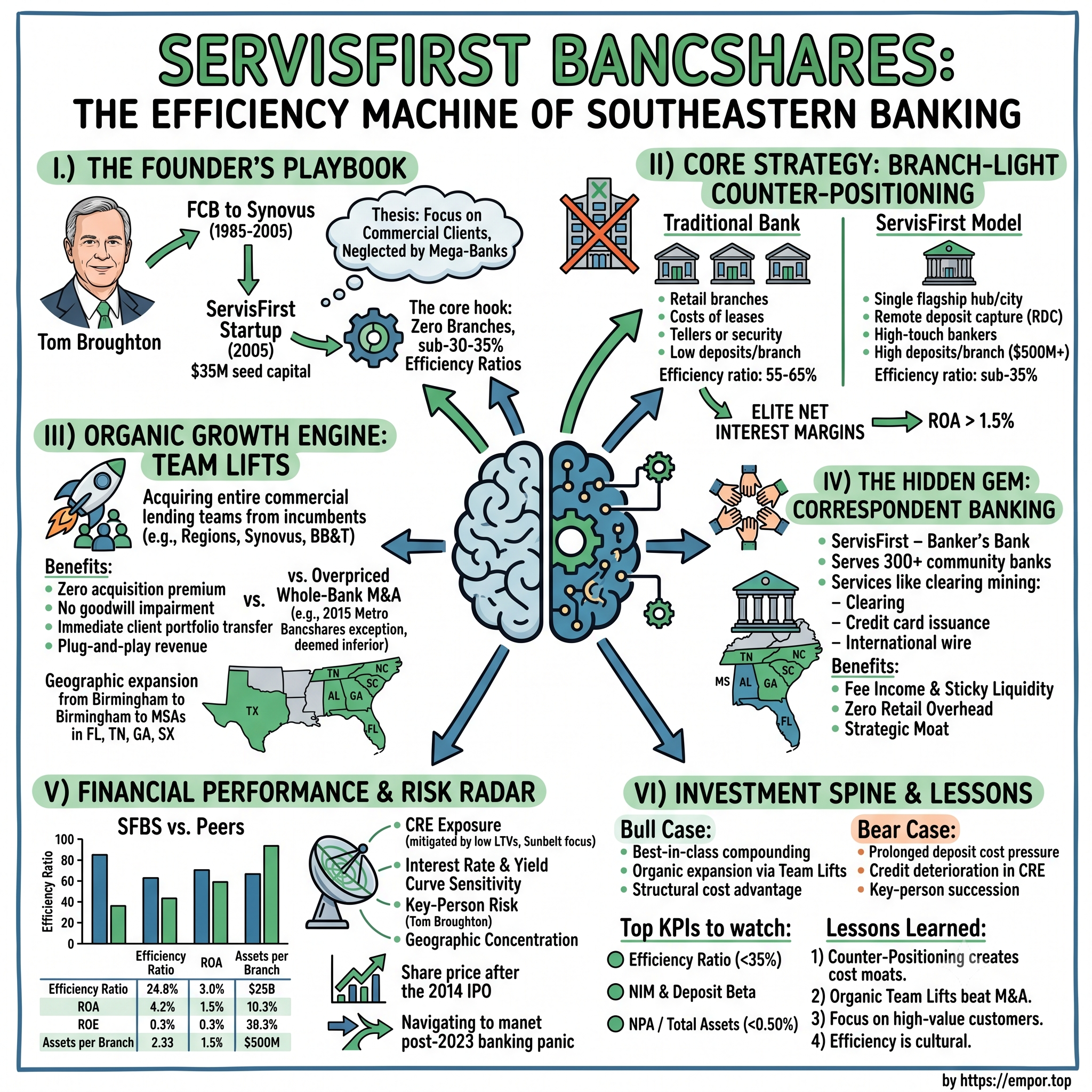
ServisFirst Bancshares: The Efficiency Machine of Southeastern Banking
I. Introduction & Episode Roadmap
In May 2005, veteran Birmingham banker Thomas A. Broughton III opened a bank in Birmingham, Alabama, with $35 million of capital, no conventional branch network, no proprietary ATM infrastructure, and no intention of competing for checking accounts tied to grocery-store loyalty cards.1 Twenty-one years later, that bank holds roughly $17.7 billion in assets, operates thirty-three offices across seven states, and employs 666 people — a workforce smaller than the back-office staffing of some regional peers.2
The central metric for ServisFirst Bancshares (NYSE: SFBS) is not its asset scale, but its efficiency ratio: noninterest expense divided by revenue. In 2025, ServisFirst operated at an efficiency ratio of 32.89%, down from 37.60% in 2024 and 40.34% in 2023.2 By the second quarter of 2026, the ratio had fallen to 29.65% — marking a third consecutive quarter below thirty percent.3 For context, a typical U.S. regional bank spends between fifty-five and sixty-five cents to produce a dollar of revenue. ServisFirst spends thirty cents. Evaluating whether this efficiency gap is structural and durable forms the primary investment question.
Management attributes this performance to structural design rather than cyclical tailwinds. For two decades, Broughton has maintained that commercial banking does not require traditional branches, that senior lenders with direct credit authority outperform distant loan committees, and that recruiting established bankers is less costly and less disruptive than acquiring institutions. While this strategy has differentiated the bank, by 2026 the model faces strain in areas outside standard bullish narratives: nonperforming assets multiplied nearly fourfold in a single year, the compensation committee awarded discretionary bonuses despite missing two of four performance targets, and executive leadership has experienced near-total turnover since late 2024.24
The roadmap begins with the founder: how Broughton developed his operating philosophy, and why Synovus's 1992 acquisition of his first bank shaped his subsequent strategy. It examines the 2005 counter-positioning strategy in an incumbent-dominated market, followed by the 2008 financial crisis, which accelerated ServisFirst's market share gains. The analysis then covers the company's 2014 initial public offering, its sole whole-bank acquisition, and management's decision to avoid subsequent bank purchases. Next is correspondent banking — a crucial yet often misunderstood component of the balance sheet — followed by the rate cycle from 2022 through 2026, which compressed net interest margins before restoring them. Finally, the narrative evaluates the loan portfolio, competitive positioning, corporate governance, key operational risks, and the core metrics defining the bank's trajectory.
The central thesis hinges on one fundamental question: is ServisFirst structurally cheaper to operate than its competitors, or is it simply smaller and more concentrated, with the costs of that concentration yet to materialize?
A key analytical framework is essential before examining the bank. Banking operations are straightforward to explain yet complex to analyze. At its core, a bank borrows short-term funds at lower interest rates, lends long-term capital at higher rates, and collects the spread as revenue. In practice, however, critical variables — including loan loss expectations, deposit cost sensitivity, and collateral valuations — rely on estimates prepared by executives whose compensation is tied to those results. The analysis that follows seeks to separate verifiable financial performance from management assertion.
 Subscribe on LinkedIn
II. The Founder & The Playbook: Tom Broughton's First Act
Understanding ServisFirst requires examining Broughton's first bank.
In 1985, Birmingham was a major banking center. Alabama had produced regional institutions like AmSouth, SouthTrust, and Central Bank, alongside a dense network of commercial lenders who maintained close personal ties to local business leaders. Broughton co-founded and ran First Commercial Bank — a de novo institution built on the premise that mid-sized Alabama businesses wanted local lenders empowered to make credit decisions locally.5
The strategy succeeded, and Synovus Financial Corp. acquired the bank in 1992.5 That transaction became the defining catalyst for ServisFirst's future strategy. Rather than departing, Broughton remained at Synovus for twelve years, eventually serving as a regional chief executive across three states before retiring in 2004.5 He spent over a decade inside the type of institution he would later compete against, observing how a nimble commercial bank operates once incorporated into a multi-state holding company.
That trajectory was unusual for a bank founder. Most selling executives either depart under non-compete agreements or transition to non-operational roles. Broughton remained an active operator, occupying a position where institutional friction is acute: holding responsibility for local earnings while key operational levers are controlled at corporate headquarters. Those twelve years provided a prolonged case study in corporate overhead. By 2004, Broughton had gained direct insight into the cost structures, credit approval workflows, compensation grids, and recruiting vulnerabilities of large regional banking institutions.
In his assessment and the historical record of that era, large bank holding companies accumulated significant structural overhead: branch networks built for physical cash handling, credit committees operating on fixed schedules rather than client demand, and compensation models favoring product cross-selling over relationship depth. Furthermore, acquisitions created multi-year integration hurdles as institutions merged core technology systems, corporate cultures, and underwriting policies — distracting management while competitors targeted their top talent.
The market gap Broughton identified focused on mid-market commercial borrowers generating annual revenues between $2 million and $250 million — a target client segment ServisFirst continues to serve.2 These middle-market companies were often too small to warrant corporate coverage from money-center banks, yet too large for the legal lending limits of small community banks. Rather than requiring extensive branch networks, these clients prioritized dedicated lenders capable of issuing credit decisions efficiently. Crucially, commercial operating accounts maintained substantial, sticky deposit balances relative to their servicing costs, generating funding without the overhead of retail branch infrastructure.
The second core insight centered on lender talent acquisition. Broughton's business model relied on recruiting experienced commercial lenders by offering greater underwriting autonomy.6 Because commercial lending relationships often follow individual bankers rather than institution brands, hiring established lenders enabled the bank to acquire client portfolios without paying M&A control premiums, absorbing unvetted loan assets, or recording intangible goodwill on the balance sheet.
The resulting strategy eliminated retail consumer banking to focus exclusively on business owners, real estate developers, professional firms, and their associated private accounts. The bank sought to compete on execution speed rather than physical branch proximity, offering competitive compensation and credit authority to lenders while maintaining a low-overhead operating structure.
A third structural component involved alignment of incentives. Broughton structured compensation to reward direct production across a broad range of activities. When executive management sought to expand non-interest income years later, adding loan fee collection to banker incentive metrics drove a 40% annual increase in loan fees.7 Directly aligning lender compensation with revenue generation created an operating environment distinct from traditional salaried product distribution teams.
That was the blueprint in 2004. The remaining challenge was securing the capital to execute it.
III. Founding ServisFirst & The "Branch-Light" Counter-Positioning (2005–2008)
Broughton and his team secured that capital in May 2005, launching ServisFirst Bank in Birmingham with $35 million — at the time the largest amount ever raised by a de novo bank in Alabama.16 The investor base was integral to the strategy. As an early market chief executive noted in a 2009 release, the institution operated as a "client-owned bank" in which business-owner investors brought operating accounts and referrals alongside their equity investments.1 This structure allowed the capital raise to function simultaneously as a customer acquisition channel, aligning the depositor base directly with equity shareholders from inception.
The bank's operating design was deliberately lean, establishing a single substantial office per metropolitan market instead of an extensive branch network. Remote deposit capture enabled corporate controllers to scan checks directly from their offices, while treasury and cash management services were delivered electronically. Senior lenders held substantial individual approval authority, with larger credit decisions escalating to a regional chief executive officer and senior management only when a relationship exceeded the officer's limit.2 ServisFirst describes this operational framework as a "uniform, centralized back office risk and credit platform to support a decentralized decision-making process executed locally by our regional chief executive officers" — centralizing back-office functions for scale while keeping credit execution local for speed.2
This counter-positioning generated a distinct economic structure. Traditional retail branches operate as fixed-cost nodes, where facilities, teller staffing, physical security, and infrastructure costs remain relatively constant whether a location holds $30 million or $130 million in deposits. By contrast, a commercial banking office functions as a variable-cost node centered on production-based lender compensation. While retail models must build additional branches as deposit volume grows, commercial offices scale deposit volume within existing locations. ServisFirst carries an average of roughly $430 million in deposits per banking office, reflecting the structural design of its branch-light footprint.2
The bank expanded selectively across Alabama, opening offices in Huntsville in August 2006, Montgomery in June 2007, and Dothan in October 2008.1 Each market entry followed a standardized template: recruit a regional chief executive with established local relationships, establish a single location, and gather commercial deposits alongside credit relationships. By late 2008 — three and a half years after launch — ServisFirst surpassed $1 billion in total assets.1
Rapid balance-sheet expansion in 2006 and 2007 created credit risk for many Southeastern institutions, where growth was heavily concentrated in residential land development loans that subsequently triggered numerous bank failures during the 2008 financial crisis. ServisFirst avoided this trajectory by concentrating its lending in commercial and industrial accounts and owner-occupied real estate rather than speculative land acquisition. Funding discipline was similarly conservative; for example, when the Montgomery office reached $150 million in assets, management highlighted that it had done so without using brokered deposits — a common funding mechanism for aggressive regional lenders during that period.1
A structural feature originating in this period remains visible on the balance sheet. ServisFirst maintains several subsidiaries that manage participations in residential mortgages and commercial real estate loans originated by the bank across Alabama, Florida, Georgia, and Tennessee, with each subsidiary electing real estate investment trust status for U.S. income tax purposes.2 While these entities are fully consolidated into reported financial results and represent a standard state-tax management practice among multi-state institutions, the arrangement indicates that a portion of ServisFirst's reported return on equity stems from tax optimization rather than core banking operations — a dynamic that recurs in the company's later use of purchased tax credits.
Equally important was the lending ServisFirst declined to pursue. The bank avoided building a large residential mortgage origination platform and eschewed subprime and Alt-A lending entirely. The company's annual disclosures reiterate that ServisFirst has not originated and does not expect to originate such loans.2 While this restraint limited short-term fee generation during the real estate boom, it preserved asset quality when credit markets collapsed.
That underwriting discipline positioned the bank for the financial crisis that followed.
IV. The Great Financial Crisis: Turning Chaos Into Scale (2008–2014)
Consider the Southeastern banking landscape in early 2010. Colonial BancGroup — headquartered in Montgomery, Alabama, and once one of the region's largest institutions — had been seized by regulators the previous August in what was then among the largest bank failures in U.S. history. Georgia led the nation in bank failures, driven predominantly by residential acquisition, development, and construction loans backed by land that no longer had buyers. Surviving regional banks were consumed by three simultaneous emergencies: preserving capital, working through nonperforming loans, and integrating hastily acquired failed institutions.
Each of those emergencies presented an operational distraction — and for an unencumbered competitor, distraction represented market opportunity.
ServisFirst entered this period with an advantage no incumbent possessed: a clean balance sheet free of legacy assets. Every loan on its books had been underwritten after 2005 by the executives still running the bank. The institution held no late-1990s land development portfolio to work out, no acquired loan book underwritten by third parties, and no mortgage-servicing division facing regulatory scrutiny. ServisFirst did issue $40 million of Non-Cumulative Perpetual Preferred Stock, Series A, to the U.S. Treasury under the Troubled Asset Relief Program (TARP) — capital it maintained until redeeming the full $40 million liquidation value in 2015.8 Rather than obscuring this history, the record shows ServisFirst utilized federal crisis capital much like hundreds of solvent banks, deploying those funds to expand while competitors contracted.
The bank's primary growth engine during this era was an industry strategy known as a "team lift." When a regional bank enters capital-preservation mode, lending slows or stops. Commercial bankers — whose compensation and career progression depend on deal volume — become open to recruitment. These hires often occur not individually, but in intact teams comprising relationship managers, credit analysts, and treasury management specialists.
The economics of a team lift contrast sharply with whole-bank acquisitions. In a traditional bank purchase, an acquirer pays a premium over tangible book value, creates goodwill that poses ongoing impairment risk, inherits unfamiliar loan portfolios, assumes unwanted branch leases, and endures lengthy technology integration cycles. In contrast, hiring an established team incurs salaries, incentive compensation, and occasional sign-on structures that flow through the income statement over time rather than inflating the balance sheet up front. The institution acquires client relationships without taking on legacy loans or structural integration hurdles.
However, a team lift also represents an uncollateralized bet on talent. No legal mechanism guarantees that a hired banker's clients will transfer their accounts to the new institution. If relationships fail to move, the hiring bank simply absorbs higher operating expenses. Furthermore, the portability that enables ServisFirst to recruit talent from regional incumbents like Regions Financial or Synovus allows competitors such as Pinnacle Financial Partners or SouthState to recruit from ServisFirst in turn. Team lifts represent a repeatable growth tactic rather than a structural competitive moat — a distinction critical to evaluating the bank's long-term positioning.
This opportunistic recruiting strategy dictated ServisFirst's geographical footprint across the Sunbelt. Expanding out of Birmingham, the bank established presences in Huntsville, Montgomery, Mobile, and Dothan, while crossing state lines into Pensacola, Florida, and Nashville, Tennessee. By the time the company filed for its initial public offering in 2014, it operated twelve full-service banking offices across the Birmingham-Hoover, Huntsville, Montgomery, Dothan, and Mobile markets in Alabama, as well as Pensacola and Nashville.5
The financial metrics from this period provide empirical backing for the model, having been generated during a severe credit downturn. For the year ended December 31, 2013, ServisFirst reported a 38.78% efficiency ratio, a 1.32% return on average assets, and an 18.30% return on average common equity on approximately $3.5 billion in total assets.5 Delivering an eighteen percent return on equity in 2013, when much of the banking sector struggled to cover its cost of capital, demonstrated a distinct operational profile.
That performance requires analytical context common to rapidly growing lenders. In a loan book expanding at thirty percent annually, the vast majority of credit assets are seasoned for only a short duration, and newly originated loans rarely default immediately. Rapid balance-sheet growth mechanically suppresses nonperforming asset ratios through an expanding denominator. While ServisFirst's crisis-era execution was strong, those early credit metrics were aided by rapid portfolio growth that does not directly apply to a mature loan book compounding in the single digits. The bank's 2025 credit experience, evaluated later in this narrative, illustrates the performance of a more seasoned portfolio.
Ultimately, the post-crisis era demonstrated that ServisFirst's low-overhead operating structure could deliver superior efficiency under macroeconomic stress. What it had not yet proved was whether that advantage would persist as the bank scaled, navigated credit seasoning within its own portfolio, and managed eventual leadership transitions.
V. Going Public & Capital Deployment: Organic Discipline vs. M&A (2014–2019)
The initial public offering was straightforward and modest in scale. On May 13, 2014, ServisFirst Bancshares priced 625,000 shares at $91.00 apiece, generating $56.9 million in gross proceeds and approximately $53.5 million in net proceeds before expenses, with an underwriters' option for 93,750 additional shares.5 Common shares began trading on the Nasdaq Global Select Market under the ticker SFBS on May 19.5
Relative to the institution's asset base, the capital raise was small. ServisFirst held approximately $3.6 billion in total assets at the time, selling equity equivalent to roughly 1.5% of its balance sheet.5 Management outlined no specific acquisition targets, earmarking net proceeds for general corporate purposes.5 Rather than a capital-raising event intended to fund aggressive expansion, the listing primarily established public market liquidity for existing shareholders, provided an equity currency for employee compensation, and created a transparent public benchmark for evaluating the operating model.
Insider alignment was substantial at listing, with directors and executive officers holding 13.95% of the company on a fully diluted basis.5 That insider ownership stake has since declined, a trend evaluated later in the corporate governance analysis.
Less than a year after going public, management departed from its purely organic strategy. On January 31, 2015, ServisFirst completed its acquisition of Metro Bancshares, Inc. and its subsidiary Metro Bank, marking the company's entry into greater Atlanta with two banking offices.98 ServisFirst paid total consideration of $40.3 million, consisting of $20.9 million in cash and 636,592 common shares valued at $19.4 million.8 Metro brought $203.4 million in total assets, $152.9 million in loans, and $175.2 million in deposits.8 Relative to fair-valued net assets acquired of $26.7 million, the transaction created $13.6 million in goodwill — an intangible asset that remains unimpaired on ServisFirst's balance sheet.82
The transaction valued Metro at roughly 1.5 times fair-valued net assets, representing a conservative valuation during a period when regional bank mergers frequently cleared between 1.7 and 2.0 times tangible book value. At closing, Broughton framed the move succinctly: "We at ServisFirst Bank are excited to start the year off with this merger. We welcome our newest employees and the customers we will serve in the expanding economy of Atlanta."9
Metro remains the only whole-bank acquisition in ServisFirst's history. Subsequent market entries — including expansions into Charleston, the broader Carolinas, Virginia, and Houston — were executed entirely by hiring commercial banking teams.
This reliance on organic growth reflects straightforward capital allocation. The $40 million Metro transaction added roughly $200 million in assets alongside two physical branches that required integration into an operating framework designed specifically to avoid branch infrastructure. Deployed instead toward talent acquisition, that same capital could fund numerous commercial banking teams over several years, building loan portfolios underwritten directly to ServisFirst's credit standards. Metro provided an entry point into Atlanta rather than a repeatable growth template.
A secondary constraint reinforces this approach. Large-scale bank acquisitions typically require issuing equity, yet ServisFirst's valuation has historically traded at a premium that would make issuing stock for slower-growing, lower-return institutions dilutive to earnings and book value per share. As ServisFirst noted in its 2026 proxy statement, the bank maintains "among the highest price to book ratio and price to EPS ratio of its regional bank peers."4 Structural discipline and valuation constraints have aligned to limit M&A activity.
While avoiding acquisitions preserves underwriting consistency, it also bounds growth. By relying primarily on lender recruitment, ServisFirst's expansion is constrained by the speed at which it can identify and hire productive commercial teams. As a result, the bank reached $17.7 billion in assets after twenty-one years, whereas regional peers pursuing aggressive M&A strategies expanded balance sheets to multiples of that size. Accepting slower asset compounding in exchange for higher returns on equity represents a trade-off that prioritizes profitability over absolute asset scale.
Throughout this period, operating performance remained consistent. Asset growth continued while the efficiency ratio stayed in the thirty-percent range. Management maintained a conservative dividend payout strategy — recording payout ratios of 26.88% in 2025, 29.82% in 2024, and 30.06% in 2023 — retaining roughly 70% of net income to support internal loan growth.2 For an institution generating mid-teens returns on equity, retaining earnings to fund organic portfolio expansion preserved capital flexibility.
On June 8, 2021, ServisFirst announced it would transfer its common stock listing from the Nasdaq Global Select Market to the New York Stock Exchange, where trading commenced under the SFBS ticker on June 21.10 The exchange transfer signaled the institution's evolution from a regional Alabama lender into a broader Sunbelt enterprise.
ServisFirst's conservative capital structure extended to holding company leverage. The bank has issued minimal long-term debt, placing $34.75 million of 4.00% subordinated notes due October 2030 in 2020, alongside a $30.0 million 4.50% tranche due November 2027. Management elected to redeem the 4.50% notes in the fourth quarter of 2025 to eliminate higher-cost debt ahead of 2026.211 With internal capital generation supporting asset growth, holding company borrowing remained secondary to deposit and retained-earnings funding.
The rapid balance-sheet expansion during the pandemic era subsequently tested this operational framework through interest rate volatility rather than credit losses.
VI. The Hidden Gem: Correspondent Banking as a Capital-Light Engine
Beyond its core commercial lending operations, ServisFirst operates a major correspondent banking division — effectively acting as a bank for community financial institutions. Thousands of smaller community banks across the United States require operational services that are inefficient to build internally: daily cash letter clearing, Federal Reserve account settlement, branded credit card programs, international wire processing, loan participation capacity when borrower needs exceed legal lending limits, and holding company financing. As large regional banks merged and scaled back these services, ServisFirst built a centralized national operation to capture the displaced market share.
By the fourth quarter of 2025, ServisFirst maintained 388 correspondent banking relationships, with 145 of those institutions settling directly at the Federal Reserve through its platform.7 Its agent credit card program — enabling community banks to issue co-branded credit cards through ServisFirst — served roughly 150 banks across 27 states, supported by endorsements from the American Bankers Association and twelve state banking associations, including new endorsements in Ohio and Maryland added during 2025.7 To expand its footprint, the company opened a Texas correspondent office in March 2023 under Don Dickerson, a forty-year veteran of Texas banking; by the end of 2025, that office had grown to 35 active relationships managed by two dedicated bankers.127
This division was built under Rodney E. Rushing, who has served as ServisFirst's Executive Vice President and Chief Operating Officer since February 2021. Rushing previously ran correspondent banking for ServisFirst from 2011 to 2021, following a nearly three-decade tenure at BBVA Compass, where he served as Executive Vice President of Correspondent Banking overseeing a division that served over 600 financial institutions at his departure.4 Rushing essentially recreated his former operating framework inside an institution specifically structured to prioritize capital-light institutional services.
Evaluating the financial impact of correspondent banking requires separating fee generation from balance-sheet funding. On a direct fee basis, the unit's contribution is modest. Total noninterest income for 2025 was $27.2 million against net interest income of $535.2 million.2 Credit card income — the line item most directly tied to the agent program — was $8.3 million in 2025, essentially flat compared to 2024.2 Combined, these fee streams represent roughly 1.5% of total revenue, demonstrating that correspondent banking does not function primarily as a noninterest fee engine for the bank.
Instead, the division's primary strategic value lies in low-cost institutional funding. As of December 31, 2025, ServisFirst held $1.37 billion of federal funds purchased from correspondent bank clients, down from $1.91 billion a year earlier; such balances averaged $1.80 billion through 2025 at an average rate of 4.37%.2 Representing nearly one-tenth of the total balance sheet, this liquidity is provided by institutional counterparties who maintain deposits primarily to access operational settlement services rather than to chase yield.
During the market turmoil of March 2023, Rushing outlined the underlying economics of these balances. Correspondent banks maintain non-interest-bearing demand deposit balances at ServisFirst to compensate for Federal Reserve settlement expenses. When short-term interest rates rise, correspondents shift capital from non-interest-bearing balances into interest-bearing accounts or overnight federal funds. However, because ServisFirst previously absorbed settlement fees out of earnings on those non-interest-bearing deposits, this shift is broadly neutral to overall bank profitability. As Broughton noted on that call, if interest rates fall and money moves back into demand deposits, "it will not improve our profitability. It'll be the same."12
This structural dynamic indicates that reported shifts between non-interest-bearing and interest-bearing correspondent deposits are largely optical, meaning investors should not treat correspondent demand deposits as uncompensated funding in a falling-rate environment.
Nevertheless, the franchise's deposit stickiness proved resilient during sector-wide stress. In March 2023, as commercial depositors withdrew funds across the banking system, only ten to twelve of ServisFirst's more than 340 correspondent relationships trimmed their overnight positions — reflecting routine counterparty risk management rather than systemic outflows.12 Furthermore, several correspondents drew on their ServisFirst credit lines to test them, discovering that lines at other upstream correspondents were not honored.12 In an institutional business dependent on counterparty reliability, that operational execution strengthened client retention.
Ultimately, correspondent banking functions not as a fee driver, but as a sticky funding franchise reinforced by high operational switching costs. Once a community bank integrates its daily clearing workflows into ServisFirst's platform, changing providers requires substantial operational reconfiguration. The model is capital-light because it requires almost no incremental physical infrastructure, though company disclosures explicitly flag credit exposure to correspondent banks as a counterparty risk.2
The division also creates a strategic asymmetry. While correspondent clients are nominally competitors offering commercial loans in overlapping Sunbelt geographies, in practice they serve as complements. A $300 million bank in rural Georgia encountering a credit demand beyond its legal lending limit can partner with ServisFirst to take the participation. Consequently, the correspondent business functions as a distributed origination network the company does not have to pay for, while providing management with a real-time read on credit conditions across hundreds of local markets.
Growth within this segment is constrained primarily by geographic saturation. In Alabama, where roughly ninety bank charters remained as of 2023, ServisFirst already held correspondent relationships with about sixty percent of them, with similar penetration in Georgia and Tennessee.12 That made Texas a primary target, with over four hundred community bank charters concentrated in Houston, Dallas, San Antonio, and Austin, almost none of which were ServisFirst customers.12 Opening the Texas correspondent office two and a half years prior to establishing a local commercial banking team represented a deliberate market-entry strategy, laying an operational foundation ahead of commercial expansion.
The 2023 stress test that validated this correspondent model coincided with a broader macroeconomic challenge: the rapid rise in interest rates that tested the bank's earnings model.
VII. The Regional Banking Panic, Rate Hikes & Deposit Beta Stress Test (2022–2025)
The pandemic was, for ServisFirst, a gift disguised as a crisis. Federal stimulus flooded commercial deposit accounts. The Sunbelt absorbed a historic wave of domestic migration and corporate relocation into Alabama, Florida, Georgia, Tennessee and the Carolinas. Deposits arrived faster than loans could absorb them, and the balance sheet expanded sharply.
Then the Federal Reserve raised rates 475 basis points between December 2021 and March 2023, including four consecutive 75-basis-point increases — a pace ServisFirst's then-CFO pointed out on the first-quarter 2023 call had no modern precedent. The next-largest one-year tightening, from February 1994 to February 1995, was 300 basis points delivered in smaller increments.12
Here is why that hurt a bank like ServisFirst more than it hurt a retail franchise, and it is worth being precise. A retail deposit base is slow. Consumers do not move a $4,000 checking balance to chase 200 basis points. A commercial and correspondent deposit base is fast. Corporate treasurers and bank CFOs are paid to notice rate differentials, and they move money in days. ServisFirst's funding is almost entirely commercial and institutional. Its deposit beta — the share of a rate move that passes through to deposit costs — is therefore structurally high.
Meanwhile the asset side lagged. A meaningful slice of the loan book was fixed-rate paper written in 2020 and 2021 at yields near five percent, contractually locked while funding costs climbed. The result was net interest margin compression: 2.81% in 2023 and 2.82% in 2024, against 3.12% in 2025.2 For a bank whose entire earnings model is spread income on a low cost base, a thirty-basis-point margin gap on a $16 billion balance sheet is the difference between a great year and an ordinary one.
Management's response through 2022 and 2023 was to slow down deliberately. Broughton said as much on the April 2023 call: the bank began throttling loan growth in the middle of 2022 once it became clear Fed tightening would create industry problems, and the first quarter of 2023 was the first non-pandemic quarter in which loans did not grow.12 Simultaneously the credit team was aggressively repricing existing fixed-rate loans ahead of maturity — roughly $130 million repriced at an average pickup of 1.4% in the first quarter of 2023 alone, plus over $70 million of early fixed-rate paydowns.12 More than eighty percent of new originations that quarter were variable rate, at an average new-loan yield of 7.71%.12
Then came March 2023 and the failures of Silicon Valley Bank and Signature Bank, and suddenly the market cared about exactly one thing: uninsured deposits.
ServisFirst's uninsured exposure is high and always has been. At December 31, 2025 the company estimated approximately $9.69 billion of uninsured deposits against $14.22 billion of total deposits — roughly sixty-eight percent.2 On a screen, that looks alarming. It is also close to inevitable for a bank whose customers are operating companies; a manufacturer's payroll account does not fit inside $250,000 of insurance.
The relevant question is not the ratio but the granularity and the reason the money is there. On the 2023 call, Rushing disclosed that excluding correspondent banks, 25% of deposits carried a credit relationship with ServisFirst, and that no industry represented a meaningful concentration — commercial banking clients about 4.7% of the deposit base, law firms roughly 3%, real estate firms about 2%, and declining from there.12 That is the opposite of the Silicon Valley Bank profile, where a single venture-backed technology cohort held enormous, correlated, non-operational balances and shared a group chat.
The bank also entered the panic without the two funding crutches that turned other institutions' problems into emergencies: no brokered deposits and no Federal Home Loan Bank advances — a position it still maintains, with $1.46 billion of cash equivalents, about eight percent of total assets, as of mid-2026.123 Its securities portfolio was short by design, with an average life of 4.2 years against a peer-group average of 7.2 years across 33 banks with more than $10 billion of assets.12 Short-duration bonds meant smaller unrealized losses, which meant the accumulated other comprehensive income hole that terrified investors elsewhere was comparatively modest here.
The company did later clean up what remained. During the second and third quarters of 2025, management deliberately restructured the bond portfolio, booking $16.4 million of securities losses in exchange for reinvesting at higher yields; by year end the remaining portfolio carried little embedded loss.27 That is a legitimate and reasonably common trade — sell low-yielding bonds at a loss, redeploy at market rates, earn the difference back over a few years. It is also, notably, the item management asked its compensation committee to exclude from adjusted earnings per share, which we will come back to.
The recovery arrived roughly on the schedule management had predicted, which is itself a data point on credibility. Margin climbed from 2.92% in the first quarter of 2025 to 3.38% in the fourth, helped by aggressive deposit repricing as the Fed cut — the company achieved an 83-basis-point deposit beta during the 2025 easing cycle — and by a 40% increase in loan fee collection after management added fee capture to banker incentives.7 "Believe it or not," the CFO observed, "people do what you incent them to do."7 By the second quarter of 2026 margin reached 3.63%, or 3.58% excluding a one-time interest recovery, up 53 basis points year over year.3
The asset-repricing tailwind is not finished but it is narrowing. As of mid-2026 management flagged roughly $2 billion of repricing opportunity over the following twelve months from scheduled maturities, normal cash flow, covenant violations and loan modifications — but the gap between the portfolio yield of 6.18% and the going-on rate of 6.32% had compressed sharply from the 130-basis-point spread available a year earlier.311 The CFO guided margin expansion down from 7–9 basis points a quarter toward 4–6 by year end.3 That is a company telling investors the easy part is over, which is the right thing to say and not what every management team says.
A second defensive feature emerged from this cycle that is easy to miss and quite valuable. Because so much new lending after 2022 was written at variable rates, ServisFirst systematically embedded interest rate floors — and by the end of 2025 roughly 86% of variable-rate loans carried floors at a weighted average rate of 4.74%.7 A floor is simply a contractual minimum: no matter how far the index falls, the loan cannot reprice below that level. In a cutting cycle, floors convert what would be a symmetric liability into an asymmetric one — deposit costs fall freely while a large share of loan yields stops falling. That is a meaningful part of why the bank was able to run an 83-basis-point deposit beta downward without giving all of it back on the asset side, and it is a design choice rather than a windfall.
The underlying rate arithmetic across the cycle is stark when laid out simply. ServisFirst's average interest-earning asset yield was 5.78% in 2025 against 5.97% in 2024 — down. Its average cost of interest-bearing liabilities was 3.44% against 4.13% — down considerably more.2 The entire 2025 earnings improvement is contained in that divergence. When it stops, so does the tailwind.
The rate story, in other words, ended well. The credit story did not.
VIII. Economics, Segment Analysis & Industry Structure
Look at the loan book and the first thing you notice is how much of it is real estate. At December 31, 2025, commercial and consumer real estate loans made up 65.8% of the portfolio.2 Break it into pieces: non-owner-occupied commercial real estate was the single largest category at $4.60 billion, or 33.6% of loans; commercial, financial and agricultural — the C&I book — was $3.15 billion, or 23.0%; owner-occupied commercial real estate $2.74 billion, or 20.0%; one-to-four family mortgage $1.67 billion, or 12.2%; construction and development $1.46 billion, or 10.6%; and consumer a rounding error at 0.6%.2
The composition matters more than the totals. Owner-occupied commercial real estate is, functionally, C&I lending with a building attached — the borrower is an operating company, the repayment source is business cash flow, and the real estate is collateral rather than the investment thesis. Combine it with C&I and you get about 43% of the book underwritten primarily on operating cash flow. Non-owner-occupied CRE, at a third of the portfolio, is the piece that depends on tenants, occupancy and cap rates.
Management has managed the aggregate exposure against capital rather than against a fixed dollar target. Income-producing CRE stood at 317% of risk-based capital in early 2023; construction and development had fallen from 100% of total risk-based capital at year-end 2022 to 93% by that March, and to 71% by the end of 2025.127 Total CRE concentration then moved from 298% of capital at March 2026 to 307% at June 2026 as loan demand recovered — a level management says leaves headroom before regulatory attention becomes an issue.3
The geographic spread of that CRE book is a useful corrective to the "Alabama bank" shorthand. At year-end 2025, Alabama held 30.8% of commercial real estate collateral, Florida 26.7%, Georgia 12.4%, Tennessee 8.9%, South Carolina 4.2%, North Carolina 3.7%, Virginia 2.0%, and other states 11.3%.2 Two states account for well over half. That is diversification relative to 2010, and concentration relative to a national lender.
A more granular way to read risk in this book is through the substandard bucket — loans internally graded as showing well-defined weakness, but not yet nonaccrual. At year-end 2025 that was $88.7 million within non-owner-occupied commercial real estate, $36.8 million in construction, $21.1 million in owner-occupied CRE and $10.0 million in one-to-four family.2 The construction figure is the one that jumps: $3.5 million a year earlier, $36.8 million at year-end 2025 — a tenfold increase on a portfolio that actually shrank by $31.7 million over the same period.2 Net charge-offs in construction were $16,000 for the year, so nothing has crystallized.2 But a shrinking portfolio with a rapidly growing problem bucket is a combination worth watching, and it received no discussion on any of the four most recent earnings calls.
Two further scale markers put the balance sheet in context. Unfunded commitments to extend credit beyond current fundings stood at $3.78 billion at year-end 2025, plus $117.4 million of standby letters of credit and $395.8 million of credit card commitments.2 Those are real obligations that convert to funded loans at exactly the moment borrowers are most stressed — the reason regulators care about them and the reason ServisFirst's insistence on holding liquidity headroom is not conservatism theater. Separately, $3.64 billion of the loan book matures within one year and another $7.38 billion within five, which is why management can talk about repricing so much of the portfolio so quickly.2 Short-dated commercial paper is the asset-side complement to fast-moving commercial deposits.
On office — the exposure everyone asked about between 2023 and 2025 — ServisFirst's answer has been consistent and, so far, borne out. Office made up roughly 3.5% of the total loan portfolio in early 2023, with an average income-producing office loan size of about $1.5 million, typically suburban one- and two-story buildings with very minimal central business district exposure.12 Small suburban medical and professional offices in Huntsville do not behave like a forty-story tower in San Francisco.
Now the cost structure, which is the reason anyone is here.
In 2025 ServisFirst produced $535.2 million of net interest income and $27.2 million of noninterest income against $185.0 million of noninterest expense.2 Salaries and employee benefits — $94.8 million — were slightly down year over year, on a balance sheet that grew.2 Total noninterest expense rose 2.1% while net interest income rose 19.8%.2 That is operating leverage in its purest textbook form, and it is why the efficiency ratio fell nearly five points in a single year.
The physical footprint explains most of it. Thirty-three banking offices supporting $17.73 billion of assets works out to roughly $537 million of assets per office.2 Right-of-use assets for leased space totaled $22.0 million and total annual net lease cost was $6.9 million — for the entire company.2 Occupancy and equipment expense across all thirty-three offices ran $14.6 million for the year.2 Put differently: ServisFirst spends less on real estate in a year than many regional banks spend on a single flagship branch renovation program.
The second driver is who the 666 employees are. Only 216 sit in the corporate office including sales and operations; 450 are in regional offices and branches.2 Management stated at the first quarter of 2026 that the company had 161 producers, and that of 32 full-time-equivalent hires over the prior twelve months, roughly 75% were frontline.11 The company is not, in the CFO's phrasing, adding back-office cost or major technology spend.3
That last point deserves scrutiny rather than applause. A bank that says it has "no additional technology that we're spending money on" is describing a genuine advantage — no legacy core conversions, no branch digital build-out — but it is also a bank that has chosen not to compete on digital product. That is coherent for a commercial franchise where the product is a banker's phone number. It becomes a vulnerability if mid-market treasury management becomes a software competition rather than a relationship one. There is no evidence in the filings that it has, and no evidence management is preparing for the possibility that it will.
Two further pieces of the economics belong here because they are the parts of ServisFirst's earnings that are not really banking at all.
The first is bank-owned life insurance. BOLI is a life insurance policy the bank owns on current and former employees; the cash surrender value builds tax-deferred, and if the policy is held to death the accumulation is permanently untaxed.2 Banks use it to pre-fund employee benefit costs, and it is entirely conventional. ServisFirst has been leaning on it heavily: BOLI income rose 55.4% to $14.8 million in 2025, boosted by a $4.3 million death benefit; the company added $150 million of new contracts in the third quarter of 2025 and another $25 million in the second quarter of 2026, and BOLI income was up 94% year over year in that quarter.23 By mid-2026, BOLI was the single largest line in noninterest income — larger than service charges, mortgage banking or credit cards. It is real, tax-efficient earnings. It is also non-operating, lumpy, and not a franchise.
The second is the tax line. ServisFirst has actively purchased federal investment tax credits — the CFO has singled out solar credits — including credits with carryback provisions, and has explicitly targeted an effective tax rate below 20%.73 The rate came in at 17.83% in the first quarter of 2026 and 19.94% in the second, with the difference attributed to the timing of credit purchases.113 This is legitimate tax planning available to any profitable bank. It is also a discretionary lever on reported earnings per share, applied unevenly across quarters, and worth watching in a period when management is being paid partly on earnings per share.
It is worth correcting a piece of the popular framing here, because the shorthand version of the ServisFirst story tends to inflate it. The company is often described as carrying roughly a billion dollars of assets per office and earning a return on assets comfortably above 1.4% through the cycle. The filings say something more modest and more interesting. Assets per office are about half that figure. Return on average assets was 1.37% in 2023, 1.39% in 2024, and 1.56% in 2025.2 The 1.9%-plus figures reported in the first half of 2026 are impressive but reflect a margin at a cyclical high point, and Broughton himself has flagged that reaching a 2% return on assets "may be tough for the last 10 basis points."3 The structural cost advantage is real and well-evidenced. The returns it produces still move with the rate cycle like everyone else's.
IX. Helmer's 7 Powers & Porter's 5 Forces Analysis
Evaluating the durability of ServisFirst's efficiency advantage requires examining the strategic bind facing traditional regional incumbents, such as Regions Financial or larger national institutions. An incumbent seeking to match ServisFirst’s cost structure by closing branch networks immediately encounters structural barriers. Traditional retail deposits — low-cost, sticky, and insured — are tied to those physical branches. Shutting down branches at scale requires writing down leases, absorbing severance and community backlash, and risking the loss of low-cost funding. Because revenue drops faster than branch overhead can be eliminated, an incumbent's efficiency ratio deteriorates before improving. This dynamic exemplifies strategist Hamilton Helmer’s concept of counter-positioning: a business model that incumbents decline to adopt not out of negligence, but because adopting it damages their legacy operations more than tolerating the challenger does.
While counter-positioning serves as ServisFirst's primary power, the protection has clear boundaries. Counter-positioning defends against traditional branch-heavy incumbents, but offers no protection against competitors built on the same branch-light blueprint, such as Pinnacle Financial Partners or Live Oak Bancshares. In its annual filing, ServisFirst identifies its five primary competitors as Regions, Wells Fargo, PNC, Truist, and Pinnacle.2 Four are legacy branch incumbents vulnerable to counter-positioning; the fifth operates on a similar commercial playbook.
Process power represents the bank's secondary competitive claim: the assertion that a uniform, centralized credit platform coupled with decentralized local approval authority yields faster credit decisions than traditional committee structures.2 While plausible and consistently emphasized by management, this advantage is largely unverifiable from external disclosures, as banks do not publish average credit turnaround times. The clearest observable proxy is pricing power — whether ServisFirst can win commercial business at premium interest rates. Broughton’s comments on the first-quarter 2026 earnings call were candid: "If a competitor is happy with a 10% return on equity, you're trying to get a 20% return on equity, he's probably going to beat you on some terms and rates," adding that this occurs "probably more than you think we would."11 This admission underscores that ServisFirst acts primarily as a price-taker at the margin, indicating that internal process efficiency has not translated into structural pricing power.
Scale economies are partially evident. Spreading a centralized back office and credit administration across an expanding balance sheet drives the efficiency ratio downward, as demonstrated in 2025 when operating expenses rose just 2% while revenue expanded by nearly 20%.2 However, operating leverage faces natural boundaries. Regulatory compliance costs step up significantly at the $10 billion asset threshold and increase again at $50 billion, placing structural limits on administrative scaling.
Cornered resource is the weakest of the four framework claims. High-performing commercial lenders recruited through performance-based compensation do not constitute a locked-in asset; rather, they participate in an open labor market where ServisFirst must continually outbid rivals. Broughton acknowledged this supply constraint in January 2026, remarking on aggressive peer expansion plans: "You read people say they're going to hire 200 new bankers this year, like from where? I don't think there was 200 good ones in the Southeast."7 A tight supply of top talent protects ServisFirst against lower-tier acquirers, but exposes the bank to intense recruiting battles against well-capitalized peers.
A broader industry analysis using Porter's Five Forces underscores these structural dynamics:
Rivalry is intense and escalating across the Sunbelt. The merger of Pinnacle and Synovus — completed on January 1, 2026, in an $8.6 billion all-stock transaction creating a roughly $117 billion pro forma institution, put a large, growth-oriented, commercially focused competitor directly across ServisFirst's core markets.13 Notably, Synovus, which acquired Broughton’s First Commercial Bank in 1992 and served as his original case study in corporate overhead, no longer exists as an independent entity.
Supplier power — exerted by commercial and institutional depositors — is structurally high, as demonstrated during the 2022–2023 rate cycle. Paying market rates on sensitive commercial deposits represents a permanent cost of operating without a retail deposit moat.
Buyer power — held by commercial borrowers — remains moderate. While middle-market clients face operational friction when transferring treasury and operating accounts, borrowers regularly shop for competitive loan pricing and execution speed.
New entrants face substantial regulatory hurdles at the charter level, keeping de novo bank formations near historic lows. However, the primary competitive threat stems not from new charters, but from rival institutions entering markets like Huntsville by recruiting established local lending teams.
Substitutes pose a subtle but growing threat. Private credit funds have moved persistently down-market from large-cap leveraged buyouts into middle-market lending. While middle-market borrowers generating under $250 million in revenue still rely on commercial banks for revolving credit lines and treasury management, any further expansion of direct lending into traditional bank products directly threatens ServisFirst's most profitable commercial and industrial loan segments.
Beyond standard frameworks, ServisFirst derives substantial durability from switching costs at the operating-account level. Integrating a commercial client’s treasury operations — including payroll files, automated clearing house processing, lockbox services, and positive-pay fraud controls — requires months of setup and significant administrative effort to dismantle. While borrowers frequently shop for competitive loan rates, operating accounts remain sticky once established. Consequently, growth in noninterest-bearing demand deposits serves as a vital indicator of franchise health, distinguishing deep commercial relationships from volatile institutional liquidity.
In sum, ServisFirst commands one primary structural advantage in counter-positioning, alongside bounded scale economies, unproven process advantages, and meaningful operating-account switching costs. While this combination establishes a formidable competitive position across Southeastern banking, it remains vulnerable to lender poaching, deposit repricing, and aggressive commercial rivals.
X. Management Credibility, Governance & Capital Deployment Track Record
Tom Broughton's communication style on earnings calls contrasts sharply with standard corporate rhetoric. He frequently grades local loan demand on a letter scale — offering assessments such as "I give it a B+" or "I guess I have to call it an A" — while declining to issue formal forward guidance on the grounds that market conditions remain unpredictable.113 When questioned in July 2026 about the bank's lender hiring pipeline, he candidly noted, "I really can't give you a very good answer, Dave... I'm sorry, I can't give you a better answer."3 Regarding a nine-figure nonaccrual loan relationship, he stated only that management anticipated "good progress in the next 2 quarters."11 Even following a quarter of 40% year-over-year earnings growth, he opened his closing remarks by noting, "We certainly were pleased with the quarter, but not satisfied."3
This restrained messaging has remained consistent across a decade of investor communications. During the regional banking turmoil of April 2023, Broughton avoided claims of immunity, instead outlining five structural reasons ServisFirst was positioned to capture market share before turning the presentation over to the chief credit officer and chief financial officer for detailed metrics.12 Management's projections during that cycle — that net interest margins would bottom and begin recovering "a couple of three quarters" after the Federal Reserve ceased rate hikes, and that loan growth would resume in the second half of the year — proved directionally accurate.12
However, the company's governance record reveals notable friction across executive stability, compensation design, and risk oversight.
Executive turnover. Since October 2024, ServisFirst has replaced its chief financial officer twice and its chief credit officer once. Kirk Pressley notified the board on October 21, 2024, that he would resign as CFO effective October 31; Edison K. Woodie III served as interim CFO until David A. Sparacio assumed the role on March 3, 2025; and on April 21, 2025, James H. Harper — previously Executive Vice President and Senior Credit Risk Officer at Cadence Bank — was appointed Chief Credit Officer, replacing Henry F. Abbott.4 Public disclosures offer no detailed context for these departures beyond reporting the changes. For an institution whose strategy relies on underwriting discipline and expense control, replacing the primary officers responsible for credit and financial management within seven months — during the same year nonperforming assets expanded nearly fourfold — introduces governance uncertainty.
Compensation discretion. Executive pay practices reveal additional governance friction. The 2025 annual incentive plan weighted earnings per share at 40%, loan growth at 30%, deposit growth at 20%, and the efficiency ratio at 10%, alongside a credit-quality modifier tied to nonperforming assets as a percentage of total assets.4 Operational results were mixed: adjusted EPS reached $5.25, meeting the minimum performance threshold; loan growth reached 8.7%, landing between target and maximum; deposit growth stood at 5.0%, falling below the 6.0% threshold; and the adjusted efficiency ratio reached 32.09%, exceeding the maximum performance target.4 Based strictly on the formula, payout calculated to 72.5% of target. However, the compensation committee exercised discretion to increase executive awards, granting supplemental bonuses of $220,964 to Broughton and $91,831 to Chief Operating Officer Rodney Rushing, citing peer outperformance, quarterly operating momentum, and ServisFirst's elevated market valuation multiples.4
This discretionary override raises two analytical concerns. First, citing valuation multiples to justify above-formula bonuses introduces circular reasoning, as market multiples reflect investor pricing rather than direct management operational achievements. Second, the adjusted EPS figure of $5.25 was reached by adding back thirty cents per share in realized losses from marketable securities, on the rationale that the bond portfolio restructuring was discretionary.4 Because that portfolio adjustment was an operational decision, excluding its economic cost removed the penalty for asset sales that would have otherwise caused GAAP diluted EPS of $5.06 to fall short of the $5.25 incentive threshold.24 Although 98.5% of voting shareholders approved the advisory say-on-pay resolution at the 2025 annual meeting, the structure highlights potential misalignment between incentive payouts and GAAP earnings.4
The credit-quality modifier. The incentive plan's risk control mechanism proved similarly permissive. The credit-quality modifier was structured to reduce compensation awards only if nonperforming assets exceeded 1.50% of total assets, with payouts fully eliminated at 2.00%.4 Because reported nonperforming assets ended 2025 at 0.97% of total assets, no compensation reduction was applied.4 Yet over that same period, nonperforming loans increased from 0.34% to 1.23% of total loans, while total nonperforming assets expanded nearly fourfold from $45.0 million to $171.4 million.2 Calibrating the modifier against total balance-sheet assets rather than loan portfolio concentration prevented a significant deterioration in credit metrics from impacting executive compensation.
Ownership & Governance. Equity ownership among leadership remains substantial, though diluted over time. As of March 25, 2026, directors and executive officers collectively held 6.5% of common shares, representing 3,579,616 shares, with Broughton holding 1.4% (788,024 shares) and director James J. Filler serving as the largest individual insider at 2.5%.4 Institutional manager BlackRock represents the sole disclosed five-percent holder, owning 13.4% of total equity.4 Although the aggregate insider position has declined from 13.95% at the company's 2014 initial public offering due to ongoing share issuance and personal portfolio diversification, insider alignment remains higher than regional bank averages.5
ServisFirst maintains no formal stock ownership guidelines for executive officers or directors. Management's proxy disclosures state that formal mandates are unnecessary because current holdings significantly exceed typical requirements — with the chief executive holding stock valued at more than 72 times his base salary and non-employee directors averaging holdings worth roughly 578 times their annual cash retainers.4 While high existing equity holdings mitigate immediate alignment concerns, the absence of codified ownership requirements leaves a governance gap for future executive successions. Additionally, proxy filings disclose that two directors have pledged company shares as loan collateral, with one director pledging shares directly to ServisFirst Bank.4
In contrast to governance friction, management's capital allocation track record demonstrates consistent discipline. The bank has prioritized organic growth by maintaining a modest dividend payout ratio, retaining roughly 70% of earnings, completing only one minor acquisition over twenty-one years, avoiding share repurchases at premium market valuations, and redeeming $30.0 million of 4.50% subordinated notes in late 2025 to eliminate higher-cost debt.72 When questioned in July 2026 regarding the deployment of accumulating excess capital, Broughton characterized the surplus as "a champagne problem," noting that prior to the pandemic, organic loan expansion rapidly absorbed excess capital reserves.3 By avoiding aggressive share repurchases at price-to-tangible-book multiples above 2.5 times while preserving capital for organic deployment, management has maintained a disciplined approach to balance-sheet management.
XI. Current Risk Radar & Earnings Call Transcript Analysis
Start with the thing that actually went wrong.
In 2025, ServisFirst's nonperforming loans rose from $42.5 million to $168.8 million — from 0.34% of loans to 1.23%. Total nonperforming assets went from $45.0 million to $171.4 million. Net charge-offs went from $10.4 million to $28.1 million, or from 9 basis points of average loans to 21.2 The 10-K attributes the increase to "a large, real-estate secured relationship."2
The calls fill in the picture. It is a single merchant developer — described on the calls as a multifamily and workforce housing sponsor — with roughly $100 million of exposure spread across eight loans and, in the credit officer's words, "literally dozens of special purpose entities."11 No borrower entity had filed for bankruptcy as of April 2026.11 Properties are being listed for sale; management stated the loans are appropriately reserved.3 The allowance for credit losses stood at 1.25% of loans at year-end 2025 and 1.26% at mid-2026.23
How to read this. The optimistic case: it is one relationship, the collateral is real, charge-offs so far have been modest — 11 basis points in the second quarter of 2026, down from 25 in the first — and net nonperforming assets fell by just under $7 million in the second quarter as several credits resolved, including the U.S. Coast Guard's purchase of a private university campus and the assumption of two other loans by a stronger borrower.311 The pessimistic case: a bank that built its brand on pristine credit through the financial crisis concentrated nine figures of exposure with a single developer running dozens of SPEs, and the workout has now been described as "slow and steady" across three consecutive quarterly calls.11 Concentration risk of this kind is not visible in a loan-mix table. It is the thing loan-mix tables are worst at showing.
The honest conclusion is that ServisFirst's credit record remains good — 21 basis points of charge-offs in a bad year is not a crisis — but the narrative of exceptional underwriting has taken real damage, and the disclosure has been thinner than the situation warrants. Investors do not know the sponsor, the markets, the loan-to-value marks, or the specific reserve against the relationship.
The other live risks, in order of how much they should move an investment view:
Commercial real estate concentration. At 307% of capital and rising, with non-owner-occupied CRE at a third of the loan book, this is the balance sheet's central exposure.32 The mitigants are real: low central-business-district office exposure, personal guarantees, annual reviews on relationships over $3.0 million, three independent third-party loan reviews per year covering 35–40% of the commercial book by commitment, and loan-level stress testing shared with the Risk Management Committee.2 The mitigants did not prevent the 2025 problem.
Interest rate positioning. Management describes the bank as roughly neutral, still slightly liability-sensitive. On the second-quarter 2026 call the CFO quantified it: a 25-basis-point increase costs about $240,000 of first-year net interest income; a 25-basis-point cut adds about $105,000.3 On a company earning north of $340 million pre-tax, that is essentially zero. The genuine rate risk is no longer directional — it is that the repricing tailwind, worth 130 basis points on maturing fixed-rate loans a year ago, is running out.113
Key-person and succession risk. Broughton is chairman, president and CEO, and has been since 2005.2 He personally recruits. He personally sets the culture. There is no publicly disclosed succession plan, no president-designate, and no named heir apparent. Given that the two most senior non-CEO roles turned over in the last two years, this is the single least-hedged risk in the story.
Geographic and sector concentration. Roughly 57% of CRE collateral sits in Alabama and Florida.2 Florida in particular carries insurance-cost and property-tax pressures on multifamily and commercial assets that have no analogue in the company's Alabama book.
Regulatory and disclosure items. The CFPB's Section 1071 small-business lending data rule, finalized March 30, 2023, remains an implementation cost with subsequent rulemaking activity ongoing.2 The FDIC special assessment recovering Silicon Valley Bank and Signature losses ran through the expense line, and a $1.2 million favorable revision to it flattered first-quarter 2026 other operating expense — management told analysts not to model that run rate forward.211 Check fraud is explicitly named in the 10-K as an ongoing source of losses.2 The effective tax rate has been managed below 20% through purchases of investment tax credits, largely solar, with carryback provisions — a legitimate strategy, but one that makes the tax line lumpy and partly discretionary.37
Liquidity structure. Approximately 73% of the bank's liabilities are checking and other liquid deposits payable on demand, while 77% of assets are loans that cannot be sold in the same timeframe.2 Every bank has this mismatch; ServisFirst's is on the wide side, offset by $2.12 billion of liquid assets, $3.20 billion of FHLB borrowing capacity against pledged loans, and $2.30 billion at the Federal Reserve Bank of Atlanta.2 Notably, in mid-2026 management disclosed that at regulators' request it now applies a haircut to unpledged securities in its published liquidity supplement — a small disclosure that quietly tells you supervisors are paying attention to this exact question.3
Governance and audit signals. Nothing in the record suggests an accounting problem. Forvis Mazars, LLP serves as independent registered public accounting firm, put to shareholders for ratification at the May 2026 annual meeting.4 There have been no restatements, no going-concern language, and no material weakness disclosures. The accounting judgments that matter most are the ordinary ones for a bank — the CECL allowance, which requires estimating expected credit losses over the full contractual life of every loan, and the fair-value marks on collateral supporting individually evaluated impaired loans.2 Both are genuinely subjective, and both are currently doing heavy lifting on a nine-figure problem relationship. That is not an allegation; it is where an investor should focus if the numbers start moving.
The Texas execution risk. Houston is the largest regional start-up in company history, and management has been candid that it is currently dilutive. The CFO described it plainly: Houston's loans, business and deposits "are not ramping up as quickly as their expenses are. This is a natural evolution of building out a franchise."3 By the second quarter of 2026 the team had funded roughly $50 million of loans and $25–30 million of deposits.3 That is a fine start and a long way from the multi-billion ambition. The risk is not that Houston fails outright; it is that a large fixed cost base sits in place for several years while the revenue arrives more slowly than budgeted, which is exactly what happens to most out-of-region bank expansions and exactly what the efficiency ratio would show first.
What the Q&A reveals that the prepared remarks don't: analysts in 2026 are pressing on three things — how much margin expansion remains, whether the efficiency ratio can hold below thirty percent while Houston is a cost center, and when the big nonaccrual resolves. Management's answers have been specific on the first two and consistently vague on the third. On the efficiency ratio, the CFO has been notably willing to talk his own numbers down: "we're not going to dip too much lower than where we are," and on whether sub-30% holds, "I mean that's going to be a challenge."113 That is guidance discipline, and it stands in useful contrast to the compensation committee's enthusiasm.
XII. The Investment Spine: Bull vs. Bear Case & Key KPIs
Why this wins from here.
The cost advantage is not a claim; it is in the audited numbers, sustained across a full rate cycle, and it compounds. In 2025 revenue grew nearly 20% while expenses grew 2%.2 The reason that is repeatable rather than a one-off is structural: incremental growth at ServisFirst requires bankers, not buildings. A new $500 million market costs a handful of salaries and 26,000 square feet of leased space, which is what Houston cost.11
The recruiting environment is unusually favorable. The Southeast and Southwest are in a merger wave — Pinnacle and Synovus completed in January 2026, Cadence has been active, and Broughton notes constant private-to-public bank consolidation that never makes headlines.133 Every merger creates a cohort of senior bankers with a one-year stay-pay clock and a deteriorating client-service story to sell against. Broughton's line — "none of these bank mergers are done to improve customer service" — is self-serving and also true.3 The company added nine bankers in the second quarter of 2026 alone, across the Carolina Piedmont, Northwest Florida and Houston.3
The Texas expansion is the largest single organic bet in company history: nine bankers in December 2025, eighteen by March 2026, a market president and regional CEO added in the second quarter, roughly $50 million of loans and $25–30 million of deposits funded in the second quarter, an almost entirely C&I orientation, and a budgeted 2026 growth rate higher than any other region.7113 Asked what Houston could be in three to four years, Broughton indicated billions rather than millions.11 That is an unverified forecast from a founder with a good track record, and should be weighted accordingly.
The correspondent franchise continues to add relationships in states where merger activity is destroying incumbent correspondent providers, and the American Bankers Association endorsement of the agent card program is a distribution advantage a competitor cannot simply buy.7
Why it might not.
Start with the valuation, because it is doing more work in the bull case than most people acknowledge. ServisFirst's own proxy notes the company carries among the highest price-to-book and price-to-earnings multiples in its peer group.4 Tangible book value per share was $35.94 at June 30, 2026.3 A premium of this size prices in continued mid-teens book value compounding, continued sub-33% efficiency, and no credit surprises. Two of those three assumptions were tested in 2025 and one of them failed.
The margin tailwind is finite and narrowing on management's own math.3 Deposit growth has been the persistent soft spot — 5.0% in 2025, below the incentive plan's own threshold, and only $62 million of linked-quarter growth in the second quarter of 2026 against $533 million of loan growth.43 The loan-to-deposit ratio is rising toward 100%. Broughton's framing — "we always want to be in a position where we need deposits" — is a genuine philosophy, but a commercial bank that needs deposits in a competitive market pays for them, and paying for them is precisely how the cost advantage erodes.
Credit is the live question. A single relationship approaching $100 million, eight loans, dozens of SPEs, three quarters of "slow and steady" workout commentary, and nonperforming loans still above 1% of the book.1132
The recruiting model is a competitive process, not a moat, and Broughton has publicly stated the talent pool is thin.7 Every bank in the Southeast is running the same play.
There is also a subtler cultural risk in the current hiring push. ServisFirst's cost advantage depends on a specific behavioral norm — bankers who produce, who do not need layers of support staff, and who accept that back-office headcount will not grow to accommodate them. Importing an entire eighteen-person team from a different institution in a market a thousand miles from Birmingham, and then adding a market president on top, is the largest cultural transplant the company has ever attempted. Broughton's own framing is that the bank hires "bankers who embrace the culture of ServisFirst."3 That is the right filter. It is also the hardest thing to verify from outside, and the efficiency ratio is the only place it will eventually show up.
And the founder is the strategy. Twenty-one years in, with no disclosed succession plan and both the CFO and CCO seats having turned over recently, key-person risk is concentrated and unmitigated.
The activist stress test. Imagine a concentrated fund taking a position and writing a letter. What would it say? Probably four things. First, that the board granted discretionary bonuses in a year when the largest incentive metric only met threshold and deposit growth missed outright, and that it justified this partly by pointing to the share price — a governance error of category, not degree.4 Second, that the credit-quality modifier is calibrated so loosely as to be decorative, and should be reset to a level that would actually have bitten in 2025.42 Third, that a company reporting a nine-figure nonaccrual relationship across eight loans and dozens of special purpose entities owes shareholders more disclosure than three quarters of "slow and steady," and that the absence of a named sponsor, updated collateral marks, or a specific reserve is a disclosure choice rather than a legal constraint.11 Fourth, that a company with a founder-CEO who has personally been the strategy for two decades, no stock ownership policy, and no articulated succession plan is carrying an entirely avoidable governance discount.4
What the activist would not find is the usual ammunition: no portfolio complexity, no underperforming segments to spin off, no leverage to criticize, no related-party transactions of consequence beyond ordinary-course director lending, no empire-building M&A, and a capital allocation record of retention and organic reinvestment that is close to a model of the type.42 The bear case here is about disclosure, board discipline and concentration — not about strategy.
The metrics that actually matter. Not a dashboard — three numbers, and they answer three distinct questions.
One: the efficiency ratio. This is the thesis in a single figure. It answers whether the structural cost advantage is intact. It ran 29.65% in the second quarter of 2026 against 32.89% for full-year 2025, with management guiding to a 30–33% range for 2026 as Houston absorbs cost.327 If it drifts persistently into the high thirties without a specific investment explanation, the counter-positioning case is weakening.
Two: nonperforming assets relative to loans, alongside net charge-offs. This answers whether the credit reputation is being repaired or eroded. Nonperforming assets were 1.25% of loans plus other real estate at year-end 2025 against 0.36% a year earlier; net charge-offs were 21 basis points for 2025 and 11 basis points annualized in the second quarter of 2026.23 The direction of the first number over the next four quarters — as the large developer relationship resolves or doesn't — is the single most informative data point available.
A note on what not to track. Quarterly earnings per share at ServisFirst is a noisy number, and 2025 and 2026 demonstrate exactly why: a $4.3 million one-off insurance death benefit inflated the fourth quarter of 2025; a $1 million prior-period insurance adjustment deflated the first quarter of 2026; a $1.9 million interest recovery on a resolved nonaccrual added five basis points to the second quarter of 2026 margin; securities restructuring losses ran through 2025; and the effective tax rate swings on the timing of tax credit purchases.1132 None of those tell you anything about the franchise. The three metrics above do.
Three: deposit growth, specifically noninterest-bearing deposit growth, relative to loan growth. This answers whether the franchise is funding itself or buying funding. Noninterest-bearing demand deposits grew 13.8% year over year at mid-2026 while total deposits grew 5%.3 If the noninterest-bearing line keeps outgrowing the total, ServisFirst is winning operating relationships and the margin is defensible. If total deposit growth is being carried by time deposits and rate-sensitive money, the model's cost advantage is being funded from the liability side, which it cannot be indefinitely.
XIII. Playbook: Business & Investing Lessons
Counter-positioning is defined by what the incumbent cannot un-choose. ServisFirst's advantage does not stem from clever branch design. It arises because a regional competitor managing four hundred branches and thirty years of retail deposit relationships cannot transition to a branch-light commercial model without destroying the physical infrastructure supporting its current business. When evaluating any challenger claiming a structural cost advantage, the key test is not whether the new model is superior, but what specific assets an incumbent would have to write off to copy it — and whether that cost is high enough to deter imitation.
Hiring talent is a fundamentally different asset class from acquiring companies. A team lift converts a balance-sheet transaction into an income-statement line item: avoiding goodwill, purchase accounting, technology integration, and inherited credit exposure. However, it is also inherently less permanent, as an institution acquires an option on client relationships rather than a contractual claim to them. ServisFirst's single acquisition in twenty-one years generated $13.6 million of goodwill that has remained unimpaired for a decade; the more instructive lesson is that management reviewed that result and still concluded it was a less effective deployment of capital than organic lender recruitment.8
Customer selection drives cost structure more than operational frugality. ServisFirst's low efficiency ratio is not primarily the result of lean administrative discipline. It is the outcome of targeting middle-market commercial clients who maintain $500,000 operating balances rather than retail consumers with $4,000 checking accounts. A lean headcount can thus support a far larger volume of interest-earning assets. Before attributing efficiency to superior cost control, analysts should evaluate whether the cost advantage was decided upstream in the choice of client segment.
Funding structure represents the deferred bill for a high-efficiency asset model. The trade-off of a commercial and institutional deposit base is that it is professional, mobile, and highly rate-sensitive. ServisFirst's margin compression during the 2022–2023 Federal Reserve tightening cycle was not an operational error, but the contractual price of its funding design, exacted when interest rates rose rapidly. Any financial institution relying on sophisticated corporate depositors will find that sophistication expensive precisely when market liquidity tightens.
Concentration risk hides in relationship structures rather than loan categories. ServisFirst's balance sheet appears well diversified across five primary loan categories, seven Sunbelt states, and numerous industry sectors. Yet the single developer relationship that expanded nonperforming assets nearly fourfold in 2025 remained invisible in standard portfolio disclosures because the borrower operated across dozens of separate legal entities. Category diversification and counterparty concentration represent distinct risks, and standard loan-mix tables reflect only the former. When a commercial lender experiences a sudden credit deterioration after years of strong asset quality, the primary catalyst is far more often concentrated counterparty exposure than a broad macroeconomic decline.
Incentive design reveals board oversight far more accurately than corporate governance declarations. Establishing a credit-quality compensation modifier at 1.50% of total assets in a year when nonperforming loans nearly quadrupled, combined with exercising board discretion to award above-formula bonuses after missing two of four performance targets, provides an empirical record of governance enforcement.4 These structural dynamics remain fully disclosed in proxy filings for investors willing to analyze them.
XIV. Epilogue & Final Verdict
There is a historical symmetry to where this story arrives. Tom Broughton built First Commercial Bank in 1985, sold it to Synovus in 1992, spent twelve years inside an incumbent system learning what he did not want to emulate, and left in 2004 to build its antithesis.5 On January 1, 2026, Synovus itself ceased to exist as an independent entity, absorbed into Pinnacle Financial Partners in an $8.6 billion all-stock merger.13 ServisFirst's regulatory disclosures now list its fifth-largest competitor as Pinnacle Financial Partners, Inc., noting its legacy identity as Synovus Financial Corp.2 The institution that acquired Broughton's first bank has itself been acquired.
Today, ServisFirst operates as a $17.7 billion commercial bank with thirty-three offices across seven states and a lean staff of 666 employees. For 2025, the company generated a 1.56% return on average assets and a 16.05% return on equity, ranking fifth among American Banker's top-performing publicly traded institutions with $10 billion to $50 billion in assets based on a three-year average return on equity of 16.95% — down from fourth place the prior year.214 The bank continues to fund its balance sheet through core deposits, maintaining zero reliance on brokered deposits or Federal Home Loan Bank advances while deploying the largest single-market expansion in its history into Houston, Texas.3
The bull case relies on empirical results rather than management assertion: two decades of maintaining an efficiency ratio roughly half the regional banking average. ServisFirst built that track record across the 2008 financial crisis, the pandemic, the steepest monetary tightening cycle in four decades, and the 2023 regional banking panic — all executed without a significant equity raise since its 2014 initial public offering or a whole-bank acquisition since 2015.
Equally notable is management's strategic consistency. The core narrative presented to investors in 2026 mirrors the strategy outlined at its listing: prioritize organic growth, recruit established commercial lenders, keep overhead low, avoid M&A, and skip brokered deposits or wholesale borrowing. While narrative consistency alone does not guarantee future performance, erratic strategic shifts often signal emerging weakness — a flaw absent from ServisFirst's public record. Executive commentary on macroeconomic conditions has evolved alongside rate cycles, but the underlying operating formula has remained unchanged since the initial public offering.
The bear case does not question the validity of the branch-light model, but rather its long-term durability. The key drivers of ServisFirst's historical performance — a founder who embodies the corporate culture, an underwriting reputation recently strained by a single nine-figure nonaccrual relationship, a lender recruiting model that well-capitalized rivals can emulate, and a rate-sensitive commercial deposit base — are each more vulnerable than a sub-thirty-percent efficiency ratio suggests.
For long-term investors, the central analytical task is separating institutional design from key-person dependence. The cost structure functions as a durable system embedded in the branch-light footprint, lean staffing mix, modest lease commitments, and incentive structures — none of which require a single executive to operate. In contrast, the organic growth engine remains heavily reliant on Broughton's personal reputation and ability to recruit veteran lenders across Sunbelt markets. Operating systems survive leadership transitions; personal networks and executive reputations generally do not.
Twenty-one years after its founding, ServisFirst's efficiency model remains operational and highly profitable. The ultimate question for investors is whether that performance stems from a self-sustaining institutional framework, or from a uniquely talented founder executing a single sound strategy out of a headquarters in Birmingham.
References
-
ServisFirst Bank Montgomery Hits $150 Million in Assets — ServisFirst Bancshares SEC filing exhibit, 2009-01-09 ↩↩↩↩↩↩
-
ServisFirst Bancshares, Inc. Form 10-K for fiscal year 2025 — SEC EDGAR, 2026-02-27 ↩↩↩↩↩↩↩↩↩↩↩↩↩↩↩↩↩↩↩↩↩↩↩↩↩↩↩↩↩↩↩↩↩↩↩↩↩↩↩↩↩↩↩↩↩↩↩↩↩↩↩↩↩↩↩↩↩↩↩↩↩↩↩↩↩↩
-
ServisFirst Bancshares Q2 2026 Earnings Call Transcript (July 20, 2026) — Seeking Alpha SFBS transcripts archive ↩↩↩↩↩↩↩↩↩↩↩↩↩↩↩↩↩↩↩↩↩↩↩↩↩↩↩↩↩↩↩↩↩↩↩↩↩↩↩↩
-
ServisFirst Bancshares, Inc. Definitive Proxy Statement (DEF 14A) — SEC EDGAR, 2026-04-06 ↩↩↩↩↩↩↩↩↩↩↩↩↩↩↩↩↩↩↩↩↩↩↩↩
-
ServisFirst Bancshares, Inc. Prospectus, Rule 424(b)(4) (IPO) — SEC filing via ServisFirst Bancshares, 2014-05-13 ↩↩↩↩↩↩↩↩↩↩↩↩
-
Tom Broughton Shares the ServisFirst Bank Story — Birmingham Rotary Club ↩↩
-
ServisFirst Bancshares Q4 2025 Earnings Call Transcript (January 20, 2026) — Seeking Alpha SFBS transcripts archive ↩↩↩↩↩↩↩↩↩↩↩↩↩↩↩↩↩
-
ServisFirst Bancshares, Inc. Form 10-K for fiscal year 2015 — SEC EDGAR, 2016-02-24 ↩↩↩↩↩↩
-
ServisFirst Bancshares, Inc. Announces Closing of Metro Bancshares Acquisition — PR Newswire, 2015-01-31 ↩↩
-
ServisFirst Bancshares, Inc. Announces Transfer Listing of Common Stock to the New York Stock Exchange — GlobeNewswire, 2021-06-08 ↩
-
ServisFirst Bancshares Q1 2026 Earnings Call Transcript (April 20, 2026) — Seeking Alpha SFBS transcripts archive ↩↩↩↩↩↩↩↩↩↩↩↩↩↩↩↩↩↩↩↩
-
ServisFirst Bancshares Q1 2023 Earnings Call Transcript (April 17, 2023) — Seeking Alpha SFBS transcripts archive ↩↩↩↩↩↩↩↩↩↩↩↩↩↩↩↩↩
-
Pinnacle and Synovus Complete Merger to Become Regional Bank Growth Champion — Synovus, 2026-01-02 ↩↩↩
-
ServisFirst Bancshares, Inc. Ranks Fifth Among Top Publicly Traded Banks with between $10 Billion to $50 Billion in Assets — ServisFirst Bancshares, 2025-07-28 ↩
 LinkedIn
 WhatsApp
 Reddit
 Hacker News
 Email
Email Kindle
 RSS Feed
 Spotify
 Apple Podcasts
 Amazon Music
 Audible
 YouTube