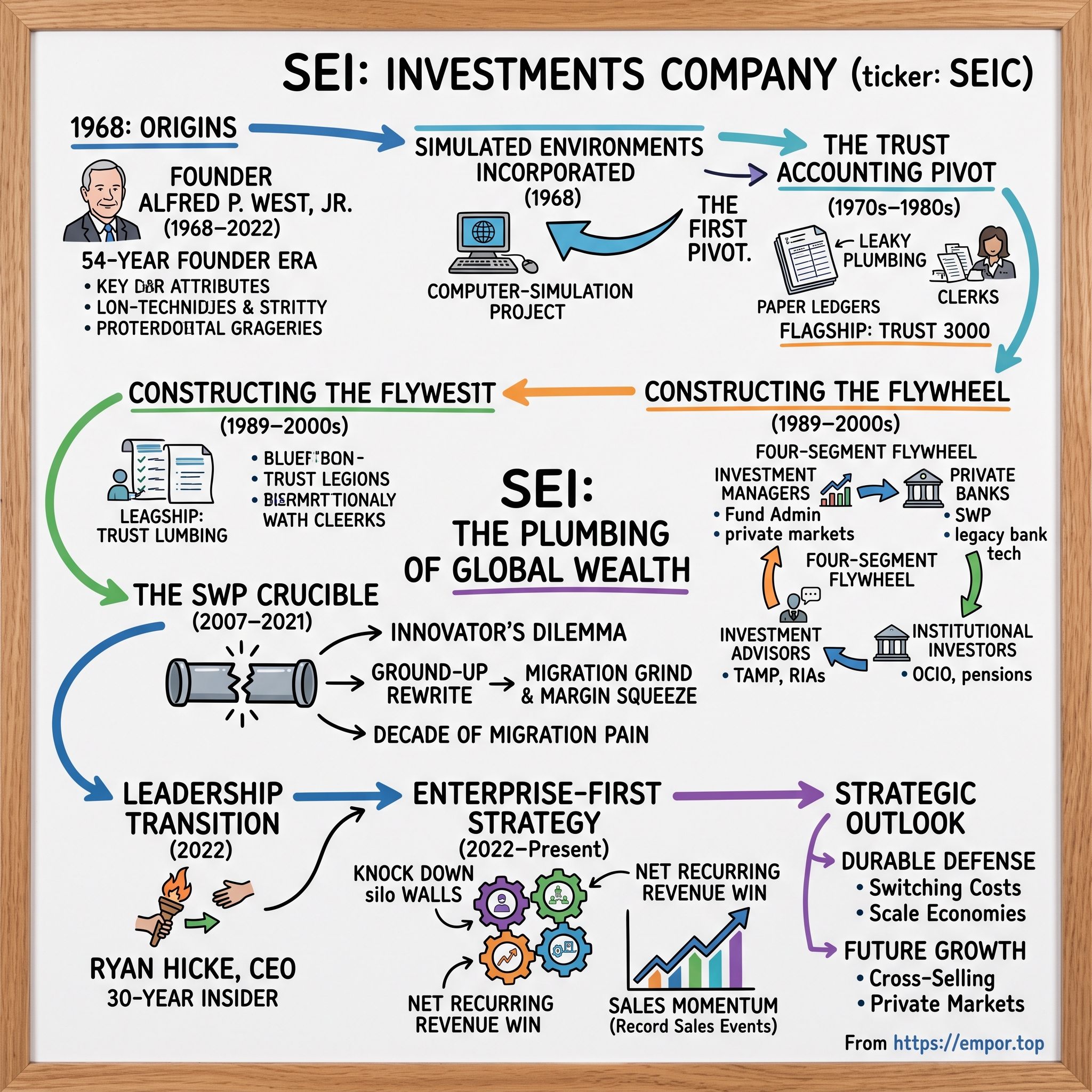
SEI Investments Company: The Plumbing of Global Wealth
I. Introduction & Episode Roadmap
Picture the back office of a large American bank in the early 1970s. Fluorescent light, rows of clerks, and — critically — the trust department, where the bank holds and administers money on behalf of widows, pension plans, and wealthy families. Every dividend, every bond coupon, every stock split has to be recorded by hand in enormous ledgers. A single transposed digit can misstate a beneficiary's wealth. It is slow, it is terrifyingly error-prone, and it is exactly the kind of unglamorous, high-stakes drudgery that most entrepreneurs would run from. SEI ran toward it. That instinct — to find the least sexy, most mission-critical plumbing in finance and quietly own it — is the through-line of this entire company.
Today SEI oversees roughly $1.9 trillion in client assets when you combine what it manages, administers, and holds through affiliated firms, and it generated $2.30 billion of revenue in 2025 at a 27% operating margin — a level of profitability that most "fintechs" only fantasize about.1 The company touches global private banks, mega-RIAs, alternative asset managers, corporate pension plans, and hospital endowments. Yet it does almost none of this in its own name. SEI is a white-label engine — the intelligence and the ledgers behind other people's brands.
The core hook of this story is a simple, almost improbable question. How did a project that started as computer-based training software for bank loan officers — a kind of 1968 flight simulator for lending decisions — mutate into the back-office technology, fund-administration, and investment operation powering some of the largest financial institutions on earth? The answer is not a single brilliant pivot. It is more than half a century of patient, sometimes painful reinvention, punctuated by one enormous, near-existential bet that we will spend a good chunk of this episode inside.
To understand SEI you have to understand its unusual hybrid architecture, because it does not fit any clean category. It is part software-processing engine, selling technology and operational outsourcing to private banks. It is part alternative fund administrator, doing the accounting and investor servicing for private-equity and hedge funds. It is part turnkey asset-management program — a "TAMP" — bundling technology and investment models for independent financial advisors. And it is part outsourced chief investment officer, managing money directly for pension funds and endowments. Four businesses, four sets of economics, one shared piece of DNA: SEI would rather be paid to run the machinery of finance than to place the bets.
Four themes will run through everything that follows. The first is the 54-year founder era of Alfred P. West, Jr., a man who built financial infrastructure before the word "fintech" existed and who ran the same company from 1968 until he handed over the CEO title in 2022.3 The second is the SEI Wealth Platform, or SWP — a decade-long, multi-hundred-million-dollar campaign to rewrite SEI's own core banking software from scratch, a project that nearly broke the company's margins and its credibility with investors before it began to pay off. The third is the 2022 succession to Ryan Hicke, a 30-year SEI insider who started as an intern, and his "Enterprise-First" attempt to knock down the walls between those four segments.3 And the fourth is the question every long-term investor must answer: are SEI's famous switching costs and fat margins a genuine, defensible moat, or a slowly eroding legacy advantage being nibbled at by mega-custodians and fee compression?
It helps to be concrete about what "plumbing" means here, because the metaphor does real work. When a hedge fund needs to tell its investors what their stake is worth, someone has to independently value every position, reconcile it against the prime broker, and produce an auditable investor statement — that is fund administration, and SEI does it for a fee. When a trust bank needs to record that a client's bond paid a coupon and route the cash to the right sub-account under the right tax treatment, someone's software has to do that flawlessly a million times a day — that is core processing, and SEI's platform does it. None of this is visible to the end client, and none of it is optional for the institution. It is the financial-services equivalent of municipal water and sewage: invisible when it works, catastrophic when it doesn't, and almost never replaced once installed. That is the business SEI chose, on purpose, decades before the market decided such businesses deserved premium multiples.
The scale of it is worth sitting with. A 27% operating margin on $2.3 billion of revenue means SEI converts more than a quarter of every dollar that comes in the door into operating profit — a figure that would be the envy of most software companies and is nearly unheard of in a firm that also manages money. In 2025 the company earned $715.3 million of net income and $5.63 of diluted earnings per share, both up sharply on the prior year.1 These are not the economics of a struggling incumbent; they are the economics of a franchise that has already won its core markets and is now arguing with itself about how fast it can grow.
We will not take management's word for any of it. SEI tells a good story about durability and outsourcing tailwinds; our job is to test that story against the filings, the segment economics, the earnings-call transcripts, and the behavior of its customers. Let's begin where the company did — in a Wharton classroom.
 Subscribe on LinkedIn
II. The Wharton Origin & The First Pivot: EduTech to Trust Accounting (1968–1980s)
Alfred P. West, Jr. did not look like a man who would spend the next fifty-seven years building trust-accounting software. He arrived at the University of Pennsylvania's Wharton School with an aerospace engineering degree from Georgia Tech — a rocket scientist's training, quite literally — and the restless energy of someone who had already decided he was never going to work for anyone else.4 In 1968, still in his twenties, West and a fellow Wharton student, Douglas McNair, founded a company with the earnest, faintly academic name of Simulated Environments Incorporated. Those three words gave the company the ticker it still trades under today: SEIC.5
The original product was, in a sense, an education-technology startup born decades too early. West and McNair built a computer program that simulated a lending environment so that bank loan officers could practice making credit decisions — a training simulator for the delicate art of deciding who gets a loan.4 It was clever, it was novel, and it caught on fast. By the early 1970s SEI had sold its loan-simulation software into a remarkable share of the largest American banks. And that early, rapid success taught West the first hard lesson of his career: a great product in a small market is a trap. There are only so many big banks, and once you have trained their loan officers, you have exhausted your total addressable market. Growth stalls not because the product failed, but because it succeeded too completely.
So West did something that would become the defining reflex of SEI: instead of squeezing a dying market, he went and asked his customers what actually kept them up at night. Walking the halls of those bank back offices, he kept hearing about the same nightmare — the trust department. Banks that administered money for others were doing it with armies of clerks and mountains of paper, reconciling securities transactions by hand in an environment where an error was not just embarrassing but a potential breach of fiduciary duty. Here was a market that was enormous, permanent, and desperate for automation. The plumbing was leaking, and nobody wanted to be the plumber.
In the early-to-mid 1970s SEI made its first and arguably most important pivot, abandoning the clever training software for the unglamorous machinery of automated trust and investment accounting.4 The eventual flagship of that effort, TRUST 3000, would become the workhorse system running the trust and custody operations of a large share of U.S. banks for decades. Why did this matter so much strategically? Because bank trust departments are the ultimate sticky customer. They operate under intense regulatory scrutiny. The cost of an accounting error is catastrophic. And their appetite for ripping out and replacing a working back-office system is somewhere close to zero. Once SEI's software was threaded into a bank's daily operations, it did not come out — not because the contract forbade it, but because no sane operations executive would volunteer to re-plumb the entire trust department to save a few basis points.
It is worth pausing on West himself, because a company that keeps the same leader for fifty-four years is, to an unusual degree, an extension of that person's temperament. West was famously anti-hierarchical — a boss who reportedly never took a formal promotion and never held a title grander than the one he started with, who scattered his executives across an open campus rather than stacking them in a corner-office pyramid, and who prized a "team-oriented" culture in which small units competed for internal capital like a venture portfolio.34 He was an engineer by training, not a financier, and it showed: he thought about SEI as a machine to be optimized rather than a set of assets to be traded. That engineering mindset — build the system once, build it right, then let it run and compound — is the psychological root of everything from the trust-accounting pivot to the SWP gamble decades later.
This is where the SEI cultural DNA was set, and it is worth dwelling on because it explains everything that comes later. West built a company that was allergic to flash and addicted to embedding itself into workflows that customers could not live without. He bootstrapped, kept overhead lean, and treated capital as something to be deployed with discipline rather than sprayed at growth. He took SEI public in 1981, but the IPO did not change the temperament.4 The company's entire theory of value was that if you own the boring, mission-critical infrastructure — the ledger, the reconciliation, the regulatory reporting — you earn a recurring toll for as long as the customer stays in business, which for a bank is essentially forever.
There is a subtler point here that sophisticated investors should not miss. SEI never tried to be the bank's competitor. It positioned itself as the bank's arms dealer — supplying the technology and operations that let its customers compete with each other, while remaining agnostic about which of them won. That neutrality is a strategic choice with real consequences: it dramatically expands the addressable market (you can sell to every bank, not just one) and it defuses the fear that keeps institutions from outsourcing (SEI is not going to steal your clients). Decades before "picks and shovels" became an investing cliché, West had built a picks-and-shovels business in the one industry where the miners never leave.
For an investor, the lesson buried in these founding years is the one that recurs across SEI's history: the most durable moats are often dug in the least appealing ground. But a trust-accounting utility, however sticky, is a slow-growth business. To become the company it is today, SEI needed to turn its single toll booth into a network of them — and to start collecting a second kind of fee entirely.
III. Constructing the Four-Segment Flywheel (1989–2000s)
If the 1970s taught SEI how to embed itself into a bank, the 1990s taught it how to get paid twice for the same relationship. This is the era in which SEI stopped being a software vendor and became something stranger and more valuable — a company that would sell you the plumbing and then sell you the water running through it.
The first step came in 1989, when SEI pushed beyond pure trust processing into mutual-fund accounting and distribution, riding the enormous wave of retail money pouring into mutual funds as America discovered the 401(k) and the equity cult of the 1980s and 1990s took hold. Administering funds — striking a daily net asset value, handling shareholder recordkeeping, managing the operational back office — was a natural extension of the trust-accounting expertise SEI already had. It was the same core competence (get the numbers exactly right, every single day, under regulatory scrutiny) pointed at a booming new customer set.
Then came the genuinely clever move. In the early 1990s SEI helped pioneer what the industry now calls the TAMP — the turnkey asset-management program. The idea sounds mundane until you see the economics. Independent financial advisors were multiplying, but each one was drowning in operational overhead: they needed technology, custody, model portfolios, rebalancing, performance reporting, and someone to actually manage the underlying money. SEI bundled all of it into a single platform. The advisor got to focus on the client relationship; SEI ran everything behind the curtain.
Here is why that was strategic genius rather than mere convenience. The TAMP created a dual-revenue engine from one customer. SEI collected a recurring technology and platform fee for running the operational machinery — the sticky, software-like income. And on top of that, because SEI managed or sub-advised the actual investment portfolios, it collected an asset-based fee measured in basis points on the money itself. When markets rose, SEI's revenue rose with them, without SEI having to sell a single new account. The company had found a way to marry the stability of a software subscription to the upside of an asset manager. Skeptics would later call this "double-dipping"; SEI called it a flywheel. Both descriptions are accurate.
Think about what this did to the character of an advisor relationship. An independent RIA who has moved his entire book onto SEI's platform is not a customer who churns easily. His client statements, his compliance reporting, his rebalancing, and his back office all run through SEI; unwinding that would mean re-papering every client account and risking the one thing an advisor cannot afford, which is a service disruption in front of the people who trust him with their money. The switching cost that SEI had learned to build into bank trust departments in the 1970s was now replicated, in miniature, across thousands of small advisory firms. The same trick, at a different scale. And because the advisor's assets tended to grow — through market appreciation and through the advisor winning new clients — SEI's basis-point revenue compounded quietly in the background whether or not SEI's own sales team lifted a finger.
Around the same time, SEI extended the same manager-of-managers philosophy to the largest pools of money in the country by pioneering what would become the outsourced chief investment officer, or OCIO, model. A corporate pension plan or a hospital endowment has a fiduciary obligation to invest prudently but rarely has a world-class investment staff in-house. SEI offered to become that staff — selecting managers, constructing portfolios, handling liability-driven investing for pensions — as an outsourced fiduciary. Once again, SEI was being paid to run the machinery rather than to be a brand-name money manager, and once again the revenue was recurring and asset-based.
By the 2000s the modern shape of SEI had crystallized into the four-segment matrix it still reports today. Investment Managers handles operational outsourcing, accounting, and investor servicing for alternative and traditional asset managers — the fund-administration business. Private Banks provides the end-to-end technology platform and custody processing for wealth-management institutions and trust banks — the direct descendant of TRUST 3000. Investment Advisors is the TAMP business serving independent RIAs and broker-dealer advisors. And Institutional Investors is the OCIO fiduciary-management business for pensions, foundations, and endowments. Four segments, but one underlying idea repeated four times: find a customer with a mission-critical operational burden, take it off their hands, and get paid a recurring toll — ideally two tolls — for doing it.
There is a less flattering way to read the four-segment structure, and an honest analyst should hold it alongside the flywheel story. Four semi-independent businesses, each with its own sales force and P&L, is also a recipe for internal fiefdoms, duplicated overhead, and a company that is harder to steer than it should be. For years the segments barely talked to one another, and a customer who dealt with two of them experienced SEI as two different vendors. The very structure that let SEI attack four markets at once also left enormous value stranded between them — a problem that would sit unaddressed until a new CEO made it his central mission. The flywheel spun, but each segment spun its own; they were not yet geared together.
Underpinning all of this was a capital-allocation philosophy that looked almost quaint next to the leverage-fueled financial engineering of the era. SEI ran with essentially no net debt, converted its profits into free cash flow, and returned the excess to shareholders through a steadily growing dividend and consistent share repurchases. It was the balance sheet of a company that had lived through enough market cycles to know that the ability to keep investing through a downturn is itself a competitive weapon. That fortress balance sheet was about to be tested — not by a recession, but by a bet SEI made against its own most profitable product.
IV. The SEI Wealth Platform (SWP) Crucible: A Decade of Migration Pain (2007–2021)
Every enduring company eventually faces the moment when its greatest asset becomes its greatest liability. For SEI, that asset was TRUST 3000 — the legacy system that had processed trillions of dollars for the top U.S. banks and thrown off high-margin cash for a generation. By the mid-2000s it was also aging technology, and the world it was built for was disappearing.
The problem was structural. TRUST 3000 was, at its heart, a monolithic mainframe-era system designed for a domestic, batch-processed, single-custody world. But the wealth managers SEI wanted to win in the twenty-first century were demanding something the old architecture simply could not deliver: real-time processing, multi-currency support, the ability to plug into many different custodians rather than one, and eventually cloud-native flexibility. A modern global private bank could not run its business on software conceived when the fax machine was cutting-edge. SEI faced the innovator's dilemma in its purest form — cannibalize your own cash cow, or watch a competitor build the future while you defend the past.
Alfred West chose to cannibalize. Beginning in the mid-2000s, SEI committed to building the SEI Wealth Platform — SWP — entirely from scratch rather than buying an off-the-shelf core system or bolting patches onto TRUST 3000. This was a colossal, multi-hundred-million-dollar wager on a ground-up rewrite of the company's most important software, and West made it with the founder's freedom of a man who owned a large slice of the company and answered to no activist. SEI launched SWP first in the United Kingdom in the second half of the 2000s — a smaller, contained market in which to prove the platform — before beginning the far harder push to migrate large U.S. institutions in the years that followed.
What came next was a masterclass in how brutally hard it is to replace mission-critical financial infrastructure — even your own. This is the crucible, and it has two distinct inflection points.
Inflection Point One: the migration grind and the margin squeeze (roughly 2014–2019). Converting a bank from TRUST 3000 to SWP was not a software update; it was open-heart surgery. Each large migration could take three to five years, involving painstaking data ingestion, heavy custom engineering, retraining of the bank's operations staff, and a paralyzing fear of anything going wrong with live client money. Sales cycles stretched out for years. And crucially, SEI was paying twice during the transition — maintaining the old mainframe environment for clients not yet converted while simultaneously pouring money into building and implementing the new one. This "double-running" cost dragged on consolidated operating margins for years, compressing them well below the levels investors had grown used to. On earnings calls of the period, analysts pressed West and his team repeatedly on implementation delays, cost overruns, and when — exactly when — the deferred revenue would finally show up. The narrative had curdled from "visionary platform investment" into "when does this stop hurting?"
To understand why the double-running cost was so corrosive, picture SEI's income statement during those years as two companies bolted together. One company — the legacy business — was mature, high-margin, and cash-generative, running TRUST 3000 for banks that had not yet converted. The other — the SWP build-out — was a money-losing startup, absorbing hundreds of engineers, sales staff on multi-year deals that had not yet closed, and implementation teams grinding through conversions that generated cost long before they generated revenue. Consolidated, the two averaged out to margins that looked disappointing to a market that had known SEI as a serenely profitable compounder. The company was, in effect, funding a venture-scale bet out of its own operating profits in full view of quarterly-focused investors, and it did so for the better part of a decade.
For a fundamental investor, this stretch is the most instructive in SEI's history, because it exposes the real cost of the moat everyone celebrates. The very switching costs that make SEI's customers so sticky cut the other way when SEI is trying to move those customers onto a new platform: high stakes, long timelines, and enormous friction. A moat is a wall, and walls are just as hard to climb from the inside. It also revealed something about SEI's governance: only a founder with a large personal ownership stake and no fear of being fired could have sustained a bet that punished reported earnings for that long. A hired-gun CEO on a three-year contract would almost certainly have been forced to cut the project back. West's control was, in this instance, the thing that made the long game playable — a reminder that concentrated founder ownership can be both a governance risk and a strategic asset, sometimes in the same decision.
Inflection Point Two: crossing the chasm (roughly 2020–2022). Slowly, then more noticeably, the platform began to win the accounts that validated the entire gamble. SEI landed conversions and expansions with large wealth and custody institutions, and the assets administered on SWP began to compound from hundreds of billions toward the trillion-dollar range. By the mid-2020s the total assets SEI managed, administered, or held through affiliates had climbed to roughly $1.9 trillion.1 The platform that had nearly broken the margin story was now the engine underneath it.
Part of what turned the corner was a feature that only becomes valuable once the platform is mature: multi-custody support. A modern SWP connects to a large roster of third-party custodians, meaning a bank does not have to move its assets to a single custodian to use the platform — it can keep its existing custody relationships and let SWP orchestrate across them. In an industry where "who holds the assets" is a jealously guarded relationship, the ability to sit above custody rather than demanding it is a genuine selling point, and it is the kind of capability that is enormously expensive to build and therefore enormously hard for a new entrant to replicate. Each additional custodian connection SEI builds is a fixed cost it can spread across every client — the scale economy quietly compounding underneath the platform story. This is the part of the SWP investment that most clearly justifies the years of pain: SEI did not just rebuild TRUST 3000 in modern code; it built something the old system fundamentally could not be.
And here is the payoff that makes the pain rational in hindsight. Once a bank has spent three to five years and many millions of dollars migrating onto SWP — rebuilding its general ledger integrations, its compliance workflows, and its client reporting around the platform — the idea of ripping it out again is almost unthinkable. The re-migration would cost years, millions, and an unacceptable amount of operational risk on live client assets. That is what produces institutional retention rates in the mid-90s and above, and it is why SWP, having survived its brutal adolescence, became one of the stickiest assets in financial technology.
But an independent reading of the SWP saga should resist the temptation to call it a clean triumph. The build cost more and took longer than SEI ever projected — the pattern is so reliable across the industry that it deserves to be treated as a law rather than an accident. During the worst years, SEI's stock badly lagged the broader market's fintech enthusiasm precisely because investors could not see the payoff and were tired of being told to wait. And even now, the Private Banks segment that houses SWP earns the thinnest margins of SEI's four businesses, which means the platform's economics are still a promise being kept rather than a promise fully delivered. The moat is genuine; the return on the capital that dug it is still being earned. The question for the next chapter is whether SEI's new leadership could finally convert that hard-won stickiness into growth — rather than just defense.
V. Leadership Transition & The "Enterprise-First" Acceleration (2022–Present)
In May 2022, a man who had run the same company for fifty-four years let go of the wheel. Alfred P. West, Jr. stepped down as chief executive of SEI, the firm he had founded as a Wharton student in 1968, and moved into the role of Executive Chairman.3 It is difficult to overstate how rare a 54-year CEO tenure is; West had led SEI across the entire arc of modern computing, from mainframes to the cloud, and he still owned a founder-sized stake that gave his voice enduring weight. His chosen successor was not a celebrity hire parachuted in from a rival. It was Ryan Hicke, a man who had spent roughly three decades inside SEI, beginning as an intern and working across the company's international and technology operations before rising to the top job.3
That insider pedigree is a double-edged sword, and honest analysis has to hold both edges. On one side, a thirty-year veteran knows where every body is buried, understands the culture, and can move fast without a long learning curve — exactly what you want when the strategic challenge is execution rather than reinvention. Hicke had spent years running SEI's technology and international operations before taking the top job, which meant he understood SWP from the inside — not as a line item but as an engineering and sales problem he had personally lived.3 On the other side, an insider is precisely the person least likely to question the assumptions the company was built on. The market's fair question in 2022 was whether Hicke would be a caretaker of West's legacy or an agent of change. The early evidence points to the latter, at least in tempo.
It also matters that the founder did not fully leave when the title changed hands. West stayed on as Executive Chairman from 2022 until the very start of 2026, retaining a founder-sized equity stake and, one assumes, considerable influence over any decision that touched the culture or the balance sheet.3 This is a governance arrangement investors should watch with clear eyes: a long-tenured founder looking over a first-time CEO's shoulder can be a stabilizing anchor or a subtle brake on genuine change, and from the outside it is hard to know which. The full test of Hicke's independence only really began on January 1, 2026, when West stepped back to Chairman Emeritus and the chairmanship passed to an independent director.3
The centerpiece of Hicke's tenure is a strategy he brands "Enterprise-First." For most of its history SEI operated as four largely separate businesses, each with its own sales force, its own clients, and its own P&L — a structure that made the company easy to manage but left an enormous amount of value stranded between the silos. A private bank running SWP was a Private Banks client; if that same bank also wanted alternative-fund administration, it was a separate sale, often by a separate team that barely knew the first relationship existed. Hicke's thesis is that SEI's real, underexploited asset is the combination — that a single institution could be sold SWP processing, plus alternative fund administration, plus investment management, across its entire lifecycle, if only SEI stopped organizing itself around internal boundaries the customer never cared about.
Is there evidence this is working, or is it just a reorganization with a slogan? The most concrete proof point is sales momentum. In 2024, SEI's net sales events — the company's measure of newly signed recurring business — jumped 58% versus 2023, reaching $127.9 million, which management explicitly attributed to demand for SEI's enterprise capabilities across the whole organization.6 That acceleration continued into 2025, when full-year net sales events reached a record $149.9 million.1 These are leading indicators, not booked revenue, and a skeptic should note that "sales events" is a company-defined metric that converts to revenue only over the following year or two. But the direction and magnitude are real, and they represent a genuine change from the grinding, delay-plagued sales narrative of the SWP migration years.
Hicke also moved to sharpen the portfolio, and here the behavior is worth watching closely because it tests management's claim of discipline. In mid-2025 SEI sold its Family Office Services business to the private-investment firm Aquiline Capital Partners for a total consideration of $120 million, and the sale — completed June 30, 2025 — produced a net gain of roughly $94.4 million.[^6] The logic was that family-office technology was non-core, and that SEI would rather double down on high-margin enterprise fund administration and bank technology than run a subscale unit. Divesting a good-but-not-great business to concentrate on the crown jewels is exactly the kind of unsentimental capital allocation investors should want; the counter-risk is that a company selling off pieces can quietly shrink its own optionality.
On capital returns, the Hicke-era behavior has been consistent with the founder-era philosophy rather than a break from it. SEI carries no net debt and a substantial cash balance, and in 2025 it repurchased 7.5 million shares for $595.5 million while paying a semiannual dividend that totaled $1.01 per share for the year.1 Notably, the company funded the first close of a strategic investment in Stratos Wealth Holdings — a $440.8 million deployment giving SEI downstream access to a large advisor network — entirely from balance-sheet cash, without touching the buyback cadence.1 The message to the market is that SEI can invest for growth and return capital simultaneously, because its asset-light model spins off more cash than it can reinvest organically.
The Stratos investment deserves a moment of scrutiny rather than applause, because it is exactly the kind of move a skeptical investor should interrogate. Buying a stake in a large advisor network is a step downstream — closer to the end client — from SEI's traditional stance as the neutral arms dealer that never competes with its customers. Does owning a piece of an advisor aggregator compromise that neutrality with SEI's other advisor clients? Management's answer is that Stratos secures distribution for SEI's platform and asset-management products, adding roughly $38.4 billion in client assets into SEI's orbit.1 That is plausible. But it is also SEI paying nearly half a billion dollars to buy distribution it historically won by selling technology, and whether that is a shrewd vertical extension or a subtle drift from the model that made SEI great is a question only time will settle. It is worth filing away as one of the first genuinely Hicke-era capital-allocation decisions to judge on its merits.
On incentives, the structure aligns Hicke's pay with the levers investors care about — operating income growth, net recurring revenue wins, and adjusted earnings per share sit at the center of the compensation design, which is the right set of targets for a business whose value is created by signing sticky, recurring business and converting it to profit rather than by chasing headline AUM. The credibility test, though, is not the plan on paper but the behavior over time: has management set targets and hit them, explained misses honestly, and kept its story consistent across calls? On the evidence so far, the answer leans favorable — the sales-acceleration narrative has been backed by rising sales-event numbers two years running — but Hicke's tenure is still short, and no CEO's credibility is fully established until it survives a genuinely bad year, which the buoyant markets of 2024 and 2025 have not yet provided.
The most telling evidence of the leadership shift, though, is not in the numbers but in the tenor of the earnings calls. Listen to the transcripts of the 2018–2020 period and you hear West and his team on the defensive — explaining implementation delays, managing expectations, absorbing analyst frustration about the SWP grind. Listen to Hicke on the recent calls and the register has changed entirely: quantitative, aggressive on sales velocity, focused on multi-custody adoption and margin expansion, describing 2025 as "one of the strongest years in SEI's history" and saying the firm was entering 2026 "with confidence."1 An investor should treat confident CEO language as a claim to be tested, not a fact — but the shift from defense to offense is itself a data point about where the company believes it now stands.
One more governance note closes this chapter. On January 1, 2026, West retired fully from the Executive Chairman role after 57 years, becoming Chairman Emeritus, with independent director Carl A. Guarino appointed non-executive chairman.3 The founder era, in any operational sense, is now over. What West leaves behind is not a personality cult but a machine — and the value of that machine lives in the segment economics we turn to next.
VI. Segment Economics, M&A Benchmarking, & Competitive Landscape
Consolidated financials are a kind of camouflage. A company reports one revenue number, one margin, one growth rate, and the market prices the average — but the average is often a fiction that hides two or three genuinely different businesses moving in opposite directions. Nowhere is this truer than at SEI, where a serene 27% blended margin conceals a segment earning 48%, a segment earning 17%, a business growing double digits, and a business quietly shrinking. To see what SEI actually is, you have to take the $2.30 billion revenue base apart and look at where the money — and more importantly the profit — is really made.1 The differences tell you everything about the strategy, and about the risks the headline number papers over.
Investment Managers — the growth engine. This is now SEI's largest and fastest-growing segment, generating $815.0 million of revenue in 2025, up 12%, and throwing off $320.7 million of operating profit at a 39% margin.1 The core function is unglamorous and wonderful: middle- and back-office outsourcing, accounting, and investor servicing for asset managers — increasingly the alternative managers running private equity, private credit, and hedge funds. Why is this the crown jewel? Because it rides one of the most powerful secular trends in finance. As capital floods into private markets, every new fund vintage needs an administrator to strike valuations, process capital calls, and service investors, and those fees are recurring and scale beautifully. Crucially, unlike an asset manager's fees, a fund administrator's revenue does not depend on the fund performing well — it depends only on the fund existing and having investors to service. That makes the revenue remarkably resilient to the boom-and-bust cycles of the private-markets managers themselves; even a poorly performing private-credit fund still needs its investors serviced for years. SEI competes here against the pure-play giants of fund administration — SS&C Technologies, Citco, Apex Fund Services, and the alternative-servicing arms of custody banks like BNY. It is a real fight against scaled, well-capitalized rivals — SS&C in particular has assembled a fund-administration empire through relentless acquisition — but it is a fight in a growing market, which is the best kind. The strategic risk here is not the market shrinking; it is pricing pressure as the largest managers use their scale to negotiate down the basis points they pay for administration.
Private Banks — the technology core, and the margin puzzle. This is the direct heir to TRUST 3000 and SWP: the platform, custody processing, and operational outsourcing sold to trust banks and wealth managers. In 2025 it produced $572.9 million of revenue, up 6%, but only $98.0 million of operating profit — a 17% margin that is by far the lowest of the four.1 Here is the analytical tension at the heart of SEI. Private Banks is the segment with the deepest moat and the stickiest customers, yet it earns the thinnest margins, because the SWP investment cycle and the cost of implementation weigh it down. The bull case for the whole company rests substantially on the idea that as SWP assets scale and the heavy implementation spending recedes, this segment's margin can climb from the high teens toward the 25–30% range. The bear case is that it has been "about to inflect" for years. Encouragingly, segment operating profit did grow 21% in 2025 even as revenue grew only 6% — early evidence of the operating leverage the bulls are promised.1 SEI's competition here is a murderers' row of financial-infrastructure incumbents: Broadridge, FIS, Fiserv, and BNY's Pershing.
Investment Advisors — the high-return TAMP. SEI's TAMP business generated $577.4 million of revenue in 2025, up 13%, at a superb 46% operating margin producing $265.7 million of profit.1 This is the dual-revenue flywheel from Section III in its mature form: basis-point fees on advisor assets layered on top of technology subscriptions. The economics are outstanding because the platform is already built and each incremental dollar of advisor assets drops a rich margin to the bottom line. But this is also the segment most exposed to competitive attack, from Envestnet, AssetMark, Orion, and — most dangerously — the free or near-free platform tools offered by mega-custodians like Charles Schwab and Fidelity to the same independent advisors SEI serves.
Institutional Investors — the cash cow in gentle decline. The OCIO business is the most profitable of all on a margin basis — a 48% operating margin generating $134.4 million of profit — but on the smallest and shrinking revenue base of $282.5 million, down 1% in 2025.1 That single negative sign is important, and it is exactly the kind of small number that a numbers-first reading would skim past and a thoughtful one would stop on. It reflects the secular headwind facing SEI's traditional manager-of-managers approach: pension plans and endowments steadily shifting money out of active, multi-manager strategies and into low-cost passive index products, compressing the basis-point fees SEI can charge. There is a demographic layer to it too — corporate defined-benefit pension plans, a core OCIO client base, are a mature and slowly disappearing species as companies freeze and terminate them. It is a wonderfully cash-generative business that is, quietly, in structural runoff at the margin, and no amount of operational excellence reverses a shrinking pool of clients. SEI competes here with Mercer, Russell Investments, and the OCIO arm of BlackRock — the last of which can bundle OCIO with its index products in a way SEI cannot easily match.
Put the four together and a clear picture emerges. SEI's profit is increasingly powered by fund administration for private markets (Investment Managers) and the mature TAMP (Investment Advisors), while its deepest-moat business (Private Banks) is a margin turnaround story and its highest-margin business (Institutional Investors) is shrinking. That is a more nuanced reality than the tidy "durable compounder" label suggests.
On M&A, SEI's behavior is the opposite of the roll-up playbook run by some competitors. Rather than dilutive mega-deals, it has favored disciplined, targeted tuck-ins: the 2021 acquisition of portfolio-analytics and data-visualization firm Novus to strengthen its institutional offering; smaller purchases such as Oranj and cloud-native banking capabilities to extend SWP's digital front-end and multi-custody reach; and the strategic Stratos Wealth Holdings stake to secure downstream advisor distribution.1 The through-line is a preference for building organically and buying only capabilities that plug directly into the existing platform. It is instructive to contrast this with SS&C Technologies, which has built its scale largely by acquisition — swallowing fund administrators and software firms and integrating them onto a common back end. SS&C's model produces faster revenue growth and more scale, but it also produces integration risk, goodwill on the balance sheet, and the ever-present danger of overpaying near the top of a cycle. SEI's model produces slower growth but cleaner economics and a balance sheet that stays pristine. Neither is obviously right; they are different bets on how value compounds in this industry, and an investor's view of SEI is partly a view about which philosophy wins over a decade.
For investors wary of "diworsification," SEI's restraint compared with the acquisition appetite of an SS&C or an Envestnet is a genuine, if unexciting, virtue — the discipline that keeps returns on capital high. The 2025 divestiture of Family Office Services to Aquiline, booked at a roughly $94.4 million net gain, is the same discipline pointed in the other direction: a willingness to sell a non-core unit at a good price rather than let it linger out of sentiment.[^6] Whether that discipline is a durable competitive advantage or merely a conservative temperament is the question the moat frameworks are built to answer.
VII. Strategic Position, Moat Frameworks, & Material Risk Radar
Strip away the narrative and ask the cold question a competitor's strategist would ask: why can't we just take SEI's customers? Two analytical frameworks — Hamilton Helmer's 7 Powers and Michael Porter's Five Forces — help pressure-test the answer, and they should be used to interrogate the moat, not to decorate it.
Start with the 7 Powers, and be honest about which ones SEI genuinely has. The primary power, unambiguously, is switching costs. When SWP is threaded into a bank's general ledger, its compliance engine, and its client-reporting stack, and when the bank has spent years and millions migrating onto it, the cost of leaving is measured in operational risk to live client money — the single thing a bank executive will never gamble with. This is what generates the retention rates in the mid-90s and above that management cites, and it is the realest thing about the SEI franchise. The secondary power is scale economies: the fixed cost of building and maintaining data connections to a large roster of third-party custodians and the R&D behind the platform gets spread across a huge base of assets, and a subscale competitor simply cannot match the breadth of integrations at the same unit cost. There is also a credible case for process power — the accumulated, hard-to-replicate organizational know-how of navigating decades of SEC, OCC, and international trust-accounting regulation, the kind of tacit expertise that cannot be hired in a quarter.
But an independent analyst should also note which powers SEI does not clearly have. It has no meaningful branding power — SEI is deliberately invisible, a white-label engine, which means it captures none of the pricing premium a consumer brand commands. It has limited network effects in the classic sense; more custody connections help, but SEI's value does not compound with each new user the way a marketplace's does. The moat is real, but it is a moat of embedded switching costs and scale, not of brand or network — and that distinction matters, because switching-cost moats protect the installed base far better than they win new logos.
Porter's Five Forces sharpens the same picture. The threat of new entrants is low: the capital, regulatory scrutiny, and sheer risk-aversion of banks make it nearly impossible for a startup to break into core trust processing. Supplier power is low, because SEI owns its core software IP and sub-advises its own investment mandates. But buyer power is medium-to-high, and this is the pressure point: SEI's largest customers are Tier-1 global banks with sophisticated procurement teams who push hard on fee schedules at every major contract renewal. Substitutes are a medium threat: a large bank can always threaten to build in-house, and at the small end, mega-custodians offer native tools that make SEI's TAMP look expensive. And competitive rivalry is high, against the deep-pocketed incumbents — SS&C, Broadridge, FIS — and the specialist TAMPs. The net read is a business well-protected on its installed base but fighting hard, on price, for every new dollar.
That framing leads naturally to the material risk radar — the things that could actually break the case, expressed as business mechanisms rather than a generic checklist:
Bank IT capex freezes. SEI's growth depends on banks committing to multi-year technology transformations. When regional-banking stress or a risk-off macro environment hits, those projects are the first to be delayed, lengthening SEI's already-long sales and implementation cycles and pushing revenue recognition further out.
Fee compression. The Institutional segment's revenue decline is the canary. Across both traditional asset management and OCIO, the secular drift toward passive, low-cost products steadily squeezes the basis-point fees on which SEI's asset-based revenue depends — a slow, grinding headwind that no amount of sales momentum fully offsets.
Cybersecurity and concentration risk. SEI sits atop roughly $1.9 trillion of processed wealth data. It is, by definition, a high-value single point of failure. A serious breach or prolonged outage would be existential in a way that a lost sales quarter never could be — the flip side of being mission-critical infrastructure is that failure is catastrophic, not merely costly.
Legacy overhang. The final act of the SWP saga is sunsetting the remaining TRUST 3000 clients, and that transition carries its own expense and execution risk. Every legacy client still to be converted is both a cost to maintain and a migration that could go wrong.
It is worth closing this section by fact-checking the consensus narrative directly, because the popular story about SEI is not quite the real one. The myth is that SEI is a fast-growing fintech riding the outsourcing wave to inevitable double-digit growth. The reality is more textured: SEI is a collection of mostly mature, high-return businesses growing revenue in the mid-to-high single digits, in which one genuinely fast segment (fund administration for private markets) is partly offset by one that is shrinking (institutional OCIO), and in which the most-hyped asset (SWP) still earns the lowest margin. A second myth is that the switching-cost moat means SEI can grow simply by holding what it has. In truth, retention protects the base but does almost nothing to win new logos, and SEI's growth is gated by the same three-to-five-year conversion cycles that make its customers sticky — the moat guards the castle but slows the conquest. Seeing SEI clearly means holding both the durability and these limits in the same frame. None of the risks above is acute today, but each is real, and a sober investor holds them alongside the moat rather than letting the moat narrative crowd them out. With the powers and the risks on the table, we can finally frame the two competing cases for the stock.
VIII. The Bull vs. Bear Case & Key Investment KPIs
Every durable company is really an argument between two coherent stories, and the most useful thing an analyst can do is state both at full strength rather than caricaturing the one they disagree with. What makes SEI genuinely interesting as a debate is that it is not a binary — nobody credible thinks the company is going to zero, and nobody credible thinks it is about to triple. The argument is subtler and more useful: it is about the rate of value creation, and whether a set of high-quality but mature businesses can be re-accelerated by a strategy change, or whether the gravitational pull of fee compression and slow conversions caps the whole thing at low-single-digit growth. Here are SEI's two cases, laid out fairly, because the honest answer for a business this steady is that both sides are partly right.
The bull case rests on four pillars. First, cross-selling: if Hicke's Enterprise-First strategy genuinely lands — selling alternative fund administration into the private-bank and advisor client bases — SEI can grow revenue per client without the brutal cost of winning new logos, and the record net sales events of 2024 and 2025 are early evidence it is starting to work. Second, operating leverage in Private Banks: as SWP assets compound and implementation spending recedes, that laggard 17% margin has room to climb toward the enterprise 25–30% range, and the 21% profit growth on 6% revenue growth in 2025 is the first real sign of the inflection.1 Third, private-market tailwinds: the secular growth of private equity, private credit, and real assets drives high-margin, recurring processing revenue in the Investment Managers segment, SEI's best business, more or less regardless of what public markets do. And fourth, capital allocation: an asset-light model generating cash well in excess of reinvestment needs, funding buybacks and a growing dividend while still self-financing a $440.8 million strategic investment from cash, provides a floor of shareholder returns and valuation support.1
The bear case is equally coherent. First, conversion timelines: SEI's own switching-cost moat means enterprise bank deals take three to five years to convert, structurally capping organic top-line growth in the single digits no matter how strong the sales pipeline looks. Second, disintermediation: Schwab and Fidelity offer independent advisors custody and technology at prices SEI cannot match, squeezing the TAMP economics in Investment Advisors from below. Third, passive fee pressure: the Institutional segment's revenue decline is not a blip but a structural drift, and it will keep eroding the highest-margin asset-based fees SEI earns.
Push the bear case into activist territory and the challenges sharpen. A concentrated skeptic would argue that SEI's four-segment complexity makes the company hard to value on a sum-of-the-parts basis, and that the conglomerate structure lets a slow-growth segment hide inside a decent blended number — that shareholders might be better served by separating the high-multiple fund-administration business from the mature OCIO cash cow. The same investor would press on the mix problem: the market is being asked to pay a premium multiple for a business whose deepest moat sits in its lowest-margin segment (Private Banks) and whose highest margins sit in a shrinking one (Institutional). They would scrutinize the Stratos investment as a possible drift from the neutral-platform model, and they would ask whether SEI's enormous accumulated cash and buyback machine is a sign of disciplined stewardship or of a management team that cannot find enough high-return organic reinvestment — because a company buying back a lot of its own stock is, in one reading, a company telling you it has run low on better ideas. None of these challenges is fatal, and SEI's long record of high returns on capital is a strong rebuttal to most of them. But a serious analyst runs the short case at full strength, and SEI's is more substantive than its placid reputation suggests.
How do you referee this argument over time? Not by watching the stock, but by watching the operating metrics that reveal which story is winning. Three KPIs matter most, and an investor should track exactly these:
1. Annualized net sales events / net revenue wins. This is the single most important leading indicator. It measures the recurring business SEI has signed but not yet fully recognized, and it tells you what revenue will look like in the following 12–24 months before it shows up in the income statement. The 58% surge in 2024 and the record $149.9 million in 2025 are the numbers that made the bull case credible; a stall here would be the first sign it is breaking.16
2. SWP contracted and implemented assets. Because Private Banks' margin story depends entirely on scale, the trajectory of assets actually live on the platform — not just signed, but converted and running — is the truest gauge of whether the decade-long SWP bet is finally compounding. Watch the gap between contracted and implemented; a widening gap means the migration bottleneck is back.
3. Consolidated operating margin and recurring-revenue mix. The 27% consolidated margin is the scoreboard for the entire operating-leverage thesis, and the share of revenue that is recurring processing and asset-based (rather than one-time implementation or non-recurring gains) is the gauge of quality and durability. Rising margin plus a high recurring-revenue ratio confirms the flywheel; a margin that plateaus while sales events climb would suggest SEI is buying growth at the expense of profitability.
Note what is deliberately not on this list: quarterly EPS, which is heavily swayed by markets and one-time items like the Family Office gain, and short-term AUM, which moves with the indices rather than with SEI's execution. A quarter in which EPS jumps because equities rallied tells you almost nothing about whether SEI is winning; a quarter in which net sales events accelerate while public markets are flat tells you a great deal. The three KPIs above isolate the things management actually controls, and they are the metrics against which an investor should hold every confident sentence in an SEI earnings call. If sales events keep climbing, SWP assets keep converting, and margins keep grinding higher, the bull case is being validated in the only language that counts — operating reality rather than management rhetoric. If any of the three stalls while management's tone stays upbeat, that gap between narrative and numbers is itself the most valuable signal an investor can get. Which brings us to the durable lessons this half-century story leaves behind.
IX. Playbook & Key Business / Investing Lessons
Step back from the segment tables and the earnings calls, and SEI's fifty-eight-year arc offers a handful of lessons that outlast any single quarter — lessons as useful for evaluating the next infrastructure company as for understanding this one.
Lesson one: the long-cycle infrastructure moat is paid for in advance. The SWP saga is the clearest teacher here. Rewriting legacy, mission-critical financial software took SEI far longer and cost far more than anyone budgeted, and it compressed margins and tested investor patience for years. But the same properties that made the rewrite agonizing — the depth of integration, the operational risk of change, the multi-year timelines — are precisely what make the finished platform nearly impossible to dislodge. The moat and the pain are the same phenomenon viewed from two directions. An investor evaluating any company mid-transformation should remember that the depth of the current suffering is often a rough proxy for the durability of the eventual advantage — but only if the transformation is actually completed, which is never guaranteed while it is underway.
Lesson two: hybrid revenue models compound better than pure ones. SEI's defining financial innovation was marrying two kinds of revenue that most companies keep separate — the stability and stickiness of recurring software and processing fees, and the market-linked upside of asset-based basis-point fees. The software revenue provides a floor that holds in downturns; the asset-based revenue provides equity-market participation in good times. The blend produces a smoother, higher-quality earnings stream than either model alone, which is a large part of why SEI has been able to run a fortress balance sheet and return capital consistently across cycles. The caution embedded in the same lesson: asset-based fees cut both ways, and the Institutional segment's decline shows that basis-point revenue can erode structurally even when the software underneath it is healthy.
Lesson three: founder succession is about temperament, not just competence. SEI handed the wheel from a 54-year founder-CEO to a 30-year insider, and the early returns suggest the deep-context insider can modernize sales strategy and knock down internal silos without detonating the culture or the capital-allocation discipline that made the company work. The risk of the insider succession — that the successor cannot see the assumptions worth questioning — is real, and it is too early to declare it avoided. But the transition from West's defensive, implementation-era posture to Hicke's offensive, sales-velocity posture shows that continuity of culture and change in strategy are not mutually exclusive. The thing to watch is whether Hicke ever proves willing to challenge a genuinely sacred SEI assumption, not just to run the existing playbook faster.
Lesson four: a pristine balance sheet is not conservatism — it is optionality. SEI's refusal to carry meaningful net debt looked, for years, like the caution of an old-fashioned management team. The SWP era revealed it as strategic. Only a company with no leverage and ample cash could have funded a decade-long, margin-crushing platform rewrite without being forced by lenders or a downturn to abandon it halfway. The balance sheet was the thing that made surviving the transition possible, and that same capacity now lets SEI self-fund strategic investments and return capital simultaneously. For long-term investors, SEI is a case study in the idea that financial strength is most valuable precisely when it looks least necessary — because the moment you need it, it is too late to build it.
There is a fifth, more contrarian lesson worth naming, because it cuts against the way SEI is usually praised. Invisibility is a strategy with a cost. By choosing to be the white-label engine behind everyone else's brand, SEI gave up the pricing power, the customer loyalty, and the valuation premium that a consumer-facing brand commands. It will never enjoy the fanatical customer devotion of a company whose logo the end user sees and trusts, because the end user never sees SEI's logo at all. What it gets in return is a vastly larger addressable market and the structural neutrality that lets it sell to every competitor in an industry at once. That is the trade every infrastructure business makes, and SEI made it more deliberately and for longer than almost anyone. For an investor, the takeaway is that the quiet, unbranded toll-taker and the beloved consumer franchise are simply different species of good business — and confusing the durability of one for the growth profile of the other is how people misprice both.
Whether SEI's next decade rewards patient owners will turn on questions this story has tried to frame rather than answer: whether Private Banks margins finally inflect, whether cross-selling turns a collection of segments into a genuine enterprise, and whether the switching-cost moat holds against custodians giving away for free what SEI charges for. The company has earned the benefit of a long track record. It has not earned the benefit of the doubt — and on Empor, no company does.
References
-
SEI Reports Fourth-Quarter 2025 Financial Results — SEI Investments Company (Investor Relations), 2026-01-28 ↩↩↩↩↩↩↩↩↩↩↩↩↩↩↩↩↩↩
-
SEI Investments Company 2024 Form 10-K Annual Report — U.S. SEC, 2025-02-20 ↩
-
SEI Honors Founder Alfred P. West, Jr. as He Retires from Executive Chairman Role After 57 Years of Innovation — SEI, 2026 ↩↩↩↩↩↩↩↩↩
-
The Secret Of Alfred West's Success — Forbes, 2001-05-07 ↩↩↩↩↩
-
SEI Reports Fourth-Quarter 2024 Financial Results — SEI Investments Company (Investor Relations), 2025-01-29 ↩↩
 LinkedIn
 WhatsApp
 Reddit
 Hacker News
 Email
Email Kindle
 RSS Feed
 Spotify
 Apple Podcasts
 Amazon Music
 Audible
 YouTube