Seadrill Limited: The High-Yield Titan, The $10 Billion Abyss, and the Rebirth of Deepwater Drilling
I. Introduction & The Executive Thesis (00:00:00 – 00:15:00)
The Cold Open
Picture a vessel that never travels anywhere. Roughly the length of two football fields and painted in Seadrill's livery, it floats more than 150 kilometres off the coast of Brazil in the pre-salt Santos Basin. Beneath its hull lies two to three kilometres of open water, and beneath that, several more kilometres of rock and ancient salt capping an ultra-deep oil reservoir under immense pressure.
The ship carries no anchor. Instead, a ring of computer-controlled thrusters fires constantly, countering wind, current, and swell so the vessel remains within meters of a fixed point on the seabed. Marine engineers call this dynamic positioning; a podcast listener might picture an industrial vessel hovering in place. If the ship drifts off location, the steel riser connecting it to the subsea wellhead bends, turning an expensive drilling day into an immediate operational hazard.
That ship is the West Tellus. In the first quarter of 2026, it began a three-year contract with Petróleo Brasileiro S.A. (Petrobras) valued at roughly $498 million, alongside a $41 million mobilization fee just to move onto location1. On a day-rate basis, the customer pays roughly $450,000 every 24 hours to keep the rig stationed over its wells—the price of a family home, spent every single day for three years.
This is Seadrill's core business: chartering floating drilling factories to the world's largest oil and gas producers. The day rates are massive, high-specification assets are scarce, and the entire industry turns on a recurring dilemma: when exploration spending stops, who pays for the idle iron?
The Paradox
Seadrill's corporate history answers that question better than any textbook. In the early 2010s, John Fredriksen's flagship venture stood as the world's largest offshore driller by market value2. It distributed payouts so large that suspending dividends in November 2014 was projected to conserve roughly $2 billion annually3. Income investors in Oslo and New York treated the stock like a high-yield bond with an oil-price kicker.
Then the capital structure collapsed. Seadrill filed for Chapter 11 bankruptcy protection in September 20174, emerged in July 2018 still carrying about $5.7 billion of secured bank debt5, and filed for bankruptcy a second time in February 2021. When it exited court protection again in February 2022, about $4.9 billion of secured bank debt had been converted into equity, leaving legacy shareholders with just 0.25% of the company6. The premier dividend vehicle of the offshore boom had wiped out its equity holders twice in less than five years.
The restructured entity operating today looks very different. At the end of June 2026, Seadrill carried $750 million in gross debt against $360 million in cash7. Its contract backlog stood at approximately $2.9 billion7. Between September 2023 and the end of 2024, management deployed roughly $792 million to repurchase about 22% of its outstanding shares8. A leadership transition followed on March 12, 2026, when Samir Ali succeeded Simon Johnson as chief executive officer9.
A housekeeping note on the ticker in the headline: SDRL.OL no longer trades. Seadrill's final trading session on the Oslo Børs took place on September 9, 2024, leaving the New York Stock Exchange as its sole trading venue10. The dual-listing ticker remains a historical relic of Seadrill's former corporate complexity.
The Roadmap
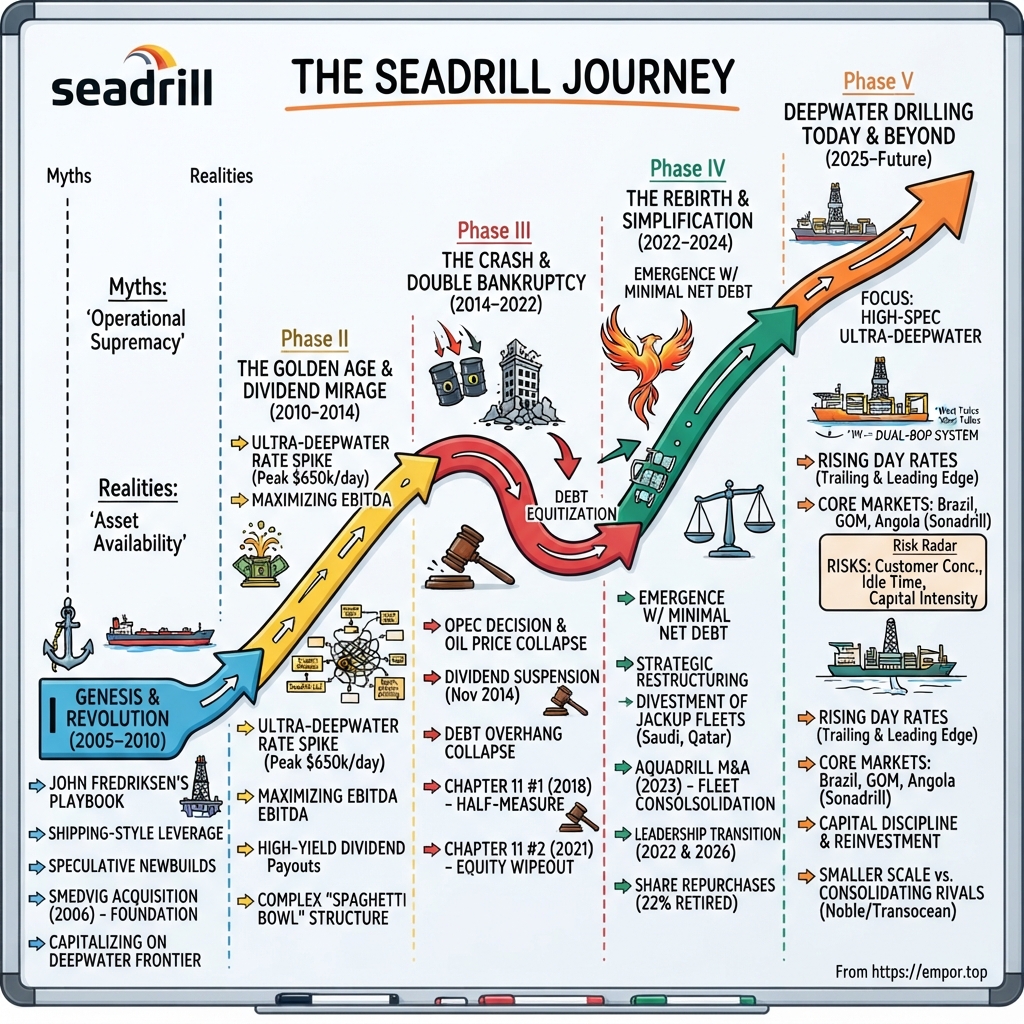
The story unfolds across five acts. Act I covers the Fredriksen playbook: how Seadrill utilized shipping-style financial leverage, speculative shipyard orders, and complex corporate structures between 2005 and 2014 to upend a historically conservative sector. Act II documents the downturn from 2014 to 2022: the crude oil price crash, the abrupt dividend cancellation, an initial restructuring that failed to resolve the debt overhang, and the subsequent bankruptcy that wiped out shareholders entirely.
Act III examines the structural simplification: emerging from restructuring with minimal net debt, selling off Middle Eastern jackups, completing a merger with its former subsidiary, retiring more than a fifth of its equity base, and transitioning chief executives in early 2026. Act IV dissects the operational unit economics of deepwater drillships, interrogates whether Seadrill commands a defensible competitive moat, and benchmarks management claims against realized performance. Act V outlines the bull and bear theses, highlights the decisive operating and financial metrics, and distills the broader strategic lessons.
The Core Question
Every investor evaluating Seadrill must weigh two conflicting arguments. Under the bull thesis, a streamlined Seadrill operates as a free-cash-flow machine commanding premium deepwater rigs in an undersupplied market where shipyard economics make new construction prohibitive. Under the bear thesis, offshore drilling remains an asset-heavy service business lacking enduring pricing power that erodes capital across full commodity cycles, temporarily flattered by an upswing in offshore upstream investment.
The positive investment case rests on scarce floater supply, rising fleet utilization, an under-leveraged balance sheet, and contracts repricing to higher day rates. The negative case centers on customer concentration among a handful of major operators, a fleet substantially smaller than consolidating rivals, heavy recurring capital expenditures, and an industry record where optimistic cycle forecasts have repeatedly unravelled.
This analysis takes neither side. Instead, it tests each premise against Seadrill's empirical record: the day rates achieved, historical guidance compared with actual performance, and cycle-wide returns on invested capital. The evidence points in both directions. The chapters that follow explain why.
 Subscribe on LinkedIn
II. Genesis: John Fredriksen and the Offshore Revolution (2005–2010) (00:15:00 – 00:45:00)
A Sleepy Industry
In 2004, the offshore drilling sector was paralyzed by memories of past busts. The devastating crude collapse of 1986 had left an enduring hangover: cold-stacked rigs rusting in anchorages, bankrupt service contractors, and commercial lenders unwilling to finance floating drilling units without ironclad guarantees.
The incumbent drillers—including Transocean, Noble, Pride International, Diamond Offshore, and Ensco—operated fleets constructed predominantly during the late 1970s and early 1980s. Having absorbed the painful lesson that a rig commissioned at the peak of an upswing is frequently delivered into a protracted slump, their capital discipline rested on an unbending rule: never order new hardware without securing a multi-year customer commitment first.
Yet offshore geology was outpacing boardroom risk tolerance. Frontier discoveries across Brazil's Campos Basin, the deepwater Gulf of Mexico, and offshore West Africa demonstrated that the industry's next production frontier lay in waters deeper than legacy anchored units could reach. Upstream demand for high-specification floating rigs was poised to outstrip global supply, but risk-averse contractors refused to stake capital on speculative construction.
Enter "Big John"
John Fredriksen was an unconventional figure to disrupt an engineering-dominated sector. A Norwegian-born shipping magnate who had taken Cypriot citizenship, Fredriksen amassed his fortune in crude tankers by treating vessels as volatile financial assets: buy countercyclically when peers capitulate, borrow aggressively against asset values, and harvest the subsequent rate spike. He had acquired tanker operator Frontline for $55 million in 1996 and transformed it into a massive tanker fleet11.
Fredriksen's key partner was Tor Olav Trøim, the financial strategist who structured the corporate machinery behind the empire. The formula they imported into offshore drilling adapted shipping finance to deepwater rigs: commission modern steel at discounted rates in Asian yards, leverage the assets heavily, get them onto location before competitors completed their feasibility reviews, and distribute the operating cash to equity investors.
Seadrill was established in May 2005 with an explicit mandate to consolidate the fragmented offshore drilling arena, and listed in Oslo that November11. Trøim later highlighted the prevailing skepticism across the market: "A year ago people were laughing at us when we said we wanted to be in the top five offshore drillers worldwide"11.
The Smedvig Raid
The decisive catalyst that transformed Seadrill into a major operator was a contested takeover battle. Smedvig ASA was a venerable Norwegian contractor with decades of harsh-environment operational pedigree in the North Sea. In December 2005, American competitor Noble acquired a 30% equity stake from Smedvig's founding family for $700 million, positioning itself for control11.
Fredriksen outmaneuvered the incumbent. By February 2006, Seadrill accumulated a 51% controlling stake via open-market purchases and institutional block transactions, leaving Noble as a stranded minority owner that was eventually forced to sell11. Forbes valued the full takeover at roughly $2.5 billion11.
The acquisition secured an indispensable asset that capital alone could not quickly build: an established operating organization. Smedvig contributed 14 active units, four additional rigs under construction, and the institutional safety systems and experienced crews demanded by North Sea operators11. Within twelve months, Seadrill evolved from an opportunistic financing vehicle into an elite global contractor.
The Newbuild Blitz
With an operational foundation in place, Seadrill initiated an aggressive shipyard expansion. By April 2006, the contractor had 11 rigs on order, encompassing three drillships and four ultra-deepwater semisubmersibles priced at roughly $500 million each11. Construction contracts were awarded primarily to Asian shipbuilders: South Korean heavyweights Samsung Heavy Industries (삼성중공업) and Daewoo Shipbuilding & Marine Engineering (대우조선해양, now Hanwha Ocean), alongside Singaporean yards for jackups.
The commercial thesis was straightforward and contrarian. While traditional contractors waited for firm customer charters before breaking ground, Seadrill ordered speculatively, betting that tightening fleet utilization would absorb the units prior to delivery. It was a play on supply-demand timing rather than proprietary engineering.
A brief technical primer clarifies why these asset specifications mattered. The offshore industry classifies floating rigs into generational tiers based on capabilities and station-keeping systems. Older semisubmersibles were moored units tethered to the seabed by heavy anchors. Newer drillships featured self-propelled, ship-shaped hulls that relied on computer-controlled dynamic positioning thrusters to transit between regions autonomously and hover over subsea wellheads. Sixth- and seventh-generation designs introduced capabilities that deepwater oil producers soon treated as standard: water depth ratings beyond 3,000 meters, immense variable deck loads capable of carrying heavy tubular casings, and dual-derrick towers that allowed roughnecks to assemble drill pipe offline while active drilling continued—operating much like a commercial kitchen with two active stoves.
Yet technical evolution carried an embedded vulnerability: every generational leap eroded the commercial value of earlier assets. That was the structural risk of speculative shipyard ordering: every cutting-edge unit Seadrill commissioned in 2006 would eventually become the older capacity displaced by someone else's next-generation rig.
In the near term, the gamble delivered spectacular results. Crude prices rallied through 2007 and 2008, deepwater exploration budgets expanded, and upstream operators confronted an acute deficit of modern, dynamically positioned units. A driller controlling uncontracted premium floaters as the market tightened dictated commercial pricing.
Myth vs. Reality: Was It Operational Supremacy?
A flattering narrative of this period attributes Seadrill's rapid ascent to operational superiority and superior offshore execution. The empirical record points to a more pragmatic reality: Seadrill prevailed because it held modern capacity available at the right moment, and it commanded those units because management embraced balance-sheet leverage that conservative incumbents avoided.
That distinction is critical because it identifies the precise mechanism that ultimately fractured. A competitive advantage grounded solely in asset availability endures only as long as capacity remains scarce. Once competing drillers embarked on their own speculative construction sprees—flooding the market with newly delivered rigs by 2014—Seadrill's technical premium evaporated, even while the fixed debt incurred to build that fleet remained on its balance sheet. The April 2006 Forbes profile noted that the strategy mirrored Frontline's playbook: acquire undervalued assets and deploy them to ride rising demand11. That represents cyclical asset trading, not an enduring operational moat.
The central lesson from Seadrill's formative decade is that rapid capital deployment and aggressive financial risk-taking do not constitute an enduring operational advantage. As subsequent events would reveal, mistaking speculative shipyard timing for a sustainable economic moat would carry catastrophic consequences once the commodity cycle turned.
III. The Golden Age & The Financial Engineering Mirage (2010–2014) (00:45:00 – 01:15:00)
The Brazilian Bonanza
Late in the 2000s, Petrobras announced a series of major discoveries beneath a thick salt canopy off the coast of Brazil. The pre-salt reservoirs ranked among the largest oil finds in a generation, but extracting them required years of development through deep water and dense rock strata.
This was precisely the demand Fredriksen had anticipated with Seadrill's speculative shipyard orders. As crude oil rebounded above $100 a barrel following the 2008 financial crisis, the global floater market tightened dramatically. Day rates for top-tier ultra-deepwater units surged, peaking at around $650,000 a day in 20133—allowing a single newly delivered drillship to generate well over half a million dollars every 24 hours.
At those day rates, unit-level operating leverage was immense. While a floater carries substantial operating expenses—crewing, marine insurance, catering, routine maintenance, and spare parts—those daily costs are largely fixed. Once revenues clear that baseline, nearly every incremental dollar flows directly to operating profit. In the third quarter of 2014 alone, Seadrill generated $635 million in EBITDA12, representing an annualized run-rate above $2.5 billion for an enterprise barely nine years old.
The Dividend Machine
Rather than retaining that operating cash to fortify the balance sheet, Fredriksen and Trøim directed it straight to equity distributions. Seadrill marketed itself to public markets as a high-yielding quasi-utility, offering investors a steady stream of payouts purportedly anchored by its multi-billion-dollar contract backlog. Prior to the eventual dividend suspension, consensus expectations pointed to $2.46 per share in dividends for 201512.
The strategy attracted a vast constituency of Norwegian retail accounts, institutional income funds, and yield-focused portfolio managers. By 2014, Seadrill had surpassed its conservative peers to become the world's largest offshore driller by market value2. Yet its secondary listing on the New York Stock Exchange attracted precisely the shareholder base least equipped to endure cyclical volatility: income investors who would liquidate their positions at the first sign of a distribution cut.
The structural mismatch between the underlying business and its investor base was profound. A midstream pipeline can maintain predictable distributions because it operates fixed infrastructure under multi-decade, fee-based tariffs with modest upkeep. An offshore driller, by contrast, operates in a hyper-cyclical auction market. Contracts span months or a few years, market day rates fluctuate violently alongside global crude prices, and rigs require multi-million-dollar dry-dockings and periodic special surveys simply to remain seaworthy and commercially viable. Distributing the bulk of operating cash flow mistook a cyclical market peak for a permanent baseline, leaving the company with zero retained earnings when the offshore cycle inevitably turned.
Compounding that vulnerability was the fact that shareholder distributions competed directly with an enormous capital expenditure schedule. In November 2014, Seadrill still had 16 rigs under construction and faced $4.7 billion in remaining shipyard installments3. Management was simultaneously funding aggressive dividend distributions and multi-billion-dollar shipyard obligations, relying on continuous debt issuance to bridge the shortfall.
The Spaghetti Bowl
To sustain this relentless expansion and dividend cadence, Trøim constructed an intricate web of affiliated entities that critics dubbed a "spaghetti bowl." The central financial conduit was Seadrill Partners LLC (SDLP), which completed its initial public offering on the New York Stock Exchange on October 24, 201213. Modeled after U.S. energy master limited partnerships (MLPs), the entity was designed as a dropdown vehicle: Seadrill would sell contracted, cash-generating rigs to Seadrill Partners at premium valuations, the partnership would raise external debt and equity from income-seeking investors, and the parent would recycle the proceeds into new shipyard orders.
Another key satellite was North Atlantic Drilling, which housed Seadrill's harsh-environment North Sea assets. In 2014, it agreed to a major strategic partnership with Russian state-controlled oil producer Rosneft, structured to exchange a 30% equity stake for Rosneft's onshore drilling operations alongside multi-year offshore rig commitments; the overall transaction was reported at roughly $4.25 billion2. However, the imposition of Western sanctions following the annexation of Crimea abruptly stalled the transaction. Mounting geopolitical and sanctions exposure triggered a sharp market repricing, contributing to a 22% plunge in Seadrill's share price in September 20142. Encircling this corporate perimeter were cross-holdings, debt guarantees, and intercompany service agreements involving Archer, Sevan Drilling, and other affiliates.
Individually, each satellite structure appeared commercially logical. Collectively, they formed an opaque, highly interdependent ecosystem where the parent company's solvency relied on the continued liquidity of its leveraged offshoots. When Seadrill ultimately entered bankruptcy, the labyrinth of intercompany liabilities, ring-fenced bank facilities, and conflicting creditor groups severely complicated restructuring negotiations.
Myth vs. Reality: Capital Allocation as Value Multiplier
During the upswing, proponents argued that the dropdown model transformed illiquid offshore iron into cheap, perpetual equity capital. Financial reality proved the opposite. Proceeds generated from asset dropdowns were not used to de-lever the parent balance sheet; instead, they were redeployed into additional shipyard contracts, leaving 16 rigs still under construction at the end of 20143. Similarly, Seadrill's outsized dividend was never financed out of organic surplus cash flow after fleet reinvestment. It was disbursed alongside mounting bank debt and billions of dollars in unfunded capital commitments.
The subsequent unraveling exposed the flaw in the architecture. Seadrill Partners—conceived as a stable, ring-fenced cash generator—filed for Chapter 11 bankruptcy protection on December 2, 2020, following a $922.9 million impairment charge on idle drilling units during the first half of that year14. A financial engineering apparatus designed to amplify returns had instead compounded losses across the entire corporate structure.
Throughout its golden age, Seadrill treated an intensely cyclical contracting trade as if it were an annuity. The market was about to deliver a brutal demonstration of why that assumption was fatally flawed.
IV. The Crash & The Double Bankruptcy (2014–2022) (01:15:00 – 01:45:00)
The Collapse
In late November 2014, oil ministers convened in Vienna, where OPEC resolved not to cut crude production in response to surging U.S. shale output. Crude prices, already falling, went into freefall over the following year.
For deepwater drilling contractors, the structural threat went beyond crude prices alone. Unconventional shale development provided exploration and production companies with short-cycle projects that paid back within months, contrasting sharply with complex deepwater ventures requiring billions of dollars and years of lead time before producing a single barrel. As upstream operators slashed capital spending, deepwater exploration budgets were among the first casualties. Market day rates had already dropped below $400,000 by November 20143, with Seadrill itself acknowledging that "certain rig owners seem willing to work at or close to cashflow break-even rates"3.
The Dividend Shock
On November 26, 2014, Seadrill abruptly suspended its dividend entirely3. Market consensus had anticipated a payout reduction of roughly one-third rather than an outright elimination3. The reaction was severe: Seadrill's Oslo-listed shares slid as much as 18% that day, deepening an annual decline to roughly 50%3. In New York, its American Depositary Receipts plunged 23% to a 52-week low of $15.9315.
The reputational damage eclipsed the immediate equity sell-off. Management had previously assured investors that Seadrill would sustain distributions through the end of 201515. Reneging on that commitment within months fractured credibility across the capital markets, prompting an exodus among income-seeking institutional funds and retail shareholders who held the stock primarily for yield.
The boardroom alliance that designed Seadrill's high-leverage model had unraveled just two months earlier. On September 22, 2014, Tor Olav Trøim unexpectedly stepped down, withdrawing his board candidacies across Seadrill, Golar LNG, Archer, and Marine Harvest2. A Handelsbanken analyst observed that while it "was in the air that he would be phased out of the Fredriksen system eventually, but few would have thought that it would happen so quickly"2. Contemporary media reporting attributed the sudden split to strategic disputes and Fredriksen's divestment of most of his personal stake in Golar LNG2. The chief architect behind the empire had departed just as the financial structure entered acute distress.
Chapter 11 #1: The Half-Measure
For nearly three years, Seadrill attempted to outmaneuver insolvency by amending credit facilities, negotiating shipyard delivery deferrals, and seeking fresh capital. Those patchwork efforts proved insufficient. On September 12, 2017, the company initiated Chapter 11 bankruptcy proceedings in Victoria, Texas4.
Confirmed after protracted creditor negotiations, the restructuring package injected roughly $1.08 billion in fresh capital, converted approximately $2.4 billion of unsecured bonds and roughly $250 million of swap claims into equity, and eliminated more than $1 billion in contingent shipyard obligations5. John Fredriksen's Hemen Holding, Seadrill's primary shareholder, anchored the recapitalization plan16. Pre-petition equity holders were heavily diluted, retaining just 1.9% of the reorganized entity5.
The critical vulnerability of the 2018 restructuring lay in what it left unaddressed. When Seadrill emerged on July 2, 2018, its balance sheet still carried approximately $5.7 billion of secured bank debt maturing in 2022, alongside roughly $880 million in newly issued secured notes maturing in 20255. The bank obligations had merely been deferred rather than written down. The viability of the capital structure hinged on an aggressive offshore day-rate recovery before those refinancing deadlines arrived. Chairman John Fredriksen termed the arrangement "a solid financial foundation"5, while then-chief executive Anton Dibowitz claimed the reorganization positioned Seadrill "to capitalise when the market recovers"16.
In economic reality, the 2018 balance sheet remained unworkable. Fleet earnings hovered far below previous highs, yet the enterprise remained encumbered by billions of dollars in senior bank claims maturing in just four years. Reorganized equity functioned essentially as a deep out-of-the-money call option on an immediate offshore super-cycle. When an underlying recovery fails to materialize before expiration, financial options expire worthless.
Chapter 11 #2: The Wipeout
The cyclical resurgence never arrived. The onset of the COVID-19 pandemic in early 2020 triggered another collapse in global hydrocarbons demand, compounding the downturn Seadrill had hoped to ride out. On February 7 and 10, 2021, Seadrill and the vast majority of its operational subsidiaries filed for Chapter 11 bankruptcy protection once again, this time in Houston, Texas17. Its flagship affiliate, Seadrill Partners, had already entered Chapter 11 two months earlier14.
This second bankruptcy tackled the debt overhang the first had preserved. Approximately $4.9 billion in secured bank debt, previously fragmented across twelve distinct credit facilities, was equitized6. Senior lenders seized 83% of the restructured equity, participants in a new-money rights offering took 16.75%, and prior equity holders were reduced to a 0.25% sliver6. Across two courtroom reorganizations in five years, the equity value of what had been the offshore drilling industry's most valuable company was almost entirely erased.
Seadrill emerged from court supervision on February 23, 2022, with $486 million in cash liquidity, an undrawn $300 million first-lien exit facility, $683 million in second-lien takeback notes, and $50 million in convertible bonds6. Then-chief executive Stuart Jackson asserted that the reorganization placed Seadrill on "firm financial footing"6. Unlike the 2018 declaration, this claim reflected structural reality: the commercial lenders who had bankrolled the shipyard boom had formally exchanged their debt claims for corporate ownership.
What the Two Bankruptcies Teach
The stark contrast between the 2018 and 2022 reorganizations illustrates a foundational principle of cyclical investing. Seadrill's first Chapter 11 proceeded on the optimistic assumption that an offshore market recovery would bail out an overleveraged balance sheet before maturities came due. Its second Chapter 11 accepted structural reality by subordinating hope to balance-sheet repair. For investors evaluating distressed cyclical businesses, the decisive question is whether a restructuring permanently rightsizes capital obligations or merely extends maturities into an uncertain future. Seadrill attempted the latter first—and returned to bankruptcy court within three years.
Having finally eliminated its debt overhang through creditor wipeouts, Seadrill faced a clean operational slate. The strategic question shifted to execution: could a streamlined enterprise resist the temptation of speculative expansion and navigate the next deepwater cycle without repeating the financial errors of its past?
V. The Rebirth, Simplification, and the Aquadrill M&A (2022–2024) (01:45:00 – 02:10:00)
A New Team at the Helm
Simon Johnson assumed leadership on March 24, 2022, succeeding Stuart Jackson with immediate effect18. An Australian executive holding an economics and finance degree from Curtin University, Johnson brought a quarter-century of offshore drilling pedigree: operational roles on rigs in Southeast Asia, senior vice president of marketing and contracts at Noble, and chief executive of jackup contractor Borr Drilling18. His background leaned commercial rather than financial.
Grant Creed was already serving as chief financial officer, having transferred from Seadrill Partners to the parent company in March 202014 and navigated both Chapter 11 reorganizations from within the finance organization. In August 2022, Samir Ali joined as chief commercial officer following eight years at Diamond Offshore leading investor relations and corporate development, preceded by roles in credit and equity investing at Bain Capital and energy investment banking at Simmons & Company9.
The reconstituted executive team pursued a clear strategic mandate: divest non-core assets, strip out operational complexity, concentrate capital on high-specification floaters, and return operating cash to shareholders—a register dominated by former creditors who had exchanged impaired bank debt for equity.
Seadrill initiated its public market return later that year. Following a New York Stock Exchange relisting in October, the company upgraded to the Oslo Børs main list on November 17, 2022, with Johnson framing the listing as the realization of a goal to secure dual-exchange liquidity within twelve months19. That dual-track structure proved brief; Seadrill delisted from Oslo less than two years later as part of its ongoing corporate simplification10.
Selling the Jackups
The portfolio rationalization began in Saudi Arabia. On October 18, 2022, Seadrill completed the sale of seven jackups contracted to Saudi Aramco—AOD I, AOD II, AOD III, West Callisto, West Ariel, West Cressida, and West Leda—to ADES for $628 million in cash20. ADES also took over the operational crews and drilling charters, while assuming the reactivation capital required for three stacked units20.
In hindsight, the divestment proved well-timed. Saudi Aramco subsequently scaled back its offshore drilling expansion, creating a surplus of regional shallow-water units. While Seadrill could hardly foresee that policy reversal in 2022, the transaction immediately de-leveraged the balance sheet and eliminated reactivation capital expenditures the company would otherwise have absorbed on stacked jackups20.
A second Middle Eastern divestment followed in Qatar. On June 25, 2024, Seadrill sold the West Castor, West Telesto, and West Tucana, alongside its 50% equity stake in the operating joint venture, to Gulf Drilling International for $338 million in cash21. The deal generated a $203 million gain on disposal22. Describing Seadrill as an exclusive floater pure-play remained a slight exaggeration, however, as its working fleet still included one harsh-environment jackup through year-end 202523.
The Aquadrill Reunion
The defining consolidation move reunited Seadrill with its former corporate offshoot. Aquadrill was the reorganized successor to Seadrill Partners, the dropdown MLP spun off in 2012. On December 22, 2022, Seadrill agreed to acquire Aquadrill in an all-stock transaction valued at approximately $958 million, anchored by a 30-day volume-weighted average share price of $31.2524. The transaction closed on April 3, 2023, when Seadrill issued roughly 29.9 million new shares, representing roughly 37% of the combined company25.
The acquisition added four drillships, a semisubmersible, and three tender-assist units to the fleet25. Crucially, the transaction brought in four seventh-generation drillships—West Auriga, West Vela, West Capella, and West Polaris—that became central to Seadrill's floater marketing. Management projected annual run-rate synergies of at least $70 million within two years of closing, driven by lower third-party management fees, streamlined corporate overhead, shared logistics, and procurement scale24.
Non-core hardware was divested promptly. On June 21, 2023, Seadrill agreed to sell the tender-assist rigs West Vencedor, T-15, and T-16 to Singapore's Energy Drilling for $85 million in cash26.
Fleet integration, however, took longer than the initial corporate announcements suggested. Several Aquadrill drillships had been operated by third-party managers under separate arrangements. Only after the West Polaris and West Auriga completed their existing contracts in January and February 2024 were those third-party agreements terminated and the units integrated into Seadrill's internal operating structure27. While insourcing eliminated third-party fees and returned direct operational oversight to Seadrill, the handover coincided with the least productive operating year for both drillships. Furthermore, Seadrill has not published a detailed accounting verifying how much of the $70 million synergy target it has captured, leaving investors to treat that figure as an internal target rather than a confirmed result.
Benchmarking the Price
Benchmarking the implied transaction value illustrates the asset pricing of the post-restructuring market. Netting the $85 million cash proceeds from the tender rig sale against the $958 million equity purchase price yields an implied valuation below $200 million per floating rig, prior to adjustments for Aquadrill's balance-sheet cash and liabilities. By comparison, Forbes reported during the prior shipyard boom in 2006 that ultra-deepwater semisubmersibles cost around $500 million each to build11, with subsequent shipyard inflation driving current replacement costs even higher.
The primary peer transaction arrived via Noble's all-stock-plus-cash acquisition of Diamond Offshore, completed on September 4, 2024. That deal gave Noble what it termed "the largest fleet of 7th generation dual-BOP drillships in the industry"28 in a transaction reported at about $1.6 billion29. Both transactions pointed to the same dynamic: following the industry-wide restructuring wave, acquiring active iron through M&A offered the most cost-effective path to aggregate deepwater tonnage at a fraction of replacement cost.
That capital allocation logic carries an essential caveat. The discount to replacement cost persists because market day rates and cyclical volatility cannot support the investment thesis for commissioning new tonnage. The very dynamic that allowed Seadrill to acquire premium floaters at a discount also caps their long-term economic valuation.
Myth vs. Reality: The Buyback Timing
The positive investment case often points to Seadrill's share repurchases as tangible evidence of capital discipline. The program commenced on September 12, 2023, exhausting its initial $250 million authorization by December 5 at an average price of $42.97 a share30. In total, Seadrill returned roughly $792 million and retired approximately 22% of its share count by the end of 20248.
Benchmarking that capital deployment against subsequent operating performance reveals the perils of pro-cyclical execution. In February 2024, alongside its full-year results, management designated 2024 as "a year of transition"31. In May 2024, it reaffirmed full-year guidance of $400–450 million of Adjusted EBITDA27. By August, however, after supply-chain friction, adverse weather, and expanded shipyard scopes delayed start dates in Brazil, guidance was cut to $315–365 million22. Having completed their previous charters in January and February 202427, the West Auriga and West Polaris did not commence day-rate billing with Petrobras until December 2024 and February 2025, respectively32. That scheduling gap left two of the company's premier drillships idle for most of the year. Yet Seadrill still deployed $125 million on share repurchases in the second quarter of 2024 alone22.
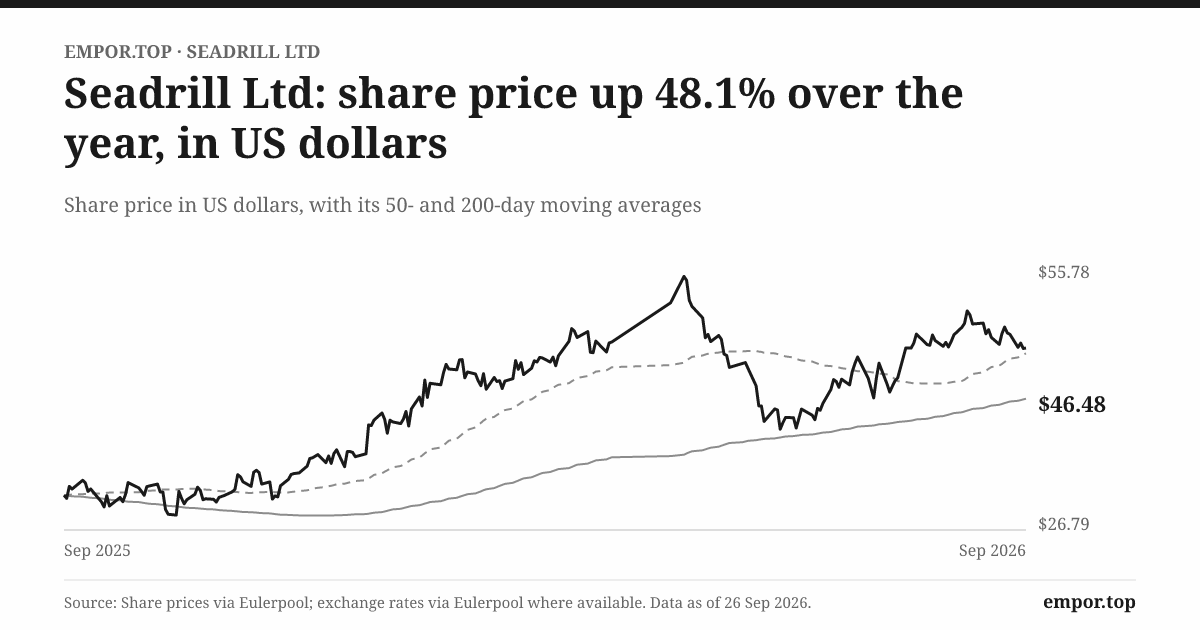
In 2025, buybacks ceased entirely23. The full year produced a net loss of $77 million, and net debt climbed to $260 million23. When repurchases resumed in the second quarter of 2026, management deployed a modest $20 million with the stock trading "in the $30s"33—well below the roughly $43 average price paid during the late-2023 tranche.
The empirical record shows that while the buyback materially reduced the share count, repurchases were concentrated when the stock traded near recent highs and halted when lower share prices coincided with operational downtime. That cadence resembles a company distributing cash simply because it was on hand, rather than a countercyclical capital return strategy. Whether management can maintain capital discipline across an entire cycle will depend on how it allocates capital during the next inevitable industry downturn.
The simplification left Seadrill smaller, free of debt guarantees, and focused on deepwater floaters. The critical analytical question is what the company now owns, and how those floating assets generate operating earnings at the unit level.
VI. Core Business Economics: Inside Ultra-Deepwater Drilling Today (02:10:00 – 02:40:00)
The Oligopoly That Keeps Getting Smaller
Three or four large contractors dominate the global supply of high-specification deepwater drilling rigs, and that circle continues to contract. Noble completed the acquisition of Maersk Drilling in October 2022 and closed its takeover of Diamond Offshore in September 202428. Then, on February 9, 2026, Transocean agreed to acquire Valaris in an all-stock transaction valued at approximately $5.8 billion34. If completed, the combined contractor would control 73 rigs, including 33 ultra-deepwater drillships, an order backlog of roughly $10 billion, and projected annual cost synergies exceeding $200 million34.
That transaction remains pending regulatory clearance. On September 22, 2026, trade press reported that the U.S. Department of Justice was expected to clear the combination without requiring asset divestitures, leaving Brazil's antitrust authority, CADE, as the principal remaining hurdle35. While industry commentary long tracked a "Big Four" in deepwater drilling, the sector may consolidate into a "Big Three" by the end of 2026, leaving Seadrill as decidedly the smallest player.
Scale carries commercial weight in offshore contracting. Transocean reported $6.7 billion in contract backlog in August 202636, more than double Seadrill's $2.9 billion backlog7. Noble's backlog stood at $6.7 billion when it finalized the Diamond acquisition28. Seadrill, by comparison, owns a fleet of 15 rigs23. Larger competitors can offer upstream operators broader global availability, regional rig-substitution options, and multi-rig, multi-basin package contracts.
To be sure, Seadrill's capital structure remains far lighter than Transocean's. Transocean still carried approximately $5.1 billion of debt in mid-2026, even after retiring roughly $1.5 billion over the preceding twelve months36, compared with Seadrill's $750 million gross debt load7. While the contrast between Seadrill's restructured balance sheet and Transocean's leveraged structure endures, that margin of difference is narrowing.
What a Drillship Actually Earns
The unit economics of a deepwater drillship are structured much like a luxury boutique hotel booked entirely by a single corporate guest. The contract day rate serves as the daily room rate. Economic utilization—the proportion of maximum theoretical contract revenue the rig collects after factoring in operational maintenance, equipment downtime, and weather delays—functions as the occupancy rate. Daily operating expenditures, including maritime crew wages, technical personnel, catering, marine insurance, and ongoing equipment upkeep, remain largely fixed whether the rig is drilling ahead or waiting on weather.
Seadrill's 2026 financial reporting illustrates this operating leverage. In the first quarter of 2026, revenue stood at $358 million and Adjusted EBITDA was $97 million37. In the second quarter, as the West Jupiter and West Capella returned to active operations and average fleet day rates rose from $343,000 to $360,000, revenue expanded to $449 million and Adjusted EBITDA reached $144 million7. Approximately half of each incremental revenue dollar flowed through to operating profit. While that reflects healthy operational gearing, it falls short of the 80%-plus conversion rates frequently cited in bullish cycle presentations, because active operating days incur mobilization costs, reimbursable customer outlays, and rig-reactivation expenses.
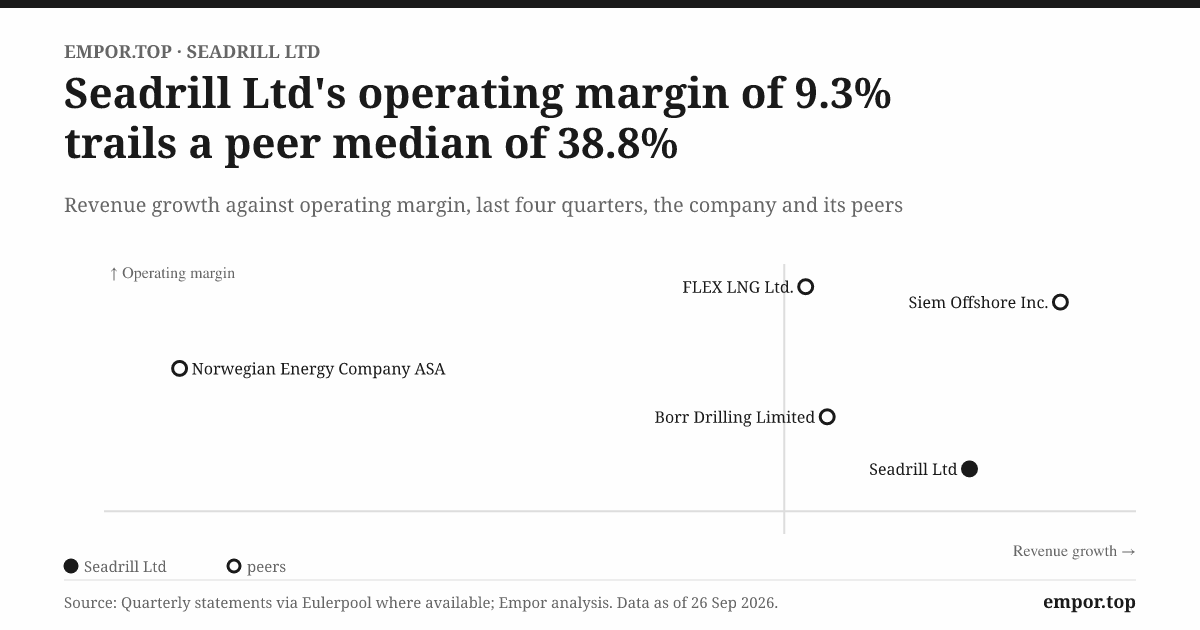
Operating margins provide essential cyclical context. Seadrill's Adjusted EBITDA margin excluding reimbursable items was 33.5% in the second quarter of 20267, compared with 24.4% in the third quarter of 202538 and 33.0% for the full year 202331. Although solid by industrial standards, these returns remain far below the roughly 70% margins that newly delivered drillships captured on peak-cycle Petrobras charters in 2013. In the modern market, average realized fleet day rates continue to trail top-tier fixtures, while post-pandemic inflation has driven baseline operational costs permanently higher.
Mobilization fees represent an overlooked nuance in drillship cash flow. Before a rig commences a new drilling program, it must often transit across ocean basins and undergo customized shipyard modifications to meet operator technical specifications. Customers typically reimburse these expenditures through lump-sum mobilization payments. Management noted that the West Jupiter generated a $30 million mobilization fee in the second quarter of 2026, while the West Tellus was projected to contribute $40 million in the third quarter33. Although these payments help offset the upfront capital required to deploy a vessel, they are non-recurring and irregular. An investor who annualizes a single quarter flattered by substantial mobilization receipts risks significantly overestimating the fleet's normalized baseline earnings power.
The Capital Seadrill Has to Keep Spending
A deepwater drillship cannot simply be operated as a hands-off infrastructure asset. Maritime classification societies mandate comprehensive special periodic surveys every five years, each requiring dry-dock inspections that take the vessel offline for weeks. Upstream operators also insist on substantial capital upgrades—such as dual blowout preventers, managed pressure drilling capabilities, automated pipe handling, and expanded variable deck load capacity—before committing to high-day-rate contracts.
Seadrill's capital guidance underscores the scale of this continuous reinvestment. The contractor projected $200 million to $240 million in capital expenditures and long-term maintenance outlays for 20267, after narrowing its 2025 capex budget to $280 million to $300 million38. Set against full-year 2026 Adjusted EBITDA guidance of $420 million to $450 million7, roughly half of Seadrill's operating cash generation must be reinvested into the fleet before accounting for interest expense, taxes, or equity distributions. That heavy reinvestment burden represents the single most critical bridge between headline EBITDA and realized free cash flow.
Reactivating stacked assets requires an even steeper capital commitment. Seadrill maintains three cold-stacked rigs: the harsh-environment semisubmersibles West Phoenix and West Aquarius in Norway, alongside the West Eclipse in Namibia23. On the second-quarter 2026 earnings call, management indicated that bringing each of the two Norwegian units back into service would require "probably over $100 million" in reactivation capex, reiterating that it would only fund those outlays if backed by sufficiently accretive contract economics33. While maintaining capital discipline on uncontracted steel is prudent, it also means three hulls across Seadrill's 15-rig fleet generate zero operating income today.
Where the Rigs Work
Global deepwater drilling demand is heavily concentrated across three premier offshore basins: the deepwater U.S. Gulf of Mexico, offshore Brazil, and West Africa. Seadrill maintains a presence across all three regions, supplemented by active units in Southeast Asia.
Offshore Brazil represents Seadrill's largest commercial exposure, with Petrobras contributing 36% of total revenue in 202523. In December 2024, the state-backed producer awarded the West Tellus and West Jupiter three-year drilling charters collectively valued at approximately $1 billion, with both programs starting in early 20261. In 2026, Petrobras further extended the West Polaris for three years commencing in January 2028, adding roughly $480 million in contract backlog37. Management disclosed that transitioning the West Jupiter and West Tellus from legacy contracts to these new fixtures boosted combined revenue across the two units by roughly $400,000 per day33.
The U.S. Gulf of Mexico serves as Seadrill's second core basin. Independent exploration and production operators Talos Energy and LLOG Exploration together generated 21% of the company's 2025 revenue23. Looking further out, the West Vela secured a one-year Gulf of Mexico charter scheduled to begin in June 2027, contributing approximately $161 million in backlog7. Management disclosed the day rate for that award at $365,00033—well below the mid-$400,000s rates it characterized as the global leading edge. That pricing discount illustrates how regional basin dynamics and operator negotiations can pull individual fixture rates below widely publicized peak benchmarks.
Across Africa and Asia, the remaining active floaters are strategically dispersed: the West Capella operates for PTTEP offshore Malaysia, while the West Gemini is stationed in Angola23. Management noted that Seadrill expects its active fleet distribution to gradually rebalance from western deepwater markets toward eastern basins as global floater utilization tightens33.
Sonadrill: A Partnership in Angola
One of the least understood components of Seadrill's corporate structure is Sonadrill, a 50:50 joint venture established with Angola's state-owned energy company, Sonangol. Under the venture's framework, three drillships are bareboat-chartered into the partnership: the Seadrill-owned West Gemini alongside Sonangol's Sonangol Libongos and Sonangol Quenguela39. Seadrill provides comprehensive drilling management, operational oversight, and technical services in exchange for fee revenue39.
Although often overlooked by investors, Sonadrill represents a significant operating contributor, accounting for 22% of Seadrill's consolidated revenue in 202523. The operational model is capital-light across the two Sonangol-owned hulls, allowing Seadrill to earn operational fees without carrying the underlying asset risk on its balance sheet. The joint venture's customer roster includes TotalEnergies and Azule Energy, and in 2026 the Sonangol Quenguela secured a contract extension running through July 202837. During the second quarter of 2026, the three venture drillships achieved technical uptime exceeding 99%, while Seadrill's management fees were increased retroactively to January 202633.
However, operating within an international joint venture has also created financial and legal friction. In 2025, Seadrill recognized a $43 million loss stemming from an adverse court ruling tied to Sonadrill management fee claims23, followed by an additional $16 million cash payment related to that judgment in the second quarter of 20267. Partnering with a national oil company guarantees regional market access, but it also introduces counterparty and legal complexities that are easily underappreciated from the outside.
In sum, Seadrill operates high-specification floating assets in the world's most prolific deepwater basins, supported by a balance sheet reconstructed to endure cyclical volatility. Yet as unit-level operating costs, relentless fleet maintenance, and regional pricing gaps demonstrate, commanding premium assets does not automatically guarantee pricing power. The analysis that follows interrogates that question directly: does Seadrill command an enduring economic moat, or does it remain at the mercy of the offshore commodity cycle?
VII. The Historical Falsification Layer: Stress-Testing the Thesis (02:40:00 – 03:00:00)
An investment thesis unexamined against historical performance is little more than corporate optimism. This section stress-tests four central bull arguments surrounding Seadrill against empirical evidence from the company's operating record.
Test 1: The "Dual-BOP Scarcity Moat" vs. Customer Monopsony Power
The claim. Seventh-generation drillships equipped with dual blowout preventers are scarce, oil producers cannot execute complex deepwater campaigns without them, and speculative new construction has ground to a halt. Consequently, owners of these high-specification units should command structural pricing power.
The test. A blowout preventer is the subsea valve stack installed on the seabed to seal a well during an uncontrolled pressure kick. A secondary, redundant stack allows crews to service one unit while drilling continues uninterrupted on the other—a critical operational advantage in deep water. Yet if asset scarcity constituted a genuine economic moat, it would manifest in two verifiable conditions: sustained pricing power and an inability of upstream operators to play rival drillers off against each other.
On day rates, the evidence is mixed. Seadrill's average contractual day rate reached $360,000 in the second quarter of 2026, up from $343,000 in the prior quarter7 and $319,000 in the fourth quarter of 202523. That trajectory represents tangible improvement, but day rates remain well below the peak-cycle day rate of $650,000 reached in 20133. Moreover, Seadrill's one-year fixture for the West Vela cleared at $365,00033, while rival Transocean reported recent fixtures averaging roughly $461,00036. Day rates are climbing, but they have not established a unilateral ability to dictate contract terms.
On customer power, the evidence cuts directly against the moat thesis. With Petrobras accounting for 36% of Seadrill's revenue in 202523, the contractor depends heavily on a single state-controlled buyer that procures capacity through structured auctions. The West Tellus secured its three-year charter through "a competitive tender process"1. Petrobras dictates contract timing, and the 2024 scheduling delays that kept the West Auriga and West Polaris idle for most of the year occurred on the customer's side of the relationship22.
The verdict. Historical evidence refines the claim rather than invalidates it. Hardware scarcity provides Seadrill a better position in a tight market, which is fundamentally distinct from enduring pricing power. The decisive metric to monitor is whether newly signed day rates outpace daily vessel operating inflation over the coming two years. If follow-on contracts continue to clear near $365,000 while management characterizes leading-edge benchmarks in the mid-$400,000s, the scarcity thesis remains an aspiration rather than an established moat.
Test 2: The "Contract White Space" Reality vs. Management Guidance Discipline
The claim. Post-restructuring management exercises disciplined fleet scheduling and issues financial guidance it can reliably deliver.
The test. The empirical record reveals a mixed performance that has improved over time. In 2024, full-year Adjusted EBITDA guidance was initially set at $400 million to $450 million27, before management lowered the range to $315 million to $365 million in August22 after commencement dates slipped for two drillships in Brazil. Management cited specific drivers—supply-chain bottlenecks, adverse weather, and expanded customer shipyard scopes22—rather than general market weakness. In November 2024, leadership raised the Adjusted EBITDA outlook to $375 million to $395 million40, and full-year Adjusted EBITDA finalized at $378 million32—inside the upwardly revised bracket, though still below the initial February target.
In 2025, guidance held firmer: Adjusted EBITDA guidance was narrowed to $330 million to $360 million, from an initial $320 million to $380 million, with capital expenditures guided toward the upper end of the range38. Actual 2025 Adjusted EBITDA landed at $353 million23. In 2026, forecasting discipline strengthened further as guidance was raised in consecutive quarters. Initial full-year Adjusted EBITDA guidance stood at $350 million to $400 million23, was raised to $370 million to $420 million in May37, and lifted again to $420 million to $450 million in August7. Chief Financial Officer Grant Creed credited "great" operational execution across the West Capella, West Jupiter, and West Tellus, highlighting that all three projects were delivered ahead of schedule and on budget37.
A more persistent operational vulnerability lies in uncontracted fleet "white space." During the August 2026 earnings presentation, executives identified the Sevan Louisiana, West Carina, and West Gemini as units confronting near-term contracting uncertainty. The West Carina was relocated to Walvis Bay, Namibia, with management targeting a follow-on charter in the first half of 202733. Unpaid idle time between drilling programs remains a structural reality of contract offshore drilling.
The verdict. The claim holds in a narrower, more qualified form. Since 2025, current leadership has established a far more dependable forecasting track record than in 2024—and stands in stark contrast to the pre-bankruptcy era, when leadership pledged distributions through 2015 only to eliminate them entirely months later15. Nevertheless, the 2024 guidance revision demonstrated that schedule slippage on just two hulls can derail a full-year outlook. The operational test going forward is whether the West Carina and West Gemini secure follow-on charters without protracted idle downtime.
Test 3: Capital Allocation Record: Dilution, Impairments, and Restructuring Traps
The claim. Seadrill's capital structure is now permanently insulated against financial distress.
The test. Characterizing any cyclical balance sheet as "permanently" protected misreads the offshore contracting industry. Net debt stood at $33 million at the close of the third quarter of 202440, rose to $120 million at year-end 202432, increased to $260 million at the end of 202523, and reached $390 million by the end of June 20267. Over that interval, Seadrill allocated hundreds of millions of dollars toward share repurchases and contract preparation capital outlays. While an enterprise guiding to $420 million to $450 million in Adjusted EBITDA against $390 million in net debt carries modest leverage, the balance sheet trend points toward accumulating debt rather than de-leveraging.
Recent liability management has meaningfully improved debt maturities and coupon costs. In 2026, Seadrill issued $700 million of 6.75% senior notes due 2034, using the proceeds to redeem $575 million of 8.375% notes due 2030, while increasing its revolving credit facility to $300 million with maturity extended to 203133. While the transaction lowered cash borrowing costs and extended debt maturities at the expense of a $35 million accounting loss on debt extinguishment in the first half of 20267, it also expanded total gross debt.
The broader historical record underscores why equity holders should remain vigilant. Pre-petition equity was compressed to roughly 1.9% in the 2018 restructuring5 and to 0.25% in the 2022 reorganization6. Furthermore, the Aquadrill acquisition required issuing approximately 37% of the combined company's enlarged equity base25. Every share held today represents the residual outcome of successive creditor wipeouts, debt conversions, and stock-financed mergers.
The verdict. Corporate history qualifies the claim: the balance sheet today is strong enough to survive an ordinary downturn, but it is not permanently fortified against a prolonged market freeze. The quantitative indicator that would validate management's prudence is net debt to trailing Adjusted EBITDA remaining below roughly 1.0x through the next contract cycle. A continuing rise in net leverage alongside discretionary share buybacks would signal that cyclical discipline is slipping.
Test 4: Technical Milestone vs. Commercialization Trap
The claim. Hybrid power retrofits, battery energy storage systems, and digital well-monitoring technologies grant Seadrill an ESG and operational efficiency edge that captures premium contracts.
The test. In standard offshore drilling agreements, fuel costs function as pass-through expenses paid directly by the upstream customer. Consequently, fuel savings and emissions reductions flow primarily to the operator, while the capital expenditures required for retrofits are absorbed by the drilling contractor. Across earnings announcements and conference-call transcripts from 2023 through the second quarter of 2026, leadership has not quantified any realized day-rate premium attributable to these features. When describing commercial bidding, management frames its objective as securing "the best potential contract for our rigs," evaluated on mobilization fees, contract terms, and total value33—making no reference to pricing premiums for environmental features.
The verdict. The thesis remains unproven. Decarbonization retrofits may serve as a baseline operational prerequisite for securing tenders with select European supermajors, but absent disclosed pricing premiums, green retrofits cannot yet be credited as an economic differentiator in an investment case.
Taken together, the four tests depict a well-run contractor operating capable assets in an industry that still denies its participants sovereign pricing power. The section that follows examines those structural dynamics through formal strategic frameworks.
VIII. Porter's 5 Forces & Hamilton Helmer's 7 Powers Analysis (03:00:00 – 03:12:00)
The War Room
Picture the contracting team at Petrobras preparing a tender. On one side of the table sits a stack of commercial bids from drillers with idle or soon-to-be-idle floaters. On the other side sits a multi-year national production schedule that cannot slip indefinitely without economic consequences. Both parties need each other. The core question is who holds the upper hand, and the answer shifts across the commodity cycle.
Michael Porter's Five Forces framework clarifies how that bargaining leverage is distributed.
Porter's 5 Forces Breakdown
Bargaining power of buyers: high. Seadrill's four largest customer relationships—Petrobras, the Sonadrill joint venture, Talos Energy, and LLOG Exploration—accounted for 79% of consolidated revenue in 202523. The customer pool is substantially smaller and more consolidated than the contractor base. Major operators procure capacity through disciplined, competitive auctions, divide work packages among competing contractors to avoid single-supplier dependence, and readily postpone exploratory campaigns when oil prices soften. A contractor with a 15-rig fleet negotiating against a national oil company does not bargain from a position of parity.
Bargaining power of suppliers: medium-high. A concentrated circle of original equipment manufacturers supplies mission-critical subsea hardware—including blowout preventers, top drives, and specialized marine risers—and must recertify that equipment during regulatory overhauls. Simultaneously, skilled offshore mariners, drill crew, and subsea engineers are scarce. Escalating labor and vendor costs explain why Seadrill's operating margins remain far below their 2013 peak, even as contract day rates rebound.
Threat of new entrants: very low. Constructing a modern ultra-deepwater drillship requires hundreds of millions of dollars in capital, and shipyards will no longer break ground on speculative hulls without ironclad multi-year charter commitments. Lenders and private equity sponsors burned by two waves of offshore restructurings refuse to finance greenfield drilling contractors. This represents the single strongest structural barrier protecting incumbent drillers, and it is the only competitive force that has decisively improved since 2014.
Threat of substitutes: low within deepwater, meaningful at the portfolio level. No substitute technology can displace a floating rig when drilling in several thousand meters of water. However, upstream exploration and production capital is highly fungible. Deepwater exploration must compete against short-cycle onshore shale, liquefied natural gas projects, and corporate share repurchases for every discretionary capital expenditure dollar—the exact substitution mechanism that undermined the deepwater offshore market in 2014.
Rivalry among competitors: medium-high, and intensifying. While industry consolidation reduces the likelihood of reckless market-wide price wars, rivalry remains intense at the basin and fixture level. When a drillship approaches contract expiration in a basin where a peer holds idle capacity, day rates quickly become the weapon of choice to avoid stacking costs. Furthermore, the pending Transocean-Valaris combination would establish an industry giant commanding 33 ultra-deepwater drillships34. That scale could foster commercial bidding discipline, or it could allow a consolidated competitor to strategically undercut smaller rivals across multiple basins.
Hamilton Helmer's 7 Powers Framework
Scale economies: modest. Managing overhead and shore-based logistics across a 15-rig fleet is inherently less efficient than spreading costs across 70 or more units. Management's target of $70 million in annual run-rate synergies from the Aquadrill acquisition24 demonstrates that scale generates real administrative and procurement efficiencies—and Seadrill commands far less scale than its consolidating peers.
Network effects: none. Offshore drilling units operate as standalone industrial assets; an additional rig in a contractor's fleet does not enhance the utility or productivity of existing units for customers.
Counter-positioning: none. Following the industry-wide restructuring wave, all primary deepwater contractors operate nearly identical business models: lean corporate balance sheets, disciplined floater marketing, and cash-flow allocation tilted toward fleet preservation and shareholder returns. Incumbents face no structural barrier preventing them from mimicking Seadrill's strategy.
Switching costs: moderate during a drilling campaign, negligible between contracts. Mid-program, swapping out a drilling rig imposes steep operational risks, mobilization costs, and wellhead reconfiguration delays for an operator. However, once a well or multi-well campaign concludes, switching costs evaporate, and the operator can tender the next program openly to the lowest qualified bidder.
Branding: weak as a pricing driver. Stringent health, safety, and environmental track records alongside operational uptime above 95% are mandatory table stakes rather than premium brand differentiators. Seadrill's 96% economic utilization in the second quarter of 20267 merely qualifies the contractor to bid; it does not confer the pricing power to command a day-rate premium over comparable peer assets.
Cornered resource: moderate, but non-exclusive and eroding. High-specification, seventh-generation drillships cannot be economically replicated at current shipyard construction costs, providing incumbent owners with a scarcity buffer. However, because this modern capacity is dispersed among Noble, Transocean, and other competitors, no single driller monopolizes the resource. Furthermore, Seadrill carries three cold-stacked rigs that management estimated would each require more than $100 million in reactivation capital33—demonstrating that holding scarce iron generates no economic return until substantial capital is committed.
Process power: low. Complex deepwater drilling methodologies and engineering know-how reside largely in the broader maritime labor pool and third-party oilfield service providers. Experienced crews and shore-based operations managers move freely across contractors, taking institutional operational expertise with them.
The Verdict
Seadrill's structural moat is narrow. The company operates a capital-intensive oilfield service business characterized by severe operating leverage, protected primarily by high barriers to entry and prohibitive shipyard replacement costs for deepwater hulls. That protective shield endures only as long as drilling contractors and financiers refrain from commissioning new units. The moment speculative shipyard orders reemerge across the sector, that barrier will begin to crumble.
Because competitive structure provides modest enduring protection, the company's fate rests on boardroom execution and capital discipline—the operational choices and leadership decisions examined in the next chapter.
IX. Management, Governance & The Current Risk Radar (03:12:00 – 03:22:00)
The Handoff
On March 12, 2026, Seadrill's board announced that Samir Ali would become president and chief executive officer, replacing Simon Johnson with immediate effect9. The board chair described Ali as "the right leader to guide Seadrill forward"9. Yet the company's press release offered no explanation for Johnson's abrupt exit9. A regulatory filing on Form 8-K subsequently disclosed that the departure was treated as a "termination without cause," triggering contractual severance payments under his existing employment agreements41.
That combination—an immediate leadership swap, an absence of public explanation, and full contractual severance—points toward an unscripted boardroom intervention rather than an orderly, planned succession. During his four-year tenure, Johnson had navigated Seadrill's post-bankruptcy public relisting, divested its shallow-water jackup fleets, completed the stock-funded Aquadrill combination, and retired roughly 22% of the company's shares through repurchases. Yet his leadership also coincided with the sharp 2024 guidance reduction caused by shipyard and delivery delays, a $77 million net loss in 2025, and a balance sheet where net debt climbed from near-zero to several hundred million dollars. The board has never publicly clarified which operational or financial pressures weighed heaviest in its decision.
The New CEO
Ali was 40 years old when he was appointed41. His career spans three disciplines central to running a modern offshore contractor: eight years leading investor relations and corporate development at Diamond Offshore, private credit and equity investing at Bain Capital, and energy investment banking at Simmons & Company9. As chief commercial officer since August 2022, Ali directed the commercial contracting campaigns that secured Petrobras awards in Brazil, deepwater programs in the Gulf of Mexico, and charter extensions in Angola.
His executive compensation structure heavily emphasizes incentive-based pay. The package includes a $750,000 base salary, an annual target cash bonus of 110% of base salary, and a $3.5 million long-term equity incentive award structured as 60% performance-vesting shares and 40% time-vesting units41. In addition, the agreement contains a double-trigger change-of-control provision that would award him three times his base salary plus target bonus if his employment is terminated within 24 months after a change of control41. In a rapidly consolidating offshore sector where Seadrill now ranks as the smallest among primary deepwater contractors, that change-of-control provision means the chief executive has a significant financial stake in evaluating potential acquisition offers.
Ali's public commentary has emphasized total contract value over chasing headline day-rate records. During Seadrill's August 2026 earnings conference call, he observed that "It's not about getting the highest day rate. It is getting the best potential contract for our rigs"33, while characterizing the floater sector as "a relatively inelastic supply in an increasing demand environment"33. While prioritizing total contract terms reflects sound commercial discipline, asserting that rig supply is inelastic in an expanding market expresses an optimism about the cycle that has repeatedly caught offshore drillers off guard in previous downturns.
Chief Financial Officer Grant Creed provides institutional continuity. Having served through the December 2020 bankruptcy of Seadrill Partners and the parent company's subsequent Chapter 11 filing in February 202114, Creed brings firsthand experience navigating acute balance-sheet distress. His stated framework for capital allocation—evaluating the company's liquidity, cash forecast, and alternative uses of capital "through a disciplined lens"33—reflects a measured posture, though it leaves management wide discretion over whether to fund share repurchases, fleet upgrades, or debt retirement.
Governance has also been reshaped by the evolution of Seadrill's equity register. The shareholder base was forged during the February 2022 restructuring, when senior secured lenders exchanged bank debt for an 83% equity stake6, before subsequent dilution from the stock-financed Aquadrill acquisition reduced that concentration25. John Fredriksen, who controlled the enterprise for over a decade and chaired the board through the 2018 restructuring5, no longer commands a controlling position. This shift eliminates the intricate related-party transactions and satellite structures of the pre-bankruptcy era. At the same time, it leaves the equity register populated by former distressed-debt creditors whose investment horizon often favors prompt cash returns or an eventual corporate exit at a premium—dynamics that help explain both the aggressive 2023–2024 share repurchases and the generous change-of-control provisions in executive contracts.
An activist or institutional investor evaluating Seadrill today would likely confront four unresolved strategic questions: Why was the chief executive replaced without explanation? Why did share repurchases halt throughout 2025 when the stock was cheaper, only to resume modestly once business conditions recovered? Should the three cold-stacked rigs be sold or scrapped rather than held at ongoing expense? And finally, does a 15-rig contractor possess sufficient scale to compete over the full cycle, or would shareholders realize superior risk-adjusted returns through a combination with a larger rival? Each question addresses a fundamental strategic tension at the core of Seadrill's corporate standing.
The Risk Radar
1. Customer and sovereign concentration. Brazilian state-backed producer Petrobras accounted for 36% of consolidated revenue in 202523. Consequently, shifts in Brazilian energy policy, Petrobras executive leadership, or sovereign tender schedules exert an outsized influence on Seadrill's financial performance. The operational bottlenecks and delivery delays in 2024 demonstrated how schedule slippage across just two Petrobras-contracted drillships can trigger a material downward revision to annual corporate earnings.
2. Fleet white space and idle downtime. In offshore drilling, every day a floating unit spends between charters generates ongoing maintenance and crew-retention expenses while yielding zero revenue. Three units—the semisubmersible Sevan Louisiana alongside drillships West Carina and West Gemini—face contracting uncertainty and limited commercial visibility over the coming year33. How effectively marketing teams recontract these assets without protracted idle periods will heavily dictate operating results heading into 2027.
3. Counterparty and litigation exposure in West Africa. While the Sonadrill joint venture in Angola remains an essential commercial contributor, it has generated material legal and financial liabilities. An adverse court judgment concerning disputed management fees cost Seadrill a $43 million accounting charge in 202523 and an additional $16 million cash outlay during the second quarter of 20267. Partnering with a national oil company provides vital regional market access, but it also carries legal, administrative, and sovereign complexities that are difficult for outside investors to quantify.
4. Capital intensity and shipyard reactivation burdens. Projected baseline capital expenditures and long-term fleet maintenance of $200 million to $240 million for 20267 absorb roughly half of Seadrill's operating cash generation. Furthermore, potential reactivation costs estimated at over $100 million for each of the company's stacked units33 impose a steep hurdle before idle steel can be returned to service. These non-negotiable industrial reinvestment requirements compete directly against debt reduction and discretionary shareholder distributions.
5. Cyclical vulnerability and market forecasting risk. Both Seadrill's executive team and consolidating peers have projected that global floater utilization will tighten into the mid-90% range by 20273336. Yet the offshore drilling sector has repeatedly witnessed broadly shared cycle forecasts falter; comparable consensus projections voiced in 2014 and 2019 were swiftly derailed by macroeconomic shocks and upstream spending cutbacks before tightening materialized. If upstream operators moderate deepwater exploration budgets in response to softer oil prices, realized day rates and fleet utilization will once again fall short of bullish industry projections.
The analysis that follows brings these strategic, operational, and financial crosscurrents together into the formal bull and bear investment theses.
X. The Bull vs. Bear Case & 3 Critical KPIs (03:22:00 – 03:30:00)
The Bull Case
Supply cannot readily respond. No speculative drillship orders are underway across global shipyards, and Seadrill's three cold-stacked units would each require more than $100 million to reactivate33. Competitor Transocean projected industry utilization for deepwater and harsh-environment rigs to move "well into the 90% range during 2027"36, while Seadrill's executive team has echoed nearly identical language33. With shipyard capacity disciplined, rising fleet utilization translates directly into upward pressure on day rates.
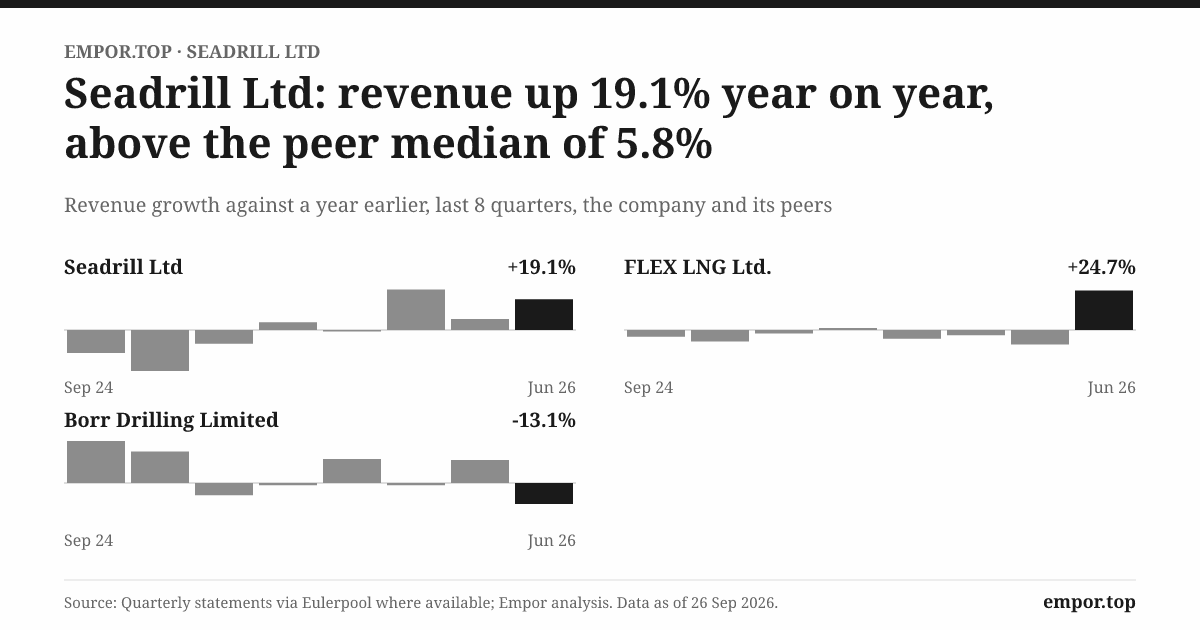
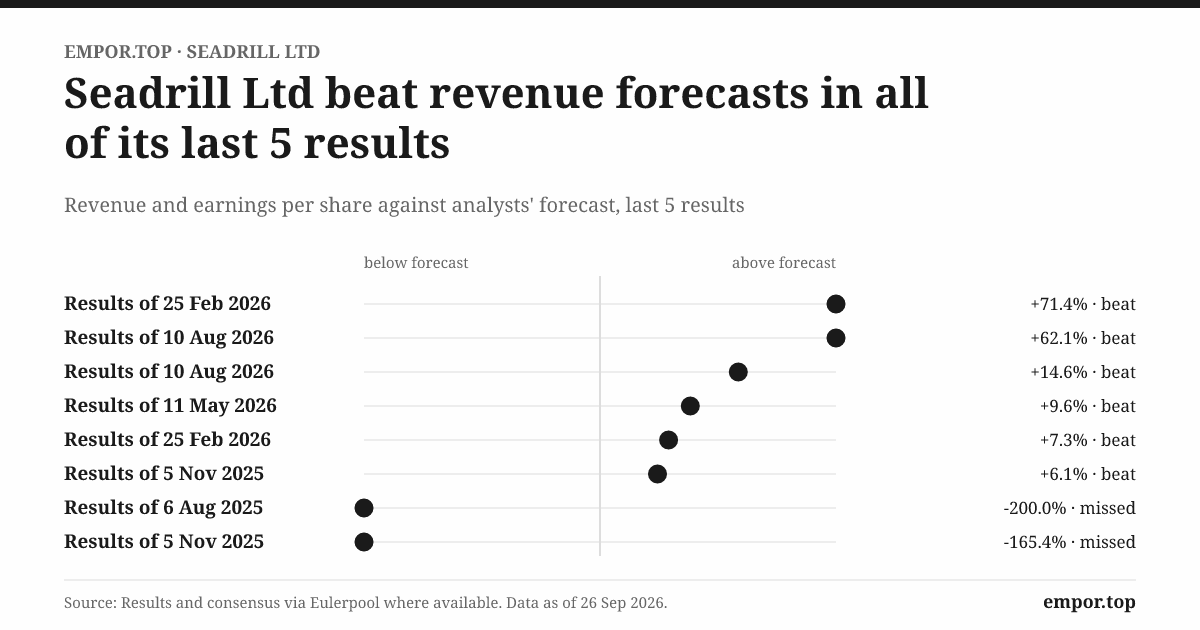
Contracts are resetting to higher day rates. The deployment of the West Jupiter and West Tellus under their new Petrobras fixtures added roughly $400,000 per day in combined revenue across the two rigs33. The West Polaris extension secures revenue visibility through 203137. Management has raised full-year Adjusted EBITDA guidance twice during 20267, while second-quarter revenue topped consensus analyst estimates by roughly 16%42.
Consolidation reinforces commercial bidding discipline. If the pending Transocean-Valaris combination clears regulatory scrutiny, three primary contractors will control the overwhelming majority of the high-specification global floater fleet. A more consolidated contractor landscape reduces the incentive for competitors to discount day rates simply to keep idle hulls working.
Operating leverage amplifies per-share returns. With approximately 62.4 million shares outstanding23, Seadrill's compact equity base provides substantial per-share gearing. Across ten active floaters, every $10,000 daily improvement in average realized day rates flows directly through to operating profit and meaningfully enhances earnings for a relatively small share count.
The Bear Case
The offshore drilling sector has repeatedly anticipated recoveries that faltered. The 2018 restructuring plan counted on an offshore rebound that never materialized5, precipitating a second Chapter 11 filing within three years. Furthermore, Seadrill's average contractual day rate of $360,000 in the second quarter of 20267 remains more than 40% below the peak levels recorded in 20133, while operating margins sit at roughly half their previous cyclical highs.
Seadrill remains the smallest competitor in a rapidly consolidating market. Operating with a fleet of 15 rigs23, Seadrill faces rivals commanding substantially larger order backlogs and broader regional footprints3436. In commercial tenders where exploration and production operators favor contractors offering fleet redundancy, rig-substitution flexibility, or multi-basin packages, smaller fleet scale poses a distinct competitive disadvantage.
Relentless capital intensity erodes free cash flow. Full-year capital expenditure guidance of $200 million to $240 million7 consumes roughly half of guided Adjusted EBITDA of $420 million to $450 million7, leaving free cash flow tightly constrained after debt service and taxes. Underscoring that capital drag, Seadrill incurred a net loss of $77 million in 202523—a year broadly characterized as an offshore market upswing.
Capital returns have proven pro-cyclical. Share repurchases halted entirely throughout 202523 and resumed only modestly in the second quarter of 2026 after the equity was trading at lower prices33. Shareholders counting on repurchases to provide an enduring valuation floor must recognize that capital distributions disappeared during the very stretch when downside price support was needed most.
Myth vs. Reality: "No Newbuilds Means Rates Must Rise"
The most prevalent bullish argument asserts that because shipyards have ceased building speculative drillships, market day rates have nowhere to go but up. That premise captures only half the commercial reality. While total global floater supply is fixed, existing capacity is not fully deployed. Seadrill alone maintains three cold-stacked rigs23, while Transocean's ultra-deepwater fleet utilization stood at just 72.6% in the second quarter of 202636. Long before any contractor commits to a shipyard newbuild, the industry will mobilize idle units whenever prevailing day rates justify the roughly $100 million-plus reactivation cost33. That reactivation threshold functions as an effective ceiling on medium-term rate expansion: every step higher in market pricing incentivizes a peer to reactivate an idle hull, reintroducing supply that competes for future contracts.
Yet the bearish counter-argument carries its own blind spot. Cold-stacked rigs that have spent years dormant cannot re-enter service overnight. Reactivating a complex floater requires extensive shipyard recertifications, long-lead equipment procurement, and restaffing specialized crews that have dispersed across the maritime sector. That operational lag creates an extended window during which actively operating drillships can capture premium pricing before dormant supply re-enters the market. The balanced reality is that restrained new construction provides a constructive foundation for higher day rates, but it does not guarantee an unconstrained return to the peak pricing of 2013.
How to Think About Value Through the Cycle
Offshore drilling contractors frequently appear misleadingly cheap at cyclical peaks and deceptively expensive at market troughs, because a single year's earnings reveal very little about the cash a floater generates across a multi-decade operational lifespan. Three valuation benchmarks provide essential cyclical grounding:
First, replacement cost—the capital required to construct an equivalent modern fleet today, which establishes a theoretical long-term ceiling on enterprise value. Second, private-market transaction value—the pricing established when active floaters change hands between contractors, as demonstrated in Seadrill's Aquadrill acquisition and Noble's takeover of Diamond Offshore. Third, normalized mid-cycle cash flow—the free cash generation a fleet delivers after maintenance capital outlays at day rates normalized between historical peaks and troughs.
Today, Seadrill trades well below shipyard replacement cost, roughly in line with secondary transaction valuations, and its equity valuation hinges entirely on assumptions regarding normalized mid-cycle cash flow. An investor who values the company by applying a mid-cycle multiple to peak-cycle EBITDA risks repeating the catastrophic error of 2013. Conversely, an investor who anchors strictly on trough earnings risks overlooking the cash generation unlocked as legacy contracts reprice to current market rates.
The 3 Critical KPIs That Matter Most
1. Forward contract coverage. The proportion of operating rig days secured under firm customer commitments over the forward 12-to-24-month horizon, alongside realized day-rate pricing. This metric provides transparent visibility into forward revenue and distinguishes structural demand growth from speculative cyclical forecasts. Seadrill discloses this data through periodic fleet status updates and backlog reports.
2. Economic utilization. The percentage of maximum theoretical contract revenue the operating fleet actually collects after adjusting for technical downtime, maintenance delays, and operational friction. Fleet economic utilization registered at 91.0% in the fourth quarter of 202523 and advanced to 96% in the second quarter of 20267. Tracking this metric reveals both unit-level operational reliability and the commercial cost of uncontracted white space between drilling campaigns.
3. Free cash flow after capital expenditures and long-term fleet maintenance. The ultimate test of Seadrill's financial health is whether headline Adjusted EBITDA converts into distributable cash after funding mandatory dry-dockings, special periodic surveys, and customer-mandated rig upgrades. Sustained free cash flow after fleet reinvestment determines whether management can comfortably service its debt, accumulate balance-sheet reserves, or return capital to shareholders across an entire commodity cycle.
Together, these three operational and financial benchmarks offer a reliable gauge for whether the bull or bear thesis is gaining ground. The concluding chapter examines what Seadrill's turbulent history reveals about the broader mechanics of cyclical investing.
XI. Playbook: Business & Investing Lessons (03:30:00 – 03:35:00)
Lesson 1: Financial Engineering in Cyclical Commodities Is Fatal
Seadrill did not collapse because its rigs were technologically deficient or poorly maintained. It failed because an industrial service enterprise whose top-line revenue could drop by half within a single year was capitalized as though its cash generation were an ironclad annuity. High operational gearing and aggressive financial leverage compound each other during a downturn. When deepwater day rates plunged from roughly $650,000 toward cash break-even levels3, an enterprise burdened by billions of dollars in bank debt and committed to unsustainable equity payouts had no margin for error. Even the dropdown partnership structure conceived to monetize contracted hulls and multiply value unraveled into its own Chapter 11 bankruptcy in 202014.
For investors, the broader lesson is that balance-sheet leverage and cyclical operating risk must be evaluated in tandem rather than treated as independent variables. When an asset-heavy contractor pairs high fixed operating costs with heavy debt and speculative shipyard commitments, financial engineering ceases to be a value driver and becomes an existential hazard.
Lesson 2: Equipment Quality Is Not a Moat
In 2014, Seadrill controlled one of the youngest and most technologically capable floater fleets in the world. It wiped out its equity holders twice in the ensuing decade regardless. In contract offshore drilling, holding premium iron provides no economic defense when upstream exploration budgets contract. An uncontracted seventh-generation drillship is not merely an idle asset; it is an industrial liability that burns cash every day in stacking, maintenance, and crew costs. Sustainable economic returns stem not from owning modern hardware, but from having that hardware deployed under profitable contracts during market peaks—and no contractor controls the timing or duration of that demand window.
The modern scarcity argument is more credible than its 2014 predecessor because speculative shipyard orders have ceased. Yet asset scarcity remains a cyclical condition rather than an enduring competitive moat. The moment prevailing day rates rise sufficiently to justify reactivating cold-stacked units or funding new shipyard construction, that scarcity buffer will begin to erode.
Lesson 3: The True Value of Balance Sheet Purity
The 2022 Chapter 11 exit delivered an operational advantage that the 2018 restructuring never provided: strategic autonomy. With its debt overhang converted into equity, Seadrill gained the flexibility to sell non-core shallow-water jackups for cash2021, acquire Aquadrill in an all-stock combination25, and retire more than a fifth of its equity base through repurchases8—all without requiring consent from an anxious bank syndicate.
Yet balance-sheet purity is merely an enabler of capital allocation, not a guarantee of sound execution. The steady accumulation of net debt since 2024732 alongside share repurchases concentrated near cyclical highs demonstrates that an unencumbered balance sheet can be depleted just as easily as it can be compounded. A light debt load provides management with strategic choices, nothing more. When the next offshore contraction inevitably arrives, the true test of Seadrill's capital discipline will be whether leadership uses that flexibility to protect liquidity and capitalize on countercyclical dislocations, or once again allows cyclical optimism to erode shareholder value.
References
-
Seadrill Announces Brazil Contract Award for West Tellus — Seadrill Limited, 2024-12-17 ↩↩↩
-
Fredriksen's Breakup With Adviser Troeim Hits Shares — gCaptain / Bloomberg, 2014-09-22 ↩↩↩↩↩↩↩
-
Seadrill Shares Tumble as Dividend is Cut — gCaptain / Reuters, 2014-11-26 ↩↩↩↩↩↩↩↩↩↩↩↩
-
Seadrill Limited Annual Report on Form 20-F for 2018 — U.S. Securities and Exchange Commission, 2019 ↩↩
-
Seadrill emerges from Chapter 11 bankruptcy — Drilling Contractor, 2018-07 ↩↩↩↩↩↩↩↩
-
Seadrill Announces Emergence from Chapter 11 — PR Newswire / Seadrill Limited, 2022-02-23 ↩↩↩↩↩↩↩
-
Seadrill Announces Second Quarter 2026 Results (Form 8-K Exhibit) — U.S. Securities and Exchange Commission / Seadrill Limited, 2026-08-10 ↩↩↩↩↩↩↩↩↩↩↩↩↩↩↩↩↩↩↩↩↩↩↩
-
Seadrill Announces Fourth Quarter and Full Year 2024 Results — Seadrill Limited, 2025-02-26 ↩↩↩
-
Seadrill Announces Appointment of Samir Ali as CEO — Seadrill Limited, 2026-03-12 ↩↩↩↩↩↩
-
Seadrill Announces Voluntary Delisting from Oslo Stock Exchange, Following Oslo Bors Approval — Seadrill Limited, 2024-06-07 ↩↩
-
Seadrill Axes Dividend as Drilling Market Slumps — The Maritime Executive, 2014-11-26 ↩↩
-
Seadrill Partners LLC Annual Report on Form 20-F for 2013 — U.S. Securities and Exchange Commission, 2014 ↩
-
Seadrill Partners Files Chapter 11 — Rigzone, 2020-12-02 ↩↩↩↩↩
-
SeaDrill Shares Plunge 23% After Board Suspends Dividend — Zacks / Yahoo Finance, 2014-11-27 ↩↩↩
-
Seadrill files for Chapter 11 bankruptcy — Financier Worldwide, 2017 ↩↩
-
Offshore Driller Seadrill Files for Second Bankruptcy Protection in US — Financial Times, 2021-02-11 ↩
-
Seadrill Limited Form 6-K: Appointment of Simon Johnson as President and CEO — U.S. Securities and Exchange Commission, 2022-03-24 ↩↩
-
Seadrill makes a comeback on Oslo Stock Exchange — Offshore Energy, 2022-11-17 ↩
-
Seadrill finalizes sale of seven jackups to ADES — Drilling Contractor, 2022-10-19 ↩↩↩↩
-
Seadrill Completes Divestment of Jack-Up Rigs — Seadrill Limited, 2024-06-25 ↩↩
-
Seadrill Announces Second Quarter 2024 Results (Form 6-K Exhibit) — U.S. Securities and Exchange Commission / Seadrill Limited, 2024-08 ↩↩↩↩↩↩
-
Seadrill Announces Fourth Quarter and Full Year 2025 Results — Seadrill Limited, 2026-02-25 ↩↩↩↩↩↩↩↩↩↩↩↩↩↩↩↩↩↩↩↩↩↩↩↩
-
Seadrill acquires Aquadrill in all-stock transaction to create leading offshore drilling company — World Oil, 2022-12-23 ↩↩↩
-
Seadrill Limited Form 6-K: Completion of Aquadrill Acquisition — U.S. Securities and Exchange Commission, 2023-04-03 ↩↩↩↩↩
-
Seadrill Sells Three Tender-assist Units for $85 Million — Offshore Engineer, 2023-06-21 ↩
-
Seadrill Limited Form 6-K: First Quarter 2024 Results — U.S. Securities and Exchange Commission, 2024-05 ↩↩↩↩
-
Noble Corporation plc announces closing of Diamond acquisition and new appointment to the board of directors — PR Newswire / Noble Corporation, 2024-09-04 ↩↩↩
-
Noble Corp to Buy Diamond Offshore in $1.6 Billion Rig Deal — Bloomberg, 2024-06-10 ↩
-
Seadrill Limited Form 6-K: Completion of Share Repurchase Program — U.S. Securities and Exchange Commission, 2023-12 ↩
-
Seadrill Announces Fourth Quarter and Full Year 2023 Results — Seadrill Limited, 2024-02-28 ↩↩
-
Seadrill Announces Fourth Quarter and Full Year 2024 Results — Seadrill Limited, 2025-02-26 ↩↩↩↩
-
Seadrill (SDRL) Q2 2026 Earnings Call Transcript — The Motley Fool, 2026-08-10 ↩↩↩↩↩↩↩↩↩↩↩↩↩↩↩↩↩↩↩↩↩↩↩
-
Transocean to Acquire Valaris in All-Stock Transaction (Form 8-K Exhibit 99.1) — U.S. Securities and Exchange Commission / Transocean Ltd., 2026-02-09 ↩↩↩↩
-
Transocean-Valaris merger: Reports indicate DOJ may clear deal early — Offshore Magazine, 2026-09-22 ↩
-
Transocean Ltd. Reports Second Quarter 2026 Results (Form 8-K Exhibit 99.1) — U.S. Securities and Exchange Commission / Transocean Ltd., 2026-08-05 ↩↩↩↩↩↩↩
-
Seadrill Announces First Quarter 2026 Results (Form 8-K Exhibit) — U.S. Securities and Exchange Commission / Seadrill Limited, 2026-05-11 ↩↩↩↩↩↩
-
Seadrill Announces Third Quarter 2025 Results (Form 8-K Exhibit) — U.S. Securities and Exchange Commission / Seadrill Limited, 2025-11-05 ↩↩↩
-
Seadrill Announces Contracts in Angola for Sonadrill Joint Venture — Seadrill Limited, 2025-08-25 ↩↩
-
Seadrill Announces Third Quarter 2024 Results and Increases Full-Year Guidance — Seadrill Limited, 2024-11 ↩↩
-
Seadrill Limited Form 8-K: Chief Executive Officer Transition — U.S. Securities and Exchange Commission, 2026-03-12 ↩↩↩↩
-
Earnings call transcript: Seadrill beats Q2 2026 estimates, shares rise 6.4% — Investing.com, 2026-08-10 ↩
 LinkedIn
 WhatsApp
 Reddit
 Hacker News
 Email
Email Kindle
 RSS Feed
 Spotify
 Apple Podcasts
 Amazon Music
 Audible
 YouTube