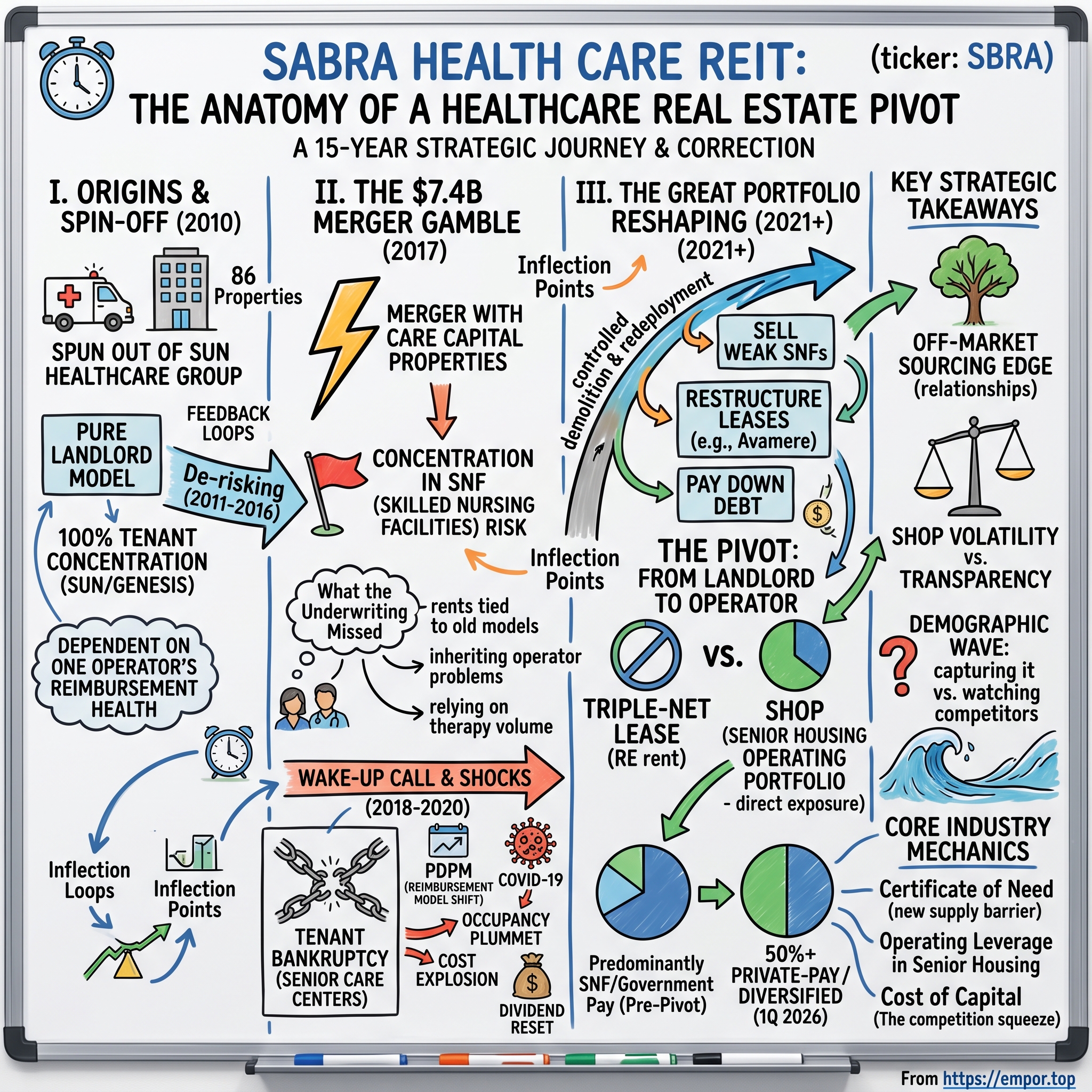
Sabra Health Care REIT: The Anatomy of a Healthcare Real Estate Pivot
I. Introduction & Episode Roadmap
There is a particular kind of real estate that nobody wants to talk about at dinner parties. It is not the trophy office tower with the lobby art collection, or the logistics warehouse humming with robots, or the data center that everyone suddenly discovered in 2023. It is a single-story building off a state highway in Kentucky or Oregon, ninety beds, a covered drop-off for ambulances, a courtyard with a bird feeder. Inside, a nurse aide is helping an eighty-seven-year-old woman with a hip fracture learn to stand again. The building is worth perhaps $12 million. The rent it pays is contractually fixed. And the entire economic value of that rent depends on whether the state Medicaid agency, three hundred miles away in a capitol building, decides to raise per-diem rates by two percent or zero.
This is the business Sabra Health Care REIT, Inc. is in. It trades on the NASDAQ Global Select Market under the ticker SBRA.1 And it is one of the more instructive case studies in American public real estate — not because it has been a triumph, but because it has been a correction. Sabra is a company that made a very large, very public mistake, spent the better part of a decade unwinding it, and arrived somewhere genuinely different from where it started.
Here is the paradox at the center of everything. Healthcare real estate is supposed to be the safest bet in the demographic universe. The 80-plus population in the United States is growing faster than at any point in the nation's history. New supply of senior housing collapsed after 2020 because construction financing dried up and costs exploded. Demand is inelastic — nobody delays a hip fracture. And yet the last fifteen years of skilled nursing and senior housing real estate have been a graveyard of tenant bankruptcies, rent resets, impairment charges, and dividend cuts. The demographics were always right. The counterparties were the problem.
As of December 31, 2025, Sabra owned 360 properties containing 36,412 beds and units, with undepreciated real estate investment of $5.9 billion plus $442.4 million of loans receivable and preferred equity. The portfolio breaks down into 210 skilled nursing and transitional care facilities, 119 senior housing properties (some leased, some directly operated), 16 behavioral health facilities, and 15 specialty hospitals and other assets, spread across 61 operator relationships, with no single tenant contributing 10% or more of 2025 revenues.2 Note the direction of travel: at the peak of its post-merger bloat, Sabra controlled well over 500 properties. It is meaningfully smaller today. That shrinkage is the story.
The narrative arc runs like this. In November 2010, Sabra was spun out of Sun Healthcare Group as a pure landlord with 86 buildings and effectively one tenant.[^3] In 2017 it bet the company on a $7.4 billion all-stock merger with Care Capital Properties that doubled its size and — within eighteen months — handed it a tenant bankruptcy, a rent repositioning program, and years of asset sales. From roughly 2018 onward, management ran what amounts to a controlled demolition: sell the weak buildings, restructure the weak leases, pay down the debt, and redeploy into a fundamentally different mix of assets. In the first quarter of 2026, for the first time in the company's history, private-pay revenue sources crossed 50% of the portfolio.3
Five themes carry the episode. First, the spin-off mechanics — why separating the operating company from the property company was supposed to unlock value, and what that logic quietly assumed. Second, the cost of bad M&A — a case study in what happens when a REIT buys scale at a cycle peak and inherits somebody else's tenant problems. Third, the dual shock of the Patient Driven Payment Model and COVID-19, which arrived within six months of each other and stress-tested every lease in the portfolio simultaneously. Fourth, the SHOP pivot — Sabra's decision to stop being purely a landlord and start taking direct operating exposure to senior housing, which is a much bigger philosophical shift than it sounds. And fifth, the question every investor in this sector is actually asking: does the long-promised demographic wave finally show up, and if it does, is Sabra positioned to capture it or merely to watch larger competitors capture it?
Throughout, the posture here is skeptical rather than celebratory. Sabra's management has, by most objective measures, executed the cleanup competently. But competent cleanup of a self-inflicted wound is a different achievement from durable competitive advantage, and the two get conflated constantly in REIT investor relations decks. The job is to separate them.
 Subscribe on LinkedIn
II. Origins & The 2010 Sun Healthcare Spin-Off
To understand why Sabra exists, you have to understand what it felt like to run a nursing home company in the 2000s.
Rick Matros had been doing exactly that. As Chairman, President and CEO of Sun Healthcare Group, he presided over an operating business with a structural problem that no amount of management skill could fix: the operating company absorbed every liability in the system while capturing almost none of the multiple. Sun's revenue came overwhelmingly from Medicare and Medicaid, which meant its top line was set by legislatures and federal rulemaking rather than by negotiation. Its cost base was nursing labor, which was sticky, unionized in places, and rising. And sitting on top of both was professional liability exposure — the plaintiff's bar had discovered long-term care, and states like Texas and Florida had become genuinely hostile venues. An operator could do everything right clinically and still get hit.
Meanwhile, the buildings themselves were boring, durable, and — in the eyes of public equity markets — worth a great deal more inside a REIT wrapper than inside an operating company. This is the OpCo/PropCo insight, and it is not exotic: the same real estate generating the same rent gets valued on a cap rate when it sits in a REIT and on an EBITDA multiple when it sits inside a healthcare services company. Because REITs avoid corporate-level tax on distributed income and because investors will pay up for predictable, contractual, inflation-escalating cash flow, the arithmetic favored separation. Split the company, and the sum of the parts should exceed the whole.
That was the pitch, and on November 15, 2010, Sun Healthcare Group executed it. Sabra Health Care REIT, Inc. was spun off as a standalone public REIT, taking with it 86 owned real property assets — 67 of them nursing homes — spread across 19 states, along with assumed debt and third-party mortgage indebtedness on 26 of the properties.[^3]4 Matros left the operating business he had run and became the landlord. The reorganized Sun entities became the tenant under a set of master leases that specified exactly what the operating company would pay for the privilege of using buildings it had previously owned.5
That last sentence contains the flaw. Sabra came into existence with something close to complete tenant concentration. Every dollar of rent traced back to one operator's ability to collect from Medicare and Medicaid. The spin-off had separated the legal liability of operations from the real estate, but it had done nothing to separate the economic dependency. If Sun's margins compressed, Sabra's rent coverage compressed with them, and the elegant OpCo/PropCo theory would reveal itself as a wrapper around the same underlying risk.
The dependency compounded quickly. In 2012, Genesis Healthcare acquired Sun Healthcare's operations, which meant Sabra's foundational tenant relationship transferred to a much larger operator — bigger, but not obviously safer, since Genesis carried its own heavily leveraged lease obligations across multiple landlords. Sabra had swapped a small concentrated counterparty for a large concentrated counterparty.
So the early playbook was straightforward and correct: dilute. Sabra spent the years from 2011 through 2016 buying skilled nursing and assisted living properties, frequently off-market, frequently from regional operators, in transactions small enough that the mega-cap healthcare REITs would not bother competing. Each acquisition added a tenant, added a state, added a reimbursement regime, and shaved a percentage point off Genesis exposure. It was unglamorous, incremental de-risking — the corporate equivalent of eating vegetables.
What is worth noticing, from an investor's standpoint, is that this early period established the operating pattern Sabra still runs on today. The company's genuine competency has always been middle-market underwriting: knowing which regional operator in Idaho or Indiana can actually run a building, structuring a lease that survives a bad reimbursement year, and doing the deal without a broker's auction. Matros's background as an operator was the asset — he had sat on the other side of these leases and knew which coverage assumptions were fantasies. That capability is real, it is durable, and it will matter later in this story when we ask what advantage Sabra actually possesses.
But there is a less flattering read of the same period, and it deserves airing. Diluting concentration by buying assets is only de-risking if the assets you buy are better than the ones you already have. A REIT that grows to escape a problem is a REIT under pressure to transact, and REITs under pressure to transact tend to relax standards. By 2016, Sabra had built a respectable diversified portfolio — and it had also built a management team that had learned that growth solves problems.
That lesson was about to be tested at a scale nobody in the company had contemplated.
III. The $7.4B Merger Gamble: Care Capital Properties & The Cost of Scale (2017)
Picture the healthcare REIT sector in the spring of 2017. Skilled nursing occupancy had been drifting lower for years as managed care organizations aggressively shortened post-acute stays. Rehabilitation therapy volumes — the profit engine of the old reimbursement system — were under scrutiny. Public equity investors had spent eighteen months marking down anything with "skilled nursing" in the description. And into that environment, on May 7, 2017, Sabra announced an all-stock merger with Care Capital Properties, Inc. valued at approximately $7.4 billion.[^7]
Care Capital Properties was itself a spin-off — Ventas, Inc. had separated its skilled nursing assets into CCP in 2015, which tells you something important. Ventas, one of the most sophisticated capital allocators in the sector, had looked at its skilled nursing portfolio and decided the right move was to hand it to shareholders and walk away. Two years later, Sabra bought the whole thing.
The strategic narrative was coherent on paper. Combining the two companies would create a healthcare REIT with genuine scale, a broader base of operator relationships, an improved cost of debt, and — critically — reduced concentration in Genesis, which had become the sector's most-discussed credit risk. Management projected roughly $20 million in annual cost savings from eliminating duplicate corporate infrastructure. CCP shareholders received 1.123 shares of Sabra common stock for each CCP share, and the deal closed on August 17, 2017, producing a combined portfolio of 564 properties.[^8]6
The market's reaction told the real story. Investors noticed immediately that the merger did not diversify Sabra — it concentrated it. Skilled nursing exposure went from roughly 57% of the portfolio to approximately 73%.6 Sabra had solved a tenant concentration problem by deepening an asset class concentration problem, at precisely the moment when the asset class was entering its worst multi-year stretch in modern memory. Management responded to the backlash by committing to select asset sales, including memoranda of understanding with Genesis to market 35 skilled nursing facilities for sale.6 That is not the posture of a buyer confident in what it just acquired. That is a buyer negotiating with its own shareholders in real time.
What the underwriting missed
The deeper failure was not the headline exposure number. It was the quality of the rent underneath it.
CCP's portfolio carried a roster of skilled nursing tenants whose lease obligations had been set in a different world — one where therapy volume drove revenue, where Medicaid rate increases were routine, and where labor was cheap and available. Senior Care Centers, a Dallas-based operator, was the most exposed of these. Preferred Care was another. Both were paying rents that had been struck against historical coverage ratios that were rapidly becoming fictional.
Here is the mechanism that matters, and it is worth explaining plainly because it is the single most important dynamic in this entire sector. A triple-net lease looks like a bond. Fixed payment, annual escalator of two or three percent, tenant pays taxes, insurance and maintenance. The landlord's cash flow appears contractually guaranteed. But the payment is only as good as the operator's ability to generate cash from the building. The standard metric is EBITDARM rent coverage — the operator's earnings before interest, taxes, depreciation, amortization, rent, and management fees, divided by the rent owed. A coverage of 1.5x means the operator generates a dollar-fifty of pre-rent cash for every dollar of rent. A coverage of 1.0x means the operator is working for free. Below 1.0x, the operator is funding the landlord out of its balance sheet, and the clock is running.
The insidious part is the asymmetry. A triple-net lease caps the landlord's upside — if the operator's margins double, the landlord still gets the same rent plus 2%. But it does not cap the downside, because when coverage breaks, the tenant does not politely pay a slightly lower rent. It stops paying, files Chapter 11, and rejects the lease. The landlord's "bond-like" instrument turns out to have been a leveraged equity stub in someone else's operating business all along.
The workout years
The break came fast. During the three months ended September 30, 2018, Sabra issued Senior Care Centers notices of default and lease termination for non-payment of rent. On December 4, 2018, Senior Care Centers filed for Chapter 11 protection in the Northern District of Texas, citing escalating lease costs against lagging reimbursement, carrying more than $100 million in debt including roughly $31 million owed to Sabra in unpaid rent and charges.7[^11]
Two days later, Sabra announced an agreement to sell the Senior Care Centers portfolio for $385 million.[^11] That transaction did not survive contact with bankruptcy court reality. The company subsequently pared the sale to 28 facilities for $282.5 million, retaining ten, and reached a settlement under which Senior Care Centers made payments of $9.5 million to its landlord.89 Read the sequence carefully: a headline sale price announced under pressure, then revised down by more than a quarter as the actual clearing price emerged. That is what distressed healthcare real estate is worth when a motivated seller meets a market that knows it.
Meanwhile Sabra had put a broader "rent repositioning program" in place for legacy CCP tenants — corporate language for cutting rents to levels the operators could actually pay.8 Across 2018 through 2020, the company sold over a billion dollars of non-core, low-coverage skilled nursing assets, took substantial non-cash impairments, and directed proceeds toward debt reduction rather than new acquisitions.
So what does this actually tell an investor?
Three things, and they are not the things the company would emphasize.
First, the merger was a genuine capital allocation error, and it should be scored as one. Sabra paid a premium for scale at a cycle peak, underwrote rents that the operating fundamentals could not support, and spent roughly four years and a great deal of shareholder equity undoing it. The $20 million of projected cost savings was real; it was also trivially small next to the impairments, foregone rent, and dilution that followed.
Second — and this is the more favorable read — management's response was better than its decision. The alternative playbook was available and frequently chosen in this sector: keep the buildings, keep accruing rent that isn't being paid, avoid the impairment, hope the operator recovers, and let the problem compound. Sabra instead took the writedowns, transitioned the assets, and shrank. Shrinking a REIT is professionally uncomfortable — it reduces the fee-earning asset base, reduces earnings, and invites uncomfortable questions. Doing it deliberately is evidence of a management team that would rather be right in three years than comfortable this quarter.
Third, and most durably: the episode destroyed the intellectual foundation of the pure triple-net model at Sabra. If leases are only as good as operators, then the landlord's real job is not lease documentation — it is operator selection and, when necessary, operator replacement. That realization is what eventually pushed the company toward directly operating senior housing. But before Sabra could get there, it had to survive two shocks arriving in quick succession.
IV. The Crucible: Reimbursement Revolutions & The COVID-19 Pandemic
On October 1, 2019, the entire economic logic of the American skilled nursing industry changed overnight.
That was the day the Patient Driven Payment Model took effect. For nearly two decades, Medicare had paid skilled nursing facilities under a system whose dominant variable was therapy minutes. Deliver more physical, occupational and speech therapy to a patient, land in a higher resource utilization group, collect a higher per-diem. The incentive was transparent and the industry responded to it exactly as you would expect: therapy departments grew, contract therapy companies flourished, and an enormous share of patients somehow landed just over the threshold minutes for the "ultra-high" category.
PDPM detonated that. CMS finalized the new case-mix model in July 2018 and implemented it in October 2019, replacing volume-based classification with one built on clinical characteristics — ICD-10 diagnosis codes, comorbidities, cognitive status, nursing acuity.10 The stated goal was to pay for treating the whole patient rather than for the volume of services delivered. In practice, it inverted the profit function of every skilled nursing operator in the country. Facilities that had built their P&L around therapy throughput suddenly needed to build it around clinical documentation and case-mix capture. Operators with strong clinical leadership and good medical records systems could actually earn more under PDPM. Operators running a therapy-volume shop were, in a matter of months, structurally impaired.
For a landlord, this was an underwriting earthquake disguised as a technical rule change. Every rent coverage projection in the portfolio had been built on the old revenue mechanics. CMS designed PDPM to be budget-neutral in aggregate — and available data subsequently suggested an unintended payment increase of roughly 5%, about $1.7 billion, in fiscal 2020.10 But aggregate neutrality is cold comfort to a specific landlord holding a specific lease with a specific operator on the wrong side of the redistribution. PDPM did not lower the tide; it sorted the swimmers.
Sabra had barely five months to observe how its tenants were adapting.
March 2020
Then the pandemic arrived, and it arrived first, and worst, in exactly the buildings Sabra owned.
Congregate settings full of frail elderly people with multiple comorbidities were the single most lethal environment COVID-19 encountered. Facilities locked down. Elective surgeries — the source of a meaningful share of post-acute skilled nursing admissions — were cancelled nationwide, cutting off the referral pipeline. Move-ins to assisted living and independent living communities stopped almost entirely, because no family tours a memory care unit during a lockdown. Occupancy, the variable that drives everything in this industry, fell off a cliff across both skilled nursing and senior housing.
Simultaneously, the cost side exploded. Staff got sick or stayed home. Facilities turned to agency nursing at multiples of employed-staff wages. Personal protective equipment, which had been a rounding error in an operating budget, became a line item measured in hundreds of thousands of dollars per facility. Testing was mandated and, initially, unreimbursed.
On March 25, 2020, Sabra reset its quarterly dividend from $0.45 per share to $0.30 — a one-third reduction announced explicitly to preserve capital amid pandemic uncertainty.11 It is worth being precise about what a dividend cut signals in REIT-land. REITs are legally required to distribute the bulk of taxable income, and their shareholder base is disproportionately income-oriented. Cutting the dividend is close to the most expensive signal a REIT can send. Doing it in the first weeks of the crisis, before the extent of the damage was known, was a defensive choice that cost the stock dearly in the short run and preserved balance sheet flexibility in the medium run. Notably, that $0.30 quarterly rate has held ever since — Sabra still paid $0.30 per share in the second quarter of 2026, representing 77% of normalized AFFO per share.3 Six years without a raise is its own commentary: the company protected the payout rather than growing it, and only recently has coverage returned to a level where growth would be defensible.
Government support did materially cushion the operators. Provider Relief Fund distributions, expanded Medicaid supplemental payments, and temporary Medicare add-ons flowed into skilled nursing facilities through 2020 and 2021, which meant that rent kept getting paid at rates that underlying operations could not have supported. Landlords across the sector reported strong collection percentages during this period. Those percentages were partly a measure of tenant health and partly a measure of federal generosity, and the two were not easy to separate in real time.
Sabra's disclosure practice during this stretch is a legitimate point in management's favor, though it should be stated carefully. The company reported rent collection percentages explicitly and repeatedly rather than describing collections in qualitative terms. In a period when a great deal of sector commentary consisted of macro hand-waving, quantified collection disclosure gave analysts something falsifiable to work with. That is a low bar. Clearing it consistently still distinguishes a management team.
The portfolio consequences
Two structural decisions came out of this period.
The first was the resolution of the Genesis relationship. Sabra worked through the dispositions identified in its 2017 memorandum of understanding, completing the final sale on August 1, 2020, after which Genesis's annual rental obligation to Sabra stood at approximately $21.8 million — a fraction of what it had once been.12 The concentration that had defined Sabra since birth was finally, functionally, gone.
The second was Enlivant. Sabra held a 49% interest in a joint venture with TPG, which owned 51%, covering 154 senior living communities operated by Enlivant. The plan had always been an eventual sale. But the combination of a broken debt market and a portfolio whose operations had been damaged by the pandemic made an orderly exit impossible, and Sabra fully exited the JV effective May 1, 2023 — management publicly described it as a "double whammy" of debt market conditions and lingering COVID effects.13 Separately, Sabra transitioned eleven wholly-owned senior housing properties formerly operated by Enlivant to Inspirit Senior Living on July 6, 2023, a handover that management characterized as faster than expected and free of frictional cost.14
The Enlivant episode is worth dwelling on because it cuts against the standard REIT narrative that joint ventures are a low-risk way to gain exposure. Sabra put minority capital into a large senior housing platform alongside a sophisticated private equity partner, and when the environment turned, it discovered that a 49% stake in a distressed operating platform offers neither control nor liquidity. The exit was, by management's own framing, a bad outcome accepted rather than a strategy executed.
What survived the crucible was a company with far less tenant concentration, far less skilled nursing exposure, a lower dividend, a repaired balance sheet, and — crucially — a hard-won conviction that owning the operating economics of a building was sometimes safer than renting them out. That conviction became the next chapter.
V. The Great Portfolio Reshaping: Triple-Net to SHOP & Behavioral Health
In the first quarter of 2026, Sabra crossed a threshold that would have seemed implausible a decade earlier: for the first time in the company's history, private-pay sources accounted for 50% of the portfolio.3
That number carries more weight than most REIT milestones because of what it replaced. A company born as a pure skilled nursing landlord — with revenue tracing almost entirely to Medicare and Medicaid — had rebuilt itself so that half its economics now came from residents and families paying out of pocket or through commercial coverage. The vulnerability that defined Sabra's first fifteen years was, by mid-2026, roughly halved.
Understanding SHOP: the landlord who stops being a landlord
The vehicle for this shift is the Senior Housing Operating Portfolio, or SHOP — built on a structure the industry calls RIDEA, after the REIT Investment Diversification and Empowerment Act of 2007, which changed the tax rules to let REITs participate in the operating income of healthcare properties through a taxable subsidiary rather than merely collecting rent.
The distinction is easiest to grasp through an analogy. Under a triple-net lease, Sabra is a landlord who rents a restaurant space to a restaurateur for a fixed monthly amount. The restaurant may be packed or empty; the rent is the same. Under a SHOP structure, Sabra effectively owns the restaurant and hires a professional manager to run it for a percentage of revenue — typically in the range of 5% to 6%. Now Sabra keeps the profits when tables are full and eats the losses when they are not.
For a company that had just spent five years discovering that triple-net leases do not actually insulate a landlord from operating risk, this was less a leap than an acknowledgment. If Sabra was going to bear the downside of operations regardless, it might as well own the upside.
And the upside in senior housing after 2022 was extraordinary, for a specific structural reason worth understanding. Senior housing has enormous operating leverage. A building's cost base — the building itself, the kitchen, the activities director, the front desk, the baseline nursing coverage — is largely fixed. Filling the eighty-fifth unit in a hundred-unit community costs very little incremental expense; the revenue from that unit falls close to straight to the bottom line. So when occupancy recovers from pandemic lows, NOI does not grow proportionally. It grows violently.
Sabra's recent numbers show exactly this dynamic. In the first quarter of 2026, same-store managed senior housing revenue grew 7.9% year over year while expense per occupied room rose only 1.8% — producing same-store cash NOI growth of 14.4%.3 Occupancy in the SHOP portfolio reached 88.4%, up 280 basis points year over year, with the domestic portfolio at 85.6% and the Canadian portfolio at 93.4%, its eighth consecutive quarter above 90%.3 Revenue per occupied room rose 4.6% overall and 6.5% in Canada. Sequentially, the managed portfolio grew revenue 7.2% and cash NOI 9.5%, with 60 basis points of margin expansion.
That gap — revenue up eight, expenses up two, NOI up fourteen — is the entire investment case for SHOP stated in three numbers. It is also, importantly, a recovery dynamic rather than a permanent one. Fourth quarter 2025 same-store managed senior housing cash NOI grew 12.6% year over year, and the 2025 quarterly average was 15.0%.15 Growth at that rate is what happens when a fixed-cost asset refills. It is not what happens forever. Once occupancy approaches the mid-nineties — which management has characterized as effectively full — SHOP growth must converge toward rate growth minus expense growth, which is a mid-single-digit business, not a mid-teens one.16 Any investor extrapolating fourteen percent NOI growth indefinitely is misreading the mechanism.
The corresponding cost of SHOP is symmetry. Sabra now absorbs utility spikes, insurance renewals, agency labor, and localized oversupply directly into NOI, with no lease to hide behind. In a downturn, SHOP earnings fall first and fastest.
The triple-net portfolio: better than it has been in years
The skilled nursing and transitional care book — still 210 properties, still the largest single segment by count — has quietly become the healthiest it has been since before the CCP merger.2 EBITDARM coverage in skilled nursing and transitional care reached 2.38x as of the fourth quarter of 2025, described by management as an all-time high, and on the first quarter 2026 call management reported new highs across skilled nursing, triple-net senior housing, and behavioral portfolios.153
Coverage at 2.38x is a strikingly comfortable number for skilled nursing. It reflects three things stacked together: rents that were reset downward during the workout years and never fully reset back up; occupancy recovery; and Medicaid rate increases that ran well above historical norms during the post-pandemic inflation surge. The third factor is the one to watch, because management acknowledged on the first quarter 2026 call that reimbursement peaked in 2024 and is now normalizing — with a Medicare market basket proposal around 2% and Medicaid increases around 3%, both described as in line with expectations.3 Coverage that was built partly on extraordinary rate relief will drift as that relief normalizes. It is a cushion, not a permanent feature.
The Avamere reset — a live test of the thesis
Nothing illustrates the current model better than what happened on July 21, 2026.
Avamere Family of Companies had been a problem tenant for years. Back in February 2022, Sabra restructured the relationship, cutting annual base rent roughly 30% from $44.1 million to $30.7 million, following months of deferrals granted in 2021.17 That is the classic landlord concession: take the pain, keep the operator in place, hope things improve.
Four years later, Sabra took the opposite approach. The company announced letters of intent to re-tenant all 26 Avamere-leased properties — 22 transitioning to subsidiaries of Cascadia Healthcare and four to an existing Sabra tenant, with completion expected in the second half of 2026. Combined annualized cash rent on the re-tenanted portfolio is expected to be approximately $53 million, roughly 30% above the $41 million Sabra collected from Avamere over the trailing twelve months ended March 31, 2026.18 Avamere, for its part, is exiting the skilled nursing business entirely.19
Cascadia Healthcare is a Pacific Northwest–focused operator founded in 2015 by CEO Owen Hammond, previously president of Signum Healthcare under Ensign, and will run roughly 80 facilities pro forma for the transition.18
This is the operator-replacement capability described earlier, executed at scale. A landlord who could only document leases would have been stuck negotiating another rent cut. A landlord with genuine operator relationships across regions could find a stronger tenant, transfer 26 licenses, and raise rent 30% in the process. The transaction is a real data point in favor of Sabra's claimed edge — with the appropriate caveat that these were letters of intent, not closed transactions, and license transfers in skilled nursing are slow, state-by-state, and occasionally fail.
Behavioral health: the growth story that shrank
The outline framing of behavioral health as a fast-growing hidden engine deserves direct correction, because the recent evidence points the other way.
Sabra's behavioral health thesis was genuinely attractive on paper: addiction treatment and psychiatric facilities draw revenue from commercial insurance and private pay rather than state Medicaid, entry cap rates were higher than in senior housing, and demand indicators were strong. The problem was execution risk at the operator level.
Landmark Recovery, a Sabra tenant, filed Chapter 11 for two of its entities in August 2025 amid a dispute over missed rent, with its CEO blaming Sabra for the assessment of rent owed and for cross-collateralization across facilities.20 The parties reached a court-approved settlement in April 2026 that ended the relationship.21 On the first quarter 2026 call, management disclosed that Landmark was contributing about $1.5 million of quarterly NOI and rent collection, expected to continue at that run rate through disposition, with three additional behavioral assets also in a disposition process.3
Then, on June 30, 2026, Sabra settled its largest behavioral exposure. The company accepted a reduced cash repayment of $200 million in full satisfaction of a $300 million mortgage owed by Recovery Centers of America that was scheduled to mature on November 1, 2026, applying the proceeds to reduce its revolver.18
Read that transaction plainly: Sabra took roughly a hundred million dollars less than the face amount of the loan to get out. Management framed it constructively, and the balance sheet effects were real — pro forma as of March 31, 2026, net debt to EBITDA fell from 5.0x to 4.8x while behavioral health concentration dropped from 13% to 9% of annualized cash NOI.18 But a hundred-million-dollar haircut is a hundred-million-dollar haircut. Behavioral health, at Sabra, has functioned less as a growth engine than as a second lesson in the same subject the CCP merger taught: high entry yields in healthcare real estate are compensation for operator fragility, and the compensation is not always adequate.
The company's capital is now flowing decisively elsewhere. On the first quarter 2026 call, management characterized the current opportunity set as "95%+ SHOP."3 Whatever behavioral health was supposed to become, the portfolio is voting with its dollars for senior housing.
VI. Core Industry Mechanics & Competitive Benchmarking
Two REITs can own the identical building, in the identical market, leased to the identical operator, and report completely different economics. Understanding why is the key to reading this entire sector.
The two structures, and what each one really costs
We have covered the mechanics — triple-net as fixed rent with capped upside, SHOP as direct operating exposure. What deserves more attention is the reporting consequence, because it changes how the two look to investors in ways that are easy to misread.
A triple-net portfolio produces beautifully smooth reported NOI right up until the moment it doesn't. The rent is contractual, so quarterly results are predictable, margins look extraordinary (a triple-net REIT's property-level margin approaches 100% because the tenant pays operating costs), and growth is a mechanical function of escalators plus acquisitions. The risk is entirely invisible in the income statement — it lives in the coverage ratio, which is disclosed on a lag, is based on operator-provided data the landlord does not audit, and typically excludes the government relief that may be propping it up. By the time a triple-net portfolio's reported NOI declines, the deterioration is usually already twelve to eighteen months old.
A SHOP portfolio is the mirror image. Reported margins are low — you are running a hospitality business with staffing, food, utilities, and insurance flowing through the P&L — and results are volatile quarter to quarter. But nothing is hidden. Occupancy, rate, and expense per occupied room are disclosed monthly-ish and move in real time. You cannot have a slow-motion invisible collapse in a SHOP portfolio, because the collapse shows up in the NOI line the quarter it starts.
For a long-term investor, this is the single most useful lens on the sector. Triple-net trades predictability for concealed risk. SHOP trades volatility for transparency. Neither is superior in the abstract; what matters is whether the price paid reflects which one you are getting.
The bridging metric between them is EBITDARM coverage, and it deserves one more note of caution. Coverage is reported by tenants, on a trailing basis, usually one quarter in arrears, and the treatment of government stimulus, related-party management fees, and ancillary business income varies. Two landlords reporting "1.5x coverage" may be measuring meaningfully different things. Sabra's coverage disclosures have been consistent over time, which is what matters most — the trend line within a single disclosure convention is far more informative than the absolute level compared across companies.
The competitive field
Sabra operates in a sector with an unusually steep size gradient, and the gradient matters more here than in most real estate verticals.
At the top sit Welltower Inc. and Ventas, Inc. Welltower in particular has become something close to a different species — its equity market capitalization in mid-2026 was more than thirty times Sabra's roughly $5.6 billion, and it has spent the last several years building a data and operating platform layered on top of an enormous North American and international senior housing business.22 The advantage that flows from this is not primarily G&A efficiency; it is cost of capital. A REIT with a lower implied cost of equity can bid more for the same building and still generate the same spread over its funding cost. In a competitive auction for a stabilized senior housing asset, Welltower can simply pay more than Sabra and be equally happy with the outcome. Ventas occupies similar terrain with a comparable senior housing operating platform.
The countervailing argument — that mega-caps carry heavier corporate overhead and are less nimble with regional operators — is directionally true but frequently overstated by smaller competitors. Welltower has been an aggressive and successful acquirer of exactly the kind of regional senior housing portfolios Sabra targets. The size gradient is a genuine structural disadvantage for Sabra, not a talking point to be waved away.
Omega Healthcare Investors, Inc. is the closest thing to a pure skilled nursing comparable, roughly three times Sabra's equity value and running a predominantly triple-net model.22 Omega's profile offers a useful contrast: a higher dividend yield, greater reliance on government reimbursement outcomes, and correspondingly higher sensitivity to CMS rulemaking and state Medicaid budgets. An investor choosing between Sabra and Omega is essentially choosing how much private-pay exposure to buy.
CareTrust REIT, Inc. and National Health Investors, Inc. are the direct mid-cap competitors, with CareTrust having grown to roughly $10 billion of equity value — meaningfully larger than Sabra — while NHI sits below $4 billion.22 CareTrust in particular has been an aggressive acquirer and competes for the same regional skilled nursing and senior housing deals.
Where Sabra actually wins, and where it doesn't
The honest assessment requires separating what Sabra claims from what the evidence supports.
The win case has real support. Sabra's sourcing profile is genuinely differentiated: on the first quarter 2026 call, management stated that skilled nursing acquisitions are sourced "100% off market through existing relationships," while senior housing sourcing runs roughly 80% marketed and 20% off-market.3 Off-market sourcing is the closest thing to a durable edge available in commercial real estate, because it means competing on relationship rather than on price. The Avamere-to-Cascadia transition is evidence that this relationship network converts into actual value when a tenant fails.
The lose case is equally concrete, and it came up on the same call. Green Street's analyst noted that marketed skilled nursing transactions were clearing at yields "a couple hundred basis points inside" the traditional 9–10% lease yields REITs historically underwrote. Management agreed, explaining that private buyers who own both the operating company and the property, and who capture ancillary business revenue like therapy and pharmacy, can underwrite to a lower real estate yield because they earn additional margin elsewhere.3 A REIT that only owns the building cannot match that bid.
This is a structural competitive constraint and worth sitting with. Sabra is squeezed from two directions: from above by lower-cost-of-capital mega-caps in marketed senior housing, and from below by vertically integrated private operators in marketed skilled nursing. Its viable competitive space is the middle — off-market regional deals sourced through relationships — which is a real space, but a narrower one than a scale story implies. Management's guidance that current market yields sit primarily in the low-7% range for stabilized assets, with value-add opportunities entering around 6%, quantifies the squeeze.3
The relevant investor question is therefore not whether Sabra can find deals — it clearly can, having closed or been awarded over $400 million year to date through the first quarter of 2026 with an actively pursued pipeline exceeding $1 billion.3 It is whether the spread between those acquisition yields and Sabra's cost of capital is wide enough to create value per share, and whether it stays wide as competition intensifies.
That question leads naturally to a more structural one: does Sabra possess any advantage that competitors cannot simply buy?
VII. Helmer's 7 Powers & Porter's 5 Forces Analysis
Strip away the narrative and ask the uncomfortable question directly. If Welltower decided tomorrow to compete for every deal Sabra pursues, what would stop it?
Applying Helmer's 7 Powers
Hamilton Helmer's framework asks a specific thing: what conditions allow a company to sustain differential returns that competitors cannot arbitrage away? Applied to Sabra, the honest scorecard is mixed and thinner than the sector's usual self-description.
Switching costs — genuinely present, but they protect the asset, not the company. Replacing an operator in a skilled nursing or memory care facility is legitimately hard. It requires state licensure transfer, regulatory approval, continuity of resident care, retention of a workforce that may already be demoralized, and management of survey and certification risk during the handover. That friction gives landlords real leverage in lease renegotiations, because a tenant contemplating walking away knows the landlord can find a replacement — slowly and expensively, but it can. Sabra has demonstrated this repeatedly, most recently with the Avamere transition. The critical caveat: this is a characteristic of the asset class, not of Sabra. Omega, CareTrust and Welltower all enjoy identical structural leverage. It is table stakes, not differentiation.
Scale economies — moderate, and pointed the wrong way. Sabra spreads corporate overhead across 360 properties, maintains access to unsecured bond markets and credit facility syndicates, and reported normalized cash G&A of about $11 million in the first quarter of 2026 against a portfolio of that size.3 That is efficient. But scale economies matter in this sector primarily through cost of capital, and on that dimension Sabra is not the scale player — it is the one being scaled against. A moat that your largest competitor possesses in greater quantity is not your moat.
Counterparty and underwriting advantage — the most plausible candidate, and still unproven as durable. This is where Sabra's genuine claim lives. An investment team with operating heritage, relationships across dozens of regional operators, and a track record of structuring joint ventures with emerging managers that larger REITs overlook can, in principle, systematically buy assets at better risk-adjusted terms than a purely financial buyer. The off-market sourcing statistics support that this is happening. Whether it is durable is the open question. Relationships reside in individuals, and the individual who built much of that network — Talya Nevo-Hacohen, Chief Investment Officer since the company's formation — retired on December 31, 2025.23
The powers Sabra does not have. No network economies: an additional Sabra building makes no other Sabra building more valuable. No branding power: residents choose communities based on the operator's name and local reputation, not the landlord's. No cornered resource: land is not scarce and buildings are not proprietary. No counter-positioning: SHOP is not a business model incumbents are structurally unable to copy — Welltower and Ventas run larger SHOP platforms and got there first. No process power: property management is outsourced to third-party operators.
The net assessment is that Sabra possesses one candidate power of moderate strength, dependent on human capital, in a sector where the strongest structural advantage — cost of capital — belongs to somebody else. That is not a damning verdict; plenty of good investments have no moat. But it argues strongly against paying a premium for a durable-advantage narrative.
Porter's Five Forces
The industry structure analysis is, if anything, more revealing than the firm-level one.
Bargaining power of payers — extreme in skilled nursing, minimal in private pay. This is the defining force in the sector. CMS and state Medicaid agencies set skilled nursing rates unilaterally through rulemaking and budget processes. There is no negotiation, no volume discount, no long-term contract. An operator can improve clinical quality, cut costs, and grow census, and a single state budget decision can erase all of it. This is precisely why Sabra's shift past 50% private pay matters economically rather than merely cosmetically: private-pay senior housing residents and their families are individually weak counterparties, so pricing power flows to the operator. The 4.6% revenue-per-occupied-room growth in Sabra's SHOP portfolio in the first quarter of 2026 is that pricing power made visible.3
Bargaining power of tenants and operators — moderate to high, and asymmetric. A performing operator has limited leverage; a failing operator has enormous leverage, because the landlord's alternative to a negotiated rent cut is licensure transfer, transition cost, and potential vacancy. This asymmetry is the reason the workout years cost Sabra so much. It is also why the Avamere outcome — replacement at 30% higher rent rather than another concession — was a meaningfully better result than the 2022 restructuring of the same relationship.
Threat of new entrants — genuinely low, and this is the sector's best structural feature. Certificate of Need laws restrict new skilled nursing capacity in many states. Healthcare licensing is slow and jurisdiction-specific. And post-2021 construction economics — elevated materials costs, high financing rates, and scarce construction lending for senior housing — have suppressed new supply dramatically at exactly the moment demand is accelerating. Management's own investment discipline reflects how hard the math has become: on the first quarter 2026 call, they noted that only about 10% of development opportunities reviewed clear their return-on-cost hurdle of 200 to 250 basis points above market cap rates.3 If a motivated buyer with existing relationships can only justify one development in ten, speculative new supply is not arriving at scale for years. That is the single most reliable tailwind in this story.
Threat of substitutes — low for high-acuity, real and rising for the lower end. Post-acute rehabilitation and advanced memory care cannot be replicated at home; they require twenty-four-hour supervision and clinical infrastructure. But the boundary is moving. Home health, remote monitoring, hospital-at-home programs, and Medicare Advantage plans actively incentivized to divert members away from institutional settings all nibble at the lower-acuity end of both skilled nursing and independent living. Management engaged this directly on the first quarter 2026 call, arguing that operators embracing value-based care arrangements and quality metrics are better positioned against insurer-driven diversion than passive competitors, and citing board member Lynne Katzmann's expertise from Juniper Communities on AI-enabled memory care and value-based models.3 The framing is credible. It is also, at this stage, largely an assertion about operators Sabra does not control.
Competitive rivalry — high and intensifying. Every public healthcare REIT, plus a substantial pool of private equity capital, is chasing the same demographic thesis. The evidence of intensity is in the yields: stabilized senior housing at low-7%, skilled nursing clearing hundreds of basis points inside historical norms.3 Rivalry is compressing returns in real time.
The composite picture is an industry with excellent supply-side protection, a brutal payer dynamic on the government-funded half, and fierce competition for the private-pay half. Sabra has spent a decade migrating from the worse half toward the better half — which is the right direction, into the more competitive water. The question of whether the people steering that migration can navigate it is next.
VIII. Management Evaluation & Governance Stress Test
There is a moment on almost every Sabra earnings call where Rick Matros stops speaking in REIT language and starts speaking in operator language — about census, about agency staffing, about which state's survey process has become unreasonable. It is a small tell, and it is the most distinctive thing about this management team.
The people
Rick Matros has been Chairman, CEO and President since Sabra's formation in 2010, having previously run Sun Healthcare Group as Chairman and CEO.[^3]24 Sixteen years in the chair at a company he founded is unusual in REIT-land, where CEOs are frequently recruited from investment banking or real estate private equity. Matros came from the other direction entirely — he ran nursing homes before he owned them. That background shows up in specific, checkable ways: in how quickly Sabra moves to replace failing operators rather than extending concessions indefinitely; in the granularity of operational commentary on calls; and in the fact that the company's underwriting conversations are about clinical staffing models and case mix as often as about cap rates.
The counterweight to a long-tenured founder-CEO is the standard governance concern: entrenchment, deference from a board that has served alongside him for years, and a strategy that becomes difficult to challenge internally. Matros also holds the combined Chairman and CEO roles, which governance-focused investors reasonably flag as a structural weakness in board independence. Sabra does not have an independent chair.
Michael Costa serves as Chief Financial Officer and has been with the company since its founding, carrying it through the post-merger deleveraging, the pandemic liquidity crunch, and the 2022–2024 rate shock. The balance sheet he has built is, on the evidence, conservative: as of the first quarter of 2026, net debt to adjusted EBITDA stood at 5.04x, the cost of permanent debt was 3.92%, average remaining debt term was four years, the next material maturity is not until 2028, and there is no floating-rate exposure in the permanent capital stack.3 Total liquidity was approximately $1.2 billion, comprising $117 million of unrestricted cash, $645 million of revolver availability, $451 million of unsettled forward equity sales, and $353 million of remaining ATM capacity.3
A 3.92% average cost of permanent debt in mid-2026, with no floating exposure and no near-term maturity wall, is a genuinely strong outcome and reflects opportunistic refinancing done before rates rose. It also has an expiration date. Four-year average term means the refinancing question arrives, and coupons struck in the 2020–2021 window will not be replicated.
Darrin Smith became Chief Investment Officer effective January 1, 2026, succeeding Talya Nevo-Hacohen upon her retirement on December 31, 2025.23 This is the most consequential governance change at Sabra in a decade and deserves more scrutiny than it has received. Nevo-Hacohen had been CIO since the company's formation, and the relationship-based sourcing model described earlier was substantially her construction. Smith is not an outside hire — he had served as Executive Vice President, Investments since March 2020 and previously spent nine years as Senior Vice President of Senior Housing Investments at HCP, Inc. (now Healthpeak Properties).23 His background is specifically in senior housing, which aligns neatly with where Sabra's capital is now flowing. Matros framed the handover as a team continuity story, noting that "Talya and Darrin have built an incredible team of investment professionals."23
The succession was planned and internal, which is the right way to do it. But investors should track whether off-market sourcing volumes hold up over the next several years, because that is the empirical test of whether the network was institutional or personal.
Credibility assessed through behavior
The most useful test of a management team is not what it says in good quarters but what it does in bad ones, and Sabra's record here is genuinely above average for the sector.
They admitted the mistake with actions. The CCP merger was not defended into oblivion. Management sold assets, took impairments, cut rents to sustainable levels, and let the company shrink. That is expensive, career-risky behavior and it is rarer than it should be.
Guidance discipline has been conservative and, so far, honored. Sabra introduced 2026 guidance on February 12, 2026, at normalized FFO of $1.49–$1.53 and normalized AFFO of $1.55–$1.59 per share, roughly 5% growth at the midpoint, built on explicitly stated assumptions: low-single-digit triple-net cash NOI growth, low-to-mid-teens same-store managed senior housing cash NOI growth, and — notably — no benefit assumed from placing any additional tenants back on cash or accrual accounting.16 Stating the assumptions that way makes the guidance falsifiable, which is the point.
The subsequent behavior is instructive. On the first quarter 2026 call, Mizuho's Vikram Malhotra pressed management on the obvious tension: annualizing a strong first quarter produced results at or slightly above the guidance midpoint, so why not raise? Matros declined, saying the company "still feel[s] as we sit here today, two months after we put our initial guidance out, that reaffirming what we put out previously still makes sense," and deferred a full reassessment to the second quarter.3 He also expressed unusual confidence on a specific commitment — that roughly $200 million of awarded deals "will close. I do not have any doubt or concern."3
Then on July 21, 2026, Sabra raised full-year guidance to normalized FFO of $1.53–$1.55 and normalized AFFO of $1.59–$1.61 per share — approximately 7% and 8% growth over 2025 at the midpoints — on the back of the Avamere re-tenanting, the RCA settlement, and portfolio initiatives adding over $9 million of run-rate cash NOI relative to the twelve months ended March 31, 2026.18 Guidance was raised when something concrete happened, not when the quarter looked good. On the prior call, management had also noted that of the $240 million awarded pipeline entering 2026, a couple of deals slipped into the following period but none fell out.16
Set-a-conservative-number-then-beat-it is not, by itself, a virtue — it can shade into sandbagging. But the pattern across calls is consistent: assumptions are disclosed, misses are explained, and raises are tied to identifiable events rather than momentum. That combination is what credibility actually looks like in practice.
Where a governance skeptic would push
Three places, and they are legitimate.
First, compensation and incentive alignment. Executive incentives at Sabra are oriented around normalized FFO and AFFO per share, leverage targets, and relative total shareholder return. Per-share metrics are the right choice — they penalize dilutive growth in a way absolute FFO does not. But relative TSR against a healthcare REIT peer group means management can be well-paid for outperforming a sector that performs badly, which is a common and rarely-discussed weakness in REIT compensation design generally.
Second, the behavioral health write-down. Accepting $200 million against a $300 million mortgage is a loss of shareholder capital, and it followed the Landmark bankruptcy in the same segment. Behavioral health was pitched to investors as a high-yield diversification opportunity. It has instead produced two impaired relationships and a shrinking allocation. Management's framing of the RCA settlement emphasized leverage improvement and concentration reduction; a skeptic would note that both of those benefits are consequences of the loss, not independent achievements.
Third, the pattern of serial tenant problems. Sun/Genesis, Senior Care Centers, Preferred Care, Avamere, Enlivant, Landmark, Recovery Centers of America. That is a long list across sixteen years. Management would fairly respond that this is what the skilled nursing and behavioral sectors did to every landlord in the period, and that Sabra's handling of each situation improved over time — the Avamere outcome in 2026 being demonstrably better than the Avamere outcome in 2022. That defense is largely valid. But an investor should still internalize that underwriting operator credit in this sector has a persistent failure rate, that the failure rate is a cost of doing business rather than an anomaly, and that any model assuming clean contractual rent collection is wrong.
Which brings us to what could break from here.
IX. Strategic Risk Radar & Activist / Bear Stress Test
In April 2024, CMS finalized a rule that the entire skilled nursing industry regarded as an extinction-level event: minimum staffing standards requiring 3.48 hours of nursing care per resident day, including 0.55 hours from a registered nurse and 2.45 hours from a nurse aide, plus twenty-four-hour onsite RN coverage.25 Operators calculated that a large share of the nation's nursing homes could not meet the standard at any price, given rural labor markets where the required nurses simply did not exist. Landlords ran the arithmetic on what happens to rent coverage when labor costs rise by double digits with no offsetting reimbursement.
Then the rule died. On April 7, 2025, the U.S. District Court for the Northern District of Texas vacated the mandate.26 On July 4, 2025, HR 1 was signed into law imposing a moratorium on implementation and enforcement — CMS will not enforce the staffing requirements until September 30, 2034.27 And on December 3, 2025, CMS published a rule repealing the standards outright, removing both the hours-per-resident-day requirements and the 24/7 onsite RN mandate.2829
This matters for how investors should read risk disclosures generally. The staffing mandate was, as recently as two years ago, the single most cited threat to skilled nursing landlords. It is now effectively dead for a decade. Any analysis of Sabra still leading with CMS staffing rules as the primary risk is out of date — and the episode is a reminder that regulatory risk in this sector is bidirectional and politically volatile. What one administration finalizes, a court and a Congress can vacate. The reverse is equally possible after 2034, or sooner if political control shifts.
So what are the risks that actually remain?
Reimbursement normalization is the quiet one. The extraordinary rent coverage in Sabra's skilled nursing book — 2.38x at the end of 2025 — was built partly on post-pandemic Medicaid rate increases that ran well above historical trend.15 Management stated plainly on the first quarter 2026 call that reimbursement peaked in 2024 and is normalizing, with the Medicare market basket proposal around 2% and Medicaid increases around 3%.3 Both are within expectations. But state Medicaid programs face genuine budget pressure, and federal reconciliation legislation has reshaped Medicaid financing in ways whose state-level effects will play out over years. A sustained period of Medicaid rate increases below wage inflation would compress operator margins and erode coverage from a high base. The cushion is thick; it is not infinite.
Cost of capital is the mechanical one. Sabra's current debt profile is a legacy asset — 3.92% average cost, four-year average term, no maturities of consequence until 2028, no floating-rate exposure in the permanent stack.3 That protects the next several years. It also means that when refinancing arrives, the spread between new coupons and old ones compresses AFFO. Simultaneously, Sabra funds acquisitions substantially through forward equity sales — $128 million issued in the first quarter of 2026 at $20.19 per share after commissions, with $451 million outstanding at an average of $19.03.3 Forward equity is an intelligent tool: it locks in an issuance price while deferring settlement and dilution. But it is fundamentally a bet that the acquisition yield exceeds the all-in cost of the equity issued. With stabilized assets clearing in the low-7% range and Sabra's cost of equity capital structurally above that of the mega-caps, that spread is thin and getting thinner. This is the most underappreciated risk in the story. The growth engine is spread-based external investment, and the spread is compressing at both ends.
SHOP margin volatility is the accepted one. Having chosen direct operating exposure, Sabra now absorbs every operating shock into NOI. The first quarter 2026 result — expense per occupied room up only 1.8% — is exceptional, and management stated they expect expense growth to "continue at levels that low for the foreseeable future."3 That forecast deserves scrutiny. Senior housing operating costs are dominated by wages, insurance, and utilities, none of which have historically grown at under 2% for extended periods. If expense growth normalizes toward 3–4% while rate growth holds at 4–5%, SHOP NOI growth compresses toward mid-single digits — a perfectly good business, but not the one embedded in a fourteen-percent-growth narrative.
Execution risk on announced transactions. The July 2026 guidance raise rests substantially on the Avamere re-tenanting, which as of the announcement consisted of letters of intent, not signed leases, with completion targeted for the second half of 2026.18 Transitioning 26 skilled nursing licenses across multiple states involves regulatory approvals that are not guaranteed and not fast.
The bear case, argued properly
A skeptical investor would construct it roughly like this.
Sabra is a sub-scale healthcare REIT competing in the two hardest segments of a sector where the dominant structural advantage — cost of capital — belongs decisively to competitors thirty times its size. Its recent earnings growth is substantially a recovery phenomenon: SHOP NOI growing in the mid-teens because occupancy is refilling from pandemic lows, and skilled nursing coverage at all-time highs because reimbursement inflated abnormally in 2023 and 2024. Both drivers are, by management's own acknowledgment, normalizing. Strip them out, and the underlying business is a mid-single-digit organic grower dependent on external acquisitions to reach anything better.
Those acquisitions, meanwhile, are being made at yields that no longer clear a comfortable spread. The company's own analysts have pointed out that it is priced out of marketed skilled nursing deals by vertically integrated private buyers, and its opportunity set has collapsed to "95%+ SHOP" — the segment where Welltower and Ventas are most dominant and best capitalized.
On capital allocation, the record includes a $7.4 billion merger that required years of impairments to unwind, a joint venture exit management itself characterized as forced by circumstances, a behavioral health strategy that produced a tenant bankruptcy and a hundred-million-dollar mortgage haircut inside twelve months, and a dividend that has not increased since it was cut in March 2020. The CIO who built the sourcing franchise retired at the end of 2025. The CEO has held combined Chairman and CEO roles for sixteen years without an independent chair.
And the demographic tailwind — the "Silver Tsunami" that has justified this sector's valuation for fifteen years — has been perpetually five years away for the entire history of the company.
The bull case, argued properly
The counter-argument is not weak.
Supply is the strongest part of it, and it is the least speculative. Senior housing construction starts collapsed after 2021 and have not recovered, because construction costs and financing rates make new development uneconomic — a point Sabra's own data corroborates, with only about 10% of reviewed development opportunities clearing the return hurdle.3 Buildings take three to four years from decision to occupancy. That means the supply constraint through the late 2020s is already locked in, regardless of what happens to demand. Meanwhile the 80-plus cohort is expanding at an accelerating rate. This is the rare case where the supply and demand curves are both moving favorably and neither can be changed quickly.
Sabra's portfolio is materially better positioned to capture that than it was. Private pay above 50% means half the business is insulated from the payer dynamic that defines the sector's downside.3 Domestic SHOP occupancy at 85.6% still sits well below the mid-nineties level management describes as effectively full, and the operating leverage between here and there is substantial.3 The Canadian portfolio at 93.4% demonstrates what the same buildings produce at stabilization.3
The balance sheet is the strongest it has been in company history. Net debt to EBITDA of 4.8x pro forma for the RCA settlement is below the 5.0x–5.5x target range, giving genuine capacity for debt-funded growth without equity dilution.18 Skilled nursing coverage at all-time highs means the segment that nearly broke the company is now generating cushion rather than consuming it.
And the Avamere transition is a concrete, recent proof point for the operator-replacement capability the entire investment case rests on: a troubled tenant replaced with a stronger regional operator at 30% higher rent.18
The synthesis, then, is that Sabra's near-term earnings trajectory is well-supported by identifiable, largely-contracted drivers, while its long-term competitive position remains genuinely uncertain. The company has fixed its balance sheet and improved its portfolio quality. It has not established that it can compound capital at attractive rates against larger, cheaper-funded competitors once the recovery tailwind exhausts. Those are different claims and should be valued differently.
X. Key Investment KPIs & The Playbook
Sabra's quarterly supplemental disclosure runs to dozens of pages of metrics. Most of them are noise. Three are not.
The three numbers that matter
1. SHOP same-store occupancy and revenue per occupied room. This is the growth engine, and it is the only place where Sabra's earnings are directly exposed to its own execution rather than to a contract. Occupancy tells you whether demand is showing up and whether the third-party managers are converting it; RevPOR tells you whether pricing power is real. The reason to track both together is that either can be manipulated by the other — a community can fill units by discounting rate, or hold rate by tolerating vacancy. Only rising occupancy and rising RevPOR simultaneously demonstrates genuine demand strength.
The critical secondary check is expense per occupied room, because the entire mid-teens NOI growth story depends on the gap between revenue growth and expense growth staying wide. When expense per occupied room growth converges toward revenue growth, the operating leverage story is over — and that convergence will happen at some point, because 1.8% expense growth is not a durable steady state in a labor-intensive business.
2. EBITDARM rent coverage by segment, and its trend. This remains the leading indicator of everything that can go wrong in the triple-net book. Coverage deteriorates for two to three quarters before a tenant misses rent; missed rent precedes restructuring by another two to three; restructuring precedes the earnings impact by more still. An investor watching coverage sees the problem roughly a year before an investor watching FFO.
Watch the direction rather than the level, and watch it by segment. Skilled nursing coverage at an all-time high is a cushion, but the more informative question each quarter is whether that cushion is thickening or thinning as reimbursement normalizes. Coverage rolling over from a high base while the earnings line still looks strong would be the single clearest early warning available in this business.
3. Net debt to adjusted EBITDA. For a REIT whose growth model is spread-based external acquisition, leverage is not a safety metric — it is the capacity metric. It determines how much Sabra can buy without issuing equity, and equity issuance is where value creation gets destroyed if the acquisition spread is thin. At 4.8x pro forma, Sabra sits below its 5.0x–5.5x target, which is genuine dry powder.18 Watch whether that capacity gets deployed into accretive deals or gets consumed by another tenant problem.
Three metrics, one per structural question: is the growth engine working, is the legacy book safe, and is there capacity to grow. Everything else in the supplemental is detail.
What this company teaches
The PropCo/OpCo separation is a legal fiction under stress. This is the central lesson of Sabra's entire history, and it generalizes far beyond healthcare. Separating operating liability from real estate value creates a genuine tax and valuation benefit in normal conditions. It creates no protection whatsoever from the underlying economic risk. When the operator's cash flow breaks, the landlord's "contractual" rent breaks with it, and the landlord discovers it was holding an equity claim on someone else's business the whole time. Every triple-net structure in every industry — restaurants, gyms, retail, cinemas — carries the same hidden characteristic. The rent is a bond until it isn't.
Shrinking can create more value than growing. From 2018 through roughly 2022, Sabra sold assets, cut rents, took impairments, and reduced its property count. Reported earnings suffered. The stock suffered. And it was the correct decision, because the assets being sold were generating rent that was never going to be paid and consuming capital that was better deployed elsewhere. The alternative — the "extend and pretend" playbook of accruing uncollectible rent and deferring impairment — is always available and always more comfortable in the near term. Management teams willing to shrink deliberately are rarer than management teams willing to grow recklessly, and the market systematically underprices the former.
Operating knowledge is a real, if narrow, edge in asset-heavy businesses. A CEO who has run nursing homes evaluates a lease differently from a CEO who has structured them. He knows which coverage ratios are achievable, which operators are one bad survey away from trouble, and which failing tenant can be replaced quickly. That knowledge does not confer a moat — it cannot stop a competitor with cheaper capital from outbidding you. But it materially improves decision quality at the margin, and over sixteen years those margins compound.
Yield is compensation for a risk you haven't identified yet. Behavioral health offered higher entry cap rates than senior housing. The premium was not free money; it was the market pricing operator fragility in a segment with immature operators, concentrated payer relationships, and limited operating history. Sabra collected the yield for several years and then paid it back with interest. Whenever an asset class offers materially higher returns for apparently similar real estate, the correct first question is what specifically is being compensated — and the answer is rarely visible in the first three years.
Regulatory risk runs in both directions. The staffing mandate that was going to destroy skilled nursing economics was vacated, moratoriumed, and repealed within twenty months. Investors who had marked down the sector for that risk in 2024 were, in a narrow sense, wrong. Investors who conclude from this that regulatory risk is overstated will be wrong in the other direction eventually. The correct posture is to treat healthcare regulation as high-variance rather than directionally bad.
XI. Epilogue & Future Outlook
Return to that building off the state highway. It is still there, still ninety beds, still dependent on decisions made in a state capitol. But the company that owns it is not the company that owned it in 2017.
Sabra today is a $5.6 billion enterprise, roughly 360 properties, half its revenue base insulated from government reimbursement for the first time ever, carrying leverage below its own target range, with no debt maturity worth discussing until 2028 and an average cost of borrowed money starting with a three.231822 It is smaller than it was at its post-merger peak and considerably better constituted. Normalized FFO and AFFO per share are guided to grow roughly 7% and 8% in 2026 over 2025.18 The dividend, cut in the first weeks of the pandemic, is covered at 77% of normalized AFFO and has held steady for six years.3
The road ahead has an unusually clear near-term shape and an unusually murky long-term one.
The near term is well-supported. The supply constraint in senior housing is already locked in by construction decisions not made in 2022 through 2025. Domestic SHOP occupancy has real room to run before it hits the natural ceiling. The Avamere transition, if it closes as structured, adds contracted rent at a 30% step-up. The RCA settlement removed the largest single credit concentration outside of core segments. Skilled nursing coverage sits at levels that can absorb meaningful reimbursement normalization before anything breaks. None of that requires heroic assumptions.
The long term is genuinely open. Sabra's growth model beyond the recovery depends on acquiring assets at yields comfortably above its cost of capital — and both blades of that scissor are closing. Stabilized senior housing is clearing in the low-7s. Marketed skilled nursing is being bid by vertically integrated private buyers Sabra cannot match. Its opportunity set has narrowed to the segment where its largest competitors are strongest. The relationship network that generated its off-market advantage just changed hands. The demographic wave is real, but so is the fact that every competitor sees the same wave and is deploying capital against it, which is precisely why entry yields have compressed.
What Sabra represents, ultimately, is a case study in institutional repair rather than institutional advantage. The company made an identifiable, expensive strategic error in 2017 and spent seven years correcting it — through tenant bankruptcies, a reimbursement regime change, a pandemic that struck its asset class harder than any other, a rate shock, and a joint venture that had to be abandoned rather than exited. It emerged smaller, less levered, better diversified, and pointed at a more attractive customer. That is a real achievement and it is not the same thing as a durable competitive position.
For a long-term investor, the useful framing is to separate the two questions rather than blending them. The first — can Sabra deliver the earnings growth currently visible in its portfolio, contracts, and pipeline — has substantial evidentiary support, and management's guidance behavior over the past several years suggests the numbers are not being stretched. The second — can Sabra compound capital at attractive rates through the 2030s against competitors with structurally cheaper funding — has not been answered, and the evidence available today points in both directions.
The test to watch is straightforward. When the occupancy recovery exhausts and the reimbursement cushion normalizes, what growth rate remains? Everything that has driven the last three years will have run its course by then, and what is left will be the true earnings power of a mid-cap healthcare REIT competing on relationships in a sector that rewards balance sheet size. That number, whenever it arrives, is the one that settles the argument.
References
-
Sabra Health Care REIT — Leading Healthcare Real Estate Investment Trust ↩
-
Sabra Health Care REIT details 2025 portfolio — Form 10-K filing summary, StockTitan, 2026 ↩↩↩
-
Sabra (SBRA) Q1 2026 Earnings Call Transcript — The Motley Fool, 2026-04-30 ↩↩↩↩↩↩↩↩↩↩↩↩↩↩↩↩↩↩↩↩↩↩↩↩↩↩↩↩↩↩↩↩
-
Sun Healthcare Real Estate Spinoff Nears — Orange County Business Journal ↩
-
Sun Healthcare Group, Inc. Form 8-K — U.S. Securities and Exchange Commission, 2010 ↩
-
Sabra Health Care REIT Completes $7.4B Merger with Care Capital Properties — Connect CRE, 2017 ↩↩↩
-
Senior Care Centers Files for Bankruptcy, Blaming 'Expensive Leases' — Skilled Nursing News, 2018-12 ↩
-
Sabra backs off fire sale of some bankrupt Senior Care Centers properties — McKnight's Long-Term Care News, 2019 ↩↩
-
Sabra, Senior Care Centers Reach Settlement Deal Amid Provider's Bankruptcy — Skilled Nursing News, 2019-02 ↩
-
Patient Driven Payment Model — Centers for Medicare & Medicaid Services ↩↩
-
Sabra Health Care REIT Resets the Expected First Quarter 2020 Dividend to $0.30 Per Share — Business Wire, 2020-03-25 ↩
-
Sabra Health Care REIT, Inc. Form 8-K Exhibit 99.1, Second Quarter 2020 — U.S. Securities and Exchange Commission, 2020 ↩
-
Sabra Exits Enlivant JV, Citing 'Double-Whammy' of Debt Markets, Covid Challenges — Senior Housing News, 2023-05-04 ↩
-
Sabra CEO: 11-Property Former Enlivant Portfolio Has 'Significant Upside' After Operator Transition — Senior Housing News, 2023-08-08 ↩
-
Sabra Reports Fourth Quarter 2025 Results; Introduces 2026 Guidance — Nasdaq, 2026-02-12 ↩↩↩
-
Sabra (SBRA) Q4 2025 Earnings Call Transcript — The Motley Fool, 2026-02-13 ↩↩↩
-
Sabra Reduces Avamere's Rent by 30% in Lease Restructuring as Operations Struggles Continue — Skilled Nursing News, 2022-02 ↩
-
Sabra Issues Business Update and Increases Full-Year 2026 Guidance — Business Wire, 2026-07-21 ↩↩↩↩↩↩↩↩↩↩↩
-
Avamere Exiting Skilled Nursing Business After 26-Property Sabra REIT Transition — Senior Housing News, 2026-07-21 ↩
-
Landmark Recovery Files Bankruptcy Amid Missed Rent Fight with Sabra Health Care REIT — Behavioral Health Business, 2025-08-27 ↩
-
Sabra Health Care REIT, Landmark Recovery Call It Quits in Court — Behavioral Health Business, 2026-04-27 ↩
-
Sabra Health Care REIT, Inc. Appoints Darrin Smith as Chief Investment Officer and Congratulates Talya Nevo-Hacohen on her Retirement — Business Wire, 2026-01-05 ↩↩↩↩
-
REIT CEO Spotlight: Rick Matros, Sabra Health Care REIT — Nareit REIT Magazine, 2023-11-01 ↩
-
Medicare and Medicaid Programs; Minimum Staffing Standards for Long-Term Care Facilities Fact Sheet — Centers for Medicare & Medicaid Services, 2024-04-22 ↩
-
District court strikes down CMS minimum nurse staffing rule — American Hospital Association News, 2025-04-08 ↩
-
Recent Legislative and Regulatory Updates for Long-Term Care Facilities — Reed Smith, Health Industry Washington Watch ↩
-
Medicare and Medicaid Programs; Repeal of Minimum Staffing Standards for Long-Term Care Facilities — Federal Register, 2025-12-03 ↩
-
CMS repeals minimum staffing requirements for skilled nursing, long-term care facilities — American Hospital Association News, 2025-12-02 ↩
 LinkedIn
 WhatsApp
 Reddit
 Hacker News
 Email
Email Kindle
 RSS Feed
 Spotify
 Apple Podcasts
 Amazon Music
 Audible
 YouTube