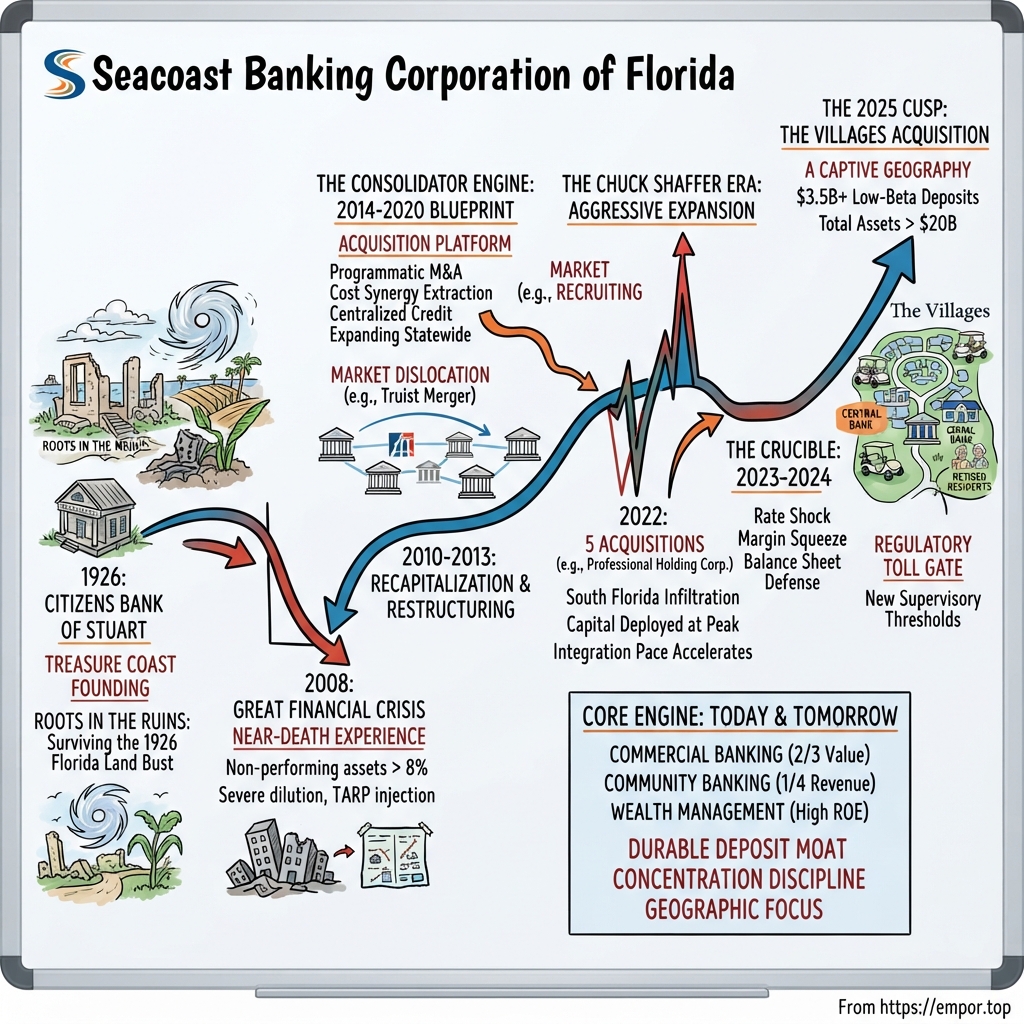
Seacoast Banking Corporation of Florida: The Empire Built on Florida's Frontier
I. Prologue: The Sovereign of the Sunshine State
On the morning of October 1, 2025, a golf cart pulled into a drive-through lane at a bank branch in Sumter County, Florida. The driver — retired, tanned, and dressed in the local uniform of a pastel polo and visor — handed a deposit slip to a teller who had worked that window for years. Nothing about the customer-facing routine had changed. The sign on the building still said Citizens First Bank. But the legal owner of that deposit, and roughly $3.5 billion more like it, had changed overnight. Seacoast Banking Corporation of Florida had closed its acquisition of Villages Bancorporation, Inc., the bank at the financial center of America's largest master-planned retirement community.[^1]1
The transaction was valued at approximately $829 million in cash and Seacoast common stock, bringing roughly $4.1 billion in assets and 19 branches into the Seacoast franchise.1[^3] In balance-sheet terms, the deal pushed Seacoast past the $20 billion asset mark — a regulatory threshold that functions less as a trophy than as a toll gate, triggering heightened supervisory standards and greater compliance overhead. In strategic terms, it handed Seacoast an unusual prize: a deposit franchise with a captive geography, situated inside a development whose population reaches into six figures and whose affluent retiree demographic tends not to rate-shop for an extra twenty basis points on liquid balances.
Understanding the significance of that deposit base requires understanding why independent banking in Florida has humbled generations of confident operators.
By almost any conventional metric, Florida represents one of the most attractive deposit and lending markets in the country. It absorbs hundreds of thousands of domestic migrants annually, imports substantial wealth from higher-tax states, and serves as an established destination for corporate relocations. Yet the state has historically been a difficult operating environment for locally headquartered institutions. The three largest national banks — JPMorgan Chase, Bank of America, and Wells Fargo — control the dominant share of statewide deposits, leaving regional and community banks to compete for the balance. Furthermore, Florida's economy remains deeply tied to commercial and residential real estate, a sector prone not just to cyclical soft landings, but to severe structural contractions: 1926, the mid-1970s, the late 1980s, and 2008, each liquidating an entire cohort of local lenders.
The central analytical question is straightforward: How did a bank founded in 1926 as a single-branch institution in a small Treasure Coast town — established directly amid the collapse of Florida's 1920s land boom — emerge nearly a century later as the largest independent commercial bank headquartered in the state? How did it survive the 2008 financial crisis, when non-performing assets exceeded 8% of total assets and its stock traded below two dollars, and subsequently convert that distress into a programmatic acquisition platform that absorbed more than fifteen Florida institutions?2 And most critically for investors evaluating the franchise today: is the rebuilt institution structurally different from the one that nearly failed, or is it fundamentally the same operating model operating on a larger scale?
Answering that question requires tracing the full trajectory: the 1926 founding and three generations of Hudson family control; the 2007–2013 credit crisis that dismantled the legacy model and forced the creation of a new operating blueprint; the 2014–2020 build-out of the bank's digital and M&A integration capabilities; Chuck Shaffer's appointment as CEO; the aggressive 2022 expansion — five announced transactions in a single calendar year — that coincided with the steepest Federal Reserve rate-hiking cycle in four decades; the margin compression and integration pause that followed; and the milestone Villages acquisition. Evaluating these chapters against the company's disclosed record tests whether the bank's core strengths are durable across credit cycles.
The story begins where Florida banking history so often begins: with a crash.
 Subscribe on LinkedIn
II. Roots in the Ruins: Surviving the 1926 Florida Land Bust
In the autumn of 1926, Stuart, Florida, was reeling from the collapse of the most aggressive speculative mania the American real estate market had ever seen. Eighteen months earlier, the town had been an active outpost in a statewide land rush. Speculators flipped options on South Florida acreage before the ink dried, and passenger trains ran south packed with buyers. Then, in the span of a single year, the system stalled. Rail embargoes choked shipments of building supplies, a capsized schooner blocked the entrance to Miami harbor, and Northern newspapers began publishing accounts of pervasive real estate fraud. Out-of-state buyers stopped closing on contracts, and a market built entirely on escalating valuations abruptly ran out of liquidity.
On September 18, 1926, the Great Miami Hurricane made landfall, killing hundreds of residents, leveling new developments across South Florida, and converting a financial contraction into a humanitarian crisis. Florida entered an economic depression three years before the rest of the nation followed.
Amid that wreckage, a group of local civic leaders in Stuart, led by Dennis S. Hudson Sr., organized Citizens Bank of Stuart in 1926 — the institution that eventually became Seacoast National Bank.2 Launching a commercial bank in the aftermath of a speculative collapse carried distinct counter-cyclical advantages: competitors were weakened or insolvent, asset prices had reset to distressed levels, and the remaining deposit base belonged to citrus growers, boat builders, commercial fishermen, and merchants whose cash flows were tied directly to the local economy.
That environment shaped the bank's initial operating philosophy: lend against verified cash flows, require collateral margins wide enough to withstand a forced liquidation, and restrict credit to enterprises management could physically inspect. The strategy surrendered speculative boom-time volume to competitors in exchange for surviving the inevitable downturn.
The model faced an immediate trial. Between 1929 and 1933, thousands of American banks failed, and Florida's state-chartered lenders — many encumbered with boom-era real estate paper — proved especially fragile. Citizens Bank of Stuart remained open and solvent, honoring depositor withdrawals in full throughout the panic. In a systemic banking crisis, that performance built a local deposit franchise that endured for decades.
Over the following half-century, the bank became the primary financial institution for Martin County and the surrounding Treasure Coast, securing municipal accounts, agricultural operations, marina facilities, and local contractors. Dennis S. Hudson Sr. eventually transferred leadership to his son, Dennis S. Hudson Jr., who navigated Florida's post-war population boom as air conditioning, interstate highways, and aerospace development transformed the state's economy.
A key structural transition arrived in 1983, when the bank holding company Seacoast Banking Corporation of Florida was formed and its shares were listed on NASDAQ.2 Creating a public holding company gave leadership an essential tool that a standalone bank charter lacked: publicly traded equity. That equity base would eventually serve as the currency for programmatic acquisitions decades later, even as it introduced public market reporting requirements, quarterly earnings scrutiny, and potential share dilution.
Dennis S. Hudson III, known as Denny, joined the bank in 1978 and became chief executive in 1998. The third generation of Hudson leadership inherited a culture anchored in relationship-driven, local underwriting, where lending decisions often weighed personal familiarity alongside financial statements. While that approach generated exceptionally sticky core deposits, it also carried subtle vulnerabilities. Relationship underwriting proved effective in stable markets, but it faced severe operational limits in an environment where collateral values surged, borrowers appeared solvent on paper, and aggressive competitors relaxed credit standards.
That proved to be the exact operating environment that arrived in 2002.
III. The Near-Death Experience: Ground Zero of the Great Financial Crisis
A distinct speculative fervor grips coastal Florida at the peak of a real estate cycle, and anyone who operated in Port St. Lucie or Cape Coral in 2005 recognized the signs. Residential lots that sold for $18,000 in 2001 traded for $90,000 four years later. Subdivisions were platted, permitted, and fully committed before contractors poured a single foundation. Many purchasers were not families intending to build homes, but speculators holding multiple contracts with plans to assign them before closing. Lenders across the market — not merely fringe operators — aggressively financed the raw land and infrastructure.
Seacoast fully participated in the expansion. During the early 2000s, the bank pushed beyond its historical Martin County footprint into St. Lucie County, Palm Beach County, and the greater Orlando metropolitan area. The balance sheet expanded rapidly on residential construction lending, lot development loans, and land acquisition financing. On paper, each underwriting decision seemed defensible: reputable sponsors, personal guarantees, and conservative loan-to-value ratios calculated against prevailing appraisals. The fundamental vulnerability was not an individual loan; the portfolio represented a single concentrated wager replicated across hundreds of transactions, and the appraisals that supported those loan-to-value calculations were themselves inflated by the speculative mania.
When Florida property values collapsed — plunging 50% or more from their peaks in the hardest-hit coastal and interior markets — that hidden correlation surfaced immediately. Half-finished subdivisions dotted the Treasure Coast: paved streets, working streetlights, and fire hydrants, but no houses. Personal guarantees offered little protection because a borrower facing foreclosure on one lot typically held speculative contracts on several others. Seacoast's non-performing assets went from a rounding error to above 8% of total assets, a level at which a bank is not managing credit problems but conducting triage.2 Cumulative net charge-offs from 2008 through 2011 eroded common equity faster than pre-provision earnings could replenish it, and the company's stock, which had traded in the high twenties in 2006, collapsed below $1.50.
In December 2008, Seacoast accepted $50 million from the U.S. Treasury's Troubled Asset Relief Program Capital Purchase Program.2 Operating under heightened regulatory oversight, the company adopted the standard capital-conservation protocol of a distressed lender: it deferred dividends on both its preferred shares and its trust preferred securities. Deferring interest payments on trust preferred securities is permitted under the contracts and does not trigger an immediate technical default, but it functions as an unmistakable distress flare, signaling to institutional counterparties that capital conservation has become an urgent imperative.
Seacoast's standing in that crisis is best understood not against national money-center institutions, but relative to its local peers. Florida led the nation in bank failures during the Great Financial Crisis. In neighboring Fort Pierce, Riverside National Bank of Florida — an older, larger, and historically respected Treasure Coast lender — was shuttered and seized by the Federal Deposit Insurance Corporation in April 2010. Dozens of other Florida community banks suffered the same fate. The distinction between Seacoast and failed peers like Riverside lay neither in their geographic concentration nor in their loan books, as both had underwritten the same housing boom. Rather, Seacoast's survival hinged on the speed and scale of its recapitalization and the willingness of leadership to absorb severe shareholder dilution rather than enter receivership.
Denny Hudson opted for aggressive restructuring. Across 2010–2013 Seacoast raised common equity, moved aggressively to dispose of legacy problem assets rather than extend and pretend, and ultimately exited the TARP investment.2 Yet while the bank's survival is frequently framed as a turnaround achievement, the cost to existing equity holders was severe. Preserving the banking charter and protecting shareholder value proved to be two entirely different outcomes, and management accomplished only the former. For investors analyzing the franchise's underwriting discipline today, Seacoast's record is that of an institution that already experienced a catastrophic credit breakdown and survived by heavily diluting its owners.
The trauma of that downturn forced an institutional reassessment. Hudson and a rising cohort of internal executives — including Charles Shaffer, then a senior finance officer — concluded that the traditional community banking model was no longer viable. Three systemic pressures were converging. Heightened post-crisis regulation under the Dodd-Frank Act, coupled with intensive anti-money laundering and Bank Secrecy Act compliance requirements, created heavy fixed overhead costs that a sub-billion-dollar institution could not support. Simultaneously, core processing systems and digital banking interfaces were becoming competitive prerequisites, requiring technology investments that demanded operational scale. Finally, Florida's real estate market would inevitably face future cyclical contractions.
Management arrived at an unconventional conclusion for what had long been a family-run lender in a small county seat: Seacoast had to transform itself into a scalable, high-throughput operating platform. The company needed to construct a centralized, data-driven credit and operational engine, target commercial borrowers underserved by the national mega-banks, and leverage the public equity currency created by its 1983 holding company structure to acquire smaller community banks that could no longer shoulder the costs of regulatory compliance and technological modernization on their own.
That operational blueprint would define the bank's strategy for the next decade.
IV. Building the Consolidator Engine: The 2014–2020 Roll-Up Blueprint
The operational arbitrage underpinning Seacoast's strategy can be stated simply. Consider two Florida banks: one with $500 million in assets, and another with $8 billion. Both must staff Bank Secrecy Act and anti-money laundering compliance programs, maintain cybersecurity infrastructure, license core processing software, prepare regulatory filings, support internal audit teams, and employ a chief risk officer. The absolute dollar cost of maintaining those mandatory capabilities differs by far less than the sixteen-fold difference in the size of their balance sheets. For a smaller institution, regulatory and technology overhead can easily consume a quarter of pre-tax earnings; for a larger organization, it represents a manageable operating expense.
A succession dilemma compounded those pressures across the state. A significant number of Florida community banks had been chartered or recapitalized by local entrepreneurs during the 1990s and early 2000s. By the late 2010s, those founders were reaching retirement age, their shares were privately held and illiquid, family succession was uncommon, and their institutions lacked the balance-sheet scale to absorb post-crisis compliance burdens. For many boards, an outright sale offered the only viable liquidity event.
Seacoast engineered its corporate structure to serve as the natural buyer for those institutions. Management focused on a specific target profile: Florida lenders holding between $200 million and $1 billion in assets, situated in expanding sub-markets, and funded by low-cost core deposits. Deposits, rather than loan books, represented the primary prize. Transactions were funded predominantly with Seacoast common stock, preserving capital, granting selling shareholders continued participation in a liquid public equity, and allowing deals to be evaluated on relative valuation multiples rather than cash outlays.
The financial underwriting followed strict operational rules. Seacoast targeted eliminating 35% to 45% of an acquired bank's non-interest expenses by closing overlapping branches and shifting back-office functions onto its centralized platform. Transactions were modeled to deliver immediate earnings accretion and recover any dilution to tangible book value per share within three years. That earnback metric remains a critical benchmark of discipline in bank consolidation. When an acquirer issues stock at a premium to purchase a competitor above tangible book value, it reduces tangible equity per share on day one. The earnback period measures the number of years of incremental post-deal earnings required to lift tangible book value back to where it would have stood without the transaction. A three-year earnback represents disciplined capital allocation, whereas a five-year recovery indicates an acquirer prioritized footprint expansion over per-share economics.
Culturally, the integration model enforced an unyielding division: retain customer-facing producers while dismantling the target's credit apparatus. Acquired institutions retained their commercial relationship managers—whose regional business networks constituted the commercial value of the franchise—but surrendered their independent lending authority. Credit underwriting migrated entirely to Seacoast's centralized risk team. That policy was the direct institutional consequence of the 2008 crisis: executive management concluded that while regional bankers should originate loans, they must never approve them.
The resulting expansion traced Florida's primary economic corridors rather than radiating uniformly from Stuart. Between 2014 and 2016, Seacoast entered the Tampa market, expanded its presence in Palm Beach County through the acquisition of Grand Bankshares, and established a branch footprint in Broward County through Floridian Community Bank.2 In 2017 and 2018, the bank deepened its reach across the Tampa Bay area by acquiring GulfShore Bancshares and NorthStar Bank, followed by its most significant strategic transaction of that period: First Green Bank, an Orlando-area lender with roughly $730 million in assets that positioned Seacoast along the Interstate 4 corridor linking Tampa and Orlando.2 In 2020, despite the initial disruption of the pandemic, the bank acquired Freedom National Bank in St. Petersburg and First Bank of the Palm Beaches.
A major market dislocation accelerated that growth in 2019, when BB&T and SunTrust agreed to merge to create Truist Financial Corporation. While the combination established a regional financial power, mega-mergers routinely generate multi-year internal frictions: duplicate branches close, reporting lines shift, and commercial borrowers frequently find their accounts reassigned across rotating personnel.
Seacoast capitalized on that upheaval by recruiting experienced commercial banking teams across Orlando, Tampa, and South Florida, using them to build its middle-market commercial and industrial lending portfolio. That organic expansion complemented the bank's acquisition platform. Hiring established lending teams allowed Seacoast to capture commercial relationships through compensation packages rather than equity dilution, bringing over clients who preferred local decision-makers to distant underwriting committees.
By 2020, Seacoast had demonstrated that its roll-up strategy operated as a repeatable, efficient mechanism. Acquired institutions were converted onto Seacoast's central operating core within roughly one quarter of closing, avoiding the overhead of managing fragmented charters or parallel software systems. Yet that six-year expansion came with an analytical caveat: every transaction had been completed during a remarkably benign economic environment marked by low interest rates, benign credit metrics, rising bank equity valuations, and rapid statewide population growth. A programmatic acquisition platform is never truly tested until it confronts an adverse credit and interest rate cycle.
That test was about to arrive, and Seacoast was preparing to accelerate into it.
V. The Chuck Shaffer Era: Aggressive Expansion & South Florida Infiltration
In January 2021, the Hudson era formally ended. Charles "Chuck" Shaffer became chief executive officer of Seacoast, and in 2023 he added the chairmanship as Dennis Hudson III retired from the board's leadership.3 It was a succession with almost no drama, because Shaffer had spent years being visibly prepared for it.
His résumé is worth reading closely, because it explains his operating style. Shaffer was not a lender who rose through production, and he was not an outside hire brought in to change the culture. He was the company's chief financial officer, later chief operating officer, and also ran community banking — meaning he had held the capital plan, the expense base, and the branch network in sequence. Executives with that profile tend to think in unit economics rather than anecdotes. On earnings calls his register is analytical and unusually direct about costs, capital, and what he will and will not do to buy growth.
What Shaffer inherited in 2021 was a company with three things simultaneously: a clean balance sheet, a currency trading at a healthy multiple of tangible book value, and a target-rich state full of exhausted sellers sitting on pandemic-inflated deposit balances. He deployed all three at once.
In 2022, Seacoast announced five separate transactions in a single calendar year — a pace that drew national attention in the trade press.[^6] The list reads like a map of Florida's growth markets. Sabal Palm Bancorp brought roughly $420 million in assets in Sarasota, in a transaction valued at approximately $53.9 million. Business Bank of Florida added the Space Coast around Brevard County, valued at approximately $28.4 million. Apollo Bancshares brought roughly $1.1 billion in assets in Miami-Dade, at approximately $168.3 million. Drummond Banking Company added roughly $1.1 billion in North Florida and the Nature Coast, at approximately $173.2 million. And the largest of them, Professional Holding Corp. of Coral Gables, brought roughly $2.7 billion in assets in a transaction valued at approximately $488.6 million.[^6]4
Professional Holding is the one that carries the strategic argument, and also the one that carries the strongest criticism. Professional was not a sleepy succession sale; it was a modern, commercially oriented bank built in Miami-Dade with a team assembled substantially from institutions that had been consolidated away. What Seacoast bought was not primarily a deposit base — it was a commercial banking organization with standing in the wealthiest, fastest-professionalizing financial market in the state, at exactly the moment when hedge funds, private equity firms, and family offices were relocating to South Florida in visible numbers. The completed combination of Professional and Apollo in January 2023 took Seacoast past $15 billion in assets with a branch network touching nearly every major Florida metropolitan market.[^8]
Now the discipline check, which is where the narrative has to stop being flattering. Seacoast paid approximately 1.75 times tangible book value for Professional, above the roughly 1.55 times median for comparable transactions in that period, and modeled tangible book value dilution of about 6.4% with an earnback near 2.3 years.4 Management's justification was that scarce commercial talent in Coral Gables was worth a premium, and that argument is not unreasonable on its face — you cannot organically manufacture a seasoned Miami commercial banking team on any sensible timeline.
But look at the date. The agreement was announced in August 2022, with the deal completing at the end of January 2023 — roughly six weeks before the collapse of Silicon Valley Bank repriced every regional banking asset in the United States.4[^8] Seacoast committed its largest-ever slug of equity currency at what turned out to be, with hindsight, very near the top of the bank M&A valuation cycle. Cost synergies were delivered at roughly the modeled level, which validates the integration machinery. The timing, however, validates nothing at all.
This is the essential tension in the Shaffer record, and it will recur: the execution engine is demonstrably real, and the cycle-timing judgment is not. A buyer who converts systems on schedule and extracts the modeled expense synergies has proven operational competence. Proving capital-allocation skill requires buying when assets are cheap, and in 2022 Seacoast bought when they were expensive. Management would spend the following two years dealing with the consequences.
VI. The Crucible: Rate Shocks, SVB Contagion, & Margin Squeeze
On the weekend of March 10, 2023, regional bank executives across the country were running the same arithmetic. Silicon Valley Bank had collapsed in a matter of days, triggered not by conventional credit defaults, but by the convergence of two balance-sheet vulnerabilities: an investment securities portfolio burdened with steep unrealized paper losses from rising interest rates, and a depositor base that was concentrated, highly sophisticated, largely uninsured, and coordinated in real time. Signature Bank failed two days later, and First Republic collapsed by May.
Seacoast entered that banking panic carrying balance-sheet vulnerabilities stemming directly from its recent roll-up. It had absorbed billions of dollars in acquired assets across 2022 and early 2023, coinciding with the Federal Reserve's most aggressive monetary tightening cycle in four decades, which pushed the benchmark federal funds rate from near zero to above 5.25%. Acquired institutions brought legacy securities portfolios and fixed-rate residential mortgages originated during the 2020–2021 low-rate trough. Marking those assets to market in a 5% interest-rate environment generated substantial unrealized paper losses that flowed through accumulated other comprehensive income, an accounting line item institutional investors and counterparties suddenly began scrutinizing as a proxy for hidden insolvency.
The core vulnerability rested on the mechanics of held-to-maturity accounting. When market interest rates surge, legacy fixed-rate bonds decline in market value. Regulatory accounting rules allow banks to carry many of these bonds at amortized cost rather than fair market value under the presumption that the bank has the intent and ability to hold them until maturity. That assumption remains sound only as long as depositor outflows do not force an institution to sell underwater bonds, converting unrealized paper markdowns into permanent, realized capital destruction. Consequently, an institution's survival depended not primarily on the size of its paper bond marks, but on the stability and granularity of its core deposit base.
In that liquidity stress test, Seacoast's traditional, branch-based deposit franchise proved resilient. Unlike coastal technology lenders funded by venture-backed startups holding eight-figure uninsured balances, Seacoast's liabilities consisted predominantly of granular operating accounts for local small businesses and household savings. The vast majority of these balances sat within Federal Deposit Insurance Corporation coverage limits, distributed across more than one hundred branches throughout central and southern Florida.5 Non-interest-bearing checking accounts paying zero interest — the most profitable funding layer in commercial banking — remained above 30% of total deposits throughout the panic.5 Small retail depositors with modest checking accounts in Martin or Brevard County were protected by federal insurance, anchored by geographic convenience, and had little incentive to initiate digital bank runs.
While Seacoast averted a liquidity run, the interest-rate shock hit its income statement directly. As rate competition intensified statewide, commercial clients holding idle cash moved balances into money market funds yielding above 5%, while retail customers shifted funds into high-rate certificates of deposit. Rising funding costs compressed Seacoast's net interest margin from roughly 3.80% in late 2022 to a cyclical trough between 3.15% and 3.20% by mid-2024.5 In practical terms, the spread between what Seacoast earned on its loan book and what it paid for funding narrowed by roughly a fifth, suppressing core net interest income.
Confronted with contracting spreads and market turmoil, Shaffer halted M&A activity entirely.
During earnings presentations across 2023 and 2024, executive management formally shifted priorities away from acquisitions toward balance-sheet defense: rebuilding regulatory capital ratios, expanding organic core deposits, repositioning the securities portfolio, and completing the operational integration of recent purchases.5 Crucially, Seacoast avoided the common balance-sheet maneuvers regional lenders often use during margin squeezes. The bank chose not to rely heavily on brokered deposits or wholesale borrowing to artificially support loan volumes, nor did it relax credit standards to chase higher-yielding, lower-quality commercial credits. Instead, management deliberately allowed loan portfolio expansion to slow.
Accepting lower growth carried near-term earnings penalties, but it provided tangible operational evidence of the bank's post-2008 underwriting discipline. The company's executive compensation architecture reinforced that posture: the corporate proxy tied annual incentives to return on average tangible common equity, adjusted earnings per share, operating efficiency, and relative total shareholder return, rather than raw balance-sheet expansion or deal volume.3 Aligning executive pay with capital returns rather than asset size removed the structural incentive to pursue dilutive transactions during stress.
Yet an analytical review also highlights the constraints governing that pause. Halting expansion was not entirely a discretionary strategic virtue. Having committed substantial equity and operational resources to five simultaneous acquisitions during an expensive 2022 market, Seacoast entered the rate shock with limited excess capital and an extensive integration backlog. In quarterly commentary, leadership acknowledged that the balance sheet required time to absorb those additions. Halting acquisitions after deploying capital at peak valuations reflected pragmatic balance-sheet management as much as credit discipline — even if pausing was preferable to compounding risk through continued consolidation.
By late 2024 and into 2025, net interest margin began recovering as fixed-rate assets repriced into higher market yields and deposit costs stabilized. Tangible capital ratios rebuilt, and back-office integration milestones were completed. With the balance sheet stabilized and the M&A pipeline cleared, Shaffer ended the two-year consolidation hiatus by orchestrating the largest transaction in Seacoast's history.
VII. The 2025 Coup: The Villages Bancorporation Acquisition
Understanding why this transaction differed fundamentally from Seacoast's previous fifteen acquisitions requires understanding that The Villages is less a conventional municipality than a privately developed enclave structured around its own transportation network and civic apparatus.
Spread across roughly 32 square miles of Central Florida at the intersection of Sumter, Marion, and Lake counties, The Villages is the largest master-planned active-adult community in the United States. It is home to well over 100,000 residents, nearly all of them retired, most of them affluent, and many relocated from higher-cost Northern states with a lifetime of accumulated savings. Built by the Morse family over several decades, the community operates as a largely self-contained economic ecosystem, complete with its own commercial squares, local media, entertainment venues, and a dedicated street grid engineered for low-speed golf carts.
Citizens First Bank, held by Villages Bancorporation, served as the financial centerpiece of that ecosystem. Founded by the developer's family, the bank operated branches embedded directly in the village commercial centers, provided drive-through lanes tailored for golf carts, and maintained primary banking relationships with virtually every retailer, dining establishment, golf facility, and service vendor inside the gates. For a resident, banking elsewhere required traveling beyond the development; for a local merchant, banking elsewhere meant stepping outside the developer's commercial circle. The resulting institution commanded a dominant share of local deposits across the surrounding counties.
Seacoast announced the acquisition in May 2025 and closed it on October 1, 2025.[^1]1 The consideration was approximately $829 million in cash and stock, bringing roughly $4.1 billion in assets, more than $3.5 billion in deposits, and 19 branches, and taking Seacoast to roughly $20.8 billion in total assets with more than $16 billion in deposits.1[^3]
The strategic significance of the transaction lay in its balance-sheet economics rather than simple asset expansion. As the rate shock from 2022 to 2024 demonstrated across the regional banking industry, the scarcest asset in commercial banking is rarely loan demand or balance-sheet size; it is sticky, low-cost, low-beta core deposits. Deposit beta measures the proportion of any Federal Reserve benchmark interest-rate increase an institution must pass on to its depositors to prevent them from moving funds elsewhere. A lender whose customers demand market yields on every dollar behaves like a commodity financing vehicle. By contrast, an institution whose depositors keep idle transaction balances regardless of rate moves retains a stable, low-cost funding base that acts much like an annuity.
An affluent retiree maintaining an $80,000 checking balance to cover routine living expenses represents an exceptionally resilient liability. That depositor is unlikely to shift balances to a digital high-yield platform for an incremental yield advantage because daily financial activity is tethered to the physical merchants and community institutions surrounding the local branch. Seacoast's underlying strategy was an asset-liability matching trade: gather low-cost, low-beta deposits from The Villages and deploy that liquidity into higher-yielding commercial and industrial loans and owner-occupied commercial mortgages across expanding metro centers like Tampa, Orlando, and South Florida, where credit demand was strong but deposit competition was intense.
That strategic rationale, however, faces two structural counterweights.
First, the deposit advantage is neither permanent nor self-replenishing by default; it is demographic and behavioral. Retiring populations gradually draw down savings, encounter healthcare expenditures, and eventually pass estates to heirs who bank outside the region. While continuing expansion within The Villages historically replenished that deposit pool with incoming retirees, that inflow remains tied to broader migration into Florida, which has faced headwinds from escalating property insurance premiums and housing affordability pressures. The funding benefit remains real and measurable, but its long-term durability depends on sustained population growth over a multi-year horizon.
Second, the acquired bank carried an unusual degree of cultural specificity. Citizens First was a family-directed lender embedded in an insular master-planned community where the institution's identity was closely aligned with the developer. Seacoast's standard integration blueprint—centralizing credit approvals, consolidating operational hubs, and migrating accounts onto a standardized core processing system—was designed for conventional community banks. Applying that centralized model to an institution whose primary asset is hyper-local customer loyalty carries retention risk. If back-office consolidation or staff changes disrupt customer relationships, the low-beta deposit stability that justified the acquisition premium could erode.
Crossing the $20 billion asset threshold also fundamentally alters Seacoast's supervisory landscape. The bank had previously absorbed the earnings headwind of the Durbin Amendment's debit card interchange fee caps after passing $10 billion in assets. Above $20 billion, regulatory expectations for liquidity stress testing, capital planning, and enterprise risk governance expand significantly. Balance-sheet scale provides operational leverage, but entering higher supervisory tiers requires substantial upfront spending on compliance, internal controls, and risk management before that leverage translates into bottom-line efficiencies.
The central question for investors is what that combined entity actually looks like in practice.
VIII. The Core Engine: Current Economics & Segment Breakdown
Strip away the acquisition narrative, and Seacoast operates as three distinct businesses sharing a single balance sheet and brand.
The largest is commercial banking, which generates roughly two-thirds of the franchise's economic value. This segment encompasses commercial and industrial lending, owner-occupied commercial real estate, working capital facilities, equipment financing, and treasury management services. Treasury management represents one of the franchise's most strategic offerings because it anchors commercial deposits and creates substantial switching costs. When a middle-market business routes payroll, receivables lockboxes, and merchant processing through a bank, moving accounts for a marginally lower loan rate becomes impractical; migrating that operational plumbing requires retraining accounting personnel and risking administrative disruption.
The second business is community and consumer banking, representing roughly a quarter of revenue. This division houses the bank's granular retail deposits, residential mortgages, and small business banking relationships across a footprint exceeding one hundred branches. While branch networks are frequently characterized as expensive legacy overhead, Seacoast's retail network functions as the primary collection infrastructure for the low-cost, low-beta funding that makes its commercial lending profitable.
The third segment is wealth management and trust, generating roughly a tenth of revenue with assets under management above $1.5 billion. It delivers the highest return on equity among the three divisions because it requires negligible balance-sheet capital.5 It also represents the primary cross-selling channel opened by the bank's recent consolidation: the Professional acquisition added commercial business owners in South Florida entering succession or liquidity events, while The Villages brought tens of thousands of affluent households managing retirement portfolios. Converting those customer relationships into sustained trust and advisory mandates remains an ongoing effort, and non-interest wealth fees still represent a modest share of overall earnings. For investors, the division functions as valuable long-term optionality rather than a primary earnings driver today.
Following the Villages transaction, the combined balance sheet expanded to roughly $20.8 billion in total assets, approximately $12.5 billion in loans, and more than $16.5 billion in deposits.1[^3] That structure yields a loan-to-deposit ratio in the mid-to-high 70% range, well below the regional bank peer median of 85% to 90%. That differential illustrates two contrasting balance-sheet philosophies.
Viewed constructively, Seacoast maintains an expansive liquidity reserve, avoids dependence on volatile wholesale borrowing, and retains ample capacity to fund future loan originations using lower-cost core deposits it already controls. That conservative profile provides resilience during broader credit downturns and explains how the institution navigated the industry liquidity stress of March 2023 without capital impairment.
Viewed critically, surplus liquidity acts as an ongoing drag on asset returns. Cash reserves and short-duration securities yield less than commercial loans. Running a loan-to-deposit ratio in the mid-70s while competitors deploy funds at near 90% results in lower net interest income and a lower return on equity. Shareholders effectively accept lower cyclical profitability in exchange for reduced structural liquidity risk.
The composition of the loan portfolio reflects post-2008 risk controls converted into explicit credit policy. Non-owner-occupied commercial real estate represents roughly 40% to 45% of total loans, owner-occupied commercial property accounts for 15% to 18%, commercial and industrial credits make up 18% to 20%, and residential and consumer lending constitutes about 20%.5 The bank's risk-based capital concentrations reveal tighter constraints: construction and land development—the portfolio that brought the bank to the brink of insolvency in 2008—is capped well below 40% of risk-based capital, compared to the supervisory monitoring threshold of 100%. Total commercial real estate exposure sits near 215% of risk-based capital, comfortably below the 300% regulatory threshold that triggers heightened supervisory scrutiny.56
Those ratios provide meaningful strategic flexibility. Many regional lenders in Florida and across the Southeast operate near or above the 300% guidance limit, forcing them to curtail originations during regulatory reviews while Seacoast retains lending headroom.6 Maintaining an average loan balance below $1.5 million alongside rigorous personal guarantee requirements ensures that asset-side granularity mirrors the granularity of the deposit franchise.
On operating efficiency, Seacoast's efficiency ratio—the percentage of net revenue consumed by operating overhead—has historically trended in the low-to-mid 50% range, indicating that 53 to 57 cents of every dollar in revenue covers corporate expenses.5 That metric is competitive across mid-sized regionals, though trailing top-tier operators that run below 50%. Management has targeted a ratio below 55%, with post-merger cost extraction from The Villages serving as the primary near-term operational lever.
In aggregate, Seacoast operates as a spread-lending institution supported by a resilient core deposit base, constrained by explicit balance-sheet concentration caps, and tied directly to Florida's macroeconomic growth. That operating profile leads directly to the core competitive question: what structural protections insulate that franchise against regional and national rivals?
IX. Strategic Analysis: 7 Powers & Porter's 5 Forces
Applying competitive-advantage frameworks to commercial banking is notoriously difficult because the core product — a dollar — is the ultimate commodity. Any durable edge must derive from distribution, funding costs, switching frictions, or operational processes. Analyzing Seacoast through Hamilton Helmer's Seven Powers framework clarifies how narrow those competitive moats truly are.
Cornered Resource: largely absent, with one geographic exception. Seacoast holds no proprietary technology, patents, or exclusive operating licenses. The sole exception is physical: the Citizens First branch footprint inside The Villages. Those branches occupy locations embedded directly within a privately developed enclave where competitors cannot simply lease a storefront across the street. Developer site control, zoning restrictions, and integration into the community's golf-cart transportation grid create a distribution position that capital alone cannot duplicate. While strategically valuable, this advantage remains narrow and strictly bounded by that specific geography.
Switching Costs: moderate, and highly asymmetric. Switching frictions vary sharply across customer categories. For middle-market commercial clients integrated into Seacoast's treasury management platform, migrating payroll, receivables lockboxes, and accounting systems introduces substantial administrative disruption. Conversely, retail checking accounts carry minimal switching barriers; moving personal balances is inconvenient but manageable. The franchise's durable switching moat resides almost exclusively within its commercial relationship book.
Scale Economies: substantial and expanding. Scale represents Seacoast's most defensible structural advantage and the core financial logic of its roll-up strategy. Regulatory compliance, enterprise risk management, Bank Secrecy Act and anti-money laundering monitoring, cybersecurity infrastructure, and core processing software are predominantly fixed overhead expenses. Spreading those costs across a $20 billion balance sheet rather than a $2 billion one enables the 35% to 45% non-interest expense reductions modeled in acquisitions. Rather than trimming front-line commercial capacity, the acquirer eliminates redundant corporate overhead. The constraint, however, is that crossing supervisory thresholds — such as the $10 billion and $20 billion asset marks — periodically ratchets that fixed-cost baseline upward.
Counter-Positioning: moderate, primarily against national money-center institutions. Seacoast's value proposition to Florida commercial borrowers relies on empowering local market presidents to make rapid credit decisions, in contrast to national lenders whose approval processes often route through centralized out-of-state committees. While this local responsiveness enabled Seacoast to capture market share during disruptions like the BB&T–SunTrust merger, it does not constitute counter-positioning in Helmer's strict theoretical sense. Mega-banks face no economic barrier preventing them from decentralizing underwriting authority; their centralized model is an operational choice that could, in principle, be reversed.
Network Economies: absent. No Seacoast depositor or borrower derives incremental utility from the addition of other customers to the bank. Commercial banking functions without platform-style network dynamics.
Branding: moderate and strictly regional. Nearly a century of continuous operation in Florida sustains trust, particularly among legacy Treasure Coast households and municipal entities. However, brand recognition confers virtually no pricing power on commercial loan yields, where borrowers routinely solicit competitive bids.
Process Power: high, but operationally double-edged. Seacoast's repeatable M&A integration platform — executing complete systems conversions of acquired institutions within 90 to 120 days of closing while capturing modeled expense synergies — represents tacit organizational knowledge refined across more than fifteen transactions. This operational discipline is difficult for occasional buyers to replicate because it resides in experienced integration personnel and established playbooks. Yet process power of this kind creates an inherent organizational dilemma: the capability only generates economic returns when deployed, creating persistent internal pressure to pursue further transactions.
That institutional dynamic introduces a structural governance risk common to serial acquirers. An organization that builds, staffs, and rewards a high-throughput acquisition engine naturally develops an internal constituency inclined toward continuous deal-making. Preserving capital discipline requires executive management and the board to actively counter that momentum, prioritizing per-share returns over transactional volume.
Applying Michael Porter's Five Forces framework underscores the competitive headwinds facing regional lenders in Florida:
Threat of New Entrants: very low. De novo bank formation in Florida has remained minimal since the 2008 financial crisis. Stringent regulatory capital requirements, heightened charter scrutiny, and heavy initial compliance overhead render small-scale bank launches economically prohibitive, effectively insulating established incumbents from new local startups.
Bargaining Power of Borrowers: high. Creditworthy commercial borrowers across Florida operate in a borrower-friendly market, soliciting competitive terms from national institutions, super-regional lenders, local community banks, and increasingly from private credit funds. Lending spreads on pristine credits face constant downward pressure, making underwriting discipline — specifically the willingness to walk away from underpriced risk — a prerequisite for credit survival across cycles.
Bargaining Power of Depositors: moderate to high. The 2023–2024 liquidity contraction highlighted the bifurcated nature of depositor leverage. While retail retirees and household savers exhibit low rate sensitivity and deposit inertia, commercial corporate treasurers with access to money market funds and alternative yield instruments exercise substantial bargaining power. Seacoast's deposit mix skews favorably toward granular core balances, providing a relative funding advantage over wholesale-reliant peers, though not an absolute shield against deposit repricing.
Threat of Substitutes: moderate and expanding. Non-bank lenders and private credit funds have aggressively expanded into middle-market corporate and commercial real estate lending. These alternative capital providers compete on closing speed, execution certainty, and flexible covenant structures, unencumbered by the commercial real estate concentration caps that constrain regulated depositories. Concurrently, fintech platforms compete directly for consumer payment flows and transaction balances.
Competitive Rivalry: intense. Florida represents one of the most contested commercial banking arenas in the United States. Seacoast competes directly against national mega-banks including JPMorgan Chase, Bank of America, and Wells Fargo, super-regionals like Truist and PNC, aggressive regional competitors such as SouthState and Amerant, and tax-exempt credit unions possessing structural cost-of-capital advantages.
Strategic Assessment: Seacoast's competitive advantages are real but structurally bounded, deriving primarily from cost efficiencies and funding characteristics rather than top-line pricing power. The franchise cannot command premium loan yields in an open commodity market. Instead, its long-term investment case depends on three foundational pillars: maintaining low-cost deposit funding, adhering to strict balance-sheet concentration limits, and executing programmatic acquisitions with operational precision. Evaluating the viability of the franchise requires testing where those assumptions are most vulnerable to breakdown.
X. The Historical Falsification Layer: Testing the Core Claims
A century-old financial institution offers the rare analytical advantage of being testable across multiple economic cycles. Seacoast has operated through enough systemic stress events that its strategic claims can be evaluated directly against its disclosed operating record rather than through management's retrospective framing.
Claim 1: "Seacoast possesses an unassailable low-cost core deposit moat driven by Florida demographics."
This proposition carries the primary strategic weight of the bank's investment thesis, and the 2025 Villages acquisition was underwritten directly upon it.
The mechanism that would falsify it is clear: an aggressive monetary tightening cycle in which depositors reallocate non-interest-bearing balances, deposit costs surge toward market yields, and demographic inertia dissolves once the rate incentive becomes significant.
The Federal Reserve's 2022–2024 rate-hiking cycle provided that exact stress test — and the deposit moat partially gave way. Non-interest-bearing deposits fell from roughly 38% of total deposits toward 30%.5 Total deposit costs escalated from approximately 0.12% in early 2022 to above 1.85% by late 2024.5 In other words, Seacoast's cost of funding multiplied more than fifteenfold in less than three years, demonstrating that the franchise was not immune to broader market forces.
The meaningful benchmark, however, is relative. Seacoast's cumulative deposit beta of roughly 35% remained materially lower than the regional peer median, which clustered between 45% and 50%.57 The deposit franchise proved noticeably more resilient than competitors, even if it did not provide absolute insulation from monetary policy.
Verdict: the claim survives in narrowed form. Florida's retail demographic profile generates a durable relative funding advantage of roughly ten to fifteen basis points against regional peers through an interest rate cycle, rather than absolute immunity from Federal Reserve tightening. That narrowed advantage remains economically meaningful — across a $16 billion deposit base, a fifteen-basis-point funding edge yields significant interest expense savings each year — but it represents a quantifiable pricing differential rather than an unassailable moat. The benchmark that will confirm or falsify this revised claim over time is the bank's total deposit cost relative to Florida peers through the next full rate cycle, specifically whether deposits from The Villages exhibit a lower beta than the legacy franchise during periods of rate volatility.
Claim 2: "Seacoast is a disciplined capital allocator that does not overpay or dilute shareholders."
Evaluating this claim against historical capital allocation reveals a mixed and instructive record.
The contradictory evidence centers on the aggressive 2022 expansion, particularly the acquisition of Professional Holding. Paying approximately 1.75 times tangible book value against a peer median near 1.55 times, weeks before the bank M&A market repriced violently following the March 2023 liquidity crisis, is the textbook definition of buying at the top.4 The modeled 2.3-year tangible book value earnback was not achieved on schedule, as subsequent net interest margin compression and fair-value marks on acquired loan books stretched the practical recovery period beyond three years. Furthermore, executive leadership's decision to pause acquisitions throughout 2023 and 2024 was an implicit concession that the pace of deployment had outrun the balance sheet's capacity to absorb it.5
The mitigating evidence is also substantive. Seacoast avoided goodwill impairments on the 2022 transactions, which would have signaled structural value destruction. Modeled cost synergies were achieved according to plan, the acquired Miami-Dade commercial lending platform generated ongoing loan volume, and initial dilution to tangible book value per share was gradually recovered through retained earnings rather than resulting in permanent capital impairment.
Verdict: partially rejected; capital discipline was enforced by external market conditions rather than self-imposed in advance. Seacoast has demonstrated consistent operational capability in integrating acquisitions, but it has not demonstrated market-timing discipline, having committed its largest slug of equity capital before 2025 at a cyclical peak. The forward test of capital allocation is measurable: compound annual growth in tangible book value per share including the Villages transaction. If growth in tangible book value per share through 2027 and 2028 exceeds the trajectory that organic capital retention alone would have achieved, the acquisition strategy creates net economic value. If it merely matches organic capital accumulation, the bank has expanded balance-sheet size without enhancing per-share value.
Claim 3: "Underwriting discipline protects Seacoast from Florida's cyclical real estate catastrophes."
This claim encounters the most severe historical counter-evidence, because the bank's legacy underwriting model previously suffered a catastrophic failure. Non-performing assets exceeded 8% of total assets during the Great Financial Crisis, requiring emergency government capital under the TARP program, the suspension of preferred dividends, the deferral of trust preferred interest payments, and severe equity dilution that wiped out the vast majority of legacy shareholder value.2 An institution that permitted non-performing assets to reach that level cannot legitimately claim underwriting discipline as an unbroken institutional heritage.
The relevant analytical question is whether that breakdown was subsequently remediated through binding structural controls rather than rhetorical commitments. Here the disclosed record provides substantial evidence of structural reform: total commercial real estate exposure was restricted near 215% of risk-based capital against the 300% regulatory guidance threshold, construction and land development loans were kept below 40% of capital against a 100% supervisory ceiling, centralized credit approval was removed from local relationship managers in favor of centralized risk committees, and average loan balances were kept modest alongside strict personal guarantee requirements.56 These underwriting limits represented genuine institutional constraints; while competitors rapidly expanded high-yield construction lending across Florida between 2021 and 2022, regulatory disclosures show Seacoast adhered to its portfolio caps.
Post-crisis credit metrics reflect the impact of those limits: annual net charge-offs have remained consistently in the single-digit to mid-teens basis-point range, representing exceptionally clean asset quality.
Verdict: the claim is validated for the post-2014 operating regime but remains unproven against an acute stress environment. Favorable credit performance during an extended macroeconomic expansion provides limited insight into true portfolio durability, as low unemployment and rising asset values support borrower solvency across the industry. The definitive test will be a prolonged Florida commercial real estate contraction accompanied by sustained higher interest rates and worsening property insurance strains — conditions the current executive team has not navigated in their present roles. Critical leading indicators will include migrations in criticized and classified loans alongside net charge-offs, which deteriorate quarters before headline non-performing asset ratios register distress.
Evaluating executive communication consistency reinforces this assessment. Leadership stated throughout 2023 and 2024 that acquisitions were paused to allow the balance sheet to absorb previous transactions and rebuild capital ratios, before announcing the landmark Villages transaction in May 2025. This sequence did not represent a contradictory reversal; the prerequisites management outlined for resuming M&A — restored regulatory capital, completed systems integration, and stabilizing net interest margins — were demonstrably achieved, and the pause spanned nearly two full years. Nevertheless, the rapid resumption of deal-making confirms an underlying organizational reality: Seacoast remains an active consolidation vehicle programmed to pursue acquisitions whenever capital headroom permits. Investors should view continued consolidation as the baseline operating model, evaluating each prospective transaction on purchase price, tangible book value dilution, and earnback duration rather than assuming the franchise has concluded its expansion.
XI. The Risk Radar: Florida-Specific Macro & Micro Threats
The primary risks facing Seacoast stem less from boilerplate regulatory disclosures than from geographic concentration: the bank made a deliberate strategic choice to operate exclusively within a single state.
The property insurance crisis represents the most under-modeled credit risk in Florida banking. As private carriers curtailed underwriting across Florida homeowners and commercial property markets, premiums rose sharply, and an outsized share of statewide coverage migrated to Citizens Property Insurance Corporation, the state-backed insurer of last resort. The transmission mechanism into a bank's commercial loan portfolio operates indirectly. Consider an apartment complex or retail strip center underwritten in 2021 with a debt-service coverage ratio of 1.35 times—meaning net operating income covered mortgage debt service with a 35% margin of safety. If the annual property insurance premium doubles, that expense comes directly out of net operating income, potentially driving debt-service coverage down toward 1.10 times or lower. The borrower has not defaulted on an installment, and the property has maintained full occupancy. Yet the credit profile has deteriorated, the collateral value has declined as prospective buyers capitalize lower net operating income, and the borrower may struggle to meet standard refinancing underwriting criteria at loan maturity. Replicated across a commercial real estate portfolio where insurance repricing affects nearly every property, this dynamic functions as a slow-moving credit strain that surfaces in collateral appraisals and loan refinancings well before triggering delinquent payments.
Post-Surfside condominium structural reserve legislation creates a second, more focused exposure. Following the 2021 collapse of Champlain Towers South, Florida enacted statutory requirements mandating milestone structural inspections and non-waivable reserve funding for aging condominium developments. Associations that deferred capital maintenance for years must now fund repairs through special assessments, which frequently run into tens of thousands of dollars per unit. For aging coastal properties housing retirees on fixed incomes, these assessments present acute financial strain. Seacoast's exposure operates through residential mortgages tied to affected units, commercial lines extended to local small businesses that rely on consumer spending from those residents, and softer transaction pricing in coastal residential submarkets.
Supervisory threshold expansion imposes front-loaded operational expense. Crossing the $20 billion asset mark through the Villages acquisition brought heightened regulatory expectations across liquidity stress testing, capital planning, and enterprise risk governance, with additional requirements looming at subsequent asset tiers. Having absorbed the permanent debit-card interchange fee reductions mandated by the Durbin Amendment after passing $10 billion, Seacoast now faces the reality that regulatory compliance costs typically arrive upfront before post-merger balance-sheet scale can offset them, creating a near-term drag on operating efficiency.
The durability of Florida's demographic tailwind remains the foundational assumption. Every component of the Seacoast investment thesis—loan demand, core deposit stability, community expansion within The Villages, and commercial property valuations—relies on sustained net domestic in-migration. Historically supported by state income tax advantages, favorable climate, and expanding remote-work flexibility, that population inflow faces growing counter-pressures from elevated home prices, steep property insurance rates, and rising condo assessments. A material slowdown in inward migration would not necessarily trigger an immediate credit crisis, but it would shift Seacoast from a high-multiple growth franchise tied to Florida's economic expansion into a mature regional spread lender, compressing its valuation multiple accordingly.
A critical analytical stress test identifies three additional governance and balance-sheet considerations:
First, the sustainability of revenue growth. A significant portion of Seacoast's asset and revenue expansion over the past decade was purchased via continuous M&A rather than generated through pure organic deposit and loan origination, raising questions about franchise growth once bank consolidation targets dwindle.
Second, the accumulation of balance-sheet goodwill and identifiable intangible assets from more than fifteen transactions. That intangible cushion creates a substantial wedge between reported book equity and tangible common equity, representing the first capital layer vulnerable to writedowns if an acute macroeconomic downturn impairs acquired operating units.
Third, key-person risk and leadership concentration. Seacoast's defining corporate maneuvers—the aggressive five-deal blitz in 2022, the subsequent two-year M&A moratorium, and the $829 million Villages transaction in 2025—were directed by Chuck Shaffer. While centralized leadership enables swift capital deployment when execution aligns with management's playbook, it concentrates significant strategic and cycle-timing judgment within a single executive office.
XII. Playbook & Core Business Lessons
Lesson 1: In post-2008 banking, scale is a compliance requirement rather than an ambition. The primary structural reality of modern commercial banking is that regulatory compliance functions largely as a fixed cost, while revenue scales alongside balance-sheet assets. That arithmetic transformed the sub-$1 billion community bank from a self-sustaining local business into a structurally disadvantaged one, creating a persistent pool of motivated sellers. Seacoast's operational insight was not merely anticipating that consolidation was inevitable, but recognizing that an acquirer's ultimate returns depend almost entirely on integration efficiency. Designing a repeatable, centralized conversion system delivered far greater operational value over time than attempting to hand-pick bargain targets.
Lesson 2: A serial acquisition strategy requires two gears, and knowing when to pause is the rarer discipline. Consolidators tend to accelerate when their equity currency trades at a premium, targets are abundant, and balance sheets retain excess capital—conditions Seacoast capitalized on in 2021, 2022, and again in 2025. The more demanding discipline, however, is halting deployment when capital ratios tighten, net interest margins compress, and back-office pipelines reach capacity, as the bank demonstrated across 2023 and 2024. The failure mode for roll-up platforms is rarely an isolated mispriced purchase; it is an institutional inability to decelerate once internal incentives and corporate overhead become oriented around deal volume. Seacoast's willingness to stop expansion represented meaningful operational restraint, even if that pause occurred only after committing substantial equity at peak valuations.
Lesson 3: Geographic concentration is a deliberate strategy rather than an incidental exposure. Traditional risk management principles favor interstate diversification to smooth regional volatility. Seacoast chose the opposite path, trading geographic dispersion for operational depth: detailed knowledge of local submarkets, the ability to recruit talent quickly when rivals stumble during integrations, and a recognizable brand identity that out-of-state regional lenders struggle to match. The structural tradeoff, however, is unforgiving: when Florida's property or credit cycle contracts, the balance sheet has no uncorrelated geographic earnings to absorb the shock. Investors must evaluate the franchise as a concentrated wager on a single state's macroeconomy rather than as a diversified regional banking institution.
Lesson 4: In a spread-lending business, acquire liabilities rather than assets. The defining logic of Seacoast's consolidation program—culminating in the 2025 Villages acquisition—was not the accumulation of loan balances. Rather, the transaction targeted a captive, low-beta deposit franchise that generates stable, low-cost funding. That sticky liquidity can be redeployed into commercial lending across expanding metropolitan centers like Tampa, Orlando, and South Florida, where borrowing demand is strong but deposit competition is severe. Commercial loans can be originated by any competitor possessing capital and credit appetite; an established base of affluent, rate-insensitive depositors cannot be assembled quickly at any price. In a volatile rate environment, defensible liabilities remain the ultimate source of franchise value.
XIII. The Bull vs. Bear Case & What to Watch
The bull case
The first pillar is franchise scarcity. Decades of consolidation have sharply reduced the number of independent, scaled commercial banking platforms headquartered in Florida. Seacoast stands as the largest among them, operating in one of the nation's fastest-growing statewide economies. That scarcity provides two distinct strategic possibilities for shareholders: it cements the bank's role as the primary consolidator of remaining Florida community lenders, and it establishes the company as an attractive acquisition platform for an out-of-state super-regional bank seeking immediate Florida scale. While management has given no public indication of exploring a sale, that optionality represents a plausible component of the franchise's long-term return profile.
The second pillar is the funding arithmetic from The Villages. If the acquired deposits perform as underwritten—maintaining low costs, low interest-rate sensitivity, and high retention—they structurally reduce blended funding costs across the balance sheet, enabling the commercial lending division to generate wider margins than regional peers. Management has targeted a return on average tangible common equity in the mid-teens or better. While mathematically supported by modeled cost synergies and asset redeployment, achieving that return target remains a forward projection that requires sustained post-integration execution.
The third pillar is competitive market share capture. As national mega-banks continue to consolidate retail branches and centralize credit administration, they routinely displace experienced commercial relationship managers and alienate middle-market business borrowers. Seacoast proved following the BB&T–SunTrust merger that it can convert that industry dislocation into productive commercial lending hires and client relationships. Recruiting established lending teams provides a capital-efficient organic growth vector, addressing skepticism regarding the company's ability to expand without dilutive acquisitions.
The bear case
The primary bear concern is integration and retention risk. Seacoast must absorb a $4.1 billion, culturally unique institution while continuing to manage the expanded footprint created by its five 2022 acquisitions. Core systems conversions inevitably create client friction, cost synergies often involve eliminating personnel who maintain local relationships, and the principal asset of Citizens First—reputational trust inside an insular master-planned community—is vulnerable to subtle erosion that registers only in hindsight. Meaningful deposit runoff from The Villages would not simply lower transaction returns; it would undermine the core strategic rationale for the acquisition.
The second concern is the compounding pressure of Florida's property insurance escalation alongside a commercial real estate refinancing cycle at interest rates well above origination levels. Credit deterioration in a higher-rate environment does not require reckless underwriting; conservative loans originated under 2021 market conditions can become stressed when operating expenses surge, debt-service coverage ratios compress, and capitalization rates reset. While Seacoast's disciplined portfolio concentration caps provide a meaningful buffer relative to regional peers, they do not insulate the balance sheet from broader statewide real estate repricing.
The third challenge is skepticism surrounding underlying organic growth. Disentangling organic expansion from acquired balance-sheet volume across more than fifteen transactions is notoriously difficult. While management points to commercial hiring and wealth management expansion, critics note that serial acquisitions frequently obscure stagnant baseline volumes. A business model dependent on ongoing consolidation requires a premium equity valuation to fund transactions; if market multiples contract, the acquisition engine stalls. That dependency represents an inherent structural vulnerability common to programmatic roll-up strategies.
The three KPIs that matter
Evaluating Seacoast's forward performance centers on three observable indicators:
Net interest margin excluding purchase accounting accretion, alongside total cost of deposits. Purchase accounting marks on acquired loan books generate accretion income that temporarily boosts reported yields. Stripping out accretion reveals the underlying earning power of the balance sheet. Evaluated alongside the total cost of deposits, this metric directly tests whether the Villages deposit franchise delivers the stable, low-beta funding modeled at announcement.
Compound annual growth in tangible book value per share. Tangible book value per share represents the definitive scorecard for a serial consolidator. While balance-sheet scale and headline revenue can be expanded by issuing equity, tangible book value per share increases over time only when acquisitions successfully earn back initial dilution and generate durable retained earnings. Tracking per-share compounding alongside dividend distributions determines whether programmatic M&A has created authentic economic value or merely increased operational size.
Asset quality metrics and criticized loan migration. Given Seacoast's historical credit experience, underwriting metrics represent an essential operational check. Increases in criticized and classified loans provide the earliest indication of portfolio stress, surfacing quarters before non-performing asset ratios or net charge-offs rise. Sustained low credit losses and stable risk ratings within commercial real estate will confirm whether post-2008 underwriting controls remain durable through a full credit cycle.
XIV. Epilogue: The Century Bank
In 2026, Seacoast marks its hundredth year. Holding the two endpoints of that century in the same frame illustrates the recurring dynamics of Florida banking. In the autumn of 1926, civic leaders in Stuart organized a bank amid the wreckage of a speculative land collapse and a devastating hurricane, backed by local relationships and the conviction that an institution underwritten on verified cash flows could outlast the downturn. A century later, their corporate descendant holds roughly $20.8 billion in assets, finances middle-market commercial borrowers across Florida's metropolitan corridors, and funds itself through a master-planned retirement enclave in Sumter County that did not exist when the original charter was drafted.
What connects those two moments is not an unbroken record of managerial foresight. The institution nearly failed during the 2008 financial crisis by repeating the precise errors its founders had warned against—underwriting speculative residential lot loans and land development paper in submarkets management could not physically inspect—and legacy shareholders absorbed severe dilution to preserve the banking charter. The modern franchise exists because Seacoast survived long enough to convert that trauma into a centralized, rules-based credit and operational engine, leveraging its publicly traded equity to acquire smaller community banks that could no longer shoulder post-crisis compliance overhead on their own.
That trajectory offers a sobering principle for financial institutions. Enduring value in commercial banking is rarely created by expanding most aggressively at the peak of an economic cycle; it is generated by maintaining the capital, liquidity, and underwriting discipline required to absorb distressed market share at the bottom. Seacoast executed that transformation once, at substantial cost to its prior owners. Whether the platform Chuck Shaffer has assembled—larger, more commercially oriented, concentrated entirely within Florida, and anchored by captive retiree deposits—can navigate the next severe credit contraction without impairing per-share value remains the definitive test of the franchise. That question will not be settled during benign operating quarters; it will be answered only when Florida's credit cycle turns once again.
References
-
Form 8-K Current Report: Acquisition of Villages Bancorporation, Inc. — SEC EDGAR, 2025-10-01 ↩↩↩↩↩
-
Seacoast Banking Corporation Form 10-K for Fiscal Year Ended December 31, 2011 (Recapitalization, Troubled Debt Restructurings, and TARP Status) — SEC EDGAR, 2012-03-15 ↩↩↩↩↩↩↩↩↩
-
SEC EDGAR Form DEF 14A (2025 Definitive Proxy Statement & Executive Compensation) — Seacoast Banking Corporation of Florida, 2025-04-11 ↩↩
-
Merger Agreement and Investor Presentation: Acquisition of Professional Holding Corp. — Form 8-K, SEC EDGAR, 2022-08-08 ↩↩↩↩
-
SEC EDGAR Form 10-K (Annual Report for Fiscal Year Ended December 31, 2024) — Seacoast Banking Corporation of Florida, 2025-02-28 ↩↩↩↩↩↩↩↩↩↩↩↩↩
-
US Regional Bank CRE Concentrations and Regulatory Ratios Report — S&P Global Market Intelligence, 2024-06-20 ↩↩↩
-
Florida Banks Navigate High Deposit Betas and Real Estate Pressures — Bloomberg Intelligence / Bloomberg, 2024-04-18 ↩
 LinkedIn
 WhatsApp
 Reddit
 Hacker News
 Email
Email Kindle
 RSS Feed
 Spotify
 Apple Podcasts
 Amazon Music
 Audible
 YouTube