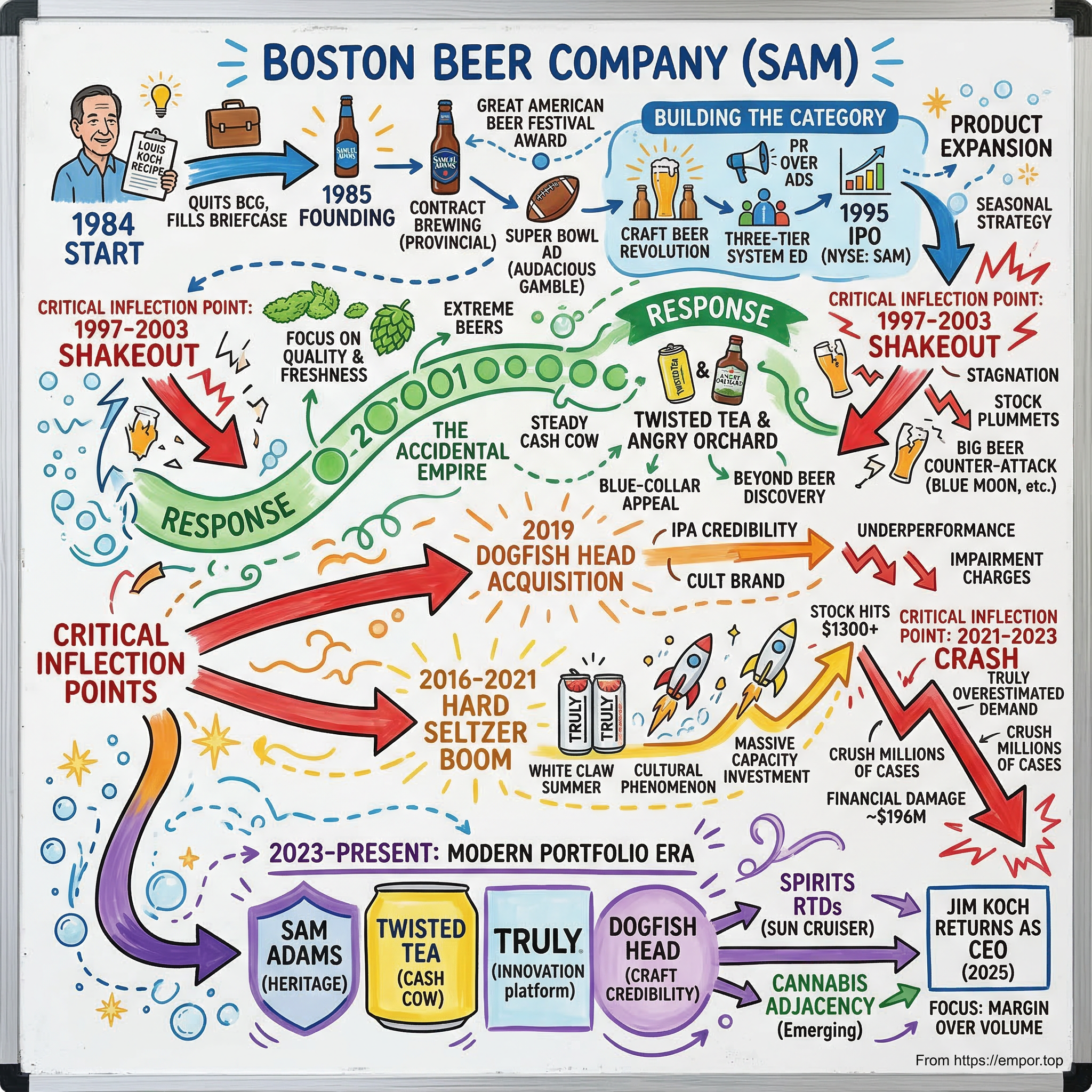
Boston Beer Company: The Craft Revolution That Changed American Beer
Introduction & Episode Roadmap
There is a particular kind of American business story that begins with a man staring at an old piece of paper and thinking, "I could make this work." In 1984, Jim Koch was that man, standing in a Cincinnati attic, holding a faded recipe for Louis Koch Lager — brewed by his great-great-grandfather in St. Louis over a century earlier. Koch was thirty-four years old, pulling down a six-figure salary at the Boston Consulting Group, the kind of place where Harvard MBAs go to feel important. He had two Harvard degrees of his own — a J.D. and an M.B.A. — and a perfectly calibrated path to partnership. And he was about to throw all of it away to sell beer.
Not just any beer. A beer that would help detonate a revolution in what Americans drink, how they think about what they drink, and how much they are willing to pay for it. The company Koch founded — the Boston Beer Company, traded on the New York Stock Exchange under the ticker SAM — would go on to generate over two billion dollars in annual revenue, launch the craft beer movement as we know it, survive two near-death experiences, accidentally build an empire in flavored malt beverages, ride the hard seltzer rocket to a thirteen-hundred-dollar stock price, then crash back to earth in one of the most spectacular miscalculations in modern consumer goods history.
Today, Boston Beer is a fascinating study in contradictions. Samuel Adams, the brand that started it all, is now a secondary player in the company's own portfolio — outsold three-to-one in chain retail by Twisted Tea, a product that debuted as an afterthought. The Dogfish Head acquisition that was supposed to restore craft beer credibility has required nearly a hundred million dollars in impairment charges. The Truly Hard Seltzer brand that sent the stock to the stratosphere nearly destroyed it on the way down. And Jim Koch, now seventy-six years old, has returned to the CEO chair for the first time in twenty-four years, trying to guide the company he built through a consumer landscape that looks nothing like the one he disrupted four decades ago.
This is the story of a man who quit the safe path to prove Americans wanted better beer, the company that proved him right, the moments it nearly fell apart, and the question that still hangs over everything: what does Boston Beer become next?
 Subscribe on LinkedIn
Pre-History: American Beer Before Craft & The Koch Family Legacy
To understand what Jim Koch accomplished, you have to understand what American beer looked like when he decided to upend it. And to understand that, you have to go back to the single most destructive event in the history of American brewing: Prohibition.
Before the Eighteenth Amendment took effect in 1920, the United States had more than 1,300 active breweries. Many were small, regional operations producing lagers and ales with distinctive local character — German-style pilsners in the Midwest, English-style ales in the Northeast, steam beers in San Francisco. Prohibition annihilated them. When repeal came in 1933, fewer than a hundred breweries reopened, and the landscape that emerged bore no resemblance to what had come before. The survivors were overwhelmingly large operations with the capital to wait out thirteen dry years, and they consolidated aggressively. By the 1970s, the top five brewers controlled over seventy-five percent of the American market. By the 1980s, it was effectively the Big Three: Anheuser-Busch, Miller, and Coors.
What these companies produced was, by design, inoffensive. Light lagers brewed with adjuncts like rice and corn — cheaper than all-barley malt, and engineered for mass appeal. Budweiser, Miller Lite, Coors Light. These were not bad beers in any technical sense. They were precisely what their makers intended: consistent, drinkable, cold, cheap, and marketed with the firepower of multi-billion-dollar advertising budgets.
But they had about as much character as a glass of water with a suggestion of grain. For a country that had once produced extraordinary brewing diversity, it was a kind of cultural amnesia. The irony was that American brewing had been founded by immigrants — Germans, Irish, Czechs, English — who brought rich brewing traditions with them. By the 1980s, all of that heritage had been flattened into a single product: the light American lager, served ice cold so you could not taste much of anything, and marketed on the basis of lifestyle imagery rather than flavor.
The only alternative for Americans who wanted something with more flavor was imported beer. Heineken and Beck's were growing rapidly through the 1970s and early 1980s, riding a premiumization wave among the Reagan-era professional class. Yuppies would pay more for a green bottle with a European label because it signaled sophistication. But these imports were often months old by the time they reached American shelves, skunked by light exposure and time, trading on image rather than freshness.
Meanwhile, two things happened in the late 1970s that planted tiny seeds. First, President Jimmy Carter signed legislation in 1978 legalizing homebrewing at the federal level — a quirk of post-Prohibition law had technically kept it illegal. Suddenly, Americans could experiment with brewing in their kitchens and garages without risking prosecution. Second, a handful of pioneers began opening small breweries: Fritz Maytag had already rescued Anchor Brewing in San Francisco in 1965, and Ken Grossman founded Sierra Nevada in Chico, California, in 1980. These were artisanal operations producing beers that tasted dramatically different from anything on supermarket shelves.
Into this landscape walked Jim Koch, carrying the unlikely advantage of six generations of family brewing heritage. His great-great-grandfather Louis Koch had brewed professionally in St. Louis in the mid-nineteenth century, part of the wave of German immigrant brewers who built America's original brewing culture. The tradition passed from father to son through five generations — an unbroken chain of men who understood malt, hops, yeast, and water at a molecular level. Jim's father, Charles Koch, had been a brewmaster — the fifth generation in the line — but had watched the industry consolidate around him and eventually abandoned brewing for a more stable career. Charles actively discouraged his son from following the family trade, convinced that small brewers had no future against the giants. It was a rational assessment, given what had happened to the industry. But it was also wrong.
Jim Koch took the conventional path instead. Born on May 27, 1949, he grew up steeped in brewing culture but steered toward academia. Harvard for undergrad, graduating in 1971, then a detour that said more about his character than any resume line: he spent several years as an Outward Bound instructor, teaching mountaineering across the American West. This was not a gap year. This was a young man testing himself against physical hardship and uncertainty — precisely the qualities that would serve him later. Then came the dual J.D./M.B.A. program at Harvard, completed in 1978, and finally the consulting track at BCG. He was good at it. Smart, analytical, disciplined. Six years in, on his way to making partner. And deeply, quietly dissatisfied.
Koch would later say that the fear of spending the rest of his life as a management consultant was more terrifying than the risk of failure. At BCG, he had learned something that would prove invaluable: "Smart people are a dime a dozen." What mattered was judgment, conviction, and the willingness to act on both.
He was watching his consulting peers climb ladders that led to comfortable lives and comfortable retirements, and something inside him rebelled.
The recipe in the attic was the catalyst, but the restlessness was the fuel. Koch understood, in a way his father's generation could not, that the calcification of American beer was not a permanent state of affairs. Consumers were already signaling a willingness to pay more for quality in wine and food. Imports were growing. The cultural moment was there. What was missing was an American brewer willing to make the product and tell the story.
The Founding Bet: Quitting BCG to Sell Beer Door-to-Door (1984-1988)
The decision to leave BCG was not, by Koch's own account, a lightning bolt of inspiration. It was more of a slow-building dread. He would later describe the moment he realized that if he did not act, he would end up as a management consultant for the rest of his life — and that the prospect terrified him more than the risk of failure. So in 1984, at thirty-four years old, with a mortgage and obligations, he quit.
His father's reaction was memorably unenthusiastic. Charles Koch told his son he would probably never be very big, but he might stay off the welfare line. Every bank in Boston turned down his loan application. Koch ultimately scraped together roughly $240,000 — a hundred thousand from his own savings, the rest from family and friends. It was enough to brew beer, but nowhere near enough to build a brewery.
This constraint produced one of Koch's most consequential early decisions: the contract brewing model. Rather than investing millions in physical plant and equipment, he hired the Pittsburgh Brewing Company to produce his recipe at its existing facility. This was heretical in the emerging craft world, where the romance of the small brewery — the gleaming copper kettles, the founder in rubber boots on the brewhouse floor — was part of the product.
Critics would later use contract brewing as a cudgel against Boston Beer's craft credentials. "You don't even have your own brewery" was the attack line that would follow Koch for years. But Koch understood something his critics did not: the recipe and the ingredients mattered more than the address where the kettle sat. He controlled the formulation, the raw materials, and the quality standards. The physical act of boiling and fermenting could happen anywhere. Contract brewing allowed him to launch with minimal capital, maintain consistent quality from day one, and focus his scarce resources on the two things that would actually determine whether the company survived — the product and the selling.
The product was Samuel Adams Boston Lager, brewed from Louis Koch's recipe with modifications Koch had tested obsessively in his kitchen. The first test batch was reportedly so vigorous in fermentation that it stripped the wallpaper off the walls.
The name was a stroke of branding genius: Samuel Adams, the patriot and revolutionary, a founding father who also happened to have been the son of a maltster. The name carried associations of American independence, Boston heritage, and rebellion against the established order — perfect positioning for a beer that was explicitly challenging the Big Three. Koch priced it at roughly twenty dollars per case, a substantial premium over the twelve-dollar Budweiser. The message was clear: this was not commodity beer.
The selling, in those early months, was pure hustle. Koch loaded bottles of Samuel Adams into a briefcase and walked into bars through the back door, asking for five minutes with whoever ordered the beer. He was treated, in his own words, "like crap" — repeatedly rejected, ignored, patronized. The bar business in Boston was controlled by entrenched relationships with the major distributors, and a guy with a briefcase and a story about his great-great-grandfather was not what bartenders wanted to deal with on a Tuesday afternoon.
But Koch had a weapon his competitors did not: the beer was genuinely better. When he could get someone to taste it, the product did the selling. He would pour it alongside whatever import or domestic the bar carried and let the comparison speak. Account by account, tap handle by tap handle, he built distribution across Boston. Samuel Adams Boston Lager debuted publicly on April 15, 1985 — Patriot's Day, naturally — at roughly thirty-five restaurants and bars in Boston's Back Bay and Downtown.
Two months later, something remarkable happened. At the Great American Beer Festival in Denver, Samuel Adams Boston Lager was voted Best Beer in America, beating out a hundred competitors. For a company that was essentially one man with a briefcase and a contract brewer, it was validation on a national stage. Koch leveraged the award relentlessly, and the press attention it generated was worth more than any advertising campaign he could have afforded. First-year sales reached approximately $200,000, and Koch reinvested every penny.
By 1986, he was flying to Washington, D.C., twice a week to open accounts there, replicating the bar-to-bar model that had worked in Boston. The man lived on planes and in the back rooms of restaurants, evangelizing his product with a persistence that bordered on obsessive. By 1988, Boston Beer had grown to 36,000 barrels with distribution on both coasts — still tiny by industry standards (Budweiser alone sold roughly eighty million barrels that year), but large enough to prove the concept. The company remained lean, private, and intensely focused on the core product.
Koch's philosophy was simple and unwavering: taste over marketing, education over persuasion. He was not just selling beer; he was teaching Americans that beer could be something worth caring about. Every conversation with a bartender was a tutoring session in malt profiles and hop varieties. Every new account was a convert to the church of better beer. It was exhausting, inefficient, and entirely unscalable — and it worked. Because in a market dominated by television advertising and distribution deals, the one thing the Big Three could not replicate was a founder who genuinely loved his product walking through the door and pouring you a glass.
Building the Category: The Craft Beer Revolution (1988-2000)
The Great American Beer Festival award was the spark, but what followed was a masterclass in category creation. Koch understood intuitively that he was not competing against Budweiser — he was creating an entirely new market. The competitive set was not domestic lager but imported premium beer, and his pitch was that Americans did not need to look across the Atlantic for quality.
His strategic use of public relations over advertising was brilliant and necessary. Boston Beer could not afford Super Bowl commercials — or at least, it could not afford what Budweiser was spending. What it could afford was Jim Koch, who turned out to be one of the most effective spokespeople in the history of consumer goods. He was articulate, passionate, credentialed (the Harvard degrees did not hurt), and willing to go anywhere, talk to anyone, and pour beer for whoever would listen. He became craft beer's public face, a one-man media operation who could explain hops, yeast, malt, and water with the enthusiasm of an evangelist and the precision of a consultant. Koch was not just selling beer; he was selling a narrative about American identity — that the country that had put a man on the moon ought to be capable of making a world-class beer. It was a story that newspaper editors, television producers, and magazine writers loved to tell. Free media coverage became Boston Beer's primary marketing channel, and Koch became its inexhaustible engine.
The 1988 Super Bowl ad was an audacious gamble that perfectly encapsulated Koch's strategic instincts. He managed to produce and air a television commercial during the biggest advertising event of the year — the first time a craft brewer had appeared on that stage. It was not a polished Budweiser Clydesdales production; it was scrappy and direct, featuring Koch himself talking about his beer with the kind of earnest conviction that felt alien amid the slick corporate spots. The sheer improbability of it — a microbrewery on the Super Bowl, a David announcing himself in Goliath's arena — generated enormous free media coverage. Newspaper articles, magazine profiles, and television segments followed. It was the kind of asymmetric bet that defined Koch's early career: spend a modest amount to generate attention worth multiples of the cost. The ad did not make Boston Beer a household name overnight, but it established the brand's audacity. This was a company that punched above its weight, and that positioning would persist for decades.
Building distribution through America's three-tier system — brewer to distributor to retailer — was the unglamorous but critical work that determined whether Boston Beer would survive or remain a regional curiosity.
For readers unfamiliar with the American alcohol industry, the three-tier system deserves explanation because it shapes everything about how the business works. After Prohibition ended, the federal government mandated that alcohol production, distribution, and retail be handled by separate entities — the goal was to prevent the "tied house" system where brewers owned the bars and could control what consumers drank. In practice, this created a mandatory middleman: distributors. No brewer, no matter how good its product, could sell directly to a bar or liquor store. It had to go through a distributor.
The major distributors had deep, profitable relationships with Anheuser-Busch and Miller — relationships built over decades, representing the vast majority of their revenue. Getting a craft brand into a distributor's portfolio, and then getting that distributor to actually push it to retailers, required relentless effort and persuasion. Koch invested heavily in educating distributors — explaining what craft beer was, why consumers would pay more, how to sell it. It was not glamorous work, but it was the work that built the business.
Boston Beer went public on November 15, 1995, listing on the New York Stock Exchange at fifteen dollars per share. It was a landmark moment for the craft beer industry — the first microbrewer on the Big Board. In a characteristic populist flourish, Koch allowed consumers over twenty-one to call in and purchase thirty-three shares each at $495 total. The IPO gave the company access to public market capital and a level of credibility that separated it from the hundreds of small breweries now sprouting across the country.
And there were hundreds. By the mid-1990s, the craft beer movement Koch had helped ignite was in full bloom. Sierra Nevada, Pete's Wicked Ale, Redhook, Widmer Brothers, Brooklyn Brewery — new brands were launching constantly, riding consumer enthusiasm for anything that was not a mass-market lager.
Boston Beer responded with product expansion beyond the flagship Boston Lager. The seasonal strategy was particularly clever: Octoberfest in the fall, Winter Lager in December, Summer Ale when the weather warmed. Each seasonal release gave consumers a reason to re-engage with the brand four times a year, gave retailers fresh products to promote, and gave distributors something new to talk about with their accounts. It was a rhythm that kept Samuel Adams relevant on shelves that were increasingly crowded with competitors.
The contract brewing model continued to draw criticism. Purists argued that a "real" craft brewer owned its own equipment and brewed on-site. Koch countered that what mattered was the recipe, the ingredients, and the quality control — not the ownership structure of the kettle. He was right on the merits, but the perception issue would linger.
Boston Beer eventually invested in its own brewing facilities, including a brewery in Boston and one in Cincinnati, creating a hybrid model that blended owned production with contract capacity. This gave the company flexibility that would prove valuable as demand fluctuated — the ability to scale up through contract partners during booms and scale back during busts without carrying the fixed costs of unused capacity.
Through all of this, Koch kept Boston Beer independent. In an era when many craft pioneers sold to Big Beer or to each other, he maintained control. The company's dual-class share structure, with Koch holding all Class B voting shares, made a hostile takeover mathematically impossible. This was not an accident — Koch had designed the governance structure at the IPO specifically to prevent the kind of acquisition that would later consume Goose Island, Ballast Point, Lagunitas, and dozens of other craft brands. Independence was not just a business decision; it was a philosophical commitment rooted in Koch's understanding of what made craft beer valuable. He believed that the moment a craft brewer sold to Anheuser-Busch or Miller, it lost the authenticity that justified its premium price. The product might stay the same, but the story changed — and in premium consumer goods, the story is half the product. That conviction would be tested repeatedly in the years ahead, as the offers grew larger and the competitive pressure intensified.
The First Inflection Point: The Craft Beer Shakeout (1997-2003)
The party ended faster than anyone expected. By the late 1990s, the craft beer market that had grown so explosively began to implode. The causes were predictable in hindsight: too many brands had rushed into the category, many producing mediocre beer with compelling labels. Quality was inconsistent across the industry — small brewers lacked the technical expertise and quality control systems to maintain consistency at scale. Consumers who had enthusiastically tried craft beer found that many of the products did not live up to the promise. Fatigue set in.
Big Beer also struck back. Anheuser-Busch and Coors launched what the industry would later call "crafty" beers — brands like Blue Moon (brewed by Coors) and Shock Top (brewed by Anheuser-Busch) that mimicked craft aesthetics and flavors while benefiting from industrial-scale production and distribution. These products occupied the same shelf space and tap handles that craft brewers desperately needed, and they carried the pricing power and marketing muscle of billion-dollar companies.
The carnage was severe. Pete's Wicked Ale, once one of the most visible craft brands in America, collapsed entirely — a brand that had been valued at hundreds of millions simply ceased to exist as a relevant business. Hundreds of small breweries closed their doors. The survivors — Sierra Nevada, Boston Beer, a handful of others — watched their peers disappear and wondered if they were next.
Boston Beer's stock, which had debuted at fifteen dollars in 1995, plummeted to $6.75 by August 1998 — a loss of more than half its IPO value. The business model was under existential questioning. If the craft beer wave was receding, was there a future for a mid-size brewer that was too small to compete with Big Beer on price and too large to survive as a local taproom?
Koch's response was characteristically disciplined — and informed by the BCG training he never fully left behind. Rather than diversifying wildly or chasing trends, he doubled down on quality and focus. The company cut SKU proliferation — eliminating products that diluted attention and resources from the core brands — and invested in supply chain improvements, particularly around freshness. Koch launched an aggressive freshness campaign, emphasizing that Samuel Adams was brewed in America with fresh ingredients, unlike imports that sat on ships and in warehouses for months before reaching American shelves. It was a direct attack on the European imports that had been craft beer's original competitive set, and it resonated with consumers who were discovering that their expensive Heineken tasted suspiciously like cardboard. Koch went so far as to buy back old bottles of Samuel Adams from retailers to ensure that no stale product sat on shelves — a costly but powerful signal of quality commitment.
The company also began experimenting with "extreme beers" in the mid-1990s — high-alcohol, boldly flavored brews that pushed the boundaries of what beer could be. These were niche products, but they served a dual purpose: they kept the innovation culture alive during a defensive period, and they generated disproportionate media attention. A twenty-eight-percent-ABV beer was a story that wrote itself, even if the audience for actually drinking it was small.
The shakeout taught Koch a lesson about the durability of brand positioning. Samuel Adams had been built on a foundation of quality, heritage, and American craftsmanship — not on trendiness or novelty. When the fad-chasers moved on, the consumers who genuinely cared about better beer stayed loyal. Boston Beer emerged from the shakeout as one of the last standing independent craft brewers with national distribution, a position that would prove enormously valuable as the market eventually recovered. The company had the public market capital to absorb the downturn, the brand equity to retain core customers, and the operational discipline to cut costs without cutting quality. Most of its competitors had none of these advantages.
But the scars ran deep. The stock would not recover to its IPO price for years. Koch became markedly more conservative about capacity investment and brand extension — a caution that would serve the company well in some moments and badly in others. The craft beer shakeout of the late 1990s was Boston Beer's first brush with mortality, and the memory of it would shape every major strategic decision for the next two decades.
The Big Beer Counter-Attack & Boston Beer's Response (2003-2012)
As the craft beer market slowly recovered through the 2000s, a new dynamic emerged that would reshape the competitive landscape: Big Beer decided that if it could not beat craft, it would buy it. The premiumization trend that had lifted craft beer in the first place was accelerating. Consumers, particularly millennials entering legal drinking age, were gravitating toward brands with stories, authenticity, and distinctive flavors. Domestic light lager consumption was plateauing. The growth was in craft, imports, and premium segments.
AB InBev moved first and most aggressively. The Goose Island acquisition in 2011 was the shot heard round the craft beer world — one of Chicago's most beloved independent breweries, sold to the largest beer company on the planet for what was reported to be around $38.8 million. It was followed by Blue Point, 10 Barrel, Elysian, Wicked Weed, and others, a systematic campaign to acquire craft credibility through M&A. The playbook was elegant in its cynicism: buy a beloved craft brand, keep the branding and the story, but produce it at scale using Big Beer's manufacturing and distribution infrastructure. MillerCoors pursued a similar strategy, though less aggressively.
The implications for Boston Beer were profound. Every craft brand that sold to Big Beer was simultaneously a competitor removed from the independent landscape and a competitor reinforced with vastly greater resources. Goose Island IPA, backed by AB InBev's distribution, could appear on taps and shelves that independent craft brewers could only dream of accessing.
This created an identity crisis for the entire craft beer category. What did "craft" even mean when Goose Island IPA was brewed in AB InBev's Baldwinsville, New York, facility alongside Budweiser?
The Brewers Association, the industry trade group, began tightening its definition of "independent craft brewer," and Boston Beer became a vocal advocate for the distinction. The company worked to position itself as the authentic alternative — genuinely independent, founder-led, with no corporate overlord diluting the mission.
But the authenticity wars were complicated. Boston Beer's contract brewing history made it an imperfect champion of craft purity. The company was publicly traded, which struck some craft enthusiasts as inherently corporate. And the products, while well-made, were increasingly seen as safe and predictable in a market that was moving toward bold, experimental, boundary-pushing beers. Sam Adams Boston Lager was your father's craft beer — reliable, but not exciting.
Koch and his team responded with innovation efforts: Sam Adams Light for the health-conscious consumer, seasonal experiments that pushed beyond the established Octoberfest and Summer Ale lineup, and the Latitude 48 IPA line that attempted to establish craft IPA credentials. These were competent products — well-brewed, thoughtfully formulated, backed by Koch's genuine brewing expertise. But they lacked the cultural resonance of what was emerging from the West Coast and the growing number of local taproom breweries. In the age of Instagram and Untappd, where consumers shared photos of exotic beer labels and competed to discover the most obscure brewery, Sam Adams felt like showing up to a street art festival with a watercolor landscape. Technically proficient, utterly beside the point. Boston Beer was playing defense when it needed to be on offense.
The company also notably did not pursue aggressive M&A during this period. While AB InBev was snapping up craft brands at rich valuations, Koch maintained his focus on organic growth and internal innovation. This was consistent with his independence-first philosophy, but it meant Boston Beer missed opportunities to acquire brands that could have strengthened its portfolio and cultural relevance. Whether this was strategic wisdom or strategic error remains debated. Koch would not make his first major acquisition until 2019, by which point the craft landscape had shifted dramatically beneath his feet.
Distribution battles intensified as Big Beer leveraged its relationships with distributors to crowd out independents. "Pay-to-play" practices — where brewers offered distributors financial incentives for favorable placement — were technically illegal in many markets but widespread in practice. Boston Beer fought these battles constantly, investing in its own sales force and distributor education programs to maintain shelf space and tap handles. The company's national scale was its key advantage; where a small regional brewer might have one distributor relationship in a market, Boston Beer had the volume and the portfolio to demand attention.
Independence, Koch argued, was itself a competitive moat. Big Beer's acquisitions of craft brands often triggered consumer backlash — the "sellout" narrative that emerged every time a beloved local brewery was absorbed into a multinational conglomerate. Boston Beer could credibly claim to be what it had always been: an American-owned, founder-led company making beer because it loved making beer, not because a spreadsheet in Leuven or Milwaukee said craft was a growth segment. That claim had real value in a market where authenticity was increasingly the product.
Critical Inflection Point: The IPA Explosion Boston Beer Missed (2010-2015)
Sometime around 2010, a seismic shift occurred in American craft beer that would nearly render Samuel Adams irrelevant. The India Pale Ale — hoppy, bitter, aromatic, aggressively flavored — went from niche subcategory to the dominant style in American craft. IPA did not just grow; it devoured. By 2014, IPA represented more than a quarter of all craft beer sold in the United States, and the percentage was climbing. For a segment that had dozens of recognized styles, having one style capture that much share was unprecedented.
The IPA revolution was led by West Coast brewers — Stone Brewing, Lagunitas, Ballast Point, Green Flash — who pushed hop intensity to levels that would have been unimaginable a decade earlier. Double IPAs, triple IPAs, hop bombs with names designed to signal extremity.
Then the "haze craze" emerged from New England, with breweries like Tree House, Trillium, and The Alchemist producing juicy, unfiltered IPAs that generated multi-hour lines and secondary-market resale prices for individual cans. IPA was not just a beer style; it was a cultural movement, a social media phenomenon, a form of identity.
Boston Beer was caught flat-footed. Samuel Adams Boston Lager was a Vienna-style lager — smooth, balanced, malty. It was the antithesis of what the IPA-obsessed consumer wanted. The company had IPA offerings — Sam Adams Rebel IPA launched in 2014 — but they were perceived as too little, too late, and too corporate. The "rebel" branding felt painfully ironic coming from a thirty-year-old public company when actual rebels were operating out of converted warehouses and selling cans from parking lots.
The cultural shift was brutal, and it struck at the heart of what Samuel Adams represented. Sam Adams had built its identity as the craft beer — the brand that educated Americans about what good beer could be. For two decades, ordering a Sam Adams had been a statement: "I care about quality. I'm willing to pay more for something better." But "good beer" had been redefined by a generation that associated craft with locality, extremity, and novelty. The language had changed. Where Koch spoke of "balance" and "drinkability," the new craft consumer wanted "juicy," "hazy," "dank," and "hop-forward." Sam Adams was national in an era that celebrated local. It was moderate in an era that celebrated intensity. It was familiar in an era that celebrated discovery. The brand that had once been the insurgent was now the establishment, and no amount of seasonal releases could disguise it. Millennial craft drinkers viewed Sam Adams the way Koch had once viewed Budweiser — as something their parents drank. There is perhaps no crueler fate for a brand built on rebellion.
Stock performance reflected the malaise. After recovering from the late-1990s shakeout, Boston Beer shares stagnated through the early 2010s as investors grew frustrated with flat growth and margin pressure. The company was generating steady cash flow — Twisted Tea and Angry Orchard were quietly performing well — but lacked a compelling headline growth narrative. Internal debates raged about the path forward: Should Boston Beer acquire younger, edgier brands the way AB InBev was doing? Build entirely new product lines? Double down on Sam Adams innovation with more aggressive IPAs and experimental styles? The company tried elements of all three but committed fully to none, creating an impression of strategic drift that frustrated both employees and investors.
The simultaneous rise of local brewery taprooms created an additional structural challenge that went beyond simple competition. There were roughly two thousand craft breweries in the United States in 2010. By 2015, there were more than four thousand — and growing by roughly one new brewery opening every day. Most of these were small operations — brewpubs and taprooms serving their local communities, often in converted industrial spaces with exposed brick walls, communal picnic tables, and a curated selection of eight to twelve beers on tap.
These taprooms did not compete with Boston Beer in the traditional sense. They did not battle for supermarket shelf space or distributor attention. Instead, they competed for something more fundamental: the drinking occasion itself. When a consumer spent Friday evening at the local taproom — sampling flights, chatting with the brewer, soaking in the atmosphere — that was an evening not spent buying a six-pack of Sam Adams at the liquor store. Every new taproom that opened was one more place where a consumer chose a hyper-local pint over a nationally distributed brand. It was death by a thousand cuts, and there was no strategic response available. Boston Beer could not open four thousand taprooms of its own.
Koch later acknowledged that the company had been slow to recognize the magnitude of the IPA shift. The loss of cultural relevance was perhaps more damaging than the loss of market share. Samuel Adams still sold well in absolute terms, but it was no longer the aspirational choice for beer enthusiasts.
It had become what Koch had always feared: a legacy brand. The question was whether the company could reinvent itself — and the answer, it turned out, was already sitting quietly in its portfolio.
The Accidental Empire: Twisted Tea & The "FMB" Discovery (2001-2018)
While Samuel Adams was struggling to stay relevant in the IPA wars, something unexpected was happening in the less glamorous corners of Boston Beer's product line. In 2000, the company had launched a flavored malt beverage called BoDeans Twisted Tea — an alcoholic iced tea positioned for the "malternatives" wave alongside Mike's Hard Lemonade and Smirnoff Ice. Within a year, the Milwaukee rock band The BoDeans had sued over the name, and the product relaunched simply as Twisted Tea. No one at the company thought much of it.
That turned out to be one of the great underestimations in the history of consumer packaged goods.
Twisted Tea found its audience not among the craft beer cognoscenti, not among the urban millennials chasing the latest hazy IPA, but in the places that craft beer marketing never reached. Rural America. Blue-collar drinkers. Convenience stores in small towns. NASCAR tailgates. Fishing trips. The demographic that had zero interest in debating hop varietals or rating beers on an app but very much wanted something cold, sweet, and alcoholic that was not beer and not wine. Twisted Tea was refreshing, simple, and unpretentious. It cost less than a six-pack of craft beer and carried no cultural baggage about what it meant to drink it. There was no "right way" to drink Twisted Tea, no snobbery, no gatekeeping. You cracked it open when it was hot outside and you wanted something that tasted good. That was the entire value proposition, and it resonated with a consumer base that Boston Beer had never consciously targeted.
The growth was slow and steady — the opposite of craft beer's boom-bust cycle. Year after year, Twisted Tea added distribution, added consumers, added volume. It was not sexy. It did not generate breathless press coverage or win awards at beer festivals. Industry analysts largely ignored it, fixated on the craft beer narrative that defined Boston Beer's public identity. What Twisted Tea did was make money. Quietly, relentlessly, compoundingly.
The business model was elegant in its simplicity. Flavored malt beverages carried higher margins than traditional beer, required less specialized brewing infrastructure, and attracted a more stable consumer base. Craft beer drinkers were famously fickle — always chasing the next limited release, the next brewery collaboration, the next hype train. Twisted Tea drinkers were loyal in a way that craft consumers never were. They found a product they liked and they stuck with it, buying it week after week, month after month, year after year. The repeat purchase rate was the kind of metric that consumer packaged goods companies dream about.
By 2017, Twisted Tea held roughly ten percent of the non-seltzer packaged FMB market. By 2021, that share had more than doubled to twenty-three percent. And here is the number that tells the whole story: by 2022, Twisted Tea was moving three times the volume of Samuel Adams in chain retail. The brand that launched as an experiment was outselling the brand that launched the company. By 2024, Twisted Tea represented approximately 3.15 million barrels — fifty-seven percent of Boston Beer's total volume. It was not a side project. It was the company.
In parallel, Boston Beer launched Angry Orchard hard cider nationally in April 2012, riding a cider renaissance in the American market. The timing was impeccable. Within fourteen months, Angry Orchard had overtaken Woodchuck as the best-selling cider brand in the United States. By 2014, it held roughly fifty percent of the U.S. hard cider market, a share that would peak near sixty percent before settling back as competition emerged.
These successes — Twisted Tea and Angry Orchard — reframed what Boston Beer actually was. The company had been founded as a craft beer company and had spent decades defining itself through Samuel Adams. But the portfolio was telling a different story.
Boston Beer was becoming a "beyond beer" company — a platform for flavored malt beverages, ciders, and alcoholic alternatives that happened to also make a famous lager. The innovation machine that Koch had built — the small-batch experimentation, the brewing science expertise, the speed to market — turned out to be more valuable for creating new categories than for winning within the increasingly crowded craft beer space.
Twisted Tea's steady cash generation also gave Boston Beer something invaluable: a financial cushion to take bigger risks. When the hard seltzer opportunity emerged, the company had the resources to invest aggressively. Whether that investment turned out to be brilliant or catastrophic depends on which year you are looking at.
Critical Inflection Point: The Dogfish Head Acquisition (2019)
By the late 2010s, Koch recognized that Boston Beer needed to address its craft beer credibility problem. Samuel Adams was a strong legacy brand, but it lacked the cachet of the new generation of craft. The internal innovation pipeline had produced competent beers but no cultural lightning strikes. What the company needed was not just a product — it needed a story, a personality, a jolt of creative energy that could not be manufactured in a boardroom. The solution came in the form of a merger with one of craft beer's most revered names.
Sam Calagione had founded Dogfish Head in Rehoboth Beach, Delaware, in 1995 — the same year Boston Beer went public. Where Koch was the polished Harvard consultant who happened to make beer, Calagione was the wild-eyed experimentalist who brewed beer the way a jazz musician plays — improvisationally, irreverently, and with an infectious joy that attracted a cult following. He was the guy who brewed a beer with lunar dust. Who recreated a nine-thousand-year-old Chinese rice wine from archaeological residue. Who built a brewery around the idea that "off-centered ales for off-centered people" was not just a tagline but a philosophy. His 60 Minute IPA and 90 Minute IPA — named for the duration of continuous hop additions during the boil — were among the most acclaimed IPAs in America, the exact category where Sam Adams had faltered.
On May 9, 2019, Boston Beer and Dogfish Head announced a deal valued at approximately $300 million. Dogfish Head was the thirteenth-largest craft brewer in the United States, on pace to sell 300,000 barrels with net sales around $120 million. But its value transcended volume. If Jim Koch was craft beer's founding father, Calagione was its mad scientist — and Boston Beer was buying both the science and the madness.
The deal was structured with cash — approximately $173 million to existing Dogfish Head shareholders — and stock. The Calagione family received roughly 406,000 shares of Boston Beer, making them the largest non-institutional shareholders behind Koch. Sam Calagione joined the Boston Beer board of directors. The merger was presented as a union of complementary brands, cultures, and capabilities, creating what the companies called "the most dynamic American-owned platform for craft beer and beyond."
The strategic logic was sound on paper: Dogfish Head brought IPA credibility, innovation culture, younger consumer appeal, and a passionate following that Samuel Adams could no longer command. The portfolio overlap was minimal — Dogfish Head's experimental, high-ABV offerings occupied a different shelf than Sam Adams Boston Lager. The cultural fit seemed strong: both companies were founder-led, independence-oriented, and committed to quality over scale.
The reality has been disappointing. Dogfish Head's brand performance has consistently underperformed the projections that justified the acquisition price. Boston Beer has recorded cumulative impairment charges exceeding eighty-six million dollars against the Dogfish Head brand — more than a quarter of the total deal value. A $27.1 million charge in 2022, $16.4 million in 2023, and $42.6 million in 2024 tell the story of a brand that has not translated its cult status into mainstream commercial success under Boston Beer's ownership. By late 2024, the remaining intangible asset had been written down to $14.4 million and was being amortized over ten years.
The Dogfish Head deal revealed something important about the limits of M&A in consumer brands. Craft beer's magic often resides in intangibles — the founder's personal charisma, the local taproom experience, the sense of discovery that comes with finding a brewery before it gets big. These are precisely the attributes that are hardest to preserve when a brand gets absorbed into a larger portfolio. Calagione remained engaged, but the structural forces of being part of a two-billion-dollar public company inevitably changed the dynamic. The beers were still excellent. The romance was harder to bottle.
The acquisition also came at a peculiar moment. It closed just months before the hard seltzer category exploded. In retrospect, the $300 million deployed on Dogfish Head might have been better invested in Truly's production capacity or in acquiring a spirits brand that could have accelerated the RTD cocktail pivot. But hindsight is always twenty-twenty, and in May 2019, hard seltzer still looked like it might be a fad. What no one at Boston Beer could have predicted was that the next two years would be the wildest ride in the company's history.
Critical Inflection Point: The Hard Seltzer Boom & Truly's Rise (2016-2021)
The hard seltzer story is one of the most remarkable category creation events in modern consumer history, and Boston Beer was in it from nearly the beginning — which makes what happened next all the more painful.
White Claw, produced by Mark Anthony Brands (the same privately held company behind Mike's Hard Lemonade), launched in 2016. Boston Beer's Truly Hard Seltzer debuted the same year, initially in glass bottles with flavors like Colima Lime and Grapefruit & Pomelo. Neither product immediately set the world on fire. Hard seltzer was a curiosity — sparkling water with alcohol, low calorie, low sugar, low carb. It did not fit neatly into existing beverage categories. Was it beer? Not really. A cocktail? Not exactly. A cooler? Too sophisticated for that label.
Then, in the summer of 2019, something broke loose. "White Claw Summer" became a cultural phenomenon that no one had planned and no one could control. Memes proliferated across Instagram and Twitter. The phrase "Ain't no laws when you're drinking Claws" became a cultural touchstone. White Claw cases were selling out at liquor stores and being rationed at distributors. Hard seltzer went from niche to mainstream seemingly overnight, driven not by traditional advertising but by social media virality and word of mouth.
The appeal was intuitive in hindsight: a generation of health-conscious consumers — particularly women and younger drinkers — who still wanted to drink alcohol but felt guilty about the calories in beer and the sugar in cocktails. Hard seltzer offered something powerful: permission to drink without the perceived baggage. A can of Truly or White Claw had roughly a hundred calories, one or two grams of sugar, and was gluten-free. It came in fruit flavors that made it accessible to people who did not like the taste of beer. And crucially, it was marketed in a way that felt casual and modern — something you brought to the beach or the pool party, not something you debated over at a bar. The packaging was clean and gender-neutral, a deliberate departure from the fratty aesthetic of beer or the fussy presentation of wine. Hard seltzer was the drink for people who did not want to think too hard about what they were drinking.
Boston Beer pivoted hard. The company had been investing in Truly at a moderate pace, but the 2019 explosion forced a dramatic acceleration. Everything changed, seemingly overnight. Production capacity was expanded at every available facility. The packaging was completely redesigned — the switch from glass bottles to slim cans was not cosmetic but essential, because cans were what the consumer wanted. They were portable, recyclable, Instagram-friendly, and they fit in a cooler without breaking. New flavors launched in rapid succession — Truly Lemonade, Truly Iced Tea, Truly Punch — each one trying to capture a different drinking occasion. The innovation pipeline ran at full speed, with the brewing team developing and testing new formulations at a pace that would have been unimaginable in the craft beer world.
By 2019, Truly and White Claw together controlled roughly eighty-five percent of the hard seltzer market. White Claw held the dominant position at approximately fifty-eight percent, with Truly at around twenty-six percent. Both brands were growing fast enough that the overall category was expanding faster than either could supply. Distributors were allocating product. Retailers were dedicating entire cold box sections to seltzer. It was a gold rush.
The COVID-19 pandemic in 2020 and 2021 poured gasoline on the fire. Locked-down consumers bought hard seltzer in enormous quantities — it was portable, shareable, and perfectly suited for the small outdoor gatherings that became the social norm. Boston Beer's stock, which had been trading in the three-hundred-dollar range before the seltzer boom, began a parabolic ascent. It crossed five hundred in mid-2020, eight hundred by early 2021, and hit an all-time closing high of $1,306.45 on April 20, 2021. The "Boston Beer is back" narrative took hold on Wall Street. After years of stagnation and the IPA miss, the company had found its next growth engine.
Koch made a fateful decision. Convinced that hard seltzer represented a permanent category shift in American drinking — not a fad, but a fundamental restructuring of the beverage market — he invested aggressively in production capacity. New can lines, expanded brewing capacity, long-term supply contracts. The logic was that supply constraints had been Truly's biggest problem; if the company could meet demand while competitors struggled, it could close the gap with White Claw and potentially take the category lead.
The financial results looked spectacular. Revenue surged past two billion dollars. Truly briefly became Boston Beer's largest brand by volume, eclipsing even Twisted Tea. Analysts published price targets above $1,500. The market capitalization exceeded fifteen billion dollars — a figure that would have seemed hallucinatory to anyone following the company during the IPA malaise just five years earlier.
For Jim Koch, the seltzer boom was vindication of a different kind than craft beer had been. Craft beer had proven that Americans wanted better beer. Hard seltzer proved that Americans wanted better everything — lower calories, lighter flavors, more permissive drinking occasions. The underlying thesis was the same: the mass-market incumbents had failed to serve a real consumer need, and the company nimble enough to fill the gap would be rewarded. Koch, after forty years of building, looked like a genius for the second time. The question nobody was asking — but should have been — was what happens when everyone else sees the same opportunity.
Critical Inflection Point: The Hard Seltzer Crash (2021-2023)
The reversal, when it came, was shockingly fast. On July 22, 2021, Boston Beer reported second-quarter results that included a bombshell: the company had massively overestimated hard seltzer demand. CEO Dave Burwick stated bluntly that the company had "overestimated the growth of the hard seltzer category in the second quarter and the demand for Truly." The stock fell more than twenty percent in a single trading day.
What had happened was not complicated in retrospect, but it was devastating in practice. The hard seltzer category had attracted well over three hundred brands by its peak — every major beverage company and scores of startups had piled in, from Bud Light Seltzer to Topo Chico Hard Seltzer to Corona Hard Seltzer to dozens of regional entries. The market was saturated. Consumers who had enthusiastically tried hard seltzer during the novelty phase were cycling back to other beverages — beer, wine, spirits, cocktails. The category was not dying, but it was maturing far faster than Boston Beer's models had predicted.
The inventory disaster was brutal. Boston Beer had committed to enormous production volumes based on exponential growth projections. When demand fell short, the company was left with millions of cases of product approaching expiration. Koch went on CNBC and delivered a memorable line: "We're going to crush millions of cases of product before it goes stale." It was candid, it was painful, and it was expensive.
The financial damage in 2021 alone totaled approximately $196 million in direct and indirect costs — a staggering figure for a company with roughly two billion in annual revenue. The breakdown told a story of systematic overcommitment: $59.5 million in inventory destruction (literally pouring beer down the drain), $30.7 million in contract termination costs (breaking agreements with suppliers and co-packers who had been enlisted for the ramp-up), $38.8 million in unfavorable brewery absorption (facilities running below capacity), and tens of millions more in related expenses. In the third quarter, the company swung from a profit of $6.51 per share to a loss of $4.76 — the inventory charge alone was $102.4 million, one of the largest single-quarter write-downs in the history of the American beverage industry. The stock continued its descent from the $1,283 high in April 2021 to $522 by September, eventually falling into the low $300s by 2022 and continuing to erode from there. For investors who had bought near the top, the loss was catastrophic — more than eighty percent of their investment evaporated in less than two years.
The seltzer crash exposed several strategic errors, each instructive in its own way.
First, the company had over-invested in a single category's momentum, violating the diversification principle that Twisted Tea's success had quietly demonstrated. The portfolio approach that was supposed to be Boston Beer's strength had been abandoned in favor of a concentrated bet on seltzer growth.
Second, the growth models had extrapolated pandemic-era consumption patterns into the future, failing to account for the reversion to mean that occurs when consumers return to normal behavior. People drink differently during a pandemic than during normal life, and models built on lockdown data were inherently unreliable.
Third, and perhaps most importantly, the competitive dynamics of hard seltzer proved to be winner-take-most. White Claw's first-mover advantage and cultural positioning created a moat that Truly could not breach despite massive investment. White Claw's market share actually increased as the category contracted — from fifty-eight percent at peak to roughly sixty-four percent by 2024 and approaching seventy percent by 2025. Truly was losing share in a shrinking market, the worst possible combination.
Management credibility took a severe hit. Koch's reputation as a prudent operator — forged through the craft beer shakeout of the late 1990s — was undermined by the seltzer overcommitment. It was not just that the numbers were bad; it was that Koch and Burwick had projected confidence in the seltzer thesis at precisely the moment it was falling apart. The company faced an investor lawsuit related to its seltzer-slowdown disclosures, alleging that management had been too slow to acknowledge the deterioration. The "founder knows best" narrative that had sustained investor confidence for decades was suddenly in question.
This is worth dwelling on, because it illustrates a broader truth about founder-led companies. The same conviction that allows a founder to see opportunity where others see risk — the conviction that drove Koch to leave BCG, to price Sam Adams at a premium, to invest in Truly when seltzer was still a curiosity — is the same conviction that can become blind stubbornness when the market turns. Koch had been right so many times that being wrong on this scale seemed almost unthinkable. But the market does not care about track records.
The strategic response involved painful cost-cutting, a refocusing on profitable brands, and an innovation pipeline reset. Truly was repositioned: fewer SKUs, less chasing of trends, a push into higher-ABV variants like Truly Unruly (eight percent ABV) and adjacent categories like spirits-based ready-to-drink cocktails. The goal was to extract what value remained in the brand without continuing to throw resources at a market position that was structurally eroding.
The hard seltzer bust was Boston Beer's most expensive mistake — worse than the craft shakeout because it was self-inflicted rather than market-driven. Koch had prided himself on conservative capital allocation for thirty-five years, and then bet aggressively on exactly the wrong moment in a category cycle. The irony was acute: the man who had survived the 1990s shakeout by being cautious had been seduced by the same kind of exponential growth curve that had destroyed his less disciplined peers two decades earlier.
But the company's balance sheet held. There was no debt crisis, no liquidity emergency, no need for a dilutive capital raise. Twisted Tea's cash flows — steady, reliable, unglamorous — and the underlying profitability of the broader portfolio kept the lights on. Koch had built enough financial resilience over forty years that even a nearly $200 million mistake did not threaten the company's survival. It threatened its growth narrative, its stock price, and its management credibility. But not its existence. That distinction mattered enormously, because it meant Boston Beer had the time and resources to find its next act — if it could figure out what that act should be.
The Modern Portfolio Era: Beyond Beer (2023-Present)
The Boston Beer Company that emerged from the seltzer wreckage bore little resemblance to the craft beer pioneer Jim Koch had founded. By 2023, approximately eighty-five percent of the company's volume came from non-traditional beer categories — a remarkable transformation for a business that had defined itself through Samuel Adams for its first three decades.
The portfolio architecture now rests on four pillars, each serving a distinct strategic function. Samuel Adams remains the heritage brand — the company's soul, carrying cultural significance far beyond its revenue contribution. It is still recognizable and respected, the beer that Americans associate with craft brewing's origin story, but it is no longer the growth engine. Think of it as the company's museum piece: valuable for what it represents, less so for what it sells.
Twisted Tea is the cash cow, and it is difficult to overstate its importance. At fifty-seven percent of total volume and holding the number-one position in the entire flavored malt beverage category, Twisted Tea is Boston Beer in all but name. Its margins are strong, its consumer base is loyal, and its growth — while decelerating recently — was built over two decades of organic compounding rather than the boom-bust dynamics that characterize trendier categories. Twisted Tea subsidizes everything else the company does, from new product development to marketing experiments to the overhead of maintaining a national distribution network.
Truly occupies the innovation slot, albeit diminished from its boom-era ambitions. It competes in the shrinking but still sizable hard seltzer segment while also serving as the platform for RTD cocktail extensions. The brand's identity has become muddled — is it a seltzer? A cocktail? An umbrella for whatever the next trend might be? — and that lack of clarity is reflected in its market performance. And Dogfish Head carries the craft credibility flag, despite the financial impairments, providing Boston Beer with a foothold in the premium experimental beer space that Samuel Adams can no longer claim.
The newer additions to the portfolio reflect a company urgently seeking the next growth vector. Sun Cruiser, a hard iced tea and vodka RTD launched in 2024, rapidly became the fourth-largest RTD spirit offering in the market. It was named the Official Ready-to-Drink Cocktail of the U.S. Open and U.S. Women's Open in early 2026 — a marketing coup that signals serious ambitions. Sinless Vodka Cocktails, another 2025 innovation, expanded to thirty-four markets by March 2026. These are spirits-based products, not malt-based, representing a genuine category expansion for a company whose DNA was in brewing.
The cannabis adjacency is perhaps the most intriguing long-term bet. Boston Beer launched TeaPot, a THC-infused iced tea brand, in Canada, and followed it in December 2024 with Emerald Hour — a line of non-alcoholic cannabis cocktails marketed as "Cali Sober" alternatives. The company is building capabilities and brand equity in Canadian markets where cannabis beverages are legal, positioning for potential U.S. expansion if federal legalization occurs. When cannabis company Green Thumb Industries publicly proposed a merger in June 2024, Koch's response was revealing: he rebuffed the offer, maintaining that Boston Beer would remain independent and that "alcohol and THC can co-exist happily." The company wants to play in cannabis on its own terms, not as a subsidiary of a cannabis operator.
The Hard Mountain Dew partnership with PepsiCo, announced in August 2021 at the peak of seltzer euphoria, has delivered mixed results. The five-percent-ABV, zero-sugar flavored malt beverage launched in February 2022, initially distributed through PepsiCo's network. Performance was underwhelming — contributing roughly two percent of net revenue by 2023 — and distribution was eventually transitioned to Boston Beer's own network in 2024. The brand has not been discontinued, and some analysts see potential for it to reach $150 to $300 million in annual sales, but current performance remains well below those aspirations.
The leadership situation has been turbulent in a way that reveals the deep tension at the heart of any founder-controlled company. Dave Burwick, who served as CEO through both the seltzer boom and the seltzer bust, retired in April 2024. The board brought in Michael Spillane, a former Nike and Converse president, to inject consumer brand marketing expertise — the theory being that Boston Beer's products were strong but its brand management needed the kind of sophistication that global consumer companies practice. Spillane lasted just sixteen months before stepping down in August 2025, citing the need "to focus on important personal matters." The brevity of his tenure — and the opacity of his departure — raised uncomfortable questions about whether an outsider could effectively lead a company where the founder held absolute voting control and remained deeply engaged in daily operations.
Koch returned as CEO and President effective August 15, 2025, his first time holding the title since 2001. At seventy-six, with one hundred percent of the company's voting rights through his Class B shares, Koch is once again the unquestioned decision-maker. Phil Hodges was named Chief Operating Officer in October 2025, elevated from the supply chain role, bringing operational expertise to complement Koch's strategic vision. The message to the market was clear: in a moment of uncertainty, Boston Beer was going back to its founder. Whether that represents strategic clarity or organizational dysfunction depends on your perspective — and perhaps on what happens next.
Financially, the post-crash recovery has been about margin over volume. Full-year 2025 revenue was $1.965 billion, down 2.4 percent from 2024, but gross margin expanded dramatically — 410 basis points to 48.5 percent. Earnings per share nearly doubled to $9.89. The company generated $270 million in operating cash flow, held $223 million in cash with zero debt, and repurchased nearly $200 million of its own shares. This is a company prioritizing profitability and shareholder returns over growth at all costs — a sensible strategy given the volume headwinds, but one that raises questions about the long-term trajectory.
The 2026 guidance tells the story of a company still searching for stability: EPS of $8.50 to $11.00, gross margin of 48 to 50 percent, low single-digit depletion declines expected, and $20 to $30 million in estimated tariff headwinds. The wide EPS range reflects genuine uncertainty about whether the volume declines will stabilize, accelerate, or begin to reverse.
Business Model Deep Dive & Strategic Frameworks
Understanding Boston Beer's competitive position requires stepping back from the narrative and examining the structural forces shaping its environment.
Porter's Five Forces paint a challenging picture for Boston Beer's competitive position.
The threat of new entrants remains persistently high — alcohol production requires licensing but can be contracted out (as Koch himself demonstrated), and the barriers to launching a new brand are far lower than in most consumer goods categories. The real barrier is distribution, not production. Anyone can make a good beverage; getting it onto shelves and into bars at scale is the hard part. But new brand launches are constant, and consumer willingness to try the next shiny thing creates perpetual pressure on established players.
The bargaining power of suppliers is moderate: ingredients are largely commodity inputs (barley, hops, water, flavoring), but brewing expertise and innovation capabilities provide some differentiation.
More concerning is the bargaining power of buyers — retailers and distributors hold significant leverage, consumers are extraordinarily fickle with minimal switching costs, and brand loyalty in alcohol (outside of a few mega-brands) is weaker than in most consumer categories. A craft beer drinker who loves Sam Adams today might discover a new local IPA tomorrow and never look back.
The most dangerous force for Boston Beer is the threat of substitutes, which has never been higher. The traditional framing of the alcohol industry — beer versus wine versus spirits — is dissolving. Consumers today choose between beer, wine, spirits, hard seltzer, RTD cocktails, cannabis beverages, non-alcoholic alternatives, and simply not drinking at all. Generation Z, by every available measure, drinks less alcohol than any generation in modern history. The total addressable market for alcoholic beverages may be approaching structural decline in developed markets — a possibility that changes the calculus for every player in the industry.
Competitive rivalry rounds out the picture: intense, fragmented, and showing no signs of easing. Big Beer's marketing budgets, hundreds of craft breweries' cultural cachet, and spirits companies' aggressive entry into RTD cocktails all create a battlefield where standing still is equivalent to retreat.
Hamilton Helmer's 7 Powers framework provides a more granular lens on where Boston Beer's durable advantages actually lie — and where they do not.
Scale economies are limited. Boston Beer is mid-sized, lacking Big Beer's cost advantages but larger than most craft producers. This creates an awkward middle ground where the company is too big to be charming and too small to be efficient. Network effects are essentially non-existent in the beverage industry — no one drinks Sam Adams because their friends drink Sam Adams.
Counter-positioning, which was Boston Beer's historical advantage — "we are craft, they are industrial" — has been diluted as Big Beer acquired craft brands and blurred the lines. When Goose Island IPA sits on the same shelf as Sam Adams, both claiming craft credentials, the counter-positioning advantage evaporates. Koch's return and the independence narrative retain some power, but it is a depreciating asset.
Switching costs are minimal; consumers experiment freely, and there is no lock-in mechanism in beverage purchasing. Branding remains the company's strongest power, particularly in Twisted Tea, which has built the kind of authentic, unpretentious identity that is genuinely difficult to replicate. Sam Adams carries heritage and Americana, though the premium craft space remains challenging.
Koch's personal brewing knowledge and the company's recipe innovation capabilities constitute a cornered resource of sorts, though not one that is defensible over the very long term — great brewers exist at hundreds of companies. And process power — the innovation velocity, the small-batch experimentation culture, the speed with which Boston Beer can develop and launch new products — is arguably its most underappreciated competitive advantage. The company has repeatedly demonstrated the ability to catch category waves (Twisted Tea, Angry Orchard, Truly) even if the execution is sometimes imperfect. That process — the institutional capacity to innovate quickly and at scale — may be the one advantage that competitors cannot easily replicate.
The synthesis of these frameworks points to a clear conclusion: Boston Beer's sustainable advantage is not in any single brand or category but in its portfolio diversification and innovation engine.
The company's willingness to experiment — to launch dozens of products knowing that most will fail, in search of the one or two that break through — is embedded in its organizational DNA. Twisted Tea, Angry Orchard, Truly, and now Sun Cruiser all emerged from this process.
The danger is that the hit rate must remain high enough to offset the inevitable declines in maturing categories, and that the company's mid-size scale limits its ability to sustain multiple large marketing investments simultaneously. Innovation is not a moat in the traditional sense — it requires constant renewal, and one bad cycle can erode years of progress.
For investors tracking Boston Beer's performance, two metrics matter above all others, and they tell you everything you need to know about the company's trajectory.
First, depletion trends — the rate at which distributors sell through Boston Beer's products to retailers. This is the most important leading indicator of brand health in the beverage industry, more revealing than revenue because it strips out timing effects, pricing actions, and channel inventory fluctuations. When depletions are positive, the brands are pulling consumers. When depletions are negative — as they have been recently, with low single-digit declines — the company is relying on pricing and mix to hold revenue. Sustained negative depletions in the face of innovation launches would be a deeply concerning signal.
Second, gross margin tells you whether Boston Beer is succeeding in its premiumization and operational efficiency strategy. The recent expansion to 48.5 percent — up from the mid-forties — reflects a meaningful shift in product mix (more spirits-based RTDs, fewer low-margin seltzer SKUs) and operational improvements. The 2026 target of 48 to 50 percent represents management's confidence that this improvement is structural, not cyclical. If gross margin begins to compress while depletions remain negative, the narrative shifts from "recovery" to "decline management" — a distinction that matters enormously for valuation.
Bull vs. Bear Case & Investment Considerations
The bull case for Boston Beer begins with what survived the seltzer catastrophe.
Twisted Tea is a genuinely remarkable franchise — the number-one FMB in America with loyal consumers, strong margins, and a growth trajectory that was entirely organic. It was built over two decades without the kind of marketing spend that typically accompanies a category-leading brand. Its appeal to a demographic that craft beer and premium RTDs do not reach gives it a natural hedge against the trends pressuring the rest of the portfolio. Twisted Tea alone justifies a significant portion of Boston Beer's market capitalization.
The innovation culture, battered but not broken, remains capable of catching the next category wave. Sun Cruiser's rapid ascent to a top-four RTD spirits position suggests the playbook still works. Sinless Vodka Cocktails, Emerald Hour cannabis beverages, and whatever Koch's team launches next all represent options on future growth. In a consumer environment where category boundaries are dissolving and new drinking occasions are being created constantly, the company that can innovate fastest has a structural advantage.
The balance sheet is pristine — $223 million in cash, zero debt, $270 million in annual operating cash flow. This is a company with the financial flexibility to invest in growth, return capital through buybacks, or pursue acquisitions.
The aggressive share repurchases — nearly $200 million in 2025 — signal management confidence and provide downside support. And the valuation, at roughly $2.5 billion in market cap, is a fraction of the peak and reflects substantial pessimism already priced into the stock. If any of the innovation bets hit, the re-rating could be significant.
Koch's return to the CEO chair is a double-edged sword but arguably net positive. His track record over four decades, despite the seltzer misstep, includes building one of the most enduring independent consumer brands in America. His hundred-percent voting control eliminates hostile takeover risk and activist distraction, allowing genuinely long-term strategic thinking. And the cannabis beverage option — Emerald Hour in Canada today, potentially the U.S. if federal legalization occurs — represents the kind of massive TAM expansion that could transform the company's growth profile.
The bear case is equally compelling, and it starts with the most fundamental question in the beverage industry: are people going to keep drinking? The structural decline in American alcohol consumption is real and accelerating, particularly among younger consumers. Generation Z drinks significantly less than millennials, who drink less than Gen X. Survey after survey shows that younger Americans are more health-conscious, more sober-curious, and less interested in building social identities around alcohol than any generation in living memory. If the total market is shrinking, even a well-executed portfolio strategy faces a powerful headwind. You can be the best operator in a declining industry and still watch your business erode.
Hard seltzer proved to be significantly more faddish than Koch predicted, and the lessons of that episode cast a shadow over every new category bet the company makes. The pattern is concerning: Boston Beer invested hundreds of millions into a category that matured in three years. How confident can investors be in Sun Cruiser's trajectory when Truly's trajectory looked equally promising at the same stage? The company's innovation engine is real, but the shelf life of each innovation may be getting shorter as consumer attention fragments and competition intensifies.
Boston Beer occupies an uncomfortable strategic middle ground: too small to compete with Big Beer's marketing budgets and distribution muscle (AB InBev spends more on advertising in a month than Boston Beer generates in operating profit in a quarter), but too corporate and too national to capture the authenticity premium that local craft breweries command. This "stuck in the middle" positioning, to use Michael Porter's framework, is traditionally the most dangerous place in any industry. It means Boston Beer has to be perpetually excellent at innovation and execution just to hold its position — there is no structural moat that protects the business if management stumbles.
Distribution challenges continue to intensify. Retailer consolidation means fewer decision-makers controlling more shelf space, increasing buyer power. DTC and e-commerce channels for alcohol remain underdeveloped and heavily regulated — a structural disadvantage for innovative brands that could otherwise bypass traditional gatekeepers.
And the spirits companies — Diageo, Pernod Ricard, Bacardi — are entering the RTD space with established brands, premium positioning, and marketing budgets that dwarf Boston Beer's resources. When Diageo can put its RTD investments behind the Smirnoff, Crown Royal, and Don Julio names, Boston Beer's Sun Cruiser and Sinless face a steep uphill battle for consumer attention.
The management credibility question lingers. Koch is seventy-six, and the company has now burned through two CEOs in rapid succession — Burwick and Spillane — without a stable succession plan. The return of the founder is often a sign of organizational stress, not organizational health.
What happens when Koch eventually steps back? The Class B voting structure that protects independence also concentrates risk in a single individual's judgment. And unlike companies such as Berkshire Hathaway, where the succession plan has been meticulously developed over decades, Boston Beer has offered no public clarity on who comes next.
And then there is the elephant in the room: the Dogfish Head acquisition, with its cumulative eighty-six million dollars in impairment charges, stands as a cautionary tale about the difficulty of translating brand cachet into commercial performance. If Boston Beer cannot make Dogfish Head work — arguably the best available craft beer acquisition target in 2019 — what does that say about the company's ability to integrate future acquisitions?
The factors to watch are clear: Truly's market share trajectory and path to profitability, Sun Cruiser's growth rate and margin contribution, the depletion trends across the portfolio, gross margin sustainability above 48 percent, any M&A activity that signals the next strategic chapter, and the regulatory landscape around cannabis beverages in the United States.
Playbook: Lessons for Founders & Investors
The Boston Beer story contains a remarkable density of strategic lessons, many of them contradictory in a way that reflects the genuine complexity of building a consumer business over four decades.
The first and most powerful lesson is about category creation. Jim Koch did not just start a company in 1984; he birthed an industry. The American craft beer movement — now comprising more than nine thousand breweries generating tens of billions in revenue — traces its commercial origins to a management consultant with a briefcase full of beer.
The strategic insight was that an entire segment of consumer demand was going unserved, not because the consumers did not exist, but because the industry structure had suppressed the supply. Post-Prohibition consolidation had eliminated diversity. Import premiumization had proven Americans would pay more for better beer. All Koch had to do was connect the dots: make a better American beer, price it above domestic and below imports, and let the product speak. He did not need to create demand for better beer. He needed to create supply. That insight — identifying latent demand suppressed by incumbent industry structure — is perhaps the most transferable lesson in the entire Boston Beer story.
The second lesson is about the authenticity moat. In premium consumer categories — food, beverage, fashion, beauty — founder-led, mission-driven brands command pricing power that scale-driven competitors cannot replicate. Koch's personal story, his family recipe, his willingness to walk into bars and be rejected, his insistence on quality over volume — these were not just marketing narratives. They were genuine competitive advantages that took decades to build and could not be copied by a committee at Anheuser-Busch. The authenticity moat is real, but it depreciates over time. Samuel Adams' rebel positioning had a half-life, and by the 2010s, the brand's authenticity had been diluted by age, success, and the emergence of newer, more authentically "rebellious" competitors.
The third lesson is about portfolio architecture. If Boston Beer had remained a single-brand company — Sam Adams and nothing else — it would likely not exist as an independent entity today. Twisted Tea, launched as an experiment with no strategic grand plan, became the company's most important brand. Angry Orchard created a new category leadership position. Truly, despite its eventual crash, generated years of growth and cash flow.
The takeaway is not that companies should diversify blindly, but that the capacity to incubate new brands — to run many small experiments and recognize the winners quickly — is enormously valuable in consumer goods. Consumer preferences shift faster than corporate planning cycles can anticipate. The company that builds an innovation culture, rather than betting on any single product, gives itself the best chance of catching the next wave. Boston Beer's innovation engine is its real product; the beverages are just the output.
The hard seltzer boom-and-bust provides the most expensive lesson: the danger of extrapolating trends.
Koch, who had survived the craft beer shakeout of the late 1990s by being conservative with capacity investment, abandoned that conservatism when Truly's growth curve seemed to validate unlimited expansion. The pandemic created a temporary surge that looked like a permanent shift. The $196 million in costs that followed was the tuition for that lesson.
For investors, the corollary is clear: when a consumer trend is growing fastest is precisely when the risk of overinvestment is highest, because that is when the gap between perception and reality is widest. The time to be cautious is not when growth slows — by then the damage is done — but when growth seems unstoppable.
The distribution lesson is underappreciated outside the beverage industry. In a market structured around a three-tier system, the ability to manage distributor relationships, fight for shelf space, educate salespeople, and maintain visibility at the point of sale is as important as the product itself. Koch invested in these capabilities from the very beginning, and they remain a source of competitive advantage against both smaller craft brewers (who lack the scale for effective distribution management) and Big Beer (whose distributor relationships, while powerful, can become complacent).
Finally, Koch's forty-year journey illuminates the tension between founder control and organizational maturity. His return to the CEO chair at seventy-six, after two successors departed within sixteen months, raises the question every founder-led company must eventually face: how do you transfer the judgment, the instincts, and the cultural authority of a founder to a professional management team? Koch's dual-class share structure ensures that he answers to no one — which has been both the company's greatest strength (long-term thinking, independence preservation) and a source of risk (concentration of decision-making, succession uncertainty).
Epilogue & The Road Ahead
Picture Jim Koch in early 2026, seventy-six years old, back in the CEO chair he left a quarter century ago, sitting in the same Boston headquarters where he once mapped out bar-by-bar sales routes with a highlighter and a phone book. The company around him has changed beyond recognition — two billion dollars in revenue, thousands of employees, a portfolio of brands he could not have imagined when he brewed that first batch in his kitchen. But the fundamental challenge is the same one he faced in 1984: convincing Americans to choose something different.
The Boston Beer Company sits at an inflection point that feels familiar and strange at the same time. Familiar because the company has been here before — searching for the next growth vector after the previous one stalled, fighting the perception that its best days are behind it, relying on Koch's judgment to chart the course forward. Strange because the landscape has never been more uncertain or more hostile. The American beverage market is fragmenting in ways that defy easy categorization. Consumers under thirty are drinking less alcohol overall, but those who do drink are willing to pay more per occasion. Traditional beer is declining while RTD cocktails, THC beverages, and functional drinks are growing. Category boundaries are dissolving: a hard seltzer competes with a ranch water, which competes with a canned margarita, which competes with a THC soda, which competes with simply staying sober. The competitive set is no longer other beer companies — it is everything.
Boston Beer's 2025 financial results show a company that has stabilized but not yet reignited growth. Revenue declined 2.4 percent to $1.965 billion, with volume declines across most major brands. But the margin story was impressive: gross margin expanded 410 basis points to 48.5 percent, reflecting a deliberate shift toward higher-margin products and operational efficiency improvements. Earnings per share nearly doubled to $9.89, demonstrating that the company can generate meaningful profit growth even without top-line expansion — though that trick cannot work indefinitely.
The balance sheet is clean: $223 million in cash, zero debt, $270 million in operating cash flow. The share repurchase program is aggressive — nearly $200 million returned to shareholders in 2025. New brands — Sun Cruiser, Sinless, Emerald Hour — are in the market and being supported with marketing investment. The company guided for 2026 EPS of $8.50 to $11.00, with continued depletion declines expected and $20 to $30 million in estimated tariff headwinds clouding the forecast. The wide guidance range — a gap of nearly thirty percent between the low and high end — speaks to the genuine uncertainty about where the business goes from here.
The succession question looms larger with each passing quarter. Koch controls the company absolutely, but he is seventy-six. The Spillane experiment lasted sixteen months. There is no publicly identified successor.
When Koch eventually steps back — whether in a year, five years, or only under duress — the company will face a leadership vacuum that the dual-class share structure alone cannot fill. The culture, the innovation instinct, the willingness to take risks that occasionally blow up spectacularly — these are Koch's fingerprints on every surface of the organization. Replicating them in his absence will be the greatest challenge the company has ever faced.
The cannabis option is the wild card that could rewrite the entire thesis. If federal legalization of THC beverages occurs in the United States — and the political momentum, while uncertain, has been building — Boston Beer's early investments in Canadian brands like TeaPot and Emerald Hour could position it as a first mover in a market with potentially enormous consumer demand. The "Cali Sober" movement — substituting cannabis for alcohol — is real and growing, particularly among the younger demographics that the alcohol industry is most anxious about losing. A company that can offer both alcoholic and cannabis beverages, through the same distribution infrastructure, to the same retailers, would have a powerful structural advantage. If legalization stalls or never comes, those investments are modest enough to be written off without material harm. It is an asymmetric bet — small downside, large potential upside — and it is exactly the kind of bet Koch has made throughout his career.
There is also the question of whether Boston Beer itself becomes an acquisition target. The company's market cap has fallen from fifteen billion to roughly $2.5 billion. Its brands — particularly Twisted Tea and the beyond-beer portfolio — would be valuable additions to a larger beverage company's lineup. Koch's dual-class voting structure makes a hostile takeover impossible, but a negotiated deal at the right price is always conceivable. Constellation Brands, Molson Coors, or even a spirits company like Diageo could see strategic value in Boston Beer's innovation capabilities and distribution network. Koch has resisted every approach for four decades, but he will not be the decision-maker forever.
What the Boston Beer story ultimately demonstrates is that the American consumer market rewards two things above all: the courage to create something new and the resilience to survive when the market punishes you for being wrong.
Koch has been spectacularly right — about craft beer, about Twisted Tea, about hard cider — and spectacularly wrong — about the permanence of hard seltzer growth. The company is smaller than it was at the peak. The stock trades at a fraction of its all-time high. Several of the brands in the portfolio are declining.
And yet Boston Beer remains independent, profitable, debt-free, and still innovating after forty-two years, led by a founder who walked away from a career at BCG to sell beer out of a briefcase.
That founding bet has generated billions of dollars in revenue, created thousands of jobs, helped launch an industry that employs hundreds of thousands, and fundamentally changed what Americans expect from their beer. Whether the next chapter is one of graceful evolution or slow decline will depend on whether the innovation engine can produce another Twisted Tea — another accidental empire that nobody sees coming. Given the company's history, counting it out would be unwise.
Further Reading & Deep Dive Resources
-
"Quench Your Own Thirst: Business Lessons Learned Over a Beer or Two" by Jim Koch (2016) — The founder's memoir and business philosophy, revealing the thinking behind four decades of decisions
-
"The Audacity of Hops: The History of America's Craft Beer Revolution" by Tom Acitelli (2013) — The definitive craft beer history with extensive Boston Beer coverage from the founding through the industry's adolescence
-
Boston Beer Company Annual Reports & 10-Ks (1995-2025) — Jim Koch's shareholder letters are unusually candid, particularly during the hard seltzer crash, and the financial filings tell the real story behind the headlines
-
"Barrel-Aged Stout and Selling Out" by Josh Noel (2018) — Chronicles craft beer's sellout wave and contextualizes Boston Beer's decision to remain independent when peers were cashing in
-
Harvard Business School Case Study: "The Boston Beer Company" — Multiple cases covering different eras of the company's evolution, used in MBA programs worldwide
-
Brewbound.com Archives — The trade publication with the most detailed Boston Beer coverage, particularly invaluable during the hard seltzer era when industry-specific reporting outpaced mainstream financial media
-
"How I Built This with Guy Raz" — Jim Koch Episode (2017) — Koch recounts the founding story in his own words, including details about the family recipe, the BCG departure, and the bar-to-bar selling that built the brand
-
"How Boston Beer Company Became a Hard Seltzer Giant" — Wall Street Journal (2020) — Captured the Truly turnaround story at its peak, before the crash that followed
-
Good Beer Hunting — "Spill It: Twisted Tea's Unpredictable, Unparalleled 21-Year Success Story" (2022) — The definitive long-form treatment of how an afterthought became the company's most important brand
-
Boston Beer Earnings Call Transcripts (2019-2025) — Management's real-time navigation of the hard seltzer boom and bust, the Dogfish Head integration, and the pivot to a beyond-beer portfolio, particularly illuminating for understanding how strategic thinking evolved under pressure
 LinkedIn
 WhatsApp
 Reddit
 Hacker News
 Email
Email Kindle
 RSS Feed
 Spotify
 Apple Podcasts
 Amazon Music
 Audible
 YouTube