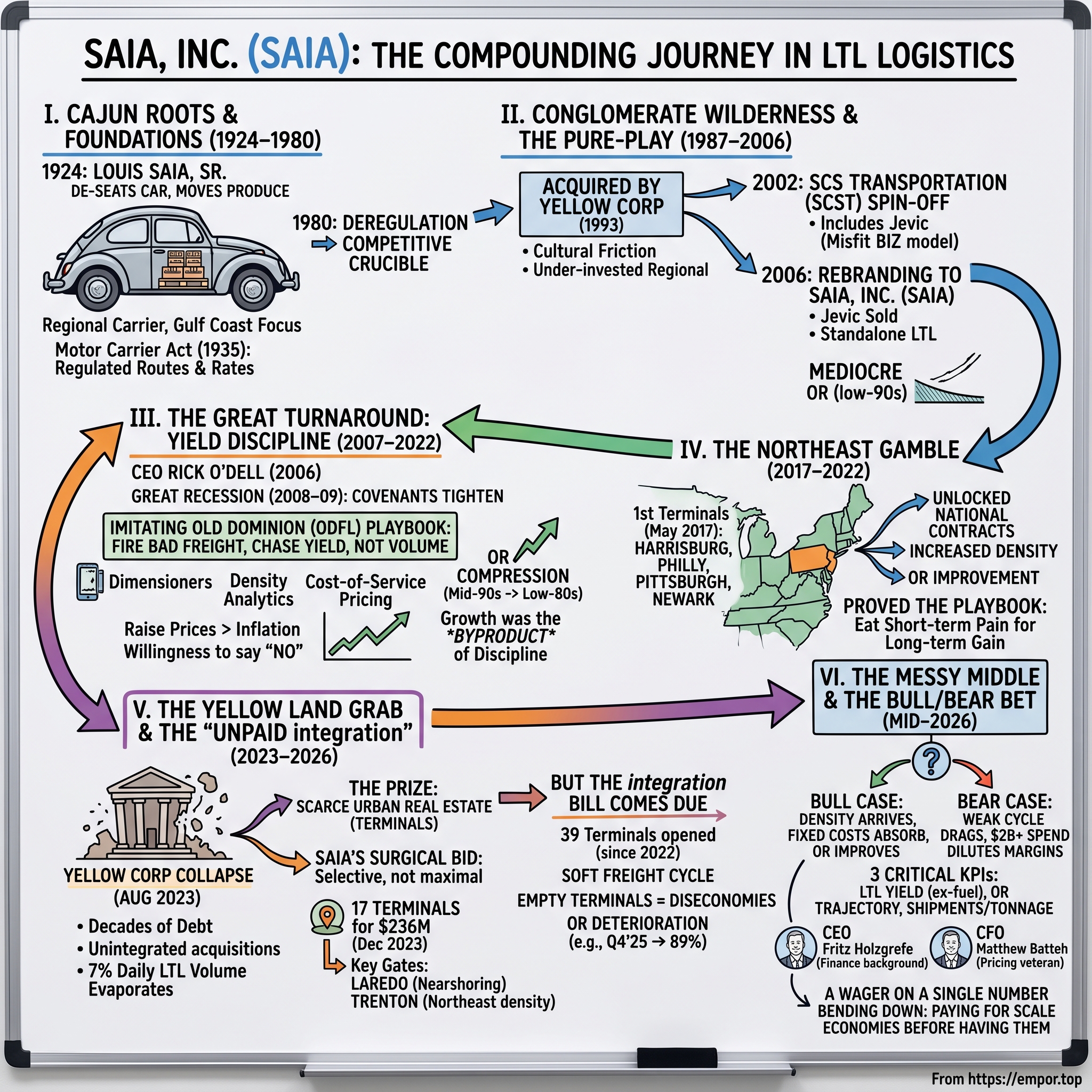
Saia, Inc.: The Playbook for Compounding in Less-Than-Truckload Logistics
There is a certain kind of stock that never makes the magazine covers. It does not build rockets, it does not train large language models, and its founder did not drop out of anywhere. It moves pallets of paint, auto parts, and industrial fasteners from a warehouse in one American city to a loading dock in another, and it charges a few hundred dollars to do it. And yet, over the roughly two decades that Saia, Inc. traded as a standalone company, a dollar put into this unglamorous freight hauler would have compounded into a return that embarrassed most of Silicon Valley.
This is the story of how a Louisiana produce-delivery outfit, born in 1924 from a man who removed the back seats of his own car to make room for crates, became a national logistics platform worth roughly ten billion dollars — and how, in the summer of 2023, it seized a once-in-a-lifetime chance to buy the physical bones of a dying competitor. It is also the story of a company that, as of mid-2026, is in the awkward middle of that bet, absorbing more new terminals than it can yet fill, watching its vaunted margins slip backward, and asking investors to trust that the density will come. This is the deep dive.
I. Introduction & Episode Roadmap
Picture a cross-dock terminal at two in the morning somewhere off an interstate in Ohio. A line-haul tractor backs up to one of a hundred numbered doors. Inside, forklifts dart between trailers, breaking down a jumble of shrink-wrapped pallets — a crate of tile bound for Cincinnati, three drums of lubricant headed to Louisville, a single machined part someone in Akron is waiting on — and re-sorting them by destination. Within a few hours the freight is reloaded, the doors close, and the trailers roll out again, each now carrying a denser, smarter mix than it arrived with. Multiply that choreography across more than two hundred terminals every single night, and you have the physical machine that is Less-Than-Truckload freight. It is boring. It is also one of the most defensible business models in American industry.
Saia is the under-the-radar compounder inside that machine. For years it was a second-tier regional carrier hugging the Gulf Coast, running an operating ratio — the industry's holy-grail measure of cost discipline — stuck in the mid-90s, meaning it kept barely a nickel of operating profit on every revenue dollar. The central narrative of this story is how Saia dragged that number down into the low 80s and, on its best days, the high 70s, by copying the discipline of the industry's gold standard, Old Dominion Freight Line, and by refusing to chase cheap freight simply to keep its trucks full.
The climax came in 2023, when the third-largest LTL carrier in the country, Yellow Corporation, collapsed into bankruptcy, and roughly a tenth of the nation's daily LTL capacity evaporated over a single weekend.8 Its terminals — permitted, urban, and effectively impossible to replicate — went up for auction. Saia showed up with a strong balance sheet and walked away with a haul of real estate that would expand its national footprint by roughly a fifth.3
But this is not a victory lap, and Empor is not management's investor-relations desk. By early 2026, the same terminals that were supposed to be Saia's masterstroke were dragging its operating ratio backward, its most recent quarters showed volumes going sideways or down, and skeptics were asking a fair question: did Saia overpay for empty buildings at the top of a freight cycle?
That tension is exactly why the timing of this story is interesting. Saia is not a company at either extreme of a narrative arc — not a triumphant compounder in full flight, nor a broken business in obvious decline. It is caught in the messy middle of the biggest bet in its history, where the costs have all landed and the payoff is still a hypothesis. That is the most honest and the most useful place from which to examine a business, because the outcome is genuinely undecided and the evidence is still coming in. Over the next several sections we will walk the physics of the network and why LTL earns its structural premium; a century of history compressed to what still matters today; the yield-discipline turnaround that copied Old Dominion; the career-defining Northeast gamble that proved the playbook; the Yellow land grab and its still-unpaid integration bill; the people now steering; a war-game of the competitive position through Porter's and Helmer's frameworks; and the honest bull and bear cases — testing each against evidence rather than accepting it on management's word.
 Subscribe on LinkedIn
II. The Physics of LTL: Industry Structure & Network Economics
To understand why Saia is a good business and a full-truckload hauler generally is not, you have to understand a distinction that sounds like accounting minutiae and is actually everything.
In Full Truckload (TL), a shipper has enough freight to fill an entire 53-foot trailer, so a carrier sends one truck from point A to point B. The economics are brutal precisely because they are simple: anyone with a truck, a license, and a driver can compete. There are hundreds of thousands of such operators in the United States, many of them a single owner-driver. There is essentially no barrier to entry, no pricing power, and no structural moat. It is the commodity end of transportation, and its margins reflect that.
Less-Than-Truckload (LTL) is a different animal entirely. Here the shipper has a load too big for a parcel service like UPS but far too small to fill a trailer — anywhere from a single 150-pound pallet to several thousand pounds. No carrier could make money driving a half-empty truck across the country for one customer. So LTL carriers run a hub-and-spoke network, the same architecture that makes airlines and package couriers work. Local pickup-and-delivery ("P&D") drivers fan out each morning across a metro area, collecting small shipments from dozens of businesses. Those shipments converge on a cross-dock terminal, where they are re-sorted by destination and consolidated onto long-haul ("line-haul") trailers that run between terminals overnight. At the far end, the process runs in reverse. Every trailer, ideally, travels full of freight from many customers heading the same direction.
Here is the punchline: building that network requires hundreds of terminals, thousands of trucks, tens of thousands of employees, and — the truly scarce ingredient — industrial real estate near major cities that can be permitted for round-the-clock truck traffic. You cannot start an LTL carrier in a garage. The capital and the physical footprint form a moat that TL simply does not have. That is why the two businesses, though both involve trucks, deserve completely different valuation multiples.
It helps to think of an LTL carrier as two businesses stapled together, each with its own cost logic. The first is local pickup-and-delivery — the swarm of trucks in each city, whose cost is driven by how many stops a driver can make per hour and how much freight sits at each stop. The denser the freight in a given zip code, the more shipments a single P&D driver handles per shift, and the lower the cost of each one. The second is line-haul — the long trailers running city to city overnight — whose cost is driven by how full each trailer is and how directly it can travel without detouring through extra terminals. A carrier that owns a terminal in the right spot can run a full trailer straight from origin to destination; one that does not must route freight through a partner or a distant hub, adding handling, miles, and damage risk. Every additional touch of a pallet is a chance to break it, delay it, or lose money on it. The whole art of LTL is minimizing touches while maximizing trailer fill — and that is a function of density, the single word that recurs in every chapter of Saia's story.
There is a subtlety in how LTL carriers even measure what they are hauling. Because a light-but-bulky shipment — think a pallet of foam insulation — consumes as much trailer space as a heavy-but-compact one, carriers price on a blend of weight, dimensions, and a freight-class system that scores commodities by density and handling difficulty. This is why "dimensioner" machines that laser-scan each pallet became a competitive weapon: a carrier that knows the true cubic footprint of every shipment can price it correctly and stop losing money on freight that looks cheap on a scale but eats the trailer. Layered on top are two pricing levers investors should know by name: the annual general rate increase (GRI), a list-price bump the carrier tries to make stick on transactional freight, and the contractual renewal, the negotiated increase on the roughly half of freight moving under longer-term shipper contracts. And running through all of it is the fuel surcharge — a separately quoted, formula-driven pass-through that rises and falls with diesel prices, which is why serious analysts strip fuel out entirely when judging a carrier's underlying pricing power.
The holy-grail metric
Everything in LTL comes back to one number: the operating ratio, or OR, defined as operating expenses divided by operating revenue, expressed as a percentage.1 An OR of 85 means the carrier spends 85 cents to earn a dollar and keeps 15 cents of operating profit. Lower is better. The reason investors obsess over it is leverage. Consider the arithmetic: a carrier running at an 85 OR earns a 15% operating margin; improve the ratio by five points to 80 and the margin jumps to 20% — a one-third increase in operating profit from a change that sounds, in isolation, modest. Because so much of an LTL carrier's cost base is fixed — the terminals, the docks, the salaried drivers who show up whether the trailer is half-full or brimming — small improvements in how densely freight flows through the network drop almost entirely to the bottom line. A single hundred-basis-point improvement (say, from 86 to 85) can move operating profit by high-single-digit percentages, and the market, knowing this, rewards durable OR compression with a higher valuation multiple. That is the mechanical link between a boring internal metric and a soaring stock chart: OR is the transmission belt between operational discipline and equity value. When Old Dominion trades at a premium to the market, that premium is the price of two decades of OR discipline, quarter after quarter.
The flip side, which the recent chapter of Saia's story makes vivid, is that operating leverage is symmetric. The same fixed-cost structure that makes falling OR so rewarding makes rising OR — from soft volumes or half-empty new terminals — punishing. When freight thins out, the costs do not thin with it, and the operating ratio climbs fast. An LTL carrier is a coiled spring: wonderful on the way up, unforgiving on the way down.
An industrial oligopoly
Unlike truckload, LTL has consolidated into something close to an oligopoly: the top ten carriers control the overwhelming majority of industry revenue, and the barriers described above mean that share is sticky.6 The named landscape Saia competes against is worth committing to memory:
- Old Dominion Freight Line (ODFL) — the undisputed gold standard, a roughly $5.8-billion-revenue carrier that has, in its best years, run an operating ratio below 80, with pristine on-time service and a near-religious philosophy of owning rather than leasing its terminals. ODFL is the model everyone else, Saia included, has spent a decade trying to imitate, and it trades at a premium multiple that is effectively the market's price for decades of unbroken discipline.
- FedEx Freight — the revenue leader at roughly $9 billion, leveraging the parcel giant's scale, data, and national corporate relationships; a business its parent has publicly explored spinning off, a reminder of how much standalone value the market ascribes to a pure LTL franchise.
- XPO, Inc. — an aggressive, technology-forward turnaround story with an $8-billion network, focused on squeezing yield out of its terminals, and, as we will see, the biggest spender in the Yellow auction.7
- Estes Express Lines — a roughly $5-billion, privately held, family-owned carrier with deep regional density and no public shareholders to appease — which means no quarterly-earnings pressure and the freedom to bid patiently, as it did on Yellow's assets.
- ArcBest (ABF Freight) — a legacy carrier with roughly $2.8 billion of LTL revenue, whose ABF unit is Teamster-unionized, balancing asset-heavy trucking with asset-light logistics and carrying the same labor-cost structure that helped sink Yellow.
- Knight-Swift Transportation — a truckload giant that has been buying its way into LTL, notably through AAA Cooper and Midwest Motor Express, and whose entry is a live test of whether a truckload culture can master the very different physics of hub-and-spoke freight.
Saia sits in the thick of this group — no longer a regional also-ran, not yet ODFL. Its operating ratio in a good year now lands in the low 80s, closer to XPO than to Old Dominion's high-70s, which frames the entire investment question: can Saia keep closing that gap, or has it stalled in the middle? The competitive benchmark that matters is not revenue but cost-per-shipment discipline, and on that scoreboard Saia has been climbing for fifteen years without yet reaching the summit. To see why the gap ever existed, we have to go back to a car with its back seats torn out.
III. Cajun Roots & The Conglomerate Wilderness (1924–2006)
In 1924, in the bayou town of Houma, Louisiana, a produce dealer named Louis Saia, Sr. made a small observation that changed his family's fortunes: there was more reliable money in hauling produce than in selling it. So he took the family car, pulled out the back seats to make room for cargo, and started moving other people's goods for a fee.15 It is the kind of origin that sounds too neat to be true — the entire hundred-year edifice of a NASDAQ-listed logistics company tracing back to a single Cajun entrepreneur and a gutted automobile — but it is the company's own telling, and it captures something essential about LTL: the business has always been about squeezing more value out of the same vehicle.
For its first several decades, Saia did what regional carriers did in the tightly regulated pre-deregulation era. Under the Motor Carrier Act of 1935, the federal government, through the Interstate Commerce Commission, dictated which routes a carrier could serve and what it could charge. A trucking franchise in that world was as much a bureaucratic grant as a competitive position; new entrants needed a "certificate of public convenience and necessity," and incumbents fought to keep the map closed. It was a comfortable, low-metabolism business, and Saia scaled steadily but modestly across Louisiana, Texas, and the Gulf Coast — a respected regional name that never had to become a great operator because it never had to.
That comfort ended in 1980. The Motor Carrier Act of that year deregulated interstate trucking, tore up the route-and-rate rulebook, and threw the industry open to competition. The consequences were seismic: within a decade, a majority of the old regulated LTL carriers had disappeared, unable to compete once price and service actually mattered. The survivors were the ones who learned to run dense, efficient networks. This is the crucible that eventually produced disciplined operators like Old Dominion — and it is the competitive furnace Saia would spend the next forty years learning to survive in. That world of protected regional franchises was gone, and so, soon, would be Saia's independence.
The corporate hot-potato years
Beginning in the late 1980s, Saia became a passenger in other companies' strategies. It was acquired by Preston Trucking in 1987, and then, in 1993, swallowed by Yellow Corporation — the very conglomerate whose eventual death would, three decades later, hand Saia its greatest opportunity. There is a deep irony there worth sitting with: for years Saia was an operating unit inside Yellow, a sprawling, heavily unionized freight empire, while Saia itself fought to stay non-union and nimble. The cultural friction of being a lean regional carrier inside a lumbering conglomerate is a recurring theme in transportation, and it left Saia under-invested and under-loved.
Yellow, for its part, eventually concluded that its regional carriers did not fit its long-haul, unionized core. In March 2002 it spun them off into a separate public company called SCS Transportation, trading on NASDAQ under the ticker SCST, bundling Saia together with a New Jersey carrier called Jevic Transportation.14 This was freedom of a sort, but it was a messy freedom. Jevic ran a hybrid business model that blended truckload and LTL, and it consistently failed to earn acceptable returns, dragging down the combined company's profitability. Meanwhile Saia itself was hardly a paragon: through this era it ran an operating ratio in the low-to-mid 90s, keeping only a thin sliver of profit and lacking the scale or discipline of the industry's leaders.
The 2006 rebranding — becoming a pure-play
The cleanup came in 2006. SCS Transportation sold Jevic to an affiliate of the private-equity firm Sun Capital Partners for roughly $40 million in cash, having concluded the unit had "not achieved acceptable levels of profitability for several years." With Jevic gone, management folded the corporate functions into Saia's operation, moved the headquarters toward Georgia, and re-branded the whole enterprise as Saia, Inc., trading under the ticker SAIA.
What mattered here was not the paperwork but the clarity. For the first time in its modern history, Saia was a standalone, pure-play LTL carrier with a single mission and its own stock. There was no conglomerate parent to appease, no misfit sister company to subsidize. The stage was set — but a pure-play with a mediocre operating ratio is just a mediocre company you can now measure precisely. The transformation still had to be earned, and it would fall to a former CFO to earn it.
IV. The Great Turnaround: Yield Discipline & The Northeast Gamble (2007–2022)
The man who inherited that pure-play was Rick O'Dell, who had joined Saia as chief financial officer in 1997 and became chief executive in 2006.9 He took the helm just in time to steer directly into the Great Recession — a near-death experience for an asset-heavy, cyclically exposed freight carrier. O'Dell would later describe the period bluntly, recalling that "the banks were at my throat" as freight volumes cratered and covenants tightened.16 A carrier with mid-90s operating ratios has almost no cushion; a demand shock can turn thin profits into losses overnight. Survival itself was the first accomplishment.
But survival taught the lesson that defined everything after. The old regional-carrier instinct was to chase tonnage — to take almost any freight at almost any price to keep the trucks and docks full, on the theory that a full truck beats an empty one. The problem is that low-margin freight is not free to handle: it clogs the terminals, consumes dock labor and dock doors, and gums up the very density it is supposed to create. Cheap volume can actively destroy network efficiency.
Copying the Old Dominion playbook
The intellectual turn Saia made — and it was, in essence, a decision to imitate Old Dominion — was to stop worshiping volume and start worshiping yield. Yield, in LTL, is usually measured as revenue per hundredweight (per hundred pounds of freight, or "CWT"), and the discipline is simple to state and hard to execute: raise price faster than cost inflation every year, invest in the technology to know precisely what each shipment costs to handle, and be willing to walk away from — to "fire" — customers whose freight does not pay its way.
That required real investment in unglamorous capability: dimensioning technology that measures the exact size and density of each pallet, cost-of-service pricing models, and density analytics that revealed which lanes and which customers actually made money. Armed with that, Saia could push through its annual general rate increases and insist on above-inflation renewals, absorbing the customers who accepted the price and shedding those who did not. Slowly, the operating ratio began its descent from the mid-90s toward the 80s.
It is worth pausing on how genuinely hard that discipline is, because it is the crux of why most carriers never become ODFL. Firing a customer means voluntarily handing a competitor revenue and watching a truck leave the dock less full than it could be. Every fiber of an operator's instinct — and every regional sales manager's commission — screams to keep the freight. The discipline only works if the entire organization believes that a low-margin shipment is worse than no shipment because of what it does to the network: it occupies a dock door, consumes a forklift cycle, delays the freight around it, and trains the customer to expect a price that does not cover the cost of service. Saia's achievement in these years was less a technology story than a cultural one — convincing a sales-driven regional carrier to say no.
Myth versus reality. The popular telling of Saia is that it "discovered a growth story." The reality visible in the numbers is subtler and more instructive: Saia's stock did not compound because revenue grew — plenty of carriers grew revenue and destroyed value doing it — but because each dollar of revenue became dramatically more profitable as the operating ratio fell. Growth was the byproduct of discipline, not the driver of the returns. An investor who mistakes the two learns the wrong lesson from Saia's history.
The Northeast gamble
By the mid-2010s Saia had a glaring hole in its map. It served most of the country but had no owned network in the Northeast — the dense industrial corridor from Pennsylvania up through New England. To move a customer's freight into that region, Saia had to hand it off to interline partners, third-party carriers who completed the delivery. Every interline handoff meant a loss of control over service quality, a split of the margin, and a customer relationship mediated by someone else's truck. Worse, it disqualified Saia from the national contracts that big shippers award only to carriers who can serve the entire country themselves.
So in late 2016, management announced a gamble: rather than buy its way in, Saia would build the Northeast from scratch. The first four terminals — in Harrisburg, Philadelphia, and Pittsburgh, Pennsylvania, plus Newark, New Jersey — opened on May 2, 2017, with 185 dock doors, more than 80,000 square feet, and nearly a hundred new hires, part of an investment program of roughly $220 million across equipment and infrastructure that year.1213 The company framed it as a multi-year plan to become a truly national carrier.
Wall Street was skeptical, and reasonably so. New terminals open empty. They carry full fixed costs — rent, labor, equipment — while generating little revenue, because a new market has no route density on day one. That means negative operating leverage, a drag on the very operating ratio management had spent a decade improving. The bears argued Saia was trading hard-won margin for a speculative land grab in a region already crowded with entrenched competitors.
The payoff
The bet worked, and it worked for a specific, teachable reason. Once Saia could route its own freight into Newark and Philadelphia without an interline handoff, it could finally bid on national contracts with the largest enterprise shippers — the home-improvement chains, the big-box retailers, the industrial manufacturers who insist on a single carrier for the whole map. The prize was not just the Northeast freight itself but the national contracts that the Northeast unlocked, because a shipper awarding its entire book to one carrier will not split it across a patchwork of interline partners. New national accounts brought volume; volume brought density; density brought down the cost per shipment; and the operating ratio, after the initial dip, resumed its march from the mid-90s of the bad old days down into the low 80s.
The scale of the transformation is easiest to feel at the endpoints. Under O'Dell, Saia's market capitalization climbed from roughly $275 million in 2006 to around $2.2 billion by the time he handed over the CEO title in 2020, with revenue reaching about $1.8 billion in 2019 and a payroll above ten thousand.9 Revenue would go on to reach roughly $3.2 billion by 2024.1 SAIA became one of the best-performing industrial stocks of its era — not because it invented anything, but because it executed a known playbook with unusual discipline. The instructive point for investors is that the entire re-rating flowed from a boring internal number, the operating ratio, bending in the right direction for years on end.
The lesson for investors is that Saia's edge was never a proprietary secret. It was the willingness to eat short-term margin pain for long-term density, and the operational competence to make the new terminals productive before the cost drag became permanent. That exact trade-off — pain now, density later — is the one Saia would soon make again, at four times the scale, when a competitor's collapse put a generation's worth of terminals on the auction block.
V. The Yellow Corp Bankruptcy & The Once-in-a-Century Land Grab (2023–2024)
For most of 2023, everyone in freight could see the iceberg. Yellow Corporation — the same conglomerate that had once owned Saia — was the third-largest LTL carrier in the country, a roughly $5-billion-revenue behemoth handling about seven percent of the nation's daily LTL shipments.17 It was also drowning: decades of debt, a labyrinth of merged-but-never-integrated operating companies, a $700-million pandemic-era federal loan that had merely delayed the reckoning, and a bitter standoff with the Teamsters union representing most of its workforce.
Yellow's death was decades in the making, and its cause is central to why Saia's whole strategy is built the way it is. Yellow had spent the 2000s trying to grow by acquisition — swallowing Roadway and then USF — but never truly integrated the pieces. It ran multiple overlapping networks, multiple brands, and multiple labor agreements under one roof, a confederation rather than a company. Its long-promised "One Yellow" consolidation, meant to finally merge those networks into a single efficient system, required Teamster cooperation that never fully materialized, and the standoff over that plan became the proximate trigger of the end. Add a balance sheet groaning under debt — and a controversial $700 million CARES Act loan from the U.S. Treasury in 2020 that critics argued merely postponed an inevitable failure at taxpayer expense — and Yellow was a company kept alive by financial engineering long after its operations had stopped making sense.
At the end of July 2023, the machine stopped. Yellow halted operations and told its roughly 30,000 employees — about 22,000 of them Teamsters — that their jobs were gone.17 On August 6, 2023, it filed for Chapter 11 bankruptcy protection in Delaware.8 Overnight, close to a tenth of the country's LTL capacity vanished. For shippers, it was a supply shock; freight that had ridden Yellow's trucks had to find new homes, and rates across the surviving carriers firmed as the industry's chronic over-capacity abruptly tightened. For the survivors, it was something rarer: a chance to buy the one thing money normally cannot conjure. The deeper lesson embedded in Yellow's collapse — a lesson Saia had internalized decades earlier — is that in LTL, scale assembled through un-integrated acquisitions and adversarial labor is not strength; it is a slow-motion liability.
Why the real estate was the prize
The crown jewels of a dead LTL carrier are not its trucks or its brand — they are its terminals. And here the story turns on a piece of economic geography that is easy to miss. You cannot simply build a new cross-dock terminal wherever you like. These are industrial facilities with dozens or hundreds of doors, running trucks around the clock near dense population centers. Municipal zoning, environmental restrictions, community opposition to diesel traffic, and decades of urban sprawl have made it nearly impossible to permit new ones in the metros that matter most. The terminals that exist are, in the language of strategy, a cornered resource: irreplaceable, location-specific assets whose scarcity is enforced by regulation and geography rather than patent or contract. Yellow's roughly 170-plus terminals represented a footprint that could not be rebuilt at any price.
So when the bankruptcy court put them up for auction, the surviving carriers lined up with billions in cash. The results, revealed in early December 2023, were staggering: the auction of roughly 130 Yellow-owned properties fetched nearly $1.9 billion.45 XPO was the biggest spender, agreeing to pay about $870 million for 28 terminals — an average north of $30 million per site, targeting the largest hub locations.7 Estes took 24 owned terminals for roughly $249 million. Knight-Swift, the truckload giant pushing into LTL, picked up 13 terminals for about $51 million, and a real-estate investor, RAMAR Land Corp., bid over $200 million — a telling detail, because it meant even non-carriers saw the terminals as scarce, appreciating assets rather than mere trucking infrastructure. Old Dominion, tellingly, largely sat the auction out, judging the prices too rich for its disciplined taste. That abstention is itself worth weighing: the industry's most respected capital allocator looked at these same irreplaceable assets and concluded the math did not work. A skeptic could reasonably ask whether ODFL's restraint or Saia's aggression will look wiser in a decade.
Saia's bid: selective, not maximal
Saia's approach was neither the biggest nor the cheapest — it was the most surgical. In December 2023 the company agreed to acquire 17 Yellow terminals for a combined $235.7 million.3[^6] Rather than chase trophy mega-hubs, Saia targeted specific gaps and gateways: its two priciest buys were a terminal near Trenton, New Jersey, for about $71 million — reinforcing the very Northeast corridor it had built from scratch six years earlier — and one in Laredo, Texas, for roughly $51 million, a cross-border gateway positioned squarely in the path of Mexico "nearshoring" traffic.3 The rest filled density holes across markets like Fresno, Grand Rapids, Knoxville, and the Mid-Atlantic. Over the following year and change, Saia continued buying additional former-Yellow sites, bringing its total to roughly 31 terminals for something north of $250 million and expanding its national door count by a mid-teens-to-twenty percent.
The analytical read on the auction is that it revealed each carrier's strategy in dollars. XPO paid up for scale and hubs; Estes bought breadth; ODFL's abstention signaled its unwillingness to overpay even for scarce assets; and Saia threaded the needle, using a strong, low-leverage balance sheet to buy exactly the locations that plugged its map. That balance-sheet strength — the product of years of conservative capital allocation — was the real weapon. Fortune favored the carrier that had kept its powder dry.
The integration bill comes due
But scarce real estate is not the same as productive real estate, and this is where the story stops being triumphant and starts being genuinely uncertain. Onboarding dozens of terminals at once is enormously expensive before it is profitable. Each new facility must be staffed — Saia hired well over a thousand dockworkers and drivers — outfitted, and integrated, all while sitting largely empty and absorbing full fixed overhead. Management spent 2024 and 2025 defending, quarter after quarter on earnings calls, a deliberate near-term dilution of the operating ratio as the price of unlocking what it argued was more than a billion dollars of incremental long-term revenue capacity.
By its own account on the Q4 2025 call, Saia had opened 39 terminals since 2022 — 21 of them in 2024 alone — and estimated those new locations contributed roughly 80 basis points of revenue market-share gain in 2025.2 The company said the new terminals, taken together, operated profitably for the year despite their inefficiency. The framing management returned to, quarter after quarter under analyst questioning, was that the network carried 20–25% excess capacity broadly — and up to 50% in the newest markets — and that filling it would generate incremental margins of 30–40%, because the fixed costs were already paid for. In plain terms: the buildings and docks are bought, so the next truckload of freight to move through them is unusually profitable. Management guided that a newly opened terminal reaches company-average margins within roughly three years under normal economic conditions.2
The strategic logic behind the specific terminals chosen is worth taking seriously even while withholding judgment on the price. The Laredo gateway is a bet on nearshoring — the multi-year shift of manufacturing from Asia toward Mexico, which routes an ever-larger share of North American industrial freight across the Texas border, where it must be picked up and distributed by domestic LTL carriers. If that structural shift is real and durable, a permitted terminal in Laredo is a toll booth on a growing highway. The Northeast and Southern California buys, meanwhile, deepen density in exactly the metros where new permits are hardest to obtain. This is coherent strategy, not scattershot bargain-hunting.
But coherence is not the same as vindication, and this is where independence matters. Whether Saia "wins" from the Yellow purchase depends entirely on a variable management does not control — the timing of the freight cycle — and on one it does: execution. The aggregate numbers, which we will confront directly in the risk section, told a more sobering near-term story than the market-share talking points. To understand who is now steering through that gap between promise and proof, we have to look at the people running the company.
VI. Current Management, Corporate Governance, & Capital Allocation
When Rick O'Dell stepped up to non-executive chairman in April 2020, the keys passed to Frederick J. "Fritz" Holzgrefe, III, and the choice said something about how Saia sees itself.9 Holzgrefe is not a lifelong trucker. He joined Saia as chief financial officer in 2014, after a career that ran through commodity processing and food distribution — including a stint as a vice president at Golden Peanut and Tree Nuts, a subsidiary of the agricultural giant Archer Daniels Midland — with earlier turns in financial advisory and commercial banking. He became president and chief operating officer in January 2019 and then president and CEO effective April 28, 2020, taking command, as O'Dell had a dozen years earlier, at the onset of a crisis — this time the COVID shock.
A finance executive running an asset-heavy carrier is a revealing choice. Holzgrefe's public framing has consistently emphasized return on invested capital over vanity market share — the idea that a terminal or a truck must earn its cost of capital, not just move freight. That is the same yield-first gospel O'Dell institutionalized, now carried by someone whose instincts were shaped in the spreadsheet rather than the cab.
A finance bench, and a changing of the guard
For the first stretch of Holzgrefe's tenure, his CFO was Douglas Col, who had joined Saia in 2014 as vice president and treasurer and became CFO in January 2020. Col's background was pure capital-markets: more than two decades as a transportation investment analyst, equity fund manager, and investment banker, including time in Cowen and Company's transportation banking group. He was, in effect, the architect of the conservative, low-leverage balance sheet that made the Yellow land grab possible.
In April 2024, Col announced his retirement, and in May 2024 Saia promoted from within, naming Matthew Batteh — an Auburn-trained, Emory-MBA finance executive who had been with the company since 2015, most recently as vice president of finance and before that running pricing and analytics from 2020 to 2023 — as executive vice president and CFO.1011 The choice of a pricing-and-analytics veteran to run the finances is itself a small tell: in a business where the whole game is charging the right price for each shipment, elevating the person who built the pricing machine keeps yield discipline at the center of the C-suite. (Col, for his part, later surfaced on the board of rival Knight-Swift — a reminder of how small the LTL talent pool is, and of how the same handful of operators cross-pollinate the entire industry.)
A brief word on governance and management credibility, which an independent reader should weigh rather than assume. The bull-friendly reading is that Saia's leadership has done what it said it would: it promised balance-sheet discipline and had the cash ready when Yellow fell; it promised yield increases and has consistently pushed GRIs and contractual renewals through, even into a soft 2025–2026 market. The more skeptical reading is that the same management, after years of preaching capital discipline, embarked on the largest and most aggressive capital-spending program in the company's history — more than two billion dollars — and is now asking investors to be patient while the returns on that spend remain, at best, unproven. The honest test is not what management says on any single call but whether its narrative stays consistent as the numbers turn against it, and whether it explains misses with specifics rather than deflection. So far the explanations have been specific — pinning operating-ratio pressure on named, quantified items like accident reserves and terminal ramp costs rather than vague macro hand-waving — which is a point in management's favor even for a critic.
Capital allocation: the honest ledger
Saia's capital-allocation priorities have been consistent and, notably, austere. First comes high-return organic capital expenditure — fleet, terminals, and dock technology — which has run enormous in recent years: management guided to roughly $350–$400 million of capex for 2026, and that figure is down from the peak, following a multi-year build-out that exceeded two billion dollars.2 Second comes a conservative, investment-grade balance sheet, held deliberately under-levered precisely so the company can pounce on dislocations like Yellow. Third, and a distant third, is opportunistic share repurchase. Saia pays no dividend at all, choosing instead to reinvest every available dollar into compounding the network.
The rationale for paying no dividend is, in theory, sound: if a company can reinvest at high returns on invested capital — which Saia demonstrably could during the Northeast build-out and the OR-compression years — then every dollar retained and reinvested compounds faster than it would in a shareholder's brokerage account. A dividend, in that logic, would be an admission that the company has run out of high-return places to put its own money. The whole model is a bet that the reinvestment opportunity remains richer than the alternative of returning cash. That bet is only as good as the returns, which is precisely the open question hanging over the Yellow terminals.
The independent read here is balanced. On the credit side, management's discipline has been real and has paid off: the war chest was there when Yellow fell, and Saia did not have to dilute shareholders or over-lever to seize the moment. On the skeptical side, a company that reinvests everything and pays nothing out is asking investors to trust that the returns on that reinvestment will stay high — and the recent returns on the newest capital have been anything but proven, with the operating ratio moving backward as the spending peaked. The bull says this is a compounder plowing cash into a widening moat; the bear says it is a capital-intensive cyclical spending at the top of a cycle and calling it strategy. Both are looking at the same cash-flow statement, and the difference between them is, once again, a judgment about time.
VII. Strategic Frameworks: Porter's 5 Forces & Helmer's 7 Powers
Strip away the narrative and the question for a long-term investor is structural: does Saia possess durable competitive advantage, or is it merely a well-run company in a good-enough moment? Two frameworks help war-game the answer.
Hamilton Helmer's 7 Powers
Cornered Resource (High). The strongest leg of the Saia thesis is its footprint of roughly 210-plus fully permitted cross-dock terminals across North America.2 As the Yellow auction proved in the bluntest possible way — with buyers paying up to and beyond $70 million for a single site — these assets cannot be replicated, because municipalities will not permit new LTL cross-docks in the metros that matter. This is a genuine, regulation-and-geography-enforced advantage, and it is why LTL carriers trade unlike truckload haulers.
Scale Economies (High). LTL is a fixed-cost business, so cost per shipment falls as volume rises. A carrier with high shipment density in a given zip code spreads its terminal, dock, and local-delivery costs across more freight, achieving a lower cost per hundredweight than a thinner competitor. This is real — but it cuts both ways, and it is precisely where Saia is currently exposed: its newest terminals have density far below the network average, which is exactly why its operating ratio has been rising rather than falling. Scale economies are a power only once you have the scale; a half-full terminal has diseconomies.
Counter-Positioning (Medium). Saia's non-union workforce gives it operational flexibility — the ability to reconfigure terminals and reschedule labor without navigating a collective-bargaining agreement — that unionized legacy carriers like ArcBest, and the departed Yellow, structurally lacked. Yellow's Teamster entanglements were a direct contributor to its collapse. But this is a shared trait among the strongest LTL players (ODFL is likewise non-union), so it is less a unique Saia advantage than table stakes for the modern winners.
Switching Costs (Low to Medium). This is the weakest leg. A shipper can, in principle, move its freight to a competitor with a phone call, and price shopping is endemic. What stickiness exists comes from integrated logistics software and API connections, custom pricing agreements, and, above all, proven on-time reliability — once a shipper trusts a carrier to deliver damage-free and on schedule, the friction and risk of switching rise. Saia's record cargo-claims ratio of roughly 0.5% in 2025 speaks to that reliability.2 But no honest analyst would call LTL a high-switching-cost business; it is a service-and-price business where trust is earned continuously and can be lost quickly.
Porter's Five Forces
Threat of New Entrants (Very Low). The combination of multi-billion-dollar capital requirements and un-obtainable urban real-estate permits makes a new national LTL network effectively impossible to build from scratch. This is the industry's deepest structural protection.
Bargaining Power of Buyers (Moderate). Large enterprise shippers push hard on rates, but the industry's capacity discipline — carriers' collective unwillingness to chase volume with suicidal pricing — has historically prevented the ruinous price wars that plague truckload.
Bargaining Power of Suppliers (Moderate to High). Truck and engine makers such as PACCAR, Volvo, and Daimler's Freightliner hold pricing power over equipment, and labor — especially drivers and dockworkers — is a persistent cost-inflation source. Saia's own recent results showed salaries, wages, and benefits rising faster than revenue, with group health insurance alone driving a meaningful chunk of per-shipment cost inflation.2
Threat of Substitutes (Very Low). There is no economical substitute for LTL in its sweet spot. You cannot ship a 1,500-pound pallet of machinery by parcel, and you cannot justify a dedicated 53-foot truckload for it either. LTL owns the middle.
Competitive Rivalry (Moderate). The top carriers behave, most of the time, as a rational oligopoly, competing on service and yield rather than torching prices. The risk — and it is the central bear point — is that this rationality frays in a prolonged downturn, when a competitor with empty capacity decides to buy volume with price.
It is worth being precise about which of these powers Saia owns versus which it merely shares. The cornered resource of permitted urban terminals, the very-low threat of entrants, and the very-low threat of substitutes are advantages of the LTL industry as a whole; every established national carrier enjoys them, and they explain why the group trades richly. What would make Saia specifically worth more than its peers is the second category — scale economies converted into a lower cost per shipment, and service reliability converted into pricing power and retention. On both of those, Saia has a strong long-run record and a weak recent one: the operating ratio that had fallen for the better part of fifteen years reversed in 2024–2025 as the Yellow terminals diluted density. In the language of the framework, Saia is currently paying for scale economies it does not yet have, on the bet that volume will convert the one into the other.
The frameworks converge on a nuanced verdict, and it is the crux of the whole story: Saia sits inside a genuinely attractive industry with a real, regulation-enforced cornered-resource advantage, but its company-specific edge — the density and service that translate into a best-in-class operating ratio — is currently unproven on its newest assets. The moat around the industry is deep and shared. Saia's own position within it is still being dug, terminal by terminal, quarter by quarter.
VIII. Material Risk Radar & The 3 Critical KPIs
The bull case for Saia has always depended on volume filling the network. The most recent chapter is a live test of what happens when it does not.
The risk radar that actually matters
The freight cycle. LTL demand is a direct function of industrial activity. When U.S. manufacturing contracts — when the ISM Purchasing Managers' Index sits below 50, signaling contraction — tonnage falls, and a fixed-cost network with empty capacity bleeds margin. This is the master risk, and it is exactly the environment Saia has been fighting. In the fourth quarter of 2025, shipments per day slipped 0.5% and tonnage per day fell 1.5%, with Southern California volume alone dropping 18% and knocking an estimated $4 million off quarterly revenue.2
Onboarding overhead. The Yellow terminals are the second risk made concrete. If freight does not ramp into those newly acquired buildings, their fixed overhead sits unabsorbed, and the operating ratio stays elevated. The contrast between two consecutive years tells the whole story. In 2024, with the freight cycle firmer and the newest terminals still fresh, Saia grew revenue 11.4% to roughly $3.2 billion, lifted shipments per day 11.5% and tonnage 8.0%, and held its operating ratio at about 85 despite the drag of opening 21 new terminals — a genuinely impressive absorption of expansion cost.1 Then the cycle softened. For full-year 2025, revenue grew less than 1%, and the operating ratio deteriorated by roughly 410 basis points to about 89%.12 Same terminals, same strategy, opposite result — because the one variable that changed, freight demand, is the one that determines whether fixed-cost leverage works for you or against you. Management estimates the network is carrying 20–25% excess capacity broadly, and up to 50% in the newest markets. That spare capacity is simultaneously the bull's promise and the bear's albatross; which one it becomes depends entirely on when demand returns.
Labor inflation and the driver market. Wage and healthcare inflation competes directly with truckload and parcel fleets for the same workers, and Saia's costs have been climbing faster than its prices in the soft market. In the fourth quarter of 2025, salaries, wages, and benefits rose 6.1%, driven by a roughly 3% wage increase and healthcare inflation, with group health insurance alone accounting for more than 30% of the year-over-year rise in cost per shipment.2 Compounding the pressure, depreciation jumped 16.4% as the bill for all that new equipment and all those new terminals landed on the income statement — a reminder that the capital-spending spree shows up as a fixed cost long before it shows up as incremental freight. When revenue is flat and depreciation and wages are climbing, the operating ratio has nowhere to go but up, which is precisely what happened.
Pricing irrationality. The nightmare scenario is a peer breaking ranks in a downturn and cutting yields to fill trucks, which would pressure the entire industry's pricing. So far the discipline has held — Saia's contractual renewals actually accelerated to 6.6% in January 2026 — but this is a behavioral risk, not a structural one, and behavior can change.2
There is also a quieter, second-layer item on the ledger: Saia's self-insurance and accident reserves. The Q4 2025 operating ratio was worsened by a $4.7 million reserve increase tied to adverse developments on prior-year accident claims, and management flagged rising litigation and settlement values as an inflationary pressure.2 For an asset-heavy trucking operation, "nuclear verdicts" in accident litigation are a genuine and growing tail risk across the industry — one that does not show up in the density narrative but can swamp a quarter's earnings in a single courtroom.
For balance, several underlying signals were genuinely working even as the headline margin slipped, and an honest ledger records both sides. On the operational-quality front, Saia posted a record-low cargo-claims ratio of about 0.47% in the fourth quarter of 2025 and roughly 0.5% for the full year, while preventable accident frequency fell 21% and lost-time injuries dropped 10% — improvements that matter because service reliability and safety are what allow a carrier to charge premium prices and hold customers.2 On pricing, contractual renewals accelerated to 6.6% in January 2026 from 4.9% in the prior quarter, and customer retention on those increases stayed above 90%, evidence that shippers were, for now, accepting Saia's rate discipline rather than fleeing.2 The bull reads these as proof the franchise is intact and only awaiting volume; the bear notes that none of it has yet stopped the operating ratio from deteriorating. Both are looking at the same set of facts.
The three KPIs to watch
Amid all the noise, three numbers tell you almost everything about whether the thesis is working:
- LTL yield — revenue per hundredweight, excluding fuel. This is the purest read on pricing power and freight-mix quality; stripping out fuel removes the noise of diesel prices and shows what Saia is truly charging to move freight. A healthy reading is yield rising faster than cost inflation, even in a soft market — evidence that capacity discipline is holding and shippers are absorbing increases rather than defecting. A yield that stalls or falls while costs climb would signal that pricing power is cracking, the single most important thing that could quietly break the long-term thesis.
- Operating ratio trajectory. The single most important number, and the one that ties everything together. The question is not its absolute level in any given quarter — which the Yellow integration and the weak cycle have inflated — but its direction over a year. Management has guided to 100–200 basis points of OR improvement in 2026, framing the low end as achievable even in a flat macro environment and the high end as requiring modest volume recovery.2 Whether it delivers against that self-set bar is both the ballgame and a direct test of management credibility.
- Shipments and tonnage per day. The measure of whether volume is actually filling the expensive new network. Density is the mechanism that converts empty terminals into low operating ratios; without volume growth, the rest is theory. Watch these two together with yield: rising volume and rising yield would be the signal that the whole strategy is compounding as designed, while volume bought by sacrificing yield would be the old "volume at any cost" trap that Saia spent fifteen years escaping. The combination, not either number alone, is what matters.
Watch those three, and the bull and bear cases resolve into evidence rather than argument.
IX. Investment Story Spine: Bull vs. Bear Case
The bull case — why Saia wins from here
The optimistic thesis is elegant because it is mechanical. Saia has bought and built a national network whose newest quarter or third sits well below mature density. As those terminals fill — management targets company-average margins within roughly three years of opening, under normal economic conditions — the same fixed costs get spread over far more freight, and the operating ratio resumes the secular compression that took it from the mid-90s to the low 80s. Management believes incremental margins on recovering volume could run 30–40%, meaning each new dollar of revenue in the under-utilized network drops disproportionately to profit.2 If that plays out, the operating ratio grinds toward the mid-to-high 70s, narrowing the long-standing valuation and margin gap with Old Dominion. Layer on a structural tailwind — Mexico nearshoring pushing cross-border volume through gateways like the Laredo terminal Saia deliberately bought — and you have a multi-year density-and-yield compounding story on assets that competitors physically cannot replicate.
The bull's strongest evidence is not management's rhetoric but the historical proof point: Saia has run this exact play before, in the 2017 Northeast build-out, and it worked. The company knows how to fill empty terminals because it has done it.
The bear case — why it may not
The skeptical thesis is equally mechanical, and it currently has the recent data on its side. If the industrial recession drags on, the volume never comes, and $250-plus million of scarce real estate becomes $250 million of fixed overhead eroding margins quarter after quarter. The evidence so far is uncomfortable: revenue essentially flat in 2025, an operating ratio moving the wrong way by more than 400 basis points, and volumes declining in the most recent quarter.12 An activist or short-seller would press three points. First, on capital allocation: Saia spent aggressively — over two billion dollars — after years of preaching discipline, and did so arguably near a cyclical peak in terminal valuations; the returns on that capital are, as yet, negative to break-even. Second, on the moat: switching costs are low and the cornered-resource advantage is an industry asset shared with better-positioned rivals like ODFL, not a Saia-specific one. Third, on execution risk: peers such as XPO (which spent even more in the auction) and Knight-Swift are pursuing the same density-and-technology strategy, and there is no guarantee Saia out-executes them in the same contested markets.
The activist stress test
Imagine a skeptical long/short investor building the short thesis in a memo. The sharpest points would not be about the industry — everyone agrees LTL is attractive — but about capital allocation and timing. The memo would argue that Saia's management, having spent fifteen years building a reputation for discipline, effectively abandoned it at the worst possible moment: spending over two billion dollars, including a quarter-billion-plus on Yellow real estate, near what may prove a cyclical peak in both freight demand and terminal valuations, and then watching the operating ratio deteriorate more than four hundred basis points as the volume failed to appear. It would note that ODFL — the operator Saia most wants to be compared to — looked at the identical assets and declined, a data point that cuts directly against the "irreplaceable bargain" framing. It would flag that Saia pays no dividend and buys back little, meaning shareholders receive nothing while they wait, and that free-cash-flow conversion is depressed by the very capex the bull case celebrates. And it would press on disclosure and governance: are the incremental-margin and three-year-ramp targets that management repeats on every call actually being met terminal by terminal, or are they aspirations restated as guidance?
The fair rebuttal is equally concrete. The balance sheet remains conservative, so the "patience" the thesis requires is genuinely affordable — Saia is not a levered company praying for a cycle turn. The company has executed this exact ramp before, in the Northeast, and the assets it bought cannot be reproduced at any price by a future competitor. And management's explanations for the recent misses have been specific and quantified rather than evasive. The stress test does not resolve the debate; it sharpens it. What it exposes is that the entire case rests on two variables — the timing of the freight cycle and the pace of terminal maturation — and that the recent evidence, honestly read, has run against the bulls for two years running.
The honest synthesis is that the bull and bear cases are not really in disagreement about the facts — both accept that Saia bought irreplaceable assets and that those assets are currently under-utilized. They disagree about time: whether the density arrives before the patience of investors runs out. That is a question about the freight cycle, which no one controls, and about execution, which Saia has earned some credibility on but must now prove again at four times the scale. An investor's job here is not to pick a side by conviction but to watch the operating ratio's direction and let it adjudicate.
X. Epilogue & Outro
Three lessons outlast the quarter-to-quarter noise of this story. The first is that density beats geography: a national map is worthless without high local route density, and Saia's entire history — from the interline-crippled pre-2017 Northeast to the half-full Yellow terminals of today — is a running demonstration that scale creates value only when the trucks are full. The second is that pricing discipline beats empty volume: the turnaround that made Saia was, at its core, the decision to sacrifice revenue for margin, to fire bad freight, and to compound yield above inflation year after year. The third is that fortune favors the well-capitalized balance sheet: when Yellow's structural assets went on sale in a fire, it was the carrier that had hoarded credit capacity, not the one that had maximized short-term returns, that walked away with the prize.
There is a final irony worth holding onto. The company that once sat trapped and underinvested inside Yellow Corporation — a lean regional carrier smothered by a unionized conglomerate — ended up feeding on Yellow's carcass, buying the very terminals that its former parent could no longer keep the lights on inside. It is a near-perfect illustration of how competitive advantage in this industry accrues not to the biggest balance sheet or the loudest strategy, but to the most disciplined operator still standing when the cycle turns. Yellow assembled scale and could not run it; Saia earned scale and now has to prove it can.
Whether that prize pays off is, as of mid-2026, genuinely undecided. Saia sits at the uncomfortable midpoint of the largest bet in its hundred-year history — the terminals bought, the workers hired, the capital spent, and the density not yet arrived. The operating ratio that made the company famous is, for now, moving against it. The story that began with a Cajun produce dealer gutting his own car for cargo space has become a wager on a single number bending back down. For the long-term investor, the task is not to cheer the wager but to watch the three KPIs — yield, operating-ratio direction, and volume — and let the evidence, quarter by quarter, tell which case was right.
References
-
Saia Reports Fourth Quarter Results (Q4 & Full Year 2024) — Saia, Inc. / Nasdaq, 2025-02-03 ↩↩↩↩↩
-
Saia (SAIA) Q4 2025 Earnings Call Transcript — The Motley Fool, 2026-02-10 ↩↩↩↩↩↩↩↩↩↩↩↩↩↩↩↩
-
Saia, Inc. Agrees to Acquire 17 Yellow Corporation Terminals in Chapter 11 Bankruptcy Sale — GlobeNewswire, 2023-12-05 ↩↩↩
-
Yellow's Terminal Auction Fetches $1.9 Billion Led by XPO, Saia — Bloomberg, 2023-12-05 ↩
-
Yellow Terminal Auction Draws Winning Bids From Top LTL Carriers — The Wall Street Journal, 2023-12-05 ↩
-
How Saia's Terminal Acquisition Strategy Fuels LTL Network Growth — Trucking Dive, 2023-12-08 ↩
-
XPO In Line for 28 Yellow Properties for $870 Million — Transport Topics, 2023-12-05 ↩↩
-
Yellow Corporation Files Voluntary Chapter 11 Petitions — Yellow Corporation, 2023-08-06 ↩↩
-
Saia Announces Planned Executive Leadership Team Transition — GlobeNewswire, 2020-03-06 ↩↩↩
-
Batteh Named Saia's Chief Financial Officer — GlobeNewswire, 2024-05-14 ↩
-
Saia Announces Upcoming Retirement of CFO Douglas Col — GlobeNewswire, 2024-04-26 ↩
-
New Saia LTL Freight Terminals Open in the Northeast — GlobeNewswire, 2017-05-02 ↩
-
Saia to Expand Into Northeast Next Year — Transport Topics, 2016-10-27 ↩
-
Yellow Corporation Completes Spin-Off of SCS Transportation — Yellow Corporation, 2002 ↩
-
Trucking firm CEO: 'The banks were at my throat' — The Atlanta Journal-Constitution ↩
-
Yellow Corp. bankruptcy: US trucking company files for Chapter 11 relief — CNN Business, 2023-08-07 ↩↩
 LinkedIn
 WhatsApp
 Reddit
 Hacker News
 Email
Email Kindle
 RSS Feed
 Spotify
 Apple Podcasts
 Amazon Music
 Audible
 YouTube