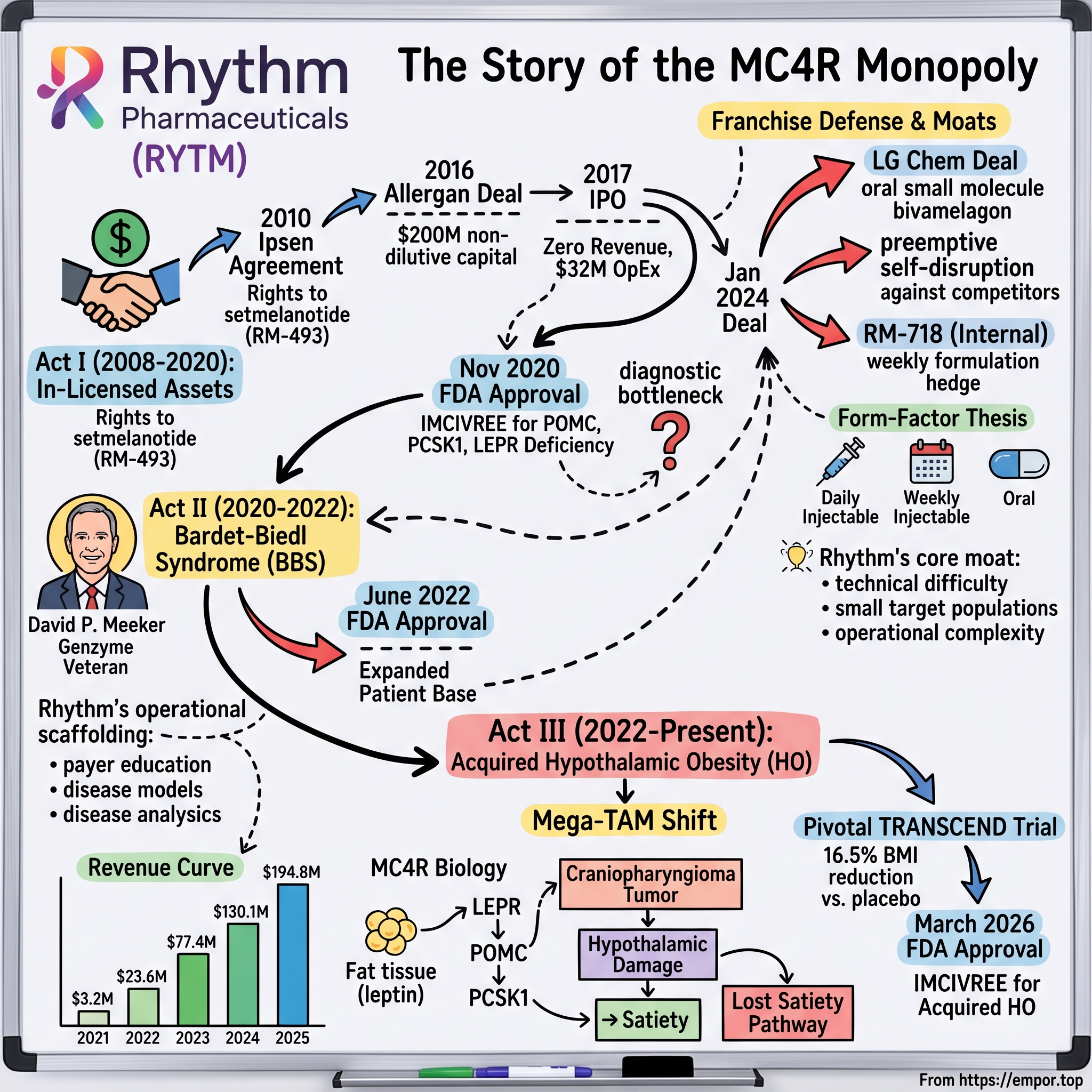
Rhythm Pharmaceuticals: The Story of the MC4R Monopoly
I. Introduction & Episode Roadmap (15 min)
On March 19, 2026, a commercial team in Boston received the regulatory decision every rare-disease developer targets for years. The U.S. Food and Drug Administration approved IMCIVREE — setmelanotide — "to reduce excess body weight and maintain reduction long term in adults and pediatric patients aged 4 years and older with acquired hypothalamic obesity."1
The context surrounding that regulatory milestone is striking. While the pharmaceutical industry's primary narrative focused on a massive race between Eli Lilly and Novo Nordisk to market incretin therapies to tens of millions of patients, a biotech firm with roughly 68 million shares outstanding and under $200 million in annual revenue secured the first approval in history for a disease that most endocrinologists could not have defined a decade earlier.2
The core thesis
Rhythm Pharmaceuticals (NASDAQ: RYTM) is built on the premise that a single biological circuit — the melanocortin-4 receptor (MC4R) pathway — represents a defensible commercial domain rather than a scientific specialty. The company's strategy centers entirely on that pathway: from the assets it in-licensed and the indications it pursued to the specialized sales force it deployed and the pipeline compounds it acquired to safeguard its franchise.
Management's thesis is that Rhythm controls the only approved therapy to address this specific disruption in hypothalamic signaling. For investors, the central task is evaluating how much of that position reflects an enduring monopoly, how much is a temporary regulatory lead, and how much represents the standard risks of a loss-making biotech that has yet to demonstrate it can convert scientific breakthroughs into durable cash flows.
That financial context is critical: through the end of 2025, Rhythm had never achieved profitability. The company consumed approximately $116 million in operating cash in 2025 alone and closed the year with roughly $389 million on its balance sheet.2 Rhythm's enterprise value ultimately depends on its commercial execution rather than historical earnings.
The obesity industry's blind spot
The rapid rise of GLP-1 therapies created a distinct market asymmetry. Capital flooded into treatments designed to reduce appetite in general patient populations, while far fewer resources reached individuals whose hunger stems from severe structural or genetic disruptions — patients whose brains cannot register satiety because a tumor, surgery, radiation, or an inherited genetic defect severed the neural pathway.
In clinical terms, this condition is hyperphagia: not standard appetite or food cravings, but an unrelenting physiological state in which the brain registers continuous starvation. Rhythm wagered that this patient population constitutes a distinct rare-disease market with favorable orphan-drug economics, rather than a small subset destined to be displaced by broader, lower-cost incretin drugs.
The product
IMCIVREE is a daily subcutaneous injection of setmelanotide, a peptide engineered to bind directly to the MC4R receptor. When upstream signaling is disrupted by genetic mutations or physical damage to hypothalamic tissue, setmelanotide acts as a substitute activator at the target receptor. That mechanism highlights both the drug's therapeutic precision and its core limitation: the underlying MC4R receptor itself must remain intact and functional.
Three acts
- Act I (2008–2020): In-licensed assets, a corporate split, an initial public offering, and the initial approval for obesity resulting from POMC, PCSK1, or LEPR deficiency — a scientific landmark accompanied by a commercially narrow patient population.3
- Act II (2020–2022): The appointment of Chief Executive Officer Dr. David P. Meeker, a veteran rare-disease executive from Sanofi Genzyme, followed by the June 2022 approval in Bardet-Biedl syndrome that provided Rhythm its initial commercial revenue base.4
- Act III (2022–present): The strategic pivot to acquired hypothalamic obesity — an estimated target population of 10,000 patients in the United States, a similar cohort in Europe, and 5,000 to 8,000 in Japan — which represents the primary driver of the company's valuation.15
What this episode covers
This section previews the key dynamics shaping the company: MC4R biology versus incretin biology and the commercial implications of that distinction; the Ipsen license that provided Rhythm's founding asset at minimal upfront cost; the execution of Meeker's rare-disease strategy; and the unit economics of therapies priced above $300,000 annually per patient. It also details Rhythm's lifecycle defense initiatives — including an oral small molecule acquired from LG Chem and an internally developed weekly peptide — alongside crucial stress tests, such as the Phase 3 EMANATE trial failure in March 2026 and underwhelming Prader-Willi syndrome data in June 2026.67
Analyzing Rhythm requires examining more than its balance sheet; it begins with the neural circuits governing human energy homeostasis.
 Subscribe on LinkedIn
II. The MC4R Frontier: Biological Mechanism & Industry Structure (20 min)
On the fourth-quarter 2025 earnings call, Rhythm's head of North America described a conversation between a company field representative and an endocrinologist. The physician was managing a patient who had gained severe weight following treatment for a brain tumor, subsequently underwent gastric bypass surgery, and later started a GLP-1 receptor agonist — with, in the executive's words, minimal benefit.2
That case compresses the company's core commercial premise into a single patient history. Two of the most aggressive weight-loss interventions in modern medicine — bariatric surgery and incretin therapy — failed because neither restored the damaged neural pathway responsible for satiety signaling.
The circuit, in plain terms
The neural control of satiety functions like a four-stage relay in the hypothalamus:
- Fat tissue secretes leptin, a hormone signaling stored energy reserves.
- Leptin binds to its receptor, LEPR, on a targeted set of neurons.
- Those neurons produce a precursor protein, POMC.
- An enzyme, PCSK1, cleaves POMC into alpha-MSH, a peptide that binds MC4R on downstream neurons. That binding delivers the critical signal: energy reserves are sufficient; stop eating.
Interrupting any stage of this signaling chain prevents the satiety message from reaching its destination. The brain interprets this absence of signal as continuous starvation and responds accordingly. Hyperphagia is not a failure of behavioral willpower, but a chronic physiological signaling defect that overpowers voluntary regulation.
The practical reality of this condition directly drives therapy adherence. Rhythm's commercial team highlighted the case of a Bardet-Biedl syndrome patient in an assisted-living facility whose fixation on food was severe enough to prevent participation in group activities. Within six months of initiating setmelanotide therapy, the patient lost approximately 40 pounds and resumed social activities.2 Caregivers of patients with severe hyperphagia routinely report keeping pantries and refrigerators locked to prevent night eating. For these families, the primary therapeutic milestone is not merely weight loss, but the reduction of persistent hunger signals.
For investors, this clinical dynamic creates distinct adherence economics. A drug that addresses a symptom around which families restructure daily routines is rarely discontinued for convenience. Discontinuations are predominantly driven by tolerability issues or reimbursement barriers — neither of which reflects a underlying lack of patient demand.
A second mechanism can break the melanocortin pathway, presenting a broader commercial opportunity. When a craniopharyngioma — a benign tumor located near the pituitary gland — is surgically resected or irradiated, the hypothalamic neurons themselves can be permanently destroyed. Even when the underlying genes remain intact, the physical hardware is lost. The resulting weight gain is rapid, severe, and largely resistant to standard dietary, lifestyle, or hormone replacement interventions.
Why incretins do not solve this
GLP-1 and GIP receptor agonists operate primarily through gut signaling, vagal pathways, and appetite centers located upstream of or parallel to the melanocortin circuit. When the target MC4R receptor remains functional but upstream signaling is absent, a direct MC4R agonist can restore the satiety signal. Conversely, if an incretin therapy attempts to stimulate a pathway that relies on destroyed hypothalamic tissue to process its signal, the intervention yields minimal effect.
Rhythm has not published head-to-head clinical trial data comparing setmelanotide directly against GLP-1 therapies in hypothalamic obesity. Consequently, claims regarding GLP-1 refractoriness in this population rely on biological mechanism, clinical observations, and physician reports rather than randomized comparative data. However, placebo data from the Phase 3 TRANSCEND trial is informative: control-arm patients gained body mass index over 52 weeks despite receiving standard medical care.1 In this population, conventional interventions failed to arrest disease progression.
Why nobody else got here first
Developing selective MC4R agonists has historically proven difficult. The melanocortin receptor family includes closely related subtypes: MC1R regulates skin pigmentation, while other subtypes modulate cardiovascular function. Previous drug candidates targeting MC4R induced blood pressure elevations that precluded chronic administration.
Setmelanotide avoided significant cardiovascular toxicity, but it did not eliminate off-target melanocortin effects entirely. The FDA prescribing information for acquired hypothalamic obesity notes that skin hyperpigmentation occurred in a majority of clinical trial participants, depression and suicidal ideation require routine monitoring, and approximately 5% of patients experienced acute adrenal insufficiency.1 The initial 2020 regulatory label also included warnings regarding altered sexual arousal and hyperpigmented nevi.3
These side effects carry practical commercial implications. Skin hyperpigmentation prompted Rhythm to initiate development of a next-generation peptide engineered for greater MC1R selectivity, and the adverse effect was cited when a trial participant in Japan discontinued therapy during the TRANSCEND study.58 A competitive moat grounded in the difficulty of manufacturing a selective molecule offers protection, but it also reflects the limitations of the initial asset.
The economics of a very small market
Orphan drug economics invert standard pharmaceutical commercial models. Instead of serving large patient populations at lower prices, orphan drug models depend on treating small patient populations at premium prices. Published health technology assessment analyses estimate the annual treatment cost for setmelanotide at approximately $294,000 for pediatric patients and $441,000 for adults receiving the maximum labeled dose.9
Rhythm's financial disclosures reflect these unit economics. Cost of goods sold represented 11.9% of product revenue in the first quarter of 2026 and 8.5% in the fourth quarter of 2025 — figures that include ongoing royalty obligations owed to Ipsen.52 Because peptide manufacturing costs remain low, realized gross margins are primarily determined by market exclusivity and pricing power rather than underlying production costs.
A key commercial metric is the company's gross-to-net realization rate, which reached roughly 84% in the first quarter of 2026 and 84.6% in the fourth quarter of 2025.52 Rhythm retained approximately 84 cents of every list-price dollar after accounting for mandatory rebates, commercial discounts, and patient co-pay assistance. This high realization rate indicates limited pricing resistance from commercial payers to date. However, this metric faces potential pressure as the patient mix expands into Medicaid programs and as European health systems finalize national reimbursement terms.
The barrier that is not a patent
Rare-disease commercial franchises are often protected less by patent barriers than by structural hurdles to market entry. Establishing a competing therapy in acquired hypothalamic obesity requires clearing several distinct operational hurdles:
- Developing a molecule with demonstrated MC4R selectivity that avoids cardiovascular safety signals — a technical hurdle that repeatedly stalled earlier industry development programs.
- Conducting a randomized clinical trial in a diagnosed population limited to a few thousand patients globally, now complicated by the presence of an approved therapy that makes placebo-controlled enrollment difficult.
- Satisfying regulatory requirements for a 52-week primary endpoint to measure weight trajectories in a slow-progressing condition.
- Deploying a specialized commercial field force to identify patients who lack standardized diagnostic coding and are scattered across multiple medical specialties.
Individually, these challenges are manageable; together, they require five to seven years of development and significant capital expenditure for a target population that major pharmaceutical companies may view as commercially modest. This dynamic — high clinical and operational complexity relative to absolute market size — forms Rhythm's primary commercial moat. However, that protection endures only so long as the market remains unappealing to larger industry competitors.
The structural question facing Rhythm is whether a sustainable commercial enterprise can be built on a patient population of this scale — an objective the company's initial strategy struggled to achieve.
III. Founding, In-Licensing, & Early Pivots: From Ipsen to IPO (2008–2017) (20 min)
Rhythm did not begin with an in-house scientific breakthrough. It began with an asset acquisition.
The company was organized in 2008 as a subsidiary of Rhythm Holding Company, LLC, a vehicle backed by venture firms MPM Capital and New Enterprise Associates, to build around assets it did not invent.10 Rather than spending a decade discovering new molecules, the founding strategy relied on acquiring two clinical-stage peptides from a large pharmaceutical company and identifying commercially viable indications for them.
The Ipsen bargain
In February 2010, the predecessor company entered into a licensing agreement with Ipsen Pharma, S.A.S., acquiring worldwide rights to two clinical candidates: setmelanotide (then designated RM-493), an MC4R agonist, and relamorelin (RM-131), a ghrelin agonist.10 Contemporaneous industry reporting estimated the total potential value of the arrangement across both programs at up to $80 million.11
The setmelanotide-specific terms disclosed in Rhythm's SEC registration statement were modest relative to typical biotech licensing deals: aggregate development and commercial milestones were capped in the tens of millions of dollars, alongside mid-single-digit royalties on future sales.10 Rhythm was still paying that royalty fifteen years later, making it a persistent line item in cost of goods sold through 2025.2
In 2010, Ipsen viewed setmelanotide as a broad obesity asset in a receptor class known for cardiovascular safety challenges, during an era when major drugmakers were scaling back investments in general weight-loss therapies. For Rhythm, the transaction demonstrated a core thesis: commercial value was created not in the deal itself, but in subsequently narrowing the target population until the drug demonstrated clear clinical benefit.
The split that funded everything
By the mid-2010s, Rhythm's two licensed assets served distinct clinical markets. Relamorelin was being developed for diabetic gastroparesis within gastroenterology, while setmelanotide was targeted toward rare genetic disorders of the melanocortin pathway.
Management chose to separate the assets rather than build parallel commercial capabilities. Relamorelin was placed into a subsidiary, Motus Therapeutics, and in October 2016 Allergan exercised an option to acquire Motus for $200 million.12 The proceeds returned to the Rhythm holding structure, providing non-dilutive capital that funded setmelanotide's transition into rare genetic obesity.
By divesting its gastroenterology candidate, the pre-revenue biotech secured nine figures in capital without executing a dilutive equity round. That transaction established an early corporate pattern: prioritizing resource concentration in rare disease over portfolio breadth.
During this period, Rhythm also pursued formulation alternatives, licensing Camurus' FluidCrystal delivery technology in January 2016 to evaluate a long-acting formulation of setmelanotide.13 While that specific program did not yield a commercial product, it reflected early efforts to explore asset lifecycle options.
The 2017 IPO
Rhythm completed its initial public offering in October 2017, pricing 8,107,500 shares at $17.00 per share to raise roughly $138 million in gross proceeds.14 The company entered the public markets as a clinical-stage entity with zero revenue and annual operating expenses of approximately $32 million in 2017.
The offering funded registrational trials to test a specific clinical hypothesis: early data indicated that patients with rare, homozygous genetic defects in the melanocortin pathway responded to setmelanotide, whereas broader patient populations showed limited response.
The 2017 IPO prospectus outlined a narrower commercial vision than the company eventually pursued. It contained no acquired hypothalamic obesity program, no oral small molecule candidate, and no dedicated sales force. The molecule itself remains the primary link between the company that listed in 2017 and the organization operating today.
What the early years say about the business
Three operational characteristics established during this period continue to define Rhythm's strategy:
- In-licensing over internal discovery: Setmelanotide came from Ipsen, delivery technology from Camurus, and an oral small molecule was later acquired from LG Chem. Only RM-718 originated in-house, arriving more than a decade after founding. Management's core focus has remained evaluating and acquiring MC4R candidates rather than maintaining an internal discovery engine.
- Divestment over diversification: The sale of relamorelin demonstrated a willingness to sell non-core programs rather than build parallel commercial teams across separate medical specialties.
- Staged infrastructure deployment: Operating expenses in 2017 reflected a minimal cost structure, with SG&A below $10 million and no field sales force. Commercial infrastructure was deferred until clinical labels were secured—a approach that contrasts with the company's 2026 practice of expanding commercial operations ahead of regulatory decisions.
The next four years would prove the science and, in the process, expose an uncomfortable commercial truth.
IV. Proof of Concept: Ultra-Rare Approvals & The Diagnostic Dilemma (2017–2020) (15 min)
On November 27, 2020, the FDA approved IMCIVREE (setmelanotide) for chronic weight management in adults and pediatric patients aged six and older with obesity due to POMC, PCSK1, or LEPR deficiency confirmed by genetic testing — making it the first therapy ever approved for those conditions.3
The efficacy
The regulatory decision was supported by substantial weight reductions in pivotal clinical trials. Among patients with POMC or PCSK1 deficiency, 80% achieved more than 10% weight loss at one year, while 45.5% of patients with LEPR deficiency met the same threshold.3 In a therapeutic category where a 5% reduction in body weight is typically considered clinically meaningful and placebo control groups routinely gain weight, the response rate in POMC and PCSK1 deficiencies demonstrated that direct MC4R activation could effectively bypass upstream genetic signaling blockades.
At the time of approval, Chief Executive Officer Dr. David P. Meeker framed setmelanotide as "a first-in-class, precision medicine that is designed to directly address the underlying cause of obesities driven by genetic deficits in the melanocortin-4 (MC4) receptor pathway."3 That focus on correcting the underlying signaling deficit rather than broadly suppressing appetite became the core thesis of Rhythm's commercial and scientific model.
The commercial problem
Initial commercial availability quickly revealed a fundamental market challenge. In 2021, its first full year on the market, Rhythm generated $3.2 million in product revenue while incurring roughly $172 million in operating expenses.
This gap reflected the epidemiology of monogenic obesity rather than commercial execution. Identified patients with POMC, PCSK1, or LEPR deficiencies numbered in the low hundreds across the United States and Europe. Even with an annual treatment cost near $300,000 per patient, an ultra-rare indication with an unidentified patient base could not generate sufficient revenue to offset operating costs. Rhythm had validated its drug's biological mechanism, but it faced the hurdle of locating patients scattered across global medical practices who had never received genetic testing.
Building the funnel
To address this diagnostic bottleneck, Rhythm developed a systematic patient-identification strategy. The company launched a sponsored genetic testing program — later branded Uncovering Rare Obesity — offering free panel testing through a CLIA-certified laboratory to patients with early-onset severe obesity.15 The panel eventually expanded to screen approximately 80 obesity-related genes, far beyond the initial indications approved for IMCIVREE. This program was complemented by dedicated genotyping studies and a global patient registry.
The initiative served three operational goals: identifying actionable candidates for treatment, mapping geographic and clinical clusters of diagnosed patients, and educating treating physicians that severe early-onset obesity could stem from identifiable genetic mutations. However, genetic screening panels remain commercially replicable by potential competitors. Rhythm's primary operational advantage lay in its accumulated clinical relationships and medical network, as evidenced by its international team securing acceptance for 64 abstracts across 12 scientific congresses in 2025 alone.2
Widening the label, patient by patient
Alongside diagnostic screening, Rhythm pursued incremental regulatory expansions to broaden its addressable patient population. European regulators authorized setmelanotide for POMC and LEPR deficiencies in 2021, establishing an international channel that Yann Mazabraud's team expanded across more than 25 countries.2 In December 2024, the FDA lowered the minimum age threshold from six to two years, bringing younger pediatric patients facing severe, lifelong hyperphagia into the treatable population.16
These regulatory milestones allowed Rhythm to convert previously identified but ineligible patients into active prescribers within its established medical network. To support early intervention with payers, Rhythm collaborated with European medical experts to publish a disease model in Obesity Facts integrating data from more than 140 publications to demonstrate how early disease onset and prolonged obesity accelerate comorbidity risk and life expectancy.2 The published analysis provided health economic arguments for reimbursement authorities, contending that early therapeutic intervention reduces cumulative lifetime healthcare costs.
Ultimately, the diagnostic infrastructure and physician network established during the monogenic obesity launch provided the operational blueprint for Rhythm's subsequent growth. The company developed a methodology for identifying rare-disease patients within general clinical practice — a capability that proved vital when it pivoted toward acquired hypothalamic obesity, an indication with a substantially larger target population.
V. The Commercial Inflection: David Meeker & Bardet-Biedl Syndrome (2020–2022) (25 min)
In July 2020, four months before securing its initial FDA approval and with its commercial organization still largely theoretical, Rhythm appointed a chairman, president, and chief executive officer with two decades of experience navigating rare-disease commercialization.
Who Meeker is
Dr. David P. Meeker is a pulmonologist by training who spent much of his career at Genzyme, the Cambridge company that established the modern rare-disease business model, eventually serving as President and CEO of Sanofi Genzyme following Sanofi's acquisition.17
That background is significant because rare-disease commercialization requires specialized execution rather than broad primary-care marketing. Success depends on identifying key academic medical centers, navigating complex prior-authorization appeals, establishing patient bridge programs during insurance transitions, and compiling clinical evidence that satisfies health technology assessment bodies.
Meeker adopted a cautious public stance. On Rhythm's first-quarter 2026 earnings call, following a launch quarter that exceeded expectations, he remarked: "launches are enormously challenging to forecast, and rare disease launches are even more difficult."5 He consistently declined to provide explicit launch guidance, establishing a track record of conservative communication in an industry often prone to overpromising.
Meeker recruited senior leadership with similar rare-disease experience. Jennifer Lee joined as Executive Vice President and Head of North America in November 2020 from Krystal Biotech, where she served as Chief Commercial Officer, following five years at Sanofi Genzyme, including three as Vice President and Head of Genetic Diseases.18 Meanwhile, Yann Mazabraud built an international team of over 100 people across 13 countries by early 2026.2
Bardet-Biedl syndrome
The commercial inflection occurred on June 16, 2022, when the FDA approved IMCIVREE for obesity in patients with Bardet-Biedl syndrome (BBS) — a genetic ciliopathy characterized by hyperphagia and severe obesity alongside progressive vision loss, renal dysfunction, polydactyly, and cognitive impairment.4
The clinical trial evidence for BBS demonstrated a lower efficacy threshold than observed in monogenic deficiencies. In the pivotal study, 31 patients aged six and older achieved an average 7.9% reduction in body mass index at one year without diet or exercise requirements.4 Compared to the 80% response rate observed in POMC deficiency, this result illustrated an essential biological principle: as disease etiologies move further from clean, isolated single-gene defects in the melanocortin pathway, the therapeutic impact of direct MC4R stimulation becomes more diluted.
Notably, the FDA declined to approve a companion indication in Alström syndrome that Rhythm had submitted concurrently with the BBS application.4
The regulatory process for BBS also encountered minor hurdles. The FDA extended its review timeline in early 2022 prior to granting approval in June, an operational delay that Rhythm disclosed transparently without attempting to reframe the narrative.4
The argument that had to be won before the drug could be sold
Commercial success required overcoming a standard payer response: classifying IMCIVREE as an elective weight-loss treatment and issuing automatic coverage denials. Between 2022 and 2025, Rhythm's primary commercial objective was reframing MC4R pathway disorders before utilization-management committees.
The company argued that these conditions represent distinct neuroendocrine diseases that manifest as obesity, comparing setmelanotide to targeted hormone replacement therapy rather than general weight-loss products. This therapeutic positioning drove Rhythm's substantial investment in medical congress presentations, patient registries, and published disease models to establish the evidentiary foundation required for favorable coverage classifications.
In European markets, reimbursement hurdles are structured formally rather than through individual payer claims. Germany's Federal Joint Committee maintains an exclusion list barring coverage for lifestyle drugs, requiring Rhythm to secure specific regulatory exemptions for each indication — a process taking six to nine months that must be repeated for acquired hypothalamic obesity.5 Meanwhile, negotiations in France resulted in an agreed reimbursed price that required Rhythm to record a one-time $3.2 million revenue adjustment in the third quarter of 2025.2
Consequently, Rhythm's strong gross-to-net realization rate is not an inherent feature of orphan drug pricing, but the ongoing result of rigorous market positioning that must be re-established across every new geographic market and clinical indication.
The TAM math
The approval in BBS expanded Rhythm's addressable patient population by approximately tenfold, with management estimating a U.S. prevalence of roughly 5,000 patients.5 However, total epidemiological prevalence differs significantly from the clinically diagnosed and accessible population. Management acknowledged that during the initial commercial launch, "disease awareness and diagnosis rates were low."5
What the revenue curve actually shows
The commercial trajectory following the BBS approval provides empirical evidence of Rhythm's execution capabilities across a complete product launch:
- 2021: $3.2 million
- 2022: $23.6 million
- 2023: $77.4 million19
- 2024: $130.1 million20
- 2025: $194.8 million, representing a 50% year-over-year increase2
Financial analysts interpret these numbers through two distinct lenses. The optimistic view highlights five consecutive years of expanding revenue in an ultra-rare setting, demonstrating that Rhythm's patient-identification model can generate consistent commercial growth. The cautious view emphasizes that annual growth rates slowed from roughly 230% in 2023 to 68% in 2024 and 50% in 2025, with absolute annual additions stabilizing near $65 million — indicating steady adoption rather than rapid market saturation driven by overwhelming latent demand.
In practice, the BBS commercial roll-out reflected the typical dynamics of a relationship-intensive rare-disease launch. On the first-quarter 2026 earnings call, management characterized the experience candidly, noting that "it wasn't always easy, but we've learned from the challenges along the way."5
The operational scaffolding
Accompanying this top-line expansion, Rhythm established its operational infrastructure: dedicated patient support services, a bridge assistance program delivering free medication to patients navigating insurance coverage delays, and a payer-education framework focused on demonstrating therapeutic necessity.
Establishing that payer-education framework proved to be the most critical operational capability developed during the BBS commercialization — positioning the company for its subsequent expansion into significantly larger patient populations.
VI. The Mega-TAM Shift: Acquired Hypothalamic Obesity (2022–Present) (30 min)
Although craniopharyngiomas are non-cancerous tumors that do not metastasize, their location near the pituitary gland and hypothalamus creates severe clinical complications. As these tumors grow, they compress the neural structures governing endocrine function and appetite regulation.
While surgical resection or radiation allows patients to survive the initial tumor, it frequently damages or destroys hypothalamic tissue. Patients often experience rapid and severe weight gain—gaining 50, 80, or 100 pounds—because the neural hardware that processes satiety signals has been lost. Standard medical care can replace thyroid, cortisol, and growth hormone deficiencies, but clinical medicine historically lacked a therapy to restore satiety signaling.
That clinical deficit defines acquired hypothalamic obesity (HO). Until March 2026, no regulatory authority had approved a targeted treatment for the condition.
Why this changed everything for Rhythm
The primary catalyst for Rhythm is the expansion in addressable market size. While Bardet-Biedl syndrome prevalence is measured in the low thousands, acquired HO has an estimated target population of approximately 10,000 patients in the United States, a comparable cohort in Europe, and 5,000 to 8,000 in Japan, where per-capita prevalence is higher.15
Equally critical is the structural difference in patient care. On Rhythm's first-quarter 2026 earnings call, Chief Executive Officer Dr. David P. Meeker described acquired HO as having "a much more concentrated call point than BBS."5 Because HO patients are survivors of brain tumors or hypothalamic trauma, their long-term management is concentrated in specialized neurosurgery, neuro-oncology, and pituitary centers. Rhythm identified approximately 40 priority medical centers in the United States, estimating that roughly one-third of the potential HO patients identified through claims data were managed within those institutions.2
In contrast to Bardet-Biedl syndrome, where patients are scattered across community medical practices, the clinical concentration of acquired HO allows a specialized field force to cover the addressable market efficiently.
The evidence: Phase 2, then TRANSCEND
Encouraging Phase 2 clinical signals prompted Rhythm to initiate its pivotal registrational trial, TRANSCEND, which generated the central dataset supporting the company's valuation.
TRANSCEND randomized patients aged four and older, two-to-one, to daily subcutaneous setmelanotide or placebo over 52 weeks. In the primary analysis cohort of 120 patients, setmelanotide achieved a 16.5% mean reduction in body mass index (BMI) compared to a 3.3% increase in the placebo group—yielding a placebo-adjusted reduction of 19.8% (p < 0.0001). Eighty percent of treated patients achieved at least a 5% BMI reduction.2122
When the full 142-patient dataset was incorporated into the prescribing label, the placebo-adjusted treatment effect was 18.4%, reflecting a 15.8% reduction in the treatment arm compared to a 2.6% increase in the placebo group.1 The trial results were published in The New England Journal of Medicine on July 8, 2026, with the senior author characterizing them as "a potentially transformative therapeutic advancement."22
The trial data highlights two important clinical dynamics. First, control-arm participants experienced continuous BMI gain over 52 weeks, demonstrating the progressive nature of untreated disease. Second, the therapeutic response was sustained over a full year across pediatric and adult cohorts, while discontinuation rates due to adverse events remained comparable between the treatment and placebo groups.22
However, long-term clinical evaluation must account for an open-label extension design in a rare patient population alongside a recognized adverse event profile. The prescribing information notes skin hyperpigmentation in a majority of clinical trial participants and acute adrenal insufficiency in approximately 5%.1 While efficacy evidence supported regulatory approval, the long-term tolerability of a daily injectable in pediatric populations remains an active operational factor and a primary driver of Rhythm's pipeline development.
Regulatory execution
The FDA granted Priority Review for Rhythm's supplemental application, initially assigning a Prescription Drug User Fee Act action date of December 20, 2025.23 Following a standard review extension to March 20, 2026, the agency approved IMCIVREE for acquired HO on March 19, 2026.12
European regulatory review proceeded faster than anticipated. The Committee for Medicinal Products for Human Use issued a positive opinion ahead of management's timeline, and the European Commission granted marketing authorization in late April 2026—approximately four weeks after the recommendation, compared to a standard two-month timeline.5
In Japan, Rhythm implemented a direct regulatory and commercial strategy. The company included a dedicated Japanese cohort within the TRANSCEND trial, submitted a regulatory filing to the Pharmaceuticals and Medical Devices Agency, established a 50-person in-country team, and mapped 151 high-volume hospitals specializing in brain tumor surgery.5 Management targeted Japanese regulatory approval within roughly one year of the U.S. decision—a condensed timeline relative to the multi-year delays or regional licensing partnerships typical of Western biotechs. Efficacy in the Japanese cohort tracked the global trial population, though the placebo-adjusted treatment effect was slightly narrower because Japanese placebo participants maintained stable BMI rather than gaining weight.5
The launch, so far
During the initial six weeks following FDA approval, commercial launch metrics exceeded corresponding indicators from the Bardet-Biedl syndrome launch across all disclosed parameters. Rhythm received over 150 patient start forms, including approximately 40 conversions from clinical trial participants. These start forms originated from roughly 110 unique prescribers—about 80% of whom were writing their first prescription for IMCIVREE—with endocrinologists representing approximately 80% of the prescriber base.5
Dr. Meeker noted that "the rate of start forms in the first six weeks is higher than we had in BBS," emphasizing broad market adoption: "this is not a launch where we've got two or three believers, and they're writing a bunch of scripts."5
Financial analysts focused on the durability of early demand. Stifel analyst Paul Matteis questioned whether the initial intake rate of roughly 20 patient start forms per week represented a temporary backlog or a sustainable trend. Jefferies analyst Dennis Ding examined potential operational barriers preventing prescribers from issuing subsequent prescriptions, while Goldman Sachs analyst Corinne Johnson questioned the financial implications of the initial payer mix on net realized price.5
Management addressed these inquiries qualitatively, stating that prescription intake is governed primarily by the scheduling cadence of specialist physician visits, while noting that early payer mix data remained preliminary. Crucially, establishing formal HO-specific reimbursement policies across commercial and government payers typically requires three to nine months post-approval.5 Consequently, converting initial patient start forms into recognized commercial revenue represents an extended trajectory spanning late 2026 into 2027 rather than an immediate second-quarter contribution.
Proportionality
Acquired HO represents the primary determinant of Rhythm's forward valuation and commercial growth. The company's major 2026 capital allocations directly reflect this prioritization: expanding the North American sales force from 16 to 42 field representatives, directing approximately 15% of incremental operating expenses toward Japanese commercial infrastructure, and selecting acquired HO for the Phase 3 clinical development of its investigational oral MC4R candidate.52
With acquired HO established as Rhythm's primary commercial franchise, the central strategic question facing investors is competitive durability and franchise protection against emerging market entrants.
VII. Franchise Defense & Lifecycle Moats: RM-718 & LG Chem's Bivamelagon (20 min)
A core strategic vulnerability facing IMCIVREE is not an incretin therapy, but a potential oral therapy operating on the same biological mechanism. A daily subcutaneous injection administered lifelong to a predominantly pediatric population—causing skin hyperpigmentation in most patients—presents an attractive target for competitive displacement. An oral MC4R agonist achieving comparable clinical efficacy could capture significant market share. To address that threat, Rhythm moved to acquire its primary oral competitor.
The LG Chem deal
On January 4, 2024, Rhythm announced an exclusive license agreement with LG Chem Life Sciences for worldwide rights to bivamelagon (LB54640), an investigational oral small-molecule MC4R agonist then in Phase 2 development.24
Under the deal terms, Rhythm agreed to pay $40 million in upfront cash and approximately $20 million in common stock at closing, followed by $40 million in cash 18 months later, plus up to $205 million in potential development and commercialization milestones alongside tiered royalties. Korean media valued the total package at up to $305 million.2425 Rhythm also assumed sponsorship of two ongoing clinical trials: SIGNAL, a randomized placebo-controlled Phase 2 study in roughly 28 patients with acquired hypothalamic obesity, and ROUTE, an open-label study evaluating POMC, LEPR, or PCSK1 deficiency.24
Evaluating this transaction depends more on what it neutralizes than what it immediately adds. By committing roughly $100 million in near-term upfront consideration—half in stock—Rhythm acquired the primary external threat to its commercial franchise before Phase 2 data could escalate the asset's valuation. Preemptive self-disruption is rare in commercial biotechnology, as it requires management to acknowledge the structural vulnerabilities of its primary marketed product.
Did it work?
Initial clinical results validated the asset, though regulatory requirements introduced operational complications.
Phase 2 topline data released on July 9, 2025, demonstrated that bivamelagon achieved mean body mass index reductions of 9.3% in the 600-milligram cohort and 7.7% in the 400-milligram cohort at 14 weeks, with a mean 2.8-point reduction in hunger scores across both groups and limited instances of localized hyperpigmentation.26 Rhythm's share price rose following the data release.27 Subsequent open-label extension data showed sustained responses at six and nine months, reaching an 18.9% mean BMI reduction among the 11 participants followed longest.52
However, regulatory requirements altered the development timeline. During its end-of-Phase-2 meeting with the FDA, Rhythm sought a six-month double-blind trial period and a smaller patient sample, arguing that prior setmelanotide studies and historical placebo data in acquired hypothalamic obesity established baseline disease progression. On the fourth-quarter 2025 earnings call, Dr. Meeker reported that the FDA required a complete 12-month double-blind, randomized controlled trial in a larger patient population expected to approach the 142-patient sample size of the setmelanotide pivotal study.2
This requirement expanded both the financial budget and development timeline for the program. Additionally, trial compliance data revealed pediatric administration challenges, as younger adolescent participants struggled to swallow the initial pill formulation. In response, Rhythm initiated development of a redesigned single-tablet formulation for each dose alongside a chewable option for younger pediatric patients.2
Rhythm targets Phase 3 initiation in acquired hypothalamic obesity by late 2026, with bioequivalence, drug-drug interaction, and hepatic impairment studies running first.52 Management plans to conduct the pivotal trial primarily in international jurisdictions where setmelanotide is not yet commercially available—reflecting the operational reality that enrolling patients into a placebo-controlled trial becomes difficult once an approved therapy is established in a given market.
RM-718: the in-house hedge
The second defense strategy relies on internal development. RM-718 is an investigational weekly MC4R-specific peptide engineered to avoid binding MC1R receptors—specifically designed to eliminate the skin hyperpigmentation associated with setmelanotide. Initial clinical trial dosing began in a three-part Phase 1 study in March 2024, progressing from healthy volunteers to multiple ascending doses in patients with hypothalamic obesity.8
By 2026, the program had expanded into Prader-Willi syndrome, with Part C hypothalamic obesity data targeted around mid-year.5 These pipeline initiatives represent substantial capital commitments. Approximately 30% of Rhythm's $104.5 million projected increase in planned 2026 operating expenses was allocated to formulation, manufacturing, and clinical supply for bivamelagon and RM-718 combined.2
The form-factor thesis, tested
Rhythm's portfolio strategy aims to control a daily injectable, a weekly injectable, and a daily oral formulation—the primary delivery mechanisms through which a competitor might enter the market.
However, owning three investigational assets does not equate to absolute market exclusivity over the MC4R target. Two of Rhythm's pipeline candidates remain unproven in pivotal Phase 3 trials, and patent claims around a biological receptor do not prevent alternative scientific approaches. Rather than establishing permanent market ownership, Rhythm's pipeline investments have secured commercial time and strategic optionality—a position that remains contingent on bivamelagon demonstrating efficacy and safety in a 12-month pivotal trial.
Pulling the geography back in-house
In parallel with pipeline expansion, Rhythm began consolidating its global commercial rights. In March 2025, the company reacquired commercial rights to IMCIVREE in mainland China, Hong Kong, and Macau by terminating its 2021 licensing agreement with RareStone Group Ltd., returning the equity shares it had received from RareStone for no additional financial consideration.28
While modest in financial scale, the transaction indicated a strategic shift toward internalizing commercial operations in international markets to capture full gross margins. This direct commercial approach parallels Rhythm's expanded infrastructure investment in Japan. Whether this strategy yields superior long-term returns depends on commercial execution—an operational challenge directly reflected in the company's financial performance.
VIII. Business Model, Unit Economics, & Commercial Performance (15 min)
Stripped of its biological complexity, Rhythm operates on a straightforward financial model: a single commercial product sold to a few thousand rare-disease patients at a premium price, yielding high gross margins, funded primarily through equity, and yet to achieve profitability.
Where the revenue comes from
In the first quarter of 2026, global net product revenue reached $60.1 million, with $36.9 million, or 61%, originating in the United States and $23.2 million from international markets.5 Geographic distribution has gradually shifted; in the fourth quarter of 2025, the U.S. accounted for 68% of $57.3 million in net sales.2
International momentum accelerated in early 2026, with ex-U.S. revenue expanding 27% sequentially in the first quarter, propelled by commercial expansion in Germany and France alongside named-patient sales in countries such as Saudi Arabia and Greece.5 IMCIVREE is now commercialized across more than 25 countries outside the U.S.2
However, named-patient sales fluctuate significantly due to irregular ordering patterns and extended lead times—a dynamic management explicitly cited as a driver of quarterly revenue volatility.5 Consequently, single-quarter international performance may not reflect long-term run rates.
By clinical indication, revenue remains predominantly driven by Bardet-Biedl syndrome, supported by a modest, consistent baseline from the monogenic POMC, PCSK1, and LEPR deficiencies. Acquired hypothalamic obesity generated minimal revenue in the first quarter of 2026, as FDA approval occurred just 12 days before the close of the period.
The revenue-recognition texture
Two operational disclosures clarify the distinction between product shipped to distributors and product actively dispensed to patients.
First, specialty pharmacy inventory levels expanded to approximately 20 days on hand at the end of 2025, compared to a baseline range of 10 to 15 days—a buildup management cautioned would create a revenue pull-forward and slow subsequent growth.2 That dynamic materialized in the first quarter of 2026: sequential revenue grew by just 5%, even as the global count of patients on reimbursed therapy expanded by 8%.5
Second, annual insurance plan transitions each January temporarily shift a subset of patients onto Rhythm's free-drug bridge program. This seasonal transition recurred in both 2025 and 2026, temporarily suppressing first-quarter recognized revenue relative to actual patient demand.5
As a result, total reimbursed patient count provides a clearer indicator of underlying commercial demand than reported quarterly revenue. Management's early disclosure of inventory fluctuations offered transparent visibility into these short-term revenue discrepancies before they impacted financial reporting.
Unit economics
Rhythm maintains favorable product-level unit economics. Gross margins remain near 90% after accounting for manufacturing costs and the ongoing Ipsen royalty, while the gross-to-net realization rate holds near 84%—an exceptionally high level of price retention for a specialty therapeutic.52
However, robust product margins have not translated into bottom-line profitability due to a lack of operating leverage.
The cost base
In the first quarter of 2026, research and development expenses reached $41.7 million, while selling, general, and administrative (SG&A) expenses rose to $63.6 million, against $60.1 million in total product revenue.5 SG&A spending alone exceeded top-line revenue, climbing 63% year over year as the company expanded commercial headcount and initiated launch marketing for acquired hypothalamic obesity.
Full-year 2026 guidance anticipates non-GAAP operating expenses between $385 million and $415 million, divided roughly equally between R&D and SG&A. This represents an annual expense increase of approximately $104.5 million, or 35%, over the $295.5 million recorded in 2025.2 Management attributed roughly 30% of this budget expansion to manufacturing and formulation for next-generation compounds, 25% to U.S. commercial infrastructure for hypothalamic obesity, and 15% to establishing operations in Japan.2
Equity dilution also represents a substantial portion of reported operating costs. Stock-based compensation totaled $66.8 million out of $362.3 million in GAAP operating expenses for 2025, and reached $23.1 million in the first quarter of 2026—accounting for approximately 22% of total reported operating expenses for the quarter.52
The balance sheet
Rhythm closed the first quarter of 2026 with approximately $340.6 million in cash, cash equivalents, and short-term investments, down from $389 million at year-end 2025, which management projects will fund operations for at least 24 months.52
The company's capital structure also reflects ongoing preferred stock conversions. In April 2024, Rhythm raised $150 million in gross proceeds through convertible preferred shares that accrue dividends and convert into equity over time. By February 2026, conversions representing nearly 25% of the initial preferred shares had taken place, reducing dividend obligations while expanding the common share count to 68,285,039 shares as of February 24, 2026.2
Throughout its history, Rhythm has relied exclusively on equity financing rather than debt—funding growth through its IPO, follow-on offerings, preferred equity issuances, and stock consideration for the LG Chem license. While issuing equity avoids debt-service obligations for an unprofitable business, total shares outstanding roughly doubled between 2020 and 2026. With a projected 24-month cash runway, future equity dilution remains an active consideration for investors.
What the financials actually say
Rhythm has demonstrated that it can commercialize an ultra-rare disease therapy at a premium price, maintain high gross margins, and deliver steady revenue growth over five years. However, the company has not yet demonstrated that it can achieve the operational scale required to cover an expense structure that management is deliberately expanding by 35% in a single year.
This spending reflects a clear strategic wager: that market expansion in acquired hypothalamic obesity and entry into Japan will generate a revenue base large enough to justify its enlarged commercial and clinical infrastructure. If initial prescription intake converts into recognized revenue at the pace observed in the first six weeks post-approval, that strategy appears viable. Conversely, if insurance coverage delays or reimbursement hurdles slow conversion, Rhythm's medium-term trajectory will once again center on capital raising.
IX. Playbook: Business & Investing Lessons (10 min)
Stripping Rhythm's corporate history down to transferable lessons yields four core insights for biopharma strategy and investing.
1. Define the disease, not the symptom — then price accordingly
Rhythm's founding asset was a general obesity candidate that a large European pharmaceutical firm willingly licensed at minimal upfront cost. Its commercial value was unlocked through progressive narrowing: moving from general obesity to rare monogenic deficiencies, then to specific pathway defects, and ultimately to physical structural destruction of hypothalamic tissue.
Each narrowing reduced the target patient population while increasing the asset's clinical necessity and unit economics. That inversion holds only when a narrow patient cohort possesses three attributes: a clear diagnostic boundary, an absence of therapeutic alternatives, and a regulatory and payer consensus treating the condition as a distinct disease rather than an elective lifestyle issue. Rhythm fought all three battles; the reimbursement classification fight is often underestimated by developers because it must be secured before initial commercial prescriptions can be written and systematically re-established across each international jurisdiction.
The broader strategic lesson is not merely to target rare diseases. It is that the boundary separating a fully reimbursed neuroendocrine disorder from an unreimbursed lifestyle condition is a strategic variable a company can actively shape—a multi-year campaign rather than a post-approval launch tactic.
2. Buy the thing that would have killed you
The LG Chem transaction stands as a notable example of a biotech acquiring its primary competitive threat while the asset remained relatively early in development. The discipline required was as much psychological as financial: by acquiring bivamelagon, management implicitly acknowledged that the daily injectable format it was preparing to launch into its largest market represented a transitional therapy.
Few commercial incumbents willingly pursue self-disruption. For investors, the crucial question is whether Rhythm can maintain that strategic posture when bivamelagon reaches market and begins actively cannibalizing IMCIVREE revenue rather than merely serving as a defensive pipeline hedge.
3. Diagnostic infrastructure is distribution
In an underdiagnosed condition, the primary commercial bottleneck is neither manufacturing supply nor pricing power, but patient identification. Rhythm's sponsored genetic testing programs, global registries, medical congress presence, and claims-data analytics are not auxiliary marketing tactics; they function as the company's core distribution infrastructure.
That operational dynamic was evident in the acquired hypothalamic obesity launch. Management noted that the vast majority of early patient start forms originated from physicians the field team had engaged prior to regulatory approval, with Rhythm having built relationships with clinicians managing over 2,000 diagnosed or suspected hypothalamic obesity patients ahead of the FDA decision.52 A rapid commercial trajectory in rare disease is rarely spontaneous; it represents the realization of multi-year preparatory work.
However, diagnostic infrastructure carries a structural limitation: awareness depreciates as a proprietary asset. Once treating physicians are educated on diagnosing pathway disruptions, that clinical awareness inherently lowers market-entry hurdles for future MC4R competitors. Rhythm built market awareness, but it cannot patent physician education.
4. Match the executive to the stage
The early iteration of Rhythm (2008–2019) required leadership adept at opportunistic in-licensing and cost-effective clinical development. Reaching commercial scale from 2020 onward demanded a distinct skill set: executives experienced in negotiating with international health authorities, establishing specialized field forces, and navigating complex rare-disease reimbursement frameworks.
Recognizing that operational transition, Rhythm recruited leadership from Sanofi Genzyme, an organization with extensive experience in rare-disease commercialization. That background is reflected in management's operational approach: a disciplined tolerance for extended launch trajectories, a deliberate refusal to issue speculative revenue guidance, and a willingness to invest heavily in payer education long before regulatory approvals materialize.
However, that rare-disease commercial model presents a clear financial trade-off. Establishing specialized global infrastructure ahead of revenue generation drives selling, general, and administrative expenses elevated relative to near-term sales—creating the substantial cost structure that defines Rhythm's 2026 financial profile.
This strategic framework leads directly to the central debate surrounding Rhythm's enterprise valuation.
X. Strategic Analysis: 7 Powers, 5 Forces, Risk Radar, & Bull vs. Bear Case (10 min)
Myth versus reality
Myth: Rhythm holds an absolute monopoly on the MC4R pathway.
Reality: Rhythm holds the only regulatory-approved MC4R agonist, orphan exclusivity across its indications, and the two most advanced next-generation candidates in development. While this represents a formidable commercial lead, it is bounded by statutory exclusivity periods rather than permanent ownership of a biological target. Management's capital allocation — specifically committing nine figures to acquire an external oral compound — demonstrates an internal recognition that the current commercial position requires active defense.
Myth: Incretin therapies present an immediate competitive threat across all target indications.
Reality: Incretin therapies are largely ineffective in addressing severe structural damage to hypothalamic tissue, which defines the primary acquired hypothalamic obesity population. However, their potential utility at the boundaries of the label — where hypothalamic function is partially impaired rather than fully destroyed, or in mild genetic variants — remains less defined, as no randomized head-to-head clinical trials exist.
Myth: The MC4R mechanism is broadly effective across all melanocortin-pathway disorders.
Reality: Clinical trial results in early 2026 defined the operational limits of direct receptor stimulation. In the Phase 3 EMANATE trial, all four substudies failed to meet their primary efficacy endpoints: heterozygous POMC/PCSK1 variants showed a placebo-adjusted body mass index reduction of -4.3% (p=0.15), LEPR heterozygotes reached -3.6% (p=0.94), SRC1 reached -4.0% (p=0.12), and SH2B1 reached -1.7% (p=0.43).6 Retrospective subgroup analyses indicated statistical significance in select patient subsets, though post-hoc findings carry limited regulatory weight.
These trial outcomes established a clear biological boundary: setmelanotide demonstrates consistent clinical efficacy where signaling is structurally or genetically disrupted, but shows inconsistent results where pathway function is merely impaired. Rhythm's strategy of directing these patient populations toward next-generation candidates and expanded genetic characterization converts a near-term commercial expansion into a multi-year development effort.5
Interim clinical data in Prader-Willi syndrome revealed similar therapeutic boundaries. Prior to data release, management outlined a public efficacy threshold on its fourth-quarter 2025 call, targeting a body mass index reduction exceeding 5%.2 Six-month interim data presented at the ENDO 2026 conference demonstrated a 3.11% mean reduction in adult participants (n=10) and a 3.00% reduction in pediatric participants (n=7).7 Although the trial demonstrated secondary improvements in hyperphagia scores, body composition, and food-related anxiety with high participant retention (17 of 18 patients remaining on therapy), primary weight reduction fell short of management's benchmark. Furthermore, entering the Prader-Willi market requires competing against Soleno Therapeutics' VYKAT XR, which received FDA approval for Prader-Willi hyperphagia in March 2025.29
Management's pre-declaration of a numeric benchmark prior to reporting data that fell short provides a transparent disclosure baseline.
Hamilton Helmer's 7 Powers, applied honestly
Cornered resource — present, representing the primary competitive driver. Rhythm maintains the only approved MC4R agonist, orphan designations, ten years of pathway safety data, and a pivotal dataset in hypothalamic obesity published in The New England Journal of Medicine.22 Although statutory exclusivity is finite, replicating this clinical evidence in ultra-rare populations represents a significant operational hurdle for potential competitors, who would face ethical and enrollment barriers conducting placebo-controlled trials against an established standard of care.
Process power — present but modest. The patient identification and diagnostic infrastructure required seven years to construct. While functional, these networks are conceptually replicable by well-capitalized market entrants.
Counter-positioning — weak. Large pharmaceutical companies face no structural disincentive to target pediatric endocrinology markets; rather, they prioritize larger commercial opportunities. This reflects resource allocation strategy rather than a business-model conflict.
Scale economies, network effects, switching costs, branding — largely absent. Manufacturing scale provides minimal margin advantage at rare-disease volumes, and network effects do not apply. Patient-level switching costs stem primarily from clinical inertia — as patients experiencing hyperphagia relief are hesitant to alter effective regimens — rather than contractual lock-in. A bioequivalent oral alternative demonstrating comparable efficacy could navigate these clinical barriers.
In summary, Rhythm's moat relies on one primary power and one secondary power. The competitive barrier is narrower than a monopoly framing suggests, explaining management's focus on securing alternative delivery formulations.
Porter's Five Forces
New entrants — low to moderate. Technical challenges in achieving MC4R selectivity without cardiovascular toxicity, combined with orphan exclusivity and published pivotal data, present high entry barriers. However, bivamelagon demonstrated that external developers can successfully engineer oral candidates. Rhythm neutralized that competitive threat through acquisition, but acquiring every emerging candidate is financially unfeasible.
Buyer power — moderate and rising. U.S. payers have maintained high gross-to-net realization rates for established indications, but coverage policies for acquired hypothalamic obesity remain in development. European health systems enforce strict formal price negotiations, resetting reimbursement terms across every new indication. With European launches anticipated to begin in 2027, national reimbursement terms negotiated over the next eighteen months will establish international margin ceilings for the franchise.5
Substitutes — low in core hypothalamic obesity. Bariatric surgery and incretin therapies have demonstrated minimal efficacy in patients with severe structural hypothalamic damage, making substitution risk lowest in this core indication.
Rivalry — low currently, structurally rising. No approved competitor exists in acquired hypothalamic obesity, though competitive density in adjacent rare metabolic indications is increasing.
Supplier power — low, with one exception. Ipsen's perpetual royalty structure on setmelanotide represents a permanent deduction from gross margins.2
The activist's stress test
An institutional evaluation highlights four operational risks:
Operating expense growth ahead of revenue conversion. Guiding to a 35% increase in annual operating expenses while declining to provide explicit commercial launch guidance represents aggressive capital deployment. The commercial infrastructure expansion in Japan — comprising roughly 50 personnel and 15% of incremental operating spend — commits capital ahead of final regulatory decisions.52
Equity dilution history. Cumulative equity issuances across the initial public offering, follow-on rounds, a $150 million convertible preferred financing, and license consideration paid to LG Chem have expanded total share count. Ongoing conversions of preferred shares continue to add to the common equity supply.224
Single-asset concentration. Product revenue depends entirely on setmelanotide. While bivamelagon and RM-718 mitigate delivery format risks, they rely on the same biological mechanism, leaving the franchise vulnerable to pathway-level safety signals.
Disclosure metrics. Disclosures emphasize patient start forms, prescribing physician counts, and reimbursed patient totals, while omitting absolute active patient counts, net realized price per patient, and real-world discontinuation rates. In a daily injectable therapy associated with widespread skin hyperpigmentation, long-term adherence rates remain a critical missing metric.
Conversely, management has demonstrated operational consistency: providing advance notice of inventory adjustments, reporting clinical trial misses transparently, communicating FDA Phase 3 trial requirements for bivamelagon directly, and securing regulatory approval for acquired hypothalamic obesity on its designated action date.526
Bull case
Acquired hypothalamic obesity commercialization maintains its initial trajectory. U.S. revenue accelerates through 2026 and 2027 as formal payer policies are established, European launches commence in 2027 following price negotiations, and Japanese regulatory authorization leads to a 2027 commercial rollout.5 Operating leverage emerges as top-line growth absorbs pre-built commercial infrastructure. Bivamelagon successfully completes Phase 3 testing, enabling Rhythm to transition the franchise to an oral formulation. Consequently, Rhythm becomes a strategic acquisition target for larger biopharmaceutical firms seeking established rare-disease commercial operations.
Bear case
Initial patient start forms reflect a transient backlog of diagnosed cases, with prescription intake normalizing at lower levels. Payers implement restrictive prior-authorization criteria — requiring documented surgical injury, failed step therapy, or strict body mass index thresholds — limiting commercial access. Administration burden and skin hyperpigmentation drive real-world treatment discontinuation above clinical trial rates. European pricing negotiations result in lower net realization, while annual operating expenses near $400 million outpace revenue growth, forcing additional equity capital raises. Bivamelagon's expanded 12-month Phase 3 trial delays commercialization, allowing competitive oral assets to advance. EMANATE and Prader-Willi trial results establish the definitive limits of the mechanism, capping the addressable market at hypothalamic obesity and Bardet-Biedl syndrome.
The three KPIs that matter
-
Reimbursed patient count, segmented by U.S. and international markets. Reimbursed patient totals provide a clearer demand signal than quarterly product revenue, which is subject to specialty pharmacy inventory fluctuations and seasonal insurance re-authorization cycles.52
-
Prescriber adoption and repeat prescription volume in hypothalamic obesity. Tracking unique prescribers alongside repeat prescription activity clarifies whether commercial adoption reflects broad clinical utilization or concentrated initial intake.5
-
Phase 3 execution for bivamelagon. Initiating the pivotal trial by late 2026 and maintaining enrollment timelines across the 12-month double-blind study of approximately 142 patients will determine whether Rhythm can execute its lifecycle defense strategy.52
Rhythm successfully validated a targeted therapy in an unaddressed rare disease and secured broad regulatory approval. The company's forward valuation depends on demonstrating that its commercial infrastructure can achieve profitability across its target patient population.
References
-
Rhythm Pharmaceuticals Announces FDA Approval of IMCIVREE (setmelanotide) for Patients with Acquired Hypothalamic Obesity — GlobeNewswire, 2026-03-19 ↩↩↩↩↩↩↩↩
-
Rhythm Pharmaceuticals Fourth Quarter and Full Year 2025 Financial Results and Business Update, Form 8-K Exhibit 99.1 (earnings release and conference call) — SEC EDGAR, 2026-02-26 ↩↩↩↩↩↩↩↩↩↩↩↩↩↩↩↩↩↩↩↩↩↩↩↩↩↩↩↩↩↩↩↩↩↩↩↩↩↩
-
Rhythm Pharmaceuticals Announces FDA Approval of IMCIVREE (setmelanotide) as First-ever Therapy for Chronic Weight Management in Patients with Obesity Due to POMC, PCSK1 or LEPR Deficiency — GlobeNewswire, 2020-11-27 ↩↩↩↩↩
-
Rhythm Pharmaceuticals Announces FDA Approval of IMCIVREE (setmelanotide) for Use in Patients with Bardet-Biedl Syndrome — GlobeNewswire, 2022-06-16 ↩↩↩↩↩
-
Rhythm Pharmaceuticals Reports First Quarter 2026 Financial Results and Business Update (earnings release and conference call) — GlobeNewswire, 2026-05-05 ↩↩↩↩↩↩↩↩↩↩↩↩↩↩↩↩↩↩↩↩↩↩↩↩↩↩↩↩↩↩↩↩↩↩↩↩↩↩↩↩
-
Rhythm Pharmaceuticals Announces Topline Results from Phase 3 EMANATE Trial — GlobeNewswire, 2026-03-16 ↩↩↩
-
Rhythm Pharmaceuticals Presents Positive Interim Six-month Data from Phase 2 Trial of Setmelanotide in Patients with Prader-Willi Syndrome (PWS) at ENDO 2026 — GlobeNewswire, 2026-06-13 ↩↩
-
Rhythm Pharmaceuticals Announces First Patient Dosed in Phase 1 Trial Evaluating RM-718, a Weekly MC4R-specific Agonist — GlobeNewswire, 2024-03-25 ↩↩
-
Pharmacoeconomic Review — Setmelanotide (Imcivree), CADTH Reimbursement Review — NCBI Bookshelf ↩
-
Rhythm Pharmaceuticals, Inc. Form S-1 Registration Statement — SEC EDGAR, 2017 ↩↩↩
-
Ipsen grants Rhythm exclusive global rights to two metabolic disorder programs for up to $80 million — The Pharma Letter ↩
-
Allergan plc Form 10-K for fiscal year 2016 (Motus Therapeutics acquisition) — SEC EDGAR, 2017 ↩
-
Rhythm and Camurus Announce License Agreement for Extended Release FluidCrystal Setmelanotide — Rhythm Pharmaceuticals, Inc., 2016-01-05 ↩
-
Rhythm Pharmaceuticals, Inc. Form 8-K Exhibit 99.1 — Closing of Initial Public Offering — SEC EDGAR, 2017-10 ↩
-
Rhythm Pharmaceuticals Launches Free Genetic Testing Program for Rare Genetic Disorders of Obesity — Rhythm Pharmaceuticals, Inc. ↩
-
Rhythm Pharmaceuticals Announces FDA Approval of IMCIVREE (setmelanotide) for Patients as Young as 2 Years Old — GlobeNewswire, 2024-12-20 ↩
-
Rhythm Pharmaceuticals, Inc. Form DEF 14A Proxy Statement — SEC EDGAR, 2025 ↩
-
Rhythm Pharmaceuticals Reports Fourth Quarter 2023 Financial Results and Business Update — GlobeNewswire, 2024-02-22 ↩
-
Rhythm Pharmaceuticals, Inc. Annual Report (Form ARS) for fiscal year 2024 — SEC EDGAR, 2025 ↩
-
Rhythm Pharmaceuticals Announces Pivotal Phase 3 TRANSCEND Trial Meets Primary Endpoint with -19.8% Placebo-adjusted BMI Reduction in Patients (N=120) with Acquired Hypothalamic Obesity — Rhythm Pharmaceuticals, Inc., 2025 ↩
-
Rhythm Pharmaceuticals Announces The New England Journal of Medicine Publication of Phase 3 TRANSCEND Trial Results in Acquired Hypothalamic Obesity — GlobeNewswire, 2026-07-08 ↩↩↩↩
-
Rhythm Pharmaceuticals Announces FDA Acceptance of sNDA for Setmelanotide in Acquired Hypothalamic Obesity — Rhythm Pharmaceuticals, Inc. ↩
-
Rhythm Pharmaceuticals and LG Chem Life Sciences Enter Agreement for Rhythm to Acquire Global Rights to Oral MC4R Agonist LB54640 — GlobeNewswire, 2024-01-04 ↩↩↩↩
-
LG Chem to transfer obesity drug rights to Boston-based Rhythm in $305m deal — The Korea Herald, 2024-01 ↩
-
Rhythm Pharmaceuticals Announces Oral MC4R Agonist Bivamelagon Achieved Statistically Significant, Clinically Meaningful BMI Reductions in Placebo-controlled Phase 2 Trial in Acquired Hypothalamic Obesity — GlobeNewswire, 2025-07-09 ↩
-
Rhythm's stock climbs on encouraging Phase II obesity drug data — Clinical Trials Arena, 2025-07 ↩
-
Rhythm Pharmaceuticals Reacquires Licensing Rights to IMCIVREE (setmelanotide) in China with Termination of Agreement with RareStone Ltd. — GlobeNewswire, 2025-03-20 ↩
-
Soleno Therapeutics Announces U.S. FDA Approval of VYKAT XR to Treat Hyperphagia in Prader-Willi Syndrome — Soleno Therapeutics, Inc., 2025-03 ↩
 LinkedIn
 WhatsApp
 Reddit
 Hacker News
 Email
Email Kindle
 RSS Feed
 Spotify
 Apple Podcasts
 Amazon Music
 Audible
 YouTube