Rayonier Inc. REIT: The Forest, The Factory, and The Arbitrage
I. The $1.5 Billion Question in the Pine Woods
In November 2023, Rayonier made an unusual promise for a company that owns trees. It said it would sell about $1 billion of its own forests.2 Timber companies normally talk about planting, growing and harvesting. They rarely talk about selling the land itself. Mark McHugh, then Rayonier's President and Chief Financial Officer, was the executive most closely tied to the plan, and the reasoning behind it was simple enough to fit on a cocktail napkin. Private buyers such as pension funds, sovereign wealth funds and timberland investment managers were paying rich prices for mature forests. Public investors were valuing Rayonier's shares as if the same kind of forest were worth far less. If the private market would pay more for an acre than the stock market would, why not sell acres and hand back the difference?
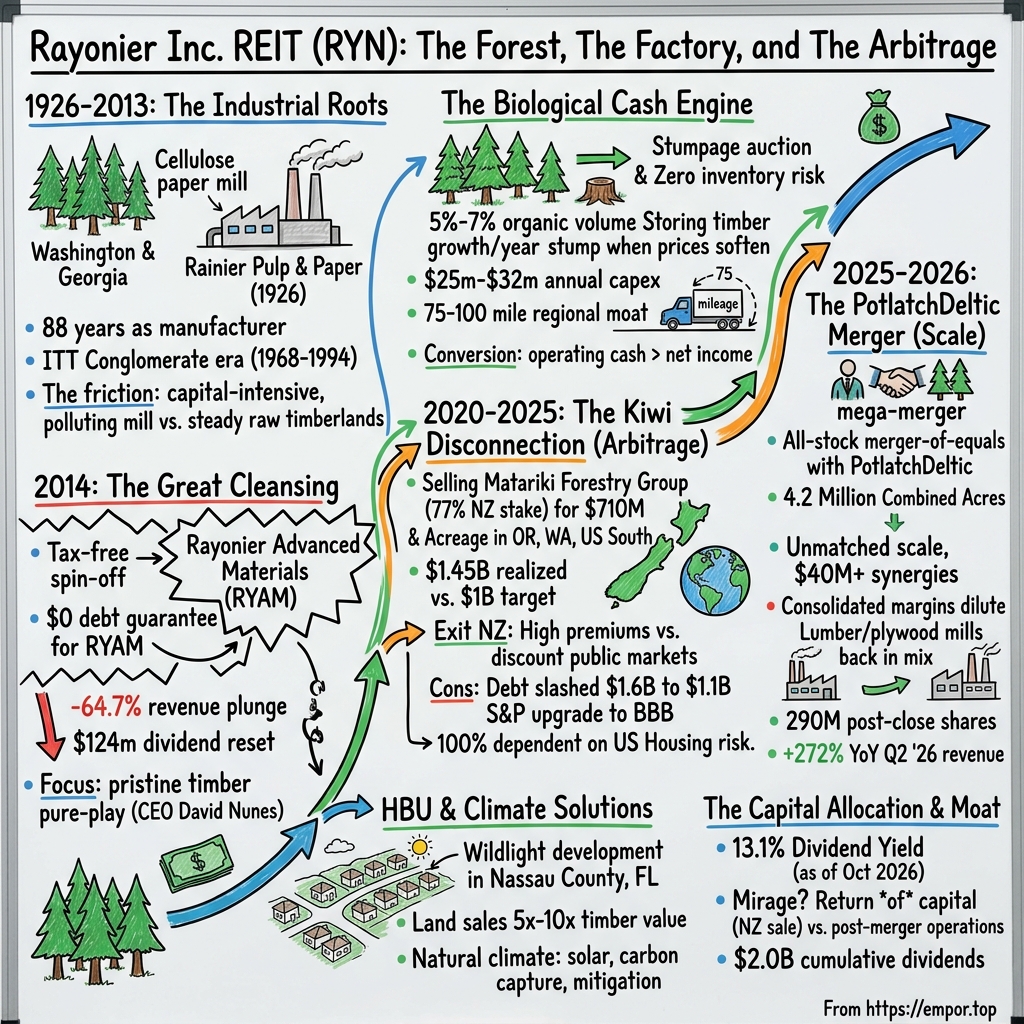
McHugh took over as CEO on April 1, 2024.8 By the middle of 2025 the program had gone well past its target. Dispositions reached about $1.45 billion, and the largest single piece was Rayonier's 77% stake in its New Zealand forestry joint venture, sold for $710 million.9 Then, just as investors were getting used to a smaller, cash-rich, debt-light Rayonier, management changed direction. In October 2025 it agreed to an all-stock merger with PotlatchDeltic, a longtime rival.12 The deal closed on January 30, 2026, and created a company with about 4.2 million acres of North American timberland.4
The sequence looks contradictory. A company sold forests because the market undervalued them, then issued a large block of its own supposedly undervalued shares to buy more forests, along with a set of sawmills. To make sense of it, this story follows three questions.
The first is whether the $1.45 billion disposition program was a smart valuation arbitrage, or whether it gave up the one part of the portfolio that did not move with the American housing cycle. New Zealand radiata pine was harvested on a different seasonal calendar, was sold into Asian export markets, and was priced in a different currency. Once it was gone, everything Rayonier owned depended on the same American homebuilders.
The second is whether PotlatchDeltic adds real scale in the Southern sawtimber regions that matter most, or whether it weakens the clean REIT model Rayonier spent a decade building. PotlatchDeltic was not a pure landowner. It ran lumber and plywood mills, and a sawmill's margin depends on lumber futures, not on how fast trees grow.
The third question will decide how shareholders actually do. Rayonier has paid out far more cash than its forests produce in an ordinary year. Can it keep returning capital at that pace now that the one-time land sales are mostly finished and the company has to live on harvests?
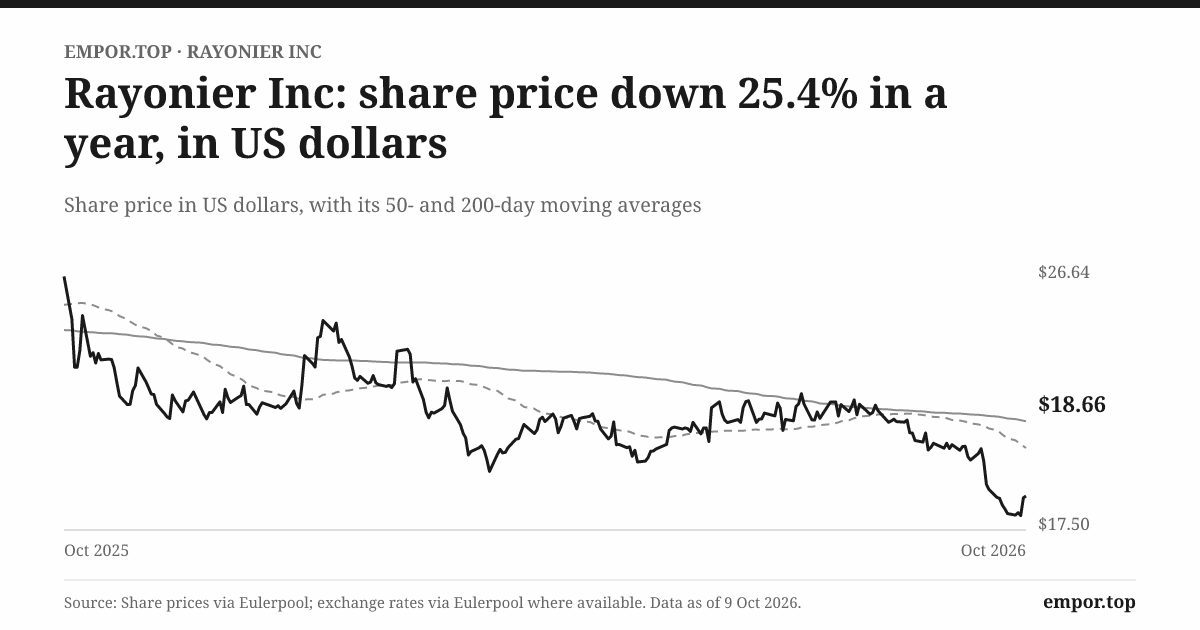
Rayonier enters autumn 2026 with a market value of about $3.0 billion and an enterprise value of about $4.4 billion.1 The shares closed at $18.66 on October 9, almost 29% below their 52-week high, and trade at roughly 60% of reported book value.3 The trailing dividend yield appears to be 13.1%. That number is the first clue in this story, and it tells investors less than it seems to. The company carries a newly upgraded investment-grade BBB credit rating from S&P,13 a combined portfolio that includes the Gulf Coast, the Atlantic coast, Arkansas and the Idaho panhandle, and a shareholder base that roughly doubled overnight.
The thesis to test is that Rayonier spent ten years cutting itself down to a clean timber pure-play, then used a private-versus-public valuation gap to raise cash, and then committed heavily to scale through PotlatchDeltic. Each of those three moves can be defended on its own. Whether they add up to a coherent strategy is the question underneath this whole story.
To answer it, the story starts in 1926, when nobody involved cared much about forests as an investment. They wanted the cellulose inside the trees.
 Subscribe on LinkedIn
II. From Rayon Cellulose to Industrial Empire (1926–2013)
Shelton, Washington, sits at the southern end of Puget Sound. In the 1920s it was a mill town surrounded by western hemlock, a tree lumbermen often treated as a weed. Rainier Pulp & Paper, part of the Reed family's timber interests in Mason County, found a better use for it. The company learned to turn hemlock into dissolving pulp, a very pure cellulose that chemists could convert into rayon fiber, cellophane film and, later, the cord inside automobile tires.1 This was a chemicals business that happened to start with logs, and the company's name came from the product it made. Rayonier grew out of rayon.
The timing was good. Artificial silk was one of the consumer crazes of the Roaring Twenties, and cellophane was becoming the packaging material of a new era of branded goods. A pulp mill that could supply those fibers at scale needed a steady supply of wood, and once a dissolving-pulp mill is built, idling it costs a fortune. The company therefore bought timberland as protection for the mill, not as an investment. Owning the forest meant nobody could squeeze the mill on log prices.
That defensive logic took Rayonier south. During the 1930s and 1940s the company developed pulp operations in Fernandina Beach, Florida, and Jesup, Georgia, and gathered large holdings of slash pine across the flat coastal plain.2 Southern pine grew much faster than Pacific Northwest conifers, and the Southern timber regions became the center of the company. The foresters working those plantations improved seedling genetics, site preparation and rotation planning, the practices that still make up Southern silviculture. The land itself was still a supply arrangement for the mills.
In 1968 Rayonier was acquired by ITT, the conglomerate Harold Geneen had built into a collection of hotels, bakeries, insurers and telephone equipment makers. Inside ITT, Rayonier was a cash generator, valued for steady output and not for the value of its land. ITT spun Rayonier back into the public markets in 1994. It returned as an independent forest products company that owned mills and forests, with the mills still the main business.2
Investors never quite resolved the tension in that structure. Making chemical cellulose was volatile and capital-hungry, and it came with environmental liabilities. Pulp mills consume large amounts of water and chemicals, and the legacy costs of old industrial sites last for decades. The forests behaved very differently. Trees grew every year whether pulp prices rose or fell. Selling land and timber received favorable capital-gains treatment, and the cash came without smokestacks. Combining the two meant the steady, tax-advantaged forests were valued at the multiple of a cyclical chemicals business.
Meanwhile a new kind of company was showing what a forest could be worth when it stood alone. Plum Creek and then Weyerhaeuser adopted the real estate investment trust structure, which lets a qualifying landowner avoid corporate income tax on most timber income if it distributes the bulk of that income to shareholders. Timber REITs attracted a different set of investors: income buyers, real asset allocators and inflation hedgers, who would pay more for land than an industrial investor would pay for a mill. Rayonier converted to REIT status in 2004 but kept its manufacturing business in a taxable subsidiary. For another decade it remained a combined company, with a cellulose business in one part and a tree farm in the other.
The forests that today support a REIT trading on the New York Stock Exchange were not assembled by someone trying to create a real estate portfolio. They were gathered as raw-material protection for some of the most industrial operations in American forestry. That history helps explain why Rayonier's acreage is so concentrated near the coast, near ports and old mill sites, and increasingly in the way of Sunbelt suburban growth.
By 2013 the pressure to separate the two businesses had become very hard to resist. The decision to separate them would bring the company's most uncomfortable year.
III. The Great Cleansing: Spinning Off the Smoke (2014)
In June 2014 Rayonier completed a tax-free spin-off of its performance fibers business into a new public company, Rayonier Advanced Materials, which trades as RYAM.15 Everything that smelled of sulfite and chlorine went with it: the Jesup and Fernandina Beach cellulose specialties mills, their workforce and their environmental history. What remained was meant to be a simple business made up of forests, land and a REIT structure.
The financial statements show how large the change was. Reported revenue fell by almost two-thirds in fiscal 2014 because the manufacturing business left the consolidated accounts.3 The dividend also had to be reset. Rayonier paid out about $257 million in 2014, which reflected the old, larger company, and roughly halved that to about $124 million the following year.3 For income investors who had owned Rayonier as a combined company, the spin-off reduced their income. The remaining company's earnings could not support the old dividend.
The separation agreements set out a clear dividing line. Legacy mill liabilities and the pension obligations attached to the manufacturing workforce went to RYAM. In the separation documents filed at the time, Rayonier described an arrangement in which the parent did not continue to guarantee RYAM's debts.15 That line has mattered since. When RYAM later went through hard years in the commodity cellulose market, those problems stayed with RYAM's own balance sheet. Investors comparing the two companies today should not let RYAM's history affect their view of Rayonier's credit, and the reverse is also true.
The new pure-play then ran into the problem pure-plays often face: once the distractions are gone, investors look closely at what remains. In November 2014 Rayonier said it would restate prior financial statements. The issue concerned how it had calculated merchantable timber inventory and the related non-cash depletion charges, which spread the cost of standing timber across harvests.16 In plain terms, the company had overstated how much harvestable wood it owned. For a company whose main asset is a stock of living trees, that is like a bank misstating its loan book. Leadership changed, and David Nunes, who had run the company's timberland operations, became CEO.
Nunes was a forester-turned-executive with a quiet, methodical style, and he spent his early years rebuilding trust. Rayonier tightened its internal estimates of timber inventory, put more emphasis on independent review of volumes, and became more conservative about the "sustainable yield" it said each forest could support. The restatement came at a bad time and hurt the company's reputation, but it had a useful effect. It made Rayonier's later inventory disclosures more credible, and Ernst & Young's unqualified opinions on both the financial statements and internal controls for fiscal 2024 and 2025 show that the reporting has been clean for some time.23
The investment pitch changed with the structure. The old Rayonier was sold on pulp margins and mill utilization. The new Rayonier was sold on three things: biological growth that increased its inventory every year, the chance to sell land at prices above timber value as Sunbelt suburbs spread outward, and disciplined decisions about when to harvest and when to wait. Management described this as total shareholder return, not commodity production.
The record since then supports part of that pitch and complicates the rest. The spin-off did isolate industrial and environmental risk inside RYAM. It also removed the downstream margin that once let Rayonier capture value between the stump and the finished product, which left the company fully exposed to stumpage prices, the price a sawmill pays for the right to cut standing trees. Over the decade from fiscal 2015 to fiscal 2025, revenue shrank by roughly 1% a year on a compound basis.3 That figure is distorted by divestitures, but it still shows that the pure-play did not become a growth business. It became a business that waits for the right moment to sell.
To see why waiting is a real economic strategy and not just a way of avoiding decisions, it helps to look at how a pine tree becomes cash.
IV. Anatomy of a Tree: The Biological Revenue Engine
Picture a morning on a timber tract in coastal Georgia. Dew is still on the needles of loblolly pine planted around the time of the spin-off, and a forester is walking a stand that has just been offered for sale. Independent logging contractors and procurement buyers from regional sawmills are bidding per ton on the standing trees. Nobody has cut anything yet. What is being sold is a right, the stumpage right, to come in with harvesters, cut a defined block of trees and haul the logs away within a set period.
That is the core of Rayonier's revenue model. The company sells timber in two main ways.2 In a stumpage sale, the buyer pays for the standing trees and takes on the work and cost of logging and hauling. In a delivered-log sale, Rayonier hires the loggers and truckers itself and sells logs at the mill gate, which brings in more revenue per ton but also more cost. Stumpage contracts usually run from six to eighteen months, while delivered-log contracts are shorter, often one to six months, or are tied to index prices.2 Neither type locks in a price for long. Rayonier is paid whatever the regional market for logs will bear that season.
Before the merger, the business was organized around three timber regions: Southern Timber, the Pacific Northwest and New Zealand, with a Real Estate segment alongside them.2 The South was always the most important. It is where most of the acreage sits, where trees grow fastest and where the network of sawmills, pulp mills and pellet plants is densest.
The unusual part of the business is the inventory. In most companies inventory is a liability that ages, spoils or goes out of fashion. A pine tree does the opposite. It adds wood every year, often at mid-single-digit percentage rates, whether or not the economy is in recession.2 And the larger it grows, the more valuable each ton becomes. A young tree is sold as pulpwood for paper and packaging. A tree that reaches sawtimber size can be cut into lumber and earns a higher price per ton. Leaving a stand in the ground for a few more years can increase both the volume and the price.
That gives management a tool few commodity producers have. When log prices are weak, Rayonier can harvest less and "store timber on the stump," letting the forest keep growing until prices recover.2 An oil producer that shuts in a well gives up current output and gains nothing. A timberland owner that defers a harvest keeps the trees, and they grow while waiting. The limits are real. Deferral cannot go on forever, because overmature stands bring their own risks from pests, fire and hurricanes. And a REIT that pays out most of its income cannot hold back harvests for years without hurting its distributions. Still, the option to wait is the main reason timberland behaves differently from other commodity businesses.
The working capital is also unusually favorable. Buyers of standing timber typically pay before harvest or post a letter of credit, while delivered logs settle on terms of fifteen to thirty days.2 Rayonier's debtor days, the average number of days customers take to pay, have stayed between about ten and seventeen for a decade and were twelve in fiscal 2024.2 Allowances for bad debts have stayed below $1 million.2 No customer accounted for 10% or more of revenue in any of the last three fiscal years, and the company recorded no material customer defaults over that period.23 Rayonier does not hold a warehouse of finished goods that can lose value. Its inventory is still standing in the forest.
This shows up most clearly in the gap between reported profit and cash. Over the twelve years from fiscal 2014 to fiscal 2025, Rayonier reported about $2.0 billion of cumulative net profit and generated about $3.1 billion of operating cash flow, roughly one and a half times its accounting earnings.23 The main reason is depletion. Each time a tree is cut, an accounting charge reduces profit to reflect the cost of the wood that was used. That charge has run in the tens of millions of dollars a year, but it involves no cash payment, because the cash was spent years earlier when the land and trees were bought. GAAP earnings therefore understate the cash the business produces, which is why sensible timber investors look at cash available for distribution rather than earnings per share.
Rayonier has no research and development budget in the usual sense. Its version of R&D happens in the field. Each year it spends between about $25 million and $32 million on silviculture in the Southern Timber region alone: replanting harvested tracts with genetically improved seedlings, controlling competing brush and fertilizing young stands.23 That is roughly 6% to 8% of the segment's revenue, which is the cost of keeping the forest productive indefinitely. Spend less and the harvests twenty-five years from now get smaller. This is maintenance spending, even if it looks optional in any particular year.
Then there is the limit on pricing power, which shapes almost everything else in this story. Logs are heavy and cheap. A truckload of pine pulpwood is worth little compared with the diesel needed to haul it, so a forest's market is defined by how far a log truck can go before freight cost wipes out the margin, roughly 75 to 100 miles in the South. Inside that radius, an owner with dense acreage near several competing mills has some bargaining position. Outside it, the owner's wood cannot compete. Rayonier does not sell into a national timber market. It sells into many local markets, each set by which mills are nearby, how much they can process and how many other landowners are competing to supply them.
That is the main limitation of the model. The engine is clean, cash-generative and self-renewing, and it carries no finished-goods risk. But the price it receives is set by local sawmills, and those sawmills take their cue from lumber prices, which follow American housing starts. Biology determines how much wood Rayonier has. Mortgage rates largely determine what it is paid for it.
For most of the past decade, one part of the portfolio did not depend on those local American markets. It was on the other side of the world.
V. The Kiwi Disconnection: Arbitrage or Abandonment? (2020–2025)
On June 30, 2025, Rayonier completed the transfer of its 77% interest in Matariki Forestry Group, its New Zealand joint venture, to a consortium of international buyers for $710 million in cash.9 With that closing, the disposition program announced in November 2023 had raised about $1.45 billion against an initial $1 billion target.9 It was a large win for the program and also a lasting change in what kind of company Rayonier would be.
New Zealand had always been somewhat out of place in the portfolio. Its radiata pine forests grew quickly on a southern-hemisphere calendar, so harvest seasons ran opposite to those in Georgia and Washington. Much of the wood went by ship to China and other Pacific Rim buyers, priced in U.S. dollars but produced with New Zealand dollar costs. In some years that diversification worked well. When the American housing market slowed, Chinese demand could keep the New Zealand business going. In other years it caused trouble. The New Zealand dollar swung, freight rates jumped, and Chinese port inventories filled up without warning. At the end of 2024 Rayonier was carrying about $128 million of currency forward contracts and $132 million of option contracts to manage that exposure.2 Owning the business meant running a currency hedging operation alongside it.
The case for selling rested on a price gap that had been widening for years. Large pools of private capital, including pension plans, sovereign wealth funds and timberland investment management organizations, wanted forests. Some wanted an inflation hedge. Others wanted carbon sequestration credits, ESG-aligned real assets, or simply long-duration cash flows that did not track equities. Those buyers paid high prices for mature, well-stocked acreage, with implied multiples above 20 times EBITDA on some transactions.9 Over the same period, public timber REITs often traded at large discounts to their own estimates of net asset value, in some cases 30% to 40%.17 The Wall Street Journal described the trade in 2024: public timber companies were selling to private buyers to take advantage of the gap while housing was weak.17 Rayonier was the clearest example.
The program was executed steadily. Rayonier sold tracts in Oregon, Washington and the U.S. South, chosen because they were noncore, less productive or simply worth more to someone else, and then sold New Zealand last.29 The effect on the balance sheet was large. Borrowings fell from about $1.6 billion at the end of 2022 to about $1.1 billion at the end of 2025.23 Cash rose to about $843 million by year-end 2025.3 Investing cash flow, normally negative for a company buying land and planting trees, turned positive by about $615 million in 2025.3 On July 10, 2025, S&P upgraded Rayonier from BBB- to BBB with a stable outlook, citing the New Zealand closing, the lower debt and an expectation that net debt would stay comfortably below three times EBITDA even at the bottom of the cycle.13
On those terms, the program was a clear success. Management said it would sell $1 billion of assets at prices above what the stock market implied, and it sold almost half again as much, paid down debt and won an upgrade. Few public-company disposition programs exceed both their size target and their stated purpose. Because the program delivered what management promised, it also gives some evidence about McHugh as an executive. He set a public target and beat it.
The case against it is just as strong. Selling New Zealand removed the only part of the portfolio whose revenue did not depend on American housing starts. It also ended the currency hedging program and the export access to Asia that came with it. Rayonier now earns all of its revenue in U.S. dollars and depends entirely on domestic demand.3 The S&P report that delivered the upgrade also named Rayonier's main weakness: cyclical exposure to North American lumber markets and dependence on a single commodity.13 After the sale, that weakness became Rayonier's entire risk profile.
The arbitrage argument has a less obvious weakness too. If private buyers were really paying 20-plus times EBITDA while the public market paid much less, selling assets captured the gap only for the assets that were sold. The remaining assets were still valued at the public market's lower multiple. The cash came back to shareholders as debt reduction and special dividends, which was real value. But the market did not rerate what remained. Rayonier's shares trade today at around 60% of book value, which suggests the discount the program set out to exploit is still there for the forests the company kept.
The fairest conclusion is that the program was a successful financial transaction that left the company with less strategic flexibility. It improved the balance sheet and, on the evidence available, captured prices public investors would not have paid. It did not close the valuation gap for the remaining portfolio, and it removed Rayonier's hedge against the next American housing downturn. One way to test it will be the Southern harvest cash yield per acre that the surviving portfolio produces compared with the operating cash flow New Zealand used to provide, which the fiscal 2026 segment disclosures should start to show.
What Rayonier did next made that comparison more complicated. Less than four months after the New Zealand closing, it announced it would double in size.
VI. The PotlatchDeltic Mega-Merger: Scale over Purity (2025–2026)
On October 13, 2025, Mark McHugh and PotlatchDeltic's leadership announced an all-stock merger of equals.12 The terms gave each PotlatchDeltic shareholder 1.8185 Rayonier shares plus $0.61 in cash for every PotlatchDeltic share.5 Shareholders of both companies approved the deal, and it closed on January 30, 2026.4 The new Rayonier owned roughly 4.2 million acres spread across the Atlantic and Gulf Coast pine regions, the Arkansas and Mississippi forests that had been PotlatchDeltic's Southern base, the Idaho panhandle and the Pacific Northwest.4
The share count shows how large the deal was. Rayonier had kept its share base in the range of 145 million to 150 million through the first half of the decade.3 The merger roughly doubled it to more than 290 million shares.4 A company that had spent two years shrinking to show the private market's view of value then issued a very large block of new stock to become the second-largest timber REIT in North America. Weyerhaeuser, with around 11 million acres in the United States, is still the clear leader. The combined Rayonier is a solid second.5
Management's case rested on scale and density. In the merger materials, the two companies said the combination would produce at least $40 million a year in run-rate synergies, mostly from removing duplicate corporate overhead and gaining procurement and marketing efficiencies across a larger and more contiguous footprint.512 Within any given log truck radius, more acreage means more ability to schedule harvests, more consistent supply to customers and more competitive tension among the mills that need the wood. Two timber companies with overlapping Southern regions should, in principle, be able to manage those regions better as one owner.
The weakness in that case was obvious from the first day. PotlatchDeltic was not a pure landowner. It operated a wood products business with sawmills producing lumber and an industrial plywood plant,5 which are the kind of manufacturing operations Rayonier had removed from itself in 2014. A sawmill earns money on the spread between the logs it buys and the lumber it sells. When lumber prices fall faster than log prices, that spread can collapse to zero or turn negative. Rayonier's shareholders, who had owned a clean timberland REIT, now owned a lumber company inside it.
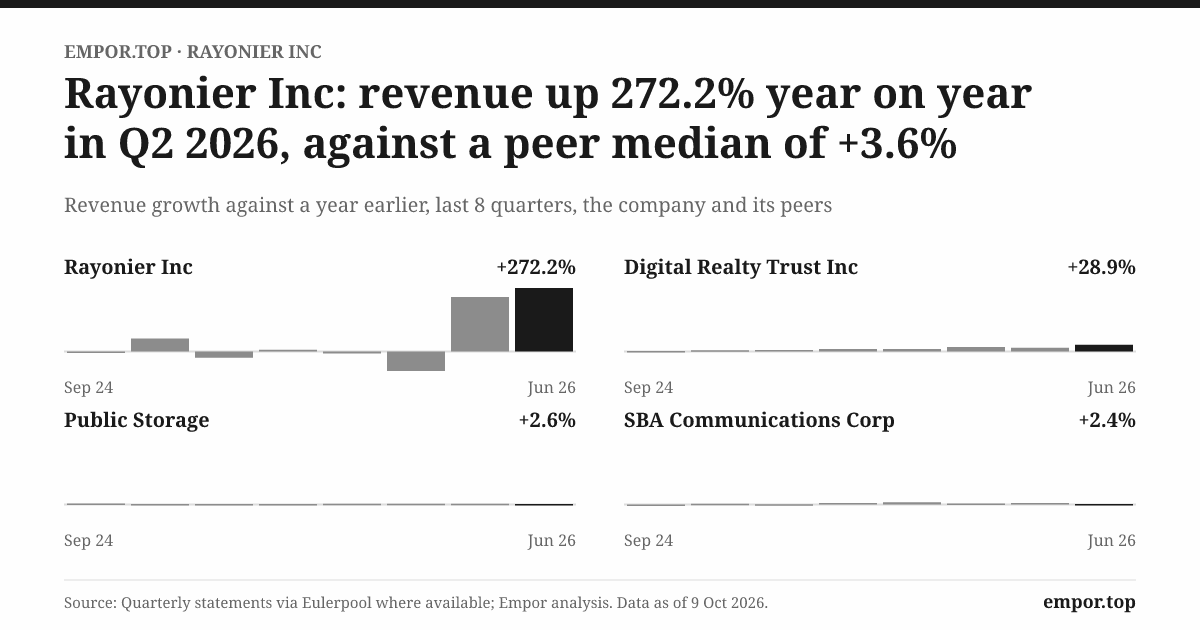
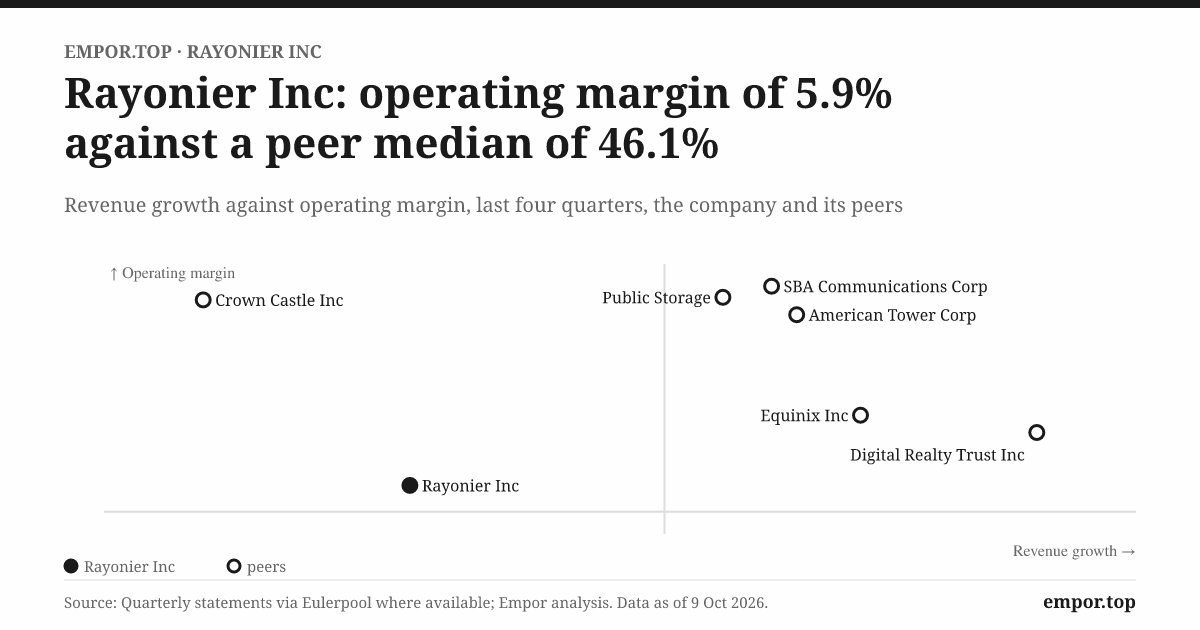
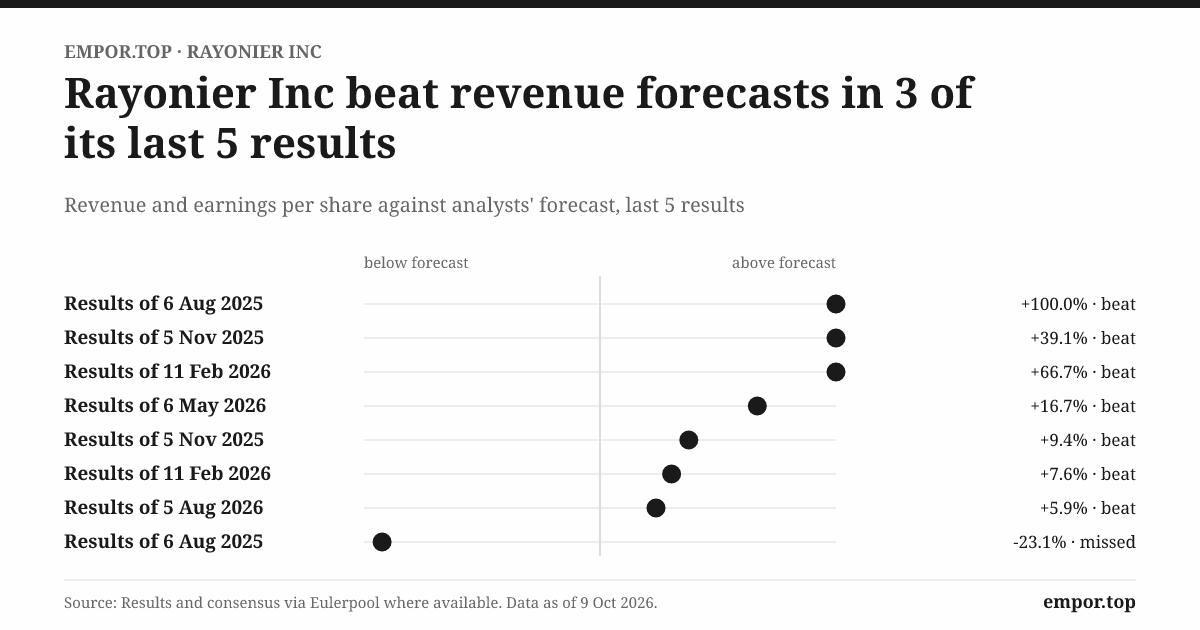
The quarterly results show the change clearly. Consolidated revenue for the June 2026 quarter was about $396 million, compared with about $107 million a year earlier, an increase of more than 270%.6 Almost all of that came from consolidating PotlatchDeltic, not from organic growth. The operating margin went the other way. Rayonier's stand-alone timber business had reported quarterly operating margins in the twenties in good quarters. The combined company reported an operating margin of about 8.7% in the June 2026 quarter,6 after an operating loss of about $46 million in the March quarter, which carried merger costs and transaction accounting.6 Some of that drop is temporary: deal fees, step-ups in acquired inventory and integration costs. Some of it is structural, because a sawmill's revenue dollar carries much less margin than a stumpage dollar.
The discussion on recent calls has focused on that tension.1011 Management has emphasized synergy progress, the quality of the combined Southern acreage and the value of controlling more of the wood flow from forest to mill. The investor questions keep coming back to the issue McHugh's team has to answer with results rather than presentations. If the company spent a decade arguing that smokestacks depressed its valuation multiple, why should the market now pay a timber multiple for a business that once again includes sawmills?
There is a reasonable answer. Owning mills alongside timberland in the same region can protect landowner profits when log markets are weak, because the company has a guaranteed buyer for its own wood. When lumber prices are strong, the mill captures margin that would otherwise go to a third-party sawmill. Weyerhaeuser has long run that integrated model successfully. But this argument also challenges Rayonier's own history. In 2014 the company concluded that combining manufacturing and timber destroyed value. In 2025 it concluded that combining them at much larger scale creates value. Both conclusions might be right in their own circumstances, since cellulose specialties and lumber are very different businesses, but investors should not simply accept a strategic reversal without evidence.
The evidence is not in yet. The $40 million synergy figure is a management estimate, not a reported result. The mills' contribution through a full lumber downturn has not yet appeared in a full-year filing. And the share issuance means every dollar of future cash available for distribution is now divided over roughly twice as many shares.
The fairest verdict for now is that the merger may well have bought real regional density in some of the best Southern timber areas, and density does carry bargaining power. It also brought back the manufacturing exposure the old Rayonier spent years getting rid of. The fiscal 2026 10-K, with its first full year of wood products segment EBITDA margins, will be the first real test.
If timber is cyclical and the mills add more volatility, is there anything in the land that does not depend on lumber prices? Rayonier's answer, for more than a decade, has been the land itself.
VII. The Higher and Better Use: Real Estate and Natural Climate Solutions
Drive north on Interstate 95 out of Jacksonville and, just before the Georgia line, the pine plantations along the highway give way to a planned town. Wildlight, in Nassau County, Florida, was built on land Rayonier once grew pine on. It has homes, a school, offices and the company's own headquarters.14 A few years ago these acres were sold the way Rayonier sold most land, as stumpage measured in tons per acre. Now they are sold by the lot, the home and the commercial parcel.
That is the higher and better use strategy, usually shortened to HBU. A timber tract is valued in two ways. One is what its trees will bring at the mill. The other is what the land itself would bring if used for something else, such as a subdivision, an industrial park, a solar farm or a conservation easement. For most rural Southern acreage, the timber value is the right one, because nobody wants to build a house forty miles from the nearest supermarket. For a small share of acreage near growing Sunbelt metros, the gap between the two can be very large. Rayonier has said HBU land can sell for several times its timber value, sometimes five to ten times or more.14
Wildlight is the company's test of whether it can capture development value itself rather than selling raw land to a homebuilder and leaving the profit with the builder. Rayonier has put in roads, utilities and entitlements to raise the value of the finished parcels. It has also sold commercial and residential lots and kept interests in some of the development.14 Done well, this approach can turn a timber company's best-located land into something like a land development business. The risk is that Rayonier ends up acting as a property developer, with entitlement fights, construction costs and the cycle of Florida's housing market, without any of the advantages it has as a forester.
Rayonier has also moved into a newer set of land uses it calls natural climate solutions.14 Utility developers lease cleared timberland for large solar arrays and pay steady rents for decades. Companies building carbon capture and storage projects lease underground pore space to inject captured carbon dioxide, a use that does not depend on what is growing on the surface. Mitigation banking lets landowners restore wetlands and sell credits to developers who must offset environmental damage elsewhere. Forest carbon programs pay landowners to grow trees longer and store more carbon. Each of these can earn much more per acre than a pine rotation, and management has presented them as a growing source of income separate from timber.14
This is where the evidence matters more than the presentation. Real estate sales are lumpy, and the segment's results can swing sharply from quarter to quarter depending on whether a large parcel closed. Several of the quarters in recent years with unusually high operating margins, including the December 2024 quarter in which operating margin reached about 48%, were driven largely by real estate transactions rather than timber.2 That shows the HBU value is real. It also shows that HBU cash is mostly a source of capital, not a source of recurring income.
The newer climate-related revenues have an even shorter record. Solar leases, carbon capture agreements and mitigation banks are long-term contracts whose economics depend on regulatory incentives, permitting and the decisions of the companies building the projects. Management has not shown that these uses generate a large share of consolidated revenue, and on the available disclosures they remain a modest fraction of the timber and wood products business. The pattern in long-lived land businesses is that optionality takes years to turn into recurring cash, and some of it never does.
So the verdict on HBU and climate land uses has two parts. The value is real and measurable at the level of individual parcels, and Wildlight shows that Rayonier can create value on well-located land rather than simply waiting for buyers. But the acreage affected is a small fraction of a 4.2-million-acre portfolio, much of it in a few micro-markets near Jacksonville, Savannah and the Gulf Coast. It cannot replace timber income through a housing downturn. At most it can soften one.
That leads to the question every Rayonier shareholder eventually asks: if part of the company's cash comes from selling land rather than growing trees, how much of the dividend is income and how much is the company selling itself off piece by piece?
VIII. Capital Allocation & Governance: The 13% Dividend Mirage
Picture Rayonier's directors meeting in Wildlight after the New Zealand sale, with a large cash balance on the books. There were three ways to use it. They could pay down debt and strengthen the newly upgraded credit rating. They could buy back stock, which the arbitrage logic favored, since the shares traded below what the company thought its forests were worth. Or they could pay it out as a dividend, which REIT rules encourage because a REIT that keeps taxable gains pays tax on them. The board did a mix of all three, and the dividend part is what investors see first.
At $18.66 a share, Rayonier's trailing dividend yield is 13.1%.1 For a BBB-rated real estate company, that is extraordinary, and it should be explained before anyone treats it as a reliable income stream. The twelve-month figure includes distributions linked to the asset sales, including special payments that returned capital from the dispositions. In fiscal 2025 Rayonier paid about $292 million in dividends, against operating cash flow of about $256 million and free cash flow of about $207 million.3 The dividend exceeded the cash the business produced from operations. The New Zealand sale covered the difference.
The longer record makes the point more clearly. Over the twelve years from fiscal 2014 to fiscal 2025, Rayonier paid about $2.0 billion in dividends. Over the same period, the free cash flow measure in its reported cash flow statements, operating cash flow less capital expenditure, added up to about $486 million.23 Dividends were roughly four times reported free cash flow. That is an extreme ratio, and it needs explaining before anyone calls it a red flag.
Part of the explanation is accounting. The capital expenditure line for a timber REIT includes timberland purchases, which are growth investments rather than upkeep. In years when Rayonier bought large tracts, such as 2016 or the 2020 Pope Resources deal, free cash flow on this measure turned sharply negative even though the forest business was generating plenty of cash.2 The other part is that Rayonier has always paid some of its dividend from land sales, recycling capital from tracts that had become worth more as real estate than as timber. Payout ratios over the period ranged from around half of net profit in fiscal 2024 to nearly four times net profit in fiscal 2020.3 Those swings are what happens when a REIT has steady cash but very uneven accounting earnings.
Even with those adjustments, the conclusion is clear. Rayonier's dividend has never been fully covered by recurring timber cash flow alone. It has relied partly on land sales, and the 13.1% trailing yield reflects an unusually large land sale. When the sale proceeds were paid out, investors received some of their own capital back. Whether that was a good decision depends on whether the forests sold were worth more to private buyers than to Rayonier's shareholders, which, as the New Zealand story shows, they probably were. It does not mean the yield will repeat.
Management's incentives are designed to encourage this kind of capital discipline. Executive compensation is tied mainly to relative total shareholder return against peers and to cash available for distribution.7 McHugh's total compensation, and that of Nunes before him, has generally been between about $4.5 million and $6.5 million a year without large discretionary bonuses.7 CFO April Tice moved into her role in the 2024 transition.8 Board independence is above 85%, and say-on-pay votes passed with more than 93% support in 2024 and 2025.7 The company disclosed no related-party transactions above the SEC's $120,000 reporting threshold over the last three years, and there are no management fees, sponsor arrangements or royalty payments to anyone outside the company.7 Institutions hold most of the stock, with Vanguard and BlackRock together owning more than a fifth of the shares, and insiders together own less than 1.5%.187
Governance is clean, but it should not be credited with more than the record supports. The most important governance event in Rayonier's recent history is the 2014 restatement, which was a real failure in controls over the company's most important asset and which management has since repaired. The more recent question is strategic consistency, not integrity. A board that approved a large divestiture program on the basis that public markets undervalued the company's forests then approved issuing roughly as many new shares as the company already had, at a share price the board's own reasoning considered too low, to acquire another company's forests and sawmills. Each decision has its own rationale. Taken together, they deserve a close look from shareholders.
Post-merger, the dividend has to be funded differently. There are now more than 290 million shares and no New Zealand sale proceeds to distribute. Ordinary dividends now have to come mainly from harvest cash flow, mill margins and normal land sales. The figure that will show what Rayonier's real distribution capacity is will be the regular quarterly dividend declared in the fourth quarter of 2026, without any special payment added on top.
Whether that capacity is high or low depends on how much bargaining power Rayonier has when it sells its logs.
IX. Competitive Moats & The Forest Industry Structure
Imagine an institutional forestry conference in an Atlanta hotel ballroom, the kind where timberland investment managers, REIT analysts and mill procurement executives meet once a year. One question always comes up. Is it better to own Weyerhaeuser's scale, about 11 million acres spread across the American South and Pacific Northwest with an integrated wood products business, or a concentrated position in the best Southern timber regions? Rayonier's answer, after the merger, is to own something of both.
The market currently values the two strategies differently. Rayonier trades at about 16.3 times enterprise value to EBITDA, compared with roughly 13.8 times for Weyerhaeuser.1 At the same time, Rayonier trades at only about 0.6 times book value.1 Taken together, the two figures show that the market expects the merged company's earnings to recover from a depressed level, but does not fully trust that the combined acreage is worth what the company paid for it. Book value now includes PotlatchDeltic's forests at their merger-date fair values, and the stock price discounts those values by about 40%.
Hamilton Helmer's 7 Powers framework helps show where any lasting advantage comes from. The strongest candidate is cornered resource. High-quality timberland in the Southeast, with good soils, enough rainfall, flat terrain, access to roads and closeness to ports and growing cities, is finite. Nobody can create a new 4-million-acre Southern pine portfolio. Rayonier's land, assembled over almost a century, is a resource competitors cannot easily copy.
The second is scale economies and density, which appear here mainly as location. Within a log truck radius, an owner with the largest and most contiguous holdings has lower harvest and hauling costs per ton, more flexibility to schedule harvests, and more influence over the mills that depend on that wood. The merger increased Rayonier's density in several Southern regions, and that is the most credible economic case for the deal.5
The other powers are mostly missing, and it is important to say so. There is no process power. Silviculture best practices are widely shared through extension services, university forestry programs and consultants, and the seedling genetics Rayonier plants are available to rivals. There are no network effects. There is no brand power: no sawmill pays more for a Rayonier log. And switching costs for buyers are close to zero. If a neighboring landowner offers lower stumpage, a mill can switch suppliers on the next contract.
Porter's five forces give the same answer from a different angle. Buyer power is moderate to high. Sawmills and pulp mills cannot move their plants, which gives local landowners some leverage, but in a housing downturn mills reduce shifts, slow purchases and push stumpage prices down, and landowners have no choice but to accept lower prices or stop harvesting. The low customer concentration in Rayonier's filings, with no customer above 10% of revenue,2 shows that no single buyer controls the company. It does not show that Rayonier can set prices.
Substitutes are a low-to-moderate threat. Steel, concrete and engineered materials compete with wood at the edges, especially in commercial construction, but for American single-family homes, framing lumber is still the cheapest structural material, and its low embodied carbon has become a selling point. New entrants are close to no threat at all. Land prices, twenty-five-to-thirty-year pine rotations, zoning limits and the competition from private institutional capital make it economically impossible to build a new multi-million-acre portfolio. Supplier power is moderate, centered on the independent logging and trucking contractors who cut and haul the wood. When diesel prices rise or contractors are scarce, harvest costs go up, and the landowner absorbs some of that.2
The strongest test of any timberland moat is a housing collapse. From 2008 to 2011, American housing starts fell to their lowest levels in generations. Southern sawtimber stumpage prices collapsed and stayed low for years, as mills closed and the region was left with excess standing wood. Timberland owners with the best land and the densest positions still saw their prices fall. The recent period was a smaller version of the same thing. When mortgage rates jumped in 2022 and 2023, Rayonier's revenue and quarterly operating margins swung sharply, with some quarters in 2024 showing single-digit margins.2 Owning good land helped Rayonier lose less in those periods. It did not protect the company from them.
The record narrows the moat claim considerably. Rayonier has a real cornered resource and real local density advantages, and those advantages show up in lower costs and more harvest flexibility. They do not give the company pricing power over a commodity whose price is set by national housing demand and global lumber trade. The best way to describe Rayonier is as a well-positioned price-taker that can choose when to sell. The KPI to watch is Southern sawtimber stumpage realization per ton compared with regional benchmarks. If Rayonier consistently earns a premium to its neighbors, the density argument holds. If it does not, the moat is mostly about cost.
That leaves the question every forestry investor faces sooner or later: what happens when American housing turns again?
X. Bull vs. Bear Case: The 2027 Housing Horizon
On trading desks in early October 2026, Rayonier shares changed hands at $18.66, almost 29% below their 52-week high and not far from their 52-week low of about $18.1 The stock has fallen 60% from its peak at its worst point over the last five years.1 Investors are trying to decide whether the shares are cheap timberland waiting for a housing recovery, or a merged company with weak earnings power and an inflated dividend.
The bull case starts with the asset backing. Investors are buying productive American forests at about 60 cents for each dollar of GAAP book value, $18.66 against roughly $32.95 per share of book value.1 Book value is an accounting figure, and the merged company's book includes acquired timberland at fair value as of the deal date. But forest values are relatively easy to check against the private market, and the disposition program showed that private buyers pay more than the stock market implies.
The second bull argument is the growing inventory. Rayonier's trees keep adding wood every year. Deferred harvests during a slow housing market are not lost, because they are still standing. If mortgage rates fall and housing starts rise, the company will have more wood and better-quality wood to sell into a stronger market. That gives the stock real leverage to a housing recovery.
The third is the balance sheet. A BBB rating, net debt below a quarter of total asset value at the end of 2025, a weighted average interest rate below about 4.2% and no large maturities before 2029 mean Rayonier can wait for better conditions.313 A timber company with that much financial flexibility is not forced to harvest at low prices.
The fourth is demand. Several estimates put America's shortfall of single-family homes in the millions after a decade of underbuilding. If that shortfall is eventually filled, it will take years of high lumber consumption, which supports Southern sawtimber prices and, with them, Rayonier's mills and land.
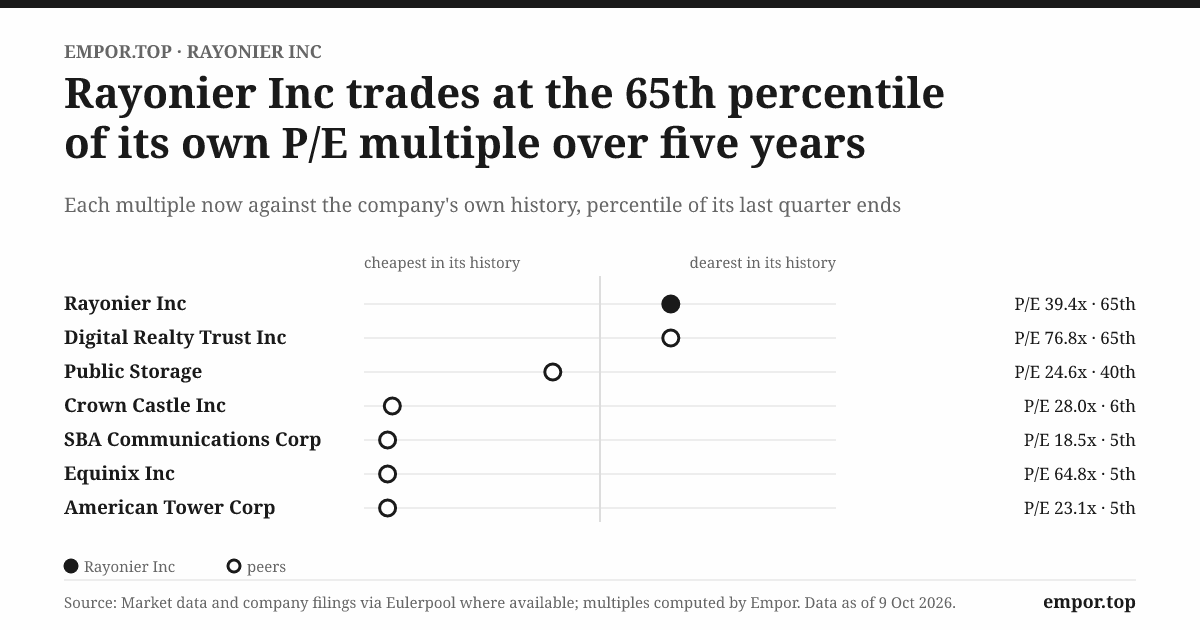
The bear case starts with the mills. PotlatchDeltic's lumber and plywood operations have pulled consolidated operating margins down into single digits, and in a prolonged lumber downturn they could turn into a cash drain. The trailing P/E of about 39 compared with a five-year median of about 31,1 and a return on equity of about 1.5% over the last twelve months,1 show how thin current earnings are relative to the price.
The second bear argument is the dividend. Investors attracted by the 13.1% trailing yield are looking at a figure inflated by asset-sale payouts. When distributions reset to what harvest and mill cash flow can support, the headline yield will look much lower, and some of the income investors who bought for that yield are likely to leave.
The third is concentration. With New Zealand gone, Rayonier has no Asian export business, no counter-seasonal harvests and no currency diversification. Its fortunes depend entirely on American mortgage rates and housing starts.
The fourth is execution. Combining two large timber organizations means reconciling harvest planning systems, silviculture programs, procurement relationships, IT platforms and corporate cultures across 4.2 million acres, with headquarters functions in Florida, Washington state and Idaho. The $40 million synergy target is management's estimate and has not yet been shown in results.5
An activist or a skeptical short seller would focus on one issue in particular: the value of the merger compared with the value of buybacks. If management believed in late 2025 that the shares were worth well above their trading price, it could have used the New Zealand proceeds to buy back stock at a discount. Instead it issued about 145 million new shares at prices near where the stock trades today. The defense is that the merger bought density no buyback could create. The critique is that it diluted the arbitrage gains the disposition program had just delivered. That argument will not be settled until the merged company has a few years of cash flow per share to compare with the old Rayonier.
Two indicators matter most for following the story. The first is cash available for distribution per share after the merger, the measure that will determine the regular dividend. The second is wood products segment EBITDA margin through a full lumber cycle. Southern stumpage realization per ton is a third useful check on whether the density argument holds. None of these is fully visible yet. The bull and bear cases are both plausible, and the next twelve months of reported results will start to show which one is closer to right.
XI. Playbook: Business & Investing Lessons
The first lesson comes from the closing of the New Zealand sale: if you can see the valuation gap, act on it before someone else closes it. Rayonier saw that private capital would pay prices for mature forest that public investors would not, and it sold into that demand rather than waiting for the stock to rerate. The lesson for any company sitting on a public market discount is that the most reliable way to capture private-market value is to sell to a private buyer. A company that only argues its shares are undervalued is usually ignored. A company that sells $1.45 billion of assets at prices above its implied valuation is not.
The second lesson comes from the change between 2014 and 2026. A pure business looks best when markets are strong, and scale matters more when they are weak. Spinning off the cellulose mills created a clean REIT that investors valued at a timber multiple. In a high-rate housing market, with smaller harvests and land sales nearly done, Rayonier concluded it needed more acreage, more density and a captive buyer for its wood. Whether that conclusion holds up will take years to know. The lesson is that a strategy can be right for one period and wrong for the next, and the judgment lies in recognizing when the period has changed.
The third lesson is about the dividend. A distribution funded by selling forests in New Zealand is a return of capital, not a return on capital. Rayonier's 13.1% yield is real cash, but much of it came from selling assets that will not be there to produce cash again. Investors who confuse the two will overpay for yield. Over time, a timber company compounds through growth and harvest margins, not through one-time payouts.
The fourth lesson is the one most specific to Rayonier: a pine tree cannot be hurried. Software can be shipped this quarter and factory output can be raised next month, but Southern pine supply takes a quarter-century to respond to demand. That slow cycle is the timberland owner's main advantage, as long as its balance sheet allows it to wait. Rayonier's debt reduction, credit upgrade and long-dated maturities give it that ability. Its job now is to keep it while running a set of mills that work on a much shorter clock.
XII. Epilogue
Tonight, integration teams in Wildlight, Spokane and Atlanta are working to combine two timber companies into one harvesting operation across 4.2 million acres. They are deciding which harvest plans to keep, which procurement contracts to renegotiate, which offices to close and which mills to keep running full shifts. It is slow, detailed work, and it will determine whether the merger produces the synergies management promised or simply a larger version of the same commodity business.
Three upcoming events will go a long way toward answering the questions this story started with.
The first is the fourth-quarter 2026 dividend declaration. That will be the first clear signal of what the board thinks the combined company can pay from ongoing operations, without asset-sale proceeds or special payments. A regular dividend that is well covered by cash available for distribution would suggest the merger has created a sustainable income stream. A sharp cut would confirm that the 13.1% trailing yield was mostly a return of capital, and the market would start to price the company on its actual earning power.
The second is the fiscal 2026 annual report, with the first full year of wood products results. That filing will show whether PotlatchDeltic's mills generated cash through a weak lumber market or consumed it. Positive mill margins in a downturn would support the integration argument. Losses would raise the question of whether the mills should be sold, closed or spun off, which would repeat the decision Rayonier made in 2014.
The third is synergy realization. Management has said it will deliver at least $40 million in run-rate savings. Whether it reaches that number without disrupting the contractor networks and mill relationships that make each region work will show whether the merger was a real operational combination or mainly a financial one.
Each outcome bears on one of the three questions. The dividend will show whether the capital returns were sustainable. The mill margins will show whether scale was worth giving up purity. The synergies will show whether the arbitrage gains were reinvested well or diluted away. None of them can be answered tonight. The trees will grow in the meantime, and the quarterly reports will keep coming. Investors will have to judge between those two timelines.
XIII. Outro
Back in the pine stands of southeastern Georgia, trees planted around the time of the 2014 spin-off are only now reaching sawtimber size. They have been through a restatement, two CEOs, a disposition program, a New Zealand exit and a merger. None of that affected them. They kept adding wood each year in the rain and the sun.
That is what makes Rayonier unusual. In most businesses, inventory loses value while it waits. Here, the inventory grows. Rayonier's management can sell forests, buy mills, issue shares and pay dividends, and none of that changes how fast a pine tree grows. What it does decide is who benefits from that growth. The company's main asset is the time its trees spend growing, and its main risk is a management team that sells off the land to pay a dividend instead of harvesting what the land produces.
References
-
Investor Relations Homepage — Rayonier Inc., 2026-10-01 ↩↩↩↩↩↩↩↩↩↩
-
Form 10-K for Fiscal Year Ended December 31, 2024 — Rayonier Inc., 2025-02-21 ↩↩↩↩↩↩↩↩↩↩↩↩↩↩↩↩↩↩↩↩↩↩↩↩
-
Form 10-K for Fiscal Year Ended December 31, 2025 — Rayonier Inc., 2026-02-23 ↩↩↩↩↩↩↩↩↩↩↩↩↩↩↩↩↩
-
Form 8-K: Completion of Merger with PotlatchDeltic Corporation — Rayonier Inc., 2026-01-30 ↩↩↩↩
-
Joint Proxy Statement/Prospectus (Form S-4/DEFM14A) for Merger with PotlatchDeltic — Rayonier Inc., 2025-12-05 ↩↩↩↩↩↩
-
Form 10-Q for the Quarterly Period Ended June 30, 2026 — Rayonier Inc., 2026-08-06 ↩↩↩
-
Definitive Proxy Statement (Form DEF 14A) — Rayonier Inc., 2025-04-02 ↩↩↩↩↩
-
Form 8-K: Executive Leadership Transition and CEO Appointment — Rayonier Inc., 2024-04-01 ↩↩
-
Press Release: Rayonier Exceeds $1 Billion Asset Disposition Target with New Zealand Sale — Rayonier Inc., 2025-07-01 ↩↩↩↩↩
-
Q2 2026 Earnings Conference Call Transcript and Presentation — Rayonier Inc., 2026-08-06 ↩
-
Q4 2025 Earnings Call Transcript: Asset Sale Proceeds and Capital Allocation — Rayonier Inc., 2026-02-24 ↩
-
Rayonier and PotlatchDeltic Joint Merger Announcement Conference Call — Rayonier Inc., 2025-10-14 ↩↩↩
-
Research Update: Rayonier Inc. Upgraded to 'BBB' on Leverage Reduction Following NZ Sale — S&P Global Ratings, 2025-07-10 ↩↩↩↩
-
Rayonier Investor Day Presentation: Sustainable Forestry and HBU Real Estate Strategy — Rayonier Inc., 2024-06-12 ↩↩↩↩↩
-
Form 8-K: Rayonier Advanced Materials Spin-Off Completion and Separation Agreements — Rayonier Inc., 2014-06-30 ↩↩
-
Rayonier Restates Non-Cash Timber Harvest Depletion and Historical Financials — Reuters, 2014-11-10 ↩
-
Timberland REITs Arbitrage Private Market Valuations Amid Housing Softness — The Wall Street Journal, 2024-09-18 ↩↩
-
Schedule 13F Holdings Report for Institutional Asset Managers — U.S. SEC EDGAR Database, 2026-08-14 ↩
 LinkedIn
 WhatsApp
 Reddit
 Hacker News
 Email
Email Kindle
 RSS Feed
 Spotify
 Apple Podcasts
 Amazon Music
 Audible
 YouTube