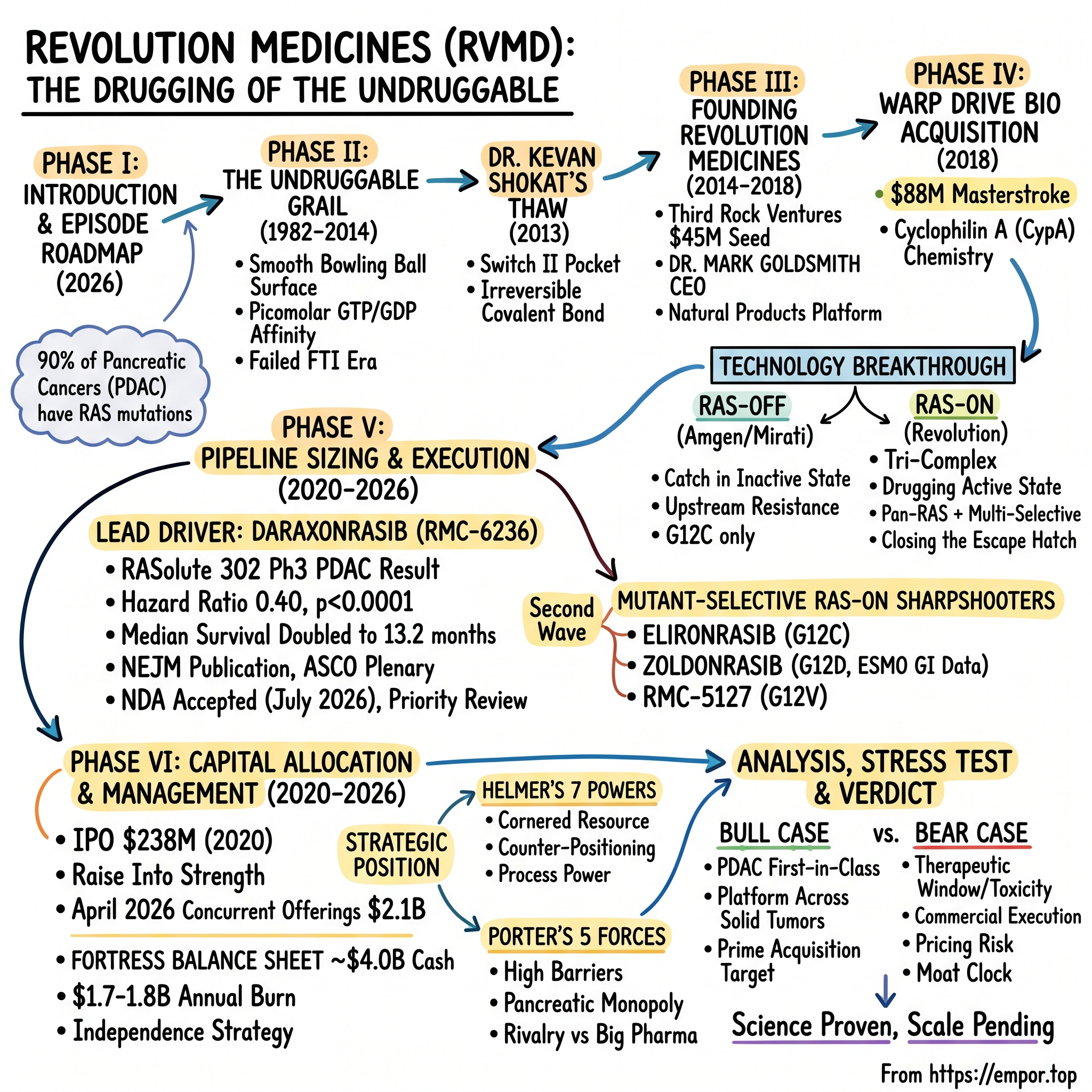
Revolution Medicines: The Drugging of the Undruggable
I. Introduction & Episode Roadmap
On the morning of July 22, 2026, a small oncology company in Redwood City, California published a press release that would have sounded like science fiction to any cancer biologist working thirty years earlier. The U.S. Food and Drug Administration had accepted for review a New Drug Application for daraxonrasib, an oral pill, for the treatment of patients with previously treated metastatic pancreatic cancer.[^17] Pancreatic ductal adenocarcinoma — PDAC — is the disease that has killed roughly nine out of ten people it touches, the cancer that took Steve Jobs and Ruth Bader Ginsburg, the tumor type oncologists quietly describe as a death sentence. And the drug under review attacks it by hitting a target that the pharmaceutical industry spent four decades and untold billions of dollars trying, and failing, to drug: the RAS protein.
For a sense of the scale of the problem, consider the numbers. Mutations in the RAS gene family drive roughly 30% of all human cancers, and RAS is mutated in nearly 90% of pancreatic cancers.1 It is the single most common oncogenic driver in human biology. It was also, for most of the modern era of drug discovery, considered flatly "undruggable" — a word that became so attached to RAS that a 2020 feature in Nature was titled, simply, "Undruggable? Inconceivable."1
This is the story of how Revolution Medicines, Inc. (NASDAQ: RVMD) set out to make the inconceivable routine. The central plot twist is a piece of counter-positioning so clean it belongs in a strategy textbook. When the industry finally cracked RAS in the early 2020s — Amgen's Lumakras (sotorasib) won accelerated FDA approval in May 2021 as the first drug to directly target a KRAS mutation2 — the winning approach worked by catching the protein in its inactive, switched-"OFF" state. Revolution bet the entire company on the opposite idea: a family of molecules that bind RAS while it is switched "ON" and actively signaling, using a bizarre "tri-complex" mechanism that hijacks an abundant human chaperone protein to build a drug-binding pocket that nature never provided.
The thesis worth testing across this piece is whether that scientific bet has translated into a durable business, and whether the numbers now emerging justify a company that the market has, at various points, valued in the tens of billions of dollars — all with zero product revenue. The raw material of the bet was cheap: Third Rock Ventures seeded the company with $45 million in 2014,3 and the platform IP that made everything possible came from a roughly $88 million all-stock acquisition of a struggling biotech called Warp Drive Bio in 2018.5 The output, if the clinical data holds, could be a generational oncology franchise.
It is worth being explicit about what kind of company this is, because it shapes how every number in this story should be read. Revolution Medicines, at the time of writing, sells nothing. It has never recorded a dollar of product revenue. Its income statement is a study in red ink — well over a billion dollars a year of operating expense against zero sales — and yet the market has at times awarded it a valuation in the tens of billions.16 That gap between what the company earns (nothing) and what it is worth (a great deal) is the entire investment proposition: it is a bet, priced in advance, that the science will convert into an approved, launched, defensible franchise. Companies like this do not get valued on earnings multiples; they get valued on the probability-weighted present value of drugs that do not yet exist as products. Understanding that is the difference between reading Revolution as a business and mistaking it for one.
Here is the ground this article will cover: the forty-year biological curse of RAS and why the smartest chemists on earth kept losing to it; the founding of Revolution by Third Rock, Dr. Mark Goldsmith, and the UCSF chemist Dr. Kevan Shokat; the Warp Drive acquisition and the strange elegance of the tri-complex; the RAS-OFF versus RAS-ON battleground against Amgen, Bristol Myers Squibb, Eli Lilly, and Roche; a clear-eyed sizing of the pipeline led by daraxonrasib; the management team and how it has funded a company burning well over a billion dollars a year; a strategic-forces analysis; and a genuine bull-versus-bear stress test that takes the skeptics seriously. Throughout, the posture is neutral. Revolution's own data is striking, but striking data has misled investors in oncology before, and a single-platform, pre-revenue company faces risks that a press release will never volunteer.
Let us begin where every RAS story must — with a virus, a smooth protein, and forty years of failure.
 Subscribe on LinkedIn
II. The Undruggable Grail: Biology & History of RAS (1982–2014)
Picture a molecular light switch. When it is flipped on, the cell receives an instruction: grow, divide, survive. When it is flipped off, the instruction stops. In a healthy cell, RAS is exactly this — a switch that toggles between an active state, bound to a molecule called GTP, and an inactive state, bound to GDP. External growth signals flip it on; the cell's own machinery flips it off a moment later. It is a beautifully controlled pulse.
Now imagine the switch gets jammed in the "on" position. The growth instruction never stops. The cell divides without limit. That, in essence, is what a RAS mutation does, and it is why RAS sits at the root of the deadliest cancers in the human catalogue.
The story starts in the early 1980s, when researchers isolated the human RAS genes — HRAS, KRAS, and NRAS — from a rat sarcoma virus, giving the family its name. It quickly became clear that KRAS mutations in particular were the engine of the most lethal solid tumors: pancreatic cancer, non-small cell lung cancer, and colorectal cancer. If you could switch RAS back off, or block it, you would have a therapy for hundreds of thousands of patients a year. The prize was obvious. The problem was that RAS refused to be drugged.
It helps to sit with why RAS was such a tantalizing target in the first place, because the tantalization is what kept pharmaceutical companies coming back to break their teeth on it for four decades. Most oncogenes are one node in a sprawling, redundant network; block one and the tumor reroutes through another. RAS is different. It is a central relay switch through which an enormous fraction of growth signaling must pass. In a KRAS-mutant pancreatic tumor, RAS is not one of many drivers — it is the driver, the linchpin holding the malignant machine together. Geneticists had known since the 1980s that these tumors were "addicted" to mutant RAS; take it away and the cancer cell, deprived of the signal it has reorganized its entire existence around, often dies. The biology all but promised that a RAS drug would work. Nature had simply built the switch without a keyhole.
Two features made it a nightmare for medicinal chemists. The first was affinity. Most successful cancer drugs are kinase inhibitors that work by squatting in the pocket where a protein normally binds ATP, its chemical fuel. RAS binds its fuel — GTP and GDP — with picomolar affinity, meaning it clings to these molecules roughly a million times more tightly than a typical kinase clings to ATP. Any drug hoping to compete for that pocket would have to out-grip one of the strongest small-molecule bonds in the cell. None could. The second feature was topography. When structural biologists mapped the surface of the RAS protein, they found something disheartening: it was smooth. Chemists described it as a bowling ball — a rounded, featureless surface with no deep hydrophobic crevice for a drug molecule to grab onto.1 A drug needs a pocket. RAS did not appear to have one.
The industry did not go quietly. Through the 1990s, Big Pharma poured enormous resources into farnesyltransferase inhibitors, or FTIs — drugs designed not to block RAS directly but to sabotage a chemical tag (farnesylation) that RAS needs in order to anchor to the cell membrane and do its job. It was an ingenious flanking maneuver, and it collapsed in late-stage trials. Tumor cells simply rerouted, attaching a different lipid tag through a backup process called geranylgeranylation, and RAS carried on signaling. The FTI era ended as one of oncology's most expensive dead ends, and it left a scar: a generation of drug hunters concluded that RAS was, for practical purposes, off-limits.
The thaw came from an academic lab, not a pharmaceutical campus. Around 2013, Dr. Kevan Shokat, a chemist at the University of California, San Francisco, and his collaborators reported something that overturned the dogma. Focusing on a specific mutation, KRAS G12C — in which the twelfth amino acid is swapped to a cysteine, a residue with a uniquely reactive chemical handle — Shokat's team found a hidden, transient pocket beneath a flap of the protein called the switch II region. This "switch II pocket" was not visible in the standard structures; it opened up only fleetingly. But it was real, and a molecule could be designed to slip into it and form a permanent covalent bond to that mutant cysteine.1 The bowling ball, it turned out, had a seam.
There is a lovely irony in how the breakthrough came. For decades chemists had studied static crystal structures of RAS — snapshots of a frozen protein — and seen only the smooth ball. The switch II pocket did not appear in those snapshots because it is not there most of the time; it is a fleeting conformation that flickers open and shut as the protein breathes. It took a different mindset — a chemist's willingness to design a molecule that reacts irreversibly, forming a permanent bond the instant the transient pocket opens, so that the drug essentially waits with its foot in the door — to exploit it. The mutant cysteine at position 12 was the gift that made this possible, because it offered a uniquely reactive chemical handle found only in the cancer, not in healthy tissue. That is why the first drugs were exquisitely selective for G12C and safe: they could only stick where the cysteine was.
The importance of this cannot be overstated: it was the intellectual big bang for the entire modern RAS field. Shokat's discovery proved RAS was druggable, and it launched a race. It gave Amgen and Mirati the blueprint for the first-generation covalent G12C inhibitors. And it seeded the founders of Revolution Medicines with a more ambitious question. Shokat's pocket worked only on the inactive, GDP-bound "off" state, and only on the one-in-eight RAS cancers that happen to carry the G12C cysteine. What about the other seven-eighths — the G12D, G12V, and G12R mutations that lack a convenient reactive handle, that dominate pancreatic and colorectal cancer, and that no covalent hook could grab? What about the active, "on" state where RAS actually does its damage? Answering that would require not a better key, but a different kind of lock — and that pursuit is where our company is born.
III. Founding Revolution Medicines & Third Rock's $45M Bet (2014–2018)
Every great biotech origin story has a venture capitalist willing to fund a thesis that sounds slightly insane, and in this case the firm was Third Rock Ventures, the Boston-based life-sciences shop known for building companies around big scientific ideas rather than incremental ones. In November 2014, Dr. Mark A. Goldsmith — a physician-scientist who had been a partner at Third Rock — took the reins as president and CEO of a new venture.4 In 2015 the company went public with its funding: a $45 million Series A led by Third Rock.3 The name it chose, Revolution Medicines, hinted at the original conceit, which was to "redesign evolution's products" — to take the intricate natural compounds that microbes and plants have spent billions of years evolving and repurpose them as drugs against targets that conventional chemistry could not reach.3
That founding idea is worth pausing on, because it explains the intellectual DNA that would later make the RAS bet possible. Revolution's scientific co-founders were not typical oncologists. Alongside Shokat, they included Dr. Martin Burke, a University of Illinois chemist famous for building a "molecular-making machine" that assembles complex natural products from simple, standardized chemical building blocks, and Dr. Michael Fischbach, a microbiome and natural-products scientist.4 The common thread was a conviction that nature's molecules — bigger, weirder, and more three-dimensional than the flat drugs pharma usually makes — could engage "frontier" targets like protein-protein interactions that had defeated standard approaches. In its earliest days the company's first program was actually in a different disease area entirely, an inborn metabolic disorder, reflecting how broad the platform ambition was.
But strategy is as much about what you say no to as what you chase, and the pivotal insight at Revolution was a commercial one dressed as a scientific one. By around 2016–2017, the G12C breakthrough was maturing into real drugs at Amgen and Mirati, and it was becoming clear that these first-generation inhibitors, for all their historic significance, addressed a narrow slice of the problem. KRAS G12C accounts for a minority of RAS-mutant cancers — well under 15% of the total, heavily concentrated in lung cancer and largely absent from pancreatic cancer.1 A company that owned the best G12C drug would own an important niche. A company that could drug RAS across mutations — G12D, G12V, G12R, and the wild-type protein that tumors amplify — and that could hit the active, signaling "on" state where resistance is born, would own the disease.
Goldsmith himself is worth understanding, because a company's willingness to make a decades-long, all-or-nothing scientific bet usually traces back to the temperament of the person at the top. A physician-scientist by training, with a research background before he crossed into venture capital, Goldsmith belonged to the class of biotech executives who are fluent in the science rather than merely managing it — the kind of CEO who can argue with his own chemists about a binding mechanism. His years inside Third Rock had also given him a builder's patience: Third Rock's model was famously to incubate companies around a single big idea and back them for the long haul rather than flip them. That patience would later manifest in the defining strategic choice of Revolution's existence — the repeated decision not to sell.
This is the moment Revolution stopped being a natural-products platform and started becoming a RAS company. Under Goldsmith, the culture calcified around a few uncompromising principles: rigorous structural biology as the engine of discovery, aggressive protection of intellectual property and trade secrets, and a refusal to license out the crown-jewel programs cheaply. Goldsmith recruited a clinical leader to match — Dr. Steve Kelsey, a veteran oncology drug developer whose career ran through the industry's premier cancer-drug organizations, joined as president of research and development in March 2017.4 Kelsey's mandate was the unglamorous but decisive work of turning elegant chemistry into trials that regulators would accept — dose selection, endpoint design, trial operations — the discipline that separates companies with interesting molecules from companies with approved drugs. The team had the ambition and the chemistry philosophy. What it did not yet have was the specific molecular trick that would let a drug grab the ungrabbable active state of RAS. That missing piece was sitting inside a quietly failing company across the country — and Revolution was about to buy it for a rounding error.
IV. The Warp Drive Bio Acquisition: The $80M Masterstroke (2018)
In the fall of 2018, a biotech called Warp Drive Bio was running out of narrative. Founded in 2012 as an ambitious collaboration between Third Rock Ventures, Greylock Partners, and the French pharmaceutical giant Sanofi, Warp Drive had set out to mine bacterial genomes for novel antibiotics and anticancer compounds using a "genomic search engine" it branded SMART. The science was elegant; the commercial traction was not. But buried inside Warp Drive's portfolio was a chemistry capability that, in the right hands, was worth vastly more than antibiotics: a platform built around small molecules that bind to cyclophilin A.
On October 9, 2018, Revolution Medicines announced it would acquire Warp Drive Bio in an all-stock transaction; the deal closed later that month, with the purchase valued at approximately $88 million.[^5]5[^7] For a company that had raised its Series A at $45 million, this was not a trivial deal — but by the standards of what the underlying technology would enable, it would prove to be one of the most value-accretive acquisitions in modern biotech.
To understand what Revolution actually bought, return to the smooth bowling ball. The central problem with the active, GTP-bound "on" state of RAS is that it, too, lacks a good pocket. You cannot dock a conventional drug on it. So Revolution's chemists, armed with Warp Drive's cyclophilin chemistry, did something counterintuitive: instead of trying to build a drug big enough to grip RAS on its own, they designed a drug that first grabs a completely different, abundant protein already floating inside every cell — cyclophilin A (CypA), a molecular chaperone. The drug binds CypA, and the resulting drug-plus-CypA unit forms a new, composite surface. That two-part surface — the "binary complex" — is then shaped to clamp directly onto the active RAS protein, forming a three-way "tri-complex" of CypA, drug, and RAS.
The analogy that makes this click: imagine you need to grab a wet, perfectly smooth ball, and your hand alone keeps slipping off. So you first pick up a baseball glove — CypA is the glove, always lying around the cell in abundance — and now the glove-plus-hand can cradle the ball. The drug does not create a pocket on RAS; it recruits a partner to build one. And critically, because the tri-complex physically wraps around the active RAS protein and jams it against the very effectors it needs to talk to — RAF, PI3K, and others — it disables RAS while it is switched on and signaling, precisely the state that first-generation OFF drugs cannot touch.
This class of molecule has a name that has become fashionable in drug discovery: a molecular glue. Rather than blocking a protein by plugging its active site, a molecular glue drags two proteins into an artificial embrace they would never form on their own, and it is that induced proximity that does the damage. The concept had earlier, accidental precedents — the immunosuppressant cyclosporine, for instance, works by gluing itself to cyclophilin — but designing molecular glues on purpose, to order, against a chosen target, is one of the hardest crafts in modern chemistry. What Warp Drive brought to Revolution was not just a compound but a system for doing this repeatedly against RAS: a library of cyclophilin-binding scaffolds, the structural methods to visualize the three-way complexes, and the accumulated intuition for how to shape the composite surface so it clamps one RAS mutation and not another, and — crucially — tumor RAS harder than the body's healthy RAS. That last capability, the tuning of the selectivity window, is the single most valuable and most guarded piece of know-how in the company.
Why was this such a coup on the deal terms? Because the market was, at that moment, pricing RAS assets on a completely different basis. First-generation, single-mutation G12C programs were being valued in the billions. Five years later, in October 2023, Bristol Myers Squibb agreed to acquire Mirati Therapeutics — whose lead asset was the G12C drug Krazati (adagrasib) — for an equity value of roughly $4.8 billion, with additional contingent value rights on top.8 Revolution had acquired the foundational chemistry for an entire platform capable of addressing the whole RAS family, in both mutation states, for well under a hundredth of that sum. The lesson embedded here — that a small, capabilities-focused acquisition can dwarf a multibillion-dollar late-stage asset purchase in value creation — is one we will return to in the playbook.
The capital-efficiency contrast is worth dwelling on because it is the heart of the deal's legend. Consider the two ends of the RAS M&A spectrum. At one end, Revolution paid roughly $88 million in stock for a platform that would go on to generate daraxonrasib, elironrasib, zoldonrasib, and a family of follow-ons — an entire multi-asset franchise spanning both RAS states and multiple mutations.5 At the other end, a large pharmaceutical company paid billions for a single, mechanism-limited, mutation-specific asset. The ratio is not two-to-one or ten-to-one; it is closer to fifty-to-one on headline price, and the value gap widens further once you weight for the breadth of what each purchase actually bought. Few acquisitions in the history of the sector have compounded so favorably from so small a base. The uncomfortable truth for acquirers everywhere is that the cheapest moment to buy a capability is exactly when it is least proven and therefore least expensive — and that is precisely the moment institutional buyers are least willing to act.
A neutral observer should add the appropriate caveat: the $88 million looks like genius in 2026 precisely because the clinical data has since cooperated. In 2018 it was a speculative bet on an unproven binding mechanism, paid for in a private company's stock that itself had uncertain value. The acquisition was necessary for what followed, but it was the years of medicinal chemistry and clinical execution afterward that converted a clever mechanism into drugs. For every Warp Drive that becomes a franchise, the industry is littered with cheap platform acquisitions that led nowhere — which is exactly why they are cheap. With the tri-complex platform in hand, the strategic question sharpened into a direct confrontation with the incumbents who had reached the RAS summit first.
V. The RAS-OFF vs. RAS-ON Paradigm Shift: Fighting First-Gen Incumbents
To appreciate Revolution's strategy, you have to understand why the first drugs to conquer RAS started losing to the disease almost as soon as they won approval. This is a story about the difference between a breakthrough and a cure.
The first-generation drugs — Amgen's Lumakras (sotorasib), approved by the FDA in May 2021, and Mirati's Krazati (adagrasib), approved in December 2022 — were built directly on Shokat's discovery.2 They are covalent inhibitors that lock onto the mutant cysteine of KRAS G12C, but only when the protein is sitting in its inactive, GDP-bound "off" state. They wait for RAS to switch off, then bolt it shut so it cannot switch back on. In lung cancer patients whose tumors carry that specific G12C mutation, they worked — producing meaningful, if modest, response rates and giving patients real time. It was a genuine medical milestone.
Then the tumors adapted. Cancer cells, sensing that their RAS engine was being disabled, ramped up signaling from upstream receptors on the cell surface — receptor tyrosine kinases like EGFR and MET. That upstream pressure floods the cell with signals that push RAS back into its active, GTP-bound "on" state faster than the drug can catch it in the "off" state. The RAS-OFF drug, by design, cannot bind the on-state. So RAS escapes, signaling resumes, and the cancer returns. Clinically, this showed up as responses that were real but often short-lived, with progression-free survival in lung cancer typically measured in months rather than years, and it left the first-generation drugs commercially constrained — Lumakras in particular faced a bruising regulatory path, including FDA skepticism about its confirmatory lung-cancer data.
There is a deeper structural point buried in this resistance story, and it is the crux of Revolution's whole thesis. The OFF drugs did not just happen to be beatable; they were beatable because of the very feature that made them safe. By waiting for RAS to switch off and grabbing it only there, they gave the tumor an obvious escape hatch — keep RAS switched on. The mechanism's safety and its fragility were two sides of the same coin. Any drug that closed that escape hatch would, almost by definition, have to engage the active state, and engaging the active state meant confronting the wild-type-toxicity problem the OFF drugs had sidestepped. In other words, the field faced a genuine trade-off: mutation-selective and safe but resistance-prone, or state-active and durable but potentially toxic. Revolution chose the harder half of that trade and staked the company on proving the toxicity could be managed. Everything about the pipeline data is, at bottom, a test of that single wager.
Now the counter-positioning becomes obvious. Revolution's tri-complex drugs, led by daraxonrasib (RMC-6236), do the opposite of the incumbents: they bind the active, GTP-bound "on" state. This is not a minor engineering tweak; it is a categorical difference that neutralizes the exact resistance mechanism that undermines the OFF drugs. When the tumor pushes RAS into the on-state to escape, it is pushing RAS directly into the arms of the RAS-ON inhibitor. And because daraxonrasib is a multi-selective inhibitor — engaging not just G12C but a broad range of RAS mutations and even wild-type RAS — it addresses the roughly seven-eighths of RAS cancers that the G12C-only drugs leave untouched, including the pancreatic tumors where G12C is nearly absent.
Counter-positioning in the Helmer sense means the incumbent cannot easily follow you without damaging its existing business — and that trap is real here. Amgen and Bristol Myers Squibb built their franchises, sales forces, and clinical infrastructures around the OFF mechanism. Pivoting fully to RAS-ON would mean conceding that the platforms they spent billions to acquire and approve are the inferior generation, cannibalizing marketed products and abandoning in-flight trials. That is a hard thing for a large organization to do quickly. Meanwhile, the broader field is scrambling: Eli Lilly has advanced its own G12C candidate (olomorasib), and Roche, Novartis, and Boehringer Ingelheim have RAS programs of varying ambition, including next-generation and G12D-directed efforts. But as of mid-2026, none has matched Revolution's lead in pan-RAS, ON-state clinical development, where Revolution holds a lead measured in years rather than months.
A neutral scorekeeper must flag the other side of counter-positioning, however. Binding active, wild-type RAS is a double-edged sword. Healthy cells depend on normal RAS signaling too, which means a multi-selective RAS-ON drug is, by design, hitting a target the body needs — raising the specter of on-target toxicity that the mutation-selective OFF drugs largely avoided. Revolution's entire clinical proposition rests on the claim that it can inhibit tumor RAS hard enough to work while sparing healthy tissue enough to tolerate. Whether that therapeutic window is wide enough in the real world is the single most important scientific question about the company, and it is where the pipeline data must do the talking.
VI. Pipeline Sizing, Clinical Execution & Materiality
If you strip Revolution Medicines down to its economic core, you find a portfolio heavily concentrated in one asset. By any reasonable valuation, daraxonrasib — the lead, multi-selective RAS-ON inhibitor known in development as RMC-6236 — represents the large majority of the company's worth, with a family of mutant-selective follow-ons and companion compounds accounting for the rest. Concentration like this cuts both ways: it means the clinical narrative is clean and easy to follow, and it means the company's fate rides disproportionately on a single molecule's trials and label.
Daraxonrasib (RMC-6236): the lead value driver
The commercial logic for leading with pancreatic cancer is stark. Metastatic PDAC is a disease of near-total therapeutic failure. Standard-of-care chemotherapy in the second-line setting delivers a median overall survival measured in single-digit months, and there are no approved targeted therapies for the RAS-driven biology that defines the disease. Into that vacuum, daraxonrasib walked with data that stopped oncologists in their tracks.
The early signal came first. In 2024, Phase 1/2 monotherapy data in previously treated RAS-mutant pancreatic cancer showed encouraging response and disease-control rates in a population that rarely responds to anything, and the results were prominent enough to be reported by Reuters in May 2024 and presented in updated form that October.910 The Phase 1/2 experience was ultimately published in the New England Journal of Medicine, a level of validation that matters both scientifically and commercially.11
Then came the pivotal readout that changed the company's trajectory. In 2026, Revolution reported results from RASolute 302, a global, randomized Phase 3 trial of daraxonrasib monotherapy versus chemotherapy in previously treated metastatic PDAC. In the overall study population, median overall survival was 13.2 months for daraxonrasib versus 6.7 months for chemotherapy, a hazard ratio of 0.40 with a p-value below 0.0001 — a 60% reduction in the risk of death, and roughly a doubling of median survival.1214 For context, pushing median survival past a year in metastatic pancreatic cancer is something no Phase 3 trial had previously achieved in any line of therapy.12 The results were delivered in a plenary session — the most prestigious slot at the meeting — at the American Society of Clinical Oncology's annual gathering in Chicago on May 31, 2026, by Dr. Brian Wolpin of Dana-Farber, and published simultaneously.1314 Importantly, the company reported that the survival benefit came with a generally manageable safety profile and a low rate of treatment discontinuation due to side effects — the crucial counter-evidence to the wild-type-toxicity concern.12
Regulators moved quickly. The FDA accepted the daraxonrasib NDA for previously treated metastatic PDAC on July 22, 2026, and the drug was selected for the FDA Commissioner's National Priority Voucher pilot program, a scheme designed to accelerate review of high-priority medicines.[^17] In Europe, the EMA had already agreed weeks earlier, on July 7, 2026, to expedite its assessment under a phased-review process.15 Beyond second-line pancreatic cancer, daraxonrasib is being pushed into first-line PDAC and into non-small cell lung cancer, the two settings that define whether this becomes a large drug or an enormous one. A neutral reader should note that second-line PDAC, however meaningful, is a relatively modest commercial base; the multibillion-dollar thesis depends on the earlier-line and lung-cancer trials reading out as well as the second-line data did, which is not yet proven.
The commercial arithmetic behind that sequencing is worth spelling out, because it explains why management fought so hard for independence rather than partnering. Pancreatic cancer, for all its lethality, is a smaller market than lung cancer simply because far fewer people are diagnosed with it and they live for less time. Winning first in second-line PDAC is therefore best understood as a proof-of-mechanism beachhead: a setting with no competition, a fast regulatory path, and a survival signal so large it is almost impossible to argue with. It establishes the drug, the mechanism, and the commercial organization. The real economic weight sits in the moves that follow — pushing into the first-line pancreatic setting, where patients start therapy earlier and stay on it longer, and into non-small cell lung cancer, a market measured in the many billions where daraxonrasib would compete not against dismal chemotherapy but against entrenched targeted and immunotherapy options. Each expansion multiplies the addressable population; each also raises the competitive bar. A pristine second-line result is the ticket to the game, not the game itself.
Mutant-selective RAS-ON inhibitors: the second wave
Behind the lead sit the sharpshooters — mutant-selective RAS-ON inhibitors designed to hit one specific mutation with maximum depth and, potentially, a cleaner safety profile than the multi-selective daraxonrasib because they largely spare wild-type RAS. A note on nomenclature, since it is easy to garble: elironrasib (RMC-6291) is the KRAS G12C-selective RAS-ON inhibitor, positioned as a superior successor to the first-generation OFF drugs in that mutation;20 zoldonrasib (RMC-9805) is the KRAS G12D-selective inhibitor, aimed at the single most prevalent KRAS mutation, which dominates pancreatic and colorectal cancer;1821 and RMC-5127 extends the approach to KRAS G12V.
The G12D program is strategically the most important of these, because G12D is to pancreatic and colorectal cancer what G12C was to lung cancer — the mutation that unlocks the biggest patient populations. Zoldonrasib's discovery was notable enough to be published in Science,21 and by 2025–2026 the company was generating clinical data in G12D lung cancer and, in combination with daraxonrasib, in G12D pancreatic cancer.1819 In the combination study presented at ESMO's gastrointestinal cancers congress in mid-2026, zoldonrasib plus daraxonrasib in previously treated G12D metastatic PDAC showed a manageable safety profile, with grade 3-or-higher treatment-related adverse events in about 35% of patients and the most common serious events being rash, anemia, and stomatitis.19 These are the toxicities to watch: they are consistent with hitting RAS-pathway biology, and the question for every one of these assets is whether efficacy scales faster than these cumulative skin, blood, and mucosal effects.
Companion and early pipeline
Rounding out the portfolio are compounds designed to attack the pathways tumors use to escape RAS blockade and to serve as combination partners: RMC-5552, an mTORC1-selective inhibitor aimed at a parallel resistance pathway, and RMC-4630, a SHP2 inhibitor that Revolution had originally co-developed with Sanofi before restructuring the arrangement to take full internal control of its RAS combination strategy. These are optionality rather than core value today, but in a disease as adaptable as RAS-driven cancer, the combination toolkit may ultimately determine how durable the responses become.
The strategic logic of owning both a multi-selective backbone (daraxonrasib) and a stable of mutation-selective sharpshooters is more subtle than a simple "more shots on goal." It gives Revolution the freedom to build combination regimens entirely from its own molecules — pairing the broad backbone with a mutation-specific inhibitor to hit RAS harder and deeper without splitting economics with a partner, exactly the kind of all-in-house regimen the zoldonrasib-plus-daraxonrasib pancreatic study was designed to test.19 If RAS turns out to require combination therapy to produce durable responses — which the resistance biology strongly suggests it will — then owning the whole toolkit is the difference between capturing the full value of a regimen and renting out pieces of it. The flip side is that stacking two RAS-pathway drugs also stacks their toxicities, which is why the tolerability readouts on these combinations deserve at least as much attention as the response rates. The pipeline, in short, is deep enough to be a platform and concentrated enough to be a bet — and a platform that burns this much cash needs a balance sheet to match.
VII. Management, Capital Allocation & Building the $2B War Chest
There is a recurring temptation in biotech to sell early. A promising platform attracts suitors, a founder-CEO gets an offer that would make everyone rich, and the company disappears into a larger organization before it ever launches a product. Revolution's defining management decision has been the refusal to take that exit — to build a fully independent, commercial-stage oncology company rather than flip the pipeline to Big Pharma. Whether that is disciplined conviction or an expensive gamble with shareholders' money is a fair question, and the answer depends on execution the company has not yet had to prove in the marketplace.
At the center sits Dr. Mark Goldsmith, president and CEO since the company's earliest days in late 2014.4 Goldsmith's background as a physician-scientist and former venture investor shows up in the company's posture: strategically patient, scientifically rigorous, and unusually willing to hold onto global rights to its core assets rather than partner them away for near-term cash. His clinical counterpart, Dr. Steve Kelsey, president of R&D since 2017, brought the drug-development experience — a career in oncology that predates Revolution — that turned a chemistry platform into a machine capable of running multiple global Phase 3 trials at once.4 The narrative consistency across years of filings and presentations is itself a data point: management said early that it would build a broad RAS-ON franchise and retain control of it, and it has largely done what it said.
The financial engineering behind that independence deserves scrutiny, because it is the only thing standing between the company and dilution or distress. The pattern was set at the very beginning of Revolution's public life. The company went public on February 12, 2020, pricing its IPO at $17 a share — the high end of an upwardly revised range — and raising roughly $238 million as investors scrambled for the offering, giving it a market capitalization north of a billion dollars before it had a single drug in late-stage trials.67 That debut established the template the company has run ever since: sell equity when the story is hot and demand is oversubscribed, bank the cash, and use it to stay independent.
Revolution has repeated that move at each subsequent inflection, raising equity into strength — issuing stock in the wake of major clinical catalysts, when its share price and investor enthusiasm were near peaks, rather than when it was desperate. The clearest example came in April 2026, on the heels of the transformative RASolute 302 readout: the company executed concurrent upsized offerings of common stock and convertible debt that brought in roughly $2.1 billion in net proceeds.16 That raise vaulted the balance sheet from the "$2B war chest" range that had characterized the company's earlier stance to about $4.0 billion in cash and investments at the end of the first quarter of 2026.16 The addition of convertible debt to the mix was itself a subtle piece of optimization — cheaper than pure equity when the stock is elevated, and less immediately dilutive — signaling a treasury function that had grown more sophisticated as the stakes rose.
That cash is being spent at a formidable clip, which is the other half of the story. In the first quarter of 2026 alone, Revolution reported a net loss of about $454 million, with research and development expense of roughly $344 million (up more than 65% year over year) as global Phase 3 trials peaked, and general-and-administrative expense of about $101 million as the company began building the commercial and medical infrastructure a launch requires.16 Management guided full-year 2026 GAAP operating expenses to roughly $1.7–1.8 billion.16 On the first-quarter call, the leadership framed the enlarged cash position explicitly as the fuel to carry the company through NDA approval and commercial launch without having to raise from a position of weakness.17
An activist or short-seller would push on a few things here, and it is worth airing them rather than waving them away. The first is stock-based compensation, which the company itself cited as a driver of rising expenses;16 in cash-burning biotechs, generous equity grants are the norm, but they are a real transfer of value from outside shareholders to insiders and they inflate the effective cost of the talent that the independence strategy requires. The second is dilution: funding a solo commercial build entirely through equity and convertibles means today's shareholders own progressively less of the eventual franchise, and the "raise into strength" discipline mitigates that arithmetic without repealing it. The third is governance concentration — a founder-CEO of more than a decade's tenure who has repeatedly declined to sell is, depending on your vantage point, either the visionary steward of a generational asset or a manager whose personal conviction is being financed with other people's capital. None of these is a red flag on its own; together they are the standard tensions of a pre-revenue company that has chosen the harder, more valuable, and riskier path of going it alone.
Read analytically, the capital-allocation record supports a specific conclusion: management has been genuinely disciplined about timing — selling equity when the story is hot is exactly what a well-run pre-revenue biotech should do — while making an aggressive strategic bet by choosing to fund a solo commercial build rather than de-risk through a partnership. The $4 billion war chest is large enough to fund the plan, but a first-time commercial organization launching a complex oncology drug against entrenched competitors is precisely where independent biotechs have historically stumbled. The balance sheet buys time and optionality; it does not buy commercial execution. That distinction sets up the strategic-forces analysis.
VIII. Strategic Position: Porter's 5 Forces & Hamilton Helmer's 7 Powers
Strip away the biology and Revolution Medicines is a question about durability: if the drugs work, can the company keep the profits, or will competitors and buyers compete them away? Two frameworks help war-game the answer.
Hamilton Helmer's 7 Powers
Cornered Resource. The strongest claim to durable advantage is Revolution's proprietary command of tri-complex chemistry — the CypA-based molecular-glue platform, the accumulated crystal structures of drug-CypA-RAS complexes, and the medicinal-chemistry know-how to tune selectivity across RAS mutations and between mutant and wild-type protein. This is partly patent-protected and partly trade secret, and it originated in the Warp Drive assets that few others possessed. A fast-follower cannot simply read a paper and replicate a decade of iterative structure-based design. This is the most defensible of Revolution's powers, though patents expire and trade secrets leak, so the moat is deep rather than permanent.
Counter-Positioning. As discussed, the incumbents' commitment to the RAS-OFF mechanism creates a genuine follow-the-leader trap: adopting RAS-ON means conceding their marketed franchises are the weaker generation. This power is real but time-limited — it holds only until competitors' own RAS-ON programs mature, which they are actively working to do.
Process Power. Revolution has built deep institutional muscle in the specific disciplines that make RAS-ON work: multi-RAS screening, structural docking, and predicting the elusive selectivity window between mutant and wild-type RAS. This is hard to hire for and hard to buy, but it is the kind of advantage that erodes as knowledge diffuses through the field.
Scale Economies (emerging). As the company runs multiple global Phase 3 programs across pancreatic, lung, and colorectal cancer off a shared clinical, regulatory, and (eventually) commercial infrastructure, there is a nascent scale advantage — one molecule platform amortized across many indications. This power is only beginning to form and is entirely contingent on the drugs reaching market.
Notably absent from this list are the powers that create the most durable consumer franchises — network effects, switching costs, and brand. Pharmaceutical economics do not really run on those; they run on patents, data exclusivity, and the sheer difficulty of the science. That is why the honest read is that Revolution's moat is a science-and-IP moat with a defined clock, not a self-reinforcing flywheel.
Porter's 5 Forces
Threat of new entrants: low. The capital, regulatory, and scientific barriers to reaching RAS-ON drugs are extraordinarily high, and the specialized chemistry is not widely held. The entrants that matter are not startups but well-funded incumbents.
Bargaining power of buyers: low to moderate. In a lethal cancer with no targeted alternatives, payers and providers have limited leverage against a drug that roughly doubles survival; the value proposition is close to unassailable in second-line PDAC. That leverage rises in more crowded settings like lung cancer, and drug-pricing politics in the U.S. and Europe remain a structural overhang.
Threat of substitutes: low. The relevant substitute in pancreatic cancer is chemotherapy, whose outcomes are dismal, and emerging modalities like antibody-drug conjugates and bispecifics face real hurdles in the heterogeneous, RAS-driven solid-tumor setting. In lung cancer the substitute landscape is richer, including the incumbent G12C drugs and immunotherapy.
Bargaining power of suppliers: low. Small-molecule manufacturing is a competitive, commoditized market of contract manufacturers; Revolution is not hostage to any single supplier.
Rivalry among competitors: moderate to high. Big Pharma — Eli Lilly, Roche, AstraZeneca, Bristol Myers Squibb, and others — is spending heavily on internal RAS programs, and the eventual battleground, especially in lung cancer, will be intensely contested. Revolution's edge is a lead of a few years in the ON-state, pan-RAS race, which is valuable but is a lead in time, not a permanent structural barrier.
Playing the rivalry forward is instructive. The first-generation G12C incumbents, Amgen and Bristol Myers Squibb, are the least likely to out-innovate Revolution on the ON-state, precisely because of the counter-positioning trap — their commercial and clinical machinery is built around the mechanism Revolution is displacing, and pivoting means admitting their own franchises are the weaker generation. The more dangerous rivals are the players without a legacy OFF franchise to defend, who can pursue ON-state or G12D biology with a clean slate — the Eli Lillys and Roches of the world, and well-capitalized newcomers. Their catch-up is gated by the same thing that protected Revolution: the sheer difficulty of the molecular-glue chemistry and the years of structure-based iteration it takes to master the selectivity window. So the war-game verdict is that Revolution's lead is real and defended by hard science, but it is a lead measured in development years, and the correct question is not whether competitors arrive — they will — but whether Revolution can convert its head start into entrenched clinical use, breadth across indications, and combination regimens before they do. Time-based leads in pharma are won or lost on execution speed, which is exactly why management's obsession with retaining control and moving without partners is strategically coherent even as it concentrates risk.
The synthesis a neutral investor should draw: Revolution's competitive position is strong today and rooted in genuinely hard science, but nearly every one of its powers carries an expiration date tied to how fast rivals catch up. The company's job is to convert its head start into scale, breadth, and installed clinical use before the moat's clock runs out. That framing leads directly to the bull-bear debate.
IX. Analysis, Stress Test & Bear vs. Bull Case
The most useful way to hold a pre-revenue biotech in your head is as a probability-weighted set of futures. Here is the case for each side, taken seriously.
The skeptical investor stress test
The therapeutic window. The deepest bear argument is mechanistic. Daraxonrasib inhibits active wild-type RAS alongside the mutant form, and healthy tissue relies on wild-type RAS. The bear asks: over months and years of daily dosing in real-world patients — older, sicker, and more varied than a trial population — will cumulative toxicities (rash, stomatitis, diarrhea, and potential liver effects) drive dose reductions and discontinuations that erode the survival benefit seen in controlled trials? The RASolute 302 report of a generally manageable profile and low discontinuation is the strongest rebuttal,12 but real-world tolerability often looks worse than pivotal-trial tolerability, and this is the risk that could quietly hollow out the commercial story.
Commercial execution without Big Pharma. Revolution has never sold a drug. The bear questions whether a company that has been, until now, a clinical-stage research organization can stand up a global commercial machine and launch into lung and pancreatic cancer against Merck, Roche, AstraZeneca, and Bristol Myers Squibb — organizations with thousands of oncology sales representatives and decades of payer relationships. A brilliant molecule launched poorly still disappoints. This is an execution risk the balance sheet funds but does not solve.
Regulatory and endpoint risk. The company has cleared the highest bar here — the RASolute 302 trial delivered a hard overall-survival benefit, not merely a surrogate endpoint,12 and the FDA has both accepted the filing and granted priority-review treatment.[^17] That substantially defuses the classic bear worry that regulators would demand more before approval in second-line PDAC. The residual regulatory risk shifts to the earlier-line and lung-cancer programs, where the competitive and evidentiary bars are higher.
The current risk radar. Beyond the company-specific worries, a handful of external forces bear on the thesis in ways that are genuinely material rather than boilerplate. Drug-pricing policy is the largest: in the United States, the mechanisms that allow the government to negotiate prices on high-spend medicines, and the general political pressure on oncology pricing on both sides of the Atlantic, could compress the economics of even a highly effective drug over time — a risk that grows precisely as daraxonrasib succeeds and its spend becomes visible. Biotech capital-market conditions are the second: a company that funds itself by selling equity into enthusiasm is, by construction, exposed to a market that can turn cold, and while the April 2026 raise bought years of runway, a solo commercial build is a multi-year commitment to spending. Competitive encroachment is the third and the one most within rivals' control — every quarter that Big Pharma's own RAS-ON and G12D programs advance narrows Revolution's lead-time moat. These are not reasons to dismiss the company; they are the weather system it must sail through, and a neutral investor prices them rather than ignoring them.
The bull case
A pancreatic cancer near-monopoly. If approved, daraxonrasib would be the first targeted therapy to meaningfully move survival in metastatic PDAC — a disease with essentially no competition and enormous unmet need — with a credible path from second-line into the far larger first-line setting.
Platform monopolization across solid tumors. The bull sees daraxonrasib as the beachhead and the mutant-selective and combination programs as the expansion, extending Revolution's reach across the full landscape of RAS-driven pancreatic, lung, and colorectal cancers — a total addressable opportunity spanning tens of billions of dollars, addressed by a platform competitors are years behind on.
A prime acquisition target. With clean Phase 3 survival data in hand, Revolution becomes exactly the kind of asset that patent-cliff-facing Big Pharma covets. Several large oncology franchises face major loss-of-exclusivity events later this decade — the looming expiration of blockbuster immunotherapy patents chief among them — and a de-risked, ON-state RAS platform addressing the most common oncogene in cancer is a rare thing to buy. The independence management has fought to preserve also makes the company a cleaner acquisition should the board ever choose that path: there are no partners to buy out, no split economics, and global rights sit in one place. The very refusal to sell cheaply in the early years is what could make the eventual price, if it ever comes, so high. It is worth noting the tension this creates with the independence narrative — a management team that insists it is building a standalone commercial company is also, by keeping the asset whole and unpartnered, building the most acquirable version of that company. Both can be true at once, and the board's ultimate choice between them is itself a source of optionality for shareholders.
Myth versus reality
Two consensus narratives deserve a fact-check. The first myth is that Revolution "solved" RAS. Reality: it has demonstrated a genuinely unprecedented survival benefit in one setting of one cancer and filed for approval there;12[^17] the broader promise across first-line disease, lung cancer, and durable resistance-free responses remains a set of ongoing trials, not settled facts. The second myth is that the $88 million Warp Drive deal was obviously brilliant at the time. Reality: it looks brilliant now because the science worked; in 2018 it was a speculative bet whose payoff depended on years of chemistry and clinical execution that could easily have failed. Good outcomes make past decisions look inevitable. They rarely were.
The balanced verdict is that Revolution has done the hard, falsifiable thing — generated a large, statistically robust survival signal in a brutal cancer — while leaving the two biggest value questions (real-world durability and solo commercial execution) still open. That is a genuinely strong position, and a genuinely unfinished one.
X. Playbook: Business & Investing Lessons
Step back from the biology and Revolution Medicines offers a set of transferable lessons for how value gets created in science-driven businesses.
M&A as a capabilities multiplier, not an asset grab. The Warp Drive acquisition is the case study. Revolution did not buy a product or a pipeline; it bought a capability — the tri-complex chemistry — for roughly $88 million, and that capability seeded an entire franchise.5 The industry norm of paying billions for a single de-risked late-stage asset (BMS's $4.8 billion for Mirati being the archetype)8 often generates far less value per dollar than a cheap, early acquisition of foundational platform IP. The catch, which the neutral investor must hold onto, is that capability acquisitions are only cheap because they are risky; most such bets do not pay off, and survivorship bias makes the winners look like obvious genius in hindsight.
Counter-position against incomplete solutions. When incumbents celebrate a partial breakthrough — as the industry did with first-generation G12C RAS-OFF drugs — the disciplined move is to interrogate the underlying biology for the flaw the celebration is papering over. Revolution recognized that adaptive resistance via the active RAS state was not a bug to be patched but a fundamental limitation of the OFF mechanism, and it built its whole strategy on solving the root cause. Attacking the mechanism your competitor cannot abandon without cannibalizing itself is the essence of durable counter-positioning.
Capital-allocation timing is a skill in itself. Raising equity when clinical data is at peak euphoria — as Revolution did after its pivotal readout, pulling in roughly $2.1 billion in net proceeds16 — builds a fortress balance sheet precisely when it is cheapest to build, and it prevents the fire-sale dilution that destroys shareholders when biotech credit markets tighten. The discipline is not in raising money; it is in raising it from strength rather than desperation.
Focus can be worth more than partnership dollars. Revolution's decision to unwind its Sanofi SHP2 co-development arrangement and take full internal control of its RAS combination strategy cost it a partner's cash but bought it speed and strategic coherence. In a fast-moving field, the ability to move without a committee, and to keep the economics of your best combinations, can outweigh the near-term capital a partnership provides — provided you have the balance sheet to go it alone.
Concentration is a strategy, not an accident. The final lesson is the one investors are most tempted to gloss over in the glow of the survival data. Revolution deliberately built a company whose fate rides on a single platform and, within it, disproportionately on a single molecule. That concentration is the source of its edge — the focus that let a small team out-execute diversified giants — and simultaneously its greatest vulnerability, because a platform-level setback (an unexpected long-term toxicity signal, a mechanism-wide resistance pattern) would not be diversified away by a broad pipeline. Focused biotechs win bigger and lose harder than diversified ones. Recognizing that a company's greatest strength and its greatest risk can be the same design choice — and refusing to celebrate one while ignoring the other — is the discipline that separates analysis from cheerleading.
The meta-lesson threading through all five is that Revolution's value came from conviction applied at the level of mechanism — insisting on solving RAS properly rather than incrementally — funded by disciplined financial timing. That combination is rare, and it is also not yet fully validated by a commercial result. Which brings us to what actually matters from here.
XI. Epilogue & Key KPIs to Watch
As of July 2026, Revolution Medicines stands at the exact inflection point that defines a biotech's identity: the transition from a clinical-stage research company to a commercial-stage oncology enterprise, with its lead drug's fate now in the FDA's hands.[^17] Everything the company built over more than a decade — the Third Rock seed, the Warp Drive chemistry, the RAS-ON bet, the fortress balance sheet — now converges on a small number of measurable outcomes. Rather than track the noise, a long-term investor should watch three things.
1. Survival and durability in the Phase 3 programs, especially beyond second-line PDAC. The second-line pancreatic data was extraordinary — a hazard ratio of 0.40 and median overall survival past a year.12 The open question is whether that magnitude of benefit repeats in first-line pancreatic cancer and in non-small cell lung cancer, the settings that separate a good drug from a franchise. Watch the overall-survival hazard ratios in each successive readout; a benefit that holds as the drug moves earlier and into new tumors is the whole thesis, and any meaningful attenuation is the first thing that would break it.
2. Dose intensity and treatment-discontinuation rates. Because the multi-selective mechanism inhibits wild-type RAS, real-world tolerability is the fault line between the trial result and the commercial result. Track the percentage of patients requiring dose reductions or permanent discontinuation due to treatment-related adverse events across the trials and, eventually, in commercial use. A drug that patients cannot stay on does not deliver the survival its trials promised, regardless of how clean the hazard ratio looked.
3. Cash runway against the burn as launch approaches. With roughly $4.0 billion in cash and investments and full-year operating expenses guided to $1.7–1.8 billion, the company has funded itself through approval and launch — but that math only holds if the burn stays disciplined and the launch converts into revenue on schedule.16 Watch the quarterly R&D-and-commercial burn against the reserve, and watch whether the eventual product ramp begins to offset it. The moment of maximum financial vulnerability for any solo biotech is the gap between peak pre-launch spending and first meaningful sales.
The larger reflection is this. Revolution Medicines set out to do something the pharmaceutical industry had declared impossible for forty years, and by mid-2026 it had produced the hardest possible evidence — a doubling of survival in one of humanity's most lethal cancers — that the impossible was merely difficult.1214 That is a genuine triumph of structural biology over dogma. But a triumph in the clinic is not yet a triumph in the market, and the distance between the two is where fortunes in biotech are made and lost. The company has proven its science. It has not yet proven it can sell, scale, and defend what its science created. For the long-term investor, that unproven second act — not the celebrated first one — is the story still being written.
References
-
FDA Approves LUMAKRAS (Sotorasib), The First And Only Targeted Treatment For Patients With KRAS G12C-Mutated Locally Advanced Or Metastatic Non-Small Cell Lung Cancer — Amgen, 2021-05-28 ↩↩
-
Third Rock Ventures Launches REVOLUTION Medicines with $45 Million Series A — Revolution Medicines ↩↩↩
-
Form S-1/A Registration Statement — Revolution Medicines / SEC EDGAR, 2020 ↩↩↩↩↩
-
Revolution Medicines Buys Warp Drive Bio to Build Out Oncology Pipeline — FierceBiotech, 2018-10-09 ↩↩↩↩
-
Revolution Medicines Announces Pricing of Initial Public Offering — Revolution Medicines, 2020-02-12 ↩
-
Oncology biotech Revolution Medicines prices IPO at $17, the high end of the revised range — Nasdaq/Renaissance Capital, 2020-02-12 ↩
-
Bristol Myers Squibb Strengthens and Diversifies Oncology Portfolio With Acquisition of Mirati Therapeutics — Bristol Myers Squibb, 2023-10-08 ↩↩
-
Revolution Medicines' RAS Inhibitor Shows Promise in Pancreatic Cancer — Reuters, 2024-05-31 ↩
-
Revolution Medicines Presents Updated Clinical Data for Daraxonrasib (RMC-6236) in RAS-Mutant Pancreatic Cancer — Business Wire, 2024-10-25 ↩
-
Revolution Medicines Announces Publication in New England Journal of Medicine of Phase 1/2 Clinical Data on Daraxonrasib in Pancreatic Cancer — Revolution Medicines ↩
-
Daraxonrasib Demonstrates Unprecedented Overall Survival Benefit in Pivotal Phase 3 RASolute 302 Clinical Trial in Patients with Metastatic Pancreatic Cancer — Revolution Medicines, 2026 ↩↩↩↩↩↩↩↩
-
Revolution Medicines Announces ASCO Plenary Presentation Highlighting Unprecedented Results from Pivotal Phase 3 RASolute 302 Clinical Trial of Daraxonrasib — Revolution Medicines, 2026-05-31 ↩
-
RAS(ON) Inhibitor Doubles Median Overall Survival in Results of Phase 3 Trial for Patients with Metastatic Pancreatic Cancer — Dana-Farber Cancer Institute, 2026 ↩↩↩
-
European Medicines Agency Expedites Assessment of Revolution Medicines' Daraxonrasib Under Phased Review Process — Revolution Medicines, 2026-07-07 ↩
-
Revolution Medicines Reports First Quarter 2026 Financial Results and Corporate Highlights — Revolution Medicines, 2026 ↩↩↩↩↩↩↩↩
-
Earnings Call Transcript: Revolution Medicines Q1 2026 — Investing.com, 2026 ↩
-
Revolution Medicines Presents Initial Data from Zoldonrasib (RMC-9805) Study in Patients with KRAS G12D Mutant NSCLC at the 2025 AACR Annual Meeting — Revolution Medicines, 2025 ↩↩
-
Revolution Medicines Presents Phase 1/2 Clinical Data for Zoldonrasib Combination Regimens in RAS G12D Metastatic Pancreatic Cancer at ESMO GI 2026 — Revolution Medicines / GlobeNewswire, 2026-07-02 ↩↩↩
-
Revolution Medicines to Present Updated Elironrasib Safety and Efficacy Data in Patients with KRAS G12C NSCLC — Revolution Medicines ↩
-
Revolution Medicines Announces Publication of a Peer-Reviewed Research Paper in Science on the Discovery and Development of Zoldonrasib, a RAS(ON) G12D-Selective Inhibitor — Revolution Medicines ↩↩
 LinkedIn
 WhatsApp
 Reddit
 Hacker News
 Email
Email Kindle
 RSS Feed
 Spotify
 Apple Podcasts
 Amazon Music
 Audible
 YouTube